Thursday, April 30, 2020
IN NEW JERSEY PRISONS, 29 CORONAVIRUS DEATHS AND ONLY 184 TESTS
Alice Speri
https://theintercept.com/2020/04/28/coronavirus-new-jersey-prisons/
WHEN BORIS FRANKLIN started seeing social media posts by people with loved ones incarcerated in New Jersey prisons, he knew the state had a problem it would soon be unable to ignore.
One woman, whose brother is incarcerated at Northern State Prison, in Newark, said that he had been experiencing Covid-19 symptoms — as had nearly everyone else in his housing wing. But prison officials were denying requests for tests to all but those ill enough to be hospitalized. “There was no way to get off the wing or see a nurse unless you could not breathe,” said Franklin, an organizer with the faith-based New Jersey Together coalition, who himself was incarcerated for 11 years.
At Mid-State Correctional Facility, in early April, 36-year-old Ricky James called his mother to tell her that he was sick but could not get a test. “They don’t care if we die,” she said he told her. Two days later, James was dead, and the wing where he had been living was put on lockdown. “Around lunchtime and dinnertime, they would bring Styrofoam trays. They would roll them in there, and they would just shut the door and the guys were basically left on their own,” said Franklin, who spoke with a man incarcerated at the facility. “They wouldn’t test anyone.”
Like New York, New Jersey has been at the epicenter of the coronavirus crisis in the United States — with more than 6,000 deaths so far. But as the state’s curve begins to flatten and new reported cases gradually drop, an opposite trend is emerging in New Jersey prisons, where deaths are quickly multiplying. As of Monday, according to official figures, 29 people had died in New Jersey’s corrections facilities, up from 19 just three days earlier.
And yet only 184 inmates have been tested for Covid-19 across New Jersey — less than 1 percent of the state’s incarcerated population. About 79 percent of those tested have tested positive, and 20 percent of inmates with positive tests have died. Because of the lack of testing, the official number of confirmed cases — 145 — is inevitably an enormous undercount.
“When the Covid-19 crisis hit, New Jersey — like much of the nation and the world — faced an unprecedented situation: the lack of access to testing,” a spokesperson for the New Jersey Department of Corrections wrote in a statement to The Intercept. “Despite this challenge, the NJDOC immediately took action to mitigate the spread of the virus and share with staff information about available testing. As the capacity to expand testing has begun to open up, NJDOC has been working diligently on a plan to expand testing for inmates and staff.” New Jersey Gov. Phil Murphy did not immediately respond to a request for comment.
“The rest of the state is slowing down and we’re doubling,” William Sullivan, the president of the local corrections officers’ union, told The Intercept. “They kind of forgot about us. We have an older population with the inmates, everybody’s confined, there’s no social distancing, the tiers are low, the bars in some units are open, so there’s no solid doors to block anything.”
“It’s just complete neglect for individuals who are incarcerated,” said Franklin, echoing Sullivan’s point about the close quarters of prison housing units. “What I’m hearing directly from guys on the tiers is, almost everyone on their tier has experienced some of the symptoms, the body aches, the headaches. But anything in the absence of short breath, they are not dealing with. If you’re not on your way to immediate death, then they’re not dealing with it.”
“If You Don’t Test, You Don’t Report”
Testing limitations have crippled the U.S. response to the pandemic from the very beginning. But as jails and prisons have become Covid-19 hotbeds and vectors of the virus into the surrounding communities, the failure to test incarcerated people reveals more than just a problem of access. “They don’t want to do the testing because if you do the testing you are going to find that a great portion of the prison population has come in contact with Covid-19,” Franklin said. “If you don’t test, you don’t report, and then you don’t have to act.”
“My theory is that they don’t want the prison numbers to actually come out because it would look really bad, like the nursing homes,” echoed Sullivan. “If you test everybody, those numbers are going to skyrocket and that’s not going to look too good. I think they just wanted to try to mitigate and keep things in-house.”
At a briefing on Monday, Murphy said he “believed” the state was testing in prisons — before another official clarified that the state was “working on a broader plan for the prison population.” New Jersey’s health commissioner, Judith Persichilli, added that officials were working with a testing strategy task force, and that while the parameters for what counted as “vulnerable populations” were being refined, “corrections” was included.
That’s hardly enough for advocates, who started raising alarm about the state’s prisons long before the deaths skyrocketed — and who now worry it may be too late. Frank McMillan, a lead organizer at New Jersey Together, told The Intercept that for weeks the group has been pushing local officials to address the approaching disaster in the state’s prisons, first reaching out in March and constantly pressing them to increase testing. When officials announced on March 23 that they would release 1,000 incarcerated people — one of the country’s first efforts to address the crisis by reducing the incarcerated population — the group asked whether there were any plans to test those people before they returned home, mostly to poor communities of color that were already bearing the brunt of the crisis.
“In various ways they said, ‘We’re having trouble doing that for the general population. We can’t prioritize these people,’” said McMillan.
“Even the words that they’re using in private conversation indicate a lack of value that they put on the human lives of people in prison and the communities that they’re returning home to,” he added. “These are the general population, they’re returning to the general population, they’re returning to the places with the highest death rates in the general population. If you are serious about keeping the pandemic under control for the general population, then this is imperative.”
Sullivan said that the corrections officers’ union has also been asking the governor’s office to test all corrections staff since March but has never heard back. The corrections department says that 495 “employees” have tested positive for the virus, but Sullivan said that figure, too, is an undercount. “I know there are more positive than what’s on the website because the officers sent me their test results,” he said. Sullivan noted that at least 465 members of his union have tested positive, and that two have died. The union has been setting up sites to test its own members — for free if they are symptomatic, and for a fee if they are not. “But it should really be coming from the governor’s office, not from the union,” he added.
Things are more complicated for inmates, Sullivan conceded. “You can’t do a test at the jail, you actually have to take an inmate with two officers and shackle him and bring him to a hospital for a test. If you had to test 19,000 inmates, that’d be a lot of trips to the hospital. They really need to streamline testing the inmates.”
“We sent our request on March 25. We were trying to get ahead of the curve,” Sullivan added. “It would have been nice if they had considered our requests earlier on. They might have saved a lot of heartache.”
New Jersey is hardly alone in its failure to test incarcerated people. In New York state, where nine prison inmates have died of the virus so far, 310 have tested positive. But the number of corrections staff who tested positive is more than 1,000 — a disparity that critics warn is indicative of different access to testing.
That disparity is even starker in some jails, where the risk of exposure is higher — people move in and out more regularly, share tighter quarters, and generally have poorer access to health care. At Rikers Island, for instance, where the estimated rate of infection is a staggering 9.9 percent, 381 incarcerated people have tested positive, compared to at least 966 corrections staff.
At least 171 incarcerated people have died of Covid-19 in jails and prisons nationwide, according to a tally kept by the University of California, Los Angeles School of Law. The rapidly climbing death toll is becoming the only way to glimpse the full picture of a crisis that testing is failing to capture.
There are some exceptions: At the Marion Correctional Institution, a prison in Ohio that has emerged as one of the largest coronavirus hot spots in the country, almost all the 2,500 men incarcerated there have received tests. More than 80 percent tested positive.

TOXIC PFAS FALLOUT FOUND NEAR INCINERATOR IN UPSTATE NEW YORK
Sharon Lerner
https://theintercept.com/2020/04/28/toxic-pfas-afff-upstate-new-york/
INDUSTRIAL CHEMICALS known as PFAS have contaminated soil and water near an incinerator in upstate New York that has been burning firefighting foam. The facility is run by Norlite, whose parent company Tradebe contracted with the Department of Defense to burn the foam known as AFFF, as The Intercept reported in January 2019.
The analysis of three soil and four water samples collected near the Norlite incinerator in Cohoes, New York, which appears to be the first environmental testing done near an AFFF incineration site, revealed the presence of 10 PFAS compounds that have been associated with the foam. The levels of the chemicals in soil and water declined with distance from the plant, and measurements of PFOS, a compound that has been widely used in firefighting foam, were twice as high downwind from the facility than upwind of it, according to David Bond, a professor of environmental studies at Bennington College, who conducted the testing with some of his students.
“All of this provides a strong indication of airborne deposition of PFAS from ineffective incineration of AFFF at the Norlite facility,” said Bond.
Despite evidence that burning the firefighting foam posed health risks, the military has turned to incineration of as a way of disposing of millions of gallons of AFFF in recent years. The foam, which has been used for decades to put out jet fuel fires, long contained both PFOA and PFOS, as The Intercept reported in 2015. Widespread use of the foam that contained these extremely persistent chemicals, which are associated with kidney cancer, testicular cancer, and many other health problems, resulted in contamination of drinking water across the country. In 2016, the Department of Defense decided to stop using PFOS and PFOA in AFFF, but continued using a newer formulation of the foam that contains closely related compounds in the same class.
States, localities, and fire departments, which have used AFFF made to military specifications for decades, have also begun to send their excess foam to incinerators. At a press conference yesterday, Cohoes Mayor William Keeler said that 25 states have been sending AFFF to the Norlite facility. The hope is that the foam could be safely incinerated at extremely high temperatures. But the testing done near the Norlite incinerator, which is less than 200 meters from a public housing complex that is home to more than 70 families, suggests otherwise.
“Far from destroying PFAS, the Norlite plant appears to be raining down a witches’ brew of PFAS compounds on the poor and working class neighborhoods of Cohoes,” said Bond.
Although, in a 2017 request for proposals, the Air Force made it clear that it believed “no satisfactory disposal method has been identified” for AFFF and that its incineration may not fully destroy PFAS in the foam and may create dangerous byproducts, the Defense Department in November 2018 entered into two contracts with Tradebe, which is based in Indiana, to incinerate more than 1 million gallons of stockpiled foam that had been collected from the Army, Navy, National Guard, and Marine installations in Italy, Spain, Bahrain, Greece, Romania, Japan, Korea, Cuba, and Djibouti.
Public records indicate that Tradebe also separately contracted with the Defense Logistics Agency for hazardous waste treatment and disposal as recently as January. Tradebe did not respond to inquiries from The Intercept about whether that most recent contract, worth $15,743, was for the incineration of AFFF.
Judith Enck, a visiting professor and senior fellow at Bennington College who has been working on PFAS, said that the contamination near the Norlite facility should raise alarms both about the company and New York State Department of Environmental Conservation, which she said failed to provide proper oversight. “There was essentially no environmental review and no test burning done in advance.”
In a statement, the New York Department of Environmental Conservation wrote that “New York continues to lead the nation in addressing PFAS threats, and any insinuation to the contrary is absurd. DEC is reviewing the data released today, and it appears to be consistent with low background levels observed in urban areas in emerging scientific studies.”
The statement also pointed out that the facility, which is temporarily closed while it is installing new scrubbers, “is not currently incinerating this waste” and that “DEC’s on-site monitor is providing strict oversight of this facility to ensure all operations are protective of human health and the environment.”
The DEC statement also notes that it discovered the burning of PFAS waste at the Norlite facility “in late 2019,” while Enck said the state likely knew about the incineration much earlier. Noting that the DEC has an on-site monitor stationed at the Norlite facility, Enck said “It would be very odd if the DEC staff person didn’t know it was being burned in 2018.”
Tradebe did not respond to repeated requests for comment for this story.
The residents of Cohoes aren’t the only people plagued by the environmental dilemma of disposing of dangerous chemicals that were designed not to burn. In February, Earthjustice and the Sierra Club sued the Department of Defense over the incineration of AFFF on behalf of people living near sites where the military authorized the incineration of AFFF, including East Liverpool, Ohio; Port Arthur, Texas; and Metro East, an area of Illinois east of St. Louis, Missouri. The suit argued that the Department of Defense had violated the National Environmental Policy Act and the National Defense Authorization Act by failing to conduct any environmental reviews “before approving the incineration of millions of gallons of toxic firefighting foam.” A hazardous waste incinerator in Arkansas owned by Veolia has also received some of the AFFF for incineration.
Many more communities are likely to be affected, according to Jane Williams, executive director of California Communities Against Toxics, who has been tracking the incineration of the firefighting foam. “States across the U.S. are looking at AFFF as a hot potato, collecting it and sending it to municipal waste incinerators, landfills, and deep-well injection sites,” said Williams. “This stuff is going all over the place. It’s a free for all.”
AS A FEDERAL HALFWAY HOUSE CONFIRMS ITS FIRST COVID-19 CASE, RESIDENT WHO RAISED ALARMS IS SENT BACK TO JAIL
Liliana Segura
https://theintercept.com/2020/04/25/coronavirus-bop-halfway-house-resident-jail/
DAYS AFTER Richard Carrillo described inadequate protections from the coronavirus by the U.S. Bureau of Prisons and a North Dakota halfway house, a resident at his facility tested positive for Covid-19 — and Carrillo was detained and jailed.
Carrillo, 42, had raised concerns in an account published by The Intercept on April 15. He was detained late Thursday morning outside the halfway house in Fargo, which is run by the nonprofit Centre Inc. His girlfriend, who was present, said that two U.S. marshals took Carrillo into custody while he was on a break from his job at a nearby grocery store. They said he had committed a violation but did not elaborate. “Both me and him asked what was the violation for and they wouldn’t tell us,” she said, only that “he violated something at the place that he was staying.”
Carrillo was taken two hours north of Fargo to the Lake Region Law Enforcement Center in Devils Lake, North Dakota. Carrillo’s mother, Denise Johnson, who had to go to the Centre Inc. facility to collect his belongings, said she was told her son had caused a “disruption” at the halfway house. But both she and Carrillo believe that he was detained in retaliation for speaking to the media. In a phone call from the jail Thursday night, Carrillo told his mother that he thought the halfway house was “making an example of him.”
In a series of messages sent from the jail on Friday, Carrillo told The Intercept that he was transported along with three other people in a van to Devils Lake and then told that he was being placed in 23-hour lockdown for 14 days. He was not charged or given any explanation apart from what his mother was told — that “someone made the decision to have me removed because I have been a nuisance.” Carrillo also said he was not feeling well, describing a light cough and a sore throat, which he fears may be a sign of Covid-19. Masks are not being provided at the jail, but staff are taking temperatures.
Johnson first approached The Intercept with fears over the BOP handling of the coronavirus because she has two sons in federal custody. Carrillo, who was released from the Federal Correctional Institution Otisville in New York on March 24, took a Greyhound bus to Fargo. In conversations with The Intercept, he expressed alarm over the lack of precautions upon his arrival at the halfway house, especially because of the time he spent at Port Authority in New York City, the epicenter of the virus. He said he was told he would be quarantined upon his arrival at the Centre Inc. facility but instead was placed in a room with a man who had come from another federal prison and allowed to mix with residents and staff. He was also required to seek work, which meant going to job interviews without any protection.
A few days after The Intercept published its story, a resident at the Centre Inc. halfway house tested positive for Covid-19. Executive Director Josh Helmer confirmed the case in an email on April 21, writing that the test result had been discovered on April 19. The next day the resident was moved to “a different community location to self-quarantine in accordance with the CDC and Department of Health recommendations.” That man, The Intercept learned, is being housed at a hotel in Fargo. According to a source familiar with the situation, the man arrived at the halfway house in late March and shared a room with four other people. He also worked in the kitchen, packing lunches for residents going outside the facility for work, while wearing a mask. The man was removed from his room after his positive test was discovered. Helmer said the facility was unaware he had been tested until learning the results. “The individual was tested as a result of other scheduled medical procedures,” he wrote.
The Covid-19 case fulfilled Carrillo’s worst fears about the possibility that the virus would get into the facility. After the resident tested positive, Carrillo confined himself to his dorm as much as possible, began using a bandana as a mask, and submitted paperwork requesting a transfer to home confinement, which would be especially practical since he already wears an ankle bracelet and has a home just minutes away. The day before he was detained, Carrillo told The Intercept that he and another resident had been bringing their meals back to their dorm in order to avoid the communal dining area, only to be told that this was forbidden. “I know I’m not very liked right now by the staff,” he said.
Carrillo also said that his case manager had spoken to him about his statements to The Intercept, saying that she would have to inform the BOP. “I go, ‘Am I in trouble? Did I do something wrong?’” he said. “And she goes, ‘Well, I’m not saying that. I don’t know if there’s gonna be any trouble about it.’”
As of Friday evening, Carrillo did not know why he was being held at the jail. No new charges have been brought against him. “They are not giving me no hearing or nothing at all,” he wrote. Staff just said he was on a “BOP hold.” Indeed, Carrillo is still technically in BOP custody rather than on probation. He was released to the halfway house to finish his sentence based in part of good behavior during his time in prison. This means the bureau can technically transfer Carrillo to whatever facility it deems necessary — and one Lake Region staffer said that the BOP is transferring people in custody from Fargo to Devils Lake because the former is a Covid-19 “hot spot.” “So they sent them this way as a precaution to keep them safe,” he said.
Nevertheless, Carrillo is certain that he was moved as punishment for making his concerns public. And he still does not understand why, if this is really a matter of public safety, he cannot be transferred to do the rest of his time under home confinement. With BOP claiming to be reducing prison transfers systemwide amid the pandemic, it seems counterproductive at best to move a man who may have been exposed to the virus in one facility to a new jail where the virus could potentially take hold.
Helmer said he forwarded The Intercept’s questions to “our referral source/contract oversight contact personnel” but had not received a response. In an email, BOP spokesperson Emery Nelson did not answer any questions about Carrillo’s arrest but shared the same information that can be found on the bureau’s Inmate Locator. “For safety and security reasons,” he wrote, “we do not discuss conditions of confinement for any particular inmate.”
HOW NEW YORK GOV. ANDREW CUOMO IS USING THE PANDEMIC TO CONSOLIDATE POWER
Akela Lacy
https://theintercept.com/2020/04/28/cuomo-new-york-primary/
NEW YORK ELECTION officials’ decision on Monday to cancel the June Democratic presidential primary was just the latest in a series of moves by Gov. Andrew Cuomo’s administration to consolidate power and shut out progressives in the state.
The state based its decision to cancel the presidential primary on public health grounds, since former Vice President Joe Biden is the presumptive nominee after Sen. Bernie Sanders dropped out on April 8. But New York will be moving forward with congressional and state-level primaries on June 23. The cancellation of the presidential primary is likely to depress turnout among Sanders supporters, and lower progressive turnout will likely have a ripple effect for a handful of left-wing insurgents who are mounting credible challenges to longtime incumbents.
In recent weeks, Cuomo has been lavished with national praise for holding nightly briefings about the pandemic, seemingly filling a leadership vacuum left by the federal government. But not only did Cuomo fumble his state’s response, minimizing the risks of the virus in early March, but he has also used this political moment to cement his authority and that of his political allies. Over the past month, Cuomo has canceled six special elections and used the state’s annual budget process, over which he wielded great influence, to enact some of the most strict ballot access laws in the nation and expand his budgetary power. Progressives say the combination of moves amount to a power grab, given cover by the ongoing pandemic.
“He’s high on his new popularity and using it to become even more authoritarian,” said Monica Klein, a progressive strategist in New York City and co-founder of Seneca Strategies.
Sanders’s presidential campaign slammed New York’s decision on Monday, citing the fact that the Vermont senator had asked to remain on the ballot to try to collect more delegates to increase his leverage over the Democratic Party platform. Sanders adviser Jeff Weaver said the move gave precedent for President Donald Trump to postpone the November election.
Progressives in the state are saying the move by the Board of Elections, whose commissioners are appointed by the governor, leaves them disenfranchised. In addition to the cancellation of the primary, they’re pointing to a handful of other changes Cuomo recently made that weaken the left-leaning Working Families Party, with which he has been in a yearslong feud.
“If it’s not safe to hold a presidential primary, then why is it safe to hold a primary for congressional and state offices? It doesn’t make any sense,” said progressive strategist Rebecca Katz. “If they really want to help New Yorkers, they should be canceling rent, not canceling elections.”
Cuomo’s office dismissed the idea that he was using the pandemic to consolidate power and put full responsibility for canceling the primary on election officials. “The presidential primary was a decision made by the Board of Elections and no one else,” senior adviser Rich Azzopardi said in a statement to The Intercept. “We’re fighting a pandemic and have no time for conspiracy theories, especially poorly thought out ones.” The governor’s office did not respond to questions about what role it played in conversations leading up to Monday’s decision.
ON FRIDAY, CUOMO signed an executive order canceling five special elections, including four state legislative races and one local election for Queens borough president. He issued another order the next day canceling a sixth special election, for city council. The legislative seats will remain open until November, and the current acting Queens borough president will serve until then as well. The fate of the election for a Brooklyn City Council seat will be decided in court later this week.
“This is your progressive governor that you all think should be president,” city council candidate Sandy Nurse tweeted following the news that her election was canceled. “This is by far the most blatant anti-democratic power grab.”

Sandy Nurse@NurseForNYC
· Apr 25, 2020
@NYGovCuomo just cancelled the Special Election for DC 37 where Darma Diaz, Misba Abdin, and I were on the ballot. @Council4Council, Misba Abdin, and I are waiting for the court ruling to see if we are on the ballot for the off year primary. https://www.governor.ny.gov/news/no-20224-continuing-temporary-suspension-and-modification-laws-relating-disaster-emergency …

No. 202.24: Continuing Temporary Suspension and Modification of Laws Relating to the Disaster...
No. 202.24: Continuing Temporary Suspension and Modification of Laws Relating to the Disaster Emergencygovernor.ny.gov
Sandy Nurse@NurseForNYC
This means that unless @NYCMayor steps in and enforces the city charter and unless the court agrees, @NYGovCuomo has effectively handed a city council seat to the machine.
57
9:41 PM - Apr 25, 2020
Twitter Ads info and privacy
25 people are talking about this
The state’s new budget, which Cuomo signed into law on April 3 — after bullying the state legislature to pass it, including by threatening to shut down the Department of Health in the midst of a pandemic — gives him the power to make unilateral rolling budget cuts at any time throughout the year, up from once annually. During budget negotiations, Cuomo had threatened to make cuts to Medicaid and education — some of the Medicaid cuts made it in while he continues to threaten to slash education spending.
Also in the budget, the governor increased the threshold for ballot access, effectively kicking the WFP off the ballot, an issue they’ve battled over for years. WFP is reviewing legal options for pushing back against the increased ballot threshold, according to a consultant who works with the group. In the meantime, it will continue its political organizing in an effort to reach 130,000 votes in November. (Cuomo has also taken some steps to develop safe election processes in light of the pandemic, using executive action to make it easier to vote by mail and shorten the period to gather signatures required to make the ballot.)
Under the new rules, a political party can only get a ballot line if it gets the higher of 130,000 votes or 2 percent of the overall vote every two years on gubernatorial and presidential lines, up from 50,000 votes. Among alternative parties, only the state’s Conservative Party has ever gotten more than 200,000 votes, meaning that in future elections, it could be the only party to appear alongside the two major parties.
Cuomo’s allies have been open about their intentions to stymie progressives by increasing the ballot access threshold. Cuomo ally and Public Campaign Finance Commissioner Jay Jacobs, who chairs the state Democratic Party, admitted last November that the ballot access changes could leave only the Conservative Party to survive among alternative parties, eliminating the candidates in the Working Families, Independent, and Green parties. In a November radio interview, Jacobs argued that any legitimate political party should be able to raise enough money to turn out 150,000 votes, arguing that the thresholds were meant to root out “sham parties,” clarifying that he did not think that applied to the Working Families, Green, or Conservative parties.
“But if you spend a little bit of money — and they all raise a lot of money — the executives of the party and the people in the party get paid a good amount, and I don’t know what they do with the rest of the money, but they sure don’t use it campaigning like the Democratic Party does and the Republican Party does,” he said. “And if you can’t, after you do that, you’re not a credible party.”
Even Democratic Senate Minority Leader Chuck Schumer has said the ballot access change would only help conservatives and weaken Democrats. “Senator Schumer believes eliminating the WFP from the ballot only helps conservatives and weakens our ability to win races,” Schumer spokesperson Angelo Roefaro told the Daily News in November.
CUOMO AND THE WFP have long feuded over some of the same left-versus-center issues straining the national Democratic Party. In New York, those tensions have manifested in battles over the issues of fusion voting and ballot access for minor parties, along with what progressives say is the governor’s mixed messaging on Democratic priorities.
Last year, Cuomo created the State Public Campaign Financing Commission to determine aspects of the state’s public campaign financing system. The governor’s office said the commission would “have the binding power to implement public campaign financing for legislative and statewide offices, authorizing up to $100 million annually in public funds.” Last year, a state Supreme Court in Niagara County found that the commission, and its approved proposals to change ballot access requirements, were unconstitutional. The court said the setup amounted to “an improper and unconstitutional delegation of legislative authority to the commission.”
WFP New York State Director Bill Lipton has said the commission’s true purpose was to end fusion voting, which allows candidates to run on multiple party lines and exists in only a handful of states. Cuomo has dismissed the idea, noting that he himself has run on multiple lines, though he went on to add the commission’s ballot threshold changes to the state budget this year.
The sweeping changes to elections have progressive politicians fired up. “Trying to suppress democracy at any time is abhorrent,” Nurse and her backers, including New York Rep. Nydia Velázquez and state Sen. Julia Salazar, said in a statement following the cancellation of Nurse’s election. “Trying to sneakily suppress democracy during a pandemic is absolutely outrageous.”
Trump Mocks Man’s Mask at White House as Pence Refuses to Wear One at Mayo Clinic
Robert Mackey
https://theintercept.com/2020/04/28/trump-mocks-mans-mask-white-house-pence-refuses-wear-one-mayo-clinic/
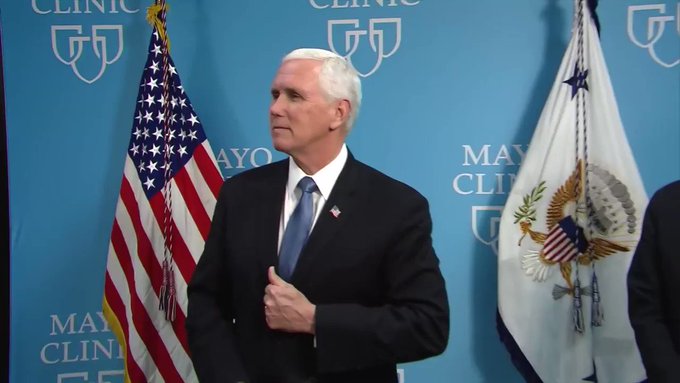
DESPITE CDC GUIDANCE that Americans should wear face masks in public to avoid spreading Covid-19, President Donald Trump mocked a man for wearing one at the White House on Tuesday and Vice President Mike Pence refused to wear one while meeting doctors and patients at the Mayo Clinic in Minnesota.
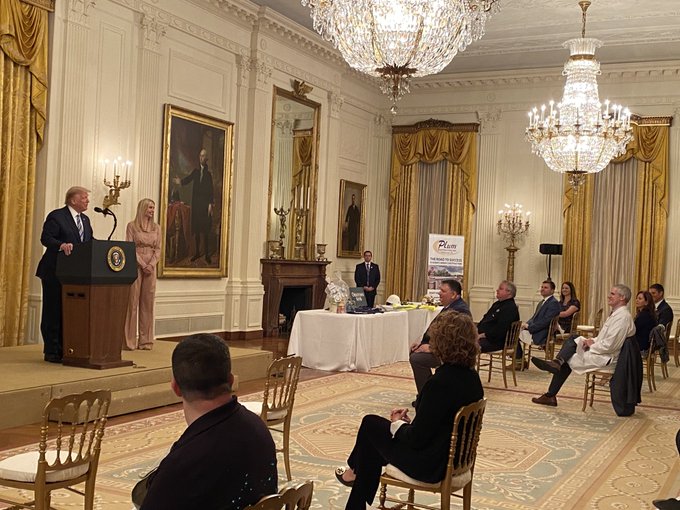
Trump’s comment came during an event designed to portray the federal government’s aid program for small businesses, known as the Paycheck Protection Program, as wildly successful. While the small business owners who attended the event in the White House East Room were asked to sit six feet apart, none of them wore masks, and neither did the president, his daughter, the treasure secretary or the small business administrator.

Jeff Mason
✔@jeffmason1
.@realDonaldTrump tells a West Virginia eye doctor who benefited from the CARES Act that he may need to get an eye examination later.
98
2:38 PM - Apr 28, 2020
Twitter Ads info and privacy
92 people are talking about this
Although many small businesses have been unable to gets loans — which are forgiven if used to pay workers for at least eight weeks — because millions of dollars have gone to large, politically connected firms, ten beneficiaries of the program were invited to the stage by the president, and thanked him profusely.
At one point, as Trump asked the vice president of a family contracting company from Pennsylvania to speak, he invited a man who accompanied her to join her on stage, and joked about the fact that the man had been wearing a mask earlier. “Put that mask on, the way you had it,” Trump said to the man. As the president shook his head and smiled, some in the room laughed.
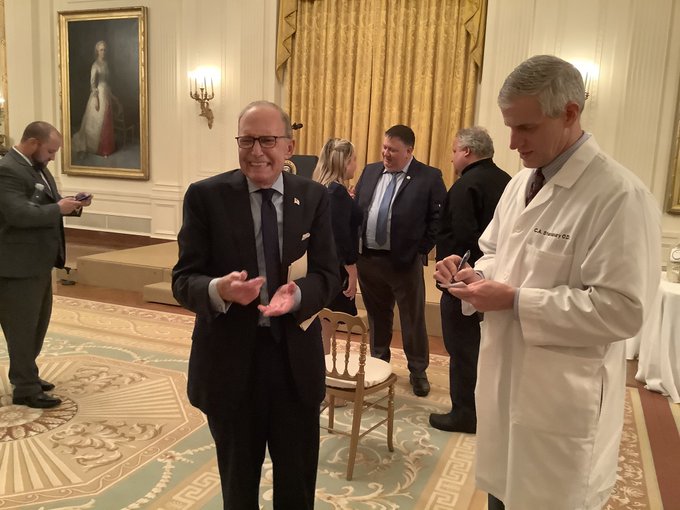
After the event ended, the business owners and officials left their seats and mingled at close quarters, including the president’s economic adviser Larry Kudlow, who approached one of the business owners, an optometrist from West Virginia, to get free advice about his glasses.

Jennifer Jacobs
✔@JenniferJJacobs
Kudlow says he, too, needs an eye doc appointment. His glasses are pinching.
27
3:11 PM - Apr 28, 2020
Twitter Ads info and privacy
20 people are talking about this
The optometrist, Chris Stansbury, was described simply as a small business owner, but he is also a Republican candidate for the West Virginia House of Delegates. Despite his politics, Stansbury has been urging his clients to take the CDC recommendations on mask-wearing seriously. In a YouTube video recorded two weeks ago he said, “if you do have to be out and about, if you do have essential travel, please go ahead and wear a mask.”
“Even if you feel fine, you could be a carrier of the disease,” Stansbury explained. “Studies have shown that up to 40 percent of people could be carrying this and not even realize it. They could be asymptomatic carriers of the disease. So if you have to go out and about into a public space, please, go ahead and put a mask on.”
The hastily organized White House event, which a limited number of reporters were allowed to attend, also seemed to be part of a new media strategy, intended to give the president an opportunity to cast his response to the crisis as a roaring success without too much scrutiny from the media. Before he took a few questions from reporters, Trump even told the business owners that they were there, in part, to keep the media from being too harsh on him. “I think with you in the room, I have a feeling that they’ll ask me much nicer questions,” Trump said, again speaking the quiet part out loud. “They’ll tone ’em done, right?”
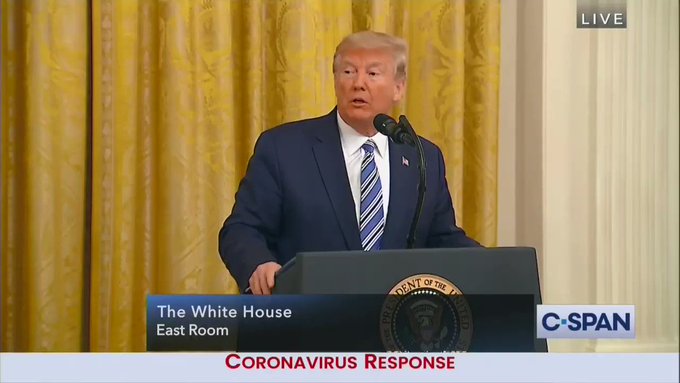
The president then lied, in response to the first question, about his wildly inaccurate prediction on Feb. 26 that coronavirus cases in the U.S. would be “down to close to zero” within days. Trump responded by inventing the entirely false narrative that he had been listening to unnamed “experts” who supposedly told him then that the pandemic virus would have no impact outside China.

Robert Mackey
✔@RobertMackey
New Trump lie: many experts "said that this would never affect the United States, it wouldn't affect Europe, it wouldn't affect anything outside of China. So we were listening to experts, we always will... but the experts got it wrong." (via @atrupar)
359
9:55 PM - Apr 28, 2020
Twitter Ads info and privacy
189 people are talking about this
In fact, on Feb. 25, the day before the president made that prediction, Nancy Messonnier, a CDC expert on respiratory diseases, told reporters something very different: that her agency expected the novel coronavirus to begin spreading at a community level in the United States and “disruption to everyday life might be severe.”
The president’s decision to poke fun at the man who wore a mask in the White House came just hours after his vice president apparently defied a request from the Mayo Clinic in Minnesota to honor its policy by wearing a mask while visiting doctors and patients there.
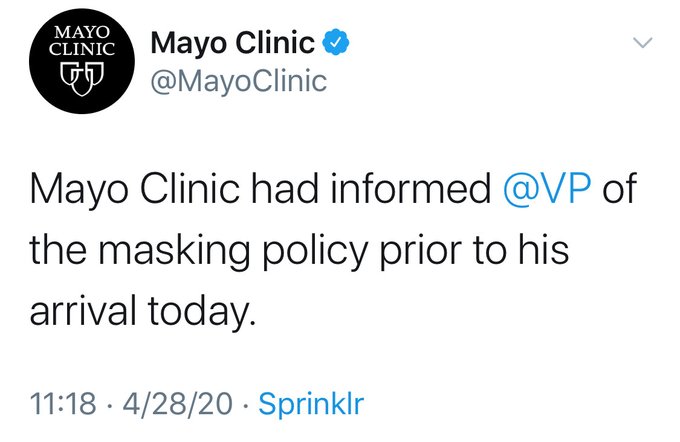
As photographs and video circulated of Pence not wearing a mask, unlike everyone else around him, including Dr. Stephen Hahn, the FDA commissioner, the clinic’s Twitter feed reported that the vice president had been informed in advance of Mayo’s policy that every visitor has to wear a mask. (Shortly after it was posted, that tweet was removed from Twitter without explanation.)
Robert Mackey
✔@RobertMackey
Here's the tweet posted and then deleted from the @MayoClinic Twitter feed on Tuesday.
46
6:29 PM - Apr 28, 2020
Twitter Ads info and privacy
23 people are talking about this
After a roundtable discussion with Mayo Clinic doctors and Minnesota’s governor, Tim Walz, during which he was the only one not wearing a mask, Pence even slapped one of the doctors on the back.
The vice president later told NBC News that since he is “tested for the coronavirus on a regular basis, and everyone who is around me is tested,” he didn’t think it was necessary for him to wear a mask. Apparently the idea that he could have a false negative has not occurred to the man leading the White House coronavirus task force, nor has the concept of using his office to model good behavior for the public.
“I thought it’d be a good opportunity,” Pence added, “for me to be here, to be able to speak to these researchers these incredible healthcare personnel and look them in the eye and say thank you.”
Robert Mackey
✔@RobertMackey
Asked why he's not wearing a mask at Mayo, Pence says as VP he's "tested for the coronavirus on a regular basis... and since I don't have the coronavirus, I thought it’d be a good opportunity for me to be here... to look them in the eye and say thank you.”
3
10:36 PM - Apr 28, 2020
Twitter Ads info and privacy
See Robert Mackey's other Tweets
Pence’s explanation outraged many observers who noted that you can still look people “in the eye” while wearing a mask over your mouth and nose to protect them from a virus you might be carrying.

Emily Williamson@EmilyCobenais
Hey @VP when I go to @MayoClinic tomorrow to bring my dad to his 4 cancer appts should I tell them I’m not going to wear a mask so I can look them in the eye? Oh wait, my dad and others at the HOSPITAL have extremely compromised immune systems and I’m not a moron!!!
21
8:22 PM - Apr 28, 2020
Twitter Ads info and privacy
See Emily Williamson's other Tweets
AS AMAZON, WALMART, AND OTHERS PROFIT AMID CORONAVIRUS CRISIS, THEIR ESSENTIAL WORKERS PLAN UNPRECEDENTED STRIKE
Daniel A. Medina
https://theintercept.com/2020/04/28/coronavirus-may-1-strike-sickout-amazon-target-whole-foods/
AN UNPRECEDENTED COALITION of workers from some of America’s largest companies will strike on Friday. Workers from Amazon, Instacart, Whole Foods, Walmart, Target, and FedEx are slated to walk out on work, citing what they say is their employers’ record profits at the expense of workers’ health and safety during the coronavirus pandemic.
The employees will call out sick or walk off the job during their lunch break, according to a press release set to be published by organizers on Wednesday. In some locations, rank-and-file union members will join workers outside their warehouses and storefronts to support the demonstrations.
“We are acting in conjunction with workers at Amazon, Target, Instacart and other companies for International Worker’s Day to show solidarity with other essential workers in our struggle for better protections and benefits in the pandemic,” said Daniel Steinbrook, a Whole Foods employee and strike organizer.
The labor action comes as workers and organizers say Amazon, in particular, has not been forthcoming about the number of Covid-19 cases at its more than 175 fulfillment centers globally.
Jana Jumpp, an Indiana Amazon employee, along with her small team of fellow Amazon workers, has over the last month tallied Covid-19 cases at Amazon warehouses in the U.S. According to Jumpp, there have been at least 500 coronavirus cases in at least 125 Amazon facilities.
Jumpp suspects that the number is much higher, but says this is what she and her team have been able to directly confirm through their sourcing, which includes screenshots of internal company texts and voicemails to employees when cases have arisen, in addition to messages received from Amazon workers on private Facebook groups. The numbers, which have not been previously reported, are the most comprehensive to this point.
Amazon declined to comment on the numbers of sick workers compiled by organizers. “While we respect people’s right to express themselves, we object to the irresponsible actions of labor groups in spreading misinformation and making false claims about Amazon during this unprecedented health and economic crisis,” said Amazon spokesperson Rachael Lighty. She added, “We have gone to extreme measures to understand and address this pandemic.”
The May 1 strike is the latest in a wave of actions led by union and nonunion front-line workers. Last month, Amazon workers in New York City and more than 10,000 Instacart workers across the country staged a walkout. Whole Foods employees led a national sickout on March 31, while upwards of 800 workers skipped their shifts at a Colorado meatpacking plant as coronavirus cases were confirmed among employees. Sanitation workers in Pittsburgh and bus drivers in Detroit both staged wildcat strikes.
“These workers have been exploited so shamelessly for so long by these companies while performing incredibly important but largely invisible labor,” said Stephen Brier, a labor historian and professor at the CUNY School of Labor and Urban Studies. “All of a sudden, they’re deemed essential workers in a pandemic, giving them tremendous leverage and power if they organize collectively.”
The workers coalition will unveil a set of demands. Among them are: compensation for all unpaid time off used since the beginning of the Covid-19 crisis in March; hazard pay or paid sick leave to be provided for the duration of the pandemic; protective equipment and all cleaning supplies to be provided at all times by the company; and a demand for full corporate transparency on the number of cases in facilities.
The workers chose May 1, International Workers Day, as a signal to workers everywhere that collectively, they can take on corporate behemoths, said Christian Smalls, a lead organizer of the strike. Amazon fired Smalls on March 30, only hours after he led his colleagues at a company warehouse in Staten Island, New York, on a walkout in protest of Amazon’s response to the pandemic. Amazon said Smalls was fired for violating a company-enforced quarantine.
The firing galvanized front-line workers everywhere, who sent dozens of messages daily to Smalls asking how they too could organize work stoppages to protest their workplace conditions. Smalls joined forces with workers rights groups like Amazonians United, Target Workers Unite, Whole Worker, and the Gig Workers Collective, among others.
The coalition organized the strike over the last several weeks on Zoom calls and encrypted messaging apps like Telegram and Signal. Civil rights icon Rev. Jesse Jackson joined in on one Zoom call to briefly address the organizers, offering the full support of his Rainbow Push network. “I am with you in your struggle,” Jackson told the call’s participants.
The Intercept spoke to 20 organizers from more than half a dozen states, reflecting the widespread nature of the strike. From Whole Foods workers in Boston to Instacart gig workers in Silicon Valley to Amazon warehouse organizers in Kentucky and Michigan, their stories and demands varied but together illustrated a pattern of corporate neglect toward workers now regarded as essential — alongside doctors, nurses, and EMT workers — during the coronavirus outbreak that has forced much of the nation into home lockdown.
“All of these workers are coming together and building power,” said Vanessa Bain, an Instacart worker and co-founder of the Gig Workers Collective, which counts more than 17,000 members and advocates for gig workers’ rights. “May Day is not just a one-time symbolic action, but also about building real, vast, and broad sweeping networks of power.”
Companies Not Doing Enough
The company that has faced the most sustained criticism throughout the outbreak has been Amazon, whose CEO Jeff Bezos has personally become $24 billion richer during the pandemic.
Last week, Amazon announced that it was ending its temporary policy of unlimited, unpaid time off on April 30. In response, on early Sunday morning, more than 50 Amazon workers in Minnesota walked out of a company warehouse in suburban Minneapolis to protest the move and decry their working conditions.
In March, Amazon announced plans to hire 100,000 workers to meet surging demand and to cover for workers who had taken out the unpaid leave over fears of exposure to the virus at their workplace. This month, the company announced plans for an additional 75,000 hires. For its part, Instacart hired 300,000 new shoppers in March alone — more than its entire existing workforce to that point — and last week announced that it would hire an additional 250,000 workers to meet the historic demand.
The hiring binge by Amazon and Instacart exposed the winners and losers in the pandemic, as businesses not deemed essential by the state fight mass layoffs, said Brier.
Critics say the opportunities to “cash in” on the pandemic have not come without risks. Pressured by worker protests and elected officials, companies granted some concessions to workers. Amazon, Walmart, and Target increased hourly pay by $2. Amazon now provides personal protective equipment at its facilities and more actively cleans workspaces, while Target has mandated its workers to wear masks after weeks of reports that they were reprimanded for doing so.
The Intercept reached out to all six companies targeted in Friday’s strike. FedEx, Walmart, and Whole Foods did not offer comments. Instacart said the company remained “singularly focused on the health and safety of the Instacart community.” In a statement, Target said it had taken many measures to ensure the safety of its employees and customers. Of the May Day strike, the company said, “While we take them seriously, the concerns raised are from a very small minority. The vast majority of our more than 340,000 frontline team members have expressed pride in the role they are playing in helping provide for families across the country during this time of need.”
A Staten Island worker, who requested anonymity for fear of retaliation from Amazon, has been on unpaid leave for more than a month. As someone with a number of underlying health conditions, the worker said contracting the virus would be “a death sentence.” They are surviving off meager savings and had to move into a friend’s home because they could no longer pay rent.
“They need to close down the warehouse and do a thorough, deep cleaning for it to be safe,” the worker told The Intercept. “If someone dies, they have blood on their hands.”
An Amazon worker in Detroit, who plans to call out sick on Friday, described a warehouse where, for weeks, there was no enforced social distancing and no gloves, masks, and hand sanitizer provided to workers, even as the city became a national coronavirus hot spot. Multiple colleagues confirmed the worker’s claims to The Intercept.
“You either come to work or take an unpaid leave of absence,” said the worker, who has a serious underlying health condition. “If I miss one paycheck, it would mean I lose my vehicle, I lose my place to live. I lose everything.”
A Whole Foods worker in Southern California spent weeks organizing colleagues to strike on May 1, as the number of coronavirus cases have increased at stores. The worker said that managers — even those sympathetic to their demands — are helpless against the Amazon subsidiary’s corporate office. The strike, like the sickout last month, is the only way that employees can get concessions from the company, said the worker: “Nothing happens unless they see their bottom line affected.”
Whole Worker, the group that advocates for Whole Foods workers rights, has compiled its own list of positive coronavirus cases at Whole Foods stores in a document shared with The Intercept. According to the group, there have been a total of 249 cases in at least 131 stores.
Adam Ryan, a Target worker in southern Virginia and liaison with Target Workers Unite, said the May 1 strike is the first collective action by Target employees in the company’s nearly 60-year history.
Ryan said, “It’s up to us to fight for ourselves.”
With Millions Unable to Pay for Housing Next Month, Organizers Plan the Largest Rent Strike in Nearly a Century
Natasha Lennard
https://theintercept.com/2020/04/25/coronavirus-rent-strike-may/
WANT A GRIM picture of the state of American dissent during the coronavirus pandemic? Take an overview of media coverage from the last week. The press focused disproportionate attention on a few hundred white reactionaries, in a small number of states, rallying against social distancing measures — buoyed, of course, by tweets from President Donald Trump. Meanwhile, some of the most radical and righteous acts of mass resistance this country has seen in decades — from a wave of labor strikes to an explosion of mutual aid networks — are earning but a fraction of the media focus accorded to fringe, right-wing protesters.
Based on mainstream news coverage alone, for instance, you’d likely never know that organizers and tenants in New York are preparing the largest coordinated rent strike in nearly a century, to begin on May 1.
At least 400 hundred families who live in buildings each containing over 1,500 rent units are coordinating building-wide rent strikes, according to Cea Weaver, campaign coordinator for Housing Justice For All, a New York-based coalition of tenants and housing activists. Additionally, over 5,000 people have committed, through an online pledge, to refuse to pay rent in May.
Precise strike numbers will be impossible to track, but the number of commitments alone points to a historic revival of this tenant resistance tactic. Coordinated rent strikes of this size in New York City haven’t been seen since the 1930s, when thousands of renters in Harlem and the Bronx successfully fought price gouging and landlord neglect by refusing to pay rent en masse.
The numbers committing to a rent strike might seem insignificant compared to the millions who don’t frame nonpayment as a strike, but simply will not be able to pay rent in the coming month. By the first week of April, one-third of renters nationwide — approximately 13.4 million people — had not paid rent; since then, 26 million workers have joined the ranks of the unemployed.
Meanwhile, government stimulus checks of $1,200 are disorganized, overdue, and woefully inadequate. The median monthly rent for a one-bedroom apartment in New York City, for example, was $2,980 last year. The federal government’s pitiful offering is also, of course, unavailable to many immigrants. Since we can therefore expect nonpayment of May’s rent to reach an unprecedented scale anyway, the idea of advocating for a rent strike might at first seem moot.
Organizers of the rent strike, however, make clear the action’s relevance. The slogan of the rent strike campaign says it all: “Can’t pay? Won’t pay!” The reframing of nonpayment as a strike — an act of collective resistance — is a powerful rejection of the sort of capitalist ethic that accords moral failing to an individual’s inability to pay a landlord.
“We don’t need to organize a rent strike to be able to say that millions of New Yorkers will not pay their rent on May 1,” Weaver told me. The call to a rent strike thus poses a crucial question to tenants who can’t afford rent, Weaver said: “Do you want to do that alone? Or do you want to do that connected to a movement of people who are also in your situation and are calling for a deep and transformative policy solution. It’s better if we can do this together.”
For tenant organizers on the front lines of New York’s housing crisis, which far predated the pandemic, the answer is clear. “The rent strike is a cry for dignity: We are all deserving of a home, no matter the color of our skin, financial status, or culture,” said Donnette Letford, an undocumented immigrant from Jamaica and a member of the group New York Communities for Change.
Until a month ago, Letford had worked as a home health care attendant. Her employer of over 10 years passed away, having contracted Covid-19. She is now jobless and mourning in quarantine, having cared for her employer until her death. “Under any circumstances, a loss like that is hard to bear, but during a pandemic it’s devastating,” Letford, a mother of one, noted in an email, urging others to join the rent strike. “The Covid-19 crisis is making clear what many tenants have known for a long time: We are all just one life event — the loss of a job, a medical emergency — away from losing our homes.”
ORGANIZERS ARE ASKING those who are able to pay May’s rent to refuse to do so in solidarity with those who can’t. The move is aimed at pressuring city and state leadership to respond in the only way appropriate to the exacerbated housing crisis: by canceling rent.
Before housing rights advocates in New York escalated calls for a mass rent strike, they had been calling, along with a small number of lawmakers, for a temporary rent suspension. And while New York Gov. Andrew Cuomo introduced a crucial eviction moratorium, without also canceling rent during this time, back pay will accrue and the threat of future evictions looms over millions of renters who have lost all sources of income. The rent strike is an unambiguous escalation to demand robust action from Albany.
“We’re still calling to #CancelRent and reclaim our homes — that is the demand of the rent strike,” Weaver said. “So far, our cries for help have been ignored in Albany. In fact, they’ve done the opposite of ignore us. Gov. Cuomo rammed through an austerity budget that harms low-income tenants and homeless New Yorkers. In the face of sustained unemployment and a never-before-seen eviction crisis, they are offering nearly nothing.”
Like the historic rent strikes of the 20th century, which led to some of the first rent control laws in New York, the coming strike makes specific demands. According to a petition from Housing Justice For All, strikers want a statewide rent cancellation for four months, “or for the duration of the public health crisis — whichever is longer”; a rent freeze and the assurance that every tenant is given the right to renew their lease at the same price; and that the government “urgently and permanently rehouse all New Yorkers experiencing homelessness and invest in public and social housing across our state.”
As Weaver put it, “One way or another, we are looking at some form of government intervention.” She added, “But we need to make sure that government intervention happens on our terms. We are escalating to collective non-compliance with rent in order to force a crisis.”
CONCERNS IN RESPONSE to calls for rent cancellations and strikes are as predictable as they are unfounded. Most common among them is the claim that small landlords, who survive and pay mortgages through collecting rent, will face ruination. Yet it is well within the government’s capacity to provide relief and support for landlords in these situations: Mortgage payments should be canceled too.
Some of the nation’s better lawmakers are trying to pass bills that combine rent and mortgage cancellations on a national level. On Wednesday, Rep. Ilhan Omar, D-Minn., introduced the Rent and Mortgage Cancellation Act, which would provide rent and mortgage forgiveness while also providing relief to landlords to assist with lost payments.
Passing such legislation in Washington is perhaps a Sisyphean task, but it’s more feasible on a state level. The problem is the political will: If Cuomo, for instance, were truly the “crisis daddy” he’s been nauseatingly hailed to be, he could make it a swift reality in New York. Meanwhile, it should go without saying that large real estate corporations and powerful landlords can take the hit of a few months’ canceled rent and deserve no less, after years upon decades of exploitative and extractive capital accumulation at the expense of tenants.
Prior to the pandemic — and thanks to the tireless work of tenants’ unions, activists, and a few progressive Democrats elected in New York in 2018 — a number of pro-tenant legislative reforms were passed last year. These laws, while welcome, were but a small step in the right direction to undo the decades of unchallenged complicity between New York’s politicians and the mighty real estate lobby. For rent strike organizers, the ideal is by no means a return to a pre-crisis status quo. As Weaver put it, “We’re demanding that we not return to the world we lived in pre-Covid — a world with 92,000 homeless New Yorkers and millions of people living just one paycheck away from an eviction.”
Phara Souffrant Forrest, a nurse and a tenant rights activist who is currently campaigning to become a New York State Assembly member, asked voters in her Brooklyn district of Crown Heights to sign a petition for rent cancellation. “We received a huge amount of support for it, but then it was as if we were talking to ourselves, we weren’t getting any response,” she told me, decrying the lack of action from sitting lawmakers. She noted that 44 percent of her district was already “rent burdened” before the pandemic, meaning that over one-third of their paychecks went to rent and utilities. Four in 10 of the entire country’s 43 million renters are in the same position.
Souffrant Forrest is organizing alongside rent strikers in the explicit recognition that the power structures by which housing is organized need to be toppled — now and long after the coronavirus crisis has passed. “We need to support candidates who believe that housing is a human right,” she said. In the knowledge that all too few such politicians currently exist, the nurse and organizer has been calling up her neighbors and telling them about the rent strike.
“Housing is a human right” has long been the cry of tenant organizers and social-justice fighters. What would it mean, though, to have a system in which housing were in fact treated as a universal human right? You wouldn’t have to pay to access those rights, for one. A rent strike is not a request for the human right to housing to be recognized; it’s instead an immediate and embodied claiming of that right. The strike makes demands, yes, but also provides an end in itself.
Subscribe to:
Posts (Atom)