Monday, February 28, 2022
Richard Medhurst and George Galloway on Russia-Ukraine Crisis
https://www.youtube.com/watch?v=w8oVNXvYCA0&ab_channel=RichardMedhurst
Ukraine: Questions for the US Anti-War Movement w/ Abby Martin & Brian Becker
https://www.youtube.com/watch?v=w6HQeunm2f4&ab_channel=BreakThroughNews
HOW MOST OF THE U.S LEFT GOT THIS WRONG & SIDING w STATE DEPT
https://www.youtube.com/watch?v=lNCmPtTIC98&ab_channel=TheConvoCouch
Brihana Joy Gray Has CAP Matt Duss for Foreign Policy Russia-Ukraine Discussion
https://www.youtube.com/watch?v=NY9O41eF2CM&ab_channel=TheConvoCouch
Russia & Ukraine PEACE Deal BLOCKED By Joe Biden
https://www.youtube.com/watch?v=RPRER1tlkRs&ab_channel=TheDivewithJacksonHinkle
AOC DUMBEST Tweet Yet, Floats WW3 With Russia Over Ukraine
https://www.youtube.com/watch?v=qpfTOcvnTRI&ab_channel=TheDivewithJacksonHinkle
Revolutionary Blackout Live | Ukraine Coverage
https://www.youtube.com/watch?v=Ak3yQrb9LnI&ab_channel=RevolutionaryBlackout
Richard Wolff | State of US Economy is SCARY
https://www.youtube.com/watch?v=_AlcxDnoQ3U&ab_channel=ChrisHedgesFanClub
AOC Spews Nonstop BS In New Yorker Interview
https://www.youtube.com/watch?v=yf8ckoVzo4M&ab_channel=TheJimmyDoreShow
"Hypocrisy of the West Is Unbelievable" | Richard Medhurst on Ukraine
https://www.youtube.com/watch?v=lwkMBge05IA&ab_channel=RichardMedhurst
Western Powers to disconnect Russia from the SWIF payment system
https://www.youtube.com/watch?v=ZouFQR_wle0&ab_channel=TeleSUREnglish
Western countries' resolution against Russia was overturned by the UN Security Council
https://www.youtube.com/watch?v=PCzmyjHygiA&ab_channel=TeleSUREnglish
Russian Federation announces reciprocity in the face of "Western Sanctions”
https://www.youtube.com/watch?v=eKJDwzhsTSU&ab_channel=TeleSUREnglish
Ukraine : President VolodÃmir Zelenski calls to defend their nation
https://www.youtube.com/watch?v=QlZ0tR4PQ-s&ab_channel=TeleSUREnglish
Government of Russia will be reciprocate with U.S sanctions
https://www.youtube.com/watch?v=7Z-L-EYWs4w&ab_channel=TeleSUREnglish
Ukraine: Kiev claims to resist advances from Russian forces
https://www.youtube.com/watch?v=0Wj2Hgb5AvU&ab_channel=TeleSUREnglish
Is the Invasion of Ukraine the Worst Thing Since the WW2?
https://www.youtube.com/watch?v=y4zd3XKwcDc&ab_channel=RichardMedhurst
Chris Hedges Debunks Jordan Peterson and Steven Pinker
https://www.youtube.com/watch?v=e8-KNvDQ0UU&ab_channel=ChrisHedgesFanClub
RUSSIA IS PREPARED TO SEND DELEGATION TO DISCUSS UKRAINIAN NEUTRALITY
https://popularresistance.org/russia-says-it-is-prepared-to-send-delegation-to-discuss-ukrainian-neutrality/
People's Dispatch.
February 26, 2022
EDUCATE!
Media reports say fighting is taking place in close proximity of Kiev and other key cities in the country.
The war has already caused the displacement of over 100,000 people, according to the UN refugees agency
Russian president Vladimir Putin on Friday, February 25, said that he is prepared to send a delegation to Minsk to discuss Ukraine’s neutrality, media reports said. This follows a call by Ukrainian president Volodymyr Zelenskyy who urged Putin to sit down for talks even while calling on the people of the country to keep fighting. Meanwhile, media reports say fighting is taking place around Ukraine’s capital Kiev, as well as other cities in Ukraine.
Earlier, Zelenskyy said that at least 137 people, including civilians and military personnel, have been killed and hundreds others wounded in Ukraine so far in the ongoing Russian offensive. Zelenskyy also continued to ask for harsh international sanctions against Russia.
Meanwhile, local officials claimed that at least two civilians were killed in Donetsk republic due to heavy shelling by Ukrainian forces in civilian areas.
According to the statement issued by the Ukrainian government, Russian troops have captured the Chernobyl region in the northern part of the country.
On Thursday, the local administration in Ukrainian capital Kiev ordered a night curfew in the city following massive explosions. The Ukrainian authorities stated that the explosions were caused due to interceptors hitting an enemy rocket. Some news reports claimed that it was a Russian aircraft that crashed into a building after being hit by the interceptor.
The war has already caused the displacement of over 100,000 people, according to the UN refugees agency. Ukrainian officials also claimed that Russian troops have started attacking Kharkiv, the second largest city in Ukraine, located near the Donbass region.
Russian troops entered Ukraine on Thursday after president Vladimir Putin ordered a “special operation” to prevent the Ukrainian forces from attacking the Donbass republics. He stated that the move is also for “demilitarization” and “denazification” of the country. The European Union, the US and other NATO members have called it a “full fledged invasion” of Ukraine and announced fresh sanctions on Thursday.
Recurring Concerns
Citing security threats due to NATO’s eastward expansion and its military deployment near its borders, Russia has long been demanding assurances from the US and NATO that they will halt their expansion and Ukraine will never be a part of the bloc. Both Ukraine and NATO have failed to give any such assurance to Russia and even claimed that such demands are non-negotiable.
Maria Zakharova, spokesperson of the Russian foreign ministry, in an interview to RT blamed the West for ignoring Ukrainian violence in the Donbass region for the last eight years and forcing Russia to intervene. She reiterated president Putin’s claims that that “main objective is to stop the escalation of the war that’s been going on for eight years, and to stop the war.”
Hundreds of people took to the streets in Moscow, Saint Petersburg, and other cities in Russia on Thursday evening opposing the war in Ukraine and calling for an end of hostilities. Russian security forces detained hundreds of the protesters citing COVID-19 protocol violations and “breaches of public order.” The protests were backed by Russia’s opposition parties.
WAR IN EUROPE AND THE RISE OF RAW PROPAGANDA
https://popularresistance.org/war-in-europe-and-the-rise-of-raw-propaganda/
John Pilger.
February 26, 2022
EDUCATE!
Marshall McLuhan’s prophecy that “the successor to politics will be propaganda” has happened. Raw propaganda is now the rule in Western democracies, especially the US and Britain.
On matters of war and peace, ministerial deceit is reported as news. Inconvenient facts are censored, demons are nurtured. The model is corporate spin, the currency of the age. In 1964, McLuhan famously declared, “The medium is the message.” The lie is the message now.
But is this new? It is more than a century since Edward Bernays, the father of spin, invented “public relations” as a cover for war propaganda. What is new is the virtual elimination of dissent in the mainstream.
The great editor David Bowman, author of The Captive Press, called this “a defenestration of all who refuse to follow a line and to swallow the unpalatable and are brave”. He was referring to independent journalists and whistleblowers, the honest mavericks to whom media organizations once gave space, often with pride. The space has been abolished.
The war hysteria that has rolled in like a tidal wave in recent weeks and months is the most striking example. Known by its jargon, “shaping the narrative,” much if not most of it is pure propaganda.
The Russians are coming. Russia is worse than bad. Putin is evil, “a Nazi like Hitler,” salivated the Labor MP, Chris Bryant. Ukraine is about to be invaded by Russia – tonight, this week, next week. The sources include an ex CIA propagandist who now speaks for the US State Department and offers no evidence of his claims about Russian actions because “it comes from the US Government.”
The no-evidence rule also applies in London. The British Foreign Secretary, Liz Truss, who spent £500,000 of public money flying to Australia in a private plane to warn the Canberra government that both Russia and China were about to pounce, offered no evidence. Antipodean heads nodded; the “narrative” is unchallenged there. One rare exception, former prime minister Paul Keating, called Truss’s warmongering “demented”.
Truss has blithely confused the countries of the Baltic and the Black Sea. In Moscow, she told the Russian foreign minister that Britain would never accept Russian sovereignty over Rostov and Voronezh – until it was pointed out to her that these places were not part of Ukraine but in Russia. Read the Russian press about the buffoonery of this pretender to 10 Downing Street and cringe.
This entire farce, recently starring Boris Johnson in Moscow playing a clownish version of his hero, Churchill, might be enjoyed as satire were it not for its willful abuse of facts and historical understanding and the real danger of war.
Vladimir Putin refers to the “genocide” in the eastern Donbas region of Ukraine. Following the coup in Ukraine in 2014 – orchestrated by Barack Obama’s “point person” in Kyiv, Victoria Nuland – the coup regime, infested with neo-Nazis, launched a campaign of terror against Russian-speaking Donbas, which accounts for a third of Ukraine’s population.
Overseen by CIA director John Brennan in Kyiv, “special security units” coordinated savage attacks on the people of Donbas, who opposed the coup. Video and eyewitness reports show bussed fascist thugs burning the trade union headquarters in the city of Odessa, killing 41 people trapped inside. The police are standing by. Obama congratulated the “duly elected” coup regime for its “remarkable restraint”.
In the US media, the Odessa atrocity was played down as “murky” and a “tragedy” in which “nationalists” (neo-Nazis) attacked “separatists” (people collecting signatures for a referendum on a federal Ukraine). Rupert Murdoch’s Wall Street Journal damned the victims – “Deadly Ukraine Fire Likely Sparked by Rebels, Government Says”.
Professor Stephen Cohen, acclaimed as America’s leading authority on Russia, wrote, “The pogrom-like burning to death of ethnic Russians and others in Odessa reawakened memories of Nazi extermination squads in Ukraine during world war two. [Today] storm-like assaults on gays, Jews, elderly ethnic Russians, and other ‘impure’ citizens are widespread throughout Kyiv-ruled Ukraine, along with torchlight marches reminiscent of those that eventually inflamed Germany in the late 1920s and 1930s …
“The police and official legal authorities do virtually nothing to prevent these neo-fascist acts or to prosecute them. On the contrary, Kyiv has officially encouraged them by systematically rehabilitating and even memorializing Ukrainian collaborators with Nazi German extermination pogroms, renaming streets in their honor, building monuments to them, rewriting history to glorify them, and more.”
Today, neo-Nazi Ukraine is seldom mentioned. That the British are training the Ukrainian National Guard, which includes neo-Nazis, is not news. (See Matt Kennard’s Declassified report in Consortium 15 February). The return of violent, endorsed fascism to 21st-century Europe, to quote Harold Pinter, “never happened … even while it was happening”.
On 16 December, the United Nations tabled a resolution that called for “combating glorification of Nazism, neo-Nazism and other practices that contribute to fueling contemporary forms of racism”. The only nations to vote against it were the United States and Ukraine.
Almost every Russian knows that it was across the plains of Ukraine’s “borderland” that Hitler’s divisions swept from the west in 1941, bolstered by Ukraine’s Nazi cultists and collaborators. The result was more than 20 million Russians dead.
Setting aside the maneuvers and cynicism of geopolitics, whomever the players, this historical memory is the driving force behind Russia’s respect-seeking, self-protective security proposals, which were published in Moscow in the week the UN voted 130-2 to outlaw Nazism. They are:
NATO guarantees that it will not deploy missiles in nations bordering Russia. (They are already in place from Slovenia to Romania, with Poland to follow)
NATO to stop military and naval exercises in nations and seas bordering Russia.
Ukraine will not become a member of NATO.
the West and Russia to sign a binding East-West security pact.
– the landmark treaty between the US and Russia covering intermediate-range nuclear weapons to be restored. (The US abandoned it in 2019)
These amount to a comprehensive draft of a peace plan for all of post-war Europe and ought to be welcomed in the West. But who understands their significance in Britain? What they are told is that Putin is a pariah and a threat to Christendom.
Russian-speaking Ukrainians, under economic blockade by Kyiv for seven years, are fighting for their survival. The “massing” army we seldom hear about are the thirteen Ukrainian army brigades laying siege to Donbas: an estimated 150,000 troops. If they attack, the provocation to Russia will almost certainly mean war.
In 2015, brokered by the Germans and French, the presidents of Russia, Ukraine, Germany, and France met in Minsk and signed an interim peace deal. Ukraine agreed to offer autonomy to Donbas, now the self-declared republics of Donetsk and Luhansk.
The Minsk agreement has never been given a chance. In Britain, the line, amplified by Boris Johnson, is that Ukraine is being “dictated to” by world leaders. For its part, Britain is arming Ukraine and training its army.
Since the first Cold War, NATO has effectively marched right up to Russia’s most sensitive border having demonstrated its bloody aggression in Yugoslavia, Afghanistan, Iraq, Libya, and broken solemn promises to pull back. Having dragged European “allies” into American wars that do not concern them, the great unspoken is that NATO itself is the real threat to European security.
In Britain, a state and media xenophobia is triggered at the very mention of “Russia.” Mark the knee-jerk hostility with which the BBC reports Russia. Why? Is it because the restoration of imperial mythology demands, above all, a permanent enemy? Certainly, we deserve better.
Sunday, February 27, 2022
Chris Hedges: Chronicle of a War Foretold
https://consortiumnews.com/2022/02/25/chris-hedges-chronicle-of-a-war-foretold/
After the fall of the Soviet Union, there was a near universal understanding among political leaders that NATO expansion would be a foolish provocation against Russia. The military-industrial complex would not allow such sanity to prevail.

Nov. 26, 2014: Damaged building in Kurakhove, Donetsk, Ukraine. (VO Svoboda, CC BY 3.0, Wikimedia Commons)
By Chris Hedges
ScheerPost.com
I was in Eastern Europe in 1989, reporting on the revolutions that overthrew the ossified communist dictatorships that led to the collapse of the Soviet Union. It was a time of hope.NATO, with the breakup of the Soviet empire, became obsolete. President Mikhail Gorbachev reached out to Washington and Europe to build a new security pact that would include Russia. Secretary of State James Baker in the Reagan administration, along with the West German Foreign Minister Hans-Dietrich Genscher, assured the Soviet leader that if Germany was unified NATO would not be extended beyond the new borders.
The commitment not to expand NATO, also made by Great Britain and France, appeared to herald a new global order. We saw the peace dividend dangled before us, the promise that the massive expenditures on weapons that characterized the Cold War would be converted into expenditures on social programs and infrastructures that had long been neglected to feed the insatiable appetite of the military.
There was a near universal understanding among diplomats and political leaders at the time that any attempt to expand NATO was foolish, an unwarranted provocation against Russia that would obliterate the ties and bonds that happily emerged at the end of the Cold War.
How naive we were. The war industry did not intend to shrink its power or its profits. It set out almost immediately to recruit the former Communist Bloc countries into the European Union and NATO. Countries that joined NATO, which now include Poland, Hungary, the Czech Republic, Bulgaria, Estonia, Latvia, Lithuania, Romania, Slovakia, Slovenia, Albania, Croatia, Montenegro, and North Macedonia were forced to reconfigure their militaries, often through hefty loans, to become compatible with NATO military hardware.
No Peace Dividend

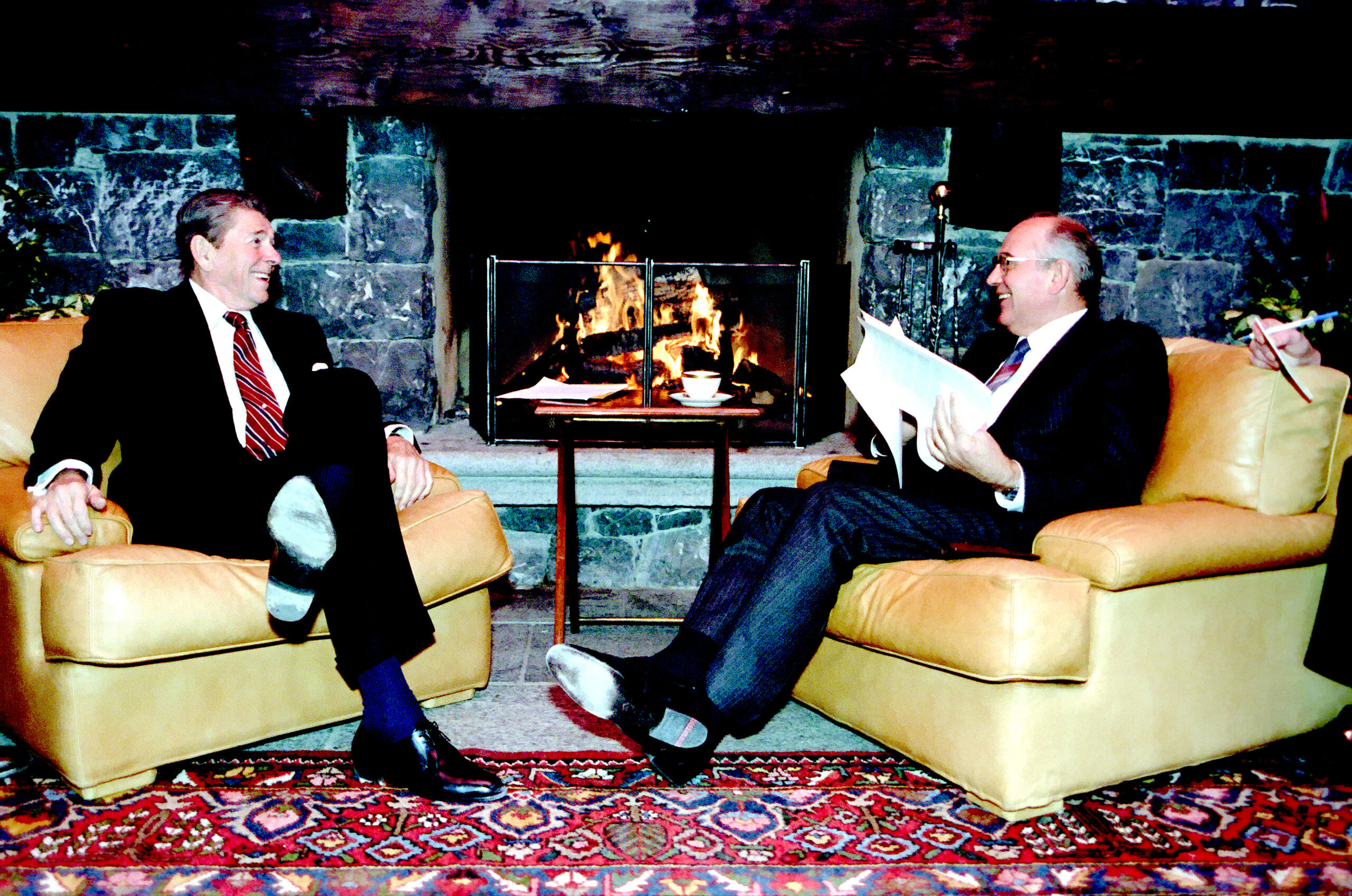
Nov. 19, 1985: U.S. President Ronald Reagan and Soviet General Secretary Gorbachev in Geneva for their first summit. (Reagan White House, Wikimedia Commons)
There would be no peace dividend. The expansion of NATO swiftly became a multi-billion-dollar bonanza for the corporations that had profited from the Cold War. (Poland, for example, just agreed to spend $6 billion on M1 Abrams tanks and other U.S. military equipment.)
If Russia would not acquiesce to again being the enemy, then Russia would be pressured into becoming the enemy. And here we are. On the brink of another Cold War, one from which only the war industry will profit while, as W. H. Auden wrote, the little children die in the streets.
The consequences of pushing NATO up to the borders with Russia — there is now a NATO missile base in Poland 100 miles from the Russian border — were well known to policy makers. Yet they did it anyway. It made no geopolitical sense. But it made commercial sense. War, after all, is a business, a very lucrative one. It is why we spent two decades in Afghanistan although there was near universal consensus after a few years of fruitless fighting that we had waded into a quagmire we could never win.

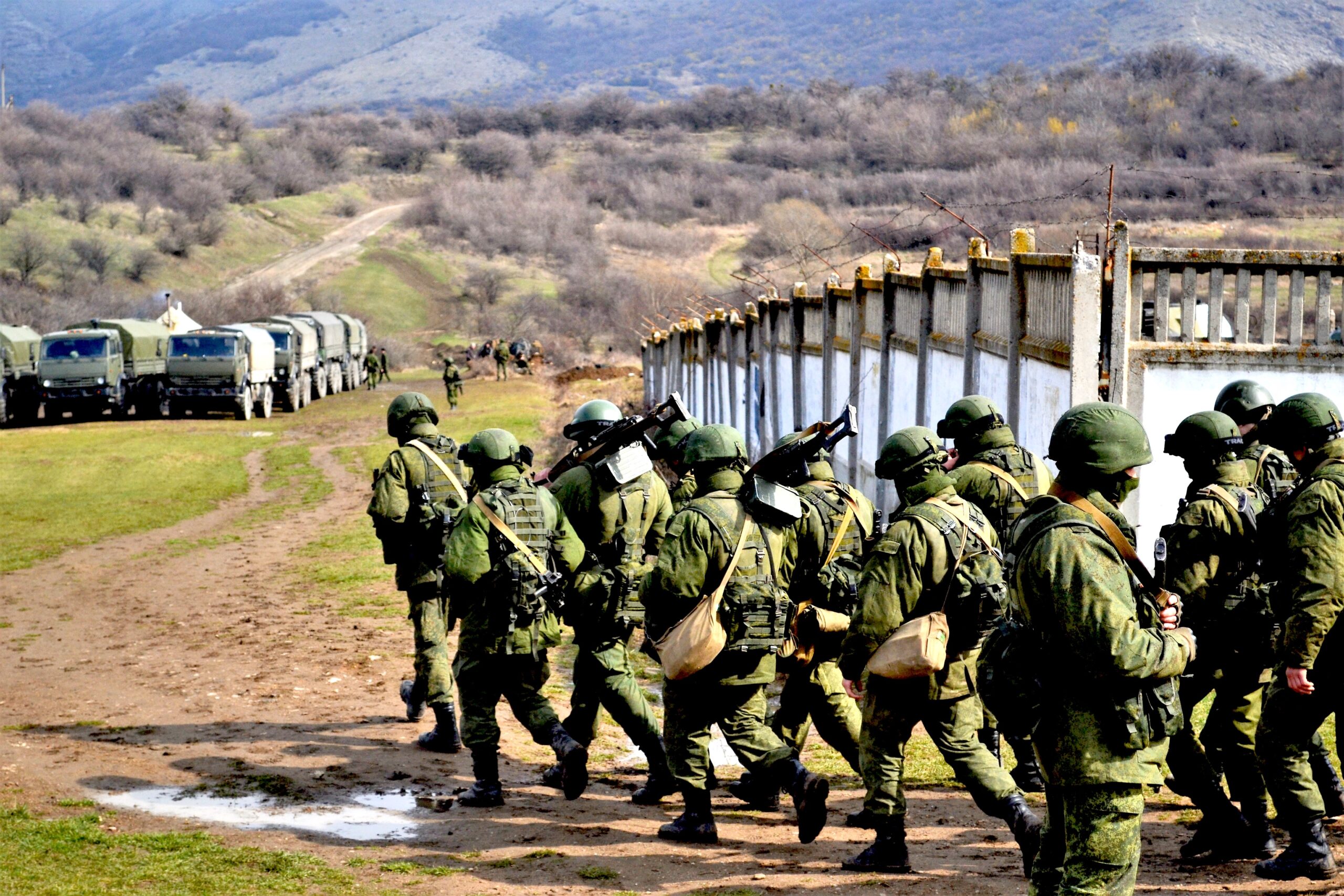
March 9, 2014: Russian troops after the seizure of the military base at Perevalne during the occupation of Crimea and the city of Sevastopol. (Anton Holoborodko, CC BY-SA 3.0, Wikimedia Commons)
In a classified diplomatic cable obtained and released by WikiLeaks dated Feb. 1, 2008, written from Moscow, and addressed to the Joint Chiefs of Staff, NATO-European Union Cooperative, National Security Council, Russia Moscow Political Collective, secretary of defense and secretary of state, there was an unequivocal understanding that expanding NATO risked an eventual conflict with Russia, especially over Ukraine.
“Not only does Russia perceive encirclement [by NATO], and efforts to undermine Russia’s influence in the region, but it also fears unpredictable and uncontrolled consequences which would seriously affect Russian security interests,” the cable reads and continues:
“Experts tell us that Russia is particularly worried that the strong divisions in Ukraine over NATO membership, with much of the ethnic-Russian community against membership, could lead to a major split, involving violence or at worst, civil war. In that eventuality, Russia would have to decide whether to intervene; a decision Russia does not want to have to face. . . . Dmitri Trenin, Deputy Director of the Carnegie Moscow Center, expressed concern that Ukraine was, in the long-term, the most potentially destabilizing factor in U.S.-Russian relations, given the level of emotion and neuralgia triggered by its quest for NATO membership . . . Because membership remained divisive in Ukrainian domestic politics, it created an opening for Russian intervention. Trenin expressed concern that elements within the Russian establishment would be encouraged to meddle, stimulating U.S. overt encouragement of opposing political forces, and leaving the U.S. and Russia in a classic confrontational posture.”
The Obama administration, not wanting to further inflame tensions with Russia, blocked arms sales to Kiev. But this act of prudence was abandoned by the Trump and Biden administrations. Weapons from the U.S. and Great Britain are pouring into Ukraine, part of the $1.5 billion in promised military aid. The equipment includes hundreds of sophisticated Javelins and NLAW anti-tank weapons despite repeated protests by Moscow.
The United States and its NATO allies have no intention of sending troops to Ukraine. Rather, they will flood the country with weapons, which is what it did in the 2008 conflict between Russia and Georgia.
The conflict in Ukraine echoes the novel Chronicle of a Death Foretold by Gabriel Garcia Marquez. In the novel it is acknowledged by the narrator that “there had never been a death more foretold” and yet no one was able or willing to stop it.
All of us who reported from Eastern Europe in 1989 knew the consequences of provoking Russia, and yet few have raised their voices to halt the madness. The methodical steps towards war took on a life of their own, moving us like sleepwalkers towards disaster.
Once NATO expanded into Eastern Europe, the Clinton administration promised Moscow that NATO combat troops would not be stationed in Eastern Europe, the defining issue of the 1997 NATO-Russia Founding Act on Mutual Relations. This promise again turned out to be a lie.
Then in 2014 the U.S. backed a coup against the Ukrainian President Viktor Yanukovych who sought to build an economic alliance with Russia rather than the European Union. Of course, once integrated into the European Union, as seen in the rest of Eastern Europe, the next step is integration into NATO. Russia, spooked by the coup, alarmed at the overtures by the EU and NATO, then annexed Crimea, largely populated by Russian speakers. And the death spiral that led us to the conflict currently underway in Ukraine became unstoppable.
The war state needs enemies to sustain itself. When an enemy can’t be found, an enemy is manufactured. Russian President Vladimir Putin has become, in the words of Sen. Angus King, the new Hitler, out to grab Ukraine and the rest of Eastern Europe. The full-throated cries for war, echoed shamelessly by the press, are justified by draining the conflict of historical context, by elevating ourselves as the saviors and whoever we oppose, from Saddam Hussein to Putin, as the new Nazi leader.
I don’t know where this will end up. We must remember, as Putin reminded us, that Russia is a nuclear power. We must remember that once you open the Pandora’s box of war it unleashes dark and murderous forces no one can control. I know this from personal experience. The match has been lit. The tragedy is that there was never any dispute about how the conflagration would start.
ROBERT PARRY: The Mess that Nuland Made
https://consortiumnews.com/2022/02/26/robert-parry-the-mess-that-nuland-made/
Victoria Nuland engineered Ukraine’s “regime change” in early 2014 without weighing the likely chaos and consequences, wrote Robert Parry on July 13, 2015.
A version of this article first appeared on July 13, 2015.
By Robert Parry
Special to Consortium News

As the Ukrainian army squares off against ultra-right and neo-Nazi militias in the west and violence against ethnic Russians continues in the east, the obvious folly of the Obama administration’s Ukraine policy has come into focus even for many who tried to ignore the facts, or what you might call “the mess that Victoria Nuland made.”
Assistant Secretary of State for European Affairs “Toria” Nuland was the “mastermind” behind the Feb. 22, 2014 “regime change” in Ukraine, plotting the overthrow of the democratically elected government of President Viktor Yanukovych while convincing the ever-gullible U.S. mainstream media that the coup wasn’t really a coup but a victory for “democracy.”
To sell this latest neocon-driven “regime change” to the American people, the ugliness of the coup-makers had to be systematically airbrushed, particularly the key role of neo-Nazis and other ultra-nationalists from the Right Sektor. For the U.S.-organized propaganda campaign to work, the coup-makers had to wear white hats, not brown shirts.
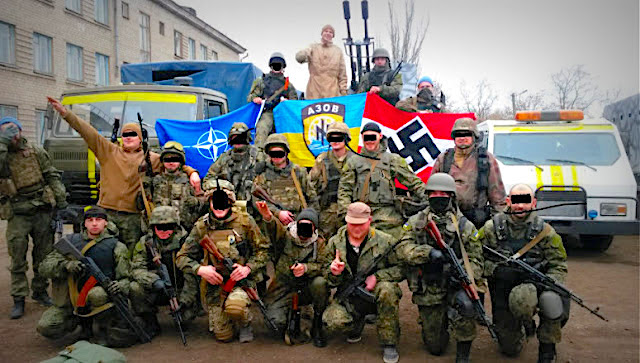
So, for nearly a year and a half, the West’s mainstream media, especially The New York Times and The Washington Post, twisted their reporting into all kinds of contortions to avoid telling their readers that the new regime in Kiev was permeated by and dependent on neo-Nazi fighters and Ukrainian ultra-nationalists who wanted a pure-blood Ukraine, without ethnic Russians.

Azov Battalion members. ( Gianluca Agostini/Wikimedia Commons)
Any mention of that sordid reality was deemed “Russian propaganda” and anyone who spoke this inconvenient truth was a “stooge of Moscow.” It wasn’t until July 7 that the Times admitted the importance of the neo-Nazis and other ultra-nationalists in waging war against ethnic Russian rebels in the east. The Times also reported that these far-right forces had been joined by Islamic militants. Some of those jihadists have been called “brothers” of the hyper-brutal Islamic State.
Though the Times sought to spin this remarkable military alliance neo-Nazi militias and Islamic jihadists as a positive, the reality had to be jarring for readers who had bought into the Western propaganda about noble “pro-democracy” forces resisting evil “Russian aggression.”
Perhaps the Times sensed that it could no longer keep the lid on the troubling truth in Ukraine. For weeks, the Right Sektor militias and the neo-Nazi Azov battalion have been warning the civilian government in Kiev that they might turn on it and create a new order more to their liking.
Clashes in the West

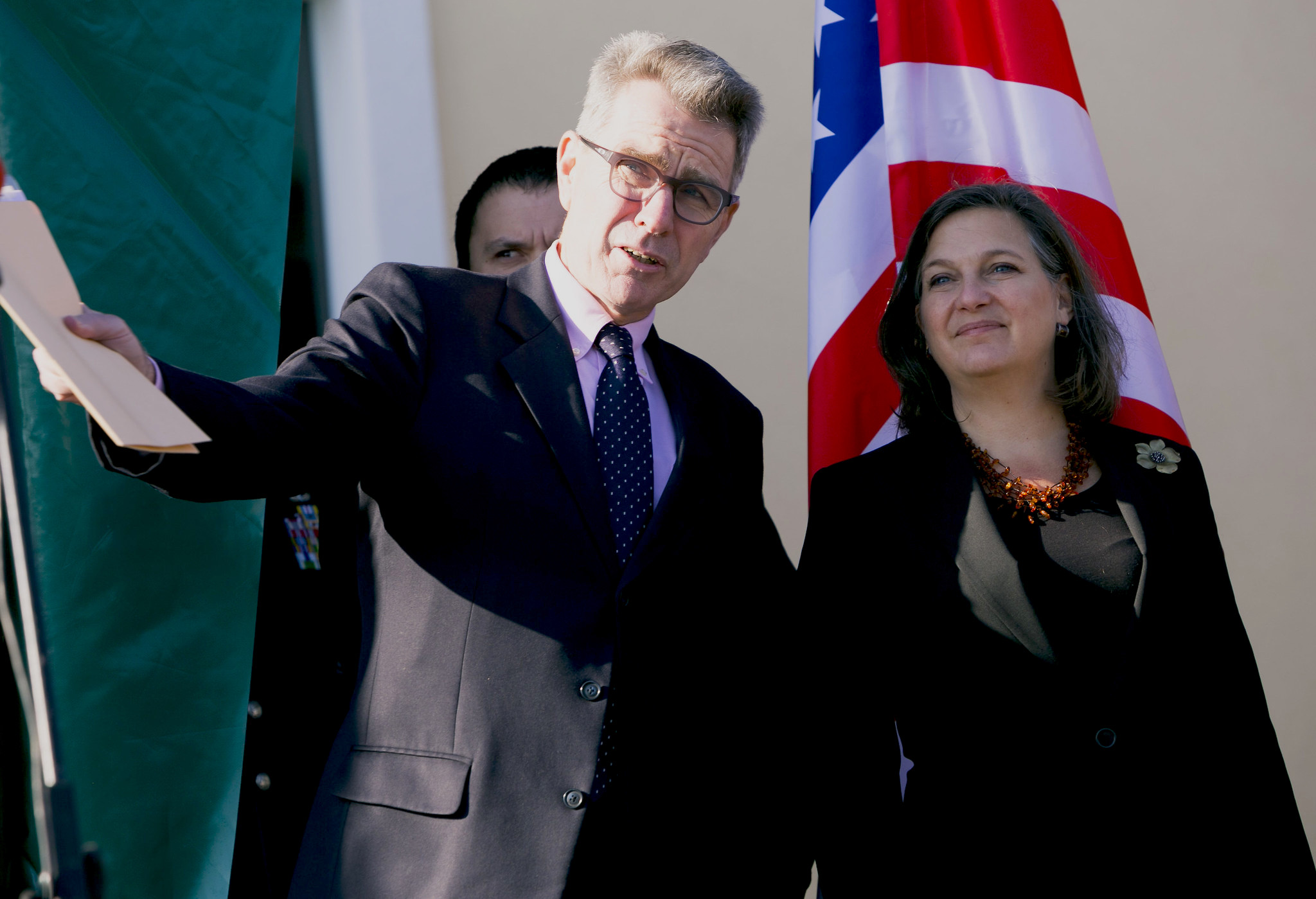
Oct. 8, 2014: U.S. Assistant Secretary of State Victoria Nuland at a Ukrainian State Border Guard Service Base in Kiev. (U.S. Embassy Kyiv, Flickr)
Then, on Saturday, violent clashes broke out in the western Ukrainian town of Mukachevo, allegedly over the control of cigarette-smuggling routes. Right Sektor paramilitaries sprayed police officers with bullets from a belt-fed machine gun, and police backed by Ukrainian government troops returned fire. Several deaths and multiple injuries were reported.
Tensions escalated on Monday with President Petro Poroshenko ordering national security forces to disarm “armed cells” of political movements. Meanwhile, the Right Sektor dispatched reinforcements to the area while other militiamen converged on the capital of Kiev.
While President Poroshenko and Right Sektor leader Dmitry Yarosh may succeed in tamping down this latest flare-up of hostilities, they may be only postponing the inevitable: a conflict between the U.S.-backed authorities in Kiev and the neo-Nazis and other right-wing fighters who spearheaded last year’s coup and have been at the front lines of the fighting against ethnic Russian rebels in the east.
The Ukrainian right-wing extremists feel they have carried the heaviest burden in the war against the ethnic Russians and resent the politicians living in the relative safety and comfort of Kiev. In March, Poroshenko also fired thuggish oligarch Igor Kolomoisky as governor of the southeastern province of Dnipropetrovsk Oblast. Kolomoisky had been the primary benefactor of the Right Sektor militias.
So, as has become apparent across Europe and even in Washington, the Ukraine crisis is spinning out of control, making the State Department’s preferred narrative of the conflict that it’s all Russian President Vladimir Putin’s fault harder and harder to sell.
How Ukraine is supposed to pull itself out of what looks like a death spiral a possible two-front war in the east and the west along with a crashing economy is hard to comprehend. The European Union, confronting budgetary crises over Greece and other EU members, has little money or patience for Ukraine, its neo-Nazis and its socio-political chaos.
America’s neocons at The Washington Post and elsewhere still rant about the need for the Obama administration to sink more billions upon billions of dollars into post-coup Ukraine because it “shares our values.” But that argument, too, is collapsing as Americans see the heart of a racist nationalism beating inside Ukraine’s new order.
Another Neocon ‘Regime Change’
Much of what has happened, of course, was predictable and indeed was predicted, but neocon Nuland couldn’t resist the temptation to pull off a “regime change” that she could call her own.
Her husband (and arch-neocon) Robert Kagan had co-founded the Project for the New American Century in 1998 around a demand for “regime change” in Iraq, a project that was accomplished in 2003 with President George W. Bush’s invasion.
As with Nuland in Ukraine, Kagan and his fellow neocons thought they could engineer an easy invasion of Iraq, oust Saddam Hussein and install some hand-picked client in Iraq, Ahmed Chalabi was to be “the guy.” But they failed to take into account the harsh realities of Iraq, such as the fissures between Sunnis and Shiites, exposed by the U.S.-led invasion and occupation.
In Ukraine, Nuland and her neocon and liberal-interventionist friends saw the chance to poke Putin in the eye by encouraging violent protests to overthrow Russia-friendly President Yanukovych and put in place a new regime hostile to Moscow.
Carl Gershman, the neocon president of the U.S.-taxpayer-funded National Endowment for Democracy, explained the plan in a Post op-ed on Sept. 26, 2013. Gershman called Ukraine “the biggest prize” and an important interim step toward toppling Putin, who “may find himself on the losing end not just in the near abroad but within Russia itself.”

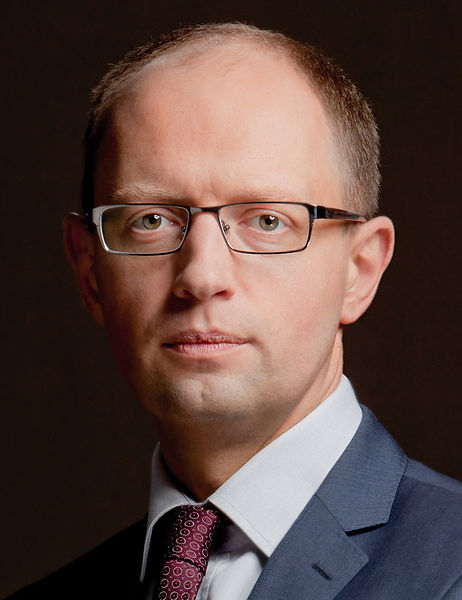
Then Ukrainian Prime Minister Arseniy Yatsenyuk. (Ybilyk)
For her part, Nuland passed out cookies to anti-Yanukovych demonstrators at the Maidan square, reminded Ukrainian business leaders that the U.S. had invested $5 billion in their “European aspirations,” declared “fuck the EU” for its less aggressive approach, and discussed with U.S. Ambassador Geoffrey Pyatt who the new leaders of Ukraine should be. “Yats is the guy,” she said, referring to Arseniy Yatsenyuk.
Nuland saw her big chance on Feb. 20, 2014, when a mysterious sniper apparently firing from a building controlled by the Right Sektor shot and killed both police and protesters, escalating the crisis. On Feb. 21, in a desperate bid to avert more violence, Yanukovych agreed to a European-guaranteed plan in which he accepted reduced powers and called for early elections so he could be voted out of office.
But that wasn’t enough for the anti-Yanukovych forces who led by Right Sektor and neo-Nazi militias overran government buildings on Feb. 22, forcing Yanukovych and many of his officials to flee for their lives. With armed thugs patrolling the corridors of power, the final path to “regime change” was clear.
Instead of trying to salvage the Feb. 21 agreement, Nuland and European officials arranged for an unconstitutional procedure to strip Yanukovych of the presidency and declared the new regime “legitimate.” Nuland’s “guy” Yatsenyuk became prime minister.
While Nuland and her neocon cohorts celebrated, their “regime change” prompted an obvious reaction from Putin, who recognized the strategic threat that this hostile new regime posed to the historic Russian naval base at Sevastopol in Crimea. On Feb. 23, he began to take steps to protect those Russian interests.
Ethnic Hatreds

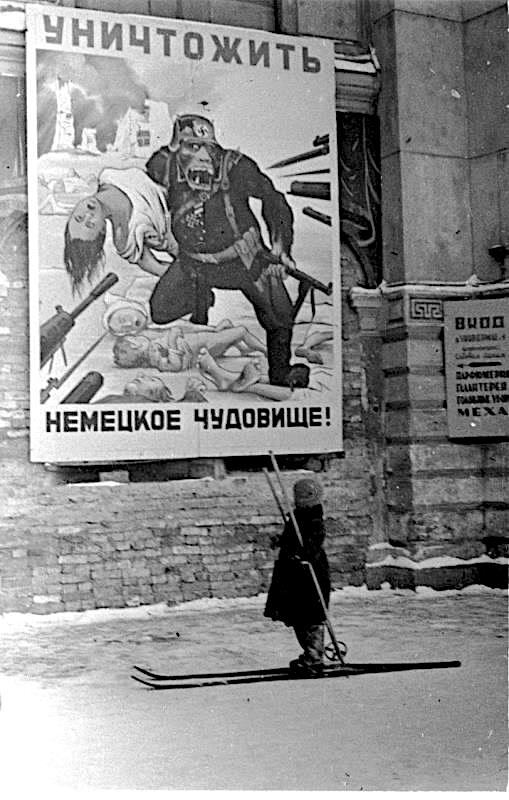
Lviv (west Ukraine) during WWII. Inscription on Soviet poster says: Destroy German Monster. (Unknown/Wikimedia Commons)
What the coup also did was revive long pent-up antagonisms between the ethnic Ukrainians in the west, including elements that had supported Adolf Hitler’s invasion of the Soviet Union during World War Two, and ethnic Russians in the south and east who feared the anti-Russian sentiments emanating from Kiev.
First, in Crimea and then in the so-called Donbas region, these ethnic Russians, who had been Yanukovych’s political base, resisted what they viewed as the illegitimate overthrow of their elected president. Both areas held referenda seeking separation from Ukraine, a move that Russia accepted in Crimea but resisted with the Donbas.
However, when the Kiev regime announced an “anti-terrorism operation” against the Donbas and dispatched neo-Nazi and other extremist militias to be the tip of the spear, Moscow began quietly assisting the embattled ethnic Russian rebels, a move that Nuland, the Obama administration and the mainstream news media called “Russian aggression.”
Amid the Western hysteria over Russia’s supposedly “imperial designs” and the thorough demonizing of Putin, President Barack Obama essentially authorized a new Cold War against Russia, reflected now in new U.S. strategic planning that could cost the U.S. taxpayers trillions of dollars and risk a possible nuclear confrontation.
Yet, despite the extraordinary costs and dangers, Nuland failed to appreciate the practical on-the-ground realities, much as her husband and other neocons did in Iraq. While Nuland got her hand-picked client Yatsenyuk installed and he did oversee a U.S.-demanded “neo-liberal” economic plan slashing pensions, heating assistance and other social programs the chaos that her “regime change” unleashed transformed Ukraine into a financial black hole.
With few prospects for a clear-cut victory over the ethnic Russian resistance in the east and with the neo-Nazi/Islamist militias increasingly restless over the stalemate the chances to restore any meaningful sense of order in the country appear remote. Unemployment is soaring and the government is essentially bankrupt.
The last best hope for some stability may have been the Minsk-2 agreement in February 2015, calling for a federalized system to give the Donbas more autonomy, but Nuland’s Prime Minister Yatsenyuk sabotaged the deal in March by inserting a poison pill that essentially demanded that the ethnic Russian rebels first surrender.
Now, the Ukraine chaos threatens to spiral even further out of control with the neo-Nazis and other right-wing militias supplied with a bounty of weapons to kill ethnic Russians in the east turning on the political leadership in Kiev.
In other words, the neocons have struck again, dreaming up a “regime change” scheme that ignored practical realities, such as ethnic and religious fissures. Then, as the blood flowed and the suffering worsened, the neocons just sought out someone else to blame.
Thus, it seems unlikely that Nuland, regarded by some in Washington as the new “star” in U.S. foreign policy, will be fired for her dangerous incompetence, just as most neocons who authored the Iraq disaster remain “respected” experts employed by major think tanks, given prized space on op-ed pages, and consulted at the highest levels of the U.S. government.
RICHMOND EDUCATORS ARE FIRST IN VIRGINIA TO WIN BARGAINING RIGHTS
https://popularresistance.org/richmond-educators-are-first-in-virginia-to-win-bargaining-rights/
By Vernon Snow,
February 25, 2022
RESIST!
Above Photo: Richmond is the first school district in Virginia to reinstate collective bargaining rights, after the legislature in 2020 lifted the state’s 43-year prohibition on collective bargaining for local government workers. Vernon Snow.
Teachers and other public school employees in Richmond, Virginia, won a major victory in December when the city’s school board, in an 8 to 1 vote, approved a resolution granting them collective bargaining rights.
The victory sets a precedent for other districts and public sector employees throughout the state. Richmond is the first school district in Virginia to reinstate collective bargaining rights, after the legislature in 2020 lifted the state’s 43-year prohibition on collective bargaining for local government workers.
Members of the school board had made repeated attempts to delay the vote. Winning took a mass mobilization led by the Richmond Education Association, which convened district-wide workers’ assemblies, held rallies outside school board meetings, and shared dozens of teacher testimonies during public comment periods.
What finally passed was a compromise resolution stating that the union and the school district can each bring only two bargaining issues to the table for the first negotiated contract, which will last three years. Still, by overturning the sweeping ban on contract negotiations, this compromise opens the terrain to expand union power in every school building.
Patchwork Of Rights
Under the new state law, which took effect May 1, 2021, each governing body (such as a school board) can vote to authorize collective bargaining rights for its employees, after which the union is permitted to hold an authorization vote among the workers.
This means there will be a patchwork of public sector bargaining rights throughout the state. Virginia’s anti-union right-to-work law remains in effect; so does its draconian ban on public sector strikes. Bargaining is still banned for state employees.
Virginia banned negotiations with public sector unions in 1946 to break the power of Local 550 of the CIO-affiliated State, County, and Municipal Workers of America, the all-Black union at the University of Virginia hospital.
In 1971 a federal district court found this prohibition unconstitutional, and public sector unions were authorized to negotiate contracts. But in 1977, the state Supreme Court reinstated the ban on bargaining for all public sector employees in the state, including those employed by local entities like Richmond Public Schools.
Authorization Card Drive
Although Richmond school employees didn’t have collective bargaining rights, they did have a union, the REA, with more than 1,000 members and a network of shop stewards.
After the new law passed in 2020, the union’s organizing committee led a grassroots campaign school by school—mobilizing both members and non-members to sign authorization cards and demand the reinstatement of collective bargaining rights.
Since Virginia is a right-to-work state, non-members can sign authorization cards in support of collective bargaining, but only members will be able to participate in negotiations and provide input on the contract.
The cards were used to show the school board how much support there was for collective bargaining, and to build momentum for an election to authorize the REA as the exclusive bargaining agent, which will be the next step.
REA also built community support by reaching out to parents and other unions, even holding committee meetings at the picket line of the Nabisco strike by Bakery Workers (BCGTM) Local 358.
These acts of solidarity paid off—members of Local 358 were among those who joined the REA rally outside the December 6 school board meeting where collective bargaining rights were finally granted.
Organized From Below
Members of the Richmond chapter of the Virginia Caucus of Rank-and-File Educators were at the center of the campaign as organizing committee members, shop stewards, and members of the REA executive board.
VCORE was founded after the 2018-2019 strike wave. The founding members, critical of their statewide union’s emphasis on lobbying, sought to transform it into a more democratic and effective fighting organization in the workplace. They were inspired by the Caucus of Rank-and-File Educators that had rebuilt Chicago Teachers Union by organizing from the bottom up.
VCORE has advocated for stronger relationships with other labor and community organizations, and for democratic participation and mass mobilization.
The caucus pushed the REA to reinvigorate its steward system. The union is training a new layer of worksite leaders to organize its authorization card campaign; these leaders will form the basis of contract action teams in future negotiations.
“Any veteran union organizer knows that the quality of the contract that the REA will win is contingent upon the strength of its organization in the workplace and willingness of its members to take action,” said Cole Oberman, a member of REA and VCORE.
VCORE members also advocated for the union to convene district-wide assemblies where all categories of school district workers—not just teachers—could identify and analyze the issues they were facing on the job and determine how to respond.
So far the REA has convened three of these assemblies, bringing together more than 100 workers total. For many, this was their first time interacting with the union. They talked about staffing shortages, uncompensated working hours, class sizes, district-mandated curriculum, decrepit buildings, and bullying by administration.
No Easy Road Ahead
The REA and its parent VEA have faced dogged opposition from employers and politicians, Democratic and Republican alike, and they have a difficult road ahead.
It was a Democrat-controlled school board in Richmond that considerably delayed and tried to weaken the collective bargaining resolution. Outgoing Democratic Governor Ralph Northam had delayed from 2020 to 2021 the implementation of the law reinstating collective bargaining rights.
The new Republican Governor Glenn Youngkin has announced his intention to launch an all-out offensive against anti-racist education, public schools, teacher autonomy, public health, and the labor movement. He has established a tip line through which parents can report on educators who engage in “divisive practices.” Among the regressive bills introduced in the first few weeks of his administration is one attempting to reinstate the ban on public sector collective bargaining rights.
Meanwhile the Virginia School Boards Association has taken a legislative stance against collective bargaining and continues to host anti-union trainings for local school boards.
It is in this context that the REA must organize a union authorization campaign (it must win an election to become the official bargaining unit representative), and then lead contract negotiations.
Beyond Richmond
Despite these challenges, the awful working and learning conditions provide fertile ground for organizing. Virginia ranks 50th nationwide for teacher pay compared to other occupations, a recent study found. In Richmond, educational support staff such as instructional assistants have spoken out against poverty wages.
And beyond the schools, a recent study from the Commonwealth Institute found that 80 percent of Richmond public sector employees are unable to support a family in the city.
Workers in other municipalities are pushing for collective bargaining too. On December 7, firefighters and county workers in Loudoun County won a collective bargaining resolution from their board of supervisors. On January 18, the newly formed Virginia Beach City Workers Union, Electrical Workers (UE) Local 111, rallied outside a city council meeting to push for collective bargaining rights.
“This victory has excited workers around the state who have long felt disillusioned with the business union model,” said elementary English as a Second Language teacher Noor Sami, a member of REA and VCORE. “People are beginning to feel like change is not only possible, but likely. Just in my school alone, everyone is looking at the REA with new eyes and excited to see what comes next.”
THE AMERICAN POLITICAL PROCESS IS DISCONNECTED FROM ECONOMIC REALITY
https://popularresistance.org/the-american-political-process-is-disconnected-from-economic-reality/
By Richard D. Wolff,
February 25, 2022
EDUCATE!
Above Photo: Nathaniel St. Clair.
The growing disconnect between the capitalist system and the economic realities plaguing the United States is now nearing completion. On the ground, the accumulated problems of U.S. capitalism undermine its empire and challenge its very future. Meanwhile, the ever-deepening inequalities of wealth and income conjure up images of ancient Egypt’s pharaohs. Three economic crashes opening the new century (2000, 2008, and 2020) have shaken the system; so have the two wars America lost against very poor countries in the Middle East: Afghanistan and Iraq. The worst public health crisis in a century during the COVID-19 pandemic has further exposed how unprepared U.S. capitalism was and is, thereby imposing massive new human and financial costs lasting into the future.
A government that serves U.S. capitalism first and foremost borrowed trillions and enabled trillions more of new debt (corporate and household) that was used to fight long, losing wars and shore up a faltering economy. Now, after two terrible years of COVID plus an economic crash, with 3 million fewer jobs in 2022 than before COVID hit, a sharp inflation looms. Meanwhile, aided partly by profit-driven U.S. capitalists who moved their operations to China, the Asian country is now in a position where it is challenging U.S. capitalism globally.
Above the troubled ground sit two old political parties, the GOP and the Democratic Party, which are formed by and are stuck in the old political economy before all these problems accumulated into crises. From 1820 to 1970, U.S. capitalism experienced cycles, but these cycles were securely anchored in a long-term upward trend. Real wages rose every decade, at least for white workers. Recessionary downturns only interrupted the long trend up (and even then not for long). The Republican Party and the Democratic Party rarely went beyond the routine rituals of orderly contests over who deserved the credit for economic growth and who deserved the blame for the interruptions during recessions.
The one big exception resulted from the one super big interruption: the 1930s Great Depression. This shook U.S. capitalism to its core. Mobilized and led by a coalition of militant unions (CIO), socialist parties, and a communist party, the U.S. working class shifted sharply to the left. This shift won a New Deal from the administration of President Franklin D. Roosevelt. That deal taxed corporations and the rich significantly more. It then poured much of those funds into the new Social Security system, unemployment compensation, and a massive federal jobs program. Because of the New Deal, Roosevelt was reelected three times, and was the most popular president in U.S. history. Correspondingly, U.S. corporations and those they enriched felt seriously threatened during this period.
The GOP reacted strongly. Once FDR died and World War II ended, the Republican Party took the lead to undo the New Deal. It did this by splitting the coalition (which included the CIO, socialists, and communists) from the Democratic Party and the coalition partners from one another. Anti-communism, McCarthyism, and the Cold War served as the weapons of choice for the Republican Party. The GOP succeeded partly because the Democrats offered mostly weak opposition or none at all. Postwar Democrats were largely complicit in destroying most of what the New Deal had achieved (with the help, ironically, of many of the Democratic Party’s own prewar efforts). After 1945, the White House, Congress, and state and local governments resumed orderly political contests between the GOP and the Democratic Party. Both endorsed a musical chairs type of rotation of public authority personnel between them (until this system was undone by former President Donald Trump in 2020).
The old, established leaders of both parties still do not grasp or accept that the orderly rotation of public authority personnel is now over. Unable or unwilling to critically evaluate U.S. capitalism, these leaders missed the signs leading up to the accumulation of capitalism’s problems that now overwhelms them. The Bushes, Clintons, President Joe Biden, and their ilk want the old political system to persist. After all, for them this old political system did well. But now their disconnect from the capitalist reality that ultimately controls them threatens to render them blatantly ineffective, sadly out of their element. Because they cannot or dare not criticize that reality, its increasing difficulties and resulting mass disaffection are beyond their reach with the old tools, arguments, and spins that used to work.
Given the disconnected mainstreams of U.S. politics, mass disaffection provokes escapism and scapegoating. The GOP eagerly validates many of them (anti-immigration, white supremacy, quasi-fascism, culture wars, and anti-leftism) to enlarge its voter base. The Democrats, meanwhile, try to fight the extreme forms of that escapism and scapegoating (as in “basket of deplorables”) without offering any real alternative to it. The socialism represented by politicians like Senator Bernie Sanders (I-VT) and Representative Alexandria Ocasio-Cortez (D-NY) is so soft-pedaled by them that, given mainstream media biases, it only marginally hovers at the edges of the national political conversation.
What people increasingly need is protection from a beleaguered capitalist system itself, from its intrinsic instability (the accumulated crashes and their effects), intrinsic inequalities of wealth and income (and their effects), devastating ecological damages, and profit fetishism. But the GOP and the Democratic Party have long ago lost the ability to see or contend with any of that. They keep repeating neoliberal ideology (and its reframing of a U.S. empire as “globalization”) so often that they actually believe and are thereby imprisoned within the system.
Thus, a peculiar political theater of disconnectedness has emerged. The Republican and Democratic leaders cannot see what most of us can. They see “the big issues” as not being about capitalism. Yet what they do see and the solutions they propose will in fact be their response as capitalism’s crisis deepens. Thus, under Trump, the Republican Party has moved toward fascism. His GOP has used and will continue to use government to enforce capitalism as it totters by extinguishing what remains of unions, crushing the left, and militarizing media and culture, much as other dictators have, including Adolf Hitler in Germany after January 1933 and Benito Mussolini in Italy after October 1922. Like them, Trump has used hyperpatriotic nationalism mixed with racial superiority to justify all his actions. That is the real meaning behind Trump’s campaign slogans and his audiences’ cheers of “save America” and “Make America Great Again.” How far down the German and Italian fascist paths Trump and others like him will go depends on circumstances.
Capitalism’s crisis exists neither for Biden nor the Democratic establishment he leads, just as it does not for Trump and the GOP. The Democratic establishment defines itself over and against Trump. It is not about to go down the fascist road. It proposes instead to “protect democracy” from what Trump represents. That difference will frame many electoral campaigns in 2022 and 2024; it already does. The Democrats will “protect democracy” by “returning to the pre-pandemic normal.” The Democratic Party’s version of “Make America Great Again” is a resurrected post-World War II political economy, complete with U.S. global dominance based securely, they imagine, on a fast-growing U.S. capitalism.
Both the Republican and Democratic establishments warn their megadonors and the public that allowing the other to take political power will disrupt civil society and prevent America from becoming great again. The GOP screams that antifa and the Black Lives Matter movement will destroy white America and will result in a civil war. The Democrats counter that Trump and January 6 type “insurgents” will dissolve social peace inside the United States, provoke counteractions, and thereby lead to civil conflict. Social peace, each side insists, requires political war to defeat the other side. Neither side glimpses the absurd contradiction of its claims.
Which way U.S. politics will go depends less on the two parties or their disconnected rhetoric. What matters far more are the actualities of U.S. capitalism as the U.S. empire continues to decline and U.S. capitalism’s accumulated problems worsen. These latter factors will determine how the public views the parties’ disconnected policies. Today’s inflation offers an example of this. As a further slap in the face of the U.S. working class who have dealt with two years of economic crash plus the health catastrophe of COVID-19, inflation and the rising interest rates aimed to stop it will ultimately shake capitalism and shape politics.
How many angry working families will now sympathize with a politician who offers big changes versus a politician who offers “stay the course”? The business community wants inflation stopped. The responsive Fed will thus resort to quantitative tightening and raising interest rates. The responsive Biden will applaud the Fed. Those Fed actions can and likely will threaten jobs. So Biden must choose between the electoral risks of inflation versus those of job deterioration. That is the risky dead-end “choice” that the problems of capitalism will dump on Biden. And if 2022 proves to be the year when capitalism’s crisis breaks into the explicit open, will most Americans tilt toward Trump-type fascism or the “democracy protection” offered by the Democrats to protect themselves from capitalism’s crisis?
Hitler’s and Mussolini’s fascist solutions to crises in their nations’ capitalisms did not end well. Yet today’s leading U.S. capitalists seem not to know or care about historical precedents. They continue to perform their disconnected politics comfortably, oblivious to the imploding capitalism and the resulting damage to Americans. In that, they resemble the upper classes in Russia (up to 1917), in Germany (up to 1933), and in Italy (up to 1922). The most important questions thus become whether or not and how soon a new left can emerge that targets capitalism per se, proposes an alternative system, and charts a transition to this alternative system.
THE GOVERNMENT JUST ADMITTED AN INCONVENIENT TRUTH
A GOP-led budget office details how corporate-run health care is crushing workers.
https://popularresistance.org/the-government-just-admitted-an-inconvenient-truth/
By David Sirota And Aditi Ramaswami,
February 25, 2022
EDUCATE!
And how Medicare for All would boost the economy.
Every now and then, federal officials admit some truths that are inconvenient to the corporations that own the government — and this latest admission is pretty explicit: Scrapping corporate health care and creating a government-sponsored medical system would boost the economy, help workers, and increase longevity.
Those are just some of the findings from the Republican-led Congressional Budget Office (CBO) in a new report that implicitly tells lawmakers just how the existing corporate-run health care system is immiserating millions of Americans — and how a Medicare for All-style system could quickly fix the catastrophe.
If that sounds like hyperbole, consider the analysis in its own words. The CBO reports that under a single-payer health care system:
“Households’ health insurance premiums would be eliminated, and their out-of-pocket health care costs would decline… Administrative expenses in the health care sector would decline, freeing up productive resources for other sectors and ultimately increasing economy-wide productivity… Longevity and labor productivity would increase as people’s health outcomes improved.”
“Workers would choose to work fewer hours, on average, despite higher wages because the reduction in health insurance premiums and (out-of-pocket) expenses would generate a positive wealth effect that allowed households to spend their time on activities other than paid work and maintain the same standard of living.”
“That wealth effect would boost households’ disposable income, which they could then split between increased saving and nonhealth consumption. Although hours worked per capita would decline, the effect on GDP would be offset under most policy specifications by an increase in economy-wide productivity, an increase in the size of the labor force, an increase in the average worker’s labor productivity, and a rise in the capital stock.”
“States could respond to the (ensuing) budget surplus by growing their rainy-day funds (at least temporarily), reducing state tax rates, increasing spending on government purchases or public services, or a combination of all three.”
The report’s findings tacitly admit that the existing employer-based, corporate-run health care system locks the non-rich into toiling more and more hours just to be able to afford ever-higher costs for insurance coverage and medical care.
Indeed, CBO declares that under a single-payer system, households would “retire at younger ages” and “hours worked would be lower for most households across the income distribution.” Under the five single-payer scenarios the agency evaluated, a “reduction in hours worked would be largest among lower- and middle-income households because those groups would see the largest percentage increase in wage rates and reductions in (out-of-pocket) expenses and premiums.”
CBO’s report seems to cast these forecasts as a warning — but they should be welcome news. Studies have long shown that on average, Americans work more hours than their counterparts in other industrialized nations, and they receive among the fewest hours for vacation and paid family leave.
CBO is effectively admitting that the corporate health care system is intensifying that problem.
One health care option evaluated by the CBO includes more robust coverage for home- and community-based care services, which provide patients with long-term assistance with daily living activities such as bathing or dressing. In addition to increasing eligibility and expanding those services for patients, the report notes that increased funding would create a 7 percent pay increase for home health care workers, who are among the lowest paid workers in the economy.
And yet for all the single-payer health care benefits outlined by CBO, Medicare for All remains stalled in a political system where stakeholders in the existing corporate health care system are spending hundreds of millions of dollars to buy elections and public policy.
That political influence was on display in the most recent presidential election, when Joe Biden kicked off his campaign with a fundraiser with a health insurance CEO, and then vowed to veto Medicare for All legislation if it came to his desk. He instead touted his proposal of building upon the Affordable Care Act with a public health insurance option.
But Biden hasn’t pushed that public option plan as president — he even omitted it from his budget plan last year. He and Democratic leaders have instead adopted proposals from health insurance lobbyists to put more Americans on subsidized for-profit health insurance plans.
More recently, California’s attempt to create a first-in-the-nation single-payer system failed after corporate interests won the day in a state where an overwhelming majority of voters believe the governor and legislature should prioritize working toward guaranteeing all residents health insurance coverage. The single-payer bill was killed by Democratic lawmakers just after their party received a $1 million check from a major private health insurer.
Despite those setbacks, the new CBO report is a loud alarm about the establishment’s sociopathic hostility to commonsense health care policy – and it comes from an important source.
The office is hardly some bastion of left-wing utopianism, and in a money-drenched political system, the federal government rarely ever admits such scathing truths about the status quo — especially truths that underscore how much better life could be with the kinds of reforms other nations long ago made.
HOW THE US INSTIGATED THE UKRAINE CRISIS
https://popularresistance.org/how-the-us-instigated-the-ukraine-crisis/
By Rick Sterling,
February 25, 2022
EDUCATE!
Above Photo: Ukraine has repeatedly stated its intention to become a NATO member state – an objective that is written into the country’s constitution. Ints Kalnins / Reuters.
Russia has sent troops into Ukraine and attacked Ukrainian military forces .
In a one hour address, President Putin said the goal was the “de-Nazification” of Ukraine.
It is now clear the Russian statements and proposed peace treaty in December 2021 were deadly serious. At that time the Russians said the US and NATO were crossing red lines, they felt threatened and would not abide this endlessly. Now they have taken action.
In his address yesterday, Russian President Putin gave a frank explanation which comes after years of complaints. The Russians have complained bitterly about the US-promoted 2014 coup in Ukraine, the eastward expansion of NATO, the installation of missiles in Romania and Poland, the pretense that the missiles were for defense against Iran, the 2019 US withdrawal from the Intermediate Nuclear Forces agreement, the aggression against Russian speaking Ukrainians in the east.
President Putin compared the situation to WW2 where the Soviet was invaded and lost 27 million citizens to Nazi Germany. He vowed to not repeat the mistake of endlessly trying to appease the aggressor.
Comparison to the Cuba Crisis
This conflict is unnecessary. It could have been avoided by simple agreement to not include Ukraine in NATO and to withdraw missile systems from Romania and Poland. Unless NATO is planning war with Russia, those agreements are eminently sensible.
In 1962 the United States drew a red line saying the Soviet Union could not install missiles in Cuba. They threatened world war to make this stand. The distance from Havana Cuba to Washington DC is over 1100 miles. In contrast, the distance from Kiev, Ukraine to Moscow in Russia is under 500 miles. Is it not clear why the Russians feel threatened?
Essential Background and Facts
Following are factors to consider in evaluating who is to blame for the current crisis and bloodshed. When we hear analysis of the situation which entirely ignores the following facts, it is a sure sign of distortion and bias.
Fact 1: In February 2014, a coup overthrew the Ukrainian government which came to power in an election certified by the OSCE (Organization for Security and Cooperation). The president, Viktor Yanukovich, was forced to flee for his life.
This situation was presciently analyzed at the time by Seumas Milne who wrote:
The attempt to lever Kiev into the western camp by ousting an elected leader made conflict certain. It could be a threat to us all.
Fact 2: The coup was promoted by United States officials. Neo-conservatives such as Victoria Nuland and John McCain actively supported the protests. As confirmed in a secretly recorded phone call, Nuland determined the post-coup composition weeks in advance. Later, Nuland bragged they spent $5 billion in this campaign over two decades. Before the coup was “midwifed”, Nuland forcefully rejected a likely European compromise agreement which would have led to a compromise government. “F*** the EU!”, she said. Nuland managed the coup but Vice President Biden was overall in charge. As Nuland says in the phone call, Biden would give the ultimate “atta boy” to the coup leaders. Subsequently, Joe Biden’s son personally benefited from the coup. Victoria Nuland has even more power now as the Under Secretary of State for Political Affairs. Secret US forces such as the Central Intelligence Agency must also be involved.
Fact 3: The coup government immediately acted with hostility toward its Russian speaking citizens. Approximately [30%](https://en.wikipedia.org/wiki/Languages_of_Ukraine#:~:text=Russian is the native language,to the former Soviet Union.) of Ukrainian citizens have Russian as their first language, yet on the first day in power, the coup regime acted to make Russian no longer an official state language. This was followed by more actions of hostility. As documented in the video “Crimes of the Euromaidan Nazis”, a convoy of buses going back to Crimea was attacked. In Odessa, over thirty opponents of the coup government died when they were attacked and the trade union hall set afire.
Fact 4: During World War 2, there were some Nazi sympathizers in western Ukraine when the Germans invaded the Soviet Union. This element continues today in the form of Svoboda and other far right nationalist parties. The Ukrainian government has even passed legislation heroizing Nazi collaborators while removing statues honoring anti-Nazi patriots. The situation was described three years ago in an article “Neo-nazis and the far right are on the march in Ukraine“. The author questioned why the US is supporting this. Under President Poroshenko (2014 to 2019) nationalism surged and even the Orthodox Church split apart.
Fact 5: The secession of Crimea, Donetsk and Luhansk are a direct result of the 2014 coup. In Crimea, a referendum vote was rapidly organized. With 83% turnout and 97% voting in favor, Crimeans decided to secede from Ukraine and re-unify with Russia. Crimea was part of Russia since 1783. When the administration of Crimea was transferred to the Ukraine in 1954. they were all part of the Soviet Union. This was done without consulting the population.
Author’s note: I visited Crimea in 2017 and talked with diverse people including the popularly elected city council officials. There is no doubt about the overwhelming support for re-unification with Russia.
In the provinces of Luhansk and Donetsk on the border with Russia, the majority of the population speaks Russian and had no hostility to Russia. The Kiev coup regime was hostile and enacting policies they vehemently disagreed with. In spring 2014, the Luhansk and Donetsk Peoples Republics declared their independence from the Kiev regime.
Fact 6: The Minsk Agreements of 2014 and 2015 were signed by Ukraine, Ukrainian rebels, Russia and other European authorities. They were designed to stop the bloodshed in eastern Ukraine and retain the territorial integrity of Ukraine while granting a measure of autonomy to Luhansk and Donetsk. This is not abnormal; there are 17 autonomous zones in Europe. These agreements were later rebuffed by the Kiev government and Washington. Ukrainian militias have escalated their attacks in the Donbas region. The US and other NATO countries have been pouring weapons into Ukraine. Russell Bentley, a US citizen who now lives in Donetsk just miles from the front-lines, provides a compelling description of the situation.
After eight years trying to implement the Minsk Agreements, the Russian government gave up and recognized the Peoples Republics of Donetsk (DPR) and Luhansk (LPR) on 21 February 2022.
The US and NATO have little credibility to oppose secession since they promoted the breakup of Yugoslavia, secession of Kosovo from Serbia, secession of South Sudan from Sudan, and Kurdish secessionist efforts in Iraq and Syria, etc.. The secession of Crimea is justified by its unique history and overwhelming popular support. The secession of Luhansk and Donetsk may be justified by the illegal 2014 Kiev coup.
Conclusion
US intervention, both open and secret, has been a major driver of the events in Ukraine. The US has instigated the conflict. Ukrainians and Russians are now paying the price.
Let us hope that the violence ends quickly and a genuinely independent Ukraine, no longer a tool of the United States, emerges.
Number of wildfires to rise by 50 percent by 2100 and governments are not prepared, UN experts warn
https://www.sciencedaily.com/releases/2022/02/220225123552.htm
February 25, 2022
United Nations Environment Programme
Climate change and land-use change are projected to make wildfires more frequent and intense, with a global increase of extreme fires of up to 14 per cent by 2030, 30 per cent by the end of 2050 and 50 per cent by the end of the century, according to a new report by the UN Environment Programme (UNEP) and GRID-Arendal.
The paper calls for a radical change in government spending on wildfires, shifting their investments from reaction and response to prevention and preparedness.
The report, Spreading like Wildfire: The Rising Threat of Extraordinary Landscape Fires, finds an elevated risk even for the Arctic and other regions previously unaffected by wildfires. The report is released before representatives of 193 nations convene in Nairobi for the resumed 5th session of the UN Environment Assembly (UNEA-5.2), between 28 February and 2 March, 2022.
The publication calls on governments to adopt a new 'Fire Ready Formula,' with two-thirds of spending devoted to planning, prevention, preparedness, and recovery, with one third left for response. Currently, direct responses to wildfires typically receive over half of related expenditures, while planning and prevention receive less than one per cent.
To prevent fires, authors call for a combination of data and science-based monitoring systems with indigenous knowledge and for a stronger regional and international cooperation.
Current government responses to wildfires are often putting money in the wrong place. Those emergency service workers and firefighters on the frontlines who are risking their lives to fight forest wildfires need to be supported. We have to minimize the risk of extreme wildfires by being better prepared: invest more in fire risk reduction, work with local communities, and strengthen global commitment to fight climate change" said Inger Andersen, UNEP Executive Director.
Wildfires disproportionately affect the world's poorest nations. With an impact that extends for days, weeks and even years after the flames subside, they impede progress towards the UN Sustainable Development Goals and deepen social inequalities:
People's health is directly affected by inhaling wildfire smoke, causing respiratory and cardiovascular impacts and increased health effects for the most vulnerable;
The economic costs of rebuilding after areas are struck by wildfires can be beyond the means of low-income countries;
Watersheds are degraded by wildfires' pollutants; they also can lead to soil erosion causing more problems for waterways;
Wastes left behind are often highly contaminated and require appropriate disposal.
Wildfires and climate change are mutually exacerbating. Wildfires are made worse by climate change through increased drought, high air temperatures, low relative humidity, lightning, and strong winds resulting in hotter, drier, and longer fire seasons. At the same time, climate change is made worse by wildfires, mostly by ravaging sensitive and carbon-rich ecosystems like peatlands and rainforests. This turns landscapes into tinderboxes, making it harder to halt rising temperatures.
Wildlife and its natural habitats are rarely spared from wildfires, pushing some animal and plant species closer to extinction. A recent example is the Australian 2020 bushfires, which are estimated to have wiped out billions of domesticated and wild animals.
There is a critical need to better understand the behaviour of wildfires. Achieving and sustaining adaptive land and fire management requires a combination of policies, a legal framework and incentives that encourage appropriate land and fire use.
The restoration of ecosystems is an important avenue to mitigate the risk of wildfires before they occur and to build back better in their aftermath. Wetlands restoration and the reintroduction of species such as beavers, peatlands restoration, building at a distance from vegetation and preserving open space buffers are some examples of the essential investments into prevention, preparedness and recovery.
The report concludes with a call for stronger international standards for the safety and health of firefighters and for minimising the risks that they face before, during and after operations. This includes raising awareness of the risks of smoke inhalation, minimising the potential for life-threatening entrapments, and providing firefighters with access to adequate hydration, nutrition, rest, and recovery between shifts.
The report was commissioned in support of UNREDD and the UN Decade on Ecosystem Restoration. UNEP will be exploring how further investments can be made to reduce fire risks in critical ecosystems around the world.

Editor's Note
The report is available online: https://www.unep.org/resources/report/spreading-wildfire-rising-threat-extraordinary-landscape-fires
Story Source:
Materials provided by United Nations Environment Programme. Note: Content may be edited for style and length.
Media Lies About Ukraine/Russia DEBUNKED
https://www.youtube.com/watch?v=Xt3Zv-e4n1M&ab_channel=TheJimmyDoreShow
Ask Prof Wolff: Population Growth & Social Security
https://www.youtube.com/watch?v=U2tGq6k5I7I&ab_channel=DemocracyAtWork
Oh Kyle.. .On-Brand Trudeau: Jimmy Dore, Kim Iverson, Ana Kasparian, Aaron Maté VS Kyle Kulinski
https://www.youtube.com/watch?v=qr-xTcmP9j8&t=11728s&ab_channel=SparandBrawl
U.S. Left and Right United On Foreign Policy
https://www.youtube.com/watch?v=7zQP2vjF0uY&ab_channel=RichardMedhurst
The World Reacts to Russian Invasion of Ukraine
https://www.youtube.com/watch?v=ZqQ3KyjyllE&ab_channel=RichardMedhurst
Thursday Chat with Caleb! #DonbassLivesMatter
https://www.youtube.com/watch?v=DIRW7Rys0e8&ab_channel=CalebMaupin