by Don
Quijones
Chinese corporate defaults
this year through April are 3.4 times the amount last year.
By Don Quijones,
Spain, UK, & Mexico, editor at WOLF STREET.
Since the global financial
crisis, the total value of outstanding corporate bonds has doubled, from
around $37
trillion in 2008 to over $75
trillion today. But the growth has been far from even, with non-financial
debt growing much more rapidly in certain jurisdictions. As the volume and
price of this debt has grown, so too has its riskiness. And that could be a
recipe for disaster, warns Sir
John Cunliffe, deputy governor for financial stability at the Bank of England.
In the US, non-financial debt
is up 40% on the last peak in 2008. Cunliffe expressed even greater caution
concerning emerging markets, where corporate debt as a proportion of the global
debt pile has grown the most over the past 10 years. “Emerging market debt now
accounts for over a quarter of the global total compared to an eighth before
the crisis,” Cunliffe said.
Before the financial crisis,
emerging market companies were issuing a total of $70 billion per year in
bonds, according
to OECD data. That was before the world’s biggest central banks
embarked on the world’s biggest monetary experiment, in which companies the
world over were invited to participate.
By 2016, emerging market
corporations were issuing ten times more money ($711 billion) than before, much
of it in hard foreign currencies (mainly euros, dollars and yen) that will
prove much harder to pay back if their local currency slides, as is happening
in Turkey and Argentina right now. Although bond issuance by emerging market
companies declined by 29% in 2017 and remained around the same level in 2018,
it is still approximately 7.5 times higher than the pre-crisis level.
Much of the increase has been
driven by China as it transitioned from
a negligible level of issuance of corporate debt prior to the 2008 crisis to a
record issuance amount of $590 billion in 2016. During that time the number of
Chinese companies issuing bonds soared from
just 68 to a peak of 1,451 and the total amount of corporate debt in China
exploded from $4 trillion to almost $17 trillion, according
to BIS data. By late 2018 it had reached $19.7 trillion.
“There has been a persistent
buildup of private debt to record levels in China,” Cunliffe said. Much of this
increase took place in the direct aftermath of the financial crisis. The
largest increases have been in the corporate sector, mainly in state-owned
enterprises. At last count, China’s corporate debt-to-GDP ratio was 153%,
enough to earn it seventh place on WOLF STREET’s leaderboard
of countries with the most monstrous corporate debt pileups (as a
proportion of GDP), 18 places above the US. This chart compares the rise of
non-financial corporate debt in China and the US:
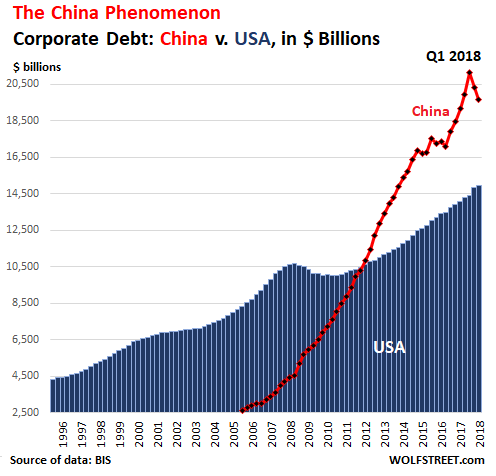
The rate of growth and level
of debt in China have passed the points where other economies, advanced and
emerging, have experienced sharp corrections in the past, noted Cunliffe citing
research carried out by the Bank of England.
Since early 2017 the Chinese
authorities have been scrambling to deleverage its corporate sector and shrink
its shadow banking system, with a certain degree of success (the hook in the
chart above): corporate debt-to-GDP ratio has fallen in the last two years by
almost 10%. However, in the face of slowing economic growth, the Chinese
government has dialed back some of these reforms as concern rises that a sharp
slowdown in growth would make China’s elevated debt levels even less sustainable.
And if things get seriously
sticky in China’s debt markets, it won’t take long before they’re felt
elsewhere, Cunliffe cautioned:
The Chinese economy is now
pivotal to regional growth and one of the main pillars of world growth and
trade. As well as the economic effects and effects directly through banking
exposures, it is likely that there would be a severe impact on financial market
sentiment, [as happened] in 2015 when a period of sharp correction in domestic
Chinese financial markets sparked a correction in US financial assets.
Problems once again appear to
be on the rise in China. Chinese companies defaulted on 39.2 billion yuan
($5.78 billion) of domestic bonds in the first four months of 2019, 3.4 times
the total for the same period of 2018, according
to data compiled by Bloomberg. For the moment, there’s little sign of
the problems spreading far beyond Chinese borders. In most advanced economies,
as well as quite a few emerging markets (Turkey and Argentina excluded), bond
spreads — the amount charged for risk, be that credit risk or liquidity risk —
are still at or near historically low levels.
But conditions can change on a
dime, as the short-lived drama at the end of 2018 amply demonstrated. Between
mid-October and the end of the year spreads on investment grade bonds widened
by around 50 bps, all on the back of “relatively modest amounts of news,”
Cunliffe noted. “Since then, these moves have fully retraced – spreads at the
start of May were the same as they were in mid-October last year. Bonds in
other currencies and high yield bonds went on a similar round trip.”
When it comes to expectations
about the value of debt, the market can be highly susceptible to changes in
sentiment, meaning a “correction can come very quickly”. As Cunliffe warns,
given the “current compression of risk pricing,” not to mention the sheer
abundance of poor quality, mispriced bonds out there, “such a correction could
be a sharp one.”

No comments:
Post a Comment