Saturday, May 11, 2019

Changing poverty formula, Trump administration to make millions ineligible for social programs


By Alex González


10 May 2019


The Trump administration released May 6 a proposal to change the way the official poverty rate is calculated. The move would involve altering the inflation formula so the poverty level increases at a slower rate, giving the artificial appearance that fewer people are poor. Major social programs, including Medicaid and food stamps, rely on the poverty rate to determine eligibility for benefits.

The proposal would be devastating for millions of people. More than 20 percent of the US population—some 52 million people—participated in means-tested programs in 2012, according to the Census Bureau. The change would gradually push millions off the rolls of government programs, intensifying the poverty and social misery of those denied already inadequate social assistance.

The proposed change was outlined by the Office of Management and Budget (OMB), under the direction of self-proclaimed “deficit hawk” and current acting White House Chief of Staff Mick Mulvaney. Having previously advocated slashing entitlement programs like Medicare and Social Security, Mulvaney is one of many Trump appointees setting policy for programs that they actually wish to destroy.

The OMB proposal calls for changing the government’s inflation formula to a so-called “chained consumer price index.” The “chained CPI” assumes that consumers substitute items that they usually buy with cheaper alternatives when prices rise. However, critics point out that, due to higher prices set by monopolies, individuals are not easily able to substitute many essential goods, such as transportation, healthcare, child care and housing.

The poverty line is adjusted each year to account for the consumer price index. The chained CPI would reflect slower inflation growth and therefore lead to fewer people being categorized as poor. The effects would be particularly dire for the elderly, because they are disproportionate users of healthcare, whose cost has typically risen much faster than prices overall.

The current poverty rate is already severely underestimated. The official poverty line was set in the 1960s as three times the cost of a basic diet, based on research showing that families spent about one third of their incomes on food. Now, however, families spend only about one seventh of their income of food and the rest on other basic necessities that are not sufficiently taken into consideration when determining who can receive social assistance.

A study by the National Center for Children in Poverty at Columbia University revealed that on average, a family of four would require double the official federal poverty level to make ends meet. Last year, the poverty level for a family of four was just $25,900.

While criticizing the outdated nature of the poverty-rate formula, the Trump administration is not looking to update it scientifically to reflect modern spending habits and allocate government resources more fairly and efficiently. Rather, it seeks to rig the rate artificially as a means of gutting social programs, enabling it to divert resources towards militarism, attacks on immigrants, and tax breaks for the rich.

This proposal is just the latest of Trump’s assaults on social programs. Trump’s proposed budget for the next fiscal year would impose the biggest cuts in Medicaid and Medicare in history, nearly $2 trillion over 10 years. Medicaid would be turned into a block grant for states, and the expansion of Medicaid under Obamacare would be repealed, leading to more than 10 million people losing healthcare. Trump’s fiscal year 2019 budget proposed cutting the budget for the Supplemental Nutrition Assistance Program (SNAP), commonly referred to as food stamps, by nearly 30 percent over 10 years.

In July of last year, the White House Council of Economic Advisors (CEA) declared that the “War on Poverty is largely over” and recommended implementing work requirements for non-cash government programs. Flying in the face of reality, the CEA declared that America no longer had “poverty” or “homelessness.”

On April of last year, Trump signed an executive order dictating that departments throughout his cabinet review which programs had work requirements affiliated with benefits. He instructed that programs lacking these requirements be either eliminated or consolidated, except when doing so would go against the law.

Trump’s tax bill, passed in December 2017 with no serious opposition from the Democratic Party, granted a windfall to the financial elite at an estimated cost of $1.5 trillion, creating conditions where social programs would be purposefully underfunded so they could be better attacked and dismantled.

The gutting of social programs was not initiated by Trump, but is bipartisan in nature. It was Obama who tried to introduce the chained CPI for federal programs in 2014. The move, which was eventually dropped due to popular opposition, would have cut Social Security payments by $130 billion and federal workers’ retirement benefits by $35 billion over 10 years. Obama’s 2012 fiscal year budget included $320 billion in Medicare and Medicaid cuts over 10 years.

In every country, the working class is coming under assault by a rapacious ruling class set on clawing back concessions fought for through sweat and blood by the working class throughout the 20th century. The attack on social program is a class response by the financial elite, who wish to solve their insoluble crisis by means of authoritarianism and war. The gargantuan $750 billion available to US imperialism to launch full-blown war abroad necessarily requires vicious attacks on the living standards and social benefits of working people at home.

The defense of social programs, the fight against war, and the struggle to reorganize social life on a scientific and democratic basis requires a break with the Democrats and the Republicans—both reactionary parties of the rich—and taking up the fight for socialism.


Friday, May 10, 2019

Top 10 reasons NOT to move to Arkansas. Pine Bluff, Ozark, and Little Rock are part of it


https://www.youtube.com/watch?v=YtLE-EowzJ8


Arkansas is a very bad place to live


Go to 10:39 to hear about the shithole that is ARKANSAS.


https://www.youtube.com/watch?v=HZWYVMzbOsM&t=702s


Arkansas: The Worst Place to Rent in America


https://www.youtube.com/watch?v=9G2Pk2JZP-E


#1. Absolute WORST state in the US: Arkansas

Arkansas is consistently ranked at or near the bottom. It is almost always listed as the WORST state in the US. Sometimes it is next to last (second worst).


#1. Absolute WORST state in the US: Arkansas
Arkansas calls itself the Land of Opportunity, but some might beg to differ. While the state does provide protections against discrimination based on race, sex, religion and national origin, it lacks such protections based on sexual orientation, gender identity, marital status and age. And it is one of only three states that bars localities from enacting wider protections of their own. According to the most recent study by the Centers for Disease Control and Prevention, more than 16 percent of Arkansans reported frequent mental distress. That is the second-highest rate in the nation.
2018 Quality of Life score: 81 out of 300 points (Grade: F)
Weaknesses: Lack of inclusiveness, health, high crime
Strength: Air quality


Arkansas was ranked as the second worst state in the country on the new version of Gallup's National Health and Well-Being Index.
Only West Virginia ranked lower on the list of the happiest and healthiest U.S. states. West Virginia has been in last place for ten years in a row.
The research organization published the results of the healthiest and happiest states in the United States, a ranking based on the way residents graded their careers, relationshipsfinances, physical health and their communities at large. Gallup collected more than 115,000 survey responses from U.S. adults in all 50 states for the entire year of 2018.
Arkansas was in the bottom 5 in the Career, Social, Financial and Physical categories. The Natural State was ranked dead last in Financial and Physical.
Using a scale of 0 to 100, with 0 being the lowest possible well-being and 100 the highest, the calculations took into consideration survey respondents' relationships and families, job satisfaction, economic security, neighborhood safety and pride in the community, plus health and energy levels to maintain an active lifestyle. Below are the results for the bottom 10 states, along with their well-being index score.
West Virginia 57.0
Arkansas 58.7
Kentucky 58.8
Mississippi 58.9
Tennessee 59.5
Oklahoma 59.8
Alabama 59.9
Louisiana 60.0
Illinois 60.3
Indiana 60.3


Here are 10 observations I've made about Arkansas.

1. The culture – Arkansas has a very redneck culture. It dominates from the small towns to the heart of Little Rock. Most people are interested in NASCAR, the "deer woods", and muddin’ in their free time. Country music and bluegrass dominate the music scene. These people believe that a Willie Nelson concert is “culture”. And all of this probably goes back to the education systems. Arkansas always ranks one of the worst states for a reason. Public schools in Arkansas put far too much emphasis in things like football stadiums and not near enough on keeping curriculum up to date.

2. Obesity - Arkansas is always ranked one of the highest states for obesity. Fast food restaurants and chain bar and grills dominate the dining scene. Subway is considered “health food” here. Also, there is only one whole foods store near me and it is very small

3. Food - It is nothing, dominated by chain restaurants like Chili’s. Little Rock has little exposure to ethnic cuisine. Many of the supposedly “ethnic” restaurants are very bland and Americanized compared to their counterparts in real cities. Here people rave about the Olive Garden (crappy Italian food) and this area has zero for health food options.

4. Lack of Entertainment- Pro Sports, Concerts, shopping, nightlife, beaches, water parks, museums, the arts, the zoo sucks, etc.

5. Lack of young people – Most young people who are educated leave after college and never look back. Therefore, there isn't much of an intellectual community. Everybody who sticks around gets married straight out of high school, so there is virtually no dating scene. If you are my age and not married yet it's very awkward. If you are gay/lesbian, you can hang it up.

6. Car culture - Unbelievable sprawl for such a low population. The natives LOVE to drive EVERYWHERE. People commute 100+ miles on a regular basis. Also, zero public transit.

7. Nightlife – Nightlife consists of hanging around a Chili's bar, going to a country bar filled with country music, or the evening church service. The streets roll up at sunset here.

8. Bible Belt – The culture here and everything about it revolves entirely around church. Your social life and networking in this area pretty much depends on it. My co-workers have Bible verses plastered all over their walls and people carry Bibles around the office. What if someone is non religious or Jewish, etc?

9. Retail - There are few retail options outside of Wal-Mart, Target, and low end department stores like Kohls, even in Little Rock. It’s unbelievable that a town with almost 200,000 people can have such few options for shopping. Similar sized cities across the country do MUCH, MUCH better in this area than Little Rock. Most people drive to Dallas or Memphis to do their shopping.

10. Crime – Little Rock has a very high crime rate for such a small town. The problem is that there are no amenities to offset the crime. People here say stuff like "Well, all major cities have crime". Newsflash. Little Rock is not a major city. It’s far from it.

That said, I know most people here are just going to say "if you don't like it, then you can leave". Well I am working on a job transfer so I can move somewhere that is living in the 21st century. I only have one life to live, and I am tired of pissing it away in this boring hellhole.


Don't come to Arkansas
Currently, I live in Arkansas. And not because I want to, mind you. The entire time I've been here has been utter hell. Bottom line, is this place sucks, and I hate it here. I don't know why anyone in their right mind would want to live here. Almost everyone I've met has been an asshole, or unpleasant. Finding anyone who is halfway decent is like pulling teeth. Not to say there aren't nice people here, they're just hard to find. There is also nothing to do here, and with a lot of cities being dry, there is so much drug activity. Want some meth? Fucking, I'm sure three people on any given block sells it. Hell, right across the street from where I'm currently staying, there was a drug dealer, mind you, we are like two blocks from the police station, yet they were still selling drugs. They recently got raided by the police, which makes me feel a bit better. I come from a pretty large city, and the "culture" I guess you could say, is much different. And God forbid you're a little different from everyone else here, otherwise you'll most likely get ridiculed. I have a job, and for probably the next month or so, I'll be working with a complete dumbass who all he talks about is sex, his penis, all the women he's been with, and drugs. All I want to do is shove my boxcutter that I work with down his fucking throat with the blade extended. Almost everyone here is homophobic. And the guy I'm working with thinks I'm gay There's tax on food. I'm not sure if tax on food is normal, but where I come from, if you bought food from the grocery store, you didn't have to pay tax. There's a lot of other things I would like to say about how shitty Arkansas is, and I know this probably doesn't sound like much, but I don't really know how to put it into words.
Just don't come to Arkansas, it's probably one of the worst states. I'm counting down the days till I don't have to live here anymore, and if I never have to come back here, it will be too soon.
Side note. Its difficult to get a WiFi connection here too. If you so much as sneeze in the wrong direction, or enter a building, you'll lose your connection, and it's downright frustrating, especially since I'm paying for the service and getting almost fuck all back


Worst States In The US For 2019


Perhaps It’s Time to Start Worrying About Global Corporate Debt, Suggests Bank of England


Chinese corporate defaults this year through April are 3.4 times the amount last year.

By Don Quijones, Spain, UK, & Mexico, editor at WOLF STREET.


Since the global financial crisis, the total value of outstanding corporate bonds has doubled, from around $37 trillion in 2008 to over $75 trillion today. But the growth has been far from even, with non-financial debt growing much more rapidly in certain jurisdictions. As the volume and price of this debt has grown, so too has its riskiness. And that could be a recipe for disaster, warns Sir John Cunliffe, deputy governor for financial stability at the Bank of England.

In the US, non-financial debt is up 40% on the last peak in 2008. Cunliffe expressed even greater caution concerning emerging markets, where corporate debt as a proportion of the global debt pile has grown the most over the past 10 years. “Emerging market debt now accounts for over a quarter of the global total compared to an eighth before the crisis,” Cunliffe said.

Before the financial crisis, emerging market companies were issuing a total of $70 billion per year in bonds, according to OECD data. That was before the world’s biggest central banks embarked on the world’s biggest monetary experiment, in which companies the world over were invited to participate.

By 2016, emerging market corporations were issuing ten times more money ($711 billion) than before, much of it in hard foreign currencies (mainly euros, dollars and yen) that will prove much harder to pay back if their local currency slides, as is happening in Turkey and Argentina right now. Although bond issuance by emerging market companies declined by 29% in 2017 and remained around the same level in 2018, it is still approximately 7.5 times higher than the pre-crisis level.

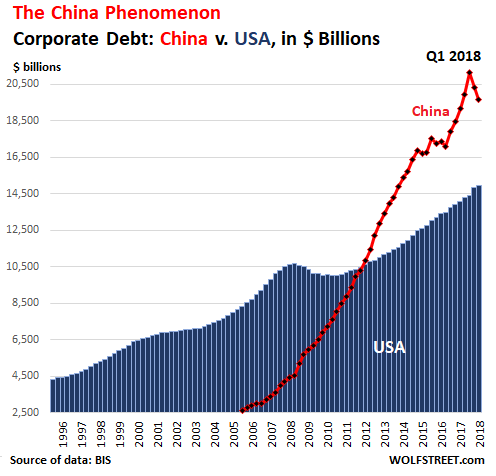
Much of the increase has been driven by China as it transitioned from a negligible level of issuance of corporate debt prior to the 2008 crisis to a record issuance amount of $590 billion in 2016. During that time the number of Chinese companies issuing bonds soared from just 68 to a peak of 1,451 and the total amount of corporate debt in China exploded from $4 trillion to almost $17 trillion, according to BIS data. By late 2018 it had reached $19.7 trillion.

“There has been a persistent buildup of private debt to record levels in China,” Cunliffe said. Much of this increase took place in the direct aftermath of the financial crisis. The largest increases have been in the corporate sector, mainly in state-owned enterprises. At last count, China’s corporate debt-to-GDP ratio was 153%, enough to earn it seventh place on WOLF STREET’s leaderboard of countries with the most monstrous corporate debt pileups (as a proportion of GDP), 18 places above the US. This chart compares the rise of non-financial corporate debt in China and the US:


The rate of growth and level of debt in China have passed the points where other economies, advanced and emerging, have experienced sharp corrections in the past, noted Cunliffe citing research carried out by the Bank of England.

Since early 2017 the Chinese authorities have been scrambling to deleverage its corporate sector and shrink its shadow banking system, with a certain degree of success (the hook in the chart above): corporate debt-to-GDP ratio has fallen in the last two years by almost 10%. However, in the face of slowing economic growth, the Chinese government has dialed back some of these reforms as concern rises that a sharp slowdown in growth would make China’s elevated debt levels even less sustainable.

And if things get seriously sticky in China’s debt markets, it won’t take long before they’re felt elsewhere, Cunliffe cautioned:

The Chinese economy is now pivotal to regional growth and one of the main pillars of world growth and trade. As well as the economic effects and effects directly through banking exposures, it is likely that there would be a severe impact on financial market sentiment, [as happened] in 2015 when a period of sharp correction in domestic Chinese financial markets sparked a correction in US financial assets.

Problems once again appear to be on the rise in China. Chinese companies defaulted on 39.2 billion yuan ($5.78 billion) of domestic bonds in the first four months of 2019, 3.4 times the total for the same period of 2018, according to data compiled by Bloomberg. For the moment, there’s little sign of the problems spreading far beyond Chinese borders. In most advanced economies, as well as quite a few emerging markets (Turkey and Argentina excluded), bond spreads — the amount charged for risk, be that credit risk or liquidity risk — are still at or near historically low levels.

But conditions can change on a dime, as the short-lived drama at the end of 2018 amply demonstrated. Between mid-October and the end of the year spreads on investment grade bonds widened by around 50 bps, all on the back of “relatively modest amounts of news,” Cunliffe noted. “Since then, these moves have fully retraced – spreads at the start of May were the same as they were in mid-October last year. Bonds in other currencies and high yield bonds went on a similar round trip.”

When it comes to expectations about the value of debt, the market can be highly susceptible to changes in sentiment, meaning a “correction can come very quickly”. As Cunliffe warns, given the “current compression of risk pricing,” not to mention the sheer abundance of poor quality, mispriced bonds out there, “such a correction could be a sharp one.”


Democrats' demands that Mueller testify are all wrong – They know he can’t discuss his report


Demands by Democrats that Special Counsel Robert Mueller testify before Congress about his report on Russian interference in the 2016 U.S. presidential election show a complete lack of respect for the rule of law and the constitutional provisions of the separation of powers.

With their single-minded objective of attacking President Trump, congressional Democrats are sending a dangerous message to the American people.

It is wrong for Democrats to demand that Mueller testify and it would be wrong for Mueller to do so.

When Mueller accepted his appointment as special counsel, he did so fully aware of the federal regulations governing his office. The regulations make it absolutely clear that the special counsel is prohibited from discussing his report publicly.

Leading members of Congress now demanding that Mueller testify know he is barred from doing so. The current special counsel regulations were passed while they were members of Congress.

In 1978, Congress passed the Ethics in Government Act. It created a process for appointing special prosecutors.  This is a different position from special counsels like Mueller.

Under the 1978 law, Congress could mandate the appointment of a special prosecutor. Congress could remove the special prosecutor, and the special prosecutor was required to report to Congress. The executive and legislative branches were both a direct part of the process. However, the law on special prosecutors expired and it was not renewed.

In 1999, the special counsel regulations under which Mueller was appointed became law and remain in effect today. These regulations were written and heavily promoted by President Bill Clinton’s administration. They changed the 1978 law in several important ways.

Under the current regulations, the special counsel does not report to Congress. Congress cannot require the appointment or removal of a special counsel. These powers and duties lie exclusively with the attorney general.

Section 600.9 of the special counsel regulations backed by the Clinton administration places very limited requirements on the attorney general in regard to what he needs to provide to Congress, and he has already exceeded these requirements.

The current regulations expressly provide that it is for the attorney general alone to determine what, if any, information to release publicly. The special counsel and his staff are expressly constrained from public comment on their report, as with any criminal investigation.

These regulations are the law. There is no exception in the law for the special counsel to comment to further the political agenda of a member of Congress.

Each of us might love the opportunity to question Mueller about his report – but our interest in doing so, even if genuinely motivated, does not supersede the law. This process was never intended to be a free-for-all.

Consider the specter of Mueller being asked questions on subjects that the attorney general – based on the authority Congress gave exclusively to him – has concluded should not be publicly disclosed because of legitimate concerns specified under the regulations.

Or what if Mueller has been shaken by the criticism his report has garnered among many Democrats and he seeks to redeem himself or the members of his team who have longstanding Democratic ties?

In that case, Mueller would have a conflict between his own perceived self-interest and the legitimate privacy concerns of the regulations under which he operated.

The fact is that Mueller’s report speaks for Mueller and his team after costing us millions of dollars and after an investigation lasting almost two years.

The special counsel process, ill-conceived from the start, is over and Congress has the Mueller report to pore over. Mueller and his views regarding the subject of his investigation are both factually and legally irrelevant now.

It is a disgrace that any member of Congress would choose to ignore the law, mislead the public, and put Mueller in a position of being required to testify. The onus should not be placed on either the president or the attorney general in this matter. They need only point to the law. Mueller must insist that Congress follow the law as well.

The larger question here is: What on Earth has happened to the Democratic Party? It was once home to true American heroes and some of the most significant substantive public policies our country ever has known.

I was extraordinarily proud to be a trial lawyer for the Democratic Party in a case several years ago, but that party no longer exists. Its agenda now is limited to attacking President Trump, rather than working constructively to make the country and the world a better and safer place.

Democratic leadership has been paralyzed by the party’s so-called progressive wing, empowering the unabashed anti-Semitism espoused regularly, unmistakably and unapologetically by some of its prominent freshmen members.

Yesterday’s Democratic Party, maligned by these freshmen, had much to offer on the important issues of the day. But if it remains on its current track, the Democratic Party will be little more than an ancient relic, representing narrow interests and a philosophy that cuts against our most treasured, inclusive American values and beliefs.