Friday, May 10, 2019

Democrats showing contempt by holding William Barr in contempt


BY JONATHAN TURLEY, OPINION CONTRIBUTOR — 05/08/19 04:00 PM EDT


The House Judiciary Committee is voting to hold Attorney General William Barr in contempt of Congress and to secure a vote of the entire House of Representatives in order to send the matter to federal court. The problem is that the contempt action against Barr is long on action and short on contempt. Indeed, with a superficial charge, the House could seriously undermine its credibility in the ongoing conflicts with the White House. Congress is right on a number of complaints against the White House, including possible cases of contempt, but this is not one of them.

As someone who has represented the House of Representatives, my concern is that this one violates a legal version of the Hippocratic oath to “first do no harm.” This could do great harm, not to Barr, but to the House. It is the weakest possible case to bring against the administration, and likely to be an example of a bad case making bad law for the House.

House Judiciary Chairman Jerrold Nadler (D-N.Y.) laid out the case for contempt. He raised three often repeated complaints against Barr in that he failed to release an unredacted report by special counsel Robert Mueller, allegedly lied twice to Congress, and refused to appear before the committee. Yet, notably, the only claim the committee seeks to put before a federal court is the redaction of the report. That seems rather curious since, if Barr lied or refused a subpoena as House leaders claim, it normally would be an easy case of contempt. The reason for this move is that House Democrats know both claims would not withstand even a cursory judicial review.

False statements

Democrats have struggled to focus attention on the summary Barr wrote rather than on the actual report. While Democrats claim the summary misrepresented the report, the report tracks the conclusions referenced in the letter Barr sent. Barr said Mueller did not find evidence of a crime linked to collusion or conspiracy with the Russians. That is true. He said Mueller did not reach a conclusion on obstruction. That is also true.

Barr said he and Deputy Attorney General Rod Rosenstein concluded the evidence, particularly on the lack of a clear showing of corrupt intent here, did not support an obstruction charge. That is again true. Barr then added the most damaging line of the report, stating Mueller expressly did not exonerate Trump. Barr also gave Mueller an opportunity to review his letter, but Mueller chose to decline. However, his letter was not false.

Democrats also have cited the exchange between Barr and Congressman Charlie Crist (D-Fla.) over a story about some “concerns” the letter raised among the members of the special counsel team. House Speaker Nancy Pelosi (D-Cailf.) declared what Barr said was a “lie” and a “crime.” One would assume that Barr would then be referred for prosecution and subject to an immediate impeachment. At a minimum, it would seem such an allegation would be in the contempt sanction. The problem is that what Barr said was true.

Crist noted unspecified news reports that members of the special counsel team are “frustrated at some level with the limited information” in the letter Barr sent and “that it does not adequately or accurately, necessarily, portray” the findings. Crist asked if Barr knew what they were referencing. Barr said no and said, “I suspect that they probably wanted more put out.” He added, “But in my view, I was not interested in putting out summaries or trying to summarize because I think any summary, regardless of who prepares it, not only runs the risk of, you know, being underinclusive or overinclusive, but also, you know, would trigger a lot of discussion and analysis that really should await everything coming out all at once.”

Barr was being questioned about news reports citing unnamed members of the special counsel team and their being “frustrated” by the portrayal of the “findings.” He said he did not know but added that he assumed they “wanted more put out” and he rejected the idea of releasing additional summaries. That is true. The only thing Barr did not mention was the letter that Mueller sent to him, which had not been public at that point.

Failure to appear

Various Democrats have declared that Barr refusing to appear before the committee is clear contempt of Congress. It is a point endlessly raised by House members on television but conspicuously missing in the contempt sanction. The reason is that it is not true. Barr appeared before the Senate and answered detailed questions from members. He was prepared to do the same in the House when the committee inexplicably demanded that he be questioned not just by members but also by professional staffers.

Democrats have tried to explain that the demand for questioning was due to the “complexity” of the record and issues of the special counsel report. That rationale is facially absurd. There is nothing overly complex about these issues, as shown in the Senate hearing. The committee wanted Barr examined by staff lawyers, including Norm Eisen, who handled ethics questions for President Obama. Eisen had declared months ago that the criminal case for collusion was devastating and that Trump was “colluding in plain sight,” a position expressly rejected by Mueller. The Democrats wanted to manufacture a conflict, and they have succeeded in doing so.

Report redactions

That leaves us with the only ground cited by the Democrats for contempt, which is Barr refusing to release the unredacted report. Senate Democrats attacked him at his confirmation hearing for refusing to guarantee public release of the report without redactions. As a witness, I testified that they were asking Barr to commit to a potential criminal act to secure his own confirmation. The report inevitably would contain some grand jury material, which under the law is information that cannot be publicly released without a court order. It is a crime to unveil such information.

Barr promised to release as much of the report as possible, and he has delivered. Indeed, he is not expressly given the authority to release the confidential report. Yet, he not only released it but declared executive privilege waived on its content. The key obstruction portion of the report is virtually unredacted. Just 8 percent of the public report was redacted, largely to remove material that could undermine ongoing investigations. The sealed version of the report given to Congress only had 2 percent redacted. Democrats are therefore seeking a contempt sanction on a report that is 98 percent disclosed and only lacks grand jury material.

Barr restricted access to the 98 percent disclosed report, as opposed to the 92 percent public report, due to the inclusion of evidence impacting ongoing prosecutions. He has offered to expand the number of members and staff to review that material but insists on it remaining protected. But this has nothing to do with the redactions. It is the 2 percent solution to a major political dilemma of the left. Faced with a report that rejected the collusion theories of their running narrative, Democrats want to focus on those 2 percent of redactions rather than over 400 pages of findings.

So Congress now will ask a court to find civil contempt for Barr refusing to release grand jury information. The District of Columbia Circuit Court of Appeals recently rejected a district court claim to have the “inherent supervisory authority” to disclose grand jury matters because of great public interest. To make matters worse, the Justice Department has now said the president has invoked executive privilege over the entire report, making this contempt claim even less likely to prevail over the long run.

Democrats are launching the weakest possible contempt claim against the administration in a civil action with a long track through the courts. In the end, there is utter contempt in this action, but not in the case of Barr.


Jonathan Turley is the Shapiro Professor of Public Interest Law at George Washington University and represented the House of Representatives in its successful challenge to executive actions under the Affordable Care Act.


Trump predicts Dem investigation will drive him to 2020 win


BY JORDAN FABIAN AND BRETT SAMUELS - 05/08/19 09:47 PM EDT


PANAMA CITY BEACH, Fla.—President Trump, speaking at a rally hours after the White House invoked executive privilege to block the release of special counsel Robert Mueller’s full report, predicted congressional Democrats’ investigations would propel him to a reelection victory in 2020.  

Trump did not directly address his administration’s decision to defy a subpoena from House Democrats, a move that raised the specter of a constitutional crisis, but he said the party’s desire to probe his administration, campaign and businesses would backfire politically.   

“They want to do investigations instead of investments,” the president told a crowd of supporters at an outdoor amphitheater just steps from the Gulf of Mexico. “I think it drives us on to victory in 2020.”

Trump said Democrats’ focus on investigations is a “disgrace” and that they should instead work with him on infrastructure, lowering drug prices and improving veterans’ health care.

As he routinely does at his campaign rallies, Trump hit a number of familiar targets: Democrats, the news media, China, illegal immigration, social media companies and even what he said was the venue’s faulty stage.

But Trump largely tiptoed around the subject that dominated the day’s discussion in the nation’s capital: his decision to assert executive privilege over the Mueller report, which preceded a House Judiciary Committee vote to cite Attorney General William Barr for contempt.

After an hours-long hearing, the panel voted on party lines to hold Barr in contempt for refusing to comply with a subpoena to provide an unredacted version of the report. The citation will now head to the Democratic-held House for a vote.

Trump declined on multiple occasions Wednesday to take questions from reporters to explain the decision to assert privilege over the report, and the White House closed a Cabinet meeting that was scheduled to be open to the press.

Trump mentioned Barr only in passing during the Wednesday rally but did not address the proceedings.

“Now the Democrats — we have a great attorney general — now the Democrats are saying, ‘We want more.’ You know, it was going to be like, ‘We want the Mueller report.’ Now they say, ‘Mueller report? No, we want to start all over again.’”

Outside of a pair of morning tweets, Trump also did not comment on a New York Times report that outlined $1 billion in business losses during a decade in the 1980s and 1990s.

Trump won northwest Florida by wide margins in 2016, and juicing turnout will be key to winning the state again in 2020. He spent a good portion of his speech addressing his administration’s efforts to accelerate the recovery from Hurricane Michael, a Category 5 storm that devastated the region last October, including a pledge for $448 billion in new disaster recovery money.

“You're getting your money one way or another, and we're not going to let anybody hold it up,” he said.

Trump went on to revive his long-running feud with Puerto Rico's leaders, chiding island officials for their criticism of his response to Hurricane Maria. Scores of Puerto Rican refugees relocated to Florida after the island was ravaged by Hurricane Maria in 2017.

Trump also focused his attention on his potential 2020 Democratic rivals, mocking them as unfit to lead the country.

“We've got some real beauties,” he said. "Let's just pick somebody, please, and let's start this thing.”

In addition to hitting Sen. Bernie Sanders (I-Vt.) and former Vice President Joe Biden, Trump took aim at a new target: South Bend, Ind., Mayor Pete Buttigieg.

He said the 37-year-old candidate doesn’t have the experience to go up against Chinese President Xi Jinping.

“Representing us against Xi in China. That will be great,” Trump said.


Stefania Maurizi on How Julian Assange Changed Journalism


May 8, 2019 • 3 Comments


The Italian journalist and WikiLeaks collaborator speaks with Dennis J. Bernstein and Randy Credico about the implications of Assange’s struggle against U.S. extradition. 


Julian Assange was back in court twice last week, and will return to a high British court next month for the major legal battle of his life. It will determine whether the U.S. is allowed to extradite the WikiLeaks publisher to the U.S. for prosecution.

In the first of a series of extradition hearings on May 2, Assange appeared in court via video screen. He seemed composed and focused and ready to fight. He told the British High Court: “I do not wish to surrender for extradition. I’m a journalist winning many, many awards and protecting many people.” The next procedural hearing is scheduled for May 30 and another substantive hearing for early June.

Stefania Maurizi is an investigative journalist for the Italian daily la Repubblica  and the author of two books; “Dossier WikiLeaks: Segreti Italiani” and “Una Bomba, Dieci Storie.” She has for years worked closely with Assange on some of the most significant WikiLeaks releases including “Collateral Murder.” Maurizi also worked closely with Edward Snowden, who blew the whistle on National Security Agency surveillance. 

On May 2, right after Assange’s high court appearance, Maurizi told us that she fears for the health and welfare of Assange. She said she also fears for what it might mean to other journalists and whistleblowers if Assange is convicted in a U.S. court for his crucial work with whistleblowers, which has been used widely by news organizations.    

Dennis Bernstein: Stefania Maurizi, I’d like you to start by giving us your gut reaction to what we have seen so far in terms of the treatment of Julian in recent days.

Stefania Maurizi: For me it has been really shocking to witness how Julian Assange has declined in the last nine years.  I have been able to see changes in Julian’s health and psychology.  It was so sad, and no one could do anything. I could report on it and expose it but the other media and public opinion did absolutely nothing to make the government understand how terrible his treatment was.  And all this is happening not in Russia, not in North Korea, this is happening in London, in the heart of Europe.  I now realize how little we can do in our democracy.  If you look at what has happened to high-profile whistleblowers like Chelsea Manning and Edward Snowden, and an important publisher like Assange, who had the courage to publish these important revelations, what did your democracy do to save them, to treat them in a human way? Chelsea Manning was put in prison for seven years, where she tried to commit suicide twice.  Now she is back in prison.  Edward Snowden was forced to leave the U.S.  Julian Assange has spent nine years in detainment and no one did anything.  We were reporting, we were denouncing, we were exposing how seriously his health was declining.  Nothing happened.

Dennis Bernstein:  You’ve worked very closely with Julian Assange in Italy.  You were in a sense a co-publisher in getting out crucial documentation.  Could you talk about why you consider Assange not only a publisher, but one of the most important publishers of our time?


Stefania Maurizi: I started working with WikiLeaks in 2009 when very few people knew about them.  They hadn’t yet published important documents like “Collateral Murder” or the “War Logs.”  I immediately saw that they were going to start a revolution. And that is what has happened: They have changed journalism. Their model of journalism spread and we see now leaks everywhere.  We see this model of collaborative media partnership used by many media, like the Panama Papers Consortium. In addition, you have to realize the importance of what they have revealed.  They have revealed the true face of the wars in Afghanistan and Iraq. They have revealed the inner working of U.S. diplomacy, for example, how they put pressure on Italian prosecutors who were trying to convict a CIA agent responsible for the extraordinary renditions here in Italy.  Or they published revelations of how the U.S. forced the Italian government to purchase a Lockheed jet fighter.  This information is now available to everyone.  You can see how The Washington Post used emails to investigate the [Jamal] Khashoggi murder and they were able to do so because they had the courage to publish these files. Even in the case of the Panama Papers, only the journalists inside the partnership can access the original files.  WikiLeaks made these files fully accessible to everyone, so that every journalist, ever activist, every scholar, every citizen can be empowered by this information free of charge.  That is the revolution.

Dennis Bernstein:  Chelsea Manning is now in jail, refusing to cooperate with the grand jury.  This is someone who spent so much time in solitary confinement. One of the key collaborations had to do with the activities of the U.S. government in Central America, destabilizing, undermining governments.  Now they say they never get involved.  If you look at the documentation in the context of the current attempt by [U.S. Special Representative for Venezuela] Elliot Abrams to destabilize Venezuela, here comes WikiLeaks again.

Stefania Maurizi: Absolutely.  Whenever we have a scandal, we can go to the WikiLeaks website and search for any pertinent information.  The information they publish continues to inform the public. They are now paying a huge price. I myself feel guilty because I was able throughout the past 10 years to work on all these documents, to verify them and publish them without any risk.  Julian and WikiLeaks are paying a huge price and all the editors are silent.  People accuse me of acting as an activist.  I am not acting as an activist, I am speaking out because I feel uncomfortable when I see how professional journalists have all sorts of protection and are not facing imprisonment or extradition.

Randy Credico: The last time I saw you was in December of 2017.  I had seen Julian three months earlier and his health had declined noticeably in those few months.  Now that he is in jail, is he able to see doctors?  What is his physical health like at this point?

Stefania Maurizi: I am not sure whether he is able to see visitors.  It is a very strict regime, there are very strict rules for suspected terrorists.  He spends most of his time completely alone.  This comes after spending the last seven years at the embassy almost entirely alone, apart from occasional visits.  So you can imagine how his forced isolation is affecting his health.

Randy Credico: I look at the sentence that judge Deborah Taylor handed down: a year in jail for allegedly skipping bail.  Can you go into the bogus charges that were never filed against Julian, and how they were perpetuated with the assistance of the Crown Prosecution Service?

Stefania Maurizi: Five years had passed since the Swedish case was closed.  No journalistic organization had ever tried to access these documents.  Thousands of journalists had covered the case but no one had the facts clear.  At that point I realized that it was important from a journalistic point of view to try to access the documentation.  These documents allow us to establish important facts, such as that it was the U.K. that advised the Swedish prosecutors against questioning Assange in London.  The whole case began with this refusal by the Swedish prosecutor.  Now we know that behind this decision there was the Crown Prosecution Service.  Let’s not forget that this agency is the very same agency which is in charge of deciding whether to extradite Julian Assange to the U.S. now. The Crown Prosecution Service entered the case at the very beginning and they advised the Swedish prosecutor against questioning Assange in London.  Julian Assange never refused to be questioned, he refused to be extradited because he was convinced that the extradition to Sweden could pave the way for his extradition to the U.S. 

Now we see that he was right. 

And it was the Crown Prosecution Service which advised the Swedish prosecutor against dropping the case in 2013.  At that time the Swedish prosecutor conceded to drop the case but the Crown Prosecution Service advised them against this. 

Finally, it was the Crown Prosecution Service who destroyed crucial emails about the case, even though the case is still ongoing.  I am still fighting in the U.K. tribunal because I want to access these documents and fill in the gaps.  Now the Swedish prosecutor is evaluating whether to open this case once again.  The statute of limitations is in August 2012.  There is a massive campaign about Julian being a rapist.  After one or two years of this campaign, who will care about Julian Assange being extradited to the U.S.?  That is a possible scenario.

Dennis Bernstein:  Again, Julian had his first hearing today [May 2, 2019] regarding extradition to the United States.  He looked okay but he is definitely in danger. Stefania, what responsibility do we have as journalists to stand up?  According to Daniel Ellsberg, if they go after Julian and Chelsea the way they want to in the United States, it is the end of journalism.

Stefania Maurizi: Absolutely.  This case is about whether the press is allowed to publish documents like the video “Collateral Murder,” which records war crimes and whether the press is allowed to publish documents about the NSA spying on world leaders, whether the press is allowed to publish documents on Guantanamo Bay.  We saw what happened after 9/11: habeas corpus came to an end with Guantanamo, the Fourth Amendment [of the U.S. Constitution] was trampled by the NSA.  Now they want to destroy the First Amendment and they will do it using Julian Assange. They will not go after The New York Times or The Washington Post.

Dennis Bernstein:  Wouldn’t you say that part of the genius of WikiLeaks was the ability to guarantee anonymity?  The reason why Assange has been successful and all these major journalistic organizations were willing to work with him is because of this process he created to guarantee anonymity.

Stefania Maurizi: Julian Assange understands technology and he understands the nature of power.  Most geeks know very little about power, about empire.  Thanks to his knowledge in the technology field, we have this platform. But let’s not forget that WikiLeaks is in trouble now not because they have this platform, but because they have the courage to publish.  It is not enough to get the documents.  Most newsrooms hide such documents.  One of the journalists at The Washington Post had the video “Collateral Murder” and he didn’t publish it. WikiLeaks did.  It is not enough to have the platform: you have to have the integrity and the courage to publish.  The New York Times didn’t publish the important story that the NSA was intercepting the communications of U.S. citizens.  For years The New York Times didn’t want to use the word “torture,” preferring instead “enhanced interrogation.”  The reason the U.S. authorities are hostile toward WikiLeaks and Julian Assange is because they publish what the U.S. media and many other media don’t want to publish.

Dennis Bernstein: Would you like to do a shout-out from one courageous woman there in Italy to a woman who became a woman in solitary confinement and was arrested again on International Women’s Day?

Stefania Maurizi: I feel a huge debt of gratitude because I have worked on Chelsea Manning’s documents for years.  I supported her defense fund, I wrote to her in prison.  I have tried to explain to my readers why she is tremendously courageous. I really would like to see her go free because I cannot accept that one of the most important journalistic sources of all time is again in prison.

Dennis Bernstein: Both Randy and I are extremely grateful for your work, Stefania Maurizi, investigative journalist for la Repubblica and author of “Dossier WikiLeaks,”  which describes the power of a courageous publisher like Julian Assange, who has worked with extraordinary sources to get information out which we would otherwise never have heard.


Student Loan Forgiveness Program Offers False Hope, Rejects 99% of Applications


Posted on May 8, 2019 by Yves Smith


The infamous HAMP program, which the Administration revised so many times on the fly as to give incompetent and mendacious mortgage servicers air cover for failing to modify mortgages, at least had a stealth purpose. As Treasury Secretary Timothy Geithner said to the SIGTARP’s Neil Barofsky, it was to foam the runway for banks by spreading out foreclosures over time. But that still doesn’t excuse servicers for their favorite gimmick for not bothering with HAMP applications, which was to pretend they’d never received them.

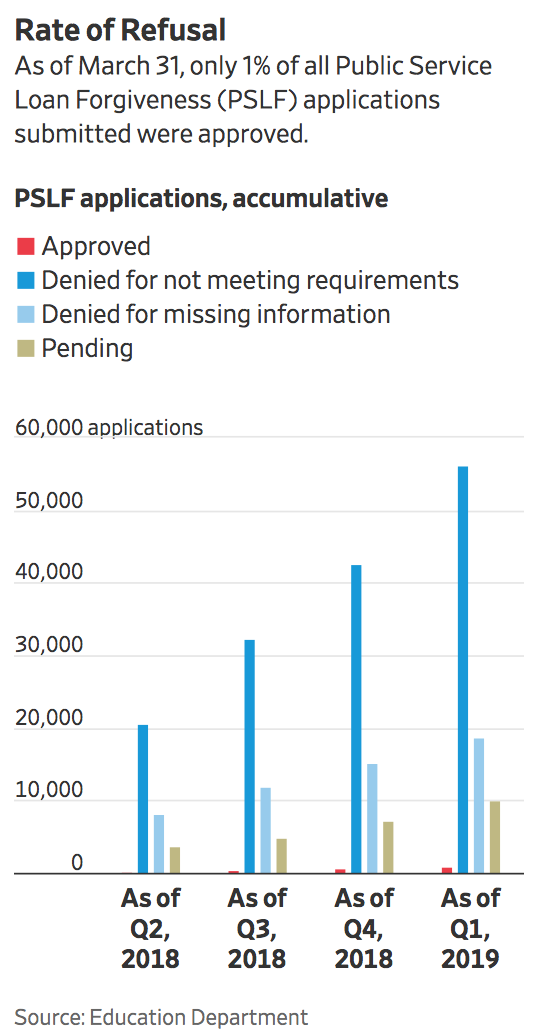
But it’s not clear what the thinking was behind the 2007 Student Loan Forgiveness Program, except to create better eyewash. The ostensible goal was to give student debt relief for borrowers who went into socially useful but not>well remunerated lines of work. But not only were the eligible employers (note employers, not job types) poorly specified as “public service” which includes some highly paid employees at not-for-profits, other elements of the program were also drafted badly. Throw in lousy servicers, revisions to an already confusing program, and conservative sabotage into the mix, and you’ve created conditions where many make what they think are the qualifying 120 payments, only to have their application for forgiveness nixed. Only 1% of 73,000 applicants have gotten relief.

Admittedly, 25% of the rejections were due to “missing information,” which means some might eventually be approved. But as of June 30 last year, 29,000 applications had been reviewed and only 1% were approved, with 28% needing more information. You’d think by now that if a meaningful percentage of the then 28% with gaps had had them filled, the proportion being approved would be rising over time.

The broad outlines of the abject failure of this scheme aren’t new but the Wall Street Journal provides a useful overview and update. The program, launched in 2007, created a series of conditions for eligibility. Per the Journal:

To qualify for forgiveness, borrowers must work for a government entity or nonprofit, hold a certain type of loan, enroll in one of several specific repayment plans and make 120 full and on-time monthly payments, or 10 years’ worth. Falling short on almost any of these requirements can mean disqualification.

The article describes a litany of problems. First, only students who had Federal student loans qualified, not ones with private Federally guaranteed loans. Servicers too often enrolled borrowers into forgiveness programs for which they did not qualify or gave incorrect payment amounts.

And even though the Trump Administration has made its antipathy for the program evident by eliminating it in its budget announced in March, it’s not as if the Obama Administration did all that much to make it work. Again from the Journal:

At that point, with the first borrowers not eligible for forgiveness for seven years, the Obama administration put off specific steps that would have helped the program run smoothly. Officials didn’t advertise the program or establish a platform to guide borrowers through its requirements. They didn’t draw up clear guidance on which employers should qualify as public-service organizations—now a subject of litigation. A government investigation last year found that officials didn’t even produce a guidebook for the servicing company they hired, Fed Loan, to implement the program.

And measures designed to make borrowers whole for program screw-ups that did them harm have wound up being close to moribund:

[Public librarian] Ms. [Bonnie] Svitavsky hit her first snag in 2013, when she submitted a form to ensure her employer qualified her for loan forgiveness. It did, but that step revealed another problem: For the prior 23 months, her servicer, like with so many other borrowers, had her on a plan known as extended repayment, which charges standard monthly payments over 25 years. Those payments were now all ineligible toward her payment count.

The improper payment plan issue raised particular concern in Washington, where members of Congress, led by Sen. Elizabeth Warren (D., Mass.), in 2018 created a temporary fund of $700 million to reimburse borrowers who had mistakenly enrolled in ineligible repayment plans but otherwise qualified. The program has so far granted loan relief to 442 additional people.

If you generously assume an average borrower put $10,000 into the extended repayment scheme, only $4 million of the $700 million set aside has been deployed.

Mind you, this isn’t even the complete litany of things that can or have gone wrong with this program. Readers have described how they were encourage to consolidate loans to help qualify for the program…..only to find the new loan wasn’t eligible and had higher interest charges.

It is distressing to see the intensity of the hostility in the Wall Street Journal comments section to the idea giving a break to borrowers. There’s no acknowledgment that students could have had their employment prospects up ended by the crisis or been misled by their university about how realistic it would be for them to earn enough to repay their loans. A few readers did point out the escalating cost of higher education was the real problem, but the “how could you be so stupid as to get advanced degrees and then become a librarian?” viewpoint drown it out (never mind that a Harvard College colleague said the degree she got later in library science was the most useful education she’d ever gotten; she parlayed that into a research job at Bain and later a position as head of white label research at one of the major international equity firms).

I hope large scale debt forgiveness doesn’t wind up falling into the Maine category of “You can’t get there from here.” But the experience to date is not encouraging. The fact that so many hurdles were set up to make sure that only very deserving candidates could qualify illustrates how few better off individuals are willing to consider that stagnant real incomes, rising housing, medical and education costs, and high job instability means that most people go from paycheck to paycheck and can’t build up a savings buffer. They are one mishap away from needing to borrow to get by. If they aren’t lucky enough to be able to get the funds from family or friends, the bank supplied sources range from pricey (credit cards) to punitive (payday loans). And if you miss a payment due to a second mishap, it’s well-nigh impossible to get off the treadmill of penalty rates.

But as long as the well-off can convince themselves that overburdened borrowers were irresponsible, as opposed to unlucky, nothing much will change until pitchfork sales go way up.


Nightmare Alley (1947) Tyrone Power , Joan Blondell


https://www.youtube.com/watch?v=4zW1uWX5ShE


No One Notices When Elizabeth Warren's Prediction Comes True


https://www.youtube.com/watch?v=EQ-HzgmHc-4


Vox is full of sh*t


https://www.youtube.com/watch?v=OD_RGbHXI8U


Vox Pro-Biden Poll Based On BullS**t