Saturday, May 26, 2018

European Earthquake as Populist Government Forms in Italy
After having fought off
popular rejection of its neoliberal economic policies that serve its own
interests, the European establishment has lost its first major election, as
Andrew Spannaus reports.
By Andrew Spannaus
Special to Consortium News
in Milan, Italy
The revolt of voters across
the Western world has reached a high point in Europe. The Five Star Movement
and the League, two so-called “populist” political parties in Italy, are
preparing to form a government after Wednesday’s appointment of a new prime
minister following an election result that could directly challenge the
foundations of the European Union.
Like other anti-system
movements around Europe, the Italian parties are calling in particular for
abandoning the neoliberal economic policies and speculative finance, which are
hollowing out the middle class.
The breakthrough comes two and
a half months after the elections held on March 4, in which Italian voters sent
an unequivocal message to the current political institutions, not simply of
protest, but of a desire to actually give power to those willing to implement
deep changes.
The two parties were not
allies during the election, but they ultimately recognized that their
anti-establishment positions, and in particular their opposition to the
austerity-based policies of the E.U., made them obvious candidates to join
together in an attempt to shake up Italy and Europe as a whole.
On the Heels of Trump and
Brexit
After the shock of the Brexit
vote and the U.S. presidential elections in 2016, Europe’s political elite
looked fearfully towards the series of elections to be held across the
continent in 2017. Political outsiders had already increased their support in
recent years, fueled by anger over deepening economic difficulties and the
related backlash against increased immigration mainly from Africa and the
Middle East.
With the precedent of Trump’s
victory and Britain’s vote to leave the EU, it seemed possible that some of
those movements could actually force their way into government, opening a gape
in the fabric of “liberal democracy” across Europe.
By the end of the summer, the
revolt had faltered. The anti-Islam party of Geert Wilders had failed to break
through in Holland, and although right-winger Marine Le Pen had done well in
the first round of France’s presidential election, she was soundly defeated by
neoliberal, centrist Emmanuel Macron in the run-off.
The results in Germany were
more problematic, when in the September elections the far-right, anti-immigrant
Alternative for Germany (AfD) successfully diverted votes from the political center,
forcing the Christian Democrats and Social Democrats into months of
negotiations to form a new Grand Coalition as a bulwark against the populists.
Then last October in Austria
the anti-immigrant rhetoric of young conservative leader Sebastian Kurz led him
to victory, producing a government based on an alliance with the far-right
Freedom Party. Europe’s elites had taken some hits, but overall it seemed that
disaster for them had been avoided.
Italy, however, would prove to
be different. The Five Star Movement (M5S) increased its vote total in March as
the top party, coming in at 32%. By itself this wouldn’t have been enough to
overcome the establishment’s efforts to keep them out of government, though.
Indeed the political parties that have governed Italy in recent years had
hatched what they thought was a brilliant plan to block the newcomers: change
the election law to reward the coalition with the highest vote total,
rather than the single party. That way, even if M5S came in first, the
center-right bloc led by Silvio Berlusconi’s Forza Italia could still claim
victory, for example; and in the likely event that the coalition didn’t have
enough votes to govern, an agreement would be made with the centrist Democratic
Party (Pd) for a sort of “Grand Coalition”, not too different from the
governments in place in recent years.
What upset the apple cart was
the success of the League, led by brash young leader Matteo Salvini. Formally
known as the pro-secession “Northern League,” the party has succeeded in
expanding beyond only the North, still drawing on anti-immigrant sentiment, but
combining that with an effective anti-austerity message that allowed it to
reach 17% of the vote. That beat Berlusconi’s party by several points. The
center-right had gotten the most votes as a coalition (37%) but the internal
balance of power had shifted; the best laid plans of the elites quickly came
crashing down.
A Predictable Result
This outcome was actually
entirely predictable, given the nature of the response by Italian institutions
to the results of the country’s last general election, five years ago. In 2013,
the Five Star Movement burst onto the scene with 25% of the national vote,
despite having refused to even talk to the mass media; everything was done
through the web and meet-ups, which proved to be more than enough to catalyze
an effective movement against the “caste” of privileged members of the elite,
seen as pursuing their own interests, and not those of the people, through
various forms of corruption.
As time went by, the centrist
parties in government deceived themselves into believing that warning people
about the lack of experience of the M5S, and branding anyone who criticized the
EU as inviting a return to nationalism and war, would scare voters away from
the populists.
What the governments led by
the center-left did not do, however, was considerably change the direction of
the economy for the majority of the population. The situation improved slightly
as the harshest austerity measures from previous years were abandoned and some
limited initiatives were implemented to encourage investment and exports in the
manufacturing sector.
But the drivers of the revolt
against globalization run much deeper, rooted in the long-term destruction of
the middle class with increases in poverty and inequality, and less stable
working conditions for those who do have work. An increase in short-term
employment and promises of better times if the country would just stay the
course, was far from enough to stop the anti-system momentum.
After two months of
back-and-forth, the League ultimately split from its center-right allies in
order to avoid the risk of a grand coalition government that would continue the
same centrist policies as in the past. They reached a deal with the Five Star
Movement and accepted a non-politician close to M5S as prime minister, Giuseppe
Conte, who is now tasked with implementing a “government contract” negotiated
between the two parties.
There are significant
differences between the partners, but the most important obstacles seem not to
be internal, but rather put in place by Italian and European institutions. M5S
and the League quickly came to agreement on general issues such as deficit
spending for welfare reform (to significantly expand social benefits, not cut
them as in recent years) and simplification of the tax code. The contract also
includes the key points of separating commercial banks from investment banks
(the Glass-Steagall principle) and using public institutions for targeted
investment.
Neither Luigi Di Maio, the
31-year old Five Star leader, nor Salvini seem cowed by threats from EU
officials or pressure from the financial markets regarding the need to follow
strict budget rules. In response to a recent objection claiming his proposals
would break the public accounts, Di Maio claimed that when done right, the
multiplier effect of public investment would boost, rather than hurt the
economy.
Yet the establishment is doing
everything it can to avoid an open clash with the EU. Like many countries with
a parliamentary system, Italy has a “President of the Republic,” a figure-head intended
as a guarantor of the institutions without a direct political role. The
position is similar to that of a constitutional monarch, but in a republican
system. Despite often being viewed as merely a figurehead, the Italian state
president formally has the power to choose the head of the government, and also
the cabinet. In this case, President Sergio Mattarella seems to be taking those
responsibilities fairly seriously.
There is great pressure on the
Italian elites to ensure that the coming populist government will not be able
to call into question the architecture of the EU by openly challenging the
budget orthodoxy of the European Commission in Brussels, and the European
Central Bank in Frankfurt. Thus Mattarella’s office made its opposition known to
certain figures proposed by M5S and the League. This happened with one of the
first names floated for prime minister, Giulio Sapelli, a professor of economic
history who is strongly critical of globalization and EU economic policy. But
his prospects were quickly shot down through a series of leaks to an obliging
press.
Another name which has sparked
opposition is that of Paolo Savona, a highly-credentialed economist who was
minister of industry twenty-five years ago. Since then, he has become critical
of the European single currency and the related spending constraints. Thus,
despite clearly being qualified, when his name was suggested for the post of
finance minister, objections immediately began to appear in the establishment media.
Di Maio and Salvini seem to be
sticking to their guns on Savona, but it remains to be seen if they will
succeed in obtaining his nomination. The situation raises serious questions
about democracy in Italy. Well over 50% of Italian voters supported parties
that strongly criticize the neoliberal policies of the EU; yet there is a
concerted institutional effort to not allow someone who reflects precisely that
view to guide the country’s economic policy.
The EU Against the People
This conflict is even more
ironic because the insistence on EU principles comes from institutions which
are supposed to be guarantors of the Italian state. Their view, however, is now
that Italy is irreversibly part of the European Union, and any threat to lessen
the bonds of integration would be unacceptable. Add to this the fact that over
the years the EU has done everything it can to avoid having European citizens
actually vote on the construction of the supranational government, and the
paradox becomes clear: state institutions are defending Europe against the
democratic choices of their own people.
There are certainly risks
inherent in the coming populist government. The League wants to take a hard
line on immigration, and has often curried favor with racists and xenophobes. This
has been part of its identity from the start, although it has gradually worked
to expand its appeal by focusing on the broader issue of problems with
globalization and Europe.
M5S, on the other hand, is
inconsistent and in recent months has seemed malleable even on important points
in its program, in both economics and foreign policy. Di Maio quickly
backtracked from his criticism of Trump’s bombing of Syria, for example,
fearing it could damage his prospects to lead the government.
Furthermore, the M5S campaign
against wasteful spending goes so far as aiming to stop important
infrastructure projects like a new high-speed rail line between Italy and
France; while its environmentalist bent is expressed in the desire to shutter
the second largest steel production center in Europe, the Ilva plant in
Taranto, due to environmental problems.
These issues and others
provide plenty of legitimate grounds for criticism of the anti-establishment
parties, and raise the question as to whether they will actually succeed in
improving people’s lives. Yet there is no question that the voters have asked
for change, and that change means abandoning the pro-austerity policies that
are hollowing out the middle class and making people fear for their families’
future.
Despite the populist wave that
has spread across the Western world in the past two years, European leaders in
pursuit of their own interests have generally seemed to ignore the need to
recognize the errors of the pro-finance, post-industrial model of recent decades,
clinging to the hope that their neoliberal system will ultimately survive
despite discontent from a significant portion of the population. The Italian
elections have changed the calculus. Regardless of how effective the new
government is, European institutions need to recognize that certain problems
cannot be ignored. The only way for the elites to survive – to the extent they
still can – will be to finally accept that their errors can longer be defended.
Other 193 Countries Begin Insulting Mike Pence In Hopes Of Avoiding Future Meetings With Trump
https://politics.theonion.com/other-193-countries-begin-insulting-mike-pence-in-hopes-1826305704
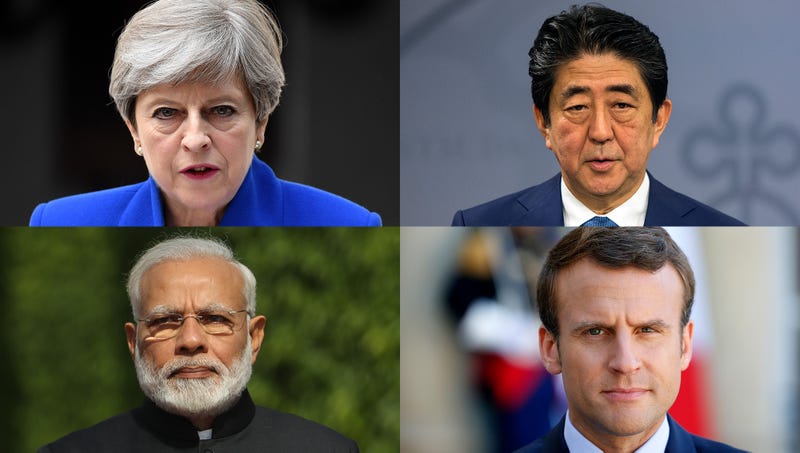
BERLIN—Leaping at the chance to never again deal with the U.S. after North Korea’s disparaging remarks towards the vice president, leaders from the other 193 nations of the world began insulting Mike Pence Thursday in hopes of avoiding future meetings with President Donald Trump.
“Mike Pence is just a dumbfuck partisan hack who doesn’t have the faintest clue about international relations or running a country,” said German Chancellor Angela Merkel, joining nearly 200 other presidents and prime ministers who mercilessly degraded Pence as “cowardly,” “full of crap,” and “repulsive” in a concerted effort to stave off any more direct contact with Trump or have him ever visit their countries.
“Mike Pence was a shit governor of a shit state, and he’s as incompetent as he is ugly. Just a pandering, feckless asshole with the personality and intelligence of roadkill. Meeting him in person was one of the worst encounters of our lives—he and his whole family can go fuck themselves.”
World leaders finished their comments by adding that if there were any justice in the world, Mike Pence would rot away alone in the dank halls of a federal penitentiary.
Friday, May 25, 2018
Nation’s Rich And Powerful Wondering When Rest Of Americans Will Just Give Up
WASHINGTON—Finding themselves
increasingly annoyed with the inexplicable and infuriating persistence of their
feeble socioeconomic inferiors, America’s rich and powerful were at a loss
Wednesday as to exactly when the rest of the country would finally relinquish
all hope and simply give up, sources close to the 1 percent confirmed.
“What exactly is wrong with
them? I mean, there’s no possible way they’ll ever stop us from getting
everything we want, so the poor—and I suppose what’s left of the middle class—are
only delaying the inevitable,” said one outrageously wealthy citizen, speaking
on expectation of anonymity and adding that, realistically, no one in their
right mind could possibly see the use of struggling against those who control
the nation’s media, financial, and political institutions.
“I suppose I should admire
their sheer animal persistence, but, Christ, it’s been over since we somehow
got them to accept that trickle-down bullshit. I know, I know, we tied their
education to their property taxes to encourage them to ass-fuck themselves
almost as hard as they ass-fucked their neighbors, but to think they’re so
stupid they can’t get the concept of ‘being fucked’ through their thick
skulls?”
At press time, the nation’s
most wealthy and influential citizens said they felt a sense of renewed hope
and optimism upon realizing how few poor people had voted in recent elections.
10 Questions About U.S. Healthcare, Answered for Americans
MAY 2018
As the healthcare debate
continues, misinformation continues to spiral out of control on social media
threads and in the mainstream media.
By now, we’ve all heard the
talking points:
"Don't other countries
with single payer experience really long wait times?"
"Why should we expand
Medicare? Don't a lot of people have negative experiences with it?"
"Why should I pay for
someone else's healthcare?"
It can be incredibly difficult
to differentiate the facts from the hype. We receive hundreds of questions
every day from our subscribers who, like you, are passionate about learning
more about the issues so that you can engage in more civil and informed
discourse. Below are answers to the top 10 questions we heard from you.
10 Questions About Healthcare,
Answered
1. How does healthcare in the
United States compare to other developed countries?
Simply put, we get less and
pay more than other countries. The United States spends over twice the average
amount per person on healthcare compared to every major industrialized country.
And we consistently rank 11th out of 11 countries in comparative studies
conducted bi-annually by the Commonwealth Fund:
30 million Americans are
uninsured and an additional 39 million are underinsured.
20% of insured Americans
report trouble paying medical bills.
36% of Americans are in
high-deductible plans with an average deductible of $4,347 or higher.
Americans pay excessive prices
for medical visits and procedures.
The fragmented and patchwork
system as compared to other countries necessitates over $200 billion per year
in administrative-related activities, or a total of 20-30% of all US healthcare
costs.
Despite the out-size spending,
the US experiences extremely poor health outcomes.
33% of Americans report going
without recommended care, they do not see a doctor when sick, or fail to fill a
prescription because of costs.
The United States has the
highest number of preventable deaths under the age of 18 when compared to 18
other industrialized countries.
The infant mortality rate is
nearly double the average rate of 13 major OECD countries.
In 2014, 68% of Americans over
the age of 65 were living with two or more chronic conditions, compared to only
33% in the UK.
The US has (uniquely) a
declining life expectancy age. Latino and Hispanic Americans have much lower
levels of insurance coverage; the health status of black Americans has declined
in recent years, according to a recent report by the Urban League. The number
of uninsured Americans has increased since the rollbacks of the Affordable Care
Act implemented by the Trump Administration. The standard of care Americans receive
varies based on ability to pay, type of coverage, and significantly by race and
gender. This is not true in other similar countries. According to report
released on May 8th, this lower quality of care comes as we spend $9,507 per
person per year on healthcare.
2. Prescription medication
prices are ridiculous. How did we get here?
According to a report by the
Senate Finance committee, prescription drug corporations price their drugs
according to the price point they want to establish for the next drug in that
class – so the ever increasing prices has nothing to do with research and
development costs, or efficacy of the medication, but rather whatever the
market will bear and specifically, whatever the market the drug companies
create will enable. There is no regulation of drug prices, and Medicare is
prohibited by law from negotiating lower prices. Hospitals and insurance
companies, ironically benefit from higher drug prices because those prices
“justify” higher rates, and generate more profit as a percentage of those
higher rates. The industry model of unregulated prices, direct to consumer
marketing, publicly supported basic research that leads to private drug
development, and profit-protecting patents have created escalating prices.
3. The ACA (Obamacare) was
supposed to cover everyone and keep costs down but they are much higher than
most people predicted they would be. What happened?
The ACA in the best case was
not going to achieve universal coverage – most optimistically, as many as 20
million people would remain uninsured after full implementation. Three-fifths
of the increase in coverage came thru expansion of Medicaid, but 23 states have
not expanded Medicaid. (The Supreme Court decision upholding the ACA in June,
2012, allowed states to opt out of the expansion). As to cost, the primary
approach was to require individuals to pay more of their share of healthcare
costs – “skin in the game” was the popular phrase - so that as “consumers” we
would be more price sensitive. But insurance rates were not regulated, so
companies could charge whatever they wanted, and hospitals were also allowed to
charge unregulated prices, as were drug companies. At the same time, the cost
of premiums has been subsidized by the federal government for individuals but
not for family coverage. The result has been a focus on keeping premiums low by
creating narrow networks of providers and high deductibles plans with
significant co-pays, as employers shift virtually the entire amount of cost
increases they experience from insurers onto workers. Since utilization of
services accounts for only one-quarter of healthcare cost increases, this
approach has not lowered costs. Higher prices account for three-fourths of cost
increases. The other mechanisms the ACA established to control costs – such as
“medical-loss ratio” requiring insurers to spend 80% of their premiums on care,
has not limited insurance rate increases. The individual mandate for people to
buy insurance did not create a younger, healthier, less expensive risk pool for
insurance companies. Shifting risk from insurance companies to providers and
hospitals through “pay for value, not volume” per capita payment reform, and by
creating Accountable Care Organizations (ACO’s), has restricted access to care
and created closed, narrow networks but has not lowered costs. Healthcare
Information Technology, especially Electronic Medical Records, has required
large capital expenditures and the latest research shows it has cost more than
it has saved.
4. The recent tax bill removed
the individual mandate from the ACA (Obamacare). How will that affect
healthcare in the U.S.?
Already, for the first time
since 2010, the number of uninsured Americans has increased, in part due to the
mandate’s demise. However, the impact will be mitigated by how ineffective the
mandate has proven to be in controlling costs. It is not the mandate that has
motivated people to buy coverage, it is the availability of subsidies for
purchasing coverage. Ironically, if the mandate removal means fewer healthy
people buying insurance – or buying it only when they need it – and premiums
rise, and subsidies go up, but pay for a smaller share of costs, it will cost
more to cover fewer people.
5. It seems like our
healthcare system isn’t working well for most Americans. Who actually benefits
from the system as it is now?
First, the top four US health
insurance companies who made $60 billion in profits between 2009-2015 during
the full implementation of the ACA, and the health insurance executives, who
take home between $20 million and $66 million per year.
It’s even better for the
prescription drug companies, whose profits continue to rise from the $125
billion reached in 2015. For-profit hospital corporations had achieved record
profits until the Trump Administration roll-backs, and in general hospitals
have had higher net income (profits) under the ACA – padding the jobs and
pockets of hospital administrators.
Wealthy Americans, and the
global elite, utilize the highly advanced treatments and technologies often
developed with tax dollars, offered in large academic and high-end private
medical centers.
In short, the 1% and the
healthcare industry are the primary beneficiaries of the present healthcare
system– some call it the “medical-industrial complex” – where money is the
metric of good medicine.
6. What is a single payer
system? And how would my life be different under a single payer healthcare
system?
The fundamental difference in
experience for people would be replacing health insecurity with the peace of
mind that comes from guaranteed healthcare. A single-payer system would
expand and improve the existing Medicare program for everyone in the
United States;
A single public program would
eliminate insurance company premiums, deductibles and co-pays and establish
fair and equitable public financing;
Patients would have the right
to culturally competent care, and complete choice of their healthcare
providers;
All medically necessary
services, including doctor visits, reproductive healthcare, hospitalization,
preventive care, long-term care, mental health, dental, vision, medical
supplies, prescription drugs and assisted living services needed by aged and
disabled people;
It would relieve businesses of
the burdens of administrating health benefits, end escalating costs that
subsidize insurance company profits, creating resources for wages, pensions,
innovation and growth;
Medicare for All would
establish a single standard of safe, therapeutic care and fund a robust
community and public health system to address health disparities, and enable
the professional clinical judgment of doctors and nurses to be the basis of
healthcare decisions (no more claims denials!).
7. Insurance can feel more
like a privilege rather than a right. I pay for it, but I don’t want to have to
pay for others too. Why should we expand the system to cover everyone?
Everyone with insurance
already pays for others, since but we all pay too much for healthcare. Rather
than our health being something we buy and sell as a insurance risk, which can
never predict what we will actually need, and depends upon huge tax subsidies,
we need a health system that will be there when we need it, regardless of
ability to pay. We cover everybody because if we do not, we will end up
spending more, and suffer from poorer health, individually through unchecked
communicable disease, and collectively through worse public health.
8. I’ve heard a lot of horror
stories on the media about wait times in countries that have single payer
healthcare. Would that be an issue if we implemented it here?
No – Medicare beneficiaries
who receive care in the system we will improve and expand do not have excessive
wait times. Most people with commercial insurance wait weeks to see a
specialist in the US. In fact, for those who are uninsured or cannot afford
their deductible have the ultimate wait time: postponed or no care at all.
9. A lot of progressives are
talking about a “Medicare for All” system, but not everyone has a good
experience on Medicare. If we expanded Medicare to the entire system would we
address those issues? And how?
If we listen to the stories of
people on Medicare now, we learn that it provides real health security,
contains costs much better than other payers, has much lower administrative
costs, and enjoys broad public support - Medicare is popular and it works. Of
course, Medicare is not perfect, operating as it does in the system dominated
by the commercial insurers, and being privatized itself in Parts B
(supplemental coverage), Part C (Medicare Advantage), and the drug benefit
under Part D.Those privatized products have created tiers of coverage, and
inequitable standards of care and access to providers. We must improve it by
among other things expanding the benefits to include dental and vision, and
eliminate all the co-pays and deductibles seniors now pay.
10. Covering all Americans
sounds like it would cost a lot of money. How would we pay for single payer
healthcare?
Improved Medicare for All
would eliminate health insurance industry profits, marketing costs, and
administrative waste and allow for the negotiation of drug prices and medical
fees, saving nearly $500 billion annually. This is enough is enough to cover
all of the uninsured and eliminate the out-of-pocket expenses for us that act
as barriers to care.
There are many options
available on how to finance a Medicare for All system that will save low and
middle-income families a significant portion of their annual income. These
include a tax on the top 5 percent, as it creates savings for 95 percent of
Americans, increase the current Medicare program excise tax on payroll and
self-employment income, and institute a modest tax on unearned income and on
speculative financial transactions.
Thursday, May 24, 2018

Subscribe to:
Comments (Atom)