Saturday, December 2, 2017

Boom or bust?


December 1, 2017


Last week, the OECD published its latest World Economic Outlook.   WARNING GRAPHICS OVERLOAD AHEAD!

The OECD’s economists reckon that “The global economy is now growing at its fastest pace since 2010, with the upturn becoming increasingly synchronised across countries. This long-awaited lift to global growth, supported by policy stimulus, is being accompanied by solid employment gains, a moderate upturn in investment and a pick-up in trade growth.”

While world economic growth is accelerating a bit, the OECD reckons that “on a per capita basis, growth will fall short of pre-crisis norms in the majority of OECD and non-OECD economies.” So the world economy is still not yet out of the Long Depression that started in 2009.

The OECD went on: “Whilst the near-term cyclical improvement is welcome, it remains modest compared with the standards of past recoveries. Moreover, the prospects for continuing the global growth up-tick through 2019 and securing the foundations for higher potential output and more resilient and inclusive growth do not yet appear to be in place. The lingering effects of prolonged sub-par growth after the financial crisis are still present in investment, trade, productivity and wage developments. Some improvement is projected in 2018 and 2019, with firms making new investments to upgrade their capital stock, but this will not suffice to fully offset past shortfalls, and thus productivity gains will remain limited.”

The OECD also thinks that much of the recent pick-up is fictitious, being centred on financial assets and property. “Financial risks are also rising in advanced economies, with the extended period of low interest rates encouraging greater risk-taking and further increases in asset valuations, including in housing markets. Productive investments that would generate the wherewithal to repay the associated financial obligations (as well as make good on other commitments to citizens) appear insufficient.”  Indeed, on average, investment spending in 2018-19 is projected to be around 15% below the level required to ensure the productive net capital stock rises at the same average annual pace as over 1990-2007.

The OECD concludes that, while global economic growth will be faster in 2017 and 2018, this will be the peak.  After that, world economic growth will fade and stay well below the pre-Great Recession average.  That’s because global productivity growth (output per person employed) remains low and the growth in employment is set to peak.  That’s a ‘slow burn’ of slowing economic growth.

But even more worrying for global capitalism is the prospect of a new economic slump, now that we are some nine years since the last one.  In a chapter of the World Economic Outlook, the OECD’s economists raise the issue of the very high levels of debt (both private and public sector) that linger on since 2009.  “Despite some deleveraging in recent years, the indebtedness of households and nonfinancial businesses remains at historically high levels in many countries, and continues to increase in some.”  The debt of non-financial firms (NFC) rose relative to GDP during the mid-2000s, generally peaking at the onset of the global financial crisis and remaining stable thereafter.
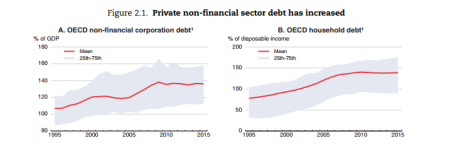

After a limited downward adjustment during the post-crisis period, NFC debt-to-GDP ratios have increased again since.
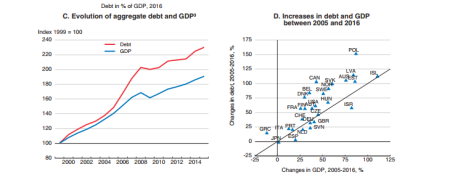

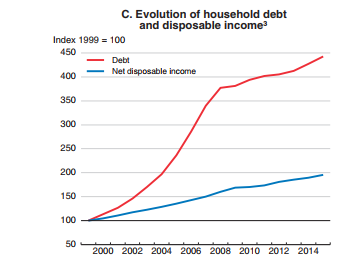
Household debt-to-income ratios also rose significantly up to 2007 and stabilised thereafter at historically high levels in most advanced economies. The rise in the debt-to-income ratio was driven by the acceleration in debt accumulation prior to the crisis, with subdued household income growth impeding deleveraging thereafter.

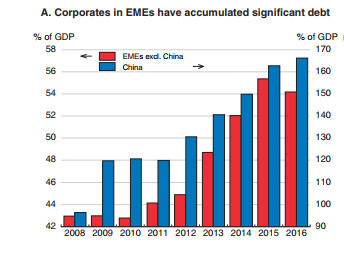
And as I have reported before in previous posts, non-financial companies (NFC) in the so-called emerging economies have sharply increased their debt burdens over the last nine years, so that now, ‘rolling over’ this debt as it matures for repayment amounts to about half of the gross issuance of international debt securities in 2016.  In other words, debt is being issued to repay earlier debt at an increasing rate.

The OECD points out that there is empirical evidence that high indebtedness increases the risk of severe recessions. Also, if the prices of ‘fictitious’ assets like property or stocks get well out of line with the value of productive assets (ie capital investment), that is another indicator of a coming recession. Currently, there is no OECD economy in recession (defined as two consecutive quarters of a fall in GDP), but the global house price index is reaching a peak level over the trend average that has signalled recessions in the past.
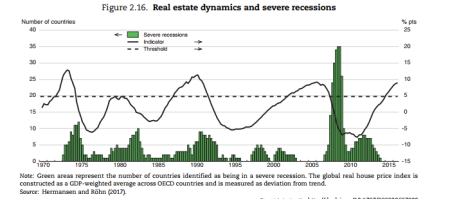

Credit is necessary to capitalism to overcome the ‘lumpiness’ in capital investment and smooth over cash liquidity.  But as Marx argued, ‘excessive’ credit expansion is a sign that the profitability of productive investment is falling.  As the OECD puts it: “If borrowing is well used, higher indebtedness contributes to economic growth by raising productive capacity or augmenting productivity. However, in many advanced economies, the post-crisis build-up of corporate debt has not translated into a rise in corporate capital expenditure.”
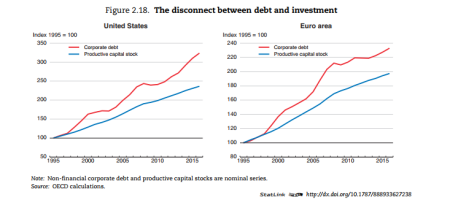

So the OECD concludes that the post-crisis combination of rising corporate debt and historically high share buybacks may suggest that, rather than financing investment, firms took on debt to return funds to shareholders. This reflects “pessimism about future demand and economic growth, leading corporations to defer capital spending and return cash to their shareholders for want of attractive investment opportunities.”  Moreover, firms with a persistently high level of indebtedness and low profits can become chronically unable to grow and become “zombie” firms. And zombie “congestion” may thus reduce potential output growth by hampering the productivity-enhancing reallocation of resources towards more dynamic higher productivity firms.

So the OECD story is that world economic growth is picking up and there is little sign of any slump in production in the immediate future, even if growth may stay well below the pre-crisis average.  But there are risks ahead because the still very high levels of debt and speculation in financial assets that could come a cropper if profitability and growth should falter.

This is much the same story that the IMF told in latest IMF report on Global Financial Stability that I referred to in a recent post.  As the IMF put it: “Private sector debt service burdens have increased in several major economies as leverage has risen, despite declining borrowing costs. Debt servicing pressure could mount further if leverage continues to grow and could lead to greater credit risk in the financial system.”  

The IMF comments: “While debt accumulation is not necessarily a problem, one lesson from the global financial crisis is that excessive debt that creates debt servicing problems can lead to financial strains. Another lesson is that gross liabilities matter. In a period of stress, it is unlikely that the whole stock of financial assets can be sold at current market values— and some assets may be unsellable in illiquid conditions.” So “if there are adverse shocks, a feedback loop could develop, which would tighten financial conditions and increase the probability of default, as happened during the global financial crisis.”  

The IMF sums up the risk.  “A continuing build-up in debt loads and overstretched asset valuations could have global economic repercussions. … a repricing of risks could lead to a rise in credit spreads and a fall in capital market and housing prices, derailing the economic recovery and undermining financial stability.”

The IMF posed an even nastier scenario for the world economy than the OECD by 2020.  Yes, the current ‘boom’ phase can carry on.  Equity and housing prices can continue to climb.  But this leads to investors to drift beyond their traditional risk limits as the search for yield intensifies despite increases in policy rates by central banks.  Then there is a ‘Minsky moment’.

There is a bust, with declines of up to 15 and 9 percent in stock market and house prices, respectively, starting at the beginning of 2020.  Interest rates rise and debt servicing pressures are revealed as high debt-to-income ratios make borrowers more vulnerable to shocks. “Underlying vulnerabilities are exposed and the global recovery is interrupted.” The IMF estimates that the global economy could have a slump equivalent to about one-third as severe as the global financial crisis of 2008-9 with global output falling by 1.7 percent from 2020 to 2022, relative to trend growth.

Will the high debt in the corporate sector globally eventually bring down the house of cards that is built on fictitious capital and engender a new global slump?  When is credit excessive and financial asset prices a bubble?

The key for me, as readers of this blog know, is what is happening to the profitability of capital in the major economies.  If profitability is rising, then corporate investment and economic growth will follow – but also vice versa.  But if profitability and profits are falling, debt accumulated will become a major burden.  Eventually the zombies will start to go bankrupt, spreading across sectors and a slump will ensue.  Financial prices will quickly collapse toward the real value of their underlying productive assets.

Indeed, according to Goldman Sachs economists, the prices of financial assets (bonds and stocks) are currently at their highest against actual earnings since 1900!
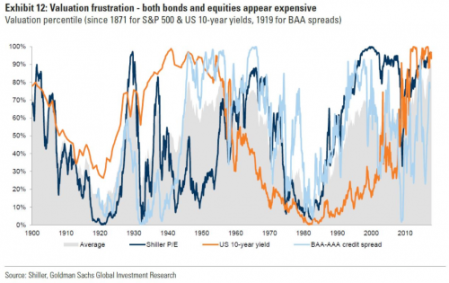

What the OECD and IMF reports show is that if there is a downturn in profitability, the next slump will be severe, given that private debt (both corporate and household) has not been ‘deleveraged’ in the last nine years – indeed on the contrary.  As I said, in my paper on debt back in 2012: “Capitalism is now left with a huge debt burden in both the private and public sector that will take years to deleverage in order to restore profitability.  So, contrary to the some of the conclusions of mainstream economics, debt (particularly private sector debt) does matter.”

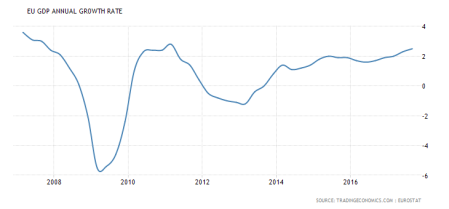
For now, the world economy is making a modest recovery from the stagnation that appeared to be setting in from the end of 2014 to mid-2016.  The Eurozone economic area is seeing an acceleration of growth to its highest rate since the end of the Great Recession.

Japan too is picking up, based on a weak currency that is enabling exports to be sold.  And the latest figures for the US show an annualised rise of 3.3% in third quarter of 2017, putting year on year growth at 2.3%, still below the rates achieved in 2014 but much better than in 2016 (1.6%).  And the forecast for this current quarter is for similar.
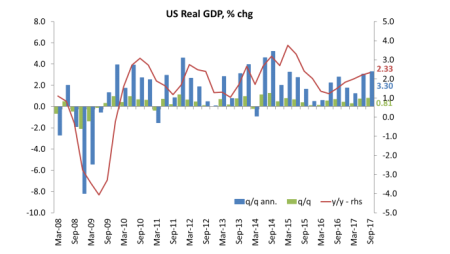

As for corporate profits and investment, the latest data show that US corporate profits were rising at over 5-7% yoy before tax, although stripping out the mainly fictitious profits of the financial sector reveals that the mass of profit is still well below the peak of end-2014.
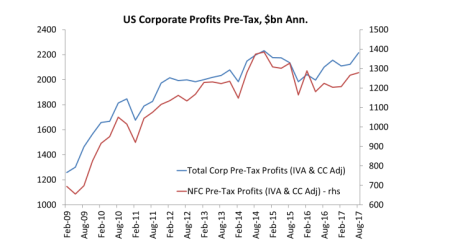

And as I showed in a recent post, profitability has fallen since 2014.
IMAGE 11


And that is confirmed in the latest data for the US.  As corporate profits have recovered from the slump of 2015-16, so business investment has made a modest improvement.


As for global corporate profits, we don’t have all the data for Q3 2017, but it looks as though it will continue to be on the up.
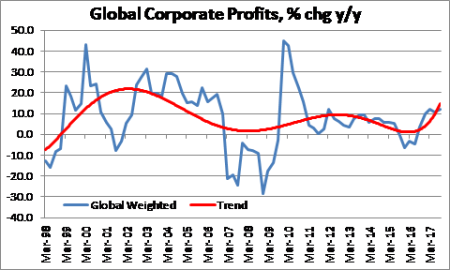

So overall, global economic growth has improved in 2017 and, so far, looks likely to do so in 2018 too.  Corporate profits are rising and that should help corporate investment.  But profitability of capital  remains weak and near post-war lows and corporate debt has never been higher.

Any sharp upswing in interest rate costs (and the US Fed continues to hike) will increase the debt servicing burden.  So if corporate profits should peak and falter in the next year or so, a major recession will be on the agenda.


Wednesday, November 29, 2017

Aung San Suu Kyi stripped of Freedom of Oxford award


https://www.youtube.com/watch?v=rLSGW7GQLlI&feature=em-subs_digest


Monday, November 27, 2017

Audio: Marx For The 21st Century, Lecture at RSA, 10 November 2017


/


https://soundcloud.com/the_rsa/marx-for-the-21st-century


Slavoj, Judith Butler & Larry Rickels. Psychoanalysis. 2006 1/3


https://www.youtube.com/watch?v=d16kMXUXPOE&t=123s


Jelica Sumic - Is there a politics of psychoanalysis?


https://www.youtube.com/watch?v=LVW8r8PbPbA


Be Thankful for the Internet as You Know It, Because It May Not Exist Much Longer


THE INTERNET SERVICE PROVIDERS ARE LYING AND AJIT PAI IS LYING!


By Lambert Strether of Corrente.

The day before Thanksgiving, November 23, the FCC dropped its proposal “Restoring Internet Freedom,” FAQ and Declaratory Ruling, Report and Order, and Order (PDF); they hope to schedule a vote on it for December 14. (Honestly. Why don’t they just go whole hog and schedule the vote for December 24?) Let me start out by drawing attention to this remarkable passage in the FAQ:

What the Order Would Do:

• Find that the public interest is not served by adding to the already-voluminous record in this proceeding additional materials, including confidential materials submitted in other proceedings.

What could those “confidential materials submitted in other proceedings” possibly be? Let’s speculate. New York State Attorney General Eric Schneiderman writes in an open letter to (former Verizon lawyer and) FCC chair Ajit Pai:

[F]or six months my office has been investigating who perpetrated a massive scheme to corrupt the FCC’s notice and comment process through the misuse of enormous numbers of real New Yorkers’ and other Americans’ identities

Long story short: Bots[1] organized by some unknown entity filed enormous numbers of often identical comments on the proposal with the FCC. This matters, because as Schneiderman points out:

Federal law requires the FCC and all federal agencies to take public comments on proposed rules into account — so it is important that the public comment process actually enable the voices of the millions of individuals and businesses who will be affected to be heard.

Which is hard to do when the organic comments are drowned out. As a legal matter, Schneiderman seems concerned with the theft of the identities that putatively signed the comments, and to that end:

We made our request for logs and other records at least 9 times over 5 months: in June, July, August, September, October (three times), and November.

To which the FCC has so far been unresponsive. As Yves pointed out:

The Trump Administration says it plans to ignore public comments, which would seem to open up the ruling to a procedural challenge by anyone who had standing.

And what I would speculate is that the “confidential materials submitted in other proceedings” bear on Schneiderman’s request, which the FCC intends to stiff, since not taking pubic comments into account would certainly open the FCC to procedural challenge.

With that detour into the weeds out of the way, in this post I will answer the following questions:

1) What is “Net Neutrality”?

2) What would a “Packaged Internet” look like? (I needed a phrase that implies the opposite of “Net Neutrality,” which “Packaged Internet” seems to do. “Rigged Internet,” my second choice, didn’t incorporate the cable-like package business model; see below.)

3) What are the real and theoretical harms of a “Packaged Internet”?

And I’ll conclude with some thoughts on action to secure net neutrality, past and present. (I will also add an Appendix on how the Democrats helped create this mess, because of course they did.)

What is “Net Neutrality”?

In the shortest posssible form: You are surfing the net at your browser, and your ISP is delivering bits that build the pages that you read (or watch (or listen to)). All bits are treated equally, no matter what (“neutrality”). The ISP must treat the bits that build this page at Naked Capitalism exactly as it treats the bits that build the Google search page or the Washington Post front page or whatever. So they can’t cripple us to boost WaPo.

In somewhat longer form, FCC commissioner Jessica Rosenworcel writes in the Los Angeles Times:

Net neutrality is the right to go where you want and do what you want on the internet without your broadband provider getting in the way. It means your broadband provider can’t block websites, throttle services or charge you premiums if you want to reach certain online content.

Without it, your broadband provider could carve internet access into fast and slow lanes, favoring the traffic of online platforms that have made special payments and consigning all others to a bumpy road. Your provider would have the power to choose which voices online to amplify and which to censor. The move could affect everything online, including the connections we make and the communities we create.

And in long form, as I wrote earlier this year:

Although the Obama administration initially set the table for net neutrality’s abolition — its choice for FCC Commissioner, Tom Wheeler, was a tube cable lobbyist — a successful grassroots campaign — which, besides online activists, also included corporate heavweights that benefit from net neutrality, like Google — ultimately led in 2015 to net neutrality’s adoption, as the FCC decided to regulate ISPs under Title II of the Communications Act as common carriers. (This is like treating ISPs as public utilities, and the issue is often framed that way, but the two are not identical in function or law). Tim Wu explains “common carrier”:

The concept of a “common carrier,” dating from 16th century English common law, captures many similar concepts [to open access and anti-discrimination remedies for “threats to the end-to-end nature of the Internet”]. A common carrier, in its original meaning, is a private entity that performs a public function (the law was first developed around port authorities).

Taxis, for example, are common carriers.

So, if taxis were no longer common carriers, but worked the way Ajit Pay — sorry, Pai — wants the Internet to work (and incorporating Rosenworcel’s verbiage), taxis wouldn’t have to pick you up if they didn’t want to (“choose which voices”), wouldn’t have to take you where you asked to go if they didn’t want to (“blocking”), could take the slow route to the airport unless you offered to pay extra (“throttling”), could charge you a fee to turn off the sound for that [family blogg]ing TV on the back of the driver’s seat (“charge you premiums”), or even charge you extra for picking you up at Penn Station as opposed to the Port Authority (“favoring the traffic of online platforms”). The taxi companies would love this. Nobody else would. ISPs would love a Packaged Internet. Nobody else would.

What Would a “Packaged Internet” Look Like?

In short form, the Packaged Internet would look like cable[2]. Ro Khanna tweets:
The FCC is getting ready to overturn #NetNeutrality. If they succeed, ISPs will be able to split the net into packages. This means that you will no longer be able to pay one price to access any site you want.


A more concrete portrayal:
https://twitter.com/Pikminister/status/933020244997693440/photo/1
Here's the man directly responsible for killing #NetNeutrality , Ajit Pai @AjitPaiFCC

Soon the net will become a #CableTV like money-pit for consumers. Where providers like @verizon @ATandT and @comcast will charge consumers with high prices to visit their favorite websites.

And good luck trying to change the terms of your package:
ME: I’d like to negotiate this term of your boilerplate service contract
ISP: Why certainly, let me get our counsel on the line. We are, after all, equally powerful bargaining partners

What Are the Real and Theoretical Harms of a “Packaged Internet”?

The ISPs say they’ll behave:
We do not and will not block, throttle, or discriminate against lawful content. We will continue to make sure that our policies are clear and transparent for consumers, and we will not change our commitment to these principles.

Too funny. The Rice-Davies Rule applies to what they say: “They would, wouldn’t they?”

And the FCC agrees with the ISPs. From the Order:

“Because of the paucity of concrete evidence of harms to the openness of the Internet, the Title II Order and its proponents have heavily relied on purely speculative threats. We do not believe hypothetical harms, unsupported by empirical data, economic theory, or even recent anecdotes, provide a basis for public-utility regulation of ISPs.428 Indeed, economic theory demonstrates[3] that many of the practices prohibited by the Title II Order can sometimes harm consumers and sometimes benefit consumers; therefore, it is not accurate to presume that all hypothetical effects are harmful.

The ISPs are lying, and the Ajit Pai is lying. Stanford’s Barbara van Schewick has a long list of the legal maneuvers the ISPs have deployed to circumvent net neutrality. And Techdirt has an excellent compilation of real harms where ISPs blocked, throttled, and generally gamed the net to their advantage.

You know, speculative instances like that time AT&T blocked customer access to Facetime in order to drive them to more expensive mobile data plans. Or the time AT&T throttled users then lied about it (something AT&T’s still fighting a lawsuit over). Or that time Comcast applied arbitrary and completely unnecessary usage caps and overage fees to its broadband service (again, thanks to a lack of competition), then exempted the company’s own content from those caps while still penalizing competitors. Or how about that time Verizon blocked competing mobile wallets from even working on its phones to give its own payment platform an advantage?

There’s plenty more very real, very non-speculative examples where that came from, and the problem gets worse if you look at the bad behavior by ISPs on the privacy front (also caused by a lack of competition). Like when AT&T decided to charge users hundreds of extra dollars a month just to opt out of snoopvertising, or the time Verizon was busted covertly modifying user packets to track users around the internet without telling them — or letting them opt out.

If you think these very real market harms are “speculative” you’ve been in a coma for the last decade. Yet this argument that net neutrality is an entirely theoretical problem sits at the heart of the FCC’s order.

“We do not and will not block, throttle, or discriminate against lawful content” my sweet Aunt Fanny.

And here is a list of theoretical harms that a cursory survey of the Twitter provides:
Bitcoin throttling: “Loss of ‘Net Neutrality’ means US government will be able to throttle traffic to #Bitcoin exchanges…” (presumably by asking the ISPs to do so)
Search engine packaging: If FCC dismantles [net neutrality], and you get internet from Verizon, they may force you to use Yahoo as your search engine (because they own it), but PAY to use GOOGLE.

Free speech suppression: From The Nation:
[The FCC proposal] would “rig the internet,” according to Congressional Progressive Caucus co-chairs Mark Pocan of Wisconsin and Raúl Grijalva of Arizona, who say, “If [Pai] is successful, Chairman Pai will hand the keys to our open internet to major corporations to charge more for a tiered system where wealthy and powerful websites can pay to have their content delivered faster to consumers. This leaves smaller, independent websites with slower load times and consumers with obstructed access to the internet—a particularly harmful decision for communities of color, students, and online activists. This is an assault on the freedom of speech and therefore our democracy.”

Crippled activism: From Tim Karr of Free Press on Democracy Now:
The Internet was created as this network where, where there were no gatekeepers. Essentially, anyone who goes online can connect with everyone else online. And that’s given rise to all sorts of innovation, it’s allowed political organizers, and racial justice advocates to use this tool to contact people, to organize, to get their message out.

Conclusion

Net Neutrality is important to Naked Capitalism. As I wrote:

Naked Capitalism is a small blog. It’s in our interest — and we like to think it’s in your interest too, dear readers, and in the public interest as well — to be just as accessible to the public on the Internet as a giant site like the Washington Post or the New York Times (or Facebook). If you agree, please support Naked Capitalism and all small blogs by vociferously supporting network neutrality in every venue available to you. Help Naked Capitalism stay unthrottled!

(And if you think the battle is hopeless, see this must-read by Matt Stoller on the fight that got the FCC to treat the Internet as a common carrier in the first place.) The Verge has an excellent article on all the venues where Net Neutrality is being supported; the tactic that particularly appeals to me is protests at stores also owned by Ajit Pai’s owner: Verizon. And, as ever, I recommend a Letter to the Editor in your local newspaper.

NOTES

[1] Via Motherboard:

This one was sent to the FCC 1.2 million times:

The unprecedented regulatory power the Obama Administration imposed on the internet is smothering innovation, damaging the American economy and obstructing job creation.\n\nI urge the Federal Communications Commission to end the bureaucratic regulatory overreach of the internet known as Title II and restore the bipartisan light-touch regulatory consensus that enabled the internet to flourish for more than 20 years.\n\nThe plan currently under consideration at the FCC to repeal Obama’s Title II power grab is a positive step forward and will help to promote a truly free and open internet for everyone.\n

Yes, the “\n” was really there. (I say “unknown entity” because although the New York Post blames “Russians,” they give no source, and attribution is hard.)

[2] Market fundamentalists argue that competition will keep the ISPs honest. Which might be true if competition were a thing:

[The FCC] argues that customers offered a two-speed internet will defect to other ISPs, and that beefed-up antitrust enforcement will prevent the worst offences. These are not strong arguments. Only half of American households have more than one ISP to choose from. Most of the rest are served by lazy duopolies.

[3] “Economic theory demonstrates.” Stop it, Ajit. You’re killing me!

APPENDIX: The Role of the Democrats

Ajit Pai, the FCC Commissioner leading the charge to rig the internet, was appointed by Obama. Wikipedia:

He has served in various positions at the FCC since being appointed to the commission by President Barack Obama in May 2012, at the recommendation of Mitch McConnell. He was confirmed unanimously by the United States Senate on May 7, 2012,[1] and was sworn in on May 14, 2012, for a five-year term.

Before his appointment to the FCC, Pai held positions with the Department of Justice, the United States Senate, the FCC’s Office of General Counsel, and Verizon Communications.

Another Flexian slithers through the revolving door. Obama no doubt asked McConnell for his very valuable opinion to maintain partisan balance among the FCC commissioners (one of those “norms” liberal Democrats are always yammering about). But actually:

Only three commissioners may be members of the same political party

In other words, Obama could have nominated a pro-Net Neutrality independent, and chose not to. When Trump was elected, he nominated Pai for FCC Chair, and that only happened because four Democrats — remember when Trump used to be a fascist? Good times — went along and helped him out. Politico:

DEMOCRATS FOR PAI? — FCC Chairman Ajit Pai locked down his reconfirmation Monday evening in a largely party-line 52-41 vote. But Pai did win votes from four of the six Democrats who voted in favor of last week’s procedural vote on his confirmation: Gary Peters (D-Mich.), Joe Manchin (D-W.Va.), Claire McCaskill (D-Mo.) and Jon Tester (D-Mont.)….

— So why did these four buck Democratic colleagues? “I disagree with him on net neutrality, but the president has a right to the chairman because he won the election,” McCaskill told John. “I have worked with him closely on the Lifeline issues and found him to be easy to work with on those issues — and he’s qualified.” [credentialism!] Peters echoed her on Pai’s qualifications and also cited his interest in working with Pai to address the Lifeline program./p>

— The senators like his broadband views. “I just need a lot of help in West Virginia, and he’s been moving in that direction,” former Commerce Committee member Manchin said, lauding Pai’s work in “trying to get the rural broadband fund moving.” Pai is “working with us,” Manchin said. Peters also mentioned rural broadband, singling out Michigan’s Upper Peninsula as an area in need: “I found him very receptive to ways to expand broadband access.” But like McCaskill, Manchin is “still very concerned about net neutrality,” as is Peters, they told POLITICO. Pai’s move to roll back net neutrality regulations dominated the Democrats’ opposition on the floor in the last week. Peters said he “will hold him accountable” and try to ensure “the internet is free and open.”

Uh huh. Let me know how that works out, Gary.


Rogue FCC Ignoring Majority of Americans That Support Net Neutrality


https://www.youtube.com/watch?v=0jHeK_o0ks4