Showing posts with label corporate criminals. Show all posts
Showing posts with label corporate criminals. Show all posts
Saturday, March 7, 2020

Message from Represent Us
Victory in Virginia
The Virginia House of Delegates just passed the anti-gerrymandering amendment! Voters will now have the opportunity to make gerrymandering illegal in Virginia at the ballot this November.
This is a huge victory for our partners at OneVirginia2021 and all Virginians. It shows how much impact we can make when we all work together. Thousands of RepresentUs members like you got involved in this campaign and created real pressure that the politicians couldn’t ignore.
Will you share this graphic on Facebook to celebrate the big win in Virginia and spread the word about our movement’s momentum?

I’m amazed by how much work this team put in to get Virginia politicians to pass the amendment, which ends a corrupt practice that rigs elections by letting politicians choose their voters. Over the last month, RepresentUs members joined phonebanks and textbanks to reach out to over 70,000 Virginia voters directly, we traveled to the State Capitol to meet with politicians, and we delivered petition signatures to legislators from over 3,400 RepresentUs members representing all 50 states.
We will need to replicate this energy in the months ahead as we continue the fight to make gerrymandering illegal in states across the country. That includes making sure this amendment wins in November.
But for the moment, let’s celebrate this triumph for voters in Virginia and supporters of fair districts across the nation. Please share the victory graphic on Facebook to tell everyone that you are part of a winning movement that’s ending gerrymandering nationwide.
Oil Bonanza Plunges Guyana Into Political Crisis
Anatoly Kurmanaev. New York Times. March 5, 2020
GEORGETOWN, Guyana — The discovery of an enormous oil deposit off the coast of Guyana was meant to catapult this tiny country into the top echelons of petroleum producers and put its citizens on the path to better lives.
Instead, it has deepened the historical tensions shackling the nation, leaving some Guyanese afraid that the newfound wealth will subvert the country’s fragile democracy and wipe out other industries, as happened in neighboring Venezuela.
The tensions surrounding the elections for president and members of the National Assembly this week may be a sign of trouble to come.
The contest will determine the politicians who will be in charge when the oil money begins to flow this year. It was a hotly disputed race between leaders representing each of the country’s two main ethnic groups, the Afro-Guyanese and those of Indian descent. Voters were split almost perfectly along ethnic lines.
Since the election on March 2, public debate has descended into a cycle of historical grievances. Both parties fear that if they concede, the opposing party would use the oil wealth to shut them out of government for years to come — and deprive their constituents of their fair share of revenue.
So, without official results, both sides are claiming victory, threatening to hamstring the economy of Guyana, already one of the poorest countries on the continent, and plunge it into a prolonged political crisis.
“We’re an ethnically riven society,” said Winston DaCosta Jordan, the country’s finance minister.
“It’s a rare incidence,” he added, to expect to see “money bringing people together.”
The Guyanese recognize that overcoming long standing divisions is a challenge. But the discovery of 8 billion barrels of oil off the coast of Guyana by a consortium led by ExxonMobil could have been a powerful enough incentive for the country’s 750,000 citizens to overcome mutual suspicion and unite around the promise of an economic bonanza that could benefit all.
The start of oil production in December is expected to nearly double the country’s gross domestic product in 2020, according to the International Monetary Fund, and multiply in years to come.
Instead, the winner-takes-all attitude that has marred the elections is weighing heavily on Guyana’s economic prospects as it enters the oil age, said Ralph Ramkarran, a prominent local statesman who led a largely Quixotic campaign for a small multiethnic party.
“The thinking here is, ‘why share when you’re winning?’” he said. “Until that’s fixed, it will remain a place of suspicion and economic underdevelopment.”
The stakes could not be higher.
Exxon started production in December, and although the payoff in 2020 will be a trickle relative to what will come, it is expected to elevate oil income this year to a third of all government revenue, surpassing all of the country’s traditional exports combined, according to the I.M.F.
By the end of the decade, the country’s output will reach 1.2 million barrels a day, according to estimates by the oil consultancy Rystad. That would mean Guyana’s production would overtake the current output of its neighbor, the declining oil giant Venezuela.
The economic decisions taken by the next government will largely determine whether the former British sugar-growing colony is able to harness its oil wealth for national development. But neither major party has offered a plan for the nation.
Guyana’s tiny civil service and outdated laws have not kept up with Exxon’s breakneck development. The company began exporting crude from Guyana’s first deepwater well, located 120 miles off the country’s coast, in January, five years after making the initial oil discovery. The revenue from the government’s first load is expected to fall into the country’s coffers within the next few days.
The country’s mining and environmental laws, which also regulate the oil industry, are outdated and don’t even mention petroleum.
A tentative deal between the government and Exxon to use the natural gas associated with oil production to provide Guyana with cheap electricity, a major voter demand, has gone nowhere because there are no laws or state agencies that can guide such a project, said Guyanese officials.
“We were not expecting this level of activity,” said Newell Dennison, the head of Guyana’s Geology and Mines Commission, who is responsible for overseeing oil exploration from his office in the former colonial railway headquarters.
Mr. Dennison’s computer screen was obscured by stacks of paper, which covered his desk. Because the government’s natural resource databases are not digitized, he seldom needs to turn on the computer, he said.
Some in Guyana worry that the government’s preoccupation with oil is already displacing resources from the country’s traditional industries — sugar, rice, bauxite and gold — which are the country’s largest sources of employment. In the last few years, the government has shut down four unprofitable sugar plants, leading to the loss of 7,000 jobs. The main bauxite mine, run by Russia’s Rusal, is also cutting jobs and exports.
“They have stopped paying attention to the other sectors,” said Bharrat Jagdeo, leader of the opposition.
A new economy catering to oil is rapidly taking shape. Around the capital, Georgetown, abandoned sugar fields are being bulldozed and turned into luxury gated compounds for foreigners and supply bases for the oil companies. A new shopping mall hosting a Hard Rock Cafe and 12 cinemas is catering for those able to tap into the industry’s boom.
But while the offshore oil fields will shower Guyana with billions of dollars in the coming years, they provide few direct jobs. And like everything else in the country, the fate of the displaced agricultural and mining workers has become a partisan battle.
The opposition People’s Progressive Party, backed primarily by the descendants of indentured Indian laborers brought by the British, has promised to use the oil revenues to reopen and modernize the bankrupt sugar refining plants, reflecting their traditional strength in the rural areas.
The ruling Partnership for National Unity party, supported mainly by Afro-Guyanese, wants the agricultural workers to retrain by pouring the oil money into health and education, a nod to their strongholds in the public sector.
But neither party has provided any concrete investment figures or outlined any initial projects.
“The profits from our petroleum industry will provide you, and you and you with a good life,” President David Granger, a 74-year-old retired Army Brigadier who is running for re-election, told tens of thousands of supporters on Saturday.
He didn’t provide details, instead treating his jubilant supporters to colorful live performances of reggae and chutney, Guyana’s national music style, mixing Caribbean calypso with Bollywood themes.
At the opposition closing rally earlier that day, the opposition leader, Mr. Jagdeo, lambasted the government’s handling of the Exxon contract, which grants the company highly favorable terms, without presenting a detailed path forward.
For many voters, party preference is driven by tradition and allegiance to their own group rather than policies.
“My family has voted for them since I was little,” said Ashad Ali, a welder who attended the PPP’s closing rally in the outskirts of Georgetown. He and six of his friends shrugged when asked to explain why their party would be a better manager of the oil wealth.
According to the latest census, ethnic Indians comprise 40 percent of Guyana’s population, compared with 30 percent for the Afro-Guyanese. The country’s traditional swing vote are the Indigenous communities comprising about 10 percent of the population.
The strong performance of a multiethnic party, Alliance for Change, in the last elections briefly raised hopes that the country finally began to surmount its colonial past.
But support for the party had collapsed after it joined Mr. Granger’s coalition.
“We can’t bridge a racial divide,” said Mr. Ramkarran, the veteran champion of a multiethnic government.
The Cultural Problem of Cheating & Lying
Widespread dishonesty in the U.S. — exemplified by Trump but coming long before him and going far beyond — threatens key pillars of society, writes Lawrence Davidson.
https://consortiumnews.com/2020/03/05/the-cultural-problem-of-cheating-lying/
Cheating, and the lying that always accompanies it, is probably as old as the human species. At the same time, that is probably how long we have known that they are harmful traits. The Eighth Commandment (out of the famous 10) tells us not to bear false witness, which means, don’t lie. Most older societies had someone assigned to monitor the marketplace for reliable weights and measures — because left to themselves, most capitalists, of all times and places, cheat. This reality was and still is confirmed by the Roman warning “caveat emptor,” let the buyer beware.
This perennial problem is still with us and can only be held at bay by education, regulation and standards set by role models and other worthy authority figures. Alas, these standards are slipping in the case of the United States and thus, our tendency to cheat is witnessing a growth phase. Here are some recent examples:
(1) The Astros baseball team cheated to win the World Series in the 2017 season. Baseball is the “national sport” of the United States and as such it is supposed to hold an honorable place in our culture. But did that stop what must have been nearly the entire Astros team (every batter must have been in on the scheme) from involving themselves in the “game plan” to steal their opponents’ pitching signs? Not at all.
(2) Then we were shown how willing numerous well-to-do Americans were to suborn the college entrance process by buying their children into elite schools. The educational system in the United States is supposedly a mark of national pride, but so is the status of wealth. So why shouldn’t the latter assure entrance into the former? To make it so, all one has to do is cheat (in these cases bribery was the vehicle).
(3) And, by the way, students in colleges and universities, high-end schools or otherwise, can engage in the cheating process by plagiarizing. Term papers and other pre-prepared, and illicit, assignments are for sale online.
Here in the U.S., we are no longer sure that all of this is really so bad.
Maybe, if you can get away with it, it is just smart. That is the message the public receives from an increasing number of traditional role models — those who now stand at the very highest levels of our society and publicly flaunt corruption. I speak here of the behavior of President Donald Trump (and his entourage), who, in less than three years in office has managed to brandish his particular aptitude for mendacity (the man is a habitual liar by any standard), bribery, obstruction, incitement and just plain disdain for all manner of rules. And this behavior has given license to others to act out their own disregard for both honesty and truth.
All of this is very bad news. This cheating side of our behavior, having gained increased acceptance, has become a real threat to two basic pillars of our society: the integrity of science/technology and the practice of honest government.
Discrediting Science
Let’s begin with science/technology. Our society would be unrecognizable apart from the science and technology that underpins all material aspects of modern life. The scientific method is the surest way we know to establish the truth about aspects of the material world. Yet today, this foundation is in danger of being eroded by the lies and misrepresentations that plague our everyday lives.
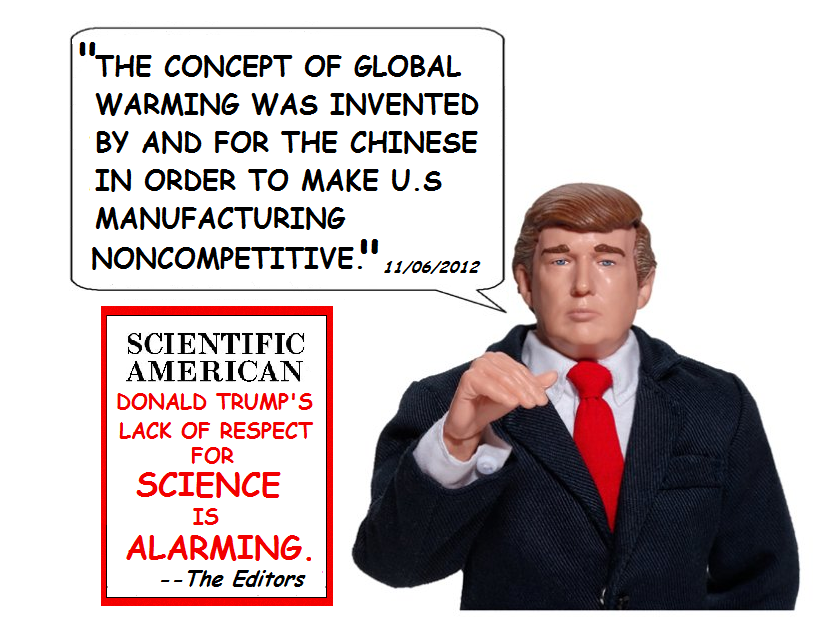
How is this being done? According to the Union of Concerned Scientists, the Trump administration, in its rush to do away with all manner of regulations, appears to consider scientific facts as obstacles to be overcome. This is particularly the case when it comes to the “active dismantling of science-based health and safety protections, sidelining scientific evidence, and undoing recent progress” based on scientific research. Here are just a few of dozens of examples:
(1) Trump appointed administrators at the Environmental Protection Agency have “forbidden SACC [that is, its own Scientific Advisory Committee on Chemicals] from commenting” on EPA decisions concerning such things as worker safety protections, cancer risks, and the (often suspect) quality of industry data.
(2) The Department of the Interior “dismantled the role of science” when looking at protections for endangered and threatened species.
(3) The Department of Agriculture prevented the release of a plan for how the agency can effectively respond to the impacts of climate change.
(4) Trump issued an executive order to “rid federal agencies of one-third of their advisory committees,” many of which provide scientific advice to federal agencies.
(Mike Licht, Flickr)
Without proper scientific standards for review and regulation, we get what David Michaels, former assistant secretary of labor for the Occupational Safety and Health Administration, calls “mercenary science.” This is “science-for-hire, contracted out by chemical and pharmaceutical companies to prove that their harmful products aren’t harmful by giving them the quantitative imprimatur.” This is what happens given inadequately supervised capitalism, where science and truth are separated out for the sake of profit. Before proper regulation, this approach ended up killing and maiming a lot of consumers. It will do so again as Trump deregulates.
Dishonest Government
A popular sense that those who run the U.S. government are not trustworthy, and do not run the government in the interests of the nation as a whole, is not new. According to multiple polls taken regularly since the end of World War II, this sentiment began to become prevalent in the 1960s, and has persisted ever since.
It is also interesting that this downturn in confidence in U.S. leadership coincides with the upturn of a culture war still being waged today. In the 1960s, it was the alienating and starkly immoral nature of the Vietnam War that gave impetus to a youth counterculture movement.
It was also in the 1960s that the various aspects of an African-American power movement — ranging from the actions of Martin Luther King Jr. to those of the Black Panthers — began to promote politically effective equalitarianism. Therefore, one should not be surprised that a good part of Donald Trump’s “base” is a reactionary force in this war: white, racist and culturally traditionalist. As to the last of these positions, many of Trump’s backers are religious ideologues who wage a societal war against same-sex marriage and other LGBTQ civil rights protections. These are the same “Godly” folks who think evolution is wrong and science a suspect anti-religious enterprise. Simultaneously, they turn a blind eye to Trump’s criminal inclinations. They will support him because they think he is a tool, albeit a lying and cheating one, in some genocidal divine plan.
However, the cheating culture we are now confronting does not express itself through Trump and his supporters alone. As we have seen, it is wider ranging. So, while the actions of certain Democrats may not match Donald Trump’s venality, you can bet that these Democrats are also undermining honest, representative government.
Democratic Party cheating became notable in 2012. No doubt it goes back much further, but 2012 is when it literally showed itself on public media. Specifically, the telltale incident occurred on Wednesday, the fifth of September, 2012 — in the middle of a broadcasted session of the Democratic Party convention, no less!
Here is how it went: The Democratic platform committee had decided to keep all issues pertaining to a final treaty between Israelis and Palestinians out of the platform. After all, Israel and Palestine are foreign nations. Among these issues was the final status of the city of Jerusalem. However, the Republican platform of that year “envisioned” Israel with Jerusalem as its capital, and the Republicans were trying to make the status of Jerusalem a campaign issue.
So, President Barack Obama and his platform committee apparently decided that the politically savvy thing to do was to change the Democratic platform to match that of the Republicans.
However, to amend the platform required a two-thirds majority vote from the convention floor. So, Los Angeles Mayor Antonio Villaraigosa, who was chairing the Democratic convention, confidently called for a voice vote on the issue.
Villaraigosa called for the vote three times. Each time the viewer could hear that he failed to get the desired result. Between the second and third vote a member of the platform committee went over and told Villaraigosa that he had to rule in favor of the change in wording. So, after the third vote, which again could be heard to fall short of the two-thirds required, Villaraigosa straight out lied and said the delegates had approved the change in wording, and that was that.
This brazen incident, taking place on national television, was not the last time the Democratic leadership cheated. They rigged the selection process in favor of Hillary Clinton in 2016 and may even now be rigging the selection process against Senators Bernie Sanders and Elizabeth Warren in 2020. Also, some Democratic “progressives” are showing signs of being vicious competitors in their own right.
Cheating, along with its partner habitual lying, undermines both communities and institutions: everything from marriage to commerce, to science, to government. Nothing can stand firm before them once these vices become normative. That is what makes Trump so unacceptable—he represents a social climate wherein honesty can never be assumed.
Once again, it should be emphasized that Trump, as dangerous as he certainly is, did not cause this present problem. He is just opportunistically exploiting it. In truth, these vices are always latent within society because, for human beings, cheating rather than honesty may be a default position. Thus, we must be taught or otherwise encouraged to be honest with both each other and ourselves.
This is not just a lesson for parents, schools, the courts, and the marketplace. It is also a necessary lesson for our politics. But we have not managed to come up with a way to vet our leaders so as to assure their long-term honesty and integrity — a process we have been searching for since the time of Plato. Nonetheless, we should try harder, because both history (of which most people are woefully ignorant) and our present circumstances offer us examples of what it means to fail in this regard. Cheating and the habitual lying that comes with it are the ultimate signs of systems failure.
Friday, March 6, 2020
70+ Groups Demand Trump Prohibit Coronavirus Profiteering by Big Pharma
"We the People have driven coronavirus research and development—not pharma corporations."
Julia Conley, staff writer
https://www.commondreams.org/news/2020/03/05/70-groups-demand-trump-prohibit-coronavirus-profiteering-big-pharma?
More than 70 organizations on Thursday demanded that the Trump administration forbid monopolies or price-gouging on all vaccines and coronavirus treatments and to reject any effort by private companies to profit off the public health crisis now roiling the U.S. and the world.
As the government offers subsidies to pharmaceutical companies like Sanofi and Regeneron, the open letter (pdf) from the groups, led by Public Citizen, said, the Trump administration must require all COVID-19 contracts guarantee reasonable pricing for any treatments or vaccines.
"Allowing companies to price-gouge and hold monopolies on treatment for the respiratory illness which has killed more than 3,300 people so far would have grave implications for the U.S. government's ability to stop the spread of COVID-19," the groups said.
"The imperative of requiring reasonable pricing and access is not just a matter of avoiding profiteering, it's a matter of public health urgency," they wrote. "If monopoly pricing of pharmaceutical companies inhibits access around the world, it will hinder our response to what could turn into a global pandemic."
"We need clear and firm commitments across all funding agencies, and for all types of products," the groups added. "Specifically, we call on your administration to require open, non-exclusive licenses. All manufacturers who can produce high-quality products and commit to reasonable pricing should be allowed to develop vaccines and treatments."
The letter was written days after congressional Democrats pushed their Republican colleagues to include "fair and reasonable price" standards in federal contracts for purchasing treatments and vaccines for COVID-19, failing to force Republicans to apply those standards to the commercial market.
Taxpayers, the groups said, have already spent nearly $700 million on research and development regarding coronaviruses including COVID-19, SARS, and MERS since 2002.
That taxpayer-funded research "has been instrumental in laying the groundwork for the COVID-19 response," the groups wrote. "Taxpayers should not have to pay twice."
"We the People have driven coronavirus research and development—not pharma corporations," said Robert Weissman, president of Public Citizen. "Americans will not accept Trump giving Big Pharma corporations monopolies or letting pharma corporations profiteer off a potential pandemic that claims lives daily."
Public Citizen led the drafting of the letter a week after Health and Human Services Secretary Alex Azar told Congress he could not guarantee that a federally-funded coronavirus vaccine or treatment would be affordable for all Americans. Azar told Rep. Jan Schakowsky (D-Ill.) that "we can't control that price because we need the private sector to invest."
Azar, who led drug company Eli Lilly during a period when it doubled the price of insulin, later backtracked on the statement. But as Public Citizen and other groups wrote, "Vague assurances are not enough."
"No, Secretary Azar, it would be ludicrous to leave such operations to private industry," Sachs wrote. "Mr. Secretary, we should not grant patent protection for such a new vaccine produced heavily with public money to fight a global public emergency."While not unusual in general, economist Jeffrey Sachs wrote in an op-ed on Thursday that allowing the pharmaceutical industry to set the price of life-saving treatment would "be disastrous in the context of an epidemic."
Sachs added that vaccine development should be placed in the hands of Dr. Anthony Fauci, director of the National Institute of Allergy and Infectious Diseases, with delivery and funding in the control of the federal government.
"Private industry can be a welcome partner but should operate under clear federal leadership and with no monopoly rights to the vaccine," Sachs wrote.
Lee Camp Ledger, Mar 5
Week Of Mar 3, 2020
News The Corporate Media Is Scared You'll See!
Lee Camp Mar 5


I’ve started a new Moment of Clarity YouTube channel to get around the suppression against my anti-corporate news. Do me a favor and subscribe to the new account by following this link. It takes 2 seconds.
Eleanor & I go over everything you need to know about how F**ked Super Tuesday was — on my weekly news podcast Common Censored
This is why Chris Matthews just resigned —on Redacted Tonight
Ron Paul came on my show to discuss anti-imperialism & freedom of the press — on VIP
Michael Bloomberg has dropped out of the DNC primary but it’s still important to remember that the DNC was comfortable with a billionaire who was connected to notorious sex criminals Jeffrey Epstein & Harvey Weinstein — on Moment Of Clarity
The Washington Post supported the US-backed coup in Bolivia last year. Now they’ve been forced to report that the justification for the coup, election fraud, was a lie — on FAIR
As capitalism decays, the death of shopping malls across the country offers a unique opportunity to redevelop communities in a smarter way — on Grist
Ben Norton takes on CNN pundit Ana Navarro’s history of supporting right-wing death squads in Latin America — on The Grayzone
Wall Street Loves Biden - Insurance Stocks Soar After Super Tues
THE CORRUPT US HEALTH INDUSTRIES ARE THE ONLY WINNERS COMING OUT OF SUPER TUESDAY.
https://www.youtube.com/watch?v=TBAB4J-PyjU&feature
Subscribe to:
Posts (Atom)