Posted on July 8, 2019 by Lambert Strether
By Lambert Strether of
Corrente.
Readers, every so often I
mention the famous New Yorker article about a reporter who accompanies a group
of locals into a swamp to find a bird, thought to be extinct, but whose song
may have been heard. After many many pages, the upshot: They didn’t find the
bird. I’m afraid this post is like that. Among the many unanswered questions
about electric vehicles (EVs) is whether we have enough of the necessary
minerals — lithium, cobalt, nickel — to manufacture their batteries.
We are now at 91 lithium ion
battery megafactories in the pipeline to 2028 #EV
(The vast majority of these
factories are not in the United States[1]) Can we — I suppose as a
species instead of a polity — keep all these factories running? For how long?
Now, I was in Canada for the
Bre-X scandal, “the
most elaborate fraud in the history of mining,” which involved fake
(“salted”) samples of gold; Bre-X had a market capitalization of $4.4 billion
before the fraud was exposed. So I’m not disposed to take reporting on mineral
reserves on faith, and most of the sources I read seemed to be talking their book. (Those in the Naked Capitalism
readership who are minerals fans will correct me on this.) I had hoped to begin
from the material characteristics of lithium, nickel, and gold, from which the
mining technique would follow, and combine that with the location of deposits
to come to some sort of rough estimate of supply, and of the risks involved.
For example, lithium (Li)
is so reactive that it never occurs freely in nature. It dissolves in brine,
so one approach is to look for subsurface brines under dry lake beds, pump the
brine into evaporation ponds, and when the brine is sufficiently concentrated,
extract the lithium and then pump the result back under the lake bed. This is
the approach used for the world’s largest lithium deposits, in the “Lithium Triangle”
(Argentina, Chile and Bolivia). By the Monroe Doctrine, we should be
controlling that piece on the board, but Germany and China seem to be doing the investing. So,
that looks a lot like fracking re-injection to me, an environmental risk, and
there’s geo-political risk as well.
Cobalt (Co),
like lithium and nickel, is only found in chemically combined form, as a
metallic-lustered ore, most often as a by-product of copper and nickel mining
in the Congo, where there are also seams of cobalt close to the surface. As a
result, there are “artisanal miners” — what a phrase — who scour the mine
tailings for shiny cobalt, or dig informal shafts. Here there are political
risks, the Congo being what it is, and public relations risks,
since artisanal miners are often children, and who wants a supply chain (that’s
undeniably) tainted by child labor?
Nickel (Ni) is mined
worldwide (Indonesia, the Philippines, Russia, New Caledonia,
Australia, and Canada, among others. “Nickel mining occurs through extractive metallurgy,
which is a material science that covers various types of ore, the washing
process, concentration and separation, chemical processes and the extraction
process.” So we don’t have artisanal nickel mining, and the environmental
effects are no more than normally bad for “extractive metallurgy”, which is awful. Given the countries where it’s mined, the
political risks seem minimal[2].
But — and this is the longest
windup ever, I feel like Luis Tiant — that approach is simply too complicated,
and doesn’t lead me to the question of supply. So I’m going to move ahead to a
topic-based review of the literature. This is a topic I hope to return to, so I
hope readers will, as it were, provide me with some paths through the swamp, or
even give me a line on the bird.
It’s Not Clear We Have the
Necessary Lithium, Cobalt, and Nickel
There are currently 31.5
million cars on the UK roads, covering 252.5 billion miles per year.
If we wanted to replace all
these with electric vehicles today (assuming they use the most resource-frugal
next-generation batteries), it would take the following:
207,900 tonnes of cobalt –
just under twice the annual global production
264,600 tonnes of lithium
carbonate (LCE) – three quarters the world’s production
at least 7,200 tonnes of
neodymium and dysprosium – nearly the entire world production of neodymium
2,362,500 tonnes of copper –
more than half the world’s production in 2018
Even if we only wanted to ensure an annual supply
of electric vehicles, from 2035 as pledged, the UK would need to annually
import the equivalent of the entire annual cobalt needs of European industry.
For the UK alone. As John
Petersen points out in Seeking
Alpha:
Bernstein Research analyzed
the incremental technology metal requirements for an ~88% transition from ICE
to EV. This table summarizes their conclusions and compares those requirements
with the current global production base for each technology metal:
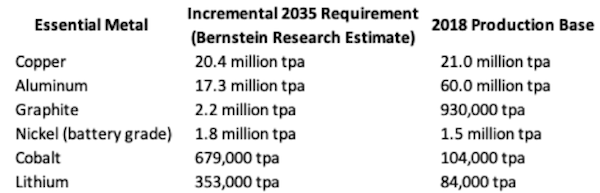
While aluminum doesn’t present
insurmountable issues and increasing graphite and lithium production from
modest current levels is theoretically possible, doubling
nickel production over a period of 17 years would require herculean effort and
doubling copper production would be almost impossible. Since
cobalt is a byproduct of copper mining in the Congo and nickel mining in other
parts of the world, the only path I’ve seen that has a chance of growing to
meet anticipated demand is sub-sea mining. While extensive work in the 1970s
proved that sub-sea mining was technically feasible, the only commercial
sub-sea operations are diamond mines in offshore Africa.
And we’re on deadline.
Battery Production Is Not
Green
“Like any mining process,
[lithium mining] is invasive, it scars the landscape, it destroys the water
table and it pollutes the earth and the local wells,” said Guillermo Gonzalez,
a lithium battery expert from the University of Chile, in a 2009 interview.
“This isn’t a green solution – it’s not a solution at all.” But lithium may not
be the most problematic ingredient of modern rechargeable batteries…. Unlike
most metals, which are not toxic when they’re pulled from the ground as metal
ores, cobalt is “uniquely terrible,” according to Gleb Yushin, chief technical
officer and founder of battery materials company Sila Nanotechnologies.
I understood about artisanal
mining and child labor, but I didn’t understand that children were handling a
toxic material.
Battery Recycling Isn’t a
Thing
It’s difficult. From Engineering.com:
Whereas lithium batteries are
said to be 95 per cent recyclable, the practice of recycling them is
more easily said than done. Throughout their lifespan, lithium batteries
undergo irreversible damage, meaning that they can’t simply be repurposed.
Instead, they need to be entirely taken apart, the lithium extracted, and then
re-manufactured. But even this is an oversimplification.
Battery manufacturers
incorporate several additives into the electrolyte liquid in the Li-ion
battery. The purpose of these additives is to improve the battery in many ways,
such as by speeding up the manufacturing process, or making the battery
more durable in hot and cold weather. But when manufacturers keep the
battery cocktail a secret, repurposing the precious minerals contained within
becomes difficult and, therefore, expensive.
Moreover, the electrolyte
mixture is the component of the battery that has been known to explode when
handled incorrectly, for instance, if it is subjected to high temperatures. This means that any attempt
at creating a recycling process will need to find a way to ensure that the
batteries are dismantled in a safe manner.
With these difficulties in
mind, it’s not surprising that recycling rates for lithium battery is really
low; only 2 per cent of lithium batteries in Australia are recycled,
with the rest left to rot in landfills. But the problem does not necessarily
come from members of the public carelessly tossing their cracked iPhones into
the trash.
It might be argued that
sustainable recycling infrastructure should come from the car companies—a
process that is still not cost effective compared to market lithium costs, and
therefore provides little incentive. “Recycled lithium is as much as five times
the cost of lithium produced from the least costly brine based process,” Waste-Management-World stated. Even with our best efforts,
recycled lithium is not pure enough to produce batteries, and the material ends
up being used for non-battery purposes.
Recycling will be a big
problem. From CFact:
Most electric vehicles in use
today are yet to reach the end of their cycle. The first all-electric car to be
powered by lithium-ion batteries, the Tesla Roadster, made its market debut in
2008. This means the first generation of electric vehicle batteries have yet to
reach the recycling stage. An estimated 11 million tons of spent lithium-ion batteries will flood our
markets by 2025, without systems in place to handle them.
It doesn’t seem likely that
the externalities of disposing of, let alone recycling, lithium-ion batteries
have gotten much attention in the EV industry, let alone from regulators. I’m
picturing an enormous pile of batteries catching on fire somewhere, but I have
a vivid imagination.
The Prevalance of Magical Thinking
“Sarah Maryssael, Tesla’s
global supply manager for battery metals, told a closed-door Washington
conference of miners, regulators and lawmakers that the automaker sees a
shortage of key EV minerals coming in the near future, according to the
sources.”
Update: Reuters updated their
story to that a Tesla spokesman said: the comments were industry-specific and
referring to the long-term supply challenges that may occur with regards to
these metals.
With EVs at 2% of the market,
I suppose in the short term there are no problems, yes. However:
[Tesla] rarely comments on
supply problems at the mineral level [odd] and when it has in the past, it
mainly brushed off concerns.
That’s partly because cobalt
has been the main concern for many automakers and Tesla’s use in cobalt in its
proprietary [i.e., not recyclable in the general case] battery chemistry is
somewhat limited.
Nickel and copper are the most
common minerals in its batteries, but there are also the most commonly mined.
It’s interesting that they are
now warning that there could be shortages. It’s another indication that the
growth in the industry is going to happen fast in the next few years with so
many different mass market EV programs in the work.
Those
are good problems to have because they indicate that we are going in the right
direction and they are somewhat easily solvable. They just require investments.
“They just require
investments.” And investment is a zero-time task!
Conclusion
I wish I felt I had my arms
round the material completely, but no doubt that will come with future study.
(EV stans, don’t @ me.) Do any of the old codgers in the readership remember
Saturday Night Live’s sketches on Toonces the Driving Cat? This video is
seconds long:
That’s what the EV discourse
reminds me of. For most of the time Toonces was on the road, past
results did indeed predict future performance (“we are going in the right
direction”). Until they didn’t! Was the only requirement “more investment”? No.
Cats like Elon Musk shouldn’t be driving anything!
NOTES
[1] Simon Moores, Managing Director of Benchmark Mineral
Intelligence: “Right now, the US produces 1% of global lithium supply and only
7% of refined lithium chemical supply, while China produces 51%. For cobalt,
the US has zero mining capacity and zero chemicals capacity whilst China
controls 80% of this second stage.” It’s not clear that ramping up domestic
production will be easy, especially on public land. And developing a nickel mine, at
least, can take a decade.
[2] Making this statement from Tesla all the more odd: “Tesla
claims that the nickel in its vehicles is 100% reusable at the end of life, but
refused to disclose to the Guardian where the nickel in its car batteries is
sourced from. In a statement a Tesla spokesperson said suppliers were ‘three or four layers removed from Tesla. It is
obviously quite difficult to have perfect knowledge about everything that happens
this far down in the supply chain, but we’ve worked extremely hard to gather as
much information as possible and to ensure that our standards are being met.'”
If there’s nothing to deny, why all the deniability?

No comments:
Post a Comment