Tuesday, June 28, 2022
Food Insecurity Increases In The US While It Declines In Nicaragua
https://popularresistance.org/food-insecurity-increases-in-the-u-s-while-it-declines-in-nicaragua/
Whose Socialist Government Has Defied U.S. Regime Change Designs.
In 2018, 48% of U.S.-based churches had their own food-distribution ministry or supported efforts run by other churches or organizations such as food pantries or food banks. These faith-based ministries, unlike government programs, provide immediate help to hungry people with no requirements. And more than two million people volunteer at a food pantry, soup kitchen, emergency shelter or after-school programs in the U.S., working more than 100 million volunteer hours a year—according to Hunger in America 2014, a study conducted by Feeding America.
Expansion Of Public Sector In Nicaragua Has Improved Quality Of Life For Everyone
In 2018, 48% of U.S.-based churches had their own food-distribution ministry or supported efforts run by other churches or organizations such as food pantries or food banks.
These faith-based ministries, unlike government programs, provide immediate help to hungry people with no requirements. And more than two million people volunteer at a food pantry, soup kitchen, emergency shelter or after-school programs in the U.S., working more than 100 million volunteer hours a year—according to Hunger in America 2014, a study conducted by Feeding America.
This wave of charity recognizes a serious problem in the United States: Despite being a wealthy nation, food insecurity remains high.
People In The U.S. Are Not Food Secure
In the U.S., the average percentage of households with food insecurity stayed between 10% and 15% from 1995 until 2020, when the numbers shot up. Despite volunteer and government food aid, hunger grew 9% from 2019 to 2020, when 38 million people were hungry.
According to recent research by the Census Bureau from the week before Christmas 2021, 81 million people experienced food insecurity, and 45 million reported not having enough food. Families with children have suffered most: The rate of hunger has been 41% to 83% higher for households with children than adult-only households.
In 2020, one in seven (14.8%) households with children could not buy enough food for their families. The prevalence of food insecurity was much higher in some states than others, ranging from 5.7% in New Hampshire to 15.3% in Mississippi from 2018 to 2021.
Twice as many Black households experience hunger than white households. During the pandemic, 19% to 29% of Black homes with children have reported not having enough to eat; 16% to 25% of Latino homes and 7% to 14% of white homes reported the same. Black families go hungry at 2 to 3 times the rate of white families.
Some 43% of Black households with children have experienced food insecurity during the pandemic—the highest rate in recorded history. Children get sick more often if they are not consuming enough nutritious food, and hunger impedes learning.
Thus, one in four people in our nation, the richest nation on Earth, did not have adequate access to sufficient nutritious food needed for a healthy life.
In the face of this pervasive food insecurity, families turn to a variety of sources for help.
More than 42 million people rely on SNAP, the Supplemental Nutrition Assistance Program. During the Covid pandemic, the USDA increased the purchasing power of the plan—by 21% —for the first time since 1975. There were also emergency allotments that increased the value of food stamps people received. This part will likely end soon.
In 2019, 35 million people relied on food charity, another sign that millions of people do not earn a living wage.
Undocumented immigrants are more dependent on food pantries because they are excluded from government programs. Church-related food programs make a big difference for these people’s lives, especially for their children.
One in eight families have reduced their food spending to pay for health care. And Black families are twice as likely to be unable to afford health care. Impoverishment in the United States includes food insecurity, lack of decent housing, lack of health care, poorly paid employment or no employment, and poor quality public education.
Approximately 80% of households receiving food stamps had at least one worker, indicating that millions of people do not earn a living wage.
In 2019, unemployment of Black individuals was double the rate of whites and Blacks were much more likely to only earn minimum wage or less.
In 2020, the average Black family had $1,500 for emergency spending, while white families had $7,500. Only 10% of Latino families had savings to last six months, while 36% of whites did.
In January 2020, at least 580,466 Americans were without a home, and 30% of those were children. Marginalized racial groups are more likely to be without homes as a result of segregation and discrimination in housing and employment as well as in many other areas of life. Hunger is not universal among unhoused people; however, it is much more frequent than among the housed population.
“Vehicle residency is one of the fastest-growing forms of homelessness,” said Sara Rankin, Professor of Law and Director of the Homeless Rights Advocacy Project at the Seattle University School of Law.
U.S. foreign policy has had a major effect on hunger and nutrition in developing nations for many years. U.S. agricultural policies aggressively promote creating markets for our farmers by promoting international reliance on U.S. food exports.
U.S.-Related International Food Insecurity
U.S. loan policies are never aimed at the food security of the population of developing nations; instead, they promote production and export of products such as bananas, sugar and coffee to the point that many developing nations are producing and exporting the same things. Thus, the international price stays artificially low, and the countries benefit little from these exports.
Small and medium-scale farmers plant the food that local people eat, like corn, beans, rice, vegetables and fruits, and they also raise farm animals in a more healthful way than large corporations. But U.S. policies have contributed to placing that land into the hands of large landowners and corporations.
The U.S. influences national policies of developing nations such that it is very difficult for small and medium-scale farmers to get loans or any other kinds of government support.
The U.S. subsidizes its own farmers to the point that products like corn and rice are actually sold below what would be the real price.
In this way, we put small and medium-scale corn and rice producers out of business in developing nations—they simply cannot compete with the large-scale subsidized farmers. So, most end up having to sell their land, leading to more large export-based farms—many now owned by U.S. corporations.
This whole process also leads to more migration out of these countries.
Dependency on food imports from the U.S. also undermines the international goals formulated at the 1974 UN World Food Conference to encourage food self-reliance and security from hunger.
An Example Of Food Sovereignty For The United States And Other Nations
The small nation of Nicaragua in Central America has worked on ending poverty for the last fifteen years. One of the most important strategies has been to develop food security, and today they have reached approximately 90% food security.
This means that small and medium-scale farmers are producing 90% of the food that Nicaraguans eat: corn, beans, rice, plantains, vegetables, fruits, chicken, fish, pork, beef, honey, sugar, etc. Their population is much more food secure in times of crisis, whether it be a climate-related crisis or a political crisis. There are no factory farms of cattle. There are large and corporate producers of export crops like sugarcane; but even coffee production for export is held more in the hands of small and medium-scale producers.
Along with this, they now have almost 100% electricity coverage, more than 90% of people have potable water in their homes, and there is good universal health care and education including technical and university education. The government subsidizes transportation, electricity and water for their more vulnerable population.
Since petroleum prices skyrocketed in March 2022, the government is covering all the increases in electricity, gas and gasoline. Since 2007, amazingly, they have increased renewable energy from 20% to almost 80% and are in third place worldwide.
They had a major land reform in the 1980s that put land into the hands of nearly a million people. During three governments by and for the wealthy from 1990 to early 2007, much of that land returned to the hands of the wealthy. But government policies have helped nearly 600,000 families legalize their property. The government also makes technical assistance, training and low-interest loans available to micro and small-scale farm families.
It is interesting to note that, during the years of the Somoza-family dictatorship, supported by the U.S. from the 1930s to 1979, there was much concentration of land in a few hands. That impacted what was grown and how. In the western Pacific area, there were so many pesticides used for production of cotton that, even today, pesticides are found in the breast milk of women from this area.
Because of current Nicaragua policies that benefit the people instead of U.S. corporations, the U.S. has been doing many things to destabilize Nicaragua politically, and even directed and financed a coup attempt in 2018.
Although it didn’t fly, it cost the economy billions of dollars, and the U.S. continues to try to destroy the excellent example Nicaragua is giving to the world. Just visit Nicaragua and you will see that another world is possible and that we could be employing similar policies in our country.
Corporate Profits Limit Food Security And Health In The United States
Monoculture production of grains on a corporate scale is not good for the land and requires enormous amounts of fertilizers and pesticides. Whereas sustainable farming practices control weeds, insects and other pests with ecosystem management, farmers who monocrop are dependent on pesticides. Pesticides are linked to multiple health problems, including neurological and hormonal disorders, birth defects, cancer and other diseases.
Production of cattle, pigs and chickens on a corporate scale is terrible for the environment and there are many cases of water sources being polluted.
Corporate-raised animal products such as beef have lower levels of important nutrients and are higher in LDL (the “bad”) cholesterol. Grass-fed cows eating in a field produce milk and meat higher in omega-3 fatty acids, high-quality fats, and precursors for Vitamins A and E.
The volume of animal waste produced on factory farms is much greater than that of human waste. Household waste is processed in sewer systems, while animal waste is often stored in lagoons and applied, untreated, as fertilizer to farm fields. That excrement stored in lagoons has pathogens such as E.coli, residues of antibiotics, animal blood, bedding waste, cleaning solutions and other chemicals. Manure pit gases with hydrogen sulfide, ammonia and methane fill the air, along with dust and irritants.
Factory farming is especially threatening to ground water supplies. Bacteria, viruses and nitrates can enter the supply and the community can be exposed to disease and nitrate poisoning. Nitrate poisoning is dangerous to infants and fetuses and can lead to birth defects and miscarriages. It has also been associated with esophageal and stomach cancers.
There is substantial overuse of antibiotics on factory farms—80% of antibiotics sold in the world today are for corporate farming. Antibiotic overuse leads to the evolution of antibiotic-resistant bacteria. Then with mutations, these bacteria can jump to humans, causing pandemics. Pandemics are also associated with viral mutations promoted by the large number of animals in very small spaces. In recent years, we have seen an increase of zoonotic diseases; these are infectious diseases caused by a pathogen such as a bacterium, virus, parasite or prion that has jumped from an animal to a human. Examples are salmonellosis, Ebola, influenzas, and bird and swine flu.
In the United States, along with food charity, it is essential for us to become involved in changing food production policies that support more small and medium-scale farmers who can be encouraged to use sustainable practices through loan policies, for example.
We also need an agrarian reform plan and laws to limit how big a farm can be so that we prioritize the health of our population instead of prioritizing the profits of corporations. And, of course, we need good jobs that pay a living wage so that everyone can enjoy good nutrition—and we must recognize this as a human right.
One last point as food for thought. The U.S. has already sent $13.6 billion in arms to Ukraine and it appears on the verge of sending $33 billion more in arms. To end world hunger would only cost $45 billion. Why do our lawmakers so easily spend billions on war but do not even consider spending money on peace?

Lessons From Colombia: A Victory For The People
https://popularresistance.org/lessons-from-colombia-a-victory-for-the-people/
By Margaret Flowers, Clearing the FOG.
June 27, 2022
Featured Campaign, Podcast
On June 19, Colombians elected the first leftist president and the first Afro-Colombian vice president in history. This was possible, despite being in a repressive state, because of a strong national social movement that organized an effective national strike in the spring of 2021. Clearing the FOG speaks with Charo Mina Rojas, an Afro-Colombian human rights defender and leader in the 2016 peace process, about this victory, the obstacles they faced and how they will counter efforts by the wealthy class to prevent further progress. Activists in the United States have much to learn from the Colombian people’s movement and an important role to play in preventing interference by the US government.
Listen here:
Subscribe to our show on iTunes, SoundCloud, MixCloud or Stitcher.
 Review us on iTunes! Click here … Then click on “View in iTunes … Then click “Ratings and Reviews.”
 Guest:
Charo Mina Rojas is an Afro-Colombian human rights defender with more than two decades of experience in activism at the national and international levels. Ms. Mina-Rojas is the National Coordinator of Advocacy and Outreach for the Black Communities’ Process (Proceso de Comunidades Negras- PCN) and a member of the Afro-Colombian Solidarity Network.
Ms. Mina-Rojas was extensively involved in the Havana peace process, serving on the Gender Committee of the Ethnic Commission. The Ethnic Commission was composed of the Afro-Colombian Peace Council (CONPA) of which PCN is part, the National Indigenous Orgarnization (ONIC) and Consejo Mayor Indigena.
The Ethnic Commission was formed to advocate for the inclusion of Afro-Colombian and Indigenous rights and perspectives in the agreement. Their collective advocacy led to the landmark achievement of an Ethnic Chapter within the Peace Accord, which contains protections for Indigenous and Afro-Colombian Peoples, including for their gender-based human rights. Ms. Mina-Rojas was instrumental in guaranteeing that Afro-Colombian and Indigenous women’s rights were included in the final agreement.
Ms. Mina-Rojas is now a member of the Special High Level Body for Ethnic Peoples, and is working to ensure the Colombian Government’s peace implementation plan fully adheres to the provisions of the Ethnic Chapter and other relevant provisions of the Peace Accord, including its gender rights protections.
Ms. Mina-Rojas has worked for many years to educate grassroots Afro-descendant communities on Law 70 of 1993, which recognizes their cultural, territorial and political rights. It was PCN, the organization that she works for that successfully advocated for the enactment of this law as well as the development of the Observatory of Racial Discrimination in Colombia, and the addition of specific statistics on Afro-descendant people in the Census 2005. Ms. Mina-Rojas raises awareness about gross human rights violations against Afro-descendant women at national and international level, calls for accountability and provides protection for Afro-descendant women leaders and women human rights defenders.
Abortion rights protests encounter police, right-wing violence
https://www.wsws.org/en/articles/2022/06/27/rqth-j27.html
By our reporters
a day ago
Tens of thousands continued to protest over the weekend in cities from coast to coast in the United States, denouncing the Supreme Court’s decision announced Friday morning to overturn the Roe v. Wade decision and allow state governments to outlaw abortion.
Some 15 states with “trigger laws” are expected to have legal bans on abortion in effect by early July, and a total of 26 states are at some stage of a legislative process to follow suit. Only the Northeast and mid-Atlantic states, the West Coast, and Illinois and Minnesota in the Midwest have robust protection of abortion rights in place.
States like Michigan, Indiana, Iowa, Kansas, Florida, Georgia, the Carolinas, Arizona and Montana are in legally uncertain conditions.
One of the largest demonstrations took place Friday night in Phoenix, as some 8,000 people marched and rallied outside the Arizona state Capitol. As they chanted their opposition to the Supreme Court’s reactionary and anti-democratic action, the demonstrators were suddenly hit by teargas fired by police from inside the Capitol building itself.
Republican Senate President Karen Fann issued a news release describing the peaceful protest as an insurrection aimed at overthrowing the state government. The state Senate was in session engaged in approving a major expansion of charter schools to undermine public education while the rally outside was taking place.
State police said in a statement that what “began as a peaceful protest evolved into anarchical and criminal actions by masses of [a] splinter group” (?!). They said gas was fired “after protesters attempted to break the glass” separating the protest from the Capitol building.
Despite these claims, state police made no arrests, and there were no injuries reported. Reporters on the scene found no broken glass. The only apparent violence was the tear-gassing itself, which not only dispersed the protesters but disrupted the state Senate proceeding, as legislators fled their chambers and took refuge in the basement as gas filled the halls.
Democrats in the legislature issued a mewling statement condemning “violence in all forms,” noting the purported attack on the legislature, but saying that Republican lawmakers were “weaponizing this moment to deflect from the actions of January 6th.” They also noted that they have voted to give state police a large pay raise.
Protests continued Saturday in dozens of cities, including New York City, Philadelphia, Washington D.C.; Norfolk, Virginia; Atlanta, Georgia; Birmingham and four other cities in Alabama; New Orleans, Louisiana; Tucson, Arizona; across California, and in Portland, Oregon, and Seattle, Washington.
In Providence, Rhode Island, a speaker at an abortion rights rally, Jennifer Rourke, a black woman who is running for a state Senate seat as a Democrat, was assaulted by her Republican opponent, Jeann Lugo, a white male police officer who was off duty. A group of anti-abortion protesters had approached the much larger group of abortion rights demonstrators and fighting broke out, which Rourke was seeking to break up.
Lugo has been suspended by the police department pending an investigation, and he announced that he was also suspending his election campaign.
In Atlanta, a group of fascist Proud Boys trailed Saturday’s abortion rights demonstration but were blocked from getting to the protesters by a group of veterans who called themselves the “Wall of Vets,” forming a barrier to protect the demonstration.
Friday night in Cedar Rapids, Iowa, the driver of a pickup truck engaged in a verbal conflict with abortion rights supporters, then accelerated his vehicle and struck one of the protesters, who had to be taken to the hospital for evaluation. The police have made no arrest and filed no charges.
Outside New Orleans, WSWS reporters spoke with people demonstrating at the St. Tammany Parish Justice Center in the suburb of Covington.
Most abortions were banned in Louisiana on Friday following the Supreme Court ruling, when so-called “trigger laws” went into immediate effect. The two anti-abortion bills that went into effect were signed by Democratic governors, current Governor John Bel Edwards and a previous governor, Kathleen Blanco.
A number of young people at the demonstration spoke about their thoughts on the ruling, its relation to broader political issues and the role of the Democratic Party.
Riley said, “I feel like we’re going so far back in history. This is something women already fought for, and the fact that so many are here today having to fight again is awful. It’s awful to see that people have to fight for their rights again.”
Kylie added, “It’s terrible that we’re repeating something that is already so far gone. We have voices that deserve to be heard, and as women in America it’s not fair for our choices to be taken away.”
Asked about the Democratic Party, Riley and Kylie agreed that “they’re not doing enough. They could have done a lot more, and they’re not changing anything. They’re as responsible as Republicans because they’re not showing our voices.”
Two other young demonstrators also spoke about the Democratic Party. One said, “I think that the Democratic Party is not doing enough to support people and their endeavors to combat capitalism, and the brutality of the government is in turn backing the Republicans and all the very right-wing people and taking away people’s rights.”
Kyle added, “I think the Democratic Party is just another right-wing party no matter how much they want to disguise themselves as a liberal and social justice. I think it’s just as bad.”
Between 300 and 400 demonstrated in Norfolk, Virginia on Sunday at a rally called by a reproductive rights group. While the organizers and speakers tried to funnel mass anger into support for the Democratic Party, a WSWS reporting team spoke with several youth and professionals who tended to draw more far-reaching conclusions from Friday’s gutting of abortion rights.
Kaylani, a family therapist, told the WSWS , “Unfortunately, with this ruling it’s only the beginning, only the first step. There are going to be so many precedents they will try to overturn; we are now going so far backwards.” She added, “There is a right and a wrong in this situation. You don’t get to put your opinions on someone else’s body; you don’t get to choose for them.” Michaela interjected, “or who they love, who they marry.”
Cassandra and Savannah, two college students at Old Dominion University in Norfolk, came to the rally to oppose the attack on abortion. Savannah said, “I am a gay woman who uses birth control so I’m not cool with any of this. I am out here trying to protest, to make content on TikTok, anything to raise awareness about this. Honestly, the people representing us right now are not doing their job. Democrats knew that Roe v. Wade has been targeted for a long time, and they really have not been doing their job.”
Imperialist war and the attack on democratic rights
https://www.wsws.org/en/articles/2022/06/27/pers-j27.html
WSWS Editorial Board
a day ago
The escalation of the US-NATO war against Russia and the massive attack on democratic rights—epitomized in the US Supreme Court decision abolishing the right to an abortion—are two sides of the same process.
In his seminal 1916 work Imperialism and the Split in Socialism, Vladimir Lenin defined imperialism as “reaction all down the line.” In both war and domestic policy, he explained, “finance capital strives for domination, not freedom.” Lenin wrote, “The difference between the democratic-republican and the reactionary-monarchist imperialist bourgeoisie is obliterated precisely because they are both rotting alive.”
Lenin’s words aptly characterize the present crisis of the world capitalist system.
At this weekend’s G7 summit, the leaders of the major imperialist powers met in the Bavarian Alps to plan the next stage of the war. Behind the backs of the population, with no public discussion and no formal declaration, the conflict has developed into a de facto war against Russia in Ukraine.
The extent of NATO involvement was revealed in a New York Times article published Saturday titled “Commando network coordinates flow of weapons in Ukraine, officials say.” The article explains that the US and NATO have organized “a stealthy network of commandos and spies” who are “rushing to provide weapons, intelligence and training.”
The article cites US and European officials who confirmed that the NATO powers have deployed advisers within Ukraine to train Ukrainian soldiers, while the US military directly trains soldiers at bases in Germany. This is the product of a years-long plan, dating back to the 2014 Ukrainian elections and the Maidan putsch, to transform Ukraine into a staging ground for a war against Russia. The Times article states, “From 2015 to early this year, American Special Forces and National Guard instructors trained more than 27,000 Ukrainian soldiers at the Yavoriv Combat Training Center in western Ukraine near the city of Lviv, Pentagon officials said.”
In both their choice of planning location as well as in their war aims, the leaders of the world’s self-proclaimed “democracies” emulated Hitler, the last capitalist politician who attempted the colonization of Russia through military means. The very castle where the G7 leaders met in the Bavarian town of Schloss Elmau had been a Nazi military vacation camp during World War Two.
A communiqué issued by the G7 group after the meeting in Schloss Elmau states that it is prepared to carry on the war “as long as it takes.” This means there is no limit to the number of lives the governments are willing to sacrifice to accomplish their geostrategic goals.
The first point on the agenda at the G7 summit—on the cost-of-living and food crisis—makes clear that the ruling class is aware the war is paving the way for a colossal confrontation with the working class.
Under these conditions, the ruling class of each imperialist power views the most basic democratic rights as obstacles in the pursuit of its war aims. Even as the war propagandists in the corporate media justify war on the grounds that Putin is a “fascist,” the logic of the development of the war in the imperialist countries necessitates “reaction all down the line.”
The decision by six unelected judges on the Supreme Court to strip hundreds of millions of Americans of the right to abortion must be seen in this context.
In issuing its decision, the court announced that it was launching an assault on all basic democratic rights. While Supreme Court Justice Clarence Thomas explicitly referenced contraceptives and same-sex marriage as the next targets, he made clear that all cases involving substantive due process must now be revisited. This includes fundamental rights related to searches and seizures, free speech and assembly, labor regulations and other civil rights.
The Democratic Party and Biden administration have facilitated the Supreme Court’s attack on democratic rights with constant efforts to appeal to and appease the far right. When Biden speaks of his “Republican friends,” he is appealing for bipartisan unity in the pursuit of imperialist war aims against Russia. This bipartisanship only legitimizes the extreme right and strengthens the increasingly fascist Republican Party, which attempted to prevent Biden from taking office less than two years ago.
The intensification of the war and the abortion ban are inextricably related and underscore the basic truth that democracy is incompatible with imperialism. In his 1948 book The American Political Tradition, the historian Richard Hofstadter references publisher Frank Cobb’s recollection of a discussion with then-President Woodrow Wilson on the eve of Wilson’s 1917 decision to enter World War One.
According to Cobb, Wilson “said when a war got going it was just war and there weren’t two things about it. It required illiberalism at home to reinforce the men at the front. We couldn’t fight Germany and maintain the ideals of Government that all thinking men shared.” Cobb quoted Wilson as saying, “To fight you must be brutal and ruthless, and the spirit of ruthless brutality will enter into the very fiber of our national life, infecting Congress, the courts, the policeman on the beat…”
This is the case in every imperialist center, where three decades of nonstop imperialist war have asphyxiated democracy and nourished the forces of extreme political reaction. In Britain, Boris Johnson is perhaps the most hated prime minister in history for his naked corruption and slovenly subservience to the London banks. The Johnson government is attempting to deport asylum seekers from countries devastated by imperialist war to Rwanda in a move that even the European Court of Human Rights ruled is blatantly illegal.
In France, where Emmanuel Macron is reviled as the “president of the rich,” the fascist far right won more votes than in any previous presidential election. An unelected administrative court just banned Muslim women from wearing bathing suits that comport with their religious beliefs in a blatant act of cruel discrimination against the country’s large immigrant population.
The war will be conducted on the basis of a massive assault on the economic and social rights of the working class in every country. Government after government is pouring billions of dollars into arming Ukraine without ever asking the public. Calls are growing for balancing budgets to pave the way for further military spending. To pay for war, health and welfare programs will be gutted, even as the pandemic spreads and as governments enact fiscal policies aimed at increasing unemployment and lowering wages.
The war has exacerbated a cost-of-living crisis that is forcing billions of workers to confront unprecedented levels of economic hardship. The imperialist governments are sacrificing the lives of millions in Asia and Africa who face varying degrees of starvation in an attempt to weaken the Russian government’s ties to the global economy. In Europe and North America, the cost of food, gas, energy, rent and basic services is skyrocketing because of the war, while the corporatist trade union bureaucracies suppress wages.
Conditions are emerging for a revolutionary explosion throughout the world. Protests against the rising cost of living are suppressed with deadly brutality in countries like Peru, Sri Lanka, Ecuador, and elsewhere.
In Europe, strikes are growing across the transport industries, including among British rail workers, dockworkers in Germany and Greece, airport workers in France, Denmark and the Netherlands, and pilots and flight attendants across the continent at Easy Jet, Ryanair, British Airways and SAS. A series of powerful strikes has taken place in heavy industry in the United States, where strikes are threatened by tens of thousands of dock and rail workers.
The ruling class has responded by banning strikes and blaming workers for undermining the war effort. In Britain, the Tories are denouncing striking rail workers as “Putin’s agents” while the courts in the US have barred rail workers from striking on national security grounds. This is the modern version of Hitler’s “stab-in-the-back” narrative, which blamed German workers and the revolution of 1918 for German imperialism’s defeat in World War One. In Spain, the “democratic” government of the PSOE and Podemos banned airport workers from joining a European-wide strike for similar reasons.
The International Committee of the Fourth International and its national sections, the Socialist Equality Parties, call for the development of a powerful movement of the international working class against imperialist war. The fight against war must be connected to the defense of democratic rights, rooted in the growing struggles of workers throughout the world and based on a socialist program in opposition to the capitalist profit system.
Transcending The ‘Imperial Mode Of Living’
https://popularresistance.org/transcending-the-imperial-mode-of-living/
An interview with political scientist Ulrich Brand.
In a giant overcorrection from the anti-consumerism era of No Logo and Adbusters, much of the “climate left” in the Global North now tends to dismiss any critique of resource-intensive consumption—driving and flying, factory farmed meat, smartphones—as reactionary, if not even “Thatcherite” or “Malthusian.” Focusing on consumption, the argument goes, distracts from immense capitalist power and profits, blaming the increasingly immiserated working class for conditions that we have no control over. This conclusion has been widely memeified: think of “no ethical consumption under capitalism,” the “Mister Gotcha” comic, or the (misleading) claim that a mere 100 corporations are “responsible” for 71 percent of emissions.
There’s some merit to this pushback, of course. Individualizing climate change and other environmental crises is a key strategy of capital, with the “carbon footprint” first promoted and popularized by BP as a way to diffuse the responsibility of fossil fuel producers. This reality seems only further confirmed every time we learn of a new situation of extreme capitalist waste, such as airlines running thousands of “ghost flights” during the pandemic to maintain airport slots, farmers dumping thousands of gallons of milk, or Amazon destroying millions of items of unsold stock. Capital is to blame, of course.
But when thinking about any kind of rapid and globally just transition, there’s an urgent need to assess the profound imbrication of resource-intensive consumption at the subjective level of conscious and unconscious desires. Countless things that are popularly understood and strived for as key components of a “good life” fundamentally depend on the ever-deepening immiseration of poor, colonized, and racialized peoples, especially in the Global South. Continued access to these material benefits has helped shore up capitalism and stabilize or displace its many crises and contradictions—until very recently, that is—with an “unstable equilibrium of compromise” enrolling subjects as active participants in its maintenance.
One of the most vital recent texts exploring this trend is The Imperial Mode of Living by German scholars Ulrich Brand and Markus Wissen. In contrast to the overly simplistic notion that capital unilaterally imposes consumption upon us, Brand and Wissen emphasize a dialectical analysis in which capitalist domination “draws on the wishes and desires of the populace … becomes a part of individual identity, shapes it, and thereby becomes all the more effective.” Canadian Dimension spoke with Brand, professor for international politics at the University of Vienna, about the imperial mode of living, the dynamic nature of hegemony, and potential alternatives.
Canadian Dimension (CD): What is the imperial mode of living? Why is it a mode of living, rather than a lifestyle or way of life?
Ulrich Brand(UB): The context when we started to work on it was the economic crisis of 2007-2008, where the climate crisis and the ecological crisis had a lot of attention but the specific crisis policies were old-school: supporting the car industry and not really pushing the mobility transition. We asked ourselves: why is the continuity so strong?
We said, OK, there are obviously structures coming from critical theory and Marxism. It’s the mode of production. But what is the other side of the coin? There, we proposed the term “imperial mode of living” or “mode of living” in the sense that it has its own dynamics. We have to think about the mode of production, of course, which is class-based, power-based, globalization-oriented. But the mode of living is that people make sense or have material practices as everyday life.
It’s not a thing of choice, like “I want to have this living room or that car.” But people, with all their differences, are inscribed in a mode of living and mode of production that constantly refers to an elsewhere: to cheap labour and nature. The products and the commodities that people are consuming don’t indicate the conditions under which they were produced. In the smartphone, in the car, in the plane, in the industrially produced food there is this elsewhere—this exploitative relationship—inscribed.
CD: A central claim about the imperial mode of living is that it is exclusive, with contradictions only heightening as more people fight for access to it or refuse to continue bearing its costs. What is it about the imperial mode of living that makes it inherently exclusive and something that can’t be universalized?
UB: “Everyday life” is not a moralizing category, it’s a structural category. To understand this deeply embedded, unsustainable mode of living and mode of production, we necessarily need the other side of the coin: we need the destruction of land to exploit oil and gas—and now even worse with fracking. We need the workers in Bangladesh for the production of textiles. We need the workers in China for the production of cellphones. Against the economic orthodoxy that if there are high enough growth rates, there will be the famous trickle down effect and everybody will be better off along income and class dimensions, we argue, no: we need this other side of the coin.
However, coming from critical theory, we want to highlight dialectical thinking. It’s on the one hand exclusive but it’s also attractive. Even the exploited people, when they have a higher income and better status: they want to be integrated. They want to live the imperial mode of living. We see this with this enormous growth of meat consumption and cars in China. It’s attractive and exclusive. We want to understand and underline this and the invisibility of the preconditions: how nature is appropriated and destroyed, how other people and their workforce is appropriated.
CD: How are the benefits of the imperial mode of living further differentiated through various intersections of gender, race, and socioeconomic status?
UB: This is a very important point. We argue as a structural category, everybody is pulled into the imperial mode of living. We need to live the imperial mode of living. But there are differences because of exploitation within the Global North: there are migrant workers and poor working conditions for many, many people.
These inequalities exist mainly along income: it’s not so much the “ecological consciousness” but the income that produces the so-called ecological footprint or how we are integrated in the imperial mode of living. It’s also public infrastructure that’s produced with materials from the Global South. So we argue that it depends along race and gender because it’s part of the social division of labour. People of colour are usually more exploited: they have fewer chances for a career and good education so they’re stuck to a position within the social division of labour and usually gain less. It’s the same with the gender division of labour: there is a gender pay gap and very different opportunities for careers.
Besides the socialization and social division of labour, we also have consumption patterns that are very different. For example: the use of cars and who gets the larger car, in what Cara Daggett calls “petro-masculinity.” Even with electric cars: the huge Tesla car, almost looking like a tank. So it’s the division of labour and it’s the pattern of accepted consumption that has to do with status and masculinity. But again, it’s this ambiguous integration into society. A woman who earns more money and is part of the upper middle class or elite is very differently inscribed and attached to the imperial mode of living than a poor woman.
We argue that inequality is a precondition of the imperial mode of living and it’s a consequence. The imperial mode of living can be realized because we have this huge inequality, the exclusive character, the class and gender and race-based character. But the effect is also stabilizing social inequality. When we look at the Global North and South relation it’s even stronger.
CD: Another key aspect of the argument concerns the Gramscian theory of hegemony. Crucially, this often plays out at the level of unconscious desires, habits, and anxieties. How does a theory of hegemony help us understand the imperial mode of living and its lasting power, especially as it pertains to these unconscious desires?
UB: Let’s start briefly with the split within the Gramscian use of the concept of hegemony. Usually, of course, it’s domination by consent: it’s the specific form of domination that was the great invention of Gramsci with class domination not just power and coercion but also the fabrication of consent. At least within Western Europe, there is the notion of hegemony and of civil society which was very much attached to “the public,” which is close to Jürgen Habermas and his theory. So “the public” is the form of contestation: it’s the form where the consent is produced.
We, coming from Marxism or historical materialism, argue no: hegemony is practiced in the everyday, consciously or unconsciously. So we have to think not only about the huge public debates: “How’s the energy transition working?” and so on. We have to look in a finer sense about how people make their living and what is attractive in it. Even Gramsci distinguished between active consent and passive consent. He said the active consent is usually the upper middle classes thinking: “This is great, we want to maintain our life.” The passive consent is: “I don’t have an alternative. I don’t want to be exploited or I don’t want to have a boring life but I don’t have any alternatives.” This is passive consent.
Our point is close, if you like, to Bourdieu’s concept of habitus: that this form of living—of desires—is corporealized. It’s part of our subjectivities and part of our body, our wish to have more. This is when it comes to the politicization or the critique of the imperial mode of living. It’s not only the great public debate and hegemony. Of course, we need protest movement, we need this debate. But it’s not enough. Those protest movements and debates should look also at what are the preconditions of people and of their living? It broadens the political perspective of alternatives quite a lot when we have this take of the Gramscian notion of hegemony.
CD: The imperial mode of living is contrasted with a potential solidary mode of living that works to shift subjectivities and social conditions through a radical transformation towards a global care economy. What are some of the key aspects of the solidary mode of living?
UB: To start with, we tried to argue with our book against a very dynamic treatment dealing with ecological crisis: what we call green capitalism, or the green economy, or ecological modernization of capitalism. Which is: we have a problem with the combustion engine so it should be the electric engine. This will not be sufficient, we know, because the resources have to come from the South and there is still the space problem.
We prepare our argument of solidary mode of living against a strong expectation of the green side of the government in Germany and Austria that we don’t have to question our imperial mode of living: we green it a bit. There’s a greening ecological modernization, if you like. I’m sure in Canada you have similar debates. Even many movements believed it; not the radical movements, but many NGOs and so on.
We argue: no, if we take the problem seriously: that we have to get rid of the capitalist growth imperative, that we have to get rid of the world resources market, this enormous flow from the South to the North. We need principles but also to take seriously experiences and then certain policies towards the solidary mode of living. This chapter is a first attempt. It’s very comprehensive and it was also criticized—which is why we’re writing another book.
But you point at a distinction which to us seems crucial: the distinction between the subjective preconditions and the objective preconditions. We don’t accept an environmentalist discourse that says “it’s just behaviour, it’s just the consciousness.” But we also don’t say, “it’s just the policy framework.” We say that if we want a real mobility transition, but only from the combustion engine to the electric engine, we need an understanding via conflicts and via learning processes that the car is not only not necessary but it’s not attractive. It’s a struggle over subjectivities that what we call the “automobile imperial mode of living” or “imperial automobility” is not any longer possible.
The objective conditions are the other infrastructures, the other production systems, which means also a loss of jobs. I work a lot with trade unions on this. A reduction of the car industry means to rethink how the production of mobility is organized and to take the power from the automotive industry and to produce much more the means for public transport. The argument from the automotive industry is always: “There is job loss.” And the unions are on their side. It’s necessarily to convince them to have good public transport—which does not mean planes but a good train and bus system—means also to create jobs. This is the subjective and objective.
Then, we have some principles. One principle, since we come from critical theory, is that the care principle—a principle to organize society carefully: to have care for yourself, for others, for nature, for society—should overrule the profit principle of the large companies. At the large scale of the automotive industry and military, the profit motive turns into political power. We have to reduce certain production but we also have to change property relations.
Another principle beside this care principle is to rebuild the public sector. Of course, we have many problems with the public sector. Corruption, inefficiency: we are aware of these things. But to guarantee basic provisioning, we need a strong public sector because this can be made responsible. When it comes to pensions, when it comes to health, when it comes to education, the private principle is “who has the money?” The public principle is that it’s a social right.
Finally, we argue that we need strong social movements, which are usually the indicators of the need of radical change. We have this wonderful movement in Germany to leave the coal in the soil and the anti-nuclear movement that has decades of experiences and work. At the end, it’s political contestation: it needs to be armoured—to draw on Gramsci—with coercion and the finances of the state. It needs a macro perspective. It’s not enough to remain within a niche. But we defend that the radical innovation usually comes from the edges. For example, we don’t argue “we have to wait until the majority wants it.” We need these starting points of an emancipatory politics, which means criticizing domination in a manyfold sense.
The major challenge we are working on now is to think of a solidary mode of living beyond the national scale. What does it mean to restructure world market flows and power: a very structural inequality? Often, a socialist or ecosocialist perspective is implicitly sticking to the nation state such as Canada or Germany. What we need much more is to think in very concrete steps about what it would really mean to get rid of or at least weaken an international and global division of labour that is reproducing the imperial mode of living.
This interview has been edited for clarity and length.
James Wilt is a freelance journalist and graduate student based in Winnipeg. He is the author of Do Androids Dream of Electric Cars? Public Transit in the Age of Google, Uber, and Elon Musk (Between the Lines Books) and the upcoming Drinking Up the Revolution (Repeater Books). You can follow him on Twitter @james_m_wilt.
AFL-CIO Complicit In Murder Of Journalist Shireen Abu Akleh
https://popularresistance.org/afl-cio-complicit-in-murder-of-journalist-shireen-abu-akleh/
Shameful behavior fits long history of AFL-CIO support for the Histadrut, an arm of the Israeli state.
Much of the world was horrified in early May when Shireen Abu Akleh, a renowned Al Jazeera reporter, was shot in the head by Israeli troops while on assignment in Jenin in the Occupied West Bank.
Not long before, the American Federation of Labor-Congress of Industrial Organizations (AFL-CIO) President Liz Shuler had been photographed with Labor Party Chair Merav Michaeli, a strong supporter of the Israeli occupation of the West Bank, along with Randi Weingarten, the president of the American Federation of Teachers (AFT). None of the three raised any outcry subsequently after Akleh was killed.
Shuler moreover sent a letter to the San Francisco Labor Council stating that its delegates could not discuss a boycott of Israel.
The AFL-CIO’s current support for Israel fits a long historical pattern. For decades now, it has allied with and sheltered the Histadrut, the Israeli trade union federation, and the Israeli state from any criticisms.
Handmaiden of the Israeli State
The Histadrut is the handmaiden of the Israeli state, and the Israeli state is a junior partner to American imperialism. The Histadrut has billed itself as a labor union and thus the defender of the Israeli working class but, if one examines it honestly, without the Histadrut, Israeli capitalism would have had a hard time getting off the ground.
The early founders of the Israeli state concur that without the Histadrut, there would likely have been no Israeli state. It does not have any semblance of independence because it is part of the state apparatus. While the Histadrut is in no way a labor union, the AFL-CIO pretends that it is.
In the March 2009 Electronic Intifada article “Histadrut: Israel’s racist ‘trade union,” Tony Greenstein pointed out that Golda Meir explained in 1928, “I was put on the Histadrut Executive Committee at a time when this big labor union wasn’t just a trade union organization. It was a great colonizing agency.” Israel’s first Prime Minister, David Ben-Gurion, contended that, without Histadrut, “I doubt whether we would have had a state.”
Trade unions often function as a bridge between the needs of the bosses and those of the workers, but with a trade union such as the Histadrut, with its lack of any semblance of independence, it is virtually impossible to call this a trade union.
The fascists of both the Mussolini and Hitler stripes led states that were corporatist states, that is everyone who participated in the economy was “represented” by the state as opposed to having independent organizations that could pressure the government to bend to their needs.
The unions were not independent, they sat on the corporate boards. In the case of Italy, the unions were completely smashed and what remained was a representative, but in the case of Israel, the Histadrut is part of the capitalist class itself.
It helped to organize capitalism and helped to drive out the indigenous peoples, that is, they helped to colonize Palestine.
In a series of strikes that were either mixed, that is Palestinian and Jew, or were organized by Palestinian workers alone, the Histadrut sent in strikebreakers.
Therefore, if we examine the remarks of the two most influential persons in the Israeli project, that is Golda Meir and David Ben-Gurion, it is clear in an unabashed explanation that the Histadrut is an arm of the Israeli state, not only an organizer of industry, and is part of the settler colonial project and, unlike the sellout politics and class collaborationist politics of the AFL-CIO, the very purpose of the Histadrut was to get this project under way.
Histadrut was the owner of 25% of the capitalist industries which often employed strikebreakers so that any independent activity of the working class would be shut down. Thus, any well-respected capitalist nation wishes and needs to expand its economic and political influence in the rest of the world, but for the moment, the Israelis decided that the Middle East was its back door.
Imperialism thus became the driving force of the Israeli economy.
Tony Greenstein also argues that, “in 1958, the International Institute for Development, Cooperation and Labor Studies was established as a means of furthering Western interests in the Third World. Half of its graduates came from The Asian Institute for Labor Studies and Cooperation funded by the CIA through the AFL-CIO. It operated on behalf of the U.S. in African countries such as Zaire and Kenya.” It thus operated as an arm of Israeli and U.S. foreign policy.
Israel and Apartheid South Africa
Israel has often been described as an apartheid state because of its mistreatment of the Palestinians. It is not that well known, however, that Israel was actively committed to supporting the apartheid regime in South Africa.
Not seeing this as a morally repugnant nation, Israel armed the white South African regime, modeling its own policies on South African apartheid, suppressing the Palestinian people.
Tony Greenstein wrote: “Iskoor steel company, 51 percent owned by Histadrut’s Koor Industries and 49 percent by the South African Steel Corporation, manufactured steel for South Africa’s armed forces. Partly finished steel was shipped from Israel to South Africa, enabling the apartheid state to escape tariffs.”
Greenstein continued: “Other Histadrut companies such as Tadiran and Soltam were equally complicit in supplying South Africa with weaponry. [It] also helped build the electronic wall between South Africa/Namibia and neighboring African states.”
In the early 1960s, the Histadrut was a conduit for CIA and Mossad in Africa and later cooperated with the AFL-CIO’s AIFLD program and the CIA to undermine rural cooperatives in El Salvador.
Suppressing Class Struggle and Discriminating Against Arabs
Histadrut is recognized by the International Confederation of Free Trade Unions as the representative of all Israeli workers, even though its very nature is to discriminate against Arab workers. However, class struggle was anathema to the Histadrut generally.
In 1951, seamen who were on strike were drafted into the army with Histadrut support. This goes back as far as the 1920s when the Gdud Avodah workers went on strike and were starved into submission by Ben-Gurion.
The organization’s class collaborationism has not only undermined Arab workers, but it has undermined Jewish workers as well, with the inevitable outcome that we are witnessing now, that is with the utter racism that is being displayed by many of the Jewish working class.
This is how a capitalist arrives at implanting a colonial settler state. The Jewish working class, at the beginning of this project, believed that it was setting up a socialist society; the Jewish capitalists thought differently and used this desire for liberation as a battering ram against Palestinians who are the indigenous peoples.
All the evidence points to the criminality of people such as Ben-Gurion who explicitly said that class struggle meant struggle against Arab labor.
Ben-Gurion argued that “the role of the working class was a national one, to construct the Jewish state: “Socialism was never an aim in itself but a tool for the advancement of national objectives.” It was Ben-Gurion who “coined the slogan from class to nation…both perspectives saw the role of labor as a nationalist role.”
This perspective was one that was very much supported by fascist governments such as Mussolini’s Italy.
The Histadrut founded Haganah, the Zionist terrorist group, in the 1920s and Mapai, which became the Israeli Labor Party, in the 1930s. Greenstein wrote that Ben-Gurion was “Histadrut’s first secretary-general, became in 1935 chairman of the Jewish Agency, the Zionist government-in-waiting, and in 1948 prime minister of the State of Israel.”
Ben-Gurion made it clear that there was no reason to respect Palestinian rights and that it was also clear that the Palestinians, understandably, would not give up their land without a fight.
He stated that “we do not recognize the right of the [Palestinian] Arabs to rule the country, since Palestine is still undeveloped and awaits its builders.”
And so the Labor Party was created and, it too pretends that it is somehow championing the cause of labor.
The list of Israeli crimes has been documented in thousands of books, but it is the pretend nature of its support for workers, that is, it is a labor union of some sort, which allows the AFL-CIO to pretend as well.
The list of crimes of the Israeli state and its partner the Histadrut is much more extensive, but having limited space, the focus of this article is on the relationship between the AFL-CIO and the Histadrut and the Israeli state.
On the Side of the Oppressor
So why is the AFL coming down on the side of the oppressor?
The history of the AFL has been one of racism and sexism and elitism from the very jump. It historically worked and continues to work with management, protecting white male workers, and thus they have been able to win contracts more effectively for the aristocracy of labor, but in the process, it has sold out everyone else. Therefore, they are no stranger to organizations such as the Histadrut and will thus lend a hand to the bosses.
The willingness of the largest trade union federation in the U.S. to cover up the crimes of the histadrut and the Israeli government by not supporting BDS, allows the Israeli government to act with impunity, thus the killing of Shereen. Shuler has said nothing about the murder, continuing the AFL-CIO’s support of the Israeli state and the oppression of the Palestinian people.
National AFL-CIO Western Region Field Director Fernando Losada said: “Expressions of solidarity [are] always good, But in terms of setting international policy, that is the purview of the national AFL-CIO through our organizational processes. There’s an existing policy in solidarity with working people in the Holy Land. It does not include BDS.”
According to The Intercept, AFL-CIO leadership cited a procedural rule to tell the San Francisco Labor Council it could not even debate a resolution on BDS. 
I am of the opinion, and it is the opinion of others in the Labor Education Project on AFL-CIO International Operations (LEPAIO), that the AFL-CIO is complicit in the murder of Shireen and so many others since Shuler and Weingarten met with the leader of the Israeli Labor Party and Shuler sent a letter to the San Francisco Labor Council stating that delegates could not discuss a boycott of Israel.
Let us not forget that the Interior Minister of Israel is a member of the Labor Party who supported the murder of the journalist, and the Labor Party supports the apartheid state and Liz Shuler supports the State of Israel.
Thus, instead of being in solidarity with the Palestinians, U.S. labor has taken the side of the oppressor.
Every time members of any union have attempted to defend the rights of the Palestinians, the AFL-CIO has stepped in to defend the Israeli state and has either sidelined Palestinian rights or has forcefully defended the actions of the Israelis and have prevented any dissent among its members.
This is clearly demonstrated in a manual written by the Jewish Labor Committee in 2008 for pro-Israel lobby groups. It blatantly advises:
“Please DO NOT discuss with union members, representatives of the press or others, guesstimates of the value of State of Israel Bonds held by unions. ‘Divest from Israel’ activists have used such information in their arguments and have quoted figures found in Jewish newspapers and/or provided by Jewish communal representatives.”
Randi Weingarten, the President of the AFT, is a member of this organization.
Since the 1950s, the U.S. labor movement has continued to invest in Israeli bonds using their pension funds. The American labor unions collectively hold millions in Israeli bonds. The AFT alone reported to the DOL that the union has invested $200,000 in State of Israel bonds. Richard Trumka, the former head of the AFL-CIO, absolutely opposed support for BDS.
Change Gonna Come?
But now, things are decidedly changing, that is, there is more of an awareness among American workers that the situation in Israel is untenable and they will no longer support the repression of the Palestinians.
More recently (2010), members of the Connecticut AFL-CIO successfully got the state labor federation to dump its $25,000 in Israeli bonds and, five years later, the Connecticut federation passed a resolution calling on the national AFL-CIO to support BDS. (This vote was later annulled by Trumka.)
But just recently, major unions and labor federations in Oregon passed unprecedented resolutions calling for divestment from an Israeli company over its human rights abuses.
In Oregon, the AFL-CIO and the American Federation of State, County and Municipal Employees (AFSCME), collectively representing more than 300,000 workers in the state, passed a resolution calling for the state to divest from the fund that owns Israeli spyware firm NSO.
And finally, in my union, the Professional Staff Congress, the International Committee, along with the Academic Freedom Committee and the Anti-Racism Committee, passed a resolution on Palestine (May 2021) which passed almost unanimously at the Delegate Assembly.
Almost immediately afterwards, the Zionists in the union went on the attack and the resolution has all but been suppressed. The Zionists, as we can see, hold tremendous sway in the unions.
American workers are far ahead of our “leaders” and, with a different leadership, we could make headway fighting for the democratic rights of oppressed peoples; but if we don’t break, not only on this issue, but similar ones such as a women’s right to choose, Black rights, etc., we will be moving closer and closer to a fascist society.
The economy is breaking down and right before our eyes, the society is disintegrating. Workers need a new leadership. Victory can only be won with a conscious, organized working class that is willing to build a movement that will knock down the barriers that capitalism sets up to divide us and that means we must start by dumping our “leaders” and replacing them with a socialist leadership, since they are the main obstacle standing in the way of this effort.
Carol Lang teaches at Bronx Community College. She is a founding member of 7K or Strike and a member of Rank and File Action. Carol can be reached at carollang55@gmail.com.
Wide spectrum of class struggles at Labor Notes conference
https://www.workers.org/2022/06/65072/
By Martha Grevatt posted on June 26, 2022
Chicago
The 2022 Labor Notes conference, sponsored by the magazine of the same name, brought 4,000 worker-activists to Chicago June 17-19. The multinational, multigendered, multigenerational gathering gave voice to a range of struggles, from union drives to strikes to building rank-and-file caucuses opposed to class-collaborationist union leaders.
A rally the night before featured Association of Flight Attendants-CWA President Sara Nelson, recently-elected Teamsters union President Sean O’Brien and incoming Chicago Teachers Union President Stacey Davis Gates. These union leaders spoke militantly to the crowd, which consisted mainly of Chicago Teamsters and people in town for the conference.
Nelson called for a general strike. She and O’Brien pointed out that Teamster truckers, united with flight attendants and other transportation workers, could shut the country down.
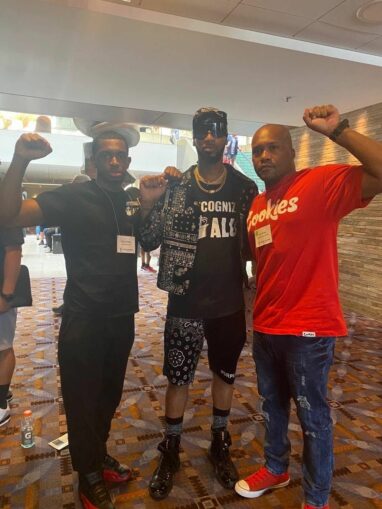
Amazon worker leaders at Labor Notes conference, Chicago, June 17. Left to right Derrick Palmer and Chris Smalls from Amazon Labor Union; Rev. Ryan Brown, chairperson of Carolina Amazonians United for Solidarity and Empowerment.
Credit: CAUSE
Conference plenary speakers included Amazon Labor Union President Chris Smalls, Starbucks Workers United representative Michelle Eisen, John Deere striker and Unite All Workers for Democracy representative Nolan Tabb, Minneapolis Federation of Teachers First Vice President Marcia Howard and Mexican General Motors worker Israel Cervantes from Casa Obrera del Bajio.
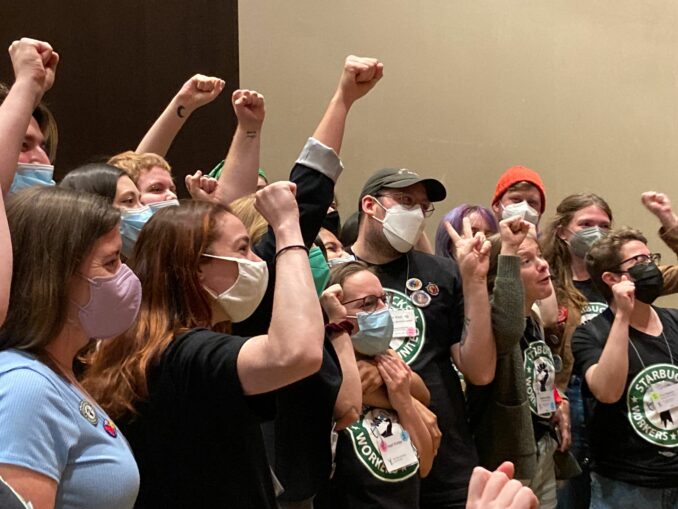
Starbucks workers chant ‘Suck it, Howard!’ before a workshop at the Labor Notes conference, Chicago, June 17. WW Photo: Martha Grevatt
Among the over 200 workshops were many that featured Amazon and Starbucks workers, who are the vanguard of the working-class movement today. “A Union Brews at Starbucks” workshop featured Starbucks Workers United leaders from Boston; Phoenix; Jacksonville, Florida; Kansas City, Missouri; and Buffalo, New York. They asked everyone to sign a “No contract, no coffee” pledge and voiced solidarity with fired Starbucks workers around the country, including panelist Laila Dalton from Phoenix and the Memphis Seven in Tennessee.
“Amazon Workers in Action” brought together representatives of the Amazon Labor Union, Carolina Amazonians United for Solidarity and Empowerment, Amazonians United and the Retail, Wholesale and Department Store Union (RWDSU). Amazon worker-organizers described long days, short and infrequent breaks, being watched and tracked constantly, excessive heat, unjust firings, lack of safety, failure to accommodate disabilities and overtly racist bosses.
“We are living a defining moment in history,” said a Southern Amazon worker. “History will not be kind to Amazon.”
The need for working-class solidarity
There were speakers from unions in other countries, including Starbucks workers from Chile, call center workers from the Philippines, Amazon workers from Poland and Germany and auto workers from Brazil and Canada as well as Mexico. However, anti-China “unionists” from Hong Kong were given a workshop, which unfortunately gives credence to U.S. imperialism’s hostile attitude to socialist China.
Throughout the conference, panelists emphasized the term “working class” as opposed to the misleading term “middle class,” often invoked by the labor bureaucracy. Some speakers openly said capitalists or “the owning class” were the problem in society. A smaller number said workers could only get justice by getting rid of capitalism altogether.
The one speaker to get “rock star” treatment was Senator Bernie Sanders, whose campaigns for president in 2016 and 2020 excited millions of workers and youth and stimulated interest in socialism. However, his brand of “socialism” would bring progressive reforms while leaving capitalist property relations intact. Objectively his presence at the conference served to discourage a break with electoral politics and to keep the labor movement tied to the Democratic Party.
Overall, this year’s Labor Notes conference was valuable. It promoted class-struggle unionism, and brought a wide range of class battles together under one roof. What working-class and oppressed people urgently need now is a global, classwide movement against capitalism.
Ben Carroll, Ed Childs, Otis Grotewohl and Dave Welsh contributed to this article.
Subscribe to:
Posts (Atom)