Tuesday, May 25, 2021

COVID-19 breaks out in Taiwan, with daily case numbers above 100


https://www.wsws.org/en/articles/2021/05/24/taiw-m24.html


Jerry Zhang
a day ago


Amid the continuing global pandemic, a new wave of COVID-19 infections has broken out in Taiwan. The Taiwan Pandemic Control Centre announced on May 23 that there were 287 new cases, 284 local cases and three imported cases in Taiwan. Six people have died. This is the ninth day that there have been more than 100 new cases.

With this sudden outbreak, Taiwan is again shrouded in anxiety about the potential dangers. Amid an ongoing public debate, the government is yet to implement a full lock-down to contain its spread.

According to Taiwanese media reports, the outbreak has been traced to infections that took place in a quarantine hotel at the end of April. Some crew members from a China Airlines cargo plane returning to Taiwan were infected—at least one with the British strain, according to the Taiwan Pandemic Control Centre.
People line up at a rapid coronavirus testing center after the COVID-19 alert raise to level 3 in Taipei, Taiwan, Tuesday, May 18, 2021. (AP Photo/Chiang Ying-ying)


The crew members were quarantined in a hotel near the airport, but the hotel did not comply with the epidemic prevention regulations. As result, cross-infection took place between the crew members and hotel employees, which then spread to their families. Now, Taiwan is experiencing cases in which the infection source is unknown.

On May 15, Taiwan added 180 local cases and another five imported cases—a daily record of confirmed cases. Taiwan’s Minister of Health and Welfare Chen Shih-Chung told a press conference on May 15 that the new cases were mainly concentrated in the greater Taipei area, including 89 cases in Taipei City and 75 cases in New Taipei City. The patients were between five and eighty years old.

Taiwan Prime Minister Su Tsen-chang announced the need for “larger, stronger and more timely” measures to control the outbreak. At present, Taipei City and New Taipei City have been upgraded to the third level of restrictions—the second highest level. Gatherings of more than five people indoors and 10 people outdoors are prohibited. All entertainment venues and gyms in Taiwan are closed, and religious venues must halt their activities.

The government’s limited response has provoked public criticism, with accusations that the authorities are trying to avoid any impact on the economy by avoiding the imposition of a complete lock-down. Health minister Chen Shih-Chung has defended the government’s actions with the absurd claim that further restrictions would lead to “epidemic prevention fatigue.”

Cases have continued to escalate. Taiwan announced on May 17 that 333 new local cases had been detected in a single day—a new daily record. The government reacted by suspending the arrival of foreign tourists and flights to Taiwan from May 19 until June 18. Schools in Taipei City and New Taipei City are closed until May 28.

Over the past year, the Taiwanese government has been boasting of its lack of COVID-19 cases, holding the island up as “a model for epidemic prevention.” With US backing, it argued on the basis of this record that it should be represented at World Health Organisation meetings—a move that Beijing rejected as a breach of the One-China policy that treats Taiwan as part of China.

Despite the resurgence of the pandemic globally, Taipei continued to ease restrictions, leading to what is now a dangerous outbreak. Some health experts have criticised the lack of facilities to carry out large-scale testing. Chen Yi-min, a Taiwanese epidemiologist, accused the government of not wanting to conduct large-scale testing as the current situation was already difficult to handle.

Su Ih-jen, the former director of the Centre for Disease Control, said that the most effective way to prevent the epidemic was vaccination, but the country had insufficient vaccines and a “golden opportunity” to protect the population had been missed.

Taiwan opened its vaccination program on March 22, but its uptake has been slow, in part because of the incessant government propaganda that Taiwan was a “safe country.” Although doctors and medical experts have stressed the importance of vaccination, the government has largely ignored that issue. To date, the vaccination rate in Taiwan is less than 1 percent—one of the lowest in a relatively developed country.

The outbreak in Taiwan—an island nation—demonstrates that there is no “safe country” while the pandemic continues to rage globally. Concerned by the latest outbreak, many people have begun to seek vaccinations but are facing a shortage. A doctor told the media that clinics are already full and vaccinations will not be available in Taipei City until June.

Taiwan is completely dependent on imports for vaccines, but with European and American countries scrambling to stock up vaccines Taiwan’s access is very limited.

Vaccine supplies are also restricted as a result of tensions between China and Taiwan, further fuelled by Washington’s increasingly aggressive confrontation with Beijing. On May 17, the Taiwan Affairs Office of China offered to provide vaccine assistance, but the offer was immediately rejected by the Taiwanese Mainland Affairs Council which declared that the Chinese government did not have to “pretend to be kind.”

Over the past year, the ruling Democratic Progressive Party (DPP), which favours greater independence from Beijing, has joined the US and its allies in denigrating China’s offers of vaccine assistance as “vaccine diplomacy” designed to further China’s interests. The accusation is entirely hypocritical coming from Washington which always used its foreign aid to advance its political and strategic ends.

The government’s attitude has been criticized by opposition parties, including the Kuomintang, which favours closer relations with China. Chang Hsien-yao, former deputy director of the Taiwan Mainland Affairs Council, told the media that geopolitical factors should not come into consideration when dealing with pandemics and vaccines.

Despite the criticism, the government is maintaining its hostile attitude to Beijing. Chen Zong-yan, Taiwan’s Deputy Minister of the Interior, accused the Chinese government of spreading false news about the Taiwan pandemic.

Lee Chun-yi, Deputy Secretary-General of the Office of the President of Taiwan, branded calls on social media for large-scale testing, temporary quarantine hospitals, lock-down and the use of Chinese vaccines as part of Beijing's psychological warfare. The purpose, he claimed, was to “intensify internal conflicts in Taiwan, reduce Taiwan's productive forces, and hit the economy and stock market.”

Faced with the increasing case numbers and an unresolved vaccine shortage the Taiwanese government is attempting to divert public attention from its own inadequate response by trying to shift the blame to China and accusing its critics of being part of Beijing’s psychological warfare.




Abandonment of health measures threatens US COVID-19 resurgence


https://www.wsws.org/en/articles/2021/05/24/pers-m24.html


Andre Damon
a day ago


On May 13, the Centers for Disease Control and Prevention reversed its guidance on mask-wearing, urging vaccinated people to stop wearing masks and socially distancing in crowded areas.

The World Socialist Web Site, in line with the statements of leading epidemiologists, warned that these guidelines would trigger businesses, states and municipalities to remove all masking and social distancing requirements for vaccinated and unvaccinated people alike.

These warnings have been confirmed. Nearly every major retailer in the United States, including Walmart, Trader Joe’s, Whole Foods and Walgreens, abandoned nationwide masking requirements within days of the CDC’s ruling, with no mechanism to verify whether those walking into their facilities are vaccinated or not.
National Guard members assisting with processing COVID-19 deaths and placing them into temporary storage at LA County Medical Examiner-Coroner Office in Los Angeles, Jan. 12, 2021. (LA County Dept. of Medical Examiner-Coroner via AP)


Epidemiologists and workplace safety experts have vocally condemned the CDC’s action. “It’s such a mess! So many of us are really upset. It is incredibly frustrating!” Dr. Eric Feigl-Ding, Senior Fellow at the Federation of American Scientists, told the World Socialist Web Site last week. “Inevitably, now state after state and business after business is saying you don’t need to wear your masks if you are vaccinated.”

From the beginning of the pandemic, workplaces have been a central source of transmission and broader outbreaks. The removal of any restrictions, under conditions in which nearly two-thirds of the population is not fully vaccinated, will lead to an increase in cases and deaths.

Over 500 people continue to die every single day from the disease in the United States. This translates to a death rate of 15,000 every month, or 182,500 every year.

The fact that hundreds of people are dying every single day from a disease that could be stopped through aggressive public health measures is treated as a non-event in the media. When the official US death toll crossed 600,000, the media simply ignored the milestone, just like it downplayed last week’s report by the Institute for Health Metrics and Evaluation that the real death toll in the country is actually closer to one million.

Globally, moreover, new cases remain at or near record highs, and epidemiologists are warning about the dangers posed by new variants of COVID-19 emerging as the pandemic surges throughout the world.

Every day, 600,000 people test positive for the disease, a figure that vastly underestimates its spread. Daily deaths are at more than 12,000. In India, the total death toll has surged past 300,000. While the country is recording more than 4,000 deaths per day, given the scale of undercounting, the actual figure could be in the tens of thousands. In Brazil, the official death toll is approaching half a million, and the 65,000 daily new cases are just shy of records set in March.

On Sunday, Germany banned travel from the UK as a new variant of COVID-19—termed the B.1617.2 or “Indian” variant—is spreading rapidly throughout the country.

Dr. Feigl-Ding warned of the significant dangers posed by the new variant of the disease. “Pay attention to rising #B16172 crisis in UK—crucial because [the] Indian variant affects us all,” Feigl-Ding wrote on Twitter. “It is now ~50% of all cases in England, surging fast, especially in kids. Hospital #COVID19 ward in Bolton filling up.”

He noted that the new variant “is by leaps and bounds growing faster than any other variant. The previously fast #B117 is growing much much slower—5x slower than B16172.” He continued, “Reinfections with #B16172 is also approximately ~4x more with B16172 versus #B117 if we compare the rates of reinfections / variant cases found. 4x ... is a lot.”

The rise of COVID-19 variants that are increasingly resistant to vaccines is reason for utmost vigilance. Government policy, however, is in exactly the opposite direction.

The CDC’s mask reversal has created the conditions for an even more dangerous move. The ending of mask requirements in schools, placing the lives of unvaccinated students as well as teachers in danger.

On Tuesday, Texas Governor Greg Abbott banned mask mandates in public schools, declaring that “no student, teacher, parent or other staff member or visitor may be required to wear a face covering.” On Thursday, Iowa Governor Kim Reynolds banned schools from requiring masks, and South Carolina Governor Henry McMaster followed suit.

These actions come despite extensive scientific evidence showing that masking significantly reduces the spread of COVID-19 in schools. Dr. Leana Wen, the former health commissioner of Baltimore, condemned these moves, noting that “unvaccinated children need to stay masked around other unvaccinated people, including in schools. Nearly 1 in 4 new [COVID-19] infections are in kids. We need to help keep them safe.”

The reduction of COVID-19 cases in the United States is the outcome of mass vaccination that came about as a result of an unprecedented effort by scientists and academic institutions to create a whole new class of vaccines in record time.

In a rational society, the reduction of COVID-19 cases would be used to strengthen protections ahead of what public health experts warn will be a new resurgence in the fall. But the Biden administration is squandering what health officials call a temporary reprieve to abandon measures to monitor and contain the disease.

On May 1, the CDC ended its monitoring of “breakthrough infections” of COVID-19 in people who are fully vaccinated, unless the disease leads to hospitalization or death.

Like the withdrawal of masking recommendations, the move has drawn condemnation from epidemiologists, who warned that it would leave the US blind to the effect of new COVID-19 variants.

“By the CDC not doing this level of monitoring, it’s very reminiscent to me about how I felt in the Trump era: ‘You’re each on your own,’” Dr. Kavita Patel, a primary care physician and nonresident fellow at the Brookings Institution, told the Washington Post.

The Post paraphrased Eric Topol, a professor of molecular medicine at Scripps Research in San Diego, as saying that “the CDC should monitor those people, along with hospitalized and fatal cases, to determine whether and how virus variants might evade vaccine protection, help discover new variants and track how well certain vulnerable groups, such as the immunocompromised, are shielded by vaccines.”

The Biden White House, like the Trump White House before it, is seeking to convince the public to disregard the continued pandemic—in many cases leading by example.

The attitude inside the White House was summed up by a recent headline by NPR: “How the Biden White House Learned to Drop the Masks and Stop Worrying.”

“At the Biden White House,” wrote NPR, “it’s like 2019 all over again, with large and largely mask-free events in the East Room both Thursday and Friday.” Asked whether the White House was even tracking whether those in attendance were vaccinated or not, White House Press Secretary Jen Psaki told NPR bluntly, “That’s not the role we’re going to play.”

As with similar displays under Trump, such callous disregard for public health and safety has the direct intent of sending a message: The pandemic is over. There can no longer be any obstacle—in the name of preserving public health—to the accumulation of private profit.


The stance of the Biden administration channels the demands of major corporations, which see efforts to save lives from COVID-19 as an unacceptable impingement on the extraction of profits from the working class.

If the response to the pandemic is left in the hands of this financial oligarchy, the disease that has already killed nearly a million people in US will take the lives of countless others. It is urgently necessary that workers take up the struggle against the pandemic into their own hands, both through the fight to create rank-and-file safety committees at workplaces and the political struggle against the capitalist system that subordinates human life to private profit.

Webinar on Wednesday: A pivotal moment for Israel-Palestine


Haggai Matar | Executive Director


Dear reader,

While the ceasefire between Israel and Hamas has provided some respite from two weeks of death and destruction, there is no calm. We are seeing a new round of police aggression in Jerusalem and cities throughout Israel, with the authorities carrying out arrests of hundreds of Palestinians who participated in protests this past month. The attempts to displace Palestinian families in Jerusalem neighborhoods like Sheikh Jarrah and Silwan also continue unabated.

But new opportunities have opened up. The Palestinian popular struggle has re-energized between the river and the sea, in a show of unity that could significantly alter the dynamics on the ground. Meanwhile, in the U.S., cracks in the bipartisan consensus, which had long turned a blind eye to Israel’s sustained dispossession of the Palestinians, are rapidly widening.

Join us on Wednesday, May 26, at 12 pm EST / 9 am PST / 5 pm GMT for a conversation that looks at where we go from here, sponsored by +972 Magazine, the Foundation for Middle East Peace, and Just Vision.

I’ll be moderating a conversation between Amjad Iraqi, +972 editor and writer; Ahmed Alnaouq, advocacy and outreach officer at Euro-Med Human Rights Monitor; and Lara Friedman, president of the Foundation for Middle East Peace. We’ll discuss the future of the Palestinian struggle, new developments in U.S. public opinion and policy, how Israel is likely to proceed, and more.

To register, click this link and fill out your name and email address. Also, if you want to support our journalism and help us organize more events like this, please consider becoming a member of +972 Magazine.

Hope to see you there,
Haggai


Participant bios:

Amjad Iraqi is an editor and writer at +972 Magazine. He is also a policy analyst at the think tank Al-Shabaka, and was previously an advocacy coordinator at the legal center Adalah. In addition to +972, he has written for the London Review of Books, The Guardian, Le Monde Diplomatique, and Palestine Square, among others.

Ahmed Alnaouq is the advocacy and outreach officer at Euro-Med Human Rights Monitor. He was the inspiration for and the original project manager of We Are Not Numbers, a platform for youth from Gaza to tell their stories. He later won the Chevening scholarship and earned a master's degree in international journalism from Leeds University. He is co-founder of Beyond the Wall, a Hebrew media outlet that tells Palestinian stories and amplifies the Palestinian narrative. Ahmed's writings have been published by the Gulf News, New Arab and other websites.

Lara Friedman is the president of the Foundation for Middle East Peace (FMEP). With more than 25 years working in the Middle East foreign policy arena, Lara is a leading authority on U.S. foreign policy in the Middle East, with particular expertise on the Israeli-Arab conflict, Israeli settlements, Jerusalem, and the role of the U.S. Congress. She is published widely in the U.S. and international press and is regularly consulted by members of Congress and their staffs, by Washington-based diplomats, by policy-makers in capitals around the world, and by journalists in the U.S. and abroad. In addition to her work at FMEP, Lara is a contributing writer at Jewish Currents and a non-resident fellow at the U.S./Middle East Project (USMEP). Prior to joining FMEP, Lara was the Director of Policy and Government Relations at Americans for Peace Now, and before that she was a U.S. Foreign Service Officer, serving in Jerusalem, Washington, Tunis and Beirut.

Haggai Matar (moderator) is an award winning journalist, a political activist and the executive director of +972 Magazine. He was a co-founding editor of Local Call, and is a board member of the Journalists' Union in Israel. Haggai has also written for outlets like Ha'aretz, Ma'ariv and The Forward. In 2002, Haggai was imprisoned for two years for refusing Israeli military conscription.


United States: California’s megadrought and the fight for socialism


Jake Thorpe
24 May 2021


https://www.marxist.com/united-states-california-s-megadrought-and-the-fight-for-socialism.htm


California, the breadbasket of the United States, is facing devastation as a centuries-long drought cycle coincides with the ongoing effects of man-made climate change. Rather than mitigating the catastrophe through rational planning, the short-term profiteering of capitalism – and agribusiness in particular – threatens to create an even greater catastrophe. It will be workers, in California and far beyond, who will be made to pay. It has never been clearer that if our planet is to remain habitable for human beings, capitalism must die.

The history of California in the capitalist era is as mythic as the American Dream itself. From around the world, countless workers have emigrated to the “Golden State” in search of a better life. The exploitation of their labor, coupled with the region’s enormous natural resources, has turned California into an economic powerhouse. California’s share of US GDP is around 15%, nearly twice that of the second most significant contributor, Texas. While places like Hollywood and Venice Beach are known worldwide for their cultural significance, California renders immense services to world capitalism as a finance, real estate, and technology hub. Were it an independent country, the state would be the fifth-largest economy in the world, ahead of the UK, India, and France.

California is also an agricultural region of global significance—a veritable “land of milk and honey.” It provides two-thirds of the US’s fruits and nuts, over a third of its vegetables, 80% of the world’s almonds, and is the world’s fourth-largest wine producer. Overall, the state’s agricultural bounty includes more than 400 commodities. If California were a sovereign nation, it would rank in the top ten of countries globally for output in food production.

Cyclical shifts in climate are a problem humanity has contended with before, with nature exacting a heavy price from the populations involved. Today, the technology and productive capacity exist to liberate humanity from a precarious existence at the mercy of nature. But capitalism turns this promise on its head and limits human potential, particularly when it comes to building a sustainable future. The capacity for a world of superabundance is shackled to the market’s chaos and distorted by the profit motive. Capitalism continually creates crises of its own while exacerbating the problems nature itself throws at us.

Today, the technology and productive capacity exist to liberate humanity from a precarious existence at the mercy of nature – but not under capitalism / Image: Alan Grinberg, FlickrFolsom Lake Drought Alan Grinberg Flickr


In California, the combination of anthropogenically accelerated climate change and a natural, cyclical centennial-scale climatic event has brought on the worst “megadrought” in over 400 years. Through a study of tree rings in species with centuries-long lifespans, scientists have been able to piece together a picture of the extreme climate cycles that are endemic to the region. The most recent period of exceptional drought, from 2014–2017, had widespread cultural, political, and economic effects throughout the country. The potentially disastrous scale of the current megadrought, which began in the mid-2000s, is shown in the fact that the previous cycle lasted from 1575–1603—nearly three decades of desiccation—well before the human-driven increase in extreme weather events. This does not bode well for our future under capitalism.

As a key “breadbasket” region for our entire society, the failure of California agriculture would have a crippling effect throughout both the national and world economies, placing the livelihoods of tens of millions at risk and threatening our food supply. Unfortunately, this is precisely the scenario we are facing. The ongoing megadrought now afflicts 77% of the Western US. The effects of the drought have been widespread and nonlinear. A potentially catastrophic array of feedback loops based on current water usage and conservation practices in California is on the cards. Under a rational system, the worst effects could be mitigated. However, for-profit agriculture is dead set on further intensifying these contradictions.
Fire and water

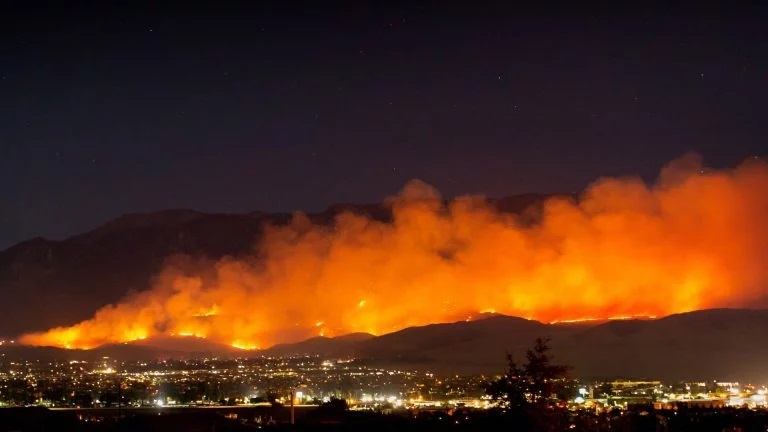
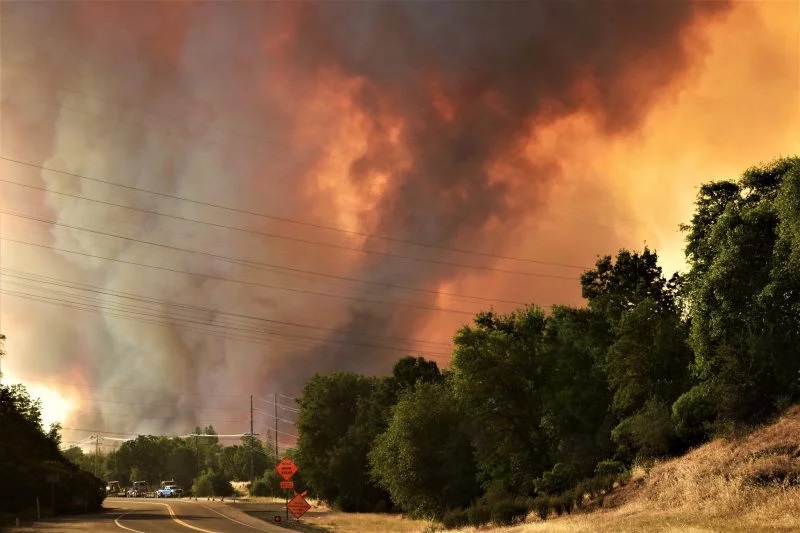
Wildfires are a cyclical constant in the western United States. However, climate change has accelerated their occurrence and severity. Dryness from a lack of precipitation, loss of biodiversity, and even a rise in the number of lightning strikes aggravate the frequency, duration, and severity of fires. Further, California’s aging energy infrastructure and cost-cutting shortcuts have led to the most destructive fires on record in recent years.

Despite being among the regions most susceptible to drought, California remains more consumptive and reliant on freshwater than any other state for manufacturing, power generation, public usage, and primarily, industrial agriculture. The loss of biodiversity due to climatic shifts beyond what native species can withstand is likely to change California’s landscape dramatically. In the coming years, we may see grasslands turn to deserts, blown-out and dried-up rivers and streams, and continually receding reservoirs in place of lakes.

Even under relatively temperate conditions, California has always been excessively dependent on irrigation and the transport of water across vast distances for most of its agriculture. Despite the media’s focus on individual conservation efforts—such as taking fewer showers and collecting rainwater—the overwhelming majority of freshwater consumed in the state goes towards agricultural and environmental purposes.

Wildfires occur on a cyclical basis in California, but man-made climate change has exacerbated their frequency and severity / Image: Brody Hessin


Under conditions of creeping desertification, the current practices are unsustainable. Continued access to potable water across the state is under threat, and many areas may not only become non-arable but entirely inhospitable for humans altogether. California farms, operating for profit and without regard to a long-term plan of production for need and sustainability, frequently rely on groundwater pumping to maintain crops. Under current drought conditions, where freshwater availability is 30–70% of the non-drought average, this puts even more pressure on the water system. Groundwater pumping draws from aquifers—layers of porous rock between non-permeable layers that hold water. Once drained of water, or nearly so, aquifers become compacted, collapsing in on themselves and permanently limiting the region’s freshwater capacity.

The San Joaquin Delta provides for the irrigation of four million acres of surrounding farmland. From here, it is diverted south, where it provides two-thirds of freshwater for the entire state. The Delta’s management is a testament to the shortsighted and irrational use of natural resources in a capitalist economy. Unsustainable irrigation has led to subsidence, or “sinking in,” of entire portions of California’s Central Valley by more than 20 feet.

As the land subsides, some portions of the valley have fallen below sea level. The outflow of fresh water from the delta is reduced by drought and aggressive irrigation. Saltwater from the San Francisco Bay estuary flows progressively further inland. As sea levels rise, this effect will be amplified, with saltwater intrusion penetrating deeper into the state and transforming surrounding habitats.

Under capitalism, the fallout from these converging factors will be disastrous. Nearly 70% of all Californians who live in coastal regions will experience increased flooding, worsening smog, heat waves, invasive pest species, and extreme weather events. Prices for many agricultural goods could skyrocket worldwide, with the market potentially taking decades or more to compensate for California’s drop in production. Those further inland will not fare much better. More than 25% of Californians live in wildfire risk zones. These millions are threatened not only by the damage and loss that accompany wildfires but also by the hazardous air filling their lungs with smoke and particulate matter.

Millions are threatened not only by damage and loss accompanying wildfires but also by hazardous air conditions that can damage human lungs / Image: Bureau of Land Management California, Flickr


Policy initiatives purportedly aimed at alleviating the worst effects of climate change are being increasingly exposed as the largely symbolic gestures that they are. Initiatives to retrain workers from the fossil fuel industry as green energy workers remain chronically underfunded. And studies that advocate the replacement of water-intensive cash crops with grains more appropriate to the historic drought fall on deaf ears.

California’s cap-and-trade system—a so-called “carbon market”—is another heinous example of ineffectual capitalist-driven climate policy. It creates an army of middle-men carbon brokers who produce nothing of value, offshoring emission reduction benefits through shell companies set up out of state. This allows companies to buy and sell the “right” to pollute and does nothing to address the totality of the problem.
Workers pay the price

But California is not an agricultural and manufacturing powerhouse in the abstract—millions of workers produce all of that wealth. The state is a highly urbanized population center with more residents than the whole of Canada. Los Angeles and its surrounding counties is the second-largest metropolitan area in the country, with an estimated 13 million people.

California has already proven vulnerable to rising temperatures and other causes and effects of the drought. Last year, the state experienced its first rolling blackout in 20 years. Apocalyptic scenes flooded the media as residents crammed into “cooling zones” amidst statewide wildfires and a global pandemic. Faced with rising temperatures, the bourgeois-liberal solution to avoid blackouts is to increase electricity prices to minimize air conditioner usage. In other words, the capitalist solution is to shift the burden onto workers.

Climate change has the potential to upend urban existence in California. Projected sea-level rises will erode the coastline of the state, changing the map and submerging several areas altogether. The profit-motive-driven logic of capitalism sharply contradicts the level of planning required to address these coming changes.

Any disruption to California’s urban economy could be calamitous for the world economy. As the technology center of the world and a major financial hub, California drives much of the innovation on the world market and is a media powerhouse. If its cities are flooded as sea levels rise, these industries are unlikely to survive the exodus of workers. And in the shorter term, if the drought intensifies, the stability of urban life will likewise be undermined.

Despite the capitalists’ craven unwillingness to tackle climate change head-on, workers and young people are more supportive than ever of bold initiatives to alleviate and ameliorate its effects. Advances in technology point the way forward, but the pursuit of profit is an unyielding barrier to meaningful progress. At some point down the line, some desperate and severe measures may be adopted by the capitalists. But who will pay? How many millions will suffer displacement, unemployment, homelessness, ill health, and personal loss? Once the climate catastrophe has exacted its warlike privations from the working people of California, what will be left of the breadbasket for future generations to steward and develop?
Climate struggle is class struggle!

Instead of leaving it up to the capitalists and their apologists to act decisively on climate change when it is convenient—read: profitable—for them to do so, workers and youth must act for themselves.

The enormous productive capacity in California must be retooled to serve the interests of environmental stewardship while at the same time continuing to feed millions. Scientists and engineers can be redirected from for-profit industries into research aimed at reducing the environmental impact of agricultural and industrial production year after year.

We cannot leave it to the capitalist class to fix the climate crisis. They will only act when it is profitable to do so. In the meantime, millions of ordinary people will suffer terrible consequences / Image: Socialist Revolution

We must fight for public ownership over the land, energy, and natural resources to bring the waste and profiteering that predominates under capitalism to heel. Since climate change in coastal areas across the globe all but guarantees displacement, we must use this public ownership to guarantee paid employment for every worker who requires relocation and retraining. The nationalization of big agriculture, tech, finance, manufacturing, and entertainment will allow the working class to rationally plan for the public health and wellbeing of the entire population, and not only in California.

Climate change is not going away—but capitalism must if we are to respond to it as seriously as the threat demands. Workers worldwide will bear the brunt of these challenges in the future—we must ensure that we are the ones in the driver’s seat if further catastrophes are to be prevented.

The environments we live in are an incredibly complex layering of natural systems, each one dependent on every other. Humanity is capable of understanding these systems and working in tandem with them, provided that we first understand and rationally organize our own society. But capitalism is beholden to national borders, blind market forces, and internal contradictions. Private ownership of the means of production is not the end-all-be-all for our species. It is a blunt and unreliable instrument for the production and distribution of resources and no longer has a place in mediating our delicate balance with the planet. Any serious attempt to adapt to and overcome a future of megadroughts, gigafires, and rising sea levels will require a democratically planned socialist economy. On this economic basis, and with a workers’ government in power, humanity could seamlessly implement the necessary transitions to ameliorate the worst effects of climate change. Capitalism threatens the very existence of our species and deserves to be overthrown. If humans are to have a future worthy of the name, it must be socialist!


The Political Situation and the National Strike in Colombia


By Pedro Santana Rodríguez on May 20, 2021


https://www.resumen-english.org/2021/05/the-political-situation-and-the-national-strike-in-colombia/


The protests in Colombia have continued for 23 days in the midst of brutal repression that has resulted in more than 50 demonstrators killed, according to the non-governmental organization INDEPAZ (Instituto de Estudios Para el Desarrollo y La Paz / The Institute of Studies for Development and Peace), as of May 18, 2021. There were 46 cases of killings by police, in addition to six other cases that were in the process of verification, the latter in the city of Cali. As of May 12th, according to a joint report by INDEPAZ and Temblores, there had also been 278 wounded, 32 eye injuries, 356 physical aggressions, 18 acts of sexual violence and more than 1,000 arrests. At this time, 134 people have gone missing and have not yet been located.

The most visible case of sexual violence occurred in the city of Popayán on the night of Wednesday, May 12th. It was documented in a recording by local media filming the protest in that city. Alison Meléndez, a 17 year old girl who was a by-stander near the demonstrations, was recording what was happening and was violently detained by four police officers. She was taken to the prosecutor’s office where she was sexually abused. She was later released and committed suicide at her grandmother’s house. This is one of the 18 cases of sexual aggression against women by members of the National Police in the context of the protests that have been shaking the country since April 28th. The generalized repudiation in the country and the recordings widely published by the social networks forced the Police, which initially denied the facts — calling them fake news — to finally admit the violent detention of the young girl, who was also the daughter of a police officer. The events ended with the burning of the facilities of the Detention Unit where the sexual abuse of the minor allegedly took place.

The magnitude of the repression is disproportionate and corresponds, in my opinion, to a deliberate strategy of the government and the security forces to try to contain and suffocate the demonstrations. The aim is to provoke fear and reduce popular protest by force. Infiltrating the demonstrations and showing the unfettered action of paramilitary groups in the city of Cali and in the neighboring city of Yumbo, proof of this strategy has been widely documented by citizens who have recorded both the excesses of the public forces and the presence of armed civilians. Together with the police, civilians shoot at unarmed demonstrators. This occurred on Sunday, May 9, in the city of Cali against the Indigenous Minga, resulting in the wounding of 12 indigenous people. To date, and despite the recordings showing these events, the Attorney General’s Office has not offered any results of the investigations it says were undertaken. They wanted to reduce the protest with violence. And despite the dreadful toll in deaths, injuries, arrests and violence, the protest continues. In the face of national and international pressure, President Duque has reluctantly, and without showing remorse, acknowledged the excesses of the security forces. The truth is that there has been no condemnation and no results of the investigations have been released. The government continues to use repression to try to weaken the protest movement, but has not succeeded. So far, this strategy has failed, but that does not mean that the Uribe-Duque government has given up on it.

The government has refused to authorize the request of the Inter-American Commission on Human Rights, IACHR, which wants to go to Colombia to investigate what has happened and what is still happening. Nor has it issued a statement in favor of the formation of a Truth Commission that, with the presence of international delegates, would investigate the events that occurred in Colombia and the way the State responded to the protests. These proposals are part of the document that the National Strike Committee delivered to the government last Sunday, May 16th. There has been no concrete response from the government except for the presidential speeches which have neither acknowledged the proposals nor taken responsibility for the excessive use of force against demonstrators.

The other strategy is to criminalize and prosecute social leaders who have been active in calling for the strike and the ongoing demonstrations. In this strategy, the most notorious event was propitiated by the Minister of Defense himself, Diego Molano. On May 15, at the end of a security council meeting in the city of Popayán, Molano accused four recognized social leaders of being the instigators of the attack and subsequent burning of the URI and the headquarters of Legal Medicine in that city. Molano’s outburst was so ridiculous that the Governor of the Department Elías Larrahondo Carabalí and the Mayor of the city of Popayán, Juan Carlos López, came out to deny what the minister had said, pointing out that this issue had not been considered in the security council and that the Molano’s accusations were made against four well-known social leaders in the city. They further said that the four social leaders had nothing to do with the vandalism against the official facilities. This is another problematic strategy that puts the life and honor of protest leaders at risk. For this fact and for the murders registered during the protests, as well as for the repression and violence against the demonstrators, Molano will have to face a motion of censure next Tuesday, May 25th. We will see what happens, but so far the motion of censure does not seem to have the necessary votes to remove him from office. However, the pressure that the mobilizations exert on Congress comes back into play.

While continuing with this strategy to weaken the movement, the government is moving in two other directions. One of them is to broaden the political support base with new partners. The first objective is to add the Liberal Party led by former President Cesar Gaviria. Two long conversations took place between Duque and Gaviria last week with a bittersweet outcome for Duque. Gaviria, one of the mentors and promoters of the neoliberal model — the real cause of the social crisis and poverty, aggravated by the current pandemic — publicly stated that he supported Duque. He advised Duque that he should get rid of several ministers. First, dump the Minister of Defense, Diego Molano. Gaviria told Duque he could support his new tax reform project, as long as the new resources did not affect the middle class and the popular sectors. But still, he has not managed to integrate liberalism to the government. And the fact is that Gaviria has serious differences with a sector of his party in Congress, which does not agree with backing an unpopular government such as Duque’s with an electoral campaign for Congress next March. Even with these limitations, this position gives Duque an air of support, although nebulous.

The situation is very volatile in the political arena. This is mainly due to the proximity of the presidential and congressional elections. Proof of this are two new defeats that the mobilizations and protests have achieved. The first one is the exit through the back door of the opaque and erratic Foreign Minister Claudia Blum, who presented her resignation letter after making a number of mistakes. Nothing new is expected in terms of international relations with the appointment of the loquacious Vice President Martha Lucia Ramirez. The other more significant defeat was the axing of the health reform bill which sought to deepen the privatization of the health system. After resisting in the Congress, both in the House and in the Senate by large majorities, the bill was defeated on Wednesday, May 19th. This was another victory for the street protests that had called on the government to withdraw it.

Attrition, exhaustion and future of the movement

The intensification of repression does not seem to be the government’s primary strategy, although the person who is really pulling Duque’s strings — former President Alfaro Uribe — continues to insist on it. That strategy would escalate internal divisions and does not seem to me to have enough acceptance today in the government and its partners in the business associations. Neither does the possibility of a coup d’état. There are powerful adverse factors in this situation. The pressure from the international community is strong and above all the pressure from an important parliamentary block of U.S. Democrats. So are the critical positions of the European Union, the United Nations and some governments of the region. They point to the repression and tie it to the amount of military assistance being given to the government. And little would be added to this strategy by the declaration, at least in the short term, of internal divisions.

The collaboration of the control agencies also allows the government to use repressive mechanisms without major consequences, given that the prosecutor is a government official, as well as the Comptroller General, the Attorney General and the Ombudsman. The Justice Department, with the communiqué issued by the high courts, is also under the control of the government, although somewhat limited; it is the only institutional counterweight that has worked so far. In addition, there is a non-existent Congress, since it functions ‘virtually’ with many limitations. The government continues to have narrow majorities in the Congress, but majorities nonetheless. Duque and Uribe are now seeking to keep their closest partners satisfied with quotas and resources to avoid weakening their alliance, which explains the change of ministers and Duque’s hopes to bring the Liberals into the government coalition. So, on the institutional front, the regime is under control. Therefore, I see neither internal divisions in the short term nor a coup d’état.

The popular protest movement will now have to face its own fatigue as a result of long weeks of mobilization. Lots of people turned out for the demonstrations yesterday, Wednesday, May 19th — which was big but smaller than those of other days called by the National Strike Committee. The sit-ins and blockades remain in effect, but have been lifted at some points due to the demands of communities facing food shortages and the decrease in commerce and street sales where a very important part of the population obtains its means of survival. Perhaps it is time to temporarily rethink the mobilization strategy. Give way to staggered mass mobilizations that maintain the pressure while awaiting the outcome of the negotiations. At the same time, broad processes of deliberation could be opened on the contents of the proposals for tax reform, basic income, massive public employment plan, policies for rural/farm economies, public policies for youth, zero enrollment for higher education, reform of the security forces, political reforms, which are, in my opinion, the central issues of the protests at this juncture. Perhaps it is time for the collective construction of public policy proposals on these and other priority issues. Preserve and expand organization and deliberation accompanied by large peaceful mobilizations. These issues should be debated in the movement and, of course, in the National Strike Committee.


Pedro Santana Rodríguez is Director of Sur Magazine


Source: Alainet, translation Resumen Latinoamericano – English


Poll: Israel failed to win support of US voters during Gaza massacre


Ali Abunimah Lobby Watch 23 May 2021


https://electronicintifada.net/blogs/ali-abunimah/poll-israel-failed-win-support-us-voters-during-gaza-massacre


Israel failed to win the sympathy of most Americans during its massive attack on Gaza , a new survey finds.

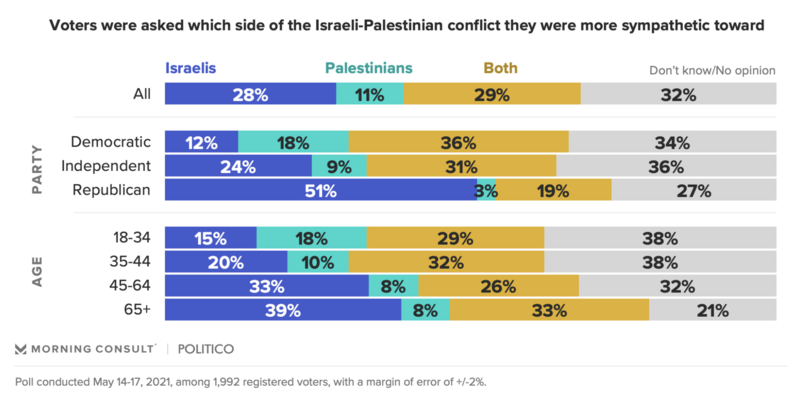
In only one demographic group – Republicans – did Israel manage to eke out a narrow majority in support, according to a Morning Consult poll conducted for Politico from 14 to 17 May.

Among Democrats and young voters, more people stood with Palestinians than with Israelis.

The survey of almost 2,000 registered voters was taken amidst Israel’s savage bombing campaign in Gaza that began on 10 May and ended with a ceasefire in the early hours of Friday.

Overall, 28 percent of voters surveyed were more sympathetic to Israelis, compared with 11 percent who were more sympathetic to the Palestinians.

But while US voters were more likely to side with Israelis than Palestinians, they were even more likely (29 percent) to sympathize with both.

Over 11 days, at least 230 Palestinians, including more than 60 children, were killed by Israeli forces and 2,000 were injured.

Twelve people were killed in Israel.

Israel’s bombing of civilian homes, businesses, media agencies, health facilities and other infrastructure caused massive damage in Gaza and displaced tens of thousands of people.

Israel killed 27 Palestinians in the West Bank and injured 6,000 in the same period.

Source: Morning Consult
Dwindling support among Democrats

Remarkably, the only group where Israelis found majority sympathy was among Republican voters – by the barest margin of 51 percent.

In the 18-34 age group, just 15 percent favored Israelis, while 18 percent sympathized more with the Palestinians. Twenty-nine percent said they stood with “both.”

A mere 12 percent of Democratic voters said their sympathy lay more with Israelis, while 18 percent stood with the Palestinians. More than a third of Democrats – 36 percent – opted for “both.”

The escalation of Israeli violence against Gaza followed rocket fire by Palestinian resistance groups in response to Israel’s attacks on worshippers at the al-Aqsa mosque compound and intensifed ethnic cleansing of Palestinians in occupied East Jerusalem.

The poll will undoubtedly unnerve Israel and its lobby groups, which launched their usual propaganda blitz demonizing Palestinians in order to justify the carnage as a “response” to “terror.”

Yet it confirms a long-term trend: the steady erosion of support for Israel among significant groups of Americans.
Failed strategies

In recent years, Israel and its lobby have invested huge resources in trying to appeal to younger and more left-leaning demographic groups – apparently without success.

“Support for Israel is driven largely by Republicans and older voters, while Democrats and younger voters are more likely to back the Palestinian cause in the decades-long Middle Eastern conflict,” Morning Consult observes.

A lot of Israeli propaganda aims at marketing Israel as “progressive” – particularly for its supposed support of LGBTQ rights and environmental issues.

These pinkwashing and greenwashing strategies have been a dismal failure.

Israel and its army of propagandists are finding again and again that there is just no way to make a state that perpetrates vengeful massacres and apartheid against Palestinians seem hip and cool.


Bernie Sanders says “tone down the rhetoric” on Israel’s crimes


Ali Abunimah Power Suits 24 May 2021


https://electronicintifada.net/blogs/ali-abunimah/bernie-sanders-says-tone-down-rhetoric-israels-crimes


Palestinians are still reeling from the horrific toll of death and destruction inflicted by Israel in the Gaza Strip this month.

Over 11 days, more than 240 Palestinians were killed in Gaza, including more than 60 children, and 2,000 others were injured.

In the occupied West Bank, almost 30 families are mourning loved ones killed by occupation forces just during the past two weeks. And within Israel, Palestinian citizens faced organized pogroms by Jewish Israeli mobs backed by authorities.

Meanwhile, Israel continues its assaults on Palestinians throughout historic Palestine, particularly in occupied Jerusalem.

Raw numbers cannot capture the scale of the terror and trauma Israel continues to inflict.


But Senator Bernie Sanders, the supposed standard bearer of US progressives, wants Palestinians and their supporters to make a little bit less of a fuss.


Decades after Palestinians first accurately described Israel as an apartheid state, such mainstream human rights organizations as Israel’s B’Tselem and New York-based Human Rights Watch have in recent months reached the same conclusion.


Yikes what a disgrace. https://t.co/lzjxcWBgmG— Mohammed (@m7mdkurd) May 23, 2021


“Tone down the rhetoric”

On Sunday, Sanders was asked about the use of this term on CBS’ Face The Nation.

Host John Dickerson – who sounded like a defense attorney for Israel throughout the interview – told Sanders that “there are a number of liberals who use the word apartheid to describe Israel’s treatment of the Palestinians.”

Citing an Israel lobby group, Dickerson claimed such criticism was fueling an upsurge in anti-Jewish bigotry.

He then put it to Sanders that using the word apartheid “has increased the level of vitriol that has contributed to this anti-Semitism.”

Rather than affirm that Israel indeed practices apartheid and reject the equation between criticism of Israel’s crimes and anti-Semitism, Sanders agreed with his host.

“Well, I think we should tone down the rhetoric,” Sanders said, before serving up a word salad that concluded, “the job of the United States is to bring people together.”

Mohammed El-Kurd, a Palestinian poet and activist against ethnic cleansing in occupied East Jerusalem’s Sheikh Jarrah neighborhood, called Sanders’ answer “a disgrace.”

There was a torrent of similar criticism of Sanders from Palestinians and their supporters.

Sadly, it was not the only disgraceful thing Sanders said in the 8-minute segment on Palestine that you can watch at the top of this article.

As the world recoils at the brazenness of Israel’s colonial war crimes, Sanders still insisted that “We have to be pro-Israel, but we have to be pro-Palestinian” – adamantly sticking to a false balance that equates the perpetrator with the victim.


And rather than challenge the language that has for decades been used to demonize and delegitimize any and all Palestinian resistance, Sanders called Hamas “a terrorist, corrupt, authoritarian group of people” and insisted “we have got to stand up to them.”


As significant as what Sanders said is what he failed to say.

Nowhere did he criticize Zionism, Israel’s racist state ideology.

Nor did he call for effective, popular solidarity with Palestinians by endorsing and promoting BDS – the boycott, divestment and sanctions movement modeled on the global campaign that helped end apartheid in South Africa.

Indeed, Sanders is on record opposing BDS.

Sanders failed to call for Israeli leaders to be held to account for war crimes.

He did not demand that the Biden administration drop its opposition to the International Criminal Court’s investigation of war crimes in the West Bank and Gaza Strip.

Instead, the senator sought to shield Israel from criticism by deflecting the blame on to its current government.

“Over the years, the Netanyahu government has become extremely right wing,” Sanders asserted, and “there are people in the Israeli government now who are overt racists.”

Every Israeli government of every political stripe from Zionist “left” to Zionist right has been racist since the state was founded by ethnic cleansing in 1948.

But just as many liberals think that America’s problems started with the election of Donald Trump in 2016, Sanders apparently believes that Benjamin Netanyahu invented racism in Israel.
“White moderate”

None of this should be surprising.

It is all in keeping with Sanders’ long record of support for Zionism, not to mention his staunch record of support for US imperialism.

However his latest comments should put to rest any hope that Sanders can fundamentally change or be a real ally to Palestinians.

Sanders’ efforts to police and “tone down” the language that accurately describes Israel’s crimes brings to mind the archetypal “white moderate” so eloquently described by Martin Luther King, Jr. in his 1963 Letter from a Birmingham Jail:


I have almost reached the regrettable conclusion that the Negro’s great stumbling block in his stride toward freedom is not the White Citizen’s Counciler or the Ku Klux Klanner, but the white moderate, who is more devoted to “order” than to justice; who prefers a negative peace which is the absence of tension to a positive peace which is the presence of justice; who constantly says: “I agree with you in the goal you seek, but I cannot agree with your methods of direct action”; who paternalistically believes he can set the timetable for another man’s freedom; who lives by a mythical concept of time and who constantly advises the Negro to wait for a “more convenient season.” Shallow understanding from people of good will is more frustrating than absolute misunderstanding from people of ill will. Lukewarm acceptance is much more bewildering than outright rejection.

So it is with Sanders’ lukewarm support for Palestinians.

Just like the white moderate who condemned segregation, Sanders does acknowledge some of the wrongs perpetrated by Israel.

On Face the Nation, for example, he stated that in the recent attack on Gaza, Israel “killed 64 children and destroyed a large part of the infrastructure of Gaza in a community that has already been one of the most uninhabitable territories in the world.”

“The United States of America has got to be leading the world in bringing people together, not simply supplying weapons to kill children in Gaza,” he added.
Ineffective measures

Sanders has put forward a Senate resolution to block $735 million in further sales of precision-guided bombs from the US to Israel.

Given that as recently 2014, Sanders was angrily berating and silencing his constituents for objecting to Israel’s massacre of Palestinians in Gaza that year, this could be seen as “progress.”

But what it really is, is a distraction.

If Sanders put forward the Senate resolution while supporting the Palestinian people’s struggle and legitimate resistance, particularly BDS, it might be seen as a building block.

But he is offering a resolution that has no chance of passage while opposing and condemning all forms of Palestinian resistance – even using the Israel lobby’s demonizing terminology of “terrorism.”

Even with all his criticism of Israeli leaders – the worst he will call Netanyahu is “right wing” and a “racist” – Sanders is still harsher in his denunciation of Palestinians.

At best Sanders provides rhetorical support to Palestinians, at worst he is undermining their struggle for liberation by defusing anger and demands for action by channeling them into a dead end.

Just as he twice sheepdogged left-wing voters into the corporate, warmongering Democratic Party, Sanders seeks to channel supporters of Palestinian rights away from clear diagnosis and effective solidarity, into his moribund liberal Zionism.

At a moment when support for Israel is collapsing within the base of the Democratic Party, here comes Bernie Sanders to the rescue, with soft criticism of Israel and ineffective measures.

Writing from his jail cell, King rejected the “moderate” criticism that nonviolent direct action was generating crisis and tension and that he needed, so to speak, to tone it down.

“We merely bring to the surface the hidden tension that is already alive. We bring it out in the open, where it can be seen and dealt with,” King countered.

“Like a boil that can never be cured so long as it is covered up but must be opened with all its ugliness to the natural medicines of air and light, injustice must be exposed.”

That is as true today of Israel’s regime of occupation, apartheid and settler-colonialism, as it was of the American apartheid King was fighting, and which sadly persists to this day.


No one should listen to Bernie Sanders’ advice. Do not tone it down. Tone it up.