Saturday, October 31, 2020
Why Is Socialism Becoming Less Scary?
A look at the new documentary, “The Big Scary ‘S’ Word” in which director Yael Bridge explores how socialist ideas that were once considered radical are now taken for granted by most Americans.
October 29, 2020 Peter Dreier TALKING POINTS MEMO
https://portside.org/2020-10-29/why-socialism-becoming-less-scary
In her extraordinary new documentary film, “The Big Scary ‘S’ Word,” director Yael Bridge examines the surprising rebirth of American socialism. “Socialism is as American as apple pie,” notes one of the film’s interviewees, Harvard University philosopher and activist Cornel West. That statement becomes the film’s theme.
Of course, many would dispute West’s statement. “America will never be a socialist country,” President Donald Trump has often proclaimed, identifying socialism with Venezuela, Cuba, and other undemocratic societies. Trump is echoing the redbaiters who, throughout the 20th century, and especially during the Cold War (from the late 1940s through the 1970s), attacked socialism as a “hostile and foreign ideology,” an import from Soviet Communism, as Columbia University historian Eric Foner explains in the film.
“Most socialists begin with a critique of inequality and the premise that this is essential to the nature of capitalism and if you want to create more justice and more equality, you’re going to have to change the system,” Foner observes.
Although Bridge excavates the past contributions of socialism to American politics and culture, she primarily focuses on the past decade’s upsurge of socialist activism, including its role in various issue movements (feminism, Occupy Wall Street, struggles for health care and environmental sustainability, workers’ rights, and Black Lives Matter) and the growing number of socialists winning elected office.
Recent polls show that Americans — especially young people — are warming up to socialism. A Gallup poll earlier this year discovered that 43 percent of Americans say socialism would be a good thing for the country. Among 18-34 year olds, 58 percent embrace the idea, compared with 40 percent of those between 35 to 54, and 36 percent among those 55 and older. Among Democrats, 70 percent say they think socialism would be a good thing for America, in contrast to 45 percent of independents, and 13 percent of Republicans. "Most socialists begin with a critique of inequality and the premise that this is essential to the nature of capitalism and if you want to create more justice and more equality, you’re going to have to change the system."
The popularity of Sen. Bernie Sanders (I-VT) and Rep. Alexandria Ocasio-Cortez (D-NY) is both a cause and a consequence of these changing beliefs. So, too, is the remarkable growth of the Democratic Socialists of America (DSA), which had only 6,000 members a few years ago but now has over 70,000 dues-paying adherents and many more who embrace its ideas and its activities.
If today’s American socialists have any model at all, it is not Russia, Cuba, or Venezuela, but the social democracies of Scandinavia, like Denmark, Sweden, Finland, and Norway — countries with greater equality, a higher standard of living for working families, better schools, free universities, less poverty, a cleaner environment, higher voter turnout, stronger unions, universal health insurance, and a much wider social safety net. Sounds anti-business? Forbes magazine ranked Sweden as the number 2 country for business. The United States ranked number 17.
But the 83-minute film goes into considerable depth in explaining that American-style socialism is homegrown, rooted in the nation’s soil and culture. Bridge shows how socialist ideas once considered radical are now taken for granted by most Americans. Key leaders of the abolition movement — and founders of the Republican Party — were influenced by socialist views, historian John Nichols reminds us. President Abraham Lincoln, who corresponded with Karl Marx, viewed slavery as antithetical to democracy and believed that in the burgeoning battles between labor and capital, workers and farmers had the moral upper hand.
In the early 1800s, American socialists — many of them influenced by religious beliefs and secular philosophies, including writers Nathaniel Hawthorne and Ralph Waldo Emerson — founded communitarian colonies like New Harmony in rural Indiana, Brook Farm in Massachusetts, and the Oneida Community in upstate New York to try to put their ideas into practice. Utopian socialism gained many new adherents — including labor leader Eugene Debs and feminist writer Charlotte Perkins Gilman — after Edward Bellamy published his novel, “Looking Backward,” in 1888, which described a socialist America in the year 2000.
In the film, West reminds us that the “Pledge of Allegiance” was written by Francis Bellamy, a socialist Baptist minister and Edward’s cousin, in 1892 and that “America the Beautiful” was penned by a socialist poet, Katherine Lee Bates, the following year. He might have added that in 1883 another socialist poet, Emma Lazarus, wrote the words inscribed on the Statue of Liberty.
In the early 1900s, socialists led the movements for women’s suffrage, child labor laws, consumer protection laws, the progressive income tax, and workplace safety. Their constituents included activists from old American families, among them some wealthy “traitors to their class,” as well as many recent immigrants, including Jewish and Italian garment workers, Scandinavian farmers, Polish and Czech steelworkers, and Milwaukee’s German brewery workers.
In 1916, Victor Berger, a Jewish immigrant from Austria and a socialist congressman from Milwaukee, sponsored the first bill to create “old age pensions.” The bill didn’t get very far, but two decades later, in the midst of the Depression, President Franklin Roosevelt persuaded Congress to enact Social Security. Critics denounced it as un-American. But today, most Americans, even conservatives, believe that Social Security is a good idea.
Nichols (whose book, “The ‘S’ Word,” helped inspire the documentary) reminds us that Milwaukee was run by Socialists from 1910 through 1960. Milwaukee introduced reforms, later adopted by many other cities, that led to clean water and air, lovely municipal parks, and well-designed public housing. Under Socialist Mayor Dan Hoan, who led the city from 1916 to 1940, Milwaukee was consistently ranked as the nation’s healthiest and best-run city. Anita Zeidler — daughter of the socialist Frank Zeidler, who served as mayor from 1948 to 1960 — noted that Milwaukee’s socialists were “very practical.” Proud of their modern infrastructure, they called themselves “sewer socialists.”
Debs, who founded the Socialist Party in 1901 and ran for president five times under its banner, “spoke the language of American society,” explains historian Foner. He never received more than six percent of the national vote, but he was a popular public figure. At its peak in 1912, over a thousand Socialist Party members won public office. Candidates running as Republicans, Democrats, and Progressives stole many of the Socialist Party’s ideas, watered them down, and got elected.
A similar dynamic occurred during the Great Depression. With one-quarter of Americans out of work, many became radicalized. Elected president in 1932, FDR tapped into that anger by promoting ideas that a few years earlier would have been unthinkable. He met with Socialist Party leader Norman Thomas and other leftists and invited a number of pragmatic radicals like Frances Perkins, Harry Hopkins, and Sidney Hillman, into his inner circle. They crafted the New Deal program — public jobs, Social Security, the minimum wage, unemployment compensation, the right of workers to unionize, tough regulations on banks — ideas that were first espoused by socialists. "Socialism is a scare word they have hurled at every advance the people have made in the last 20 years."
It may surprise some viewers of “The Big Scary S Word” to hear President Harry Truman – an ardent anti-communist Cold Warrior – excoriating his Republican opponents for branding as socialist his efforts to expand the New Deal by providing government-funded health insurance, more low-rent public housing, and other programs. In a speech in October 1952, Truman said: “Socialism is a scare word they have hurled at every advance the people have made in the last 20 years.”
Black and white socialists were in the forefront of the civil rights movement from the founding of the NAACP in 1909 through the Voting Rights Act of 1965. Socialist organizers A. Philip Randolph and Bayard Rustin influenced Martin Luther King’s thinking and activism.
In a letter to his girlfriend (and later wife) Coretta Scott in 1952, when he was a graduate student at Boston University, King wrote: “I imagine you already know that I am much more socialistic in my economic theory than capitalistic… [Capitalism] started out with a noble and high motive… but like most human systems it fell victim to the very thing it was revolting against. So today, capitalism has out-lived its usefulness.”
The film includes a little-seen interview with King in which he discusses his leftist views.
“We have socialism for the rich and rugged free enterprise capitalism for the poor,” King says. “Why are there 40 million poor people in America? When you ask that question you’re raising the question of a broader distribution of wealth. You begin to question the capitalistic economy.”
But King rarely spoke publicly about his socialist views because he believed that, in the midst of the Cold War, it would hurt his credibility as a civil rights leader.
One of King’s closest advisors was Michael Harrington, whose best-selling 1962 book, “The Other America,” awakened the country to the reality of poverty in the midst of affluence. Although he was a committed socialist, he did not argue that America’s persistent poverty and inequality were caused by capitalism because, like King, he feared that doing so would undermine the book’s influence. "The taxpayers are essentially the owners of the bank. It is controlled by the people. … Sure it’s socialistic. But it’s not un-American."
Socialism is no longer so scary. The most compelling parts of the film are the stories of Lee Carter, Kshama Sawant, Stephanie Price, and Dicarlo Johnson, contemporary activists who reflect the upsurge of socialism.
In 2017, Lee Carter, a 30-year old white Marine veteran and DSA member, ran for the Virginia state legislature after he was injured at work and discovered the inequities of the state’s workman’s compensation system. A Democrat, he beat a six-term Republican incumbent, but quickly learned that he would have little influence in the Republican-controlled legislature. While many of his legislative colleagues had cushy jobs with corporations that influenced their votes, Carter worked as a low-wage Lyft driver in order to give him the flexibility to attend legislative sessions and meet with constituents.
In 2019, however, the Democrats won a majority of seats in the legislature and Carter was re-elected, buoyed by support from DSA, the Democratic Party, the Sierra Club, Indivisible, NARAL and Planned Parenthood. Earlier this year, the legislature finally passed one of his bills — to extend the state’s minimum wage to workers at Dulles and Reagan airports.
Sawant, an immigrant from India and a one-time software engineer and economics instructor, was active in Seattle’s left-wing movements, including Occupy Wall Street. In 2013, she won a seat on the Seattle City Council, running as a socialist. The following year, she helped lead a grassroots campaign that persuaded her colleagues to pass a $15 citywide minimum wage, against the opposition of Amazon, Starbucks, and other large Seattle corporations. Other cities have since followed Sawant’s example and now Democrats have embraced a $15 minimum wage at the federal level.
Carter and Sawant are among the roughly 50 socialists who now serve in public office at the local and state levels (not only in deep blue states but also in Montana, Indiana, Texas and Tennessee) as well as four members of Congress.
Price is a single mom with a master’s degree who teaches elementary school in Oklahoma. She has to work two jobs to make ends meet and dip into her own pocket to buy school supplies for her students because the state government won’t provide adequate funding for public schools. Classrooms are overcrowded and textbooks are outdated. Price was never involved in politics until 2018, when her union, the Oklahoma Education Association, waged a lobbying campaign to persuade the Republican-controlled legislature to increase funding. We see Price joining 36,000 other teachers marching on the state capital and taking part in a remarkable 10-day strike that generated national media attention.
“We are fed up,” says Price, who is Black. “We shouldn’t have to fight this hard.”
The strike ends with only a modest increase in school funding. Price says: “I don’t feel it’s time to quit. We have to keep pushing. We need to stand up together. I’m ready to shake some shit up. I’m ready to make some changes.”
Those experiences radicalized her. She gained self-confidence and is elected vice president of her local union. At the end of the film, she attends her first socialist conference and even gives a speech. “I’m surrounded by people who are not happy with the status quo. I’m not the only person who has these feelings,” she says.
Johnson, a Black man, turns around his life after he gets involved with the Evergreen Cooperative movement in Cleveland, which, starting in 2008, set up several successful worker-owned businesses that employ over 200 people, many of them inner city residents who had previously barely survived on minimum wage jobs.
Johnson works in the co-operative’s laundry, which serves some of Cleveland’s largest hospitals and universities. Thanks to his job at Evergreen, Johnson was able to buy a house. He exudes pride at being part of the co-op, where he sits on a committee that reviews the firm’s financial information, something that blue-collar employees in traditional businesses never get to do. The film uses the Evergreen experience to illustrate the tradition of consumer, worker and tenant co-operatives in American history.
In a segment of the film that perhaps best illustrates Bridges’ theme, we see North Dakota’s Republican Gov. Doug Burgum extolling the virtues of the Bank of North Dakota (BND) at a celebration of its 100th anniversary in 2019. The bank was founded after the Non-Partisan League, a political movement led by socialist farmers, gained control of the governor’s office and the state legislature in 1918. The next year, the legislature established BND with $2 million of capital to serve the farmers who were being ripped off with high interest rates by private banks based in Minneapolis and Wall Street.
During the Depression, when other banks were foreclosing on family farmers, BND helped them buy their farms back. BND made the first federally-insured student loan in the country and continues to provide loans to local farmers, businesses, and homeowners.
“The Bank of North Dakota is successful when the citizens are successful,” explained Roxanne Junker, a North Dakota native who wrote a book about the bank. “It could make more money lending to luxury condos instead of single-family owners, but it doesn’t have to. Its goal is to serve the communities.”
Since the Wall Street-induced financial collapse that began in 2008 and the rise of the Occupy Wall Street movement in 2011, activists around the country have looked to the BND as a model. Several cities and states have been debating the pros and cons of creating public banks. Proponents hope that the Biden administration and a Democratic Congress will pass legislation to create a federal bank to make loans to worker, consumer, tenant co-operatives, and other enterprises that Wall Street banks shun.
“The taxpayers are essentially the owners of the bank. It is controlled by the people,” explains Mike Jacobs, publisher of the Grand Forks Herald, referring to BND. “Sure it’s socialistic. But it’s not un-American.”
“The Big Scary ‘S’ Word” will be screened at NYDOC, the New York Documentary Film Festival, from November 11 to 18.

It’s Time to Re-Radicalize the Abortion Movement
We shouldn’t despair. The real power lies with the people, not the Court. The Women’s Liberation Movement raised consciousness, raised hell, and raised the banner for “Free Abortion on Demand” when abortion was illegal in all 50 states
October 29, 2020 Jenny Brown JEWISH CURRENTS
https://portside.org/2020-10-29/its-time-re-radicalize-abortion-movement
THE SUPREME COURT gave us abortion rights, and it can take them away. This is the fallacy at the heart of the uproar following the death of Justice Ruth Bader Ginsburg. It’s true that the situation is dire. Donald Trump’s nominee, Judge Amy Coney Barrett, will likely join five other anti-abortion ideologues on the Court in permitting states to restrict or ban abortion. Ten states already have laws triggering a ban if the Court permits it.
But we shouldn’t despair. The real power lies with the people, not the Court. The Women’s Liberation Movement raised consciousness, raised hell, and raised the banner for “Free Abortion on Demand” when abortion was illegal in all 50 states and considered criminal by the vast majority of the population. It was their organizing, not a wise and sympathetic bench, that led to the legalization of abortion nationally in 1973 with Roe v. Wade. We can start winning again if we rebuild our movement around the radical principles that forced the court to legalize abortion in the first place.
To do that, we must first understand how the movement’s tactics have changed since Roe was decided. Justice Ginsburg herself was famously critical of Roe precisely because she believed the decision foreclosed state and national legislative fights, and demobilized the movement that was igniting them. By 1973, the movement had already been diverted into less radical channels, but the Supreme Court decision likely pushed it further in this direction, as liberals seized on the Court’s legal arguments, replacing the bolder arguments that built the movement—such as free abortion on demand—with conservative reasoning such as “it’s our constitutional right,” and “abortion is a private decision between patient and doctor.” With this turn, abortion also became siloed from other, more radical feminist demands, such as rearranging the economy to value care work and wealth redistribution. For the last several decades, our movement has been dedicated almost exclusively to “saving Roe,” even though we’ve endured severely restricted abortion access since 1977, when the Court allowed Medicaid to stop paying for abortion with the infamous Hyde Amendment. Since then, the Court has allowed so many additional restrictions that legal abortion has been placed out of reach for millions. With Roe’s final demise on the horizon, it’s time to leave behind the apologetic language and methods of the post-Roe abortion movement, and to return to the radical strategies that gained us the most ground.
The Court based Roe in a right to privacy implied by the Bill of Rights and the Fourteenth Amendment, following its 1965 Griswold v. Connecticut decision legalizing contraception for married women. After Roe, this reasoning—and the general understanding of abortion as an issue of privacy—came to define the abortion movement. (As groups strove for respectability, they also started to avoid the A-word, replacing it with “choice.”) But the ’60s mass movement to repeal abortion laws relied on the opposite approach: taking abortion out of the private realm and making it public. The Women’s Liberation Movement wielded the slogan “The personal is political” to express the idea that personal and secret pain, for which women blamed themselves, had its roots in social structures and could be acted on in the public arena. In February 1969, after a year of consciousness-raising, during which they shared stories about their illegal abortions, women’s liberationists broke taboos when they disrupted a New York state legislative hearing on abortion reform. They loudly testifying from the floor about their own experiences, to the shock of the liberals on the panel, who went into private session and locked the activists out. A month later, the same group, Redstockings, held the first ever speak-out on abortion in a Greenwich Village church. Women’s fury and suffering burst into public view as feminists marched, picketed, and testified in public depositions about how they had been harmed by the law. By 1970, the legislature yielded to this firestorm, passing a sweeping legalization of abortion on demand in New York in the first two trimesters. The law became the model for Roe. Despite the now-dominant language of personal privacy, bold recent projects like Shout Your Abortion have taken our testimonies public again. Expanding these efforts will be essential to rebuilding our strength.
In the wake of Roe, pro-choice groups also departed from the original abortion movement by emphasizing that abortion is a matter “between a woman and her doctor.” Ginsburg considered this focus on “a doctor’s freedom to practice his profession as he thinks best” to be a flaw of the Roe decision, noting that the appeal to medical authority wasn’t “woman-centered,” but rather designed to reassure skeptics that women wouldn’t be making the decision to get an abortion alone. For the movement, meanwhile, the requirement that a doctor must perform the abortion represented a significant compromise, which drove up the price of the procedure and gave unnecessary power to doctors. Women’s liberationists were justly skeptical of medical authority. They organized self-help classes and even designed and built equipment to do menstrual extraction, a procedure that can end a very early pregnancy. It was feminist laywomen in the abortion underground who advocated the vacuum aspiration abortion method—which has become the gold standard—while most doctors were still using the more painful and hazardous dilation and curettage method. In Chicago, a collective of trained laywomen called Jane performed 11,000 safe, illegal abortions before 1973. When police raided one of Jane’s secret pop-up clinics in 1972, they kept looking around the apartment in vain for a male doctor.
Now, doctor requirements have become an obstacle to freeing up pill abortions, which account for a third of abortions in the US. Special FDA restrictions confine abortion pills to clinics; you can’t get them at a retail pharmacy, even though some experts suggest they could be safely provided over-the-counter. Shedding the doctor-centric rhetoric will put us in a better position to organize for the elimination of these unnecessary restrictions, which would make abortion cheaper and more accessible; in the meantime, we can strengthen existing underground efforts to provide pill abortions to those unable to access them, and circulate information about how to use them safely.
In another damaging concession, over the last several decades, pro-choice leaders have chosen to emphasize the most tragic cases in which abortions are necessary. This returns us to the timid strategy the abortion reform movement employed in the ’50s and early ’60s. Before the Women’s Liberation Movement burst on the scene, the doctors, lawyers, and clergy that led the reform movement focused on loosening laws in cases they assumed would be perceived as the most sympathetic and blameless: rape, health emergencies, fetal deformity. By contrast, the Women’s Liberation Movement specifically argued for repeal of all abortion laws. Abortion pioneer Lucinda Cisler argued in 1970 that it was the movement’s demand for repeal rather than reform that made it wildly popular:
Part of the reason the reform movement was very small was that it appealed mostly to altruism and very little to people’s self-interest: the circumstances covered by “reform” are tragic but they affect very few women’s lives, whereas repeal is compelling because most women know the fear of unwanted pregnancy and in fact get abortions for that reason.
Today, Planned Parenthood advertisements and state campaigns against restrictions are devoted to rape cases; cases where cancer treatments have to stop during pregnancy; and non-viable fetuses late in a pregnancy, when abortion is prohibited under Roe. But 30% of women get abortions—as do other people who don’t identify as women—and very few fall into these rarified categories. To change course, we should take a cue from Ireland. For years, Irish abortion campaigners were stuck in a similar rut, trying to get abortions for suicidal teenagers and others who might die without them. It was only when they started to raise the demand for “Free Safe Legal” abortion that their campaign took off; their organizing efforts led to the repeal of the country’s abortion ban in 2018.
A post-Roe legal environment will leave us with 21 states banning or severely restricting abortion, with 13 states and DC protecting it. Clearly, federal legislative action will be needed to make abortion available nationwide, and a Medicare for All system will be required to make that right universally accessible. But the Supreme Court could still rule any such law unconstitutional, allowing states to opt out. Ultimately, the legitimacy of the Court itself, which has always functioned as an undemocratic restraint on our legislature, must be challenged. In two previous national crises—when it defended the expansion of slavery and blocked efforts to end the Great Depression—the other branches successfully employed political attacks to override it. When it comes to that fight, our success will ultimately depend on how well we’ve built a movement base to force the political changes we need.
Israeli Conscientious Objector Begins Third Stint in Military Prison
Conscientious objector Hallel Rabin was sentenced to 25 days behind bars for refusing to join the Israeli army over its policies toward the Palestinians. This is Rabin’s third period of incarceration.
October 29, 2020 Orly Noy +972 MAGAZINE
https://portside.org/2020-10-29/israeli-conscientious-objector-begins-third-stint-military-prison
Israeli conscientious objector Hallel Rabin began serving a 25-day sentence in military prison on Wednesday for refusing to join the Israeli army over its policies toward the Palestinians.
Rabin, 19, from Kibbutz Harduf in northern Israel, arrived at Tel Hashomer conscription base on Monday, where she was brought before the IDF’s conscientious objectors committee. Military conscription is mandatory for most Jewish Israelis.
This is Rabin’s third period of incarceration, while her appeal to the conscientious objectors committee is still pending. She was first imprisoned in August after appearing before the committee to appeal for an exemption. She was tried and sentenced to two different periods of incarceration, including during Rosh Hashanah, the Jewish New Year.
“People in power institute a policy of occupation and oppression of an entire nation,” Rabin wrote in her statement of refusal earlier this year. “I will not take part in a system which is based on inequality and fear. We live in a reality that raises us to be violent, and I refuse to take part in it or keep quiet about it.”
In a phone call a day before her sentencing, Rabin told +972 “I come from a very liberal home. We were all raised on the idea of love, equality, and freedom. I never thought there should be any difference between people of different races, genders, or sexes.
“My mother is a civics teacher. From a young age I asked myself questions about war; why there was war in some places but not others, why [we are] afraid of Arabs, etc. I had access to professional answers to my questions… From a young age I realized that not everyone thinks like I do.”
By the time Rabin entered middle school, politics had already become a burning issue for her. “At age 15, I understood that I won’t be able to enlist [in the IDF] — that doing so goes against my most basic ideals, and that I cannot support such violent policies.”
It was not naïveté or a refusal to take responsibility, Hallel continues, but a choice to take the more difficult route. “I could have gone along with the system… but I decided not to because I felt like it was not honest. It would have meant avoiding taking responsibility over our reality.”
Do you identify as a pacifist?
“I strive to be a pacifist. I recognize the violent energies that I unfortunately have, but I strive to make change through nonviolence. Even if I were living in Switzerland, I would refuse to join their army. The essence of an army is fighting, and in Israel this has a political context.”
What happened at the conscription base?
“It was a very short meeting [with the IDF’s conscientious objectors committee]. No one in the last half year has been exempted for being a pacifist [something that took place more frequently in the past]. The committee’s job is to analyze the new recruit’s worldview. They asked me a lot of questions about my background, my childhood, how I see the world, about enlisting. They differentiate between pacifism and political opposition. At the end of the day, I didn’t pass the committee.
“The meeting with the committee was set for a week and a half before my enlistment date. I received a response a week later, so I didn’t have enough time to appeal the decision.”
It took quite a while before you received an explanation for the refusal.
“Anyone who doesn’t pass the conscientious objectors committee has the right to receive the committee’s stated reasons [for rejecting the request] in order to appeal within 30 days. Despite pressure by attorneys from Mesarvot [a grassroots network that brings together individuals and groups who refuse to enlist in the IDF in protest of the occupation], we only received the documents after 45 days. By then I had already been jailed twice. This was the army’s failure. We filed the appeal after receiving the reasons.”
What was their rationale?
“They didn’t give too many details, but in general they claimed that I am a conscientious objector. It bothers me that they didn’t even ask questions to try and better understand this issue. It’s a lot of pressure to sit in front of people who hold my freedom in their hands.”
At home, Rabin says she feels supported by her family and friends, although her grandparents remain very concerned. She smiles as she quotes them: “Why are you in jail? You are not a criminal!”
Hallel Rabin interview with Israel Social TV:
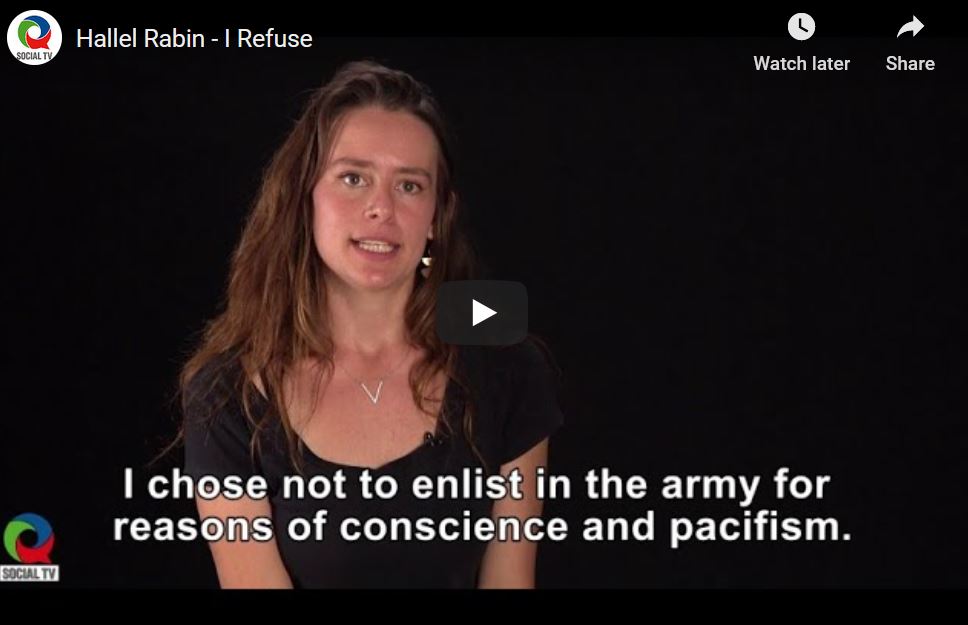

Watch here
“Prison is a very particular experience. It is very detached, but it is not bad. For me, prison isn’t a place where I feel miserable or in crisis, but it is difficult because I am part of the military system, and it can feel like basic training. On the other hand, you get to meet very interesting girls from different backgrounds, and develop special friendships in such a short time.”
Rabin says that despite disagreements, none of the girls she has met in prison have cast her out over her politics. Many, she says, did not know what a conscientious objector was and began asking questions. “It’s very important for me to talk about the legitimacy [to refuse]. Even those who disagreed strongly showed me respect. Perhaps that’s the strange common denominator that forms in prison.”
You’re currently the only conscientious objector sitting in prison. Do you have a sense of why conscientious objection has almost ceased to be used as a political tool by the left?
“I think it has become illegitimate. From what I see, many people seek exemption on medical or psychological grounds. It’s a more comfortable avenue for boys and girls as well as the army, since it does not place a mirror in front of its face.
“Personally, the decision to go to prison had to do with my striving for integrity; to not exploit systems in an unfair way. To acting according to my beliefs and not shy away from paying the price. However, I very much respect other people’s choice to go another route.”
A version of this article first appeared in Hebrew on Local Call. Read it here.
“Prison is a very particular experience. It is very detached, but it is not bad. For me, prison isn’t a place where I feel miserable or in crisis, but it is difficult because I am part of the military system, and it can feel like basic training. On the other hand, you get to meet very interesting girls from different backgrounds, and develop special friendships in such a short time.”
Rabin says that despite disagreements, none of the girls she has met in prison have cast her out over her politics. Many, she says, did not know what a conscientious objector was and began asking questions. “It’s very important for me to talk about the legitimacy [to refuse]. Even those who disagreed strongly showed me respect. Perhaps that’s the strange common denominator that forms in prison.”
You’re currently the only conscientious objector sitting in prison. Do you have a sense of why conscientious objection has almost ceased to be used as a political tool by the left?
“I think it has become illegitimate. From what I see, many people seek exemption on medical or psychological grounds. It’s a more comfortable avenue for boys and girls as well as the army, since it does not place a mirror in front of its face.
“Personally, the decision to go to prison had to do with my striving for integrity; to not exploit systems in an unfair way. To acting according to my beliefs and not shy away from paying the price. However, I very much respect other people’s choice to go another route.”
They Lost Their Jobs in the Pandemic. Now Defeating Trump is Full-Time Work
Hundreds of laid-off service workers — members of Unite Here, many of them immigrants Trump has insulted — are getting out the vote in Nevada, Arizona, Florida and Pennsylvania.
October 29, 2020 Dave Jamieson HUFFPOST
https://portside.org/2020-10-29/they-lost-their-jobs-pandemic-now-defeating-trump-full-time-work
Norberto Meniano feels as though everything in his life is riding on this election. So when the 49-year-old unemployed restaurant worker knocks on doors for Joe Biden and Kamala Harris in Las Vegas, he starts the conversation by talking about himself.
As a native of the Philippines, Meniano shudders at the way President Donald Trump denigrates immigrants like himself. As a gay man, he worries about the direction of LGBTQ rights under a conservative Supreme Court. As the husband of a man protected from deportation by the Deferred Action for Childhood Arrivals program, he wonders if the love of his life will be forced to leave. And as a cook on the Las Vegas Strip who’s been out of work since March, he fears he will lose the home he bought last year.
Sometimes, Meniano doesn’t even make it through his story before voters are crying in their doorways, tears running down into their masks.
“They tell me, ‘Thank you for doing this,’” said Meniano, who became a U.S. citizen in 2012. “It makes me want to knock on 10 more doors, 20 more doors.”
Meniano is one of millions of workers who lost their jobs earlier in the pandemic and still haven’t been hired back. With his schedule wide open, he is now canvassing full-time in hopes of ousting Trump from the White House. His union, Unite Here, has been paying him and other out-of-work members an hourly wage to knock on doors and get out the vote for Biden and other Democrats.
Unite Here says it has turned more than 1,000 of its members into canvassers in four swing states: Nevada, Arizona, Florida and Pennsylvania. Like Meniano, many are immigrants and other people of color who feel threatented by Trump’s racism and hardline policies. They also face a long and painful spell of joblessness due to a pandemic that the Trump administration has grossly mismanaged. Roughly three out of four of the union’s members are still out of work.
Even though the union is dealing with its own financial struggles, Unite Here President D. Taylor said the program is its largest canvassing operation to date, and donations from other labor groups and nonprofits have made it possible. Although the union declined to name funders, one source is former presidential hopeful Michael Bloomberg, who recently gave $1 million to the union’s canvassing efforts in Florida.
That kind of money has helped pay cash-strapped members while they pour their energy and frustration into political action. With less than two weeks to go before Election Day, they are focusing their efforts on driving up turnout in Democratic strongholds within battleground states.
Taylor said his membership feels a unique urgency, given its high share of immigrants and the way the pandemic has decimated their livelihoods.
“We need a president who actually cares about people, who’s going to be honest, and who’s going to put people like our members before the interests of Wall Street,” he said. “Until we solve the pandemic, it’s hard to see how the economy ever comes back.”
Even as many Americans have returned to jobs lost during the early lockdowns, a growing number now consider themselves permanently laid off. The national unemployment rate is currently close to 8%, but it’s still 19% among workers in the leisure and hospitality sector.
With businesses still shuttered or running at reduced capacity, lost earnings and dim job prospects could affect these workers for years. Unite Here represents workers in the hardest-hit industries: hotels, restaurants and entertainment venues, all places that could take years to return to a pre-pandemic normal.
Thousands of the union’s members at Disney World learned recently that their furloughs were now layoffs. Madi Portes was among them. The 61-year-old Disney cast member helped tourists plan their visits to the Magic Kingdom. Now she spends her days phone-banking for Biden, telling Florida voters that the Trump administration has made both the pandemic and the recession far more painful than they needed to be.
“It’s making the poor poorer. And we are not getting any kind of help from the government,” said Portes, who earned around $15 per hour before her layoff. “The executives of Disney, the people in the administration ― they need to come down and live a day in the life of one of us.”
Trump and Biden are neck-and-neck in Florida, a state Trump carried by roughly 1 percentage point in 2016. The coronavirus has hit the state hard. Case numbers have come down since their peak in July but are still elevated compared to the spring.
Given people’s skittishness about talking to strangers, the pandemic has made some campaigns reluctant to invest heavily in door-to-door canvassing for the election. Unite Here worked with epidemiologists to put safety protocols in place, likely daily health screenings and the use of both masks and face shields. Some Democratic campaigns have been slow to hit the doors in places like Nevada, as the Los Angeles Times recently reported.
“Frankly, until extremely recently, we were the only ones going door-to-door canvassing,” said Unite Here’s Taylor.
Yolette Lareus said some residents prefer not to open their doors when she canvasses in Miami, but most are willing to have a doorstep conversation while masked. She has been talking to voters for weeks, carrying extra face coverings to give to any resident without one.
The 50-year-old line cook from Haiti was laid off from the Calder Casino in Miami Gardens in March.
“I had to go into my savings to pay for my house and everything,” said the single mother of two.
Lareus said she could be back to work at the casino; she has 27 years of tenure, and callbacks are based on seniority. But since the union can pay her to canvass, she has decided to do that until after the election. She feels a special motivation. Trump has tried to end the protected status of 46,000 Haitians in the U.S. and reportedly called her home country a “shithole.”
“I’m not a shithole person,” said Lareus. “Another four years of this president, I don’t see how we can make it. That’s why I’m doing everything I can.”
After a full day of door-knocking, Lareus often spends the evening on her phone, following up with voters she’s been in contact with to make sure they plan to get their ballots in.
Charles Patton Jr., 36, has worked as a cook inside the Philadelphia airport for seven years. He was laid off in March and hasn’t been called back. For several months he scraped by on unemployment benefits and wages he received from the state for caring part-time for his mother, who is disabled. Now he is working full-time as a canvasser in Philadelphia.
Pennsylvania is one of the key Rust Belt states that put Trump over the top in 2016. Patton is telling voters there to consider the division Trump has sown in the country, and the fact that the pandemic that has killed more than 220,000 Americans and brought economic hardship to millions more.
“Trump hasn’t handled it the way it should have been handled,” Patton said. “It would never have gotten this big if somebody else was there ― somebody who spent more time focusing on what actually matters, instead of tweeting.”
Many laid-off workers who are getting out the vote have no idea what will happen to them after the election.
Maggie Acosta has been canvassing in the battleground state of Arizona. The single mother of two lost her airline catering job in March when travel came to a halt. She worked for a while as a relief coordinator for her union, helping other members navigate the unemployment process, but then realized the most important thing she could do was turn out the vote against Trump.
Acosta was livid after Trump’s crowded church rally in Phoenix in June, where many attendees declined to wear masks. She said the president’s minimizing of the virus and flouting of health guidelines played a large role in her decision to canvass for Biden.
“If they had listened and done what was recommended, I really believe that we wouldn’t be going through all of this,” she said.
Recent polls put Biden and Trump in a virtual dead heat in the state, which could also help determine the Senate majority as Democratic challenger Mark Kelly, an astronaut, leads the incumbent, Republican Sen. Martha McSally. Unite Here says it has 300 members canvassing Arizona ― what it believes to be the largest Democratic door-knocking operation in the state.
At first, the idea of knocking on doors during a pandemic scared Acosta. Her 22-year-old son got sick with the virus in June while working as an HVAC technician, forcing them both to quarantine. Acosta said she also has a preexisting condition that puts her at risk for a more severe bout of COVID-19.
“I was like, ‘What if I go out and then I get sick?’ But also I’m thinking, ‘Well, what if I don’t do this, and we get another four years of Trump?’” she said. “I’d rather be out there talking to people, mobilizing the vote.”
Acosta said she often wonders how she’ll make her rent and car payments after Nov. 3. The catering contractor she worked for closed its Phoenix office, leaving her with no position to return to, even when air travel rebounds. She’s braced herself for a difficult job search with other unemployed service workers. But talking to voters about the election helps keep her mind off all the uncertainties.
“It’s my best therapy,” she said.
OTI CONDEMNS ‘UNHINGED’ FCC, URGES RESTORATION OF NET NEUTRALITY
By Open Technology Institute.
October 29, 2020
https://popularresistance.org/oti-condemns-unhinged-fcc-urges-restoration-of-net-neutrality/
Washington, DC – On October 27, 2020, the Federal Communications Commission voted 3-2 to reaffirm its 2017 repeal of net neutrality. The vote is a response to Mozilla v. FCC, a 2019 court ruling that found the FCC’s decision to repeal net neutrality was “unhinged from the realities of modern broadband service” and ignored the government’s duty to protect public safety, digital equity, and broadband competition.
In February 2020, the FCC abruptly announced a short public comment period to address the ruling and the court-ordered remand, or do-over, of the net neutrality proceeding. OTI filed comments in this proceeding, but first responders were overwhelmed by the beginning of the COVID-19 pandemic and couldn’t meet Chairman Pai’s arbitrary deadline. The first responders—including the very firefighters that the Mozilla court admonished the FCC for ignoring in 2017—asked for more time. Inexplicably, the FCC refused to grant this reasonable request.
OTI is a litigant in Mozilla v. FCC and has consistently pressed the FCC to restore strong, enforceable net neutrality rules.
The following statement can be attributed to Joshua Stager, senior counsel at New America’s Open Technology Institute:
“A federal court ruled the FCC was ‘unhinged from reality’ when it repealed net neutrality in 2017. Sadly, today’s vote is even more unhinged. Millions of people are suffering through the pandemic without internet access, and it’s hurting our economy, our schools, and our ability to combat the virus. Yet the Trump Administration chose today to give another gift to the telecom industry while continuing to do nothing to help people stuck on the wrong side of the digital divide. The FCC needs to restore net neutrality, expand internet connectivity, and get its priorities straight. We will continue fighting for these urgent priorities.”
FBI RAIDS HOME OF ACTIVIST, TEACHER ANTHONY SMITH, ARRESTS HIM
By CBS3.
October 29, 2020
https://popularresistance.org/fbi-raids-home-of-activist-teacher-anthony-smith-arrests-him/
NOTE: The article below comes from a local CBS news outlet. In this tweet, Philly for Real Justice provides their view on the situation.
An activist and West Philadelphia teacher is facing federal charges related to rioting surrounding the George Floyd protests in Philadelphia this past June. Eyewitness News has learned that Anthony Smith, of West Philadelphia, has been arrested and faces multiple federal charges related to the civil unrest.
Law enforcement sources confirmed Smith’s arrest, along with the community group he represents, Philly for Real Justice.
“Early Wednesday morning Federal agents raided the West Philadelphia home of Anthony Smith, an outspoken community activist and a leader in the movement for Black lives in Philadelphia,” Philly for Real Justice Smith spokesperson Deandrea Jefferson said. “Smith, 29, was arrested and is being held on multiple Federal charges several hours away from his home at the Allenwood Jail as he and his community struggle to pull together his legal defense.”
Smith was profiled in Philadelphia Magazine’s list of Influential Citizens for his role in helping to topple the Rizzo Statue that was formerly in front of the Philadelphia Municipal Services Building.
He self-identified his participation in the magazine’s article.
United States Attorney William McSwain is expected to be joined Thursday by local, state and regional law enforcement officials, including Philadelphia Police Commissioner Danielle Outlaw, to announce criminal indictments related to the riots in Philadelphia early this year.
The charges are part of a federal investigation into the George Floyd protests last June and are not related to the current civil unrest following the fatal police shooting of 27-year-old Walter Wallace Jr.
Last May, protests and outrage erupted across the country after George Floyd was killed during an altercation with the Minneapolis police.
Jeremy Corbyn suspended by Labour leadership in latest outrage during Blairite anti-Semitism witch-hunt
Chris Marsden
https://www.wsws.org/en/articles/2020/10/30/pers-o30.html
The suspension of Jeremy Corbyn is a vicious and antidemocratic action by the right-wing cabal in control of the Labour Party.
The political pretext on which the suspension was carried out, claiming the existence of widespread “left anti-Semitism” in the Labour Party under his leadership, is a slander not only against Corbyn, but of countless party members. It is a political witch-hunt designed to justify the enforcement of the policies of British and US imperialism in the Middle East, built around the dishonest and illegitimate identification of anti-Semitism with principled opposition to the policies of the Israeli state.
The level of cynicism involved beggars belief. Anti-Semitism, racial hatred directed towards the Jews, is historically identified with the far right, especially with Nazi Germany, though it had many adherents within the British ruling class, including among the Royal family. Now the left is being targeted as the source of anti-Semitism even as the fascist Alternative for Germany has been elevated to the position of official opposition in the Bundestag and similar formations, including Marine Le Pen’s National Rally in France, are being cultivated by the ruling elite throughout Europe.
The opposition expressed by Corbyn to the suppression of the Palestinians is no more than can still be found among substantial sections of the left and peace movement in Israel. Nevertheless, bogus allegations of anti-Semitism are now being employed against the left based upon a filthy campaign waged by the Blairite right, the Conservative Party, the Netanyahu government, and the security services of the US, Israel and the UK, ever since Corbyn became Labour leader in 2015.
Any criticism of Israel and its persecution of the Palestinians has occasioned demands for the accused to be removed from the Labour Party. This was codified in Labour’s adoption of the International Holocaust Remembrance Alliance (IHRA) definition of anti-Semitism in 2018, outlawing political criticism of the Israeli state. The sole purpose of such baseless lies is to complete the thoroughgoing transformation of the Labour Party into a reliable instrument of the most reactionary elements within the British state apparatus. It has been orchestrated by the war criminal Tony Blair—possibly the most sinister figure in British politics today—and his inner coterie.
Left unchallenged, it will have a chilling effect on democratic rights, including the right to free speech and the right of political parties to advance policies that are deemed illegitimate by an unaccountable cabal of state operatives and political scoundrels.
None of this excuses the fact that Corbyn is the architect of his own fate and is responsible for allowing the right wing to carry out its schemes against the working class.
Corbyn won leadership of the party in 2015 and then again in 2016 at the head of a popular rebellion involving hundreds of thousands of workers and young people demanding a political reckoning with the criminal pro-business and warmongering legacy of the Blair and Brown Labour governments. Corbyn was mandated not only to oppose the Blairites, but to kick them out of the party.
He refused to do so, making one pathetic capitulation after another and using his political authority to preserve the control of the right wing by opposing all popular moves to expel them and insisting on “party unity.” This enabled the Blairites to pursue their plans to remove the Corbynites, centred on the anti-Semitism witch-hunting of his leading allies, including former Mayor of London Ken Livingstone, black Jewish activist Jackie Walker, Marc Wadsworth, Chris Williamson MP and countless rank-and-file members. They then retook control of the party following the electoral disaster of December 2019.
Corbyn's adversaries of course have no compunction against expulsions and are now proceeding with a political bloodletting, beginning with Corbyn.
Corbyn was suspended just hours after the release of an Equality and Human Rights Commission (EHRC) report claiming that there were “serious failings in the Labour Party leadership in addressing antisemitism and an inadequate process for handling antisemitism complaints.” The EHRC, which is responsible for enforcing non-discrimination laws, identified what it said were “three breaches of the Equality Act (2010) relating to: Political interference in antisemitism complaints; failure to provide adequate training to those handling antisemitism complaints” and “unlawful acts of discrimination and harassment.”
The EHRC did not formally identify anyone guilty of the alleged criminal acts, but Corbyn was named on a dozen occasions. The Socialist Equality Party warned in March 2019 that the EHRC investigation, instigated based on complaints by the pro-Zionist Jewish Labour Movement (JLM) and Campaign Against Antisemitism (CAA), would end in mass expulsions.
Yesterday morning, Corbyn issued a defence of his record in opposing anti-Semitism, stating that “the scale of the problem” within the Labour Party was “dramatically overstated for political reasons by our opponents inside and outside the party, as well as by much of the media.”
Within two hours, amid demands by the Blairites and the media for his expulsion from the party, Corbyn was suspended by party leader Sir Keir Starmer. More will follow. The Campaign Against Anti-Semitism said it had filed complaints to Labour about 16 MPs, including Corbyn, his former Shadow Home Secretary Diane Abbott, his preferred replacement Rebecca Long-Bailey, and even Angela Rayner, presently Starmer’s deputy leader.
But it will not stop there. The ultimate target of this McCarthyite orgy is the working class, which will face censorship, political victimisation and even criminal prosecutions for opposing imperialism’s crimes internationally and at home. Demands have already been made by the Johnson government for the IHRA definition to be enforced on Britain’s campuses.
The Corbynites have once again responded by waving the flag of surrender. Former Shadow Chancellor John McDonnell tweeted, “In interests of party unity let’s find a way of undoing & resolving this.” Corbyn told Sky News, “What I will be doing is appealing to the party... to kindly think again.” He later appealed to Labour members, “Don’t go away, don’t leave the party. Stay in the party and argue the case for economic and social justice in our society.”
Fundamental lessons must now be learned from this degrading spectacle by workers in Britain and internationally.
Events have provided a devastating refutation of the claims made by the pseudo-left groups that Corbyn’s leadership of the Labour Party represented a “rebirth of social democracy” or the formation of a “new workers’ party,” according to the Socialist Party. Corbyn’s statements confirm that his only real concern for the past five years has been to suppress opposition to the Blairites so as to preserve the domination over the working class of Labour and its allies in the trade union bureaucracy.
Corbyn was only the latest in a line of supposedly left-wing figures and movements promising that new life could be breathed into old and discredited parties and trade unions, or that they would weld together various fragments of these old parties into a new political vehicle for the working class. Every one of these political adventures has ended in disaster.
Corbyn’s capitulation to the Blairites immediately followed that of Syriza in Greece, which was given a massive referendum mandate to oppose European Union/International Monetary Fund-dictated austerity in June 2015 and instead implemented more draconian measures than its right-wing predecessors. In Spain, Podemos was hailed as the political new wave and now governs in a pro-austerity coalition with the Socialist Party (PSOE). In the US, Barack Obama promised “hope” and “change” and delivered eight years of uninterrupted wars and targeted assassinations. Bernie Sanders took his millions of young supporters on a wild goose chase promising socialism through the Democratic Party and is now providing a left gloss for Joe Biden’s right-wing campaign, seeking to demobilise popular opposition to Trump’s threats to impose a presidential dictatorship.
The Socialist Equality Party rejected all efforts to sow illusions in a renewal of social reformism under Corbyn, warning that Labour was historically a party of British imperialism and its major political prop in opposing a socialist turn by the working class. Moreover, its lurch to the right was not the product of bad leaders such as Tony Blair, but had profound objective roots in fundamental shifts within world capitalism associated with globalisation—which had dramatically undermined the viability of the old labour organisations and programmes embedded in the nation-state system. This appraisal has been confirmed. The heirs of Blair, the most hated politician in the UK, are back in charge of a party that has shed its last pretensions of a connection with the working class and socialism.
Labour will not survive what it is about to do in launching the witch-hunt against its members. But neither will Corbyn and “Corbynism.” There are desperate calls being made for Corbyn to finally leave Labour and set up a new party. But what would be the character of such a party, led by those who foresaw nothing and failed their supporters miserably at every turn?
The protracted death of the Labour Party must instead be the occasion for a political turn by the working class to the building of the SEP and its sister parties in the International Committee of the Fourth International, which not only predicted the failure of Corbynism but advanced the genuine alternative of socialist internationalism.
Subscribe to:
Posts (Atom)