Monday, April 29, 2019

Saturday, April 27, 2019
History Shows Joe Biden 3.0 Is a Bad Idea
April 26, 2019
So Joe’s in
now, and really, thank God. The corporate neoliberal “center” is dreadfully
under-represented in the current tiny
field of potential Democratic nominees. In the event candidates
Buttigieg, Harris, O’Rourke, Booker, Klobuchar, Moulton, Inslee, Hickenlooper
and Gillibrand fail to successfully advocate for continuing 30 years of failed
conservative “centrist” Democratic policies, former Senator and Vice
President Joe Biden (D-Delaware)
will be there to shoot the gap.
:facebrick:
“The third time’s lucky,”
reads Alexander Hilsop’s 1862 compendium of Scottish proverbs. I guess we’re
all going to find out how true that is over the course of the 79 weeks standing
between this ragged little patch of time and the 2020 presidential election.
Senator Biden’s first run at the brass ring began on June 9, 1987, and ended in
searing disgrace only 106 days later after his campaign was subsumed by
plagiarism accusations and his questionable relationship with the facts of his
own life.
Biden ran for president for
the second time 20 years later, after dancing right up to the edge of declaring
his candidacy before stepping back in 1992 and again in 2004. Biden managed to
stay in the 2008 race for 11 months while never polling above single digits,
finally withdrawing after placing 5th in the Iowa caucus. He did get noticed,
however, and ultimately accepted the number two slot on what became a
victorious Obama/Biden ticket.
Biden kicked off his third
presidential run on Thursday with an ominous and somewhat cumbersome 6:00
am tweet —
“[E]verything that has made America — America — is at stake.” The
announcement tweet failed to mention Biden’s plans to attend a big-dollar
fundraiser hosted by David Cohen, chief lobbyist for Comcast,
the most
despised company in the country. This, morosely, is par for a very
long course.
Though he labels himself a
friend to working people, Biden has a record of harming workers that spans
decades. “His energetic work on behalf of the credit card companies has earned
him the affection of the banking industry,” wrote Sen.
Elizabeth Warren in 2002, “and protected him from any well-funded challengers
for his Senate seat.”
“State laws have made Delaware
the domicile of choice for corporations, especially banks,” writes Andrew
Cockburn for Harpers, “and it competes for business with more notorious
entrepôts such as the Cayman Islands. Over half of all US public companies are
legally headquartered there.” Joe Biden spent 36 years as a Delaware senator
until Obama raised him up in 2008, and during that time he served his core
constituency with vigor.
Biden voted in favor of one of
the most ruthlessly anti-worker bills in modern legislative history, the 2005
Bankruptcy Abuse Prevention and Consumer Protection Act, depriving millions of
the protections provided by Chapter 7 bankruptcy. For this, and for his
pro-corporate labors stretching all the way back to 1978, he has earned the
financial devotion of the too-big-to-fail club many times over.
Millennial voters are touted
as the sleeping giant of the 2020 election: Turn them out in large numbers,
goes the thinking, and you can practically start measuring the drapes in the
Oval Office today. If this is true, and I believe it is, candidate Biden began
his campaign behind an eight-ball roughly the size of, well, Delaware.
“Student debt broke $1.5
trillion in the first quarter of 2018 according to the Federal Reserve,” writes Mark
Provost for Truthout. “Twenty percent of student borrowers default on
their loan payments. Delaware’s own senator and former vice president of the
United States, Joe Biden, is at the center of the decades-long campaign by
lenders to eviscerate consumer debt protections.”
Biden became chairman of the
Senate Judiciary Committee in 1987, at a time when Republicans were running
actively racist campaigns under the gossamer veil of being “tough on crime.” Chairman Biden, who
was about to spend 106 days failing to become president at the time, was not
about to miss the boat. By 1994, he had become the Democratic
championfor the Violent Crime Control and Law Enforcement Act, a vicious
piece of legislation which ushered in an age of mass incarceration that
lawmakers today are still laboring to dismantle.
Biden’s problems on the matter
of race go far beyond his full-throated support for the 1994 crime bill. “I do
not buy the concept, popular in the ’60s, which said, ‘We have suppressed the
Black man for 300 years and the white man is now far ahead in the race for
everything our society offers,’” he said in
1975 regarding school desegregation. “‘In order to even the score, we must now
give the Black man a head start, or even hold the white man back, to even the
race.’ I don’t buy that.”
You can expect to see that
quote at least once a day for as long as his campaign remains active. One can
try to shrug off a 44-year-old quote as the words of a man whose opinions on
race have “evolved” — he shared the ticket with Obama! — but his record on the
issue is unavoidably long and bleak.
“Joe Biden’s greatest strength is that he’s been in the mainstream of American
politics for the last 50 years,” writes the NBC
politics blog, The Fix. “And that’s his greatest weakness, too.”
In this, Biden mirrors the
history of the party whose nomination he seeks, a party that was firmly on the
wrong side of racial justice until the middle of the 1960s. “My state was a
slave state,” he told Fox
News in 2006. “My state is a border state. My state has the eighth-largest
Black population in the country. My state is anything [but] a Northeast liberal
state.” Later that same year, before a mostly Republican crowd in South
Carolina, Biden jokedthat
Delaware only stayed in the Union during the Civil War “because we couldn’t
figure out how to get to the South.”
Joe Biden voted in favor of
George W. Bush’s invasion and occupation of Iraq. I have spent the last 17
years of my life writing
about that horrific war, and expect to still be writing about it right up
until they wind me in my shroud. There is no lack of irony to be found in the
fact that Biden ultimately decided not to run for president in 1992 because
he voted
against George H.W. Bush’s Gulf War resolution, believing that vote
irretrievably damaged his chances for victory. Some 26 years later, his vote in
favor of a different Iraq war will be around his neck like a blood-soaked
millstone, and justly so.
And then there is the
matter of Anita Hill, which rolls many of the most pressing issues of the
day — women’s rights, the patriarchy, racism, the conservative balance of the
Supreme Court, collusion with a Republican Party that thinks “bipartisanship”
is hilarious — into a very hard ball.
“Joe Biden was the ringleader
of the hostile and sexist hearing that put Anita Hill, not Clarence Thomas, on
trial,” writes Shaunna
Thomas, co-founder and executive director of the women’s group, UltraViolet.
“In doing so, Biden caused tremendous harm to all survivors, he set back the
movement, and he helped put Clarence Thomas on the Supreme Court. This is not a
subject he can sweep under the rug. This is not something he can just get out
of the way before announcing his candidacy. This is not something one line in a
speech or interview will fix.”
Prior to announcing his
candidacy, Biden expressed
regret for his treatment of Anita Hill, going so far as to say “I’m
sorry” on the Today show in September 2018, which speaks volumes about
how long he has been contemplating this campaign (Hill was not present in the
studio to hear the apology). On the day he announced this third run, CNBC reported
that Biden had spoken to Hill personally. “They had a private
discussion,” said a
campaign spokesperson, “where he shared with her directly his regret for what
she endured and his admiration for everything she has done to change the
culture around sexual harassment in this country.”
According to The New York
Times, however, Hill was having none of it. “Ms. Hill, in an interview
Wednesday, said she left the conversation feeling deeply unsatisfied and
declined to characterize his words to her as an apology,” reported the Times.
“She said she is not convinced that Mr. Biden truly accepts the harm he caused
her and other women who suffered sexual harassment and gender violence.”
“I cannot be satisfied by
simply saying I’m sorry for what happened to you,” Hill is quoted as saying. “I
will be satisfied when I know there is real change and real accountability and
real purpose. The focus on apology, to me, is one thing. But he needs to give
an apology to the other women and to the American public because we know now
how deeply disappointed Americans around the country were about what they saw.
And not just women. There are women and men now who have just really lost
confidence in our government to respond to the problem of gender violence.”
Joe Biden’s first three public
endorsements — from conservative Democratic Senators Chris
Coons (Delaware), Bob
Casey (Pennsylvania) and Doug
Jones (Alabama) — tell you all you need to know about who is rooting
for his candidacy. A significant number of the policies he has devoted his life
to are simply terrible. He’s a bannerman for a failed Democratic Party
experiment, and the only people who don’t seem capable of perceiving that
failure are the “centrist” Democrats cheering him on.
Biden is planning to run on
the same “But I can win!” platform that worked out so poorly in the last
election. The politics blog Crystal Ball labels
him as potentially “The Most Experienced New President Ever,” which
was also what some people were saying about Hillary Clinton in 2016. Even in
the short time between now and then, a great many Democratic voters have
demonstrably left
him behind.
Three decades of watching
conservative Democrats assist Republicans as they drove the country to the
right is enough already. Alexander Hilsop’s proverb, I strongly suspect, is
dead wrong on this one. Joe Biden is leading in the polls at the moment, but if
he’s still in the race after Super Tuesday, I will be stunned. At least he’ll
know how to find the exit. He’s done it before.
The Time of the Era and the Time of an Analysis
27 April, 2019
Jorge Assef
In the course of his Brazilian
seminars published under the title of “The Erotics of Time”, Jacques-Alain
Miller, referring to La Rochefoucauld’s saying about the impossibility of
looking death in the face, states: We could say there is a Horror Temporis[1].
After the decline of the Name
of the Father, and confronted with the empire of the capitalist discourse and
the consequent rise of object a to the social zenith, we can see how
our era lives in the frenzy of making the most of its time. The push to jouissance,
along with the imperative that “time is money” so don’t waste it, have shaped
the hyper-modern version of the contemporary “Horror Temporis”: This is the
horror at wasting time which translates into an ongoing status of subjective
urgency.
The other side of these
phenomena is that those who do not know how to catch this train remain on the
fringes, in some sort of suspension of time, or delayed condition of apathy or
uncertainty. How does this phenomenon appear in the clinic today?
One typical form has to do
with being in a hurry: patients ask about the length of the treatment in their
first interview, say that they don’t have time to come often, get upset if
there are delays in the waiting room, etc. Another form is a kind of lethargy
manifested in the doubt that some patients express about coming every week,
using as justification the argument that there is nothing so important going on
in their lives, they would not know what to talk about, for instance.
What both these forms express
is an avoidance of what Lacan situated as the logical time between the instant
of seeing and the moment for concluding. Lacan calls this blank space, where
there are no certainties (whether good or bad), no conclusions and no answers,
the time for understanding. It has to do with a necessary lapse, a lapse where
something can come into being, something can be loosened, something can be
built, can ripen, break away or crop up.
For this “Time for
Understanding” to acquire its power, we need to safeguard it against the
oppression of apathy as dead-time and from the acceleration of hyper-activity;
which is something that in itself goes against the grain of our era and its
imperatives. It installs the analytical experience as an unprecedented pause in
the generalized velocity of our way of life.
There is an often repeated
remark from Lacan’s interview on Belgian radio published as a text called
“Radiophony” where, referring to Socrates, he states: “He knew like us that a
being needs time to come to be” [2]. Lacan says that
this time, which is a logical time, needs to be respected and supported not
only by the patient but also by the analyst. That is why he then adds: “This ‘it
takes time’ (faut du temps), he — i.e. the analyst — supports it long
enough for that which comes to be said not to fail…[3]”
And precisely, when Lacan
gives his interview for the Italian magazine Panorama he
states: “My books are called incomprehensible. But for whom? I did not
write them for everyone, thinking that just anyone could understand them. (…).
For me, it is enough to have an audience who reads my work. If they do not
understand, well, let’s be patient. (…) I am also convinced that within ten
years at the utmost, people reading my work will find it entirely transparent
(…).’ [4].”
He does not say that his work
will become transparent, as if he were a man ahead of his time; he says
that those who read it will, within ten years at the utmost, find it
transparent, meaning that he also includes time in the act of reading. The
formation of the psychoanalyst thus also requires time for understanding.
In fact, when an analyst
acquires the skill of managing time in the direction of the treatment (which
includes supporting the time needed “to come to be”) it is an effect of their
formation, and formation is also a matter of time.
We thus see that supporting
time, a time that has no forced limits, no deadlines, no certainties, the time
of the “Time for Understanding”, is part of the materiality of the analytical
session. That is why Lacan says: “(…) except that discourse is not simply
(…) something which leads somewhere, has a fabric, a texture, and not only does
it take time, not only does it have a dimension in time, a certain density
which means that we cannot in any way be satisfied with the instantaneous
present (…)[5]
Therefore, it is thanks to
this “Time for Understanding” that the “Instants of Seeing” can irrupt, like
the spring of the lion that Freud talks about, as well as the “Moments for
Concluding” as precipitations that often take the subject by surprise.
The analytical experience
ranges between these two zones[6]:
The series, frequency,
continuity and regularity: so that those events in life that left a mark on the
subject (and which fixed a certain regime of jouissance) are displayed. Then
the effects of truth can be gathered[7] and organized
as knowledge.
The cut, spring, surprise, the
act, the irruption.
It is between these two
registers of time that one makes room for something to happen that will lead to
the end of the analysis.
In the meantime, our practice
does not detain itself in setting deadlines, or goals according to a time
schedule, a chronological period or fixed hours. It is not a question of how
long an analysis takes or how long a session lasts, but about the effects that
are produced there.
It is said that once a
journalist asked Jackson Pollock how he knew when one of his drip paintings was
finished. His answer was: “And how do you know when you are finished
making love?”
The time of the analytic act
is a time that breaks all clocks, because it operates at the level of the
subjective experience of time. This is why Miller claims: (…) In precise
terms, I consider Lacanian sessions as a time frame with a supplement of the
infinite (…) Otherwise the problem of the duration of sessions would become
insolvable. They will always be too short or too long (…) It is not that we
give short sessions, but that we give sessions that are infinite[8].
[2]
Lacan, J. (2012) “Radiofonía” in Otros Escritos. P. 449. Buenos Aires: Paidós.
[3]
Lacan, J. (2012) “Radiofonía” in Otros Escritos. P. 451. Buenos Aires: Paidós.
[4]
Lacan, J. (1974 [2015]) “Jacques Lacan Freud for Ever” an interview with Panorama.
Published in Hurly-Burly. The International Lacanian Journal of Psychoanalysis.
Issue 12. P. 16. Published for the Freudian Field by the New Lacanian School.
[5]
Lacan, J. (1957-1958 [2017]). “Formation of the Unconscious. The Seminar of
Jacques Lacan | Book V”. USA: Polity Press.
[6]
Brousse, M-H. (2019) Available at: https://www.facebook.com/watch/?v=299986064184879/
[7]
Córdoba, C. (2019). Available at: https://www.facebook.com/CIECSeminarioInternacional/photos/a.790997284294532/2145609028833344/
[8]
Miller, J-A. (2002). “La erótica del tiempo”. P. 19. Buenos Aires: Tres Haches.
Progressive capitalism – an oxymoron
Michael Roberts
Joseph Stiglitz is a Nobel (Riksbank) prize
winner in economics and former chief economist at the World Bank, as well as an
adviser to the leftist Labour leadership in the UK. He stands to the left
in the spectrum of mainstream economics.
He has just published a new
book called People,
Power, and Profits: Progressive Capitalism for an Age of Discontent, in
which he proclaims that “We can save our broken economic system from
itself.” He is very concerned about the rising inequality of incomes and
wealth in the major economies, especially in the US. “Some 90 percent
have seen their incomes stagnate or decline in the past 30 years. This is not
surprising, given that the United
States has the highest level of inequality among the advanced countries
and one of the lowest levels of opportunity — with the fortunes of young
Americans more dependent on the income and education of their parents than
elsewhere.”
You see, capitalism used to be
‘progressive’ in that it developed the economy and raised the human condition,
using scientific knowledge and innovation; and it worked well, with the rule of
law and democratic checks on ‘excesses’. But then in the 1980s, Ronald
Reagan and Margaret Thatcher came along and changed
the rules, deregulating the economy – and now Trump is breaking down the
checks and balances. So the progressive capitalism of the 1960s has been
destroyed. By relying on uncontrolled markets, exploitation and
inequality has run riot.
“The result is an economy with
more exploitation — whether it’s abusive practices in the financial sector or
the technology sector using our own data to take advantage of us at the cost of
our privacy. The weakening of antitrust enforcement, and the failure of
regulation to keep up with changes in our economy and the innovations in
creating and leveraging market power, meant that markets became more
concentrated and less competitive.” (Stiglitz)
What is Stiglitz’s
solution? “Things don’t have to be that way. There is an alternative:
progressive capitalism. Progressive capitalism is not an oxymoron; we can
indeed channel the power of the market to serve society.” You see, it is
not capitalism that is the problem but vested interests, especially among
monopolists and bankers. The answer is to return to the days of managed
capitalism that Stiglitz believes existed in the golden age of the 1950s and
1960s.
How are we to return to the
golden age of progressive capitalism? On Democracy
Now, the online broadcaster, Stiglitz was asked in an interview: “should
it be progressive capitalism or workers power?” He replied, “the
market is going to have to play an important role. So, that’s why I wanted to
use the word “capitalism.” But I wanted to signal that the form of capitalism
that we’ve seen over the last 40 years has not been working for most people.
And that’s why I talk about people. We have to have progressive capitalism. We
have to tame capitalism and redirect capitalism so it serves our society. You
know, people are not supposed to serve the economy; the economy is supposed to
serve our people”. When he was asked “Hasn’t capitalism always done that
(ie serve the rich and the monopolies rather than the poor and workers)?”, he
responded “Not to the extent that it has.”
Stiglitz’s views are either
pure naivety or clever sophistry –or maybe both. Does he really think that
there was a period when capitalism benefited both workers and corporations;
rich and poor? The ‘golden age’ after 1945 up the late 1960s was the
exception in advanced capitalist economies and then only for those economies,
not for Latin America, Asia, the Middle East and Africa. For the greater
part of the globe, those decades were ones of dire poverty and a battle against
imperialist exploitation.
Anyway, it is a myth that in
the 1950s and 1960s that everybody gained from ‘progressive’ capitalism in the
West. And what gains that were made in public services, a welfare state,
relatively full employment and rising incomes were mainly the result of
struggle and pressure by the labour movement, forcing concessions from the
owners of capital.
And Stiglitz never explains
why this supposed regulated, democratic progressive capitalism came to an end
in the 1970s, except to suggest it was down to the vile politics of Reagan,
Thatcher etc. But readers of this blog know that there was a change of objective
conditions from the mid-1960s, namely a sharp fall in the profitability of
capital globally.
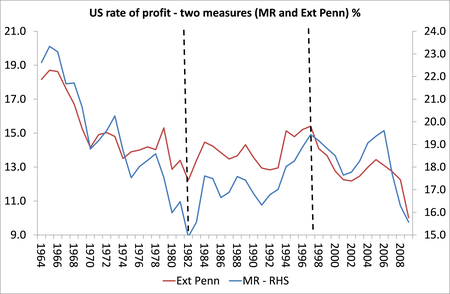
That meant that capital could
no longer accede to rising real incomes, more public services and free
education and health etc. The years of high profitability that allowed
for concessions were over. Profitability is the driving force of capitalism, so
politicians were elected (both right and left) committed reducing the welfare
state and labour power; privatising and deregulating. Above all,
progressive” capitalism had a series of major slumps that weakened the labour
movement and restored (to some extent) profitability.
Indeed, Stiglitz never
mentions the causes of recessions at all except to suggest that they are due to
rising inequality: “If we had curbed exploitation in all of its forms and
encouraged wealth creation, we would have had a more dynamic economy with less
inequality. We might have curbed the opioid crisis and avoided the 2008
financial crisis.” And yet the international slumps of 1974-5 and
1980-82 took place when inequality was at its lowest since industrial
capitalism began (according to Thomas Piketty – graph). So rising
inequality was not the cause of the Great Recession but the result of efforts
to raise profitability after the 1980s.

And how do we get back to this
‘progressive capitalism’ anyway? Stiglitz proposes regulation,
breaking up the ‘monopolies’, progressive taxation, ending corruption and
enforcing the rule of law in trade. “The prescription follows from the
diagnosis: It begins by recognizing the vital role that the state plays in
making markets serve society. We need regulations that ensure strong
competition without abusive exploitation, realigning the relationship between
corporations and the workers they employ and the customers they are supposed to
serve. We must be as resolute in combating market power as the corporate sector
is in increasing it.” These prescriptions are the stock of the reformist
left in the US and elsewhere. America’s Left Democrat Senator Elizabeth
Warren has made similar proposals with her “accountable
capitalism” plan.
What on earth would make the
top 1% and the very rich owners of capital agree to reduce their gains in order
to get a more equal and successful economy? And how would regulation and
more equality deal with the impending disaster that is global warming as
capitalism accumulates rapaciously without any regard for the planet’s
resources and viability? Programmes of redistribution do little for this.
And if an economy is made more equal, would it stop future slumps under
capitalism or future Great Recessions? More equal economies in the past
did not avoid these slumps.
Unlike 1949, in 2019, none of
Stiglitz’s ‘progressive’ measures are possible. Indeed, radical change is now
probably only possible with ‘workers’ power’ and if that became a reality we
could move beyond such measures to real democratic control of the economy, by
replacing capitalism, rather than ‘saving it from itself’’.
33-year study shows increasing ocean winds and wave heights
April 25, 2019
University of Melbourne
Extreme ocean winds and wave
heights are increasing around the globe, with the largest rise occurring in the
Southern Ocean, University of Melbourne research shows.
Global trends in extreme (90th
percentile) wind speed over the period 1985-2018. Areas in red indicate
increasing values, whereas blue indicates decreases.
Credit: Professor Ian Young
[IMAGE]
Extreme ocean winds and wave
heights are increasing around the globe, with the largest rise occurring in the
Southern Ocean, University of Melbourne research shows.
Researchers Ian Young and
Agustinus Ribal, from the University's Department of Infrastructure
Engineering, analysed wind speed and wave height measurements taken from 31
different satellites between 1985-2018, consisting of approximately 4 billion
observations.
The measurements were compared
with more than 80 ocean buoys deployed worldwide, making it the largest and
most detailed dataset of its type ever compiled.
The researchers found that
extreme winds in the Southern Ocean have increased by 1.5 metres per second, or
8 per cent, over the past 30 years. Extreme waves have increased by 30
centimetres, or 5 per cent, over the same period.
As the world's oceans become
stormier, Professor Young warns this has flow on effects for rising sea levels
and infrastructure.
"Although increases of 5
and 8 per cent might not seem like much, if sustained into the future such
changes to our climate will have major impacts," Professor Young said.
"Flooding events are
caused by storm surge and associated breaking waves. The increased sea level
makes these events more serious and more frequent.
"Increases in wave
height, and changes in other properties such as wave direction, will further
increase the probability of coastal flooding."
Professor Young said
understanding changes in the Southern Ocean are important, as this is the
origin for the swell that dominates the wave climate of the South Pacific,
South Atlantic and Indian Oceans.
"Swells from the Southern
Ocean determine the stability of beaches for much of the Southern Hemisphere,
Professor Young said.
"These changes have
impacts that are felt all over the world. Storm waves can increase coastal
erosion, putting costal settlements and infrastructure at risk."
International teams are now
working to develop the next generation of global climate models to project
changes in winds and waves over the next 100 years.
"We need a better
understanding of how much of this change is due to long-term climate change,
and how much is due to multi-decadal fluctuations, or cycles," Professor
Young said.
Story Source:
Materials provided by University of Melbourne. Note:
Content may be edited for style and length.
Journal Reference:
Ian R. Young, Agustinus
Ribal. Multiplatform evaluation of global trends in wind speed and wave
height. Science, 2019; eaav9527 DOI: 10.1126/science.aav9527
Subscribe to:
Posts (Atom)