Saturday, March 17, 2018
Corbyn Smeared as ‘Russian Stooge’ for Requesting Evidence on Poisoned Spy
https://www.youtube.com/watch?v=VDZG1oqO_rM

How the Iraq War Destabilized the Entire Middle East
MARCH 15, 2018
by MEL GOODMAN
As we approach the fifteenth
anniversary of the unwarranted invasion of Iraq, which we are still paying for
in so many ways, it is important to remember the misuse of intelligence that
provided a false justification for war. It is particularly important to
do so at this time because President Donald Trump has talked about a military
option against North Korea or Iran (or Venezuela for that matter). Since
there is no cause to justify such wars, it is quite likely that politicized
intelligence would once again be used to provide a justification for audiences
at home and abroad.
In 2002 and 2003, the White
House, the Department of Defense, and the Central Intelligence Agency
collaborated in an effort to describe the false likelihood of a nuclear weapons
program that had to be stopped. In the words of Bush administration officials,
the United States was not going to allow the “smoking gun to be a mushroom
cloud.” On September 8, 2002, Vice President Cheney and national security
adviser Condi Rice used that phrase on CNN and NBC’s “Meet the Press,”
respectively, to argue that Saddam Hussein was “using his procurement system to
acquire the equipment he needs to enrich uranium to build a nuclear weapon.”
In October 2002, the CIA
orchestrated a national intelligence estimate to argue falsely that Iraq was
acquiring uranium from Niger for use in a nuclear weapon. Senior
officials throughout the intelligence community knew that the so-called Niger
report was a fabrication produced by members of the Italian military
intelligence service, and several intelligence officials informed Congressional
and White House officials that they doubted the reports of Iraqi purchases of
uranium from Niger. Nevertheless, the national intelligence estimate spun
a fictitious tale of a clear and present danger based on false reports of
alleged stockpiles of chemical and biological weapons; nuclear weapons;
unmanned aerial vehicles; and ties between Iraq and al Qaeda that were
nonexistent.
In December 2002, President
George W. Bush found the CIA’s case for war inadequate and asked for “something
that Joe Public would understand or gain a lot of confidence from.” Bush
turned to CIA director George Tenet and remarked, “I’ve been given all this
intelligence about Iraq having WMD and this is the best we’ve got?”
Instead of being truthful, Tenet replied, “Don’t worry, it’s a slam
dunk!” Several days later, Alan Foley, the chief of the Weapons
Intelligence, Proliferation and Arms Control Staff, told his analysts to
prepare a briefing for the president. “If the president wants
intelligence to support a decision to go to war,” Foley said, “then it is up to
the agency to provide it.” In early January, CIA Deputy Director John
McLaughlin gave the phony “slam dunk” briefing at the White House.
The Pentagon’s Office of
Special Plans distributed the unsubstantiated and flawed intelligence that not
even the CIA would vouch for. The Undersecretary of Defense for Policy
Douglas Feith supplied bogus intelligence to the White House on Iraqi WMD and
links to terrorist organizations to make the case for war, and then “leaked” this
intelligence to key journalists such as Judith Miller at The New York
Times. Miller had a front page article in the Times on September 8,
2002, citing administration officials claiming that Saddam was seeking
“specially designed” aluminum tubes to enrich uranium, the so-called “smoking
gun.” Several days later, President Bush inserted the Times’ claim
in his speech to the United Nations General Assembly.
The aluminum tube issue was
central to Secretary of State Colin Powell’s speech to the UN in February 2003,
which was based on the phony CIA estimate from October 2002. As Powell’s
chief of staff, Lawrence Wilkerson wrote in The New York Times in
February 2018, the secretary’s “gravitas was a significant part of the Bush
administration’s two-year-long effort to get Americans on the war wagon.
It was CIA Deputy Director McLaughlin who lied to Secretary of State Powell
about the reliability of the intelligence in Powell’s speech. McLaughlin was
the central advocate for the phony intelligence on mobile biological
laboratories that ended up in that speech.
President Bush would have gone
to war with or without intelligence, and once again we are confronted by a
president who might consider going to war with or without intelligence. Fifteen
years ago, we had a CIA director from Capitol Hill who was loyal to the
president and unwilling to tell truth to power. Once again, we have a CIA
director, Gina Haspel, who is a White House loyalist and cannot be counted on
to tell truth to power. She was one of the Agency’s leading cheerleaders
for torture and abuse, and sent the message that order the destruction of the
torture tapes. And former CIA director Mike Pompeo, a neoconservative
hardliner, is now secretary of state, who earned his new position by being a
total loyalist who would never tell truth to power. Is there a voice for
moderation left in the White House?
Bush’s war destabilized the
entire Middle East. Any Trump war could lead to the use of nuclear
weapons that would destabilize the entire world.
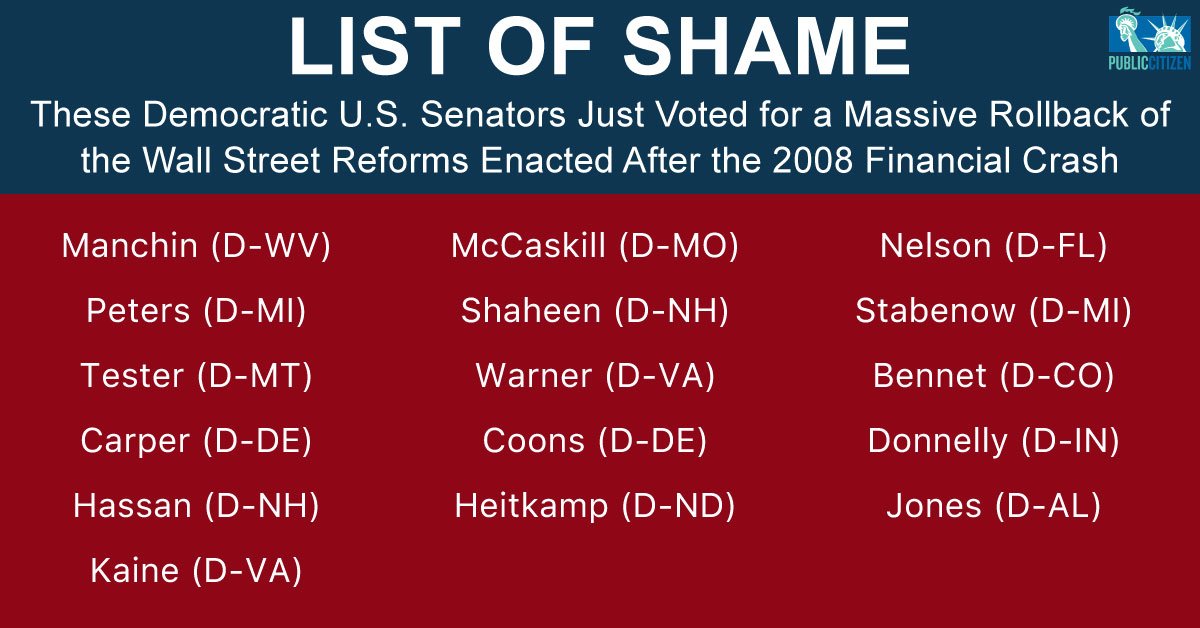
US Senate Democrats who are puppets of the big banks
https://twitter.com/Public_Citizen/status/974056525697376256
https://www.justicedemocrats.com/
Yesterday, over a dozen Senate
Democrats voted in favor of an atrocious bill to deregulate the vast majority
of our nation’s big banks, leaving consumers and taxpayers vulnerable to
another economic disaster.
If this bill becomes law, many
of the big banks who orchestrated the 2008 financial crisis will no longer be
subject to strict oversight. Even worse, it would repeal most of the reporting
requirements that aim to prevent racist lending practices, such as charging
people of color higher fees when buying a home.
These Senate Democrats claim
they voted for it because they’re facing competitive reelection
campaigns. We call bullshit.
The vast majority of voters,
regardless of party, don’t want the Big Banks to destroy the economy again.
They don’t want to lose their retirement, their homes, or their jobs again. And
they don’t trust these banks to behave without stringent regulation.
The only reason to vote for
this bill is to please Wall Street donors, and we’re disgusted that Senators
from our own party would choose profit over people.
The Sick Paying for the Healthy: How Insurance Companies Drive Up Drug Prices
Thursday, March 15, 2018
By Mike Ludwig,
Truthout | Report
Faced with angry consumers and
impending political reforms, the massive corporations that shape the way we pay
for medicine are clamoring to preserve their public image, profit margins and
political clout -- often by pointing the finger of blame at each other. The
poster child for the debate is insulin, a hormone replacement drug that many
people with diabetes need to stay alive. As Truthout has reported, the market
price of popular insulin products has skyrocketed in recent years. Some people with diabetes
go broke paying for their medicine. Others have died while attempting to ration dosages.
Despite public outrage over
insulin prices, three of the largest insulin manufacturers have refused to seek
a settlement in a class action lawsuit filed against them on behalf of diabetes
patients. The drug makers Eli Lilly, Novo Nordisk and Sanofi-Aventis asked a
federal judge in New Jersey to dismiss the case and suggested that the
plaintiffs turn their attention to insurance companies instead, according to
briefs filed last Friday.
Court records show that
plaintiff attorneys and advocates for people with diabetes have sparred over
how to proceed with the case and whether to include insurance companies and
their pharmacy benefit managers (who negotiate drug prices) as defendants in
the lawsuit. Currently, only manufacturers are named as defendants.
Food and Drug Administration
(FDA) Commissioner Scott Gottlieb has also put insurers on notice. In a speech
before an insurance industry conference last Wednesday, Gottlieb said that
current pharmaceutical pricing agreements between insurers and drug
manufacturers have saddled people living with serious or long-term illnesses
(such as diabetes) with the cost of keeping premiums lower for everyone else.
"But sick people aren't
supposed to be subsidizing the healthy," Gottlieb said. "That's
exactly the opposite of what most people thought they were buying when they
bought into the notion of having insurance."
Gottlieb was referring to the
system of "rebates" that currently controls the price of
pharmaceuticals. Under this system, drug makers pay billions of dollars to
insurance companies in order to sell drugs to people enrolled in health plans.
It's a system that benefits people who can afford expensive insurance coverage,
but for many working people, this system is a total failure. To understand why,
we must consider how the different industry players use the money that flows in
from drug manufacturers.
Patient advocates say this
system creates perverse incentives that push the price of drugs like insulin
through the roof.
In his speech, Gottlieb
applauded insurance giant UnitedHealth for announcing plans to pass savings secured by lavish
rebates it receives from drug manufacturers directly to members when they buy
drugs at the pharmacy, rather than using the money to pad its central coffers
and lower premiums across the board.
These rebating agreements are
at the center of the drug pricing system that a growing chorus of advocates and
policy makers say must change.
High drug prices are usually
blamed entirely on pharmaceutical companies because they make the drugs and set
the prices. However, these manufacturers do not set prices in a vacuum: They
say they shape prices around the costs of rebate payments they're required to
make to insurance companies in exchange for selling prescription drugs to their
members.
Yes, this means that insurance
companies are making secret deals with drug manufactures, and that's why people
with health coverage don't pay full price for drugs at the pharmacy. These
"kickbacks," as advocates call them, raise an important question: Are
insurance companies giving customers what they pay for?
The Sick Subsidizing the
Healthy
Here's how the system works:
Pharmacy benefit managers (PBMs) work with insurers to decide which drugs will
be covered by their health plans. This provides PBMs with considerable leverage
over drug makers. In 2017, the three largest PBMs -- Express Scripts, OptimaRx
and CVS/Caremark -- controlled access to about 72 percent of the drug market,
according to the Drug Channels Institute. This explains why individual
insurance plans cover certain types or brands of medicines and not others.
Using this leverage, PBMs make
secret agreements with manufacturers like Novo Nordisk and Eli Lilly to place
their drugs on health plans in exchange for large discounts and rebate
payments. The PBM keeps a percentage of the rebate, and the insurance company
takes the rest.
This gives drug companies
access to millions of customers in exchange for billions of dollars in discounts and rebates that can
significantly lower costs for people with health coverage, depending on how
insurance companies share the savings. The Drug Channels Institute estimates
that drug companies spent $127 billion on rebates, discounts and price
concessions in 2016 alone.
PhRMA, the industry group
representing major drug makers, estimates that one third of the original price of all
brand name drugs is rebated back to insurers and other members of the supply
chain. Some drugs are more heavily rebated than others. Insulin, for example,
secures rebates for insurers at rates of up to 75 percent of the original
market price of the drug, or "list price," according to diabetes advocates.
Insurers and PBMs tend to
include higher-priced drugs that bring bigger rebates on the list of drugs they
cover, rather than including cheaper generics and biosimilars.
Patient advocates say this
system creates perverse incentives that push the price of drugs like insulin
through the roof. Insurers can use hefty rebates from commonly used drugs
to lower premiums and attract new customers, and the demand for steeper rebates
pushes manufacturers to set their list prices higher and higher. As result,
many pharmacy benefit plans operate like "reverse insurance,"
according to Drug Channel Institute CEO Adam Fein.
"The sickest people
taking medicines for chronic illnesses generate the majority of manufacturer
rebate payments," Fein wrote last week at Drug Channels, his oft-cited blog.
"Today, these funds are used to subsidize the premiums for healthier plan
members."
People who can afford robust
insurance plans may not notice the price increases, but those buying medicine
with cheaper plans do. Insurance companies often calculate coinsurance and deductibles with the
original list price of a drug, not the after-rebate "net price" they
actually pay. That means cheaper health plans with high out-of-pocket costs
require patients to pay all or part of the inflated list price until
deductibles are paid off. In the case of insulin, that list price could be
hundreds of dollars higher than what the insurer pays after rebates.
High out-of-pocket costs are a
leading reason why patients don't take their medication, which can lead to
medical problems that increase the cost of health care for everyone, according
to Steven Knievel, an access to medicines advocate at Public Citizen.
"The practice of raising
the list price [to increase the size of rebates] benefits the drug companies
and the PBMs. Both come out winners," Knievel said. "But the consumer
is the loser."
Meanwhile, insurers and
PBMs tend to include higher-priced drugs that bring bigger rebates on the list
of drugs they cover, rather than including cheaper generics and biosimilars.
(The FDA is currently promoting generics as competitive
solutions to high drug prices, but that solution seems unlikely to take hold
without serious changes to the pricing system.) Major PBMs are increasingly merging with insurance companies, a sign
that their interests have long been aligned.
"Patients shouldn't be
penalized by their biology if they need a drug that isn't on formulary," Gottlieb
said, referring to a health plan's list of covered drugs. "Patients
shouldn't face exorbitant out-of-pocket costs and pay money where the primary
purpose is to help subsidize rebates paid to a long list of supply chain
intermediaries, or is used to buy down the premium costs for everyone
else."
It's a system of profit built
on the backs of sick people. Faced with lawsuits from insulin users, proposed rebating reforms for Medicare and angry
members of Congress, the major players in the drug supply chain have consistently blamed each other for it.
"The manufacturers point
the finger at the PBMs and say, 'The rebates that you are demanding are so
large that we have to raise our prices to maintain a reasonable rate of
returns,'" said Patricia Danzon, a professor of health care management at
the University of Pennsylvania, in an interview. "The PBMs say the drug
companies are the ones that set the prices, and we are only trying to get the
best prices for our customers."
The Court of Public Opinion
The result is an opaque blend
of public relations messaging and raw economics. For example, manufacturers
claim to be unfairly singled out by a growing number of state-level drug-pricing transparency laws, and they are
eagerly promoting research suggesting that insurers are not passing
savings from drug rebates on to their customers.
If lawmakers agree, they may
pass transparency legislation requiring insurers to report the rebates they
receive, or at least disclose the actual net cost of prescriptions to their
customers. Once this information is disclosed, it's only a matter of time
before consumers demand insurers pass the rebate savings on to them directly.
"The
manufacturers could in theory benefit from the pass-through of the
rebates to patients through co-payments," Danzon said. "This
could make rebates visible. In theory, if manufacturers in any
industry know how much their competitors are rebating, this
visibility makes it easier for them to keep their prices in line without
illegally colluding with each other."
PBMs and insurers, however,
argue that rebates must remain secret in order to maintain the negotiating
advantage and competitive bidding that brings prices down. Plus, if two
manufacturers of a specialty drug know each other's price, they can tacitly
collude to raise it. Danzon said this is why the Congressional Budget Office
(CBO) has assumed in their analysis of legislative proposals that making
rebates fully transparent could increase costs for programs like Medicare.
"The argument for
transparency is very intuitive, people understand that, but the fact the CBO
has consistently come out against full transparency -- that has economic
argument behind it," Danzon said.
Meanwhile, Ben Wakana,
executive director of Patients for Affordable Drugs, told Truthout that
consumers would benefit from more transparency in the rebating system -- if not
a different system altogether -- but rebates are not the only factors pushing
up drug prices. In the United States, drug manufacturers enjoy patent
exclusivity on new drugs for years, allowing them to charge monopoly prices.
They also spend huge amounts of money on advertising and influencing
politicians.
"Drug companies can claim
they have to raise drug prices to pay PBM rebates, but ... they could take
those terrible ads off the air and stop paying their CEOs a hundred million
dollars," Wakana said. "It's a murky system and patients need to know
where their money is going, but drug corporations have to lower their prices."
Wakana supports allowing the
government to negotiate drug prices with the buying power generated by millions
of Medicare members, a proposal supported by progressives in Congress. Perhaps
if drug prices came down, then insurers would not be so reliant on rebates to
control costs. Still, the question of whether consumers are getting what they
pay for from insurance providers remains, and that's exactly how drug makers
like it.
There are profiteers standing
on all sides of the drug pricing equation. Consumers are stuck in the middle,
shelling out monthly premiums along with rising out-of-pocket costs at the
pharmacy. However, the more light we shine on this system, the more we see it
beginning to crumble under its own weight -- and the weight of public opinion.
As Haspel Nomination Reopens Dark CIA Chapter, Liz Cheney Leads Pack of Torture Apologists
As lawmakers and former
intelligence officials defend Trump's CIA pick, civil libertarians argue she
"should be in jail."
President Donald Trump's
decision this week to nominate Gina Haspel—an intelligence official civil
libertarians argue "should
be in jail" for her role in
the Bush administration's torture regime—as the next CIA chief has illuminated
something of a spectrum of torture apologists among America's political elite.
Placing herself firmly on the
far-right end of this spectrum on Tuesday was Rep. Liz Cheney (R-Wy.), daughter
of former Vice President Dick Cheney, who tweeted a proud defense of the CIA's
euphemistically-named torture program at Sen. John McCain (R-Ariz.), who argued
the Senate should closely scrutinize Haspel's role in overseeing the torture of
detainees at U.S. black sites overseas.
In openly praising the Bush
torture regime and the "brave men and women" who carried it out,
Cheney differentiated her position from that of many Washington establishment
figures who have defended Haspel's role in overseeing the Bush torture program
this week, on the grounds that she was merely "following
orders."
For instance, former CIA
director Michael Hayden wrote in
an op-ed for The Hill on Wednesday that Haspel's "role in CIA's
counterterrorism program" should not be cause for concern, as she was
merely doing "nothing more and nothing less than what the nation and the
agency asked her to do."
Highlighting several similar
examples in an articlefor The
Intercept on Thursday, Jon Schwartz argues the defense of Haspel offered
by Hayden, former Obama officials, and some lawmakers is precisely the defense
Nazis used during the Nuremberg trials following the Second World War.
While Nuremberg judges
rejected the "Nuremberg defense" as illegitimate, "many members
of the Washington, D.C. elite are now stating that it, in fact, is a
legitimate defense for American officials who violate international law to
claim they were just following orders," Schwartz writes.
In a tweet on Thursday, Trevor
Timm, executive director of the Freedom of the Press Foundation, summarized the
principal narratives of torture apologists—all of which serve to undermine all
attempts to hold those who oversee violations of international law accountable
for their actions.
The rush among the
intelligence establishment to defend Haspel's past comes as civil liberties
groups are ramping up efforts to stop her confirmation. As The Daily Beast's
Spencer Ackerman notes,
these groups "spent Barack Obama's presidency loudly warning that without
prosecutions for torture, it will be a matter of time before torture
returns."
Now that the U.S. has a
president who campaigned
on bringing back torture, the effort to block Haspel is "a fight
[rights groups] feel compelled to wage," Ackerman writes.
"Gina Haspel dishonored
our country and disgraced herself by participating in the CIA torture program
and the destruction of criminal evidence," Wells Dixon of the Center on
Constitutional Rights, told The Daily Beast. "We do not believe she
should be director of the CIA. Rather, she should be in jail."
“Marx’s Refusal of the Labour Theory of Value” by David Harvey
It is widely believed that
Marx adapted the labour theory of value from Ricardo as a founding concept for
his studies of capital accumulation. Since the labour theory of value has
been generally discredited, it is then often authoritatively stated that Marx’s
theories are worthless. But nowhere, in fact, did Marx declare his allegiance
to the labour theory of value. That theory belonged to Ricardo, who
recognized that it was deeply problematic even as he insisted that the question
of value was critical to the study of political economy. On the few
occasions where Marx comments directly on this matter,1 he
refers to “value theory” and not to the labour theory of value. So what,
then, was Marx’s distinctive value theory and how does it differ from the
labour theory of value?
The answer is (as usual)
complicated in its details but the lineaments of it can be reconstructed from
the structure of the first volume of Capital.2
Marx begins that work with an
examination of the surface appearance of use value and exchange value in the
material act of commodity exchange and posits the existence of value (an
immaterial but objective relation) behind the quantitative aspect of exchange
value. This value is initially taken to be a reflection of the social (abstract)
labour congealed in commodities (chapter 1). As a regulatory norm
in the market place, value can exist, Marx shows, only when and where commodity
exchange has become “a normal social act.” This normalization depends upon the
existence of private property relations, juridical individuals and perfectly
competitive markets (chapter 2). Such a market can only work with the
rise of monetary forms (chapter 3) that facilitate and lubricate exchange
relations in efficient ways while providing a convenient vehicle for storing
value. Money thus enters the picture as a material representation of
value. Value cannot exist without its representation. In chapters 4
through 6, Marx shows that it is only in a system where the aim and object of
economic activity is commodity production that exchange becomes a necessary as
well as a normal social act. It is the circulation of money as capital
(chapter 5) that consolidates the conditions for the formation of capital’s
distinctive value form as a regulatory norm. But the circulation of capital
presupposes the prior existence of wage labour as a commodity that can be
bought and sold in the market (chapter 6). How labour became such a
commodity before the rise of capitalism is the subject of Part 8 of Capital, which
deals with primitive or original accumulation.
The concept of capital as a
process – as value in motion – based on the purchase of labour power and means
of production is inextricably interwoven with the emergence of the value form.
A simple but crude analogy for Marx’s argument might be this: the human
body depends for its vitality upon the circulation of the blood, which has no
being outside of the human body. The two phenomena are mutually
constitutive of each other. Value formation likewise cannot be understood
outside of the circulation process that houses it. The mutual interdependency
within the totality of capital circulation is what matters. In capital’s
case, however, the process appears as not only self-reproducing (cyclical) but
also self-expanding (the spiral form of accumulation). This is so because
the search for profit and surplus value propel the commodity exchanges, which
in turn promote and sustain the value form. Value thereby becomes an
embedded regulatory norm in the sphere of exchange only under conditions of
capital accumulation.

Figure 1
While the steps in the
argument are complicated, Marx appears to have done little more than synthesize
and formalize Ricardo’s labour theory of value by embedding it in the totality
of circulation and accumulation as depicted in Figure 1. The sophistication and
elegance of the argument have seduced many of Marx’s followers to thinking this
was the end of the story. If this was so then much of the criticism launched
against Marx’s theory of value would be justified. But this is not the
end. It is in fact the beginning. Ricardo’s hope was that the labour
theory of value would provide a basis for understanding price formation.
It is this hope that subsequent analysis has so ruthlessly and properly
crushed. Marx early on understood that this was an impossible hope even
as he frequently slipped (I suspects for tactical reasons) from values to
prices in his presentations as if they were roughly the same thing. In other
instances he studied systematic divergences. In Volume 1 Marx recognizes
that things like conscience, honour and uncultivated land can have a price but
no value. In Volume 3 of Capital he explores how the
equalization of the rate of profit in the market would lead commodities to
exchange not at their values but according to so-called “prices of production.”
But Marx was not primarily
interested in price formation. He has a different agenda. Chapters 7 through 25
of Volume 1 describe in intricate detail the consequences for the labourer of
living and working in a world where the law of value, as constituted through
the generalization and normalization of exchange in the market place, rules.
This is the famous transition, at the end of chapter 6, where Marx invites us
to leave the sphere of circulation, “a very Eden of the rights of man” where
“alone rule Freedom, Equality, Property and Bentham.’ And so we dive into “the
hidden abode of production” where we shall see “not only how capital produces
but, how capital is produced.” It is only here, also, that we will see how
value forms.
The coercive laws of
competition in the market force individual capitalists to extend the working
day to the utmost, threatening the life and well-being of the labourer in the
absence of any restraining force such as legislation to limit the length of the
working day (chapter 10). In subsequent chapters, these same coercive
laws push capital to pursue technological and organizational innovations, to
mobilize and appropriate the labourers’ inherent powers of cooperation and of
divisions of labour, to design machinery and systems of factory production, to
mobilize the powers of education, knowledge, science and technology, all in the
pursuit of relative surplus value. The aggregate effect (chapter 25) is
to diminish the status of the labourer, to create an industrial reserve army,
to enforce working conditions of abject misery and desperation among the
working classes and to condemn much of labour to living under conditions of
social reproduction that are miserable in the extreme.
This is what Diane Elson, in
her seminal article on the subject, refers to as “the value theory of
labour.” It is a theory that focuses on the consequences of value
operating as a regulatory norm in the market for the experience of labourers
condemned by their situation to work for capital. These chapters also explain
why Bertell Ollman considers Marx’s value theory to be a theory of the
alienation of labour in production rather than a market phenomenon.3
But the productivity and
intensity of labour are perpetually changing under pressures of competition in
the market (as described in the later chapters of Capital). This
means that the formulation of value in the first chapter of Capital is
revolutionized by what comes later. Value becomes an unstable and
perpetually evolving inner connectivity (an internal or dialectical relation)
between value as defined in the realm of circulation in the market and value as
constantly being re-defined through revolutions in the realm of production.
Earlier in the Grundrisse(pp. 690-711), Marx had even speculated, in a
famous “fragment on machines,” that the embedding of human knowledge in fixed
capital would dissolve the significance of value altogether unless there were
some compelling forces or reasons to restore it.4
In Volume 3 of Capital Marx makes much of the impact of technological
changes on values leading to the thesis on the falling rate of profit.
The contradictory relation between value as defined in the market and value as
reconstructed by transformations in the labour process is central to Marx’s
thinking.
The changing productivity of
labour is, of course, a key feature in all forms of economic analysis. In
Marx’s case, however, it is not the physical labour productivity emphasized in
classical and neoclassical political economy that counts. It is labour productivity
with respect to surplus value production that matters. This puts the internal
relation between the pursuit of relative surplus value (through technological
and organizational innovations) and market values at the center of Marx’s value
theory.
A first cut at Marx’s value
theory, I conclude, centers on the constantly shifting and contradictory unity
between what is traditionally referred to as the labour theory of value in the
sphere of the market (as set out in the first six chapters of Capital) and
the value theory of labour in the sphere of production (as analyzed in chapters
7 to 25 of Capital).
But the materials presented in
chapter 25 of Capital suggest that it is not only the experience in
the labour process that is at stake in the value theory. Marx describes
the conditions of social reproduction of all those demoted into the industrial
reserve army by the operation of the general law of capital accumulation (the
subject of chapter 25). He cites official reports concerning public
health in rural England (most notably those by a certain Dr Hunter) and other
accounts of daily life in Ireland and Belgium, alongside Engels’ account
of The Condition of the English Working Class in 1844. The consensus
of all these reports was that conditions of social reproduction for this
segment of the working class were worse than anything ever heard of under
feudalism. Appalling conditions of nutrition, housing, education,
overcrowding, gender relations and perpetual displacement were
exacerbated by punitive public welfare policies (most notably the Poor Laws in
Britain). The distressing fact that nutrition among prisoners in jail was
superior to that of the impoverished on the outside is noted (alas, this is
still the case in the United States). This opens the path towards
an important extension of Marx’s value theory. The consequences of an
intensification of capitalist competition in the market (including the search
for relative surplus value through technological changes) produce deteriorating
conditions of social reproduction for the working classes (or significant
segments thereof) if no compensating forces or public policies are put in place
to counteract such effects.
In the same way that the value
theory of labour is foundational for Marx’s approach to value, so “a value
theory of social reproduction” emerges as an important focus for study.
This is the prospect that Marx opens up in the last sections of chapter 25 of
volume 1 of Capital. This is the focus of those Marxist feminists who have
worked assiduously over the past forty years to construct an adequate theory of
social reproduction.5
Marx (Capital, Volume 1,
p.827) cites an official report on the conditions of life of the majority of
workers in Belgium who find themselves forced “to live more economically than
prisoners” in the jails. Such workers “adopt expedients whose secrets are only
known (to them): they reduce their daily rations; they substitute rye bread for
wheat; they eat less meat, or even none at all, and the same with butter and
condiments; they content themselves with one or two rooms where the family is
crammed together, where boys and girls sleep side by side, often on the same mattress;
they economize on clothing, washing and decency; they give up the diversions on
Sunday; in short they resign themselves to the most painful privations.
Once this extreme limit has been reached the least rise in the price of
food, the shortest stoppage of work, the slightest illness, increases the
worker’s distress and brings him to complete disaster; debts accumulate, credit
fails, the most necessary clothes and furniture are pawned, and finally the
family asks to be enrolled on the list of paupers.” If this is a
typical outcome of the operation of the capitalist law of value accumulation
then there is a deep contradiction between deteriorating conditions of social
reproduction and capital’s need to perpetually expand the market. As Marx notes
in Volume 2 of Capital, the real root of capitalist crises lies in the
suppression of wages and the reduction of the mass of the population to the
status of penniless paupers. If there is no market there is no value. The
contradictions posed from the standpoint of social reproduction theory for
values as realized in the market are multiple. If, for example, there are
no healthy, educated, disciplined and skilled labourers in the reserve army
then it can no longer perform its role.
The dialectical relations between
competitive market processes, surplus value production and social reproduction
emerge as mutually constitutive but deeply contradictory elements of value
formation. Such a framework for analysis offers an intriguing way to
preserve specificities and differences at the theoretical level of value theory
without abandoning the concept of the totality that capital perpetually
re-constructs through its practices.
Other modifications,
extensions and elaborations of the value theory need to be considered.
The fraught and contradictory relation between production and realization rests
on the fact that value depends on the existence of wants, needs and desires
backed by ability to pay in a population of consumers. Such wants, needs and
desires are deeply embedded in the world of social reproduction. Without
them, as Marx notes in the first chapter of Capital, there is no
value. This introduces the idea of “not-value” or “anti-value” into the
discussion. It also means that the diminution of wages to almost nothing will
be counterproductive to the realization of value and surplus value in the
market. Raising wages to ensure “rational consumption” from the standpoint of
capital and colonizing everyday life as a field for consumerism are crucial for
the value theory.
What happens, furthermore,
when the presumption of perfect competition gives way to monopoly in general
and to the monopolistic competition inherent in the spatial organization of
capital circulation poses another set of problems to be resolved within the
value framework. I have recently suggested, following on some relevant
formulations by Marx, that the usual acceptance of the idea of a single
expression of value be replaced by recognizing a variety of distinctive
regional value regimes within the global economy.
Marx’s value form, I conclude,
is not a still and stable fulcrum in capital’s churning world but a constantly
changing and unstable metric being pushed hither and thither by the anarchy of
market exchange, by revolutionary transformations in technologies and
organizational forms, by unfolding practices of social reproduction, and
massive transformations in the wants, needs and desires of whole populations
expressed through the cultures of everyday life. This is far beyond what
Ricardo had in mind and equally far away from that conception of value usually
attributed to Marx.
NOTES
1. See “Notes on Adolph Wagner,”
in Marx., K., Value: Studies by Marx (ed. A. Dragstedt), London: New
Park Publications, 1976.
2. Much of what follows derives
from Harvey, D., Marx, Capital and the Madness of Economic Reason, London,
Profile Books; New York, Oxford University Press, 2017
3. Elson, D., “The Value Theory
of Labour,” in Elson, D. (ed.) Value: the Representation of Labour in
Capitalism, London, CSE Books, 1979; Ollman,
4. B., Alienation, London,
Cambridge University Press, 1971.
5. The so-called “fragment on
machines” has been widely debated in recent years. See Carlo Vercellone, “From
Formal Subsumption to General Intellect: Elements for a Marxist Reading of the
Thesis of Cognitive Capitalism,” Historical Materialism15 (2007) 13–36
6. See the recent survey and
collection in Bhattacharya, T., Social Reproduction Theory: Remapping
Class, Recentering Oppression, London, Pluto Press, 2017.
Subscribe to:
Posts (Atom)