https://www.youtube.com/watch?v=ngr_TPPKIYo
https://consortiumnews.com/2025/02/08/vijay-prashad-dreams-are-wearing-thin/
Vijay Prashad: ‘Dreams Are Wearing Thin’
February 8, 2025
Hundreds of millions of people from the Americas to China have been killed or subdued so a small part of the world — the North Atlantic — could enrich itself. That is madness. 
Umar Rashid, United States, I was dreaming when I wrote this. Forgive me if I go astray. The song of the four companions begins in the Sahel in the presence of the marabouts. Pandora comes from the north. The Harmattan approaches and beckon the storms and wars to come, 1799, 2023.
By Vijay Prashad
Tricontinental: Institute for Social Research  Donald Trump returned to the White House with a loud thump.
His staff threw executive order upon executive order on his desk, which he signed with a flourish and then got on the phone to bark orders at the Danes and the Panamanians and the Colombians, demanding this, that, and the other thing, that thing, this thing, the things that he feels that the United States deserves.
In Trump’s history, the U.S. once had a Golden Age. He is now the symbol of its anxiety. His slogan, “Make America Great Again,” does not disguise the worry about its collapse: “Make it great again,” he says, “because it no longer is great, and it should be great, and I will make it great.”
His followers know that at least he has been honest in his assessment of the decline. Many of them can feel it in their bank accounts, too depleted to feed their families, and they can see it in the crumbled infrastructure that surrounds them.
Crystal methamphetamine and fentanyl numb the ugly pain while the new songs of the United States bemoan the uncertainty, how even their “dreams are wearing thin.”
A passenger jet collides with an army helicopter, and Trump ascends to the podium of the White House pressroom and blames the accident on diversity hirings. Geniuses need to be at the air traffic control computer, he says.
But the man who was at the desk that night was doing the job of two because of ruthless cuts that began decades earlier, with President Ronald Reagan’s 1981 union decertification of the Professional Air Traffic Controllers Organisation (PATCO). It was Reagan who first introduced the world to Trump’s slogan, “make America great again.”
Reality is ugly. It is far easier to indulge in fantasy. Trump is the magician who wields that fantasy. Everything has deteriorated — not because of the attack on trade unions, the austerity that followed, or the rise of the tech bros whose share of the social surplus is outrageous and who have been on tax strike for decades.
Trump’s fantasy is incoherent. How else could Trump have elevated Elon Musk, the symbol of the decline, to be the agent of transformation for a new Golden Age? 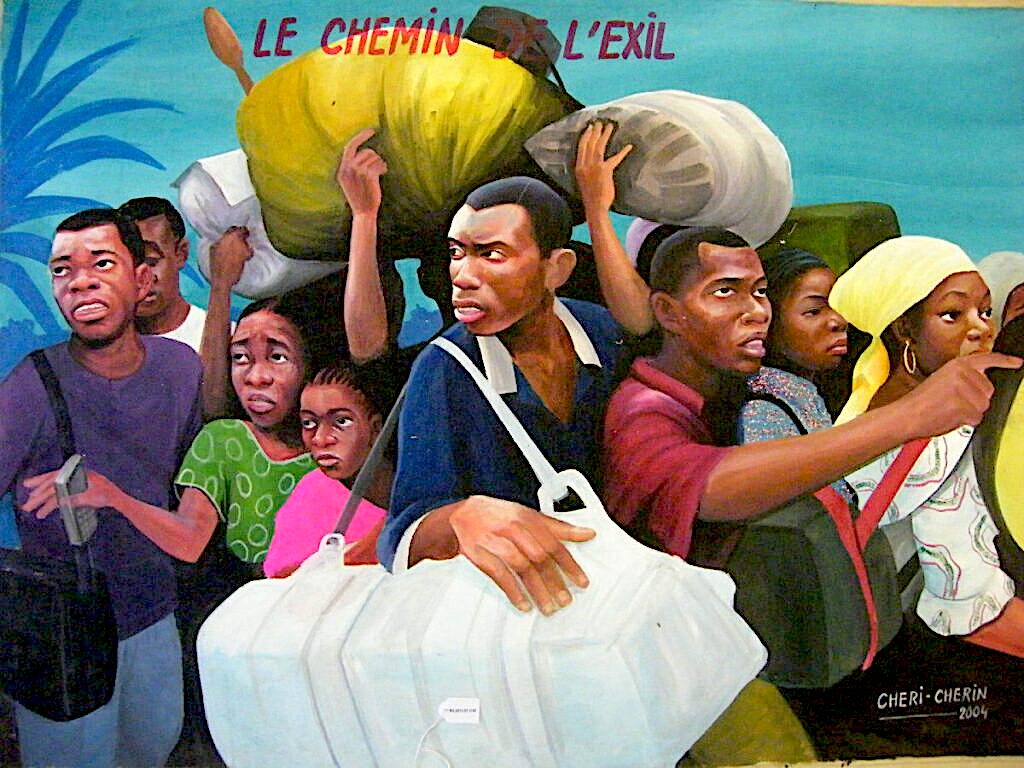
Chéri Chérin, Democratic Republic of the Congo, Le chemin de l’exil or The Path to Exile, 2004.
There is madness, yes. But imperialism has always been tinged with madness. Hundreds of millions of people from the Americas to China have been either killed or subdued so that a small part of the world — the North Atlantic — could enrich itself. That is madness. And it worked. It continues to work, to some extent.
The neocolonial structure of capitalism remains intact. When a country in Africa, Asia, Latin America or the Pacific Islands tries to assert its sovereignty, it is defenestrated. Coups, assassinations, sanctions, theft of wealth — these are just a few of the instruments used to damage any attempt at sovereignty.
And this neocolonial structure is maintained because of the international division of humanity: some people continue to think that they are superior to others. Tricontinental’s study “Hyper-Imperialism,” shows that North Atlantic Treaty Organisation (NATO) Plus countries account for over 74 percent of global military spending.
While China accounts for 10 percent and Russia 3 percent, we nonetheless hear that it is China and Russia that are the threats, rather than NATO, which, led by the United States, is in fact the most dangerous institution in the world.
NATO has destroyed entire countries (Yugoslavia, Afghanistan and Libya, for instance) and now cavalierly threatens wars against countries that have nuclear weapons (China and Russia). Trump screams into the wind:
We want the Panama Canal.
We want Greenland.
We want to call it the Gulf of America.
Why should these demands come as a surprise? Panama was part of the Republic of Gran Colombia from 1821, when the region — under the leadership of Simón Bolívar (1783–1830) — broke from the Spanish Empire.
[Related: Panama Tries Compromise; US Says It’s Not Enough]
U.S. interest in building a canal through the isthmus of Panama to shorten the maritime routes between the Atlantic and Pacific Oceans and bypass the long journey around South America developed in the early 20th century, decades after Gran Colombia dissolved roughly into what is now Panama, Venezuela, Colombia and Ecuador.
In 1903, intrigue by France and the United States, and an intervention by the U.S. Navy, led to the secession of Panama from Colombia. The new Panamanian government gave the United States the Panama Canal Zone, which meant full control of the isthmus from 1903 to 1999, when the U.S. “returned” the canal to Panamanian jurisdiction.
Bear in mind that in 1989, when their former C.I.A. asset Manuel Noriega no longer pleased them, the U.S. invaded Panama, seized Noriega, and incarcerated him in Miami before releasing him to die in Panama City in 2017.
The current president of Panama, José Raúl Mulino, first entered the government during the administration of Guillermo Endara, who was sworn in on a U.S. military base in 1989 as Noriega was taken to Florida.
These men are intimately familiar with the proprietary way the United States looks at their land. It is not merely Trump who “wants” the Panama Canal; it is the entire history of the U.S. treatment of Latin America – from the Monroe Doctrine to today – congealed in a phrase: we want the Panama Canal.
Memory is fragile. It is shaped repeatedly by half-truths and evasions. Beneath the surface reality of events lie deeper structures that influence how we see things. Old colonial ideas of Western benevolence and native savagery burst onto the surface at the time of interpretation. 
Hafidh Al-Droubi, Iraq, Cubist Coffeehouse, 1975.
In 2004, a year after the United States and its allies began a war of aggression against Iraq, United Nations Secretary General Kofi Annan was interviewed by Owen Bennett-Jones of the BBC. Part of that conversation was about the war on Iraq:
Owen Bennett-Jones (OBJ): So, you don’t think there was legal authority for the war?
Kofi Annan (KA): I have stated clearly that it was not in conformity with the Security Council, with the U.N. Charter.
OBJ: It was illegal?
KA: Yes, if you wish.
OBJ: It was illegal?
KA: Yes, I have indicated it is not in conformity with the U.N. Charter. From our point of view and from the Charter point of view, it was illegal.
If the war was illegal, a war of aggression, then there should have been consequences. That was supposed to have been the purpose of the Nuremberg Tribunal of 1945–46.
The excess deaths due to that war are now easily above a million people, with millions more negatively impacted by the destruction of infrastructure. If it were treated as a war of aggression, would its architects (former U.S. President George W. Bush and former U.K. Prime Minister Tony Blair) be able to tour the world with their thousand-dollar smiles and their fancy bespoke suits?
They neither faced International Criminal Court warrants, nor did their countries get taken to the International Court of Justice to face a hearing.
Bush faced Muntadhar al-Zaidi’s shoes in 2008 when he went to Baghdad while Blair in the Iraq War Inquiry in 2012 was surprised by David Lawley-Wakelin, who stepped from behind a curtain and said, “This man should be arrested for war crimes.”
Neither did the shoes hit Bush, nor was Blair arrested. Now, Blair has transformed himself into a peacemaker and Bush has shaped himself into an elder statesman. 
Tetsuya Fukushima, Japan, Untitled, a red circle, 2015.
In Justice Robert Jackson’s three-hour opening statement at the Nuremberg Tribunal in 1945, he said:
“Civilisation asks whether law is so laggard as to be utterly helpless to deal with crimes of this magnitude by criminals of this order of importance. It does not expect that you can make war impossible. It does expect that your juridical action will put the forces of international law, its precepts, its prohibitions, and, most of all, its sanctions, on the side of peace, so that men and women of good will, in all countries, may have ‘leave to live by no man’s leave, underneath the law.’ ”
The line Justice Jackson quoted is from Rudyard Kipling’s poem “The Old Issue” (1899), which was widely read in the 1940s. Two years before Jackson’s opening statement, British Prime Minister Winston Churchill quoted from the same poem in his Harvard University speech to make the point that there are, he said, “common conceptions of what is right and decent” that endowed humans with “a stern sentiment of impartial justice… or as Kipling put it: ‘Leave to live by no man’s leave underneath the law.”’
Churchill’s conception of what was “right and decent” is summarised in his view, two decades prior, when, dealing with the Kurdish rebellion in northern Iraq, he wrote that he was “strongly in favour of using poisoned gas against uncivilised tribes.” 
Zubeida Agha, Pakistan, Urban Landscape, 1982.
It would be worthwhile to shift emphasis from Nuremberg, which is relatively well known, to the lesser-known war crimes trials in Tokyo. There, the tribunal decided to punish military leaders whose troops committed atrocities.
General Tomoyuki Yamashita commanded the Fourteenth Army Group of the Imperial Japanese Army, which operated largely in the Philippines. After he surrendered, General Yamashita was accused of permitting his troops to commit atrocities against civilians and prisoners of war.
He was executed on Feb. 23, 1946. Nobody claimed that General Yamashita personally inflicted pain on anyone: he was charged with “command liability.”
In 1970, the lead military prosecutor at Nuremberg, Telford Taylor, reflected that “there was no charge that General Yamashita had approved, much less ordered these barbarities, and no evidence that he knew of them other than the inference that he must have because of their extent.”
He was hung because, as the Tokyo tribunal noted, General Yamashita “failed to provide effective control of his troops as required by the circumstances.”
Taylor wrote these words in his book Nuremberg and Vietnam: An American Tragedy, now long forgotten, in which he made the case not only to prosecute U.S. politicians and generals, but also U.S. aviators who bombed civilian targets in northern Vietnam because they participated in the Nuremberg era crime of “aggressive warfare.” 
Mohammed al-Hawajri, Gaza, Occupied Palestine Territory, Untitled, from the series Été au Gaza, or Summertime in Gaza, 2017.
In mid-January, Declassified UK’s Alex Morris confronted Israeli General Oded Basyuk on his way to meet with the U.K.’s Ministry of Defence and the Royal United Services Institute.
General Basyuk has overseen the genocide of Palestinians and is being investigated for war crimes by the International Criminal Court. Yet, there he was on the streets of London on his way to meet the U.K.’s high officials in the military.
ICC warrants against Israeli Prime Minister Benjamin Netanyahu were set aside by Poland and the United States, grinding the Nuremberg and Tokyo Tribunals into the dust. Sadly, the United Nations Principles to Combat Impunity (2005) are not legally binding.
Blood will flow down the avenues in some parts of the world. Champagne will fill the glasses in others.
In 1965, during the war between India and Pakistan, Faiz Ahmed Faiz wrote a poem called “Blackout”:
Since our lights were extinguished
I have been searching for a way to see;
my eyes are lost, God knows where.
You who know me, tell me who I am,
who is a friend, and who an enemy.
A murderous river has been unleashed
into my veins; hatred beats in it.
Be patient; a flash of lightning will come
from another horizon like the white hand
of Moses with my eyes, my lost diamonds.
Let us find our lost diamonds.
Vijay Prashad is an Indian historian, editor and journalist. He is a writing fellow and chief correspondent at Globetrotter. He is an editor of LeftWord Books and the director of Tricontinental: Institute for Social Research. He is a senior non-resident fellow at Chongyang Institute for Financial Studies, Renmin University of China. He has written more than 20 books, including The Darker Nations and The Poorer Nations. His latest books are Struggle Makes Us Human: Learning from Movements for Socialism and, with Noam Chomsky, The Withdrawal: Iraq, Libya, Afghanistan and the Fragility of U.S. Power.
This article is from Tricontinental: Institute for Social Research.
https://thenextrecession.wordpress.com/2025/02/08/trade-tariffs-as-economic-policy-the-debate/
Michael Pettis is an American professor of finance at Guanghua School of Management at Peking University in Beijing and a nonresident senior fellow at the Carnegie Endowment for International Peace. He has become a popular media source on China’s economy but also on global trade and investment trends.
In the wake of Donald Trump’s announcement of tariff hikes on US imports from a range of countries, Pettis has been expounding the view against the consensus in mainstream economics that tariffs can sometimes be beneficial to a country and even the world economy.
His argument centres on the view that: “[unlike in the 1930s], Americans consume far too large a share of what they produce, and so they must import the difference from abroad. In this case, tariffs (properly implemented) would have the opposite effect of [the] Smoot- Hawley [tariffs of the 1930s]. By taxing consumption to subsidize production, modern-day tariffs would redirect a portion of US demand toward increasing the total amount of goods and services produced at home. That would lead US GDP to rise, resulting in higher employment, higher wages, and less debt. American households would be able to consume more, even as consumption as a share of GDP declined.”
He goes on: “Thanks to its relatively open trade account and even more open capital account, the American economy more or less automatically absorbs excess production from trade partners who have implemented beggar-my-neighbor policies. It is the global consumer of last resort. The purpose of tariffs for the United States should be to cancel this role, so that American producers would no longer have to adjust their production according to the needs of foreign producers. For that reason, such tariffs should be simple, transparent, and widely applied (perhaps excluding trade partners that commit to balancing trade domestically). The aim would not be to protect specific manufacturing sectors or national champions, but to counter the United States’ pro-consumption and anti-production orientation.”
Pettis claimed that US tariffs, even though it is a tax on consumption, would not necessarily make American consumers worse off. “American households are not just consumers, as many economists would have you believe, but also producers. A subsidy to production should cause Americans to produce more, and the more they produce, the more they are able to consume.” For example, if the US were to put tariffs on electric vehicles, US manufacturers would be incentivised to increase domestic production of EVs by enough to raise the total American production of goods and services. If they did, then American workers would benefit in the form of rising productivity. In turn, this would lead to wages rising by more than the initial price impact the tariffs had and American consumers would be better off.
Pettis argued that “It was direct and indirect tariffs that in 10 years transformed China’s EV production from being well behind that of the US and the EU to becoming the largest and most efficient in the world”. So tariffs may not be an especially efficient way for industrial policy to force this rebalancing from consumption to production, but it has a long history of doing so, and “it is either very ignorant or very dishonest of economists not to recognize the ways in which they work…To oppose all tariffs on principle shows just how ideologically hysterical the discussion of trade is among mainstream economists.”
Pettis’ favourable view of Trump’s tariffs policy produced a broadside of attacks by mainstream neo-classical and Keynesian economists. Paul Krugman, the Keynesian guru who got a ‘Nobel’ prize for his contribution international trade analysis, reckoned Pettis was just “mostly wrong”.
Keynesian economics blogger Noel Smith noted that Pettis reckoned that cheap Chinese imports actually made Americans poorer, by reducing their domestic production so much that Americans actually end up consuming less. Really, proclaimed Smith? “I’m highly skeptical of this argument, since a basic principle of economics is that people don’t voluntarily do things that make them poorer.” (Smith). Smith retorted that Trump’s tariffs in his first term did not boost domestic production as Pettis claimed tariffs could. Industrial production actually declined after Trump put up his tariffs: 
Moreover, the trade deficit did not decline at all. 
Pettis was failing to consider other factors, in particular, the dollar exchange rate with other trading currencies. The dollar appreciated in response to the tariffs, cancelling out at least part of the tariff effect on import prices. And it was not just households that had to pay more for imported goods in the shops, US manufacturers also suffered when they had to pay a lot more for parts and components.
Neoclassical economist Tyler Cowan also launched in, outlining “the mistakes of Michael Pettis”. “Michael Pettis does not understand basic international economics”. “He talks about tariffs (FT) as if they are anti-consumption, but pro-production. But tariffs are anti-production on the whole…. he basically presents an argument that we would expect economics undergraduate majors to reject.”
Certainly, the empirical evidence suggests that tariffs do not lead to a rise in economic growth. “Using an annual panel of macroeconomic data for 151 countries over 1963–2014, we find that tariff increases are associated with an economically and statistically sizeable and persistent decline in output growth. Thus, fears that the ongoing trade war may be costly for the world economy in terms of foregone output growth are justified.”
Pettis’ argument has two features. First, he reckons that import tariffs would lead to import substitution ie domestic American manufacturers would increase production and replace foreign imports and so employment and incomes would rise for all. Second, what is wrong with the world economy are the imbalances in trade and international payments. The US runs a huge trade deficit because exporting nations like China and Germany have flooded the home market with their goods. Tariffs can stop that by allowing US manufacturers to compete.
The first argument is really the old ‘infant industry’ argument, namely that countries just beginning to build their industrial base need to protect those ‘infant’ industries with tariffs from cheaper foreign imports. This was the economic basis for the tariff measures introduced by successive US administrations after the end of the civil war in the 1860s. This culminated in the Tariff Act of 1890, better known as the McKinley Tariff, which was a pivotal episode in US trade policy, dramatically raising import duties to near-record levels (by 38-50%).
Donald Trump referred to McKinley when announcing his executive orders to raise tariffs. “Under his leadership, the United States enjoyed rapid economic growth and prosperity, including an expansion of territorial gains for the Nation. President McKinley championed tariffs to protect U.S. manufacturing, boost domestic production, and drive U.S. industrialization and global reach to new heights.” Indeed, McKinley campaigned on raising tariffs so that internal taxes could be lowered, just as Trump campaigned in the 2024 election. “You go back and look at the 1890s, 1880s, McKinley, and you take a look at tariffs, that was when we were proportionately the richest,” Trump said.
In 1890 McKinley as a congressional rep proposed a range of tariffs to protest American industry. This was adopted by Congress. But the tariff measures did not work out well. They did not avoid a severe depression that began in 1893 and lasted until 1897. In 1896, McKinley became US President and presided over a new set of tariffs, the Dingley Tariff Act of 1897. As this was a boom period, McKinley claimed that the tariffs helped to boost the economy. Called the ‘Napoleon of Protection’, he linked his tariffs policy to the military takeover of Puerto Rico, Cuba and the Philippines to extend America’s ‘sphere of influence’ – shades of Trump But early in this second term as president from 1901, he was assassinated by an anarchist who had been enraged by the suffering of farm workers during the recession of 1893-7, which he blamed on McKinley.
Now we have another ‘Napoleon of Protection’ in Trump, who claims his tariffs will help American manufacturers in the same way that McKinley argued. But this time. the price will be paid by American households. Trump’s last set of tariffs in his first term raised domestic prices and hurt consumers much as the McKinley Tariff did in its time.
The debate here between Pettis and his critics boils down to two things. First, did the ‘infant industry’ argument hold at least for 19th century America, and if it did, can we apply it now for the US economy in the 21st century? The mainstream critics like Cowan are outright neoclassical supply and demand equilibrium theorists. Cowan reckons that over the long term, any change in supply and demand for American exports and imports caused by tariffs will lead to a price adjustment and a new balance. So there will be no gain for American industry.
Pettis correctly replied to Cowen’s fantasy world of equilibrium: “While I understand Cowen’s reliance on the “Econ 101” model, which assumes that prices always adjust to balance supply and demand, this framework isn’t relevant in the context of current global economic conditions. Prices have not adjusted in the US or many other countries over several decades.”
But Pettis fails to accept the obvious: that the US in the 21st century is not an emerging industrial power that needs to protect burgeoning new industries from powerful competitors. Instead, it is a mature economy with a declining industrial sector that will not be restored in any significant way by tariffs on Chinese or European imports.
As long ago as the 1880s, Friedrich Engels pointed out that when a capitalist economy is dominant worldwide, it is favour of free trade and no tariffs, as Britain was in the mid-19th century and the US was in the 1950s to the 1980s. But the long depression of the 1880s and 1890s saw Britain’s manufacturing dominance decline and British policy switched to protectionist tariffs for its vast colonial empire. 
Engels commented then: “if any country is now adapted to acquiring and holding a monopoly of manufacturing, it is America.” Engels reckoned that America’s tariffs from the 1860s had helped ‘nurture’ the development of large scale industry, but eventually as the US gained dominance, protective tariffs would “simply be a hindrance.” In the 21st century, America is Britain in the late 19th century; and China is the America of the 20th century – at least in industrial terms. Thus now Trump and Pettis want tariffs; while China wants free trade.
Pettis, in defending his argument for tariffs against his mainstream critics raised, what he called the “wider picture”, namely that China (and until recently Germany) exported for growth rather than consumed. As a result, workers wages were held down in China and Germany while the US became the final consumer for their exports and thus over consumed. This was the reason for trade imbalances that must be corrected by tariffs.
It is the thesis that Pettis and co-author Matthew Klein developed in their book Trade wars are class wars, a title that so enthused not only the mainstream media but attracted support from the left (indeed, I remember Klein being invited to participate in a left-wing online discussion on international trade and suddenly realising where he was, blurted out that he was ‘not a Marxist’. Of course, this was not his fault as the hosts should have known better!).
Klein-Pettis reckoned that the industrial policy of ‘investment for export’ by countries like China and Germany create ‘global imbalances’ that encouraged dangerous reactions like those from Trump. So Trump’s actions were the fault of China and Europe. You see, some economies (China) are ‘saving’ too much ie not investing at home enough to use up savings and instead export abroad, running up big trade surpluses. Others are forced to absorb these surpluses with excessive consumption (US) and so run large current account deficits. So we have trade wars as governments like Trump’s try to reverse this trend.
This is a bit like Trump’s argument that Mexico and Canada were causing a drugs overdose epidemic in the US by exporting fentanyl and it had nothing to do with Americans demanding cheap imported drugs to help their depressions.
Klein and Pettis were saying that these trade imbalances are caused by the decisions of governments like China and Germany that seek to suppress wages and consumption (the class war), in order to boost investment and export surplus savings. Klein and Pettis reckoned that “The problem emerged when the Chinese economy could no longer absorb new investment productively. … Once China reached that point, consumption was too low to drive growth, and it entered into a state of excess production.”
But as I showed in my review of that book and in several other posts, this thesis is nonsense. It was just not true that household consumption in China is being repressed. Actually, personal consumption in China has been increasing much faster than fixed investment in recent years (even if it is starting at a lower base) and faster than in the US or any other G7 economy. Pettis and Klein’s own empirical analysis reveals that there has been a rise in consumption as a share of GDP in China in the last ten years, even without recognising that this is a probable underestimate of the size of household consumption in the stats (which exclude many public services or the ‘social wage’). 
Any proper analysis of the trade imbalances would recognise that they are not the result of ‘excess savings’ or ‘weak domestic demand’ in China and ‘inadequate savings’ or ‘excessive demand’ in the US. This view is a false Keynesian analysis that ignores the supply-side forces of strong investment in technology reducing unit costs of production to gain competitive advantage in international trade. Germany and China were just outcompeting US industry through increasingly superior technology and productivity growth.
Global imbalances in trade and capital were the result of the higher productivity and technology base of the major companies in the ‘winning’ economies leading to a transfer of profits to the strong from the weak. It’s not a transfer of excess savings to excess consumption across borders; but the transfer of value and surplus value from the weaker capitalist economies to the stronger. Indeed, that is precisely the nature of imperialism: the unequal exchange of value, not a savings-consumption imbalance. Indeed, even on the adjusted (A) Western measures of labour productivity growth during the COVID period, China has done way better than the US. 
Over the last 30 years, China’s savings rate rose 25.8%, but its investment rate rose more, 26.8%; so no ‘savings glut’ there, at least over the long term. Indeed, in the global boom period of 1990s, China’s investment rate rose much faster than its savings rate and there were no large surpluses on the current account. Only in the short period of 2002-7 did China run a large net savings surplus when the US has a credit-fuelled consumer boom before the global financial crash.
In their book, Klein and Pettis argued that: “The rest of the world’s unwillingness to spend — which in turn was attributable to the class wars in the major surplus economies and desire for self-insurance after the Asian crisis — was the underlying cause of both America’s debt bubble and America’s deindustrialisation.” But this is historically inaccurate. Since the 1970s, the US had been losing market share in manufacturing and trade and running current account deficits, not just after the Asian crisis. The cause of this decline was down to the relative weakness of US productivity growth, not Asian ‘excess savings’. Moreover, US manufacturing companies had shifted their production abroad during the 1980s.
Ironically, in trying to defend his pro-tariff policy from his orthodox critics, Pettis reversed the view in his book. He replied: “Contrary to Cowen’s claim, US business investment is not constrained by a lack of American savings. Just look at what US businesses say. They argue that if they are not investing in increased manufacturing, it is more likely because they do not believe they can produce profitably in the face of intense global competition, particularly from countries like China, Germany, South Korea and Taiwan, whose trade surpluses reflect a competitive advantage achieved at the expense of weak domestic demand. Another way to assess this is by looking at what businesses do with retained earnings. If US companies were eager to invest domestically but constrained by a lack of savings, they would not be sitting on massive cash reserves or spending heavily on share buybacks and dividend payments. This suggests that the problem is not a shortage of capital but a lack of profitable investment opportunities in the US.”
Apart from the reference to ‘weak domestic demand’, what Pettis says is right. American capital did not invest to sustain its manufacturing superiority because the profitability of that sector had fallen too much. Instead, they switched to investing in financial assets and/or shifting their industrial power abroad. In the last couple of decades they hoped to sustain an advantage in hi-tech and information technology including AI. Now even that is under threat.
But this is not the fault of China running an ‘unfair’ industrial trade policy that is based on suppressing the living standards of its people; on the contrary, it is the failure of US capital to sustain its hegemony, just as Britain did in the late 19th century. Pettis attacks China’s success and calls for the US to protect its ailing industries with tariffs. If anything, that is likely to reduce the living standards of Americans instead.
 Kit Klarenberg and Wyatt Reed·September 30, 2024
 “The objective of IRI’s youth programs is to ensure that Bangladesh’s young people have the knowledge and skills to wield online and off-line tools for change,” reveals an internal IRI document which featured this graphic.

 “There’s strength in the scarlet of blood,” Bangladeshi rappers declare in a US government-sponsored hip-hop track.