Friday, January 13, 2023
2023 Outlook For Ukraine
https://popularresistance.org/2023-outlook-for-ukraine/
By Scott Ritter, Consortium News.
January 12, 2023
Educate!
Given the duplicitous history of the Minsk Accords, it is unlikely Russia can be diplomatically dissuaded from its military offensive.
As such, 2023 appears to be shaping up as a year of continued violent confrontation.
After almost a year of dramatic action, where initial Russian advances were met with impressive Ukrainian counteroffensives, the frontlines in the ongoing Russian-Ukrainian conflict have stabilized, with both sides engaged in bloody positional warfare, grinding each other down in a brutal attritional contest while awaiting the next major initiative from either side.
As the one-year anniversary of Russia’s invasion of Ukraine approaches, the fact that Ukraine has made it this far into the conflict represents both a moral and, to a lesser extent, a military victory.
From the chairman of the U.S. Joint Chiefs of Staff to the director of the C.I.A., most senior military and intelligence officials in the West assessed in early 2022 that a major Russian military offensive against Ukraine would result in a rapid, decisive Russian victory.
The resilience and fortitude of the Ukrainian military surprised everyone, including the Russians, whose initial plan of action, inclusive of forces allocated to the task, proved inadequate to the tasks assigned. This perception of a Ukrainian victory, however, is misleading.
The Death of Diplomacy
As the dust settles on the battlefield, a pattern has emerged regarding the strategic vision behind Russia’s decision to invade Ukraine. While the mainstream Western narrative continues to paint the Russian action as a precipitous act of unprovoked aggression, a pattern of facts has emerged which suggests that the Russian case for preemptive collective self-defense under Article 51 of the United Nations Charter may have merit.
Recent admissions on the part of the officials responsible for the adoption of the Minsk Accords of both 2014 and 2015 (former Ukrainian President Petro Poroshenko, former French President Francois Hollande and former German Chancellor Angela Merkel) show that the goal of the Minsk agreements for the promotion of a peaceful resolution to the post-2014 conflict in the Donbass between the Ukrainian government and pro-Russian separatists was a lie.
Instead, the Minsk Accords, according to this troika, were little more than a means to buy Ukraine time to build a military, with the assistance of NATO, capable of bringing the Donbass to heel and driving Russia out of Crimea.
Seen in this light, the establishment of a permanent training facility by the U.S. and NATO in western Ukraine — which between 2015 and 2022 trained some 30,000 Ukrainian troops to NATO standards for the sole purpose of confronting Russia in eastern Ukraine — takes on a whole new perspective.
The admitted duplicity of Ukraine, France and Germany contrasts with Russia’s repeated insistence prior to its Feb. 24, 2022, decision to invade Ukraine that the Minsk Accords be implemented in full.
In 2008, former U.S. Ambassador to Russia William Burns, the current C.I.A. director, warned that any effort by NATO to bring Ukraine into its fold would be viewed by Russia as a threat to its national security and, if pursued, would provoke a Russian military intervention. That memo by Burns provides much-needed context to the Dec. 17, 2021, initiatives by Russia to create a new European security framework that would keep Ukraine out of NATO.
Simply put, the trajectory of Russian diplomacy was conflict avoidance. The same cannot be said of either Ukraine or its Western partners, who were pursuing a policy of NATO expansion linked to the resolution of the Donbass/Crimea crises through military means.
Game Changer, Not Game Winner
The reaction of the Russian government to the failure on the part of the Russian military to defeat Ukraine in the opening phases of the conflict provides important insight into the mindset of the Russian leadership regarding its goals and objectives.
Denied a decisive victory, the Russians seemed prepared to accept an outcome which limited Russian territorial gains to the Donbass and Crimea and an agreement by Ukraine not to join NATO. Indeed, Russia and Ukraine were on the cusp of formalizing an agreement along these lines in negotiations scheduled to take place in Istanbul in early April 2022.
This negotiation, however, was scuttled following the intervention of then British Prime Minister Boris Johnson, who linked the continued provision of military assistance to Ukraine to the willingness of Ukraine to force a conclusion to the conflict on the battlefield, as opposed to negotiations. Johnson’s intervention was motivated by an assessment on the part of NATO that the initial Russian military failures were indicative of Russian weakness.
The mood in NATO, reflected in the public statements of NATO Secretary General Jens Stoltenberg (“If [Russian President Vladimir] Putin wins, that is not only a big defeat for the Ukrainians, but it will be the defeat, and dangerous, for all of us”) and U.S. Secretary of Defense Lloyd Austin (“We want to see Russia weakened to the degree that it can’t do the kinds of things that it has done in invading Ukraine”) was to use the Russian-Ukrainian conflict as a proxy war designed to weaken Russia to the point that it would never again seek to undertake a Ukraine-like military adventure. [Coupled with an ill-fated economic war, it was also designed to bring down the Russian government, as President Joe Biden admitted last spring.]
This policy served as the impetus for the injection of what would amount to well over $100 billion worth of assistance, including tens of billions of dollars of advanced military equipment, to Ukraine.
This massive infusion of aid was a game-changing event, allowing Ukraine to transition from a primarily defensive posture to one that saw a reconstituted Ukrainian military, trained, equipped and organized to NATO standards, launching large-scale counterattacks that succeeded in driving Russian forces from large swaths of Ukraine. It was not, however, a game winning strategy — far from it.
Military Math
The impressive Ukrainian military accomplishments that were facilitated through the provision of military aid by NATO came at a huge cost in lives and material. While the exact calculation of casualties suffered by either side is difficult to come by, there is widespread acknowledgement, even among the Ukrainian government, that Ukrainian losses have been heavy.
With the battle-lines currently stabilized, the question of where the war goes from here comes down to basic military math — in short, a causal relationship between two basic equations revolving around burn rates (how quickly losses are sustained) versus replenishment rates (how quickly such losses can be replaced.) The calculus bodes ill for Ukraine.
Neither NATO nor the United States appear able to sustain the quantity of weapons that have been delivered to Ukraine, which enabled the successful fall counteroffensives against the Russians.
This equipment has largely been destroyed, and despite Ukraine’s insistence on its need for more tanks, armored fighting vehicles, artillery and air defense, and while new military aid appears to be forthcoming, it will be late to the battle and in insufficient quantities to have a game-winning impact on the battlefield.
Likewise, the casualty rates sustained by Ukraine, which at times reach more than 1,000 men per day, far exceed its ability to mobilize and train replacements.
Russia, on the other hand, is in the process of finalizing a mobilization of more than 300,000 men who appear to be equipped with the most advanced weapons systems in the Russian arsenal.
When these forces arrive in full on the battlefield, sometime by the end of January, Ukraine will have no response. This harsh reality, when coupled with the annexation by Russia of more than 20 percent of Ukraine’s territory and infrastructure damage approaching $1 trillion, bodes ill for the future of Ukraine.
There is an old Russian saying, “A Russian harnesses slowly but rides fast.” This appears to be what is transpiring regarding the Russian-Ukraine conflict.
Both Ukraine and its Western partners are struggling to sustain the conflict they initiated when they rejected a possible peace settlement in April 2022. Russia, after starting off on its back feet, has largely regrouped, and appears poised to resume large-scale offensive operations which neither Ukraine nor its Western partners have an adequate answer for.
Moreover, given the duplicitous history of the Minsk Accords, it is unlikely Russia can be dissuaded from undertaking its military offensive through diplomacy. As such, 2023 appears to be shaping up as a year of continued violent confrontation leading to a decisive Russian military victory.
How Russia leverages such a military victory into a sustainable political settlement that manifests itself in regional peace and security is yet to be seen.

The Vote For House Speaker Obscured Democratic Treachery
https://popularresistance.org/the-vote-for-house-speaker-obscured-democratic-treachery/
By Margaret Kimberley, Black Agenda Report.
January 12, 2023
House Speaker Kevin McCarthy’s need for 15 rounds of voting from his party is viewed with alarm or humor.
But the right wing proved that activists win if they make demands. Democrats have no members brave enough to confront leadership, and the people’s needs go unmet.
In 2021 Democratic Party progressives asked those members of congress who claimed to share their political priorities to stand up to their leadership, which meant standing up for the people. They knew that Joe Biden promised to veto any legislation providing free, universal healthcare, known as Medicare for All. But they did what any political activist should do. They made the demand anyway. The call to #ForcetheVote was a request for House members to withhold their votes for Nancy Pelosi as Speaker of the House unless she committed herself to bringing Medicare for All to a vote.
The House members who called themselves progressives did nothing of the sort. They elected Nancy Pelosi without demanding that she bring Medicare for All or any other issue for a vote. The Squad and the Progressive Caucus, all failed to do what their supporters wanted.
In 2023 a different dynamic took place. Republicans won control of the House in the 2022 midterm elections. Some of their members, such as Lauren Boebert and Matt Gaetz, are considered lesser lights and are routinely dismissed by democratic pundits and propagandists as being dumb, crazy, or a host of other epithets.
Whatever one can say about them, they did something that Squad members did not. They withheld their votes from Kevin McCarthy, who needed 15 ballots to become Speaker of the House, a record in congressional history. The process was messy, the word “chaos” was used a lot, and social media memes making fun of McCarthy and the Republicans proliferated.
There was a lot of finger pointing and snobbery about the Republicans, but there was far too little analysis. Delving into the story in a truthful way would have meant dredging up the progressive democrats shameful behavior two years ago and exposing them to the level of critique that Boebert and Gaetz received.
Not only did democratic progressives run for cover when their leadership dropped the hammer, but they lied in order to hide their cowardice. Alexandria Ocasio-Cortez and others claimed that they would lose the speakership to Republicans unless they all stayed on board. “We are just an extremely slim amount of votes away from risking the speakership to the Republican Party. It’s bigger than any one of us.”
This statement was a bald-faced lie meant to keep liberals in line. Republicans didn’t lose the Speakership to the Democrats despite taking 15 rounds of voting to select McCarthy. The overly hyped congresswoman known as AOC was doing the leadership’s bidding and protecting herself from criticism.
Actually, she may not have needed to lie. Many democrats behave like cult members, mesmerized and hypnotized by con artists, living in fear of making any demands on any issue. They easily give in and have been indoctrinated into thinking they can never make political change.
Now Joe Biden is sitting in the political catbird seat. He can wheel and deal and triangulate to his heart’s content, which is what Democratic presidents actually prefer. They don’t want to provide Medicare for All or student loan debt relief, or a minimum wage increase. Biden can now feign powerlessness; the propagandists will join him in declaring that his hands are tied because Republicans control the House.
Republicans like Boebert will be scrutinized and caricatured so that Democrats can make fun and/or scare their people into shutting up. But it is actually more important to watch AOC and her cohort. Boebert and company are just the bogeywomen and men of the moment who provide a convenient cover for liberals the next time they are ready to perform another stab in the back. Phony progressives are a far worse enemy.
In the final analysis, the Republicans’ deal making was democracy in action. Elected representatives debated and challenged one another. Most importantly, party leadership faced a challenge they couldn’t avoid. This country would be far better off if the people who claimed to be progressive had acted likewise in 2021 instead of taking a dive when they should have been willing to confront.
Oddly enough, one of the demands that McCarthy met was a proposal to cut the federal budget to FY2022 levels. Such a cut would mean a $75 billion cut to defense spending . Of course, Republicans don’t really want to do that. The military industrial complex survives with bipartisan support. But inadvertently the Republican renegades revealed how much their Democratic Party colleagues have increased defense spending.
This year on January 16, Democrats and Republicans alike will fan out across the country and claim to pay homage to the memory of Dr. Martin Luther King, Jr. King broke with president Johnson when he denounced the Vietnam war, and was roundly criticized for doing so. The progressives of today possess none of his courage and go along with their party’s oligarchy when ordered to do so. The right wingers on the other side of the aisle seem to have far more conviction.
University of California grad student strike ends
https://www.workers.org/2023/01/68591/
By Martha Grevatt posted on January 12, 2023
After nearly six weeks on the picket line, 48,000 graduate students at the University of California voted to accept a new contract. This ended the largest academic strike in U.S. labor history.
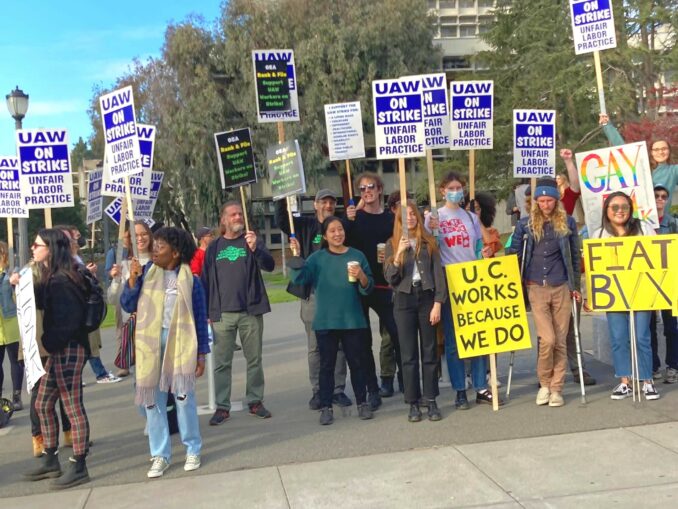
Picket line, University of California Berkeley, Nov. 20, 2022. WW Photo: Judy Greenspan
Solidarity was strong throughout the strike, with student workers risking arrest by engaging in acts of civil disobedience. Construction workers stopped work on new campus buildings, and Teamsters stopped delivering packages to the universities during the strike. Members of numerous unions joined the picket lines and attended strike rallies.
Members of the three striking United Auto Workers locals — 2865, 5810 and Student Researchers United-UAW — won significant pay increases, along with transportation and child care subsidies. The contract improves health benefits, job security language and language on bullying, harassment and discrimination.
However, the pay increases fell far short of what the union initially demanded. On average, base pay remains below $30,000 after the first big raise, which doesn’t kick in until Oct. 1. UC management refused to grant a key demand of the strike: housing subsidies to offset the high cost of living in California. Other shortcomings include the retention of fees of around $15,000 per year, which out-of-state students, including international students, are required to pay.
Another concern of contract opponents — including 15 members of the 40-member negotiating team — is that the contract creates “tiers,” something UAW members in manufacturing are all too familiar with. Typically lower pay tiers are introduced for workers hired after a certain date, creating a divisive system where workers working side-by-side, doing the exact same work, are paid differently. The UC contract instead has higher pay scales at more prestigious campuses in the 10-campus system.
A rank and file-led “vote no” campaign convinced 38% of those who voted to reject the contract, but with a majority voting in favor, the contract goes into effect with the strike’s end.
Whatever the gains or shortcomings in the contract, this historic strike provided a stellar example of what solidarity looks like, today and in the future.
Martha Grevatt is a retired Chrysler (now Stellantis) worker who served on the executive boards of UAW Locals 122 and 869.
UAE Names Oil CEO As COP28 President
The United Arab Emirates on Thursday named Sultan al-Jaber, the CEO of the UAE's state-run oil company, as president of COP28 which will be held in that country in November. "This appointment goes beyond putting the fox in charge of the hen-house," said Teresa Anderson, global lead on climate justice, ActionAid. The world's leading climate scientists have concluded, with “unequivocal” certainty, that the extraction and combustion of fossil fuels is the main cause of climate change. "COP28 must speed up the global phase-out of fossil fuels - we cannot have another COP where fossil fuel interests are allowed to sacrifice our futures to eke out another few years of profit," Ugandan climate justice activist Vanessa Nakate said. A UN IPCC report last April concluded the world must immediately cease all new fossil fuel infrastructure and phase out existing fossil fuel extraction and combustion — and said entrenched "status quo" actors are the main barriers to doing so. Backlash from those seeking to limit and halt the present and mounting impacts of climate change was swift and predictably forceful. "An oil company CEO cannot be the kind of President that COP28 needs," Catherine Abreu, founder and executive director of environmental nonprofit Destination Zero, told ABC News. "A person tasked with making the most profit possible from oil and gas extraction can’t be the same person tasked with landing the most ambitious outcome possible from a climate conference." (AP, Washington Post $, ABC, Context, Forbes, FT $, CNN, Reuters, BBC, The Hill, Climate Home, CNBC)
GOP Anti-ESG Laws Could Cost Taxpayers $700 Million: Taxpayers in six states could lose more than $700 million because of Republican officials' boycotts of firms that consider environmental, social, and (corporate) governance factors in their investment decisions, a new report from Econsult Solutions finds. The legislation enacted in Kentucky, Florida, Louisiana, Oklahoma, West Virginia, and Missouri spawned out of model legislation pushed by ALEC and a network of fossil fuel-funded dark money groups. "This report highlights the potential multi-million-dollar economic burden on both residential taxpayers and businesses in states that are taking or considering actions to limit climate and other ESG [environmental, social and governance] considerations within their municipal bond work," Steven Rothstein, a managing director at Ceres, said in a statement. (E&E $, Politico, Reuters, News from the States, ImpactAlpha $)
Exxon Knew … Really Accurately: ExxonMobil climate scientists predicted the climatic damage their product would cause with remarkable accuracy, all while the company spent huge sums of money denying and obfuscating the science of climate change, a study published Thursday in Science reveals. That "Exxon knew" its product was dangerously increasing global temperatures has been known for years, but the precision and accuracy of its predictions were "actually astonishing" Harvard science history and co-author of the study Naomi Oreskes told the AP. “ExxonMobil accurately foresaw the threat of human-caused global warming, both prior and parallel to orchestrating lobbying and propaganda campaigns to delay climate action,” the study's authors wrote. Researchers "dug into not just to the language, the rhetoric in these documents, but also the data. And I’d say in that sense, our analysis really seals the deal on ‘Exxon knew’,” Jeffrey Supan, an environmental science professor at the University of Miami and lead author of the study, told the AP. It “gives us airtight evidence that Exxon Mobil accurately predicted global warming years before, then turned around and attacked the science underlying it.” Multiple states and municipalities have filed lawsuits seeking to hold Exxon accountable, along with numerous other oil and gas firms and trade associations, for defrauding consumers about the damaging impacts of their products. (AP, Inside Climate News, LA Times $, New York Times $, Politico, Bloomberg $, Axios, Gizmodo, Grist, CNN, The Hill, The Guardian, CNBC, Exxon Knews)

[ ... ]
CALIFORNIA STORMS: [ ... ] MONTEREY ISLAND: Flooding threatens to turn Monterey Peninsula into an island (San Francisco Chronicle, Washington Post $, LA Times $, CNN, NBC Bay Area, CBS)
[ ... ]
2022: Multiple agencies concur: ’22 was one of Earth’s hottest years (Washington Post $ [ ... ]), 2022 was the warmest La Niña year on record. Scientists say this year will be warmer (CNN)
[ ... ]
The full roundup of this morning's climate and energy news is available here.

Proposed methane rules would protect Texans (San Antonio Express-News, Sheila Serna. op-ed)
[ ... ]
The full roundup of this morning's climate and energy A&O is available here.

Birth Of A Disinfluencer: Latest Anti-Wind Spokesman Shows How Grassroots Becomes Astroturf
In the world of PR, grassroots activism describes community action for or against a project or policy. Astroturfing, by contrast, is when industry-backed PR professionals use actors to pose as local activists, because media outlets treat normal people protesting differently than corporate-sponsored spokespeople. This distinction is rarely so cut and dry, though.
[ ... ]
Read the full Denier Roundup here.
The wrong kind of civil disobedience,
Orly, +972 Magazine info@972mag.com

The struggle brewing inside Israel’s anti-government movement
The far-right coalition has already provoked broad resistance from within Israeli society — but Palestine remains the elephant in the room.
By Haggai Matar

The Israeli right is the minority — the left need only realize it
It’s time for the Jewish left to understand that by aligning its struggle with the Palestinians, it can be part of a majority against occupation and apartheid.
By Meron Rapoport

Ben Gvir wants to ban the Palestinian flag. Here’s why it won’t work
The national security minister’s new directive illustrates the Israeli right’s fear of any symbol that reminds it of the Palestinian people’s refusal to disappear.
By Oren Ziv

The Palestinian ecovillage putting grassroots democracy into action
In the West Bank community of Farkha, a young communist leadership is championing feminism, sustainability, and care for elders.
By Fatima AbdulKarim

The racial logic behind Palestine’s partition
Partition was rarely endorsed as a solution to settler colonialism. But Europe's racialization of Jews distinguished Zionism from other settler enterprises.
By Yair Wallach

Palestinian loses eye after police stun grenade explodes in his face
Abdullah Rawajbeh was smoking a cigarette when a Border Police officer threw a grenade at his face. Doctors had no choice but to remove his eye.
By Basil Adra
Orly Noy
The wrong kind of civil disobedience
The chaos unleashed by Israel’s far-right government has brought a forgotten concept back to the public lexicon: civil disobedience. Over the past few weeks, even before the new government was inaugurated, activists and opposition leaders have called for mass protests, strikes, and other forms of unrest.
Two of those leaders are Ehud Barak and Yair Golan, both retired army generals — people who have spent much of their lives in military uniform, and who are now encouraging us to go out into the streets and disobey the regime. While for Barak, the threat of civil disobedience remains vague and devoid of a plan of action, Golan already has a clear one: shutting down businesses and services, blocking roads, and more.
Of course, one may wonder where a man whose party was wiped from the face of the political map in the last election will find the troops for this civil disobedience, and whether he struggles to get not only the concept of “civil,” but also that of “disobedience.”
The closest thing Israel has seen to civil disobedience — whether in scope, organization, or determination — was the uprising by Palestinian citizens in October 2000. But those events transcended civil disobedience, for two reasons: first, because of the second-class citizenship of Palestinians living under a regime of apartheid and Jewish supremacy; and second, because of the accepted definition of the term, according to which those engaging in acts of civil disobedience may reject the actions of the government, while still accepting its legitimacy. In general, Arab citizens justifiably do not accept the legitimacy of a government that is inherently discriminatory and oppressive toward them.
And still, those massive demonstrations were the most meaningfully defiant that we have seen against the government. Yes, there were larger demonstrations in terms of numbers, such as the 400,000 people who protested in Tel Aviv against the Sabra and Shatila massacre in 1982. That protest, however, was focused on a very specific demand, and did not approach the challenge posed to the regime by Palestinian citizens in October 2000.
Where were the two heroes of civil disobedience, Golan and Barak, when the Arab public rose up in opposition to this rotten and immoral regime? One was the head of the Nahal Brigade in the Israeli army, which oppressed Palestinians in the refugee camps and cities of the occupied West Bank, and the other was the prime minister of the state that brutally suppressed that same uprising.
That suppression led to the deaths of 13 Palestinian citizens at the hands of Israeli police. And while Barak did later “express regret” and apologized for his responsibility for the killings, his empty gesture was rejected by the bereaved families. Golan has not even offered a symbolic apology for his crimes; on the contrary, during his brief stint as a member of Knesset for Meretz in the “government of change,” he supported the Citizenship Law, and tried to suppress voices in his own party who sought to transform it into an Arab-Jewish one.
But not only do the two retired generals, who are still deeply committed to the idea of Jewish supremacy, not understand the true meaning of citizenship, it seems they also have difficulty understanding the concept of disobedience. Effective civil disobedience requires, first and foremost, the masses, and without the participation of Palestinian citizens, Barak and Golan’s battered and beaten camp stands no chance of bringing about real change. This has already been proven in the parliamentary arena, and it is also true in the streets.
Golan and Barak, of course, have no chance of mobilizing the Arab public for the kind of protest they want to lead — not only due to the rivers of Palestinian blood that are on their hands, but because of the deep gaps in the nature of the change they wish to see.
And this is actually the real question: will the camp that is calling for civil disobedience agree to part with its privileges in favor of participation in an equal and just democracy? Or will it prefer them even at the cost of the establishment of an outright fascist regime? There is simply no third way. By putting aside the pipe dream of a “democratic and Jewish Israel,” it will be possible to imagine real civil disobedience led by Arab citizens, which could free all of us from the shackles of supremacy. If not, we will remain entrenched in a deepening Israeli fascism.
P.S. Producing the newsletter, like every other aspect of our work, requires time and resources. Become a member of +972 Magazine to help us sustain our work and bring you the kind of analysis from on the ground in Israel-Palestine that you won’t find anywhere else.
Subscribe to:
Comments (Atom)