Monday, July 11, 2022

The Decadent Empire


https://www.resumen-english.org/2022/07/the-decadent-empire/ 


By  Randy Alonso Falcón on July 4, 2022 from Havana

The decline of the US is reflected on the streets of its cities and towns. photo: Bill Hackwell


With a stroke of a pen the majority of the US Supreme Court has just set women’s rights in the United States back 50 years. There is no better example of the degradation that nation suffers. Today it celebrates its independence amidst fireworks and bullets.

No empire lasts forever as mighty Rome showed. It lost its almost undisputed dominance amid wars, economic decline, corruption, immoralities, and declined into decadence.

The Modern Rome is also decrepit. Contested in the military, downtrodden in the economic, degraded in the social, dwarfed in the moral and more dangerous than in its projection towards the world.

Washington’s imperial pose of “global bully” has been deflated by continuous wars throughout the world crowned by failure. The Saigon-like exit from Afghanistan, after 20 years of conflict, is the best image of the gradual collapse of the greatest military power that history has ever known. Its real impossibility to stop Russia in the war in Ukraine and to catch up with Russia’s developments in certain fields of military technology is another.

Despite enormous pressure, the United States and its European allies have not been able to drag China, India, Mexico, Brazil, Indonesia, Iran, Turkey and much of the world into their war of trade sanctions against Russia.

It cannot even impose its designs on its once “backyard”. The Summit of the Americas showed that more than a few Latin American and Caribbean governments are standing up to Washington’s attempts at imposition and bludgeoning. And that the world’s leading economy cannot even compete with China in terms of economic offers to the region. Much less in these times of crisis and the record high inflation in four decades.

For historian Alfred McCoy, the decline of the empire in this phase began with the invasion of Iraq in 2003. According to him, China will surpass the economic and military influence of the United States in the world by 2030.

The concern of the empire’s strategists is growing. Two Pentagon advisors put it clearly in a recent article: “The United States and its allies are in a strategic quagmire. Shaken along the full spectrum of hybrid warfare by similar adversaries, near and non-state, they are being challenged in all domains of contemporary conflict. Russia’s invasion of Ukraine turned the already threatened rules-based liberal order upside down and lowered expectations about the behavioral boundaries within which states could act. China’s unprecedented rise as an economic, technological and military rival has catalyzed a tectonic shift in the global balance of power. The resurgence of Sino-Russian alignment further complicates the West’s strategic situation.”

This has just been reaffirmed by the recently concluded NATO Summit, where Western powers anathematize China and Russia, and try to show muscle under the umbrella of thousands of U.S. nuclear weapons.

Moreover, no military power maintains its hegemonic might without intense production capacity, technology and economic power to safeguard this power.

But the financial casino is running out of steam

The financial bubble economy with which they have dominated and shorn the world over the past decades is showing signs of its exhaustion. Having the dollar printing machine going is no longer enough. The United States has worn out its economic and financial power by implementing irresponsible economic policies, say respected analysts.

The enormous U.S. public debt is an increasingly heavy burden for the great power. The nation’s huge fiscal deficit has been financed almost entirely since the beginning of this century by foreign lenders, including those from China, Russia and other countries considered enemies by Washington.

As economist Nouriel Roubini (the guru who predicted the 2008 crisis) analyzes, “…a country that needs to borrow between $700 billion and $800 billion a year from abroad to finance its external debt cannot be very selective in the ways (common stock rather than debit) in which its lenders and creditors want to finance these deficits. The first rule of good manners if one is invited is not to spit in the dish on which the host feeds one. But under this corrupt financial protectionism, the United States believes it is going to order other countries how and on what terms they should finance their twin deficits. This attitude will not be permitted by creditors for much longer.”

The Federal Reserve, with historic losses on its assets of more than 13 times the amount of its consolidated capital, was forced to raise interest rates by three-quarters of a percentage point (0.75%) in a move seen as aggressive, to address the red-hot inflation that is plaguing the economy, frustrating consumers and stifling the Biden administration. It is the largest rate hike since 1994 and will affect millions of U.S. businesses and households, raising the cost of home, auto and other loans to force a slowdown in the economy.

And there will be no soft landing, warn experts, who even speak of the risk of a stagflationary storm in the making.

Here and there, there are signs of a shake-up in the economic dominance of the United States, which can no longer compete in certain fields with the Arab monarchies, which are also financiers of the U.S. debt. Last week, the head of the PGA Golf Tour, the former symbol of the supreme in this elite sport, came out to cry for help because they cannot compete with a new golf league backed by Saudi Arabia, which in recent weeks has acquired stars such as the Spanish Sergio Garcia or the Americans Dustin Johnson and Bryson DeChambeau. “I want to be clear, I’m not naive, if this is a war and the only weapon is dollars, the PGA Tour, an American institution, cannot compete with a monarchy that spends millions in an attempt to buy golf,” its commissioner Jay Monahan told a news conference in Cromwell, Connecticut, USA.

Rotten bills

Financial corruption makes waves in the midst of the crisis and deepens the decomposition of the empire. It’s not just Trump’s shenanigans to avoid paying taxes, in a country where it is legend that Al Capone went to jail not for being a notorious mobster but for evading the taxman. The Federal Reserve itself has been undermined by scandals in recent years.

The credibility of the U.S. central bank is at risk due to the behavior of some officials who have allegedly put their personal interests above the interests of the economy they are supposed to help steer, several analysts agree.

When countries were beginning to announce mandatory quarantines and panic was growing in the financial markets due to the economic consequences and the potential financial crisis caused by Covid-19, Richard Clarida, the vice-president of the U.S. Federal Reserve, sold almost five million dollars in shares that had already been losing value in the New York Stock Exchange. A “planned portfolio rebalancing” was described by the Federal Reserve in its reports on the stock market movements that senior officials of the U.S. central bank have to report on a daily basis.

Clarida sold his shares on February 24, 2020 when markets were down to avoid losing more money on stocks amid a turbulent backdrop. However, three days later, on February 27 of the same year, he bought back the same shares when they had lost even more value. What most caught the attention of researchers is that one day later, on February 28, Jerome Powell, head of the Federal Reserve, announced that he would use the tools at his disposal to mitigate the economic consequences brought by the pandemic and the general reduction in demand and consumption.

On February 26 of that same year, Fed officials met to define what macroeconomic measures to take to counteract the effects of Covid-19 on the economy, a meeting Clarida was not at, but about which he later obtained report by a call that is recorded with one of the attendees. On March 15, 2020, the Federal Reserve cut the benchmark interest rate to 0%, bought Treasury bonds and other mortgage-backed financial products in excess of $700 billion. Eventually, the financial markets recovered and so did the stocks that Clarida had bought at very low prices before the anti-crash measures were taken.

After investigations, initially revealed by Bloomberg, and much questioning by congressmen and other experts, Richard Clarida submitted his resignation to President Joe Biden on Monday, January 10, 2022. His term was to end on January 31, but he brought his term forward two weeks and left office on January 14. Just like Peter in his own house.

Two other U.S. bank officials, Robert Kaplan, former president of the Federal Reserve’s regional office in Dallas, and Eric Rosengren, former president of the regional office in Boston, also resigned over similar cases in September 2021.

From the Enron and Maddof cases at the turn of the century to the recent episode of fraud in telemedicine services, financial scams have multiplied. And the role of the United States in global financial opacities and corruption has skyrocketed.

As the so-called Pandora Papers revealed, over the past decade, South Dakota, Nevada, Alaska, Wyoming, Nevada and more than a dozen other U.S. states became leading tax havens.

By 2020, 17 of the world’s 20 least restrictive jurisdictions for trusts were located in U.S. states, according to an Israeli university study cited in the Pandora Papers.

Tax secrecy, regimes that allow companies to avoid paying taxes, or individuals to avoid payments during an inheritance… these states compete to attract funds, American and foreign, the extensive journalistic investigation highlights.

Delaware (the state for which Joe Biden was a senator for 36 years) is the leading tax haven if you want to create a limited liability company with international activities to avoid paying taxes. More than 1.3 million companies are registered there, i.e. more than the number of its inhabitants.

And if those at the top use sophisticated operations to get their hands on money, other rogues also take advantage of the circumstances. One gigantic fraud spread across the country in the midst of the pandemic: making fraudulent claims of pandemic unemployment, a recent audit of federal aid delivered between July 2020 and June 2021 to mitigate the social impacts of the paralysis caused by COVID-19 showed.

They used bots or teams of low-wage workers to complete online forms and file false unemployment claims in all 50 U.S. states. An international collection of fraudsters raised billions in pandemic unemployment relief funds to commit what U.S. prosecutors say could be the largest wave of fraud in U.S. history.

The U.S. Inspector General’s Office estimates about $87 billion in fraudulent claims; some experts think the losses could be in the hundreds of billions.

In Illinois alone, fraudsters stole more than half of the money paid by the state from a special pandemic unemployment fund that amounted to $3.6 billion. Nearly $2 billion in federal money that was supposed to help out-of-work Illinoisans ended up in the hands of scammers who filed more than 212,000 fraudulent unemployment claims.

Corrupt “democracy”

Political corruption reaches scandalous levels for what calls itself the “largest democracy in the world”. Congress is like a great gambling house, where the seats are mostly occupied by those who manage to recruit the most money among the generous and well-interested lobbyists and Political Action Groups. Economic policy specialist Thomas Ferguson points out that: “…the parties in the U.S. Congress now put a price on vacant seats that are key to the law-making process”.

According to Transparency International’s latest annual report, issued in January 2022, the United States has the worst level of corruption in nearly a decade. Its deterioration, in part, is the result of a collapse in confidence in its electoral system generated not only by misinformation, but by the investment of unprecedented amounts of money whose sources are not disclosed.

What in any other country would be considered a corrupt activity by definition is common practice in the United States where astronomical sums of private money are injected into national, state and local elections, all in a legal manner. Donors do not have to be identified and can evade contribution limits through various maneuvers.

The federal election -presidency and legislature- of 2020 was the most expensive to date, totaling nearly 14 billion, more than double the previous cycle in 2016, according to the specialized organization Open Secrets. And the trend is to grow. Last year, 20 billionaires contributed a total of 2.3 billion, a figure that is double what Biden’s election campaign spent.

An example of the “exemplary” functioning of the great democracy that economic power can buy is that of Gary Cohn, former president of Goldman Sachs, who became Trump’s top economic advisor. Upon leaving Goldman, the firm gave him a total of $285 million; $123 million in the form of cash and stock that he could only cash in if he left the firm for a government job.

While cashing that $285 million check, Gary Cohn helped rewrite the country’s tax laws, advanced the changes through Congress and basically gave Goldman Sachs its money back and a few billion dollars too much.

So it matters little that the country is tearing itself apart or mourning more and more families through mass shootings. Nothing can go up against gun ownership. That’s what generous contributions to lawmakers by the National Rifle Association and other gun advocacy groups are for.

“Every day 30 people are killed by someone using a gun. And if you add in suicides and accidental deaths, the number rises to 100 people every day. And we all know how terrible these mass shootings are. It seems like it’s weekly, the tragic lives that are lost in these mass shootings and in these individual shootings every single day,” said Democratic Representative Mike Thompson in a recent session of Congress.

For the first time in 30 years, that Congress has just agreed to limited gun legislation that includes restrictions such as a ban on assault weapons and background checks for all gun transactions across the board. It is just a step short of what a society jaded by violence is demanding.

Most of the 15 conservative senators who have joined, including Republican House Majority Leader Mitch McConnell, have done so because they are not running in elections this year in which their voters could punish them. The gun issue remains a red line for the voting base of many of those lawmakers.

But 33 Republican senators, almost all well-funded by the NRA, voted against the bill.

This happened on the same day that the Supreme Court decreed the right to bear arms in public places, based on the Second Amendment. Now bars, restaurants, subways and other public spaces will be filled with guns ready to be used. Hail, sheriff.

Today, July 4, a shooting turned Illinois’ Independence Day festivities into mourning. Nothing seems safe anymore in the great northern nation.

It matters little to the magistrates that statistics indicate that today there are more American children dying from homicides than from disease. Or that an epidemic of drug use such as fentanyl is affecting the destinies of millions of people and has become the leading cause of death among younger Americans. Images of zombie people on the streets of Philadelphia or New York seem like scenes from a futuristic world dominated by mindless people.

In 2020, 93,000 Americans died from opioid overdoses, up 30% from the previous year.

As La Jornada columnist David Brooks noted in a recent article: “…60-70% of the country supports abortion rights, just as majorities support immigration reform, gun control, universal access to health care, labor rights, measures to combat climate change and economic inequality, and more. But as demonstrated again last week, the will of the people is not what reigns in this “beacon of democracy”.”

Sad barbarism

Decadence, as in Rome, leads to barbarism. With Trump, as a modern Nero, the most reactionary and conservative forces of the empire are flexing their muscles in the face of the loss of world hegemony and domestic ravings. They were participants in the assault on Capitol Hill a year and a half ago. They are the ones who propagate ideologies that have encouraged the perpetrators of several of the recent mass murders. They have taken over a Supreme Court that has just erased with the stroke of a pen a victory won by American women 50 years ago. Overturning the protection of abortion rights, the mythical Roe v. Wade ruling, as happened a few days ago, will leave it in the hands of each state to decide on the sexual and reproductive rights of women.

A total of 26 states are in the hands of conservative or Republican governors who have already expressed their willingness to pass legislation opposing abortion or banning it altogether.

The Supreme Court’s decision will have a devastating effect on millions of women, but especially on the poorest women, especially black women, Latinas and in general those of immigrant origin. The Supreme Court’s decision will affect some 40 million women and girls of reproductive age, who may no longer have access to abortion. The International Planned Parenthood Federation (IPPF), the umbrella organization of all national family planning federations, estimates that women’s mortality could increase by 14%. The worst part, they add, will be borne by African-American women, whose risk of dying during childbirth is currently three times higher.

And it seems that the backlash is not enough. Justice Clarence Thomas stated in his brief on abortion that they now intend to go after contraceptive rights and the existence of equal marriage.

Giant corporations and powerful interests have not limited their influence in Congress and the White House. They have also turned their attention to the courts.

The Federalist Society-a far-right, corporate-funded group that selected Trump’s slate of Supreme Court nominees-covered all of Justice Clarence Thomas’ expenses so he could attend a luxury event hosted by the Koch brothers. And for years, Justice Thomas filed no public statements indicating that his wife worked as a White House liaison for the Heritage Foundation, a group whose co-founder personally started the conservative effort to overturn the Roe v. Wade decision.

The looming decline

As the eminent political scientist Noam Chomsky defined in his analysis of America’s decline: ” Corporate power, at this point composed largely of finance capital, has reached a point at which the two major political organizations in the United States, which barely resemble the traditional parties anymore, are in the most extreme right-wing position relative to the general population on all matters of importance that are on the table.

[…]” Over the past 30 years, “the ‘masters of mankind,’ as Smith called them, have put aside any sentimental concern for the welfare of their own society, and, instead, have concentrated on short-term profits and immense bonuses, and the country be damned – as long as the nanny-state remains intact to serve their interests, that is.”

A March 2019 Pew Research Center survey focused on what Americans think the U.S. will look like in 2050 reveals that most respondents envision a country with a growing national debt, a widening gap between rich and poor, and a workforce threatened by automation.

Most predict that the economy will be weaker, health care will be less affordable, the condition of the environment will be worse, and older Americans will have a harder time making ends meet than they do now. Also predicted: a terrorist attack as bad or worse than 9/11 sometime during the next 30 years.

The decline in the military, economic, political and moral might of the U.S. empire is notorious. It is not a process of days; it takes years. But it is going the way of the Rome of the emperors. The American people are suffering. The world is also suffering the blows.


Source: Cubadebate, translation Resumen Latinoamericano – English


The Dems Doing Their Duty of Keeping the People Off the Streets


https://www.counterpunch.org/2022/07/08/the-dems-doing-their-duty-of-keeping-the-people-off-the-streets/


July 8, 2022

by Paul Street
Facebook Twitter Reddit
Email


Image by Teemu Paananen.

Part 1: The Continuing Passive Resistance to January 6th

+ “Part 2: The Continuing Passive Resistance to the Evisceration of Abortion Rights” will be published next week

“The Scale of the Crimes” and “The Meagerness of the Reaction”

A question regarding the Democratic Party: at what point does its failure to resist authoritarian Trumpist white nationalism in the streets and public squares get properly understood as complicity and collaboration with fascism?

It’s nice to expose terrible crimes after they occur, but it’s better to act to stop those crimes before and during commission, when you have the power to do so. It’s essential to seriously punish the crimes after the fact.

Take the attempted fascist insurrection of January 6, 2021. The current US House hearings on that day’s events reveal some very harsh realities about the fragile and vulnerable state of US bourgeois democracy and rule of law. They show beyond reasonable doubt that, as the Socialist Equality Party’s David Walsh writes on the World Socialist Web Site (WSWS):


“Donald Trump and his allies led a serious, determined effort to overthrow the constitutional system and establish a fascistic presidential dictatorship, that this conspiracy embraced a substantial portion of the Republican Party, the judiciary and no doubt elements within the military, that it came within minutes (or perhaps seconds) and inches of succeeding and that its failure was not the result of any organized resistance whatsoever but rather happenstance, logistics, inexperience and so on.”

And yet there is little sign that the hearings will generate serious legal action against Trump and his top circle. As Walsh comments, “the contrast between the scale of the crimes revealed and the meagerness of the reaction is staggering… Had the Democrats planned to act against Trump and the fascist coup makers, they would have done so by now. They will do nothing…”

Indeed, it has been well understood since long before the House January 6th Committee belatedly convened that Trump committed numerous federal felonies in connection with the 2020 election and the January 6th Capitol Riot:


+ obstructing the work of Congress

+ conspiring to defraud the United States

+ willful destruction of government records

+ conspiracy against rights

+ depriving state residents of a fair and impartial election process

+ obstruction of an official proceeding

+ conspiracy to prevent an officer from discharging duties

+ seditious conspiracy

+ coercion of political activity

+ interference in an election by employees of federal or state governments.

No criminal referral from the House Committee has ever been required for the Department of Justice to move on obvious evidence that Trump committed any and all of these crimes.

Joe “Nothing Would Fundamentally Change” Biden stills calls the Republi-fascists who tried to carry out a coup his “friends.” Even in the case of a 21st Century version of Hitler’s Beer Hall Putsch in the world’s most powerful state, he and his milquetoast Attorney General, aptly named after an inert decorative object, have little stomach for breaking the ruling class gentlemen’s agreement against prosecuting presidents and former presidents. While the Iowa Catholic Worker Jessica Reznicek sits in federal prison on an absurd eight-year sentence for heroically trying to stop the construction of the planet-cooking/water-poisoning/life-ending Dakota Access Pipeline (making her one of many political prisoners in the world’s leading mass incarceration state), the orange fascist thug Trump and his white nationalist minions will remain free to terrorize the nation and world. Without serious punishment of its top culprits, January 6th will be like many other failed coup attempts: a useful training exercise.

Smelling the blood of total impunity in the water, Trump will soon declare his 2024 presidential candidacy partly to keep his Stay Out of Jail transit card loaded up. He reckons that officially throwing his hat in the ring will make it easier for him to smear any attempted charges against him as “politically motivated.” This strategy could well work given the passivity and fear of the dismal Dems, as Vanity Fair’s Bess Levin reported three days ago:


“Democrats are concerned that Attorney General Merrick Garland’s fear of looking political may result in the DOJ getting cold feet when it comes to prosecuting. ‘I’m just not seeing the urgency from the attorney general,’ Democratic congressman Ruben Gallego told CNN last month. ‘He’s thinking more about protecting the institution of the Department of Justice. And I appreciate that, but he has to be thinking about protecting the institution of democracy.’ While acknowledging that no one is above the law, former senator Doug Jones told Politico, ‘there are so many more dynamics that I think come into play when trying to indict a former president of the United States for activities that took place in office.’ If Trump were to run for a second term, it would, The Guardian writes, “complicate any decision to criminally charge him.”

The dismal Dems will rationalize non-prosecution of Trump, Bannon, Eastman, Meadows, Flynn, Giuliani, Brooks, and Perry et al with the claim that following the letter of the law on the painfully obvious charges against these fascist pigs – incitement to riot, interference with an official proceeding, sedition, etc. – would put the country at the risk of civil unrest. In reality, however, not putting these revanchist reptiles behind bars guarantees more and harsher political violence, possibly even civil war. It will be a green light for white nationalists to wreak yet more havoc going forward.

The Coup Attempt was “Inevitable”

The Dems and their affiliates’ pathetic lack of forceful resistance to the coup was evident well before its occurrence despite abundant advance warning of its coming occurrence. According to Walsh:


“Neither before nor during the coup was there any attempt to forestall or obstruct it in any way…Why did this fascistic coup come so close to succeeding? Its preparation was no secret; it was organized in plain sight to a large degree. Trump spelled out his plans again and again in the weeks and months leading up to the 2020 election. The World Socialist Web Site (WSWS) at the time pointed repeatedly to the ongoing threat. In September 2020, for example, we commented that ‘Trump is an out-and-out fascist who is conspiring to erect a presidential dictatorship… If the [presidential] debate made one thing clear, it is that he will not accept the outcome of the election.’ In October, we argued that ‘Trump has a strategy to steal the election, the Democrats have no strategy to oppose it…No faction or individual in the political establishment attempted to prevent Trump’s criminal operation ahead of time. No one alerted the population to the immense risks it confronted in January 2021. The democratic rights of the American people were left entirely vulnerable for the fascist rabble to trample on.”

This is not entirely accurate. Refuse Fascism, the Revolutionary Communist Party, and numerous unaffiliated Left thinkers with whom I was in contact rang coup alarm bells throughout the constantly authoritarian Trump presidency. The radical anti-fascist left aside, warnings came from many quarters, including Trump’s former “fixer” Michael Cohen, former administration official Miles Taylor (writing as “Anonymous”), and Republican intellectual Norman Ornstein in 2019.

As early as April of 2017, it was clear to historian Timothy Snyder that Trump wanted a second if not a third term and that he had no interest in getting it the “conventional way”: by trying “to be popular or to be legitimate in this country [by having] some policies, to grow your popularity ratings and to win some elections.” Look at the title of Chancy de Vega’s May 1, 2017 Salon column: “Historian Timothy Snyder: ‘It’s Pretty Much Inevitable’ That Trump Will Try to Stage a Coup and Overthrow Democracy.”

In May of 2016, the New Yorker’s Adam Gopnik identified Trump as an agent and proponent of a fascist “program of national revenge” that was “led by a strongman” and characterized by “a contempt for parliamentary government and procedures” along with determination not to be “restrained by normal constitutional limits.” Trump had Reichstag Fire written all over him from day one.

After the 2020 election, which Trump lost thanks to his pandemicist response to Covid-19 and his insane effort to make the George Floyd Rebellion his burning Reichstag, it should have become crystal and screamingly clear that Trump was going to do whatever he thought was necessary to stay in power. The madcap “legal” and “constitutional” strategies – absurd court challenges, endless false charges of voter fraud, conspiracy claims, attempts to get state legislators to send alternative Elector slates and the like – were in the works from day one. So was the tool of violent coercion: the paramiliary-led and Trump-instigated January 6 “insurrection” was preceded by two major post-election Trump-fascist rampages in Washington DC, replete with openly armed Proud Boys beating up liberals and leftists and sporting t-shirts proclaiming, “6 Million [Jews killed during the Nazi Holocaust] Wasn’t Enough” and “Pinochet Did Nothing Wrong.” Trump did a thumbs-up ok drive by for one of these rampages and a flyover for the other one. We are still learning how much coordination existed between the inner coup circle and the paramilitary leaders, whose on-the-ground troops Donald “Take Down the Metal Detectors” Trump wanted cleared for armed assault on the Capitol on January 6th, 2021.

“Democracy Requires a Little Patience”

And what did the Dems do to stop the clearly coming physical attack on the certification of the 2020 election? What did they do as it occurred and right after? Incredibly little, consistent with their longtime conduct as the party of hollow resistance and bipartisan complicity in the creeping fascitization of the USA. By Walsh’s properly acerbic account:


“On January 6 itself, there was no effort to put down the coup d’état while it was in progress. Trump’s extreme right supporters came close to murdering leading officials in the US government. Biden issued no statement for hours. Nor did Nancy Pelosi or Charles Schumer. The military and the police-intelligence agencies bided their time, waiting to see who would come out on top…The coup attempt was not halted, it merely petered out…Had the coup succeeded, it would have been accepted by the Democrats and the political-media establishment. Their preoccupation would have been to block, demobilize and demoralize popular opposition. Just as the Democrats accepted the theft of the 2000 election, they would have accepted the suppression of what remained of American democracy” (emphasis added).

Agreed. And it was all too pathetically consistent with Biden’s historically clueless statement of advance surrender to the American people on the Thursday after Election Day. “Democracy’s sometimes messy,” Biden said, in words that could easily (and may well) have been written by the ridiculous neoliberal master of passive resistance and bipartisan surrender Barack “More Perfect Union” Obama or one of Barack “Look Forward Not Backwards” Obama’s speechwriters. “It sometimes requires a little patience as well. But that patience has been rewarded now for more than 240 years with a system of governance that’s been the envy of the world.” (NYT, November 6, 2020, A1).

Surrendering to Doomsday

Still, the real story is of Dem appeasement and passivity is a bit more complicated and no less damning, indeed more damning and grotesque, than Walsh seems to know. Eighteen days after the Trump Hall Putsch attempt, the bourgeois New York Times published a long report (“updated” last October) titled “How Democrats Planned for Doomsday.” Times reporter Alexander Burns described what he called “a long season of planning and coordination by progressives, aimed largely at a challenge with no American precedent: defending the outcome of a free election from a president bent on overturning it. By the time rioters ransacked the Capitol, the machinery of the left was ready: prepared by months spent sketching out doomsday scenarios and mapping out responses, by countless hours of training exercises and reams of opinion research.”

What, beyond the Democrats, did Burns mean by “the left”? The “machinery” he described in his report was an “organized left” consisting of “progressives” led by people like AFL-CIO strategist Michael Podhoezer and “prominent organizer” (an interesting title) Ai-jen Poo. As best one could tell from Burns’ reporting, the labor bureaucrat Poedhoezer, Poo, and other and unnamed “activists” from vaguely liberal Beltway organizations that few people outside elite Washington circles have ever heard of – the “Fight Back Table,” the “Social and Economic Justice Leaders Group” (wow), and the nonpartisan group “Protect [bourgeois] Democracy” –pulled together “progressive” forces to counter the coming Trump coup attempt in April 2020. They built the “Democracy Defense Coalition,” which was coordinated by former Planned Parenthood (more on that organization below) strategist Deirdre Schifeling and reached out to unnamed “liberal organizations” across the country to enlist 200 groups in protecting the 2020 election (I’m pretty sure I was in pre-election Zoom calls with both Iowa and Chicago arms of this coalition).

Burns was deeply impressed by the supposed heroism of this grand coalition. He wrote breathlessly about how it responded to the January 6th Capitol Riot by holding a video call, joined by 900 people: “a coalition of union officials and racial justice organizers, civil rights lawyers and campaign strategists, pulled together in a matter of hours after the Jan. 6 attack on Capitol Hill. They convened,” Burns wrote, “to craft a plan for answering the onslaught on American democracy, and they soon reached a few key decisions.”

And what was that plan, exactly? To “stay off the streets for the moment and hold back from mass demonstrations that could be exposed to an armed mob goaded on by President Donald J. Trump” and to “use careful language. In a presentation, Anat Shenker-Osorio, a liberal messaging guru, urged against calling the attack a ‘coup,’ warning that the word could make Mr. Trump sound far stronger than he was — or even imply that a pro-Trump militia had seized power.” And, get this, to “demand stern punishment for Mr. Trump and his party” (emphasis added).

Burns wrote that that this surrender summit (not Burns’ words, of course) was “no lucky feat of emergency organizing, nor was the highly disciplined and united front that emerged from it. Instead, it was a climactic event in a long season of planning and coordination by progressives, aimed largely at a challenge with no American precedent: defending the outcome of a free election from a president bent on overturning it” (emphasis added with no small irony).

By Burns’ reporting, based on hours of interviews with dozens of the “progressive democracy defenders,” this was courageously consistent with the coalition’s initial response to Trump’s denial of the election outcome and with its behavior since the Capitol Riot, which reflected a determination to shut down leftish language as well as action in the streets:


“[the] progressive groups reckoned with their own vulnerabilities: The impulses toward fiery rhetoric and divisive demands — which generated polarizing slogans like ‘Abolish ICE’ and ‘Defund the police’ — were supplanted by a more studied vocabulary, developed through nightly opinion research and message testing…Worried that Mr. Trump might use any unruly demonstrations as pretext for a federal crackdown of the kind seen last summer in Portland, Ore., progressives organized mass gatherings only sparingly and in highly choreographed ways after Nov. 3. In a year of surging political energy across the left and of record-breaking voter turnout, one side has stifled itself to an extraordinary degree during the precarious post-election period…Since the violence of Jan. 6, progressive leaders have not deployed large-scale public protests at all” (more ironic emphasis added).

Ain’t that some shit? The great “progressive” strategy throughout the whole post-election period was to cower: to shut up, not call the fascist coup attempt a fascist (or any other kind of) coup attempt, squelch lingering righteous calls for dismantling racist and nativist institutions, and to stay off the streets and out of the public squares. Damn, how was that for noble “left” self-sacrifice! It takes discipline and daring to engage in a militant united front of radical spinelessness!

But this was nothing new. After some early impressive airport protests and a giant Women’s March that was about letting off steam and the election cycle and not any actual social movement and popular resistance to the new white nationalist and arch-patriarchal president, the Dems and Alexander Burns’ “left” spent the fascist Trump presidency[1] pretty much in hiding. Their supine quiescence and invisibility were aided and abetted by a host of centrist, liberal, and even “left” intellectuals and commentators who openly mocked and resisted proper identification of the Trump administration, Trumpism, and the Trump base as 21st century US-Amerikaner fascism[2]. The vast majority of the so-called left (something of a joke at this point) failed to understand what Refuse Fascism (RF), the Revolutionary Communist Party, and the SEP/WSWS and a small group of unaffiliated left and liberal intellectuals properly grasped. Along with this came an abject refusal to heed RF’s relentless and proper, from-the-start call for Trump-Pence Out Now: for the fascist Trump-Pence regime to be driven from office through sustained mass protests that would have set radical new terms for subsequent occupiers of capitalist-imperialist power while dramatically raising the profile and power of the masses of everyday people.

When people took to the streets and public squares in the beautiful anti-racist George Floyd, Breonna Taylor, and Justin Blake Uprising, the instigation came from Covid-19 and racist pig cops and not from any Democrats, who fear the mob – organized and militant citizens taking to the streets – far more than they worry about authoritarian neofascist power. The dismal Dems did everything they could to tone down the uprisings’ militancy and rhetoric and to channel popular anger into support for major party electoral politics and the presidential candidacy of Joe “You Ain’t Black” Biden, a neoliberal imperialist who had an ongoing terrible record on racial justice and promised wealth Wall Street donors that “nothing would fundamentally change” if he became president.

“The Actual Vote May Matter Little”

Maybe masses need to take to the streets now to demand Trump’s immediate prosecution and incarceration. Last January, David Gumpert, a former Wall Street Journal reporter and a historian of the Nazi Holocaust, wrote an essay on “the uncanny resemblance” between Adolf Hitler’s 1923 Beer Hall Putsch and Trump’s Capitol Riot. Until and unless Trump is prosecuted and convicted for charges related to “leading the first known coup attempt in nearly 250 years of American history,” Gumpert opined, “Trump seems on a smooth path to reclaim the presidency, and mold it to his autocratic preferences.” Gumpert was impressed by how much easier Trump’s path to power in 2025 compared to what Hitler faced after his failed coup attempt. Trump, Gumpert noted, has “inherited a 150-plus-year-old major political party that still holds the legitimacy conferred to it by the likes of Abraham Lincoln, Dwight Eisenhower, and Ronald Reagan,” has “maintained a sizable political following, and “appears to be ahead Hitler and the Nazis on intimidating opponents and sabotaging democratic institutions.” Gumpert ended on an ominous note:


“We don’t know exactly how Trump will fare in another run for president, but the actual vote may matter little. In the recent book Hitler’s First Hundred Days, historian Peter Fritzsche writes that the power brokers who handed over dictatorial power to Hitler in January 1933, absent majority support, were focused on ending the ever-worsening polarization, inconclusive elections, and political gridlock, ‘because the divisions in the country had created political paralysis.… Better ‘an end with horror’ than ‘horror without end,’ asserted one Nazi leader.’ [The great Third Reich historian William] Shirer quotes a speech from November 9, 1936, celebrating the 13th anniversary of the Beer Hall Putsch, in which Hitler reflected on his elevation to chancellor: ‘In 1933 it was no longer a question of overthrowing a state by an act of violence; meanwhile the new State had been built up, and all that there remained to do was to destroy the last remnants of the old State—and that took but a few hours.’ As Republicans undermine America’s election system, it’s not difficult—absent a successful legal prosecution—to imagine Trump reflecting in a few years about just how easy his takeover of the United States turned out to be.”

Gumpert wrote this six months before the Trump Court just agreed to hear a case (Moore v. Harper) in which Republifascists will argue (in the name of the insane “independent legislature theory”) for letting state legislatures defy their jurisdiction’s voters, governors, and courts in sending Electoral College slates to the Congress for certification in the 2024 president election. Nobody who has followed the Trump Supremes should be surprised when they make a fascist constitutional ruling on that matter. We might want to get seriously and radically organized.

Part 2, next Monday, will extent this critique of the demobilizing Dems to the abortion rights issue.

Notes

+1. See my latest book, This Happened Here: Amerikaners, Neoliberals, and the Trumping of America (London: Routledge, 2021) for an exhaustive discussion of how and why it is appropriate to understand Trump, the Trump presidency, and Trumpism as objectively fascist.

+2. See Chapter 4 of This Happened Here, titled “The Anatomy of Fascism Denial,” for an exhaustive and occasionally comedic critique of the remarkable and stupid lengths to which many commentators and activists, including a number of self-described radical leftists, went to deny the fascist essence of Trump, the Trump presidency, and Trumpism. Among the idiotic narratives skewered are the moronic claim that leftists became friends of the corporate and imperialist Democrats by (properly) identifying Trump, the Trump presidency, and Trumpism as fascist. This false charge (myself and others in Refuse Fascism consistently considered Democrats to be complicit with the Republicans’ fascist politics) reminds me of later anti-vaxxer claims that one is a friend of Big Pharma if one accepts medical and public health science on Covid-19. Dysfunctional revisionist workerism intimately related to a fundamental misunderstanding of the Trump base as proletarian, is a consistent theme in much of the lethal fascism-denial still advanced by certain dogged left-deniers I know.


Paul Street’s latest book is This Happened Here: Amerikaners, Neoliberals, and the Trumping of America (London: Routledge, 2022).


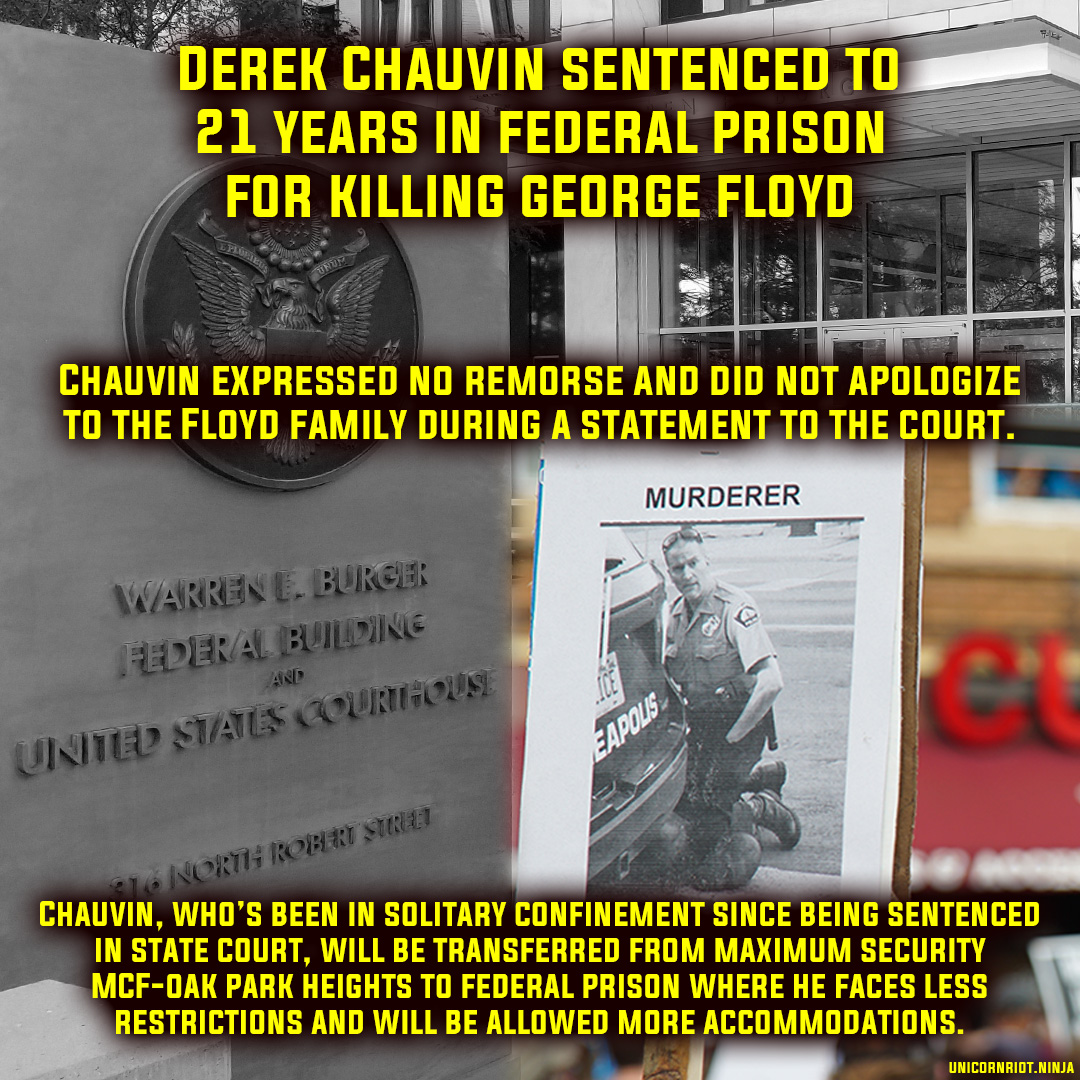
Derek Chauvin to be Moved to Federal Prison After Sentenced to 21 Years


https://unicornriot.ninja/2022/derek-chauvin-to-be-moved-to-federal-prison-after-sentenced-to-21-years/


By Niko Georgiades, Unicorn Riot July 7, 2022

Saint Paul, MN – Former Minneapolis Police officer Derek Chauvin was sentenced to 21 years in federal prison on Thursday, July 7, 2022, by U.S. District Judge Paul Magnuson. Chauvin, who had pleaded guilty to federal civil rights violations in December 2021, has been incarcerated in state prison since April 2021 after being convicted of murdering George Floyd. In June 2021, Chauvin was sentenced to 22.5 years in state prison, the longest prison sentence for a killing committed in the line of duty in Minnesota.

Chauvin’s federal sentence will give him four more years in prison due to more “good time” given in state prison (up to 120 days a year) than federal (up to 47 days a year). His anticipated release date from state prison was late 2035 whereas his anticipated release date from federal prison will be early 2039.

Although he’ll serve more time, his transfer to the federal prison system will result him in facing less restrictions while being granted more accommodations. Since incarcerated in state custody, Chauvin has been in solitary confinement and will likely be in general population when he’s situated into the federal system.

During a statement he made in court, Chauvin reportedly expressed no remorse and didn’t apologize to the Floyd family. Chauvin had an extensive history of violence against the community and is also facing multiple lawsuits from victims of his acts. Chauvin has also been ordered to pay a yet-to-be-determined amount of restitution to the family of George Floyd.

Three other former Minneapolis police officers were convicted in February on federal civil rights charges in Floyd’s killing. They are due to be sentenced on September 21.


German parliament condemns psychological torture of Julian Assange


https://www.youtube.com/watch?v=Y4M3Le-Ye0s 


The Feds Are Using Terrorism Charges Against Water Protectors


https://scheerpost.com/2022/07/07/the-feds-are-using-terrorism-charges-against-water-protectors/


July 7, 2022

6 Comments on The Feds Are Using Terrorism Charges Against Water Protectors
A federal court sentenced Jessica Reznicek to eight years in prison for taking nonviolent direct action to stop the Dakota Access Pipeline. Her story is a sign of Big Oil’s desperation, according to one of her lawyers, Bill Quigley.

Share this:


Print
Email
WhatsApp

Pax Ahimsa Gethen, CC BY-SA 4.0, via Wikimedia Commons

By Frances Madeson / The Real News Network

It takes a strong, steady hand and seven long minutes to burn a nickel-sized hole into the Dakota Access Pipeline (DAPL) with an oxy-acetylene welding torch. And yet, water protector Jessica Reznicek accomplished this feat on multiple occasions, up and down the pipeline, in Iowa and South Dakota during the spring of 2017. These punctures comprised just some of her deliberate acts of sabotage meant to delay DAPL’s completion and forestall the flow of oil under crucial, endangered Midwestern waterways. Drinking water for millions of North Americans has been put at risk by a pipeline that has still never received the proper permits and that, completely unrelated to Reznicek’s direct action efforts to disable the pipeline, leaked at least five times in the first six months of 2017.

For water protectors who live with the acute daily awareness that pipeline leaks are a known and common risk, a burning question persists: When will the masses of people move out of their comfort zones to protect clean drinking water and stand up for protectors like Reznicek who are fighting an asymmetrical battle against powerful oil oligarchs? When DAPL operator Energy Transfer spills a couple million gallons of thick black ooze (known as “drilling mud”) on a pristine wetland and is fined $40 million by the Federal Energy Regulation Commission, none of the corporate executives lose their liberty in a federal prison for a single day, though the environmental impacts of their reckless practices will linger for generations. Five years after taking action to prevent such long-lasting destruction, however, Jessica Reznicek is serving out an excessively long prison sentence. It takes a stout, steadfast constitution to contend with the consequences that Reznicek has faced for her nonviolent civil disobedience—consequences meted out by a federal judicial system that, to put it mildly, doesn’t always play or adjudicate fairly.


For water protectors who live with the acute daily awareness that pipeline leaks are a known and common risk, a burning question persists: When will the masses of people move out of their comfort zones to protect clean drinking water and stand up for protectors like Reznicek who are fighting an asymmetrical battle against powerful oil oligarchs?

Reznicek pled guilty to a single charge of “conspiracy to damage an energy facility,” but was nevertheless slapped with an absurdly onerous sentence: three years incarcerated, three years of federal supervision afterward, and an obligation to pay pipeline operator Energy Transfer $3.2 million in restitution. Thanks to a provision in the Patriot Act, however, things got worse for Reznicek. Southern District of Iowa Judge Rebecca Goodgame Ebinger was able to apply a “domestic terrorism enhancement” to her sentence, turning three years of prison into eight and branding Reznicek a terrorist for life. None of this seemed right or just, neither to herself nor to future protestors who would be saddled with a terrible legal precedent, so Reznicek appealed.

The appeal was denied.

On June 6, a three-judge panel in the 8th Circuit Court of Appeals issued an unsigned decision that reads like a one-two sucker punch. First, the decision failed to address the appeal’s main question: namely, did Judge Ebinger properly apply or misapply the “domestic terrorism enhancement”? Second, it upheld the 8-year sentence anyway.

The day after the decision was handed down, the Department of Homeland Security issued its latest warning about domestic terrorism, in which it noted that “The United States remains in a heightened threat environment” and that DHS expects said environment to become more “dynamic” between now and November. It would be reasonable to assume that most of these domestic terrorist threats will continue to come from the far right, yet DHS’s list of potential targets of domestic terrorist attacks notably specifies “critical infrastructure”—which includes fossil fuel pipelines—along with racial and religious minorities. The ink was not yet dry on the decision regarding Reznicek’s case before DHS was normalizing the supposed equivalency between puncturing a pipeline or disabling a bulldozer and mass shootings like the one carried out by white supremacist Payton Gendron at a Tops grocery store in Buffalo, New York, in May.

As an amicus brief filed by the Center for Constitutional Rights (CCR) in support of Reznicek’s appeal notes, there is murk around the various legal definitions of domestic terrorism and the safeguards guiding their use in the United States. But as the appellate brief made clear, simply damaging oil and gas infrastructure operated by a private corporation, while still a crime, is not an act of terrorism: “Reznicek’s offense did not qualify as a federal crime of terrorism because it was not calculated to influence or affect the conduct of government by intimidation or coercion, and was not retaliation against government conduct.” As anyone can hear in the oral arguments held on May 13, the judges sounded skeptical about whether Reznicek’s actions crossed the threshold, based on these criteria, to qualify them as acts of terrorism. Nevertheless, they opted to remain silent on the issue in their decision, letting Ebinger’s enhanced sentence stand.


Thanks to a provision in the Patriot Act, however, things got worse for Reznicek. Southern District of Iowa Judge Rebecca Goodgame Ebinger was able to apply a “domestic terrorism enhancement” to her sentence, turning three years of prison into eight and branding Reznicek a terrorist for life.

As the ACLU notes on their website, Section 802 of the USA Patriot Act defines domestic terrorism thusly:


“A person engages in domestic terrorism if they do an act ‘dangerous to human life’ that is a violation of the criminal laws of a state or the United States, if the act appears to be intended to: (i) intimidate or coerce a civilian population; (ii) influence the policy of a government by intimidation or coercion; or (iii) to affect the conduct of a government by mass destruction, assassination or kidnapping.”

Jessica Reznicek did damage private property and publicly accepted responsibility for her actions, but she took great care to make sure no human life was put at risk. There are plenty of laws stipulating punishments for damaging property, but damaging property on its own is not terrorism.

It’s worth noting that the United States would likely not have had the opportunity to prosecute Reznicek if she hadn’t come forward. She was never caught in the act, nor was she tied to the sabotage by skillful detective and forensics work carried out by any law enforcement agency or private security force: she’d eluded them all. But on July 24, 2017, she and Ruby Montoya, a fellow climate activist and member of the Catholic Worker Movement, alerted the public to their joint acts by holding a press conference and issuing a claim of responsibility. In it, they detailed what they did, how they did it, and explained what had moved them to step so boldly outside the bounds of the law:


We acted from our hearts and never threatened human life nor personal property. What we did do was fight a private corporation that has run rampantly across our country seizing land and polluting our nation’s water supply. You may not agree with our tactics, but you can clearly see the necessity of them in light of the broken federal government and the corporations they protect. We do not anticipate a fair trial…

They were right not to anticipate a fair trial. But Reznicek’s sentence goes beyond mere unfairness; it is a clear, heavy-handed attempt to discourage protestors from taking any action that could be construed, however obliquely, as terrorism. In general terms, Reznicek’s legal and support team view Ebinger’s harsh sentence and the ensuing aftermath as the bidding of an oil and gas industry that, until its dying breath, will resort to whatever measures it needs to to make sure nobody gets in their way. Since the initial sentencing, her legal team has been circulating a petition, which expresses a guiding sentiment: “What happens to Jessica, happens to all of us.” Now, members of that legal team are weighing their best options for making another attempt to overturn this dangerous precedent and obtain a more proportionate sentence. These options include: asking for a rehearing by the entire 8th Circuit, composed of 11 judges (not just the three who failed to clarify the law in their ruling); directing an appeal to the US Supreme Court; and/or seeking clemency from President Biden.


“We acted from our hearts and never threatened human life nor personal property. What we did do was fight a private corporation that has run rampantly across our country seizing land and polluting our nation’s water supply. You may not agree with our tactics, but you can clearly see the necessity of them in light of the broken federal government and the corporations they protect.”JESSICA REZNICEK AND RUBY MONTOYA, CLIMATE ACTIVISTS AND MEMBERS OF THE CATHOLIC WORKER MOVEMENT

Bill Quigley, renowned civil rights attorney and one of Reznicek’s lawyers, likens Reznicek’s acts to those of 19th-century abolitionists who broke the law to free slaves. Regardless of what the court does or says, Quigley believes history will honor her for her selfless courage. Though he takes his cues from his client, he is determined to fight this attempt by the state to curtail protest until there’s no more fight to be had. On behalf of The Real News, I spoke with Quigley about the high-stakes battle to disestablish this terrible legal precedent and to overturn Reznicek’s unjust prison sentence.

Quigley also represents water protectors who protested DAPL’s construction in Louisiana, the L’eau est la Vie Bayou Bridge defendants, all of whom were charged with felony trespassing under the state’s “critical infrastructure” bill passed in 2018. While Quigley succeeded in getting all charges dropped for the Louisiana defendants, the felonies hung over their heads for two years, which amounted to a punishment by process.

My talk with Quigley tracks events from the moment Judge Ebinger handed down her perturbing sentence last year to June 3, 2022, just three days before the most recent decision was handed down.

Frances Madeson: Bill, I shouldn’t be surprised. I was in the Bismarck, North Dakota, courtroom when #NoDAPL water protector Red Fawn Foster was sentenced to 57 months and remanded to Bureau of Prison custody. The FBI had sicced an informant on her, who’d seduced her into becoming lovers; it was his gun they’d found in her jacket. There is no low they won’t stoop to when it comes to #NoDAPL water protectors. It is bitterly anathema to think that a water protector’s name could be linked for posterity to this attack on protest.

Take us, please, behind the scenes—to the moment you were all sent down the “domestic terrorism” rabbit hole.

Bill Quigley: Honestly, it didn’t become real to me personally until the judge started talking about it at the sentencing. It had been something that was in the paperwork, we’d put some materials in the brief about why it wasn’t appropriate (one of many points in a long document), and the government had made a casual reference to it. But I never ever believed that Jessica’s actions constituted terrorism, and I never believed that any judge would think that her actions did. As the judge was seriously talking about it, I was really shocked and stunned, and extremely disappointed.

At one point, the judge actually did say that, in the regular course [of] this kind of case, the [sentencing] guidelines were somewhere around 36 to 40 months, which is about what we had hoped for. Not “hoped for,” but expected. We hoped for less than that, honestly. And when [the judge] talked about that, I thought, “That’s where we’re going”; but then she went on from there and I thought, “Really? You see this as an attempt to intimidate the government? Really, to intimidate the United States government?” [My reaction] was just unbelief.


“I never ever believed that Jessica’s actions constituted terrorism, and I never believed that any judge would think that her actions did. As the judge was seriously talking about it, I was really shocked and stunned, and extremely disappointed.”BILL QUIGLEY, CIVIL RIGHTS ATTORNEY AND ONE OF JESSICA REZNICEK’S LAWYERS

I was one of the two lawyers for Jessica in the courtroom at the time. There were quite a few people that had come to support her, and she was shocked, I was shocked, they were shocked. But then here was the thing: The judge was saying, “You qualify for terrorism, so I’m going to essentially double your sentence, but I’m also gonna let you stay out without a bond until you have to report to prison in another couple of months,” and it’s like… would you do that with a terrorist? You wouldn’t let a terrorist stay out on their own recognizance and report on their own volition to the prison. The disconnect between the word “terrorism” and the actions, and the treatment of her by the court, just didn’t add up.

Jessica had told the court that the plan was that they intended to stop the pipeline—there’s no doubt about it. They tried to stop the continued construction of the pipeline, property was damaged, and they were somewhat successful. But they went to great lengths to make sure that no person got hurt.

In the United States, for the last several years, there have been thousands of people arrested for nonviolent civil disobedience, and of those thousands, certainly dozens, if not hundreds, have actually done some damage to property. The idea that damage to property plus protest could equate to terrorism—it’s something that went like lightning through the entire protest community across the country.


“In the United States, for the last several years, there have been thousands of people arrested for nonviolent civil disobedience, and of those thousands, certainly dozens, if not hundreds, have actually done some damage to property. The idea that damage to property plus protest could equate to terrorism—it’s something that went like lightning through the entire protest community across the country.”BILL QUIGLEY, CIVIL RIGHTS ATTORNEY AND ONE OF JESSICA REZNICEK’S LAWYERS

People have advocated bring[ing] terrorism charges against Black Lives Matter protesters, against environmental protesters, anti-nuclear protesters, and the like. But to me that was always just hyperbole, and not something to be taken that seriously. But [Reznicek’s case] shows, I think, that we had underestimated the power of the United States government to try to crush any sort of civil disobedience, even if it was nonviolent.

Immediately upon leaving the courtroom we gathered in a circle outside the courthouse and talked about this. Jessica felt, and it was very clear at that point, that we were really going to work on this terrorism enhancement. If she had been given two or three years, I’m not sure if she even would’ve wanted to appeal, but with this idea of eight years, and the signal that it sends to other protesters around the country, she was very much open to appeal.

Frances Madeson: One of the outstanding aspects of your appeal was the collective strength and power of the four amici curiae briefs (friend of the court briefs) from the Climate Defense Project, the Center for Constitutional Rights, the Water Protector Legal Collective and National Lawyers Guild, and Catholic Social Action. How did that strategy evolve?

Bill Quigley: We started putting together a team of people to talk about the appeal. The team was me, the federal public defender, and a special person that was doing appeals for them, and we talked to lawyers and legal groups around the country. I started talking about the importance of its impact not just on Jessica, but all the other protesters, and that’s where the idea of the amicus briefs emerged.

It’s something that’s done very rarely. There are thousands of appeals, and most of the time it’s one person appealing one thing, or one corporation, but it’s pretty rare to get a large number of people and legal organizations to join in and talk about how important the case is. One of them, the Catholic lawyers’ brief—they reached out to us out of the blue and said, “We’re a bunch of Catholic lawyers in Kentucky and we think it’s important for the court to realize just how prominent this idea of respect for the Earth is in Catholic social teaching,’ and they wanted to do an amicus brief, and Jessica said yes.

Frances Madeson: Maybe it wasn’t the most polished of the four briefs, but in some ways I felt it was the most passionate. Perhaps because I read it on the day the revelations around the hidden graves at Indian boarding schools in the US came to light, but some of its verbiage seemed to gesture toward amends to Indigenous people for past harms the Church had caused them. I was also struck by how seriously it took the need to vigorously defend the Catholic Workers from an association with terrorism.


“People have advocated bring[ing] terrorism charges against Black Lives Matter protesters, against environmental protesters, anti-nuclear protesters, and the like. But to me that was always just hyperbole, and not something to be taken that seriously. But [Reznicek’s case] shows, I think, that we had underestimated the power of the United States government to try to crush any sort of civil disobedience, even if it was nonviolent.”BILL QUIGLEY, CIVIL RIGHTS ATTORNEY AND ONE OF JESSICA REZNICEK’S LAWYERS

Bill Quigley: There are legitimate concerns about terrorism, and terrorism is unfortunately a fact of life in our world these days. But the concept of terrorism is being badly abused in this case. I’m sure the people who originally inhabited the land before the English, French, and Spanish took it over considered what happened to them terrorism. It’s a concept that’s bandied about lately, and the court really runs the risk of diluting the concept if you just apply it to everyone you don’t agree with politically.

And CCR’s brief had other points in terms of international context, and we felt that all of the briefs [together] would help the court understand that this is just much more than an individual sentencing issue. Not everybody thinks or agrees that amicus briefs are helpful; some people think that in special criminal cases the best thing to do is keep quiet and focus on the technicalities and don’t try to show their ripple effects and that sort of thing. But Jessica very much wanted to respond to the concerns of her supporters, and to publicize these parts of it as well.

If she has to serve eight years in prison, she’s going to do that, and she’s going to do that as well as anybody can do it. She’s already spent a fair amount of time in there—in the summer it’ll be a year. But the hope is that the amicus briefs will educate the court and the public to the larger importance of this beyond the significance of how many years Jessica Reznicek spends in prison.

Frances Madeson: The courts being political institutions, were [the briefs also meant] to demonstrate a countervailing force to the fossil fuel industry?

Bill Quigley: Yes. Whenever you go for an appeal, the chances of winning are low. By the time you get to the court of appeals in the federal system, you have a less than 50-50 chance to win. The government gets the close calls. So [the briefs are partly] to show that this is not just a private pipeline corporation at issue, but the government is trying to do something that is very scary not just to Jessica Reznicek, but to lots of other people as well.


“There are legitimate concerns about terrorism, and terrorism is unfortunately a fact of life in our world these days. But the concept of terrorism is being badly abused in this case… It’s a concept that’s bandied about lately, and the court really runs the risk of diluting the concept if you just apply it to everyone you don’t agree with politically.”BILL QUIGLEY, CIVIL RIGHTS ATTORNEY AND ONE OF JESSICA REZNICEK’S LAWYERS

Frances Madeson: Like so many others, I follow her progress on Free Jessica Reznicek and on social media, but sometimes it can be hard to tell how she’s doing.

Bill Quigley: Jessica is a very gregarious person and a very positive person and she has made a lot of friends in prison. At the same time, prison is set up to harm the spirit, and the prison has been locked down with COVID—and she has had COVID. Lockdowns are particularly tough because you don’t get to go outside, you don’t get to do any sort of recreation.

She has made it very clear to me and others that she respects the way that her prison is operated, and its place in the Bureau of Prisons, and she’s doing everything she can. She’s enrolled in college courses, she has a job there (she’s helping to train animals to assist people with disabilities), and she is taking every opportunity to maximize the purposefulness of her time there.

She’s overwhelmed by the numbers of letters and cards that she’s getting, and she just literally cannot respond to everyone who is in touch with her. But she does appreciate it.

I think there is growing support for her across the country, but also internationally. There have been articles published in Germany and many other countries about what’s going on here, and she has been getting tons of support from people who are really concerned about the future of our planet. And not everybody is saying she shouldn’t have gone to prison; but what they are saying is that it is ridiculous to send somebody to prison for eight years for doing that stuff, and to label her a terrorist for doing it.

The other part about it that’s pretty unusual is the amount of support she’s getting from these Catholic sisters that are up there. She tries to be in contact with one of them as a spiritual advisor every week, and they exchange letters regularly. She is working really hard to try and keep her spirits up and make this time as productive as possible. But on occasion it’s overwhelming, hurtful, and depressing, especially over this last winter when it was really cold, dark, and they couldn’t go outside, and they were locked down, and they weren’t allowed to mix much inside the prison. That was really hard. Some long-time political prisoners have said that last winter was the hardest time they had ever spent in prison because of the isolation and the COVID.

Frances Madeson: How is she coping with being labeled a domestic terrorist?

Bill Quigley: Jessica was never charged with terrorism, she never pled guilty to terrorism, and now, after everything is all over, she’s being labeled a terrorist. It’s just in the terrain of Animal Farm; it doesn’t really make sense, but if people keep repeating it often enough…

I have noticed that people say she should pay a price for destroying property, and she’s going to pay a price. There are laws to punish people for destroying pipelines and property—she pled guilty to those. But she was never even charged with terrorism, and the idea that they come up with it at the 11th hour—it’s just very unfair, and it’s a real overkill by the government, and what I would call hyper- criminalization.

She was ready to take the consequences, she took the consequences, and then on top of it they add a whole other layer of consequences, which is just not fair and not logical. And it has a chilling effect [on] what other people understand about the limits of protest.


“Jessica is a very gregarious person and a very positive person and she has made a lot of friends in prison. At the same time, prison is set up to harm the spirit, and the prison has been locked down with COVID—and she has had COVID.”BILL QUIGLEY, CIVIL RIGHTS ATTORNEY AND ONE OF JESSICA REZNICEK’S LAWYERS

There is a conscious effort across the United States to hyper-criminalize people who interfere with pipelines because pipelines are so controversial right now. People are protesting them so broadly—from nuns, to Native Americans, to climate activists, to business people, elected officials—everybody. Because these are sort of the dying days of the pipeline industry, and they know it, and they’re trying to get as many pipelines in the ground in as many states as they can. They’re going to be stopped and they know that, so they’ve made a conscious effort to hyper-criminalize protesting them.

It’s a scary time for people who protest, and not everybody is going to sit down and figure out in advance what they are going to do and how they’re going to do it. But it’s clear that the government is really trying to clamp down hard on protesters who do anything other than stand with a sign on the sidewalk. Oil and gas and the government will do whatever they are allowed to do. They’re not gonna stop, they’re going to try and be more aggressive in other ways. If they can do this to [Jessica], and the court sanctions it, what does that mean for all the other people?

In order to stop them, we have to push back, and pushing back means taking public stances. It means working the legislature, fighting in the courts; it means lots of things.

The CCR brief was really important in showing the international context and where this stuff comes from, and [it] lays out why it’s important to not let the courts cheapen the idea of what terrorism actually is—and, especially, to not let the courts use it as a bludgeon against people who are doing nonviolent civil disobedience.

They would not have done this 20 years ago. If they get away with this [now], we really have to wonder: Where are they going to go next?


Frances MadesonFrances Madeson writes about liberation struggles and the arts that inspire them. She is the author of the comic political novel Cooperative Village. Follow her on Twitter @FrancesMadeson.


One year after a brutal crackdown, the struggle for democracy remains alive in Swaziland


https://peoplesdispatch.org/2022/07/04/one-year-after-a-brutal-crackdown-the-struggle-for-democracy-remains-alive-in-swaziland/


June 29 was observed as a day of commemoration in Swaziland to honor the dozens of people killed by the forces of King Mswati III during the unprecedented anti-monarchist uprising of 2021 

July 04, 2022 by Tanupriya Singh
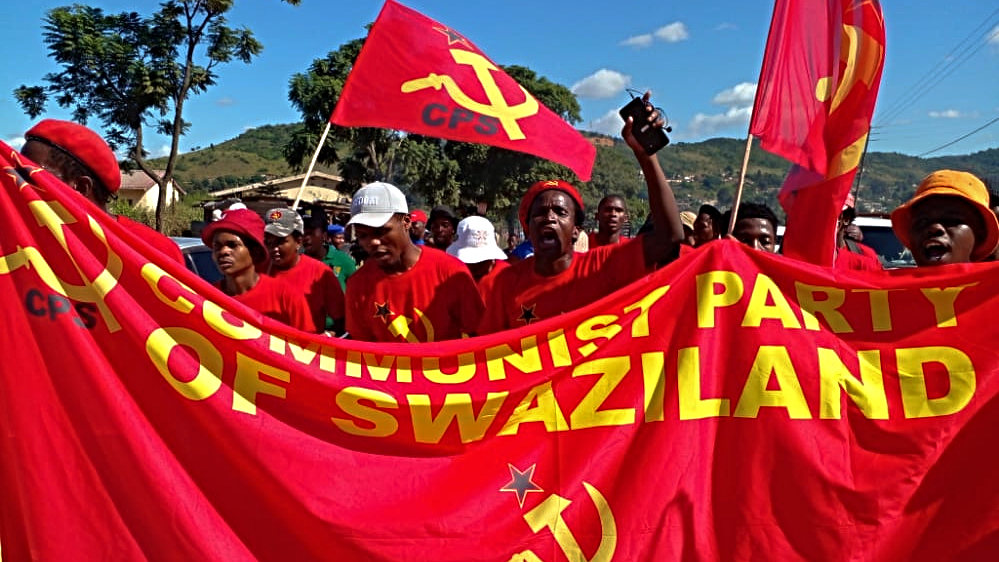
(Photo: Communist Party of Swaziland)

June 29 marked one year since the brutal crackdown on Swaziland’s anti-monarchist uprising in 2021. The day was observed as a commemoration of the June/July massacre, during which the armed forces of King Mswati III indiscriminately shot and killed dozens of protestors agitating for democracy in the African continent’s last absolute monarchy.

“[On Wednesday] we saw the people of Swaziland making sure that they commemorate, by celebrating the lives of our fallen soldiers, those who died for our struggle,” stated Simphiwe Dlamini, the National Organizing Secretary of the Communist Party of Swaziland (CPS). The CPS, which has been a leading force in the struggle for a democratic republic in the country, organized a series of actions including vigils. Public transport was shut down, with local news outlets reporting that businesses had also been shuttered in certain areas.


The People’s United Democratic Movement (PUDEMO) and the Multi-Stakeholder Forum (a platform of political parties, trade unions, civil society and other groups) had also issued a call for a public holiday on June 29 and urged businesses to remain closed, even as the government maintained that it was to be a regular working day.

Meanwhile, there was heavy deployment of police and military forces in the streets, especially in the capital city of Mbabane and in Manzini, the country’s economic hub which was one of major sites of unrest in 2021. Stop and search barricades were also set up on the highway connecting the two cities to prevent any planned protest actions.

While there were no reports of violence on Wednesday, the months leading up to the June 29 commemoration were marked by rising attacks against pro-democracy forces, particularly the CPS.

On June 28, hundreds of police officers descended on the Mbikwakhe area in Mastapha, where a majority of the party’s members who are students at the University of Swaziland and Gwamile VOCTIM reside. The operation was disguised as a community raid, however, only two houses, which happened to be rented by CPS members, were targeted. Importantly, the space had been used to coordinate the party’s work in the area.

Over the course of four hours, police ransacked the houses and seized seven laptops, cell phones, and even the students’ food parcels, clothes and personal belongings. Dlamini also stated that the roads leading to the area had been lined by police. However, party members and activists were able to successfully evade arrest.

The state forces were acting out of fear of the June 29 commemoration, Dlamini explained. “What we saw yesterday [June 29] is a regime in crisis. How so? – by wanting to continue to rule over a people who have declared that enough is enough. Mswati fled the country on June 29, fearing the revolution.” He was not alone, Dlamini added that the Prime Minister and the Deputy Prime Minister had reportedly also followed suit, “You can see the desperation, their fear of the people.”

Late on Wednesday night, Dlamini stated that people had set up barricades and burned tires in different parts of the country. “If they [the people] take out picket lines, the regime will respond by butchering them, so the people put up barricades”, he stated. “They are denied their right to picket [and protest] by the ruthless regime, so the people put up barricades because they are still wanting to defend themselves.”
Mswati must fall!: the 2021 uprising for democracy

In May 2021, protests broke out in Swaziland against the alleged police killing of a young law student, Thabani Nkomonye. After days of official inaction, the Swaziland National Union of Students (SNUS) organized the #JusticeforThabani campaign, mobilizing thousands of young people to demand an inquiry into the case. The police responded with tear gas and bullets.

In the face of this repression, the movement to demand justice for the slain student morphed into a massive wave of unrest across the country, demanding an end to the monarchy. Speaking to Peoples Dispatch at the time, Simphiwe stated that Thabani had become “the face” of the ongoing movement against the monarchy because his murder and the subsequent treatment of his family and the protestors was “typical of how the Mswati regime disregards the value of human life” in the country.

Longstanding anger over Mswati’s extravagant lifestyle, made possible by an iron-fisted control over the economy and the political system, in a country where 70% of the population was languishing in poverty, spilled over. Between May and June, people in over 40 constituencies marched to their Members of Parliament (MPs) and successfully delivered petitions raising their demands, including a push for democratization.

“The level of consciousness of the people at the time had gone up dramatically, but it was generally the demands that the people had been raising since the inception of the monarchy in 1973- that the country needs to return to a multi-party democracy, but also that the economy of the people needs to be used for the development of the people as a whole,” says Pius Vilakati, International Secretary of the CPS.

Swaziland was put under an absolute monarchy in April 1973, when King Mswati’s father Sobhuza II repealed the 1968 constitution, banned all political parties, and seized executive, legislative, and judicial powers.

During the protests, there were some sections which were demanding an election for the post of the Prime Minister. However, the CPS’s view was to demand a total unbanning of political parties in order for the country to move towards democracy. “Along those lines we were able to push the uprising to another level, where people did not want some cosmetic changes anymore, an election of the prime minister was not going to change the system. The CPS demanded a total overthrow of the tinkhundla system and the monarchy,” stated Vilakati.

The 2021 protests were unprecedented in their sheer scope, spreading even to the country’s rural areas. Vilakati argued that this was a crucial mark of the uprising – given that not only did a majority of Swaziland’s population live in those areas, but also that the control of the chiefs, who ruled on behalf of the king, was very strong there.

“The people no longer wanted the system of the chiefs’ rule, they wanted self-rule. The royal family relied on the rural areas for its propaganda that people were happy with the way things are. The fact is that people had been suppressed, gagged and muzzled, they had been victimized for standing up for themselves. But this time, people removed all the barriers, the regime was now only left with its military to defend itself now. This was also unprecedented,” he added.

The protests showed no signs of waning, even after King Mswati III imposed a ban on demonstrations on June 24. The next day, the military was deployed into the streets with a sanction to shoot-to-kill. The killings began on June 28 under a widespread internet blackout, amid reports that Mswati had fled the country. By the time things calmed down over the next few days, over 70 people had been killed and nearly 600 had been arrested, according to the CPS.

Despite the ever present threat of violence in the aftermath, the struggle for democratization remained alive in Swaziland. Sporadic protests gave way to the beginning of another wave of agitations and boycotts in September, led by students across schools and colleges to demand better quality education. Severe police repression pushed the unrest even further, with civil servants, public transport workers, teachers, and nurses also carrying out protests.

While they were raising distinct demands for better wages and working conditions, these struggles were united in their call for an end to the absolute monarchy. This was precisely because of the extent of control exercised by the King on the economy and its exploitation for the royal family’s private gains. There was a push for people to recognize that “democracy is not helpful in and of itself if you do not also own the economy,” Vilakati stated.
Building a grassroots democracy

Under Swaziland’s current political system, the King appoints the Prime Minister and the cabinet, the top jurists, two-thirds of the upper house of parliament, and 12% of the lower house. The remaining members of the legislature are chosen from constituencies, or tinkhundla, each of whom are divided into chiefdoms. Only those candidates who are approved by the chiefs are permitted to contest in the election. As such, the process of determining the tinkhundla MPs is by its very nature undemocratic, states the CPS.

Vilakati has argued that the tinkhundla elections are used by the Mswati regime to maintain its legitimacy in the international community, particularly in front of the South African Development Community (SADC). Just days after the killings of protestors in 2021, amid growing international scrutiny, the SADC met with the government of Swaziland on July 4. Two days prior, the delegation’s head, President Mokgweetsi Masisi of Botswana, issued a statement saying that at least one protestor had been killed. The major undercount caused outrage, given that the Political Parties Assembly which included PUDEMO had documented the killings of at least 43 people by then.

Masisi’s statement went further, saying that “disturbances” had resulted in a “widespread destruction of property and injuries to people.” She urged “all stakeholders to channel their grievances through the established national structure.”

“The role of the SADC, for all intents and purposes, was to help the regime stabilize. They could not even condemn the security forces, or have Mswati account for the deaths, injuries and arrests,” stated Vilakati. “They have not acknowledged our struggle as a just struggle of the people. But of course, what has been inspiring is we have received solidarity and support particularly from the unions, the Communist Party of South Africa, and a huge wave of grounded solidarity actions in the form of border blockades,” he added.

On June 30, South Africa’s National Education, Health and Allied Workers Union (NEWAHU) led a picket outside the Swazi High Commission in Pretoria to protest the “Mswati autocracy”.
Watch: Picket at the Swazi High Commission in Pretoria

Protestors also gathered outside the embassy of Zimbabwe for a solidarity demonstration, demanding an end to the persecution and brutalization of workers by the government.

The CPS has condemned the role of imperialists and international players in protecting the regime, including the US, European Union, India, and Taiwan. The party argues that international players have used their friendship with Mswati to exploit Swazi workers in factories, paying them wages that are not even sufficient for survival. (Swaziland happens to be the only country on the African continent which has diplomatic ties with Taiwan).

In this context, the CPS is focusing its efforts on the upcoming tinkhundla elections in 2023.“We need to unite and use our collective energy to render the country ungovernable. Among the things we need to do is to ensure that the regime is unable to even run its elections,” stated Vilakati. The CPS is gearing towards a Boycott and Disrupt campaign, its objectives being to weaken the tinkhundla system and to intensify the party’s own political and ideological struggle.

A key strategy has been the organization of “sunset rallies” which take place at night “to mobilize communities for the total dismantling of the tinkhundla system,” Vilakati explains. Their purpose is to “awaken the people, but also to be part and parcel with the people in the formation of Community Councils which would form a grassroots level democracy from where people can not only wage their struggle, but also defend themselves.” Dlamini also emphasized that the rallies were aimed at taking the struggle to the people, calling upon them to form local welfare and security councils to test how the people might govern themselves.

During one such sunset rally held in the Mahwalala community on June 26, 2022 the regime’s forces shot live bullets at CPS members and activists. It was the second such rally held that weekend, following one in the Msunduza township in Mbabane on June 25. CPS announced that its activists and the community were able to fight off the police, and that all people were safe and uninjured.


“We have put the tinkhundla regime on the defensive. Our goal now is to make this state permanent,” stated Dlamini. The CPS is mobilizing around key issues including the unbanning of all political parties, the release of political prisoners, and the safe return of political exiles including senior leaders of the CPS – its General Secretary, International Secretary, and Chairperson. Others are on the run, Dlamini said.

The party is also pushing to secure freedom of association, speech, and assembly. In terms of the economy, it has stressed that key industries must be owned by the people, and that properties and investments must be returned to them.

“Our struggle took a turn when the masses stood up and said that now it is us who will fight for our liberation. It was because of the questions that were raised through political schools focusing on the youth and the students. The students made a stand that they want liberation,” Dlamini stated. “The regime has responded by shutting down schools. As we speak [on June 30], the schools in the country have been shut down. And that is because the students have stood up and assumed their role in the revolution,” he added.

The student movement has been a key force of unity in the struggle for freedom, especially the SNUS, which has gone beyond just organizing students to also getting workers to come together and get involved. The union and its leadership have been repeatedly targeted and arrested on trumped-up charges. On June 28, SNUS members Bafanabakhe Sacolo and Siphosethu Mavimbela had their cases dismissed from the judicial roll.

The two had been charged for allegedly burning down a police post and holding police officers hostage in May 2021, the same day they attended the memorial service for Thabani Nkomonye. On Tuesday, the matter was removed from the Manzini Magistrate Court’s roll “until the Crown had put its house in order.”

The CPS is now urging workers to join the forefront of the struggle. Dlamini stated that the party understood that there was a role in the struggle for people across all sectors: “The people in the countryside, the peasants, have said that they cannot be ruled by the monarchy anymore. The urban poor living near towns have said ‘enough is enough’!”

He stressed that the commemoration on June 29 was to galvanize the people to continue the fight. “Our road to socialism is only through a democratic republic,” Dlamini said, and “We will continue organizing and fighting till Mswati surrenders and we are able to achieve democracy on our own terms.”


National strike in Panama continues amid heavy repression


https://peoplesdispatch.org/2022/07/05/national-strike-in-panama-continues-amid-heavy-repression/


Thousands of Panamanians have been on strike since July 1 to demand the government of Laurentino Cortizo take immediate action to address the country’s economic crisis July 05, 2022 by Peoples Dispatch
Workers participate in a road blockade to demand the government take immediate measures to address their demands. Photo: SUNTRACS

The people of Panama continue protests against the high cost of living and to demand government action to resolve the growing economic crisis. The protests began on July 1 to mark three years since the beginning of the government of right-wing president Laurentino Cortizo. Since then, workers, fisherfolk, students, educators, and civilians have braved heavy police repression, staging blockades of key roads and marching in major cities to make their demands to the government heard.

The mobilizations are organized by social movements and trade unions from across diverse sectors of Panamanian society that came together in the People United for Life Alliance including the National Front for the Defense of Economic and Social Rights (FRENADESO) and the Single Union of Construction Workers (SUNTRACS). During a meeting in May, the Alliance created a list of 32 demands “in light of the grave economic, political, and social situation the country is suffering under and the lack of response and attention of the authorities.”


“We want to send a clear message to the government that we are willing to fight for a better quality of life, for a better salary, down with the high fuel costs! Without struggle, there can be no victories”

The demands include freezing the price of fuel and basic commodities, a general increase in salaries and pensions, freezing the price of medicine and resolving the lack of supply, measures to combat corruption, repairing schools, roads, and public infrastructure, rejecting the four bilateral US-Panama military bases, policies to support the Indigenous communities and ensure the respect of their autonomy, among others.

In their letter to the national government, they highlighted that in response to the crisis that was made worse by the COVID-19 pandemic, there is consensus amongst international bodies such as the ILO and the UN, that governments should take measures that protect the rights of people and broaden the social safety net for the most vulnerable. However, they state, Panama has taken the opposite approach and has continued to be oriented towards the “recovery only of the rate of profit and the protection of capital”.

The Alliance had attempted to raise the list of demands to the national government on several occasions, but had been summarily told that the government could not address any of them. The closure of the doors of dialogue led the Alliance to call for national mobilizations beginning on July 1.

In a statement released by FRENADESO, they highlighted that the protests take place “amid a social crisis, provoked by neoliberal policies that got worse during the pandemic, such as the price of food, medicine, fuel, the increase in unemployment and informal employment, debt, corruption among other things.” They emphasize that “the Panamanian people have taken to the streets to demand effective solutions for the collective good…while the government of Cortizo continues to put the country in further debt, making Panama, according to Bloomberg, one of the most indebted of the continent.”

FRENADESO further denounced the arbitrary detentions of several leaders during the protests such as Ariel Rodríguez, a union leader from SUNTRACS, who on July 1 was arrested and put in jail in Chiriquí. Rodríguez was released later that day following protests and social media campaigns demanding the same.

Leaders from the Alliance will meet in the Meeting of Leaders on July 6 in Panama City to discuss their list of demands and the response of the government so far.