skip to main |
skip to sidebar
https://www.commondreams.org/news/2022/07/01/federal-abortion-ban-desired-gop-would-increase-maternal-deaths-24-study
"Pregnancy shouldn't kill people—in fact, in other rich countries it very rarely does," said the lead author of the new analysis.

Jake Johnson July 1, 2022
New research published Thursday by experts at the University of Colorado Boulder estimates that a nationwide abortion ban of the kind Republican lawmakers are intent on pursuing would increase maternal mortality in the United States by 24%.
Released just days after the U.S. Supreme Court ended the constitutional right to abortion—triggering total bans in a number of GOP-led states—the analysis uses newly available data from 2020 to show that the "increased exposure to the risks of pregnancy" caused by a federal abortion ban "would cause an increase of 210 maternal deaths per year (24% increase), from 861 to 1071."
"We know that the so-called 'pro-life' movement has nothing to do about saving lives, it's about control."
The researchers stress that their estimate, which has not been peer-reviewed, is conservative—it only takes into account the higher mortality risk of continuing pregnancy to term.
"We find that increases in some states would be as great as 29%, while in others, because of already extremely low abortion rates and numbers, less than one additional death would be expected," they note. "Banning abortion will likely change maternal mortality in ways beyond exposing more people to the existing risks of maternal death; any increase in maternal mortality due to these changes would be in addition to our estimates."
The U.S. already has the highest maternal mortality rate among rich nations. A recent study by the Commonwealth Fund found that "although most are preventable, maternal deaths have been increasing in the United States since 2000."
"In 2018, there were 17 maternal deaths for every 100,000 live births in the U.S.—a ratio more than double that of most other high-income countries," the study noted. "In contrast, the maternal mortality ratio was three per 100,000 or fewer in the Netherlands, Norway, and New Zealand."
Amanda Jean Stevenson, assistant professor of sociology at the University of Colorado Boulder and the lead author of the new analysis, told the Denver Post on Thursday that "pregnancy shouldn't kill people—in fact, in other rich countries it very rarely does."
"The arithmetic truth our findings reveal is simple: reducing abortions increases maternal deaths," Stevenson and her colleagues write. "The additional maternal deaths we estimate here could be avoided if we help people get wanted abortions, if we make pregnancy and birth safer—particularly for Black people—and, of course, if we do not ban abortion in the first place."
Survey data released both before and in the wake of the Supreme Court's decision in Dobbs v. Jackson Women's Health Organization indicates that a majority of U.S. voters would oppose a nationwide abortion ban.
But public sentiment doesn't appear to be deterring far-right groups and their anti-abortion allies in Congress. As the Washington Post reported in May, "Leading anti-abortion groups and their allies in Congress have been meeting behind the scenes to plan a national strategy" in anticipation of the Supreme Court's ruling.
"A group of Republican senators has discussed at multiple meetings the possibility of banning abortion at around six weeks, said Sen. James Lankford (Okla.), who was in attendance and said he would support the legislation," the Post reported. "Sen. Joni Ernst (R-Iowa) will introduce the legislation in the Senate, according to an antiabortion advocate with knowledge of the discussions who spoke on the condition of anonymity to discuss internal strategy."
Days after the Washington Post published its story, Senate Minority Leader Mitch McConnell (R-Ky.) signaled that the Republican Party could attempt to enact a federal abortion ban if it retakes Congress in November.
"We know that the so-called 'pro-life' movement has nothing to do about saving lives, it's about control," former Ohio state Sen. Nina Turner tweeted Thursday, citing the new University of Colorado Boulder research.
"There is no time to waste," Turner added. "The Senate must abolish the filibuster to codify Roe."
https://www.commondreams.org/news/2022/07/01/payoff-40-years-dark-money-supreme-court-delivers-corporate-america
"It was the conservative court's larger agenda to gut the regulatory state and decimate executive powers to protect Americans' health and safety," warned one expert.
Jake Johnson July 1, 2022
Over the past several decades, corporate lawyers, right-wing activists, Republican officials, and dark money groups with deep pockets have been laying the groundwork for a far-reaching legal assault on the federal government's ability to regulate U.S. industry—including the oil and gas sector threatening the planet.
On Thursday, their investments bore major fruit.
In a 6-3 decision along ideological lines, a Supreme Court packed with right-wing judges handpicked and boosted by some of the same forces leading the yearslong crusade against the power of regulatory agencies—which conservatives often dub the "administrative state"—dramatically restricted the Environmental Protection Agency's authority to rein in greenhouse gas pollution from power plants.
"The court deals yet another blow to the ability of the United States to democratically govern in the face of severe public policy crises."
On its face, the ruling in West Virginia v. EPA appears limited in scope, pertaining to a specific section of the 1970 Clean Air Act and zeroing in on the reach of a single government agency.
But experts saw in the decision, authored by Chief Justice John Roberts, an ominous warning that the Supreme Court is ramping up its assault on the federal government's capacity to act on matters ranging from environmental protection to workplace safety to public health to consumer protection.
Lawrence Gostin, a professor at Georgetown Law, argued that the high court's right-wing majority wasn't really concerned with the Clean Power Plan, an Obama-era zombie regulation at the center of West Virginia that never even took effect.
"It was the conservative court's larger agenda to gut the regulatory state and decimate executive powers to protect Americans' health and safety," wrote Gostin, who contended that "the ripple effects of West Virginia v. EPA are profound" and could hinder other key federal agencies such as the Centers for Disease Control and Prevention, the Food and Drug Administration, and the Occupational Safety and Health Administration.
"Congress doesn't have a magic crystal ball that can predict every future health hazard," Gostin added. "Nor does Congress have the expertise. That's why Congress has delegated wide powers to health and safety agencies. They have the expertise and flexibility to safeguard the public from major threats."
William Boyd, an environmental law professor at the University of California Los Angeles, agreed with Gostin's analysis, telling Vox that he believes the West Virginia ruling "can be seen as part of a larger trend directed at restricting the ability of EPA and other agencies to protect health, safety, and the environment."
"This starts at the top with the Supreme Court," he noted, "but it will ripple through the federal judiciary as decisions accumulate and the jurisprudence that has taken over the last half-century to accommodate the regulatory state is diminished and hollowed out."
The West Virginia ruling was a long time in the making, the product of coordinated efforts by GOP attorneys general, the fossil fuel industry, and shadowy organizations such as the Federalist Society.
For years, the industry-backed legal group has been building up a pipeline of far-right judges that Republican politicians have dutifully attached to the nation's judiciary, pumping young, often under-qualified, and business-friendly judges into district courts, appeals courts, and the highest court in the land. (All six sitting conservative Supreme Court justices have ties to the Federalist Society.)
Among the organization's donors is Koch Industries, the multinational oil and gas behemoth whose current billionaire leader, Charles Koch, and his late brother David have financed a vast apparatus of think tanks and advocacy organizations that've grown so influential that they frequently write entire laws for GOP legislatures to rubber stamp.
As The Lever's Andrew Perez reported earlier this year, groups linked to the Koch network took a serious interest in the West Virginia case, which was led by a group of Republican attorneys general and major coal companies. The Supreme Court agreed to take up the case last October.
"Koch's Americans for Prosperity Foundation filed an amicus brief in the case arguing that the EPA should not be permitted to 'impose its will on the nation through regulatory diktat,'" Perez observed. "Several more Koch-funded dark money groups have filed similar amicus briefs in the case. That includes the Cato Institute, the New Civil Liberties Alliance, the Competitive Enterprise Institute, and the Mountain States Legal Foundation."
"The New Civil Liberties Alliance also received $1 million from the 85 Fund, a charitable foundation steered by Trump judicial adviser Leonard Leo," Perez added. "A longtime executive at the Federalist Society, a conservative lawyers group, Leo also helps direct the Judicial Crisis Network, a dark money group that spent tens of millions leading the confirmation campaigns for Gorsuch, Kavanaugh, and Barrett."
As Jane Mayer, the award-winning investigative journalist and author of Dark Money: The Hidden History of the Billionaires Behind the Rise of the Radical Right, put it Thursday, the West Virginia decision is "payoff for 40 years of dark money from some of the planet's biggest polluters."
"And we're not done," he added. "My office will continue to fight for the rights of West Virginians when those in Washington try to go too far in asserting broad powers without the people’s support."
Senate Minority Leader Mitch McConnell (R-Ky.), who is hoping to take back the upper chamber's gavel in the upcoming midterms, hailed the majority's opinion and warned "other overeager bureaucrats" to "take notice."
In the decision itself, the court's conservatives defined West Virginia v. EPA as a "major questions case," invoking an obscure and novel legal doctrine that insists federal agencies must have explicit and specific congressional authorization to act on matters deemed politically or economically significant.
"The court embraced the doctrine in a full-blown way, making clear that it views a wide range of agency protections as potential targets for abolition."
As Bloomberg's Noah Feldman explains, "the major questions doctrine appears to take a very large bite out of" the so-called Chevron doctrine, which states that "the courts must defer to agencies' reasonable interpretation of laws passed by Congress."
The implications of the major questions doctrine's emergence as a guiding principle for the court are vast. In her dissent in West Virginia, liberal Justice Elena Kagan observed that "the court has never even used the term 'major questions doctrine' before."
"Let's say the obvious: The stakes here are high," Kagan wrote. "Yet the court today prevents congressionally authorized agency action to curb power plants' carbon dioxide emissions. The court appoints itself—instead of Congress or the expert agency—the decisionmaker on climate policy. I cannot think of many things more frightening."
Jenny Breen, associate professor at the Syracuse University College of Law, similarly argued in an email to Common Dreams that the court's West Virginia ruling "relies on judicial overreaching to undermine public policy and the legitimacy of government more broadly."
"The majority did not like the agency's approach to regulating power plants," Breen wrote. "But only in this new universe of governance-by-judicial-fiat should any of us care what John Roberts thinks is the best approach to regulating power plants. Congress gave that job to the EPA, not the Supreme Court."
"In taking that decision for itself," Breen added, "the court deals yet another blow to the ability of the United States to democratically govern in the face of severe public policy crises."
While the conservative-dominated court may not have overtly wielded the major questions doctrine against the federal government's regulatory powers in previous cases, Mekela Panditharatne and Martha Kinsella of the Brennan Center for Justice note that it has "obliquely" relied on the doctrine to "strike down the Centers for Disease Control and Prevention's eviction moratorium and block the Occupational Health and Safety Administration's mandate that large employers ensure their workers are vaccinated or frequently tested for Covid-19."
"In Thursday's case, the court embraced the doctrine in a full-blown way, making clear that it views a wide range of agency protections as potential targets for abolition," they warned. "By gutting regulatory agencies' ability to use existing statutory authority to respond to contemporary societal needs, the court places the onus on Congress to amend countless laws to expressly authorize agencies to 'make decisions of vast economic and political significance,' whatever that means."
"The suggestion that Congress just needs to pass more explicit instructions to agencies in order for the government to perform core functions is easier said than done," Panditharatne and a Kinsella added. "For his part, Justice Gorsuch in concurrence, alarmingly, raises the specter that agency action without express congressional authorization could be deemed to violate the Constitution, a position the dissent vehemently rejects."
The institutional obstacles for Congress to step into the void created by the court's ruling are enormous, including but not limited to the Senate's 60-vote legislative filibuster. Corporate-friendly Democrats and the Republican Party—made up of industry-funded lawmakers wedded to mass deregulation—are also sure to stonewall any congressional attempts to make regulatory agencies' statutory authority to fight the climate emergency and other crises more explicit.
The ultimate result, observers fear, could be the sweeping defanging of the federal government that corporate America and the conservative movement have sought for decades.
"These politicians in black robes know full well that, with Mitch McConnell in a leadership position doing the bidding of Koch and the oil and gas industry, this Congress will not pass any substantial climate change mitigation legislation," Lisa Graves, the executive director of True North Research, told The Intercept.
In a series of tweets on Thursday, the Green New Deal Network asked Americans to "imagine a future where the USDA can't regulate what chemicals are in your food."
"Imagine a reality where the FDIC can't protect your money from greedy bankers and investors. And imagine a world where the FDA can't prevent pharmacies from stocking up with literal poisons," the group added. "This is the endgame."
https://www.commondreams.org/news/2022/07/01/naomi-klein-us-midst-shock-and-awe-judicial-coup
"The rolling judicial coup coming from this court is by no means over," warned the author of "The Shock Doctrine."
Jake Johnson July 1, 2022
Renowned environmentalist and author Naomi Klein argued Thursday that over the past week, the United States experienced the early stages of a "rolling judicial coup" as the Supreme Court took a sledgehammer to abortion rights, gun control laws, and the federal government's authority to tackle greenhouse gas emissions that are fueling the global climate emergency.
"We have witnessed a shock-and-awe judicial coup," Klein wrote in a column for The Intercept, pointing also to the right-wing high court's decisions to weaken Indigenous sovereignty and further undermine the separation of church and state.
"Biden and the Democrats are currently careening toward a wave of defeats. But it's not too late to get back on track."
"And now this: a decision that eviscerates the Environmental Protection Agency's power to regulate a major source of the carbon emissions destabilizing our planet," wrote Klein, who for years has explored the ways in which reactionary political forces and corporations have taken advantage of crises to impose their will—a method she has dubbed "The Shock Doctrine."
West Virginia v. EPA marks a seismic win for such forces, which have spent decades coordinating and taking legal action against the federal government's regulatory authority, particularly when it comes to challenging the ability of corporations to pollute and degrade the environment as they please.
"The rolling judicial coup coming from this court is by no means over," Klein warned Thursday. "Next term, the Supreme Court will hear a redistricting case that could well make it far easier to concoct a legal pretense for overriding the popular vote in elections in favor of state-appointed electors—the very thing that Donald Trump attempted but failed to do, because enough people were afraid of ending up in jail."
"There is no reason to believe that a group of people whose very presence on the bench required grotesque abuses of democracy would somehow draw the line at thwarting it," she added. "The moment to stop them from getting the chance is right now."
Klein argued that to combat the right-wing justices' sweeping attacks on basic freedoms and the climate, President Joe Biden and the narrowly Democratic Congress must "challenge the underlying legitimacy of the U.S. Supreme Court and advance an aggressive climate action agenda."
"History contains crossroads when a single set of decisions can alter the trajectory of a people—or even a planet," Klein continued. "The Biden administration's response to the Supreme Court's 6-3 EPA ruling, hot on the heels of the other outrageous power grabs, is a moment like that."
In the wake of the court's decision Thursday, climate groups and progressive lawmakers made clear that Biden and Congress have at their disposal numerous executive and legislative tools to rein in fossil fuel use, slash planet-warming emissions, and bolster renewable energy production. Whether they opt to use them is a matter of political will.
"Biden and the Democrats are currently careening toward a wave of defeats," Klein wrote. "But it's not too late to get back on track. They have just been handed a winning platform: Use the Supreme Court's attack on urgent carbon control as a catalyst to build a more meaningful democracy and take transformational climate action at the same time. If they decide to run with it, everybody on this planet wins. If they refuse, they deserve every loss coming their way."
https://www.wsws.org/en/articles/2022/07/02/pers-j02.html
Andre Damon
@Andre__Damon
1 July 2022
This week, the United States and its NATO allies pledged to increase their troop presence in Europe seven-fold in order to prepare for what they called “warfighting against nuclear-armed peer-competitors”–that is, war against Russia and China.
The NATO members declared that they would increase their “high readiness forces” from 40,000 to 300,000. Biden announced the US would send another 20,000 troops to Europe amid the escalating war with Russia, accompanied by the permanent deployment of guided missile destroyers and F-35 aircraft.
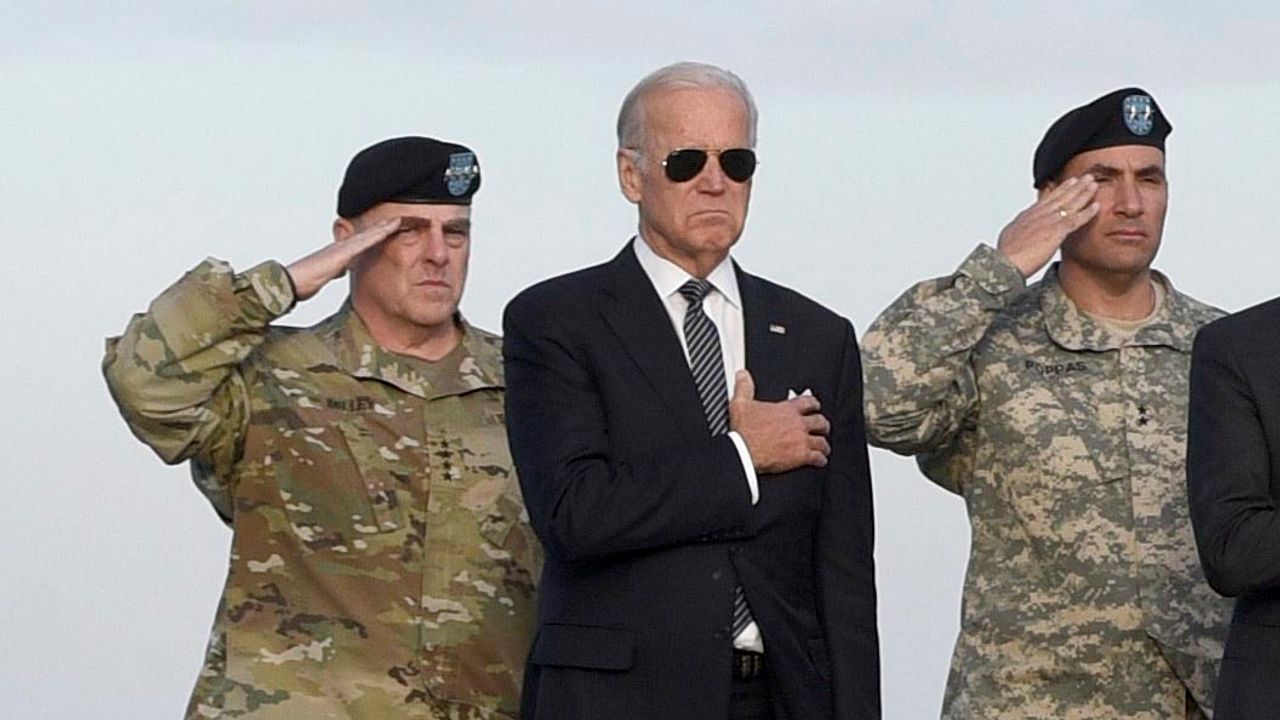 Biden, flanked by Gen. Andrew Poppas and Gen. Mark Milley, in 2016. (AP Photo/Steve Ruark)
The US, which spends more on its armed forces than the next 10 largest militaries combined, has increased its military spending for six years in a row. Biden’s military budget for 2023, already the largest on record, was boosted another 6 percent by a vote in the Senate Armed Services Committee, bringing the total to $858 billion.
Since the start of the Biden administration, the US has pledged over $50 billion in military and economic aid to Ukraine. Ukrainian President Zelensky stated that the country needs at least $60 billion a year in aid to continue its war effort, a figure equivalent to nearly half of Ukraine’s pre-war economic output.
Last year, when Biden announced the US withdrawal from Afghanistan, he said, “We’ve been a nation too long at war. If you’re 20 years old today, you have never known an America at peace.” He declared, “It’s time to end the forever war.”
Now Biden is committing the American population to a new perpetual war, asserting that there are no limits to the resources that must be devoted to it.
Asked Thursday at a news conference at the NATO Summit in Madrid to “explain what that means to the American people” and whether he was pledging “indefinite support from the United States for Ukraine,” Biden said “We are going to support Ukraine as long as it takes.”
Another reporter asked about the “high price of gasoline in the United States and around the world,” inquiring, “How long is it fair to expect American drivers and drivers around the world to pay that premium for this war?”
Biden reiterated, “As long as it takes.”
No one thought to ask Biden an obvious question: How long will “it” take? What will be the cost of this open-ended war, and what will be the consequences?
The United States is spearheading a global conflict that threatens the lives of millions of people and, if it develops into a nuclear exchange, the fate of humanity itself.
Can anyone imagine, moreover, that a war against Russia, the aim of which is to overthrow the government of the world’s largest country, coupled with a war against China, the world’s second-largest economy, can be achieved without totally impoverishing the American population?
The social and economic consequences of the militarization of society pledged by the US and its allies at the NATO summit are incalculable. In every country, government spending on public health and social infrastructure is to be gutted to free up resources for the war effort.
The costs of the war are to be imposed onto the working class through the dismantling of social programs and the demand that workers accept a reduction in real wages in the name of the “national interest.”
The eruption of the war has been accompanied by the total abandonment of any efforts to stop the spread of COVID-19. According to US government estimates, there will be 100 million new cases of COVID-19 this fall, more than the number of all COVID-19 cases previously reported to date. And Congress has refused to pass any additional pandemic funding, meaning that uninsured people will be forced to pay for COVID-19 vaccines, testing and treatments out of pocket.
This week, New York City announced that it is slashing public school funding by $215 million in what is expected to be a surge in austerity measures around the country.
Already, the war has fueled demands for slashing “entitlement” spending. “NATO Needs More Guns and Less Butter,” Glenn Hubbard, the former chair of the Council of Economic Advisers, wrote in an op-ed in the Wall Street Journal earlier this year, demanding cuts in spending on Social Security, Medicare and Medicaid. “Spending offsets to accommodate higher defense spending would surely require slowing the growth in social insurance spending,” he wrote.
While out-of-control military spending against the backdrop of decades of Wall Street bailouts has contributed to the inflationary crisis, the US political establishment is seeking to impose the full burden of the crisis on the working class. The Federal Reserve has initiated a program of seeking to deliberately increase unemployment by raising interest rates, hoping to restore “balance” to the labor market by throwing hundreds of thousands of people out of work.
The intensification of the war will take place against a tidal wave of layoffs, beginning in the technology and real estate sector and spreading through the auto industry. According to one tracker, there were 26,000 layoffs in the technology sector alone last month, up from 20,000 the month before.
The global war being initiated by the Biden administration is at one and the same time a war against the working class of the United States. Through war, the US ruling class is seeking to at once divert internal tensions outward through the creation of an external enemy and build up the forces of repression to crush strikes and social struggles.
Biden’s commitment to unlimited American involvement in the war with Russia enjoys the support of the entire US political establishment. The outcome of the NATO summit was hailed by the editorial boards of the major US newspapers, from the Democratic-aligned New York Times and Washington Post to the Republican-aligned Wall Street Journal.
“Whatever else happens in President Biden’s tenure, and no matter how long that tenure lasts, the events this week in Europe will ensure that his presidency is a consequential one,” the Post proclaimed.
Not a single Democratic member of Congress has criticized Biden’s pledge of endless resources for the war effort.
Despite the unending barrage of propaganda aimed at exciting public hated of Russia and China, the war in Ukraine is broadly unpopular. In a YouGov poll published this week, 40 percent of respondents said the US should be “less militarily engaged in conflicts around the world,” compared with 12 percent who said it should be more engaged.
Asked what Biden’s top priority should be, 38 percent said the White House should seek to address the surging cost of living, compared with 8 percent who said the US should “ensure a defeat of Russia in Ukraine.”
Forty-six percent of respondents said they “oppose the United States military becoming directly involved in combat in the Russia-Ukraine war,” compared to just 23 percent who support such a move.
The American population has not forgotten the crimes carried out by American imperialism against the people of Iraq, Afghanistan, Libya, Syria, Yemen and dozens of other countries subjected to US destabilization campaigns, proxy wars and murderous economic sanctions.
There does not, outside of the International Committee of the Fourth International, exist any organized political opposition to the war plans of US imperialism. The social basis for the building of a new anti-war movement is the working class. Just as imperialist war abroad is at the same time a war on the working class at home, so too the fight against war is at the same time a fight of the working class against inequality, exploitation and the capitalist profit system.
https://www.afsc.org/newsroom/general-mills-divests-israel-following-campaign-led-quaker-organization
Jun 1, 2022

Photo: Pittsburgh BDS coalition
Oakland, CA (June 7, 2022) Following a two-year campaign calling on General Mills to stop making Pillsbury products on stolen Palestinian land, the company announced yesterday that it had divested its Israeli business altogether.
According to its announcement, General Mills divested its 60 percent stake in its Israeli subsidiary and sold it to Bodan Holdings, which until now only held the other 40 percent. After this divestment, General Mills’ operations in Israel are fully owned by Bodan Holdings, whose owners are Israeli businesspeople Danny Nagel and Boaz Raam.
The American Friends Service Committee (AFSC) – a Quaker organization that has worked for decades to promote a world free of violence, inequality, and oppression – launched the No Dough for the Occupation campaign to boycott Pillsbury products two years ago. The campaign was endorsed by members of the Pillsbury family and included the Palestinian Boycott National Committee, Jewish Voice for Peace, American Muslims for Palestine, SumOfUs, Women Against Military Madness, and many other local groups.
This campaign targeted General Mills because it manufactured Pillsbury products in the Atarot Industrial Zone, an illegal Israeli settlement in the occupied West Bank. In 2020, the United Nations included General Mills in its database of companies doing business in illegal Israeli settlements in the occupied Palestinian territory. The company’s announcements indicate that following this divestment, General Mills does not source products from the settlement factory.
“General Mills’ divestment shows that public pressure works even on the largest of corporations,” said Noam Perry of AFSC’s Economic Activism program. “With this move, General Mills is joining many other American and European companies that have divested from Israel’s illegal occupation, including Microsoft and Unilever just in the last couple of years. We call on all companies to divest from Israel’s illegal and brutal occupation of Palestine, and from the apartheid system it is part of. We congratulate General Mills on this decision and hope this is the first step in cutting all its ties to Israeli apartheid.”
You can read more about the No Dough for the Occupation campaign here.
###
The American Friends Service Committee (AFSC) promotes a world free of violence, inequality, and oppression. Guided by the Quaker belief in the divine light within each person, we nurture the seeds of change and the respect for human life to fundamentally transform our societies and institutions.
https://electronicintifada.net/content/end-unrwa/35786
Is this the end of UNRWA?
Dalal Yassine The Electronic Intifada 30 June 2022 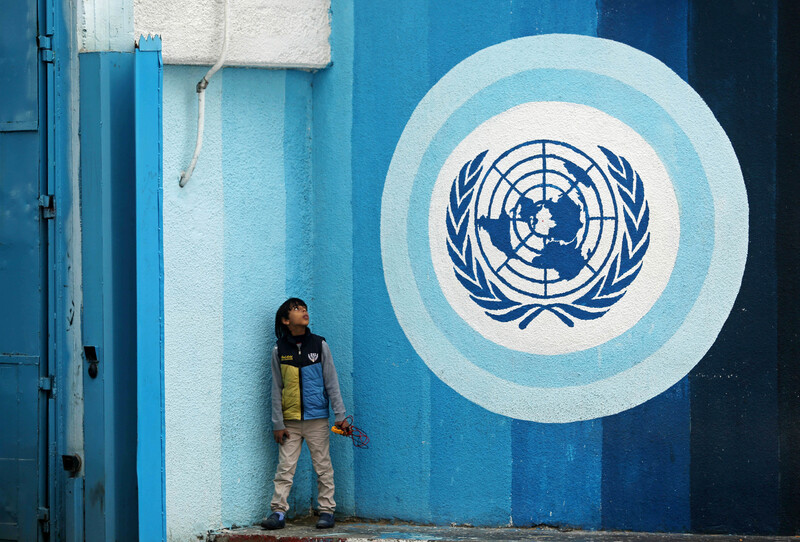
Analysts worry that UNRWA’s perpetual cash crunch signals the beginning of the end for the agency. Ashraf Amra APA images
In his April 2022 message to Palestinian refugees, Philippe Lazzarini, commissioner-general of UNRWA, the UN agency for Palestine refugees, said the agency is “cash-strapped” and that it has become “almost customary” for the person in his position to “beg for help if we want the services to continue.”
Throughout the message, he emphasized the “chronic underfunding” of UNRWA only to note that the agency is exploring how to “maximize partnerships within the broader UN system.”
This cryptic statement – what does it mean, exactly, if UNRWA were to maximize partnerships within the broader UN system? – has raised concerns among Palestinians that UNRWA will be disbanded – its services dispersed among other UN agencies or nongovernmental organizations.
UNRWA was established in December 1949 to provide relief to Palestine refugees created by the Nakba, or the forcible expulsion of Palestinians from their homeland to create the state of Israel.
Today, some 5 million refugees are “eligible,” according to UNRWA, to receive its social services, education and health care. However, the agency has been forced to steadily reduce those services due to lack of funds.
Yet Lazzarini said in his April message that “such partnerships” – as in, those “within the broader UN system” – “have the potential to protect essential services and your rights from chronic underfunding.”
Without UNRWA’s services, Palestine refugees in Syria, Lebanon and Gaza face a potential (or, in some cases, even more dire) humanitarian crisis.
In Syria, 82 percent of Palestine refugees live on less than $1.90 a day. In Lebanon, 86 percent of Palestine refugees live below the poverty line. Meanwhile, Palestinians in Gaza have been under siege and persistent attacks by Israel for almost two decades. UNRWA reports that 1.2 million Palestinians in Gaza need food assistance.
Although Palestinian refugees’ right of return is enshrined in international law, Palestinians fear that their rights will be further diminished without a UN agency to provide basic services.
Disappearing donors
UNRWA’s mandate, which is renewed every three years by the UN General Assembly, includes a commitment to assist and protect Palestine refugees until a “just resolution” to the Palestine refugee “question” is reached.
In December 2019, the General Assembly extended UNRWA’s mandate until June 2023. The measure was passed with overwhelming support despite the lone objections of the United States and Israel.
As UNRWA prepares for a new General Assembly vote at the end of 2022 to renew its mandate, the agency faces a financial deficit of roughly $100 million.
This is not a new dilemma for UNRWA.
Donor pledges to UNRWA totaled approximately $412 million in 2022, a drastic decrease from years prior, such as in 2018, when pledges to UNRWA totaled $1.3 billion – and that was despite the Donald Trump administration’s elimination of approximately $300 million of its anticipated contributions to UNRWA that year.
While Arab states have typically provided a quarter of UNRWA’s budget, those contributions have also declined, with Arab donations falling to less than 3 percent of UNRWA’s budget in 2022.
This decline in Arab funding appears to be a consequence of several Arab states – the United Arab Emirates, Morocco, Bahrain and Sudan – signing the so-called Abraham Accords in 2020 and thus “establishing diplomatic relations” with Israel.
In 2018, the United Arab Emirates contributed nearly $54 million, helping to allay UNRWA’s budget deficit after Washington cut off funding. The following year, its contributions decreased to $51.8 million. However, the UAE only donated $1 million in 2020, the year the accords with Israel were signed. Last year, it did not offer any financial support.
It also reflects how, for decades, Israel and its supporters in the United States have targeted UNRWA.
Former Israeli Prime Minister Benjamin Netanyahu previously called for UNRWA to be dismantled because it “perpetuates the Palestinian refugee problem.”
The Trump administration adopted similar rhetoric and sought to change the definition of a Palestinian refugee.
At the beginning of the 2021-22 academic school year, the European Parliament blocked 20 million euros in aid to UNRWA, demanding changes be made to textbooks used in UNRWA schools for assistance to resume.
Although the Joe Biden administration resumed US contributions to UNRWA, it has set conditions on the funding.
Last year, the United States signed a “framework for cooperation” with the agency that linked funding to a number of issues related to the identity and national rights of the Palestinian people.
Services will not be “outsourced”
UNRWA claims that the partnerships referenced by Lazzarini are neither new nor will they replace the agency.
In a 5 June email interview, Hoda Samra, UNRWA’s senior media and communications adviser in the Lebanon field office, said that “partnerships” were a reference to “partnerships between UNRWA and other UN agencies/funds/programmes.”
The partnerships “have been a part of operations since UNRWA was first established,” she said, adding that “UNRWA will engage with key stakeholders (UN agencies, hosts, donors) during the coming months to discuss the partnerships option, and [it] expects to reach a collective agreement on the way forward within 2022.”
Samra said: “The idea of expanding partnerships is still at an early stage, with initial consultations taking place between the UNRWA commissioner-general and his senior counterparts within the UN system.”
Yet outside observers are concerned that UNRWA’s weak financial state and lack of political support will only worsen in time.
Palestinian author and historian Salman Abu Sitta told the author by email at the beginning of June that the United States and Israel are “trying to eliminate UNRWA altogether by transferring its activities to other agencies.”
“This means that Palestinians will not have a right of return and they can only seek food and shelter elsewhere, away from their homeland,” he added.
UNRWA’s Samra dismissed the notion that the agencies’ services will be “taken over” or “outsourced.”
“Any service-delivery to Palestine refugees that falls under the UNRWA mandate is also under its responsibility,” she said.
Samra emphasized that support from UN partners will be “on behalf of UNRWA and not in replacement of it.”
Dalal Yassine is a non-resident fellow at the Jerusalem Fund/Palestine Center in Washington, D.C. Twitter: @Dalal_yassine. The views in this article are those of the author and do not necessarily reflect those of the Jerusalem Fund and Palestine Center.
https://electronicintifada.net/blogs/omar-karmi/israeli-impunity-intact-despite-abu-akleh-killing
Omar Karmi Rights and Accountability 30 June 2022 
A memorial event for Shireen Abu Akleh on 19 June. Ahmed Ibrahim APA images
A memorial service for Shireen Abu Akleh in London this week provided yet another reminder that despite a large and growing body of evidence regarding Israel’s culpability for the Al Jazeera correspondent’s death, no one has yet been held accountable.
The service was held at the St Bride’s Church in Fleet Street. Due to its location, on a central London road traditionally home to the UK’s print media, the church has long been associated with journalists.
The service followed a separate memorial event in the occupied West Bank on 19 June, 40 days after her slaying.
In between, the United Nations became the latest body to conclude that Abu Akleh, a veteran Palestinian American journalist, was killed by Israeli gunfire.
On 24 June, the UN’s Office for the High Commissioner for Human Rights announced that “all information we have gathered – including official information from the Israeli military and the Palestinian attorney-general – is consistent with the finding that the shots that killed Abu Akleh and injured her colleague Ali Samoudi came from Israeli security forces.”
That statement also described it as “deeply disturbing” that Israel had not yet conducted a criminal investigation into Abu Akleh’s killing.
Israel has ruled out a criminal investigation. Its authorities have decided that the killing was a “combat event.”
In the US, 24 senators have called for the US to take an active role in that investigation, but so far, the US State Department has rejected such calls and maintains that Israel can conduct its own probe.
Israel’s flimsy narrative
Such faith in Israeli due process is puzzling.
On 20 May, Yesh Din, an Israeli rights group, published data it had collected on Israel’s military law enforcement system.
The findings were damning: Only 2 percent of complaints received in 2019-2020 resulted in prosecution.
Of the investigations opened, only 7.2 percent resulted in indictment in what the group said amounted to a system designed to “grant soldiers near total immunity from prosecution.”
Israel initially denied that any of its soldiers had fired the shot that killed Abu Akleh, blaming instead Palestinian fighters and “crossfire.”
But that story soon looked flimsy and has only gotten flimsier as a number of organizations began picking holes in Israel’s version of events.
At least seven separate media outlets, and investigative and rights groups, in addition to the Palestinian Authority and United Nations, have so far conducted investigations. All, without exception, point to Israeli guilt.
In chronological order:
On 11 May, the day Abu Akleh was killed, the Israeli rights group B’Tselem concluded that contrary to a video released by the Israeli military, claiming Palestinian gunfire in the vicinity, the group’s own investigation concluded that such gunfire could not have harmed Abu Akleh because of the location shown by the military’s own video.
On 12 May, the Palestinian organization Al-Haq followed with an initial field investigation that also laid the blame squarely at the door of the Israeli military.
On 14 May, Bellingcat, an investigative group based in the Netherlands that analyzes open source material, concluded that while both Israeli soldiers and Palestinian fighters were present at the time, the latter were too far away and the weight of evidence suggests Israeli troops were culpable.
On 24 May, The Associated Press conducted its own investigation, supporting assertions by the Palestinian Authority and Abu Akleh’s Al Jazeera colleagues who were present when she was shot, that “the bullet that cut her down came from an Israeli gun.”
On 26 May, CNN went a step further with its own investigation. This found that “new evidence” supported the accusation that Abu Akleh was killed not only by an Israeli soldier, but in a targeted attack.
Consequences, shmonsequences
Also on 26 May, the PA wound up its two-week probe, concluding that Abu Akleh was intentionally killed by Israeli sniper fire.
On 12 June, The Washington Post sent some of its reporters to investigate. They too came to the conclusion that it was an Israeli soldier that “likely shot and killed” Abu Akleh.
Finally, on 20 June, The New York Times chimed in with its own investigation, finding, with the others, that the bullet that killed Abu Akleh could be traced to an Israeli military convoy.
None of this has in any way impacted Israel yet. Indeed, while the European Union has called for an independent probe, the US and the UK have merely requested an investigation, despite Israel’s record of whitewashing its own military.
Although rights organizations are united, and media outlets clearly understand the reality, governments – especially, but not confined to, western governments – continue to protect Israel.
Thus it has been for nearly 75 years. Even though Israel has engaged in and is engaged in ethnic cleansing, assassinations, occupation, land grabs, war with its neighbors, population transfers, colonial settlement construction and apartheid – all well-documented – the country has yet to be held to account for any of it.
The signs are not promising that the slaying of a veteran journalist doing her job will change that situation.
If anybody is interested in changing Middle East dynamics, holding Israel accountable for its many and repeated crimes and transgressions of international law might be a useful place to start.
