Saturday, July 2, 2022

The global solution: private or public?


https://thenextrecession.wordpress.com/2022/06/29/the-global-solution-private-or-public/


Michael Roberts


Inflation, risk of global recession, growing inequality and rising debt for the global south, global warming, war – I could go on. These are the fault-lines exhibited in the world economy in 2022. What is to be done about it? It is revealing to consider the solutions offered by analysts writing for the IMF in its monthly Finance and Development (F&D) journal.

The new chief economist for the IMF, Pierre-Oliver Gourinchas kicks off in the June issue of F&D. “Like an earthquake, the war has an epicenter, located in Russia and Ukraine. The economic toll on these two countries is extremely large.” Gourinchas lists the toll. The first impact is on the price of commodities. Second, trade flows have been heavily disrupted, Third, the war caused financial conditions to tighten.

He continues: “the earthquake analogy is perhaps most apt because the war reveals a sudden shift in underlying “geopolitical tectonic plates.” The danger is that these plates will drift further apart, fragmenting the global economy into distinct economic blocs with different ideologies, political systems, technology standards, cross border payment and trade systems, and reserve currencies. “The war has made manifest deeper divergent processes. We need to focus on and understand these if we want to prevent the ultimate unraveling of our global economic order.”

He recognizes that US imperialism will remain the hegemonic power but while: “the dominance of the US dollar is absolute and organic (it is ) ultimately fragile. This is one of the fault lines in the current economic order. How this transition is implemented could have a major effect on the global economy and the future of multilateralism.”

What’s the answer? Apparently, it is the IMF! According to Gourinchas, “this is a world that needs the IMF more, not less. As an institution, we must find ways to deliver on our mission to provide financial assistance and expertise when needed and to maintain and represent all our members, even if the political environment makes it more challenging. If geopolitical tectonic plates start drifting apart, we’ll need more bridges, not fewer.”

This is an ironic conclusion given the record of the IMF in squeezing down growth and public spending and living standards in so any countries over the last 40 years in the interests of ‘reducing debt and fiscal probity’. The IMF failed to alleviate the rise in poverty for millions from the COVID slump and still offers no effective program to relieve billions of people living in countries with huge debts. Not a word from Gourinchas about cancelling those debts. The IMF is less a bridge over the global fault-lines and more a contributor to more fissures.

In another piece, Nicholas Mulder, the author of The Economic Weapon: The Rise of Sanctions as a Tool of Modern War, explains how the sanctions being imposed by ‘the West’ on Russia and also those already on China have serious consequences globally particularly for poor countries: “sanctions have global economic effects far greater than anything seen before. Their magnitude should prompt reconsideration of sanctions as a powerful policy instrument with major global economic implications.” Sweeping sanctions against Russia have combined with the worldwide supply chain crisis and the wartime disruption of Ukrainian trade to deliver a uniquely powerful economic shock. Additional sanctions on Russian oil and gas exports would magnify these effects further.
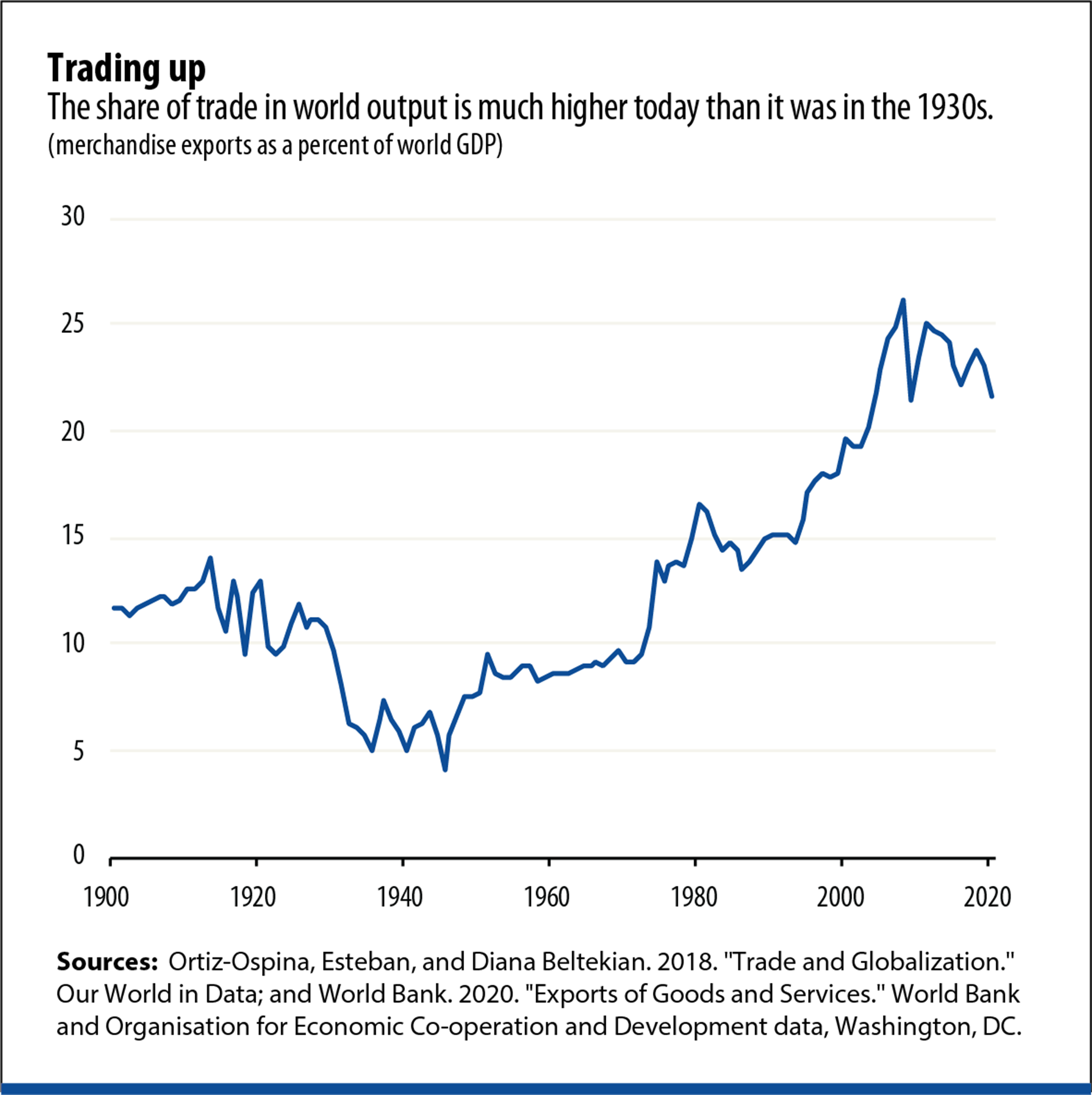
Again, what’s the answer?. Well, of course, ending the Russia-Ukraine conflict is the first that springs to mind. But that alone will not stop the spread of sanctions (trade, technology and finance) as weapons of war are now being used by the imperialist bloc against any nations who resist the interests of that bloc.

Mulder says that it is in the interest of the well-being of the world population and the stability of the world economy to take concerted action to counteract the spillovers of sanctions on Russia. A number of policy adjustments could help. First, advanced economies should focus on long-term infrastructure investment to ease supply chain pressures, while emerging market and developing economies should make income support a priority. Is any of that happening?

Second, advanced economy central banks should avoid rapidly tightening monetary policy to prevent capital flight from emerging markets. This solution flies in the face of the interest rate hikes being pursued with vigour by nearly all the major central banks in order to ‘control inflation’.

Third, looming debt and balance of payments problems in developing economies can be tackled through debt restructuring and increases in their allotments of the IMF’s Special Drawing Rights, a type of international reserve currency. Debt restructuring, let alone cancellation, is being ignored by the IMF, which still demands its pound of flesh.

Fourth, humanitarian relief should be extended to distressed economies, especially in the form of food and medicine. Tell that to poor countries lacking vaccines during COVID and now facing food faines.

Fifth, the world’s major economic blocs should do more to organize their demand for food and energy to reduce price pressures caused by hoarding and competitive overbidding. How is that to be achieved when food distribution globally is controlled by a handful of monopoly trading companies?

Mulder’s solutions are in the interests of the well-being of the global population, but not in the interests of big capital, finance, fossil fuels and corporate profits. He concludes: “Unless such policies are put in place in the next few months, grave concerns about the world economic outlook for 2022 and beyond will be justified.” But there is fat chance of any of these measures being agreed globally, let alone ‘put in place’.

Then there is global warming and climate change: Tharman Shanmugaratnam is senior minister in Singapore and chair of the Group of Thirty (the new international banking forum). In his article in F&D, he is concerned that cutting off Russian gas supply to Europe and elsewhere may be very costly to millions, but he reckons that it also offers an opportunity to move towards the reduction of fossil fuel emissions to reach net zero by 2050. But even that seems unlikely given the sharp increase in coal production to compensate for gas supply reductions and the expansion of degrading shale oil production in the US.

To convert the world economy from its current path to one that achieves net-zero carbon emissions by mid-century would cost $25trn in infrastructure investment. Shanmugaratnam says: “Measured from a societal perspective (my emphasis), these investments pay for themselves many times over, given that fossil energy use costs more in external damages than it adds value to GDP.” So Shanmugaratnam wants to invest in what he calls ‘public goods’: “we have to invest at significantly higher levels, over a sustained period, in the public goods needed to address the world’s most pressing problems. We must make up for many years of underinvestment in a wide range of critical areas—from clean water and trained teachers in developing economies to upgrades of an aging logistics infrastructure in some of the most advanced economies. But we also have the opportunity now to spur a new wave of innovations to tackle the challenges of the global commons, from low-carbon construction materials, to advanced batteries and hydrogen electrolyzers, to combination vaccines aimed at protecting simultaneously against a range of pathogens.”

Yes, sounds great. But two things spring to mind here. Why has there been so much ‘underinvestment’ in such ‘critical areas’ up to now? Shanmugaratnam offers no explanation, but the evidence (expounded many times on this blog) shows that it is the failure of the capitalist sectors of the world economy to invest because profitability in ‘productive investment’ has been in long-term decline, particularly in the 21st century. Capital has instead gone into financial and property speculation, driven by low or near zero interest borrowing rates.

Time for a change says Shanmugaratnam: “We must now reorient public finance, in partnership with philanthropic capital where possible (! – MR), toward mobilizing private investment to meet the needs of the global commons (my emphasis). So the answer is to rely on private capital backed by public money to get the capitalist sector to invest. That approach has been tried over and over again and clearly failed. Yet Shanmugaratnam persists with this solution (as he must): “almost half the technologies needed to reach net zero by mid-century are still being prototyped. Governments must put skin in the game to leverage private sector R&D (my emphasis again), and promote demonstration projects, to accelerate the development of these technologies and bring them to market. Besides getting to net zero on time, they should aim to spur major new industries and job opportunities.”

He recognises correctly that: “the social returns to protecting the global commons will typically be far in excess of the private returns” and “Developing and producing vaccines at scale for the next pandemic is a strong illustration of the point. A project to immunize the world’s population even six months earlier will save trillions of dollars and countless lives.” In which case, why not turn to the public investment? Well, no, instead this “makes a strong case for the public sector to share risks with private investors.” God help the public sector then.

Shanmugaratnam calls for global coordination: “the additional international investment required to plug major global gaps in preparedness, with contributions fairly distributed across countries, will not only be affordable for all but also enable us to avoid costs that would be several hundred times larger if we fail to act together to prevent another pandemic. The longstanding aversion to collective investment in pandemic preparedness reflects political myopia and financial imprudence, which we must overcome urgently.”

Indeed! But what is Shanmugaratnam’s answer? The usual one: the World Bank “must pivot more boldly toward mobilizing private capital, using risk guarantees and other credit-enhancement tools rather than direct lending on its own balance sheet.” Exactly what the World Bank has been up to for decades, using public money to fund private capital schemes.

As for global coordination to achieve these social tasks, Shanmugaratnam says that “a more effective multilateral system will require fresh strategic understanding between major nations, most important, between the United States and China, as the world shifts irreversibly toward multipolarity.” Given the latest NATO summit, which aims to surround and ‘contain’ China as an enemy of the West, global coordination is clearly off the agenda.

Shanmugaratnam is clear: “We can be under no illusion that an integrated global order, with its deep economic interconnections between nations, will on its own assure us of peace. But economic interdependence between the major powers, save for sectors impinging on national security (! MR), will make conflict far less likely than in a world of increasingly decoupled markets, technologies, payment systems, or data.” But how can there be ‘economic interdependence’ in a world dominated by an imperialist bloc, led by the US, aiming to work against those major economies that resist its interests (China, Russia and even India)?

Private capital has failed to reduce poverty and inequality – on the contrary. It has failed to invest in the infrastructure and technology to raise living standards globally and reduce carbon emissions – on the contrary, fossil fuel production and profits continue to rise. It’s clear, even if the IMF experts do not admit it, that public investment for common good should replace capitalist investment for profit to meet the needs of the many and to introduce the technology to reduce emissions and expand vaccines And fossil fuel companies need to be brought under public ownership and control and phased out. Global coordination is impossible while imperialist powers dictate the terms. Peace and imperialism is an oxymoron.




Sustainable Practices, Less Chemical Fertilizer Lead To Higher Crop Yields


https://popularresistance.org/sustainable-farming-practices-and-less-chemical-fertilizer-can-lead-to-higher-crop-yields-study-finds/


In farming, high crop yields are often associated with the use of human-made fertilizers. But what if these abundant results could instead be achieved by using farming practices that were more environmentally friendly?

An extensive new study of 30 farms in Africa and Europe has shown that the combination of small amounts of fertilizer with natural farming methods like mixing compost or manure with the soil, cultivating a wider variety of crops and cultivating plants like clover or beans that amplify soil’s fertility can result in high crop yields while maintaining the harmony of agricultural ecosystems, a press release from Rothamsted Research said.

The study found that a significant amount of chemical fertilizers could be replaced by adopting these more natural techniques, which would have multiple benefits.

“Reducing reliance on chemical fertilisers would help to buffer farmers and consumers against economic shocks, such as the current spike in fertiliser costs and consequent increase in food prices,” said plant ecologist at Rothamsted Research in the UK Dr. Chloe MacLaren, who was the lead author of the paper, as The Guardian reported.

The study, “Long-term evidence for ecological intensification as a pathway to sustainable agriculture,” was published in the journal Nature Sustainability.

The farm experiments the researchers examined for the study had been going for more than nine years and 25,000 harvests and included 30 individual experiments on crops of oats, wheat, barley, maize, potatoes and sugar beet, the press release said. The research team analyzed how the variety of natural methods used interacted with various levels of plowing and nitrogen-rich fertilizers. Each analysis considered at least one of the trio of natural farming practices.

It was the first time a major study had explored the interaction of a variety of natural farm methods with fertilizer and land cultivation practices.

The study also found that, in general, the use of more natural farming methods in combination with large amounts of chemical fertilizer didn’t further increase crop yields. In fact, the most abundant yields in the experiment were achieved when some nitrogen was added to the “ecological intensification” practices.

Ecological intensification is when farmers actively support the environmentally friendly practices that benefit agriculture.

“Ecological intensification could help return agriculture into a ‘safe operating space’ for humanity,” MacLaren said in the press release. “Our results demonstrate that it could play an important role in the development of future sustainable farming systems.”

MacLaren went on to say that the worldwide playing field of nitrogen fertilizer distribution could also be leveled with the increased use of these natural practices.

“Widespread uptake of these practices could also contribute to a more equitable global distribution of fertiliser. Currently, average nitrogen fertiliser rates in Africa are a small fraction of those in Europe, with smallholders in particular using much less than their fair share. If fertiliser use is reduced where it is currently high, then fertiliser use could be increased where it is currently low — addressing food security issues without exceeding planetary boundaries,” said MacLaren in the press release from Rothamsted Research.

In the last 60 years, the excessive use of human-produced fertilizer has contributed to increased carbon emissions, water pollution and [biodiversity](https://www.ecowatch.com/understanding-biodiversity-2653049258.html#:~:text=Without spending more to tackle,to %24140 trillion a year.) loss.

MacLaren said that a combination of many factors should be looked at when evaluating the fostering of these environmentally friendly practices in the future.

“Future assessments of ecological intensification should include a wider analysis of all social, economic and environmental factors, such as nutritional value or farm profitability. There are undoubtedly benefits beyond just yield, such as reducing costs, reducing pollution, or providing other valuable farm products,” MacLaren said, according to the press release. “Conversely, socioeconomic factors can also limit the adoption of such practices by farmers. These factors can include a lack of markets for these diverse products and limited access to necessary resources including land, seed, and manure. Upscaling these practices will require policymakers and society to create a more conducive socioeconomic context.”


Biden Says US Will Beef Up Military Presence In Europe


https://popularresistance.org/biden-says-us-will-beef-up-military-presence-in-europe-as-nato-summit-begins-in-madrid/


As NATO Summit Begins in Madrid.

NATO is set to agree on an expansion of its forces in Eastern Europe.

President Biden kicked off his three-day visit to a NATO summit in Madrid by announcing that the US plans to increase its military presence in Europe.

Speaking with Spanish Prime Minister Pedro Sánchez, Biden said the US will increase the number of US Navy Destroyers stationed at a naval base in Rota, Spain, from four to six.

The president said that this was the first of multiple announcements the US and NATO will make at the summit on increasing their forces in Europe, steps being taken in response to Russia’s invasion of Ukraine.

“And as I said before the war started: If Putin attacked Ukraine, United States would enhance our force posture Europe and respond to the reality of a new European security environment,” Biden told reporters.

“I’ll be laying out additional steps the United States is going to take with our NATO colleagues as our — in our summit tomorrow,” he added.

The US currently has over 100,000 troops stationed in Europe for the first time since 2005. Tens of thousands of US troops were sent to the continent around the time Russia invaded Ukraine, and Washington is looking to make the number of assigned troops in Europe reflect those currently deployed.

NATO is set to approve a significant increase in its troop presence in Eastern Europe and the Baltic States, although exact numbers aren’t set. NATO Secretary-General Jens Stoltenberg said Monday that part of the plan is to increase its high-readiness force from 40,000 troops to over 300,000.

Stoltenberg described the alliance’s plans as “the biggest overhaul of our collective defense and deterrence since the Cold War.” NATO preparing for its largest military buildup in decades as it is pumping weapons into Ukraine also means the risk of nuclear war is at its highest since the end of the Cold War.


Key Takeaways From BRICS Summit


https://popularresistance.org/key-takeaways-from-brics-summit/


Last week the 14th BRICS Summit took place virtually, chaired by Chinese President Xi Jinping. The BRICS bloc (Brasil, Russia, India, China and South Africa) represents a key political, economic, and scientific force in the international arena. These nations represent half of the world’s population and their collective GDP is greater that $20 trillion.

In today’s context, the significance of the BRICS summit is increased to the extent that the bloc represents an alternative to the unipolar world of the decaying West.

What follows are some of the key points from the Summit’s in Beijing: Multilateral compromise in the defense of international law, which includes being more inclusive with less developed countries.


Promote peace and international security without compromising the environment.
 

Support for a an open, multilateral, transparent, inclusive, rules-based, non-discriminatory commercial system.
 

Cooperation to combat COVID-19, with support for multilateral organizations but also searching for medicinal alternatives.
 

Support dialogue between Russia and Ukraine from an impartial perspective.
 

“We strongly support a peaceful, safe, and stable Afghanistan while we emphasize our respect for its sovereignty independence, territorial integrity, national unity, and non-interference in its internal affairs.”
 

The necessity to resolve the nuclear problem in Iran through peaceful and diplomatic means in accordance with international law.
 

Support for bilateral and multilateral negotiations in order to solve the problems related to the Korean peninsula.
 

Compromise for a world free of nuclear arms.
 

Cooperation against terrorism and the reaffirmation of the exclusive authority of the UN Security Council.
 

International cooperation against corruption.
 

Compromise to continue bettering the coordination of macroeconomic policy, to further practical economic cooperation, and to work to achieve post-COVID-19 economic recovery in a sustainable, balanced, and inclusive manner.
 

“We commit to strengthening intra-BRICS cooperation to intensify the BRICS Partnership on New Industrial Revolution (PartNIR) and collectively create new opportunities for development.”
 

“We encourage the BRICS Interbank Cooperation Mechanism to continue playing an important role in supporting BRICS economic and trade cooperation.”
 

Opposition to green commercial barriers and support for coordination on this issue.
 

Cooperation in agriculture.


CIA And Western Special Ops Commandos Are In Ukraine


https://popularresistance.org/cia-and-western-special-ops-commandos-are-in-ukraine-directing-proxy-war-on-russia/ 


Directing proxy war on Russia.

The CIA and special operations forces from Britain, France, and Canada are physically in Ukraine, helping direct the proxy war on Russia, overseeing weapons, training, and intelligence. Some Ukrainian fighters have US flag patches.

The CIA and special operations forces from NATO members Britain, France, Canada, and Lithuania are physically in Ukraine, helping direct the proxy war on Russia, according to a report in The New York Times.

These Western forces are on the ground training and advising Ukrainian fighters, overseeing weapons shipments, and managing intelligence.

At least 20 countries are part of a US Army-led coalition, guiding Ukraine in its fight against Russian troops.

Some Ukrainian combatants are even using US flag patches on their equipment.

This is all according to a June 25 report in The New York Times, titled “Commando Network Coordinates Flow of Weapons in Ukraine, Officials Say.”

The Times is a de facto organ of the US government. Although technically private, the paper closely follows the line of the CIA and Pentagon. Its report is based on statements by top US officials.

This is the strongest evidence yet that the conflict in Ukraine is not just a battle between neighbors, but rather a Western proxy war on Russia, with the direct involvement of NATO forces from several nations.

The Times acknowledged that Ukraine “depends more than ever on help from the United States and its allies — including a stealthy network of commandos and spies rushing to provide weapons, intelligence and training.”


The chief of US Army Special Operations Command, Lieutenant General Jonathan P. Braga, boasted of an “international partnership with the special operations forces of a multitude of different countries” that “have absolutely banded together in a much outsized impact” to help wage the proxy war on Russia.

The Times noted that, “even as the Biden administration has declared it will not deploy American troops to Ukraine, some C.I.A. personnel have continued to operate in the country secretly, mostly in the capital, Kyiv, directing much of the vast amounts of intelligence the United States is sharing with Ukrainian forces.”

The US Army has a “coalition planning cell in Germany to coordinate military assistance to Ukrainian commandos and other Ukrainian troops,” the newspaper reported.

At least 20 countries are part of this US-led cell providing military assistance to Ukraine, “which was modeled after a structure used in Afghanistan,” the newspaper added.

And the 20-nation coalition “is part of a broader set of operational and intelligence coordination cells run by the Pentagon’s European Command to speed allied assistance to Ukrainian troops.”

In a battle in the eastern Donbas region, “a group of Ukrainian special operations forces had American flag patches on their gear and were equipped with new portable surface-to-air missiles as well as Belgian and American assault rifles,” the Times noted.

This is one of many reports proving CIA support for anti-Russian forces in Ukraine.

Ever since the United States sponsored a violent coup d’etat that overthrew Ukraine’s democratically elected government in 2014, CIA agents have been active in the country, training fighters to kill Russian-speaking independence supporters in the east.

Yahoo News published an investigation in March, titled “Secret CIA training program in Ukraine helped Kyiv prepare for Russian invasion,” which revealed that “CIA paramilitaries” began traveling to Ukraine in 2014, and a “covert CIA training program run from Ukraine’s eastern frontlines” was teaching Ukrainians “irregular warfare” tactics.


Another report released in Yahoo News in January, a month before Russia invaded Ukraine, admitted that the CIA had since 2015 been “overseeing a secret intensive training program in the U.S. for elite Ukrainian special operations forces and other intelligence personnel.”

A former CIA official stated openly, before Russia sent its troops in, “The United States is training an insurgency,” in order “to kill Russians.”


Amid outrage over journalist’s killing, US vows to put Israel first


https://electronicintifada.net/blogs/maureen-clare-murphy/amid-outrage-over-journalists-killing-us-vows-put-israel-first


Maureen Clare Murphy Rights and Accountability 28 June 2022

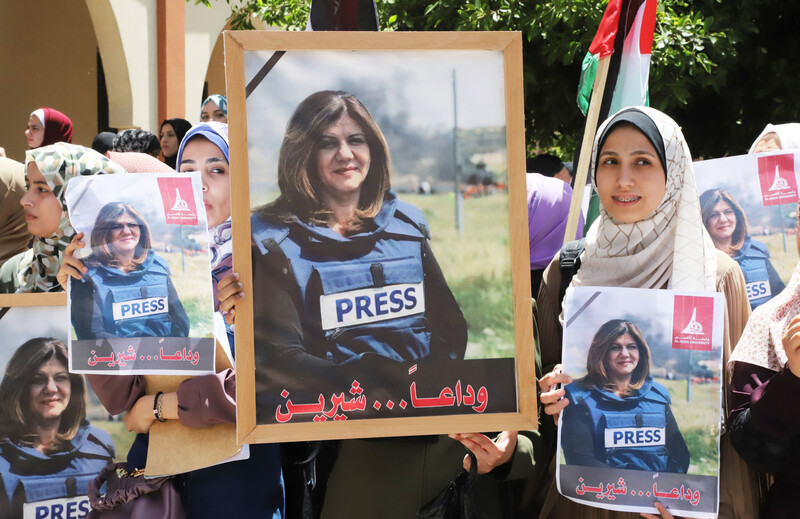
Palestinians in Gaza City hold posters in memory of Shireen Abu Akleh on 11 May, the day the reporter was killed. Youssef Abu Watfa APA images

Pressure is mounting on US President Joe Biden in the absence of an Israeli criminal investigation into the killing of prominent Al Jazeera journalist Shireen Abu Akleh.

The Committee to Protect Journalists – a New York-based press freedoms watchdog – is calling on Biden to “lead a thorough, independent and transparent investigation” into Abu Akleh’s death.

Investigations undertaken by Israeli and Palestinian human rights groups, the Palestinian Authority, CNN, The Associated Press, The New York Times, The Washington Post and the UN human rights office all point to Israeli responsibility for Abu Akleh’s death.

Abu Akleh, who held US citizenship, was shot on 11 May while covering an Israeli raid in the northern West Bank city of Jenin last month. She was wearing a helmet and a protective vest marked “PRESS” when she was shot and killed instantly.

Ali Samoudi, a producer, was shot in the shoulder and survived. Witnesses and survivors of the shooting said that the journalists came under Israeli fire and there were no armed Palestinians present or exchange of fire at the time – contrary to Israel’s claims.

“While your administration has called for an investigation, more than one month after Abu Akleh’s killing, only journalists have carried out serious probes of the incident,” the Committee to Protect Journalists stated.

The watchdog added that “Israel’s attacks on journalists and media facilities is a trend that [the Committee to Protect Journalists] has documented over decades,” with nearly 20 journalists killed while carrying out their work in the West Bank and Gaza since 1992.

The group noted that “exactly one year prior to Abu Akleh’s killing … Israeli warplanes began a bombing campaign targeting at least four buildings in Gaza housing the offices of 18 international and local media outlets.”

The Committee to Protect Journalists said it has not yet received a response from Israeli authorities to a letter asking them to “make public any evidence” that – as Israel claimed – Hamas was using “those buildings for military purposes.”

The watchdog noted that Israel has suggested that Abu Akleh’s killing was justified, with military spokesperson Ran Kochav proclaiming that the targeted journalists were “armed with cameras, if you’ll permit me to say so.”

The reluctance of Tel Aviv’s allies, including the US, “to seek accountability for these violations” has emboldened Israel’s attacks, the Committee to Protect Journalists added.

Nearly 60 members of US Congress, including half of all Democratic senators, have called on the Biden administration to investigate Abu Akleh’s death.
American bullet

Al Jazeera, which obtained an image of the bullet that killed Abu Akleh, said that she was struck by a US-designed and manufactured 5.56mm caliber armor-piercing bullet used in an M4 rifle.

Israel has declined to launch a criminal investigation into the soldiers involved in Abu Akleh’s death, with the military advocate general stating that “the incident had been a ‘combat event’ in which there was no suspicion of a criminal offense,” the Tel Aviv daily Haaretz reported.

Israel has used the same baseless interpretation of international law to justify the use of lethal force against unarmed protesters in Gaza during the Great March of Return protests between March 2018 and December 2019.

Israel argued that the mass protests were orchestrated by Hamas, the political party and resistance group that oversees Gaza’s internal affairs.

Israeli military directives require an immediate criminal investigation into the death of a Palestinian outside combat activity.

More than 215 Palestinians were killed during the Great March of Return protests. Only one Israeli soldier had been indicted over the use of live fire as of late 2020.

Israel’s killing and maiming of Gaza protesters is a main focus of the International Criminal Court’s investigation in Palestine that was opened in March last year.
Calls for ICC probe

The Palestinian Authority and Al Jazeera have separately requested that the tribunal in The Hague investigate Abu Akleh’s killing, as has a filing to the ICC from the International Federation of Journalists, the Palestinian Journalists Syndicate and the International Centre of Justice for Palestinians.

The Biden administration says that it does not support an ICC investigation into the killing of Abu Akleh and has repeatedly deferred to the Israel military’s self-investigation protocol.

Israel’s self-investigations into violations of Palestinians’ rights – long dismissed by human rights groups as a whitewashing mechanism to avoid international scrutiny – will likely become a point of contention for the ICC’s investigation in Palestine, should it move forward.

The Philippines attempted to defer an ICC investigation on the basis that its authorities were investigating or had completed investigations into alleged murders committed in the context of that country’s so-called “war on drugs.”

Under the principle of complementarity, the ICC privileges a country’s internal investigations where they exist.

Karim Khan, the ICC chief prosecutor, rejected the Philippines’ request, stating last week that the government’s procedures “do not seek to establish criminal responsibility, and therefore cannot warrant deferral of the ICC’s criminal investigation.”

Khan added that “the investigation should resume as quickly as possible.”

In addition to shielding soldiers from charge or trial for Abu Akleh’s death, Israeli authorities have said that no police officers will be punished for attacking the pallbearers carrying the slain journalist’s coffin, nearly causing them to drop it, during her funeral in Jerusalem.
“Put them first”

US ambassador Tom Nides said on Tuesday that he had been “working around the clock” to help Tel Aviv meet all requirements to join the State Department’s visa waiver program before the Israeli government votes to dissolve later this week.

“Don’t lose momentum now. This will help Israeli citizens travel to the US – put them first!” he added.

Progressive US lawmakers have urged the Biden administration to keep Israel out of the visa waiver program due to the discrimination faced by Palestinian Americans seeking to visit Israel and the West Bank.

Biden will be traveling to the Middle East next month, first visiting Israel and the West Bank.

From there, Biden will make his way to Saudi Arabia, where he will meet Muhammad Bin Salman, the crown prince, who – according to the CIA – approved the murder of Washington Post columnist Jamal Khashoggi in 2018.


Israel’s claim it defeated Ben & Jerry’s melts under scrutiny


https://electronicintifada.net/blogs/ali-abunimah/israels-claim-it-defeated-ben-jerrys-melts-under-scrutiny


Ali Abunimah Activism and BDS Beat 29 June 2022

Israeli leaders had a meltdown when Ben & Jerry’s announced last year that it would stop selling its frozen treats in Israel’s illegal settlement colonies in the occupied West Bank. Richard B. Levine Newscom

This story has been updated with a statement from Ben & Jerry’s rejecting move by its parent company Unilever.

Israel claims it has forced a reversal of the principled decision last year by Ben & Jerry’s to stop selling its ice cream in illegal settlement colonies in the occupied West Bank.

Unilever, the parent company of Ben & Jerry’s, announced Tuesday that it has sold the Ben & Jerry’s brand in Israel to its Israeli licensee, AQP.

AQP has vowed to keep selling the ice cream in the occupied West Bank with the Ben & Jerry’s name in Hebrew and Arabic, prompting cries of victory from Israeli officials.

However, the ice cream will be sold against the explicit wishes of Ben & Jerry’s, which will earn no income from sales in Israel.

“We are aware of the Unilever announcement. While our parent company has taken this decision, we do not agree with it,” Ben & Jerry’s wrote to The Electronic Intifada on Wednesday.

“Unilever’s arrangement means Ben & Jerry’s in Israel will be owned and operated by AQP. Our company will no longer profit from Ben & Jerry’s in Israel,” the Vermont-based firm added.

“We continue to believe it is inconsistent with Ben & Jerry’s values for our ice cream to be sold in the Occupied Palestinian Territory.”


What appears to have happened is that Unilever went over the ice cream maker’s head in an effort to appease Israel and its lobby.


When Unilever acquired Ben & Jerry’s in 2000 it was under an agreement that the ice cream maker would have the autonomy to continue pursuing the socially conscious principles of its founders.

Ben & Jerry’s retained an independent board. According to the firm’s website, the board is “empowered to protect and defend Ben & Jerry’s brand equity and integrity.”

It appears that Unilever has violated at least in spirit the 2000 acquisition agreement.
“Same look and feel”

Unilever announced on Tuesday that it had “sold its Ben & Jerry’s business interests in Israel to Avi Zinger, the owner of American Quality Products Ltd (AQP),” the current Israeli licensee for Ben & Jerry’s.

“The new arrangement means Ben & Jerry’s will be sold under its Hebrew and Arabic names throughout Israel and the West Bank under the full ownership of its current licensee,” Unilever added.

Unilever’s London press office confirmed to The Electronic Intifada that “the brand in Israel will continue to have the same design look and feel as today.”

“The brand name will be in Hebrew and Arabic. It will be exactly the same ice cream as consumers enjoy today,” the company added.

But the multinational refused to say if Ben & Jerry’s itself supports the deal and the continued use of its name by the Israeli company – albeit not in English.

“In answer to your question on Ben and Jerry’s and whether they support this decision, we wouldn’t comment on internal conversations so again, you are best placed asking Ben & Jerry’s directly for their response,” Unilever wrote to The Electronic Intifada.

Unilever also did not respond about whether the Israeli company will have continued contact with Ben & Jerry’s related, say, to marketing or product development.

Notably, the Unilever press statement contains no quotation from any Ben & Jerry’s spokesperson indicating support for the parent company’s decision.

The parent company acknowledges that “Ben & Jerry’s and its independent board were granted rights to take decisions about its social mission, but Unilever reserved primary responsibility for financial and operational decisions and therefore has the right to enter this arrangement.”

As noted, Ben & Jerry’s has now confirmed that it opposes the move.
Israeli meltdown

In July last year, after years of grassroots campaigning, Ben & Jerry’s announced it would pull its products from settlements.

“We believe it is inconsistent with our values for Ben & Jerry’s ice cream to be sold in the occupied Palestinian territory,” the firm said at the time.

Israel’s leadership and lobby groups had a major meltdown in response.

Israeli Prime Minister Naftali Bennett spoke to Alan Jope, CEO of Unilever, warning him of “severe consequences.”

“Ben & Jerry’s has decided to brand itself as the anti-Israel ice cream,” Bennett asserted.

Israel and its lobby then went into full gear in an effort to reverse a decision they feared would encourage other companies to follow suit.

In March, the Brandeis Center, an Israel lobby group that uses lawfare – legal harassment – against supporters of Palestinian rights, filed a lawsuit in US federal court on behalf of the Israeli licensee against Unilever and Ben & Jerry’s.

The lawsuit accused Unilever of “unlawfully terminating its multi-decade business relationship in order to boycott Israel.”

The Brandeis Center said Wednesday that Unilever’s decision to sell its interests in Israel to Avi Zinger settles that lawsuit and marks a “major victory” against the Palestinian led BDS – boycott, divestment and sanctions – movement.

“The settlement prevents Ben & Jerry’s from boycotting Israel and ensures that Zinger will continue selling Ben & Jerry’s ice cream throughout Israel and the West Bank,” the Brandeis Center claimed.

But that’s a stretch, since there is no indication that Ben & Jerry’s independent board reversed its decision. This looks simply like a strong-arm tactic by Unilever, which never expressed support for Ben & Jerry’s move in the first place.
Hypocrisy over Ukraine, Palestine

“Unilever rejects completely and repudiates unequivocally any form of discrimination or intolerance. Anti-Semitism has no place in any society,” the multinational said in its statement Tuesday, effectively endorsing Israel’s smears that campaigning for Palestinian rights is tantamount to anti-Jewish bigotry.

“We have never expressed any support for the boycott divestment and sanctions (BDS) movement and have no intention of changing that position,” Unilever added.

Declaring itself “very proud of our business in Israel,” Unilever offered no condemnation whatsoever of Israel’s systematic violations of Palestinian rights, which major human rights groups describe as apartheid – a crime against humanity.

But the company does not oppose boycotts in principle.

In March, Unilever, which owns dozens of well-known consumer brands, condemned the war in Ukraine “as a brutal and senseless act by the Russian state.”

“We have suspended all imports and exports of our products into and out of Russia, and we will stop all media and advertising spend,” Unilever added. “We will not invest any further capital into the country nor will we profit from our presence in Russia.”

Given this context, Unilever’s effort to circumvent Ben & Jerry’s decision can only be interpreted as an emphatic endorsement of Israel’s illegal colonization of occupied Palestinian land – a war crime that is under investigation by the International Criminal Court.


Yair Lapid, Israel’s foreign minister who is taking over as caretaker prime minister in the run up to new elections in September, painted Unilever’s move as a “victory” for Israel.


“The anti-Semites will not defeat us,” Lapid asserted. “Today’s victory is for all those who know that the struggle against BDS is first and foremost for advancing partnership, conversation and an ongoing struggle against discrimination and hate.”

That isn’t how human rights defenders see it.

“Ben & Jerry’s decision last year to end sales of its ice cream into Israeli settlements in the occupied West Bank avoids complicity in grave human rights abuses and contributing to a veneer of normalcy over Israeli authorities’ crimes of apartheid and persecution of millions of Palestinians,” Omar Shakir, Israel and Palestine director for Human Rights Watch, said Wednesday.

Shakir added that Unilever’s plan to sell Ben & Jerry’s operations in Israel to Zinger, “amid significant Israeli government pressure,” seeks to undermine that decision.

“But it won’t succeed: Ben & Jerry’s won’t be doing business in illegal settlements,” Shakir added. “What comes next may look and taste similar, but, without Ben & Jerry’s recognized social justice values, it’s just a pint of ice cream.”