Saturday, July 2, 2022

Self-Determination Wrenched from Half US Population


https://consortiumnews.com/2022/06/29/self-determination-wrenched-from-half-us-population/


June 29, 2022


There is no reason, in fact or in law, to erase the constitutional right to abortion, writes Marjorie Cohn.
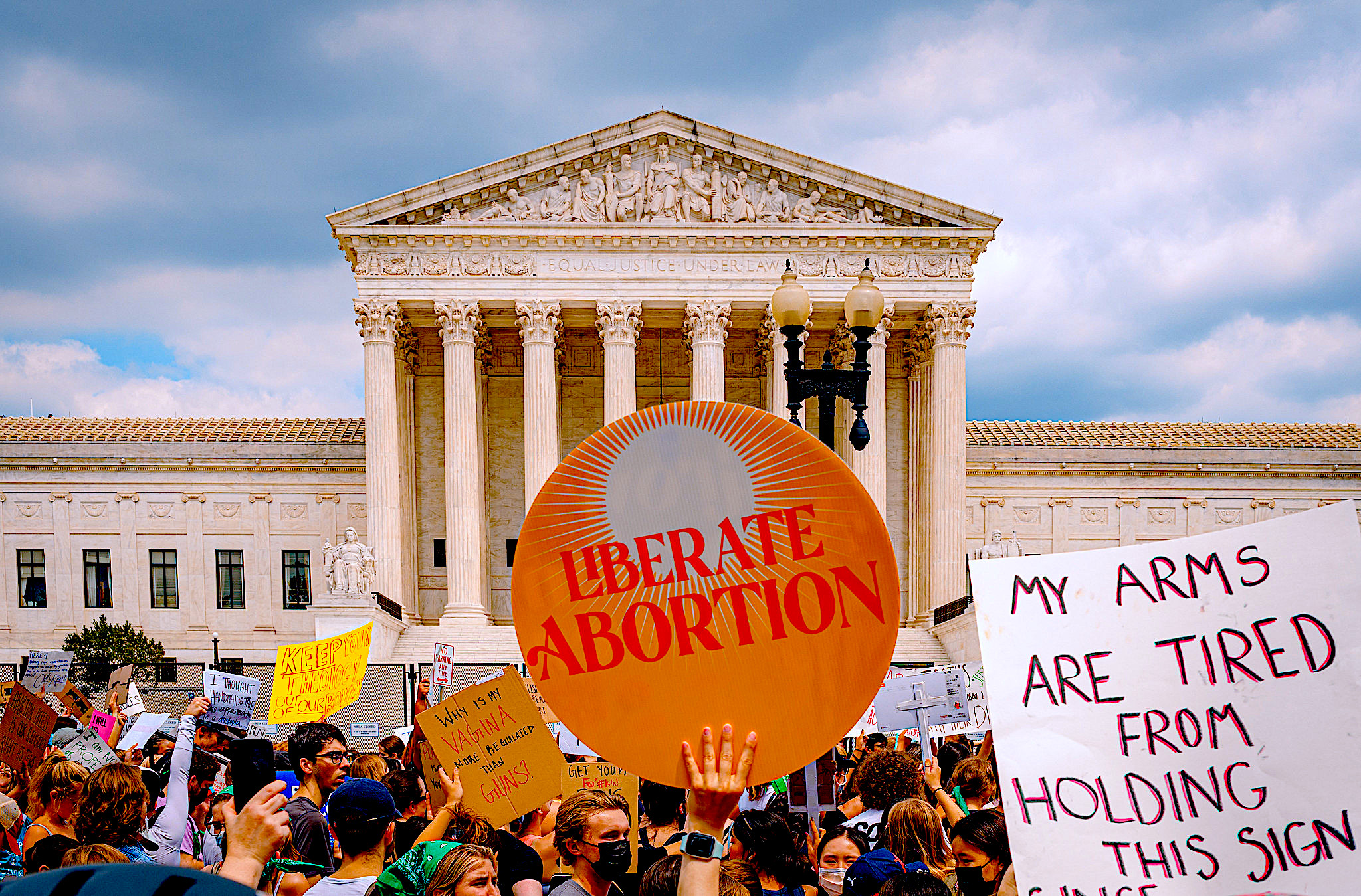


Protests at the U.S. Supreme Court on June 24, the day Roe v Wade was overturned. (Ted Eytan, Flickr, CC BY-SA 2.0)

By Marjorie Cohn
Truthout



For the first time in U.S. history, the Supreme Court has retracted a fundamental constitutional right. “We hold that Roe and Casey must be overruled,” Samuel Alito wrote for the majority of five right-wing zealots on the court in Dobbs v. Jackson Women’s Health Organization. They held that “procuring an abortion is not a fundamental constitutional right because such a right has no basis in the Constitution’s text or in our Nation’s history.”

Since the day Roe v. Wade was decided nearly 50 years ago, its opponents have executed a methodical campaign to overturn it. There is no reason, in fact or in law, to erase the constitutional right to abortion. The Constitution still protects abortion, and there have been no factual changes since 1973 that would support abolishing it. The only thing that has changed is the composition of the court. It is now packed with radical Christian fanatics who have no qualms about imposing their religious beliefs on the bodies of women and trans people, notwithstanding the Constitution’s unequivocal separation of church and state.

Alito was joined by Clarence Thomas, Neil Gorsuch, Brett Kavanaugh and Amy Coney Barrett in stripping protection of the right to self-determination from half the country’s population.

In their collective dissent, Stephen Breyer, Sonia Sotomayor and Elena Kagan said the majority “has wrenched this choice from women and given it to the States.” They wrote that the court is “rescinding an individual right in its entirety and conferring it on the State, an action the Court takes for the first time in history.”

“…the court… is now packed with radical Christian fanatics who have no qualms about imposing their religious beliefs on the bodies of women and trans people, notwithstanding the Constitution’s unequivocal separation of church and state.”

Noting, “After today, young women will come of age with fewer rights than their mothers and grandmothers had,” the dissenters conclude: “With sorrow — for this Court, but more, for the many millions of American women who have today lost a fundamental constitutional protection — we dissent.”

During the December oral argument, Sonia Sotomayor expressed concern about how the Supreme Court would “survive the stench” of the overtly ideological overruling of Roe. It will show, she said, that the Court’s rulings are “just political acts.”

By overturning Roe and Planned Parenthood v. Casey, the court’s majority confirmed the significance of Sotomayor’s query. While purporting to shift the restriction or abolition of abortion to the states, the court has engaged in a political act. It delegated the fate of a right that had been moored in the Constitution to the political process.
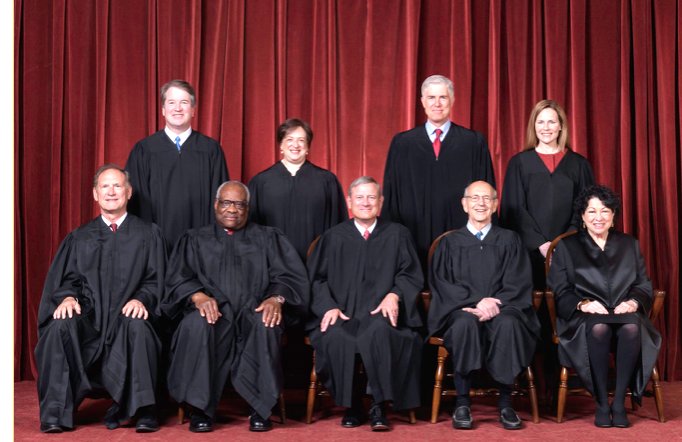

The Supreme Court as composed Oct. 27, 2020, to present. Front row, from left: Samuel A. Alito, Jr., Clarence Thomas, John G. Roberts, Jr., Stephen G. Breyer, Sonia Sotomayor. Back row, from left: Brett M. Kavanaugh, Elena Kagan, Neil M. Gorsuch and Amy Coney Barrett. (Fred Schilling, Collection of the Supreme Court)

“This conservative court defers to the political process when it agrees with its results,” Berkeley Law School Dean Erwin Chemerinsky wrote in the Los Angeles Times, “but the deference vanishes when the conservative justices dislike the states laws.”

As Chemerinsky notes, “there was no deference to the political process earlier this week when the conservatives on the court declared unconstitutional a New York law limiting concealed weapons that had been on the books since 1911 or struck down a Maine law that limited financial aid to religious schools.”

Brett Kavanaugh insisted in his concurrence that the Constitution is “neither pro-life nor pro-choice.” Arguing that it is “neutral” on abortion, he claimed that the issue should be left to the states and “the democratic process.” But partisan gerrymandering and the Supreme Court’s evisceration of the Voting Rights Act to the detriment of Democrats and people of color belie the court’s purportedly “democratic” and “neutral” delegation of abortion to the states.

“… partisan gerrymandering and the Supreme Court’s evisceration of the Voting Rights Act to the detriment of Democrats and people of color belie the court’s purportedly ‘democratic’ and ‘neutral’ delegation of abortion to the states.”

The court held in Roe that abortion was a “fundamental right” for a woman’s “life and future.” It said that states could not ban abortion until after viability (when a fetus is able to survive outside the womb), which generally occurs around 23 weeks. Nineteen years later, the court reaffirmed the “essential holding” of Roe in Casey, saying that states could only place restrictions on abortions if they don’t impose an “undue burden” on the right to a pre-viability abortion.

Alito wrote in Dobbs that since abortion is no longer a fundamental constitutional right, restrictions on it will be judged under the most lenient standard of review — the “rational basis” test. That means a law banning or restricting abortion will be upheld if there is a “rational basis on which the legislature could have thought that it would serve legitimate state interests.”

At issue in Dobbs was Mississippi’s 2018 Gestational Age Act, which outlaws nearly all abortions after 15 weeks of pregnancy, well before viability. The law contains exceptions for medical emergencies and cases of “severe fetal abnormality,” but no exception for rape or incest.

The majority said that Mississippi’s interest in “protecting the life of the unborn” and preventing the “barbaric practice” of dilation and evacuation satisfied the rational basis test so its law would be upheld. The court accepts the notion of protecting “fetal life” but nowhere mentions what the dissenters call “the life-altering consequences” of reversing Roe and Casey.

In both Roe and Casey, the court grounded the right to abortion in the liberty section of the Due Process Clause of the 14th Amendment, which says that states shall not “deprive any person of life, liberty, or property, without due process of law.” The court in Roe relied on several precedents saying that the right of personal liberty prohibits the government from interfering with personal decisions about contraception, marriage, procreation, family relationships, child-rearing and children’s education.

“The court in Roe relied on several precedents saying that the right of personal liberty prohibits the government from interfering with personal decisions about contraception, marriage, procreation, family relationships, child-rearing and children’s education.”

The Dobbs majority said the Constitution contains no reference to abortion and no constitutional provision implicitly protects it. In order to be protected by the Due Process Clause, a right must be “deeply rooted in this Nation’s history and tradition” and “implicit in the concept of ordered liberty.” According to the majority, there is no liberty interest because the law didn’t protect the right to abortion in the 19th century.

To his credit, John Roberts did not vote to overturn Roe and Casey, writing that the majority’s “dramatic and consequential ruling is unnecessary to decide the case before us.” Mindful of the threat this “serious jolt to the legal system” will pose to the legitimacy of the Roberts Court, the chief justice sought to split the baby, so to speak. He discarded the viability test and upheld the Mississippi law, leaving the issue of the constitutionality of abortion to a future case. Purporting to be a supporter of abortion rights, Roberts said women in Mississippi could choose to have an abortion before 15 weeks of pregnancy.
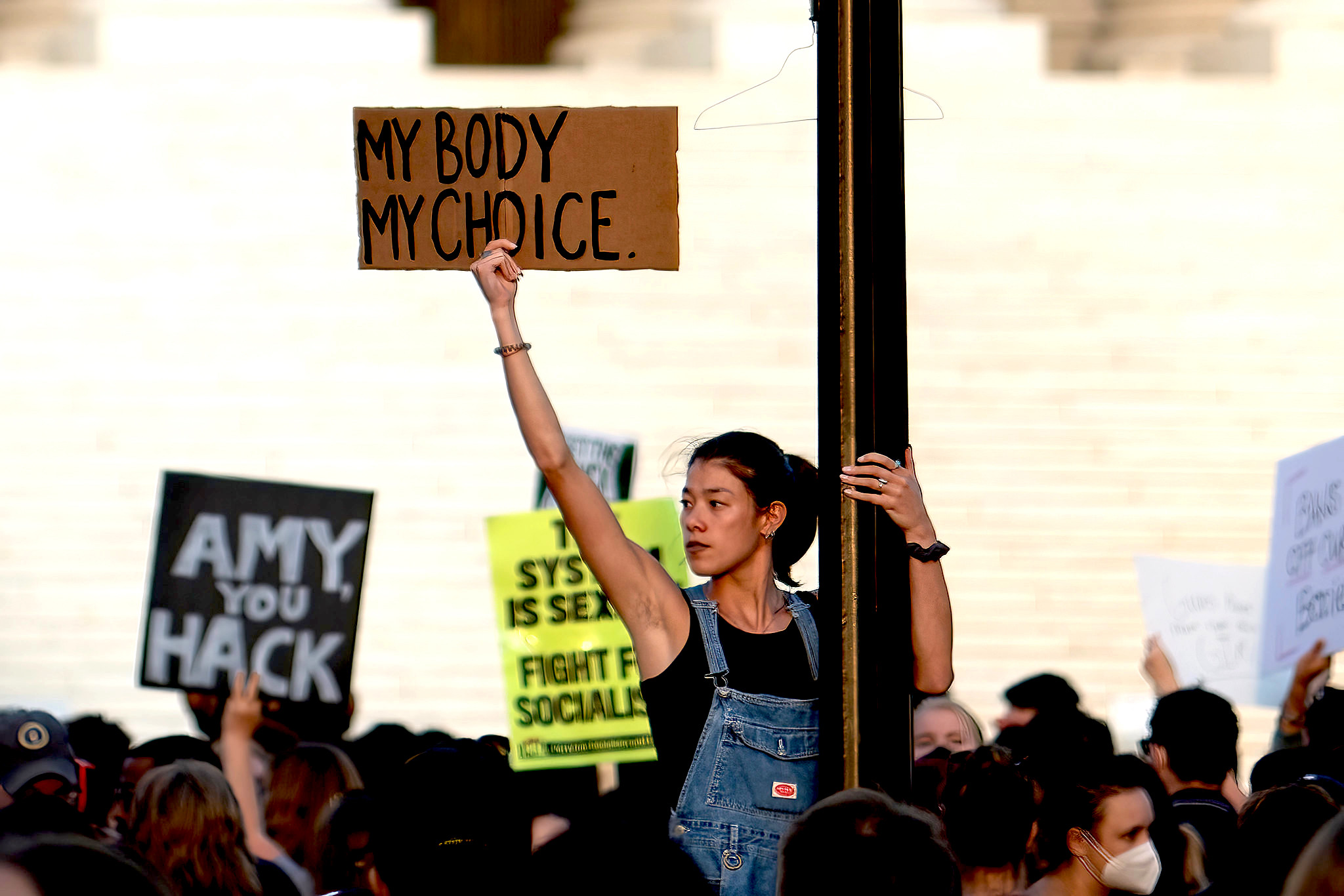

Protesters at the U.S. Supreme Court on May 3, the day after the draft opinion for Dobbs v. Jackson Women’s Health Organization was leaked. (Miki Jourdan, Flickr, CC BY-NC-ND 2.0)

In order to justify their rejection of stare decisis (respect for the court’s precedent) to which the members in the majority had pledged fealty during their confirmation hearings, Alito wrote that Roe was “egregiously wrong.” He and the others in the majority had the nerve to compare abortion to racial segregation, drawing an analogy between the court’s overruling of Roe and its rejection of Plessy v. Ferguson in Brown v. Board of Education.

Nearly half the states have laws banning or severely restricting abortion. Almost 1-in-5 pregnancies (not counting miscarriages) end in abortion, which is one of the most frequent medical procedures performed today. Twenty-five percent of American women will end a pregnancy in their lifetime. Now that Roe has been overturned, it is estimated that 36 million women and others who can become pregnant will be denied the fundamental right to choose whether to continue a pregnancy.

The dissenters observed that under laws in some states (like Mississippi) that don’t offer exceptions for victims of rape or incest, “a woman will have to bear her rapist’s child or a young girl her father’s — no matter if doing so will destroy her life.”

Alito wrote, “The Court emphasizes that this decision concerns the constitutional right to abortion and no other right. Nothing in this opinion should be understood to cast doubt on precedents that do not concern abortion.”

Part of the Constitutional Fabric

But the dissenters were not convinced. “No one should be confident that this majority is done with its work,” they warned. The dissent noted that the right to abortion enshrined in Roe is “part of the same constitutional fabric” as the rights to contraception and same-sex marriage and intimacy. “Either the mass of the majority’s opinion is hypocrisy, or additional constitutional rights are under threat. It is one or the other.”

Thomas didn’t pull any punches in his concurrence. He said that the court “should reconsider” other precedents based on substantive due process, including Griswold v. Connecticut (the right to contraception), Lawrence v. Texas (the right to same-sex sexual conduct) and Obergefell v. Hodges (the right to same-sex marriage).

In Alito’s draft opinion, which was leaked to Politico in May, he wrote that the rights protected by Lawrence and Obergefell are not “deeply rooted in history.” But the final majority opinion didn’t go that far. Kavanaugh would not have signed onto it. He wrote in his concurrence, “Overruling Roe does not mean the overruling of [Griswold, Obergefell, Loving v. Virginia (right to interracial marriage)], and does not threaten or cast doubt on those precedents.”

The dissenters frame the Dobbs v. Jackson Women’s Health Organization ruling as a gross attack on the right to self-determination:


“The Court’s precedents about bodily autonomy, sexual and familial relations, and procreation are all interwoven — all part of the fabric of our constitutional law, and because that is so, of our lives. Especially women’s lives, where they safeguard a right to self-determination.”

It is that right to self-determination that the five ultraconservative members of the court have wrenched away from half of the people in the United States.


Marjorie Cohn is professor emerita at Thomas Jefferson School of Law, former president of the National Lawyers Guild, and a member of the national advisory boards of Assange Defense and Veterans For Peace, and the bureau of the International Association of Democratic Lawyers. Her books include Drones and Targeted Killing: Legal, Moral and Geopolitical Issues. She is co-host of “Law and Disorder” radio.






UK Knew Terrorists Would Gain from Toppling Gaddafi


https://consortiumnews.com/2022/06/30/uk-knew-terrorists-would-gain-from-toppling-gaddafi/


June 30, 2022

The revelation raises serious questions about British foreign policy and whether David Cameron misled Parliament, write Phil Miller and Mark Curtis.


RAF Tornado being prepared for a sortie to help enforce the no-fly zone over Libya, March 24, 2011. (Neil Chapman, MOD)

[This is Part 3 of Declassified UK’s investigation into the Manchester bombing; Here are Part 1 and Part 2.]

By Phil Miller and Mark Curtis
Declassified UK

Britain’s military knew that fighters from an Al Qaeda-linked terrorist organisation were benefiting from the overthrow of Colonel Muammar Gaddafi in 2011, but continued to support NATO airstrikes in Libya for another two months.

The revelation raises serious questions about British foreign policy and whether the U.K.’s then Prime Minister David Cameron misled Parliament.

In early September 2011, Cameron updated the House of Commons about the situation in Libya, telling MPs:


“This revolution was not about extreme Islamism; Al-Qaeda played no part in it.”

However, the Ministry of Defence (MOD) had assessed the month before that: “The 17 February Brigade is likely to be an enduring player in [the] transition” away from Gaddafi’s regime and had “political linkages” to Libya’s rebel leadership, the National Transitional Council.

The 17 February Brigade, also known as the 17 February Martyrs Brigade, was a hardline Islamist militia named after the date the uprising began against Gaddafi. Its ranks included Salman Abedi, who went on to murder 22 innocent people in the Manchester Arena terrorist attack in 2017.

[Related: How the West’s War in Libya Spurred Terrorism in 14 Countries]

The MOD assessment said, “Many 17th February Brigade fighters have affiliations with the Muslim Brotherhood and other Islamist groups, such as the Libyan Islamic Movement for Change (formerly LIFG).”

The LIFG, or Libyan Islamic Fighting Group, was banned by Britain in 2005 as a terrorist organization over its links to Al Qaeda. Its supporters included the Manchester bomber’s father, Ramadan Abedi. The organization rebranded to the Libyan Islamic Movement for Change during the 2011 war.

Although the LIFG’s leadership renounced ties to Al Qaeda as part of a prisoner release deal it made with Gaddafi shortly before the 2011 uprising, many of its members continued to hold violent Islamist views. It was not until 2019 that the ban was lifted on the LIFG in the U.K.

Misleading Parliament?


May 27, 2010: Prime Minister David Cameron, left, with Defence Minister Dr. Liam Fox. (MOD)

The MOD has only released a portion of its assessment to Declassified following a freedom of information request. It is not clear whether the intelligence was shared at the time with ministers.

Dr. Liam Fox, who was defence secretary during the war, told Parliament’s Foreign Affairs Committee in 2016: “I do not recall reading any reports that set out the background of any Islamist activity to specific rebel groups.”

Fox was responding to a question from the committee about whether he was aware that members of the LIFG were participating in the rebellion.

Lord William Hague, who was foreign secretary, told the committee: “Libyan leaders themselves did not have a deeper understanding of what was happening in their own country” and so “it is probably wrong to expect somebody sitting in the backrooms of the Foreign Office or Vauxhall Cross [MI6 headquarters] to know better than they did.”

General Sir David Richards, Britain’s top military officer during the intervention, said Whitehall’s knowledge about the extent of LIFG involvement in the rebellion “was a grey area.” He told the committee “in a perfect world, we would have known it all” and that “we were suspicious and beginning to build up our understanding during the campaign.”

Richards had argued internally for pauses during the bombing campaign to allow for negotiations, but Cameron overruled him.

The former defence chief told Declassified he was concerned that this particular assessment was not shown to him at the time.

“Given my well-known hostility to regime change in Libya, I am certain that my outer office staff would have brought this to my attention if they had seen it,” Richards commented.

“I suspect it remained within Defence Intelligence as one of many sometimes contradictory reports. The report’s importance was also probably not properly understood at the time.”

Defence Intelligence is a branch of the MOD that gathers and analyses information relevant to conflicts.

Failed State

The MOD assessment was compiled sometime in August 2011, when rebels led by former LIFG commander Abdul Hakim Belhaj captured Libya’s capital Tripoli. That operation relied heavily on NATO air power and planning.

Ian Martin, the U.N.’s top official in Libya at the time, has said British attack helicopters were “pivotal … in supporting the final assault on Tripoli”, and that U.K. special forces accompanied and advised a rebel commander throughout the advance.

Although NATO’s U.N. mandate allowed it only to protect civilians, the alliance continued attacking Gaddafi’s forces until the end of October 2011, two months after the fall of Tripoli. Gaddafi was lynched by rebels in his hometown of Sirte on Oct. 20.


Oct. 31, 2011: NATO Secretary General Anders Rasmussen meets leaders of the National Transitional Council forces in Tripoli. (NATO)

By destroying Libyan government forces, rather than seek a ceasefire and negotiated settlement, as the African Union proposed, NATO helped create a power vacuum in the country.

Elections were held in 2012, at which Islamists failed to win a majority and instead used their militias to maintain political influence. Libya then descended into a failed state, as rival militias vied for control.

The chaos created a safe haven for international terrorism, with Al Qaeda’s Libyan branch Ansar al Sharia and the so-called Islamic State group setting up camps in the country.

Among those fighting with Ansar al Sharia in 2011-12 was Khairi Saadallah, a child soldier who several years later went on to murder three men in a park in Reading. Attacks on Western tourists in Tunisia in 2015, that killed 60 people, were also linked to a terrorist base in Libya.

More than a decade after NATO’s intervention, Libya is split between rival governments and run by militias. A recent survey by The Economist found that Tripoli was one of the worst capital cities in the world to live in.

An MOD spokesperson told Declassified:


“Throughout 2011, the U.K. government was responding to a rapidly changing and volatile situation in Libya and sought to make timely decisions to protect Libyan civilians and U.K. national security. All U.K. military action was taken in accordance with the United Nations mandate to protect civilians.

“Assessments of the different actors in Libya in 2011 were produced as standard by the MoD. These were routinely made available to ministers and senior officials.”

David Cameron, Liam Fox, William Hague and former Home Secretary Theresa May did not respond to requests for comment.


Phil Miller is Declassified UK’s chief reporter. He is the author of Keenie Meenie: The British Mercenaries Who Got Away With War Crimes. Follow him on Twitter at @pmillerinfo

Mark Curtis is the editor of Declassified UK and the author of five books and many articles on UK foreign policy.


This article is from Declassified UK.


US Supreme Court Drops Carbon Bomb on the Planet


https://www.commondreams.org/news/2022/06/30/us-supreme-court-drops-carbon-bomb-planet


One Democratic senator warned the right-wing majority's ruling "could unleash a new era of reckless deregulation that will gut protections for all Americans and the environment."


Jake Johnson June 30, 2022


Update:

The U.S. Supreme Court's right-wing majority handed down a decision Thursday that will severely limit the Environmental Protection Agency's authority to regulate planet-warming greenhouse gas emissions from power plants, undermining the federal government's ability to combat the climate emergency.

In its 6-3 ruling in West Virginia v. Environmental Protection Agency, the court's conservative justices—led by Chief Justice John Roberts—sided with the coal industry and Republican attorneys general who sought to curb the EPA's rulemaking powers under the Clean Air Act.

Amy Coney Barrett, one of the right-wing justices who voted to limit the EPA's authority, has family ties to the fossil fuel industry.

Liberal Justice Elena Kagan warned in her dissent that "today, the court strips the Environmental Protection Agency of the power Congress gave it to respond to 'the most pressing environmental challenge of our time.'"

Environmentalists echoed that assessment in response to the majority's decision, the latest in a series of hugely consequential rulings over the past week. According to EPA data, the power sector represents the United States' second-largest source of greenhouse gas emissions.

"A Supreme Court that sides with the fossil fuel industry over the health and safety of its people is anti-life and beyond broken," said John Paul Mejia, national spokesperson for the youth-led Sunrise Movement. "We cannot and will not let our Democratic leaders standby while an illegitimate court and the GOP goes on the offense."

Wenonah Hauter, executive director of Food & Water Watch, said in a statement that the court's ruling is "part of a broad-based assault on the ability of regulators to protect our air, water, and climate."

"Long-sought by corporate polluters, industry-backed think tanks, and politicians who serve monied fossil fuel interests, this decision strikes at the heart of federal experts' ability to do their jobs," added Hauter, who stressed that "while this ruling intends to hamstring the federal government's ability to regulate dangerous emissions, it does not signal the end of climate action."

"The climate movement must and will continue to pressure agencies and elected officials at the local, state, and federal levels to enact policies that ensure a swift reduction in climate pollution and an end to the fossil fuel era," Hauter said. "The Supreme Court will not stand in the way of the fight for a livable planet."

The court's ruling spells serious issues for President Joe Biden's vow to put the U.S. on a path to 100% clean electricity by 2035. Meanwhile, the administration is moving ahead with oil and gas leasing on public lands, drawing backlash and legal action from climate groups.

The People vs. Fossil Fuels coalition, made up of more than 1,000 U.S.-based environmental groups, called on Biden to use his still-existing authority to "declare a climate emergency and stop new fossil fuel leases, exports, pipelines, and other infrastructure today."

"Using authorities under the National Emergencies Act and the Defense Production Act," the coalition noted, "the president could also halt crude oil exports, stop offshore oil and gas drilling, restrict international fossil fuel investment, and rapidly manufacture and distribute clean and renewable energy systems."

Earlier:

Climate advocates are apprehensively watching the U.S. Supreme Court Thursday morning as it's expected to deliver a ruling that could imperil the federal government's regulatory authority to rein in carbon dioxide emissions from power plants, striking a potentially fatal blow to global efforts to fight the climate crisis.

The closely watched case, formally known as West Virginia v. Environmental Protection Agency, is the culmination of a yearslong legal campaign by Republican attorneys general and right-wing activists financed by the oil and gas industry, which is hoping the high court's right-wing supermajority will hand down a decision that guts the EPA's rulemaking authority.

"The Supreme Court must not give corporations license to recklessly destroy our planet."

If the court does just that, it would spell doom for President Joe Biden's stated goal of transitioning the U.S. to a 100% clean electricity sector by 2035. As the Washington Post notes, West Virginia v. EPA "comes before a Supreme Court that's even more conservative than the one that stopped the Obama administration's plan to drastically reduce power plants' carbon output in 2016."

"This will undoubtedly be the most important environmental law case on the court’s docket this term, and could well become one of the most significant environmental law cases of all time," said Jonathan Adler, an environmental law expert at Case Western Reserve University School of Law.

Given the United States' status as the world's largest historical emitter and second-largest current emitter of planet-warming carbon dioxide, the Supreme Court's decision will have serious ramifications for global efforts to avert climate catastrophe.

"The Supreme Court could hand down an extreme decision in the case of West Virginia v. EPA, which would devastate the federal government's ability to curb climate chaos," Sen. Jeff Merkley (D-Ore.) tweeted late Wednesday. "The Supreme Court must not give corporations license to recklessly destroy our planet."

Sen. Sheldon Whitehouse (D-R.I.) similarly warned earlier this week that the Supreme Court's ruling "could unleash a new era of reckless deregulation that will gut protections for all Americans and the environment."

During oral arguments over the case earlier this year, the Supreme Court's conservative justices appeared inclined to restrict the EPA's regulatory authority to slash carbon emissions—authority that the court affirmed a decade and a half ago in Massachusetts v. EPA.

Climate experts and advocates fear the worst from the industry-friendly Supreme Court majority.

"Each morning at 10 am, my anxiety spikes," Sara Colangelo, director of the Environmental Law and Justice Clinic at Georgetown University Law Center, told the Post Thursday morning, referring to the time the court's ruling is expected to drop.


Matthew Hoh, Green for US Senate, Slams Democratic Party


https://www.matthewhohforsenate.org/hoh-slams-democratic-partys-voter-intimidation-campaign/


Matthew Hoh, Green for US Senate, Slams Democratic Party’s Massive Voter Intimidation Campaign to Sabotage NC Green Party Ballot Drive

June 29, 2022
Accountability, Ballot Access, corruption, Democracy, Democratic Party, Green Party


Matthew Hoh, Green for US Senate, Slams Democratic Party’s Massive Voter Intimidation Campaign to Sabotage NC Green Party Ballot Drive


FOR IMMEDIATE RELEASE
Wednesday June 29, 2022
Contact: Rose Roby, Matthew Hoh for Senate Campaign Manager rose@matthewhohforsenate.org

Today Matthew Hoh, who is seeking the North Carolina Green Party nomination for US Senate, condemned the Democratic Party for launching a massive and deceptive voter intimidation campaign attempting to bully North Carolina voters into removing their names from a petition to qualify the Green Party for ballot access.


“We’ve been hearing from folks across the state that they’re being bombarded with phone calls, text messages, and even people coming to their houses demanding to remove their signature from the Green Party petition,” said Rose Roby, Campaign Manager for Matthew Hoh. “We have recorded evidence of these callers falsely representing themselves as calling on behalf of the Green Party, while making misleading to outright false claims to pressure people to remove their names from a petition they already signed. Our campaign team has seen a lot of dirty tricks from the establishment parties over the years, but none of us has ever seen such a massive, deceitful, and shameless campaign of voter intimidation to try to sabotage a successful grassroots petition drive.”


As reported by the Raleigh News and Observer and CBS 17, after the Green Party submitted over 22,500 signatures, of which nearly 16,000 passed the rigorous county verification process, the Elias Law Group, headed by former general counsel for Hillary Clinton Marc Elias, demanded all documentation related to the petition drive from the State Board of Elections on behalf of the Democratic Senatorial Campaign Committee (DSCC). Shortly after that, the DSCC began harassing petition signers with barrages of unsolicited phone calls, text messages, and even operatives showing up to their doors after they said they weren’t interested.


One such example is Janet Nagel, a petition signer who contacted the Hoh campaign after she received at least four unsolicited calls in one afternoon. According to Nagel, the caller “said she was calling for the Green Party” but then “launched into a diatribe about how voting for the Green Party would take votes from the Democrats.” When Nagel disagreed and pointed out that there are more unaffiliated voters than Democrats or Republicans, the caller replied: “So you would like to remove your name from the petition?”


Another recipient of the deceptive calls was Tony Ndege, Co-chair of the North Carolina Green Party, who recorded a caller who claimed multiple times that he was with the Green Party before asking Ndege to remove his name from the petition. After Ndege asked why the Green Party would want his signature removed from its ballot access petition, the call was abruptly hung up.


“It certainly appears to us, and to many concerned North Carolina voters who have gotten in touch with us, that the DSCC – aided and abetted by the Elias Law Group – is engaging in fraud, voter intimidation, an aggressive spamming campaign and even showing up at people’s houses trying to sabotage a hugely successful grassroots petition drive through intimidation and fraudulent representation.” said Roby. “It’s a shocking abuse of public records to harass voters and attempt to suppress political opposition.”


“This massive, dirty, and obviously well-funded voter intimidation scheme to undo the success of our grassroots petition drive shows how far the Democratic Party will go to prevent someone who actually represents working people from being on the ballot,” said Hoh, a disabled Marine combat veteran who resigned his post in 2009 to protest the escalating war in Afghanistan. “The establishment is terrified that Green Party organizers were able to succeed in clearing their ballot access hurdles, because they know that the people are hungry for a political movement that will deliver healthcare, housing, living wages, and a sustainable economy for all.”


“This blatant attack on democracy highlights the corporate Democratic Party’s utter hypocrisy, whether they’re claiming to fight for democracy, stand for working people, care about climate crisis, or any other of countless issues where their actions fly in the face of their rhetoric,” said Hoh. “The hardest thing I’ve ever seen the Democrats fight for is to keep a disabled Marine combat veteran off the ballot. But the Democratic establishment’s heavy-handed attack on our grassroots campaign will only inspire more and more people across North Carolina to stand with us as the only campaign fighting for working people, the planet, peace, and real democracy.”

The Matthew Hoh for Senate campaign encourages all North Carolina residents who are targeted by the Democratic Party’s voter intimidation campaign to contact the campaign about their experience at https://www.matthewhohforsenate.org/contact/


Station Eleven (series, 2021)


https://fmovies.ps/tv/watch-station-eleven-online-75478 


‘They Continue the Crisis’: parliamentary breakup in Bulgaria amidst war and inflation


https://www.marxist.com/they-continue-the-crisis-parliamentary-breakup-in-bulgaria-amidst-war-and-inflation.htm

Emily Wall 30 June 2022


Image: U.S. Secretary of Defense
Share
Tweet

Bulgarian Prime Minister Kiril Petkov and his party “We Continue the Change” (PP, Prodalzhavame Promyanata) – Pro-West darlings, self-proclaimed heroes in the fight against corruption and for liberal democratic values – lost a vote of no-confidence in the National Assembly on 22 June, with 123 in support to 116 against.

This party of Wall Street financiers, as well as US-and-UK-educated technocrats, emerged from the interim government that was hand-picked by President Rumen Radev, which ran the country from May to December 2021. This was during a period of repeat elections and parliamentary crisis in which a ruling majority could not be formed to govern. We described this parliamentary chaos here, and now we see that it continues.

PP, which in last year’s November elections garnered a narrow win over the right-wing GERB party, whose mafia-profiled leader Boiko Borisov had held power for some 12 years, did not take long to fall. Their election platform was based on promising to lead Bulgaria away from its perceived status as looted and ruled by oligarchs, putting it on the the path to a ‘European, modern, liberal future’. They played every pro-West and pro-NATO propaganda card in the book. Whatever illusions existed in their promises soon dissipated. Voter turnout for this third attempt at parliamentary elections was the lowest in 30 years.

The move to expel this fragile government from power by the opposition bloc in Parliament began on 8 June as some members left the ruling coalition, once again leaving the government short of the threshold of minimum seats needed to vote decisively as a majority. The stated reasons for this exodus was the Petkov government’s budget and their betrayal of Bulgaria on the question of relations with North Macedonia. Petkov used his last days after the loss of confidence and before his June 27 resignation to orchestrate a vote in Parliament to remove Bulgaria’s block on North Macedonia’s ascension to the EU, and to urge Macedonian Prime Minister Kovačevski to agree to France’s proposed terms to join the Union. 


What failed?

Hopes that PP offered for a facelift of democratic and judicial reform did not last long. Such appeals will increasingly lose their power to move the masses in the future. Liberal free-market rhetoric is completely out of touch with the underlying needs of society suffering the effects of capitalist crisis. Following the 30-year gutting of state resources, and depression brought about by the transition to capitalism, now we have the shock of 15 percent inflation, skyrocketing gas prices, and major problems in agriculture. There is a widening awareness that the country is on the brink of deeper economic fallout from failed and contradictory handling of the COVID-19 pandemic, costs and military aid related to the current war in Ukraine, and to top it off, a hurried switch of currencies to the Euro that is planned to happen at the end of next year.

The increased division in the bourgeoisie in recent years was signalled in the fall of Boiko Borisov's long-standing GERB regime, after it inevitably became too unpopular to be useful to Western imperialism / Image: Defense Visual Information Distribution Service

Consider the current wave of protest around the dissolution of the parliament. While some 5,000 protested in support of the Petkov government on 22 June, the day of the no-confidence vote in parliament, the mood rang hollow and lacked a unified or articulate political expression, despite the fact there were 12 different protests on multiple issues – rising electricity costs, pro and anti-government, etc. – planned that day.

This was for a few reasons. First, Petkov revealed his shallowness by again using cheap business-management-school propaganda to rally support for his continued governance. With the help of the corporate media in Bulgaria and abroad, the attempt by opposition parties to expel him from parliament was portrayed as an attack of “the mafia” against “democracy”; of the “barbaric East” against the “civilised West”. This rhetoric presented the situation as an attack by ugly and stupid Bulgarians against the “smart and beautiful” liberal elite Bulgarians (a trope coined by Borisov in the past to undermine his opposition). Such fairytales do not provide a means of resolving the massive contradictions in Bulgarian society.


The failure over the past decades of all brands of bourgeois political parties and ‘leaders’ has consolidated widespread scepticism towards the viability of the system, and the present regime as a whole. None of the capitalist state’s representatives in parliament are capable of raising mass support. This is evidenced by dwindling participation in elections, despite mounting discontent and will to throw out the establishment parties, the last manifestation of which peaked in the protests in the summer of 2020. Clearly, there is no solution to these issues on the basis of capitalism, despite all talk of “corruption” as the core problem plaguing the country, with the easy fix of replacing the “rotten” government with a more “honest” one.

Marxists understand that, in reality, the division we see playing out in parliament reflects a split in the ruling capitalist class. We have, on the pro-government side, the PP along with the (falsely named, and thoroughly pro-capitalist) “Bulgarian Socialist Party” (BSP) and right-wing “Democratic Bulgaria.” On the anti-government side is the opposition bloc composed of GERB, the “Movement for Rights and Freedoms” (DPS, the party representing the Turkish minority in Bulgaria), “There is Such a People” (Ima Takav Narod, ITN, a confused populist party led by singer Slavi Trifonov, who originally entered parliament as an anti-GERB party and surpassed them in votes in the July 2021 election), and Revival (Vazrazhdane, the fringe nationalist platform for anti-NATO and anti-EU sentiment). The capitalist class in Bulgaria is composed of competing interests. The local oligarchs would profit from economic ties with Russia, while western capital and its puppets are at present used to cut off all business to the East and punish Putin – exemplified by the role of PP.

The increased division in the bourgeoisie in recent years was signalled in the fall of the long-standing GERB regime, whom the Western imperialists wanted to dispense with in order to have a fresh tool of influence, after GERB inevitably became too unpopular to be useful. But now this conflict of interests has further worsened following the Russian invasion of Ukraine in late February, wherein two poles of capitalist power are now dragging Eastern Europe through war, piling pressure on the region to militarise and participate in sanctions on Russia, and to finance support for the Zelensky regime in Ukraine.
Petkov and the beloved war in Ukraine

The drastic drop in the popularity of PP leading up to the no-confidence vote occurred in part because their hard stance against corruption turned out to be a hard pro-West stance, as revealed by the question of war and support for Ukraine. Petkov has adopted the role of a wannabe Zelensky, a small dog barking at Russia in defiance, in war-escalating fashion. He did so to pose as a darling of the West, in spite of the heavy dependence of Bulgaria on Russian gas supplies, and exposing the country to predictable Russian retaliation.

Petkov has adopted the role of a wannabe Zelensky, a small dog barking at Russia, in order to pose as a darling of the West / Image: ZUMAPRESS.com

Despite basic economic logic, internal opposition and the grave misgivings, for example, of President Radev, Petkov refused to agree to Russian terms for natural gas payment in roubles, which led to Russia cutting off its gas, 90 percent of Bulgaria’s total supply, in late April. Within days of this event there was talk of limiting the public transit to a reduced schedule, decreasing the temperature of water over the summer, and shutting down elementary schools because electricity was too expensive. Then came unconvincing reassurances that Bulgaria has plenty of gas stored for now, and will transition, over the summer if not overnight, to other gas suppliers (with much help from the American ambassador).

Petkov has stopped short of providing a direct supply of weapons to Kiev, but is “very much for” the aid provided by Bulgarian weapons manufacturers, selling arms or parts through third countries (arms exports have reportedly increased by three times since the start of the war). He has also agreed to provide technical support to repair Ukrainian weapons, based on a deal made in Kiev in late April. To make sure everyone knows how much he supports Ukraine, he donated a month’s salary to the cause and made an appeal to Bulgarians to do the same! Then, on 28 June, the Petkov government suddenly decided to expel from the country the entire staff of the Russian Embassy, calling them “spies” working against Sofia’s interests, leading to a shut-down of all the consulates.

He has dramatised the ousting of his government as a Kremlin plot, with himself honoured to play such a noble role as target of the forces of evil, saying: “Russia really wants to take down this government because it will show that if you don’t play with them, then governments fall… It would be a great example of how the diversification strategy of gas does not work.” We are all grateful to Petkov for this lesson!
The opposition bloc and the ‘socialists’

Bulgarian society largely supports neutrality in the Russia-Ukraine conflict and has historical ties and affinity with Russian culture. At the fringe, this pro-Russia lean is expressed in hard pro-Kremlin nationalism. Such sentiment is mainly directed through Revival, a new party in Parliament (it won 13 of 240 seats in the last election) whose leader Kostadin Kostadinov radically opposes the Ukrainian regime and calls the pro-government protesters in Bulgaria “fascist scum.” This party has taken up various anti-government causes, organising anti-vaccination mandate protests and falling in line with anti-Macedonian chauvinism. For instance, there was the Bulgarian nationalist attempt to block North Macedonia from EU ascension on the basis of their allegedly falsifying the history of relations between Bulgaria and Macedonia, which they see as belonging to the Bulgarian nation. They also serve to channel much of the anti-Western-imperialism mood, demanding Bulgaria leave the EU and NATO and calling for a referendum on the introduction of the Euro.

Historically, since the transition, the misnamed Bulgarian Socialist Party (BSP) has similarly served as a tool for the Bulgarian bourgeoisie (as well as the western imperialists) while resting on support from their pro-Russia base. They too have refused support to Ukraine, and devote party time and resources to obsess over the contents of the North Macedonian constitution. Yet the BSP stood with the Petkov bloc, which is not surprising from the point of view of how irrelevant they are (their support hit a record low in the last election, as the discredited Ninova clings to authority within the party), and how opportunistic their policy is. As of 29 June, the BSP suspended its willingness to be in a block with PP until Petkov steps away from leadership, following his expulsion of Russian diplomats.

A week after the invasion of Ukraine began, the Petkov government forced the Minister of Defence, Stefan Yanev, to resign after he publicly came out in favour of neutrality in what he insisted on calling the Russian “special operation.” Yanev, who was given this position in Petkov’s PP, and who had been appointed acting Prime Minister in the caretaker government, and formerly served as a general in the Bulgarian Army, has now launched a new party called “Bulgaria Rise.” This party will run in the snap elections that are probably due this fall after the likely failure of reforming a government based on the current elected members of the National Assembly. In his conservative party, we again see nothing pro-working class and therefore nothing genuinely democratic or progressive. His campaign will appeal to “national interest” and ensuring “security” and the protection of family values, and will predictably fall into the category of parties heavily accused of corrupt and dishonest practices by opponents who do the same.
Which way forward?

The instability and dysfunction in parliament is a symptom, not just a cause, of the economic crisis and instability inherent in capitalism. It is a product of the selling out of the peoples’ interests, which has been the defining feature of Bulgaria’s incorporation into the capitalist world beginning more than 30 years ago. In a period of global capitalist decline, such contradictions are deepening.

The selling out of the peoples’ interests has been the defining feature of Bulgaria’s incorporation into the capitalist world / Image: Kevin Walsh


Here we find the actual basis of what could be a revolutionary movement, based on the very people who are now entering, or could soon enter en masse, into the political arena and class struggle in Bulgaria. Real solutions will not come about by way of reforms granted by the pro-capitalist, so-called anti-establishment parties of the kind spawned by the last large wave of protests in 2020. Rather, genuine progress will come by a strengthening of the class struggle, based on a programme of socialist political and economic demands.

Such a workers’ alternative is currently missing, but Bulgaria has a rich revolutionary tradition that can be revived as capitalism proves continuously incapable of solving the burning problems of the working class. If established on the right principles, it could grow quickly to lead a transformation of the situation in Bulgaria: to throw the ruling class out as a whole rather than in part, and to oppose imperialist war and plunder, defending national interests and security on the basis of international workers' revolution and cross-border solidarity.

Such a revolutionary party must boldly embrace an anti-capitalist and socialist programme, by confronting the bureaucratic degeneration of the so-called communist regime before 1989, while defending the idea of collective ownership of the means of production, the expropriation of the oligarchy and imperialist exploiters and the establishment of a planned economy democratically controlled by the working class.

In order to do so, it is necessary to sharply cut through the bourgeois and petit-bourgeois illusions that capitalism can provide for the wellbeing of the majority; and that the present regime can be reformed out of cronyism and corruption, which is endemic in capitalism itself. This is the factor needed to finally attain the goals of taking social services and previously-privatised sectors of the economy back into the hands of the people, and charting a future free from enslavement to capital.


American Gun Culture & Frontier Mythology


https://consortiumnews.com/2022/06/30/american-gun-culture-frontier-mythology/


June 30, 2022


Contrary to the imagery of the Wild West, Pierre M. Atlas says many towns in the real Old West had tougher restrictions on the carrying of guns than the one just invalidated by the Supreme Court.


Reenactments of Old West gunfights, like this one at a tourist attraction in Texas in 2014, are part of the mythology underpinning the United States’ gun culture. (Carol M. Highsmith via Library of Congress)

By Pierre M. Atlas
Indiana University

In the wake of the Buffalo and Uvalde mass shootings, 70 percent of Republicans said it is more important to protect gun rights than to control gun violence, while 92 percent of Democrats and 54 percent of independents expressed the opposite view.


Just weeks after those mass shootings, Republicans and gun rights advocates hailed the Supreme Court ruling that invalidated New York state’s gun permit law and declared that the Second Amendment guarantees a right to carry a handgun outside the home for self-defense.

Mayor Eric Adams, expressing his opposition to the ruling, suggested that the court’s decision would turn New York City into the “Wild West.” Contrary to the imagery of the Wild West, however, many towns in the real Old West had restrictions on the carrying of guns that were, I would suggest, stricter than the one just invalidated by the Supreme Court.

Support for gun rights among Republicans played an important role in determining the contents of the the bipartisan Safer Communities Act, the first new gun reform bill in three decades. President Joe Biden signed it into law just two days after the Supreme Court’s decision was released.


In order to attract Republican support, the new law does not include gun control proposals such as an assault weapons ban, universal background checks or raising the purchasing age to 21 for certain types of rifles.


Nevertheless, the bill was denounced by other Republicans in Congress and was opposed by the National Rifle Association.

I have found that for those Americans who see the gun as both symbolizing and guaranteeing individual liberty, gun control laws are perceived as fundamentally un-American and a threat to their freedom. For the most ardent gun rights advocates, gun violenceas horrible as it is – is an acceptable price of that freedom.

My analysis finds that gun culture in the U.S. derives largely from its frontier past and the mythology of the “Wild West,” which romanticizes guns, outlaws, rugged individualism and the inevitability of gun violence. This culture ignores the fact that gun control was widespread and common in the Old West.


Although hard to read, the sign to the right of this view of Dodge City, Kansas, from 1878 reads “The carrying of firearms strictly prohibited.” (Ben Wittick via Kansas Historical Society)

The Prevalence of Guns

Guns are part of a deep political divide in American society. The more guns a person owns, the more likely they are to oppose gun control legislation, and the more likely they are to vote for Republican candidates.

In 2020, 44 percent of American households reported owning at least one firearm. According to the 2018 international study Small Arms Survey, there were approximately 393 million firearms in civilian hands in the U.S., or 120.5 firearms per 100 people. That number is likely higher now, given increases in gun sales in 2019, 2020 and 2021.

Americans have owned guns since colonial times, but American gun culture really took off after the Civil War with the imagery, icons and tales – or mythology – of the lawless frontier and the Wild West.


Frontier mythology, which celebrates and exaggerates the amount and significance of gunfights and vigilantism, began with 19th-century Western paintings, popular dime novels and traveling Wild West shows by Buffalo Bill Cody and others. It continues to this day with Western-themed shows on streaming networks such as “Yellowstone” and “Walker.”


A gunfight in the TV show “Yellowstone.”

Marketing Move

Historian Pamela Haag attributes much of the country’s gun culture to that Western theme. Before the middle of the 19th century, she writes, guns were common in U.S. society, but were unremarkable tools used by a wide range of people in a growing nation.

But then gun manufacturers Colt and Winchester started marketing their firearms by appealing to customers’ sense of adventure and the romance of the frontier.

In the mid-19th century, the gun manufacturers began advertising their guns as a way people all around the country could connect with the excitement of the West, with its Indian wars, cattle drives, cowboys and gold and silver boomtowns. Winchester’s slogan was “The Gun That Won the West,” but Haag argues that it was really “the West that won the gun.”

By 1878, this theme was so successful that Colt’s New York City distributor recommended the company market the .44-40 caliber version of its Model 1873 single-action revolver as the “Frontier Six Shooter” to appeal to the public’s growing fascination with the Wild West.


Colt’s Frontier Six Shooter was marketed to take advantage of people’s romantic ideas of the Wild West. (Cabelas)

Different Reality

Gun ownership was commonplace in the post-Civil War Old West, but actual gunfights were rare. One reason was that, contrary to the mythology, many frontier towns had strict gun laws, especially against carrying concealed weapons.

As UCLA constitutional law professor Adam Winkler puts it, “Guns were widespread on the frontier, but so was gun regulation. … Wild West lawmen took gun control seriously and frequently arrested people who violated their town’s gun control laws.”

Gunsmoke,” the iconic TV show that ran from the 1950s through the 1970s, would have seen far fewer gunfights had its fictional marshal, Matt Dillon, enforced Dodge City’s real laws banning the carrying of any firearms within city limits.

The appeal of this mythology extends to the present day. In August 2021, a Colt Frontier Six Shooter became the world’s most expensive firearm when the auction house Bonhams sold “the gun that killed Billy the Kid” at auction for over $6 million. As a mere antique firearm, that revolver would be worth a few thousand dollars. Its astronomic selling price was due to its Wild West provenance.

The historical reality of the American frontier was more complex and nuanced than its popular mythology. But it’s the mythology that fuels American gun culture today, which rejects the types of laws that were commonplace in the Old West.

Particular View of Safety & Freedom

Hardcore gun owners, their lobbyists and many members of the Republican Party refuse to allow the thousands of annual gun deaths and the additional thousands of nonfatal shootings to be used as justifications for restricting their rights as law-abiding citizens.

They are willing to accept gun violence as an inevitable side effect of a free and armed but violent society.

Their opposition to new gun reforms as well as the current trends in gun rights legislation – such as permitless carry and the arming of teachers – are but the latest manifestations of American gun culture’s deep roots in frontier mythology.

Wayne LaPierre, executive director of the National Rifle Association, the country’s largest gun rights group, tapped into imagery from frontier mythology and American gun culture following the Sandy Hook massacre in 2012. In his call to arm school resource officers and teachers, LaPierre adopted language that could have come from a classic Western film: “The only thing that stops a bad guy with a gun is a good guy with a gun.”

This view of a lone, armed person who can stand up and save the day has persisted ever since, and provides an answer of its own to mass shootings: Guns are not the problem – they’re the solution.


Pierre M. Atlas is senior lecturer at the Paul H. O’Neill School of Public and Environmental Affairs, Indiana University.