skip to main |
skip to sidebar
https://www.wsws.org/en/articles/2022/07/01/nato-j01.html
Johannes Stern
@JSternWSWS
10 hours ago
The two-day NATO summit in Madrid, which ended yesterday, was dominated by the military alliance’s preparations for war against the nuclear powers Russia and China. NATO’s new Strategic Concept describes Russia as “the most significant and direct threat to Allies’ security and to peace and stability in the Euro-Atlantic area.” NATO “cannot consider the Russian Federation to be our partner” and will “significantly strengthen deterrence and defence for all allies.”
 German Chancellor Olaf Scholz during a media conference at the NATO summit in Madrid [AP Photo/Manu Fernandez]
For the first time in NATO’s history, the alliance also has China in its crosshairs. The newly adopted NATO strategy speaks of “malicious hybrid and cyber operations,” “disinformation” and “confrontational rhetoric,” among other things. It therefore plans “to address the systemic challenges posed by the PRC [People’s Republic of China] to Euro-Atlantic security and ensure NATO’s enduring ability to guarantee the defence and security of Allies.”
The cynicism is breathtaking. In fact, it is the NATO powers, and their imperialist allies in the South Pacific—including Japan and Australia, both of which were represented in Madrid—who are the aggressors in world politics. They have been waging war almost continuously for 30 years and have reduced entire countries to rubble. Russia and China have also been systematically encircled with the aim of weakening and militarily subjugating these resource-rich and geostrategically important countries.
The Russian invasion of Ukraine is a desperate and, at its core, reactionary response by the capitalist Putin regime to NATO’s war policy, which is now being further escalated. The summit launched measures directly aimed at expanding the NATO-led proxy war in Ukraine into an all-out war against Russia.
With the accession of Finland and Sweden, NATO is turning Scandinavia and the entire Baltic Sea into a second front in the war against Russia. Finland alone has a land border with Russia that is more than 1,300 kilometres long. Should “military contingents and military infrastructure be stationed” in these states, Russia would be forced to respond in kind, Russian President Vladimir Putin warned in the Turkmenistan capital Ashgabat on Thursday.
NATO has decided to turn the whole of Europe into a military staging area for war against Russia. NATO’s rapid reaction force (NRF) will be increased from 40,000 to well over 300,000 soldiers, NATO Secretary General Jens Stoltenberg announced at a press conference. The “battle groups in the eastern part of the alliance” would be strengthened up to brigade level.
All in all, it concerns the “biggest restructuring of our collective deterrence and defence since the Cold War”—a euphemism for the preparations now underway for a devastating hot war. What is planned, he said, was, “More pre-positioned equipment, and stockpiles of military supplies. More forward-deployed capabilities, like air defence. Strengthened command and control. And upgraded defence plans, with forces pre-assigned to defend specific Allies.”
The forces deployed would then “exercise together with home defence forces. And they will become familiar with local terrain, facilities, and our new pre-positioned stocks.” This would enable them to “respond smoothly and swiftly to any emergency.” Specifically, the troops are to be ready for war within a few days. According to a report in Der Spiegel, the new NATO documents speak of a so-called “notice to effect.” According to this, troop units “would not only have to be ready to leave within 10 days but would have to arrive at the place of operations and be ready to fight; the rest would have to be ready within 30 days at the latest.”
The Bundeswehr (German Armed Forces) is playing a central role in this massive rearmament. “In future, we will provide credible and substantial support for the new force structure, whose forces the NATO Secretary General has put at 300,000 for the first hours and days of a crisis,” Chancellor Olaf Scholz said at his press conference at the summit.
Germany had set the standard in the alliance with its “announcement to keep a combat brigade [i.e., up to 5,000 soldiers] exclusively available for the defence of alliance territory in Lithuania.” In addition, he said, “the offer to provide a regional naval command for the Baltic Sea region will enable us to assume leadership responsibility in the maritime domain.”
And that is far from all. “In addition, and in high readiness, the Bundeswehr will permanently maintain at its core an armoured division in the order of 15,000 soldiers for the defence of north-eastern Europe, over 60 aircraft and up to 20 naval units,” Scholz added.
Scholz made clear that the ruling class in Germany regarded the offensive against Russia as an opportunity to increase its own weight within Europe and NATO, and to re-establish itself as a leading imperialist power after losing two world wars in the 20th century. “As a logistical hub in Europe,” Germany made “a strategically important contribution to NATO’s collective defence capability,” Scholz explained.
Eighty-one years ago, on June 22, 1941, Hitler’s army, the Wehrmacht, invaded the Soviet Union and began a war of extermination that claimed the lives of at least 27 million Soviet citizens. Despite these monstrous crimes, the thrust of German imperialism is once again directed towards the East.
“Today, in coordination with NATO, we have already expanded our presence on the eastern flank geographically, and, among other things, by contributing to air surveillance in Poland and Romania with Eurofighters as well as to the NATO unit in Slovakia with currently 500 soldiers and the high-value Patriot capability,” Scholz boasted.
Then, as if moved by the old militaristic megalomania, he exulted that Germany would “further expand its contribution on land, at sea and in the air.” Among other things, he offered to establish a regional maritime command for the Baltic Sea in Rostock. In addition, he “promised that in future, the Bundeswehr will maintain an armoured division for north-eastern Europe, among other things.”
Scholz also used his appearance to defend the massive German arms deliveries to Ukraine, many of which are going to right-wing extremist forces in the Ukrainian army and the country’s so-called territorial defence. It was “right, what we are doing, that we are supplying weapons to Ukraine,” he declared. This included, “of course, the self-propelled howitzers that we have delivered” and the multiple rocket launchers, “but also, all those deliveries that we provide for defence against attacks from the air.” This course would “be continued in this way.”
He said the same applied to the historic rearmament of the Bundeswehr that he had announced previously. “No one should believe that when the 100 billion from the special fund is spent, there will suddenly no longer be a requirement to continue investing accordingly,” he threatened. However, “for the change of direction” one needed “to set the points, so to speak” and this was “the 100 billion euro Bundeswehr special fund.”
Scholz’s press conference and the NATO summit are more than a warning. The imperialist ruling elite have made clear they are preparing for a devastating third world war, for which the working class will pay in every way. As cannon fodder on the battlefields, and in the form of massive attacks on social and democratic rights, and in financing and enforcing the war policy. The only way to prevent a catastrophe is to build a socialist movement of the international working class against war and its root cause: capitalism.
Sign
https://www.wsws.org/en/articles/2022/07/01/ftvp-j01.html
Andre Damon
At the conclusion of this week’s NATO summit in Madrid, Spain, the members of NATO, including most European states as well as the United States and Canada, adopted a strategy document outlining plans to militarize the European continent, massively escalate the war with Russia, and prepare for war with China.
 The NATO Summit in Madrid. (Jonathan Ernst/Pool Photo via AP)
The document pledges to “deliver the full range of forces” needed “for high-intensity, multi-domain warfighting against nuclear-armed peer-competitors.”
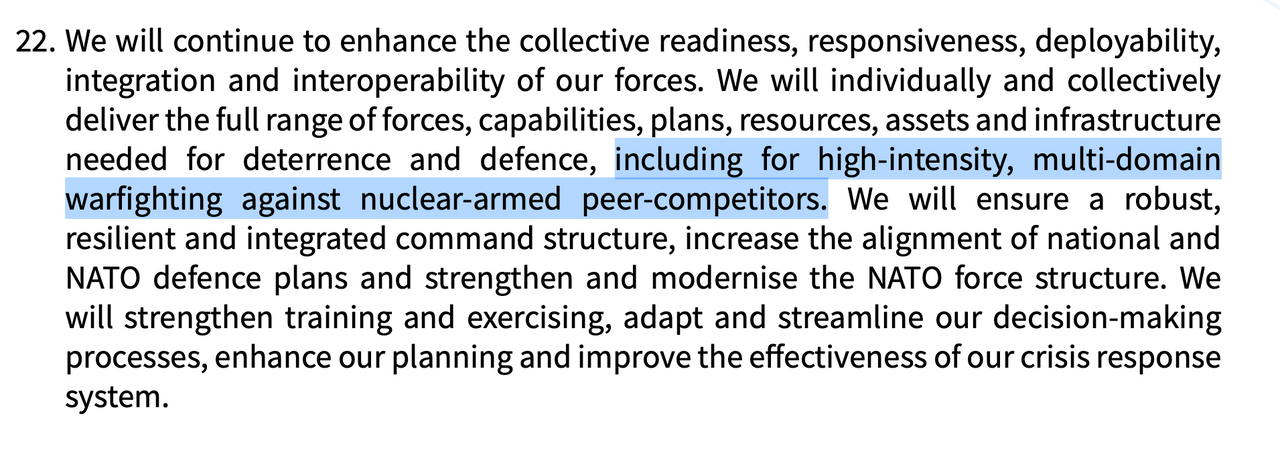 An except from the strategy document
In a sea change from the last strategy document, first published in 2010, the new NATO strategy document proclaims that “the Euro-Atlantic area is not at peace” – all but declaring that the alliance is at war. This is despite the fact that none of the members of the NATO alliance have declared any war within the “Euro-Atlantic area.”
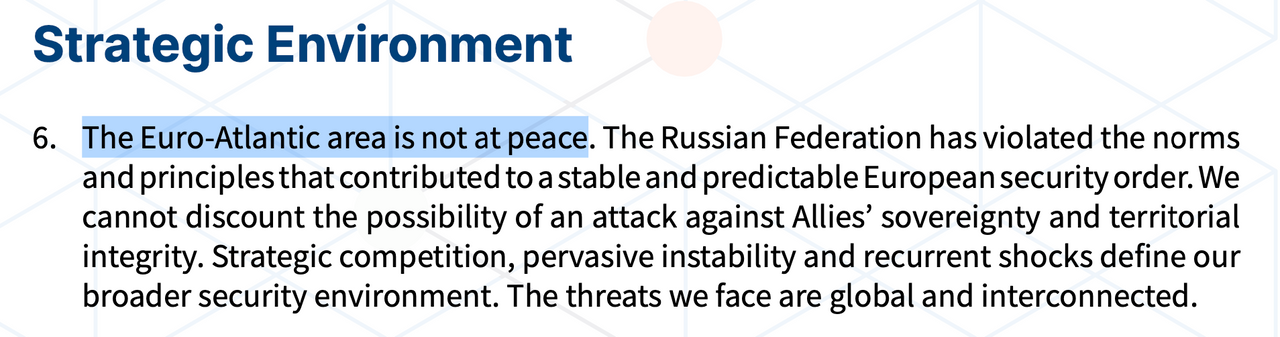 The document declares that "The Euro-Atlantic area is not at peace."
The strategic framework document openly adopts the language of power politics, better known by its German name, Machtpolitik. It references the word “interests” seven times, declaring that both China and Russia challenge the “Alliance’s interests.”
The previous NATO strategic framework, published in 2010, used the word “interests” only once, in pledging to “enhance the political consultations and practical cooperation with Russia in areas of shared interests.”
While the 2010 document named Russia a “partner,” this year's strategic framework proclaims Russia a “threat” and China a “challenge.” The new NATO strategy document explicitly justifies these designations by declaring that these countries “challenge our interests.”
It declares that “The PRC [People’s Republic of China] seeks to control key technological and industrial sectors, critical infrastructure, and strategic materials and supply chains. It uses its economic leverage to create strategic dependencies and enhance its influence.”
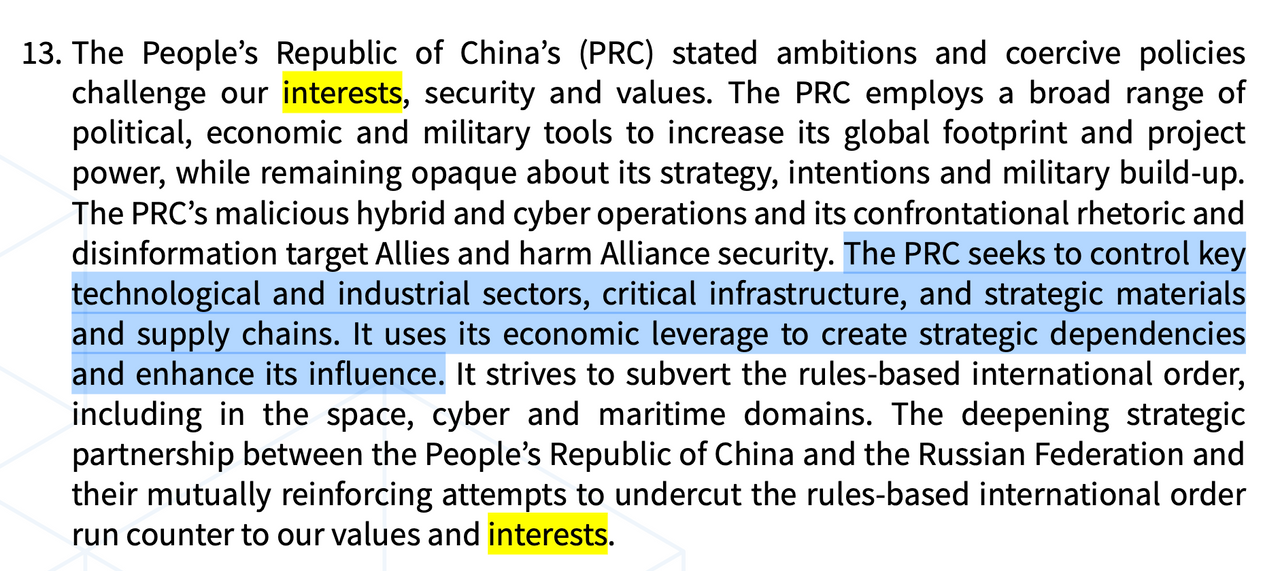 The document asserts that China's economic development (expressed as 'control') conflicts with the "interests" of NATO members.
In order to preserve their “interests,” the allies pledge to “significantly strengthen deterrence and defense.”
Critically, the document asserts that the series of actions that triggered the war in Ukraine have been a success, declaring “NATO’s enlargement has been a historic success.” The Kremlin justified its invasion of Ukraine by claiming that Ukraine’s efforts to join NATO and the deployment of nuclear weapons on Russia’s border constituted a threat to its national security.
The NATO document doubles down on the expansion of the military alliance, declaring, “We reaffirm our Open Door policy…. Our door remains open to all European democracies that share the values of our Alliance.” It added, “Decisions on membership are taken by NATO Allies and no third party has a say in this process.”
The war now raging in Ukraine is the largest in Europe since the Second World War, and has already killed tens of thousands of Ukrainians and Russians. In describing the expansion of NATO as having been a success, the alliance effectively declares that these deaths, and many more to come, are acceptable costs for protecting the interests of the alliance’s members.
In response to the challenges to the alliance’s “interests,” the NATO members have pledged a program of militarization that will affect all aspects of society. It declares, “In an environment of strategic competition, we will enhance our global awareness and reach to deter, defend, contest and deny across all domains and directions, in line with our 360-degree approach.”
The document further states, “As long as nuclear weapons exist, NATO will remain a nuclear alliance” and the alliance pledges to “ensure a substantial and persistent presence on land, at sea, and in the air, including through strengthened integrated air and missile defense.” The document added that “NATO’s nuclear deterrence posture also relies on the United States’ nuclear weapons forward-deployed in Europe and the contributions of Allies concerned.”
The achievement of the goals set out in the document requires a massive expansion of the troops, munitions, and supply changes necessary for war fighting. “We will deter and defend forward with robust in-place, multi-domain, combat-ready forces, enhanced command and control arrangements, prepositioned ammunition and equipment and improved capacity and infrastructure to rapidly reinforce any Ally, including at short or no notice.”
The NATO strategy document does not acknowledge or recognize any competing priorities for military resources. The words “hunger,” “poverty,” and “unemployment” do not appear, nor is there any reference to the COVID-19 pandemic, which has killed tens of millions worldwide and one million in the United States alone.
The comments of US president Joe Biden were fully consistent with the tone of this document.
At a post-summit press conference, Biden boasted: “We provided Ukraine with nearly $7 billion in security assistance since I took office. In the next few days, we intend to announce more than $800 million more, including a new advanced Western air defense system for Ukraine, more artillery and ammunition, counter-battery radars, additional ammunition for the HIMARS multiple launch rocket system we’ve already given Ukraine and more HIMARS coming from other countries as well.”
He added that the total commitment of the US allies included “nearly 140,000 anti-tank systems, more than 600 tanks, nearly 500 artillery systems, more than 600,000 rounds of artillery ammunition, as well as advanced multiple launch rocket systems, anti-ship systems, and air defense systems.”
Yet when asked about the costs to the American public of the war, Biden did not express that this was even a consideration in determining that this was not even taken into consideration.
At the press conference, Biden was asked by a reporter, “G7 leaders this week pledged to support Ukraine, quote, ‘for as long as it takes.’ And I’m wondering if you would explain what that means to the American people—‘for as long as it takes.’ Does it mean indefinite support from the United States for Ukraine? Or will there come a time when you have to say to President Zelenskyy that the United States cannot support his country any longer?”
Biden replied, “We are going to support Ukraine as long as it takes.”
Another reporter asked about the “high price of gasoline in the United States and around the world… How long is it fair to expect American drivers and drivers around the world to pay that premium for this war?
Biden reiterated, “As long as it takes.”
Biden: Gas Prices Will be High for 'As Long As It Takes'
Biden’s declaration is an effectively unlimited pledge of social resources for the war effort. Having gutted COVID-19 funding, meaning that uninsured workers will be forced to pay out of pocket for vaccines and COVID-19 hospitalization, the American ruling class is instead pressing ahead with funneling vast social resources into the war effort.
The plans outlined in the latest NATO strategy document will have incalculable consequences, not only for the war itself, but also through the endless diversion of social resources to military spending, which will be coupled with the slashing of spending for health care and pensions, and reductions in workers’ wages.
As workers enter into struggle all over the world against the surging cost of living, it is critical that they take up as a critical demand the struggle against war and militarism.
https://www.wsws.org/en/articles/2022/07/01/pers-j01.html
David Walsh
8 hours ago
The current US Congressional hearings into the events of January 6, 2021 have exposed harsh truths about the diseased, precarious state of American democracy.
The hearings have incontrovertibly proven that Donald Trump and his allies led a serious, determined effort to overthrow the constitutional system and establish a fascistic presidential dictatorship, that this conspiracy embraced a substantial portion of the Republican Party, the judiciary and no doubt elements within the military, that it came within minutes (or perhaps seconds) and inches of succeeding and that its failure was not the result of any organized resistance whatsoever but rather happenstance, logistics, inexperience and so on.
This last fact needs to be emphasized. The American media is eternally generating “heroes,” and yet even it has not been able to come up with a single political figure identified with resistance to the January 6 insurrection, not one daring or gallant action, no photo opportunity, nothing. Fleeing politicians, people hiding beneath their seats—not an image, a phrase, a gesture associated with opposition, not one act of even symbolic confrontation.
The ongoing hearings have revealed the magnitude of the event. They have brought to light important, even explosive new facts. But the latter only raise more starkly this issue: Why has it taken 18 months to make the public aware of the reality? In any event, there is not the slightest indication that the hearings will become the basis for any action. President Biden continues to refer to members of the Republican Party as “my friends.”
It is clearer than ever that neither before nor during the coup was there any attempt to forestall or obstruct it in any way. Now, the contrast between the scale of the crimes revealed and the meagerness of the reaction is staggering.
Why did this fascistic coup come so close to succeeding?
Its preparation was no secret; it was organized in plain sight to a large degree. Trump spelled out his plans again and again in the weeks and months leading up to the 2020 election.
The WSWS at the time pointed repeatedly to the ongoing threat. In September 2020, for example, we commented that “Trump is an out-and-out fascist who is conspiring to erect a presidential dictatorship... If the [presidential] debate made one thing clear, it is that he will not accept the outcome of the election.” In October, we argued that “Trump has a strategy to steal the election, the Democrats have no strategy to oppose it.” A score of such citations could be presented.
No faction or individual in the political establishment attempted to prevent Trump’s criminal operation ahead of time. No one alerted the population to the immense risks it confronted in January 2021. The democratic rights of the American people were left entirely vulnerable for the fascist rabble to trample on.
On January 6 itself, there was no effort to put down the coup d’état while it was in progress. Trump’s extreme right supporters came close to murdering leading officials in the US government. Biden issued no statement for hours. Nor did Nancy Pelosi or Charles Schumer. The military and the police-intelligence agencies bided their time, waiting to see who would come out on top.
The coup attempt was not halted, it merely petered out. A grand total of 60 people were detained January 6—on the occasion of a concerted, violent effort to overturn the American government and the Constitution in operation for 232 years—at the US Capitol, in downtown Washington D.C. and along the National Mall, combined. Only 10 were arrested on the spot for unlawfully entering the Capitol, where they planned to assassinate leaders of Congress. The coup plotters, for the most part, made their way home and “lived to fight another day.”
Had the coup succeeded, it would have been accepted by the Democrats and the political-media establishment. Their preoccupation would have been to block, demobilize and demoralize popular opposition. Just as the Democrats accepted the theft of the 2000 election, they would have accepted the suppression of what remained of American democracy.
Had the Democrats planned to act against Trump and the fascist coup makers, they would have done so by now. They will do nothing. This is an imperialist party, a party of Wall Street and the oligarchs, propped up by the trade unions and the upper-middle class race and gender fanatics. The Democrats fear arousing the population against the far right, which all the present circumstances render entirely possible, a thousand times more than they fear each and every far-right conspiracy.
The Democrats primarily differed with Trump while he was in power over his handling of foreign policy, the Ukraine-Russia situation in particular. They wanted him to be more focused and aggressive against the Putin regime—it was this on which they based their impeachment efforts, not the president’s obvious dictatorial tendencies.
The inaction of the Democratic Party in response to January 6, despite the hand-wringing and verbal jousting, comes as no surprise. No less passive and no less criminal roles were played by the AFL-CIO and the rest of the labor federations. In the modern era, resistance to far-right dictatorship depends upon the existence of a powerful, politically vigilant working class movement. On January 6, the AFL-CIO was an irrelevancy. Then-President Richard Trumka did nothing to mobilize resistance, issued no call for a general strike or widespread protest. The only intervention along these lines was the spontaneous action of Twitter employees to cut off Trump’s account and halt his fascist provocations.
The rabidly chauvinist, pro-capitalist American union hierarchy would not be especially troubled by the prospect of a dictatorship in the US. After all, it has helped organize enough of them in Latin America, Africa and elsewhere.
The absence of opposition to January 6 extends to the academic world. Is there a single prominent intellectual who has spoken out or offered a way forward in the face of Trump’s coup? Professor Noam Chomsky rightly observed that the January 6 participants “were united in the effort to overthrow an elected government,” but then went on to blame “[white people’s] fear of ‘losing our country’” for many of the difficulties.
Authors Sinclair Lewis, Jack London and Philip Roth, among others, turned the fascist danger in America into convincing fiction. Now that the threat is more actual than at any time in US history, shamefully, the novelists, poets and dramatists have nothing to say.
The upper-middle class pseudo-left refused to take the coup attempt seriously. Historian Bryan Palmer, for example, claimed that the events of January 6 were not an insurrection and derided those who warned about their significance: “Hyperbole flowed as the trail of tears grew to a tidal wave.” Jacobin magazine lulled its readers to sleep, arguing that the “defeat” of the January 6 attempt and its “quick repudiation by the political and economic elite made plain that there is currently little base in the state or among big capital for a Trumpist coup.” Jacobin issued this immortal pronouncement: “Capital, it seems, is still committed to liberal democracy.”
What’s left of academic “radicalism” has been fatally infected by the race and gender obsession. For such people, class has been abolished as a gauge in politics. While Trump was putting together his plans for authoritarian rule, the identity politics forces in Hollywood, on campuses and in the media were maniacally focused on the persecution and prosecution of individuals over allegations of sexual abuse. To them, Harvey Weinstein, Woody Allen and Kevin Spacey represented a far graver danger than the fascist mobs.
The refusal of these elements to resist the extreme right’s attempt to seize the US government has been mirrored in their attitude toward the murderous COVID-19 pandemic and the US-NATO proxy war with Russia, which threatens a new world war.
A vast flood of cash has corrupted the media, academic life and artistic circles. Following stock market and real estate values and pursuing one’s career have largely replaced a serious concern for social issues and the fate of the broad masses.
Frederick Engels, in 1886, observed that insofar as the German intelligentsia had “set up its temple in the Stock Exchange,” it had “lost… the aptitude for purely scientific investigation, irrespective of whether the result obtained was practically applicable or not, whether likely to offend the police authorities or not.” The “old fearless zeal for theory” had been replaced by “an anxious concern for career and income, descending to the most vulgar job-hunting.” That process has metastasized in our day.
Only one movement was correct in its analysis and warnings on a daily basis of the Trump plot—the WSWS, the Socialist Equality Party and the International Committee of the Fourth International.
The WSWS is the expression of the objective, revolutionary role of the working class, and it consciously articulates the organic resistance of workers to capitalism. As this resistance becomes more pronounced, as militancy and open struggle re-emerge, the correlation between the WSWS and the struggles of the working class will become more evident and powerfully intersect.
The January 6 coup and the response of the entire political establishment to it demonstrates that opposition to dictatorship can only come from a movement that is based on the working class and fights for the overthrow of capitalism. The WSWS does not have to suppress the truth because the program of revolutionary socialism corresponds to the logic of objective developments. The exposure of capitalism is critical to the development of a movement for socialism.
Those who recognize the necessity of this struggle must make the decision to join the SEP.

https://popularresistance.org/europeans-have-far-more-reproductive-freedom-than-americans/
In both access to abortion and a pro-family welfare state, Europe beats the US hands down.
Since the end of Roe v. Wade, numerous European political leaders have lamented the decision. British Prime Minister Boris Johnson labeled the Dobbs decision a “big step backwards,” and French President Emmanuel Macron said abortion “must be protected,” as his country prepared to place a nationwide right to abortion in its constitution.
In response, conservatives have cried hypocrisy, both to deflect criticism and to cast doubt on European institutions in general. “Many of the leaders who criticized the United States for the decision have laws that are either comparable to the Mississippi law at the center of Dobbs v. Jackson Women’s Health, which outlawed abortion past the 15th week of pregnancy,” Charles Hilu writes at National Review. “Americans should be very skeptical of the opinions of leaders across the pond.”
But this is not true on multiple levels. Though there are some moderate restrictions on abortion access in most European countries (and strict ones in a few), in practice almost all of Europe had far greater access to all aspects of reproductive freedom than Americans did even before Roe was overturned, and vastly greater freedom now.
Let me start with abortion rights. As Politico Europe points out, every major European country except the U.K., Poland, and Finland allows abortion on demand for at least part of the pregnancy term, typically the first trimester, and the U.K. and Poland have wide latitude in their rules. (Andorra, Liechtenstein, Malta, Monaco, and San Marino have stricter rules, but they are tiny.)
As the Center for Reproductive Rights elaborates, there are some moderately burdensome requirements in some countries, like waiting periods in Eastern Europe or mandatory counseling in Germany. In countries like Italy, it can be hard to find a doctor willing to perform one. But none of these countries are anything like Mississippi, where a restrictive abortion law is combined with systematic legal harassment that had closed down every abortion clinic but one by 2004.
Moreover, outside of Poland, major European health care systems render these restrictions far less meaningful than they might sound. The overwhelming majority of people who want an abortion will get one as soon as possible, and thanks to the fact of universal health care in most European countries it is a relatively simple matter to get an appointment and arrange payment. Pregnancy is a difficult, dangerous, and often quite unpleasant experience, and doubly so if the pregnancy is unwanted; very few normal people will procrastinate about ending one if they can help it. Almost all abortions happen either very soon after becoming pregnant, or after learning of some terrible medical problem later in the term, in which case it is widely acceptable across Europe.
Unfortunately for Americans, our awesomely horrible health care system often means tremendous obstacles to even the simplest medical needs. About 9 percent of Americans are uninsured, and a further quarter are underinsured—and thanks to the Hyde Amendment, Medicaid will not cover abortions except in case of rape, incest, or if the mother’s life is in danger.
The theoretical expansive access provided by Roe did not actually translate into reality for many: In the 2014 Guttmacher Institute Abortion Patient Survey (the most recent one), 53 percent paid for theirs out of pocket. It also found half of abortion patients below the poverty line, and another quarter below twice the poverty line; it can take weeks or months for such a person to scrape up even a few hundred dollars if they can do it at all. And now, of course, outright bans are either enacted or coming soon in something like 26 states.
Second, the punishments for European abortion regulations are almost always far less punitive than ones written by American reactionaries (again, except in Poland). Criminal penalties of any kind are relatively rare, and nowhere is there anything like the deranged bounty hunter law Texas cooked up.
On the other hand, there is the positive aspect of reproductive freedom—that is, the freedom to choose to have children. For workers living on wages (that is, most people), having a child is a problem for three reasons. First, one’s childbearing years come early in life, when one’s income is typically at its lowest point. Second, one must take time off work to care for the child, especially when it is first born. Third, children cost tons of money to raise, which creates enormous inequality between families based on how many kids they have.
Hence the European welfare state for families, which addresses these problems through paid leave for new parents, a child benefit to help with expenses, public provision of child care, and public school. Though institutional details vary considerably across the continent, on these terms Europe is simply blowing America out of the water.
The Nordic countries set the highest bar; their systems are incomprehensibly generous by American standards. Norway, for instance, has one year of parental leave that can be split up in various ways, and both public day care facilities and subsidies for private options, a child allowance of about $170 per month for children under six and $107 per month for children six and over, and public school (along with several other smaller benefits).
The U.S., by contrast, has no national paid leave (one of only two countries on Earth without it) and no public child care. For a year, we had a jerry-rigged child allowance that all parents were theoretically eligible for (though incompetent design left out many of the poor), but Joe Manchin killed that, and today the poorest parents with little or no work income once again get nothing from the Child Tax Credit. We managed to sneak through public school, though not universal pre-K.
American reactionaries barely even pretend to care about the massive anti-family coercion created by our atrocious welfare state. A 2004 Guttmacher survey of abortion patients found fully 73 percent including an inability to afford another child among their reasons for terminating a pregnancy, yet the best movement gurus like Chris Rufo can come up with are addle-brained schemes to provide a pitiful three months of paid leave by pushing back parents’ retirement age. The belief expressed by eternally optimistic people like Ross Douthat or Peggy Noonan, that now will be the moment that conservatives combine their concern for the life of a fetus with support for parents who have to take care of the child after birth, is so ludicrous that it gets laughed at routinely in polite company.
In right-wing utopia, all Americans will find abortions difficult or impossible to obtain, even in cases of medical necessity, and then those new parents (the ones who survive giving birth, that is) will get very little government help raising the child they didn’t want. Almost no Europeans live like this and they are right to be proud of that fact.
https://popularresistance.org/teens-work-drive-and-pay-taxes-they-should-be-able-to-vote-too/
Greater Civic Engagement Will Depend On Enfranchising Young Voters.
low • er • the • vot • ing • age
noun a campaign to enfranchise younger voters for U.S. elections
“Well, you didn’t vote for me.” — Sen. Dianne Feinstein (D- CALIF.) to a 16-year-old Sunrise Movement activist in 2019, who was asking her to support the Green New Deal.
Just how young are we talking?
The most popular proposal is to give everyone 16 and up the right to vote. In the United States, 16-year-olds are working full-time, paying taxes and driving, so why not voting? And most live with their families, which may be a better time for them to cast their first vote — rather than when they’re in the midst of major life transitions a few years later.
In countries like Scotland and Austria, where 16- and 17-year-olds can vote in some or all elections, the teens vote at higher rates than their slightly older cohorts — and research shows voters who begin earlier stick with the habit. Civically engaged teenagers at home might even boost the participation of parents and other family members.
Enfranchising more young people could also combat what writer Astra Taylor has termed the “gerontocracy”: a generational cohort making long-term policy they won’t be around to deal with. While the electorate is growing more diverse and progressive overall, the system is rigged against outcomes reflecting that reality.
Do teenagers really care about politics?
They probably should. Some of the biggest problems facing society — climate change, gun violence, student debt — weigh most heavily on the young. Meanwhile, half of Congress is over 60.
What would it take to lower the voting age?
We’ve done it before. After years of mass protests (and more than 2 million Americans drafted to Vietnam), the 26th Amendment reduced the voting age from 21 to 18, adding 11 million new voters for the 1972 election.
Rep. Ayanna Pressley (D‑Mass.) revived the issue in March 2019. A month prior, Sen. Dianne Feinstein (D‑Calif.) had been curtly rebuking youth climate activists, a scene that went viral. Pressley’s plan continues to face bipartisan opposition.
There is more movement at the local level. Efforts have faltered in San Francisco and Boston, but several small cities have lowered the age to 16 for local elections, where the policy has been effective and popular. Takoma Park, Md., was the first, back in 2013; under-18 voters had a turnout rate four times higher than those over 18.
What if the teens make bad decisions?
Youth are at the forefront of some of the most dynamic movements of our time. If you’re still not convinced, consider a simple counter: Are adults really doing such a great job?
https://popularresistance.org/this-southern-appalachian-town-uses-co-ops-to-build-new-communities-around-old-industries/
Morganton, North Carolina – In the foothills of western North Carolina, the small town of Morganton is home to a growing co-op movement that’s reinvigorating the region’s once-struggling textile and furniture manufacturing industries, and refashioning them around egalitarianism and localism.
This expanding collective of frontline workers and artists is changing the way people there view industry and the nature of work.
From Sharing To Solidarity
The birthplace of bluegrass and home to the oldest mountain range east of the Mississippi River, Southern Appalachia is not only fertile soil for the sharing economy, but a co-op-driven movement known as the solidarity economy.
Aimed at generating locally rooted wealth and ensuring its equitable distribution, the solidarity economy is fiercely democratic.
For Sara Chester, co-executive director and founder of The Industrial Commons (TIC), a 501(c)3 organization that fosters employee ownership, in a solidarity economy “workers are appreciated not just for their labor but their ideas, insights, and innovations. Workers are not just a piece of the business, they are the reason the business exists.”
Sometimes referred to as the co-op model, this approach is about creating prosperous and resilient communities by emphasizing worker agency and ownership, environmental sustainability, and the value of place.
According to Tea Yang, manager of values and culture at TIC, co-ops offer a “system wide approach to ensuring everyone benefits” from a business, as compared to exploitative entrepreneurial models that tend to treat workers like expendable resources.
The power of the worker coop model can be found not only in its egalitarianism but its solution-making mechanism.
“Those closest to the process know the issues and solutions best,” Yang continues. “It’s a matter of giving them a voice, the opportunity for leadership development, and the organizational structure to enact change.”
In Morganton, TIC continues a long tradition of cooperative and solidarity movements in Southern Appalachia.
According to the “2021 Worker Cooperative State of the Sector” report, produced by the U.S. Federation of Worker Cooperatives, North Carolina is the eighth largest worker co-op state in the country, with more than 20 democratic or worker-owned workplaces.
Raised in Morganton, Chester believes the solidarity economy goes hand in hand with the region’s character and topography.
“I think there is something about Southern Appalachia and being in the mountains that have instilled a spirit in individuals and communities of a cooperative mentality,” she says.
With resources being scarce and communities often isolated, there is a long history in Southern Appalachia of individuals working together to achieve their goals.
She believes this ethos has been further nurtured by other newcomers bringing “a spirit of cooperation to our region,” including a large immigrant Guatemalan/Mayan community.
Reclaiming, Renewing, Rebuilding
Due to the region’s abundant timber, furniture manufacturing once thrived, but economic instability has plagued Southern Appalachia for decades. TIC is working deliberately to overcome that, Yang says, and capture the energy of the region’s “deep and rich history in textile and furniture craftsmanship and manufacturing.”
Once considered the furniture capital of the United States, North Carolina lost more than half of its furniture manufacturing jobs between 1999 and 2009, according to the Federal Reserve Bank of Richmond.
In part, this is a result of large manufacturers moving business overseas, often where worker wages are considerably lower than domestically—alongside other less worker-centric policies.
TIC’s bold goal, to rebuild “a diverse working class based on locally rooted wealth,” is a common refrain among team members.
What makes [Southern Appalachia] prime grounds for co-op and circular economic development is that we’re not trying to replace these existing industries, but revitalizing them by doing the work in a way that benefits everyone and the environment — not just a few people. — Tea Yang, manager of values and culture at TIC
Aware of the region’s strong cooperative spirit, Chester, TIC co-founder, saw an opportunity to enhance what was happening and wanted to ensure that local economic growth wasn’t being concentrated, but rather “shared by everyone in our community.”
TIC grew out of Opportunity Threads, a worker-owned, cut-and-sew textile plant started by Molly Hemstreet in 2008. Hemstreet and Chester met in 2012, and shortly thereafter founded the Carolina Textile District, which eventually evolved into TIC in 2015.
TIC is an incubator for regional co-ops and service programs, including the Carolina Textile District, a member-governed collection of textile manufacturers in North and South Carolina; Material Return, which uses a circular economic model to transform textile waste into new products; and Good Books, a worker-owned, women-led, cooperative bookkeeping group for the many coops and businesses in the region.
Ashley Dula, a training and hospitality coordinator for the Carolina Textile District and head instructor of their youth sewing program, says her students start with repairing their own clothes, and later develop a “skill set for potential employment. The income provided by these skills gives students the opportunity to have an affordable lifestyle in the community versus working an odds-and-ends job.”
Among these more explicitly economic endeavors are arts and educational programs, such as TOSS, a collection of arts initiatives in Morganton, including writing, murals, and art classes for children, designed to foster TIC’s shared values of solidarity economics, racial justice, and environmental sustainability.
Hometown Walkabout (HW), a guided, educational tour of regional cultural landmarks, highlights the diverse ethnic, racial, and cultural history of the surrounding county, which may surprise participants who hold very different expectations for the demographic makeup of a small Southern Appalachian town. These include a statue celebrating local African-American blues artist Etta Baker and sites related to the “Maya of Morganton,” to name a couple.
HW tours facilitate challenging conversations around race and community. For instance, participants discuss the implications of a 20-by-30-foot Confederate flag that furls next to I-40 as visitors drive into Morganton, a protest by the Sons of Confederate Veterans against the movement by other Southern Appalachians who want to take down Confederate Statues and other related symbols—including a county monument in downtown Morganton.
The program connects participants with personal narratives and conversations about the diversity of the region, and has been designed and offered to specific cohorts in the region, including attendees from UNC Healthcare, Western Piedmont Community College, and the North Carolina School of Math and Science, a residential high school focused on STEM, which recently opened a new campus in Morganton.
Some models of change focus exclusively on economic development as a means of addressing poverty, but TIC asserts a more well-rounded and grassroots approach is needed.
”We know that providing a good job that pays a liveable wage is not the only solution to eradicating generational poverty, so we take a system-wide approach that includes bringing racial equity, diversity, and inclusion to the forefront of all of our work.” says Tea Yang. “So much of systemic racism is directly tied into economic mobility and stability.
Making A Better Place — For Everyone
When asked whether there has been much pushback from the wider community — businesses, government, or residents — Sara Chester says she has “never had anyone approach us as a critic.”
People are mostly just curious, she says, which is why TIC has prioritized keeping its doors open, and being as collaborative with the community as possible.
TIC has strong partnerships and collaborations with local, city, county, and state governments, Yang notes. This may be due, in part, to their nonpartisan focus on making material changes.
“No matter the political spectrum of our partnerships,” she says, “our interests are aligned in the shared desire to develop a vibrant and thriving economy and that is something everyone can get behind.”
Nonetheless, challenges remain.
For instance, North Carolina is a right-to-work state, where state laws make it difficult for workers to unionize or have greater leverage when negotiating with employers.
While this may not completely undermine the co-op model, Yang believes it is one of their “biggest challenges,” especially as TIC helps businesses transition into worker-owned enterprises.
However, she hopes that TIC’s vision will help people become more open and interested in the co-op model.
“We do not shy away from criticism or curiosity,” she says. “We invite anyone who is skeptical about our work to engage with us and learn more about the ‘why’ behind our mission.”
TIC’s work always comes back to strengthening relationships with members of the local community — giving everyone the means to stay in a place, liberated from the pains of poverty.
“I’m from here and hope to live here for the rest of my life,” Chester remarks. “Being committed to place allows you to go deep where you live and not be worried about moving on to the next professional step or location. We’re here and we want our community to be a better place — for our children and grandchildren and everyone else’s children and grandchildren.”
https://popularresistance.org/industry-insiders-question-louisiana-regulators-over-cleanup-on-exxonmobil-land-amid-corruption-claims-and-pollution-fears/
Amid Corruption Claims and Pollution Fears.
As billions in federal funds start flowing to state orphan well programs, a DeSmog investigation raises questions about whether oil-friendly states will put industry interests ahead of the environment.
If you had ventured down a dirt road running through remote marshland along the Gulf Coast in Vermilion Parish, Louisiana, at just the right time back in late February, you might have come across a pit of gray muck. Down in that pit, you’d find a contractor welding a steel cap about the size of a dinner plate onto a stub of pipe jutting up from the mud below.
That pipe was the last visible sign of an old oil and gas wastewater well that once dropped over a half-mile deep into the earth, now plugged up and sealed by contractors hired by the state.
For decades, oil and gas companies disposed of millions of barrels of waste down that hole, ringed with cement and steel, dubbing the wastewater well Freshwater City SWD 01, according to state records.
Experts told DeSmog the well was defective and that using it put underground supplies of drinking water in the area at risk.
“It’s a mess,” said Cornell engineering professor Anthony Ingraffea, who reviewed public well records provided by DeSmog and found that Freshwater City was riddled with flaws.
That means the process of “abandoning” the old well creates new problems. “If they just do the usual plugging job, and now there’s a suspicion that this well was leaking over some period of time and contaminating the water supply,” he said, “you’ve lost the opportunity to do the diagnosis.”
Properly plugging and abandoning oil and gas wells is vital to protect the environment and stop methane leaks – but for decades, oil operators have often slipped away without paying to clean up, leaving millions of deteriorating abandoned wells across the U.S.
The abandonment of Freshwater City played out amid a firestorm of infighting and allegations of public corruption surrounding Louisiana’s orphan well plugging program, documents show. The tangle of fights between Louisiana officials over this one site offers a preview of battles that could be on the way across the U.S., potentially affecting the ultimate fate of millions of abandoned oil industry wells.
Ranking Louisiana’s Orphan Wells
Freshwater City has ties to some of the world’s biggest oil giants but wound up on Louisiana’s orphan well list, putting the burden on the state to fund its cleanup and attempt to recoup costs later.
The wastewater well sits on land that’s owned by ExxonMobil, was drilled by ConocoPhillips, and eventually wound up run by a tiny start-up called Black Elk Energy that specialized in wringing out the last dregs of oil from aging wells.
Black Elk went belly-up in 2015 after a deadly explosion on one of its offshore platforms — leaving a bankruptcy judge in Texas to decide how the company’s remaining assets should be split between workers and the families of those killed and those to whom Black Elk owed money, including contractors hired to plug and abandon its wells.
DNR currently lists over 4,600 orphan wells in Louisiana, including oil and gas producing wells and injection disposal wells where oil and gas industry waste is gotten rid of deep underground.
The environmental threat from orphan wells and the difficulty and expense of plugging varies radically across the U.S., and regulators in different drilling regions face different issues. Done right, plugging can stop climate-warming methane emissions and other environmental issues like water contamination. In some cases, plugging wells removes a costly obstacle to companies that want to exploit the surrounding land, like nearby oil and gas drillers, who may need the wells to be plugged first.
Regulators in Louisiana – like those all across the U.S. – lack enough funding to properly plug and abandon every orphan well. Even with the influx of federal funds, only a small fraction of the wells can be cleaned up, leaving a large number behind.
So how do state regulators decide which sites to choose first? It’s different in each state, but in Louisiana there is no strict ranking system that dictates the order wells should be plugged, as oversight commission meeting transcripts show. As part of its Oilfield Site Restoration (OSR) program, Louisiana’s Department of Natural Resources (DNR) scores each site, adding points for a variety of red flags, in an effort to identify which sites are particularly problematic or slated for “potential economic development.”
At a heated April meeting of this program’s oversight commission, Commissioner David Levy demanded to know why the Freshwater City disposal well was plugged before actively polluting oil and gas wells. Companies had already stopped pumping in more wastewater years ago – and if Freshwater City had leaked when it was in use, as experts feared, those leaks would have flown into aquifers deep underground where inspectors couldn’t see them.
Levy, owner of Petrotechnologies, a company that makes specialty parts for the oil and gas industry, charged that DNR didn’t follow its own standard operating procedures when it bumped Freshwater City up the list. DNR added points to Freshwater City’s score for a “missing or damaged” wellhead, Levy pointed out, even though the inspection report the score was based on indicated no wellhead damage and no leaks found at the surface.
“This is taxpayer money that was expended on a false document,” Levy, the most recent commissioner appointed, told the other oversight commissioners, pointing to over a half million dollars in costs for the project. “I’m astounded. I don’t know where — what to do with this.”
The final bill for Freshwater City isn’t yet in, DNR told DeSmog, but a spokesperson estimated costs might have reached up to $700,000. That would mean that the project cost nearly ten times the roughly $71,000 it cost DNR to restore an average orphan well from 2008 to 2019, state records show.
Some of the state’s highest scoring orphan wells have obvious methane leaks, have no wellhead left, or are close to habitat for endangered species.
Levy was puzzled to find lower-scoring wells were slated to be plugged before wells that were more dangerous to the environment and public when he reviewed DNR’s choices. Freshwater City jumped out at him, he said, because it consumes a large chunk of the fund’s annual budget and it is located on ExxonMobli’s land.
At the April oversight meeting, Levy asked if DNR had updated their standard operating procedures, a revision due in 2018. DNR said the agency likely had not, but would look into it.
DNR spokesperson Patrick Courreges told DeSmog that the agency’s decision to plug Freshwater City was based on damage to its storage tanks from Hurricane Laura in 2020 and not just the score at the heart of Levy’s objections. “If you look at our checkboxes, ‘migrating tanks’ is not on there,” he said about the decision to add points for a damaged wellhead. “So we think what our inspector did was just say, ‘okay, that’s part of the well set up, so I’m going to count it as that.’ We didn’t have a way to check a box and say okay, ‘tank batteries have left the building.’”
But Levy, who took aerial photos of the site, dismissed DNR’s claims that the storm damaged tanks represented a threat to the public. He told DeSmog that, like Cornell’s Ingraffea, he’d also become concerned that by plugging Freshwater City, state regulators had made it much more difficult and expensive to trace any possible past water contamination back to the companies responsible.
Registered drinking water wells nearby include both shallow wells and others reaching over 600 feet down, state data shows.
When asked if there was reason to be concerned the well could have caused water contamination below ground during the decades it was used to dispose oilfield waste, Ingraffea replied: “Absolutely.”
DNR, which permitted the injection well back in 1972, oversaw its use for decades, and ultimately arranged for its plugging and abandonment, told DeSmog it believes water contamination was unlikely. “Our folks aren’t seeing a good pathway for injection fluids to have gotten out,” Courreges told DeSmog.
“If you tried to get us to permit a well in that configuration today, we would not permit it,” he said, saying the well had been grandfathered in by DNR during the early 1980s. He said the agency was looking into allegations that DNR should have caught problems at Freshwater City in the 1990s, when the well underwent another review to see if it met federal standards. He agreed that Freshwater City had some problems but disputed others, saying that it “would probably pass” those federal standards, in DNR’s view.
Courreges confirmed DNR does not test for groundwater contamination when injection wells are plugged. “Unfortunately, we’re not set up to do that,” he said, noting that testing adds costs. “That probably would be one for the landowner to try and take up with the operators up the chain, if they can.”
“Nobody’s complained to us,” about their drinking water, Courreges noted. “That’s not the same as saying that it’s not possible.”
ExxonMobil and ConocoPhillips did not respond to questions from DeSmog, including when asked if the companies were aware of any groundwater pollution related to Freshwater City.
A Trip To Freshwater City
As with so many oil industry orphans, the story of Freshwater City runs from riches to rags, a Horatio Alger tale spun in reverse.
About a century ago, famed businessman E.A. McIlhenny, whose family made its fortunes producing Tabasco Sauce, bought up a 150,000-acre swath of swampland in Vermilion Parish along the coast of southern Louisiana.
It was “all part of this grandiose vision that he had to set up a great hunting and fishing and recreational facility,” Judge William P. Edwards III, then-president of Vermilion Corp., one of a host of corporations that eventually grew out of McIlhenny’s plans, explained to historians, “a place for northerners to come down and sort of snowbird.”
Enticed by the discovery of oil and gas in the region, Humble Oil (now ExxonMobil) bought up Vermillion Corp.’s land in 1958, then leased the surface rights back to Vermilion.
Some of Humble Oil’s executives seem to have found their way to living out McIlhenny’s dream themselves. In 1958, Humble wound up being offered ten memberships in the private club that leased the property’s best hunting grounds, Judge Edwards said, adding that Humble divided those memberships among the oil company’s executives.
For decades, a blend of crude and water flowed from offshore oil wells to Freshwater City, drilled in 1975 by ConocoPhillips right where Exxon’s land met the Gulf of Mexico. A web of subleases fed Vermilion Corp. and Exxon income, legal filings show.
Those companies reported injecting at least 3.6 million barrels of wastewater piped to shore from a half-dozen Gulf oil and gas platforms into Freshwater City from 1982 to 2008 (records from earlier years were unavailable).
Black Elk purchased Freshwater City an oil company called W&T Offshore in late 2009, as part of a larger deal. But trouble lay ahead for the Houston-based start-up, founded just two years earlier.
Fueled by a New York-based hedge fund, Black Elk had embarked on a buying spree in the Gulf — and not just for oil assets. Black Elk bought up aging oil wells – and also boats, helicopters, and even a cigar room for the firm’s offices, the company’s chief financial officer would later say under oath.
Then, in November 2012, a deadly explosion rocked Black Elk’s West Delta 32 platform off Louisiana’s coast, an incident that would ultimately lead to Black Elk being convicted of eight felonies and a misdemeanor. Two of the hedge fund’s executives were later convicted of securities fraud related to Black Elk.
By 2015, Black Elk was bankrupt, brought down by creditors who dragged the company into bankruptcy court with an involuntary chapter 7 petition.
Freshwater City had fallen into disuse long before Black Elk’s bankruptcy – in fact, largely before the start-up even arrived on the scene.
By the time Black Elk collapsed, Freshwater City had seen little use for at least seven years. The well sat unused in 2006 and 2007 — “shut in due to Hurricane Rita,” records show — then was used to inject less than 5,000 barrels of wastewater shortly before the sale to Black Elk in 2009. No other volumes were reported after Black Elk took over.
Environmental groups have long criticized Louisiana regulators for allowing the oil and gas industry’s wells to linger unused and unplugged for years (unlike other states that require companies to plug and abandon wells after they’ve fallen out of use for a set period of time).
“Each storm brings more wells from ‘shut-in’ into the orphan category,” Scott Eustis, Louisiana organizer for environmental nonprofit Healthy Gulf, wrote in a March letter to the U.S. Department of the Interior, noting that 26,000 inactive oil and gas wells dot Louisiana. “These wells are ill-maintained, and we have found that coastal wells in this category are the majority of wells that leak oil and gas in storms, such as Hurricane Ida.”
After Black Elk’s bankruptcy, state inspectors who visited would find the Freshwater City disposal well site overgrown with vegetation, its massive storage tanks increasingly unsound.
Finally, in 2020, Hurricane Laura tore through Vermilion Parish, breaking Freshwater City’s storage tanks from their moorings and scattering them in the surrounding swamp. One roughly 25,000-barrel tank landed nearly a mile away. A 500-barrel tank traveled twice as far.
Not long after, Freshwater City landed on the state’s list of orphans to plug.
States Gear Up For Billions In Federal Orphan Well Funding
By the time a well is abandoned, complications may have layered on for decades — and meanwhile, any revenue generated by the well has dwindled away. But since the dawn of the oil era, the nation’s patchwork of rules governing plugging and abandonment has left important and expensive decisions until the very end of most wells’ lifespans.
The result? At least 2 million abandoned oil and gas wells across the U.S. have never been properly plugged, a 2020 Reuters investigation reported, a number that doesn’t include the wastewater wells used by the oil and gas industry like Freshwater City. Gaping loopholes make it possible for companies to slip away, leaving the mess of millions of these inactive wells.
A 2021 McGill University study estimated that one-tenth of the U.S. emissions of methane, a powerful greenhouse gas, comes from abandoned oil and gas wells, accelerating the alteration of Earth’s climate already underway. Unplugged oil and gas wells have contaminated groundwater and been responsible for deadly home explosions. And then, in Texas, there’s a sixty-acre stew of corrosive brines, dubbed Lake Boehmer by locals, from which deadly hydrogen sulfide gas wafts. The toxic lake is fed by wells the oil industry drilled decades ago — but never properly plugged.
Billions in taxpayer funds are now being aimed at cleaning up those wells — a move President Biden says will combat the climate crisis and create jobs while tackling “super-polluting” methane emissions.
The Bipartisan Infrastructure Law signed this past November set aside $4.7 billion in federal funding to plug orphan wells, which are abandoned wells without links to any solvent company that is both liable and available. Those billions are just a drop in the bucket compared to the $280 billion that watchdog group Carbon Tracker estimates it will eventually cost to plug those wells.
Federal regulators immediately reported “overwhelming interest” in orphan well funding from states.
But industry insiders like Levy, who also consider themselves stewards of the environment, and fiscal watchdogs warn that without tighter rules, billions in public funds that lawmakers said would help fight climate-altering methane leaks from orphan wells will be dished out to the same regulatory agencies that oversaw the rise in orphan wells. If those funds are misspent, they warn, they could even wind up promoting more fossil fuel production and undermining climate goals.
“We should have a new federal agency that actually does this work. An Abandoned Well Administration would directly employ people, would have the actual equipment, so we’re not renting from Halliburton during record oil prices,” said Megan Milliken Biven, former U.S. Bureau of Ocean Energy Management staffer and founder of the energy transition nonprofit True Transition. She added that she has drafted model federal legislation to do the job.
“In the U.S., oil and gas regulation is delegated to the states, where lax rules have conspired to swell the nation’s inventory of discarded and orphaned oil and gas wells,” Biven and two co-authors wrote in a June 15 American Prospect op-ed.
“The states should not be doing this because the states are co-creating the issue,” she told DeSmog, explaining that the ground rules states set over the years wound up allowing drillers to avoid liability. “We would not have orphan wells if state regulators did not create them. They are orphan [well] creators.”
Louisiana DNR is expected to receive roughly $48 million in the first phase of the federal funding, which was billed as addressing climate pollution. The state’s inspectors do not currently own methane meters for field use during orphan well visits, Courreges confirmed on a call.
“It is beyond me why that is not taking place,” Commissioner Levy said at the most recent commission meeting in late April. “They’re like $120 off of Amazon.”
This gap leaves the field inspectors who are examining abandoned wells to rely on little more than listening for the sound of hissing gas to detect leaks of colorless and odorless methane.
“You may see us moving to that,” Courreges said about the state possibly investing in methane detectors. “I think a lot of regulatory agencies — and we’re one of them — are dealing with a shift in the way we approach dealing with methane.”
Courreges added that DNR had begun looking into collaborating with local universities to help develop techniques to identify high risk orphan wells, explaining that effort could help the state figure out which wells to plug first and to demonstrate that DNR’s work reduces methane emissions.
Claims Of “Corruption Within The Government Agency”
Levy isn’t the first oversight commissioner to raise concerns about how Louisiana spends its orphan well funds in recent years, documents obtained via open records requests show.
“I recently began to observe what appeared to me, and in my opinion, [was] corruption within the government agency I was trusted to serve,” then-Commissioner John Connolly wrote in a March 31, 2021 email to Mark Cooper, chief of staff for Governor John Bel Edwards, who had appointed Connolly. The email asked the governor to accept Connolly’s resignation.
Just one day earlier, documents show Connolly and other Oilfield Site Restoration Commission members had been informed by a DNR representative that the state was “seeking opportunities presented by the federal legislation” to fund orphan well plugging and abandonment.
Shortly after Connolly’s resignation, in May 2021, DNR opened bidding for the Freshwater City project.
DNR confirmed that no formal investigation into Connolly’s allegations was ever launched by the department. A legislative auditor did ask a few questions, he noted, but DNR didn’t hear more about it afterwards. “As far as we could tell, we couldn’t see anything founded by it and he didn’t get into any specifics, he just said there’s corruption, he just said that ‘you’re not doing it right,’” Courreges said.
“He didn’t agree with the way the program was carried out,” the DNR spokesperson continued, “and seemed to view anything that was done in a way that he didn’t agree with to be corruption.”
Oversight Commissioner Told To Pay For State Records
Connolly’s resignation email had pointed to “recent” disputes over access to information and data he said he needed from DNR to fulfill his duties.
Courreges said that no other oversight commissioner asked for as many documents on the program’s spending as Connolly had.
Commissioner Connolly, DNR decided, would have to pay for copies or to come into DNR’s office and review them like any member of the public.
“If he had said, ‘okay, the board needs this,’ and got a majority of the board to vote, yes, we want the staff to turn that over, we’d turn it over to everybody,” Courreges said, “but if it’s just him asking, then by the law, we’re supposed to be charging so much a page – and he balked heavily at that.”
Connolly declined to comment, including on the reasons for his resignation from the oversight commission, when contacted by DeSmog.
Levy, who took Connolly’s seat on the oversight commission, has raised much more public concerns about DNR’s choices by airing those concerns in a public forum.
“It’s like, when I ask, ‘why did you say that the wellhead was damaged and this picture shows this wellhead, there’s nothing wrong with it,” he told DeSmog. “And they just start talking nonsense.”
DNR Takes Lead On Federal Funds
When it comes to the new influx of federal funding to clean up orphan wells, DNR plans to leave the state oversight commission on the sidelines, Courreges said.
“The OSR commission is not going to have a role in the federal dollars. That’s going straight through, being managed through the office of the secretary” of DNR, Courreges said.
The commission will continue to oversee the state’s orphan well fund, Courreges said, explaining that the agency’s program staff will handle much of the legwork created by the influx of federal funds.
“The oversight is basically, ultimately going to be the federal government.”
The ten-member oversight commission, by state law, includes four members nominated by industry groups and one by a landowners association (plus two from DNR, two nominated by environmental groups, and one at-large member). This setup positions commissioners to oversee spending that might benefit the corporations that employ them. “I work for Apache Corporation,” Commissioner Tim Allen said during an OSR commission meeting in January, referring to a Houston, Texas-based oil and gas company. “We have a plethora of these types of wells on our property, and I’m anxious to work with everybody and let’s make this problem go away for the state of Louisiana.”
In May, Louisiana enacted a state law designed to position the DNR to capture an estimated $200 million in federal orphan well grants — by giving DNR more discretion and allowing it to spend more on plugging low-priority wells.
Separately, DNR also recently asked federal regulators to give the state more authority over permitting new injection wells in the future – giving the state power over so-called “Class VI” injection wells, used for carbon capture. But critics say the feds should be providing more oversight of state regulators, not less.
“Both Texas and Louisiana are applying,” for that new authority over carbon capture wells, Biven said. “And really both Texas and Louisiana are in a state of crisis with their injection wells.”
The Houston Chronicle editorial board penned an editorial this month opposing approval for Texas state regulators. “Might as well let the bank robber guard the vault,” they wrote.
Getting Off The Road To Freshwater City
Orphan well watchdogs have been urging the Interior Department to act now and adopt rules to get out in front of many of the issues on display in the Freshwater City controversy.
For example, federal programs should first test for existing leaks and casing problems and then plug the wells, Ingraffea, the Cornell engineering professor, told DeSmog.
That process, he suggested, can preserve vital evidence – and help regulators figure out which wells actively pose hazards and should jump to the front of the line. He called on federal regulators to adopt that plan in public comments on the new pot of cleanup money in March, he noted.
Guidance released by the Interior Department in April for the first round of funds encouraged states “as a best practice” to inspect for leaks and to “measure or estimate” water contamination before plugging wells – but fell far short of requiring states to do the sort of testing Ingraffea described. States should report on water contamination and other pollution, Interior wrote, but they will be allowed to rely on estimates rather than measurements.
The guidance also allows well plugging programs to rank orphan wells based on factors including “other land use priorities” – a phrase that opens the door to plugging old wells to make it easier and cheaper for oil companies to drill new ones nearby.
Maps of the Louisiana coast show the land surrounding Freshwater City is largely owned by oil and gas giants including ExxonMobil and is located near Henry Hub, Vermilion Parish’s famed pipeline hub, making the area potentially prime acreage for carbon capture projects that play a major role in the oil and gas industry’s favored response to the climate crisis.
Interior wrote that federal rules may be “further refined” after the first round of grants – meaning the debate over prioritization and pollution is hardly over.
Watchdogs have said it’s crucial for federal plugging and abandonment programs to start making oil and gas wells that are actively polluting a top priority.
Because plugging Freshwater City proved so expensive, DNR will be able to seek repayment from two of the oil companies that previously used the wastewater well, making Freshwater City an outlier in that respect. State law allows regulators to seek repayment from earlier operators – but only if costs exceed $250,000. (In general, the capped OSR fund is replenished with fees from oil producers, which bring in about $4 million a year.)
Courreges told DeSmog he didn’t have readily available figures for how often DNR ultimately recouped those costs.The problem too, environmental advocates say, is that it can take time to fight over who pays once things hit that point – and timing matters, particularly when it comes to climate-altering methane leaks and other pollution. They are calling for structural changes across the U.S. to make it harder for drillers to walk away from cleanups – including making drillers pay into trust funds to cover plugging up front. A recent Carbon Tracker report details ideas on how to prevent games of hot potato both on land and offshore.
Right now, the oil and gas industry is relatively flush with funds amid surging oil and gas prices. But the emerging energy transition — as well as the shale industry’s struggles with profitability over the past decade — suggests this won’t always be the case.
Environmental advocates remain deeply concerned about the possibility that funds meant to combat climate change could wind up being used to prepare old oil and gas sites for more drilling or fossil fuel infrastructure. If cleanup funds aren’t prioritized with climate in mind, they warn, the result could be that billions in spending winds up fueling today’s climate fires, rather than fighting them.
“They have all of the information in the priority systems,” Levy said, “but they don’t choose to pick them according to the priority system.”
“It’s a complete fraud on the Louisiana citizens that expect this operation to protect them,” he said.
