Saturday, June 11, 2022

Global Warming After Emissions End


https://consortiumnews.com/2022/06/09/global-warming-after-emissions-end/

June 9, 2022


Climate scientist Julien Emile-Geay discusses the implications of “committed warming.”


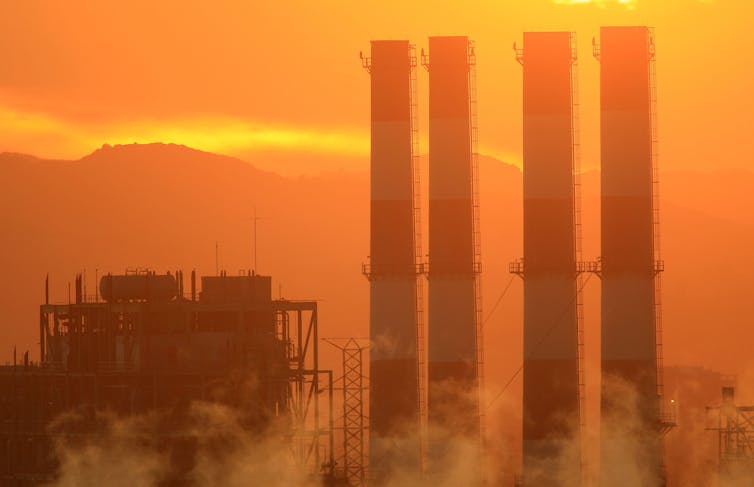
Greenhouse gases emitted today will warm the planet for years. (David McNew/Getty Images)

By Julien Emile-Geay
USC Dornsife College of Letters, Arts and Sciences

By now, few people question the reality that humans are altering Earth’s climate. The real question is: How quickly can we halt, even reverse, the damage?

Part of the answer to this question lies in the concept of “committed warming,” also known as “pipeline warming.”

It refers to future increases in global temperatures that will be caused by greenhouse gases that have already been emitted. In other words, if the clean energy transition happened overnight, how much warming would still ensue?

Earth’s Energy Budget Out of Balance

Humans cause global warming when their activities emit greenhouse gases, which trap heat in the lower atmosphere, preventing it from escaping out to space.

Before people began burning fossil fuels to power factories and vehicles and raising methane-emitting cattle in nearly every arable region, Earth’s energy budget was roughly in balance. About the same amount of energy was coming in from the Sun as was leaving.

Today, rising carbon dioxide concentrations in the atmosphere are more than 50 percent higher than they were at the dawn of the industrial age, and they’re trapping more of that energy.
Earth’s delicate energy balance. (California Academy of Sciences)

Those carbon dioxide emissions, together with other greenhouse gases such as methane, and offset by some aspects of aerosol air pollution, are trapping energy equivalent to the detonation of five Hiroshima-style atomic bombs per second.

With more energy coming in than leaving, Earth’s thermal energy increases, raising the temperature of land, oceans and air and melting ice.

Warming in the Pipeline

The effects of tampering with Earth’s energy balance take time to show up. Think of what happens when you turn the hot water faucet all the way up on a cold winter day: The pipes are full of cold water, so it takes time for the warm water to get to you – hence the term “pipeline warming.” The warming hasn’t been felt yet, but it is in the pipeline.

There are three major reasons Earth’s climate is expected to continue warming after emissions stop.

First, the leading contributors to global warming – carbon dioxide and methane – linger in the atmosphere for a long time: about 10 years on average for methane, and a whopping 400 years for carbon dioxide, with some molecules sticking around for up to millennia. So, turning off emissions doesn’t translate into instant reductions in the amount of these heat-trapping gases in the atmosphere.


Second, part of this warming has been offset by man-made emissions of another form of pollution: sulfate aerosols, tiny particles emitted by fossil fuel burning, that reflect sunlight out to space. Over the past century, this global dimming has been masking the warming effect of greenhouse emissions. But these and other man-made aerosols also harm human health and the biosphere. Removing those and short-lived greenhouse gases translates to a few tenths of a degree of additional warming over about a decade, before reaching a new equilibrium.

Finally, Earth’s climate takes time to adjust to any change in energy balance. About two-thirds of Earth’s surface is made of water, sometimes very deep water, which is slow to take up the excess carbon and heat. So far, over 91% of the heat added by human activities, and about a quarter of the excess carbon, have gone into the oceans. While land-dwellers may be grateful for this buffer, the extra heat contributes to sea level rise through thermal expansion and also marine heat waves, while the extra carbon makes the ocean more corrosive to many shelled organisms, which can disrupt the ocean food chain.


Earth’s surface temperature, driven by the imbalance of radiant energy at the top of the atmosphere, and modulated by the enormous thermal inertia of its oceans, is still playing catch up with its biggest control knob: carbon dioxide concentration.

How Much Warming?

So, how much committed warming are we in for? There isn’t a clear answer.

The world has already warmed more than 1.1 degrees Celsius (2 F) compared to pre-industrial levels. Nations worldwide agreed in 2015 to try to prevent the global average from rising more than 1.5°C (2.7 F) to limit the damage, but the world has been slow to react.

Determining the amount of warming ahead is complicated. Several recent studies use climate models to estimate future warming. A study of 18 Earth system models found that when emissions were cut off, some continued warming for decades to hundreds of years, while others began cooling quickly. Another study, published in June 2022, found a 42 percent chance that the world is already committed to 1.5 degrees.

The amount of warming matters because the dangerous consequences of global warming don’t simply rise in proportion to global temperature; they typically increase exponentially, particularly for food production at risk from heat, drought and storms.

Further, Earth has tipping points that could trigger irreversible changes to fragile parts of the Earth system, like glaciers or ecosystems. We won’t necessarily know right away when the planet has passed a tipping point, because those changes are often slow to show up. This and other climate-sensitive systems are the basis for the precautionary principle of limiting warming under 2°C (3.6 F), and preferably, 1.5°C.

The heart of the climate problem, embedded in this idea of committed warming, is that there are long delays between changes in human behavior and changes in the climate. While the precise amount of committed warming is still a matter of some contention, evidence shows the safest route forward is to urgently transition to a carbon-free, more equitable economy that generates far less greenhouse gas emissions.


Paul Mason Says Bellingcat Launders Information for Western Intelligence


Caitlin Johnstone


https://consortiumnews.com/2022/06/09/caitlin-johnstone-paul-mason-says-bellingcat-launders-information-for-western-intelligence/


June 9, 2022


The best propaganda is generally a mixture of truth with half-truth, distortion, lies by omission and the removal of context and perspective.
Nina Jankowicz

By Caitlin Johnstone
CaitlinJohnstone.com
Listen to a reading of this article.


The Grayzone has published leaked email communications between faux-left British commentator and aspiring parliamentarian Paul Mason and a shady intelligence contractor named Amil Khan which plainly show the two plotting to use state power to subvert anti-imperialist media outlets like Consortium News and The Grayzone, as well as “far left rogue academics” and the broader left more generally.

Mason has obliquely authenticated the contents of the emails with a weird, rambling Medium post claiming to have been victimized by a “Russian hack-and-leak operation.” The post does not deny the veracity of the emails. Instead, Mason bizarrely claims that they “may be altered or faked,” as though they are not his own personal communications whose accuracy he could instantly deny if they were altered or faked in any way.

This is the same as verifying the emails and then yelling “But look over there! It’s Putin!”

It would take a very silly person indeed to look at a bunch of authenticated emails showing a major British media figure conspiring with an intelligence contractor to subvert the antiwar left and then conclude that the correct response to this would be to get angry at the Russians.


There will probably be a lot written about these leaks in the coming days, but for now I’d like to focus on the fact that, in these private communications between a media insider and an intelligence insider, the “independent investigative journalism” outlet known as Bellingcat is described as a “proxy” for Western intelligence agencies and is said to receive “a steady stream of intel” from them.

“Just as Bellingcat get a steady stream of intel from Western agencies, I suspect the attacks on you and others are fed by Russian and Chinese intel,” Mason is seen telling Khan, who has been the subject of a previous Grayzone exposé.

On the team of spinmeisters Mason and Khan were plotting to assemble to undermine anti-imperialist media, Mason said that “what it really also needs is intel service input by proxy — eg Bellingcat.” Which certainly reads like an explicit call to work with Western intelligence agencies to take down his perceived enemies on the left.

“Khan — a long-time advocate and associate of [Bellingcat] — did not once challenge Mason’s repeated characterization of the supposed citizen journalist collective as a clearing house for friendly spy agencies,” write Grayzone’s Kit Klarenberg and Max Blumenthal.


As of this writing there has been little in the way of denial from Bellingcat of those claims the closet C.I.A. fan Paul Mason made when he believed he was communicating in privacy. The Twitter page of Bellingcat’s executive director and founder Eliot Higgins tweeted, “I see the Gray Zone has acquired even more hacked emails, I wonder who keeps providing them with those, hmmmm.”

When asked by a commenter if intelligence agencies leak information to Bellingcat, Higgins replied, “No and never,” which he then immediately retreated from when pressed, saying instead, “Well if we use sources that aren’t open sources we’ll use multiple independent sources to acquire the same or related data and triangulate the data to confirm its authenticity.”

Which is a mighty long pace from “No and never,” if you look at it. It’s saying well if we do get information from someone who might work for an intelligence agency, we’ll use “related data” from other sources (who themselves may or may not also have intelligence ties) to “confirm” it.

People would be well advised to take anything Higgins says about his operation with a large grain of salt. In 2016 he dismissed the suggestion that his operation is funded by the CIA cutout known as The National Endowment for Democracy (NED) with a “Stop reading conspiracy websites.” Less than a year later he admitted when pressed that Bellingcat does indeed receive funding from NED.


This is not the first time it has been claimed that Bellingcat operates as a proxy for Western intelligence information laundering, nor the second, nor the third. As Alan MacLeod documented last year for Mintpress News, there was already a mountain of evidence that the “independent” narrative management firm celebrated and beloved by the Western political/media class operates as a proxy of the Western intelligence cartel. Mason and Khan’s communications are just one more piece on the pile.

Western intelligence agencies have numerous pathways through which they can get information, misinformation and disinformation into the mainstream press without people noticing that the news media are publishing government propaganda. Mason’s emails are yet more evidence that Bellingcat is one such pipeline for intelligence cartel psyops.

If there’s something the cartel wants published, they launder it through proxies like Bellingcat and then the news media run it saying it’s been verified by an “independent” “OSINT” (open-source intelligence service). And presto, you’ve got yourself some good old-fashioned Langley-cooked spook propaganda.

This doesn’t mean that everything Bellingcat publishes is entirely false. The best propaganda is generally a mixture of truth with half-truth, distortion, lies by omission and the removal of context and perspective. It just means it’s generally untrustworthy because it operates at the direction, knowingly or unknowingly, of sociopathic government agencies whose only interest is in domination and control.


If the term “information laundering” sounds familiar to you, it might be because you heard it used in the news, like during the George W. Bush administration when the inner circle of then Vice President Dick Cheney was leaking false claims about Iraq to The New York Times, “verifying” that information when contacted to confirm it, and then citing those false news reports when continuing to make the case for invasion.

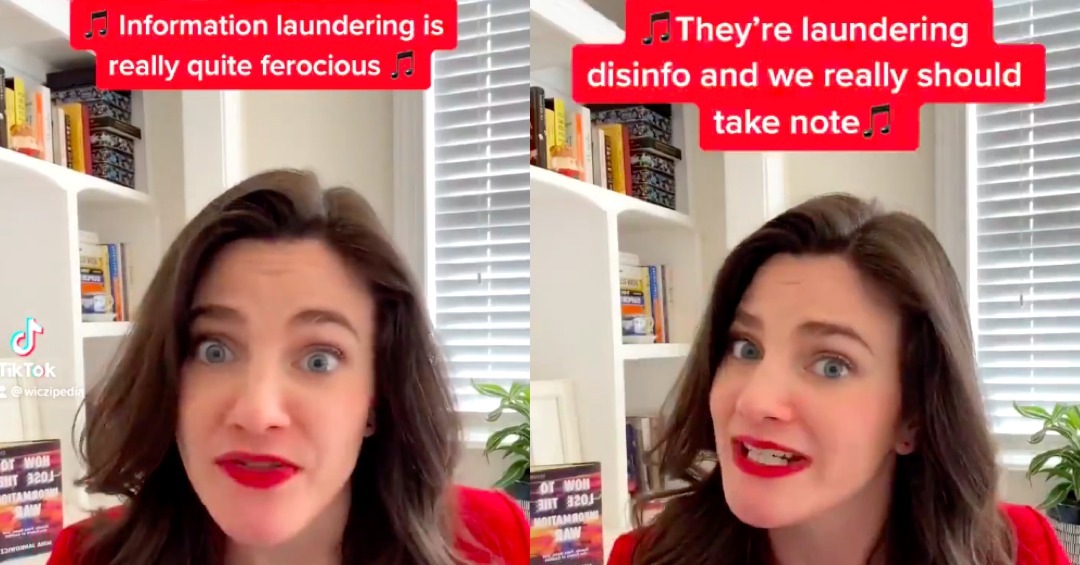
The term might also sound familiar to you because information laundering was the subject of the much-ridiculed Mary Poppins jingle sung by notorious imperial narrative manager Nina Jankowicz, who also featured in The Grayzone report. Apparently Mason contacted Khan in outrage over a Consortium News piece disputing the official imperial Ukraine narrative and Khan reached out to Jankowicz for advice on what to do.

Jankowicz told Khan that Consortium was a case of “useful idiots rather than funding,” meaning it’s not paid by the Kremlin it just publishes things that empire managers don’t like. Khan then told Mason that there was a highly suspicious gap in Consortium News publications between 2005 and 2011, which, as Consortium Editor Joe Lauria explained in The Grayzone piece, was apparently the result of Khan not doing basic fact checking and not understanding how the internet works.

Lovely.

Sing it with me now:

“It’s how you hide a little, hide a little lie! It’s how you hide a little, hide a little lie!”


The Plot Against GrayZone & Suspicions About Consortium News


https://consortiumnews.com/2022/06/09/the-uk-plot-against-grayzone-suspicions-about-consortium-news/


June 9, 2022


The GrayZone has revealed leaked emails that show the British government’s involvement with private actors plotting to take down GrayZone and asking who is behind Consortium News, writes Joe Lauria.

Nina Jancowicz, Then-Head of Disinformation Governance Board, Called CN ‘Useful Idiots’


Nina Jankowicz on Cyber Security at the U.S. Embassy Vienna in 2019. (U.S. Embassy, Vienna)

By Joe Lauria
in London
Special to Consortium News


The Establishment’s war against independent media took an even darker turn with revelations by The GrayZone on Thursday that the British government and private disinformation “experts” discussed how to damage The GrayZone’s credibilty and funding, while raising suspicions about Consortium News.

The Gray Zone is the main target discussed in leaked emails between Paul Mason, a British journalist now running for Parliament, and Amil Khan, a former Reuters Middle East correspondent embedded with jihadists, who later helped spread the notion of moderate terrorists in Syria. He now runs a counter-disinformation firm called Valent Projects.

The emails were leaked anonymously to The GrayZone and were authenticated through their metadata, GrayZone reporter Kit Klarenberg, who co-authored the piece with GrayZone editor Max Blumenthal, told Consortium News.

Target: GrayZone

The emails show Mason and Khan intent on hurting The GrayZone because they believe it spreads disinformation and because they themeselves had been exposed by The GrayZone’s reporting.

The two men were organizing a meeting of establishment figures “because, like us, you have also been targeted by a network of pro-Russian trolls…This network revolves around the outlet known as Grayzone and includes a dozen or so individuals who use online intimidation, bullying and harassment to promote pro-Kremlin talking points,” Khan wrote.

“In one leaked email,” The GrayZone reported, “Mason thundered for the ‘relentless deplatforming’ of The Grayzone and the creation of ‘a kind of permanent rebuttal operation’ to discredit it.” In another email, Khan calls for “full nuclear legal to squeeze them financially.”

Effort to Involve Government The emails provide important insight into efforts to involve the British government and appears to settle the question about the relationship between “citizen journalism” outfit Belligcat and British intelligence. Mason, in one email, said Bellingcat had been receiving “a steady stream of intel from Western agencies.”

Though Bellingcat has issued denials in the past they have long been suspected to have intelligence ties. I first heard of them in 2014 from the British ambassador to the U.N. who at background briefings to the press that I attended mentioned Bellingcat approvingly almost every week. Mason suggested inviting Belligcat to the GrayZone meeting to provide “intel service input by proxy.”


Mason has openly called for government to be involved in fighting what he calls disinformation. And the emails reveal his efforts to do so, with apparent relunctance on the part of the government.


Mason writes in another email that he invited someone from the National Security Council’s Communications Directorate, a Whitehall unit “tasked with hybrid threats,” to attend the anti-GrayZone meeting but he declined so as not to “jeopardise outcomes later.”

In another email, Mason writes that he asked “two people on the official side” does “the state monitor and counter left disinfo” and “they said no.” It was an answer Mason seems to have taken at face value. “But this is exactly why someone needs to do it,” Mason writes.


In fact, the British state has gotten in the business of countering what it sees as disinformation when it made Russian state media illegal in the U.K. after the Russian invasion of Ukraine. But it apparently has not gone far enough for Mason and Kahn in countering sites like The GrayZone. Mason and Khan’s discussions reveal a proposal from a government official to make a formal complaint about The GrayZone to OFCOM, the government’s media regulator.


Mason, in one email, shows awareness of what is really the crux of the matter. He asks Khan whether he knows the researcher Emma Briant, whom Mason calls a “specialist in this.” Mason then adds that he agrees with Briant’s concern about “the British state’s inability to do this stuff without repressing geniune left critical voices.”

‘Who Is Behind Consortium News?’


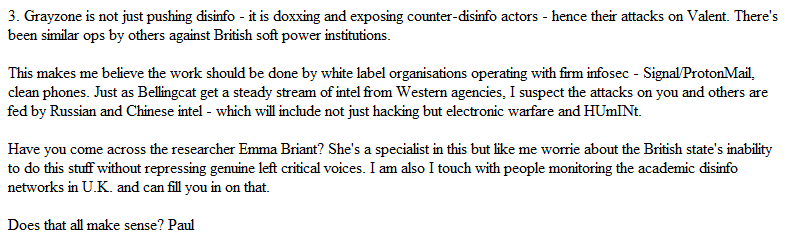
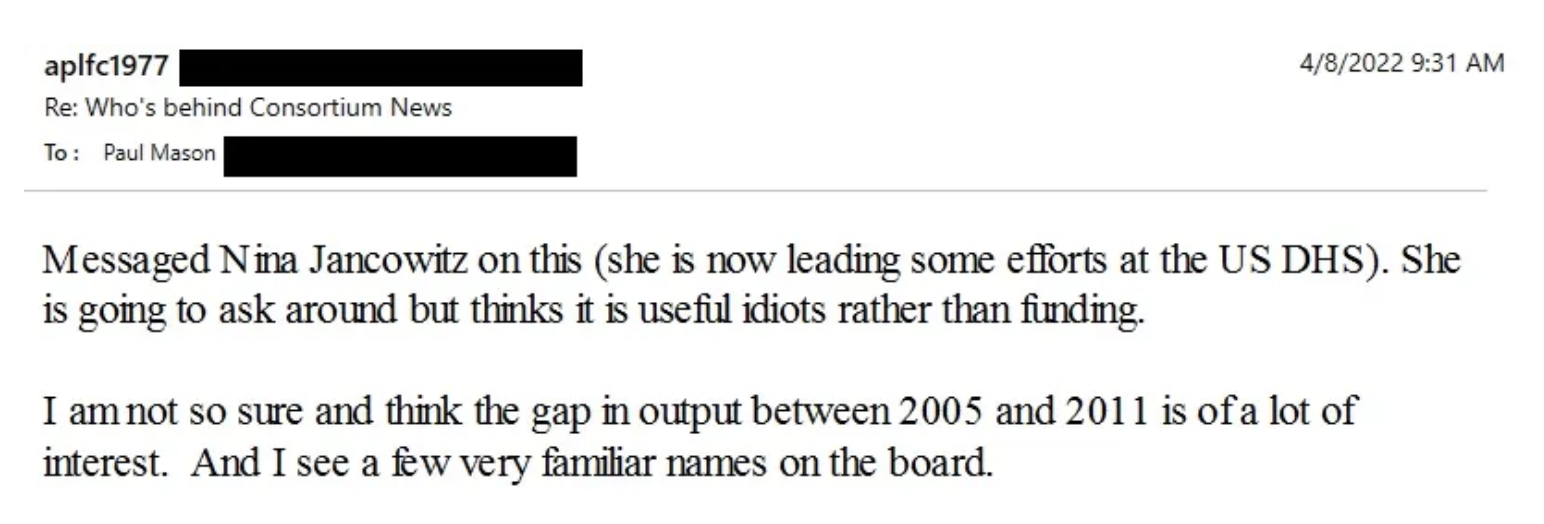
Image of leaked email from Khan to Mason on CN. (The GrayZone)

Mason wrote to Khan on April 8 objecting to an article I wrote four days earlier in which I raised questions about the Bucha massacre; said it was still unclear who was responsible; called for an independent probe and warned against rushing to judgement. I did not exonerate Russia, saying its soldiers may have well been behind the killings.

My sin, apparently, was to even dare question the narrative that was immediately being enforced before any evidence had even been gathered. That set Mason off, questioning Khan about “who is behind” Consortium News.

Khan responded that he had contacted Nina Jancowicz, who at the time was heading the Biden administration’s new Disinformation Governance Board under the Department of Homeland Security. (She has since resigned and the board has been mothballed after a fierce backlash). Kahn said Jancowicz had told him that she would “ask around” about Consortium News.

It is not clear who she asked, whether in or out of government. But Jancowicz told Kahn she thinks CN was not being funded, presumably by a foreign power such as Russia, but instead were just being “useful idiots.”

It is the same, tired formula that was used to brand anti-Vietnam war protestors tools of Beijing, Moscow and Hanoi. Criticism of one’s own government’s murderous policies just won’t be tolerated.


Consortium News has been around for nearly 27 years and established itself by breaking with corporate media before the 2003 invasion of Iraq and the 2016-to-present Russiagate story. In both cases, CN was proven right, and the corporate media wrong.

CN supports no side in the Ukraine war but has examined the causes of the conflict within its historical context that is being whitewashed from mainstream Western media, which seems to signal people like Mason, Kahn and Jancowicz that CN is not legitimate journalism.

Like the British state, as Briant pointed out, they appear unable to distinguish between independent editoral judgement that counters the mainstream, and being either “useful idiots” or funded by a foreign government. CN is funded by no government, corporation or advertisers and is producing an outside audit to prove it.

What is lost in this is the focus on whether information is true or not, and not only what its source is.

What marks independent journalism is that it examines information from various sources and uses its own agency of editorial judgement to decide what can be determined to be true or false based on the evidence, not the source.

For disinformation warriors the source appears to be everything. If it comes from Russian or Chinese media it has to be false and if it comes from Western media regarding foreign affairs it has to be true.

They are operating on the shallow assumption that Western governments really are motivated by humanitarian concerns and spreading democracy rather than pursuing economic and geopolitical interests often in the most brutal manner. They have turned reality on its head: support for Western goals is information and exposing its actual goals is disinformation.


True Believers?


Paul Mason speaking at the ResPublica Tomorrow’s Democracy day conference at The Riverfront, Newport, 2018. (Rwendland/Wikimedia Commons)

What suprisingly emerges then from these leaked emails, in which we see the unvarnished, private discussions among these “experts,” is that they really do seem to believe in what they are doing. The language of the emails does not appear to be that of operatives cynically defending the interests of powerful people, even though that is what they are doing.

It is possible they are too clever to write down, even in emails to themselves, that independent media, such as Consortium News — however limited its influence — needs to be stopped because it is a threat to those interests.

Khan undermines such an assessment of cleverness, however, when he tells Mason that he’s not sure he agrees with Jancowicz that CN isn’t being foreign funded. He points to what he says is a “gap” in Consortium News‘ publishing history between 2005 and 2011.

There was no gap in publishing. CN published throughout those years as can be easily seen on the Wayback Machine. CN began publishing on WordPress in 2011, and its founder, Bob Parry, transferred only some of the most important articles between 2003 and 2011 to WordPress.

Kahn’s assesment betrays a knee-jerk reaction and an impulse to find suspicion when one is looking for it even when it doesn’t exist. It is typical of an idelogue on a mission, not a careful researcher.

Kahn did not respond to repeated requests for interviews from CN left on his voicemail and sent to him via Signal and Telegram. CN went to his address in London and knocked on his door, only to learn that he had moved four months earlier.

The knowledge that someone as influential at the time as Jancowicz had inquired into Consortium News follows PayPal permanently banning CN and NewsGuard’s review. All of these moves came as Consortium News‘ readership increased with its coverage of Ukraine.


Though these disinformation “experts” operate in the same milieu and many know each other, and though Mason mentions in one email that The GrayZone should be deplatformed — “as with PayPal/compendium (sic) and mintpress,” there is as yet no evidence that these moves against CN were coordinated.

As these actors are motivated by the same objective to suppress criticism of the Establishment’s agenda, especially in Ukraine, they could have well acted on their own initiatives at around the same time.

The most disturbing element of the GrayZone revelations is the confirmation that these supposedly private actors are in close contact with parts of the British government, and in the case of Bellingcat at least, are recepients of government intelligence.

While NewsGuard has partnerships with the Pentagon and the State Department as well as powerful former government officials on its advisory board, there is no evidence at the moment of U.S. government involvement, for instance, with PayPal.


Mason’s Mirror

In his May 4 column in The New Statesman, Mason makes no apologies calling for direct state involvement. “We need state action to challenge the hate speech, lies and threats generated by the far right and the pro-Kremlin left,” read the subhead. He calls the U.S. Constitution “dysfunctional” because it protects what he calls “disinformation.”

Mason wrote:


“Disinformation is often defined as false information purposefully spread. But the most effective disinformation comes from spreaders who don’t know it’s false: who ardently believe it … People who share this kind of material do so because they want to believe it. The websites, Twitter accounts and YouTube channels spreading such disinformation target an audience that has drunk so much Kremlin Kool-Aid, from RT, Sputnik and George Galloway, that they cannot drink anything else.”

If Paul Mason looked in a mirror, might he see himself spreading false information purposefully because he does not know it is false and ardently wants to believe it? Might he also notice his lips tinged by the Kool-Aid dispensed from Washington and Whitehall?

Indeed, who are the useful idiots?


Iran: Khuzestan Protests Reveal Rage Towards Rotten Regime


https://socialistrevolution.org/iran-khuzestan-protests-reveal-rage-towards-rotten-regime/


Hamid Alizadeh
June 4, 2022


Protests have been increasing in Iran’s Khuzestan province, a week after the 10 and 11-story Metropol Towers in the city of Abadan collapsed, killing and wounding up to 100 people. After much hesitation, the Iranian regime called for a national day of mourning on Sunday, but the ceremony in Abadan, led by the local Friday Prayer Imam, was also disrupted by angry protesters.


Nine days have passed since the collapse of the Metropol Towers, a prestigious commercial complex built by one of the biggest developers of Abadan in one of the busiest streets of the city. According to official state media, 34 people have been confirmed dead and 37 injured, with many remaining trapped under the rubble. However, locals report that at least 44 families have been informed of the death of their loved ones. They say that the total number of dead and wounded could be up to 120.

The building collapse has lifted the veil from a network of corruption, involving developers and top officials, spanning the municipal, provincial and national level. The callous handling of the matter by the regime has sparked sporadic protests in Abadan, spreading to other cities in the Khuzestan province and beyond.

On a daily basis, growing crowds of people led by the youth, have braved a heavy security presence in taking to the streets, chanting slogans such as: “It’s a day of mourning today, the neglected Abadan is ruled by mourning today,” “Death to the dictator,” “Don’t be afraid, we are all together,” “Get lost basiji” (Basij refers to the regime’s domestic militia), “We are people of war, fight so we can fight,” “Abdolbaghi [the owner of the Metropol Towers whom the regime claims died in the collapse] is not dead,” and “I will kill, I will kill, he who killed my brother.”

Anti-riot forces have been dispatched throughout affected areas, and on several occasions they have opened fire on protesters, though for now with what appears to be non-lethal slugs. Reports also indicate that at least 100 people have been arrested so far in Abadan alone.

The repression however, has only added further fuel to the fire. Numbering in the hundreds early last week, crowds in Abadan on Sunday appeared to number in the thousands. There have also been significant protests in Ahvaz, Khorramshahr and on Minoo Island, as well as smaller protests in Omidiyeh, Behbahan, Mahshahr and Sar-Bandar and other towns and cities in the region.


The regime has attempted to stamp out news coming from Abadan by cutting off internet connections in the region, as well as tightly controlling reports in the national media. Nevertheless, a deep sense of solidarity exists with the Abadanis across the country. In the past few days there have been reports of isolated solidarity protests in Tehran, Shahr-e Rey, Andimeshk, Shiraz, Isfahan, Shahinshahr, Bandar Abbas, Bushehr, Yazd and Qom. A clip from Tehran’s Azadi Football Stadium appears to show fans chanting “Abadan” in solidarity with the people of the city.
From grief to rage

Most of the dead and wounded were poor workers, shop owners and ordinary people who were working in or just happened to be in and around the buildings when they collapsed. Their deaths have evoked a strong sense of grief across Khuzestan. This has been in sharp contrast to the official reactions of the regime, which at first appeared indifferent and aloof. Now, in a blatantly calculating and opportunistic manner, it has tried to exploit the tragedy for its own benefit.

Unmoved by the gravity of the accident, the initial response of the regime was largely to ignore what had taken place. The Supreme Leader, who often gives long, meandering speeches, did not mention the event until three days after it happened. And even then, he only spent about one minute on the topic, out of which he spent almost 50 seconds praising the authorities, and around ten seconds sending condolences to the people of Abadan.

On the same day, with much fanfare, the authorities organized a celebration rally in Tehran’s Azadi Stadium, where an estimated crowd of 100,000 people sang songs of praise for the regime and Supreme Leader Ali Khamenei. Following nationwide protests against inflation three weeks ago, the regime was eager to rally its supporters and make a show of strength. This came as a slap in the face for Abadanis who were either mourning or anxiously awaiting news of their loved ones who they believed to be under the rubble. Slogans heard in protests across Khuzestan that day included: “In Tehran there is a wedding, [while] there is a bloodbath in Abadan”; and “Khamenei leave, set the country free.”

Under the impact of rising pressure, Khamenei finally declared a day of mourning on Sunday May 29, six days after the disaster. State media was suddenly full of condolences and words meant to placate the anger on the streets. Footage of the protests was shown on TV but presented as mere mourning ceremonies. The regime also organized vigils in different locations, while a nationally televised mourning ceremony was held near the site of the collapsed buildings, led by Abadan’s Friday prayer Imam, Ayatollah Mohsen Heidari AleKasir.

But people were not in the mood to be soothed and there was enormous anger at the regime’s opportunistic attempt to hijack the city’s grief. Thus, before the Ayatollah could speak the crowds started interrupting him with chants of “Shameless!” (a word which in Persian also roughly translates as “bastard”), so that the live transmission had to be cut.


The crowds later took to the streets, where they were joined by Arab and Bakhtiari tribal youths, who marched into the city with their tribal flags symbolizing solidarity, chanting mourning songs and vowing to defend the people against repression. This is significant because the tribes are the only non-regime-linked organized groups which are openly armed in Iran. The protests were attacked by security forces, which nevertheless stopped short of using lethal violence for fear of sparking a war with the tribes.


The mismatch between the official tally of dead and injured, and the claims of the locals, is yet another source of the deep suspicion and mistrust towards the establishment that has surfaced in the wake of this tragic event. As we reported last week, another source of contention has been the fate of Hossein Abdolbaghi, the owner and developer of the building.

Abdolbaghi was first reported by the judiciary and national media outlets to have been arrested. The following day however, the story was suddenly changed and he was pronounced to have been killed in the accident. But the people of Abadan did not believe in this story. A surreal and obviously staged nationally televised clip purporting to show Abdolbaghi’s family identifying his body and weeping, only strengthened these suspicions.

Whatever the actual course of events, there is a feeling amongst the masses that something is being swept under the carpet, and that there is a conspiracy against letting the truth come to light. So far, 13 people have reportedly been arrested on charges of corruption. These include one present and three former mayors of Abadan, as well as several municipal officials. What is clear however is that Abdolbaghi’s connections went far beyond the municipal level.

So far, reports have surfaced suggesting the involvement of Ali Shahkhani, Secretary of the Supreme National Security Council; Mohammad Forouzande, the former head of Bonyad-e Mostazafan va Janbazan (the biggest holding company in the Middle East); as well as Mohammad Mokhber, the First Vice-President of Iran and former Deputy Governor of Khuzestan.

These characters have served on leading bodies of the Arvand Free Zone (a special economic free trade zone that covers Abadan) over the past three decades. As one investigative journalist reports, they, as well as top officials of Abadan municipality, were directly involved in corrupt land and construction deals with Abdolbaghi and his company Abdolbaghi Holding.

Meanwhile, others have pointed to links between Abdolbaghi’s family and Vice-President of Economic Affairs, Mohsen Rezaei; as well as the Abadan Friday Prayer Imam; and Esmail Zamani, the current head of the Arvand Free Zone. The truth is that the mafia networks that run Khuzestan include all of these figures, and they were all complicit in Abdolbaghi’s crimes.

It was through the use of such connections that Abdolbaghi could ignore building regulations, despite countless warnings from official and private experts that the Metropol Towers were unsafe. While the majority of the people of the region live in poverty under the constant threat of fines and persecution for small infringements, these people loot, plunder and generally act with impunity in the full light of day.

Abdolbaghi, while being a major developer in Abadan however, was only a small fish compared to his backers, who are connected to the very core of the regime. While trying to suppress the truth from coming out, the regime is trying to deflect blame by pointing its finger at local officials and businessmen. But the people are not being fooled.

If anything, the obvious maneuvering and blatant lies, directed towards people who have lost their family members, friends and acquaintances, is only agitating masses and stiffening the resolve of those on the streets. They sense instinctively that the true perpetrators of this crime must be found higher up, and that ultimately, the collapse of the building is only a reflection of the rottenness of the whole regime. That is the significance of the popularity of the slogan “death to the dictator,” and other slogans aimed at Supreme Leader Ali Khamenei.
Water water everywhere, not a drop to drink

Khuzestan has known its share of tragedies. In the ‘80s, the province was the frontline of the Iran-Iraq War, the scars of which still remain as part of the memory of the region. But while the regime habitually mentions the heroism of the Khuzestan in the war as a part of its own mythos, it has consistently neglected the development of the region.

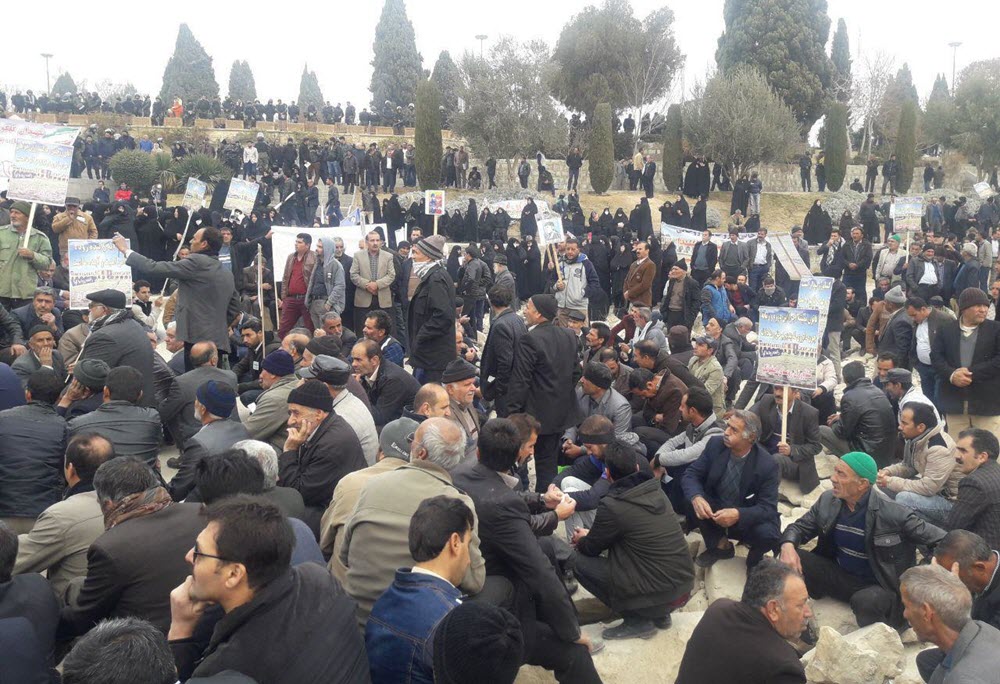
Khuzestan has some of the largest water reserves of Iran, but decades of mismanagement and the diversion of water to other areas have drained the region dry. In the past years, worsening droughts have led to severe water shortages—a problem which has become endemic in Iran—leaving 700 villages in the province without running water. Last July, this sparked protests and clashes with state security forces all over the region. The water shortages have led to dried-up wetlands and caused extreme dust storms and wildfires. As a consequence, the region’s agriculture is in tatters, a problem which is compounded by pollution of the soil caused by the oil industry.Last July Khuzestan was rocked by a protest over water shortages, when more than 700 villages in the province were without running water. / Image: National Council of Resistance of Iran
The region is also the heart of the Iranian economy, home to 80% of the country’s oil and 60% of its natural gas reserves. While billions of dollars of profit is extracted from the natural wealth of the province every year, its people are left in a state of poverty and desperation, with the third-highest unemployment rate in Iran. As such, the restive province composes a microcosm of the contradictions of Iranian capitalism.

Official youth unemployment stands at 35% and some parts of the province are reported to have up to 45% general unemployment. The Arab and Bakhtiari Lur minorities, which together form the majority of Khuzestan’s population, are particularly discriminated against and comprise some of the poorest layers in Iran.

Khuzestan is also home to a powerful industrial proletariat with revolutionary traditions. It is home to the Abadan oil refinery, one of the biggest refineries in the world, as well as numerous other oil and petrochemical industries. Abadan and Ahvaz oil workers famously played a leading role in the 90-day oil workers’ strike, which broke the back of the Pahlavi Monarchy in the 1979 revolution.

More recently, the workers of the Haft Tappeh sugar cane plantation have been at the forefront of Iranian trade union struggles, continuously calling for re-nationalization of privatized companies under workers’ control. In 2020, they secured the re-nationalization of the company, although the implementation of this is still pending. Their struggle and their slogans have become a focal point for youth and workers’ movements across the country.

Partially inspired by the Haft Tappeh workers, thousands of workers of Ahvaz steel also went several months long on strikes in 2018, calling for the payment of unpaid waves and the re-nationalization of their company. Also, last year thousands of casually employed oil and petrochemical workers of the region joined a national strike of oil workers for better wages and for permanent employment. The Iranian oil workers movement has been taking important steps towards reestablishing an independent national trade union movement, with its strongholds in the south and south west of the country.
Winds of revolution

Iranian capitalism is at a complete impasse. The enormous wealth of the country is gobbled up by a tiny minority at the top, while the majority are pushed into a state of abject poverty and desperation.

As we have previously reported, three weeks ago the regime decided to cut subsidies to basic goods such as bread and cooking oil, the prices of which multiplied overnight. This led to protests in more than 100 cities across the country. Khuzestan, with its large, poor communities, saw some of the biggest. That movement has been violently suppressed with an unknown number of people killed and detained. But it is only a matter of time before a new movement raises its head.

On a daily basis, new layers are entering the path of struggle: pensioners fight for the right to retire in dignity; teachers, oil workers, bus drivers, taxi drivers and truck drivers fight for a living wage; farmers fight for fair water distribution; the poor fight for bread; the youth fight for democratic rights; national minorities fight oppression and people everywhere fight against the endless corruption and mismanagement by officials.

We are already seeing the first signs of a convergence of these struggles, with the rise of national unions for teachers and oil workers, for instance. These in turn are becoming focal points for the wider movement, and they have begun more explicitly to express solidarity with other struggles.

But isolated and purely economic struggles are not sufficient. As we can see in the conditions of dictatorship and acute economic crisis, every struggle, however local it may appear to be at first, immediately becomes political, and necessarily turns against the very heart of the regime. The aim of the regime is to keep these struggles isolated, portraying them as local incidents, or events related to a particular layer of people, which they can deal with one at a time.

The task of revolutionaries is the exact opposite. We must show in every instance that the vast variety of movements that are erupting in all four corners of the country are essentially the same. We must fight to unite these under a common revolutionary banner, with the working class at the forefront. On such a basis, nothing can stand in the way of the Iranian masses.

Khuzestan has played a pivotal role in every revolutionary movement in Iran in the past century and the coming revolution will be no exception. The Metropol Tower tragedy has brought light to the extent of the rottenness of Iranian capitalism. It has exposed a regime at a complete impasse. But it has also revealed the explosive social forces that such conditions are preparing, just underneath the surface.



Howard Schultz, Union Buster


https://socialistrevolution.org/howard-schultz-union-buster/


 Kevin Nance
June 6, 2022


Millions of workers in the US are excited every time they hear that a new Starbucks has voted to unionize. There is now a serious campaign to unionize the company, which has more than 8,800 stores across the country. As we go to press, employees at 230 stores have already filed for union-recognition elections. The campaign to organize one of the biggest companies in the service sector has repercussions for the 240,000 Starbucks employees, the broader service industry, and the entire working class.The campaign to organize Starbucks has repercussions for the entire working class. / Image: Starbucks Workers United, Twitter

The momentum has caused a panic in the corporate offices of Starbucks and beyond. Howard Schultz has been brought back as CEO to handle this crisis. The company took this step to have a big name with “progressive” credentials to run its charm offensive. But make no mistake: nobody has more experience busting unions at Starbucks than Howard Schultz. As far back as the 1980s, Schultz worked to crush a union representing workers at a small coffee chain that Starbucks eventually absorbed. This was his first action in a decades-long career of union busting. The corporate offices of Starbucks get what they need in Howard Schultz—both the stick and the carrot.

The battle has already started to turn ugly. Starbucks is carrying out an aggressive campaign of intimidation, distortion, and lies. This is coupled with union-busting executives and lawyers using faux progressive imagery and solemn head nodding at captive-audience anti-union meetings called “co-creation sessions” in truly Orwellian fashion. The thinking is that if workers “feel heard” by the company figurehead, they won’t go through all the trouble to form a union.

According to Schultz, “I was convinced that under my leadership, employees would come to realize that I would listen to their concerns. If they had faith in me and my motives, they wouldn’t need a union.” But workers should not have any faith in Howard Schultz or his motives. He is a capitalist, and his motives are ultimately driven by the need to generate profits by exploiting the company’s workers.

Along with the saccharine talk, concessions are being promised to Starbucks employees—with the caveat that only employees who are not in the process of unionizing can get them. But giving benefits only to employees who are not union members or in the process of possibly joining the union is a blatant unfair labor practice.Schultz’s motives are driven by the need to generate profits by exploiting Starbucks workers. / Image: Gage Skidmore, Wikimedia Commons

But workers would also make a big mistake if they placed any confidence in federal or state labor law. The whole point of labor law is to mediate the class struggle by convincing workers not to mobilize their forces for victory and hope that the capitalist state will force the employer “to be reasonable.” Unions are pressured to obey the laws, but when corporations break them, the worst that happens is a slap on the wrist after years of litigation. It is not labor law, but the workers’ ability to slow down and shut down production, standing strong and united against the boss’s attacks, that protects us and wins victories.

One example of how labor law is primarily a one-way street is the three Starbucks workers fired for union activities. The National Labor Relations Board (NLRB) has sued Starbucks to reinstate these employees. The litigation will commence, and after months, at most, Starbucks will rehire the workers with back pay. This back pay—minus what they have earned elsewhere in the meantime—is only paid once it is proven that Starbucks fired that person for union activity. This means it is perfectly fine to harass, intimidate, and fire workers for union activity if Starbucks is willing to earmark a few bucks from its multibillion-dollar budget. If a worker who comes to work five minutes late happens to be fighting for a union, they can use the lateness as “just cause for termination.”

Capitalist politicians from both parties created the country’s labor laws. Half of the House Democrats’ funding in 2020 came from large individual contributions, 30% coming from PACs, and 17% coming from small individual contributions. Meanwhile, House Republicans received 40% from large individual donations, 30% from PACs, and 22% from small individual contributions. The working class has no party to represent its interests.

Howard Schultz was, until recently, a lifelong Democrat. He has toyed with the idea of running for president for decades and has been active in the halls of power, fighting for his class. He lobbied hard against Seattle, raising the minimum wage to $15 an hour. He also jumped into the fray over the Employee Free Choice Act (EFCA) battle in 2009. EFCA would have streamlined the process and made it somewhat easier to form a union, eliminating long periods between filing for elections and the actual vote to join a union. This period is intentionally protracted, during which the boss uses a mixture of threats, lies, and distortions to campaign against the union—the very process dozens of Starbucks stores are engaged in right now.The only way we will successfully organize a giant company like Starbucks is through mass mobilization. / Elliot Stoller, Flickr

In 2009, when this legislation was on the table, the Democrats had a filibuster-proof majority in Congress. A workers’ party with that sort of mandate would have quickly passed EFCA, codified Roe v. Wade into law, dramatically increased the federal minimum wage, passed universal healthcare, abolished student debt, and much more. Needless to say, the Democrats are not a workers’ party. Howard Schultz joined with the CEOs of Whole Foods and Costco to make headlines in their lobbying against EFCA. In the end, EFCA was never even voted on, thanks to the Democratic Party and the pressure that Howard Schultz and his ilk put on them.

The only way we will successfully organize a giant company like Starbucks is through mass mobilization. The Service Employees Industrial Union (SEIU) is taking the lead in organizing the union by forming Starbucks Workers United. But SEIU has donated over $15.5 million to the Democratic Party over the last decade, the same party Howard Schultz donates to. Talk about a class conflict of interest!

The only way labor can fight effectively and win against Schultz and his company is on the basis of class independence, both on the labor front and politically. After all, how could enemy number one in our union meetings be a “friend of workers” in the political arena? Starbucks workers can stand united and defeat Schultz and his gang. But this requires a clear understanding of who is our friend and who is our enemy. If the leadership of Starbucks Workers United is armed with both determination and political clarity, nothing can stop the momentum of the working class.


[Leaflet] Fight Gun Violence! Fight for Socialism! Socialist Revolution


https://socialistrevolution.org/leaflet-fight-gun-violence/


June 7, 2022


This is the text of a leaflet distributed by supporters of Socialist Revolution throughout the country. Download the PDF of the half-sheet, two-sided leaflet here.


Rosa Luxemburg once said that humanity is faced with a choice between socialism and barbarism. The longer capitalism survives, the more stressful and violent life becomes. Is there anything more barbaric than a teenager going to an elementary school to kill young children? The Uvalde massacre marks a tipping point, transforming the shock and grief of thousands of students into outrage and a vow to put an end to the seemingly endless stream of mass school shootings.

The young generation has grown up in a world of crisis, violence, and conditions of perpetual fear and insecurity—the new normality in US schools. Such tragedies are always met with rehearsed outrage, platitudes, and crocodile tears from politicians and the media. But the youth are speaking up—rejecting the hollow “thoughts and prayers” from Biden and the rest of the capitalist politicians.

The nascent movement is giving voice to a range of social demands that go far beyond the empty and impotent “culture war” debate over gun control that has prevailed in Washington and the media until now. The question of safety at school and in working-class neighborhoods is a social question tied to jobs, housing, healthcare, funding for education, and more. This is not something that can be entrusted to the armed bodies of the capitalist state!

Although many students have expressed support for liberal gun-control measures, it’s clear that a growing section of working-class youth has no trust in the capitalist state’s ability to provide safety for the workers and poor. This is especially true in the aftermath of the historic George Floyd movement against police racism and brutality, and given law enforcement’s abject failure to “serve and protect” in Uvalde.

The question of how the working class can defend itself against such attacks must be part of a broader discussion in the context of the crisis-ridden system of capitalism. This truly is a fight for our lives and futures. As long as the capitalists and their government control the main levers in the economy and society, there can be no guarantee of safety or quality of life for the working-class majority. For one, the production and distribution of arms must be placed under democratic workers’ control. And starting immediately, teachers must be provided with school nurses and psychologists, counselors, social workers, more calendar days for teaching and fewer standardized tests, and smaller class sizes to allow teachers to get to know students and parents better.

Even the very young can sense that these shootings reflect a much deeper and systemic problem. As one New York City sixth-grader put it after yet another shooting, “My dad said he never worried about school shootings or had lockdown drills. Something had to have changed to go from not having to worry about it, to multiple school shootings. We have to see what changed to allow this to happen, to see what needs to change.”

For Marxists, this tragic pattern is, above all, an indication of the social decay of a system that was ripe to be overthrown long ago. Whatever the immediate motivations of the shooters, these mass killings, as with other forms of terror, reflect the impasse of a society in decline. A century after Lenin described capitalism as “horror without end,” millions of people find themselves living in a society in which they can see no future for themselves. Today’s youth are the first generation to have a lower standard of living than the one that came before it. As a result, off-the-chart levels of desperation, alienation, depression, mental illness, and countless other consequences of soul-crushing life under class society are pushing humanity to a breaking point.

After the Parkland massacre in 2018, the CEO of the NRA, Wayne LaPierre, warned that the growing youth movement was part of a “new socialist wave in America.” If young people continue to draw radical conclusions about the need to fight for social demands through class struggle—which must include a break with both the Democrats and Republicans—the aptly named “Generation Z” may indeed leave its mark on history as the last generation to come of age under the inhuman conditions of capitalism.For a revolutionary socialist solution!
 

The working class can depend only on its own forces and organizations to guarantee its safety and quality of life!
 

Schools should be democratically run and defended by teachers, school workers, students, and parents, and the broader working class!
 

Quality education, childcare, and healthcare should be free and universal from the cradle to the grave!
 

Nationalize the arms industry under democratic workers’ control!
 

Break with the parties of Wall Street and build a mass, working-class socialist party!


Mexican Marxists Discuss the Tasks of Revolution at Their 21st Congress!


https://socialistrevolution.org/mexican-marxists-discuss-the-tasks-of-revolution-at-their-21st-congress/

Rubén Rivera
June 8, 2022 Image: La izquierda socialista


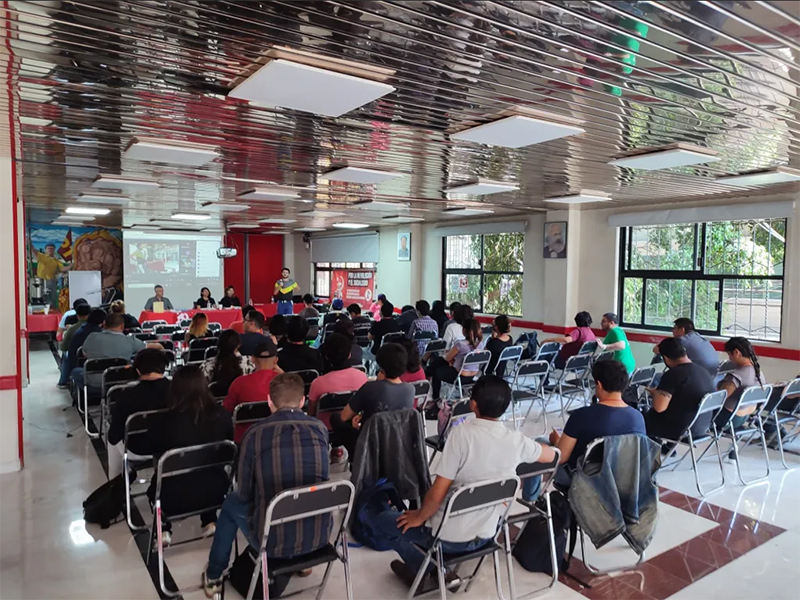
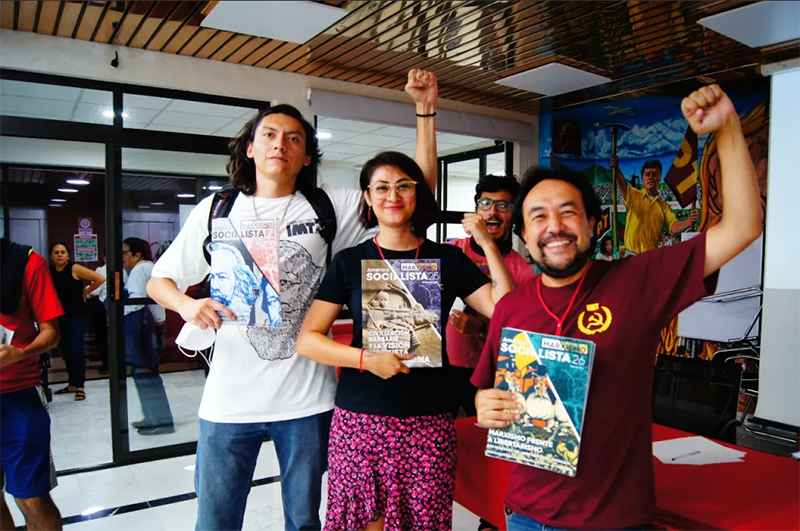
On May 21 and 22, 2022, the congress of the Socialist Left (the Mexican section of the IMT) was held in Mexico City, with about 85 attending both in person and online. The event saw lively and enthusiastic discussions about the national and world political situation, and the tasks ahead for building the forces of Marxism in Mexico and across Latin America!

Read the original in Spanish

This event took place in the context of the worsening of the capitalist crisis at the international level, characterized by a fierce imperialist war in the Ukraine. In the economic field, the imperialist tensions and the consequences of the crisis can be felt across the Americas. The war is a symptom of the relative decline of US imperial rule, which is also expressed in increasing conflicts with China and turbulence in other regions.

The effects of this crisis are already spreading throughout the world, and we are seeing economic stagnation combined with runaway inflation. War, disease, and famine are all that capitalism offers in the current phase of its existence.
Great enthusiasm

The congress was attended by delegates from Sonora, Chihuahua, Hidalgo, Mexico State, Puebla, Veracruz, Querétaro, Mexico City, Oaxaca, Chiapas, Quintana Roo, Yucatán, and Jalisco. Among the attendees, the comrades from the state of Guerrero and Campeche stood out, as well as trade unionists from the SNTE-CNTE in various sections.Around 85 comrades from all around Mexico took part at the national congress of La Izquierda Socialista. / Image: La Izquierda Socialista
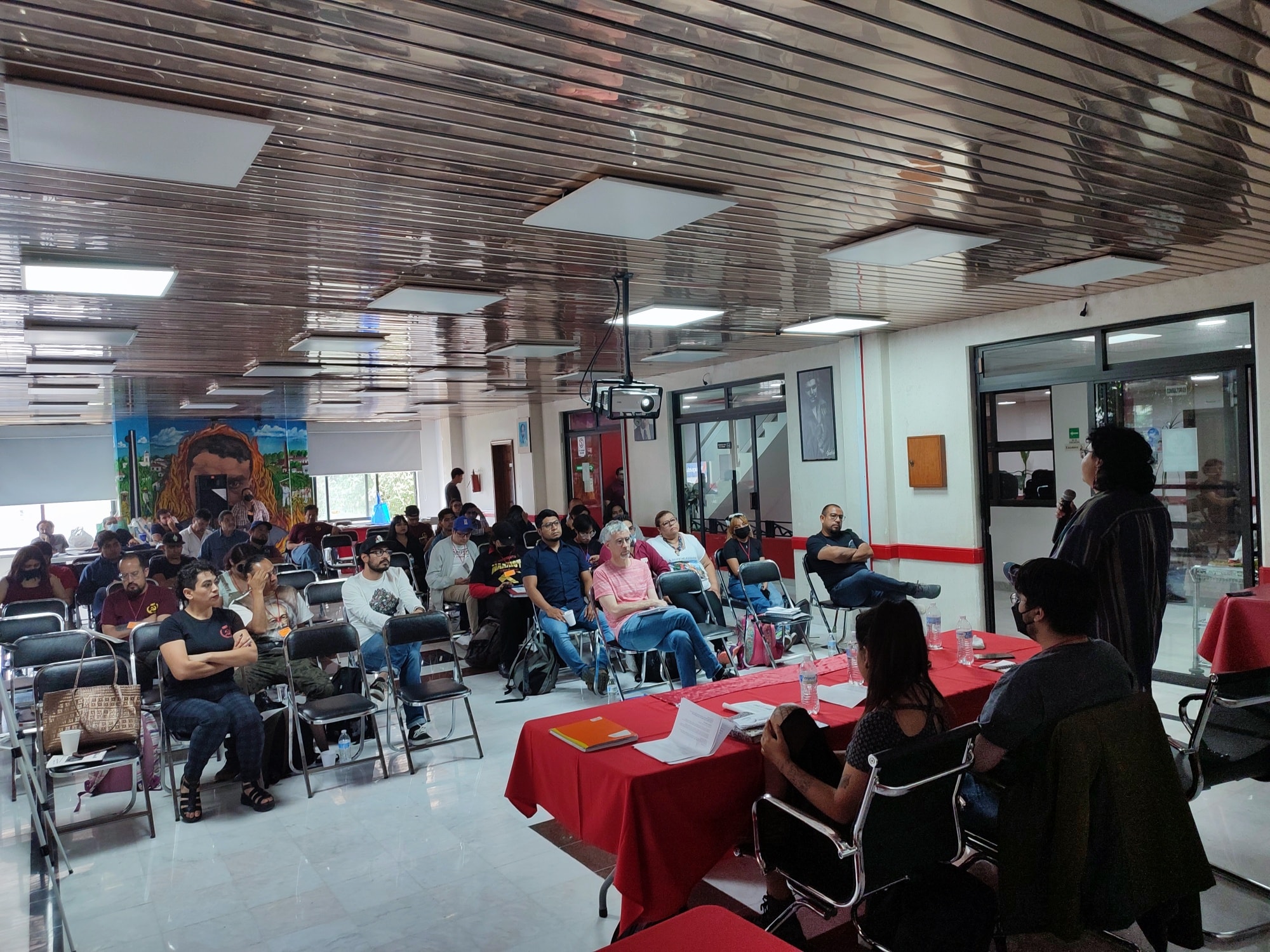
There were also comrades from Teléfonos de México, workers from Mexico City, civil servants, call centre workers, grassroots militants of Morena (political party of the sitting president), and many others.

Also noteworthy was the participation of women comrades, who have actively engaged in all the struggles that have taken place in recent years in the broad women’s movement, and belong to the League of Revolutionary Women (la Liga de Mujeres Revolucionarias). Of course, we cannot forget the participation of student comrades from the different states that we have already mentioned, and from the centre of the country; especially the IPN, UNAM and UAM universities. These young comrades brought a spirit of great enthusiasm and high morale to the congress.

The congress has confirmed Izquierda Socialista as the definitive heir to the revolutionary tradition that began in Mexico with the founding of the first group of the International Marxist Tendency, consisting of IPN students organizing between 1989 and 1990.

On the first day of the congress, the international situation was discussed. Jorge Martín, a leading member of the IMT, led the session. Emphasis was placed on the characteristics of the war in the Ukraine and its imperialist nature, as well as the deep economic crisis, from which there is no clear way out at this moment.The discussion at the congress ranged from Mexican and world perspectives to reports on the growth of the IMT. / Image: La Izquierda Socialista
A revolutionary road forward is impeded by the absence of the subjective factor; hence the importance of emphasizing the need to organizationally strengthen a revolutionary alternative.

Afterwards, national perspectives were discussed. This is a particularly important issue, given that it is necessary to establish a correct position regarding the nationalist government of López Obrador and his reformist policies. The experience of this government basically shows that, within capitalism, any policy of class conciliation only postpones the definitive battles, at the cost of increasing the contradictions of the system.

In this context, while denouncing the character of the right-wing opposition as the most rotten expression of the Mexican oligarchy, we emphasize the need for the absolute class independence of the workers’ organizations in defense of their concrete demands, striving for greater cohesion and unity of the different struggles; always pointing, in the context of this situation, to the socialist alternative.
Revolutionary methods and traditions

The next topic of the congress was a report on the development of the International Marxist Tendency, which already extends its activities across the five continents. In the context of the recent pandemic, it managed to double its forces thanks to a bold orientation towards the youth, based on the defense of the ideas of Marxism against so-called progressive trends such as postmodernism, and nationalist and petty-bourgeois deviations.

The first day ended with an analysis of the organizational tasks and different proposals of how to build the forces of Izquierda Socialista.The mood at the congress was one of enthusiasm and militancy for the battles ahead. / Image: La Izquierda Socialista

The second day of the congress dealt with issues of an internal nature, linked to the different fields of struggle for the Mexican Marxists. The maturity and seriousness of the interventions, and the leading role that the different comrades are playing in so many battles of the working class and youth, was remarkable to witness.

Later, the methods of building the organization, based on democratic centralism, were analyzed in detail. Comrades went over our methods, and practical examples of development.

This also involved a historical analysis of the different phases of development of our organization: the lessons imparted by the triumphs and the crises that we have experienced. This was an especially important discussion, given that most of the members of the organization today joined in the last period. Is necessary to strengthen the traditions and teachings of the organization’s history.

Finally, we held a successful fighting fund collection, which will allow us to continue building the forces of Marxism in Mexico. We voted on and approved different resolutions of a political and organizational nature that will be decisive to continue advancing the construction of the revolutionary alternative in Mexico and Latin America.