Saturday, June 11, 2022

'This Is Terrifying': Explosion at Texas Gas Plant Spotlights Threat of LNG Industry


https://www.commondreams.org/news/2022/06/09/terrifying-explosion-texas-gas-plant-spotlights-threat-lng-industry


"We shouldn't have to live in fear just so gas executives like Michael Smith can get rich," said one local resident, referring to Freeport LNG's CEO.


Jake Johnson June 9, 2022


An explosion at a major liquefied natural gas plant in Texas on Wednesday heightened fears of pollution and other impacts in nearby communities—and served as the latest example of the threat the booming LNG industry poses to the climate.

"Freeport LNG really doesn't care about us. This is not the first fire."

The blast at Freeport LNG's export terminal on Texas' Quintana Island was reported around noon local time, and no injuries have been disclosed. Authorities said the fire and "release" from the explosion were swiftly contained and that an investigation into the cause is underway, but local residents voiced concern that they're going to be kept in the dark.

"This is terrifying," said Melanie Oldham, founder of Citizens for Clean Air and Clean Water in Brazoria County, where the Freeport LNG facility is located. "We've been afraid of a disaster happening ever since Freeport LNG started exporting gas. We shouldn't have to live in fear just so gas executives like [company CEO] Michael Smith can get rich."

"This is dangerous business," Oldham added. "What kind of air monitoring are they doing out there? Will they even be able to tell what the explosion released? And will they tell us? Thankfully it looks like none of the workers or anyone else was injured or killed. We may not be so lucky the next time there's an explosion at this plant, or any of the polluting facilities surrounding us, for that matter."

Surveillance video footage posted to Facebook by Quintana Beach County Park appears to show the first moments of the explosion, which reportedly shook nearby buildings.

"I saw it blow up from my job site—biggest fireball I've ever seen," said one Freeport resident.


The facility, one of the largest LNG export plants in the United States, is expected to shut down for at least three weeks in the wake of the explosion and fire, injecting further chaos into global energy markets already roiled by Russia's war on Ukraine.

One industry analyst told Reuters that the temporary shutdown will likely take 1 million tonnes of LNG off the market.

But Harold Doty, who lives on Quintana Island, warned that "there is still no emergency action plan for that plant" despite Wednesday's explosion.

"Originally, the plant said that people on the island should go to the beach and have the Coast Guard pick them up in boats," said Doty. "Freeport LNG really doesn't care about us. This is not the first fire. There are often fire alarms at the plant that I can hear from my house. I can never get any explanation when I call, so I've quit calling."

The explosion came as U.S. LNG exports to Europe are surging as part of the Biden administration's plan to help E.U. nations wean themselves off Russian fossil fuels. According to federal data released this week, U.S. LNG exports averaged 11.5 billion cubic feet per day during the first four months of this year, an 18% jump compared to the 2021 annual average.

While the fossil fuel industry often characterizes LNG as a more climate-friendly alternative to coal and other dirty energy sources that are driving global warming, environmentalists stress that LNG is a major emitter of methane—a greenhouse gas roughly 80 times more potent than carbon dioxide.

"In the United States, natural gas accounts for more than one-third of carbon emissions and almost half of methane emissions," notes Marisa Guerrero of the Natural Resources Defense Council.

In a statement Wednesday, Citizens for Clean Air and Clean Water in Brazoria County and the Texas Campaign for the Environment said that "the oil and gas industry has been benefiting from an 'export boom' that is sending gas and crude oil overseas in record amounts, but has resulted in leaks, explosions, and wrecked communities back home—from flaring and pollution in the Permian Basin to explosions like the one today on Quintana Island."

"Officials rarely disclose the contents of the tanks that explode, leaving local residents to just have to wonder whether or not they are in danger," the groups continued. "The boom is also jeopardizing global climate agreements, as the window to rein in emissions is closing."




Trailer Park Residents Take On Venture Capitalists—And Win


https://popularresistance.org/trailer-park-residents-take-on-venture-capitalists-and-win/


As Gentrification Sweeps The West, Investors Are Buying Up Mobile Home Parks.

Residents Of This Colorado Park Got Together And Bought It Themselves.

Durango, Colorado - On a cold January day at the height of ski season, as tourists check into Durango’s resort hotels and wealthy vacationers roll suitcases into their second homes, Alejandra Chavez pulls away from her single wide trailer on the outskirts of town and drives the two-lane road south to look for a new place to live in New Mexico. Chavez dreads the prospect of making this same 1.5‑hour-drive, back and forth, every day, but she sees few options. Her work is in Durango, but Durango, it seems, may no longer have a home for her.

Chavez, 30, moved to the area 18 years ago to join her parents, who fled economic desolation in Mexico and found work in Durango. In 2008, the family bought their trailer in Westside Mobile Home Park for $12,000. It was in rough shape, but Chavez’s father, who owns a construction company, spent years and some $20,000 renovating it into a comfortable home. Westside, Chavez says, has been a good place to live — a neighborhood where Latino, Native American and white families raise their kids together.

As is common in trailer parks, however, the Chavezes and most of their neighbors own their homes but not the land beneath them. In December 2021, they received notice that the park was for sale. Chavez pictured their homes being torn down to make way for a hotel, a gas station or some other amenity for ski resort-goers. Or their homes might simply become unaffordable: In recent years, an inrush of tourists, remote workers and investors has driven land and housing prices out of control in Durango and across the West. The park’s prospective buyer, Harmony Communities, raised lot rents by 50 percent when it bought a trailer park in Golden, Colo., in 2021.

Chavez and the other Westside residents saw one other option — one way to turn private tragedy into collective victory. On Jan. 14, residents formed a cooperative, elected representatives (including Chavez to the role of vice president), and voted to try to buy the park themselves.

The $5.46 million asking price was daunting, but residents knew the cost of failure. Chavez has friends who pile in six to a car and drive 2.5‑hour commutes to Durango from cheaper towns in New Mexico, casualties of this new, outdoorsy form of gentrification.

The land rush has not spared mobile home parks, which speculators buy up as investment properties. Two such investors even started “Mobile Home University” (MHU) to sell online courses in how to do it. In a blog post titled “How to Make Huge Returns on Mobile Home Parks,” MHU co-founder Frank Rolfe sums up the strategy: “It costs $3,000 to move a mobile home.… As a result, tenants cannot leave when you raise their rents.”

Thanks to a new Colorado law, however, IQ Mobile Home Parks, the New York-based company that owns Westside, had to give residents notice of its intent to sell and 90 days to make their own offer. And Westside residents had a model: In June 2021, residents of Animas View Mobile Home Park across town bought their park with guidance from ROC USA, a program that connects trailer park residents to financing so they can buy and run their parks cooperatively. The Animas View website lists some of the benefits of self-ownership: “There is no profit margin in your rent” and “no commercial owner who can decide to close the community.”

On March 15, with Denver-based Elevation Community Land Trust (ECLT) negotiating on their behalf, Westside residents made an offer at asking price, contingent on financing. IQ rejected it in favor of Harmony’s cash offer, but gave residents a week to come up with a cash offer of their own, according to Stefka Fanchi, president and CEO of ECLT. Residents launched a GoFundMe and hosted a fundraising dinner, bringing in nearly $50,000 in a few days. La Plata County, the Colorado Impact Development Fund, the Local First Foundation and ECLT offered loans and grants to cover the rest. On March 31, after what Fanchi called “a miraculous act of financial gymnastics,” IQ accepted the offer.

Michael Peirce thinks it shouldn’t take a miracle for residents to be able to buy their own parks. Peirce is project manager for the Colorado Coalition of Manufactured Home Owners (CoCoMHO) and president of the resident co-op that bought Sans Souci park outside Boulder in June 2021. But such successes are the exception: Of the 68 parks that have sold since Colorado’s opportunity-to-purchase program took effect in 2020, only four (including Westside) have been successfully purchased by residents. To lower the barriers, CoCoMHO is supporting a bill in the Colorado legislature that would extend the offer timeline to 180 days and impose penalties on owners who don’t negotiate in good faith.

In the meantime, Chavez offers this encouragement to other trailer park residents interested in buying their parks: “Look out for each other. Ask your community for help. If we did it, I’m pretty sure others can.”


The Setback In Russiagate Probe


https://popularresistance.org/the-setback-in-russiagate-probe/


The jury foreperson said politics wasn’t a factor.

But was any prosecution of a senior Clinton campaign official possible in a jurisdiction where Clinton beat Trump 91-4?

Michael Sussmann, an A-list attorney who was a senior advisor to Hillary Clinton’s 2016 presidential campaign, was acquitted by a jury in the federal District Court of the District of Columbia last week.

Sussmann had been accused of lying to the F.B.I., a crime widely considered to be a “process felony” or a “throwaway felony,” something the Justice Department charges you with when they can’t get you for anything else. Even though the federal sentencing guidelines called for 0-6 months in prison had Sussmann been convicted, the loss of his law license and the humiliation of a felony conviction would have been a far worse punishment.

But that didn’t happen. Sussmann was acquitted after the jury had deliberated for only six hours, two of which were spent eating lunch. After the trial was completed, two jurors, including the foreperson, told The Washington Post that the verdict was not a close call or a hard decision.

The foreperson added, “Politics were not a factor. Personally, I don’t think it should have been prosecuted…The government could have spent our time more wisely.” The second juror said, “Everyone pretty much saw it the same way.”
Four Vital Questions

The verdict raises several different — and important — questions. First, how did this happen? The evidence against Sussmann was pretty straightforward, at least if you take the F.B.I.’s word for it. I’ll give you the details in a minute.

Second, why did this happen? The jury foreperson said that politics was not a factor. But was any prosecution of a senior Clinton campaign official even possible in a jurisdiction where Hillary Clinton beat Donald Trump 91-4?

Third, was this more a reflection on the incompetence and unpopularity of the F.B.I.?

And finally, was it because people still believe the false narrative of the Steele Dossier, that the Russians got Donald Trump elected president of the United States.
Opposition Research Masquerading as Intelligence

This case began with the Steele Dossier. That document, compiled on behalf of the 2016 Clinton campaign by former British intelligence officer Christopher Steele, made a number of very serious accusations against Donald Trump, his company, and the Trump campaign. Some of these accusations, if they had been true, would have constituted major crimes.

The allegations in the Steele Dossier included that the Russians had: “cultivated Trump for at least five years” and that the operation was “supported and directed by Putin;”
that there was an “extensive and well-developed conspiracy of cooperation between the Trump campaign and the Russian leadership, with information willingly exchanged in both directions;”
that Trump had used “moles inside the DNC (Democratic National Committee), as well as hackers in the US and Russia” to spy on his political rivals;
that Trump had declined “sweetener real estate business deals,” but that he had accepted a regular flow of intelligence from the Kremlin on his political rivals;
that Trump hated former President Barack Obama so much that when he stayed in the presidential suite at the Ritz-Carlton Hotel in Moscow, he hired prostitutes to urinate on the bed while in his presence in order to defile the bed used during an earlier visit by the Obamas;
that the Russian intelligence service was responsible for the hack of the DNC’s emails, not an internal whistleblower, and that Wikileaks, which published the documents, was used only as a cut-out for plausible deniability;
and that the former pro-Russian President of Ukraine had told Putin that he had been making “untraceable” bribery payments to Trump campaign manager Paul Manafort, presumably for inside information or for passage back to Trump.

Literally nothing in the Steele Dossier was demonstrably true. That’s the problem with raw intelligence, which was really just dressed-up as opposition research in this case. It’s just a collection of unvetted rumors.

Steele, being a career intelligence professional, knew that. He saw his job as putting all the rumors he could collect from his Russian contacts in one document and then sending it to the Clinton campaign. But the Clinton people, including Sussmann, were not intelligence professionals. They wanted to accept the revelations as fact, which is what got them into trouble in the first place.
The Text Message

Sussmann’s role in this was that when the Clinton campaign received the Steele Dossier, which had also alleged that the Trump Organization was communicating with Russia’s Alpha Bank using a private encrypted server, he texted a contact at the F.B.I., former F.B.I. General Counsel James Baker, saying, “I have a time-sensitive (and sensitive) issue that I need to raise with you. I’m coming on my own—not on behalf of a client or company—want to help the Bureau.”

That text message essentially kicked off the case. Sussmann wasn’t going to speak to the F.B.I. as a private citizen. He was going as a representative of the Clinton campaign. At least, that was special prosecutor John Durham’s contention.

Durham thought he had proved that because when Sussmann got back to his office, he billed the Clinton campaign for the time he took to talk to Baker. The billing document was entered into evidence as a prosecution exhibit.

This is where there was an odd twist in the case. The Justice Department didn’t charge Sussmann with lying to the F.B.I. in the text message. It’s unclear why, and DOJ has never explained it.

Instead, Sussmann was charged with lying to Baker in their actual meeting. Baker testified that he was “100 percent confident that he said that” (that Sussmann was acting as a private individual) in the meeting.

“Michael’s a friend of mine and a colleague, and I believed it and trusted that the statement was truthful,” Baker said. Prosecutors alleged that when Baker then sent the information about Alpha Bank and the Trump Organization to F.B.I. agents for investigation, he could not tell them that the Steele Dossier was a piece of opposition political research from the Clinton campaign.
Wasted Time

As a result, F.B.I. agents wasted their time investigating the allegations. For their part, the F.B.I. agents conducting the investigation said that all they knew was that the information had come from the general counsel, so it “must have been reliable.”

Sussmann’s attorneys countered that Baker was mistaken. They found a note from a meeting at the Justice Department in March 2017 attended by Baker, senior Justice Department officials and F.B.I. agents, which mentioned the Alfa Bank investigation and said the information was brought to the F.B.I. “by an attorney on behalf of client (sic).” So therefore Sussman hadn’t misrepresented himself to Baker, his lawyers argued.

Baker said that he had only a vague memory of that meeting and that he had no recollection that anybody had said anything about Sussmann’s “client.” Baker, however, had to admit that he had not taken any notes in the original meeting with Sussmann and that he was relying only on his memory, a violation of the F.B.I.’s standard operating procedure for meetings with people outside the F.B.I..

The case against Sussmann was clearly weak from the start. It was also very poorly timed. The decision to prosecute the attorney was taken while the F.B.I. was still reeling over allegations that it, not the Russian government, was the one responsible for giving the country Donald Trump.

Remember, former F.B.I. Director James Comey said in July 2016, four months before the presidential election, that he was recommending to the attorney general that Hillary Clinton not be charged for mishandling classified information by using a private email server.

But on Oct. 28, 2016, just days before the election, Comey felt compelled to send a letter to Congress saying that he was considering reopening the investigation against Clinton. The act caused a political earthquake, and *The Washington Post* reported that a senior Justice Department official speaking on the condition of anonymity said, “Director Comey understood our position (on the Clinton investigation.) It was conveyed to the F.B.I., and Comey made an independent decision to alert the Hill. He is operating independently of the Justice Department. And he knows it.”

Clinton was livid. And she has always blamed Comey for the fact that she lost the election.
Going to the Media

Another of the Sussmann defense points was that neither he nor the Clinton campaign would have gone to the F.B.I. if they had wanted to spread rumors about Trump. They didn’t trust the F.B.I., after all. Instead, they said they would have gone to the media. And go to the media they did.

Clinton campaign manager Marc Elias said during the trial that it was Clinton herself who ordered senior campaign officials to leak the claim that the Trump Organization had a secret channel to the Kremlin through Alpha Bank. She had the information sent to Slate, which published it immediately.

The campaign then followed up with a statement expressing “alarm,” as if this were some sort of new revelation they had never heard before. It was a false narrative that the Clinton campaign circulated for political gain.

The New York Times, though, even now that the trial is over, continues reporting from an alternative reality. Journalist Charlie Savage, who covered the Sussmann trial for the paper, wrote the day after the verdict that the trial “centered on odd internet data” after it became public that “Russia had hacked the Democrats.”

A logical conclusion was that the information in the Steele Dossier was true because “Mr. Trump had encouraged the country to target Mrs. Clinton’s emails.” Savage continued that, “Trying to persuade reporters to write about such suspicions is not a crime.”

Nobody ever said it was a crime. That’s not why Sussmann was charged in the first place. He was charged because the F.B.I. believed he had lied to them. And there was never any evidence that “Russians had hacked Democrats,” by the way.

None of that matters anymore. It’s all over. Sussmann is free to go. The F.B.I. looks like a bunch of incompetent boobs and that Durham wasted millions of dollars of the taxpayers’ money. And The New York Times still spins a different story.


Ominous Economic Distress In India: No Buying Power, No Jobs, Rising Prices


https://popularresistance.org/ominous-economic-distress-in-india-no-buying-power-no-jobs-rising-prices/


By Subodh Varma, People's Dispatch.

June 8, 2022
Educate!

The government is ignoring people’s distress and the worsening crisis – and it has no solutions.

Recently released estimates of India’s economic output show that people are not spending enough. The only reason this can be is because they do not have sufficient income, and their buying power is limited. On the other hand, prices of all essential commodities are increasing at a disturbingly high rate. This will further restrict spending. Industrial production has grown at snail’s pace, and with people not having enough to spend, demand will continue to be low and industrial output too will languish. Bank credit for large industries is growing very slowly. So, prospects of any check on raging unemployment continue to be bleak because there is unlikely to be a fresh investment that would create jobs.

It is an ominous situation – and the Narendra Modi government, which is celebrating eight years of ‘sushasan’ (good governance), appears to be indifferent to it. All of their neoliberal prescriptions have failed spectacularly – tax cuts to the corporate sector did not spur new investment, squeezing funds on welfare schemes did not encourage private capital to move in, and putting public sector units for sale has not received many takers and hence not much disinvestment funds, opening up various sectors to foreign direct investment has not led to any boost to the economy and employment. In fact, the government’s policies have led to a tanking economy and widespread distress for people, which is sought to be salved by free food grain distribution.
No Buying Power

The provisional estimates for Gross Domestic Product (GDP) for the fiscal year 2021-22 show that per capita Private Final Consumption Expenditure (PFCE) was Rs.61,215, down from Rs.61,594 two years ago, in 2019-20. During the pandemic year 2020-21, it had slipped to Rs. 57,279. PFCE represents spending by all non-governmental entities and hence includes all families besides business entities. Comparing it with two years ago is sensible because it shows that the spending has still not recovered to pre-pandemic levels.

What this means is that for a majority of the people of this country, there is no increase in their buying power. This is because either earnings have become very low or they are unemployed. High prices are further robbing them of their meager earnings. As a result, demand for products and services will remain low. PFCE makes up the most substantial part of the economy, making up 56.9% of GDP, the same as in 2019-20. Hence the whole economy can’t revive unless private consumption spending picks up.

What about government spending, which could have provided the requisite demand? Government spending (called Government Final Consumption Expenditure or GFCE) increased slightly in the pandemic year to 11.3% of GDP, but it has since declined in 2021-22 to 10.7%. In other words, the government has started pulling its hands back and restricting its expenditure. So much for the talk of all the beneficial schemes that one hears endlessly from the Modi government! Government spending would be the only way this crisis can be resolved, but the Modi government is shackled by its neoliberal dogmas, unable to lift itself out of the paralysis.
Industrial Production Slump

As shown in the graph below, the Index of Industrial Production (IIP) has been showing very weak growth for the past year.

The high growth rate for May 2021 and, to some extent, for the following three months are merely because growth is being computed in comparison to a year ago since then – and a year ago was May 2020, the lockdown that stopped all industrial activity. The next few months also reflect this base effect as the comparison is with the slowly reviving industrial activity in those months of 2020. However, once the base effect goes away, the real situation emerges – the IIP slumps to a very weak, almost negligible growth of 1-2% every month.

IIP measures a basket of different types of industrial output. If one looks only at the manufacturing sector, which forms the backbone of the economy, the growth is even weaker. For instance, in March 2022, when the overall index grew at 1.9%, the manufacturing sector grew at just 0.9%.

All this is meant to show that the industrial sector – especially the big corporate sector is not growing, thus causing the increase in unemployment and the prevalence of insecure, low paying jobs in agriculture or the informal sector.

The likelihood of growth in the coming months is bleak because, as we saw earlier, demand is low. This is confirmed by the fact that bank credit to the large industry is growing at a measly pace, according to Reserve Bank of India data. Loans outstanding to large industry increased by just 1.6% between April 2021 and April 2022. In the previous year, credit had slumped by -3.6% because of the pandemic. Credit to the MSME sector has grown by leaps and bounds, driven by the easy credit made available by the government to that sector as part of its pandemic management strategy. However, since there has been hardly any demand, the sector is still facing a crisis.
Rising prices and unemployment

This situation becomes even more desperate for people because of rising prices and continuing joblessness.

Prices of essential items of use – from food to fuels – have risen inexorably over the past years. This has led to cutbacks in consumption. Retail inflation, that is, the rise in prices of what common people pay for various commodities or services, was recorded at 7.73% in April 2022. Within this general rise in prices, food items have increased more, topping off at 8.03% in the same month.

As shown in the chart below, based on data from the Reserve Bank of India, retail inflation has zoomed up since September last year.

2021-22 has become the year with the highest average yearly wholesale price increase in the past decade at 13%. Much of this increase is driven by fuel prices, which accounted for 25% of the jump in wholesale prices. Petrol and diesel prices have risen mainly due to the imposition of excise duties by the Modi government, which saw this as an easy way of raising resources. Price rise is actually direct robbery – it is the transfer of resources from the pockets of common people to rich traders and industrialists.

Meanwhile, unemployment continues unabated, having remained over 6.5% since September 2018, that is for 44 months continuously, according to CMIE. This includes the almost 25% rate of unemployment that was hit in April 2020, as the lockdown was imposed unexpectedly in India. In May 2022, average unemployment was clocked at 7.2%, while urban unemployment was higher, still at 8.2%.

The combination of these features has become an unbearable burden on the Indian people – and there appears to be no hope of any relief soon because the Modi government is only planning more of the same policy prescriptions.


Biden’s Exclusionary ‘Summit Of The Americas’ Disrupted By Journalists


https://popularresistance.org/bidens-exclusionary-summit-of-the-americas-disrupted-by-journalists/


How can you speak of press freedom when your governments murder journalists?

The ninth Summit of the America’s opened in Los Angeles on Monday, June 6. This is the second time that the summit has been hosted in the United States. The Biden administration chose to exclude the elected governments of Cuba, Nicaragua and Venezuela, inviting members of the US-backed far right ‘opposition’ instead. That decision caused the presidents of other American countries to boycott the summit, notably Mexico, Bolivia, Honduras and Guatemala.

In protest, social movements from the United States and Latin America organized a counter summit, The People’s Summit, which begins on June 8. Journalists involved in the People’s Summit disrupted Biden’s sham Summit, confronting US Secretary of State Antony Blinken and the head of the US-controlled Organization of American States, Luis Amalgro.

One journalist confronted Amalgro over the OAS’ backing of a violent right-wing coup in Bolivia in 2019 that prevented the democratically-elected Evo Morales from taking his seat as president. Coup supporters massacred dozen of people, including journalist Sebastien Moro.


Abby Martin of The Empire Files confronted Sec. Blinken over the United States selling weapons to Saudi Arabia and the state of Israel, two countries that are responsible for the murders of journalists Jamal Khashoggi, a Saudi Arabian who worked for The Washington Post, and recently Shireen Abu Akleh, a US citizen who worked for Al Jazeera.


And Eugene Puryear, host of Break Through News, also confronted Sec. Blinken over the exclusion of the governments of Cuba, Nicaragua and Venezuela while including illegitimate leaders such as Dr. Ariel Henry of Haiti, who is governing without a Constitutional mandate and who has been involved in multiple crimes, including the murder of the past president Jovenel Moise.


You can follow The People’s Summit at Break Through News.


Sweeping Threat to Free Speech in UK


https://consortiumnews.com/2022/06/08/sweeping-threat-to-free-expression-in-uk/

June 8, 2022


Journalists and civil-society staffers could be sentenced to life imprisonment for offences committed under a bill championed by Home Secretary Prit Patel, Richard Norton-Taylor reports.


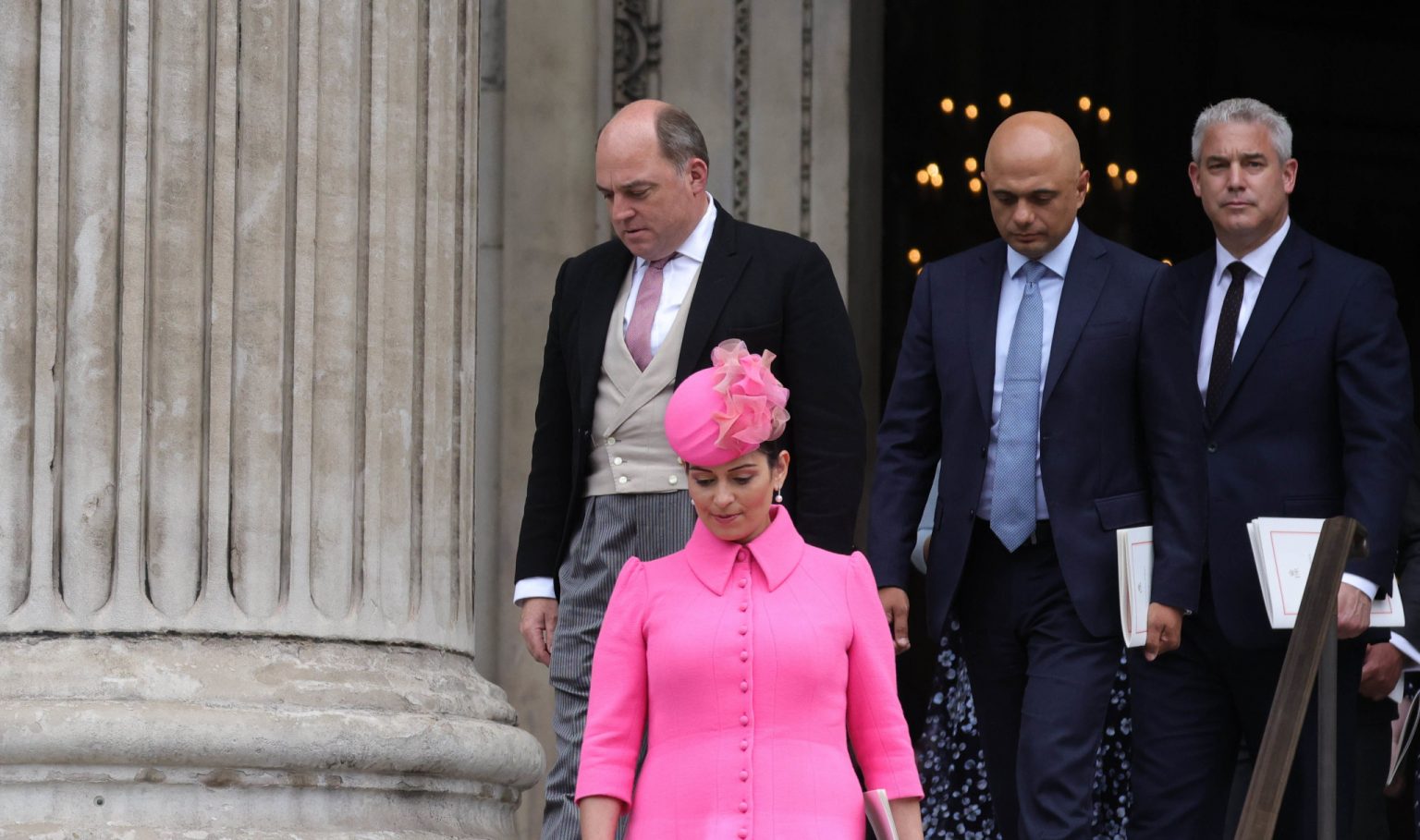
Home Secretary Priti Patel leaves St Paul’s Cathedral with other ministers after the Platinum Jubilee service on June 3. (Andrew Parsons / No 10)

By Richard Norton-Taylor
Declassified UK

Journalists who receive some funding from foreign governments are at risk of committing offences under a bill that carries a maximum sentence of life imprisonment. The risk also applies to individuals working for civil society organisations such as human rights groups.

It would be an offence to disclose leaked information that would prejudice the “safety or interests of” the U.K. What constituted such prejudice would be entirely a matter for ministers to decide and there would be no defence to argue that the publication was in the public interest.

The sweeping new threat to freedom of expression is contained in the National Security Bill, which is being championed by Home Secretary Priti Patel.

Although the government has claimed the measure is designed to prevent new types of spying, the bill is much broader, wider even than the much-criticised section 1 of the 1911 Official Secrets Act it would replace.

The 1911 Act refers to the obtaining or communication of information “calculated to be or might be or is intended to be directly or indirectly useful to an enemy” (emphasis added).

Also under the bill, ministers and spies would be given immunity from collusion in serious crimes overseas.


Military chiefs of the Five Eyes countries — U.S., U.K., New Zealand, Australia and Canada — met U.K. Prime Minister Boris Johnson, third from left, last week. (Andrew Parsons/No 10 Downing Street)

Life Imprisonment

The Freedom of Information (FoI) Campaign and Article 19, the global campaign for free expression, describe the bill as a major extension of the scope of offences in the 1911 Act.

They say: “A civil society organisation engaged in legitimate activities which has some funding for work on environmental, human rights, press freedom, asylum, aid or other issues from a friendly government could commit an offence under the bill.”

The prosecution would need to show only that such organisations had made use of leaked information “which they knew or should have known was restricted to avoid prejudicing the U.K. ’s safety or interests and that its use did prejudice the U.K.’s safety or interests.”

The organisations add:


“The decision on what constituted the U.K. ’s safety or interests would be the government’s and could not be challenged in court. If the government decided that the U.K. ’s energy situation required an immediate expansion of fracking or the building of coal fired or nuclear power plants, the use of leaked information which could undermine that policy could be a criminal offence under the bill.

“The prosecution would only have to show that the information prejudiced the attainment of the government’s policy in the U.K. ’s interests and that the person who used the information received funding from a foreign government.”

On conviction, that person could face life imprisonment.

Overseas Funding

The FoI Campaign and Article 19 point out that the same would be true if an organisation with overseas government funding to confront the problems of asylum seekers used leaked information to oppose the U.K. government’s asylum policies.

The government could assert that these were necessary in the U.K.’s interests.

A journalist working for another government’s state broadcaster – including that of a friendly state – who reports on a leak of protected information which is held to be prejudicial to the U.K. ’s interests, would also commit an offence under the bill if they knew or ought to have known that the broadcast would prejudice the U.K. ’s safety or interests.

The fact that the journalist was paid by the funds of a foreign government department or agency and that the broadcasting organisation itself was financed by such funds would satisfy the foreign power condition.

They would also face a maximum sentence of life imprisonment.

Yet a journalist working for a U.K. news organisation responsible for an identical report based on the same leak could not commit this offence because the foreign power condition would not apply.


Earth's Delicate Energy Balance | California Academy of Sciences


https://www.youtube.com/watch?v=U2CPwWgY_G4&t=6s