Saturday, June 11, 2022

[Leaflet] Fight Gun Violence! Fight for Socialism! Socialist Revolution


https://socialistrevolution.org/leaflet-fight-gun-violence/


June 7, 2022


This is the text of a leaflet distributed by supporters of Socialist Revolution throughout the country. Download the PDF of the half-sheet, two-sided leaflet here.


Rosa Luxemburg once said that humanity is faced with a choice between socialism and barbarism. The longer capitalism survives, the more stressful and violent life becomes. Is there anything more barbaric than a teenager going to an elementary school to kill young children? The Uvalde massacre marks a tipping point, transforming the shock and grief of thousands of students into outrage and a vow to put an end to the seemingly endless stream of mass school shootings.

The young generation has grown up in a world of crisis, violence, and conditions of perpetual fear and insecurity—the new normality in US schools. Such tragedies are always met with rehearsed outrage, platitudes, and crocodile tears from politicians and the media. But the youth are speaking up—rejecting the hollow “thoughts and prayers” from Biden and the rest of the capitalist politicians.

The nascent movement is giving voice to a range of social demands that go far beyond the empty and impotent “culture war” debate over gun control that has prevailed in Washington and the media until now. The question of safety at school and in working-class neighborhoods is a social question tied to jobs, housing, healthcare, funding for education, and more. This is not something that can be entrusted to the armed bodies of the capitalist state!

Although many students have expressed support for liberal gun-control measures, it’s clear that a growing section of working-class youth has no trust in the capitalist state’s ability to provide safety for the workers and poor. This is especially true in the aftermath of the historic George Floyd movement against police racism and brutality, and given law enforcement’s abject failure to “serve and protect” in Uvalde.

The question of how the working class can defend itself against such attacks must be part of a broader discussion in the context of the crisis-ridden system of capitalism. This truly is a fight for our lives and futures. As long as the capitalists and their government control the main levers in the economy and society, there can be no guarantee of safety or quality of life for the working-class majority. For one, the production and distribution of arms must be placed under democratic workers’ control. And starting immediately, teachers must be provided with school nurses and psychologists, counselors, social workers, more calendar days for teaching and fewer standardized tests, and smaller class sizes to allow teachers to get to know students and parents better.

Even the very young can sense that these shootings reflect a much deeper and systemic problem. As one New York City sixth-grader put it after yet another shooting, “My dad said he never worried about school shootings or had lockdown drills. Something had to have changed to go from not having to worry about it, to multiple school shootings. We have to see what changed to allow this to happen, to see what needs to change.”

For Marxists, this tragic pattern is, above all, an indication of the social decay of a system that was ripe to be overthrown long ago. Whatever the immediate motivations of the shooters, these mass killings, as with other forms of terror, reflect the impasse of a society in decline. A century after Lenin described capitalism as “horror without end,” millions of people find themselves living in a society in which they can see no future for themselves. Today’s youth are the first generation to have a lower standard of living than the one that came before it. As a result, off-the-chart levels of desperation, alienation, depression, mental illness, and countless other consequences of soul-crushing life under class society are pushing humanity to a breaking point.

After the Parkland massacre in 2018, the CEO of the NRA, Wayne LaPierre, warned that the growing youth movement was part of a “new socialist wave in America.” If young people continue to draw radical conclusions about the need to fight for social demands through class struggle—which must include a break with both the Democrats and Republicans—the aptly named “Generation Z” may indeed leave its mark on history as the last generation to come of age under the inhuman conditions of capitalism.For a revolutionary socialist solution!
 

The working class can depend only on its own forces and organizations to guarantee its safety and quality of life!
 

Schools should be democratically run and defended by teachers, school workers, students, and parents, and the broader working class!
 

Quality education, childcare, and healthcare should be free and universal from the cradle to the grave!
 

Nationalize the arms industry under democratic workers’ control!
 

Break with the parties of Wall Street and build a mass, working-class socialist party!


Mexican Marxists Discuss the Tasks of Revolution at Their 21st Congress!


https://socialistrevolution.org/mexican-marxists-discuss-the-tasks-of-revolution-at-their-21st-congress/

Rubén Rivera
June 8, 2022 Image: La izquierda socialista


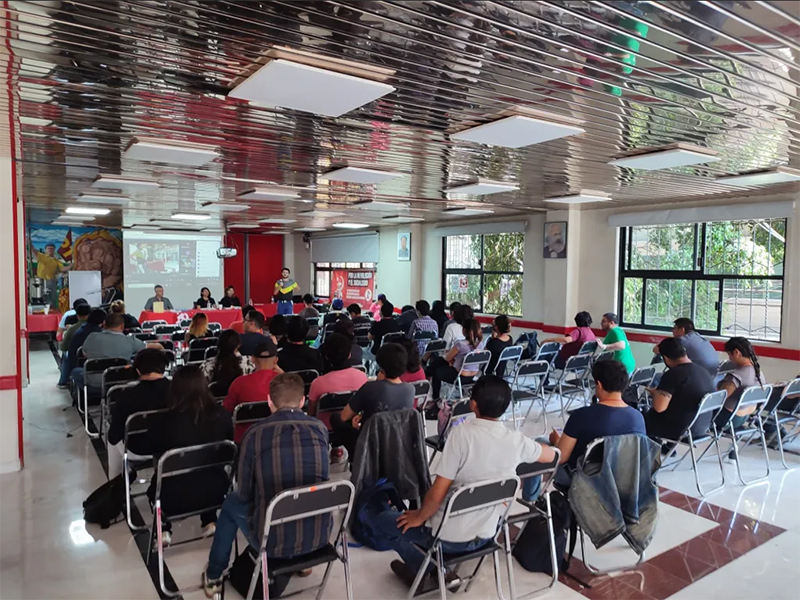
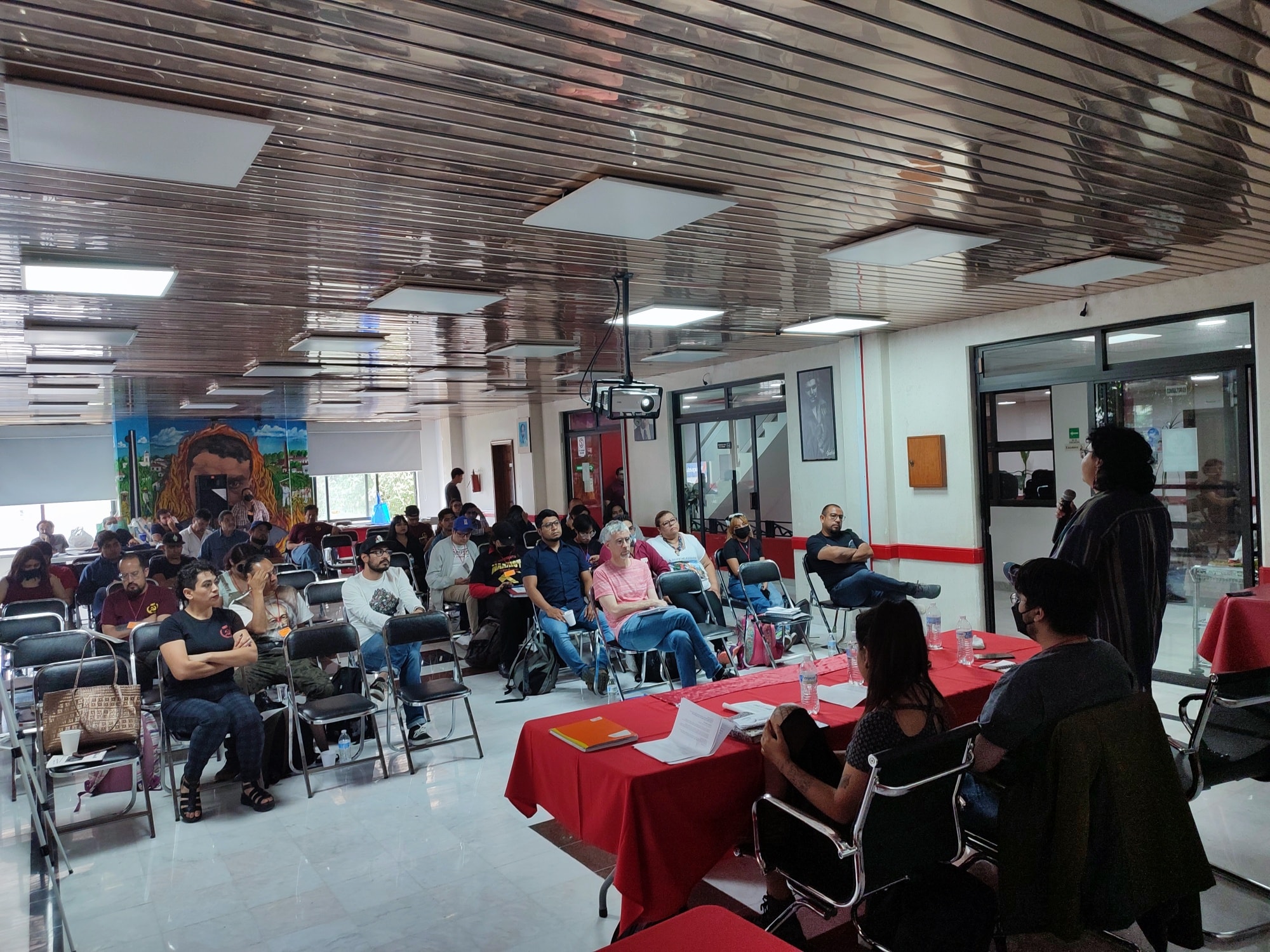
On May 21 and 22, 2022, the congress of the Socialist Left (the Mexican section of the IMT) was held in Mexico City, with about 85 attending both in person and online. The event saw lively and enthusiastic discussions about the national and world political situation, and the tasks ahead for building the forces of Marxism in Mexico and across Latin America!

Read the original in Spanish

This event took place in the context of the worsening of the capitalist crisis at the international level, characterized by a fierce imperialist war in the Ukraine. In the economic field, the imperialist tensions and the consequences of the crisis can be felt across the Americas. The war is a symptom of the relative decline of US imperial rule, which is also expressed in increasing conflicts with China and turbulence in other regions.

The effects of this crisis are already spreading throughout the world, and we are seeing economic stagnation combined with runaway inflation. War, disease, and famine are all that capitalism offers in the current phase of its existence.
Great enthusiasm

The congress was attended by delegates from Sonora, Chihuahua, Hidalgo, Mexico State, Puebla, Veracruz, Querétaro, Mexico City, Oaxaca, Chiapas, Quintana Roo, Yucatán, and Jalisco. Among the attendees, the comrades from the state of Guerrero and Campeche stood out, as well as trade unionists from the SNTE-CNTE in various sections.Around 85 comrades from all around Mexico took part at the national congress of La Izquierda Socialista. / Image: La Izquierda Socialista

There were also comrades from Teléfonos de México, workers from Mexico City, civil servants, call centre workers, grassroots militants of Morena (political party of the sitting president), and many others.

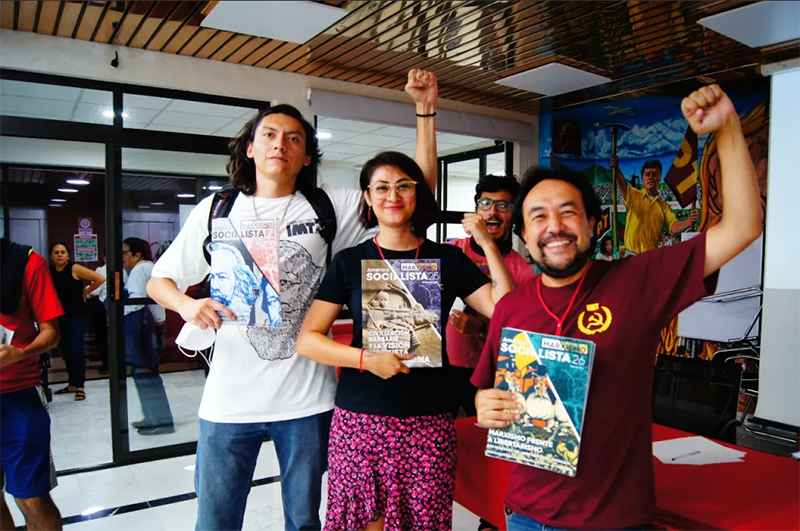
Also noteworthy was the participation of women comrades, who have actively engaged in all the struggles that have taken place in recent years in the broad women’s movement, and belong to the League of Revolutionary Women (la Liga de Mujeres Revolucionarias). Of course, we cannot forget the participation of student comrades from the different states that we have already mentioned, and from the centre of the country; especially the IPN, UNAM and UAM universities. These young comrades brought a spirit of great enthusiasm and high morale to the congress.

The congress has confirmed Izquierda Socialista as the definitive heir to the revolutionary tradition that began in Mexico with the founding of the first group of the International Marxist Tendency, consisting of IPN students organizing between 1989 and 1990.

On the first day of the congress, the international situation was discussed. Jorge Martín, a leading member of the IMT, led the session. Emphasis was placed on the characteristics of the war in the Ukraine and its imperialist nature, as well as the deep economic crisis, from which there is no clear way out at this moment.The discussion at the congress ranged from Mexican and world perspectives to reports on the growth of the IMT. / Image: La Izquierda Socialista

A revolutionary road forward is impeded by the absence of the subjective factor; hence the importance of emphasizing the need to organizationally strengthen a revolutionary alternative.

Afterwards, national perspectives were discussed. This is a particularly important issue, given that it is necessary to establish a correct position regarding the nationalist government of López Obrador and his reformist policies. The experience of this government basically shows that, within capitalism, any policy of class conciliation only postpones the definitive battles, at the cost of increasing the contradictions of the system.

In this context, while denouncing the character of the right-wing opposition as the most rotten expression of the Mexican oligarchy, we emphasize the need for the absolute class independence of the workers’ organizations in defense of their concrete demands, striving for greater cohesion and unity of the different struggles; always pointing, in the context of this situation, to the socialist alternative.
Revolutionary methods and traditions

The next topic of the congress was a report on the development of the International Marxist Tendency, which already extends its activities across the five continents. In the context of the recent pandemic, it managed to double its forces thanks to a bold orientation towards the youth, based on the defense of the ideas of Marxism against so-called progressive trends such as postmodernism, and nationalist and petty-bourgeois deviations.

The first day ended with an analysis of the organizational tasks and different proposals of how to build the forces of Izquierda Socialista.The mood at the congress was one of enthusiasm and militancy for the battles ahead. / Image: La Izquierda Socialista

The second day of the congress dealt with issues of an internal nature, linked to the different fields of struggle for the Mexican Marxists. The maturity and seriousness of the interventions, and the leading role that the different comrades are playing in so many battles of the working class and youth, was remarkable to witness.

Later, the methods of building the organization, based on democratic centralism, were analyzed in detail. Comrades went over our methods, and practical examples of development.

This also involved a historical analysis of the different phases of development of our organization: the lessons imparted by the triumphs and the crises that we have experienced. This was an especially important discussion, given that most of the members of the organization today joined in the last period. Is necessary to strengthen the traditions and teachings of the organization’s history.

Finally, we held a successful fighting fund collection, which will allow us to continue building the forces of Marxism in Mexico. We voted on and approved different resolutions of a political and organizational nature that will be decisive to continue advancing the construction of the revolutionary alternative in Mexico and Latin America.


Mass Layoffs from Carvana to Tesla: Tech Companies Are Driving Over a Cliff


https://socialistrevolution.org/mass-layoffs-from-carvana-to-tesla-tech-companies-are-driving-over-a-cliff/

Cris, Phoenix IMT
June 9, 2022


On Tuesday, May 10, employees of the online car retailer Carvana woke up to a chilling internal email from CEO and owner Ernie Garcia III. The Arizona-based tech company had joined the Fortune 500 list only last year, and was considered the fastest growing online auto retail business in the country. So it came as a shock when Garcia informed his employees that 12% of the workforce would be laid off, putting 2,500 workers out of a job.

In his email, the CEO waxed on about the regrettable factors beyond his control and his obligation to do the “right thing” for the company’s interests:


There is so much going on in the world today that I don’t want to pretend to have a full understanding, but it is an understatement to say a lot has changed about our environment. Inflation and interest rates are up, supply chains are disrupted, and consumer and investor sentiment have shifted. The impact of all of these forces on our industry has been severe. All-time-high car prices are slowing sales to recession levels… This brings us to a painful conclusion… We have to say goodbye to part of our team—to some of you—in order to get our team size back into alignment with sales.

Ironically, this internal announcement came within minutes of a very different public announcement: Carvana had successfully closed that day on a $2.2 billion deal to acquire the car auction company ADESA from KAR Global. In a statement regarding the ADESA deal, the boss struck a much more cheerful tone:


Despite the recent industry slowdown, Carvana continues to grow and deliver exceptional experiences to an increasing number of customers. We aim to use this ADESA US alignment… for Carvana to catapult back into rapid profitable growth as the industry inevitably rebounds.

After putting in a hard day’s work—closing a major business deal while carrying out one of the largest mass tech layoffs in recent history—Ernie III surely celebrated with an expensive bottle of champagne. But for the thousands of workers who had lost their livelihoods over a Zoom call that ended with a “have a good day,” the day was one of bitter rage and tears.Garcia is only interested in lining his own pockets at the expense of the working class. / Image: Gage Skidmore, Wikimedia Commons

The acquisition of ADESA represents a further enlargement of the Garcia family car empire. Ernie III was gifted Carvana by his father, Ernie Garcia II, whose company Drive Time provided its first round of funding. Both father and son appeared on the Forbes 400 list of richest Americans last year. Garcia II came in at 39th place with a net worth of $18.8 billion. His son made 83rd place, at $9.3 billion. The family also has ownership of Bridgecrest Acceptance Corp, a company that provides car and vehicle loans and services, and Silver Rock Inc., a vehicle service and insurance company.

In addition to running the parent company to his son’s business, Garcia II has the distinction of being a convicted felon for his role in a 1980s bank fraud scandal that wiped out the life savings of over 20,000 people—mostly elderly retirees. It is clear that the Garcia family has one goal in life—lining their pockets with as much profit as possible, at the expense of the livelihoods of their employees and the broader working class.
Booming profits and forced overtime

For a long time, Carvana management prided itself on the company’s astronomical rise, depicting it as a story of David standing against the Goliaths of the auto retail industry, and promoting itself as the “Amazon of cars.” In 2015, just a few years after its creation, Carvana employed roughly 1,000 workers. In 2018, this grew to 4,000, and then to 7,000 employees in 2019. By the time the pandemic hit in early 2020, when millions were forced to stay home, the online dealer was positioned to benefit from a flood tide in the demand for internet-based sales.

While many traditional dealerships closed, the company reported a 25% increase in vehicle sales. From April to June 2020 Carvana had a gross revenue of $1.12 billion, up 13%. Carvana needed the manpower to meet the surging demand, growing its workforce by over 200% over the last two years to almost 22,000. By February 2021, its stock had risen more than 130% since the start of the pandemic. Carvana was valued at $45 billion, making it a competitive rival for traditional car companies like Ford and Honda.

This business boom sent profits soaring for several big tech companies such as Amazon, Facebook, and Google, boosted in part by the state’s COVID-19 relief programs, while other industries were being negatively affected as the pandemic wreaked havoc. For Carvana, the good fortune had little to do with the intelligence or skill of Ernie Garcia. It had everything to do with a favorable market situation, combined with the unprecedented degree of exploitation of the workers, who were subjected to mandatory overtime.

Carvana described the entire eight-month period between April and November 2021 as its “busy season,” and required up to eight hours of mandatory overtime weekly from every employee. During this period, it wasn’t uncommon for some workers to rack up to 60 hours a week. The company heavily incentivized “slumber parties” during which employees worked until midnight. Some workers were clocked in from 6 AM to 12 AM during these “slumber parties,” foregoing normal sleep schedules to keep the profits rolling in.


Market chaos and overproduction

While the workers toiled around the clock, Garcia worked to bite off the largest share of the market he could, expanding operations as if the sky was the limit. But under capitalism, production is ultimately restrained by very real limits. As Marx explained in Capital: “The ultimate reason for all real crises always remains the poverty and restricted consumption of the masses as opposed to the drive of capitalist production to develop the productive forces as though only the absolute consuming power of society constituted their limit.”After expanding as quickly as possible and forcing overtime from their employees Carvana now has to slam on the brakes and layoff workers. This is the chaos of capitalism. / Image: Carvana, Wikimedia Commons

In a booming market, capitalists are driven to rapidly expand operations in an effort to capture a larger share of the growing demand and maximize profits. But capitalist profits don’t come out of thin air—they are the byproduct of paying workers less in wages than the value generated by their labor. Sooner or later, this inevitably leads to a point where more is produced than the market can absorb, since the working class also makes up the main population of consumers. This contradiction is called overproduction, and it is an inherent and unavoidable feature of capitalism.

When the bosses realize—as Ernie Garcia recently did—that workers are producing goods or services that can’t be sold profitably on the market, they slam on the brakes, tapering down operations and laying off workers, which in turn tends to further suppress consumer demand. When this happens on a broad scale, the result of the downward spiral is a full-blown recession or depression.

Today, many of the industries that experienced booming profits during the lockdowns are facing the consequences of overproduction. This is particularly clear in the tech sector, where companies are starting to institute hiring freezes and mass layoffs. Aside from the Carvana culling, there have been layoffs at Facebook, Uber, Netflix, and Amazon. In February, the home fitness company Peloton halted production and laid off 2,800 workers, 20% of its employees. And in the last few months, the online mortgage lender Better.com has laid off nearly 4,000, over a third of its workforce, after quadrupling its staff during the pandemic. Like the Carvana layoffs, the bad news came as a shock and was delivered callously over a mass Zoom call: “If you’re on this call you are part of the unlucky group that is being laid off. Your employment here is terminated effective immediately.”

The wave of hiring freezes and mass layoffs shows no sign of stopping. At the beginning of June, Tesla CEO Elon Musk announced a global hiring freeze and warned that up to 10% of the company’s workforce may be cut, citing “a super bad feeling” about the direction of the economy. This would amount to laying off approximately 10,000 workers—the largest mass layoff in the tech sector since the 2020 crisis.
 

A warning for the working class

For several years now, the world economy has been in the grips of chaos that has only intensified under the impact of the war in Ukraine. While bourgeois politicians and pundits blame economic turmoil on external factors like the pandemic and the war, in reality, events since 2020 have only more clearly revealed the internal contradictions of capitalism.Tesla CEO Elon Musk warned that up to 10% of the company’s workforce may be cut. This would be the largest mass layoff in the tech sector since the 2020 crisis. / Image: Raysonho, Wikimedia Commons

The onset of the COVID-19 pandemic undoubtedly exacerbated many problems. Widespread lockdowns brought some industries to a screeching halt, while others were sent booming. An unprecedented spike in unemployment was combined with an unprecedented injection of federal stimulus spending in an effort to avoid total collapse and social revolt. One consequence was that businesses had no way of estimating future demand based on data from previous years, since no one knew when the pandemic would end, or how long the changes in consumption patterns would last. On the supply side, no one knew whether production would close down tomorrow due to new outbreaks, and international logistics chains completely clogged up, creating a supply crisis. Additionally, the record stimulus spending produced the biggest jump in money supply in US history. This has led to the highest inflation in over 40 years, eating deeply into the wages of the working class.

Recession worries were already present in 2019, when the IMF warned of a “synchronized slowdown” affecting 90% of the world economy. If anything, today’s forecasts are even gloomier. The pessimism of the capitalists is reflected in the two-month decline of the S&P 500, the longest stock market downturn in over 20 years. It is a matter of time before another 2008-style meltdown once again plunges millions into unemployment, homelessness, and desperation.

As long as the capitalist system continues, there is no escape from this continuous loop of misery. But the world working class will not take these attacks lying down. The recent wave of unionization efforts is a sign of the combative mood among a growing layer of workers—particularly the younger generation who grew up through the last major recession and its aftermath. Millennials and Gen Z make up the majority of the American workforce, and are also the most critical of capitalism—a system that has offered our generations nothing but one crisis after another.

If Carvana workers were organized, they could have responded to the recent attacks with united strike action and workplace occupations, forcing the Garcias to take the losses in the form of lower profits, instead of destroying thousands of livelihoods. The capitalists give up nothing for free, and it is only by collectively withholding their labor that workers have the leverage necessary to fight back these kinds of attacks. Class struggle is the only way to fight against the constant onslaught of attacks from the bosses—attacks which will only intensify in the coming period. But another world—with full employment and quality working conditions for all—is possible. Join Socialist Revolution and help us achieve this in our lifetime!


Paul Mason’s covert intelligence-linked plot to destroy The Grayzone exposed


https://thegrayzone.com/2022/06/07/paul-masons-covert-intelligence-grayzone/


Kit Klarenberg and Max Blumenthal·June 7, 2022


Leaked emails reveal British journalist Paul Mason plotting with an intel contractor to destroy The Grayzone through “relentless deplatforming” and a “full nuclear legal” attack. The scheme is part of a wider planned assault on the UK left.

A former Trotskyist and BBC journeyman, journalist Paul Mason has made a career as the establishment’s favorite gatekeeper of the UK left. Since the Russian military incursion into Ukraine, he has cemented his position as one of Britain’s most vocal “left” cheerleaders for Western military intervention.

While leading a “U.K. left” delegation to Kiev and a demonstration through the streets of London in support of NATO military escalation against Russia, Mason has accordingly used his platform to assail journalists, academics, Labour party members and private citizens who oppose shipping piles of advanced weaponry to Ukraine.

In a series of recent columns, Mason called for the state-enforced suppression of facts and perspectives he considers overly sympathetic to the Kremlin, and demanded “state action” against members of the media that oppose the NATO line on Ukraine. He placed The Grayzone at the top of his fantasy censorship target list.

Mason has since announced a run for parliament on the Labour ticket to wage his crusade against “disinformation” from inside the House of Commons.

The Grayzone, meanwhile, has learned through anonymously leaked emails and documents that Mason has been engaged in a malicious secret campaign that aims to enlist the British state and “friendly” intelligence cut-outs to undermine, censor and even criminalize antiwar dissenters.

In one leaked email, Mason thundered for the “relentless deplatforming” of The Grayzone and the creation of “a kind of permanent rebuttal operation” to discredit it.

In another, the celebrity journalist declared that “the far left rogue academics is who I’m after,” then rants that he is motivated by fear of an emergent “left anti imperialist identity” which “will be attractive because liberalism doesn’t know how to counter it.”


Mason is joined in his covert crusade by Amil Khan, the founder of a shadowy intelligence contractor called Valent Projects. In the cache of leaked emails, Khan proposed to Mason the initiation of a “clever John Oliver style stunt that makes [The Grayzone] a laughing stock,” as well as a “full nuclear legal to squeeze them financially.”

The Grayzone has previously revealed Khan’s extensive involvement in the Syrian dirty war, during which he provided public relations guidance to jihadist groups, trained anti-government activists in communication strategies, and secretly oversaw supposed citizen journalist collectives backed by foreign governments. His goal was to flood international media with pro-opposition propaganda, destabilize the government of Bashar Assad, and ready the ground for Western regime change.

This ethically dubious work was conducted for a variety of intelligence-adjacent British Foreign Office contractors, such as ARK, a firm founded by probable MI6 operative Alistair Harris, and IncoStrat, which has been plausibly accused of producing propaganda for the blood-stained UK and Saudi-backed insurgents.

After leaving the Middle East, Khan reinvented himself as an expert in countering “disinformation”, and has since charged a number of blue chip clients a premium for his dubious services. As this outlet reported, the same techniques of manipulation and information warfare that Khan honed in Syria were turned against Western citizens when he oversaw a British quasi-state funded astroturf YouTube project designed to counter public skepticism of Covid-related restrictions.

Khan’s email communications with Mason illustrate the grudge he has harbored since The Grayzone exposed his devious exploits. In the missives, he descends into self-delusion, insisting this outlet’s factual reporting was, in fact, state-sponsored retaliation for his crusading work “opposing military dictators and kleptocrats.”

Together, Khan and Mason plotted to assemble a coalition of anti-Grayzone actors, including the US and UK government-funded “open source” outlet Bellingcat, which Mason revealingly described as a channel for “intel service input by proxy.” Khan proposed convening the de facto Victims of Grayzone Memorial Foundation at an in-person summit to “come up with a plan that addresses [The Grayzone’s] objectives and vulnerabilities.”

At one point, he even reached out across the Atlantic for advice from Nina Jankowicz, the disgraced former head of the Department of Homeland Security’s Disinformation Governance Board.

It is uncertain how Mason and Khan became acquainted, but their mutual coincidence of needs, motives and vendettas is obvious. The public interest in releasing the pair’s private communications is also abundantly clear. If their planned criminalization of The Grayzone for publishing facts and opinions they abhor is successful, it will have dire ramifications for any and all journalists and independent media institutions seeking to challenge the status quo.

When approached by The Grayzone, Paul Mason declined to comment on the incriminating correspondence with Khan, and claimed to have informed local police that “an attempt was made” to hack his email account. While dismissing the leaked content as “likely to be edited, distorted or fake,” he went on to pledge he would “not cease to identify and rebut Russian disinformation operations masquerading as journalism.”

In other words, Mason implied he plans to carry on with the very activity exposed in the leaked emails.


Khan and Mason collude to form anti-Grayzone coalition and shatter Corbynite left

On April 30 this year, Paul Mason emailed Amil Khan, making clear he was “keen to help” de-platform The Grayzone.

He attached a bizarrely constructed “dynamic map of the ‘left’ pro-Putin infosphere” that resembled a spider’s web, with a mess of arrows linking the names of members of parliament, media outlets, activists, causes, and British minority communities.

The barely coherent, racially-tinged chart connected the Russian government, Russian state broadcaster RT, the People’s Republic of China, and Beijing-based tech millionaire-financier Roy Singham to the “Muslim Community,” “Young Networked Left” and “Black Community” through a series of leftist outfits and UK Labour figures. No evidence was provided to support Mason’s linkages.

At the center of Mason’s chart (see below) is Jeremy Corbyn. When Corbyn served as Labour leader, Mason plotted against him in private while simultaneously posing as one of his most ardent public supporters. He also sought to influence Shadow Chancellor John McDonnell in a pro-war direction.

The implication behind Mason’s Nixonian enemies chart was clear: Russia and China have weaponized the British left to corrupt key Labour constituencies – therefore the left must be neutralized.


Mason suggested to Khan that he enlist the help of “pro traffic analysts to map” how these “different echo chambers interact, where their material begins – and work out who might [emphasis added] be pulling the strings.”

He nonetheless seemed certain about the dark forces animating The Grayzone, bombastically charging that its “attacks” on Khan and others are “fed by Russian and Chinese intel,” including hacking, “electronic warfare” and human intelligence.

Mason compared this process to Bellingcat receiving “a steady stream of intel from Western agencies.” The US and UK government-funded outlet Bellingcat has frequently been accused of laundering CIA and MI6 dirt, a charge which the operatives behind it aggressively repudiate. However, Khan – a long-time advocate and associate of the outlet – did not once challenge Mason’s repeated characterization of the supposed citizen journalist collective as a clearing house for friendly spy agencies.

Underlining the sensitivity of the pair’s malicious plans for The Grayzone, Mason stressed the need for their work to be conducted via “white label organisations operating with firm infosec – Signal/ProtonMail, clean phones.”


Khan was clearly amenable to his suggestions. Five days later, he outlined two options for taking down The Grayzone: “some sort of clever John Oliver style stunt that makes them a laughing stock” – referencing a sting operation targeting academic Paul McKeigue conducted by the dubious, intelligence-linked Commission for International Justice and Accountability back in 2021 – “or full nuclear legal to squeeze them financially.”

Mason was enthused by the latter prospect, submitting that it should be “combined with relentless deplatforming,” including cutting off The Grayzone from donation sources such as PayPal, in the manner of Consortium News and MintPress, and setting up “a kind of permanent rebuttal operation.”


Khan agreed, proposing the pair “get a few people together who are looking at/been target [sic] by this together and do a centre of gravity analysis,” pooling “what we’ve all learnt about how they operate” in order to “come up with a plan that addresses their objectives and vulnerabilities, not just their arguments.”

Mason responded by launching into a conspiratorial aside asserting that the Organization for Security and Co-operation in Europe’s (OSCE) post-February 16, 2022 reports showing a dramatic Ukrainian military escalation against pro-Russian separatists in the Donbas region represented “manipulated facts.”

He then proposed “creating a dynamic reference catalogue debunking all [The Grayzone’s] allegetions[sic] and ‘facts,'” pitching the initiative as an alternative to direct engagement or “toe to toe” debate.


“Keen” to move on the project, Mason suggested several information warriors to join them; Emma Briant, an academic researching disinformation; Chloe Hadjimatheou, the British intelligence-linked BBC journalist who produced a multi-part podcast series smearing critics of the NATO-backed Syrian White Helmets organization as Kremlin stooges and fascists; and Bellingcat, which he said could provide “intel service input by proxy.”

Khan said he was “happy” to host a secret meeting of these individuals at Valent Projects’ London offices.


After Mason proposed inviting a representative of the UK Foreign Office to the anti-Grayzone meet and greet, the Valent Projects chief reached out to a friend at the National Security Council’s Communications Directorate, a Whitehall unit “tasked with hybrid threats.”

His Directorate source said the British government would be averse to sending a representative to the gathering, “as it could jeopardise outcomes later.” Nonetheless, they advocated convening people “targeted” by The Grayzone, to collate evidence that could be submitted to OFCOM, Britain’s communications regulator, and/or Digital, Culture, Media and Sport (DCMS), the name of both a government department and parliamentary committee, “as part of a formal complaint.”

They imagined that this process could somehow trigger an investigation into The Grayzone’s “funding and activities,” leading the government to “get properly involved.”

Khan added that his pal suggested also approaching Thomson Reuters Foundation and BBC Media Action for the initiative.The Grayzone has previously exposed these media charities as having participated in covert British state-funded efforts to “weaken the Russian state’s influence.”

Khan said he would also be in touch with the Foreign Office’s newly-founded psychological warfare unit, the Government Information Cell.


Mason’s reaction was mixed. While hailing the prospect of triggering an official government investigation into The Grayzone as “a good idea,” he seemed crestfallen the plan did not include securing material from British intelligence on who funds the site, and “what their ultimate deliverables are on behalf of the ppl [people] their work benefits.”

“An investigation into them would lead to what? Deplatforming? Anyway that’s progress,” he concluded.

Khan reassured Mason that OFCOM and DCMS could task “other bits of government to get that intel; and the findings will automatically enter the system” – meaning The Grayzone and its contributors could end up slapped with “Russian state affiliated media” labels on social media, leading to algorithmic discrimination and potential shadow banning, among other penalties.


“I think/hope there’s potential to go further [emphasis added]. It’s too easy for them to flip deplatforming with ‘the system is scared of us’. We need to look at their influence/legitimacy with audiences,” Khan stated.


Yet Khan is likely to be extremely disappointed if he and Mason follow through on their dream of submitting formal complaints about The Grayzone to OFCOM and/or DCMS.

For one, OFCOM’s remit extends to domestic broadcast media, such as TV, radio, and streaming platforms. In other words, it does not and cannot scrutinize or sanction online content, let alone that of US websites. On the same grounds, it is unclear what jurisdiction DCMS has to investigate The Grayzone. Further, no British government department, except perhaps for MI6, could possibly be tasked with unearthing damaging “intel” on this publication or its staff.

It is therefore stunning that veteran mainstream media pros like Mason and Khan were unaware of such an obvious, fatal flaw in their scheme. More importantly, The Grayzone does not and never will receive funding or direction of any kind from the Chinese or Russian governments, or any other foreign state or connected entity.
Khan and Mason plan pro-Ukraine propaganda shop backed by NATO states “through cutouts”

Mason and Khan’s brazen attempt to de-platform and financially cripple an independent media outlet on the slanderous, fictional pretext it is actually a hostile foreign information operation is especially perverse given that other leaked emails in The Grayzone’s possession reveal that Khan and Mason apparently plan to construct a hostile foreign information operation of their own.

Dubbed by Khan “International Information Brigade,” the proposed project would represent an astroturfed civil society organization which serves as “the major, forward leaning player in the information war.” While publicly operating as an NGO, the Brigade would be funded by Western states “through cutouts,” and closely intertwined with intelligence services.


Mason responded that Khan’s plan for a state-backed propaganda operation presented as a grassroots civil society initiative was a “good idea,” and proposed “immediate translation of Kyiv independent stuff,” noting that “the European Young Socialists are doing this already and have raised funds.”

The Young European Socialists is a social democrat-oriented youth organization sponsored by the European Union. And the Kyiv Independent is a key propaganda organ of the Ukrainian government which has received financial support from the Canadian government and European Union.
Khan drafts invite to secret anti-Grayzone summit

Whether Khan and Mason’s bold plans for an anti-Grayzone summit have been put into action remains unclear. However, by May 12, Khan had drafted an invitation for prospective members to attend the initial brainstorming session. In his note, he conjured up a vast and fearsome nexus of “pro-Russian trolls” destroying anyone in the Kremlin’s way, at the center of which rests The Grayzone Death Star.

“We are getting in touch because, like us, you have also been targeted by a network of pro-Russian trolls…This network revolves around the outlet known as Grayzone and includes a dozen or so individuals who use online intimidation, bullying and harassment to promote pro-Kremlin talking points,” Khan wrote. “Social media platforms and governments have identified the [sic] RT, Sputnik etc as Russian state affiliated outlets and taken action accordingly. Grayzone, however has avoided scrutiny.”


Mason suggested a minor amendment to “avoid libel risk”: revising the passage referring to The Grayzone as “in fact an information operation of a dictatorship.” He felt this should be softened to The Grayzone “present themselves as journalists when their modus operandi looks more like [an] information operation – whether voluntary or co-ordinated – of a dictatorship.”

Khan agreed to the alteration and proposed more summit guests. They included the BBC’s “first specialist disinformation and social media reporter,” Marianna Spring, who recently smeared several British academics for scrutinizing Western claims relating to the NATO proxy war in Ukraine. He also suggested including former BBC and Jewish Chronicle editor Martin Bright, who he said may be “heading up a group looking at the legal side of this sort of thing.”

For further participants in the anti-Grayzone summit, Khan referred Mason to Paul Hilder, the Ted Talk-ing, Labourite co-founder of the National Endowment for Democracy-funded OpenDemocracy.net and Avaaz, which has lobbied for NATO military interventions in both Libya and Syria.


Consulting Nina Jankowicz on paranoid scheme against Consortium News

On April 8, Mason emailed Khan to express alarm about a piece in Consortium News, the independent news platform founded by the late Robert Parry in 1995, questioning the Western narrative of the Bucha massacre. “Who’s behind Consortium News?”, the subject header read.

Khan responded that he had consulted Nina Jankowicz, former chief of the Department of Homeland Security’s Disinformation Governance Board, who resigned her post in disgrace just three weeks after being appointed due to intense criticism of her professional history, bizarre behavior, and record of censorious statements.

According to Khan, Jankowicz saw Consortium News as a case of “useful idiots rather than funding,” presumably a reference to Kremlin financial support. Khan was by contrast “not so sure,” suggesting “the gap” in its output “between 2005 and 2011” was “of a lot of interest.”


Joe Lauria, editor-in-chief of Consortium News, expressed bewilderment at the purported disinformation expert’s observations, and outrage at the defamatory implication that the site might be in receipt of illicit Russian funding.

“There was never any ‘gap’ in our publication,” Lauria told The Grayzone. “Our founder, Bob Parry, simply switched to WordPress in 2011 and transferred some of the most important articles from the old system. There were thousands of articles so he couldn’t possibly transfer all of them, it had to be done manually. The articles that weren’t transferred can be found on Wayback Machine.”

Indeed, anyone perusing Consortium’s archive of “most important” past pieces can see that numerous articles from the period cited by Khan have been avowedly republished, with their original publication dates clearly stated. This raises the question of whether such conspiratorial thinking influenced PayPal’s decision to terminate Consortium’s account in May 2022.

Nonetheless, it seems reasonable to infer Khan has been enmeshed in a wilderness of mirrors for so long as a psy-ops professional that he has lost his grip on reality, and has begun to project his own mephitic perspectives and malicious motives onto actually independent, alternative voices.

Similarly, Mason’s descent into paranoia about The Grayzone’s factual reporting may represent the terminal stage of a career that has taken him from the margins of Trotskyite activism to the molten core of the British establishment, still posing as an authentic radical to wage war on the UK left.


Stagflation and struggle: Capitalism’s new era


https://www.socialist.net/stagflation-and-struggle-capitalism-s-new-era.htm


Share prices have been falling for weeks, as fear grips markets in response to war in Ukraine, rampant inflation, lockdowns in China, and the threat of a new slump.

The FTSE All-World index is now on its longest losing streak since the middle of 2008 – on a par with when the subprime mortgage crisis led to the collapse of Lehman Brothers.

Such erratic swings on the world’s stock exchanges are a reflection of the pessimism that haunts the ruling class. According to Warren Buffett, the billionaire investor: “We are not very far away from having something of a repeat of 2008, or even worse.”

“Markets are falling not just because of higher interest rates,” asserted Luca Paolini, chief strategist at Pictet Asset Management. “The risk of a recession [in major economies] is significant,” he added. “The reality is a big chunk of the global economy is basically contracting.”
Euphoria evaporates

Last year’s euphoria about a post-pandemic economic recovery has completely evaporated. Having seemingly overcome one crisis, another crisis has quickly appeared in its place. This has provoked panic in corporate boardrooms.

As the Financial Times, the mouthpiece of British capitalism, recently explained:


“Only last year, many economists were expecting 2022 to be a period of strong economic rebound. Businesses would return to full operation post-Covid. Consumers would be free to splash their accumulated savings on all the holidays and activities they had not been able to do during the pandemic. It would be a new ‘roaring twenties’, some said, in reference to the decade of consumerism that followed the 1918-21 influenza.” (2/5/22)

Such a boom, according to them, would open up a new epoch of growth and prosperity. But in a short space of time, this perspective has been reduced to rubble. Rather than a ‘roaring twenties’, capitalism is facing a new world slump.

We have entered a totally new era, to quote Kissinger – an era of deepening crisis, where the old norms have been turned upside down. “Reason has become unreason”. The underlying crisis of capitalism, which they thought they had contained, has resurfaced with a vengeance.

As a recent editorial in the Financial Times stated:


“This week, the economic mood music changed into a more anxious minor key, as recent shocks to developed world economies have echoed longer and louder than had been expected. Whatever you thought about the economy a week ago, you should be a little more worried than you were.”
Stagflation ahead


Economic forecasts are being hastily downgraded. Many now expect global economic growth to average only 3.3 per cent this year, down from 4.1 in January, before the war.

Inflation, long considered dead, has again raised its ugly head, with the effect of devaluing currencies, pushing up costs, and cutting living standards.

Global inflation is now forecast at 6.2 percent – 2.25 percentage points higher than January’s forecast.

In the United States, inflation reached 8.3 percent in April, and it is expected to rise even higher. At the same time, the US economy also contracted in the first quarter, despite previous predictions to the contrary.

Many economies are facing ‘stagflation’ or even ‘slumpflation’. And this “stagflationary shock of 2022 is truly global,” explains the Financial Times.

This is a reflection of the increased integration of the world market, especially over the last 30 years. Countries are all bound together as never before, heightening the threat of contagion. This is the real meaning of ‘globalisation’.
Dismounting the tiger

Central bankers are desperately hoping that things will stabilise. But their predictions, as always, are overly optimistic. After all, they said the inflation would only be ‘transitional’ and ‘temporary’.

Their witch-doctor theories – whether Keynesianism or monetarism – have blinded them to the dire situation faced by capitalism. But now they are caught between the devil and the deep blue sea; or, more accurately, by the contradictions of capitalism.

For years, capitalism has been awash with cash, which has artificially kept the system afloat. From 2008 onwards, the ruling class pumped cheap money into the economy, keeping interest rates at historically low levels in order to stave off another depression.

Whilst they succeeded in their immediate goal, the capitalist system became addicted to this stimulus. But now we are seeing the consequences, with the ruling class belatedly being forced to take measures to dampen economic activity and reverse the policies of the last decade.

Normally, this excess liquidity would have long ago led to inflation. But this was held in check by the depressed state of the world economy. Everything has its limits, however. And the end of lockdown, followed in quick succession by the war in Ukraine, has served to ignite inflation.

The ruling class are therefore desperately trying to return to some kind of ‘normality’, by reining in the fiscal stimulus and rock-bottom interest rates, which have clearly become unsustainable.

Faced with an inflationary spiral, the Federal Reserve and the Bank of England have been forced to raise interest rates. Other central banks, starting with the European Central Bank, will inevitably follow suit.

Bloated balance sheets, laden with historic levels of debt, need to be reduced, but without causing a crash. Somehow, the era of cheap money must be brought to an end. But this will not be easy. It is like trying to dismount from the back of a hungry tiger without being eaten.
Bleak prospects

Given the situation, increasing interest rates and cutting back on the fiscal stimulus can clearly cause a deep slump. Many businesses have been kept alive by cheap money. And cutting back on this will push them over the edge, leading to widespread bankruptcies.

But this is the only way the bankers can ‘squeeze’ out inflation. To simply continue as before, pouring in liquidity, will also lead to disaster, provoking hyper-inflation and intensifying the crisis.

As Nouriel Roubini, professor at New York University Stern School of Business, warned: “Central bankers can take policy normalisation only so far before risking a financial crash in debt and equity markets.” But they have very little choice.

The prospects are looking increasingly bleak. As the Financial Times explained:


“The risk of recession on both sides of the Atlantic is now very high. Perhaps it is already too late, the inflation genie is out of the bottle and monetary policy needs to generate a recession to drive it out of the system. Alternatively, policymakers will be too cautious, too slow and allow inflation to persist and embed itself in the economy with the same ultimate consequences.

“The path we all desire is narrow and sits in between these economic disasters. It is possible we will eradicate high inflation without a deep economic downturn, but the odds on this favourable outcome are now low indeed.” (FT 15/4/22)
Fragile recovery


Rather than a ‘once-in-a-century event’, crises are becoming more frequent and more serious. This is the new rhythm of the boom-and-slump cycle.

Before the pandemic hit, the world capitalist economy was already slowing down, with increased protectionism and overproduction affecting different sectors. Coronavirus gave the crisis a new fatal twist, serving to sharpen and aggravate the contradictions in the system.

The chain of capitalism broke down at a whole series of points, disrupting both production and supply. This, in turn, led to the closure of large sectors of the economy, alongside a collapse in demand. Millions were laid off or furloughed, adding to the downward spiral.

This meant that markets, trade, and supply chains – the arteries of the world economy – were severely disrupted or completely paralysed.

What began as a developing crisis of overproduction ended with the physical lockdown and closure of many sectors of the capitalist economy.

As a result, in 2020, economic activity contracted in 90 percent of the world’s countries. This exceeded the proportion seen in both world wars, the Great Depression, and the global slump of 2008-09. The UK economy, for example, saw its biggest decline in 300 years.

Of course, such a collapse could not continue indefinitely. At a certain point, a recovery would inevitably take place, helped in large measure by unprecedented state stimulus.

This recovery was heralded as the beginning of a new era. Pent-up consumer demand, now being spent in bars and restaurants, and on holidays, was supposedly going to result in a robust economic revival.

Economies certainly rebounded for a time. Many reached pre-pandemic levels of output. But the recovery was continually cut across by disruption – or complete fractures – in supply chains, a legacy of the crisis.

‘Just-in-time’ production, which had boosted the capitalists’ profits in previous decades, became ‘nothing-in-time’ chaos, as key industries and sectors ran out of vital parts. These shortages, in turn, pushed up prices and provoked a new surge in inflation.

 
War and slump

The whole world situation has become exceedingly volatile. The very integration of world trade, which was a colossal boost in the past, has turned into its opposite. A single event in one country can have a massive knock-on effect elsewhere. The lockdowns in China, for example, which directly affect exports, are having an impact on world trade.

Equally, other factors – whether it is post-pandemic problems, war in Ukraine, political shocks, or other ‘accidents’ – can also have a decisive impact on the workings of the capitalist system.

Today, the conflict in Ukraine has set off a chain of events that is having far-reaching consequences – politically, diplomatically, socially, and economically.

The war has become a proxy war between Russia and the NATO countries, especially the USA, with billions of dollars worth of arms being poured into Ukraine by western imperialism.

This is having a massive impact everywhere. Economic sanctions imposed by the West, with the aim of isolating Russia from the world economy, will have grave implications.

The bone-headed American and British imperialists, in particular, appear blind to such consequences. They are prepared to risk everything to defeat Russia. But their actions are serving to exacerbate the crisis.

The surge in energy prices has pushed up costs and prices generally, as inflation takes hold everywhere. If Russian gas supplies to Europe are halted, which some are demanding, it will lead to an immediate slump, starting in Germany.

Economic sanctions – a war by other means – are intensifying the situation. In turn, consumer demand is being further eroded and capital investment halted, pushing the world economy further towards a new slump.
Economic nationalism


All these factors are dialectically interacting upon one another to drag things down. All the factors that contributed to the impetus of capitalism in the past are now the factors that are preparing the way for social and economic catastrophe.

“The war is in sum a multiplier of disruption in an already disrupted world,” states Martin Wolf, economics editor at the Financial Times. “Now alas, we are again on a downhill path to a world of division, disruption and danger.” (FT, 26/4/22)

The world economy is fracturing into blocs, and supply chains are being broken, as the West attempts to cut off Russian energy supplies and reduce the country’s access to currency markets.

We have entered a period of economic nationalism similar to the interwar period – a further reflection that private ownership and the nation state have become barriers to progress.

The consequences of these dramatic changes were highlighted by Pierre-Olivier Gourinchas, IMF chief economist:


“If we become a world of many different blocs, we will have to undo a lot of the integrated economies that we’ve built and supply chains that we’ve built…and build something else that is more narrow [and] smaller in scope.”

“There will be adjustment costs [and] there will be efficiency losses,” he added, “and that could lead to an increase in unit costs because things are not done as efficiently as before.”


“If we are in a world in which we have different blocs, then I don’t exactly know how the [IMF] can function. Does it become an institution that works for one bloc but not the others? How does it work across different parts of the world? It is certainly not something that would be desirable on many, many fronts.” 


Limits of capitalism

The present crisis is undermining what is left of the postwar framework, clearly exposing the limits of the capitalist system.

“The weaponisation of finance has profound implications for the future of international politics and economics,” explained the Financial Times.


“Many of the basic assumptions about the post cold war era are being turned on their head. Globalisation was once sold as a barrier to conflict, a web of dependencies that would bring former foes ever closer together. Instead, it has become a new battleground.” (FT, 6/4/22)

The war in Ukraine has created havoc and shattered any hope of recovery. The dramatic rise in energy costs alone would be enough to upend the situation. On top of this, however, the fall in wheat and cereal production in Ukraine and Russia is sending food prices rocketing, with all the political implications that go with it.

As the Financial Times warned in March: “When food prices rose in 2008 it helped to spark the Arab spring and, eventually, civil war in Syria. Russia’s invasion of Ukraine has sown the seeds of a crisis that will be felt well beyond European borders.” (FT, 5/3/22) 


Revolutionary conclusions


By their actions, the bourgeoisie have opened up a Pandora’s Box. They have destroyed any semblance of stability or equilibrium, deepening capitalism’s contradictions everywhere.

Believing their own propaganda, they have intensified the capitalist crisis in ways that could not have been foreseen.

The whole scenario is laying the basis for a mighty upswing of the class struggle, in Britain and internationally. Inflation will cut living standards and dramatically push up the cost of living. The working class will have no alternative but to fight.

Following the First World War, Leon Trotsky explained that “the cost of living is the mightiest factor of revolutionary ferment in all countries”. It was this question that again served to raise the class struggle to new heights in the 1970s, placing revolutionary events on the agenda. This is about to be repeated – but on a far higher level.

As the IMF managing director Kristalina Georgieva warned: “History has shown that hunger often triggers social unrest and violence.”

It is not boom or slump that engenders revolution, but the shifts between one and the other, shaking up consciousness in the process. Plenty of inflammable material has accumulated in the recent period. And this is constantly increasing. The stability of the past is over.

Engels referred to the 40 years of sleep of the British working class, which was the prelude to the explosion of New Unionism in the 1890s. This opened up a new era of class struggle, war, and revolution.

Today, the ebb in the class struggle in the main capitalist countries – an ebb that lasted for more than three decades – is finally coming to an end.

As the fog of war lifts, and the reality of the capitalist crisis hits home, millions of workers and youth are going to be thrown into the class struggle. New fresh young layers are about to enter the struggle, untainted by the defeats of the past. Given the crisis, many are going to draw radical and even revolutionary conclusions.

The lament of Martin Wolf, a key strategist of capital, that we are “again on a downhill path to a world of division, disruption and danger” is a serious warning to the ruling class of what is coming.

What he is talking about, but dare not say by name, is revolution. For those who have eyes to see, this is exactly the nature of the period we have entered.


Boris survives by the skin of his teeth – Kick them all out!


https://www.socialist.net/boris-survives-by-the-skin-of-his-teeth-kick-them-all-out.htm


Lenin once said that the first condition of revolution is a split in the ruling class. That is an apt description of the situation in Britain, as civil war rages within the ranks of the Tories, the governing party.

Boris Johnson was known as the Teflon Tory, seemingly able to glide over a series of blunders over the years. He seemed to be like a comic book superhero, able to escape from the most precarious of predicaments: ‘And with one mighty bound, he was free!’

But now Boris has run out of road.

Last week, Tory ministers insisted there would be no vote of confidence in the Prime Minister. Then, just when he thought he was off the hook, a dramatic escalation occurred – confirming Harold Wilson’s remark that a week is a long time in politics.

By the time of the weekend’s Jubilee celebrations, 54 deadly letters from Tory MPs – 15% of the parliamentary party – had reached the desk of Sir Graham Brady, the chair of the Conservative backbench 1922 Committee. This forced last night’s vote over Boris’ future.

The fact that Johnson had been booed by flag-waving royalists at St Paul’s Cathedral was an ominous omen of what was to come. It was only a matter of time.
Mighty hath fallen


For poor old Boris, it doesn’t rain these days, it pours.

His ‘victory’ in last night’s vote – by 211 to 148, in a secret ballot of Tory MPs – left him badly wounded.

Above all, the vote exposed the deep divisions and animosity within Johnson’s own party. The poison and bile was overflowing. Theresa May, for example, gleefully turned up in a ball gown and twinkley shoes, clearly savouring the occasion. Nothing tastes so sweet as revenge.

The numbers voting to get rid of Johnson equate to a loss of support for the Tory leader of a whopping two-fifths of his parliamentary colleagues. Their saviour in 2019 was now a lead weight around their necks. How the mighty hath fallen!

As we know, there is no honour among thieves. These Conservative MPs are terrified of losing their seats. They feel the ground shifting beneath their feet. They hope that by sacrificing Johnson, they might save themselves. But they are deluding themselves. The rot has gone too far.

The rebels had a better chance of removing Boris if they had waited until after the two upcoming by-elections on 23 June, where the Tories are expected to lose. But it seems they couldn’t wait. Johnson had to go! Their parliamentary careers depend on it!
Lame duck

Now the real fun will begin, as one plot after another is hatched against this maimed, lame-duck prime minister. Johnson and his government will be thrown from pillar to post by event.

“We need to think bigger, much, much bigger,” bragged rebel Tory MP Tobias Ellwood, a former defence minister.

And what is Ellwood’s big idea? “If you are interested in bringing down the cost of food, then let’s lean into Ukraine and keep the port of Odessa open,” he said. “There’s a gap in the market for international leadership there.”

Imagine the British barging their way into Odessa, with foreign secretary Liz Truss waving the Union Jack? What a great idea of solving Boris’ problems: by starting World War Three! What a MAD idea – Mutually Assured Destruction!
Rabid ranks


Without doubt, Johnson has presided over the most inept government in British history. He has headed the most short-sighted, stupid, cavalier gang of charlatans and crooks ever produced by the Tory Party.

Boris was the clown that led this court of degenerates and liars, only interested in one thing: himself. He has no principles, and is prepared to do a U-turn on anything to save his skin.

One ancient Greek proverb says that “whom the gods wish to destroy, they first make mad”. But Boris and co. are already stark raving bonkers.

Johnson was most certainly not the choice of the ruling class. Instead, the choice rested – and still rests – with the even crazier, rabid ranks of the Tory Party.

The biggest mistake the ruling class ever made was to allow the introduction of democracy into the party, giving these ‘swivel-eyed loons’ (in the words of ex-PM David Cameron) the vote.

Far better were the ‘men in grey coats’, who would mysteriously appear and make any necessary changes behind closed doors – a far more reliable method for choosing the right person for the job.

Now everything has come back to haunt them.
Staggering on

The problem faced by the ruling class is: who could replace Boris? The choice is very limited, with some even worse, more worrying options. As the old saying goes, be careful of what you wish for.

The ruling class could end up with the likes of Liz Truss. Rishi Sunak was the obvious choice, but he blew it in defending his millionaire wife’s non-dom status.

Last night, Boris won the support of 59% of his MPs. In December 2018, Theresa May got 63% of the vote, and was gone within months. In 1990, an injured Thatcher was gone within days.

But Boris is determined to stagger on, whatever the weather, refusing to leave voluntarily. The only way he would go is if he is forced to do so, kicking and screaming. They would have to drag him out of Downing Street by the ankles, with his fingernail marks imprinted on the door of Number 10.

Under Conservative Party rules, there cannot be another confidence vote for twelve months. In theory, therefore, Johnson is safe until then. But if the crisis deepens, Tory MPs can always change the rules to allow an earlier challenge.
‘Blood on the carpet’


Has Boris’ luck run out? All the Tory papers say he is a dead man walking, and that he will have to go.

“Boris Johnson winning Monday’s vote would be unlikely to solve his, the party’s, or the country’s problems,” stated Paul Goodman, editor of the ConservativeHome website, and a former MP.

“There are difficult by-elections to come, allegations pending, and Commons’ committee investigation pending in the autumn,” Goodman added.

Goodman noted that the vote would reveal fault lines in the parliamentary party, and in the wider Tory membership.

“It is disputed whether there is a Johnson loyalist base in the Commons, but there certainly is in the country, Goodman continues. “They will cause problems for any successor if a stab in the back myth ever arises.”

Whatever happens, there is no single candidate who can unite the warring factions of the Tory Party. As one minister asserted: “Anyone who thinks this will draw a clear line in the sand is wrong. All the people who were unhappy with Boris will still be unhappy. It just makes us look divided, which we are.”

“There’s already blood all over the carpet,” the anonymous government source continued. “And I can’t see why anyone would take over the party right now when there’s a civil war and there’s blood everywhere.”
Revolutionary explosions

Despite its 80-or-so seat majority, this Tory government will continue to be a government of crisis.

The crisis in the Tory Party is at bottom a reflection of the sickness and decline of British capitalism. The Tory rebellion is only a reflection of the turbulent period we have entered. And it is going to get far stormier, with ‘stagflation’ looming and the class struggle sharpening.

‘Sir’ Keir Starmer is crowing over Boris’ plight. But his main criticism of the Tory leader is that his actions are bringing the whole of the British establishment into disrepute.

Starmer, in turn, is putting himself forward as the real champion of the capitalist establishment – a man who the ruling class can trust.

Whatever the outcome of these struggles at the top, the deepening crisis of British – and world – capitalism is preparing massive class battles ahead, as the accumulation of anger and discontent within the working class reaches explosive levels.

Rather than looking to reform or patch up capitalism, demands will grow louder for the overthrow of this whole rotten system.

A split in the ruling class is only the first condition for revolution. The other conditions are maturing in Britain, as elsewhere.

Most important amongst these is the subjective factor: the presence of a bold revolutionary leadership that can show the way forward. Providing this – building the forces of Marxism – is the urgent task in front of us.


Davos goes to war for Ukraine


https://www.youtube.com/watch?v=V_9tw3tBh68