Saturday, June 4, 2022

'Racing at Top Speed Towards Global Catastrophe': NOAA Says CO2 Levels Highest in Human History


https://www.commondreams.org/news/2022/06/03/racing-top-speed-towards-global-catastrophe-noaa-says-co2-levels-highest-human


"We have known about this for half a century, and have failed to do anything meaningful about it," said one NOAA researcher. "What's it going to take for us to wake up?"


Brett Wilkins June 3, 2022


There is more carbon dioxide in Earth's atmosphere than at any time in the past four million years, as the world's continued dependence on fossil fuels keeps humanity hurtling toward a "global catastrophe," officials at the National Oceanic and Atmospheric Administration warned on Friday.

"It's depressing that we've lacked the collective willpower to slow the relentless rise in CO2."

NOAA reports its Mauna Loa Atmospheric Baseline Observatory in Hawaii measured CO2 levels averaging 420.99 parts per million (ppm) in May, an increase of 1.8 ppm over levels at this time last year, while scientists at the San Diego-based Scripps Institute of Oceanography, which also tracks atmospheric CO2, calculated a monthly average of 420.78 ppm.

"The science is irrefutable: humans are altering our climate in ways that our economy and our infrastructure must adapt to," NOAA Administrator Rick Spinrad said in a statement. "We can see the impacts of climate change around us every day."

"The relentless increase of carbon dioxide measured at Mauna Loa is a stark reminder that we need to take urgent, serious steps" toward climate resiliency and action, he added.


As NOAA explains:


CO2 pollution is generated by burning fossil fuels for transportation and electrical generation, by cement manufacturing, deforestation, agriculture, and many other practices. Along with other greenhouse gases, CO2 traps heat radiating from the planet's surface that would otherwise escape into space, causing the planet’s atmosphere to warm steadily, which unleashes a cascade of weather impacts, including episodes of extreme heat, drought and wildfire activity, as well as heavier precipitation, flooding and tropical storm activity.

Impacts to the world's oceans from greenhouse gas pollution include increasing sea surface temperatures, rising sea levels, and an increased absorption of carbon, which makes sea water more acidic, leads to ocean deoxygenation, and makes it more difficult for some marine organisms to survive.

Before the Industrial Revolution, CO2 levels registered around 280 ppm for the entire history of human civilization, or about 6,000 years. Since then, it's estimated that human activity has released more than 1.5 trillion tons of the planet-heating greenhouse gas.

"CO2 levels are now comparable to the Pliocene Climatic Optimum, between 4.1 and 4.5 million years ago, when they were close to, or above 400 ppm," notes NOAA. "During that time, sea levels were between five and 25 meters higher than today, high enough to drown many of the world's largest modern cities. Temperatures then averaged 7°F higher than in pre-industrial times, and studies indicate that large forests occupied today's Arctic tundra."


Adequately reducing global CO2 emissions would require a dramatic shift in human activity—especially by the world's wealthiest 1%, who according to a September 2020 study by Oxfam emit more than twice as much CO2 as the poorest 50% of humanity.

"It's depressing that we've lacked the collective willpower to slow the relentless rise in CO2," said Ralph Keeling, who runs Scripps' program at the mountaintop observatory. "Fossil fuel use may no longer be accelerating, but we are still racing at top speed towards a global catastrophe."

Pieter Tans, senior scientist at NOAA's Global Monitoring Laboratory, said that "carbon dioxide is at levels our species has never experienced before—this is not new."

"We have known about this for half a century, and have failed to do anything meaningful about it," he added. "What's it going to take for us to wake up?"



Strike against inflation brings Belgium to a halt


https://www.wsws.org/en/articles/2022/06/03/vjuo-j03.html


One-day national public sector strike against inflation brings Belgium to a halt

Gregor Link, Alex Lantier


19 hours ago


On Tuesday, a one-day nationwide public sector strike paralyzed Belgium. Public sector unions in Belgium had announced strike action against the cost-of-living crisis and staff shortages, and for better working conditions. The strike brought together Flemish- and French-speaking workers across this country of 11.5 million inhabitants, hitting train and mass transit, logistics, postal and other public services.

Only a quarter of all trains operated nationwide, Belga news agency reported, with “few or no buses and trains” in Brussels and the francophone Wallonia region. Local and national public transport was particularly affected. In the Belgian provinces of LiΓ¨ge, Namur and Luxembourg, trains came to a complete standstill. In the capital, Brussels, only one of the city’s four metro lines was operating. In Antwerp, 55 percent of the buses, trams and metros ran.

Trains between Maastricht and Liège stopped on Monday evening, as well as many trains between Roosendaal and Antwerp. At the transport company De Lijn, 35 to 50 percent of departures were cancelled.

International connections such as the Deutsche Bahn’s Brussels-Frankfurt connection and Thalys’ Paris-Brussels-Dortmund train were also entirely cancelled. The Dutch press reported that no Belgian train traffic ran between Belgium and Germany, nor to Maastricht in the Netherlands or the duchy of Luxembourg, during the strike.

Rail workers defied minimum service requirements and other legal moves imposed by the employers to block or illegalise strike action. Workers “essential to the circulation of the trains” had to inform “at the latest 72 hours before the start of the strike, of their intention to take part or not in strike”, according to Belgian Train.

At least 75 ships were blocked in ports in Flanders as the strike closed down the locks. A further 65 ships were blocked at locks at Diepenbeek, Genk, Hasselt and Wijnegem on the Albert Canal connecting Antwerp to Liège.

Public broadcasting, waste collection, administration, postal services and education were also affected. Strikes at Belgian public broadcasters VRT and RTBF led to shortened TV news.

There was no rubbish collection in the regions of Wallonia and Brussels.

In Charleroi (Wallonia), a march started from the site of the Intermunicipal Waste Tibi and going towards the city center gathered Charleroi public service workers around demands such as increased purchasing power and more resources for public services.

At the Belgian post corporation Bpost, a large majority of post office branches were closed in Wallonia, and 65 percent were closed in Brussels. Four percent of post office branches were closed in Flanders. On Twitter, Bpost management announced that “the strike will have an impact on the service in post offices, contact center, collection, processing and delivery of letters and parcels.”

Prison staff also joined Tuesday’s strike. “Nearly three-quarters of our staff are taking part in the day of action,” General Confederation of the Public Services union officials reported to RTL, and “in some places there are even more.”

The Belgian strike is part of a growing movement across Europe against the global surge in prices driven by the COVID-19 pandemic and NATO’s war on Russia. This has driven industrial wildcat strikes and doctors’ strikes in Turkey, as well as mass strikes by metal workers and truck drivers in Spain. In Italy, a one-day nationwide strike by train and mass transit workers, textile workers, postal and delivery workers, and ferry workers brought much of the country to a standstill on May 20.

There is mounting anger in the European and international working class. According to a recent report from the National Bank of Belgium, inflation has reached its highest level in Belgium since 1982, at 8.97 percent in May. This is largely due to surging food prices and energy shortages, as the European Union (EU) moves to cut off critical oil and gas imports from Russia.

However, the Belgian government publicly declared in response to the strike that nothing can or will be done to protect workers’ lives or living standards. “Inflation is a difficulty that everyone must deal with,” Belgian Prime Minister Alexander De Croo bluntly stated, refusing to announce any new measures against it.

“Business associations,” the Brussels Times reported, “went even further, arguing that a salary increase for public sector workers would stifle the country’s economic growth.”

While the strikes in Belgium and across Europe have unquestionably demonstrated the social power of the working class, they also have revealed its principal weakness: the lack of international organisation, coordination and socialist perspective.

Without this, isolated one-day actions, however powerful, cede the initiative after the strike is over to national trade union bureaucracies that work closely with capitalist governments and corporate management. Deprived of their own organisations of struggle, the workers are not mobilised again until the next one-day action, whose timing is elected by the union bureaucracies and their allies in state and banking circles.

The bankruptcy of such a national approach is particularly clear when the threats of inflation, pandemic and war all have an international and indeed global character.

Belgium has been particularly hard hit by COVID-19, which has claimed 1.8 million lives in Europe and an estimated 15-20 million lives worldwide. Early in the pandemic, the Belgian bourgeois press championed reactionary calls to spread the virus and reach “herd immunity” via mass infection and death. As a result, Belgium confirmed 4 million infections, over one-third of its population, and 31,574 deaths or 2,717 deaths per million inhabitants—the second-highest death rate in Western Europe after Italy’s 2,766 per million.

During the pandemic, Brussels, the capital of the EU, worked to pour over 2 trillion euros into bank and corporate bailouts. While massively enriching the investing classes, the EU and the Belgian bourgeoisie insist that no money should go to protect workers’ lives and living standards.

Even as Russian and US officials warn that the NATO military build-up could rapidly escalate into an all-out global war between NATO and Russia, the Belgian government is also sending tens of millions of euros in weapons to the armed forces and allied far-right nationalist militias of Ukraine.

In the initial weeks of the war, the Belgian state sent 5,000 automatic weapons, 200 anti-tank weapons and 3,800 tons of fuel to Ukraine. In April, it pledged to send heavy artillery including US-made M-109A4BE and French-made CAESAR howitzers. “What is important to us is that the Ukrainians be able to receive this material, that is the essential thing,” Belgian Defence Minister Ludivine Dedonder told a session of the Belgian legislature yesterday in which she confirmed these weapons had been sent.

Inflation and other attacks on workers’ living standards will not stop unless the handover of public funds to the banks and NATO’s war on Russia are stopped. The struggle must be taken out of the grip of the national union bureaucracies and led by rank-and-file committees built by the workers themselves.

The International Workers Alliance of Rank-and-File Committees is the organisation that can be built to coordinate workers’ struggles and launch a mass, anti-war movement in the European and international working class. Only such a movement can impound the public funds misappropriated by the super-rich, halt NATO’s policy of provoking world war and stop the impoverishment of the workers by the socialist overthrow of the capitalist system.


Food, famine and war


https://thenextrecession.wordpress.com/2022/06/03/food-famine-and-war/


If anything proves that famine and food insecurity are man-made rather than due to vagaries of nature and the weather, it is the current food crisis that is putting millions globally close to starvation.

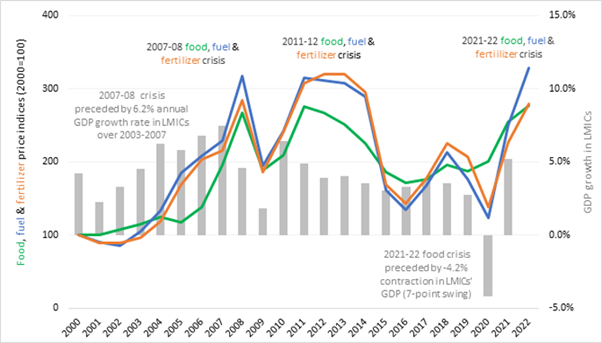
The Russia-Ukraine war has highlighted the global food supply disaster but this was brewing well before the war. The food supply chain has been increasingly global. The Great Recession of 2008-9 began to disrupt that chain, based as it was on multi-national food companies controlling the supply from farmers across the world. These companies directed demand, generated the fertiliser supply and dominated much of the arable land. When the Great Recession struck, they lost profits, and so cut back on investment and increased pressure on food producers in the ‘Global South’.

The cracks in these fundamentals of food supply were accompanied by rising oil prices, explosive demand for corn-based biofuels, high shipping costs, financial market speculation, low grain reserves, severe weather disruptions in some major grain producers, and an increased protectionist trade policies. This was the food ‘climate’ in the long depression up to 2019, before the pandemic struck.

Food, fuel and fertiliser prices versus GDP growth in low- and middle-income countries, 2000-2022. FAO/IMF/World Bank.


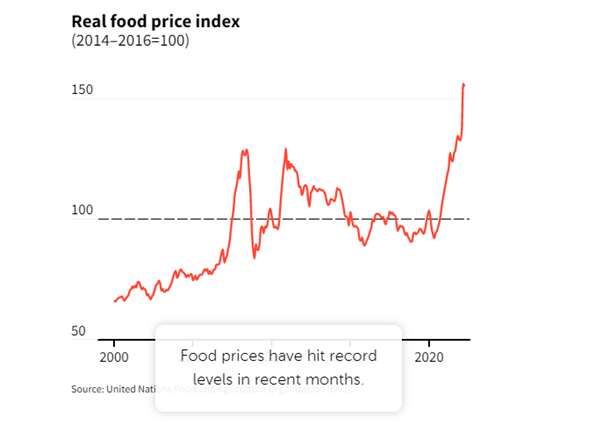
The food crisis after the Great Recession was relatively short lived but was followed by another food price explosion in 2011-12. Finally, the ‘commodities boom’ ended and food prices were relatively stable for a while. But the pandemic slump provoked a new crisis as the global supply chain collapsed, shipping costs rocketed and fertiliser supply dried up. The cereal price index showed prices hit their 2008 level in 2021.

The world has not recovered from the tailwinds of the COVID-19 pandemic, the worst economic crisis since the second world war. And this is at a time when many economies face large debt burdens relative to national income. Africa is the most vulnerable region. North Africa is a huge net importer of wheat, most of which comes from Russia and Ukraine, so it faces a particularly acute food crisis. Sub-Saharan Africa is predominantly rural, but its growing urban populations are relatively poor and more likely to consume imported grains. Farmers in many parts of Africa are struggling to access fertilisers, even at inflated prices, due to shipping and foreign exchange problems. Exorbitantly high costs will erode farmers’ profits and could reduce incentives to increase production, dampening the poverty-reduction benefits of higher food prices.

Countries already affected by conflict and climate change are exceptionally vulnerable. War-ravaged Yemen is heavily dependent on imported grains. Northern Ethiopia is one of the poorest regions on Earth, facing ongoing conflict and a humanitarian crisis. And Madagascar was slammed by successive tropical storms and cyclones in January and February, leaving its food system broken. In Afghanistan, child mortality rates are soaring due to the collapse of the economy and basic health services. Myanmar’s GDP shrunk by 18% after the military coup in February 2021.

The Russia-Ukraine war only exacerbated this food security and price disaster. Russia and Ukraine account for more than 30% of global grain exports, Russia alone provides 13% of global fertiliser and 11% of oil exports, and Ukraine supplies half of the world’s sunflower oil. In combination, this is huge a supply shock to the global food system, and a protracted war in Ukraine and the growing isolation of Russia’s economy could keep food, fuel and fertiliser prices high for years.

Russia’s invasion of Ukraine has sent the global food price index to an all-time high. The invasion idled Ukraine’s once-busy Black Sea ports and left fields untended, while curbing Russia’s ability to export. The pandemic continues to snarl supply chains, while climate change threatens production across many of the world’s agricultural regions, with more drought, flooding, heat, and wildfires.

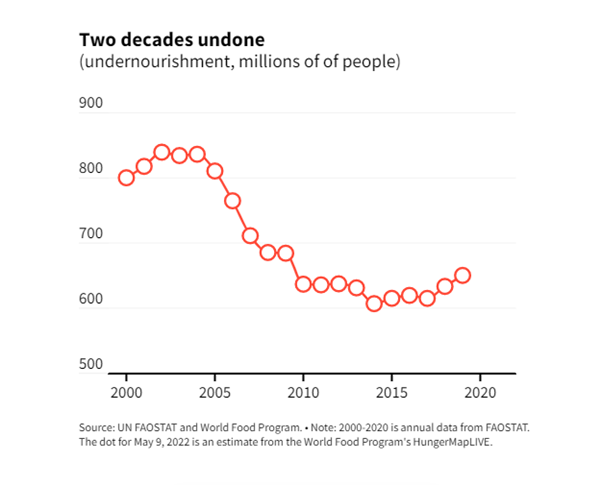
Millions are being driven towards starvation according to the World Food Program. Those considered ‘undernourished’ rose by 118 million people in 2020 after remaining largely unchanged for several years. Current estimates now put that number at about 100 million more.

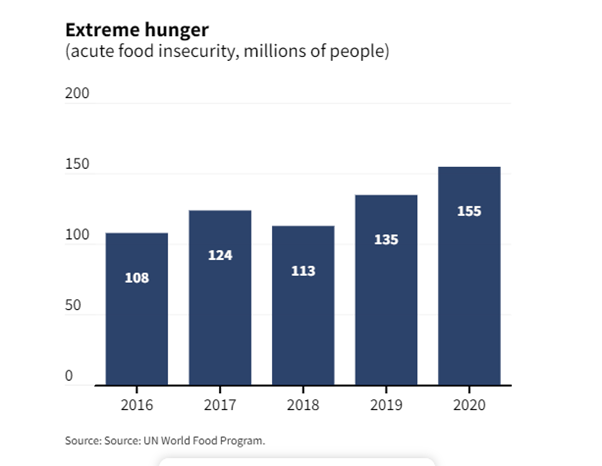
Acute hunger levels—the number of people who can’t meet short-term food consumption needs – rose by nearly 40 million last year. War has always been the main driver of extreme hunger and now the Russia-Ukraine war is adding to the risk of hunger and starvation for many millions more.

IMF Managing Director Kristalina Georgieva: “For several countries, this food crisis comes on top of a debt crisis. Since 2015 the share of low-income countries at or near debt distress has doubled, from 30 to 60%. For many, debt restructuring is a pressing priority … We know hunger is the world’s greatest solvable problem. A looming crisis is the time to act decisively—and solve it.”

But the mainstream solutions to this disaster are either inadequate or utopian, or both. The call is for the ‘major grain producers’ to resolve logistical bottlenecks, release stocks and resist the urge to impose food export restrictions. The oil-producing nations should increase fuel supplies to help bring down fuel, fertiliser and shipping costs. And governments, international institutions and even the private sector must offer social protection via food or financial aid.

None of these proposals is happening. Very little is being done by the major capitalist powers to help those poor countries with the starving and malnourished millions. At the end of last month, the European Commission announced a €1.5 billion aid package, along with additional measures, to support farmers in the EU and protect the bloc’s food security . The leaders of the World Bank Group, International Monetary Fund, United Nations World Food Program, and World Trade Organization called for urgent, coordinated action to address food security. Fine words but no action.

A real help would be to cancel the debts of the poor countries. But all that the IMF and the major powers have offered is a debt service suspension – the debts remain but the repayments can be delayed. Even this ‘relief’ is pathetic. In total, over the last two years, the G20 governments have suspended just $10.3 billion. In the first year of the pandemic alone, low-income countries accumulated a debt burden totalling $860 billion, according to the World Bank.

The other IMF ‘solution’ was to increase the size of Special Drawing Rights, the international money, to be used for extra aid. The IMF injected $650 billion of aid through the SDR program. But because of the ‘quota’ system for the distribution of SDRs, SDR quotas are disproportionately tilted toward rich countries: Africa received less SDRs than the German Bundesbank!

The macroeconomic conditions now sparking food riots. In a new report, titled “Tapering in a Time of Conflict.”, UNCTAD spelt out the scenarios ahead. Sri Lanka, whose debt crisis is several years in the making, is a useful illustration of key dynamics. Remittances and exports collapsed during the pandemic, which also disrupted the crucial tourism sector. The growth slowdown strained the budget and depleted foreign-exchange reserves, leaving Colombo now struggling to import oil and food. The shortages are acute. Two men in their seventies died while waiting in line for fuel, Al Jazeera reported. Milk prices have increased, and school exams were cancelled due to shortages in paper and ink. As Sri Lanka struggles to service the $45 billion in long-term debt it owes, of which over $7 billion is due this year, it could join countries that have defaulted during the pandemic, including Argentina and Lebanon, the latter heavily dependent on wheat imports.

Instead of increasing supply, releasing food stocks and trying to end the war in Ukraine, governments and central banks are hiking interest rates which will increase the debt burden for the food-starved poor countries. As I have explained in previous posts and UNCTAD concurs, central bank interest-rate hikes do nothing to control inflation created by supply disruptions, except to provoke a global recession and an ‘emerging market’ debt crisis.

Increasing protests and political upheaval worries the major powers more that people starving. As US Treasury Secretary Janet Yellen said: “Inflation is reaching the highest levels seen in decades. Sharply higher prices for food and fertilizers put pressure on households worldwide—especially for the poorest. And we know that food crises can unleash social unrest.”

Back in the 1840s as capitalism became the dominant mode of production globally, Marx talked of a “new regime” of industrial-capitalist food production, connected to the repeal of the Corn Laws and the triumph of free trade after 1846. He associated this “new regime” with the conversion of “large tracts of arable land in Britain,” driven by the “reorganization” of food production around developments in livestock breeding and management, and by crop rotation, coupled with related developments in the chemistry of manure-based fertilizers.

Capitalist food production dramatically increased food productivity and turned food production into a global enterprise. In the mid-1850s, these trends were already apparent: close to 25 percent of wheat consumed in Britain was imported, 60 percent of it from Germany, Russia, and the United States. But it also brought regular and recurring production and investment crises that created a new form of food insecurity. No longer could famine and hunger be blamed on nature and the weather – if it ever could. Now it was clearly the result of the inequities of capitalist production and social organisation on a global scale. And it is the poorest who suffer. Karl Marx once wrote that the famine ‘killed poor devils only’.

And with industrial farming came the cruel exploitation and treatment of animals just as much as humans. Marx wrote in an unpublished notebook, as “Disgusting!” Feeding in stables a “system of cell prison” for the animals. “In these prisons animals are born and remain there until they are killed off. The question is whether or not this system connected to the breeding system that grows animals in an abnormal way by aborting bones in order to transform them to mere meat and a bulk of fat—whereas earlier (before 1848) animals remained active by staying under free air as much as possible—will ultimately result in serious deterioration of life force?”

This is a global crisis and requires global action in the same way that pandemic should have been dealt with and the climate crisis needs. But such global coordination is impossible while the global food industry is controlled and owned by a few multi-national food producers and distributors and the world economy heads towards another slump.


NATO EXPANSION DEFEATED - The Duran


https://www.youtube.com/watch?v=4xMY6sSLL_Y 


The Duran: Poland INVADING Ukraine Next?


https://www.youtube.com/watch?v=P-AY9lEmDrk 


Russia's CHECKMATE MOVE On The West - The Duran


https://www.youtube.com/watch?v=Dh7gjhlh0vY 


THIS MAKES NO SENSE - The Duran


https://www.youtube.com/watch?v=553ZUCtSr_E