Monday, May 9, 2022
How An Israel Lobby Group Infiltrated US Education
https://popularresistance.org/institute-for-curriculum-services-how-an-israel-lobby-group-infiltrated-us-education/
By Jessica Buxbaum, Mintpress News. May 8, 2022
The Institute For Curriculum Services.
Jessica Buxbaum Uncovers How The Institute For Curriculum Services, Which Boasts Of Its Reach In All 50 States, Is Twisting The Truth About The Israeli Occupation In US Schools.
Richmond, Virginia – In 2018, the Virginia Coalition for Human Rights (VCHR) successfully stopped the state from adopting textbook edits made by the Institute for Curriculum Services (ICS), a pro-Israel “educational” institution.
The ICS promotes itself as improving the accuracy of K-12 instruction on Judaism and Jewish history in the United States. Yet, backed by the Israel lobby, its strategy appears more in line with advocating a Zionist narrative than enhancing education.
Today, ICS boasts that it has helped better public education in all 50 states and impacted 11 million students across the country. With this in mind, MintPress News uncovered how ICS is twisting the truth about Israel in U.S. schools.
The Fight In Virginia
In January 2018, Virginia activist Jeanne Trabulsi attended a Jewish Council for Public Affairs (JCPA) webinar featuring ICS. During the event, ICS Director Aliza Craimer Elias spoke about the nonprofit’s activity, specifically how it works with Jewish Community Relations Councils (JCRCs) to send revision requests to textbook review committees.
Following the webcast, the Institute for Research: Middle Eastern Policy (IRmep) sent a request to Virginia’s Department of Education, under the Virginia Freedom of Information Act, for all documents submitted by ICS, JCPA and JCRCs. IRmep found that ICS-proposed edits were sent to the Virginia Department of Education on behalf of the Jewish Community Federation of Richmond and the JCRCs of Greater Washington, Richmond, and Tidewater.
Requested ICS changes to public school textbooks included: Replace “settlers” with “communities,” “occupation” with “control of,” “wall” with “security fence,” “occupied territories” with “captured areas,” and “militant” with “terrorist.”
Discourage students from conducting open internet research, and instead recommend the Anti-Defamation League’s website and the JewishVirtualLibrary.org.
Delete all references to “Palestinian Territories.”
Change maps to recognize Israeli annexation of East Jerusalem and the Golan Heights, instead of classifying these areas as occupied.
ICS targeted 12 textbooks published by the National Geographic Society, Prentice Hall, Five Ponds Press, Houghton Mifflin Harcourt, and McGraw-Hill for revision.
With these revelations, VCHR sent a letter to the Virginia Department of Education and the above publishers requesting that they not incorporate ICS edits. To VCHR’s knowledge, no ICS-sought changes were made to the textbooks during the 2018 review cycle.
ICS Tactics
In March, Trabulsi presented VCHR’s victory against ICS at the Washington Report on Middle East Affairs and IRmep’s annual Israel Lobby Conference.
“VCHR is of the opinion that ICS is not a true education outfit. It’s a public affairs and advocacy group,” Trabulsi said during her talk.
ICS operates as a nonproft under the 501(c)(3) status of San Francisco’s JCRC and is a grantee of the Schusterman Family Foundation, which also supports the American Israel Education Foundation, an American Israel Public Affairs Committee charity organizing congressional visits to Israel.
In addition to textbook revisions, ICS also hosts teacher training. Currently, 90 U.S. cities have hosted ICS workshops with over 6,000 teachers have participated. Trabulsi attended their flagship course entitled “Teaching the History of the Arab-Israeli Conflict Using Primary Sources.” She described their teaching methods during the conference:
[T]hey are highly selective about what documents they do include in their teaching modules. If you didn’t know the story of the Arab world and Israel, you’d think they’re pretty good. I remember one student remarking that the Israelis have offered peace to the Arabs so many times, what else could the Arabs possibly want?”
The primary sources ICS uses for this module include The Jewish State (1896), The First Arab Congress (1913), Hussein-McMahon Correspondence (1915), and The Sykes-Picot Agreement (1916), and The Balfour Declaration (1917).
Trabulsi told MintPress that ICS doesn’t use primary sources that may alter the narrative they wish to set, such as the White Paper of 1939, a policy paper by the British government rejecting the establishment of a Jewish state in historic Palestine.
“VCHR believes that ICS is enmeshed with and funded by Israel affinity groups that drive their pro-Israel advocacy. We believe that this results in biased and inaccurate textbooks and teacher training,” Trabulsi said at the conference.
ICS Involvement In Textbooks Across The US
MintPress sent freedom of information requests to the education departments or boards of all 50 states and the District of Columbia asking for all materials sent by ICS, JCPA, JCRCs, or Jewish federations during curriculum and textbook review processes.
Nineteen states responded that textbook and curriculum decisions are made at the local district level, so information on recommended changes is not available. Fourteen states said none of the aforementioned organizations contacted them regarding proposing textbook edits. Eleven states and D.C. did not respond by the time of writing. However, the states of California, New Mexico, Louisiana, South Carolina, and Kentucky provided information on correspondence they had with ICS, their state Jewish federations, and JCRCs.
ICS revisions in Kentucky focused on adding references to ancient Israel and the Holocaust in the content. The Jewish Federation of New Mexico sent their state’s education department an ICS review of social studies standards — advocating “Nation of Israel” be changed to “State of Israel.” In South Carolina, ICS reviews of a textbook from National Geographic Learning and Cengage Learning detailed adding references to acts of Palestinian terrorism.
In California, where ICS is based, JPAC, JCRCs of San Francisco and Sacramento, and the Jewish Federations of Greater Los Angeles and the Desert sent the state’s education department proposed revisions made by ICS. In their cover letter, the organizations commended California for accepting previous ICS edits.
ICS reviewed the textbooks from Houghton Mifflin Harcourt, Pearson Scott Foresman and Prentice-Hall, McGraw-Hill, Teachers Curriculum Institute, Studies Weekly, National Geographic Learning, Discovery Education, Pearson Prentice Hall, and First Choice Educational Publishing. ICS proposed edits include: Delete mentions of “Palestine” and the “West Bank.”
Change “Palestine” to “Judah,” the ancient Israelite kingdom.
Add “Mandate” and “Region” to references of Palestine.
Delete reference to “Palestinian cultural heritage.”
Change “Jews settled there” to “Jews joined those [Jews] already there.”
Delete reference to Israel capturing the West Bank in 1967.
In Louisiana, the North Louisiana Jewish Federation, Jewish Federation of Greater New Orleans and the Jewish Federation of Baton Rouge sent a letter to the state’s Department of Education on behalf of ICS recommending ICS revisions to content published by the American Book Company, The Gilder Lehrman Institute of American History, Studies Weekly, Edmentum, Houghton Mifflin Harcourt, and Brown University’s The Choices Program. ICS changes to these texts include: Delete “rightfully” from sentence “The Arabs believed Israel had stolen land that rightfully belonged to Palestinian Arabs.”
Delete mentions of Israel “seizing territory” from Arab nations.
Add information describing Palestinian President Yasser Arafat as “directing countless terrorist attacks against Israelis.”
Delete student exercise to “[w]rite an unbiased essay that explores all sides of the issue of West Bank settlements.”
Delete mentions of “The Green Line,” “The wall,” and “Land lost by the wall” on maps.
Delete reason for Arab states rejecting the UN partition plan.
Add “Mandate” to references of Palestine
Delete mentions of “historic Palestine” and mentions of Palestine as a “land” or “country.”
Add references to acts of Palestinian terrorism
Place liberation of Palestine in quotes
Delete “natives of Palestine” in definition of Palestinians
Delete references to Palestinians inhabiting the land for thousands of years.
Add information describing Zionism as a movement for Jewish self-determination.
Add Israel retaliates in “self-defense” to Palestinian attacks.
Delete sentence “Israel disproportionately uses the bulk of the water from those aquifers [in the Occupied West Bank] for its population.”
Mention “Israel is the only democracy in the Middle East.”
Delete mention of Israel being” accused of many human rights abuses against Palestinians in the territories it occupies…[and] treating its Arab-Israeli citizens as inferior to its Jewish citizens” and replace it with “Israeli Arabs, who are Israeli citizens, have the same full legal rights as Israeli Jews.”
Erasing the existence of Palestine and the indigenous identity of Palestinians was a common theme in ICS revisions. “They relabeled maps and they deleted all references to Palestine. You can call it Mandatory Palestine, but you can never call it Palestine,” Trabulsi said during the Israel Lobby conference. “They want to change the word Palestine to Palestinian. The reasoning is there is no state of Palestine, nor has there ever been.”
ICS, JCPA, and the Jewish Federations of North America did not respond to MintPress’ requests for comment.
The Israel Agenda In Schools – And Progressive Pushback
ICS isn’t the only pro-Israel organization attempting to shape the narrative on Israel-Palestine in American education. Left-wing activists accused the final adoption of the California Ethnic Studies Model Curriculum of being “white-washed” and “watered down” following opposition by pro-Israel groups.
The Anti-Defamation League’s No Place for Hate initiative is involved in thousands of schools across the U.S. and encourages these institutions to use ADL resources. Pro-Israel groups also continuously go after Palestinian and solidarity activists on college campuses across the country.
Yet progressive movements are fighting back. In 2018, the Texas Coalition for Human Rights (TCHR) successfully got the state’s board of education to change curriculum standards related to Palestine-Israel.
The following main changes were approved: “[E]xplain how Arab rejection of the state of Israel has led to ongoing conflict” changed to “discuss factors contributing to the Arab-Israeli conflict, including the rejection of the existence of the state of Israel by the Arab League and a majority of Arab nations.”
“[E]xplain how developments in Islam influenced law and government in the Muslim world such as secularism, nationalism, and fundamentalism” changed to “explain how geopolitical and religious influences have impacted law and government in the Muslim world.”
In November 2018, the Texas Board of Education heard public comments on its decision to update the school curriculum. TCHR testified in favor of changing the curriculum while Jewish community center Shalom Austin, the Jewish Community Relations Council, Jewish Federations in Texas, B’nai B’rith International, and Truth in Texas Textbooks all testified in favor of keeping the current standards.
TCHR activist Alex McDonald understands that more needs to be done in fixing the U.S.’ faulty school curriculum and ensuring accuracy, especially when it comes to Palestine. “The goal is to stifle the conversation and the criticism,” McDonald told MintPress News. “And ICS is just one small part of the brainwashing.”

A Socialist Perspective On The Abortion Rights Struggle
https://popularresistance.org/we-are-trying-to-transform-society-a-socialist-perspective-on-the-abortion-rights-struggle/
By Natalia Marques, People's Dispatch. May 8, 2022
“We Are Trying To Transform Society.”
Karina Garcia, a socialist feminist activist, spoke to Peoples Dispatch in the wake of the Roe v. Wade draft decision.
On the night of May 3, a US Supreme Court draft decision regarding the landmark Roe v. Wade decision was leaked to the press. As per the draft, penned by conservative Justice Samuel Alito, the Supreme Court is set to overturn the historic decision, eliminating the right to abortion for millions of women. In response, thousands have taken to the streets of US cities, demanding that the right to abortion be protected. Activists and the millions of women in the streets hope that this outpour can sway the final Supreme Court decision.
Karina Garcia is an organizer with the Party for Socialism and Liberation and a writer for socialist feminist magazine Breaking the Chains. She has been organizing since she was 17 years old, when she founded a women’s rights organization at her high school. For the past ten years, she worked with a national reproductive justice organization focused on the Latina community. Peoples Dispatch interviewed Garcia to discuss her perspective on the current moment in the struggle for abortion access in the US.
Peoples Dispatch: Why is it that the ruling class in the United States is fighting so hard against abortion rights, specifically now? What has changed about the current moment?
Karina Garcia: This is really an attempt to distract, divide and confuse the people.
People are facing so many problems, whether it’s poverty wages, a lack of health care, lack of sick days, lack of all sorts of protections, clean water, food, all these very obvious social problems that actually have solutions. If the government put the massive amounts of resources that exist in this country into these issues, we would actually be able to provide people with all of the basic necessities, not just in this country, but in the world, overnight. We have those resources now. 40% of the food in this country is wasted. We spend trillions of dollars on the military industrial complex, starting new wars.
The resources all exist for people to live dignified lives and to have food, health care, housing, education, all the things that they need, but we have a ruling class that doesn’t want that. They want to keep starting new wars and they want to keep accumulating endless amounts of profits.
The fact of the matter is, people’s living conditions in this country have not improved, they’ve gotten worse. Inequality has only been sharpened during this pandemic. The complete failure and inability of the government to meet the people’s basic needs has been exposed for all to see. They couldn’t even pass Build Back Better, which would barely get us to a level of social welfare that’s comparable to other countries in the global north. They didn’t do anything, not that they couldn’t, but they just wouldn’t. They can make all the excuses they want: the filibuster, this or that politician, we’ve heard it all and it’s worthless. When they want something to pass, they get their people in line and they pass it. When it comes to tax cuts for the rich and bailouts for the banks, they act immediately and with complete urgency. So we’re not having it.
Right now there are all of these looming social problems that exist in society, and abortion access is just that thing that they are able to use, that they’re trying to use to scapegoat and to divide people. It presents an opportunity for them to distract. Our class is mostly unorganized, so they can use these wedge issues because they have control over the media.
They use these wedge issues to divide people based on what they call moral issues. But the fact of the matter is, we know that it has nothing to do with morality at all, because the states where they are enacting the most vicious and cruel restrictions on abortion access are the places where women and families have it the worst. Texas, for example, is one of the worst places to be if you’re a woman or a child, because there’s so little support, from child poverty to lack of access to child care, to poor, underfunded schools.
The restrictions on abortion have nothing to do with actually improving people’s lives, or protecting people’s lives or protecting families. It has everything to do with providing no solutions and no major changes in society, not actually providing anything material for people other than scapegoating, propaganda, division, humiliation, shame. That’s the only thing that they can offer, to put down and shame people.
It’s disgusting. But it has nothing to do with the population. It has nothing to do with wanting more workers or wanting a more moral society. It’s a way to score political points with religious voting blocks without actually making any material changes to people’s lives.
PD: What do you think it will take to sway the court’s decision on Roe v. Wade?
KG: What has happened has provided us with a really big opportunity. The myth is that the Supreme Court is this higher, almost holy body, that is only moved by arguments and whatever is written on paper. That’s just ahistorical. The Supreme Court is highly political. They’re highly affected by social movements, the things that are happening in society, over and above everything else: their function is to provide stability for the capitalist system.
And whenever there are movements that are challenging the status quo, that can be explosive, it creates a level of instability that they don’t want to deal with. That’s the kind of instability that we have to show them. If they think that they’re going to roll back the rights of half the population, that they’re going to put us in this endless position of humiliation and domination and control and that we’re not going to do anything about it, they’re mistaken.
This has provided us an opportunity. Whoever leaked that draft decision is a hero. Because they’re giving us a chance to fight now. Influence them now. Make them feel it now.
Kavanaugh is a DC frat boy, he’s not a religious zealot. He can totally be moved. And, you know what? At the end of the day, any one of them can be.
PD: Is Roe v. Wade enough? And if not, what more do we need?
KG: Roe v. Wade is not enough. We’ve known for years that Roe v. Wade is not enough, because you can have any right on paper. The fact of the matter is that 90% of counties in the United States don’t have abortion clinics. Not only that, but people don’t have health care, people don’t have child care. This is about our lives and our families living dignified lives.
Abortion is just one part of health care. It’s a part of the fight for reproductive justice. The fight for socialism is a fight for all of our needs to be met, for us to have the resources and the wealth that we create put towards the things that matter to us, the things that that we really need. Clean water, clean energy, housing, health care, education, all those things are part of reproductive justice. They’re a way for families to live with dignity.
We’re not really for imposing one or another view of what families should or shouldn’t be. We’re for providing people with what they need to be able to create the families that they want with the resources that they deserve. Whether that’s more support for fertility treatments for people who are having difficulty conceiving, or better or more accessible forms of contraception, to be able to have an abortion if they need it, if they want it, if it makes sense for them.
All of those things are what’s needed, what’s really required. Roe is an important baseline, but we have to go beyond it too.
PD: What are some major obstacles for building a movement that can win abortion rights for everyone?
KG: One of the obstacles that we face is that a lot of people don’t have basic sex education. They really don’t understand the process of pregnancy and so that makes them vulnerable to the cynical and despicable vitriol that is put out by the right wing antis. Another challenge, and I think the challenge that the whole movement faces, is the nonprofit industrial complex. Just the fact that so many issues are separated and that and there’s real divisions, of course, in our class, but we don’t have a very highly developed national movement for something more comprehensive.
We are trying to transform society. We think that our resources should be used to fight racism, to fight sexism, to overcome the historic exploitation and super-exploitation and oppression of certain communities and actually build up a society that meets all of our needs, the needs of the many, not the few, a society that aligns with our values for dignity and justice.
Having that collective vision, a program that ties together all of the different social movements, that’s historically one of the challenges that we face in this country.
PD: How do activists overcome the divisions within society that already exist in order to build this movement?
KG: Political education is really important. In addition to bringing people out in the street, we have to bring people together to deepen their understanding of what’s behind these attacks so that we can see that this is part of a bigger attack on our communities as a whole. When they’re coming after one segment of our community, [help them see] it actually hurts all of us. An injury to one is an injury to all. That can’t just be some slogan. It has to become a fact.
And we’ve seen a lot of solidarity over the years out on the streets and I think that we’re going to see that again. But solidarity is really earned and trust and respect for each other is really earned. We get that and we give that by coming out for each other, struggling side by side.
PD: You’ve been in the streets these past few days. What is the mood of the people? What have you been noticing?
KG: People were so happy when we were marching down the street. People joined us from the sidewalks, they were cheering and chanting alongside us. That kind of feeling is electrifying, it’s magnetic, and it spreads. That’s why it’s important to get out into the streets.
And it’s a complete distraction to just say, oh, we have to focus on getting the Democrats elected, let’s all vote. Please. We’re past that. That’s our enemies talking, confusing us, and lulling us back to sleep. We have to stay out in the streets so that we continue to bring our people out and break through this facade of apathy.
People know what’s going on and they have seen and experienced that their vote hasn’t fundamentally changed the things around them. It’s bigger than choosing between these two ruling parties: we need a new system. It’s a really patronizing way of thinking and is just downright disrespectful to say that all the people that don’t vote just don’t care or are apathetic or are somehow to blame for this rotten system of these capitalist politicians who use all of our resources and then have the nerve to blame the people themselves for the problems that they’ve created.
PD: What can the movement in the US learn from the struggles in Latin America for abortion rights?
KG: Stay in the streets. Our sisters in Latin America, they won their rights the way that we won our rights to begin with. They fought for them. They took them. They built strong independent organizations, people’s organizations. They’re connected to a broader socialist vision of all of the different rights that they deserve. It wasn’t about just waiting for these politicians to change their mind.
They were able to win their rights by exercising and showing their strength, the strength of their organizations, building them tirelessly day by day through actions, great and small, supporting each other, helping each other. All of these ways that you show you care about each other. You build up your organization that makes you so much more powerful, so much more difficult to ignore, coopt, and divide, when you are building strong political organizations in your community with a shared vision of what you want.
Climate Nexus, Top Stories
Climate Change Threatens Blackouts Nationwide: Grid operators are warning summer heatwaves will cause rolling blackouts across the country, the Wall Street Journal reports. Concerns are especially high in California where heat waves drive electricity demand, drought threatens to shut off hydroelectric power stations, and wildfires (and the threat thereof) force outages. Climate change, mainly caused by the extraction and combustion of fossil fuels, increases the intensity, duration, and frequency of extreme heat, heatwaves, and droughts and thus essentially supercharges wildfires by turning fuel into veritable tinder. While relatively few customers lost power in Texas over the weekend, concerns over the state’s notoriously independent grid's (in)ability to cope with impending summer temperatures are sure to grow. (Nationwide: Wall Street Journal $; California: Sacramento Bee $, AP, New York Times $, Reuters, Bloomberg $; Hydro: S&P Global; Texas: Ft Worth Star-Telegram, Gizmodo, Washington Post $; Weekend outages: Fox7-Austin; Climate Signals background: Extreme heat and heatwaves, Western US megadrought, Wildfires)
Doulas Fill Post-Disaster Gaps In System Failing Parents: A New Orleans-area doula collective is preparing to help new parents care for their infants as climate change supercharges major storms, The 19th* News reports. The Birthmark Doula Collective has prepared emergency infant feeding kits for years, working to fill gaps emblematic of larger societal failings to support children and families after a fetus is carried to term. The kits, which contain formula, ice packs, and nursing covers, now also include soap and bottle brushes and come in a bucket to wash everything — poorly sanitized bottles can cause diarrhea and dehydration, "especially scary for a baby that’s born prematurely or who has a weak immune system.” Malaika Ludman, a doula and certified lactation consultant with BDC, said. The collective has also set up an emergency hotline staffed with doulas, lactation counselors, and Spanish language interpreters to help parents in the wake of disasters. In a crisis, details matter and ensuring shelters have breastfeeding spaces, sinks for handwashing, and private rooms for pumping are key. Low-income people breastfeed at lower rates — for a range of reasons including deficient postpartum care and support and the lack of paid family leave — and feeding babies with formula becomes even more complicated when a hurricane hits. "Thinking about it as a human rights issue is really critical,” Sarah DeYoung, an assistant professor at the University of Delaware and disaster researcher, said. “And in the United States, it’s a racial justice issue as well, because minority populations are more likely to be exposed to disasters.” (The 19th* News)
Town Powered By Solar Energy Offers Bright Spot For Puerto Rico During Blackout: In early April, in the middle of Puerto Rico's densely forested mountains, residents of Adjuntas cooled off in an air-conditioned community center while the rest of the disenfranchised colonial territory was without power. The town weathered the massive blackout by relying on solar power and battery backups. “When you have energy security, you’re taking the weight off the shoulders of the employees as well as the families that come to the business,” said Ángel Irizarry Feliciano, owner of Lucy’s Pizza, which served pies through the outage. “It was a relief we could continue providing a service to our people without interruptions or having to reduce our hours.” The town is a success story in a largely-sun-drenched island that gets just 2.5% of its electricity from solar power. Even as Puerto Rico continues to suffer from unreliable power as it recovers from Hurricane Maria, illegal development is destroying mangrove forests and increasing its vulnerability to future hurricanes. “This is one of the biggest environmental crimes I’ve seen,” said Rep. Jesús Manuel Ortiz during a public hearing in late April. “It’s outrageous. A crime is being committed right in front of everyone.” (Solar: New York Times $; Illegal development: AP, NBC; Climate Signals background: Hurricane Maria)

FOSSIL FUELED WAR: EU rewrites oil ban to give Hungary, Slovakia and Czech Republic more time (Politico Pro $), G-7 leaders commit to banning imports of oil from Russia (Bloomberg $), Companies count the cost of ditching Russia (Reuters, Factbox), Germany should cut gas use in power generation to preserve supplies -industry (Reuters), Russia's Victory Day could be a crucial moment for oil (OilPrice), Thought sanctions on Russian oil were hard? Try gas. (Politico Pro $), European gas drops as Russia tries to calm clients over payments (Bloomberg $), Gazprom tries to reassure Europe clients they can still buy gas (Bloomberg $)
HAVANA GAS EXPLOSION: At least 30 dead as explosion rocks luxury hotel in Havana (Washington Post $, CNN, AP, The Guardian, BBC, New York Times $, ABC), Havana hotel death toll at 31 as dogs search for survivors (NBC Miami)
CLIMATE DIPLOMACY: Climate summit and Ukraine focus talks between El-Sisi and Macron (Prensa Latina)
CLIMATE LITIGATION: Filipino inquiry finds big polluters ‘morally and legally liable’ for climate damage (The Guardian)
DENIAL: Climate denial is dead on Facebook. What replaced it is more insidious. (Protocol)
WHY? ARE PEOPLE FEELING UNEASY?: How climate scientists keep hope alive as damage worsens (AP), On climate ‘doomism’: Heart & mind reasons to resist it (Yale Climate Connections)
ALL ABOARD!: People vs. cargo: How a battle over Amtrak’s Gulf Coast line could shape the future of passenger rail (Grist)
EPA: Trump broke the EPA. Biden is struggling to fix it. (Buzzfeed)
DOE: Biden administration proposes new commercial water heater efficiency rules (The Hill), Energy Secretary explains why feds are spending $2.5 billion on carbon capture (CNBC), Investigation into solar tariffs could threaten US 2035 clean energy goal, says DOE’s Granholm (Utility Dive), On the record with DOE's cleantech finance boss (Axios, Jigar Shah interview)
DOJ & CEQ: A new office of environmental justice is announced (Grist), Biden’s new EJ czar got her start by working 14-hour shifts (E&E News), Biden administration announces plan to crack down on pollution in poor, minority areas (The Root), New Department of Justice office will target climate disparities (Gizmodo, Grist, E&E News, The Root, Gizmodo)
EXECUTIVE BRANCH: Tai: US and Canada exploring 'all options' over Mexican energy policy (Politico Pro $), US commerce head aims to move ‘swiftly’ on solar trade probe (Bloomberg $)
WHITE HOUSE: Biden’s trade team: RIP globalization (Politico), Rich nations must stick to climate promises, says US envoy Kerry (Reuters), White House aims to tackle environmental injustices, but challenges loom (Washington Post $), White House alarmed that commerce probe is ‘smothering’ solar industry (Washington Post $), Biden nutrition conference may fire up climate debate on meat (E&E News)
THE HILL: Bipartisan climate talks pick up steam (The Hill), Democrats fear Manchin’s bipartisan energy push is a stalling tactic (The Hill), Manchin says he'd pass parts of Biden's agenda. But Democrats may have to write the bill for him. (NBC)
TRIBES: ‘Please listen to us’: Diné allottees try to reclaim Chaco Canyon (Navajo Times), Muscogee Nation turns to cows to build for the future (Yes Magazine)
CITIES AND STATES: New Mexico’s Clean Car Rule will go into effect July 1 (New Mexico Political Report, AP), Moms push Massachusetts utilities to transition to renewable heat sources (Yale Climate Connections), Ohio Democratic Party sues Gov. DeWine over redacted nuclear records (The Hill) CALIFORNIA: A bid to stop freeway expansions in California hits a roadblock: Organized labor (LA Times $) VERY LEGAL AND VERY COOL: Louisiana legislator pushes bills benefiting the oil and gas industry — and her husband (The Guardian)
IMPACTS: 5,000 hospitalized in Iraq as another severe dust storm strikes (Democracy Now), As conflict and climate change bite, are high food prices here to stay? (Thomson Reuters Foundation), Climate change is leaving its mark on Indigenous-owned food businesses (Prism Reports), Coral reefs provide stunning images of a world under assault (AP)
HEAT: 'Bad boys' are back: India doubles down on coal as heatwave worsens power crisis (Reuters), An unprecedented heat wave in India and Pakistan is putting the lives of more than a billion people at risk (Inside Climate News), The world has no choice but to care about India’s heat wave (The Atlantic), India tries to adapt to extreme heat but is paying a heavy price (Washington Post $)
DROUGHT: The two largest reservoirs in California are already at 'critically low levels' and the dry season is just starting (CNN) LAKE POWELL: Climate change is drying up biggest reservoir in US (CNN, Reuters), What Israel, Las Vegas and other places can teach SoCal about using a lot less water (LA Times $)
FLOODING: Life in a Minnesota ‘fishbowl’: Water everywhere, except inside town (New York Times $)
WILDFIRES: ‘Stripped of everything,’ survivors of Colorado’s most destructive fire face slow recoveries and a growing climate threat (Inside Climate News), Fire suppression fueled California’s destructive 2020 wildfires (Bloomberg $), As fires scorch new Mexico, the west braces for another hellish summer (Grist) NEW MEXICO: Villages told to evacuate as New Mexico wildfire pushes north (Reuters), ‘Potentially historic’ wildfire event threatens new Mexico, southwest (Washington Post $, Reuters, Axios, AP, Washington Post $), Fire-ravaged New Mexico villages cling to faith, ‘querencia’ (AP)
Inflation: wages versus profits
https://thenextrecession.wordpress.com/2022/05/09/inflation-wages-versus-profits/
The Governor of the Bank of England, Andrew Bailey set the attitude of the mainstream view on the impact of inflation in February, when he said that “I’m not saying nobody gets a pay rise, don’t get me wrong. But what I am saying is, we do need to see restraint in pay bargaining, otherwise it will get out of control”.
Bailey followed the Keynesian explanation of rising inflation as being the result of a tight (‘full employment’) labour market allowing workers to push for higher wages and thus forcing employers to hike prices to sustain profits. This ‘wage-push’ theory of inflation has been refuted both theoretically and empirically, as I have shown in several previous posts.
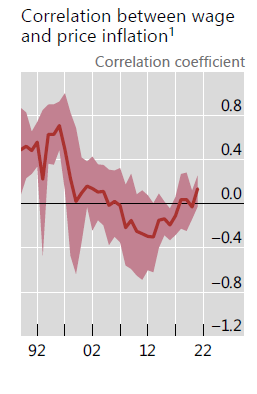
And more recently the Bank for International Settlements (BIS) study confirms that “by some measures, the current environment does not look conducive to such a spiral. After all, the correlation between wage growth and inflation has declined over recent decades and is currently near historical lows.”
 BIS
BIS But this wage push theory persists among orthodox Keynesians because they think full employment breeds inflation; and it is supported by the authorities because it ignores any impact on prices by businesses attempting to boost profit. Bailey did not talk about ‘restraint’ in market pricing or profits.
The wage-push theory existed before Keynes. As far back as in the mid-19th century, the neo-Ricardian trade unionist Thomas Weston argued in the circles of the International Working Man’s Association that workers could not push for wages that were higher than the cost of subsistence because it would only lead to employers hiking prices and was therefore self-defeating. For Weston, there was an ‘iron law’ of real wages tied to the labour time required for subsistence which could not be broken.
Marx rebutted Weston’s views both theoretically and empirically in a series of speeches published in the pamphlet, Value Price and Profit. Marx argued that the value (price) of commodity ultimately depended on the average labour time taken to produce it. But that meant the shares of that labour time between the workers who created the commodity and the capitalist who owned it was not fixed but depended on the class struggle between employers and employed. As he said, “capitalists cannot raise or lower wages merely at their whim, nor can they raise prices at will in order to make up for lost profits resulting from an increase in wages.” If wages are ‘restrained’ that may not lower prices but instead simply increase profits.
Indeed, that is what is happening now in the current bout of inflation. In the Great Recession recovery, price growth was actually quite subdued over the first few years of that recovery. Corporations instead applied extreme wage suppression (aided by high and persistent levels of unemployment). Unit labour costs (ie the cost of labour per unit of production) fell over a three-year stretch from the recession’s trough in the second quarter of 2009 to the middle of 2012.
There has been a general pattern of the labour share of income falling during the early phase of recoveries characterized most of the post–World War II recoveries, though it has become more extreme in recent business cycles. By 2019, labour’s share was at all-time low. The decade of the 2010s saw basically a stagnation of average real wages in most major economies.

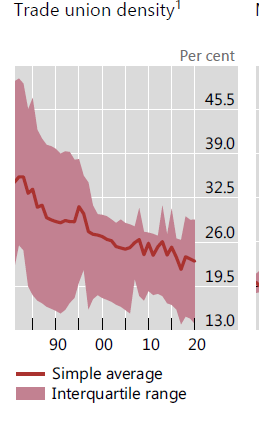
In a recent report, the Bank for International Settlements (BIS) makes the point that “in recent decades, workers’ collective bargaining power has declined alongside falling trade union membership. Relatedly, the indexation and COLA clauses that fuelled past wage-price spirals are less prevalent. In the euro area, the share of private sector employees whose contracts involve a formal role for inflation in wage-setting fell from 24% in 2008 to 16% in 2021. COLA coverage in the United States hovered around 25% in the 1960s and rose to about 60% during the inflationary episode of the late 1970s and early 1980s, but rapidly declined to 20% by the mid-1990s “
 BIS
BIS Since the COVID slump, labour’s share of income and real wages have been falling sharply even as unemployment falls. This is the complete opposite of the Keynesian inflation theory and the so-called ‘iron law of wages’ proposed by Weston against Marx. The rise in inflation has not been driven by anything that looks like an overheating labour market—instead it has been driven by higher corporate profit margins and supply-chain bottlenecks. That means that central banks hiking interest rates to ‘cool down’ labour markets and reduce wage rises will have little effect on inflation and are more likely to cause stagnation in investment and consumption, thus provoking a slump.
Prices of commodities can be broken down into the three main components: labour costs (v= the value of labour power in Marxist terminology, non-labour inputs (c =the constant capital consumed, and the “mark-up” of profits over the first two components (s = surplus value appropriated by the capitalist owners). P = v + c + s.
The Economic Policy Institute reckons that, since the trough of the COVID-19 recession in the second quarter of 2020, overall prices in the producing sector of the US economy have risen at an annualised rate of 6.1%—a pronounced acceleration over the 1.8% price growth that characterized the pre-pandemic business cycle of 2007–2019. Over half of this increase (53.9%) can be attributed to fatter profit margins, with labour costs contributing less than 8% of this increase. This is not normal. From 1979 to 2019, profits only contributed about 11% to price growth and labour costs over 60%. Non labour inputs (raw materials and components) are also driving up prices more than usual in the current economic recovery.
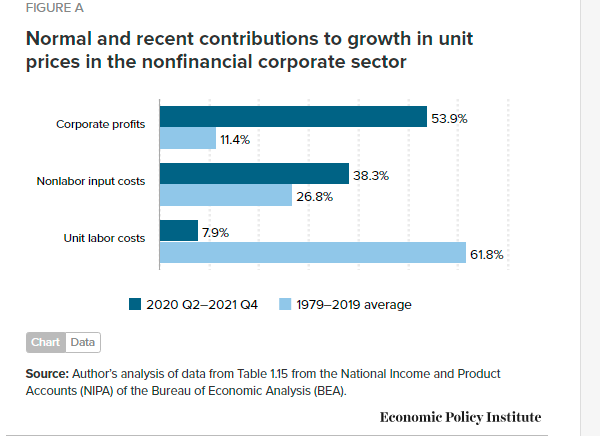
Current inflation is concentrated in the goods sector (particularly durable goods), driven by a collapse of supply chains in durable goods (with rolling port shutdowns around the world). The bottleneck is not labour asking for higher wages, shipping capacity and other non-labour shortages. Indeed, in the current inflation spike, US weekly earnings growth has been slowing month by month.
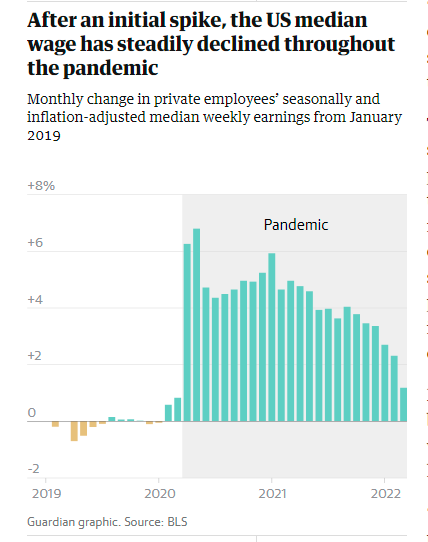
It’s profits that have been spiralling upwards. Firms that did happen to have supply on hand as the pandemic-driven demand surge hit have had enormous pricing power vis-à-vis their customers. Corporate profit margins (the share going to profits per unit of production) are at their highest since 1950.
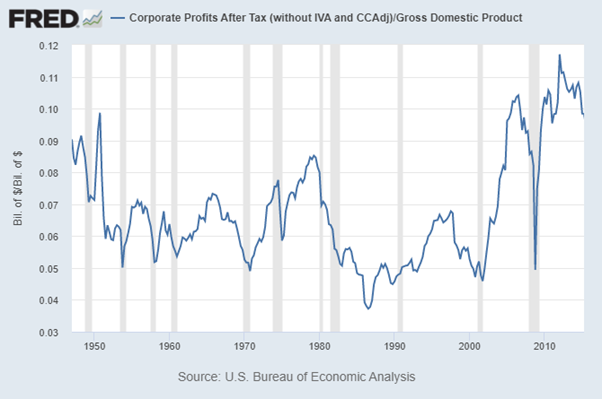
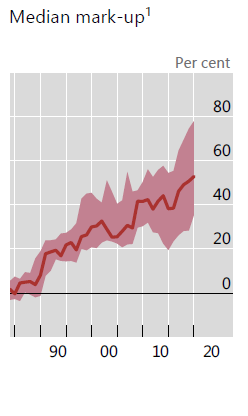
The BIS study finds similarly: “Firms’ pricing power, as measured by the markup of prices over costs, has increased to historical highs. In the low and stable inflation environment of the pre-pandemic era, higher markups lowered wage-price pass-through. But in a high inflation environment, higher markups could fuel inflation as businesses pay more attention to aggregate price growth and incorporate it into their pricing decisions. Indeed, this could be one reason why inflationary pressures have broadened recently in sectors that were not directly hit by bottlenecks.”
 BIS
BIS An analysis of the Securities and Exchange Commission filings for 100 US corporations found net profits up by a median of 49% in the last two years and in one case by as much as 111,000%!
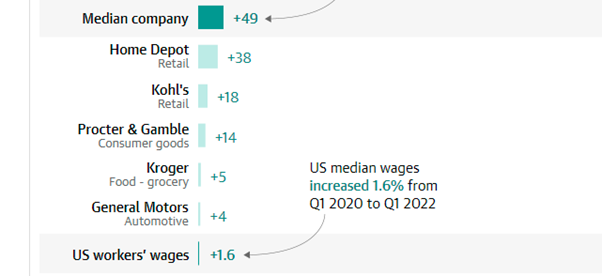
Chief executives are acutely aware to the ability to hike prices in this inflationary spiral. Hershey bar CEO Michel Buck told shareholders: “Pricing will be an important lever for us this year and is expected to drive most of our growth.” Similarly, a Kroger executive told investors “a little bit of inflation is always good for our business”, while Hostess’s CEO in March said rising prices across the economy “helps” profits.
Does this mean that companies can raise prices at will and are engaged in what is called ‘price-gouging’? Marx, arguing with Weston in 1865, did not think that was the case in general. The power of competition still ruled. George Pearkes, an analyst at Bespoke Investment, pointed to Caterpillar, which recorded a 958% profit increase driven by volume growth and price realization between 2019 and 2021’s fourth quarters. Eliminating price increases may have dropped the company’s 2021 quarter four operating profits slightly below the $1.3bn it made in 2020. “This isn’t price gouging … and it shows pretty concretely that there’s a lot of nuance here,” Pearkes said, adding profiteering is “not the primary driver of inflation, nor the primary driver of corporate profits”. Indeed, companies that push prices as hard as the current environment allows to maximise profits in the short run may find themselves paying a price in market share down the road as others get into the game. It is clear, however, that the concentration of capital is any sector, the greater ability to hike prices. “When you go from 15 to 10 companies, not much changes,” one analyst argued. “When you go from 10 to six, a lot changes. But when you go from six to four – it’s a fix.”
Recently, the UK’s Competitions and Market Authority (CMA) published an important report. The CMA found a mixed picture.Profit persistence has increased as measured by markups over marginal costs and the return on capital but not when measured by profits before tax.
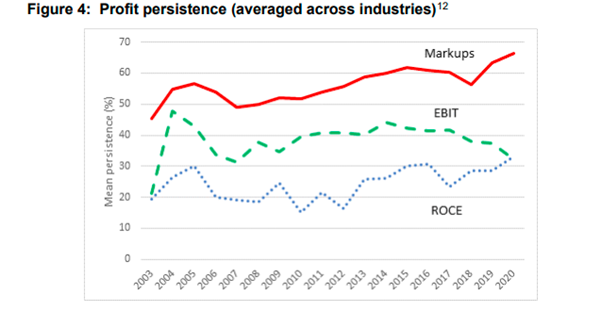
And the CMA also found that the more international competition there was, the less ability for firms to increase prices and mark-ups. “This highlights the important role that international trade plays in contributing to keeping UK markets competitive.” The BIS summed up this debate: “In product markets, the degree of competition comes into play. Firms with higher markups – an indication of greater market power – could raise prices when wages increase, while those without such pricing power may hesitate to do so. Strategic considerations in price-setting are also relevant. Firms may feel more comfortable raising prices if they believe their competitors will also do so. Price increases are more likely when demand is strong. With less concern about losing sales and less room to adjust profit margins, even firms with less pricing power could pass higher costs through to customers.”
As a partner in the Bain consultancy, an adviser to many corporations, argued, “when times are tough, screw your customers while the screwing is good!”. The consultant went on: “I don’t think this is actually nefarious at all. Companies should charge what they can. Profit is the point of the whole exercise.”
Subscribe to:
Comments (Atom)