Saturday, May 7, 2022

American Dissent on Ukraine Dying in Darkness


https://consortiumnews.com/2022/05/06/listen-american-dissent-on-ukraine-dying-in-darkness/


Robert Scheer, former Los Angeles Times columnist and editor of ScheerPost, interviews Prof. Michael Brenner on Scheer’s podcast Scheer Intelligence. (With full transcript).


From ScheerPost
Professor Michael J. Brenner

As the death toll in Russia’s illegal invasion of Ukraine continues to rise, there have only been a handful of Westerners publicly questioning NATO and the West’s role in the conflict. These voices are becoming fewer and further between as a wave of feverish backlash engulfs any dissent on the subject. One of these voices belongs to Professor Michael J. Brenner, a lifelong academic, Professor Emeritus of International Affairs at the University of Pittsburgh and a Fellow of the Center for Transatlantic Relations at SAIS/Johns Hopkins, as well as former Director of the International Relations & Global Studies Program at the University of Texas. Brenner’s credentials also include having worked at the Foreign Service Institute, the U.S. Department of Defense and Westinghouse, and written several books on American foreign policy. From the vantage point of decades of experience and studies, the intellectual regularly shared his thoughts on topics of interest through a mailing list sent to thousands of readers—that is until the response to his Ukraine analysis made him question why he bothered in the first place.

In an email with the subject line “Quittin’ Time,” Brenner recently declared that, aside from having already said his piece on Ukraine, one of the main reasons he sees for giving up on expressing his opinions on the subject is that “it is manifestly obvious that our society is not capable of conducting an honest, logical, reasonably informed discourse on matters of consequence. Instead, we experience fantasy, fabrication, fatuousness and fulmination.” He goes on to decry President Joe Biden’s alarming comments in Poland when he all but revealed that the U.S. is—and perhaps has always been—interested in a Russian regime change.

On this week’s Scheer Intelligence, Brenner tells host Robert Scheer how the recent attacks he received—many of a personal, ad hominem nature—were some of the most vitriolic he’s ever experienced. The two discuss how many media narratives completely leave out that the eastward expansion of NATO, among other Western aggressions against Russia, played an important part in fueling the current humanitarian crisis. Corporate media’s “cartoonish” depiction of Russian president Vladimir Putin, adds Brenner, is not only misleading, but dangerous given the nuclear brinkmanship that has ensued. Listen to the full discussion between Brenner and Scheer as they continue to dissent despite living in an America that is seemingly increasingly hostile to any opinion that strays from the official line.
Credits
Host: Robert Scheer
Producer: Joshua Scheer
Transcription: Lucy Berbeo
FULL TRANSCRIPT

RS: Hello, this is Robert Scheer with another edition of Scheer Intelligence, where the intelligence comes from my guests. In this case it’s Michael Brenner, who is a professor of international affairs emeritus at the University of Pittsburgh, a fellow at the Center for Transatlantic Relations at SAIS Johns Hopkins; he’s written a number of important studies, books, academic articles; he’s taught at every place from Stanford to Harvard to MIT and what have you.

But the reason I wanted to talk to Professor Brenner is that he’s been caught in the crosshairs of trying to have a debate about what’s going on in the Ukraine, and the NATO response, the Russian invasion and what have you. And to my mind, I read, I was reading his blog; I found it very interesting. And then he suddenly said, I’m giving up; you cannot have an intelligent discussion. And his description of what’s going on reminded me of the famous Lillian Hellman description of the McCarthy period as “scoundrel times,” which was the title of her book.

So, Professor Brenner, tell us what buzzsaw you ran into when you dared question, as far as I can see, you dared do what you’ve done all your academic life: you raised some serious questions about a foreign policy matter. And then, I don’t know what, you got hit on the head a whole bunch of times. So could you describe it?

MB: Yes, it came only partially as a surprise. I’ve been writing these commentaries and distributing them to a personal list of roughly 5,000 for more than a decade. Some of those persons are abroad, most are in the U.S.; they’re all educated people who’ve been involved one way or another with international affairs, including quite a number who have had experience in and around government or journalism or the world of punditry.

What happened on this occasion was that I had expressed highly skeptical views about what I believe is the fictional storyline and account of what has been happening in Ukraine, back over the past year and most pointedly in regard to the acute crisis that has arisen with the Russian invasion and attack on Ukraine. I received not only an unusually large number of critical replies, but it was the nature of them that was deeply dismaying.

One, many—most of them came from people whom I did know, whom I knew as level-headed, sober minds, engaged and well informed on foreign policy issues and international matters generally. Second, they were highly personalized, and I had rarely been the object of that sort of criticism or attack—sort of ad hominem remarks questioning my patriotism; had I been paid by, you know, by Putin; my motivations, my sanity, et cetera, et cetera.

Third was the extremity of the content of these hostile messages. And the last characteristic, which really stunned me, was that these people bought into—hook, line and sinker—every aspect of the sort of fictional story that has been propagated by the administration, accepted and swallowed whole by the media and our political-intellectual class, which includes many academics and the entire galaxy of Washington think tanks.

And that’s a reinforced impression that had been growing for some time, that this was not just—that to be a critic and a skeptic was not just to engage in a dialogue [unclear], but to place one’s views and one’s thoughts and send them into a void, in effect. A void, because the discourse as it has crystalized is not only uniform in a way, but it is in so many respects senseless, lacking any kind of inner logic, whether you agree with the premises and the formally stated objectives or not.

In effect, this was an intellectual and political nihilism. And one cannot make any contribution to endeavor to correct that simply by conventional means. So I felt for the first time that I was no part of this world, and of course this is also a reflection of trends and attitudes that have become rather pervasive in the country at large, sort of over time. And so beyond simply sort of disagreeing with what the consensus is, I had become totally alienated [unclear] and decided there was no point to it, to going on distributing these things, even though I continue to follow events, think about them, and send some shorter commentaries to close friends. That’s essentially it, Robert.


U.S. President Richard Nixon and Chinese Premier Zhou Enlai toast, Feb. 25, 1972. (White House/Wikimedia Commons)

RS: OK, but let me just say, first of all, I want to thank you for what you did. Because it turned me on to a whole different way of looking at what happened to Ukraine—the history, reminding us of what had happened for the previous decade, not just the expansion of NATO but the whole question of the change in government that the U.S. was involved with previously. And the whole, you know, the relation of the two powers.

And the irony here is that actually we’re back in the worst moments of the Cold War, but at least in the Cold War we were willing to negotiate with people who were very serious, ideological at least, or enemies, and had some coherence in that respect. And you know, Nixon did have his kitchen debate with Khrushchev, and we did have arms control with the old Soviet Union; Nixon himself went to China and negotiated with Mao Zedong; there was no illusion that these were wonderful people, but they were people you had to do business with. Suddenly Putin is now put in a Hitler category even worse than Stalin or Mao, and you can’t talk.

And I do want to disagree with one thing you’ve done: your retirement from this. You’re only about, what, a mere 80 years old; you’re a kid compared to me. But I remember when Bertrand Russell, one of the great intellectuals that we’ve had in our history, or Western history, dared to criticize the U.S. on Vietnam. He and Jean Paul Sartre, and actually raised the prospect that we had committed war crimes in Vietnam.

And The New York Times denounced Bertrand Russell, and they actually said he’d become senile. I went all the way to Wales when I was editing Ramparts magazine to interview Bertrand Russell—which I did, and I spent some lovely time with him. He certainly was frail at the age of 94, but he was incredibly coherent in defense of his position; he had been a very strong anti-communist all of his life, and now he was saying, wait a minute, we’re getting this war wrong.

So I’m not going to accept that you have the right to retire; I’m going to push you now. So please tell listeners what it is that you object to in the current narrative, and on what basis?

MB: Well, I mean, it’s the fundamentals. One, it has to do with the nature of the Russian regime, the character of Putin; what Soviet objectives, foreign policy and national security concerns are. I mean, what we’re getting is not only a cartoon caricature, but a portrait of the country and its leadership—and by the way, Putin is not a dictator. He is not all-powerful. The Soviet government is far more complex in its processes of decision-making.

RS: Well, you just said the Soviet government. You mean the Russian government.

MB: Russian government. [overlapping voices] You see, I’ve picked up by osmosis this conflating of Russian and Soviet. I mean, it’s far more complex [unclear]. And he is, Putin himself, an extraordinarily sophisticated thinker. But people don’t bother to read what he writes, or to listen to what he says.

I know, in fact, of no national leader that has laid out in the detail and the precision and the sophistication his view of the world, Russia’s place in it, the character of interstate relations, with the candor and acuity that he has. It’s not a question of whether you believe that that depiction he offers is entirely correct, or the conclusion that he draws from it, with regard to policy. But you are dealing with a person and a regime which in vital respects is the antithesis of the one that is caricatured and almost universally accepted, not only in the Biden administration but in the foreign policy community and the political class, and in general.

And that raises some really basic questions about us, rather than about Russia or about Putin. As you mentioned, the question was: what is it that we’re afraid of? Why do Americans feel so threatened, so anxious? I mean, by contrast in the Cold War—I mean, there was a powerful enemy, ideological, military in some sense, with all the qualifications and nuances [unclear]. But that was the reality then; that was a reality which was, one, the focal point for national leaders who were serious people, and responsible people. Second, that could be used to justify actions highly dubious, but at least could be used to justify, such as our interventions all around the so-called Third World, and even the great, tragic folly of Vietnam.

What is there today that really threatens us? At the horizon, of course, there is China, not Russia; although they now, thanks to our unwitting encouragement, have formed together a formidable bloc. But I mean, even the Chinese challenge is to our supremacy and our hegemony, not to the country directly [unclear]. So the second question is, what is so compelling about the maintenance and the defense of a conception of the United States of America’s providential birth admission in the world that compels us to view people like Putin as being diabolical, and as constituting as grave a threat to America as Stalin and Hitler, whose names constantly crop up, as well as ridiculous phrases like genocide and so on.

So I mean, once again, I think we have to look in the mirror and say, well, we’ve seen—[unclear] the source of our disquiet, and it’s within us; it’s not out there, and it is leading to gross distortions of the way in which we see, we depict and we interpret the world, all across the board. By which I mean geographically and in terms of sort of different arenas and dimensions of international relations. And of course, continuing along this course can only have one endpoint, and that’s disaster of some form or other.

RS: Well, you know, there’s two points that have to be addressed. One is, this is not comparable to going into Afghanistan or Vietnam or Iraq or anywhere else. You are taking on the other huge nuclear-armed power. And we have forgotten in this debate the risk of nuclear war, accidental nuclear war, automatic pilot nuclear war, let alone intentional use of nuclear weapons. There’s a giddiness about that which I think adds a—you know, this is not just a surrogate thing.

The other is that, you know, to try to understand and to see if there’s room for negotiation—yes, OK, you call your opponent Hitler, you say he has to be removed. But the fact is, we negotiated with Mao. Nixon did. And the world has been a lot safer and more prosperous place because Nixon went and saw Mao Zedong, who was described as the bloodiest dictator of his time. The same thing happened with the arms control with Russia, and by the way, Ronald Reagan’s ability to talk to Mikhail Gorbachev, and actually even consider getting rid of nuclear weapons.

Now we have forgotten—you know, talk about global warming, we have forgotten what nuclear weapons would do. I happen to be one—you know, I went into Chernobyl a year after the disaster; that was a peaceful plant, and my god, the fear that was prevalent in the Ukraine, and I couldn’t tell who were the Russians and who were the Ukrainians, they were still part of the same country.

But nonetheless, there’s a giddiness now. And what surprised me about your farewell address, you were talking about intelligent people that you and I have rubbed shoulders with at arms control conferences; we’ve taken seriously their arguments. This is not just a fringe of neoconservatives who seem to have encamped now in the Democratic Party, whereas they before were in the Republican Party, the same kind of extreme Cold War hawks. We’re talking about people, you know, that denounced their former colleagues even in the peace movement for daring to question this narrative. What is going on?

MB: Well, Robert, you’re absolutely right. And that question is the one that should preoccupy us. Because it really cuts deepest into, you know, contemporary America. It’s what contemporary America is. And I think the intellectual tools to be used in trying to interpret it must come from anthropology and psychology at least as much, if not more, than political science or sociology or economics. I truly believe that we are talking about collective psychopathology. And of course, collective psychopathology is what you get in a nihilistic society in which all sort of standard, conventional sort of reference points cease to serve as markers and guideposts on how individuals behave.

And one expression of that is in the erasure of history. We live in the existential—I think in this case the word can be properly used—moment, or week, or month, or year or whatever. So we totally, almost totally forget about the reality of nuclear weapons. I mean, as you said, and you’re absolutely right, in the past, every national leader and every national government that had custody of nuclear weapons came to the conclusion and absorbed the fundamental truth that they served no utilitarian function. And that the overriding, the imperative was to avoid situations not only in which they were used as part of some calculated military strategy, but to avoid situations in which circumstances might develop where, as you said, they would use them because of accident, misjudgment, or something of the sort.

Now, we can no longer assume that. I believe, oddly, in some sense oddly enough, that the people in official positions who must remain most acutely aware of this are the Pentagon. Because they’re the ones who have direct custody of it, and because they study and read about it in the service academy as a whole Cold War sort of history, and the history of weaponry, et cetera.

I’m not suggesting that Joe Biden has sort of sublimated all of this. But he seems to be in a state, hard to describe, in which certainly [unclear] could permit the kind of encounter with the Russians that all his predecessors avoided. Which, in turn, is the kind of encounter where it is conceivable, and certainly not entirely inconceivable, in which nuclear weapons might be somehow resorted to in some uncalculating, you know, way.

And you see that, by the way, in articles published in places like Foreign Affairs and other respectable journals, by defense intellectuals, if you’ll excuse the expression. Whenever I hear the word “defense intellectual,” of course my reaction is to run and hide, but there are people of some note who are writing and talking along these lines, and some of them are neocons of note, like Robert Kagan, Victoria Nuland, sort of husband and partner in crime, and others of that ilk. And so, yes, this is pathological, and therefore really leads us into territory I don’t think we’ve ever been in or experienced before.

RS: So let’s get to the basic, what you feel is the distortion of this situation. I mean, you know, clearly Russia’s action in invading Ukraine should be condemned, at least in my point of view; that’s why I consider myself an advocate for peace. And clearly, this is one that empowered the hawks to then, you know, push for more extreme measures, and we’re in this frightening situation.

But take us through this history, and what have we missed? Because, you know, if you read it now, The New York Times, The Washington Post, everywhere, it’s all about rushing even more military stuff to the Ukraine. There seems to be almost a delight in getting this war expanded, forget about negotiations; there’s no real caution here. How did we get to this place? We’re going to run out of time, but can you give me the narrative, as you see it, that’s missed in the media?

MB: Robert, I’ll try to do it in a staccato fashion. One, this crisis, in leading to the Russian invasion, has little to do with Ukraine per se. Certainly not for Washington; for Moscow it’s otherwise. It’s had to do with Russia from the beginning. It’s been the objective of American foreign policy for at least a decade to render Russia weak and unable to assert itself in any manner of speaking in European affairs. We want it marginalized, we want to neuter it, as a power in Europe. And the ability of Putin to reconstitute a Russia that was stable, that also had its own sense of national interest, and a vision of the world different from ours, has been deeply frustrating to the political elites and the foreign policy elites of Washington.

Two, Putin and Russia are not interested in conquest or expansion. Three, Ukraine is prominent to them, not only for historical and cultural reasons, et cetera, but because it is linked to the expansion of NATO and an obvious attempt, as became tangible at the time of the Maidan coup [unclear], that they wished to turn Ukraine into a forward base for NATO. And against the background of Russian history, that is simply intolerable.

I think a point to keep in mind is that—and this relates to what I said a moment ago about policy-making in Moscow—that if one were to place the attitudes and the opinions of Russian leaders on a continuum from hawk to dove, Putin has always been well towards the dovish end of the continuum. In other words, the majority of the most powerful forces in Moscow—and it’s not just the military, it’s not just the oligarchs, it’s all types—the locust of the sentiment has been that Russia is being exploited, taken advantage of; that cooperation will become a part of a European system in which Russia is accepted as a legitimate player is illusory.

So we have to understand that, and I—OK, specifically we’ve gone to the current crisis. The Donbass, and that is not just Russian-speaking but a highly concentrated Russian region of Eastern Ukraine, which tried to separate itself after the Maidan coup—and by the way, Russian speakers in the country as a whole represent 40% of the population. You know, Russians, quite apart from intermarriage and cultural fusion—you know, Russians are not some small, marginal minority in the Ukraine.
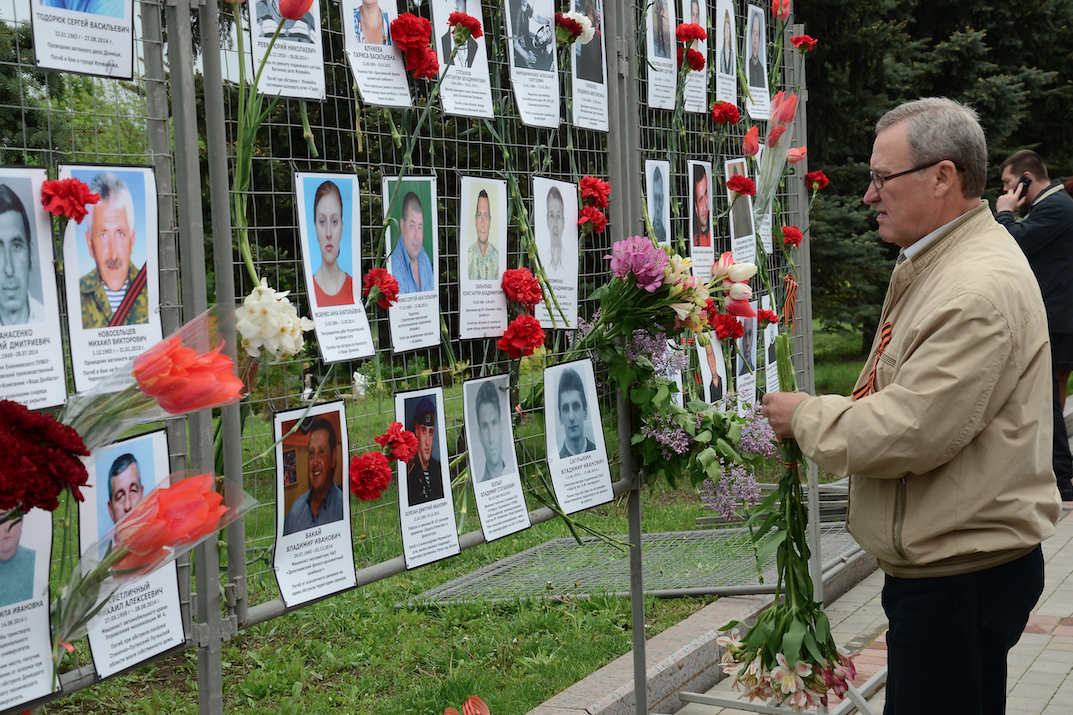

May 9, 2015: Casualties of the War in Donbass. (Andrew Butko, CC BY-SA 3.0, Wikimedia Commons)

OK, quickly down now to the present. I believe there is growing and now totally persuasive evidence that when the Biden people came to office, they made a decision to create a crisis over Donbass to provoke a Russian military reaction, and to use that as the basis for consolidating the West, unifying the West, in a program whose centerpiece was massive economic sanctions, with the aim of tanking the Russian economy and possibly and hopefully leading to a rebellion by the oligarchs that would topple Putin.

Now, no person who really knows Russia believes that it was ever at all plausible. But this was an idea which was very prominent in foreign policy circles in Washington, and certainly the Biden administration, and people like Blinken and Sullivan and Nuland believe in it. And so they set about strengthening even further the Ukrainian army, something we’ve been doing for eight years—Ukrainian army, thanks to our efforts, armaments, training advisors.

And by the way, it is now becoming evident that we might well—probable that we have physically, in the Ukraine now, American special forces, including British special forces and some French special forces. Not only people who have engaged in training missions, but are actually providing some direction, intelligence, et cetera. We’ll see if this ever comes out. And that’s why [unclear] Macron, et cetera, are so desperate about getting the brigades and other special elements trapped in Mariupol out of the city, which they’re not ceding it.

So the idea was you created—and it is now growing evident that in effect, an assault on the Donbass was planned. And that it was in November that the final decision was taken to go ahead with it, and the time set for February. And that is why Joe Biden and other members of the administration could begin to say, with complete confidence, in January that the Russians would be invading Ukraine. Because they knew and committed themselves to a major, a major military attack on the Donbass, and they knew that the Russians would respond. They didn’t know how large a response, how aggressive a response it would be, but they knew there would be a response.

You and listeners might recall Biden saying in February, second week of February that when the Russian invasion comes, if it is small, we’re still going to go ahead with sanctions, but we might have a fight within NATO as to whether to go whole hog. If it is large, there’ll be no problem, everybody will agree on killing Nord Stream II, and taking these unprecedented steps against the Russian Central Bank, et cetera. And he said that because he knew what was planned. And the Russians reached the conclusion about the same time. Well, they certainly understood what the broad game plan was.

And then they crystalized that this was going to happen soon, and the final blow came when the Ukrainians began massive artillery barrages on cities in the Donbass. Now, there had always been exchanges over the past eight years. On February 18, there was a 30-fold increase in the number of artillery shells, five from the Ukrainians into the Donbass, to which the Donbass militias did not retaliate in kind. It peaked on the 21st and continued to the 24th. And this apparently was the last confirmation that the assault would be coming soon, and forced Putin’s hand to preempt by activating plans which no doubt they’d had for some time to invade. I think that has become clear.

Now, this is of course the diametrical opposite of the fictional story that pervades all public discourse. And you can say “all” and only count on the fingers of your hands and toes the number of dissenters, right, that prevails. Now, let’s leave open the question of do you defend Putin’s actions. I, like you, find it very hard to defend, justify, any major military action that has the consequences that this does. Except in absolute, you know, self-defense.

But you know, that’s where we are. And if there had been the Ukrainian assault that was planned on the Donbass, Putin and Russia would have been in real, real trouble, if they limited themselves to resupplying the Donbass militias. Because given the way we had armed and trained the Ukrainians, they really couldn’t withstand them. So that would have been the end of [unclear] subordination of the Russian population and the suppression of Russia’s language, all of which are steps that the Ukrainian government has moved on and has in the work.

RS: You know, what’s at the heart of this really is the denial of anyone else’s nationalism. It’s kind of been the theme of the post-World War II U.S. posture. We are identified with universal values of freedom, justice, liberty—and whatever we do, sometimes it’s admitted to have been a mistake; I watched the movie last night Fog of War—with Robert McNamara, who was unknown to all my students. Nonetheless, this wonderful film that won the Academy Award, where he admits to the war crimes and says three and a half million people died in a war that you cannot defend. Actually, the number is much closer to six million or five million, somewhere up there maybe, but higher.

But that we denied the nationalism of the Vietnamese, and when McNamara went to Hanoi, the Vietnamese said to him, did you not know we are nationalist? That we had a thousand years of fighting with the Chinese and everyone else? Why did you put us into that? You denied our national feelings and what Ho Chi Minh represented.

And you know, I remember being in Moscow covering, really, Gorbachev for the L.A. Times; I was one of the people that was over there. I also gave some papers there. And at the time, Gorbachev, it seemed to many people I talked to, was being naïve about the willingness of the United States to accept any independent Russia. And Gorbachev actually became—now, Reagan for a moment looked Gorbachev in the eye and said we can do business, the same way, I guess, George W. Bush looked Putin in the eye. But these hawks outside the meeting room and everything descended on him. And Gorbachev became very unpopular, very unpopular.
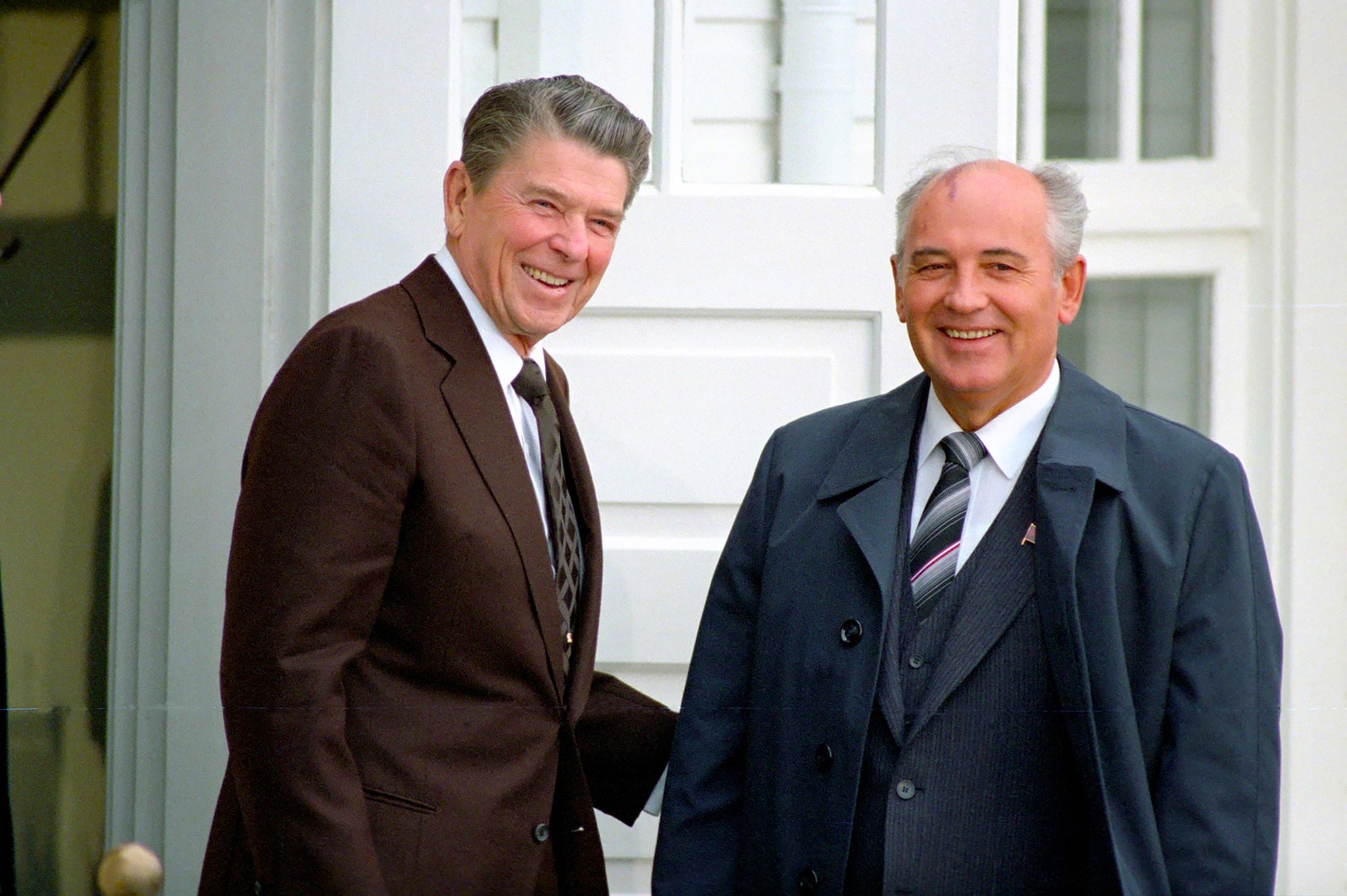

10/11/1986 Reykjavik Summit, Arrival of General Secretary Mikhail Gorbachev at Hofdi House (Reagan White House Photographs)

And so there’s a sort of assumption, not—you know, I personally don’t like nationalism and think it’s a sort of great mischief and evil in the world. But nonetheless, you cannot cope with the world if you don’t understand nationalism. When Nixon went to China, he actually conceded that Mao was a representative of Chinese nationalism and had to be listened to. The same thing was true in the arms control with Russia. That is lost now, and the idea that there might be Russian aspirations, concerns—that’s pushed to the side.

The irony is that the United States is now—I don’t know if you agree with this, but it would be a good thing to consider in concluding this. The United States has accomplished something that communist ideology was not able to accomplish. Because the Chinese communists and the Russian communists were at war even before the Chinese communist revolution succeeded. They called themselves followers of Marxist Leninism, but they actually, the Sino-Soviet dispute could be traced back even to the 1920s, and certainly recognize when Mao went to Moscow, and is reflected in Khrushchev’s memoirs.

And so the Sino-Soviet dispute became this major force, this opposition, despite Marxist Leninism. Now, you have still communist China uniting with anti-communist Putin Russia—why? Because of a common fear of a U.S. hegemony. Isn’t that really the big story here that’s being ignored?

MB: Yeah, Robert, you’re absolutely right in everything that you say. Of course the world system is being transformed by the formation of this Sino-Russian bloc, which is increasingly incorporating other countries. You know, Iran is already part of it. And you know, we will note that there are only two countries outside the Western world—about which I’m speaking politically and socially, not geographically—who have supported the sanctions: South Korea and Japan. All of Asia, Southwest Asia, Africa and Latin America is not observing them, has not signed on to them. Some are exercising self-restraint and slowing down deliveries of certain things, out of sheer prudence and fear of American retaliation. But we’ve gotten no support from them. So, yeah, the gross underestimation of this, Bob.

Now, in what passes for grand strategy among the American foreign policy community, not just the Biden people, they still—they’ve had a dual hope: one, that they could drive a wedge between Russia and China, an idea they entertain only because they know nothing or have forgotten anything they might have known about each of those countries. Or, second, to in effect neutralize Russia by what we talked about: breaking the Russian economy, maybe getting some regime change, so that they would be a negligible contributor, if at all, to ally with the Chinese. And of course we have failed utterly, because all of those mistaken premises were mistaken.

And this utterly unprecedented hubris, of course, is peculiarly American. I mean, from day one, we’ve always had the faith that we were born in a condition of original virtue, and we were born with some kind of providential mission to lead the world to a better, more enlightened condition. That we were therefore the singular exceptional nation, and that gave us the freedom and the liberty to judge all others. Now, that’s—and we’ve done a lot of good things in part because of that [unclear] dubious things.

But now that’s become so perverted. And as you said, it encourages or justifies the United States setting it up as the judge of what’s legitimate and what isn’t, what government’s legitimate and what isn’t, what policies are legitimate and which aren’t. Which self-defined national interests by other governments we can accept, and which we won’t accept. Of course, this is absurd in its hubris; at the same time it also defies [unclear] logic—Nixon and Kissinger really operated and were able to set aside or sort of, you know, surmount this ideological, philosophical, self-congratulatory faith in American unique prowess and legitimacy, based on strictly practical grounds.

And currently, though, we don’t exercise restraint based either upon a certain political-ideological humility, nor on realism grounds. And that’s why I say we’re living in a world of fantasy—a fantasy which clearly serves some vital psychological needs of the country of America, and especially of its political elites. Because they are the people who are supposed to have taken on the custodial responsibility for the welfare of the country and its people, and that requires maintaining a certain perspective and distance on who we are, on what we can and cannot do, of reality testing even the most basic and fundamental of American premises. And now we don’t do any of that.

And in that sense, I do believe it’s fair to say that we have been betrayed by our political elites, and I use that term, you know, fairly broadly. The susceptibility to propaganda, the susceptibility to allowing the popular mindset to be set the way it’s going on now, in giving in to hysterical impulse, means that yeah, there’s something wrong with society and culture as a whole. But even saying that is up to your political leaders and elites to protect you from that, to protect the populace from that, and to protect themselves from falling prey to similar fantasies and irrationalities, and instead we see just the opposite.
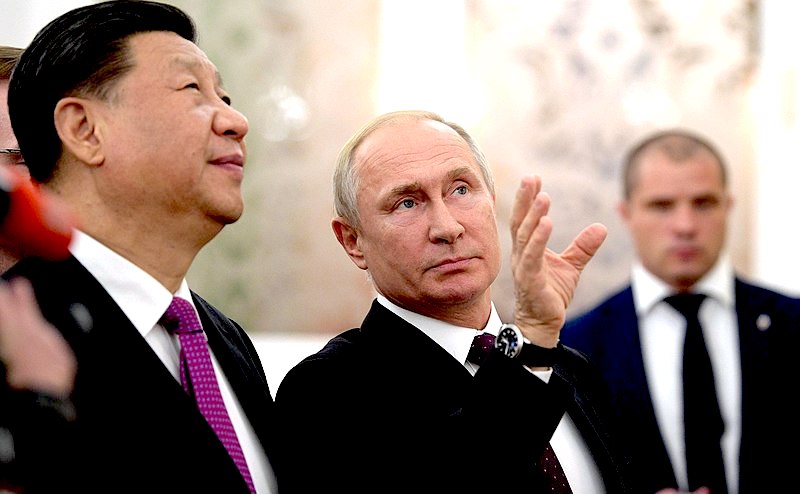

Chinese President Xi Jinping, left, with Russian President Vladimir Putin during visit to Moscow in 2019. (Kremlin)

RS: You know, one final point, and you’ve been very generous with your time. What is really being challenged here is a notion of globalization. Of one world based on economic productivity, trade, advantage of one region or another to provide different things. And we’re back to, I don’t know what, pre-World War I nationalism and borders and so forth.

And what is truly frightening about it is the point you made about China. After all, ironically, China was held up as this great revolutionary military threat; they were going to be, communist was inherently expansionist, the Soviet model had somehow trimmed its sails or been intimidated, but the Chinese were really radical. Then, somehow, peace was made with China; they turned out to be better capitalists, they carried us through this whole pandemic; and then because they’re an economic threat, and they can produce things and so forth, they are now the real target, I think, of the people we used to call neoconservatives. Because they talked about it when they were Republicans, before they became the Democratic establishment again. China was really the enemy.

And the irony here is that China, Chinese expansion, is not needed anymore if they have in fact an alliance and are forced into trade patterns with this huge real estate called Russia that remains, with all of its underpopulation, incredible resources, not just petroleum, which China is obviously missing. You have to really wonder whether we’re not talking about an America as a Rome in decay, of an idea that somehow you can control everything to your advantage and make it palatable to the world, and it’s going to stand.

Because that’s really what we’re talking about here, is a notion of equating U.S. hegemony with enlightenment, civilization, democracy, freedom, and anyone else who challenges it—which clearly China is doing, and Russia, certainly—that becomes the enemy of civilization. That is the frightening message here. It’s kind of the Roman empire gone nuts.

MB: You’re absolutely right, Robert. And it is China which we look at over our shoulder. And I mean, you could argue in a number of respects—if you look at Chinese history, they have never been terribly interested in conquering other societies, nor in governing alien peoples. Their expansion, such that it was, was to the west and to the north, and was an extension of their millennia-long wars with the marauding tribes of central Asia, and dealing with that constant threat. And you know, those Central Asian barbarians succeeded four times in breaking through and in bringing them central authority in Asia.

So they’ve never been in the conquering business. Two, yes—so it’s easy enough and convenient enough to conflate China’s growing military capabilities with its economic prowess, and the fact that its whole system, in every respect, whatever you want to call it—state capitalism, ideological overlay, whatever—and whatever it turns out to be, to crystalize, it is going to be different from what we’ve seen before. And that is very threatening. Because it calls into question our self-definition as being in effect the natural culmination point of human progress and development. And suddenly we’re not; and second, the guy who’s taken another path might very well—is certainly going to be in a position to challenge our dominance politically, in terms of social philosophy, economically, and secondarily, militarily.

And there is simply—you know, we won’t censor—there is simply no place in the American conception of what’s real and natural for a United States that is not number one. And I think that’s ultimately what drives this anxiety and paranoia about China, and that is why we have not seriously entertained the alternative. Which is, you develop a dialogue with the Chinese that’s going to take years, that will be continual, in which you try to work out the terms of a relationship, about a world which will be different from the one we’re in now, but will certainly satisfy our basic interests and concerns as well as China’s. To agree on rules of the road, to carve out areas of convergence as well. You know, a dialogue of civilizations.

That’s the kind of thing which Chas Freeman, one of the most distinguished diplomats, and who was the interpreter as a young man for Nixon when he went to Beijing. And he’s been writing and saying this since his retirement 10, 12 years ago, and the man is ostracized, he is shunned, he is invited almost nowhere to speak, nobody asks him to write an op-ed piece. As far as The New York Times and The Washington Post and the mainstream media, he doesn’t exist.

RS: Who is that you’re referring to?

MB: Charles Freeman. And he still writes, and incredibly intelligent, acute, sophisticated, I mean, by orders of magnitude superior to the kinds of clowns who are making our China policy today. And recently published a breathtaking long essay on the nature and character of diplomacy. So he’s the kind of person who could, you know, be involved in and help to shape the kind of dialogue I’m talking about. But these people don’t seem to exist. Those that have any potential like that are marginalized, right.

And instead we’ve taken this sort of simplistic path of saying the other guy is the enemy, he’s the bad guy, and we’re going to confront him across the board. And I think this is going to lead to, sooner or later, to confrontation and crisis, probably over Taiwan, which will be the equivalent of the Cuban missile crisis, and hope that we survive it, because we’re going to lose a conventional war if we choose to defend Taiwan. And everybody who knows China says the Chinese leadership is watching the Ukraine affair very closely, and thinking to themselves, ah, maybe Russia has given us a glimpse of what the dynamic might be if we go ahead and invade Taiwan.

RS: Yeah. Well, that’s of course the position of the hawks also: let’s show them that they can’t, and let’s get embroiled in that. But leaving that aside, we’re going to wrap this up. I want to say it’s your voice, clearly anyone listening to this, I hope you keep blogging and return to the fray, because your voice is needed. I want to thank Professor Michael Brenner for doing this. I want to thank Christopher Ho at KCRW and the rest of the staff for posting these podcasts. Joshua Scheer, our executive producer. Natasha Hakimi Zapata, who does the introductions and overview. Lucy Berbeo, who does the transcription. And I want to thank the JKW Foundation and T.M. Scruggs, separately, for giving us some financial support to be able to keep up this work. See you next week with another edition of Scheer Intelligence.


LIVE: Paypal Bans MintPress, Consortium & several indie journalists


https://www.youtube.com/watch?v=-gw8o_BXrSg&t=2s 


Fascist militia leader Stewart Rhodes sought Trump's approval on January 6


https://www.wsws.org/en/articles/2022/05/06/rnah-m06.html


Fascist militia leader Stewart Rhodes sought Trump's approval on January 6 for more violent attacks

Jacob Crosse


12 hours ago


In court documents filed Wednesday by the US Department of Justice (DoJ), federal prosecutors allege that in the early evening of January 6, 2021, far-right militia leader Stewart Rhodes called an intermediary of Donald Trump’s and requested to speak with the then president. The Yale-educated lawyer and former US Army paratrooper, according to prosecutors, wanted Trump to “call upon groups like the Oath Keepers and forcibly oppose the transfer of power.”

While fighting was still taking place on Capitol Hill, Rhodes and his armed paramilitaries were seeking permission from Trump to make more violent attacks. Rhodes allegedly had a high-level contact he thought could get him on the phone with Trump directly. This explodes claims advanced by Trump, his allies in the Republican Party and the pseudo-left that the January 6 coup was simply a “spontaneous riot” or a misplaced but organic expression of “working class” outrage. Rather, it was a pre-planned, multi-pronged attack, organized months in advance from inside the Oval Office of the White House in coordination between Republican politicians and their fascist supporters.
Composite image of Oath Keeper leader Stewart Rhodes and ex-president Donald Trump at the 2022 Conservative Action Political Conference (Credit: Collin County Texas, CPAC 2022 con, Hermann Tertsch and Victor Gonzalez, WSWS.org)

This damming revelation was included in a Wednesday plea deal unveiled by the DoJ. In the plea agreement, William Wilson, 44, a “military and law enforcement veteran and a member of the Oath Keepers since 2016,” agreed to turn state’s evidence and plead guilty to one count of seditious conspiracy and one count of obstructing an official proceeding. He could spend decades in prison but likely will not, given his cooperation with the government.

Wilson is the third member of the Oath Keeper militia group, comprised of current and former military members, police officers and far-right nationalists, to plead guilty to seditious conspiracy and obstruction charges. Joshua James, 34, of Arab, Alabama, and Brian Ulrich, 44, of Guyton, Georgia, both pleaded guilty earlier this year to the same crimes.

According to the court documents, Rhodes, Wilson and other Oath Keepers, after the storming of the Capitol, gathered at a private suite at the Phoenix Park Hotel in Washington D.C. after 5 p.m. on January 6, where they continued to plot to stop the certification of Biden.

Wilson, “a county leader for the North Carolina chapter of the Oath Keepers,” claims that he was present while Rhodes made the phone call to the close contact of Trump’s. On the call, Rhodes demanded that Trump unleash his Brownshirts, telling his fellow fascists after the call ended, “I just want to fight.”

The Oath Keepers, Proud Boys, III Percenters and Christian-fascist Moonie cult were among the far-right militia groups summoned by Trump and his Republican co-conspirators to violently block the certification of President-elect Joe Biden and overturn what remains of bourgeois democracy in the United States.

Prior to January 6, the above groups participated in and promoted far-right “Stop the Steal” rallies throughout the country, publicizing Trump’s false claims that the election was stolen while building support among far-right elements for forcibly stopping the certification as the only way to prevent a “socialist takeover” of the US government.

The “Stop the Steal” movement was funded by right-wing billionaires and organized and promoted by “America First” fascist congressmen including Arizona Reps. Paul Gosar and Andy Biggs and Alabama’s Rep. Mo Brooks, none of whom, like Trump, have been charged or arrested 16 months after the failed coup.

In addition to the aforementioned Republican legislators, it is possible that Rhodes was communicating with Trump’s long-time political crony Roger Stone, an honorary Proud Boy member. In addition to working closely with admitted FBI informant and Proud Boy leader Henry “Enrique” Tarrio, Stone frequently employed Oath Keeper militia members as “body guards,” including the aforementioned Joshua James.

That these fascist groups would be summoned by Trump in an attempt to overturn the election was revealed by Trump himself in a September 2020 debate with Biden. After moderator Chris Wallace asked Trump “to condemn white supremacists,” Trump refused, claiming that violence emanated from “the left wing.”

Biden, revealing that the Democratic Party was at the time, and still is, acutely aware of the innumerable connections between Trump and the Republican Party and fascist militia groups, offered the Proud Boys as an example of a racist street gang for Trump to condemn. Trump took the opportunity, instead, to issue a military order to his foot-soldiers, saying, “Proud Boys stand back and stand by.”

Following Trump’s declaration to the fascist paramilitaries, and the FBI revelation of a far-right assassination plot against Democratic Michigan Gov. Gretchen Whitmer a week later, the World Socialist Web Site warned in an October 9 perspective: “The Michigan conspiracy, Trump, and the 2020 election”:


Trump’s plan for election day is no longer a matter of conjecture. In battleground states that support Biden, Trump will falsely proclaim himself the victim of election fraud, deploy violent groups to intimidate voters, seize statehouses and eliminate political opponents. Armed supporters will declare the vote invalid or compel state legislatures to certify pro-Trump slates of electors. Michigan, North Carolina, Pennsylvania and Wisconsin have Democratic governors and Republican-controlled legislatures and will therefore be the central target of this plot.

This is very nearly what transpired less than three months later.

In his plea deal, Wilson admits that he, Rhodes and other unnamed Oath Keepers began planning to violently overturn the election in the event Trump lost, even before the election was declared for Biden.

In a Signal chat group titled “Leadership Intel Chat” which Wilson was a part of, Rhodes is alleged to have instructed the group on November 5, 2020, “We aren’t getting through this without a civil war. Too late for that. Prepare your mind, body, spirit.”

By December 31, 2020, Wilson was included in an Oath Keeper chat group titled “DC OP: Jan 6 21.” Over the next few days Wilson and other Oath Keepers plotted their trek to Washington D.C.

On January 5, 2021, on orders from Rhodes, Wilson drove to the capital and “brought with him,” per the DoJ, “…an AR-15-style rifle, a 9-millimeter pistol, approximately 200 rounds of ammunition, body armor, a camouflaged combat uniform, pepper spray, a large walking stick intended for use as a weapon, and a pocketknife.” Wilson has admitted to being armed with the knife when he attempted to enter the House chamber inside the Capitol on January 6.

While driving to D.C., Wilson texted the “DC OP: Jan 6 21” Signal group, “It’s going to hit the fan tonight,” and that he had “all my gear with me.”

Upon arriving at the Hilton Garden Inn hotel in Vienna, Virginia, on January 5, Rhodes, Wilson and “other leading Oath Keeper members and affiliates” finalized their plans, the plea deal states.

Wilson said he met with Rhodes and other “Quick Reaction Force” teams that were “expected to participate on January 6.” Wilson, prosecutors write, “believed that, if called upon, the QRF would provide firearms or cover to co-conspirators (such as himself) operating inside of Washington D.C.”

Wilson claims he heard Rhodes “discuss the potential need for Rhodes and co-conspirators to engage in force, up to and including lethal violence, in order to stop the transfer of power. With this understanding, Wilson agreed to take part in a plan developed by Rhodes to use any means necessary, up to and including the use of force, to achieve this objective.”

Further revealing the intimate ties between the fascist militia groups and the Republican Party, two weeks ago, the January 6 House Select Committee “investigating” the attack on the Capitol requested voluntary testimony from three Republican House members, one of whom, Ronny Jackson, is the former White House physician under Trump and Barack Obama and a current Texas representative.

In their letter requesting Jackson’s voluntary testimony, which he has since rejected, the committee revealed text messages that were exchanged between Oath Keepers during the attack on the Capitol. In one message thread, the militia members discuss the urgency of protecting Jackson during their siege on Congress.

“Dr. Ronnie Jackson—on the move,” an unidentified Oath Keeper wrote during the attack. The message continued: “Needs protection. If anyone inside cover him. He has critical data to protect.”

The fascist Rhodes responded, “Give him my cell.”


Interview with the creator of the World Mortality Dataset


https://www.wsws.org/en/articles/2022/05/05/rsuy-m05.html


Interview with Ariel Karlinsky, the creator of the World Mortality Dataset and member of the WHO COVID-19 Mortality Assessment Groups

Benjamin Mateus


16 hours ago


Ariel Karlinsky is a graduate student in economics at the Hebrew University whose primary research interests are labor economics, data science, economics of conflict, health economics, economics of Israel and economic history. He is also the creator and maintainer of the World Mortality Dataset, specializing in all-cause mortality, excess mortality and vital registration.

In March 2021 he joined the World Health Organization’s (WHO) COVID-19 Mortality Assessment Groups, established by the international health organization and the United Nations Department of Economic and Social Affairs to “focus on methods and data for estimating total number of deaths attributable to COVID-19 and for assessing the direct and indirect impacts of the pandemic on mortality by age and sex at the national, regional, and global levels.”

The interview was conducted on April 24, 2022 and is published after the WHO released its long-awaited report on excess deaths associated with COVID-19, which found there were almost 15 million excess deaths through 2021, a figure 2.75 times higher than officially reported global COVID deaths.

Benjamin Mateus [BM]: Good morning. Thank you for taking the interview.

Ariel Karlinsky [AK]: Of course. Thank you.

BM: As a way of beginning, could you introduce yourself and tell us the work you are involved in?

AK: I’m an economist and a statistician. I have degrees in economics and statistics from the Hebrew University. When I started working on this project [COVID-19 and World Mortality Dataset], I was a master’s student. And now I’m a PhD student in economics.

I was interested in the question whether COVID was causing excess mortality and by how much. After looking at the original data from the US, the UK and Italy when the first COVID wave came through, people acknowledged that COVID was certainly causing excess mortality. But I wasn’t keen on how this was being reported and compared.
Ariel Karlinsky

For instance, they would say that when the US reports there were 2,000 COVID deaths then it’s like there were 2,000 excess mortalities. And when Egypt reports 2,000 COVID deaths, they said it is also 2,000 excess mortalities.

[According to Our World in Data, “Excess mortality is a term used in epidemiology and public health that refers to the number of deaths from all causes during a crisis above and beyond what we would have expected to see under normal conditions. In this case, we are interested in how the number of deaths during the COVID-19 pandemic compares to the deaths we would have expected had the pandemic not occurred—a crucial quantity that cannot be known but can be estimated in several ways.”

They add, “Excess mortality is a more comprehensive measure of the total impact of the pandemic on deaths than the confirmed COVID-19 death count alone. It captures not only the confirmed deaths, but also COVID-19 deaths that were not correctly diagnosed or reported as well as deaths from other causes that are attributable to the overall crisis conditions.”]

And that seemed just wrong, because I do a lot of international comparisons and I know that all countries are different, especially on the development scale, and I wasn’t sure that you can make such straightforward comparisons. There were a lot of epidemiological anomalies in much of that data that weren’t being considered from many countries like Belarus that were reporting cases or deaths.

For instance, the COVID fatality rate being reported out of Egypt was 30 percent because they were reporting so few cases.

So, I started looking for the data. I hoped it would be published by the World Health Organization (WHO) or the World Bank, but I realized they were publishing these statistics only annually. So, for 2020, this was no good. I then turned to searching the internet looking at websites of national statistics offices, vital registries, and ministries of health all over the world and found a lot of this data hidden in plain sight. I decided to begin compiling the dataset, which was non-existent.

I then started working with my colleague, Dr. [Dmitry] Kobak from Germany, and we put the data publicly on GitHub and the paper on a preprint and then we sent it to eLife. They peer-reviewed the paper and published it. And now I’m working as part of the expert working group of the WHO hoping in the next week or two to finally publish the WHO excess mortality estimate at least up to December of 2021. [Karlinsky is one of the authors of the report and his dataset was a primary source for the analysis.]

[Note 1: Dr. Dmitry Kobak is a research scientist at Tübingen University (Berens lab) who has used his skills to examine the accuracy of COVID-19 death reporting by various countries. His report on undercounting of COVID deaths is linked here for reader’s review.]

[Note 2: Dispute over the WHO’s methodology and figures for excess COVID deaths in India has stalled an upcoming report on global excess deaths through December 2021. The international health agency estimated that almost 15 million people had died in the period since the pandemic was first declared, which is two-and-half times more than the reported tally. Of the additional nine million deaths, more than one-third have occurred in India. Some say this may be due to the government of Prime Minister Narendra Modi attempting to suppress this analysis because of political calculations.

The New York Times wrote, “The release of the staggering estimate—the result of more than a year of research and analysis by experts around the world and the most comprehensive look at the lethality of the pandemic to date—has been delayed for months because of objections from India, which disputes the calculation of how many of its citizens died and has tried to keep it from becoming public.”]

BM: You touched on some of the initial questions I had for you. But to continue in this vein, there was an obvious need for the “World Mortality Database” that you built, because there was no international real-time dataset that could provide these figures.

What logistical issues did you face creating it? What hurdles remain and what are the long-term goals for the project?

AK: That’s a very good question.

Again, I’m an economist and I have dealt with some health economics, but that wasn’t really my field. My hopes and goals are that starting from now, just as countries report their GDP and unemployment figures regularly to the IMF (International Monetary Fund) and similar organizations, hopefully all-cause mortality will be reported to the WHO in a timely and consistent manner. Many countries already do, but most of them are highly developed.

But that leaves tons of gaps … Maybe I should say there are two major issues playing here. There are countries, many in Africa, but also places in the Pacific and Southeast Asia, where there are essentially no vital registries. Maybe 100 people die but only one death gets counted in their national statistics. It is similar but less so for births. And these are very highly correlated with economic development. This is also true within countries, such as in rural regions. For instance, in rural areas of Latin America, the chances that a death will be registered are much lower than in urban areas.

So, there are countries where the data doesn’t exist. There’s simply none.

We noted this in our paper as well. We had this very frank response from Liberia when we asked for this data and they said, “We just don’t have it. We are currently working very hard on modernizing and improving our vital registration system, but there’s no data. It’s not coming out soon. It just doesn’t exist.”

And, under the auspices of WHO and the World Bank, what they have are these national household surveys conducted every five or 10 years where they ask about births and deaths, which are only estimates of fertility and mortality. It’s better than nothing, but it’s not very good when you think about an issue like excess mortality or if you have a large crisis such as the COVID pandemic or some other natural disaster or conflict for that matter.

Of note, Latin American countries—Peru, Bolivia, Ecuador and others—have been undergoing, in the last five years, significant improvements in their vital registries. Had COVID-19 happened five years ago, our knowledge about excess mortality in Latin America, which has been really disheartening and massive, would have been much less.

The second issue is that there are countries where this information exists, but they’re not keen on sharing it. I think probably the best example is Pakistan, where they recently had a considerable improvement in vital registration … supposedly, or at least that is what they reported to the WHO.

But that data is completely opaque. Not annually, not monthly, not nothing. Every couple of years they may report something like, “We registered eight million deaths when we would have expected maybe nine million.” And the vital registration is almost full, but they are not sharing any data. I’ve approached them and I have had my colleagues approach them but they’re not sharing their data because they don’t want to.

And then there are countries where the data used to be shared, but now they’re not sharing it because I think they are afraid it exposes the fact that the real toll of COVID has been much heavier than they had reported. These include countries like Turkey, El Salvador and Belarus.

This is a very hot political issue and I try not to get involved in the politics. But one of the fields that I’m very interested in is political economy. And I do think that in a sense, this large difference between excess mortality and COVID mortality that we saw in many countries is especially pronounced in authoritarian countries. It’s even sort of a measure of obfuscation or information manipulation.

When I tell people that Russia fudged their COVID numbers everybody says, “Of course, what’s new?” But I think it’s very telling that you see this again and again, and mostly from authoritarian countries, regardless of their level of development.

BM: But the US Centers for Disease Control and Prevention (CDC) has been fudging its numbers too. In March they slashed their pediatric COVID-19 deaths by almost a quarter and eliminated more than 70,000 deaths previously attributed to COVID. Now they are trying to say people died with COVID and not from COVID. The CDC is politicizing these statistics.

AK: The US … and this is not in the research I’m doing with the WHO, but like other research that I’m currently doing focused on 2020 … the US and Brazil under Trump and Bolsonaro are very clear examples of countries where the leaders would have loved to say that “COVID was over, there’s no COVID, let’s get on with it, there are no deaths, it’s inflated, it’s manipulated …” They made public speeches about this; they’re not hiding the fact that they're trying to hide it, in a sense.

But because democracies are still strong and the institutions are still independent, there may be some undercounting, but it isn’t Russia level, it isn’t Uzbekistan levels. It’s nowhere near these levels.

Like I told you in my email, I’m a capitalist and I lean very conservative, but between Trump and Clinton, I’m with Clinton because she’s more of a conservative. And between Biden and Trump, I was pro-Biden. But it saddens me that it seems like under Biden there may be somehow more cohesion between the institutions of the US when suddenly it is okay to downplay COVID. But it isn’t on the level in authoritarian countries. It’s a whole other scale. [Excess deaths versus COVID deaths: United States—1.13 million vs. 966,308; Russia—1.21 million vs. 369,064; Brazil—764,000 vs. 659,000. Source: World Mortality Dataset]

It’s true that in the US and Spain, in these two developed countries the gaps between excess deaths and COVID deaths are the highest. It is significant. It is 20 to 30 percent, which means tens of thousands of deaths higher. But it isn’t five times or 10 times or 20 times higher. In Tajikistan it is 100 times higher.

BM: To clarify, when you say there is an undercounting of COVID deaths you are looking at the ratio of excess deaths to reported COVID deaths? That is the ratio you are referencing when you say 20 to 30 percent above COVID deaths? And in Russia …

AK: Yes. And in Russia that is at 3.5 times higher. [1.21 million/0.369 million =3.28]. In Uzbekistan it is 30 times higher and Tajikistan it is 100 times, as I mentioned previously. Yeah, that’s what I am referring to.

In the US, we have good evidence that some of the excess mortality is strictly non-COVID. There is increasing homicide, increasing traffic accident deaths. But in most countries, that’s not the case. In most countries, homicides, even in very violent countries such as Latin America and South Africa, homicides were lower than previous years for 2020. Traffic accidents, the same again, were down due to lockdowns and other social restriction measures.

In this regard, the US is an outlier. This also goes with alcohol-induced deaths and opioid overdoses. This is true for Canada.

So, [excluding the US and Canada] if you just look at deaths say at slightly younger ages, which you can do mostly just in developed countries because the data does not exist for less developed countries ... If you look at deaths between 25 to 44 or 44 to 60, and so on, people that supposedly shouldn’t be dying of COVID in large amounts, you can see that excess mortality tracks COVID reported mortality for these ages almost completely.

So, what I think is going on there is that these countries have some vulnerabilities among younger ages. For instance, a 50-year-old in India that has COVID has a much higher chance of dying from it than if it was in the UK. We have a lot of evidence to that effect. [Ariel Karlinsky didn’t specify if these vulnerabilities were intrinsic to the health of the individual or extrinsic, related to the socioeconomic factors such as access to health care systems.]

There is probably some increase in self destructive or violent behavior during the pandemic in the US. I’m not certain that 100 percent of excess deaths are attributable to COVID [in the younger ages]. But in most other countries it’s very close to 100 percent. We find no evidence of lockdown deaths or deaths of despair and or even indirect COVID deaths.

[The Pew Research Center found that the US murder rate rose 30 percent between 2019 and 2020, jumping from six to 7.8 homicides for every 100,000 people. The CDC reports that during a 12-month period ending April 2021, drug overdose deaths had climbed over 100,000, an almost 30 percent increase from the prior year.]

When people died from cardiac arrest, they would say that’s not COVID because COVID is a respiratory disease. But we did see that COVID has exacerbated the mortality even in countries which are significantly deflating their COVID numbers like Nicaragua. In Nicaragua there is a large increase in cardiovascular deaths, because COVID, unfortunately, basically attacks everything—the brain, the heart, the immune system and not just the respiratory systems.

BM: Before moving on to the issues surrounding the World Health Organization and their soon-to-be-published report on excess deaths, could you speak about the excess homicide rates in the US.

AK: I haven’t looked at them recently, but in 2020 I think it was around a 30 percent increase, which I think was the largest annual increase since the seventies. The US had been on a decreasing trend in homicide rates up to 2014 or 2015 after which it began to increase a bit. But then in 2020 we saw a significant increase. And 2021 has stayed on the same trend as 2020.

The absolute increase in numbers is not very big, but every one of these is a tragedy, especially because it is usually very young people involved in these deaths. Before COVID, if I recall the numbers correctly, about 50,000 to 65,000 people died each week from all causes, depending on the season. But during COVID, weekly deaths were numbering from 70,000 to 90,000 each week.

So, if you look at all homicides it is an increase of about 6,000, which brings the total to about 26,000 for the year. The excess homicide rate for the year is barely 10 percent of all excess deaths in just one week. Homicides are important to track but they don’t account for a huge shift in the numbers.

As you had previously mentioned, maybe 70 percent of the excess deaths are COVID and 30 percent other causes. But this doesn’t mean that if there are 10,000 excess deaths, 7,000 are from COVID and 3,000 deaths are unrelated to COVID. A lot of these deaths that you didn’t code as COVID could very well be.

I gave testimony to the Texas legislature some months back on the power outage in February 2021 [during winter storm Uri]. And you can see there in Texas, during the power outage, excess mortality peaks. The number that Texas authorities said that had died from the cold weather and the power outage was around 200 people. But my estimate and other independent estimates placed that figure closer to 1,000.

BM: That is a huge number.

AK: it is astronomical, and I do hope that the Texas legislators … the issue should be completely disconnected from politics. The question again is then what do you do about it? There may be a lot more leftist solution or there may be right-wing solutions, but first we need to get to understand what the hell happened.

And Puerto Rico did that with Hurricane Maria. There were initial claims that only 64 people had died. But that figure increased massively following an official report back in 2018. I did a short testimony then and I believe the excess deaths figure was around 3,000. [Analysis by several independent institutions placed excess mortality due to the hurricane between 3,000 and 5,000.]

Excess mortality can convincingly show you, by zooming in on a time window and looking at the pattern of deaths, what happened. And what we find is not what right-wing media is saying, that the 30 percent rise in excess deaths during COVID was due to lockdowns. That is simply not true. We found a similar gap in Florida during 2021 with zero lockdown. These excess deaths are, by all accounts, related to COVID, which are not counted, just as much as the excess deaths during the power outage and in Puerto Rico due to the impact of the hurricane were not counted.

BM: Thank you for these clarifications and interesting points.

Can you speak on your work with the WHO? I understand that they are putting together this excess death report, but it’s been on hold primarily because India is challenging the methodology of the study. Maybe if you could speak if other countries challenged the report?

AK: I’m not sure about other countries. There are probably other countries there. Not every country said, “Okay, this is great.” Many countries have not responded. But, yes, India is a very vocal opponent.

Our excess mortality estimates for India place it somewhere in the middle. They’re not the best and they’re not the worst. They’re a large country with over a billion people. Our estimates placed excess deaths during COVID at several million. However, when you look at the figures on a per capita basis then you see they are somewhere in the middle.

India finds itself in a peculiar position. It’s not like the US and it’s not like Peru where the data is completely out there, official national level data showing deaths by day, week, or month, which you can have a very good estimate for how many deaths you would expect. And then how many deaths actually occurred and then calculate a very sound estimate of excess mortality.

For India, what you have is a huge federation with many states and union territories which are essentially like states and each one of them has its own vital registration systems and they differ very widely in just the number of deaths they are able to register. The more developed states can register 100 percent of deaths like in developed countries while less developed states register a third or 50 percent of total deaths.

All this means that for India we don’t have national level data from 2020 onwards. We have state level data, but from a lot of states. I think by now we have covered 60 to 70 percent of the total deaths in the Indian population. It’s not from some small village.

We have data from multiple large states and from cities like Calcutta and Chennai and Delhi and Mumbai. A lot of excess mortality has been observed just in these regions. And if you look just at these states and cities it already surpasses the official reported COVID deaths by a large amount.

We do some sort of projection to other states where we also have a lot of other evidence from other disparate systems or surveys that Indian researchers have done. The findings note that excess mortality is very high in India, higher than reported. I can’t give you an exact number until we publish, but it’s much higher than reported.

India finds itself in this sort of peculiar position because neighboring Pakistan, which—we have very preliminary evidence from journalists about this—also has excess mortality at much higher levels than reported COVID-19 mortality. But in Pakistan we have access to zero data.

The Indian officials are irate that they are not being treated like a developed country with a full, complete vital registration database. But they are also irate that they aren’t being treated like countries with zero data like Pakistan.

The evidence for India in terms of certainty, it is less certain than the US but it’s much more certain than Pakistan. And they kept throwing these pretty nonsensical arguments but none of them were very convincing. [Press coverage of the subject has alluded to major Indian state elections that took place in February and March as a factor in these disputes with the WHO.]

BM: I understand that there are independent scientists that are upset with the WHO for conceding to India’s stall tactics. And they are saying that if the report isn’t published by April that they will move to publish it without the WHO’s endorsement. This places them in a difficult position.

AK: We, the researchers are uncomfortable with this, but we are giving it a few more days. It was supposed to be released on May 2, 2022, but it would conflict with Eid al-Fitr (Muslim holiday). So, it keeps getting pushed back for other mundane reasons.

The previous delays have been helpful to get the model better, to improve the write-up, time to respond to critiques, which ultimately means our research is better. But we have completed all the corrective actions and could have had it published by the end of April. Everything’s in order.

BM: To avoid the confusion behind what defines a COVID death, why doesn’t the WHO provide a clear definition for it so that everybody uses the same metric? That would help standardize some of the reporting by various countries.

AK: It did. And there are standard guidelines. But again, you must remember that in many countries a lot of people die at home. The doctors never even see them, or they aren’t well equipped or well-trained. And in many countries, there is political pressure to downplay the number of deaths.

In Moscow, for example, which again has all the equipment, has all the development level, there was this guideline which I’m not sure if it’s still in place or not. But it said that you certify a COVID death only if after an autopsy it is beyond any doubt that this is the primary cause of death.

And you can imagine, what are the chances of doing autopsies for thousands of people dying en masse? The chance is zero, meaning you can downplay COVID by supposedly being much more thorough and saying, “No, we’re going to get to the bottom of each and every death.” The WHO definition is broader because the pathogen is a new contagion and we’re trying to understand how it spreads, understand how to fight it. We’re going to err on the other side. Maybe even if COVID is just a contributory factor you list it and not just if it’s the primary factor.

So, the standard guidelines exist. The issue is that a lot of countries either can’t or don’t want to follow them. It’s not an issue of devising regulations and then it’s done. In a lot of countries like India or Egypt, even before COVID, there are tons of garbage codes in death certifications that people don’t know what they died from, but they know that they died. A stricter guideline, that’s not the issue here.

BM: Is the methodology of the WHO report different than that used by the Economist or IHME? And to what extent is this report more comprehensive?

AK: The main difference I think is data. We collected even more data and data is much better than estimates. If you would have asked me, for example, if I didn’t have Belarussian data, you would have asked me and I would have said they are probably undercounting by 50 or 100 percent similar to countries like Ukraine or Poland, similar countries that have similar ethnicity and economies and are nearby.

But then you get actual data from the Belarusian government, and you see that it’s 12 times higher. The data defies imagination in the sense which a model by its nature would aim for like a mean, or median, or ratio as observed in other countries.

The fact that we have more data from states in India, from Jakarta in Indonesia, from China, from Turkey, etc., it makes the model better just because more data is better in the sense that the models are more transparent.

We have also made the data more accessible by having an interactive web application where anyone can look at the estimates and plot them and see where they go, how they go, meaning it’s not just going to be some report in a scientific journal that’s very opaque.

It is a complicated model because the data quality varies greatly. You need to treat each data point in a bit of a different way. It depends on the quality. The main methodological issue is similar across all these methods. You need to figure out what would be the number of deaths in that country in the absence of COVID and then you have the observed number of deaths and excess death is simply subtracting the two numbers.

So, there is some uncertainty there. But, unfortunately, in many countries, the signal, the increase in mortality, is so large, it doesn’t really matter if you account for this trend or that trend. It changes some of the numbers, but it won’t lead you to conclude that excess mortality has been null, it’s not like a statistical exercise.

In that sense, I’m glad that the IHME and the Economist estimates are there. They were able to put it out very quickly. But they didn’t have to go through a committee and have every revision go through all these people, which slows down stuff considerably.

But then WHO can say with pride, and there’s truth in that, that we did the estimates. They went through several iterations between a large panel of experts. Countries responded to these estimates. Then some countries also found or gave more data, which was very helpful. So, it was more like a holistic process. But it causes it to be delayed, even if there was no political pressure.

BM: You are speaking about the peer-review process.

AK: It certainly takes longer and we are all doing it in our spare time. We are not WHO employees. We are researchers in academia and that’s just one of our many academia things that we do.

BM: There was a study that came up that was done by Professor Patrick Heuveline from UCLA titled “Global and national declines in life expectancy: An end-of-2021 assessment.” He noted that global life expectancy fell 0.92 years between 2019 and 2020, and then 0.72 years between 2020 and 2021. In the 70 years that the UN has tracked such figures it is the first time we’d seen these kinds of declines. Do you care to comment on what this means to society, to the globe? What’s the implication of having this kind of massive decline in life expectancy?

AK: I’m not an expert on life expectancy. I just know that it’s an unfortunate term. It gives a sense that at my age now I have maybe 50 more years to live.

In countries where we are very certain of the data and there are good estimates of the age/sex deaths, life expectancy went down in 2020 in some countries. It went down even further in 2021. In some countries it bounced back up.

Patrick’s research and some other researchers in this area, they take data like mine on total deaths, and it has a very strong relationship with changes in life expectancy. And then from that, even if they don’t have the specific age/sex data, for example, for Bolivia, from this relationship you can estimate the changes in life expectancy in a country like Bolivia. And their life expectancy went down even further.

Again, I’m not an expert on how life expectancy looks across time and explain what that means. I can tell you that during World War I and II, life expectancy dropped because a lot of mostly young men died, especially as soldiers. But then it went completely back on trend.

A lot of people look at that and they say it means nothing really happened. Of course, things happened. People died; many people died. When things go back on trend, it doesn’t mean that nothing happened. But I’m not sure what reverberating implications these will have. I have a colleague in Copenhagen you can speak with who does a lot of work in this field.

He’s been doing a lot of work on life expectancy during COVID and what life expectancy means on a societal level and on a global level. But yes, COVID-19 has caused a decrease in life expectancy and that’s like the first time, absent some wars like in the Balkans, where we have observed that.

BM: With the introduction of the vaccines in early 2021, Israel rapidly moved to vaccinate its population. It then shifted to a vaccine-only strategy which has been adopted by almost every country but has proved problematic—in September 2021 and then February 2022, Israel faced Delta and Omicron. Maybe for someone who has lived there, you can share your perspective.

AK: Israel was close to eliminating COVID circulation several times. Unfortunately, it did not and besides the first lockdown in March-April 2020, it didn’t really stick to an elimination strategy, which has proven very good and doable in my opinion.

This lack of certainty and commitment made it harder to achieve elimination each passing day, eventually probably making it next to impossible. It might very well be that Israel’s will to try to balance fighting COVID with other aspects of normal life activities made us suffer on both ends, more so than eliminating COVID would have. In Hebrew we have a saying, “Half coffee and half tea,” meaning that in theory if you can’t decide you can mix and balance. But in practice the result is much worse than sticking to either one.

I do fault my own discipline (economics) here. Economics is all about trade-offs and that’s a very correct analytic method normally, but unsuitable (at least at the start) for pandemics or wars, where more of a war mentality I think is in order.

BM: We are well into the third year of the pandemic. Long COVID is affecting millions and it will have a detrimental impact on the quality of life for the populations of many countries. What are you expecting to see from the database as you continue with it?

I raise the question because in the UK we saw a trend to higher levels of excess deaths though there wasn’t much COVID community transmission. Some are attributing these deaths to the impact COVID has had on population health.

Data now indicates that even those who suffered only mild symptoms can expect a rise in their all-cause mortality.

AK: That’s a major issue that the UN’s World Population Prospects is dealing with right now. They do these projections on total deaths, total births, five years further, 20 years further … and they’re struggling with a lack of good data. And then it depends on assumptions. Again, I’m not a demographer but I’ve managed to learn a lot from my demography colleagues …

Consider a situation in the US, for example, where two million people die annually. Most of them are old, as is the case in other countries. Then say some pandemic hits and it kills most of the elderly. Assume then excess mortality in 2020 was 5 million people. Something massive and horrible.

You would be inclined to say, “Okay, but you can only die once, and these people will not die in the next year.” So, in the next year you would have like a deficit mortality in a sense because all the people that should have died in 2021, 2022, 2023 and on so on already died in 2020. On the other hand, like you said, if the fact that you contracted COVID means that you are more handicapped right now and your health went down, it might lead to higher mortality in the future.

And the direction right now is not clear.

There are countries where there was a large wave of infections and deaths such as Ireland in January and February 2021. But the mortality following that in the same year was lower than you would expect. So, I think that in Ireland, it’s clear. Probably a lot of the people that died of COVID were people that were close to dying regardless, in a sense.

But in most countries, 2021 mortality was even higher than 2020. There are some countries where they had very little excess mortality in 2020 and 2021, and then in 2022 a huge uptick, like Hong Kong.

It’s a huge question and the estimates of excess mortality are like the tip of the iceberg because we can’t account for all deaths. It’s easy to count deaths. You know when someone has died. Many people know when someone has died, even if it’s in a very rural area. But a lot of people don’t even know that they caught COVID.

They may know it like in five years from now. And that also depends on the exact strain that they caught. I am very careful with predictions and forecasting because it’s very hard. I really don’t know.

I think that if the COVID deniers were correct, what you would have seen is a large uptick in mortality in the start of 2020 in the US and the UK. But then mortality would have been much lower for the rest of the year. And then in 2021, you would see a rise in life expectancy. It didn’t happen.

Both in 2020 and in 2021 we saw very significant excess mortality. Possibly, some years from now, we might see mortality be lower, but that doesn’t mean that something good happened. Again, all the people that died in the world war did not die 80 years after that. So, mortality 80 years after it may be a bit lower, but that’s not a good thing. They died prematurely, very prematurely.

Even expert demographers are debating this because it depends on a lot of assumptions and data which is now quite scant. We can’t really say something convincing now as these studies are usually done decades later.

BM: Ariel Karlinsky, thank you for all your time. I look forward to reading the report when it is finally out.

AK: It was my pleasure. Please let me know if any questions come up.


COVID pandemic has 15 million across the globe


https://www.wsws.org/en/articles/2022/05/06/kdok-m06.html


The World Health Organization says the COVID pandemic has killed nearly 15 million across the globe

Benjamin Mateus


12 hours ago


The World Health Organization (WHO) released Thursday its much-awaited and anticipated report on global excess deaths associated with COVID-19 for the period from January 2020 to December 2021.
The bodies of COVID-19 victims placed on hospital stretchers in Sri Lanka (Source: Facebook)

By the end of last December, officially reported global deaths had reached 5.42 million. However, the WHO study found that almost 15 million more people perished in the same period than usual, 2.75 times higher than the official total of COVID-19 deaths. The estimate of excess deaths gives a range from 13.3 million to 16.6 million.

The WHO defined excess death/mortality as “the difference between the total number of deaths and the number of deaths that would have been expected in the absence of the [COVID-19] pandemic.”

Dr. Tedros Adhanom Ghebreyesus, WHO director-general, remarked, “These sobering data not only point to the impact of the pandemic but also to the need for all countries to invest in more resilient health systems that can sustain essential health services during crises, including stronger health information systems.”

A regional comparison of excess deaths to official COVID-19 deaths underscores the seriousness of these warnings. But more than recognizing the disparities, without understanding why these exist, little can be expected to bring about the changes advocated by the WHO. The disparities are ultimately a byproduct of global capitalism and its criminal policies that allowed the virus free rein to infect the most vulnerable and the disenfranchised.

In this sense, the New York Times attempts to cover the criminal policies perfected in 2021, precisely the vaccine-only strategy that forced the piecemeal and systematic return to normalcy. They wrote yesterday, “Much of the loss of life from the pandemic was concentrated in 2021 when new and more contagious variants drove surges of the virus even in countries that had fended off earlier outbreaks.”

Rather than making a straight year-to-year comparison, the Times only notes that roughly 18 percent, an extra 10 million people, died in 2021 than “would have been without the pandemic.” It is worth noting that when the 2020 excess death report was published, there were 3 million excess deaths and 1.8 million official COVID-19 deaths. The Economist’s estimate placed those figures at 5.6 million excess deaths and 1.8 million COVID-19 deaths.

In other words, the number of excess deaths for 2021 is far more than twice the number that perished in 2020, despite having confirmed the efficacy of several COVID-19 vaccines and the recognition of the airborne nature of the virus, and the importance of respirators and high-efficiency ventilation to stem the tides of infection. It also became clear that the virus could mutate to forms with more virulent and contagious characteristics.

Instead, the de facto capitalist policy of vaccine nationalism and a vaccine-only strategy was used to begin the lifting of mask mandates and loosening of social restrictions and returning to “economic” normalcy that has cost the lives of millions more when every means to eliminate COVID-19 was available. That the scale of death doubled or tripled in 2021 only confirms that all remaining inhibitions for the social murder of the population had evaporated.

Twenty countries accounting for half of the global population saw more than 80 percent (11.9 million) of the estimated global excess mortality—Brazil, Colombia, Egypt, Germany, India, Indonesia, Iran, Italy, Mexico, Nigeria, Pakistan, Peru, the Philippines, Poland, the Russian Federation, South Africa, the United Kingdom of Great Britain and Northern Ireland, Turkey, Ukraine and the United States of America.

Ten countries accounted for 68 percent (10.1 million) of excess deaths—Brazil, Egypt, India, Indonesia, Mexico, Russia, South Africa, Turkey and the United States.

When these are sorted according to the World Bank income groups, lower-middle-income regions had the highest estimate of excess deaths with 7.87 million (52 percent) and the highest excess deaths per capita at 236 per 100,000 people. These regions also account for approximately 3.3 billion people and have a per capita GDP of only $2,217.

By comparison, upper-middle income regions saw 4.24 million excess deaths and high-income areas 2.16 million. But when compared on a per capita basis, they had similar excess death rates at 168 and 177 per 100,000, respectively. Low-income regions had only 0.64 million excess deaths, but the uncertainty bounds of the estimates are the largest because of poor registration systems for vital statistics.

Dr. Samira Asma, assistant director-general for data, analytics, and delivery at WHO, noted, “measurement of excess mortality is an essential component to understand the impact of the pandemic. Shifts in mortality trends provide decision-makers with information to guide policies to reduce mortality and effectively prevent future crises. Because of limited investments in data systems in many countries, the true extent of excess mortality often remains hidden.”

WHO experts told the New York Times, “About half of countries globally do not regularly report the number of deaths from all causes. Others supply only partial data. In the WHO African region, for example, the experts said that they had data from only six of 47 countries.”

By the WHO region categories, the population of Southeast Asia, which includes the Indian subcontinent, suffered the most significant number of excess deaths, with close to 6 million. With 4.7 million excess deaths, India accounted for nearly one-third of global excess deaths. The figure is almost 10 times higher than official COVID-19 deaths reported by Indian health officials. Most of these occurred during the explosive Delta wave that produced horrific scenes of burning piles of corpses across the country.

The delay in bringing out the report when it was completed in January was in large part due to objections raised by India on the methodology for estimating the excess deaths. According to several media reports, the complaints appear to be politically motivated to stall the release of the damning results until after elections in key Indian states were concluded in early March.

It also placed the WHO leadership in a precarious position. Many of the independent scientists working as technical advisors for the WHO and contributing extensively to the findings criticized the international agency for acquiescing to India’s delaying tactics. Though the report results are significant and now finally published, the delay underscores the politically explosive nature of the inconvenient truth.

The other country in Southeast Asia with a significant undercounting of COVID-19 deaths was Indonesia. More than 1 million people perished during the pandemic though official COVID-19 deaths stand at 156,000, a six-fold undercounting.

The case in Peru exemplifies that a robust vital registration system is not a substitute for investment in health systems and public health infrastructure. With a population of nearly 33 million, the excess deaths of 290,000 were only 1.4 times above the reported COVID-19 deaths. But on a per capita basis of 437 excess deaths for every 100,000 people, Peru is among the highest globally.

Dr. Elmer Huerta, an oncologist and public health expert in Peru, said, “When a health care system isn’t prepared to receive patients who are seriously ill with pneumonia when it can’t provide the oxygen they need to live, or even provide beds for them to lay in so they can have some peace, you get what you’ve gotten.”

In conjunction with the release of the WHO report on excess deaths, the mainstream press is acknowledging that the United States has reached the harrowing mark of 1 million COVID deaths. Though on an excess death per capita basis, the US stands in 40th place with 140 deaths per 100,000, the grim milestone is both substantively and symbolically a stain on the criminal policies that have been shaped initially by Trump and further carried out in the most criminal form by Biden.

Yesterday, new COVID-19 cases in the United States exceeded 100,000 again. Deaths sharply increased, with 1,929 deaths reported on May 4, 2022. Hospitalizations have also turned up sharply. And no preparations are underway to stem the seventh wave of infections.