Sunday, April 17, 2022

Protesters pack commissioner’s meeting over death of Patrick Lyoya


https://www.workers.org/2022/04/63349/


Grand Rapids, Michigan


By a guest author posted on April 15, 2022

By Sam Tunningly

The following article appeared in the April 13 online issue of Fightback News! (fightbacknews.org/) The four police videos of the killing of Patrick Lyoya were released on April 13.
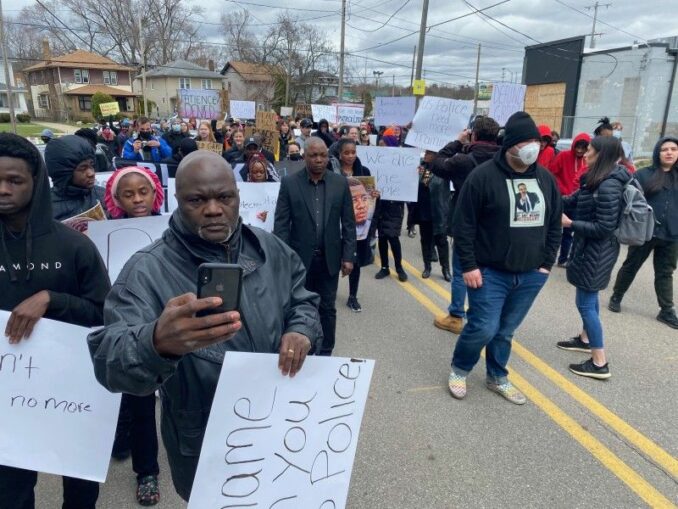

Grand Rapids march demands justice for Patrick Lyoya. PHOTO: Fightback News!

Grand Rapids, MI – A crowd of hundreds marched to the Grand Rapids City Commissioners meeting, April 12, to demand both the release of the raw video showing the murder of Patrick Lyoya and the arrest of the still-unnamed killer cop. Lyoya was a 26-year-old Congolese immigrant executed by the Grand Rapids Police Department last week [April 4–WW]. In the days after his death, citywide mourning and protests against the police have increased and are expected to surge after the release of the video this Wednesday.
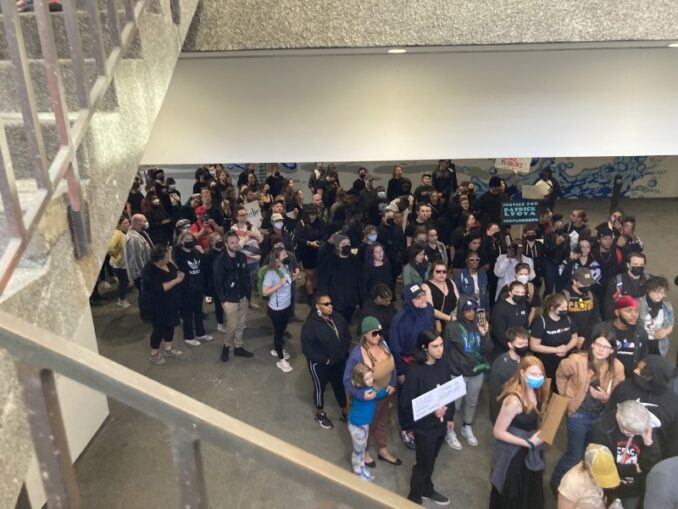

City Hall protest for Patrick Lyoya, Grand Rapids, April 12. PHOTO: Fightback News!

The police department has continued to stall the footage, while the city insists it is acting in full transparency. Patrick’s father, Peter Lyoya, said the video shows his son murdered “execution style” on the ground. The family has said the narrative of the department, that there was a “struggle,” runs counter to the facts.

The Royal Black Panther Party of Grand Rapids organized the march to the meeting. It was attended by hundreds of community members and weaved through all the major streets of downtown. “Say his name! Patrick Lyoya!” and “You can’t stop the revolution! GRPD is not the solution!” echoed through the city.

Before the protest, barricades were erected around the police station. A few of the businesses downtown have boarded up their windows with “Patrick Lyoya” painted on the plywood.

The protesters stopped in front of City Hall and were led through chants of “I am! A revolutionary!” and “Black power!” before crowding into the building. Demonstrators were led up in groups due to capacity limits, while the rest stayed on the first floor to continue chanting and watching the livestream in an overflow room.

City Manager Mark Washington, near the beginning of the meeting, said the video will be released tomorrow at 3 p.m. during a livestream with the police chief, who will “provide context” for the images. The video provided Wednesday will be compiled from nine different sources. GRPD Chief Eric Winstrom released a statement warning the video has “graphic images resulting in the loss of life” and will be tagged with an age restriction on the city’s YouTube page.

During public comments, calls for the release of the video, the arrest of the unnamed killer cop and the resignation of the entire commissioner board were prevalent. A few speakers acknowledged their continued presence at the meetings over the past few years, and the city’s inaction in resolving the GRPD’s brutality, which has left local activists with physical injuries and mental trauma.

Commissioners were called out by name for failing to do their jobs and for their “crocodile tears” now that the attention is on them. One local woman said her husband was murdered by the GRPD, and her 12-year-old child was too traumatized to attend the meeting.

The meeting lasted well over four hours. Further protests have already been scheduled after the release of the video, including a call to action on Friday, April 15.



Gross negligence in for-profit prison health care


https://www.workers.org/2022/04/63358/


By Marie Kelly posted on April 15, 2022

By law, people in prison have a right to get the health care they need. In the late 1970s, the U.S. Supreme Court decision Estelle v Gamble set the standard for medical rights of prisoners. But prison authorities are being criminally negligent in not providing adequate health care to incarcerated people.


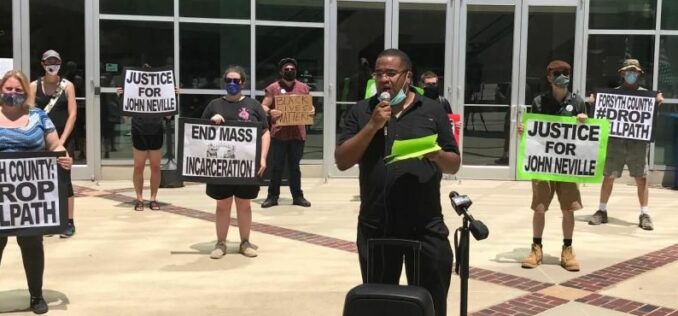
Black Lives Matter of Winston-Salem, North Carolina, demonstrated July 28, 2020, to demand the Forsyth County Jail end its contract with WellPath.

As the jailed population ages, 40% have chronic health conditions. The cost of providing health care has skyrocketed and local, state and federal governments have contracted with for-profit prison health care companies as a way of tightening their budgets.

Private companies give a per diem rate for basic and specialty care – which would be lower if services were publicly provided. The negotiated per diem rate creates a huge profit incentive. By providing little or substandard care, companies have everything to gain and nothing to lose. In contracting the financial and bureaucratic burden of incarcerated health care to private firms, the correctional departments “win” too.

But, to say the least, incarcerated people don’t fare well in this system.

Private companies have little regulatory oversight. There are many first hand accounts of mistreatment and neglect. Complaints of illness are ignored or dismissed. Infirmary staff are ill-trained to handle the demanding challenges of caring for a very oppressed incarcerated population. Staff are pressured to avoid sending incarcerated patients to outside facilities for treatment, even when that is the correct course of action.

Incarcerated people trying to access health care are blocked at almost every turn. They can’t simply walk over to the infirmary. Often the first attempt at treatment is a perfunctory exam with no resolution. Only after persistent and repeated visits does anyone on staff take the incarcerated patient seriously. And being incarcerated increases one’s risk of disease due to lack of proper food and exercise, isolation from loved ones, and the mental strain of having your individual rights violated on a daily basis.

These are high hurdles for people who are sick and living in a demoralizing, punitive facility. No wonder there are so many stories from the incarcerated who spent days or weeks in pain because they were too weak and debilitated to demand the care they deserve.

Profiting from prisoners

A handful of companies currently provide the majority of healthcare in prisons: WellPath, Corizon, NaphCare, PrimeCare Medical and Armor Correctional Health Services.

WellPath is the largest of the private firms – responsible for over 300,000 incarcerated people in over 40 states. Former CEO Jerry Boyle was convicted this year on federal bribery charges related to “winning” a $3.2 million contract at a Norfolk, Virginia, jail. The company donates to the political campaigns of sheriffs with whom it has contracts.

Corizon manages health care for some 116,000 prisoners in state and county facilities at more than 140 locations in 15 states. In 2020, they settled a lawsuit brought by an elderly disabled incarcerated man in Florida. Corizon agreed to pay $50,000 to Henry Washington for injuries he suffered when Corizon staff failed to administer medications he was prescribed for high blood pressure and glaucoma.

NaphCare was the private firm at Alabama correctional facilities in 2003 when Timothy Oliff’s illness was ignored by infirmary staff. He subsequently collapsed and died in the hospital. A physician at the hospital told his family that he succumbed to pneumonia and a severe stomach infection which was treatable if he had been admitted sooner. Alabama dropped NaphCare as a provider but its new choice, Wexford, is being sued for bribery in Mississippi.

PrimeCare Medical, based in Harrisburg, Pennsylvania, is the for-profit health care provider at 70 carceral facilities in five states. In 2003, the company was held liable for the suicide death of 21-year-old Kyle Flyte after the PrimeCare psychiatrist canceled his suicide watch.

Armor Correctional Health Services, based in Florida, generated over $155 million in 2021 revenue. In 2019, Armor was criminally charged for allegedly falsifying records in the death of a man imprisoned in Wisconsin. The company was dropped by at least seven counties in Florida, New York, Colorado and Oklahoma. After years of allegations of failing to meet its contractual obligations and placing inmates at risk in New York state, the company agreed to pay $350,000 and not bid on any state contracts for three years in a settlement with the New York state attorney general.

Examples of negligence by these for-profit companies are easy to find because they are so numerous. Incarcerated people and their families are speaking out and telling stories that will make your hair stand on end or your blood boil. It is imperative that we share their stories far and wide – because their lives depend on our solidarity.


We’re Failing To Prepare Our Children For The Climate Fight


https://popularresistance.org/were-failing-to-prepare-our-children-for-the-climate-fight/


By Eleanor Cummins, Portside.
April 16, 2022


Most Schoolchildren Get Only An Hour Or Two Of Climate Education Per Year.

It’s Up To Their Parents To Teach Them Optimism And Action In The Face Of A Daunting Crisis.

Climate change is hurtling forward at frightening speed. And the American K-12 system still isn’t remotely prepared to teach children about what they’ll soon face. Today, the majority of students in U.S. schools get between zero and two hours of instruction per year about climate change—hardly enough time to discuss the political, cultural, and environmental ramifications of greenhouse gas emissions, let alone make space for the emotions elicited by such an existential threat. In some districts, climate education is actually disinformation, as teachers rely on materials created by the fossil fuel industry to mislead children on the origin of the problem and our possible futures.

The obstacles to quality climate education are manifold, according to Miseducation: How Climate Change Is Taught in America, a recent book-length investigation by journalist Katie Worth. Surveys suggest a majority of K-12 teachers in the United States still believe that scientists disagree about the anthropogenic origin of climate change, encouraging skepticism to seep into the classroom. Many districts rely on old, outdated textbooks that tend to minimize the crisis, if they touch on global warming at all. And teachers who support climate education in one classroom may find their work undermined by “skeptics” teaching the same kids later in the day.

There are signs of progress. As of 2019, for example, 86 percent of Americans agreed that climate change should be taught in school in some form. But just having a working knowledge of the carbon cycle would be insufficient for kids today, says Mary DeMocker, author of The Parents’ Guide to Climate Revolution. If we only teach kids the facts about the present crisis, “we’re burdening them with science in a way that’s fatalistic,” she told me. To foreclose solutions and sidestep politics is like saying, “Here, let us help you cultivate some resilience for your dismal future.” The real solution lies elsewhere—in radically redefining the priorities of American, and in particular, white American, parents, teachers, and other caretakers. Instead of preparing children for the workforce or to reach higher standards of living than the last generation, we need to support young people in cultivating both “resilience and resistance” for one of the toughest challenges humanity has ever faced, DeMocker says. In the process, the rest of us might also reap some of these qualities for ourselves.

In Lydia Millet’s 2020 novel, A Children’s Bible, a teenage narrator named Eve decides to do the thing she dreads most and inform her younger brother about climate change. “I have to tell you a new story now,” she begins. “But a real one. A story of the future, Jack.” The adults were greedy, the world is imperiled, and (so far) it’s only getting worse—you’ve heard this one before. But for Jack it is new and heart-breaking. “Later he wiped his eyes and squared his thin little shoulders,” Eve tells us. “My Jack was a brave boy.”

The parents in this book, as might be expected, are terrible. They drink and avoid the catastrophe unfolding before them; when avoidance is no longer an option, they drink more and despair. A hurricane hits, and it’s the kids who respond swiftly and smartly, eventually bringing (almost) everyone to relative safety. It is, in part, a parable, a story out of space and time. But A Children’s Bible is also a painfully familiar representation of the pressure young people feel to save the world—and the sense that adults have failed to join the fight.

A handful of picture books have emerged in recent years to help parents and educators teach kids about the climate crisis, from The Fog by Kyo Maclear (a metaphor for global warming) to The Polar Bears’ Home by Lara Bergen (a straightforward Arctic explainer). There’s also an expanding field of nonfiction writing to help adults process their feelings—and support the next generation of climate leaders. “As parents, we should be aware of this and try to repair that sense of betrayal that young people have toward older generations,” Britt Wray, the Human and Planetary Health Fellow at Stanford University and the London School of Hygiene and Tropical Medicine and author of the forthcoming book Generation Dread: Finding Purpose in a Age of Climate Crisis, told me. “That’s why the truth is so important.”

Children today grow up knowing the stakes and mourning the injustice. Adults need to supply them, at bare minimum, with the means to act on those feelings.

The difficulty of teaching children about climate change mirrors this divide in the literature: Kids can get their hands on the raw materials, but if parents and educators lack frameworks for processing their own feelings about the crisis and channeling them into substantive action, where can their children’s knowledge and natural concern really go? While kids will be affected by climate change for the rest of their lives, they can’t vote or, in most cases, drive themselves to climate rallies, DeMocker says. As the founder of 350 Eugene, a local chapter of Bill McKibben’s international grassroots climate justice movement, DeMocker organized events for community members about how to address these problems locally. She found parents were uniquely suited to help, as they are invested in a long-term future for their kids but have the wisdom and legal rights their children lack—they just needed actionable advice. So DeMocker decided to keep a list, which ultimately grew to more than 100 items, all detailed in the The Parents’ Guide to Climate Revolution.

DeMocker’s morsels are many and varied, ranging from old standbys like planting trees to more aggressive plans for suing polluters—inspired, in part, by the plaintiffs in the Juliana v. United States case, six of whom are from Eugene. While kids are sure to encounter the climate crisis from friends, in classrooms and museums, and through popular media, and their questions deserve honest, age-appropriate answers, DeMocker believes parents should initially place the emphasis on fostering inner strength. “We need to protect [children’s] imaginations and we need to protect their hearts until they’re strong enough, when they’re teens, to really take on this crisis on this intellectual level,” she says.

As kids get older, what they know about the crisis will multiply and deepen. In the United States, many activists have been desperate merely to get people to “listen to the science” on climate change. But actually understanding that science—and being able to explain it to others and formulate plans of action based on it—would be even better, especially for kids who will never know a life without its effects. Even so, this most basic education must be done with sensitivity. One of Worth’s classroom visits, described in Miseducation, is useful here. Amid numerous stories of children failed by their schools, Worth describes how Kristen Del Real, a sixth-grade science teacher in Chico, California, has designed a resilience-minded course for her students. First, the 11- and 12-year-olds will learn about geological time. Then they observe how legume sprouts turn nitrogen into nutrients. Units on atmosphere, solar radiation, the greenhouse gas effect, and the weather system follow. “Once all those pieces are in place,” Del Real said, “when we get to global warming, the kids will just get it.”

Crucially, Del Real’s lessons don’t stop there. The final month of the school year in Del Real’s class is spent on “solutions projects,” where small groups of students apply their knowledge to develop proposals that will help solve the crisis—the most important step of all. “Usually, by the time they get to the solutions project, even the doubters understand the implications of a changing atmosphere,” Worth writes, “and [they] are eager to dream up answers.” The goal is to keep kids from getting crushed by the weight of the world and to work to ensure they’re actually up to the task of improving it.

I first learned about climate change in middle school, when our science teacher played a newly released documentary, An Inconvenient Truth. But I didn’t feel the climate crisis for another decade, when I began researching a project on changing rain patterns in the northeastern U.S. It’s not an overstatement to say that seeing the historic data change—and watching the projections extend out over the twenty-first century—eventually changed the course of my life and career. People younger than me don’t have the privilege of such a long learning curve; with apocalypse around every corner, a personal engagement with the science, let alone the history or politics of climate change, now follows the feelings of fear and grief prompted by the crisis. Children today grow up knowing the stakes and mourning the injustice. Adults need to supply them, at bare minimum, with the means to act on those feelings.

As a childless 25-year-old, I look back on my own climate education and feel as though I’m straddling two climate generations: those older than me, for whom disastrous change has (incorrectly) felt like a foregone conclusion, and the kids younger than me, for whom any change is (rightly) treated as meaningful progress. On September 20, 2019, for example, at the climate strike in New York City, I watched Jaden Smith and Willow perform and various speakers, including Greta Thunberg, take the stage. At some point, someone—I don’t remember who—spoke about how we, the crowd, would keep fighting no matter what, because 1.5 Celsius was better than two, but two was better than 2.5, and 2.5 was better than three. It was an obvious scientific fact, and yet as someone raised to think of even two degrees of warming as almost unthinkably catastrophic, I’d never felt it. But the teenagers around me, in their bucket hats and tank tops, nodded knowingly—they’d believed it all along. They’d come of age knowing the world is probably going to overshoot 1.5 degrees of warming—maybe even two. And they have every reason to fight for every fraction of a degree.

What black-and-white, all-or-nothing thinking are you employing? Where is fatalism about the future holding you back?

To me, this moment revealed an important truth about what climate education really requires. Supporting kids as they face an endangered world requires adults to relocate their own optimism and reengage in the fight. “I’ve seen a lot of these articles on ‘how to help your kid with eco-anxiety,’ as if the parent isn’t also in the world,” Wray tells me. But children and their caretakers feed off each other’s emotions, and children rely on their caretakers to help them process complex feelings. When it comes to parenting, teaching, or otherwise supporting a child, “a key part of doing this well is doing your own inner work and investigation,” Wray says. What black-and-white, all-or-nothing thinking are you employing? Where is fatalism about the future holding you back? What more can you be doing to build community?

These questions may, at times, be painful to ask. But Wray is confident they can help everyone work toward a better future. Parenting “with purpose and really committing to the joy of it—rather than fearing what may come—has an effect on your orientation toward what life is made of,” Wray tells me. If it takes a village to raise a child, then holistic, heartfelt climate education can and should change the village itself.


Leaking Massive Red Hill Jet Fuel Tanks Will Not Be Closed Anytime Soon


https://popularresistance.org/leaking-massive-red-hill-jet-fuel-tanks-will-not-be-closed-anytime-soon/


By Ann Wright, Popular Resistance.
April 15, 2022


Don’t Get Your Hopes Up!

On March 7, 2022 Secretary of Defense Lloyd Austin ordered the defueling and closure of the 80-year-old leaking 250 million gallon jet fuel tanks at Red Hill on the island of O’ahu, Hawai’i. The order came 95 days after a catastrophic 19,000-gallon leak of jet fuel into one of the drinking water wells operated by the U.S. Navy. The drinking water of over 93,000 persons was contaminated, including the water of many military and civilian families living on military bases. Hundreds went to emergency rooms for treatment of rashes, headaches, vomiting, diarrhea and seizures. The military placed thousands of military families in hotels Waikiki resorts for over 3 months while civilians were left to find their own accommodations. The military says it has already spent $1 billion on the catastrophe and the US Congress has allocated another $1 billion to the military, but none to the State of Hawai’i for the damage to the aquifer for the island.

The initial euphoria of the Secretary of Defense’s announcement of the decision to defuel and close the tanks has worn off to citizens, city and state officials.

Three wells of the City of Honolulu were shut down to prevent drawing the jet fuel plume from the Red Hill water well shaft further into the island’s main aquifer that provides drinking water for 400,000 persons on O’ahu. The island’s Board of Water Supply has already issued a request for water curtailment to all residents and warned of water rationing in the summer. Additionally, it has warned the business community that construction permits for 17 pending projects may be denied if the water crisis continues.

Another leak has occurred since the announcement. On April 1, 2022 the US Navy said that either 30 or 50 gallons of jet fuel leaked, depending on the news release. Many observers are wary of the number as the Navy has under reported previous leaks.

Military and civilian families who have returned to their homes after the military conducted flushing of the water pipes continue to report headaches from the smell coming from flushed taps and rashes from bathing with flushed water. Many are using bottled water at their own expense.

One active duty military member and mother created a list of 31 symptoms that are still suffered by family members living in homes that have been “flushed” of the contaminated water and polled persons on the Facebook support group.

I am including the top 20 symptoms in the poll and the number of persons responding give a chilling reminder of what the families have been going through for the past 4 and one-half months. I am also posting this because none of the military, federal or state agencies have ever published any data or surveys. The symptoms were posted in an April 8 JBPHH Water Contamination Facebook page entry. In 7 days on Facebook, these are the responses as of April 15, 2022:

Headaches 113,

fatigue/lethargy 102,

anxiety, stress, mental health disturbances 91,

memory or attention issues 73,

Skin irritation, rash, burns 62,

dizziness/vertigo 55,

cough 42,

nausea or vomiting 41,

back pain 39,

hair/nail loss 35,

night sweats 30,

diarrhea 28,

women’s health/menstrual issues 25,

Extreme ear pain, hearing loss, tendinitis 24,

joint pains 22,

high resting heart rate 19,

sinusitis, bloody nose 19,

chest pain 18,

shortness of breath 17,

abnormal labs 15,

abdominal pain 15,

gait disturbances/ability to walk 11,

random fevers 8,

bladder issues 8,

tooth and filling loss 8

The Secretary of Defense March 7 order states in part: “By no later than May 31, 2022, the Secretary of the Navy and Director, DLA will provide me with a plan of action with milestones to defuel the facility. The plan of action shall require that defueling operations commence as soon as practicable after the facility is deemed safe for defueling and target the completion of that defueling within 12 months.”

It is 39 days since the Secretary of Defense issued his order that the jet fuel tanks will be closed.

It is 45 days until the May 31 deadline for a PLAN of how to defuel the tanks is presented to the Secretary of Defense.

It is 14 days since the last leak of jet fuel at Red Hill.

It is 150 days since a report on the 2014 leak of 27,000 gallons was given in December 2021 to Navy brass and neither the State of Hawaii, City of Honolulu’s Board of Water Supply, nor the public have been informed of its contents.

The Navy has not withdrawn its February 2, 2022 lawsuits in State and Federal courts against the State of Hawaii’s December 6, 2021 emergency order to stop operations and defuel the Red Hill tanks.

The State of Hawaii’s December 6, 2021 emergency order required the Navy to hire an independent contractor, approved by the Department of Health, to assess the Red Hill facility and recommend repairs and improvements for safely draining the underground fuel tanks.

On January 11, 2022, the Navy allowed the Department of Health to review the contract only hours before signing and DOH determined that the Navy has too much control over the evaluation and work. “This disaster is about more than just engineering—it’s about trust,” said DOH’s Deputy Director of Environmental Health Kathleen Ho in a press release. “It is critical that the work to defuel Red Hill is done safely and that the third-party contractor hired to oversee that work will operate in the interests of the people and environment of Hawaiʻi. Based on the contract, we have serious concerns about SGH’s work being done independently.”

We have no idea how long it will take the Department of Defense to determine that the Red Hill fuel tanks are “safe” to defuel. The May 31st deadline is for a plan to defuel does not given us any indication of how long it may take after the facility is “deemed safe.”

However, Hawaii’s Senator Mazie Hirono gave us an indication that the shut down process is going to take longer than most of us are comfortable with. She has received briefings from the military during her trips into the Red Hill fuel storage facility about the condition of the Red Hill facility. In a Senate Armed Services committee hearing on April 7, the first hearing that Secretary of Defense Austin has testified in since his March 7 order to close Red Hill, Senator Hirono said to Austin, “The closure of Red Hill is going to be a multi-year and multi-phased endeavor. It is imperative that a great deal of attention be paid to the defueling process, the closure of the facility and the clean-up of the site. The entire effort will require significant planning and resources for years to come.”

While prior to the massive 19,000 gallon leak in later November 2021, the US Navy was pumping fuel up to Red Hill from fuel tankers docking at Pearl Harbor and pumping fuel back downhill to Pearl Harbor for refueling ships at Hotel Pier in Pearl Harbor, we suspicion that the Department of Defense will not be in a hurry to defuel the tanks and will use the “deemed safe” phrase as a way to slow down the process.

We certainly want the defueling process to be safe, but as far as we know, it has always been safe to move fuel up to the tanks and back down to the ships.

If this process has not been safe in the past, the public certainly deserves to know when it was deemed “unsafe.”

The bottom line is that we must push for the tanks to be defueled expeditiously before another catastrophic leak occurs.


Ann Wright served 29 years in the US Army/Army Reserves and retired as a Colonel. She was a US diplomat for 16 years and served in US Embassies in Nicaragua, Grenada, Somalia, Uzbekistan, Kyrgyzstan, Micronesia, Afghanistan and Mongolia. She resigned in March 2002 in opposition to the US war on Iraq. She is the author of Dissent: Voices of Conscience” and a member of Hawai’i Peace and Justice, O’ahu Water Protectors and Veterans For Peace.


The Power And Potential Of Democratic Public Ownership


https://popularresistance.org/the-power-and-potential-of-democratic-public-ownership/


By Thomas M. Hanna, Resilience.
April 16, 2022


Democratic Public Ownership combines solidarity economy principles around democratic governance, equity, subsidiarity, and sustainability with the benefits of collective ownership in its widest, most holistic sense.

Rather than ignore the world’s existing public enterprises and services, we should leverage their scope and scale by infusing them with democratic governance structures, innovative missions and mandates, and robust transparency and accountability mechanisms.

In most cases, it would be absurd to think that the same approach that created a problem would also be the one best suited to solve it. Yet this is exactly what we are expected to believe regarding the existential ecological threats our world now faces. As predicted by many since its inception, capitalism and its core interconnected tenants — private ownership of the means of production, market allocation, and exponential economic growth — have brought us to the precipice of both environmental and social disaster. Yet, year after year we continue to be told that capitalism will save us. Just a few more dashes of regulation here, some different market incentives there, and the turning point is right around the corner. All the while, temperatures climb, species disappear, the air is choked with smog, waters rise, forests burn, and storms rage.

If capitalism and its institutions can’t save us, what can? For many, the answer is, and always has been, some form of socialism or post-capitalism. In recent years, there has been an increasingly active and spirited debate around the issues of (eco)socialism and growth/degrowth. While all sides generally agree that capitalist growth is unsustainable and undesirable, they differ on the possibilities and implications of various alternatives. On the one hand, writers like Leigh Phillips suggest the potential and merits of “socialist growth,” arguing that carefully planned growth can occur within planetary limits and not require large-scale reductions in living standards (austerity). On the other hand, authors like Timothée Parrique and Giorgos Kallis counter that all economic growth is unsustainable and that “socialism without growth” can deliver prosperity through a combination of wealth redistribution, reductions in unnecessary materialism, and an end to extraction and exploitation in pursuit of profit.

This article does not attempt to evaluate either of these perspectives, except to say briefly that they may not be as irreconcilable as they first appear. For instance, Phillips states that socialists must take planetary limits very seriously, although he believes that humans can and should attempt to innovate their way around such limits. While Parrique and Kallis, for their part, reject both the austerity and capitalist variants of degrowth and admit that “the provision of certain useful goods and services must increase and should increase under socialism.” Rather, this article focuses on what is one of the implicitly agreed underpinnings of any anti-capitalist or post-capitalist transition strategy and envisioned sustainable future — namely collective, democratic control over the means of production — and makes the case for one form, Democratic Public Ownership (DPO), in particular.
Socializing the means of production

That collective, democratic control of the means of production is a necessary precondition for any form of degrowth or eco-socialist transition strategy is hardly a novel concept. Indeed, as Diego Andreucci and Salvatore Engel-Di Mauro wrote in their introduction to a 2019 symposium titled Capitalism, Socialism and the Challenge of Degrowth, “what eco-socialism and degrowth have in common is precisely the need to democratically control social metabolism” and “the first and most important challenge for any degrowth ‘transition’ is precisely to socialize the means of production and reproduction.” However, what “collective control” and “socializing the means of production” entails in practice is the source of considerable debate.

Historically, in many parts of the world this has traditionally taken the form of large state-owned enterprises (SOEs) and national level public services (such as healthcare, education, transportation, and so on). This model undeniably delivered many material benefits, especially with regards to industrialization, reducing inequality and poverty, economic and social development, quality employment, increased union density and power, solving market failures, and regaining sovereign control of resources and assets (especially in the Global South in the post-colonial era).

However, in most cases it manifestly failed to genuinely redistribute economic power beyond the limited benefits derived from broad-based ownership. In other words, these enterprises and services were often hierarchical and managerial organizations with little in the way of direct worker and/or community participation, control, transparency, or democratic accountability. Moreover, in some countries they eviscerated longer-standing traditions of local municipal and collective forms of production and service delivery, became engines of political corruption, clientelism, and state oppression, and/or fueled resource extraction and environmental despoliation. As a result, when confronted with the privatizing, marketizing, and liberalizing forces of neoliberalism during the 1980s and 1990s, many of these enterprises and services found few staunch defenders, leading to a massive transfer of wealth and assets from collective to private hands.

Due at least in part to the many failings of the traditional statist model of public ownership (and nation-states more generally), in recent years and decades many socialists and other anti- and post-capitalists have started to focus their attention — and hopes — on an array of decentralized institutions and approaches with more direct forms of governance and management. Sometimes grouped together under the moniker of the solidarity economy, social economy, democratic economy, or economic democracy, these often include institutions like worker cooperatives, volunteer collectives, mutual associations, producer cooperatives, worker self-managed enterprises, and, in some cases, small-scale for-profit businesses (e.g., B-corps or ‘triple bottom line’ companies).

Undoubtedly, these democratic models of ownership and control are a major advance over the profit-maximizing corporate variant of private ownership that currently predominates in many economies around the world, and they should be supported and expanded wherever possible. However, they are not without their limitations. First and foremost, with the exception of commons-based approaches and some multi-stakeholder approaches (both of which are, arguably, a form of public ownership, as will be discussed further below), these models are largely membership-based rather than truly collective in the widest sense of the term. In other words, the enterprise or service is owned and controlled by some subset of the larger population in a given area. For instance, in a traditional standalone worker cooperative only workers in that particular enterprise have ownership and control rights. The vast majority of a local population, including workers in other industries, retirees, children, family caregivers, the unemployed, and those with disability, are not included.

Secondly, inasmuch as these are profit-making enterprises operating in competitive markets, they are often constrained and/or impacted by some of the same forces as private companies — including pressure to externalize labor and environmental costs, sell to private competitors or demutualize, and grow market share and profits. In other words, as decentralized membership-based entities currently operating in a market-based capitalist system, many of these entities are structurally constrained from implementing certain approaches (such as degrowing or remaining at a steady state) and are not necessarily accountable to society as a whole (and societal priorities).

Take, for example, the case of the Mondragón cooperatives in the Basque region of Spain. With around 95 cooperatives and 80,000 workers the Mondragon Corporation is one of the world’s largest worker cooperative networks and has achieved many tremendous successes, especially as it relates to economic and social development in the Basque region and democratic governance. However, Mondragon is competing in international markets and has had to make certain sacrifices to its cooperative ethos in order to survive. Specifically, it has established a three-tiered labor force consisting of cooperative members, temporary workers on short-term contracts, and wage laborers in a number of international subsidiaries (i.e., workers who are not cooperative members). Moreover, many of the Mondragón cooperatives are industrial in nature and, as Jill Bamburg observed in 2017, “even as ‘sustainability’ issues have found a place in most global firms, I did not see much traction in Mondragon in either practice or articulated values. There is nothing in cooperativism that is inherently greener than any other structure.” And, lastly, the Mondragón cooperatives are famously not unionized and have strained relations with the rest of the working class in the Basque region.

The Mondragón network is important not just because of its successes and challenges, but also because it is one of the few modern membership based models of socialized production that have reached anything like the kind of scale that will be needed to displace corporate power and move towards a post-capitalist economy in the time frames dictated by climate change and other planetary boundaries. (Another, perhaps more interesting, model is provided by the cooperative networks in the Indian state of Kerala, but they too are facing challenges and pressures as India continues to open its economy to international trade and markets.)

So, despite renewed interest and attention (and in some cases, expansion), in most countries these membership models collectively remain relatively peripheral to the overall system of production. For instance, if all worker cooperative and ESOP (employee stock ownership plan) members in the United States were put together, they would still amount to just around 6.5 percent of the civilian labor force (almost all of whom are in ESOPs which, in most cases, are a much more passive form of worker ownership than worker cooperatives). Simply put, while these models are a critical component of any pluralist vision of post-capitalism, they have yet to reach anything like the scale, impact, and potential of the previous generation of state-owned firms and nationalized services — and time is running out.
Democratic Public Ownership

Another model that is implicit in the solidarity economy ecosystem, but not as often discussed, is public ownership. In contrast to both private, corporate models and many member-based models, public ownership refers to enterprises and services that are owned by all people in a given geographic area and governed either directly through commons-based approaches or indirectly via government structures at various levels (from local to regional to national). By virtue of its direct connection to, and embeddedness in, society (rather than purely markets), public ownership is an inherently flexible ownership form that can be deployed for whatever ends a community prioritizes.

As E.F. Schumacher, the British economist and author of Small is Beautiful, once put it:


Private ownership of the means of production is severely limited in its freedom of choice objectives, because it is compelled to be profit-seeking, and tends to take a narrow and selfish view of things. Public ownership gives complete freedom in the choice of objectives and can therefore be used for any purpose that may be chosen. While private ownership is an instrument that by itself largely determines the ends for which it can be employed, public ownership is an instrument the ends of which are undetermined and need to be consciously chosen.

Moreover, there are already hundreds of thousands of publicly owned enterprises and services in existence around the world and usually new ones can be created relatively easily and quickly through government action at various levels. (During the financial crisis of the late 2000s, for instance, governments around the world nationalized dozens of banks, auto-makers, and other private sector businesses virtually in the blink of an eye.)

In other words, whatever society’s goal might be — whether it is degrowth, steady state, or carefully planned growth — public ownership is a tool with immense possibility, especially if rapid action is needed (as it undoubtedly currently is). For instance, in public hands an oil or coal company could be more easily and rapidly decommissioned or converted to alternative production in a way that provides a just transition for workers and communities. Similarly, a publicly owned renewable energy company could quickly scale up operations without exacerbating economic inequality (e.g. by not serving as a tax shelter for large corporations and wealthy investors).

However, this flexibility and potential cuts both ways and, as previously mentioned, many traditional publicly owned enterprises have been deeply flawed, both in terms of their operations (e.g., resource extraction) and governance. Recognizing this, in recent years a new alternative has started to emerge (albeit one with deep historical roots). Known as Democratic Public Ownership (DPO), it is based not only in a critique of privatization and neoliberalism, but also of traditional forms of public ownership and statism. In particular, DPO rejects the SOE model prevalent around the world and throughout the 20th century for being overly top-down, bureaucratic, managerial, centralized, and alienating. It also opposes neoliberal inspired efforts to ‘reform’ publicly owned enterprises by enshrining private sector aims (such as profit maximization) and approaches (such as New Public Management).

Rather, DPO focuses on combining solidarity economy principles around democratic governance, equity, subsidiarity, and sustainability with the benefits of collective ownership in its widest, most holistic sense. Democratic Public Ownership is about establishing or significantly enhancing democratic decision-making structures, transparency, and accountability both within and around (i.e., the wider political economic system) a publicly owned enterprise or service. What this looks like, in practice, is, and will be, different from community to community, but some examples (all drawn from real-world practice) include:
genuinely multi-stakeholder boards that include worker, community, state, environment, and other representatives;
democratically elected governing assemblies;
works councils and empowered trade unions;
autonomous community ‘observatories’ as vehicles for community participation, transparency, and accountability;
participatory planning and budgeting processes;
and public-community partnerships and co-governance arrangements with community-based membership organizations.

Strategically, the concept of Democratic Public Ownership suggests that rather than simply ignoring the world’s expansive panoply of existing public enterprises and services — or worse, standing by as they are asset stripped and sold off to wealthy private investors — we should leverage their scope and scale by infusing them with democratic governance structures, innovative missions and mandates, and robust transparency and accountability mechanisms. Moreover, this should be supplemented by creating a new generation of publicly owned organizations in strategically and socially important sectors with various forms of democracy (including commons-based governance), transparency, and accountability baked in from the start. This includes, but is not limited to, municipalizing / nationalizing and then reorienting extractive, exploitive, and ecologically destructive for-profit companies.
The right tool for the job

Recently, the Intergovernmental Panel on Climate Change (IPCC) has warned that the window to mitigate the worst effects of climate change is closing fast. In order to save the planet and lay the foundations for a flourishing, equitable, and genuinely sustainable, global post-capitalist society, we are going to need every tool available to quickly and urgently assert collective ownership and control over the means of production and displace for-profit corporate power. While this includes decentralized membership and voluntary models, we would be remiss to neglect the potential and power of Democratic Public Ownership.
Three things you can do right now
Find out more about Democratic Public Ownership in these articles:– The Future is Public: Towards Democratic Ownership of Public ServicesConstructing the Democratic Public EnterpriseLocal Public Service in Crisis Mode– Adapting Governance Models to Exceptional TimesOur Common Wealth: The Return of Public Ownership in the United States
Help promote this article by sharing these posts on Twitter, Facebook, and LinkedIn. Sign up here for email alerts when articles like this are shared on social media.
Donate to an anti-privatization or remunicipalization campaign in your local area, or one of the following organizations:– The Transnational InstituteIn the Public InterestPublic Services InternationalMunicipal Services ProjectThe Democracy Collaborative


Oliver Stone on the Ukraine Invasion


https://www.youtube.com/watch?v=R_n6DY_C1-k 


How The US Does ‘Diplomacy’


https://popularresistance.org/how-the-u-s-does-diplomacy/


By Moon of Alabama.
April 16, 2022


The U.S. doesn’t do diplomacy. Every country has its own interests. But the U.S. and its pricks in the State Department insist that its interests must have priority over all others. Any country that disagrees with that will be called out on this or that issue or will even get sanctioned.

March 19 2022: President Xi Jinping Has a Video Call with US President Joe Biden


The two sides exchanged views on the situation in Ukraine.President Biden expounded on the US position, and expressed readiness for communication with China to prevent the situation from exacerbating.

President Xi pointed out that China does not want to see the situation in Ukraine to come to this. China stands for peace and opposes war. This is embedded in China’s history and culture. China makes a conclusion independently based on the merits of each matter. China advocates upholding international law and universally recognized norms governing international relations. China adheres to the UN Charter and promotes the vision of common, comprehensive, cooperative and sustainable security. These are the major principles that underpin China’s approach to the Ukraine crisis.

March 21 2022: US announces new sanctions on Chinese officials over ‘repressive acts’


The State Department said it would impose visa restrictions on Chinese officials it said are believed to be responsible for “policies or actions aimed at repressing religious and spiritual practitioners, members of ethnic minority groups, dissidents, human rights defenders, journalists, labor organizers, civil society organizers, and peaceful protestors in China and beyond.”

April 11 2022: Ukraine dominates Modi-Biden talks


Mr. Modi, who spoke via videolink to Mr Biden, described the situation in Ukraine as “very worrying” and said he had spoken, several times, with both Ukrainian President Volodymyr Zelenskyy and Russian President Vladimir Putin and had not just urged peace, but also direct talks between them. India’s unwillingness to call out Russia by name for its attack on Ukraine has not gone down well in Washington, but U.S. officials have also said that they hoped countries that have relationships with Moscow might leverage them to bring about a resolution to the situation.

April 12 2022: US Monitoring “Rise In Human Rights Abuses” In India: Antony Blinken


US Secretary of State Antony Blinken said the United States was monitoring what he described as a rise in “human rights abuses” in India by some officials, in a rare direct rebuke by Washington of New Delhi.”We regularly engage with our Indian partners on these shared values (of human rights) and to that end, we are monitoring some recent concerning developments in India including a rise in human rights abuses by some government, police and prison officials,” Mr Blinken said on Monday in a joint press briefing with US Defense Secretary Lloyd Austin, Foreign Minister Subrahmanyam Jaishankar and Defense Minister Rajnath Singh.

January 10 2022: Chas Freeman – Diplomacy as an Instrument of Statecraft: A Practicum


What distinguishes diplomats from courtiers, securocrats, and other bureaucrats in a national capital is a reliance on empathy: the ability to see the world through other eyes and to use this insight to induce others to see their interests the way the diplomat wants them to see them. It takes more than a diplomatic passport, position, or title to make someone a “diplomat.” Diplomacy, like other skilled work, requires knowhow gained through training, mentoring, on-the-job experience, and awareness of historical precedents. It is a calling and a role, not a job title.Yet diplomacy remains at best a proto-profession in the United States, thanks to the uniquely American reliance on the political spoils system to staff even key national security functions. This makes diplomatic appointments to benefit appointees and their political parties rather than the country. It thereby enshrines amateurism and incompetence. As the New York Herald-Tribune put it in 1857, in the United States “diplomacy is the sewer through which flows the scum and refuse of the political puddle. A man not fit to stay at home is just the man to send abroad.” Only one thing has changed about this in the last 165 years. Female campaign donors and celebrities now compete with men for appointments to what they imagine are ambassadorial sinecures in plummy places abroad, leaving seedy and dangerous places to lifers.