Sunday, April 17, 2022

Mexicans Mobilize In Support Of President AMLO’s Electricity Reform


https://popularresistance.org/mexicans-mobilize-in-support-of-president-amlos-electricity-reform/ 


By Tanya Wadhwa, People's Dispatch.
April 16, 2022


The electricity reform promoted by president Andrés Manuel López Obrador (AMLO) seeks to nationalize Mexico’s energy industry by rolling back the process that opened it up to foreign and private investment in 2013.

On Tuesday, April 12, hundreds of citizens took to the streets in different parts of Mexico in support of the electricity reform promoted by president Andrés Manuel López Obrador (AMLO). In the capital Mexico City, members of various civil society organizations, social movements, and trade unions held a march from the Zócalo to the Chamber of Deputies. They demonstrated outside the Legislative Palace of San Lázaro, calling on the legislators of the opposition parties to approve the reform to the Electricity Industry Law (LIE), which allows nationalization of the energy industry.

The protesters chanted anti-privatization slogans such as “Join people, today is your day, nationalize energy. Fight by night, fight by day, nationalize energy”, “Free energy is what the people need; private energy can go to hell”, and “No no no, we don’t want to be a North American colony. Yes, yes, yes, we want to be a free and sovereign nation,” among others.


Demonstrations in favor of the reform also took place in the cities of San Luis Potosí and Querétaro. The call for the mobilizations was given by the National Front in Defense of the Electricity Reform, a platform that brings together over a hundred social organizations, trade unions, and progressive political parties, which advocate that the reform will help in the recovery of the country’s energy sovereignty.

Silvia Ramos Luna, general secretary of the National Union of Petroleum Technicians and Professionals (UNTyPP), one of the organizations that participated in Tuesday’s demonstration, in an interview with La Jornada stressed that energy “must be under the direction of the state, because it is a human right, not a commodity.” Luna said that “the electrical reform must be approved because it allows us to recover energy sovereignty.”

The discussion and vote on the electricity reform in the lower house of the Congress was scheduled for April 12. However, it was postponed to Sunday, April 17, on the request of the ruling center-left National Regeneration Movement (MORENA) party and its allies, the Ecological Green Party of Mexico (PVEM) and the Labor Party (PT). The coordinator of the bench of deputies of the MORENA party, Ignacio Mier Velasco, reported that the request was made with the purpose of achieving greater public awareness about the content of the reform.

Mauro Espínola, member of the Socialist Alternative organization, highlighted that “mobilization is essential to achieve the reform in the face of the maneuvers of the opposition PAN, PRI, PRD and MC parties, who have expressed to vote against it.”

On April 11, the National Front condemned that “the opposition parties (PRI, PAN and PRD) tried to mount a provocation and limit their rights to mobilize scheduled for April 12 with the clear aim of justifying in some way their vote against the electricity reform, and presenting the demonstrators as violent people.”


What Is AMLO’s Electricity Reform?

The electricity reform presented by president AMLO seeks to roll back the opening of the energy industry to foreign and private investment by the far-right government of former president Enrique Peña Nieto in 2013. The reform proposes to change electricity dispatch rules to favor state-owned entity Federal Electricity Commission (CFE) over private renewables. It seeks to limit private investment in the energy market and strengthen the state companies. It also suggests exclusively authorizing the state to carry out the exploitation of lithium, and granting the CFE the responsibility of managing the strategic generation and distribution of electricity in the country. The government wants to boost the CFE’s market share to above 54% from a current share of 38%.

The AMLO administration and the MORENA party have stated that the reform aims to modernize and strengthen the energy sector, without having the need to privatize public companies such as Petróleos Mexicanos (Pemex). The federal government has also stated that the initiative will help establish a competitive public system in order to provide electricity at lower prices, and achieve higher production standards accompanied by transparency and accountability of industry activities. The government has also assured that the reform promotes a successful policy of social and environmental responsibility.

Opposition parties National Action Party (PAN), Institutional Revolutionary (PRI), Democratic Revolutionary Party (PRD) and Citizen’s Movement (MC) have rejected the measure. The parties have alleged that the reform threatens billions of dollars of investment, violates the trade agreements between Mexico, the United States and Canada, and will lead to electricity being more expensive.

Meanwhile, the ruling party has rejected the claims and has accused the opposition groups of defending American and Spanish energy companies operating in the country.
Opposition’s Attempts To Obstruct The Reform

The opposition parties have made several attempts to block the initiative in the past two months, but have failed to stop it so far. They filed an appeal before the Supreme Court to reverse the reform, alleging that it was unconstitutional. However, last week, on April 7, the Supreme Court denied the bid to cancel the reform. The majority of judges voted against the articles of the proposed reform, but the majority failed to reach the votes required to invalidate the bill.

The opposition parties also raised 12 objections to the reform. MORENA’s deputy Mier Velasco, at the session of the united commissions of Energy and Constitutional Points on April 11, assured that the objections had been taken care of and necessary modifications had been made to satisfy the opposition. In the aftermath, the board of directors of the commissions of Energy approved the proposal with 24 votes in favor and 19 against, and of the Constitutional Points with 22 in favor and 18 against.

The reform now faces its biggest challenge in the Chamber of Deputies. It needs two-thirds of the votes to be approved, which is an unlikely scenario with the ruling party and its allies holding 277 of the 500 seats, and the opposition parties having expressed themselves explicitly against the reform.
AMLO’s Plan B

Faced with the possible legislative defeat, on April 11, president López Obrador during his daily morning conference reported that in the event that the electricity reform did not pass, he would send a bill to reform the Mining Law to protect lithium.

“If the conservatives win, those who are in favor of foreign companies and against the Federal Electricity Commission, against the people of Mexico; if they succeed, because it can not be ruled out that there are different reasons, they want to continue stealing, the legislators are subjected to strong pressure from the companies; in case the absolute majority is not reached, the next day I send a bill to reform the Mining Law and protect lithium,” AMLO told the press.

He explained that “lithium is a strategic mineral for the independent development of Mexico, which should not be handed over to individuals, much less to foreigners, which should be the property of the people and the nation.” He added that “that specific reform does not require a supermajority, it is approved with a simple majority, half plus one, and I am sure that this will be achieved.”

The president explained that with the Court’s decision to declare the electricity reform constitutional, it would be easy to develop hydroelectric plants and produce clean, cheap energy, and not increase the price of electricity.




Siding With Ukraine’s Far-Right, US Sabotaged Zelensky’s Peace Mandate


By Aaron Maté.
April 16, 2022


https://popularresistance.org/siding-with-ukraines-far-right-us-sabotaged-zelenskys-historic-mandate-for-peace/


In 2019, Zelensky Was Elected On An Overwhelming Mandate To Make Peace With Russia.

As Stephen F. Cohen Warned That Year, The US Chose To Side With Ukraine’s Far-Right And Fuel War.

On a warm October day in 2019, the eminent Russia studies professor Stephen F. Cohen and I sat down in Manhattan for what would be our last in-person interview (Cohen passed away in September 2020 at the age of 81).

The House was gearing up to impeach Donald Trump for freezing weapons shipments to Ukraine while pressuring its government to investigate Joe Biden and his son Hunter. The Beltway media was consumed with frenzy of a presidency in peril. But Professor Cohen, one of the leading Russia scholars in the United States, was concerned with what the impeachment spectacle in Washington meant for the long-running war between the US-backed Ukrainian government and Russian-backed rebels in the Donbas.

At that point, Ukraine’s Volodymyr Zelensky was just months into an upstart presidency that he had won on a pledge to end the Donbas conflict. Instead of supporting the Ukrainian leader’s peace mandate, Democrats in Congress were impeaching Trump for briefly impeding the flow of weapons that fueled the fight. As his Democratic allies now like to forget, President Obama refused to send these same weapons out of fear of prolonging the war and arming Nazis. By abandoning Obama’s policy, the Democrats, Cohen warned, threaten to sabotage peace and strengthen Ukraine’s far-right.

“Zelensky ran as a peace candidate,” Cohen explained. “He won an enormous mandate to make peace. So, that means he has to negotiate with Vladimir Putin.” But there was a major obstacle. Ukrainian fascists “have said that they will remove and kill Zelensky if he continues along this line of negotiating with Putin… His life is being threatened literally by a quasi-fascist movement in Ukraine.”

Peace could only come, Cohen stressed, on one condition. “[Zelensky] can’t go forward with full peace negotiations with Russia, with Putin, unless America has his back,” he said. “Maybe that won’t be enough, but unless the White House encourages this diplomacy, Zelensky has no chance of negotiating an end to the war. So the stakes are enormously high.”


The subsequent impeachment trial, and bipartisan US policy since, has made clear that Washington has had no interest in having Zelensky’s back, and every interest in fueling the Donbas war that he had been elected to end. The overwhelming message from Congress, fervently amplified across the US media (including progressive outlets) with next to no dissent, was that when it comes to Ukraine’s civil war, the US saw Ukraine’s far-right as allies, and its civilians as cannon fodder.

The Ukrainian battle against Russian-backed rebels, State Department official and opening impeachment witness George Kent testified, was being waged by the “Ukrainian equivalent of our own Minutemen of 1776.” In his opening statement at Trump’s trial, Democratic impeachment manager Adam Schiff approvingly quoted another Kent line: “The United States aids Ukraine and her people, so that we can fight Russia over there, and we don’t have to fight Russia here.”


Although Trump’s impeachment failed to remove him from office, it succeeded in cementing the proxy war aims of its chief proponents: rather than support Zelensky’s peace mandate, Ukraine would instead be used to “fight Russia over there.”

In using Ukraine to bleed Russia, the US has showcased its contempt for everything in Ukraine that it claims to defend, namely its democracy and security. By treating Ukraine as a depot for US weapons, the US has joined Ukrainian fascists in sabotaging the 2015 Minsk accords that could have put an end to the civil war triggered by a US-backed coup the year prior. Minsk called for granting Ukraine’s Russian-speaking population in the eastern Donbas limited autonomy and respect for their language. This prospect was a non-starter for the far-right nationalists and Nazis empowered by the 2014 US-backed Maidan coup.

“The uncomfortable truth is that a sizeable portion of Kiev’s current government — and the protesters who brought it to power — are, indeed, fascists,” two specialists with prominent Western think tanks wrote in Foreign Policy in March 2014, one month after the coup.

The fascists have blocked peace in the Donbas at every turn. When the Ukrainian government voted on a “special law” advancing the Minsk accords in August 2015, the Svoboda party and other far-right groups led violent clashes that killed three Ukrainian soldiers and left dozens wounded. Then-Ukrainian President Petro Poroshenko, who had signed Minsk at a time when President Obama was resisting heavy bipartisan pressure to arm Ukraine, got the message and refused to uphold Ukraine’s end of the bargain.

In April 2019, Zelensky was elected with an overwhelming 73% of the vote on a promise to turn the tide. In his inaugural address the next month, Zelensky declared that he was “not afraid to lose my own popularity, my ratings,” and was “prepared to give up my own position – as long as peace arrives.”

But Ukraine’s powerful far-right and neo-Nazi militias made clear to Zelensky that reaching peace in the Donbas would have a much higher cost.

“No, he would lose his life,” Right Sector co-founder Dmytro Anatoliyovych Yarosh, then the commander of the Ukrainian Volunteer Army, responded one week after Zelensky’s inaugural speech. “He will hang on some tree on Khreshchatyk – if he betrays Ukraine and those people who died in the Revolution and the War.”

Along with the threats to his life, Zelensky experienced direct obstacles to his peace mandate on multiple fronts.

When Zelensky travelled to the Donbas in October 2019 to promote elections for the rebel-held areas, he was confronted by angry members of the neo-Nazi Azov battalion rallying under the slogan of “No to Capitulation.” In one exchange caught on video, Zelensky sparred with an Azov member over the president’s calls for a military drawdown. “I’m the president of this country. I’m 41 years old. I’m not a loser. I came to you and told you: remove the weapons,” Zelensky pleaded.


But Zelensky met continued defiance. The same far-right forces set up an armed checkpoint to delay a Ukrainian military pullback. Thousands of far-right and nationalist protesters, cheered by the liberal intelligentsia and carrying flares as torches, also marched in Kiev.

When Zelensky’s press secretary, Iuliia Mendel, “drew attention to the prevalence of civilian casualties” in the Donbas, “which she blamed on government forces’ injudicious use of return fire,” she was greeted instead with “a prosecutorial summons,” Katharine Quinn-Judge of the International Crisis Group reported in April 2020, one year after Zelensky’s election. Mendel’s recognition of the suffering in the Donbas, Quinn-Judge observed, resulted from “Zelensky’s campaign pledge to treat residents of Russia-backed enclaves more like full-fledged Ukrainians,” – a non-starter for the US-favored far-right nationalists, who harbored no such interest in Ukrainians’ equality.

Although Zelensky dithered on Minsk, he nonetheless continued talks on its implementation. The far-right continued to express its violent opposition at every turn, such as in August 2021, when at least eight police officers were wounded in armed protests outside the presidential offices.

The far-right threats to Zelensky undoubtedly thwarted a peace agreement that could have prevented the Russian invasion. Just two weeks before Russia troops entered Ukraine, the New York Times noted that Zelensky “would be taking extreme political risks even to entertain a peace deal” with Russia, as his government “could be rocked and possibly overthrown” by far-right groups if he “agrees to a peace deal that in their minds gives too much to Moscow.”

Yuri Hudymenko, leader of the far-right Democratic Ax, even threatened Zelensky with an outright coup: “If anybody from the Ukrainian government tries to sign such a document, a million people will take to the streets and that government will cease being the government.”

Zelensky has clearly gotten the message. Instead of pursuing the peace platform that he was elected on, the Ukrainian President has instead made alliances with the Ukrainian far-right that violently opposed it. As recently as late January, amid last-chance talks to salvage the Minsk accords, Zelensky-appointed Ukrainian security chief Oleksiy Danilov instead pronounced that “the fulfillment of the Minsk agreement means the country’s destruction.” At the final round of Minsk talks in February, just two weeks before Russia’s invasion, a “key obstacle,” the Washington Post reported, “was Kyiv’s opposition to negotiating with the pro-Russian separatists.”

Zelensky’s acquiescence to Nazi forces was most recently underscored on April 7th, when an address to the Greek parliament was overshadowed by his airing of a video featuring a member of the neo-Nazi Azov battalion.

“I think Zelensky found out very quickly that because of the Ukrainian right, it was impossible to implement Minsk II,” John Mearsheimer, the University of Chicago professor who has warned for years that US policies were pushing Ukraine into a conflict with Russia, said in a public event the same day. “…Zelensky understands that he cannot take the Ukrainian right on by himself. So basically we have a situation where Zelensky is stymied.”

Echoing his late friend and colleague Stephen F. Cohen, Mearsheimer stressed the centrality of the US role.

“The Americans will side with the Ukrainian right,” Mearsheimer said. “Because the Americans, and the Ukrainian right, both do not want Zelensky cutting a deal with the Russians that makes it look like the Russians won. So this is the principal reason I’m very pessimistic about Ukraine’s ability to help shut this one down.”


While claiming to profess concern for Ukrainian lives, NATO policymakers have made plain their disregard for diplomacy. Instead, as retired senior US diplomat Chas Freeman recently told me, they have pursued a policy of fighting Russia “to the last Ukrainian.”

“Everything we are doing, rather than accelerate an end to the fighting and some compromise, seems to be aimed at prolonging the fighting,” Freeman, the former Assistant Secretary of Defense for International Security Affairs, among a number of other senior positions, said.

Invoking Freeman’s warning, Noam Chomsky concurs that US policy amounts to a “death warrant” for Ukraine.


Indeed, on April 5, the Washington Post made clear the prevailing viewpoint in Washignton and Brussels: “For some in NATO, it’s better for the Ukrainians to keep fighting, and dying, than to achieve a peace that comes too early or at too high a cost to Kyiv and the rest of Europe.” While rhetorically claiming to support Ukrainian agency, in reality, the Post added, “there are limits to how many compromises some in NATO will support to win the peace.” This is undoubtedly the message being relayed to Zelensky from the White House in what National Security Advisor Jake Sullivan described as “near-daily contact” with Zelensky’s team about the negotiations with Russia.

In sabotaging Zelensky’s peace mandate to side with the Ukrainian far-right, the US pushed Ukraine into a calamity that Professor Cohen warned about nearly three years ago.

“There were moments in history, political history, when there’s an opportunity that is so good and wise and so often lost, the chance,” Cohen told me in October 2019. “So, the chance for Zelensky, the new president who had this very large victory, 70 plus percent to negotiate with Russia an end to that war, it’s got to be seized. And it requires the United States, basically, simply saying to Zelensky, ‘Go for it, we’ve got your back.'”

By choosing to ignore the pleas of lonely voices like Cohen to instead have the back of Ukraine’s far-right, Washington sabotaged a historic peace mandate and helped provoke a catastrophic war.


Desmog: Message From the Editor


Typically sleepy Grant Town, West Virginia, was in the spotlight on Saturday, April 9, as more than 50 activists from the region and around the United States gathered outside its power plant, which happens to be the primary customer for expensive waste coal sold by Sen. Joe Manchin’s company. That day 16 people were arrested after trying to block the entrance to the Grant Town Power Plant. The protesters — some of whom formed a human chain — called attention to the nearly half million dollars a year Sen. Manchin earns from these coal investments, while the conservative Democrat again stymies climate action in D.C. One protester who was in the process of being chiseled by police out of the plastic tube over her and another protester’s joined arms, remarked, “At this point, everybody knows what needs to be done.” Photojournalist Zach Roberts reports from the scene.

This week, DeSmog welcomes award-winning climate journalist and former Reuters reporter Matthew Green to the team as our first Global Investigations Editor. He’s hit the ground running with a review of the new documentary Rebellion, which charts the wild rise of the Extinction Rebellion movement just as a new wave of protests erupts across Britain. Perhaps the most notable of the recent protests came from an art teacher who this week managed to infiltrate Shell’s headquarters while livestreaming his impassioned plea to stop fossil fuel extraction. Read more.

But fossil fuels aren’t the only form of energy posing an environmental threat. Leaked documents show a powerful United States-based biomass industry group is lobbying hard to dilute European Union biodiversity rules that could limit the supply of wood going to UK power plant Drax, which is at the heart of those lobby efforts. Phoebe Cook has the story.


Have a story tip or feedback? Get in touch: editor@desmog.com.


PATRICK LAWRENCE: The Great Acquiescence — Glory to Ukraine


https://consortiumnews.com/2022/04/16/patrick-lawrence-the-great-acquiescence-glory-to-ukraine/


Americans don’t merely acquiesce to the imperium’s wars, interventions, collective punishments and assorted other deprivations. They actively embrace them.


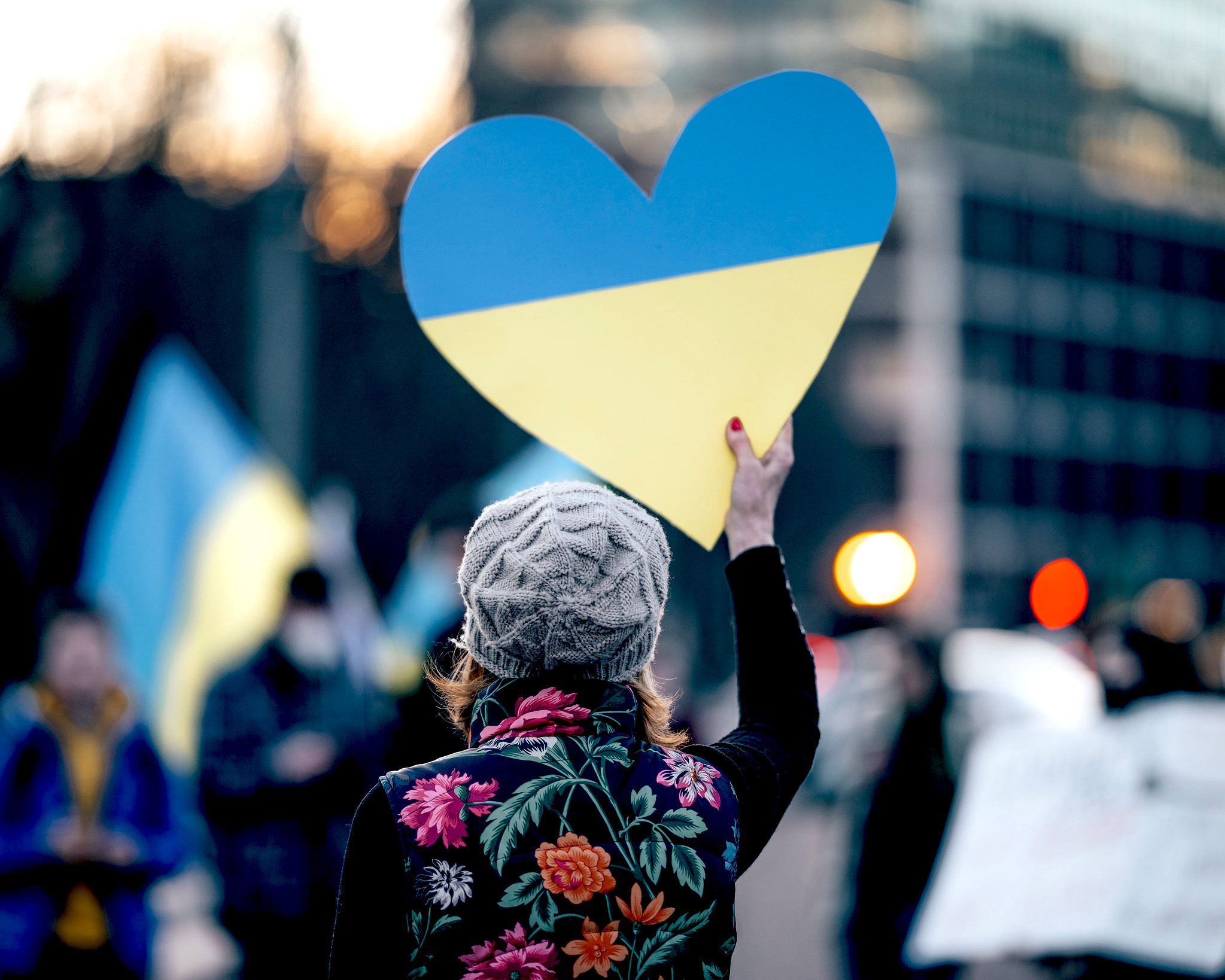
Pro-Ukraine demonstration in Washington, Feb. 25. (John Brighenti, Flickr, CC BY 2.0)

By Patrick Lawrence
Special to Consortium News

The other day I ventured forth from my remote village to a lively market town called Great Barrington to shop for Easter lunch — spring lamb, a decent bottle of Bourgogne. Easter is much marked in my household, one of the few feasts we allow ourselves, and it is a reminder this year of a truth that could scarcely be more pertinent to our shared circumstances: After all our small and large crucifixions, there is new life to come.

Great Barrington lies in the Berkshire Hills of western Massachusetts, a fashionable little burg dense — as you can tell simply by walking around in it —with righteous liberals. No place, you remind yourself, is perfect.

And there along the streets and avenues as I arrived were what I had anticipated: Ukrainian flags hanging off front porches, in shop windows, on flagpoles just below the Stars and Stripes. Somebody has painted the bit of board displaying their house number in the blue and yellow we all now recognize. Father, forgive them, I thought, for they know not what blood-soaked horrors and hate-filled killers they enthusiastically endorse.

Not in my lifetime have Americans, purporting to be thoughtful, intelligent people, been so wide-eyed, so stupefied as those who are pretending to lead them and to inform them by seeking to bury them in ignorance.

We now read that investigators are diligently “documenting the catalog of inhumanity perpetrated by Russia’s forces in Ukraine” — a U.S. diplomat’s remark. Nobody stops to think the investigators are all from nations that are acting against Russia.

“Where else should they come from?” they shrug in Great Barrington.

Nobody notes that the essential question has been crudely removed from public discourse as these sham investigations get under way. The atrocities in Bucha, Mariupol and elsewhere are beyond all dispute, but we must never ask who is responsible for them.

I hear the good citizens of Great Barrington quaking with rage as The New York Times convicts the Russian leadership, as our president describes the Bucha tragedy as a Russian war crime not two hours after it came to light.

We now read, in Friday’s editions of the Times, all about the joint American–Ukrainian campaign to inundate Russian discourse with propaganda intended to demoralize the public. The government-supervised Times explains, “Radio Free Europe/Radio Liberty, a U.S.–funded but independent news organization founded decades ago, is trying to push its broadcasts deeper into Russia.”

U.S.–funded but independent. Priceless, and don’t miss the slide into passive voice to avoid the truth, a recurrent Times trick I have grown very fond of — “founded decades ago.”

Radio Free Europe was founded by a C.I.A. front Allen Dulles cooked up in 1949, the National Committee for a Free Europe. It received agency funding until at least the 1970s, when the funding function was transferred elsewhere in the Washington bureaucracy for the sake of appearances.

What RFE/RL is doing in Russia today is exactly what American liberals, in paroxysms of horror, accused Russians of doing during the 2016 election campaigns. But it is O.K. because we’re doing it, they say in the charming bistros along Railroad Street. We must fight for democracy.

Brute Censorship

We are not reading in the corporate press, by contrast, that a new wave of brute censorship is now upon us, as social media such as Twitter, Facebook and YouTube “suspend,” “cancel,” “de-platform” — whatever this radically antidemocratic business is called — dissenting writers and analysts who have taken the trouble to examine the facts on the ground in Ukraine such as we have them with professional disinterest.

We must defend democracy at home, the good of Great Barrington insist, just as we must in Ukraine.

Since the Russiagate farrago overcame liberal America in 2016, there has been much debate as to whether our McCarthyesque circumstances are as bad as, similar to, or not as bad as things got during the Cold War decades.

This no longer seems to me the useful question. In various important ways we have passed beyond even the worst of the Cold War’s many dreadful features.


(Wikimedia Commons)

Our better reference is Aldous Huxley’s Brave New World, wherein the English novelist pictured a society of incubated beings — programmed from birth, hooked on a happiness-inducing drug called soma, devoid of everything we now consider human, wholly incapable of connection, of responsibility, and, indeed, desiring neither. Infantile gratification is all that matters to those populating the World State Huxley imagined — such as anything matters.

We are not there yet, let’s not exaggerate. But we ought to honor Huxley for his prescience, for we are heading in the direction of his unlivable world of mind-deprived children watched over by a small, chosen, diabolic elite.

I am not surprised that it is Ukraine that brings us to what I consider a collective psychological crisis. After 30 years of post–Cold War triumphalism, Washington has decided to use Ukraine and its people in a go-for-broke attempt finally to subvert Russia. Stepping back for a better look, this is the decisive event in the imperium’s confrontation with the 21st century — its grand roll of the dice, its now-or-never moment.

Broke it will be when all this is over, however far in the future that will prove. A little like Cú Chulainn, the Irish hero who drowned swinging his sword in a rage against the incoming tide, we cannot win this one. And we are falling apart as the realization of our loss arrives subliminally among us.

Whoever wins the war in Ukraine, the non–West will win. Whoever wins, the 21st century will win, burying the mostly awful 20th at last. As for Americans, we have already lost.

Our Condition

What of our condition, then? What has become of us, why, and what shall we do about it? If I am correct about America’s psychological crisis, its connection to the on-the-ground, in-our-faces crisis in Ukraine is not immediately apparent.

Huxley wrote Brave New World in 1931 and published it a year later. Let us take the cue. Let’s look back to consider the thoughts of a few people who, unlike most of us, took life seriously and so applied themselves to an understanding of their time.

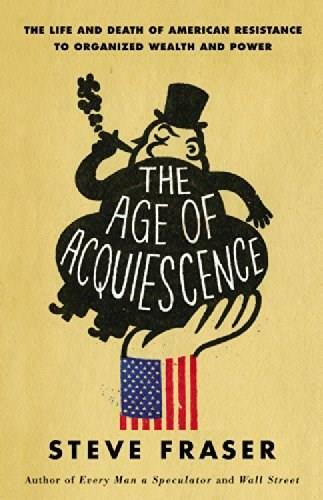
Steve Fraser brought out The Age of Acquiescence in 2015. Fraser is among the best labor economists now active, an honorable man of the 1960s, and his subtitle tells us his line of inquiry: The Life and Death of American Resistance to Organized Wealth and Power. Why and when, Fraser wanted to discover, had American workers rolled over in surrender? What happened to all those fine New Dealers who, with good minds, fought hard for the kind of society they knew was possible?

Labor isn’t our topic, but his book has implications far beyond his specific interests.

Fraser situates himself “peering back into the past at a largely forgotten terrain of struggle.” The New Deal years, the battles waged against the anti–Communist paranoia of the postwar decades, the antiwar movement of the 1960s and early 1970s: The people animating these movements had memories and experience.
They remembered what American society could be in its potential because they had lived for and acted on that potential. They knew another kind of America was possible.

Most of us have forgotten all that. Younger people never shared that consciousness in the first place. Very few of us have any memory or experience of living under anything other than pervasive corporate domination and a government, in its profound corruption, that serves corporate capital and does as little as it can otherwise.

There is nothing to wage struggle for, in other words. Our relations with those who hold power over us are not very different from the relations Huxley’s children had with the sequestered elites who controlled their lives. This is the root of our prevalent assumptions.

The work of any social or political campaign worth mounting is now rendered too imposing even to attempt. It is best to acquiesce to power, contenting ourselves — as if we all live in Great Barrington — with finding the best olive oil.

Mass acquiescence largely leads us to an explanation of the preposterous support most Americans have for the criminal regime in Kiev. But we’re beyond Steve Fraser’s Age of Acquiescence now. Americans don’t merely acquiesce to all that the imperium imposes on the world — wars, interventions, collective punishments, assorted other deprivations. Americans actively embrace the conduct of empire.

Please pass the kale chips.

The Sovereignty of Good

Iris Murdoch, the minor English philosopher and second-rate novelist, published The Sovereignty of Good, a gathering of three essays on morality, in 1970. I would be pleased to observe that nobody reads this ridiculous book anymore and few take Murdoch’s philosophic ruminations at all seriously.

But Murdoch’s arguments in favor of a moral clarity that lies beyond dispute have a great deal to do with what we’ve become. Right and wrong and goodness are objective realities for Murdoch – and how too many of us now live.

Human beings have no purpose so far as Murdoch was concerned. There are no ideals to strive for, no telos to use the Greek term she preferred. People are innately selfish. “Our destiny can be examined but it cannot be justified or totally explained,” as she put it. “We are just here.”

Here are a few snippets to give a taste of Murdoch’s prose and thinking:


“It is more than a verbal point to say that what should be aimed at is goodness, and not freedom or right action….

The Good has nothing to do with purpose, indeed it excludes the idea of purpose.

I assume that human beings are naturally selfish and that human life has no external point or telos…. The psyche is a historically determined individual looking after itself…. The area of its vaunted freedom of choice is not usually very great.”

As Murdoch sees it, there is but one thing to do as we sit stranded on the universe’s beach. We must recognize the inarguable reality of goodness and do our best to be good. This does not involve choices, as we have none to make. (Murdoch despised Sartre and the existentialists.) We are not, if I read Murdoch correctly, responsible for making judgments. Kindness, compassion, love — these are moral values, universal values. They’re all we’ve got.

Who decides what is good and worthy of kindness, and how? Who decides what is right and wrong? Murdoch didn’t address these essential questions because, being an empiricist, what is good, right, and wrong is simply there for us to see. “Good is non-representable and indefinable,” Murdoch writes — slithering, it seems to me, out the side door.

Here’s my question: Would Iris Murdoch have made an excellent “content monitor” — a censor this is to say — at YouTube? CEO at Twitter, maybe?

Readers may now suspect where all this is leading: to the main drag in Great Barrington. There we find people who are intent only on self-fulfillment and being good and kind and compassionate, while taking no responsibility for the events of their time because, after all, there is no purpose in life and “we are just here.” Being seen to be good and kind and compassionate is, of course, the essential thing. They too are empiricists.

Joe Biden denounced the Bucha atrocities at 10:30 am Eastern time on April 4, at the very moment word came of them. At that moment he could not possibly have had any knowledge of what had transpired. His reference here is to Russian President Vladimir Putin:


“Well, the truth of the matter — you saw what happened in Bucha. This warrants him — he is a war criminal.… This guy is brutal. And what’s happening in Bucha is outrageous, and everyone’s seen it.”

Pictures often require a thousand words and certainly they do in the Bucha case, but never mind that. The important thing is, we’ve all seen some images. It is a straight-ahead case of right and wrong: Ukrainians suffer. Let us be kind to them. Russians have intervened into their country. Let us condemn them.

Let us acquiesce. Let us be good.


Patrick Lawrence, a correspondent abroad for many years, chiefly for the International Herald Tribune, is a columnist, essayist, author and lecturer. His most recent book is Time No Longer: Americans After the American Century. Follow him on Twitter @thefloutist. His web site is Patrick Lawrence. Support his work via his Patreon site.

The views expressed are solely those of the author and may or may not reflect those of Consortium News.


Saturday, April 16, 2022

Amazon Union Organizer Goes On Tucker & Sh*tlib Brains Explode!


https://www.youtube.com/watch?v=1dX_cSe_hKE


Daddy Issues: Daddy's Girl, Mama’s Boy, Father Complex


https://www.youtube.com/watch?v=FkCF1Ijudwc


Venezuela: Thousands March To Commemorate Coup Defeat Anniversary


By Ricardo Vaz, Venezuelanalysis.
April 14, 2022


https://popularresistance.org/venezuela-thousands-march-to-commemorate-coup-defeat-anniversary/


Twenty years ago, an outpouring of popular support overturned the coup attempt and secured the return of Hugo Chávez.

Caracas, Venezuela ‒ Big crowds took to the streets of Caracas on Wednesday, April 13, to mark the twentieth anniversary of a short-lived coup.

On April 11, 2002, US-backed civilian and military elites ousted democratically elected President Hugo Chávez following a massive media campaign and false flag violence. A self-proclaimed “transition government” took power the next day and was endorsed by Washington and a handful of other countries.

However, a massive popular response in the ensuing 48 hours, especially from popular neighborhoods on the hillsides of the capital, pushed loyal military sectors into action. The coup was defeated and Chávez returned to the presidency in the early hours of April 14, 2002.

To commemorate the coup defeat’s twentieth anniversary, two Chavista marches featuring tens of thousands of people were held in Caracas. The mobilizations, which included delegations and high-profile politicians from throughout the country, took off from different points before converging on Miraflores Presidential Palace in the afternoon.

“On April 13 (2002), the Venezuelan people taught a lesson to the oligarchy and the empire,” President Nicolás Maduro said in his speech.

The Venezuelan leader paid tribute to those killed fighting against the short-lived coup government and hailed the events of twenty years ago as “a victory of the Bolivarian civilian-military union.”

The Bolivarian Militia had a strong presence in the rally, with several thousand members in uniform and in formation, many of them carrying weapons.

The organization was created by Chávez in 2005 and incorporated into the armed forces three years later. With a reported membership of over three million, the Bolivarian Militia is conceived as a territorial self-defense unit.


Leonardo Rodríguez, grassroots activist and professor, told Venezuelanalysis that the April 2002 events were “a turning point in Venezuelan history.”

“Without firing a single shot, the Venezuelan people and the armed forces restored constitutional order and kicked out the usurpers,” he explained. Rodríguez stated that the main lesson from 20 years ago was the need to “trust the people.”

For her part, Carmen García, a local leader of the ruling Socialist Party (PSUV) in the San Agustín barrio, stressed that the march was a great show of support for the Maduro government in the face of foreign threats.

“April 13, 2002, left us a legacy of unity that we rescue in order to continue fighting in defense of the Bolivarian Revolution,” she told Venezuelanalysis.

The 20-year anniversary commemorations also saw the Venezuelan government host an “International Summit Against Fascism” from April 11 to 13.

Featuring over 200 participants from 52 countries, the event had panels and presentations on the rise of far-right and fascist movements around the world, as well as the need to grow solidarity movements.

The summit likewise focused on the importance of alternative media to break the hegemony of corporate outlets and censorship efforts from social media platforms.