Wednesday, April 6, 2022

NATO’s global history of reaction


https://www.workers.org/2022/04/63075/


By Sara Flounders posted on April 4, 2022

The U.S.-commanded military alliance called the North Atlantic Treaty Organization – NATO, was founded April 4, 1949. Its initials describe its early geographic reach but obscure NATO’s intent, and how NATO has acted, first from 1949 to 1991, and later from 1991 to the present.

From its founding moment, NATO was an aggressive military apparatus to coordinate the police and military and intelligence apparatus among the ten founding West European member countries (plus U.S. and Canada) under U.S. command. NATO’s past 30 years of steady expansion is tied to its original purpose as an imperialist weapon against the working class.

The 1991 broken promise by Secretary of State Baker, echoed by many other Western politicians, to Soviet Prime Minister Gorbachev that if the reunification of Germany went forward “NATO would expand not one inch to the East” is often quoted today in discussing the encirclement of Russia and the root of the war in Ukraine.

What needs to be understood is why did NATO expand? Why was NATO’s expansion inevitable?

NATO expanded because the capitalist markets expanded. The defeat of socialism in Eastern Europe and the dismemberment of the Soviet Union and the auctioning off of formerly nationalized public property and industries was only possible with an enforcement organization.

Just as the U.S., as the center of finance capital, is held together by the largest repressive state apparatus, the largest internal police force, and the largest prison system in the world.

NATO’s founding principle was to ensure a strong U.S. military, political and economic presence in Europe. There was no plan to end the U.S. military occupation of Europe. Its stated purpose from its inception was a military alliance against the Soviet Union.

NATO claimed to be a collective security arrangement against Soviet expansion, even though the Soviet Union was hardly expanding. It was devastated by World War II and had suffered the overwhelming majority of the losses in human life (27 million) and in industrial capacity. Over 700 cities and towns lay in total ruin. Refugee camps and rationing dominated daily life.

The border between two social systems

But the fact that the Soviet Union had survived was threatening to the capitalist class.

In all the countries liberated by the Red Army from Nazi Germany’s occupation in Eastern Europe workers organizations were attempting to reorganize society. Only by organizing on a non-capitalist basis could they defend their countries from absorption by Western imperialism.

Former British Prime Minister Winston Churchill had spoken in Missouri in 1946 denouncing this development and labeling it an Iron Curtain dividing Europe. His speech was a rallying cry to wall off all economic trade and technological assistance to the entire region the Red Army had liberated.

Socialism in Western Europe?

Capitalist domination of Western Europe was in question. What was labeled as Soviet expansion, imminent Soviet invasion, the Red Scare (with a media frenzy that matches today’s against Russia), was the growing influence of workers’ movements in Western Europe.

The organized power of the working class and of Communist parties was rapidly growing in national parliaments, city councils and powerful unions in war-torn Western Europe, especially in Italy and France. Communists had been the largest force in resistance to the Nazis during the years of German occupation.

In Greece the Communist Party, who had led the anti-fascist resistance, was openly contending for state power. From 1945 to 1949, U.S. and British active intervention in the Civil War in Greece, equipping and helping to coordinate the weak rightwing and monarchist forces, was crucial for defeating the Greek workers’ movement.

This Civil War helped convince the West European ruling class to follow the U.S. into a continent-wide military organization of the capitalist class.

A security umbrella for capitalism

NATO was understood as a security umbrella of Western European imperialist countries. It had, from its founding, a consolidated command structure, with the U.S. military on top.

U.S. General Dwight D. Eisenhower, the first Supreme Allied Commander Europe (SACEUR), was the commander of this new military alliance. U.S.-commanded NATO and the Marshall Plan of U.S. loans and investment funds together stabilized capitalism in Western Europe and assured U.S. corporate domination.

The pre-World War II industrial capacity of much of the world was in ruins. Military security was the essential glue in Western Europe, binding the economic and political dominance of capitalist rule.

For decades NATO and the CIA operated throughout Western Europe, in tandem with the U.S. State Department, disrupting communist-led unions, financing interventions in elections and even using terror attacks against communists and socialist organizations and against the masses.

Operation Gladio was the codename for this ruthless capitalist subversion in Italy, some of which was revealed by Christian Democrat Prime Minister Giulio Andreotti in October 1990.

Impact of nuclear stalemate

The second event in 1949 that consolidated the NATO military alliance was the Soviet Union’s detonation of an atomic bomb on Aug. 29, years ahead of what U.S. intelligence predicted. President Harry Truman immediately called for a re-evaluation of U.S. policies, as the U.S. could no longer simply threaten to wipe out Soviet cities without consequences.

NATO absorbed Greece and Turkey in 1952. Turkey’s membership in NATO meant that NATO had military control of the Bosporus Straits – the essential navigational waterway from the Mediterranean Sea into the Black Sea – a choke point for the Soviet ports of Odessa and Sevastopol.

It was only after West Germany’s acceptance into NATO that the Soviet Union and the Eastern European countries formed the Warsaw Pact in 1955 in self-defense. The Soviet leaders saw West Germany’s military and industrial leaders as a continuation of the ruling class that backed the Nazis.

World’s largest military

Although the mass U.S. military during World War II had demobilized by 1949, with NATO U.S. troop presence in Europe tripled by 1950 and reached over 450,000 in 1957. In 1987 U.S. troops surged again to 340,000. (Stars and Stripes, March 15)

Today there are 100,000 U.S. troops in Europe. They are 1/35 of the 3.5 million NATO military force, among its 30 members, with another 2 million reservists and paramilitary forces. But U.S. officers still command this alliance – the largest military force in the world under a single command.

NATO has a permanent, integrated military command structure, composed of both military and civilian personnel from all member states. These forces are trained to follow a strict command structure, use the same equipment and deploy to whatever battlefront the U.S. commanders order them to, including Iraq, and Afghanistan. Each country is forced to pay for the maintenance of their own forces. (shape.nato.int)

Cold War leads to bankruptcy

The Cold War was a relentless war of military expenditures calculated to bankrupt the Soviet Union, which had less wealth and which did not exploit subject nations in the Global South.

According to a NATO report, “The Soviet Union was spending three times as much as the United States on defense with an economy that was one-third the size.” (nato.int) This policy of expanding military costs was enormously profitable to U.S. military industries.

The Soviet Union had to match each U.S./NATO escalation. The 1980 U.S. strategy to deploy nuclear-capable Pershing II and ground-launched cruise missiles in Western Europe aimed at bankrupting the Soviets.

Reagan’s 1983 Strategic Defense Initiative known as “Star Wars,” called for enormous new military expansion. The Soviet Union, starting in the mid-1980s, devoted 15-17% of its gross national product to military spending.

Concessions, enacted with great U.S. and Western applause by Mikhail Gorbachev, who became the Soviet leader in 1985, led to the complete unraveling and dismemberment of the Soviet Union by 1991.

U.S. victory opens endless war

Instead of the Cold War’s end ushering in the promised era of peace and stability, U.S. imperialism, now dominant, opened a new era of endless war and colonial reconquest. The targets were in Eastern Europe and a collapsed Russia, and in the energy-rich southwestern Asia and North Africa.

The Federal Republic of Germany annexed the German Democratic Republic in 1990 and both populations were absorbed into the NATO Alliance. A new era of open capitalist markets meant that major western corporations seized control of socially owned industries and resources in Eastern Europe and Russia.

Any country resisting complete takeover was targeted. Iraq in 1991 and then Yugoslavia in 1995 and 1999 were early victims of colonial style reconquest.

The corporate media bragged about the level of destruction of these modern, developed countries that had high levels of education, health care and infrastructure. But since they were countries that had no weapons capable of matching U.S. bombers they were destroyed with impunity. They were to serve as an example to others.

Pentagon document for world domination

What was in store for the world was discussed at the highest levels of the U.S. establishment.

In a 1992 article in Workers World newspaper, then WWP chairperson Sam Marcy wrote: “On March 8,1992, the New York Times published excerpts from a 46-page secret Pentagon draft document, (written by Paul D. Wolfowitz), that it said was leaked by Pentagon officials. This document is truly extraordinary.

“It asserts complete U.S. world domination in both political and military terms, and threatens any other countries that even ‘aspire’ to a greater role. In other words, the U.S. is to be the sole and exclusive superpower on the face of the planet. It is to exercise its power not only in Europe, Asia, the Middle East and Latin America, but also on the territory of the former Soviet Union….

“‘Our first objective,’ it states, ‘is to prevent the re-emergence of a new rival, either on the territory of the former Soviet Union or elsewhere, that poses a threat on the order of that posed formerly by the Soviet Union. It is of fundamental importance to preserve NATO as the primary instrument of Western defense and security, as well as the channel for U.S. influence and participation in European security affairs.’

“But then it adds: ‘While the United States supports the goal of European integration, we must seek to prevent the emergence of European-only security arrangements which would undermine NATO, particularly the alliance’s integrated command structure.’ The latter, of course, is led by the U.S.” https://www.workers.org/marcy/cd/sam92/1992html/s920319.htm

April 4 is a day to remember not only the founding of NATO but the famous condemnation of the Vietnam War made by Dr. Martin Luther King Jr. on April 4, 1967: “The greatest purveyor of violence in the world is my own government. I cannot be silent.”

NATO is the greatest purveyor of violence and we cannot be silent.


Questions Abound About Bucha Massacre


https://consortiumnews.com/2022/04/04/questions-abound-about-bucha-massacre/


April 4, 2022


The West has made a snap judgment about who is responsible for the massacre at the Ukrainian town of Bucha with calls for more stringent sanctions on Russia, but the question of guilt is far from decided, writes Joe Lauria.


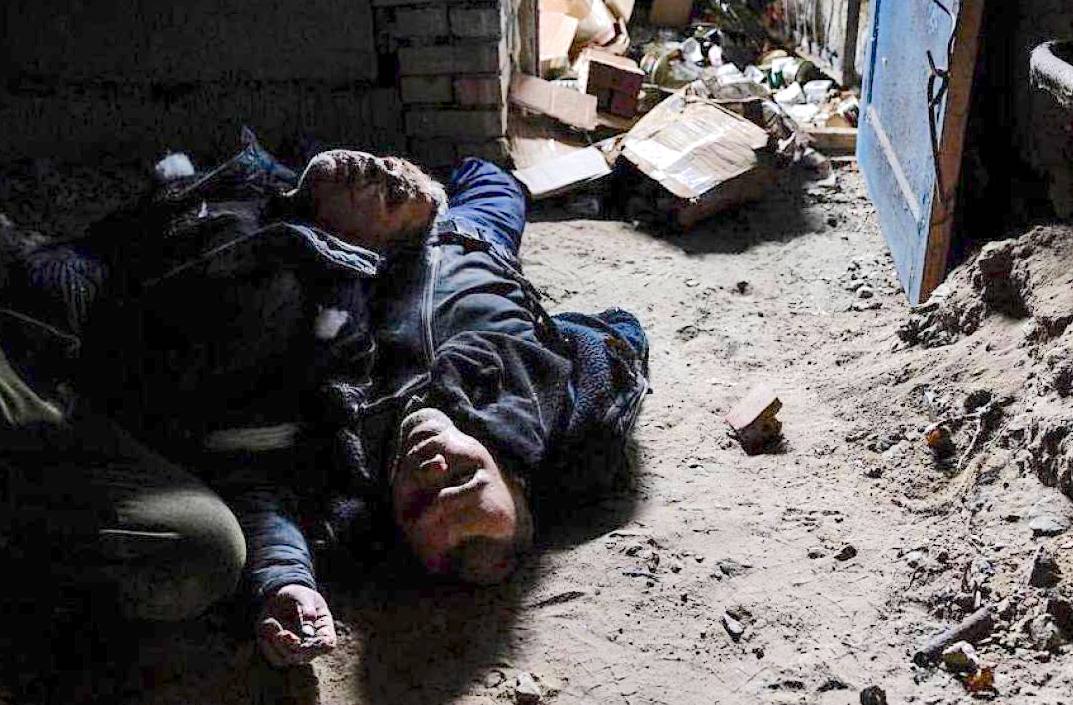
Victims in Bucha. (Ukrainian Ministry of Digital Development Mikhail Fedorov/Wikimedia Commons)

By Joe Lauria
Special to Consortium News


Within hours of news Sunday that there had been a massacre at Bucha, a town 63 kms north of the Ukrainian capital, the verdict was in: Russian troops had senselessly slaughtered hundreds of innocent civilians as they withdrew from the town, leaving their bodies littering the streets.

Unlike their judicial systems, when it comes to war, Western nations dispense with the need for investigations and evidence and pronounce guilt based on political motives: Russia is guilty. Case closed.

Except the case hasn’t even been opened yet and the sentence is already being proposed. French President Emmanuel Macron, for instance, has called for Russian coal and oil to be banned from Europe. “There are very clear indications of war crimes,” he said on France Inter radio Monday. “What happened in Bucha demands a new round of sanctions and very clear measures, so we will co-ordinate with our European partners, especially with Germany.”

Other voices are now perilously calling for the U.S. to go to war with Russia over the incident.

“This is genocide,” Ukrainian President Volodymyr Zelensky told Face the Nation on CBS. “Mothers of Russians should see this. See what bastards you’ve raised. Murderers, looters, butchers,” he added on Telegram.

Russia has categorically denied it had anything to do with the massacre.

Where to Start

If there were to be a serious probe, one of the first places an investigator would begin is to map out a timeline of events.

Last Wednesday, all Russian forces left Bucha, according to the Russian Defense Ministry.

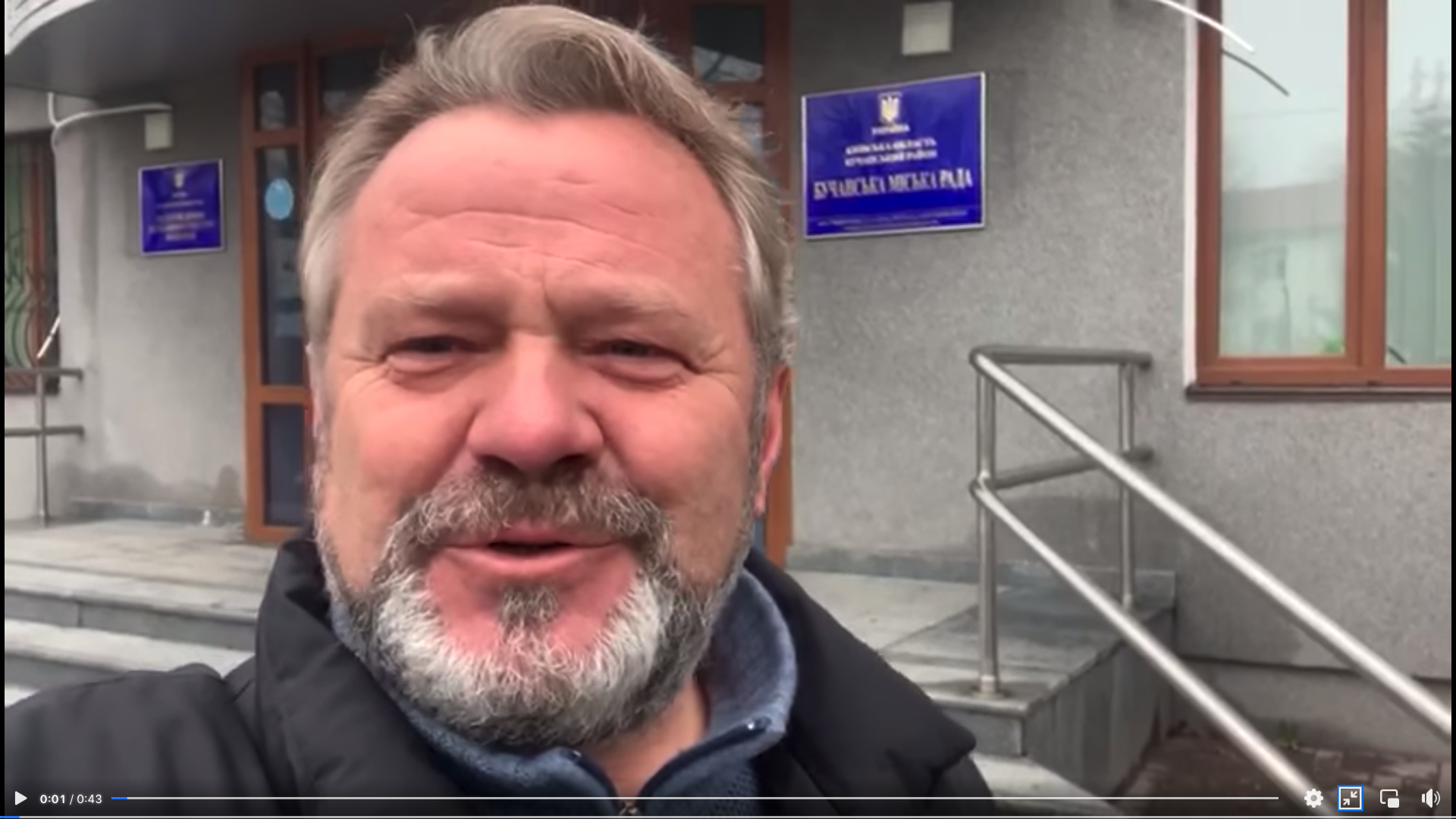
This was confirmed on Thursday by a smiling Anatolii Fedoruk, the mayor of Bucha, in a video on the Bucha City Council official Facebook page. The translated post accompanying the video says:


“March 31 – the day of the liberation of Bucha. This was announced by Bucha Mayor Anatolii Fedoruk. This day will go down in the glorious history of Bucha and the entire Bucha community as a day of liberation by the Armed Forces of Ukraine from the Russian occupiers.”


Screenshot from Fedoruk Facebook video.

All of the Russian troops are gone and yet there is no mention of a massacre. The beaming Fedoruk says it is a “glorious day” in the history of Bucha, which would hardly be the case if hundreds of dead civilians littered the streets around Fedoruk.

“Russian Defence Ministry denied accusations by the Kiev regime of the alleged killing of civilians in Bucha, Kiev Region. Evidence of crimes in Bucha appeared only on the fourth day after the Security Service of Ukraine and representatives of Ukrainian media arrived in the town. All Russian units completely withdrew from Bucha on March 30, and ‘not a single local resident was injured’ during the time when Bucha was under the control of Russian troops,” the Russian MOD said in a post on Telegram.

What Happened Next?

What happened then on Friday and Saturday? As pointed out in a piece by Jason Michael McCann on Standpoint Zero, The New York Times was in Bucha on Saturday and did not report a massacre. Instead, the Times said the withdrawal was completed on Saturday, two days after the mayor said it was, and that the Russians left “behind them dead soldiers and burned vehicles, according to witnesses, Ukrainian officials, satellite images and military analysts.”

The Times said reporters found the bodies of six civilians. “It was unclear under what circumstances they had died, but the discarded packaging of a Russian military ration was lying beside one man who had been shot in the head,” the paper said. It then quoted a Zelensky adviser, who said:


“’The bodies of people with tied hands, who were shot dead by soldiers lie in the streets,’ the adviser, Mykhailo Podolyak, said on Twitter. ‘These people were not in the military. They had no weapons. They posed no threat.’ He included an image of a scene, photographed by Agence France-Presse, showing three bodies on the side of a road, one with hands apparently tied behind the back. The New York Times was unable to independently verify Mr. Podolyak’s claim the people had been executed.'”


It is possible that on Saturday the full extent of the horror had yet to emerge, and that even the mayor was unaware of it two days before, though photos now show many of the bodies out in the open on the streets of the town, something that presumably would be difficult to miss.

In Bucha, the Times was close to the neo-Nazi Azov Battalion, whose soldiers appear in the newspaper’s photographs. In his piece, McCann suggests that Azov may responsible for the killings:


“Something very interesting then happens on [Saturday] 2 April, hours before a massacre is brought to the attention of the national and international media. The US and EU-funded Gorshenin Institute online [Ukrainian language] site Left Bank announced that:

‘Special forces have begun a clearing operation in the city of Bucha in the Kyiv region, which has been liberated by the Armed Forces of Ukraine. The city is being cleared from saboteurs and accomplices of Russian forces.’

The Russian military has by now completely left the city, so this sounds for all the world like reprisals. The state authorities would be going through the city searching for ‘saboteurs’ and ‘accomplices of Russian forces.’ Only the day before [Friday], Ekaterina Ukraintsiva, representing the town council authority, appeared on an information video on the Bucha Live Telegram page wearing military fatigues and seated in front of a Ukrainian flag to announce ‘the cleansing of the city.’ She informed residents that the arrival of the Azov battalion did not mean that liberation was complete (but it was, the Russians had fully withdrawn), and that a ‘complete sweep’ had to be performed.”

Ukraintsiva was speaking a day after the mayor had said the town was liberated.

By Sunday morning, the world learned of the massacre of hundreds of people. U.S. Secretary of State Antony Blinken said: “We strongly condemn apparent atrocities by Kremlin forces in Bucha and across Ukraine. We are pursuing accountability using every tool available, documenting and sharing information to hold accountable those responsible.” President Joe Biden on Monday called for a “war crimes” trial. “This guy is brutal, and what’s happening in Bucha is outrageous, and everyone’s seen it. I think it’s a war crime.”

The Bucha incident is a critical moment in the war. An impartial investigation is warranted, which probably only the U.N. could conduct. The Azov Battalion may have perpetrated revenge killings against Russian collaborators, or the Russians carried out this massacre. (Once again the Pentagon is dampening the war hysteria, saying it can’t confirm or deny Russia was responsible.)

A rush to judgment is dangerous, with irresponsible talk of the U.S. directly fighting Russia. But it is a rush to judgment that we are getting.


Joe Lauria is editor-in-chief of Consortium News and a former U.N. correspondent for The Wall Street Journal, Boston Globe, and numerous other newspapers, including The Montreal Gazette and The Star of Johannesburg. He was an investigative reporter for the Sunday Times of London, a financial reporter for Bloomberg News and began his professional work as a 19-year old stringer for The New York Times. He can be reached at joelauria@consortiumnews.com and followed on Twitter @unjoe


The Sorrow and the Pity (1969) full movie


https://m4uhd.tv/watch-movie-the-sorrow-and-the-pity-1969-229568.html


PATRICK LAWRENCE: The US Bubble of Pretend


The lack of objective, principled coverage of the war in Ukraine is a degenerate state of affairs. The one thing worse is the extent to which it’s perfectly fine with most Americans.


Ukrainian government photo of soldiers during battle in Mariupol on March 15. (CC BY 4.0, Wikimedia Commons)

By Patrick Lawrence
Special to Consortium News

It is perfectly obvious by now, to anyone who cares to look, that mainstream media in America and the other Western powers are not reporting the Ukraine crisis accurately.
Let me try that another way: The government-supervised New York Times and the rest of the corporate-owned media on both sides of the Atlantic lie routinely to their readers and viewers as to why Russia intervened in Ukraine, the progress of its military operation, the conduct of Ukrainian forces, and America’s role in purposely provoking and prolonging this crisis.

So far as I know, this is the first war in modern history with no objective, principled coverage in mainstream media of day-to-day events and their context. None. It is morn-to-night propaganda, disinformation and lies of omission — most of it fashioned by the Nazi-infested Zelensky regime in Kiev and repeated uncritically as fact.

There is one thing worse than this degenerate state of affairs. It is the extent to which the media’s malpractice is perfectly fine to most Americans. Tell us what to think and believe no matter if it is true, they say, and we will think and believe it. Show us some pictures, for images are all.

There are larger implications to consider here. Critical as it is that we understand this conflict, Ukraine is a mirror in which we see ourselves as we have become. For more Americans than I wish were so, reality forms only in images. These Americans are no longer occupants of their own lives. Risking a paradox, what they take to be reality is detached from reality.


This majority — and it is almost certainly a majority — has no thoughts or views except those first verified through the machinery of manufactured images and “facts.” Television screens, the pages of purportedly authoritative newspapers, the air waves of government-funded radio stations — NPR, the BBC — serve to certify realities that do not have to be real, truths that do not have to be true.


This leaves us in a sad and very parlous place.


Sad: Is there some state more pitiful than having no genuine connection to one’s own thoughts, perceptions, experience—altogether to one’s life? If Americans are not a profoundly sad people behind all the smiles we see in advertising, idiotic comedy shows, and on Facebook, then I must be missing something.


Parlous: Over the course of some decades — from the mid–Cold War years, I would say — Americans have been rendered highly vulnerable to the manipulations of those who control the images through which most people have come to live. Anyone who has read a history of the 20th century knows where this can lead.


The five weeks that have passed since the Russian intervention on Feb. 24 have been shocking on both these counts. The derelictions of the press and broadcasters are without precedent in my lifetime, and with Vietnam, the Iraq War, and the covert operation in Syria among the wreckage in the rearview mirror, this is saying something.


I will let the American public’s enthusiasm for the sinkhole that is Ukraine, the Azov Battalion, and the ridiculous posturing of President Volodymyr Zelensky, the comedian who is no longer funny, speak for itself.


‘Questionable Veracity’


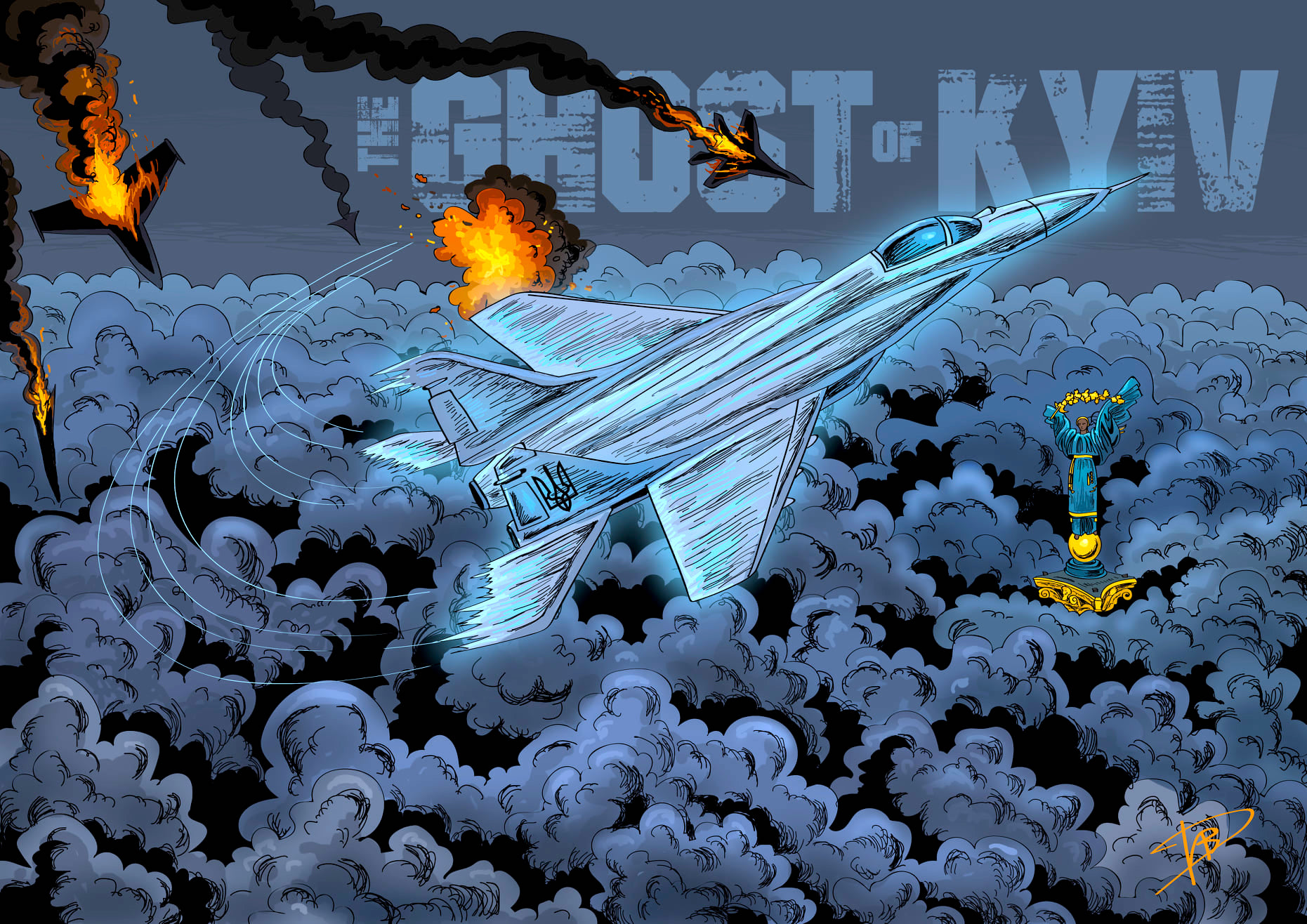
Fan art of the “Ghost of Kyiv” by Andriy Dankovych. (CC BY-SA 4.0, Wikimeda Commons)

Ten days into the Russian intervention, the propaganda coming out of Kiev was already so preposterous The New York Times felt compelled to publish a piece headlined, “In Ukraine’s Information War, a Blend of Fact and Fiction.” This was a baldly rendered apologia for the many “stories of questionable veracity,” as The Times put it, then in circulation. I do love The Times for its delicate phrasing when describing indelicate matters.


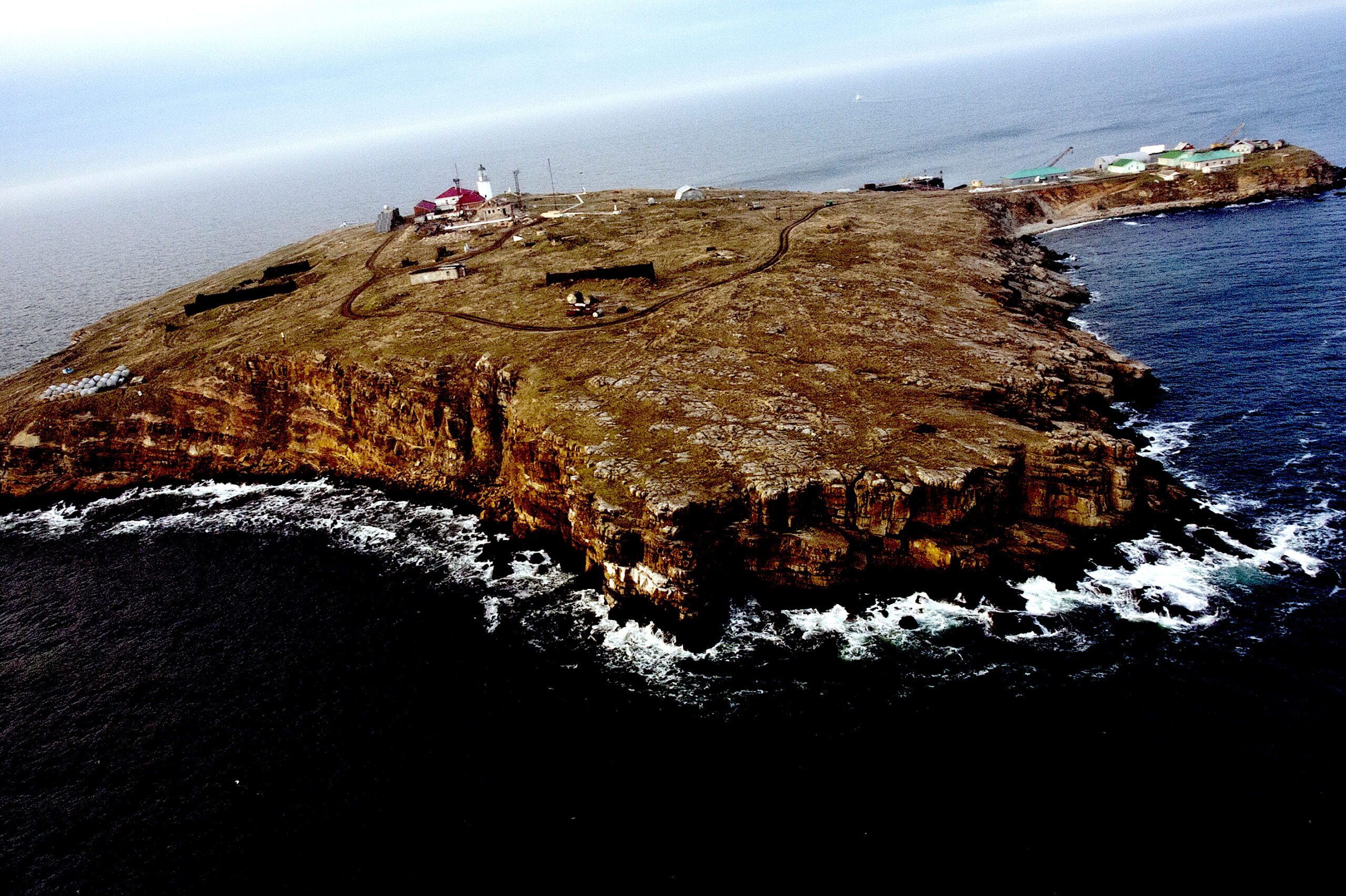
There was the “Ghost of Kiev” story, featuring an heroic fighter pilot who turned out to derive from a video game. There were the Snake Island heroes, 13 Ukrainian soldiers who held out to the death on some small speck in the Black Sea, except that it turned out they surrendered, though not before Zelensky awarded them posthumous medals of honor that were not posthumous.


After railing against disinformation for years, The Times wants us to know, disinformation is O.K. in Ukraine because the Ukrainians are our side and they are simply “boosting morale.”


We cannot say we weren’t warned. The Ghost of Kiev and Snake Island turn out now to be mere prelude, opening acts in the most extensive propaganda operation of the many I can recall.


There was the maternity ward the Russians supposedly bombed in Mariupol. And then the theater, and then the art school. All filled with huddling citizens the Russian air force cynically targeted because “this is genocide,” as the ever-intemperate Zelensky does not hesitate to assert.


All of this has been reported as fact in the Times and other major dailies and, of course, by the major broadcasters. There have been pictures. There have been videos, all very persuasive to the eye.


And then, as evidence mounts that these incidents were staged as propaganda to frame the Russians and draw NATO forces directly into the war, a silence worthy of a Catholic chapel descends. We read no more of the maternity ward that turned out to be an improvised Azov base, or the theater, where citizens were herded, photographed in raggedy blankets, and sent away. Ditto the art school: Nothing more on this since the initial reports began to collapse. No body counts, no mention of the fact that Russian jets did not fly over Mariupol on the days in question.


Snake Island in Ukraine. (CC BY-SA 4.0, Wikimedia Commons)

Before proceeding to Bucha, the outrage of the moment, I must reproduce a quotation from that propaganda-is-O.K. piece The Times published in its March 3 editions. It is from a Twitter user who was distressed that it became public that the Ghost of Kiev turned out to be a ghost and the Snake Island heroes didn’t do much by way of holding the fort.


“Why can’t we just let people believe some things?” this thoughtful man or woman wanted to know. What is wrong, in other words, if thinking and believing nice things that aren’t true makes people feel better?


America the beautiful, or something like that.


Bucha is a suburb of 35,000 souls a few miles north of Kiev and one of the cities Russian forces began to evacuate on March 29 as peace talks in Istanbul progressed. Two days later the mayor, Anatoly Fedoruk, celebrated the city’s liberation in a selfie-speech to his citizenry. He made no mention of anything untoward in Bucha’s streets, backyards, or public spaces.

Four days later, April 2, a special unit of the Ukrainian national police deployed to Bucha. And suddenly the place turns out to be a hellhole: bodies in the streets — 410, according to the Prosecutor General’s office in Kiev — evidence of atrocities galore, people bound and shot point blank. The whole nine, in short.


Instant Outrage

The outrage from Washington, London and Paris — “worldwide outrage,” this would be — was instant. No demand for an impartial inquiry, forensic inspections, or any such thing. No one asked why corpses left in the street for five days appeared to be fresh, or why the relatives of the dead left them there until Kiev’s commando unit arrived.


António Guterres, the U.N. secretary-general, was level-headed enough to state, “It is essential that an independent investigation leads to effective accountability.” This is the only sound position at this point. But we know from a long history how far SGs at the U.N. get with this sort of talk.


In my read this is yet another of the false flags the Kiev regime flies almost by the day now. Paying-attention people will not miss the striking similarity between these incidents and the numerous put-up jobs that featured in Washington’s covert operation in Syria and the campaign of those famous “moderate rebels” who desperately wanted to draw the U.S. into the conflict.


As a matter of principle we must await evidence of what happened in Bucha, even as we know we are likely to see as much about events there as we have in Mariupol. We also know that to most people neither evidence nor its absence matters.


We have been told once again what to think and believe, and most of us will think and believe it.


Media engineer. (State Department/Ron Przysucha)

We are to add this to various other “truths” now almost universally accepted: The Russian intervention had nothing to do with NATO expansion and was “unprovoked” — that favored term in the Biden regime. Ukrainian forces have pushed the Russians into retreat: not that the pressure on Kiev was a Russian diversionary tactic to keep Ukrainian forces away from Donbass where the fighting is.


After the Pentagon Papers came out in 1971, Hannah Arendt published an essay in The New York Review of Books called “Lying in Politics.” In it she wrote of America’s slide into a sort of collective psychosis she termed “defactualization.” Facts are fragile, Arendt wrote, in that they tell no story in themselves. They can be assembled to mean whatever one wants them to mean. This leaves them vulnerable to the manipulations of storytellers.


“The deliberate falsehood deals with contingent facts,” Arendt explained in this remarkable piece of work, “that is, with matters which carry no inherent truth within themselves, no necessity to be as they are; factual truths are never compellingly true.”


A dead body in a Ukrainian street, in other words, can be assigned a meaning that, once it is established, evidence to the contrary cannot be used to erase.


It is a half-century since Arendt published “Lying in Politics.” And it is to that time, the 1960s and 1970s, that we must trace the formation of what now amounts to America’s great bubble of pretend. The world as it is has mattered less and less since Arendt’s time, the world as we have wished it to be has mattered more and more.


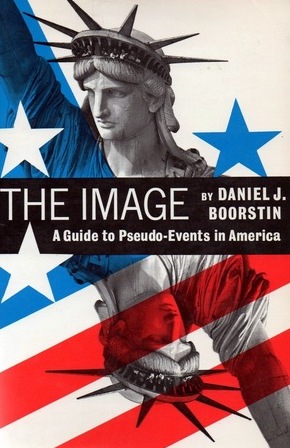
Nine years before Arendt published her NYRB piece, Daniel Boorstin brought out The Image: Or, What happened to the American Dream, an unjustly neglected work. “I describe the world of our making,” he wrote, “how we have used our wealth, our literacy, our technology, and our progress to create the thicket of unreality which stands between us and the facts of life.”


The press, as you can imagine, did not escape Boorstin’s scrutiny. “The reporter’s task,” he wrote memorably, “is to find a way to weave these threads of unreality into a fabric the reader will not recognize as entirely unreal.”


This is our condition. The Ukraine crisis is the mirror that reflects us as we are.


Now I will relate a peculiar coincidence, pertinent to our case.


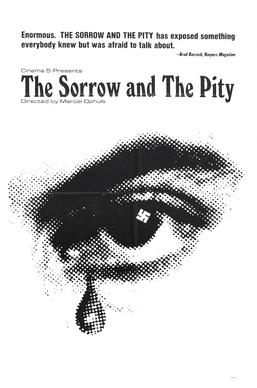
Last week I took it upon myself to watch Marcel Ophuls’ The Sorrow and the Pity, all four hours of it. This is the famously explosive documentary that forced the French to come to terms with the extent to which they had collaborated with the Nazis during the three years and some they occupied France.


Movie poster of an eye with a single teardrop and a tiny swastika near the pupil. (Wikimedia Commons)

This film has a special meaning for me. It came out in 1969, just as I arrived in Paris for university studies. France was in an uproar over Ophuls’ film. It was banned from broadcast on French television until 1981. I did not understand much of this at the time.


The Sorrow and the Pity shredded to pieces, relentlessly, unblinkingly, the national myth that the French had all been heroes of the resistance, or had aided it, or had in some way stood against the collaborationist Vichy regime of Marshal Pétain, hero of Verdun in World War I, capitulationist in World War II. This was nothing like the case.


Now I understand what the young student long ago could not quite grasp. The French simply could not face Ophuls’ unyielding exposure of who they had been. Ophuls had punctured the enduring bubble of pretend within which they had lived for 25 years after the 1945 victory in Europe.


People can live in these bubbles a very long time. The unreality within them can be very persuasive. The French finally emerged from their bubble. It was painful, a passage full of angst, but they were fortunate to have escaped.


Will we have our interim of sorrow, of pity, and emerge from our bubble the better for it? May we someday be so blest.

Tuesday, April 5, 2022

Space As A Tax Haven


https://www.youtube.com/watch?v=gy_bhoauUF8


Is legislation needed for public banks?


https://www.youtube.com/watch?v=EUfzd7aulq4


Is Russia's Invasion of Ukraine Legal?


https://www.youtube.com/watch?v=vYq1HANDMlU