skip to main |
skip to sidebar
https://www.wsws.org/en/articles/2022/03/31/lead-m31.html
Andre Damon
@Andre__Damon
30 March 2022
Despite ongoing diplomatic efforts to end the war between Russia and Ukraine that has killed thousands and led millions to flee, the United States is continuing and escalating its arms transfers to Kiev.
On Wednesday, the White House announced it would provide an additional $500 million in “budget aid” to Ukraine—money that Bloomberg reported could be used for military purposes—amid ongoing discussions on intensifying arms shipments to the country.
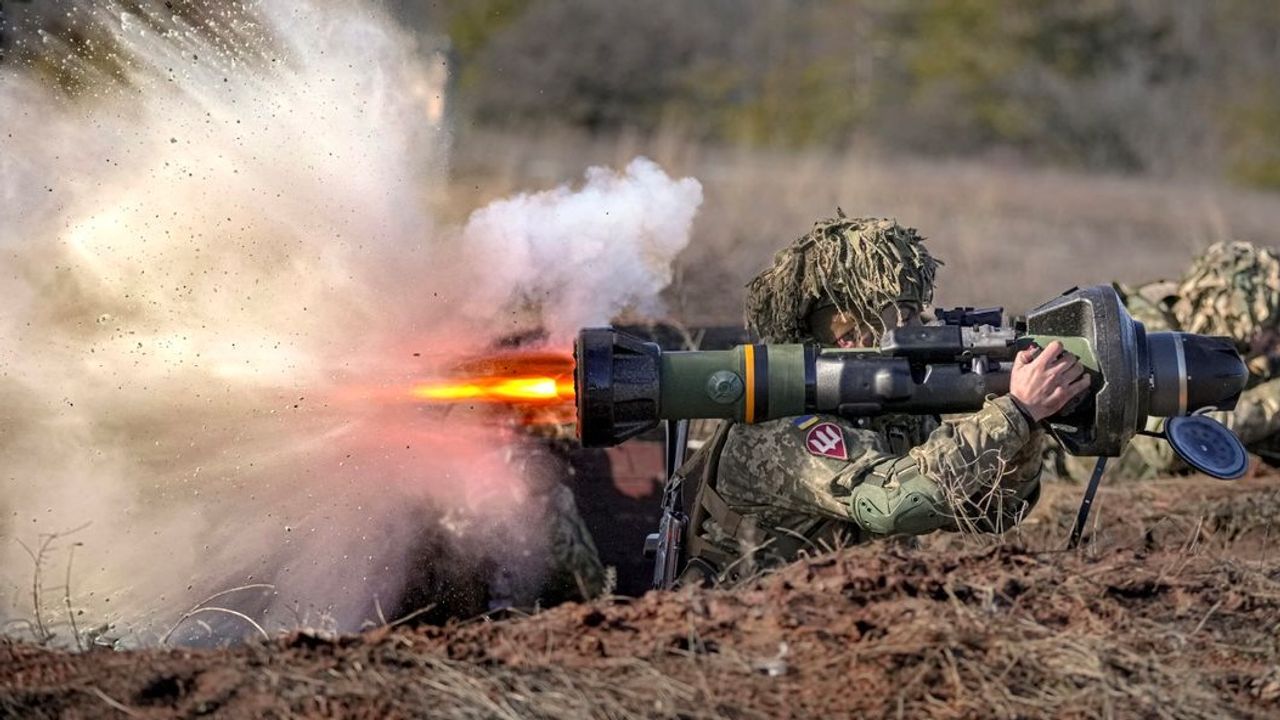 A Ukrainian soldier fires an NLAW anti-tank weapon during an exercise in the Joint Forces Operation, in the Donetsk region, eastern Ukraine, Tuesday, February 15, 2022. (AP Photo/Vadim Ghirda)
This funding comes in addition to the $1 billion in military aid announced by Biden earlier this month. According to the Washington Post, since January 2021 alone, the US has provided Ukraine with $2 billion of assistance, including Stinger and Javelin missiles.
In a phone call between Biden and Zelensky on Wednesday, “The leaders discussed how the United States is working around the clock to fulfill the main security assistance requests by Ukraine, the critical effects those weapons have had on the conflict, and continued efforts by the United States with allies and partners to identify additional capabilities to help the Ukrainian military defend its country,” the White House said.
Responding to the announcement, members of Congress pressed for further arms shipments. “Dithering needs to end. We need to flip the script and make Putin afraid of escalating against the West,” said Republican Representative Mike Rogers at a hearing of the House Committee on Armed Services Wednesday. That means, he said, “Giving the Ukrainians the resources to drive out every last Russian on Ukrainian soil.”
General Tod Wolters, the U.S. European Command Chief, told a hearing of the House Committee on Armed Services, “We can’t rest for one second. We’ve got a lot of work to do out in front of us to make sure that the Ukrainian armed forces are getting the right gear at the right time.”
Speaking for the United States European Command, Wolters demanded, “should deterrence fail—we remain ready to respond with lethal and resilient force in all domains.”
Celeste Wallander, Assistant Secretary of Defense for International Security Affairs, told the hearing that the US should be prepared to send weapons to Ukraine for a long-term fight.
“Not just days and weeks, but months of sustainment, perhaps longer for the Ukrainian military and Ukrainian people,” Wallander said.
At the hearing, Wallander reported that the United States is delivering 100 “kamikaze drones” to Ukraine.
“We have committed 100 Switchblade tactical unmanned aerial systems to be delivered in the most recent package of presidential drawdown,” Wallander said.
The calls for further arms shipments came as Ukraine, Russia and the United States poured cold water on press reports of a diplomatic breakthrough in negotiations.
There is “no sign of a breakthrough” yet in ongoing peace talks, Kremlin press secretary Dmitry Peskov stated Wednesday.
“No one said that the sides have made headway,” he said. “We can’t point to anything particularly promising.”
On Tuesday, Moscow’s chief negotiator, Vladimir Medinsky, had described proposals from Kiev in the negotiations as a step forward. He announced that Russia would limit its military operations around Kiev.
Just 24 hours later, Chechen leader Ramzan Kadyrov, a close confidante of Putin, said, “[W]e are not making any kind of retreat, Mr. Medinsky is somehow mistaken.”
Speaking Wednesday, Zelensky referred to Russian troop movements away from Kiev and said that was not a withdrawal but rather 'the consequence of our defenders’ work.”
U.S Secretary of State Antony Blinken also played down any talk of a peace agreement. “There is what Russia says and there is what Russia does: We’re focused on the latter,” adding, “we have not seen signs of real seriousness” from Russia.
The United States, for its part, is committed to prolonging the conflict as long as possible. As Edward Luce wrote earlier this week in the Financial Times, “domestic US pressure is tilting towards escalation. In marked contrast to US post-Vietnam history, America’s liberal consensus is today at least as gung-ho as on the conservative right.”
Rather, all factions of the US political establishment are intent on using the crisis that has erupted in Ukraine to massively expand US military spending.
Earlier this week, the Biden administration announced a $813 billion budget proposal, up from $782 billion in 2022.
Commenting in Newsweek, Lindsay Koshgarian of the Institute for Policy Studies noted that Biden’s military budget is “$42 billion higher than where former President Donald Trump left it, and nearly 30 percent larger than under former President Barack Obama.”
She added that “Over the past 10 years, more than half of the military budget has gone to for-profit contractors. In 2020, the U.S. already spent more on one military contractor, Lockheed Martin, than Russia spent on its entire military.”
Koshgarian noted, “The U.S. alone already spends 12 times more on its military than Russia. When combined with Europe’s biggest military spenders, the U.S. and its allies on the continent outspend Russia by at least 15 to 1.”
She added, “The U.S. spends more by far on defense than any other country, with watchdogs such as the Project on Government Oversight estimating an annual budget of over $1 trillion on national security. That estimate includes the Department of Veterans Affairs and the cost of servicing debt from previous defense spending.”
Yet despite this massive budget proposal, there is every indication that defense spending for the new year will only grow as the budget proceeds through Congress.
Republican Senator Jim Inhofe, the ranking member of the Senate Armed Services Committee, declared that there was “need for real growth in the defense budget and a sense of urgency and willingness to take risks both at the Pentagon and here in Congress.”
Inhofe declared, “We just received the President’s FY23 budget, and it does not request the real growth we need. We’ll do our due diligence and our constitutional duty, as we did last year.”
These themes were echoed in an editorial in the Wall Street Journal, which complained that “Defense spending will still be about 3.1% of the economy” under Biden’s budget.
The Journal complained, “To this end, the 298-ship U.S. Navy would buy only nine ships next year while retiring 24. The fleet would shrink to 280 ships in 2027, even as the Navy says it needs a fleet of 500 to defeat China in a conflict. That trend won’t impress Xi Jinping as he eyes Taiwan.”
Worse, the Journal wrote, “The Administration appears to have canceled a program to develop a nuclear sea-launched cruise missile, precisely the kind of weapon designed to deter Mr. Putin from using tactical nukes in Europe.”
The newspaper declared, “Congress can do a lot to improve the Pentagon request, which should be a baseline. Republicans are suggesting the military budget needs to grow 5% in real terms. Congress should set a goal of returning the U.S. to its deterrent strength of the Cold War years, when defense spending was 5% or more of the economy.”
In other words, under conditions in which funding is on the verge of running out for basic measures to fight COVID-19, powerful sections of the US political establishment are demanding a 70 percent increase in military spending.
https://www.wsws.org/en/articles/2022/03/31/pers-m31.html
Evan Blake
@evanblake17
30 March 2022
Wednesday marked the third day of COVID-19 lockdowns in the eastern half of Shanghai, the most populous urban area in China that is home to over 26 million people. On Friday, all residents west of the Huangpu River, which bisects Shanghai, will go into a four-day lockdown, while those east of the river will largely resume normal activities. Certain neighborhoods in both parts of the city where infections remain high will stay under more extended lockdowns.
 A worker wearing a face shield and a mask to help protect from the coronavirus walks through a hotel used for people who worked at the 2022 Winter Paralympics to stay during a period of health quarantine, Saturday, March 19, 2022, in the Yanqing district of Beijing. (AP Photo/Andy Wong)
During the four-day lockdowns for each half of Shanghai, every resident is given two nucleic acid tests, in addition to at-home rapid antigen tests. Since Monday, 9.1 million residents in eastern Shanghai received nucleic acid tests, with the second round of mass testing beginning Wednesday.
In total, a network of roughly 6,300 temporary COVID-19 testing sites have been built throughout the vast metropolis, staffed by roughly 17,000 medical personnel. All those who test positive for the virus are provided with medical care and safely isolated from others to prevent further viral transmission.
On Wednesday, Shanghai officials announced the results from the initial round of mass testing. A total of 5,982 COVID-19 infections were detected, of which 5,656 were asymptomatic, while China overall reported a record 8,655 new cases Wednesday. Outside of Shanghai, cases have remained relatively low and stable, although the geographic scope of the ongoing outbreak remains widespread, with over 30 cities reporting infections.
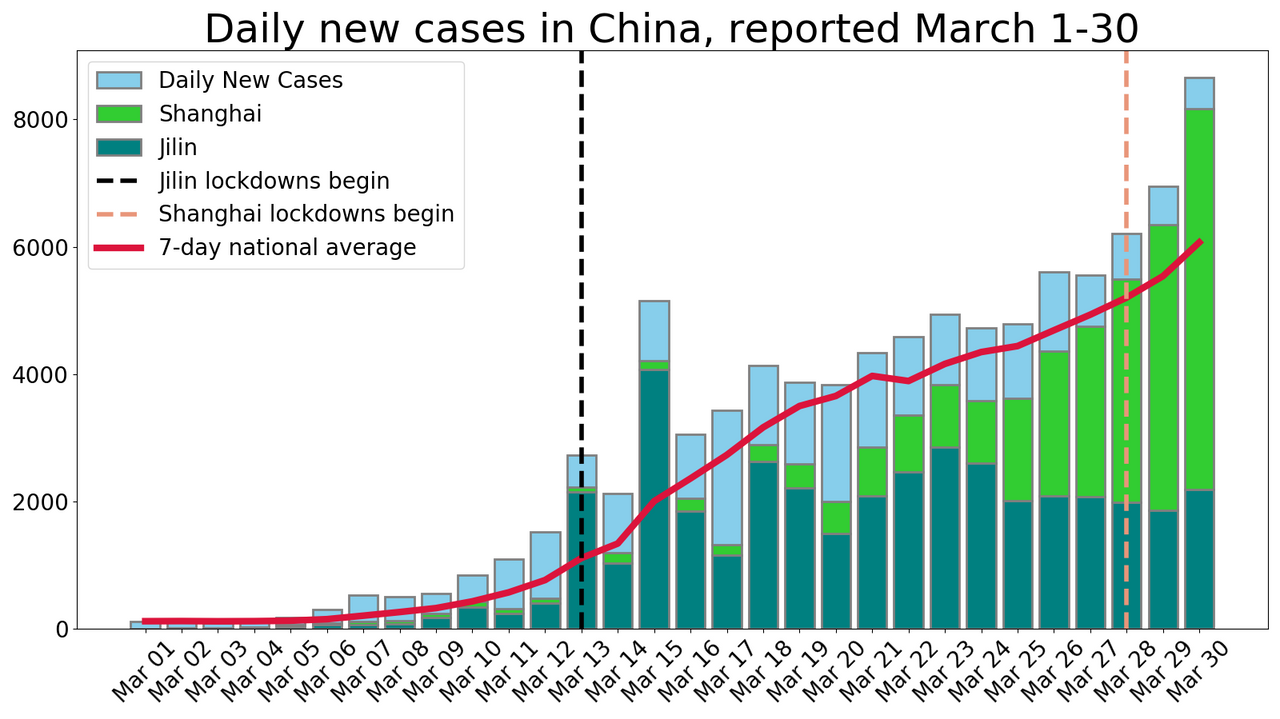 Chart showing COVID-19 infection data from China in March 2022 (WSWS Media)
The highly infectious and immune-resistant Omicron BA.2 subvariant has proven to be the greatest challenge so far to China’s “dynamic zero” strategy that has repeatedly eliminated COVID-19 from the country.
There are growing divisions in the Chinese ruling class over whether or not to maintain the elimination strategy, with sections of the bourgeoisie and affluent middle class pressuring the Chinese Communist Party (CCP) regime to adopt a “mitigationist” approach that would limit broad-based lockdowns. Shanghai and Shenzhen, two industrial and financial centers of world capitalism, have now both experimented with temporary and more limited lockdowns than those implemented in other cities.
Following the lead of Shenzhen, which emerged from a week-long citywide lockdown on March 21, Shanghai officials have allowed certain factories to remain operational during this week’s lockdowns, provided that they keep workers housed on-site and maintain regular COVID-19 testing.
Shanghai is home to the largest port in the world and has long been China’s financial center and a nexus for global finance capital. Despite the lockdowns’ bifurcated and temporary character, and the maintenance of production at key workplaces, there is growing opposition to China’s Zero-COVID policy in the Western media and financial circles.
Throughout March, the corporate media devoted all attention to the war in Ukraine and was relatively restrained in its criticisms of China’s COVID-19 policies. However, a shift is now underway that will likely intensify in the coming days and weeks as the economic consequences of lockdowns continue to mount.
The most vociferous yet is an editorial board statement from the Financial Times (FT), the leading international business newspaper, titled “China’s zero-Covid goal is no longer sustainable.”
Speaking for the City of London, Wall Street and the global financial oligarchy that once controlled Shanghai and aims to establish neocolonial domination over all of China, the FT statement denounces lockdowns and all other public health measures that impinge on the production of profits but have saved millions of lives in China.
The statement notes, “Shanghai is China’s most populous city and its financial capital. Offices and factories are moving their staff into on-site ‘bubbles,’ isolated from the outside world, so they can keep working. The economy will suffer nonetheless. Succeed or fail, therefore, the Shanghai lockdowns show the utility of China’s zero-Covid strategy is coming to an end. It is time to prepare for an exit.”
In justifying this policy, FT makes a series of false and unscientific claims.
First, it asserts that COVID-19 is “now endemic across most of the world.” In fact, the term “endemic” refers to a disease that is spreading predictably and stably, the exact opposite of COVID-19. Less than two months after the devastating global surge of the Omicron BA.1 subvariant, which infected an estimated over 2 billion people worldwide, the Omicron BA.2 subvariant has already caused another major surge throughout Europe, Australia and other parts of the world.
Second, without any scientific basis FT claims that the Zero-COVID strategy requires perpetual lockdowns. They write, “Since Omicron is highly infectious, only the strictest lockdowns will serve to eliminate it once cases occur, and unless such controls are maintained forever, they merely delay the moment when Covid will spread through the population.”
The experience of China and other Asia-Pacific countries has repeatedly proven that the combined use of lockdowns and all other public health measures can rapidly reduce cases to zero within weeks. The myth that lockdowns must be “maintained forever” is misinformation intended to prevent the public from understanding that COVID-19 can be eliminated very quickly when all public health measures are simultaneously deployed.
In fact, unlike the United States and other countries that refused to eliminate COVID-19 in 2020, the Chinese population largely returned to a state of pre-pandemic normalcy after eliminating the virus in early May 2020. The only reason temporary lockdowns have occasionally been used since then is because new variants have entered the country from abroad.
Third, the editorial concludes by stating, “As the world slowly returns to business as usual, the zero-Covid policy will come at a higher and higher cost to China. The Hong Kong and now Shanghai outbreaks of the Omicron variant have caused trauma and turmoil. But if they show once and for all that the only choice is to live with the virus, they can also mark the beginning of the end for the acute phase of the pandemic.”
In reality, were China to decide to “live with the virus,” this would cause an unprecedented wave of infection and death in the world’s largest country, which is home to 1.4 billion people. Rather than marking “the beginning of the end for the acute phase of the pandemic,” it would provide SARS-CoV-2 with a new lease on life and hundreds of millions of hosts in which the virus could mutate and evolve into an even more dangerous variant.
Conspicuously absent from the FT statement is any estimate of the public health impact that the abandonment of Zero-COVID would have for China. While they gloss over this, the fact is that the FT is advocating a policy to kill hundreds of thousands and possibly millions of people across China, while inflicting Long COVID on tens if not hundreds of millions more people.
China has 65 cities with a population above 1 million people, most of which are densely populated. Allowed to spread freely, in a matter of weeks the BA.2 subvariant would rip through every corner of the vast country, decimating communities and overflowing hospitals far beyond capacity.
A recent study by the Chinese Center for Disease Control and Prevention (CDC) modeled the impact that different pandemic scenarios would have in Guangdong province. The most extreme “coexistence” scenario, what the FT refers to as “living with the virus,” would kill roughly 1.35 million people in China in the rest of 2022 alone.
The FT knows full well how catastrophic the ending of Zero-COVID would be and nevertheless seeks to pressure the CCP and Chinese ruling class to pursue this disastrous course. As with the Opium Wars of the 19th century, they demand that China fully reopen for business at any cost.
The continuous evolution of the virus and reintroduction of new and more dangerous variants proves that a national solution to the pandemic is unviable. “Capitalism with Chinese characteristics” does not work.
Notwithstanding all the measures that have been implemented within China, the problem lies in the global character of the pandemic and the need for a globally coordinated response. In order to resist the pressures of foreign capital and sections of the bourgeoisie, the Chinese working class—which still overwhelmingly supports the Zero-COVID strategy—must organize independently of the CCP and aim to unify with the international working class.
Above all, the working class in the imperialist centers must expand the fight for a Zero-COVID policy on a world scale. It is the duty of every class-conscious worker to study the experience in China and popularize the elimination strategy necessary to end the pandemic, through the building of independent organizations of struggle at every workplace and neighborhood.
The FT’s indifference to mass death in China expresses the reactionary and homicidal character of the financial oligarchy in the imperialist countries. After overseeing the death of an estimated 20 million people and mass debilitation from Long COVID throughout the world, they have goaded Russia into a war in Ukraine that threatens to metastasize into a nuclear World War III that could destroy human civilization.
Throughout the world, the capitalist system is mired in crisis and ever-deepening inequality, with inflation skyrocketing amid the combined weight of the pandemic and the outbreak of war. Only the revolutionary overthrow of capitalism and its replacement with a planned socialist economy controlled by the international working class can stop the drive to war, initiate a global fight against COVID-19 and rebuild society on the basis of social equality.
https://consortiumnews.com/2022/03/30/conflicts-in-priti-patels-power-over-assange/
March 30, 2022
Priti Patel, who will soon decide whether to extradite the WikiLeaks publisher, has links to a group that has attacked Assange in the media for a decade, Matt Kennard reports.
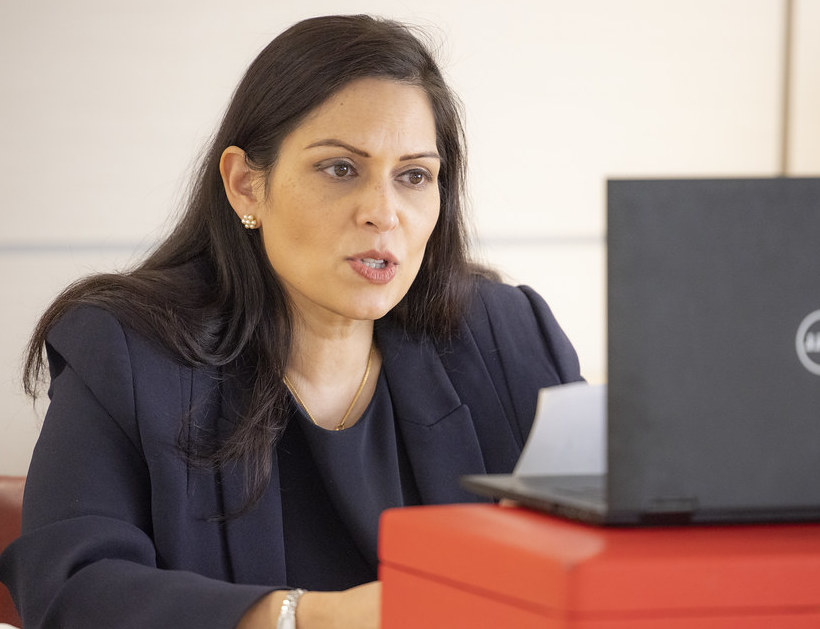
U.K. Home Secretary Priti Patel in April 2021. (Tim Hammond/No 10 Downing Street)
By Matt Kennard
Declassified UK
Patel sat on advisory council of Henry Jackson Society (HJS) with Lord Arbuthnot, whose wife later made two key legal rulings against Assange
Former C.I.A. Director James Woolsey has been an HJS patron since 2006
HJS has hosted three other ex-C.I.A. directors in London since 2014
Patel was paid £2,500 by HJS to fly to Washington for a “security” program in the U.S. Congress
Patel ignores Declassified’s request for clarification of her role in HJS
 Priti Patel sat on the Henry Jackson Society’s (HJS) advisory council from around 2013-16, although the exact dates are unclear as neither the HJS nor Patel responded to Declassified’s requests for clarification.
She has also received funds from the HJS, and was paid £2,500 by the group to visit Washington in March 2013 to attend a “security” program in the U.S. Congress.
Patel, who became an MP in 2010 and was appointed home secretary in 2019, also hosted an HJS event in parliament soon after she returned from Washington.
After the U.K. Supreme Court said this month it was refusing to hear Assange’s appeal of a High Court decision against him, the WikiLeaks founder’s fate now lies in Patel’s hands. He faces life in prison in the U.S.
The Henry Jackson Society, which was founded in 2005 and does not disclose its funders, has links to the C.I.A., the intelligence agency behind the prosecution of Julian Assange and which reportedly developed plans to assassinate him.
One of the HJS’s international patrons is James Woolsey, C.I.A. director from 1993-95, who was in this role throughout the period Patel was advising the group. Woolsey’s affiliation to the Henry Jackson Society goes back to at least 2006, soon after it was founded.
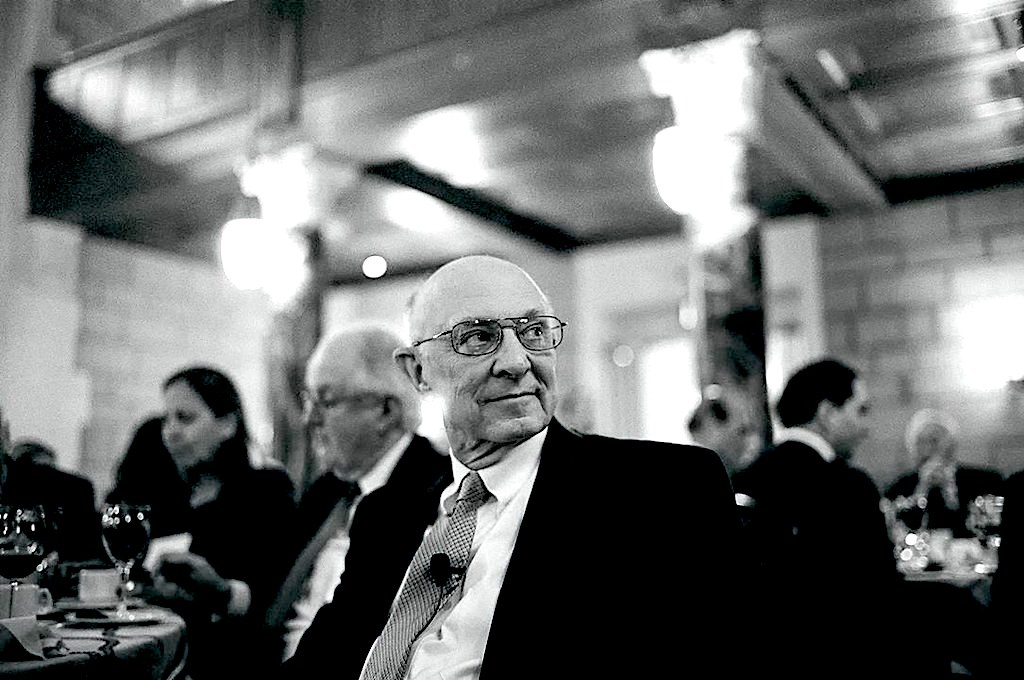
Former C.I.A. Director James Woolsey in 2015. (Christopher Michel, Flickr, CC BY 2.0)
In 2014, the group hosted General David Petraeus, C.I.A. director from 2011-12, at a U.K. Parliament meeting from which all media were barred.
Three years later, in 2017, the Henry Jackson Society organized another event at Parliament with General Michael Hayden, C.I.A. director from 2006-9, to “discuss the current state of the American Intelligence Community and its relationships with foreign partners.”
Hayden described “the relationship within the Five Eyes community as strong as ever, despite potential concerns over recent intelligence leaks between members.” Five Eyes is an intelligence alliance comprising Australia, Canada, New Zealand, the U.K. and the U.S.
‘Perception of Bias’
During a visit to the U.K. in July 2020, then U.S. Secretary of State Mike Pompeo spoke at a roundtable hosted by the Henry Jackson Society with what the Washington Post referred to as a group of “hawkish” members of the Conservative Party.
As director of the C.I.A. in 2017, Pompeo had launched a blistering attack on WikiLeaks calling the media organization a “hostile intelligence service” that makes “common cause with dictators.”
Pompeo did not provide evidence but added a threat: “To give them the space to crush us with misappropriated secrets is a perversion of what our great Constitution stands for. It ends now.”
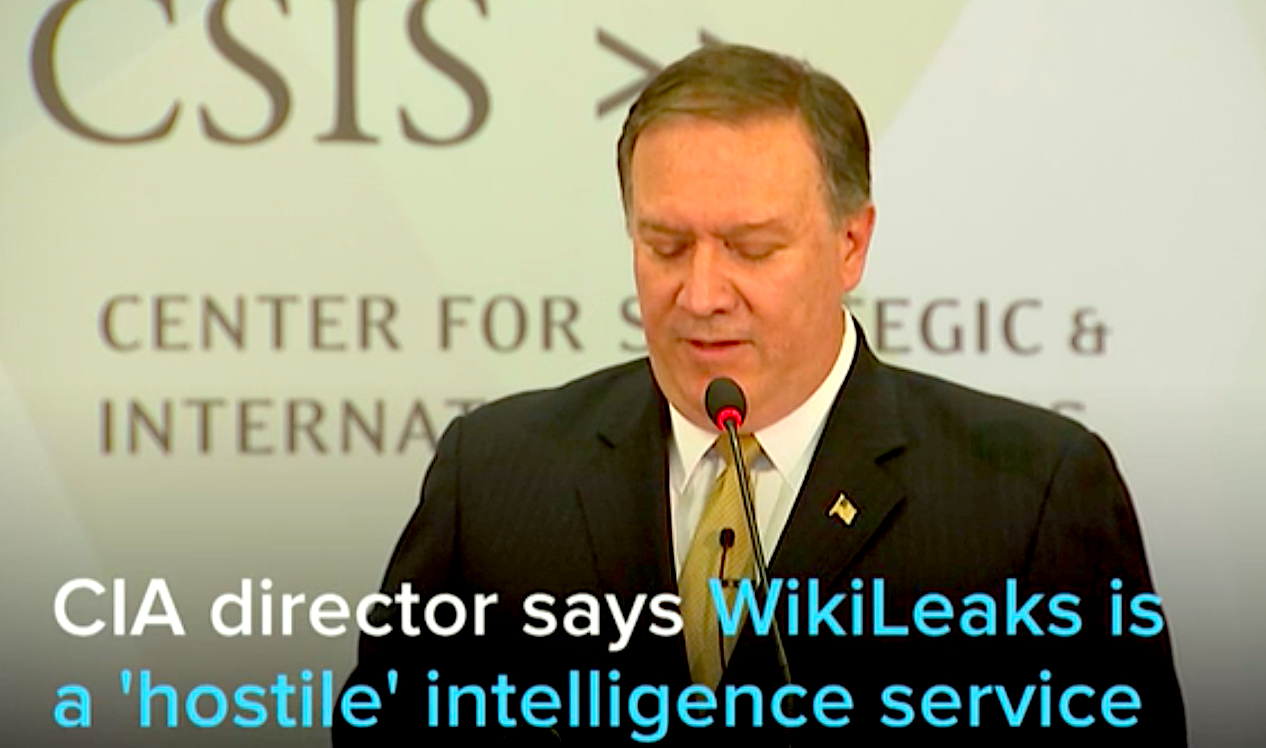
Mike Pompeo as C.I.A. director calling WikiLeaks a nonstate hostile actor. (Screenshot)
On the Henry Jackson Society advisory council at the same time as Patel was Lord James Arbuthnot, a former Conservative defence minister. His wife, Lady Emma Arbuthnot, was Westminster chief magistrate from 2016-2021.
For part of her tenure, she was in charge of the Assange case and made two key rulings against him in 2018. Lady Arbuthnot eventually stepped aside from ruling on the case because of a “perception of bias” but never declared a conflict of interest.
The links between Patel and Lord Arbuthnot go further. In 2010, soon after becoming an MP, Patel was appointed one of five parliamentary officers of the Conservative Friends of Israel when the group was chaired by Lord Arbuthnot.
The Conservative Friends of Israel has been described as “beyond doubt the most well-connected and probably the best funded of all Westminster lobbying groups.” It also does not disclose its funders.
Patel was forced to resign as secretary of state for international development in November 2017 after it was revealed that she had held more than a dozen undeclared meetings with Israeli ministers and organizations while on holiday in the country.
Many of these were arranged by the Conservative Friends of Israel’s honorary president, Lord Polak. Patel’s resignation letter accepted that her conduct “fell below…standards of transparency and openness.”
‘Bonkers & Paranoid’
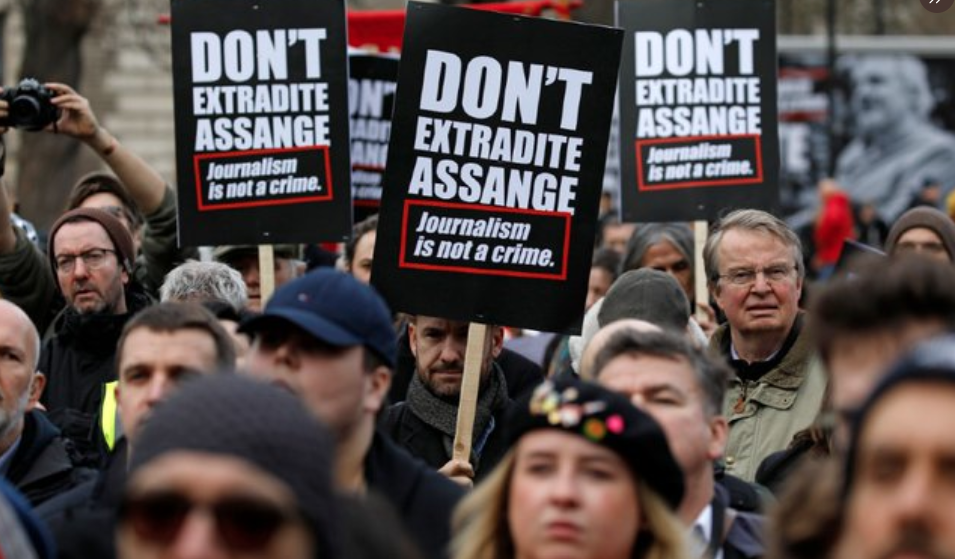
Assange supporters in London during the hearing of the U.S. appeal. (Don’t Extradite Assange Campaign)
HJS staff have been repeatedly critical of Assange and WikiLeaks in the British media since 2011 when its then associate director, Douglas Murray, engaged in a combative debate with Assange.
The following year, the Henry Jackson Society posted a video of Murray stating on media channel Al-Jazeera English: “There is not a witch-hunt of WikiLeaks. An organisation illegally obtained, or stole as we used to call it, a whole set of government documents and published them with consequences which are still not fully understood.”
Murray continued: “I think Mr. Assange has been bonkers and paranoid for years, it’s part of his alleged political makeup, and indeed I would allege that of many of his supporters.”
Over the following years, the Henry Jackson Society and its staff continued to be among the most active civil society voices for impugning the motives and reputation of Assange.
This stands in contrast to nearly all human rights and press freedom organizations which argue that extraditing the WikiLeaks publisher to the U.S. would be a grave blow to media freedom.
‘Conspiracy Theories’
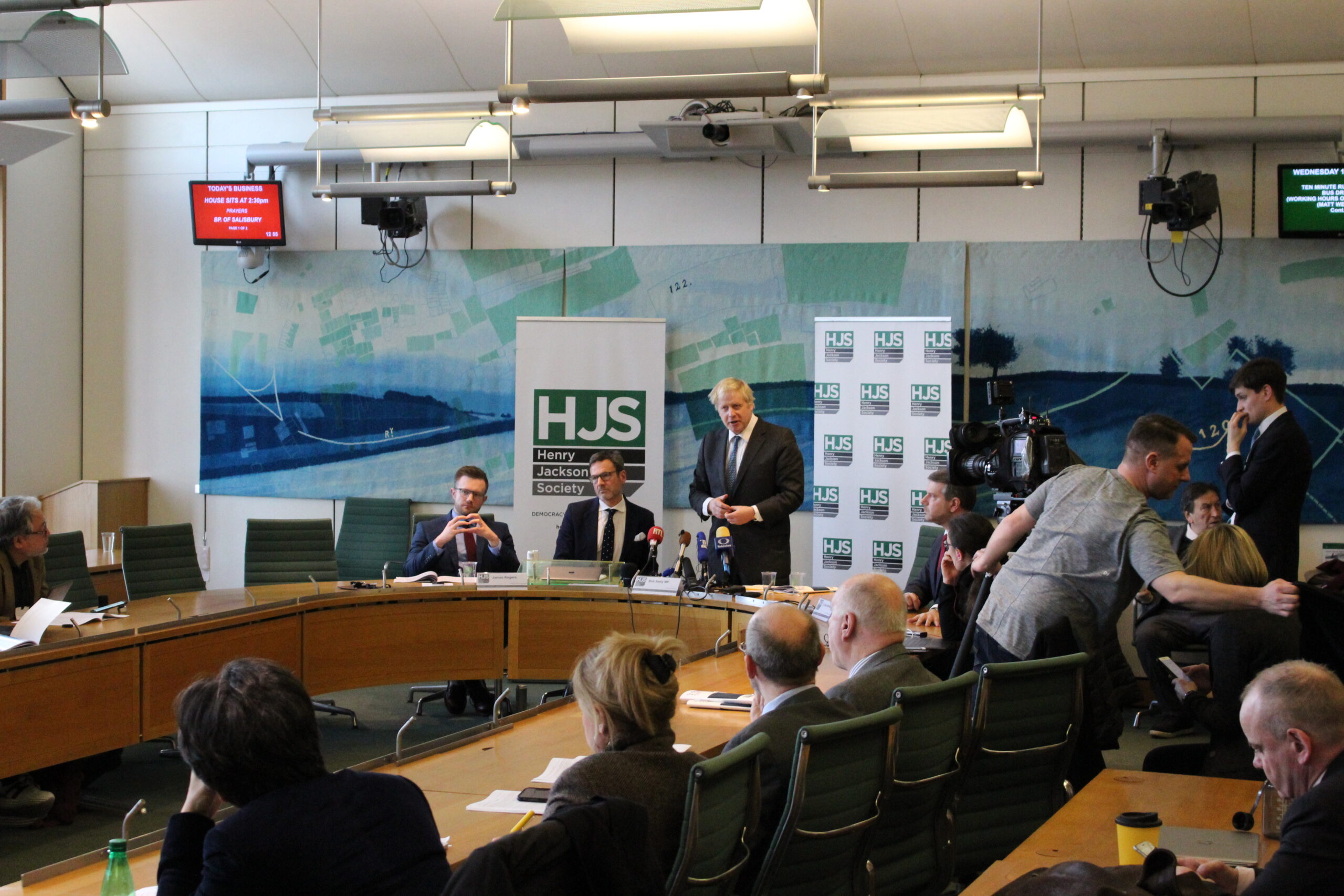
Boris Johnson in February 2019 speaking at an event hosted by the Henry Jackson Society. (Tommoretti5, CC BY-SA 4.0, Wikimedia Commons)
In October 2016, the Henry Jackson Society released a statement to the media, which claimed:
“Mr. Assange has a long track record of stealing and distributing information, peddling conspiracy theories, and casting aspersions on the moral standing of western democratic governments. He has done this whilst supporting, and being supported by, autocratic regimes.”
No evidence was supplied to support the assertions.
A number of other Henry Jackson Society staff — including spokesperson Sam Armstrong and then chief of staff Ellie Green — have made anti-Assange interventions in the British media.
In April 2019, after Julian Assange was seized from the Ecuadorian embassy in London by British police, Henry Jackson Society Executive Director Alan Mendoza was put up as the counterweight against Assange’s lawyer on BBC’s flagship Newsnight program.
Posted to the Henry Jackson Society’s Youtube channel, Mendoza told the national broadcaster: “Journalists are not allowed to break the law in obtaining their materials.”
He added: “I think it’s quite clear Mr. Assange has spent many years evading justice, hiding in a room in Knightsbridge … Isn’t it time he actually answered questions in a court of law?”
Secrecy
In October 2019, as home secretary, Patel visited Washington again to meet William Barr, the then U.S. attorney general who was in charge of the Assange case as head of the Department of Justice.
Together they signed the Cloud Act which made it easier for American and British law enforcement agencies to demand electronic data on targets as they undertake investigations.
Assange’s defense team had previously raised the concern in court that Barr may have used Assange’s extradition case in the U.K. for political ends.
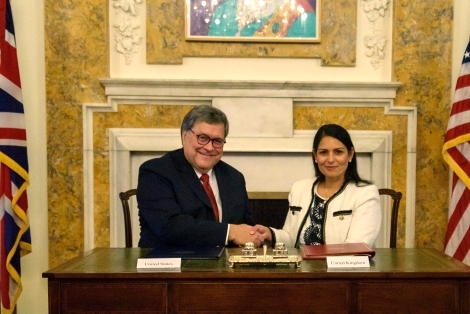
Then U.S. Attorney General William Barr and Priti Patel sign the Cloud Act in Washington, D.C., Oct. 3, 2019. (U.S. Department of Justice)
In August 2020, Declassified requested basic information about Patel’s 2019 trip to Washington. The Home Office confirmed it held the information but refused to release it because the department considered “that disclosure of some of the information would prejudice relations between the U.K. and the United States.”
In May 2020, Declassified also requested information about any calls or emails made or received by Patel since she became home secretary which concerned the case of Julian Assange, or mentioned his name.
The Home Office told us “we can neither confirm nor deny whether we hold the information you have requested” because “to do so either way would disclose information that constitutes the personal data of Julian Assange.”
The same request for Sajid Javid’s tenure as home secretary from 2018-19 was rejected because the department said “we have carried out a thorough search and we have established that the Home Office does not hold the information that you have requested.”
This was despite the fact Javid signed the initial U.S. extradition request for Assange in June 2019. The shadow home secretary at the time, Diane Abbott, opposed approving the U.S. extradition request.
Declassified previously revealed that before signing the U.S. request, Javid had attended six secretive meetings, some attended by former C.I.A. directors, which were organized by a U.S. lobby group which has published calls for Assange to be assassinated or taken down.
The Home Office recently admitted it had eight officials working on Operation Pelican, the U.K. government campaign to seize Assange from the Ecuadorian embassy in London.
The department, however, claimed it did not know which other U.K. government ministries were involved in the operation.
Priti Patel and the Henry Jackson Society did not respond to requests for information and comment.
Matt Kennard is chief investigator at Declassified UK. He was a fellow and then director at the Centre for Investigative Journalism in London. Follow him on Twitter @kennardmatt
This article is from Declassified UK.
https://consortiumnews.com/2022/03/31/read-transcript-of-cn-live-ukraine-the-economic-fallout-with-richard-wolff-and-michael-hudson/
Economists Michael Hudson and Richard Wolff joined CN Live! to discuss the economic war against Russia and its boomerang effect on the West. Does it mean that globalization is over?
CONSORTIUM NEWS – CN Live! – March 29, 2022
Joe Lauria
Welcome to CNLive! Season Four Episode Five: “Ukraine The Economic Fallout.” I’m Joe Lauria, editor in chief of Consortium News.
Elizabeth Vos
And I’m Elizabeth Vos.
Joe Lauria
The collective west, led by the United States, declared economic war against Russia last month in response to the invasion of Ukraine, imposing perhaps the harshest sanctions against any nation in history. President Joe Biden has said the aim of this economic warfare is to turn the Russian people against its government. Sanctions against Russia’s central bank were intended to destroy the value of the ruble. One U.S. dollar was worth 85 rubles on February 24th the day of the invasion and soared to $154 on March 7th. On Friday, the currency straightened to about 101.
Elizabeth Vos
Putin and other Russian leaders were personally sanctioned, as were Russia’s largest banks. Most Russian transactions are no longer allowed to be settled through the Swift International Payment System. The German-Russian Nord Stream two gas pipeline was closed down and became bankrupt. The U.S. blocked imports of Russian oil, which was about 5% of U.S. supply. BP and Shell pulled out of Russian partnerships.
European and U.S. airspace for Russian commercial liners was closed. Europe, which depends on Russian gas, is still importing it and is so far rebuffed U.S. pressure to stop buying Russian oil. Other Russian commodities, such as wheat, fertilizer and metals have been cut off. A raft of voluntary sanctions followed PayPal, Facebook, Twitter, Netflix and McDonald’s have been shut down in Russia.
Coca-Cola has stopped sales to the country. U.S. news organizations have left. Russian artists in the West have been fired, and even Russian cats are banned. It also gave an opportunity for U.S. cable providers to get RT America shut down. Other Russian media have been de-platformed and Russian government websites hacked. A Yale University professor has drawn up a list to shame U.S. companies that are still operating in Russia.
Joe Lauria
The West’s economic war and lethal aid to Ukraine are in lieu of a direct military confrontation with Russia with all of the unimaginable consequences that that could bring. But so far, the sanctions do not seem to be working as planned. China has come to Moscow’s rescue, buying more oil and other commodities from from Russia. Beijing has allowed Russia to use its UnionPay banking system, replaced Russia’s use of SWIFT with China’s Inter-Bank system.
And China and the Eurasian Economic Union, which Russia is a part of, are designing a new monetary and financial system that would bypass the U.S. dollar, threatening it as the world’s reserve currency.
Elizabeth Vos
That has led to U.S. attempts to tie China to the war in Ukraine so it so that it can impose new sanctions on Beijing, perhaps similar to those on Russia The United States is acting as though the world is the West and that this is the China of 30 years ago in its effort to impose its unilateral rule on the world while its domestic social problems mount.
The U.S. has not only driven Russia and China closer together than ever, but has now brought in India, Latin America, Africa and the Middle East into a new bloc with an economic power that exceeds the West. All of those regions have refused to sanction Russia and continue to trade with it.
Joe Lauria
The U.S. has turned the majority of the world’s population against it. We might be witnessing the end of Western dominated globalization and the birth of a divided world of two separate economic, financial and commercial systems. Cutting off trade and finance to Russia has already boomeranged on Western countries. Driving up prices, especially at the pump and at the supermarket.
Instead of prompting a popular uprising in Russia as a result of its sanctions, Russian President Vladimir Putin’s popularity has actually risen since the invasion. Adding China as a target of economic war could drive the populations of the U.S. and Europe against their own governments instead.
Joining us to discuss these complicated issues are two leading economists, Professor Michael Hudson, a professor of economics at the University of Missouri, Kansas City, and a researcher at the Levy Economics Institute at Bard College, and Professor Richard Wolff, who’s rejoining us, emeritus professor of economics at the University of Massachusetts Amherst and a visiting professor at the New School in New York.
I’d like to begin with how Russia is surviving this economic war and then discuss the economic blowback on the West. And finally, what the consequences of similar sanctions on China would be. Rick, let me start with you. How is the economic war going against Russia so far?
Richard D. Wolff
Well, it is causing pain. It is causing some difficulty. It is going to have short, medium and long term consequences. But my guess is, and we’re at a stage where gas is all you can really do. Russia has not yet decided on what counter-sanctions. A lot of folks seem to believe that sanctions always go in one direction.
They don’t. They always have consequences in which the sanctions hurt the sanctioner in turn. And then you have to figure out how this interplay affects both sides. The United States media in the main seem to be all cheerleaders for the one side and oblivious to either the reality or the potential of the other side. So it’s a little early.
Having said that, I think there’s a context here that we ought to understand. Is this the mother of all sanctions? Yes. But, you know, under Donald Trump, we had what was then the mother of all sanctions, four years of economic warfare, trade war. Mr. Trump told us trade wars were easy for the U.S. to win. That’s literally a quotation.
He imposed tariffs on a scale that was dizzying. Yeah, hundreds of billions of dollars at a time. Tariffs eventually against virtually the entire flow of goods from China to the United States. From the best I can tell. And I think this is a consensus on that program of sanctioning China, which, by the way, included comments about displacing the dominant role of Xi Jinping, displacing the dominant position of the Chinese Communist Party.
Well, widely referred to by top officials, kind of like President Biden’s remark the other night in Poland, and to be blunt, but I think to be fair, this sanctions program on China accomplished next to nothing in terms of its own stated objectives. So now we have an even bigger one against Russia. Russia, unlike China, has had quite a few years now of experience with sanctions.
People should understand that sanctions began against Russia a very few years after the Soviet Union collapsed back in 1989. We go back to the 1990s. We can see sanctions imposed on Russia. They always had this mixture of short, medium and long term objectives. One of those was to change their basic policy. That didn’t happen. Another one was to get rid of Putin.
That didn’t happen. And yeah, we got bigger sanctions and you never quite know what the new situation will bring. But if I were a betting person, the notion that these sanctions are going to fundamentally alter what’s going on here, I think is a delusion of the greatest sort. And if I can just end: what’s going on here is the decline of an empire and the rise of another one.
And that is always like a tectonic shift of the crust of the earth. That is a rough and tumble experience. It always has been. The Spanish, the British, the Dutch. I mean, those empires as they crumbled, as they clashed with one another. There was lots of violence. There was lots of terror. The Ukraine has this sad moment in history as the time and the place.
But it could have been anywhere. And in small ways, it has been elsewhere. Kosovo is not all that different in terms of what it’s fundamentally about. And when you have these kinds of huge shifts, the details, however horrific and painful to populations like obviously is happening in the in Ukraine, those end up being kind of footnotes to history, even if the passions they generate are intense at the time that it occurs.
Joe Lauria
Michael, I don’t think that Rick is using hyperbole when he talks about this being a world historical moment that we are going through. And it’s been a decade or more since we’ve seen a battle between the unilateralism of the U.S. and the multilateralism of Eurasia, of China and Russia. It seems like it’s come to a head now. How do you see it?
Michael Hudson
Well, Richard’s quite right when he says it’s a tectonic shift. Let’s look at this from Russia’s point of view. This is everything that Russia has been aiming at and insisting upon for the last five years. President Putin and Foreign Minister Lavrov have been leading the understanding that the world needs to be de-dollarized, that the United States has declared an economic war against Russia, China and their allies, really against Eurasia.
So, in effect, by drawing the sanctions — not only the sanctions — but the most important thing is by seizing Russia’s foreign holdings in the United States, its treasury bond holdings and the bank deposits. What the United States has done itself is exactly what both Lavrov and President Xi of China have been saying the world must move towards.
They’ve been saying we must have a multinational world, multipolar world. We must be de-dollarized. We must cut free of the dollar and isolate, protect ourselves from the United States’ ability to use sanctions, to interrupt our economic activity, to use oil to threaten any country that doesn’t follow U.S. policy from having their energy reserves cut off, to protect countries that don’t produce their own food from being able to buy food and feed themselves.
If they do something the United States doesn’t like, if they do not open their markets to the United States, if they do not privatize their infrastructure. So everybody thought for the last five years: How will Russia and China and their allies, India, Iran, create this new world order? Well, the United States has accelerated this process.
It has destroyed itself. The dollar as the standard. It is said whether you’re Afghanistan and we grab all of your foreign exchange reserves, whether you’re Iran, and we grab your reserves, if you’re Venezuela, and we tell the Bank of England simply take all of your gold and confiscate it.
Bank accounts in the United States are safe. You must withdraw from the dollar in order to avoid the United States doing this to you. What we’ve just done to Russia and what we would like to do to China, is grab all of their wealth and hope that this is somehow going to make them unhappy enough to say, oh, please don’t hurt us anymore. We’ll do whatever you want.
It’s about neoliberalism. So when Richard talks about the tectonic shift? It’s really a shift between two systems. It’s between the United States pushing neoliberalism on the one hand, and countries following, let’s say, an industrial capitalism evolving into socialism, on the other hand. And all of this has already begun, just as President Putin has said, this war is not about the Ukraine.
It began a year ago when the United States started the war against Germany and Europe to haul it in. When President Biden insisted that Europe and especially Germany, has to block Nord Stream 2, what he said he has been saying for over a year now: that we want Europe to become dependent on American gas and oil and not on Russian oil, not only because we want the business of the exporting, but we want the ability to control the world oil trade.
So that if countries do resist neoliberalism, we can cut off their energy supply and we can use Russia as an example of what we can do to Argentina or Latin America or Africa. And I think the Chinese phrase is killing the monkey, killing the chicken to frighten the monkeys. So that’s it.
You are seeing a fundamental shift, and it’s a shift of economics systems. And the United States has accelerated it. Of course, there’s a transition period with interrupted supply chains. But from Russia’s point of view it just accelerated the Eurasian victory by years.
Joe Lauria
Rick, do you agree with that?
Richard D. Wolff
Yeah, I agree substantially with what Michael is saying. I think this is a remarkable act of desperation. I mean, let’s go from the minuscule to to the big picture. The so-called flip of President Biden making a regime change in Russia. You know, his passion or it’s whatever you want. You know, this is desperate.
You don’t waste your time insulting other leaders in the world that you don’t like, whose policies you disagree with. You don’t do that if you’re confident. It’s a little bit like having a conflict with somebody across the street. You know, if you start calling them bad names, you know, it’s you that are out of control.
And I think to flesh out what we’ve been saying, both Michael and I, the United States wants to control Europe because it’s losing most of the rest of the world. It’s looking for an ally. It’s looking for something. So you have to shift gears instead of showing your rear end to Europe. Which was Mr. Trump’s special day. Oh, my God, that didn’t get us anywhere. We’re not one step closer to a compliant China than we were before Mr. Trump took over. Maybe we better, you know, go the other direction. And, you know, instead of demonizing China, let’s try to demonize Russia as an alternative ploy.
And that can always scare Europe. Because Russia has been a problem for Europe for centuries. Everybody needs to remember a little geography. Russia is bigger than the rest of Europe. I mean, it is the bear. It is the giant in this situation that has frightened the British Empire as early as the 18th century. And there’s been a problem for Europe all along. And the United States now wants to somehow revive all of that. That’s not going to change the basic, on the ground question. And I want everyone to be clear on this. Europeans are discussing and have been for at least ten years this tectonic change we’re talking about. They know it. They know that their trade with China is rising relative to everything else.
They know their dependence on the Chinese market is rising. Relative to everything else. Russia — I’m going to exaggerate now, but just to make the point. Well, let me do it this way with a statistic. The GDP of Russia is one and a half trillion dollars. The GDP of the United States is $21 trillion. It’s important to keep those numbers in mind. This is a struggle between a declining Goliath and an emerging David.
China’s GDP, about 14 trillion is in the middle, but growing fast and scheduled to surpass the U.S. within the next few years. So that’s the framework in which all of this is happening. The challenge of the Russians is precisely, as Michael says, part of a very long, large shift, of which China is a part that has several steps. You know, we used to talk about the BRICS. That was a step in the direction of some new configuration. And most of those countries are, let me be nice, lukewarm to the U.S. position in Ukraine, to say the least. They’re not going along. They’re not abrogating all of their relationships. They have no intention of doing that. Neither, by the way, do the German industries who got something out of all of this.
They are not going to cut their deals with Russia and China or very few of them are. They need those too much and they want the future to be a growth future for them. And that it is a better bet with China than it is with the United States. We are now, whether we like it or not, an empire that is getting old in the tooth, or that we can call mature if it makes us feel better. But economic growth is over there. It’s in China. It’s in all of these other places. And capitalists who take a course at business school know that it’s always better to be whether growth is than where it isn’t.
Joe Lauria
Rick, while we’re speaking, there’s news, breaking news. The New York Times reported that Russia said it would stop attacks near Kiev because they were close to an agreement with Ukraine on a cease fire. And now the Ministry of Foreign Affairs of Russia. And we have to say that only they are saying this now, say that Ukraine is ready to become a neutral state, unable to own nuclear weapons with international guaranteed independence, that these guarantees will not be extended to Donbass region or Crimea, which would mean that Kiev formally abandons the idea to annex them and that they are part of Russia.
Ukraine would be unable to have any military presence, including NATO and Russian forces. It doesn’t say where. And Kiev is requesting a final treaty to be signed by Russian and Ukrainian heads of state. This is from the Ministry of Foreign Affairs. It could be that the United States realized the sanctions weren’t working. They know what side of the ledger they’re on in terms of this massive change in economics in the world. And they did not stop Zelensky from agreeing to this. These were the three conditions that Russia put forward about ten days ago. Michael, you wanted to comment on that or what we were discussing before.
Michael Hudson
I want to. I will come back to it. I want to put what Rick was saying in perspective. And it’s a 50-year perspective that goes back to the (1955) Bandung Conference in Indonesia. In 1974 when President Sukarno moved with India and much of the global South to create a nonaligned nations. The attempt going back way to 1974 was to realize that the United States was acting as an exploiter of third world countries, that it [U.S.] investment that did not aim at helping them grow, but just to siphon off what they could from their raw materials and to take over the government and make the financial sector the planning sector, not the government sector.
Well the Bandung conference and the Third World were not able to go their own way because they didn’t have a critical mass. But the United States started a racist revolution in Indonesia. A million of Chinese were killed and the rivers ran red, I’m told, with ethnic cleansing. There was regime change the United States overthrow of Indonesia. It was the bloodiest internal conflict you could call it, or a fascist war, up to that time outside of Europe.
This has been the model ever since. And the United States continued to push the model. They thought they could do to Russia what they did to Sukarno, and they could do the same to China. There have been discussions in America, as I know you and I both know. Let’s divide Russia into a number of countries, like divide Iraq into a number of countries. [Ed.: a policy Sen. Joe Biden pushed.]
Let’s break China into another number of countries by pushing the West to succeed. All of this was their attempt to divide and conquer. And yet the United States didn’t take the scope into consideration that there is now a critical mass that doesn’t need the United States. They can be self-sufficient without it. But the West, the United States, plus Europe and Japan, the axis is somehow going to find itself left out in the cold.
And yet the stock market isn’t suffering from all of this. It’s soaring because energy prices are going to go way up in the U.S., much to the benefit of the oil industry. Food prices are going to go way up benefiting American agriculture. Arms purchases by Europe are going way up. So the irony is that the United States itself is benefiting largely at Europe’s expense, going its own way, while the world is divided.
Regarding the last thing you mentioned about the news that came about. I know that all along Zelensky has been asking for a ceasefire so that his neo-Nazi groups can continue their assassination programs, bombing of civilians. So I don’t know if there is a ceasefire that Russia agrees to. It must have completed clearing out the Azov battalion from Mariupol. And if they really cleared out the neo-Nazi groups there now, they’ve achieved exactly what President Putin said his objectives where from the day that he he moved in to protect the Russian speaking population in the Donbass.
Joe Lauria
Not only did they clear Mariupol, but it seems as they’re decimating the 60,000 best troops Ukraine has that were lined up along the Donbass confrontation line that appeared to be starting an offensive which brought Russia into this eight year civil war to begin with. I want to turn quickly to the question of the cost to the United States economy, to American voters, to the West, especially Europe, how they’ve suffered.
I’m going to turn to Elizabeth who also has a couple of questions on that score. Rick, I’ll go to you because you have to leave.
Elizabeth Vos
Thanks, Joe. I just want to ask really quickly about the fact that Biden had mentioned that through [unintelligible] become a reality. Do you think that that’s likely? Do you think it will be significant? And how extensive would that be? And secondarily to that. Do you think that the domestic effects of this in the United States will lead to some sort of widespread protest? I mean, how much more can the U.S. public take before reaching a breaking point with these higher gas prices, higher food prices on top of the economic fallout from the COVID 19 pandemic?
Richard D. Wolff
Okay. That’s quite a mouthful there. Elizabeth, let me try to at least deal with some of it. I’m very leery of the attempt too closely to link the inflation here in the United States to Ukraine. All that the Ukraine is doing is maybe making it worse, making it last a little longer. But everyone needs to remember that the inflation was well under way before February 24th when Russia moved into Ukraine.
So it cannot be, although it is already being blamed in some sense, it allows a connection to be made that somehow the domestic inflation is Russia’s fault, along with everything else that is attributed to Russia. We have an economy that is in very deep trouble. Mr. Biden, as the presiding president, has to keep saying, it’s really okay.
This is silly. You know, Trump, when he was running against the Democrats for president, said that their claims the economy was great, were all bogus. As soon as he became president, the Democrats accused him of being bogus about his celebration. They were right again, just as he had been right before. And now we have to play that role against Mr. Biden and the Republicans.
No doubt we will do that as well. But that’s very superficial. That doesn’t get anything. We have an economy that is extraordinary from the point of view of both classes, the employer class on the one hand and the employee class on the other. I mean, think about the years 2020 and 2021, it could be argued as among the worst for the working class in American history.
They suffered two catastrophes, a public health disaster as big or bigger than any in American history. And the arguably second worst economic collapse. A little statistic. More than 80 million Americans had unemployment for some part of the last two years. Some for only a couple of weeks, some for the whole period. But that’s more than half the working class. That’s more than half the labor force of this country. That means 50% of our working class experienced unemployment. Expect to learn what was done to these people across two years. And then as they think, and we don’t even know if it’s true yet, that they’re emerging from the pandemic and all of that, they get slapped across the face with an inflation running now officially at 8%.
And likely at least 2% or 3% worse than that if you take into account how the numbers are calculated and so on. This is an extraordinary level of pain to inflict on a working class. And you know it, because just this week, the release of the findings of the University of Michigan Survey of Consumers indicates, for example, 32% of Americans think right now that their economic future is worse than the condition they are in today.
That’s the worst number in that survey since it started in the 1940. We’ve seen a catastrophic experience, while the president who slips and says regime change is on the agenda. Tells us about a robust economic recovery. I mean it’s not me that’s questioning it. Those surveys of the University of Michigan indicate that the American people must believe that Mr. Biden is off his rocker with this kind of talk.
What in the world is he talking about? So while the American people are being squeezed they watch huge sums of money shipped off to the Ukraine. And with all due respect, Americans are feeling for the pain and the suffering of the people going through war. I understand that. My family has gone through war. I know that real well. But they are going, as they think about it, to wonder about billions over there. It is an extraordinary time. Now, the fuel price increase. I don’t know what’s going to happen to that. Even a peace deal depends on a lot of detail. Other sanctions are going to be reduced. Are they not? Are they going to be reduced quickly, if at all?
What in the world is going on? A lot of that we can’t know even from the headline that Joe just read. I mean, we just don’t know enough. And if in the absence of that and given what was happening anywhere, once an inflation like this gets built in, once every employer sees this as a rising level of cost, he wants to get ahead of it by raising his prices.
This gets built in. That’s already happening. We’re facing an inflation that is going to take the lower half of the American people into levels of economic contrition and difficulty that we can’t predict the political outcome of at this point. It’ll work in to the advantage, as I see it, of the Republicans in the election, because the Democrats have have literally painted themselves into a corner.
And if Mr. Biden can’t be stepping up on the big horse, going to war with all the drama that those guys can do, if that rug has been pulled out from under him by the Russian foreign ministry or whatever deals have been made here, I don’t know what the guy’s going to run on. He’s got I mean, he’s looking like a disaster on a scale that frightens me mostly about where it takes American politics.
Elizabeth Vos
Go ahead, Michael.
Michael Hudson
Yeah, well, I think the implication of what Rick says is that President Biden has indeed got a regime change, but the regime change is in the United States itself. When Biden said last week, well, we’ve got to make America make a lot of great sacrifices to support the Nazis in Ukraine, to support the ISIS that are fighting there.
And we’re going to support ISIS and the Nazis in their fight against civilization. You’ve got to make sacrifices, but the way the sacrifices that the public is making as Rick has explained, are a great benefit to them. There’s another side of the balance sheet, the sacrifices he’s talking about are huge, huge profits for the oil companies. Look at the stock market soaring for the oil companies. Look at the Raytheon and the military industrial complex and Boeing. Soaring prices and what he describes as a disaster for the American consumers that are squeezed is a bonanza for centralized capital.
Last night on the news and here in New York City, they had a listing by boroughs of the evictions that are taking place. If you can’t pay, meet your basic budget of covering your fuel costs, your utility costs your food costs. You’re going to be behind in your payments. And a lot of people are going to lose their homes. Either they’re renters or even owners. There is a huge agglomeration of private capital companies waiting to come in and pick up all of this real estate and turn America away from an owner-occupied economy into a rental economy, a landlord economy.
Biden really may succeed in rolling back the economy to the mid-19th century. And that basically is not just Biden, of course, it’s the people around him. And ultimately it’s the deep state. Whether you’re a Republican or a Democrat, their policy is identical. They have the same campaign contributors. And I’m sure what it brings with that, is all that voters can do is keep throwing throwing the rascals out of power. But they’re the same rascals, basically. So the United States doesn’t seem to have much of an opportunity to have a real alternative.
And you’d mention the absence of an antiwar demonstration. There isn’t an antiwar demonstration here or in Europe. In Europe, the only anti-war demonstrations are the nationalist right wing. The whole left wing in Europe has been so corrupted by C.I.A. meddling in the National Endowment for Democracy, basically turning the Labor Part’s into Tony Blairism and social democracy and the neoliberalism that they only protest is not from the left at all, which I think as you said earlier, is pretty much evaporating.
But it’s from it’s from the right. So the hope for the change is going to be the model that you’re having basically in China and Central Asia finally saying we are not going to let American finance dictate how our society develops. We’re going to develop our society for the population as a whole. So Western democracy has not been very successful in creating this prosperity. And it looks like you need a government strong enough to share financial power and strong enough to check the power of the 1%. And that’s not being done under Western democracy.
Joe Lauria
You’re watching CN Live! We’re talking about the economic fallout from the Ukraine war with Professor Michael Hudson and Professor Rick Wolff. It looks like the United States, if this peace deal that we just discussed briefly actually works, I think the Americans have lost this war. I’ve argued that they needed this invasion and they help spur it on with that offensive in Ukraine.
And it goes all the way back to the 2014 coup and even further back to the nineties NATO expansion to this moment because the U.S. needed the war in order to unleash the economic warfare, the guerrilla warfare which they hope if Russia occupied for a long period of time they could unleash. And of course the information war. And now if there’s really going to be a peace deal here I think that’s not only disastrous for the U.S. long term goals, which were to bring down Putin and that was of course what Biden really meant.
But it will hurt also, as you mentioned Michael, the defense industry or the military industries and oil companies if the war ends, they don’t need to supply anymore ordnances, do they? Rick, I want to move on because you’re going to go in about 15 minutes. I want to move on to China now. They won’t be able, perhaps if the war ends, to link China to this war in Ukraine.
We saw this bubbling up a couple of weeks ago where they were making accusations that China was helping materially helping Russia in the war in Ukraine, whereas Russia committed very little of its military to that operation. But they wanted to split Russia from China. The United States understood what they’re up against. So what would happen? Let’s just hypothetically say if the U.S. put similar sanctions on China, what would the impact be? A country that holds $1,000,000,000,000 in U.S. Treasury securities and American imports $500 billion a year in goods from China, could they actually try to do such a stupid thing?
Richard D. Wolff
Well, if if what we’re saying has got a good grain of truth to it, if particularly we’re talking about the acceleration of the decline being the outcome of the effort to prevent the decline. The horrible irony for the U.S. of that situation, then one could wonder whether maybe some sort of lesson has been learned. Trump’s efforts against China went absolutely nowhere.
Now, the even bigger efforts against Russia don’t seem to have won, although I’m sure all of this will be presented here as a great U.S. victory. But, you know, it’s not going to wash real well for me. I expect trouble. I expect that if Ukraine was a useful pretext for the events we’ve just gone through, then we already know with Taiwan, the U.S. Navy is in the South China Sea.
I mean, one can see all manner of situations that could justify this in the sense that the U.S. does this kind of economic warfare, since they are obviously afraid of nuclear warfare, at least that much sanity they have. Well, I’m afraid I expected, I mean, look, for 25 years, China’s GDP has been growing at roughly three times the rate of the United States. This is unheard of for a quarter of a century. That’s why they are what they are today. That’s why the predictions that before this decade is out, they will have the largest economy.
The United States, in a sense, can’t do anything because the direction of change is very scary. It is very hard to figure out which way to go when both routes look to be fraught. But I worry that the people who will carry the day are the ones who say every minute shifts the framework of the struggle in our enemies favor.
And therefore, you know, we may not win now, but we’re sure as hell not going to win ten or 20 years from now, given what the last 25 years have produced. There is no problem having a struggle with China, but I think this is the verdict of history, although obviously, you know, with all the usual caveats, I think it’s too late.
I think the United States is in a position where it can perhaps bemoan that it didn’t do something earlier, it can perhaps bemoan that Kissinger reopened the connections with China when he did, but people do things that later turn out to have been very strange. I like to remind people that the United States had a hand in making Mr. Putin, the leader in Russia, and they sure as hell had a hand in making Mr. Zelensky the leader in the Ukraine.
These are two products of active American diplomacy that we know of. And Lord knows what we don’t know of. And they are fighting, and all of this is a result of miscalculations, misunderstandings, or lack of historical framework review. To deal with the complex realities living in a bubble of a war against socialism or communism, which never really was that any way throughout the long 20th century, which they had to pretend that it was.
If you make mistakes like that for a long period of time and you are the dominant country, what tends to happen is you lose your dominance. You know, it’s like Britain. The sun never sets on our empire. It will. You know, you’re crazy if you think the reality doesn’t change. And and we are in that moment, I think.
And the Ukraine is just another punctuation mark, however horrible and painful by the way, it is. I forget her name and I’m sorry about that. Carolyn Elkins, it comes back to me. She’s a professor at Harvard, I believe the Harvard Business School. And she’s just written two books on the collapse of empires. It’s a timely book. It’s about the British Empire.
But half of what she writes is a commentary on what is happening to the U.S. today. And I think that’s the necessary framework to understand that we are overreaching like Russia in Afghanistan, which had to learn it can’t run an arms race with the West and finally give its people the level of consumption they want and control. You can do it. It’s the tragedy of every empire that misjudges the situation and overreaches and collapses. I think the United States is closer to that situation than in any time in its history.
Joe Lauria
Michael, can you add to that?
Michael Hudson
Yes. The fighting in Ukraine may be over, but the sanctions are going to continue because the sanctions are what, as you just pointed out in your introduction, what led to the fighting. America had to prod Russia by defending the Russian speakers so that it would attack. So America would have an excuse to say, look how bad Russia is under the sanctions.
So the sanctions are the important thing. The the ultimate cause for fighting was the variable. Now, regarding what Rick says, let’s look at exactly how this end of the empire works out. Very sad when Americans spend its dollars abroad on its 780 military bases surrounding Eurasia. These dollars in the past have been turned over to local recipients that turned into local currency for local spending.
The dollars end up in the central banks of Eurasia. In the past, the central banks have said, what are we going to do with these dollars? Well, we’ll put them in U.S. banks. We’re going to put them in the Treasury bills so that we can intervene on the foreign exchange markets to stabilize our exchange rates. Well, none of this [is true now].
Even if the fighting ends, you cannot walk back the enormous grab. America is not going to say, gee, Russia’s not defending itself against Ukraine anymore. So we’re going to give it back all the money that we have. There is nothing that you can do to roll back the money that you’ve taken. That means that in the future, as America spends its money abroad, and from the 1956 and the seventies, the entire U.S. balance of payments deficit, the deficit that forced America off gold was military spending. That was produced all the charts in my book Super Imperialism.
And now this foreign exchange is going to be not recycled to the U.S. to support the dollar. It’s going to be spent on gold and on mutual currency swaps. Well, what that means is that the dollar no longer has the free ride, no longer has the free support. And other countries will protect themselves against the depreciating dollar by doing what the United States did against Germany in 1921 after World War I, a century ago, by imposing special tariffs against depreciating currencies. So the get it, the game is over. And it’s not over because Russia and China and India and Iran defeated America. It was the self-defeating policies of this blindly arrogant, greedy, Republican, Democratic, deep state philosophy.
Joe Lauria
Therefore, the fact that the Indians have bought Russian oil and rupees and the Saudis have said they might sell oil in yuan …
Michael Hudson
Oil.
Joe Lauria
… that that’s a consequence of U.S. policy. But they are significant moments, however, in this process, isn’t it, when we start seeing settlements of oil payments, not in the petrodollar anymore, but the petro yuan?
Richard D. Wolff
It’s an old story, Joe. Every empire that went down, the Greek, the Roman, the Spanish, the Dutch, the British, the German, the earlier Russian, they’ve always had a debate between those who want to believe that the cause of the decline was external. Remember those terrible Gauls who undid the Roman Empire, those barbarians, as they were called? You know, it’s always the barbarians over there.
The truth is, as every sober evaluation of all those empires has shown us is that there’s plenty of causation coming from inside. And we shouldn’t get lost in the American media project, always on the outside agitator. I think Michael is right. The major cause of all of this is the evolution, the internal contradictions, if you allow me, of American capitalism that lie at the base of of its trajectory.
I do have to leave. This is a very important conversation. I want to congratulate you, Joe for producing it and you, Michael, for all your contributions, past and present. But the most important thing, get this out there … circulate them. That’s the biggest contribution we all can make to a better outcome than might otherwise occur.
Joe Lauria
Well, Elizabeth and I thank you very much, Richard, for coming on. Michael, can you stay a few more moments to put a bow on this?
I was thinking about when Britain took over Egypt simply by taking over their treasury They didn’t really have an invasion. And that led ultimately to the revolution of 1911, I believe. And then Nasser and the nonaligned movement. Today it seems like that kind of gunboat diplomacy or just seizing the treasury of a country isn’t necessary anymore. It’s evolved. It hasn’t it? And that’s my first question. The second one is.
Michael Hudson
Let’s do one question at the time.
Joe Lauria
All right. I’m going to forget the other one. I’ll write it down. Go ahead.
Michael Hudson
Go on. Okay. What you were talking about was called the ruin of Egypt at the time. And it wasn’t only Egypt. It was the [Sublime] Port. I mean, the the Turkish, the Ottoman Empire, of which Egypt was a part. And Turkey was ruined. Egypt was ruined. The whole area was ruined through finance and what the United States has realized in the last, I think, since World War Two is, you can control whether you don’t need to go to war with other countries.
You can control them financially as long as you’re willing to impose University of Chicago-style free market, meaning you have to kill everybody. Every academic professor who advocates an alternative, you have to treat the world like Chile. And what’s the free market realized in Chile? It is if you can kill every labor leader, every land reform or every intellectual, then you’ll have Margaret Thatcher’s dream. There is no alternative. And that’s the U.S. policy. There is no alternative.
And so financial power backed by the targeted assassination operation Gladio in Italy, the fight against the Greek anti-Nazis, who, of course, were mainly the communists trying to oppose a monarchy, the overthrow of the Iranian government, the mass assassinations after Pinochet and the spread throughout Latin America that all along with the United States have posed the military of the threat of violence.
And that’s all that it can do today. It can’t invade. It’s an army without its own draft. It can only drop bombs. It can only impose sanctions. And the crazy theory is, if you can make the puppets … the former secretary, Madeleine Albright theory, if you can punish a population, and especially if you can hurt their children and starve them and make them sick, if you can make them so unhappy, they will overthrow the government and say, okay, we don’t want this anymore …
We’ll do whatever you want. And of course, that hasn’t worked. It it didn’t work. And the fact is, Madeleine Albright simply wanted to kill little children. She wanted to kill the population. If all [the sanctions are] introduced … it didn’t work at all. But you get the the sadistic, perverse people in the deep state here, and that’s where they’re at. They’re working out their their own personal anger. And then obviously this is not a situation that can succeed in Eurasia. The Americans are the barbarians at the gate. That’s us. And they’re being perceived as that throughout the world.
Joe Lauria
Mike, I don’t see American leadership really seeing themselves that way. Obviously, they don’t understand how the world sees themselves unless there are a few who are cynical and know exactly what they’re doing. But I think there are a lot of true believers in government, too, aren’t they?
Michael Hudson
Well, but they say it’s worth it. They say, yes, they marginalize the fight against the population. They say, yes, the population’s going to suffer. That actually is going to lead them to make an economic choice, to give up their ideals, give up their self-determination, and simply do what we’ve told them to do because they don’t want to be bombed or sanctioned or or starved anymore.
So there’s an idea that you motivate people by hurting them instead of by offering an opportunity to develop. And the problem is that the United States strategists don’t know how to develop because they’re neoliberals. And the neoliberalism is all about grabbing unearned income, grabbing other people’s property, grabbing other people’s income without working. That’s what America is. And as you pointed out at the beginning of the program, the American economy is is shrinking and [the rest of the world] isn’t shrinking.
How are you going to support American living standards and voters? You can only get this by exploiting other countries by imperialism. And other countries are realizing, do we really want our economic surplus shifted off to the United States so that they can live well at our expense? That’s the issue. That’s how the issue is perceived in the rest of the world, outside of U.S., NATO and Japan.
Joe Lauria
Yeah. When does it ever work? Cuba has had sanctions since 1960 or so and Castro survived it all. So my second question, let’s imagine a post-imperial America. When you look at Europe when their empires collapsed, they after a while looked inward and created national health insurance systems and a social welfare system. In Britain, for example, right after the war, they voted Churchill out and we have the NHS within a few years.
And in Spain and Italy, all these countries developed a robust social democratic system which has been eroded with neoliberalism, no question over the last 20 years or so. But could that happen in the U.S. if the U.S. finally, whatever it’s going to take to realize — and maybe this defeat and I think this is a defeat in Ukraine, if this peace deal goes through and there are more defeats like this and China continues to grow and a whole new separate economic and financial system comes about — can the U.S. come to terms with losing its world power and would that translate into a better social system for the people of the U.S.?
Or am I dreaming?
Michael Hudson
I think you’re dreaming. It’s a nice group. It’s a nice quote. I don’t see it because Europe had a long socialist tradition that the United States did everything to try to squeeze out. But America does not have a tradition like that. America has always privatized. It’s basically infrastructure, not left in public hands and so given the fact that almost all of American health care is privatized, you’re not going to be privatized.
The privatized healthcare like Bernie Sanders once sought – that’s a bonanza for the health insurance industry. You’re not going to nationalize oil though the global warming issue is so important. The key is America is opposing any kind of opposition to global warming. You could say that American foreign policy is based on accelerating global warming warming because Biden said the future is oil and coal.
And that’s what we can control. And if other countries were to adopt renewable resources, they would lose the dependance on the American oil and gas industry and food that has enabled America to have a stranglehold over them. And if they were to shift from export crops to feeding themselves and growing their own grain, that would reduce America’s ability to sanction them and say, ‘We will starve you if you don’t do what we want.’ America is not going to give this up because America isn’t the American people.
America is basically the blob, the State Department, the C.I.A., the national security state, and its ideology is to shift economic planning away from government to Wall Street and other financial centers in England and France. And I don’t see that financialization and neoliberalism changing. That’s their religion. And you’re going to have, instead of the reform that you’d like to see, you’re going to see an increasingly violent vicious fight against anyone proposing this reform, just as they fought against Allende in Chile and against against Cuba and as they’re fighting against China and Russia today.
Joe Lauria
Well, let’s assume that the sanctions will continue. As you said, even if there’s a peace deal tomorrow, will they still try to target China? There already are sanctions on China. We know that. But I mean, these kind of serious ones like on Russia. And with the consequences [to the West], they must understand they can’t do that, right? What would happen to the world economy if they tried to sanction China the way they’ve sanctioned Russia?
Michael Hudson
The United States? Again, there will be a polarization in the United States between the 1% and the 99%. The 99% what you call the economy, of course, will suffer and the 1% well, will increase their power over the 99%. So for them it’s a win-win game. And also don’t discount the fact that when you talk about the U.S., NATO and Japan, you’re talking about basically racism against the whole nonwhite world and there’s that racist hatred of China in New York.
The news broadcasts usually lead off with a Chinese woman being pushed in front of the subway yet again and again and again and my wife has been threatened. She’s Asian, has been threatened again and again on the streets, on the subway. There is a visceral hatred of the yellow peril in the United States. And you can’t discount that, just as there used to be the hatred of Germany and the hatred of Russia.
Goes back to the fact that the [Nazism] oppressed the Germans and Stalin was anti-Semitic and that the people who are leading the anti-Russian fight are literally people I’ve known for 50 years since I worked at the Hudson Institute. They are fanatics filled with hatred for what the Nazis did. And Stalin did to the Jewish population. And they are working out this on this ethnic hatred.
So I don’t see them putting the concerns of the 99% over their own personal proclivities and over their campaign finance, their interests on Wall Street and in corporate America and the monopolies.
Elizabeth Vos
And you speak about the 1% increasing their power over the 99%. But at what point does and I asked this of Richard earlier what point does the American public or the U.S. public reach a breaking point and we see really violent protests or widespread unrest at what point do we see that?
Michael Hudson
I think how about 2090? It is at least 80 or 70 years away, even a couple of generations. There’s nothing. They will be like a frog boiling. They’re willing to go down and down and down because they believe there is no alternative. Because if you look at the news, look at the news, we’ve been saying on Ukraine, you don’t get any sign of what Russians and the rest of the world see.
You don’t get any sign of what the neo-Nazis are doing against the civilians there. It’s like there’s a complete — I’ve never in my life seen such a total control of the news by the right wing censorship. So you’re finding the same thing in economics. I stopped teaching economics because economically, because there was no way I could fit reality into the curriculum.
How are people going to understand the dynamics that we’ve just been discussing for the last hour? I don’t know how it can be done. Yeah.
Elizabeth Vos
And can you comment on that a little further, on the censorship we’ve seen of Russian media in the U.S. and in the U.K., just how extreme it’s been and how much you think maybe the Russiagate narrative played into the ability to implement censorship in such a widespread, severe way?
Michael Hudson
Well, that’s part of the fake news as we’re seeing now, and the fact that at the time it was I mean, it was obvious that this was cooked up between Hillary’s campaign and British intelligence. That’s British intelligence job, the White Helmets, British intelligence. That’s all sort of a – we’re getting propaganda. We’re in an Orwellian world. The important thing is the rest of the world is not in an Orwellian world.
So my main academic linkages are now with China, not with the United States, because they’re looking at the broad economy, the broad movements of history. And neoliberalism is basically short term. [Americans] really don’t care about the long term. They think, well, let’s just get by this fiscal year, we’ll make our profits. And if there is a mess, we we’re going to come out ahead because the wealthy people always come out ahead. We can always somehow survive any grab bag. And so they’re willing to make a grab bag out of the whole situation.
And the grab bag will be at the 99% and lower homeownership rates. Not there is going to be a further privatization of what remained of Medicare and Medicaid. It does not look good at all. I would agree. And usually in other countries such as Rome, when when Rome fell apart, you had a defection of people from the Roman Empire to the barbarians, who, of course, were the socially-minded communal ethnic groups that welcomed more more of the population.
You had a flight from Rome and a deep population there. I would imagine that America will end up sort of like Japan, a shrinking population, there will be emigration, but working Americans who emigrate do not speak foreign languages. They’re almost trapped. So I don’t see any solution. I think shortening lifespans.
Elizabeth Vos
And one last question for me before I headed back to Joe. Why is Europe going along with the U.S. on this? I mean, economically, on the economic front, how on earth do they think that they could survive an economic war with Russia and China, potentially?
Michael Hudson
Well, they don’t care there, but there they are. I talked to officials in the U.S. Treasury. They say we can simply buy foreign politicians, we can simply pay them. When you say Europe, what you really mean are the foreign politicians that are getting enormous financial support from various U.S. State Department agencies and they’re after all opportunists. They’re like Zelensky there.
They’re after their own wealth. They don’t care. Europe is not led by politicians that have Europe’s interests at heart. They’re just as corrupt as they are in any other part of the world, if not more. So. I’ve met many of them. I can hardly believe the venal greed that they have. It’s almost like they’re a Democrat.
Joe Lauria
Michael, did the U.S. Treasury officials you spoke to, did they tell you or have you heard that the Treasury was never consulted on the central bank sanctions against Russia? Is that right? Nor was Wall Street really consulted about what the impact of these sanctions would be?
Michael Hudson
That’s probably true. I mean, the banks are trying to figure out, wait a minute, we’ve since the 13th century, banking has made up one of its major business, has been financing foreign trade and so long as the oil trade was conducted in dollars, that meant it had to be conducted via U.S. banks. And it’s called receivables financing: you buy oil, you borrow the money, the bank promises payment, and it charges money for this.
It advances the money to the seller, the money is paid with interest when the oil or other export is delivered. Now, that whole foreign dollarized, foreign trade policy, finance is going to disappear for American banks. They may make a lot of money on the arbitrage. Trade economies fall apart, but you’re also going to have a huge third world southern hemisphere debt crisis this summer.
If what we’ve described for American consumers is true of Latin America and Africa and other countries that have to pay more money for their oil, more money for their food, they’re not going to have enough money to pay for debt. So there are going to be huge debt defaults occurring, and that’s going to traumatize the world market. That’s that’s another long discussion that’s independent.
But you can see the big people who did the sanctions didn’t discuss it with the Treasury because they didn’t want to be told that there are some problems here. You don’t want to know.
Joe Lauria
So, Michael, you made an interesting comment that the U.S. is an Orwellian society and much of the rest of the world isn’t. In 1984, Winston Smith’s job was to go into the archives of the Times, years back. And if there had been a prediction of the wheat yield in the five year plan and it didn’t actually make it, he had to go back and change the article in the archives to the actual number.
But we’re seeing this in real time now. They aren’t going back into the archives. We’re seeing right now excised from the Ukraine story of the coup in 2014, the existence of neo-Nazis that are part of the state military, and the war for eight years against the Donbass that is not mentioned at all even though in 2014 major media did a lot of stories about the neo-Nazis. It is gone, absolutely excised. It’s the most frightening thing you would never expect to see. You’ve never seen it worse. I’m in the news business. I have never seen it worse. I never thought I’d ever seen it this bad and that’s why Consortium News exists and CN Live! – to plug those holes to explain this conflict. Of course we’re going to be attacked as I’m sure you are Michael as I’m sure Rick has been as being some kind of stooge of the Kremlin. And that’s the first resort. They don’t want to debate you because they know they’ll lose. So the the first thing they go to is a smear.
But we have Consortium News. We have Elizabeth Vos, we have our executive producer, Cathy Vogan and myself and guests like Michael Hudson and Rick Wolff to discuss in detail this crisis in Ukraine and its economic fallout. And I thank you again, Michael, for coming on to the discussion.
Michael Hudson
Thanks for having me on.
Joe Lauria
And I thank our viewers. For CN Live! this is Joe Lauria, and we’ll be back soon with a new show.
https://popularresistance.org/california-grocery-store-workers-vote-to-authorize-walkouts/
By Otto Fors, Left Voice.
March 30, 2022
Resist!
Above Photo: Mindy Schauer. Orange County Register / SCNG.
Tens of thousands of workers at grocery stores in Southern California have voted to authorize walkouts if their demands for higher wages are not met.
Over 47,000 grocery store workers in Southern California have voted to Authorize Walkouts after contract negotiations have stalled. Despite reaping huge profits during the pandemic, the supermarket executives are refusing to meet workers’ demands for increased wages, higher minimum hours for part-time workers, and health and safety committees at stores.
A strike would include workers at over 500 Krogers, Ralphs, Albertsons, Vons, and Pavilions supermarkets. These workers currently make between $17.02 and $22.50 an hour after five to seven years, less than the living wage for the area, which MIT researchers estimated at between $19 to $34 an hour.
These workers have seen rising costs of living and inflation eat into their wages. They have also been battered by the pandemic: tens of thousands of workers with the United Food and Commercial Workers (UFCW) union have been infected, and nearly 500 have died. Once considered “essential,” these workers are now being left behind by grocers who are squeezing them for bigger profits.
As a result, the UFCW is demanding wage increases of between $5 and $8 over three years depending on workers’ positions. The supermarket executives’ offer had amounted to an annual increase of just $0.60 — basically a pay cut when factoring in inflation. Deanda Knowles, a cashier at Ralphs, said, “We’re asking for better wages. Inflation going up, gas is six, seven dollars. Bringing 60 cents to the table is disrespectful.”
The supermarkets have used union-busting and intimidation tactics, leading workers to file claims with the National Labor Relations Board. Executives have also claimed that these wage increases would force them to raise prices, harming consumers. Ralphs’s corporate affairs director John Votava said that customers would face “$400 more in monthly grocery bills … [and] push customers to nonunion competitors who do not respect collective bargaining.”
Corporations like Kroger are attempting to pass the cost of inflation onto consumers while their profits are skyrocketing. Between 2019 and 2021, Kroger’s profits nearly doubled and reached $4.3 billion. The company also paid out $1.3 billion to investors in 2020, and CEO Rodney McMullen’s compensation that year exceeded $22 million. Frontline workers, meanwhile, saw their $2/hour hazard bonus cut. Kroger and other supermarket chains can afford to pay their workers a living wage, but instead choose to fill bosses’ coffers.
The UFCW strike authorization comes amid increasing unionization efforts across the country, most notably at Starbucks. Support for unions in the U.S. is also at its highest since 1965, at over 65 percent. It comes after Striketober and the current Minneapolis and Sacramento teachers’ strikes that highlight the need for workers to fight and strike against their bosses.
The rank and file have spoken, workers are ready to strike.
Grocery store workers are essential, and they should use their immense power to unite and confront their bosses and the system which works to extract profits at every turn.
https://popularresistance.org/the-urgent-need-for-climate-action/
By John Scales Avery, Popular Resistance.
March 30, 2022
Educate!
Climate disaster seems a distant threat, but it isn’t.
One reason why the Glasgow Climate conference failed so miserably to produce urgently needed climate action was that humans tend to react to what is close to them. Money to pay the rent is urgent, while a climate catastrophe seems to be a distant threat.
Cultural inertia
A second reason is cultural inertia. All of us find it very difficult to make rapid changes in our lifestyles. Our educational and political systems also change very slowly. Automobile factories take a long time to build, and they continue to produce petroleum-driven vehicles. Many people earn their livings from the fossil fuel industry.
Avoiding climate disaster is a global problem
Finally, avoiding a climate catastrophe is an international problem. Historically, industrialized countries have been responsible for most of the greenhouse gas emissions, and people in less developed countries, such as India, feel that they therefore have a right to use their abundant coal to raise the standard of living and to combat poverty.
Warnings from the Antarctic and Arctic regions
Although the worst effects of catastrophic climate change lie in the distant future, there are recent warnings that tell us that a climate disaster may be nearer than we thought. The Arctic and Antarctic regions are warming more than twice as fast as the remainder of the world. In the Antarctic region, the vast Thwaites glacier, sometimes called “the Doomsday Glacier”, has recently exhibited so many cracks that scientists fear that it may shatter into small pieces like a windscreen. If this happens, the event may trigger the collapse of other nearby glaciers through a mechanism called “Marine Ice Cliff Instability”. This could mean several meters of sea level rise, threatening all coastal cities throughout the world.
Other warnings come from the Arctic. For example, a temperature of 100.4 degrees Fahrenheit was recorded at the Siberian town of Verkhovansk, 70 kilometers north of the Arctic Circle, and this reading has been confirmed by the World Meterological Organization. Such a temperature would be more appropriate for Spain or Italy.
Observers on top of the Greenland ice sheet can see water pouring from summer lakes into crevasses that reach all the way to the bottom of the sheet. This water acts as a lubricant, speeding the flow of the entire ice sheet towards the sea.
The Arctic Ocean will soon be entirely ice-free during one or two months of the year. This will initiate a feedback loop involving the albedo effect: Ice reflects sunlight, while dark sea water absorbs heat from the sun, leading to further warming of the Arctic Ocean.
Another serious warning comes from the International Pamel on Climate Change (IPCC). The most recent IPCC report warns us that without urgent action, climate change may soon be beyond our ability to adapt.
The Keeling Curve
The Keeling Curve measures the atmospheric concentration of CO2 at the Mount Loa observatory in Hawaii. The concentration passed 400 parts per million in 2013, and it is not only still rising but rising at an accelerated rate. Scientists say that the CO2 concentration level has not been this high for at least 2 million years.
What will happen if we fail?
What will happen if we fail in our efforts to avoid catastrophic climate change? Then, in the long run, most of the earth’s surface will become uninhabitable. Many species of plants and animals, unable to move, will become extinct. Humans may survive, but the global population of humans will be very much reduced by heat death, famine and wars.
We need urgent and radical action
For all these reasons, it is urgent that we take drastic climate action while there is still time to do so.
Let us remember Greta Thunberg’s words, “We need hope, of course we do, but the one thing that we need more than hope is action. Once we start to act, hope is everywhere.”
So let us act with urgency, for the sake of future generations, and for the sake of our beautiful planet.
What actions must we take?
The extraction of fossil fuels must stop. Currently China and India make massive use of coal. Countries such as Russia and Saidi Arabia extract and export oil and natural gas. The Canadian Tar Sands project contributes enormously to greenhouse gas emissions. In the United States, the Biden Administration, although pledged to climate action, auctions off petroleum drilling rights , both offshore and in the Arctic.
Subsidies for fossil fuel corporations must stop. A recent report found that these corporations received 5.9 trillion dollars in subsidies in 2020.
Renewable energy projects must be encouraged and supported. The Green New Deal visualises governmental action analogous to FDR’s New Deal to build urgently needed renewable energy structure. Renewable energy is now generally cheaper than energy derived from fossil fuels, but governmental help is still needed.
A new freely downloadable book
I would like to announce the publication of a book entitled “WARNINGS FROM THE POLES” It describes the Arcric and Antarctic regions, which are warming more than twice as fast as the remainder of the world.. The book may be freely downloaded and circulated from the following link: https://eacpe.org/content/uploads/2022/01/Warnings-from-the-Poles.pdf
Other books and articles about global problems are on these links:
https://www.johnavery.info/
http://eacpe.org/about-john-scales-avery/
https://wsimag.com/authors/716-john-scales-avery
John Scales Avery is a theoretical chemist at the University of Copenhagen. He is noted for his books and research publications in quantum chemistry, thermodynamics, evolution, and history of science. His 2003 book Information Theory and Evolution set forth the view that the phenomenon of life, including its origin, evolution, as well as human cultural evolution, has its background situated in the fields of thermodynamics, statistical mechanics, and information theory.
