After a decade spent stoking demand for “abundant” natural gas, the U.S. now sits more exposed than ever to the fossil fuel’s wild price swings. Oil and gas advocates want you to blame wind and solar energy. BySharon Kelly onOct 6, 2021 @ 14:18 PDT
The UK is experiencing a natural gas price surge so severe that the government stepped in to prevent a cascade down the supply chain that threatened to create food shortages. In the U.S., deals to sell natural gas this winter carry a price tag that’s roughly double or triple the costs in recent years, with a few traders placing bets that U.S. prices could multiply again, hitting $40 per thousand cubic feet (mcf), up from about $5 now. Major bank Citi said it won’t rule out $100/mcf for cargoes of liquefied natural gas (LNG) this winter, a tab for the supercooled form of the fossil fuel that’s used to ship it between continents which dwarfs even today’s record-setting heights.
Already, the natural gas industry and its backers have begun casting blame on others for the gas market’s upheaval, suggesting that consumers hold the industry’s proposed villains responsible for the industry’s price issues.
In reality, a wide range of factors — starting with a blast of LNG exports that now consumes roughly 10 percent of the United States’s total gas production — have launched prices higher in the U.S. And shale drillers themselves have proved reluctant to drill more wells even as prices lurch up — a fact that stems far more from drillers’ own wild overspending during the shale rush (and the resulting wave of bankruptcies and cratered stocks) than from anything related to, say, proposed-but-not-implemented climate policies or a small but growing shift to renewable power.
But there’s no shortage of examples of industry advocates suggesting the public should blame renewables for upheaval in the natural gas market. “The situation illustrates the intermittency problem with renewables like wind and solar power and how outages can increase demand for fossil fuel generation,” Energy In Depth, a project of the Independent Petroleum Association of America that is run by FTI Consulting, wrote about Europe’s gas price crisis on September 22. “In many parts of the world, you’ve overbuilt wind, you’ve overbuilt solar,” one Goldman Sachs executive toldBloomberg TV. “We’ve made the case that dropping natural gas and oil from the U.S. energy portfolio, heavily relying on come-and-go energies, is unwise, bordering on foolishness. It’s disconnected from reality, a reality that’s playing out right now in Europe,” a September 29 American Petroleum Institutepost reads.
Attempts to pin the blame for natural gas price swings on renewables drew immediate pushback from the International Energy Agency (IEA). “Recent increases in global natural gas prices are the result of multiple factors,” IEA Executive Director Fatih Birol said in a September 21 statement, “and it is inaccurate and misleading to lay the responsibility at the door of the clean energy transition.”
The reality too is that natural gas has long suffered from wild price swings and volatility that — while tamped down in the recent past by the shale gas glut — just might be re-emerging into a pandemic-pressured world. European natural gas prices skyrocketed in the autumn of 2021, drawing a comparison to the similarly shaped graphs of greenhouse gas levels (in ppm) surging over the past century.
In the U.S., the past decade was marked by a shale gas production glut that was perhaps dwarfed only by the industry’s own hype, as leading executives gushed over “two Saudia Arabias of gas” in the U.S. and politicians promised an era of American “energy dominance.” The shale rush rapidly expanded into oil, the fossil fuel used to make gasoline (gasoline is the “gas” you use to fuel your car — which, confusingly, is an entirely different thing from natural gas, an odorless, colorless, lighter-than-air fuel that can be burned in homes for heat and at power plants to make electricity.)
But while an extraordinary amount of both oil and gas unleashed by fracking flooded U.S. markets, a growing number of outside observers warned that fracking looked financially unstable and that spending was outpacing earnings by too large a margin.
Today’s natural gas price volatility — arriving months before winter — raises new questions about risks associated with allowing the unpredictably priced fuel to play a growing role in the nation’s energy mix. ‘Abundant’ Gas ‘Ensures Less Price Volatility’?
Say what you will about Aubrey McClendon, the one-time CEO of Chesapeake Energy who died in a fiery one-car crash in 2016 while under investigation by the Department of Justice, he was by all accounts an extraordinary salesman.
Fracking’s fiercest front man, McClendon spent his career championing methane molecules (the primary component of natural gas), as he ran Chesapeake Energy through wild booms and at least one staggering bust.
Perhaps one of McClendon’s biggest and most enduring feats was convincing America’s energy policy experts that fracking had finally abolished the notorious Achilles’ heel that had always hobbled natural gas and kept it from carrying its full weight in America’s energy systems: its price volatility.
For decades, the U.S. power supply was dominated by coal, which historically pumped out the cheapest — and, by many measures, the dirtiest — electricity around. But coal power was also inflexible and slow — and utilities need to be able to respond rapidly when power demand surges. That’s where natural gas stepped in.
“Definitely not something that they would be relying on for baseload power or high utilization,” Mark Dyson, a senior principal at RMI, a research nonprofit focused on the clean energy transition, said, describing how utilities viewed natural gas about a decade ago, before the fracking boom. Gas could be scarce when demand was high and the electricity it generated tended to be significantly more expensive than that from coal.
Shale gas could change all that, McClendon argued, by making methane supplies abundant.
The vital importance of that idea to McClendon was on display when he arrived to give a talk at Harvard University on February 24, 2010, opening his talk by promising a “different thought” on energy for attendees. “And that different thought is that natural gas is abundant,” he told those gathered.
The word “abundant” became an enduring watchword for natural gas advocates — in part because an abundant supply not only drives prices down, it can keep upward price volatility at bay by ensuring demand doesn’t outpace deliveries.
Utilities were wary, at least initially. “Consumers such as the chemical industry and competitive power generators have been reluctant to commit to U.S. natural gas because of the perception that natural gas prices exhibit unacceptable volatility. These consumers base their lack of trust on history, both long-term history and the very recent behavior of the natural gas market,” one 2010 report prepared for The American Clean Skies Foundation — a now-defunct organization founded by McClendon — observed, adding that gas development was “seriously undermined by a lack of trust in price stability.”
To assuage those sorts of fears, Chesapeake Energy began marketing the idea that 2010 to 2050 would be a golden era for natural gas.
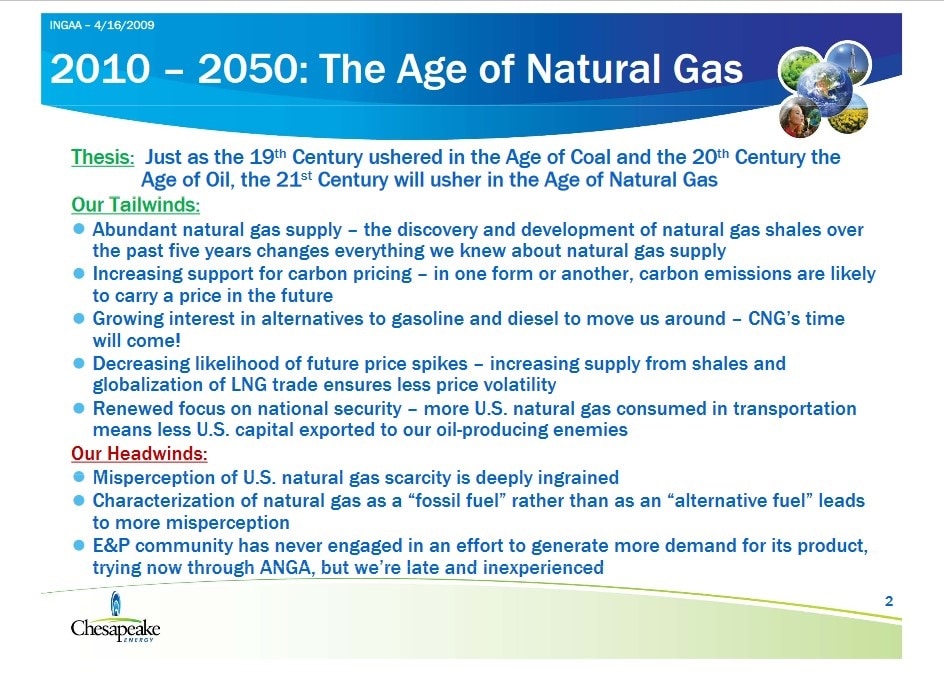
Fracking would offer an “abundant natural gas supply” for decades to come, one Chesapeake slideshow from around that time predicts, “decreasing likelihood of future price spikes” while the “increasing supply from shales and globalization of LNG trade ensures less price volatility.”
A slide from a 2009 Chesapeake Energy presentation predicts the “age of natural gas” will last decades and be marked by fewer price spikes.
Chesapeake Energy did not respond when asked if the company still foresees an era of extended low natural gas prices and less likelihood of price spikes. Spending Spree
For about the last dozen years, natural gas prices in the U.S. were indeed driven down aggressively by fracking. Excitement over the new technology spurred investors to gamble massively on the shale rush.
As capital rushed in, drillers flooded the market with so much gas that prices plummeted from over $16/mcf in 2008 to about $2/mcf in January 2020. A “drill baby drill” mentality and management incentives based on gas production growth, not earnings, opened a seemingly limitless tap of the invisible fossil fuel.
That gas found ready buyers among utilities eager to shift away from coal.
But as natural gas prices kept falling, shale drillers’ earnings always seemed to drop a little lower than their investors might have hoped — and by this summer, shale oil and gas companies had spent $300 billion more than they’d earned from selling the twin fossil fuels, according to Bloomberg.
Last year, after the COVID-19 pandemic threw the oil industry — along with much of the rest of the world — into turmoil, Wall Street nearly abandoned the industry (with analysts at Deloitte writing that “beneath this phenomenal growth, the reality is that the shale boom peaked without making money for the industry in aggregate”).
“The cheap natural gas thesis always hinged on the idea that Wall Street — Wall Street in particular — would continue to fund a gas glut,” Clark Williams-Derry, an energy finance analyst at the Institute for Energy Economics and Financial Analysis, told DeSmog. “And it looks like they’re not so interested anymore.”
“The gas industry is being asked to live within its cash flows and when it does that, it keeps production flat,” he said, adding that in some heavily drilled regions of the United States, producers have begun reaching the limits of short-term tactics that have kept production buoyed, like tapping their backlog of wells that had been drilled but never completed. Observers are watching closely to see whether shale oil and gas production can be maintained even as drillers run low on “DUCs,” or drilled-but-uncompleted wells, which allow exploration and production companies to keep spending lower in the short term while still adding more production from new wells.
Some of gas’s competitors in the power sector pushed for LNG exports in the hopes of driving domestic natural gas prices up, Williams-Derry noted, pointing to a May 2016 meeting between candidate Donald Trump and coal magnate Bob Murray (a meeting where Trump memorably assured the coal baron that he’d support LNG exports, then asked, “what’s LNG?” in Murray’s recounting). “The hope is if more natural gas can be exported, it might reduce the glut in the U.S., which has driven prices so low that it’s killing coal,” Vox reported at the time.
Today, that strategy just might be working: as LNG exports ramp up, domestic gas prices are rising too. “In an era of low gas prices, volatility means ‘up,’” Williams-Derry noted, explaining that when natural gas prices hover near the floor, there’s limited ability for prices to move down but unlimited room for prices to rise.
But the road ahead seems bumpy, in part because LNG prices themselves are notoriously hard to predict.
This August, Bloomberg declared “the era of cheap natural gas is over.”
If today’s higher prices do indeed hold, that’d be very bad news for utilities that spent massively on new power plants that burn natural gas. Ten years ago, America’s utilities got the biggest chunk of their electrical power from coal, followed by natural gas at a distant second (then nuclear and finally renewables like hydroelectric, wind, and solar).
These days, natural gas has taken over the lead, providing about 40 percent of U.S. electricity in 2020, with coal plunging to just 19 percent of the energy mix, surpassed even by renewable energy sources’ 20 percent. Utilities went on a natural gas power plant construction binge in the 2010s, investing billions in new power plants and the infrastructure to support them. Wind and solar represent the vast majority of power generation capacity added to the nation’s energy mix in 2021, representing major shifts in the past decade.
“The glut of construction in gas-fired power has left the electricity sector here very exposed to that globally traded price,” RMI’s Dyson said. “And we have in some sense guaranteed volatility in the domestic price of gas and therefore domestic electricity prices because of the expansion of LNG export capacity in this country.”
That boom in natural gas power plant construction also has major consequences for the climate — since right around the time that the fracking rush kicked off, scientists at Cornell University first warned natural gas’s methane leaks were so severe throughout its life-cycle that gas-fired electricity was worse for the climate than coal-fired power in the short-term.
On the supply side of the gas market today, there might be trouble brewing. This year, for the first time, some analysts say, frackers may be forced to spend only as much as they earn, keeping a lid on supplies.
“The other key thing about shale is you have to keep drilling,” David Hughes, a Post Carbon Institute fellow who has for many years taken federal energy analysts to task for their unrealistically rosy views of shale gas, told DeSmog. “New wells decline 85-90 percent in their first 3 years. So a vicious treadmill” for drillers.
Exports of LNG, meanwhile, are expected to accelerate, propelled in part by today’s massive gap between the price natural gas sells for in the U.S. and the far higher price LNG fetches on the global market. The capability of U.S. industry to chill LNG for export has also taken off after hovering near zero for many years, with two new export projects along the Gulf Coast, Cheniere Energy’s Sabine Pass Train 6 and Venture Global’s Calcasieu Pass, expected to start shipping gas this winter, RBN Energy notes. Industry forecasters predict that LNG export terminals will run at full capacity this year, driving 12.2 billion cubic feet of gas per day off U.S. shores.
Already, natural gas prices have dealt a brutal blow to the claim, popular in the Obama era, that fracking would give the U.S. a valuable card to play against Russia, a major natural gas exporter, when it comes to foreign policy. “This market reality also exposes another flawed idea that gained traction over the years: that U.S. LNG could protect Europe against Russia,” the Center for Strategic and International Studies’ Chair for Energy and Geopolitics Nikos Tsafos wrote in a September 24 commentary. “The proposition itself has always been suspect, reducing a complex system into a two-player game. In today’s market, its hollowness is even clearer. U.S. LNG, like other LNG, responds to market forces, and if other markets are willing to pay more than Europe, Europe has no immediate remedy. New supply, including from the United States, can offer a bargaining tool that keeps prices in check in the medium to long term. But it is no response to a short-term shock.” David Roberts, author of the Volts newsletter, drew a connection between natural gas price spikes and the fossil fuel’s environmental impacts on Twitter. Climate campaigners and advocates for renewable energy have also been quick to pick up on ways that economics no longer favor fossil fuels.
Even at very low natural gas prices, the costs of wind and solar energy have fallen so far that it’s difficult for gas to compete on the economics for power generation. “The interesting thing is that the gas price doesn’t change the outcome that much, at least given the shifts that we’re seeing,” Dyson, who authored a 2019 RMI study that found low-cost renewable energy was already making natural gas power uncompetitive, told DeSmog. Most proposed gas plants today are “uneconomic” even if gas costs just $3/mcf, he said. “Those plants don’t compete against clean energy.”
Natural gas price volatility, however, adds another layer of difficulty for gas sellers, making gas not just expensive but also hard to budget around. “When you really need them, they’re really expensive,” Dyson said about gas power plants.
Dyson said it was too early to say for sure that price volatility is permanently back in the gas market after the fracking frenzy’s glut. “It’s hard to say how much this is an indicator of structural challenges or structural shifts versus the craziness that COVID and the slow bounce-back from COVID has imposed on not just the upstream and midstream fossil fuel sector but also just the whole economy,” he told DeSmog.
“Current natural gas prices remain relatively low and stable compared with history,” Jake Rubin, a spokesperson for the American Gas Association, a trade organization representing natural gas utilities, told DeSmog in response to questions about higher prices and price volatility. “A short-term change in prices reflecting market fundamentals does not alter the fact that the U.S. has significant natural gas resources and an extensive delivery infrastructure that helps grow the economy and meet our environmental goals. This winter, natural gas is still positioned to be the most affordable fuel for heating your home.”
The American Gas Association publishes an annual winter outlook on prices for gas as a heating source and their outlook for this coming winter is expected later this month. A spokesman pointed to a Department of Energy forecast published earlier this summer that predicted natural gas would remain the least expensive fuel for home heating this winter.
Meanwhile, many energy industry experts and policy-makers have begun to speak openly again about the erratic nature of natural gas and LNG prices.
“Today’s situation underlines that we have to end our dependence on foreign volatile fossil fuels as soon as possible,” European Union Energy Commissioner Kadri Simson told a press conference on September 22. “LNG is now being looked upon as a commodity with volatile prices,” an official from GAIL, India’s state-owned gas utility, told the Gastech trade conference on September 23. “The market is super tight so not much needed to move the needle and blow up the market,” Oystein Kalleklev, CEO of Flex LNG, told Bloomberg. “Strong volatility is surely not done, and in fact is likely just getting started,” Bespoke Weather Services, a forecaster used by natural gas traders, wrote in a note to clients, Natural Gas Intelligence reported on September 29.
And, although there are regulatory tools to protect consumers from the worst of the gas market’s swings, when natural gas prices surge, consumers — both industrial users and households relying on it for home heating or power — often ultimately take the hit.
That doesn’t have to be inevitable, Dyson noted, describing tactics that a few state regulators have begun adopting to protect customers. “Hawaii is an example of a state that’s tried to make the utility accountable for decisions that it makes that pass on price risks to its customers,” Dyson said. “And the end effect is basically making the utility wear some of that risk, making the shareholders wear some of the risk, and not passing all of the fuel-price risk onto the customers.”
With some forecasters predicting a mild winter, it’s far from clear whether today’s high natural gas prices might simply melt away in the face of low demand — or whether, for example, a major hurricane might upend gas production or exports along the Gulf Coast.
But however natural gas prices move, at least in the short run, many American utilities and policy-makers chose to hitch their wagons to natural gas — and it seems we’ll all be going along for the ride.
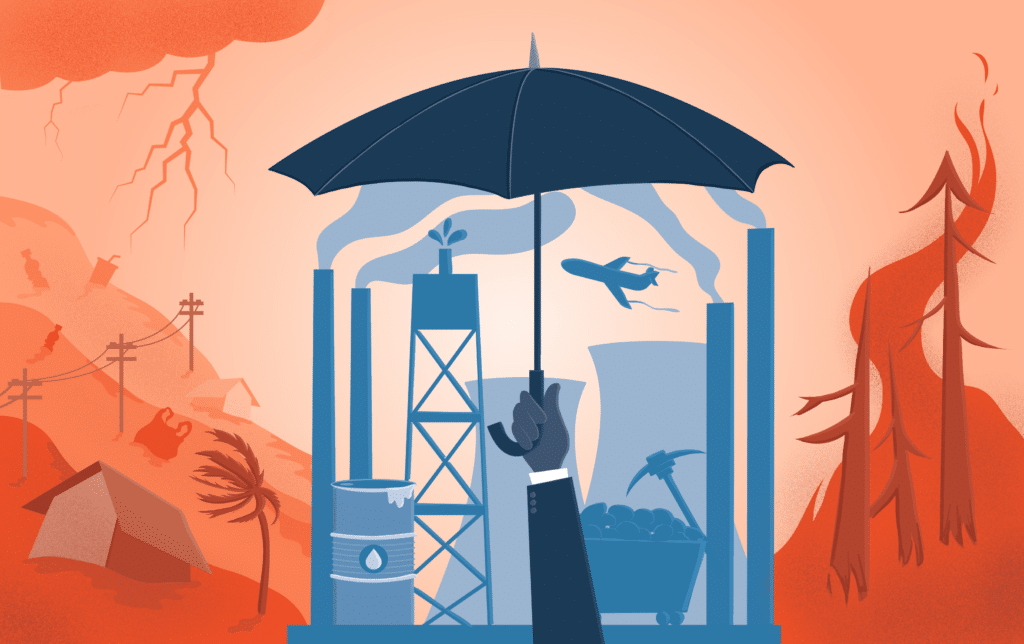
Analysis found links to Exxon, Koch Industries, and the US Chamber of Commerce, raising concerns about a potential “revolving door,” one campaigner said, between the insurance and fossil fuel industries. ANALYSIS By Rachel Sherrington on Oct 7, 2021 @ 00:00 PDT
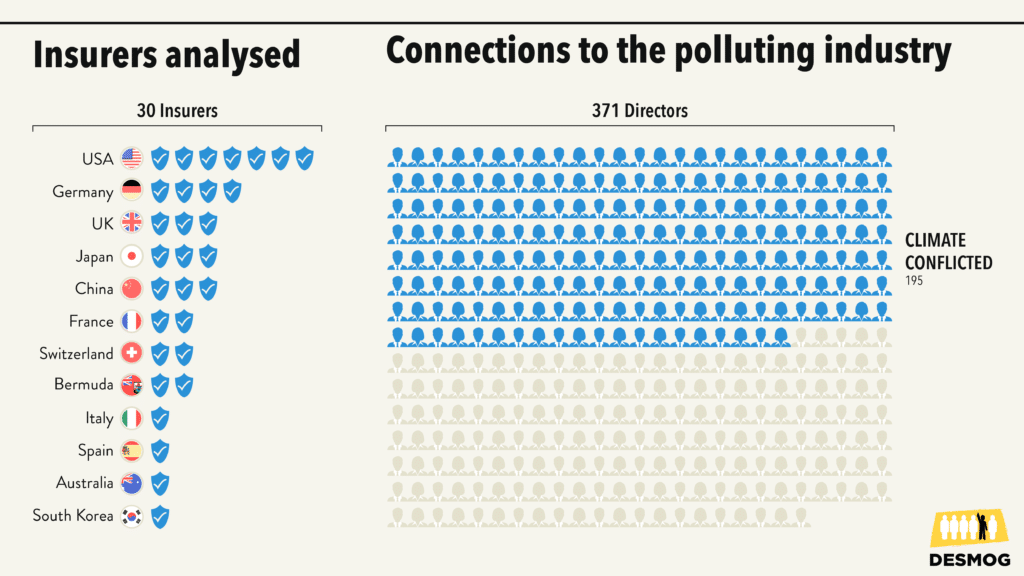
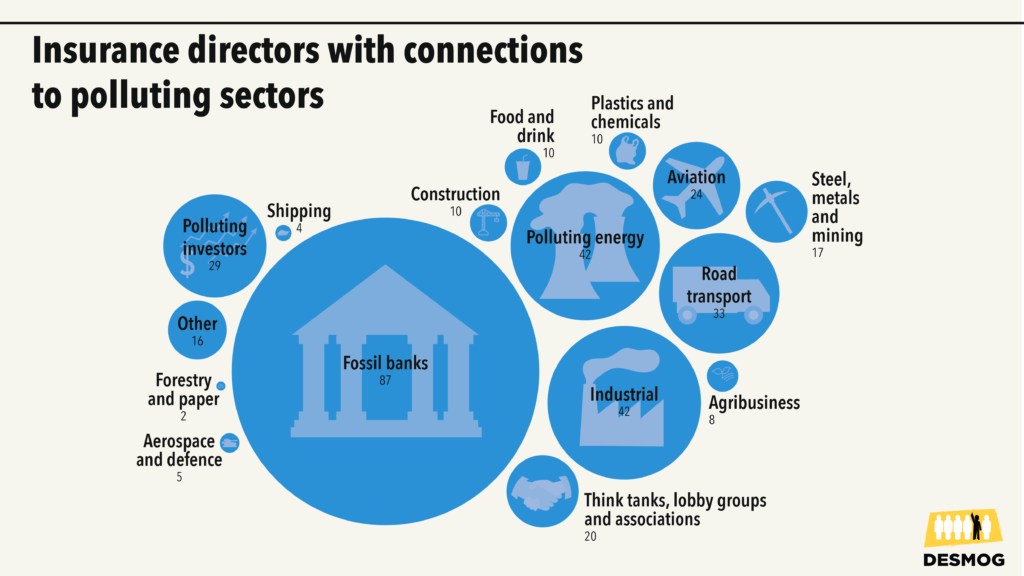
More than half of all directors sitting on the board of 30 major insurance companies analysed were linked to polluting industries. Credit: DeSmog
Just over half of all directors at 30 of the world’s largest insurance companies have affiliations to polluting companies and organisations, reveals an investigation by DeSmog, including several individuals holding senior roles at some of the world’s largest energy companies.
The findings raise concerns over a potential pervasive conflict of interest on the boards at a time when the international insurance sector is under pressure to halt its support for the fossil fuel industry.
Positions held by the insurance directors analysed ranged from director and advisory roles, including current roles at ExxonMobil, Total, and RWE, along with current and former memberships to industry trade association and think tanks, such as the US Chamber of Commerce.
DeSmog analysed director CVs on company profiles, LinkedIn pages, official filings, and news clippings from July 2021, logging the past and present work experience of 371 insurance directors who currently sit on the boards of 30 of the world’s largest property and casualty insurers.
The research reveals that 53 percent of these directors have a combined 499 past or current connections to industries that could be considered potentially climate-conflicted including polluting energy, mining, manufacturing, along with banks and investment vehicles known to support the fossil fuel industry.
Just over one in ten directors across the insurers analysed worldwide had experience at companies operating in fossil fuels, including oil and gas companies, a major coal developer, and utility companies relying on fossil fuels for the power they produce. In the US this number jumped to one in five board members across the insurers analysed.
The links revealed by DeSmog’s analysis may show a “revolving door” between insurers and high-polluting industries that may explain why, despite the risks, the sector has been slow to act on climate change, said Lucie Pinson, executive director at the environmental campaign group Reclaim Finance, reacting to the findings.
The investigation focussed on directors as they are the ones with ultimate oversight over strategic and regulatory decisions for the insurance companies. Among their powers, directors have the ability to vote on resolutions which dictate key decisions made by the company at annual general meetings. In recent years these meetings have been targeted by activists and investors calling for insurers to stop supporting the fossil fuel industry.
The revelations come as a growing number of insurance companies have announced they will limit the services they provide to the most polluting fossil fuel projects, such as by limiting or ending the insurance they provide for coal and tar sands projects.
Despite a growing trend away from the most-emitting developments, however, nearly all leading insurers, including those analysed, continue to provide insurance coverage for oil and gas projects and many still provide at least limited support for coal developments, including through what campaigners have said are “loopholes” in their coal exclusion policies.
Only one insurer in the world, Australia’s Suncorp, has announced it will restrict its support for oil and gas projects worldwide, according to a report from campaigners at Insure Our Future ranking the climate policies of major property and casualty insurers last year. While Suncorp was not included in this analysis, many of the same companies in DeSmog’s analysis feature on the ranking.
For years, experts have warned that under strong climate action to limit temperature increase below 2 degrees Celsius, the world must dramatically limit the extraction and use of fossil fuels. This means fossil fuel projects could become financially risky “stranded assets,” according to analysts.
“There are two major sets of risks for insurers being involved in fossil fuels,” explained Yevgeny Shrago, a policy counsel in climate change for advocacy group Public Citizen.
“The first risk is what we call transition risk,” Shrago said. “These are assets that are going to lose their value very quickly” and unpredictably. While an insurer invested in fossil fuels currently may be getting a large return on them now, Shrago said, this could change at any moment.
“The longer term risk we see,” Shrago continued, “is that when insurers underwrite fossil fuels, they actually are underwriting climate change. The IPCC is very clear that every fraction of a degree matters when it comes to averting physical risk.”
“What that means is that if an insurer enables a new fossil fuel project to go forward, it’s actually then contributing to increased climate harm. Increased climate harm means higher insured losses and greater pressure on solvency in the future.”
DeSmog’s findings on the experience of directors’ on insurance boards may help illuminate why, despite the risks, the sector had been slow to act, added Shrago.
“There’s actually a premium for insurance companies to stop insuring coal, stop insuring oil and gas, exit those industries, and yet they continue to do so. Which raises the obvious question, why? Why are they still doing that?” Shrago said. Ties to Big Oil
A deeper look into the data shows that roughly one in ten directors had past or current ties to the polluting energy sector. And 6 percent of board members overall were found to hold current roles in the fossil fuel industry, including through board memberships at major oil companies such as ExxonMobil, Total, and RWE. Among those with current ties are also individuals with roles at utility companies, such as Italy’s Enel or Eversource in the U.S., which generate their energy from fossil fuels including controversial and heavily emitting sources such as coal and fracked gas. Summary data for the insurers included in DeSmog’s investigation. Credit: DeSmog
Responding to the findings, Elana Sulakshana, senior energy finance campaigner at the climate advocacy group Rainforest Action Network, said: “Insurance companies can play a crucial role in accelerating a transition to a clean energy economy, but it’s highly concerning that their boards are so entangled with fossil fuel interests.”
“Insurers cannot credibly claim to be climate leaders, while being governed by executives who have a personal stake in the continued expansion of coal, oil, and gas infrastructure,” said Sulakshana.
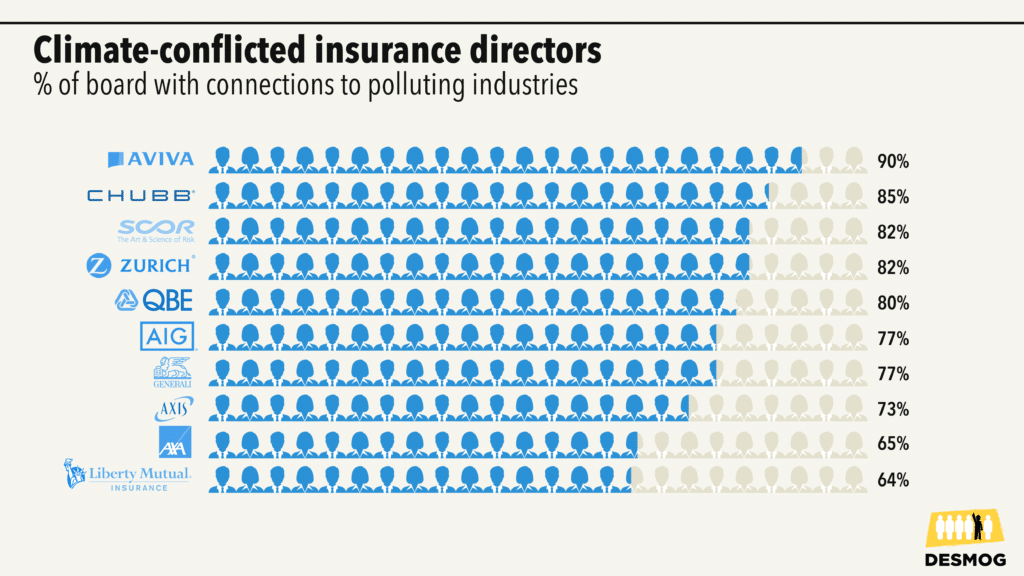
US insurance giant Liberty Mutual had the board with the most ties to the fossil fuel sector, with eight out of its 14 directors linked to major polluting energy companies. The insurer’s directors hold current board memberships at Koch Industries, Canadian Natural Resources Limited (CNRL), ExxonMobil, and utility company Eversource Energy which services Connecticut, Massachusetts, and New Hampshire, and has been targeted by campaigners for its support for the natural gas industry.
Liberty Mutual board member Annette Verschuren, for example, began her career in the Canadian coal industry and is now a director of the Canadian oil and gas company, Canadian Natural Resources Limited (CNRL), which extracts fuel from Canada’s highly polluting tar sands. Verschuren’s fellow director at Liberty Mutual, Joseph Hooley, has been director of the United States’ second largest oil company, ExxonMobil, since 2019. And three further members of the Liberty Mutual board are current trustees of Eversource Energy, while a fourth is the utility’s former CEO.
At the end of 2019, Liberty Mutual announced restrictions on the type of support it provides to the coal industry. Currently, however, it has no restrictions on its support for the oil and gas industry. The insurer is under pressure from campaigners to end its support for the tar sands industry, including the TransMountain pipeline extension, which will be used by CNRL.
“Liberty Mutual is one of the biggest fossil fuel insurers in the world, and the fact that over 40 percent of their board members are also on the boards of fossil fuel companies helps explain why the Boston-based insurance giant has been so resistant to changing that,” argues Sulakshana.
Liberty Mutual did not respond to a request for comment in time for publication.
The top 10 insurers with highest proportion of their board that were found to have connections to polluting industries. While Aviva scored the highest, all ties were to polluting industries other than energy companies. Credit: DeSmog
The other boards with the highest number of ties to polluting energy companies were Italian insurer Generali, where four out of 13 directors had experience in the energy industry and Swiss insurer Zurich where three out of 11 directors previously held roles at oil and gas and utility companies.
Generali director, Diva Moriani, was a director of Italian multinational oil and gas company, Eni, from 2014 to 2020.
A Generali spokesperson said coal, oil, and gas production “stood at less than 0.1% of its P&C premiums.” The company, they said, aims to gradually decarbonize its investment portfolio to reach carbon neutrality by 2050.
Zurich director, Dame Alison Carnwath, meanwhile, was a director of British oil giant BP until January 2021 when she resigned for unspecified “personal and professional reasons”.
A Zurich spokesperson said the company sees the “diversity of expertise” on its board “as a critical success factor for the performance of the board, as different views and ways of thinking lead to better informed decision making.”
They added: “We strongly believe that we can have the biggest impact by using our influence as an insurer and investor through engagement with our customers and the companies we invest in to promote a rethinking and the adoption of business models aligned with a 1.5C future.”
Elsewhere in Europe, AXA-director, Patrizia Barbizet, has been director of the European oil giant TotalEnergies since 2008.
AXA did not respond to a request for comment in time for publication. Coal Connections
Meanwhile, eight insurers had board members with past or current experience in companies involved in extracting coal as featured on the Global Coal Exit List produced by Urgewald, a German environment and human rights NGO, to track companies’ involvement in the global coal supply chain.
This includes Swiss Re director, Raymond K. F. Ch’ien, who is a current director of China Resources Power Holdings Co, a Chinese company that develops and operates coal plants across several Chinese provinces.
A spokesperson from Swiss Re said “Swiss Re’s board members have been selected against comprehensive criteria in various areas. They are fulfilling their mandate at any time in the best interest of Swiss Re.” Among the board’s responsibilities is overseeing the company’s sustainability strategy.
The Swiss RE spokesperson added that starting in 2023 the company will introduce insurance policies to restrict its exposure to coal. The aim is to eventually reach “a complete phase out of thermal coal exposure in OECD countries by 2030 and in the rest of the world by 2040.” And starting this year the company says it has also “gradually started withdrawing insurance support from the world’s 10% most carbon-intensive oil and gas production” to be completed by 2023.
Tokio Marine Holdings director Masako Egawa, meanwhile, is a current director of Mitsui & CO, a Japanese General Trading company featured on the Global Coal Exit List for its holdings in Australian coal developments.
Tokio Marine Holdings did not respond to a request for comment in time for publication.
And The Hartford director Michael G. Morris was president, chief executive officer, and chairman of American Electric Power (AEP) from 2004 to November 2011 and continued as AEP’s chairman until 2013. American Electric Power is one of the United States’ largest generators of electricity, and generates nearly half of its electricity from coal.
A spokesperson from The Hartford pointed DeSmog to the company’s 2019 announcement that it would no longer support companies which generate more than 25 percent of their revenues or energy production from coal or more than 25 percent of revenues directly from the extraction of tar sands oil.
Speaking generally about the insurance The Hartford provides, they said: “We have long understood we have a special role to play in response to the climate emergency. Extreme weather affects people’s lives and businesses – and the risks are getting worse. Helping people prepare and adapt to climate change is essential to The Hartford, and our customers.”
Another example is Hannover Re supervisory board member, Erhard Schipporeit, who has been a supervisory board member of Europe’s largest polluter, RWE since 2016; RWE generates nearly a third of its energy from coal, including brown coal (also known as lignite). Coal is the world’s most polluting fossil fuel, and brown coal is the most polluting form of coal, producing up to a third more greenhouse gas emissions per ton than conventional black coal when burnt.
Hannover Re did not respond to a request for comment in time for publication.
According to the 2020 analysis by Insure our Future, at least 23 insurers and reinsurers out of 33 analysed by the group have introduced policies limiting or ending their support for coal projects and developments. However, several of these policies are not comprehensive. For example, while a number of insurers have ruled out supporting particular coal projects, many do not have full exclusions on companies that are developing coal plants.
“None of the top global insurers has committed to stop insuring the expansion of the oil and gas industry,” said Pinson at Reclaim Finance, “despite knowing this is the only solution if we want to keep warming below 1.5C. It would be shameful, though not surprising, if such loyalty is the result of a revolving door between both worlds.” Other Big Emitters
DeSmog’s analysis also found significant ties among insurance directors to the world’s largest emitting companies as identified in the Climate Action 100+ (CA100+) list, an initiative created by investors to put pressure on the world’s biggest polluters to reduce their emissions.
The list includes the top one hundred companies with the highest emissions worldwide, such as BP, TotalEnergies, and Exxon, as well as 67 other companies which investors have identified as strategically important in reaching climate goals such as companies that provide support for these polluting industries. The list also includes the world’s highest emitting companies from sectors such as road transport, aviation, and shipping.
For example, nine percent of the 371 board members analysed had past or current experience in the road transport sector overall.
Sectoral breakdown of directors found to have connections to polluting organisations in DeSmog’s investigation. Credit: DeSmog
Just over a quarter of Zurich board directors, for instance, had worked at some point in their career for the car industry, including for car companies and road developers. Three current board members of the Swiss insurer have current roles at car companies included on the CA100+ list, including Rolls Royce, Paccar Inc., and BMW, through board memberships and a role at a BMW-linked research institute.
Insurance board directors also had a few connections (6 percent among all analysed) to other high-carbon industries such as aviation. The insurer with the most ties to aviation was France-based SCOR RE, where three board members had held roles in the industry. These include Fabrice Bregier, the former chief operating officer of CA100+ company Airbus; Bregier left the aircraft manufacturer in 2018. Meanwhile, AXA’s Jean-Pierre Clamadieu has been a director for Airbus since 2018.
Airbus is the world’s largest airplane manufacturer, and a major source of greenhouse gas emissions. Planes sold by the company in 2019 and 2020 will produce over 1 billion tonnes of carbon dioxide during their lifetimes, according to figures released by the company.
In response to a request for comment, a SCOR RE spokesperson said: “We have no comment to make at this time.”
Among the directors analysed there was also a connection to shipping — an often overlooked yet highly polluting industry. Allianz supervisory board member, Jim Hagemann Snabe, is the current chair of global shipping company Maersk, the world’s largest shipping company which was responsible for an estimated 35.5 million tonnes of CO2 equivalent emissions in 2018 and is also featured on the CA100+ list.
Allianz did not respond to a request for comment in time for publication.
Meanwhile, 15 percent of all board members analysed had links to companies serving heavy industries including US industrial giant and CA100+ company General Electric, which provides equipment to sectors including, oil, gas, coal, and power generation sectors, as well as in aviation and renewables. And Tokio Marine director, Akio Mimura, is former chair of Japan-based Nippon Steel, a CA100+ company and the world’s fifth largest steel-making company.
In addition, Renato Fassbind, a director at SwissRe, is a current director of Nestle, a CA100+ firm which also ranks among the world’s top ten plastic polluters according to research by Break Free From Plastic, a global movement of organisations and individuals looking to end plastic pollution. Links to Lobbying
DeSmog also found several affiliations to powerful national and international lobby groups that have opposed attempts by some of the world’s most powerful governments to curb emissions.
In total, one in twenty directors have held roles in lobby groups and trade associations that have opposed climate measures. This includes Tokio Marine director Shinya Katanozaka who is vice-chair of Keidanren, widely considered to be Japan’s most powerful business group.
Keidanren was recently identified by analysts at climate thinktank InfluenceMap as one of the biggest obstructive forces to more ambitious climate action in the country. The business group represents major polluters in Japan and has repeatedly pushed for coal to remain a significant part of the country’s energy mix.
And between 2008 and 2010, Everest Re director John J. Amore was a director of the US Chamber of Commerce, one of the United States’ most influential business groups which has repeatedly opposed attempts by the US government to regulate greenhouse gas emissions. An analysis of the trade body’s statements from 1989 to 2009 by social scientists found that the Chamber of Commerce had been a “powerful force in obstructing climate action,” in the country and that it had contributed to doubt over climate science.
Everest Re did not respond to a request for comment in time for publication.
Meanwhile, The Hartford director, Michael Morris, is a former director of the American Gas Association which has pushed against climate-focussed efforts to reduce emissions. Fossil Financiers
The research also revealed directors who held senior roles in some of the world’s leading banks and investment vehicles that are under criticism from campaigners for their continued financial support for the fossil fuel industry.
Nearly a quarter of the directors analysed have worked for financial institutions that have provided the most backing to fossil fuel projects since the Paris Agreement was signed, as ranked in the “Fossil Banks” list compiled by environmental non-profit BankTrack. For example, Bruce Carnegie Brown, chair of Lloyd’s of London since 2017, is vice chair of Spanish multinational bank, Santander, which according to BankTrack has given over $34 billion in financing to fossil fuel projects since the Paris Agreement was signed.
A spokesperson from Lloyd’s said the company was “accelerating its transition towards a more sustainable insurance and reinsurance marketplace, and has set out specific actions and commitments to align with the goals of the Paris Agreement. This includes asking managing agents to no longer provide new insurance cover for thermal coal-fired power plants, thermal coal mines, oil sands or new Arctic energy exploration activities from the end of this year.”
In addition to his current role at a coal-developing company, Swiss Re director Raymond K. F. Chi’en was, until 2007, a director of British bank HSBC which according to BankTrack lent $110.74 billion to the fossil fuel industry between 2016 and 2020.
All named directors were contacted for comment.
“Insurers often talk about the danger that climate change poses to their business,” said Shrago. This is particularly acute for property and casualty insurers right now, but in the long term will also impact life and health insurance companies Shrago said.
“You would think that given their long term perspective … [insurers] would think about the long term timing implications of their insurance and their investment businesses,” Shrago continued. “The fact that they don’t has always been something that is troubling and a little hard to understand. I think this report helps shed some light, maybe, on what’s going on.”
“Insurance companies must ensure that their boards are equipped to address the escalating climate crisis,” said Sulakshana. “That means hiring board members that are committed to serious oversight of climate risks and aligning their companies with a 1.5ºC pathway.”
Research by Ingvild Deila, Nadia Feldkircher, Mariangela Castillo, and Bo Frohlich.
This research was commissioned by The Sunrise Project. DeSmog retained full editorial control of the work.
One expert called it a “systematic deceptive marketing campaign designed to interfere with the solution that is necessary to respond to the climate emergency: stopping fossil fuel production.” ANALYSIS By Rachel Sherrington on Oct 3, 2021 @ 15:59 PDT
New research shows fossil fuel companies are overwhelmingly promoting their green efforts online. Credit: DeSmog
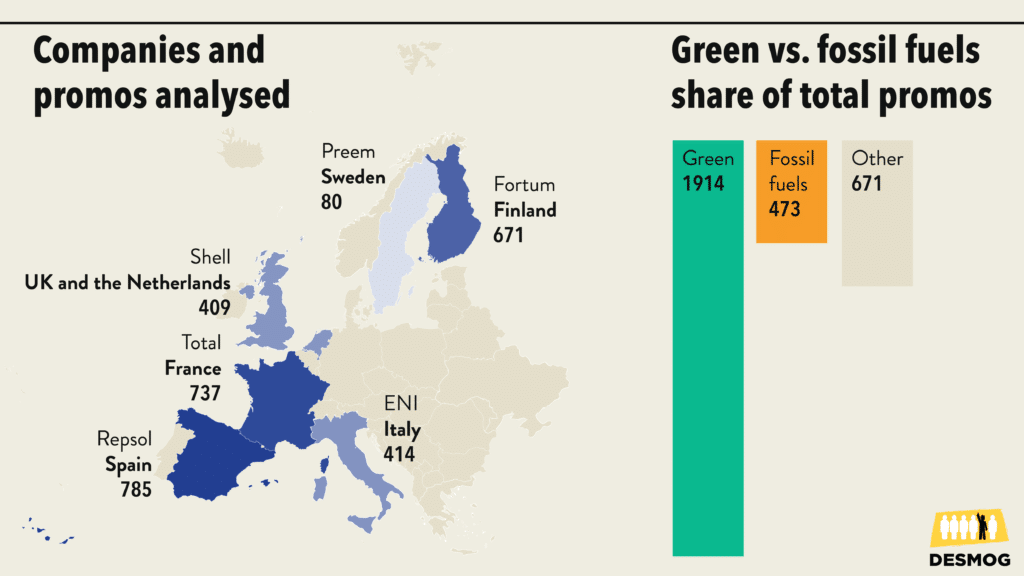
Nearly two thirds of social media posts put out by six major European fossil fuel and energy companies since the end of 2019 present a “green” image of the company, despite the majority of their business activity remaining in fossil fuels, reveals new analysis by DeSmog.
The findings add to campaigner concerns that fossil fuel companies are promoting a misleading image of their business models as the need to decarbonize the economy becomes increasingly urgent.
DeSmog’s investigation shows a disproportionate focus on green or environmental efforts by the companies — including highlighting their net zero targets — compared to the share of their business devoted to clean energy.
Available figures compiled from various public corporate reports suggest that on average 80 percent of the businesses’ operations remain in oil and gas and, in one case, coal. The remaining 20 percent represents investments outside of fossil fuels, in areas such as renewables, carbon capture and storage, and research into new green technologies.
The analysis, however, found that 63 percent of the more than 3,000 online posts and videos posted on YouTube, Twitter, and Facebook by Royal Dutch Shell, TotalEnergies, Repsol, Eni, Fortum and Preem between December 2019 and April 2021 presented the energy companies as “green”. Among these posts, 18 percent were publicly designated as advertisements as they appeared on Facebook Ad Library; the number of paid adverts analysed is likely higher overall but YouTube and Twitter do not publicly disclose this information.
Meanwhile, only 16 percent of all online posts and promotions focussed on the companies’ fossil fuel activities, the research found, such as arguing for the need for fossil fuels to ensure energy supplies remain stable, and arguing for their benefits to the economy in developing countries.
“This is greenwashing-101, and it’s utterly misleading,” said Geoffrey Supran, research associate in the Department of the History of Science at Harvard University, reacting to DeSmog’s findings. “Indeed, it’s the very epitome of greenwashing: act dirty, talk green.”
Greenwashing is defined as an umbrella term for the various misleading communications and other corporate practices that “intentionally, or not, induce false positive perceptions of an organization’s environmental performance.”
“That is indisputably what these oil and gas companies are doing when they publicly disguise their fossil fuel-based operations behind a green marketing sheen,” said Supran, who is also director of climate accountability communication at the Climate Social Science Network.
63 percent of the online posts from energy companies presented a “green” image of their business. Credit: DeSmog
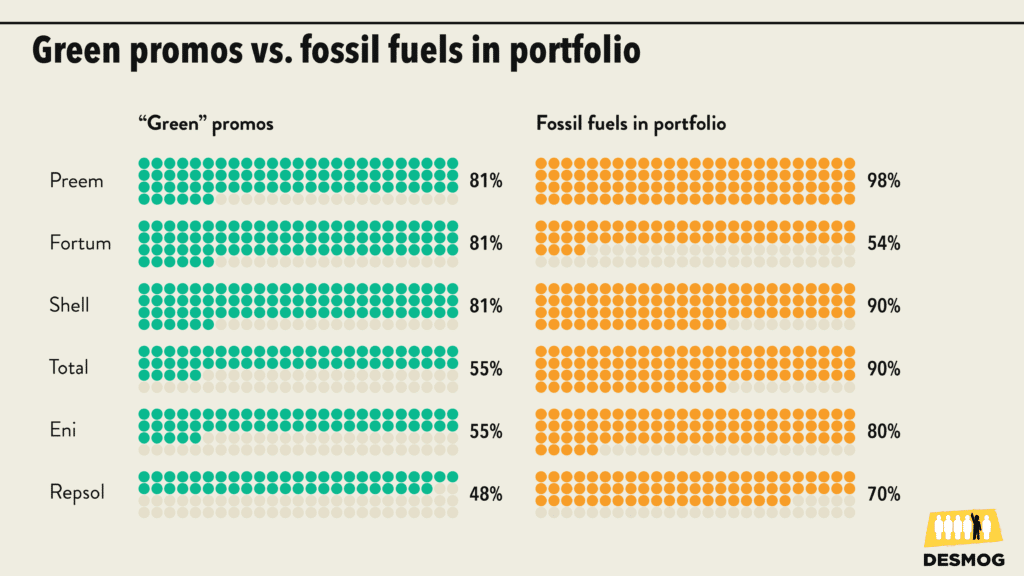
Half of the companies analysed dedicated over 80 percent of their posts to highlighting their involvement in green and climate-friendly work such as building up more renewable energy capacity. Green investments, however, make up just 12 percent of these companies’ portfolios on average based on publicly available figures.
The companies analyzed were selected to represent a range of scale and location across Europe. The ones with the highest share of green promos were Swedish fuels company, Preem, Finnish power company, Fortum, and, Europe’s largest oil company, Shell, all of which presented involvement in what they deemed to be green activities in an average 81 percent of their posts.
“There is a yawning gap between the marketing claims of fossil fuel companies and the reality of their businesses,” said Jonathan White, a lawyer at ClientEarth. “The simple fact is that they are not reducing their polluting activities by the significant amount required to limit the worst impacts of global warming.”
“Just like the tobacco industry did, the fossil fuel industry uses advertisements and promotions to deflect attention away from their harmful business models, deceive the public and politicians with false solutions and ultimately delay climate action,” said Georgia Whitaker, lead campaigner for Fossil Free Revolution at Greenpeace Netherlands. (Note: this research was commissioned by Greenpeace.) “Greenwashing is the new climate denial, and it’s allowing companies responsible for the climate crisis to hide in plain sight.”
The revelations come after several recent rulings against fossil fuel companies’ green ad campaigns for misleading claims about their businesses’ efforts to tackle climate change. Campaigners are also ramping up pressure for stricter regulations on fossil fuel companies, with growing calls for “health warnings” to be placed on fossil fuel company ads in the same way that is required for tobacco companies across much of the world.
“These companies use advertising to distort the public debate, portray themselves as the good guys on environmental issues and to create a ‘social licence’ for themselves – effectively build an aura of respectability around their activities that masks the true nature of the disastrous role they play,” said Barnaby Pace, senior campaigner at Global Witness. Worst Offenders
Of all the companies analysed in the study, Swedish oil company Preem had the highest discrepancy between the number of online messages promoting a “green” image and the reality of its energy portfolio.
While more than 80 percent of Preem’s posts promoted a green image or highlighted the use of green technology, only 2 percent of the company’s business is outside of fossil fuels, according to figures provided to DeSmog.
Preem had the highest share of promotions focussing on bioenergy out of all six companies analysed, with 23 percent of the company’s posts focussing on this theme. It also had the highest share of posts on carbon capture and storage technologies, with these making up one in five of the promos put out by the company.
A Preem spokesperson said: “We believe that it is relevant and important that we communicate about the strategic decisions that set us apart from others in our industry … We also think it is relevant that we communicate the goals we work towards and the sustainable development that takes place in our company, even though we are fully aware that we have a long way to go.”
The discrepancy between “green” posts, as identified in the study, and the share of companies’ fossil fuel portfolios according to publicly available figures. Credit: DeSmog
Shell, which was identified as the second worst offender in the study, currently channels 90 percent of its long-term investments into fossil fuels, according to recent analysis, and between 2010 and 2018, it was reported to have dedicated just 1 percent of its investments to sources of low-carbon energy such as wind and solar.
However, 13 percent of Shell’s posts focussed specifically on renewable energies such as wind, solar, and hydropower. The company also had the largest share of promos focussing on hydrogen, which made up 11 percent of its total output.
Responding to DeSmog’s findings, a spokesperson at Shell said: “To help alter the mix of energy Shell sells, we need to grow these new businesses rapidly. That means letting our customers know through advertising or social media what lower-carbon solutions we offer now or are developing, so they can switch when the time is right for them.”
The third worst offender in the analysis, Finnish energy company Fortum, generates 54 percent of its energy from fossil fuels, including 9 percent from coal and brown coal (also known as lignite). Coal is the world’s most polluting fossil fuel, and brown coal is the most polluting form of coal, producing up to a third more greenhouse gas emissions per ton than conventional black coal when burnt.
Yet, nearly half (47 percent) of Fortum’s ads and posts focussed on climate-related plans and initiatives, including posts focussing on carbon neutrality and efforts to introduce sustainable heating for homes.
Fortum did not respond to a request for comment in time for publication. A Focus on ‘Net Zero’
DeSmog’s research found that among the green-focused social media posts, the fossil fuel companies were most likely to talk about their climate plans and initiatives. This included a wide range of strategies and projects, including a large focus on “net zero” targets, which the six companies have all introduced recently.
Net zero targets, however, have been increasingly criticised as an example of “greenwashing” over their potential to mislead the public of the extent of the emissions reductions that some energy companies have promised.
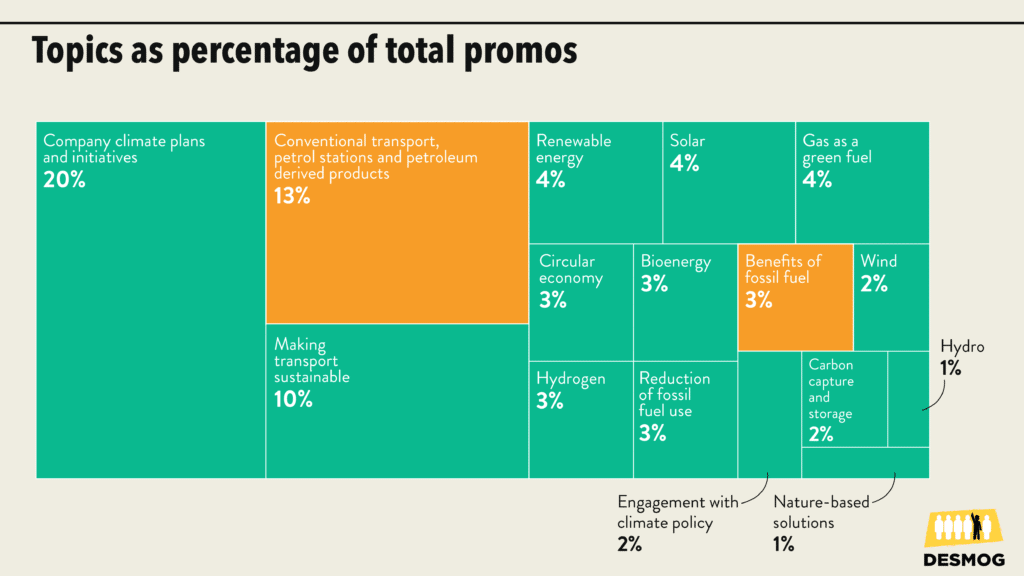
Energy topics as percentage of total promos. 20 percent of posts focused on corporate climate plans and projects. Credit: DeSmog
Preem, which is the largest fossil fuel company in Sweden, announced in 2019 its plans to become carbon neutral by 2045. Its efforts to decarbonise rely on increasing its use of biofuels and carbon capture and storage — both of which have been labelled as “false solutions” by campaigners because they still allow for the use of fossil fuels or for emissions to be released.
Pointing to investments in bioenergy, electrification, and carbon capture, a Preem spokesperson said: “The measures we focus on have support in research and national and international regulations and have a positive effect on climate change.”
Shell’s strategy to reach net zero by 2050, which the company announced this February, includes only modest reductions to the company’s oil business, as well as plans to expand its gas business by over 20 percent in the coming years.
The target also relies heavily on offsetting schemes which have been heavily criticised by campaigners who have questioned the effectiveness of carbon credits or forest offsets, which have had mixed success in the past. Guidance on offsetting best practice published by the University of Oxford last year argues that companies should instead “prioritise reducing your own emissions first.”
Eni, Repsol, and TotalEnergies also all aim to become net zero by 2050. French oil giant TotalEnergies, however, plans to increase its fossil gas sales from 33 percent of its sales in 2019 to 50 percent in 2030. Net zero targets for TotalEnergies and Eni, which announced its plans to reach net zero in April 2021, also rely significantly on offsets and carbon capture and storage technology, with Eni arguing it will capture around 90 million tonnes of CO2 by 2050.
TotalEnergies did not respond to a request for comment by time of publication.
In December 2020, Fortum committed to net zero European power generation by 2035, which includes a pledge to increase its solar and wind capacity. However the company has vocally defended the opening of a new German coal plant by its new subsidiary, Uniper, and has publicly endorsed Uniper following legal action taken by the company against a 2030 Netherlands coal phase-out date.
Reacting to DeSmog’s findings, Karen Sokol, a professor at Loyola University New Orleans College of Law, said “the industry’s ‘climate and society friendly’ messaging is nothing new. Rather, it’s just the latest instantiation of its disinformation campaign designed to allow it to continue profiting from deadly and planet-destroying fossil fuel products.”
Moving away from promoting climate denial as the industry did in the past, she said, the fossil fuel industry has now begun “positioning itself, astoundingly, as a climate leader.”
“I believe ‘greenwashing’ tends to minimize the wrongful nature of the industry’s messaging,” she continued. “It is a systematic deceptive marketing campaign designed to interfere with the solution that is necessary to respond to the climate emergency: stopping fossil fuel production,” Sokol said.
After net zero targets, posts focussing specifically on renewable energy were the second most prevalent theme among the companies’ “green” online messages, making up 11 percent of all promos analysed overall. Of posts that focussed specifically on one type of renewable energy, companies were most likely to promote their involvement in solar projects.
“These advertisements don’t just promote green efforts; they promote the fossil fuel company too,” said White, calling the companies’ various low-carbon initiatives not much more than “token projects.”
He continued: “The millions spent on sophisticated marketing and advertising campaigns are about shaping public opinion and maintaining demand for fossil fuels. The harmful impact this has on the pace of change – at a time when the need to transition could not be clearer – cannot be underestimated.”
The other major “green” topic that companies promoted was their involvement in efforts to make transport more sustainable. Transport is one of the world’s most emitting sectors overall, making up more than one tenth of emissions worldwide.
Ten percent of posts analysed focussed on transport, with companies showcasing ways they were making vehicles lower-emitting, for example, through rolling out electric charging points or by developing less-emitting petrol and diesel fuels.
Some companies, however, have a mixed track record on this issue. While Repsol appears to support the rollout of electric vehicles, according to InfluenceMap, in a February 2021 EU consultation response by Repsol, the company appears to support a “technology neutral approach to decarbonizing road transport” including considering vehicles that use biofuels or fuels from carbon capture as “zero-emission vehicles”.
A spokesperson for Repsol told DeSmog that while the company supports electrification, “low-carbon liquid fuels — like advanced biofuels and synthetic fuels produced from renewable hydrogen and captured CO2 — are also needed to decarbonize sectors where electrification is not yet an option, such as aviation, maritime, and long-distance road transport, as well as passenger cars and vans where electrification of the whole vehicle fleet will require considerable time.”
Meanwhile, Shell’s support for a transition to electric vehicles runs counter to the American Petroleum Institute’s lobbying against electric vehicles in the United States; despite saying the trade body’s positions on climate are not fully aligned with its own, Shell remains a member of the API.
Other themes identified across the green promos included those highlighting efforts to reduce and recycle waste (3 percent of posts or 98 promos in total). And 54 promos in total (1 percent of all posts) showcased companies engaging positively with legislators and other policymakers on climate change.
Meanwhile, posts that focussed narrowly and specifically on reducing fossil fuels made up 3 percent of all posts analysed. Controversial Ideas
A significant number of the green-focused social posts were about technologies and fuel sources which, although presented as green and climate-friendly by companies, have been the subject of significant concerns from scientists and activists over their potential to contribute to global emissions.
These technologies, several of which have been labelled as “false solutions” by environmental campaigners, made up 12 percent of promos overall.
“The fossil fuel industry loves pushing technological fixes to the climate crisis that mean that they don’t have to stop using fossil fuels,” said Global Witness’s Pace. “They are nearly always decades away, are vastly expensive or just simply don’t work.”
“The real risk,” Pace continued, “is that governments fall for these false solutions, often deciding to pump huge amounts of money into them that would be better spent on technology we know works such as renewables.”
The most recurring of these posts (making up a total 4 percent of all posts) was natural gas, which, despite being a fossil fuel, has a history of being presented as a bridge fuel towards a cleaner future due to the fact it produces less emissions than other conventional fuels when burnt.
Gas, however, still releases methane and carbon dioxide into the atmosphere, and its extraction leads to further emissions of the potent greenhouse gas methane, which is a more powerful greenhouse gas than carbon dioxide over the first 20 years after being released into the atmosphere. In a blow to the industry, the world’s leading energy analysts recently warned the use of natural gas must be drastically curtailed to meet climate goals.
Eni told DeSmog that gas will “in the long term” account for more than 90 percent of the company’s hydrocarbon production and “will be an important support for intermittent sources in the energy transition.”
A spokesperson for Eni added the company “strongly believ[es] that technology is the only key to face this big challenge, which requires pragmatism in using all the industrial and technological solutions available to set up ad hoc strategies for each Country and Company’s needs.”
Online posts in this category also included attempts by companies to absorb greenhouse gas emissions from the atmosphere, either through man-made technologies, which made up 2 percent of posts, or through so-called “nature-based solutions,” most commonly made up of tree-planting initiatives, which made up 1 percent of promos overall.
While carbon capture and storage (CCS) — either through natural or manmade means — has been highlighted as an important solution in addressing climate change, companies have been criticised for using these technologies to justify continued use of fossil fuels. There are also doubts over the feasibility of rolling out these projects on a large scale.
“In principle, I welcome well-intentioned researchers developing fallback, fill-in-the-gaps technologies like CCS and green hydrogen,” said Supran, who noted that natural gas doesn’t fit into the category because it is “clearly a potent greenhouse gas incompatible with a just and stable future.”
The risk, however, he said is that fossil fuel interests may try to “co-opt” these technologies to “avoid, first and foremost, scaling down fossil fuel production.”
White agreed: “It’s misleading when a fossil fuel company suggests its gas is ‘clean’ and the necessary partner to renewables. It’s misleading when an oil company says planting trees is the way to manage the environmental impact of continuing levels of oil production. And it’s misleading when a company planning to carry on, or grow, its fossil fuel production then flies in the face of climate science to claim that it’s working toward a sustainable future.”
Other themes identified in this category were biofuels and hydrogen, which collectively made up 6 percent of all promos.
Proponents of bioenergy argue it is a greener source of power than conventional fossil fuels, chiefly because the plants used in its production absorb carbon dioxide emissions, however, its impact on the climate can vary widely depending on the sources it’s made from, with scientists arguing some forms can be significantly more polluting than fossil fuels.
Hydrogen, meanwhile, has been promoted by many in the energy sector as a clean alternative to gas, as the fuel does not produce any greenhouse gases when burnt. However, activists fear widespread use of the fuel, which is not currently in commercial use, may prolong the use of fossil fuels. There are several ways to produce hydrogen, but almost all of it currently in production uses methane as the feedstock, with non-renewable energy powering that production.
The challenge with companies marketing carbon capture and hydrogen technologies as green, said Supran, is that it risks promoting these options as “(a) silver-bullet techno-fixes that aren’t yet commercially viable and (b) approaches consistent with business-as-usual for oil and gas companies.”
Ultimately, this then allows for the industry to create a “‘Fossil Fuel Savior’ framing of the climate crisis that helps defend the status quo,” he said.
This point was echoed by Sokol, who said: “All technologies that involve continued fossil fuel production — including carbon capture and so-called blue or gray hydrogen — are not merely false solutions. They would accelerate the climate crisis, perpetuate existing and create new harms that disproportionately impact communities who have long been on the frontlines of fossil fuel infrastructure.” Social Good
While most of the companies’ posts related to their core business in energy, the research revealed that all companies dedicated a significant number of posts (16 percent of all analysed) to emphasising positive involvement in wider social initiatives, not just the environment, including their involvement in schemes relating to diversity, education and training, poverty, and healthcare.
The company with the largest share of ads focussed on its wider social contribution was Italian oil giant Eni, which dedicated 37 percent of its promos to this theme. French oil company, TotalEnergies, also had a heavy focus on social initiatives, dedicating one in five of its online posts to social projects and initiatives such as supporting children’s projects in Africa, and getting more women into science.
Within the social good category, companies’ involvement and sponsorship of recreational activities, and notably sports, was a common theme. This included posts featuring partnerships with renowned sports personalities and brands, and promotion of their sponsorships of sportspeople and teams. Additional research by DeSmog found that five of the six companies (all companies except Fortum) were involved in sports sponsorships overall.
The phenomenon of “sportswashing,” which was originally coined to apply to repressive governments, has been increasingly used with regards to oil and gas companies, who campaigners say use a positive association with sports teams, for example through sponsorships, to deflect from their negative environmental records.
“Sports sponsorships have been part of a broader company communication strategy for a long time,” an Eni spokesperson said. “They cannot be considered neither alternative nor predominant compared to the other communication activities, which are currently focused on describing Eni’s solutions for a low-carbon future or the evolution of retail markets, but are complementary in specific contexts in order to reach different targets and pursue the objectives assigned, both institutional or commercial.”
Meanwhile, a Repsol spokesperson said that the company “has a long-standing commitment to motorsports where it has been sponsoring teams and sportspeople continuously since 1969. We see these partnerships as the best testing ground to develop technologies, solutions, and products and improve key aspects in the fight against climate change, such as energy efficiency.”
A spokesperson from Preem said: “We have chosen to engage in several different activities around our places of business, both to market ourselves and because we want to be an active party in the development of these communities.” Fossil Fuels
Just 16 percent of posts analysed highlighted the development and use of fossil fuels, the research found, despite these online promotions being most representative of the companies’ activities.
The most prevalent theme in the fossil fuel category was posts promoting a range of products related to conventional transport, which made up 13 percent of all promos (390 posts and videos). This included content promoting petrol and diesel for cars, without any attempts to promote these fuels as climate-friendly, and posts highlighting companies’ petrol stations.
This category also included companies selling other products used for conventional transport, such as lubricants and engine oils. Transport was less likely to be subject to greenwashing than energy, the research found, with more posts simply showing companies’ involvement in conventional forms of transport than green alternatives.
A spokesperson from Shell told DeSmog that while the company invests “billions” in “lower-carbon” energy, “the world will still need oil and gas for many years to come. Investment in them will ensure we can supply the energy people will still have to rely on, while lower-carbon alternatives are scaled up.”
Just 3 percent of promos analysed focussed on the benefits of fossil fuels, either through explicit arguments about their positive contribution to the world, or most commonly, through implicit means, such as through videos showcasing the ingenuity and scale of companies’ oil and gas operations.
“This industry has a proven track-record of acting in bad faith on the climate crisis, and so the onus must be on them to show they are serious about reforming their business practices rather than their propaganda,” said Supran. “This means putting their money where their mouths are. As long as they continue to market themselves as low-carbon, yet invest almost entirely in high-carbon, their ads are, by definition, a distraction from reality that doesn’t deserve to be taken seriously.”
Research by Nadia Feldkircher, Ines Emprin, Charlotta Lahnalahti, Ingvild Deila, Mariangela Castillo, Katherine Besenyei, Bo Frohlich and Kate McMahon.
Last week at the UK Labour Party’s annual conference, the Palestine Solidarity Campaign celebrated a victory for the boycott, divestment and sanctions (BDS) movement.
Delegates overwhelmingly passed a motion explicitly condemning Israeli apartheid and calling for sanctions, including an arms embargo.
That was certainly an achievement.
Especially considering that at least 120,000 members have left or been driven out of the party since right-wing leader Keir Starmer took over last year. Labour membership rolls are plummeting amid Starmer’s purge of the left and Palestine solidarity campaigners.
But Labour’s right-wing leadership immediately made clear it would ignore the new resolution.
In a press statement, Labour’s foreign affairs spokesperson Lisa Nandy said the leadership “cannot support this motion” because it did not approach the “conflict” in “balanced way.”
To reinforce the point, Nandy turned up the next day at Labour Friends of Israel’s annual reception, where she was roundly applauded.
That night Starmer also signaled his intent to ignore the democratically expressed wishes of his own members.
“We must bring people together,” he said, “not drive them apart with boycotts.” Starmer spoke in a video message to Labour Friends of Israel, a group that acts in close, secret collusion with with the Israeli embassy in London.
Starmer also endorsed the so-called Abraham Accords brokered by the Trump administration, normalizing ties between Israel and several regional dictatorships. Those deals, under which goods from Israeli settlements are being exported to the United Arab Emirates, have been universally condemned by Palestinians.
His video message was played at the Labour Friends of Israel reception, but this reporter watched it later via Facebook, having been once again denied a press pass to cover the conference.
The room was in a triumphant mood. And no wonder.
This year’s conference marked the happy reunion of the Israel lobby and the Labour Party leadership.
Due to the pandemic, this was the first in-person annual conference since Jeremy Corbyn – a veteran Palestinian rights campaigner – stepped down as leader at the end of 2019. Stage managed
Speakers at the Labour Friends of Israel reception vehemently opposed the motion passed by delegates. They were outraged that it accurately used the word apartheid to describe Israel’s racist regime imposed on Palestinians.
But for the lobbyists, the leadership’s eagerness to undermine the members’ wishes, as well as several other events at the conference, more than made up for it.
On the same day the motion passed, in an obviously stage-managed move, veteran Israel lobbyist and former Labour lawmaker Louise Ellman announced she had rejoined the party. In 2019 Ellman – then chair of Labour Friends of Israel – quit the party, explicitly to sabotage Corbyn’s chances in that year’s British general election.
“Jeremy Corbyn is not fit to serve as our prime minister,” she said, accusing him of “tolerance of anti-Semitism.”
After Corbyn was elected party leader by members in 2015, the Israel lobby spent years defaming him as a racist. They did so in alliance with British corporate and state media and the Labour Party establishment, including most of its lawmakers.
In his video message, Starmer also praised LFI’s “important work” and said he was “encouraged” by the new Israeli coalition government, in which the leader of the Israeli Labor Party holds a minor ministerial position.
What Starmer did not mention is that the new Israeli coalition is led by far-right racists such as Prime Minister Naftali Bennett – who infamously boasted that he has “killed a lot of Arabs” – as well as interior minister Ayelet Shaked.
Shaked in 2014 approvingly reposted on Facebook a call for genocide of Palestinians, including of women chillingly described as giving birth to “little snakes.”
In her current role, Shaked has been systematically denying reunification to Palestinian families, despite the lapsing of a racist law banning Palestinian citizens of Israel from living with their spouses from the occupied West Bank and Gaza Strip – a glaring example of the apartheid denied by Labour Friends of Israel.
The star of the show at the LFI reception was Ellman, who was cheered to rafters. In her speech, she called the motion urging that Israel be held accountable for its crimes “disgraceful,” claiming it supported a “pernicious and morally perverse boycott.”
Ellman said it showed that there are “still too many in the party” who are “obsessed” with “demonizing Israel.” She once again revealed the real agenda behind the propaganda about “Labour anti-Semitism,” saying that the “bigots” who oppose Labour Friends of Israel have now “been defeated.”
Ellman’s message was clear: The real “anti-Semitism” is support for Palestinian rights and opposition to Israeli racism – which she smeared as “anti-Semitic anti-Zionism.”
Zionism is Israel’s racist official ideology. It represses, expels and kills Palestinians in their own homeland simply because they are not Jewish. Ellman’s successor as LFI chair, little-known lawmaker Steve McCabe, opened the evening by introducing Israel’s new deputy ambassador to London, Oren Marmorstein.
The Israeli spoke for less than a minute, saying nothing of consequence. But more significant was how McCabe welcomed him as “our new deputy ambassador from Israel.”
This might have been a mere slip of the tongue, but it was more likely an unconscious signal that LFI still thinks of itself as a front group for the Israeli embassy.
The London ambassadorship was taken over last year by far-right racist Tzipi Hotovely, a member of Benjamin Netanyahu’s Likud Party, which Labour Friends of Israel claims to oppose.
Masot had recruited the undercover reporter, “Robin,” to launch a youth wing for Labour Friends of Israel. Rubin was caught telling the reporter: “Shai spoke to me and said the Israeli embassy are able to get a bit of money which is good.” Rubin explained that Masot was “happy to sort of help fund a couple of events, so I don’t think money should be a problem.” Lobby control of membership
While Palestine solidarity activists at the conference were busy organizing for the motion on Israeli apartheid, the Israel lobby was focused on a bigger prize.
This was a motion giving them an effective veto over Labour membership eligibility.
It was among a series of rule changes to increase top-down control of the party.
By three-quarters of delegates, the conference adopted the leadership’s plan for a new supposedly “independent” complaints process on allegations of anti-Semitism.
But in reality, as we reported in May, Labour’s so-called “advisory board” on anti-Semitism is dominated by the Israel lobby.
With the now all-pervasive fear of expulsion, many delegates probably felt they had little choice but to wave the motion through.
And indeed the lobby’s predictable response to those who voted against – accusing them of anti-Semitism – showed this fear was justified.
Luke Akehurst – a hard-right Labour activist whose day job is heading an Israel lobby group – described leftish group Momentum as disgraceful and “fundamentally not serious about tackling anti-Semitism” after it opposed the rule change. Ironically, Momentum itself helped to fuel the fabricated anti-Semitism crisis against Corbyn. But of course – as many at the Labour grassroots warned them – that did not stop Momentum from being smeared as “anti-Semitic” by the Israel lobby.
Charlotte Nichols – a Momentum-backedcandidate turned Labour lawmaker and former shadow minister for Starmer – chose this year’s conference to come out in support of the Israeli embassy front group by posing for photos at the LFI stall with Michael Rubin himself: Akehurst’s attack on Momentum was contained in an article written for lobby group BICOM.
He also welcomed changes to the process for electing a party leader that would “firmly shut the door … through which Jeremy Corbyn and his mass of supporters” marched in 2015.
Akehurst dismissed with contempt the Corbyn-era membership surge as “flotsam and jetsam washed in from the mailing lists of single-issue pressure groups like the [Palestine Solidarity Campaign].”
As well as quashing hopes the motion against Israeli apartheid would be implemented, Labour’s shadow foreign minister Lisa Nandy spoke at the Labour Friends of Israel’s reception.
She was among several of Starmer’s leadership team to genuflect before the Israel lobby during the conference.

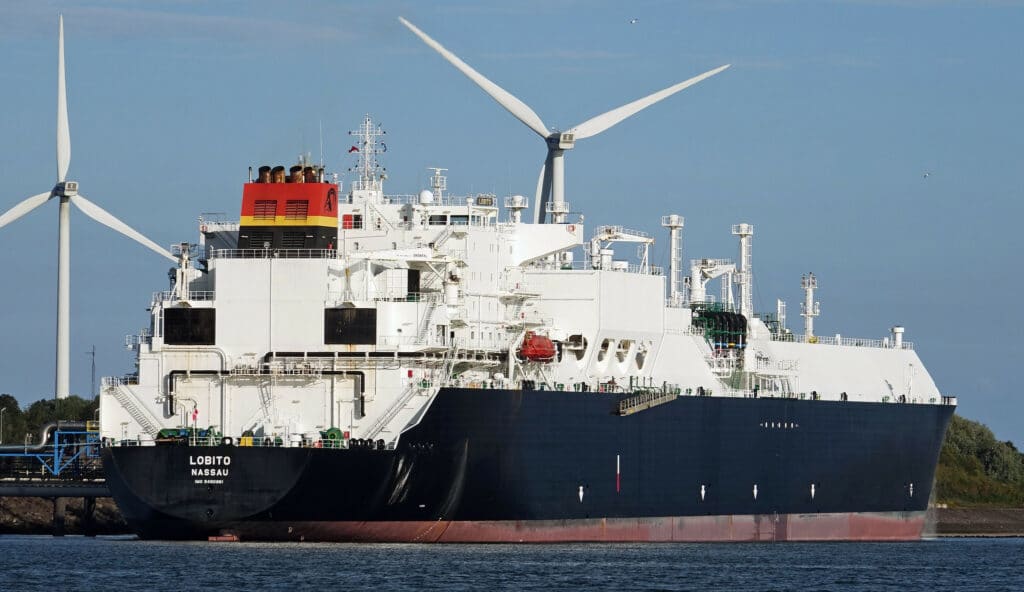 An LNG tanker in Europe passes by wind turbines on Sept. 16, 2021. Credit: Kees Torn, via CC BY-SA 2.0.