Sunday, October 3, 2021

Haiti and the Visible Pain of Racism


https://www.resumen-english.org/2021/09/haiti-and-the-visible-pain-of-racism/


By Alejandra Garcia on September 28, 2021, from Havana

Protest in San Francisco against the racist deportations of Haitians, photo: Bill Hackwell

I have fresh in my mind those images of those guards on horseback chasing Haitians with whips at the southern border of the United States just like in the days of slavery. The pictures taken on September 21 scream from the shadows of that country’s racist past that remains today.

The crisis took place when hundreds of Haitian migrants were trying to cross into the Ciudad Acuna, in Mexico, from a camp set up under a bridge in the town of Del Rio, Texas. They just wanted to buy food and water, which are basic goods they could not find on the US side.

In that camp, over 12,000 migrants, the great majority Haitians, were waiting for political asylum in the United States to escape from their country’s violence and extreme poverty. Instead of taking into account the unfolding human tragedy there the Biden Administration panicked and quickly implemented Title 42 of the United States code that allows immediate expulsion for anyone trying to get into the US who has recently been in a country where a communicable disease was present. In lieu of Covid this would mean just about anywhere but the White House’s decision can only be viewed as one that is an overtly racist move.

Thrust into planes, the images of people arriving back in the Haitian capital, Port-au-Prince on September 22, were just as painful as the ones taken by photojournalists at the southern border of the United States. Many people can be seen desperately running to get their belongings, which were left on the landing strip without any identification following their deportation from North America. While another group of migrants desperatley tried to re-enter the planes in which they had arrived, the rest of the people threw shoes and objects at the aircraft.

“They are only deporting Haitians. People of other nationalities were left in the camp. That is discrimination,” deportee Yranese Melidor told the local press in Port-au-Prince on September 22.

“The U.S. government has no conscience. This hatred against us proves they don’t like us just for the color of our skin,” said Haitian Maxon Prudhomme.

But Haiti’s pain seems imperceptible to the international gaze. Today, not only the U.S. is closing its doors to undocumented immigrants from this Caribbean nation, which faces a constant humanitarian crisis, aggravated by the assassination of President Jovenel Moise and the recent earthquake, two events that shook the country with equal intensity last August.

The alarming situation faced by Haitians in Texas is only a small part of the reality they are facing on other borders of the continent.

The Colombian Ombudsman’s Office reported, for example, that there are some 19,000 undocumented migrants (a record number) stranded in the Necocli city, from where they are waiting for a turn to cross into Panama for the trek North with the distinct possibility of another tragic showdown like the one we just saw play out at the Rio Grande River.

Most of them come from the island of Hispaniola. They make their way north from Central America, through the jungles and swamps of the Darien Gap in Colombia and Panama to the Mexican-Guatemalan border, where they have faced brutal mistreatment, including rapes, robberies and deaths.

“Migrants are victims. Instead of re-victimize, punish, persecute, expel, and deport them, we have to look for mechanisms to protect and receive them,” urged Professor María Teresa Palacios Sanabria, director of the Human Rights Research Program of the Universidad del Rosario, in Bogota.

“This migration has been motivated by the exclusion, discrimination, lack of opportunities, and poverty they experience in their country,” she added.

The region is sitting on top of an immigration time bomb. Haiti, the poorest country in Latin America, has been living through decades of one crisis after another, of power struggles, of diseases growing as fast as criminal gangs, of arbitrary school closures, of children growing up amidst violence, bullets, and food insecurity.

They are alone in a world that does not want them for one reason, as Uruguayan writer Eduardo Galeano would say: “The history of harassment against Haiti, which in our days has tragic dimensions, is also a page out of the history of racism ingrained in Western civilization.”


Source: Resumen Latinoamericano – English

AMERICA’S FATE: OLIGARCHY OR AUTOCRACY


By Chris Hedges,
ScheerPost.com.

September 28, 2021


https://popularresistance.org/americas-fate-oligarchy-or-autocracy/


The competing systems of power are divided between alternatives which widen the social and political divide — and increase potential for violent conflict.

The competing systems of power in the United States are divided between oligarchy and autocracy. There are no other alternatives. Neither are pleasant. Each have peculiar and distasteful characteristics. Each pays lip service to the fictions of democracy and constitutional rights. And each exacerbates the widening social and political divide and the potential for violent conflict.

The oligarchs from the establishment Republican Party, figures such as Liz Cheney, Mitt Romney, George and Jeb Bush and Bill Kristol, have joined forces with the oligarchs in the Democratic Party to defy the autocrats in the new Republican Party who have coalesced in cult-like fashion around Donald Trump or, if he does not run again for president, his inevitable Frankensteinian doppelgänger.

The alliance of Republican and Democratic oligarchs exposes the burlesque that characterized the old two-party system, where the ruling parties fought over what Sigmund Freud called the “narcissism of minor differences” but were united on all the major structural issues including massive defense spending, free trade deals, tax cuts for the wealthy and corporations, the endless wars, government surveillance, the money-saturated election process, neoliberalism, austerity, deindustrialization, militarized police and the world’s largest prison system.

The liberal class, fearing autocracy, has thrown in its lot with the oligarchs, discrediting and rendering impotent the causes and issues it claims to champion. The bankruptcy of the liberal class is important, for it effectively turns liberal democratic values into the empty platitudes those who embrace autocracy condemn and despise. So, for example, censorship is wrong, unless the contents of Hunter Biden’s laptop are censored, or Donald Trump is banished from social media. Conspiracy theories are wrong, unless those theories, such as the Steele dossier and Russiagate, can be used to damage the autocrat. The misuse of the legal system and law enforcement agencies to carry out personal vendettas are wrong, unless those vendettas are directed at the autocrat and those who support him. Giant tech monopolies and their monolithic social media platforms are wrong, unless those monopolies use their algorithms, control of information and campaign contributions to ensure the election of the oligarch’s anointed presidential candidate, Joe Biden.

The perfidy of the oligarchs, masked by the calls for civility, tolerance, and respect for human rights, often outdoes that of the autocracy. The Trump administration, for example, expelled 444,000 asylum seekers under Title 42, a law that permits the immediate expulsion of those who potentially pose a public health risk and denies the expelled migrants the right to make a case to stay in the U.S. before an immigration judge. The Biden administration not only embraced the Trump order in the name of fighting the pandemic, but has thrown out more than 690,000 asylum seekers since taking office in January. The Biden administration, on the heels of another monster hurricane triggered at least in part by climate change, has opened up 80 million acres for oil and gas drilling in the Gulf of Mexico and boasted that the sale will produce 1.12 billion barrels of oil over the next 50 years. It has bombed Syria and Iraq, and on the way out the door in Afghanistan murdered 10 civilians, including seven children, in a drone strike. It has ended three pandemic relief programs, cutting off benefits under the Pandemic Unemployment Assistance that were given to 5.1 million people who worked as freelancers, in the gig economy or as caregivers. An additional 3.8 million people who received assistance from the Pandemic Emergency Unemployment Compensation for the long-term unemployed have also lost access to their benefits. They join the 2.6 million people who no longer receive the $300 weekly supplement and are struggling to cope with a $1,200 drop in their monthly earnings. Biden’s campaign talk of raising the minimum wage, forgiving student debt, immigration reform, and making housing a human right has been forgotten. At the same time, the Democratic leadership, proponents of a new cold war with China and Russia, has authorized provocative military maneuvers along Russia’s borders and in the South China Sea and speeded up production of the long-range B-21 Raider stealth bomber.

Oligarchs come from the traditional nexus of elite schools, inherited money, the military and corporations, those C. Wright Mills calls the “power elite.” “Material success,” Mills notes, “is their sole basis of authority.” The word oligarchy is derived from the Greek word “oligos” meaning “a few” and it is the oligos who sees power and wealth as its birthright, which they pass on to their family and children, as exemplified by George W. Bush or Mitt Romney. The word “autocracy” is derived from the Greek word “auto” meaning “self,” as in one who rules by himself.

In decayed democracies the battle for power is always, as Aristotle points out, between these two despotic forces, although if there is a serious threat of socialism or left-wing radicalism, as was true in the Weimar Republic, the oligarchs forge an uncomfortable alliance with the autocrat and his henchmen to crush it. This is why the donor class and hierarchy of the Democratic Party sabotaged the candidacy of Bernie Sanders, although on the political spectrum Sanders is not a radical, and publicly stated, as the former CEO of Goldman Sachs Lloyd Blankfein did, that should Sanders be the nominee they would support Trump. The alliance between the oligarchs and the autocrats gives birth to fascism, in our case a Christianized fascism.

The oligarchs embrace a faux morality of woke culture and identity politics, which is anti-politics, to give themselves the veneer of liberalism, or at least the veneer of an enlightened oligarchy. The oligarchs have no genuine ideology. Their single-minded goal is the amassing of wealth, hence the obscene amounts of money accrued by oligarchs such as Bill Gates, Elon Musk or Jeff Bezos and the staggering sums of profit made by corporations that have, essentially, orchestrated a legal tax boycott, forcing the state to raise most of its revenues from massive government deficits, now totaling $3 trillion, and disproportionately taxing the working and middle classes.

Oligarchies, which spew saccharine pieties and platitudes, engage in lies that are often far more destructive to the public than the lies of a narcissist autocrat. Yet, the absence of an ideology among the oligarchs gives to oligarchic rule a flexibility lacking in autocratic forms of power. Because there is no blind loyalty to an ideology or a leader there is room in an oligarchy for limited reform, moderation and those who seek to slow or put a brake on the most egregious forms of injustice and inequality.

An autocracy, however, is not pliable. It burns out these last remnants of humanism. It is based solely on adulation of the autocrat, no matter how absurd, and the fear of offending him. This is why politicians such as Lindsey Graham and Mike Pence, at least until he refused to invalidate the election results, humiliated themselves abjectly and repeatedly at the feet of Trump. Pence’s unforgivable sin of certifying the election results instantly turned him into a traitor. One sin against an autocrat is one sin too many. Trump supporters stormed the capital on Jan. 6 shouting “Hang Mike Pence.” As Cosimo de’ Medici remarked, “We are nowhere commanded to forgive our friends.”

The political and economic disempowerment that is the consequence of oligarchy infantilizes a population, which in desperation gravitates to a demagogue who promises prosperity and a restoration of a lost golden age, moral renewal based on “traditional” values and vengeance against those scapegoated for the nation’s decline.

The Biden’s administration’s refusal to address the deep structural inequities that plague the country is already ominous. In the latest Harvard/Harris poll Trump has overtaken Biden in approval ratings, with Biden falling to 46 percent and Trump rising to 48 percent. Add to this the report by the University of Chicago Project on Security & Threats that found that 9 percent of Americans believe the “use of force is justified to restore Donald J. Trump to the presidency.” More than one-fourth of adults agree, to varying degrees, the study found, that, “the 2020 election was stolen, and Joe Biden is an illegitimate president.” The polling indicates that 8.1 percent — 21 million Americans — share both these beliefs. Anywhere from 15 million to 28 million adults would apparently support the violent overthrow of the Biden administration to restore Trump to the presidency.

“The insurrectionist movement is more mainstream, cross-party, and more complex than many people might like to think, which does not bode well for the 2022 mid-term elections, or for that matter, the 2024 Presidential election,” the authors of the Chicago report write.

Fear is the glue that holds an autocratic regime in place. Convictions can change. Fear does not. The more despotic an autocratic regime becomes, the more it resorts to censorship, coercion, force, and terror to cope with its endemic and often irrational paranoia. Autocracies, for this reason, inevitably embrace fanaticism. Those who serve the autocracy engage in ever more extreme acts against those the autocrat demonizes, seeking the autocrat’s approval and the advancement of their careers.

Revenge against real or perceived enemies is the autocrat’s single-minded goal. The autocrat takes sadistic pleasure in the torment and humiliation of his enemies, as Trump did when he watched the mob storm the capital on Jan. 6, or, in a more extreme form, as Joseph Stalin did when he doubled over in laughter as his underlings acted out the desperate pleading for his life by the condemned Grigori Zinoviev, once one of the most influential figures in the Soviet leadership and the chairman of the Communist International, on the way to his execution in 1926.

Autocratic leaders, as Joachim Fest writes, are often “demonic nonentities.”

“Rather than the qualities which raised him from the masses, it was those qualities he shared with them and of which he was a representative example that laid the foundation for his success,” Fest wrote of Adolf Hitler, words that could apply to Trump. “He was the incarnation of the average, ‘the man who lent the masses his voice and through whom the masses spoke.’ In him the masses encountered themselves.”

The autocrat, who celebrates a grotesque hyper-masculinity, projects an aura of omnipotence. He demands obsequious fawning and total obedience. Loyalty is more important than competence. Lies and truth are irrelevant. The statements of the autocrat, which can in short spaces of time be contradictory, cater exclusively to the transient emotional needs of his followers. There is no attempt to be logical or consistent. There is no attempt to reach out to opponents. Rather, there is a constant stoking of antagonisms that steadily widens the social, political, and cultural divides. Reality is sacrificed for fantasy. Those who question the fantasy are branded as irredeemable enemies.

“Anyone who wants to rule men first tries to humiliate them, to trick them out of their rights and their capacity for resistance, until they are as powerless before him as animals,” wrote Elias Canetti in “Crowds and Power” of the autocrat:


“He uses them like animals and, even if he does not tell them so, in himself he always knows quite clearly that they mean just as little to him; when he speaks to his intimates, he will call them sheep or cattle. His ultimate aim is to incorporate them into himself and to suck the substance out of them. What remains of them afterwards does not matter to him. The worse he has treated them, the more he despises them. When they are no more use at all, he disposes of them as he does excrement, simply seeing to it that they do not poison the air of his house.”

It is, ironically, the oligarchs who build the institutions of oppression, the militarized police, the dysfunctional courts, the raft of anti-terrorism laws used against dissidents, ruling through executive orders rather than the legislative process, wholesale surveillance and the promulgation of laws that overturn the most basic constitutional rights by judicial fiat. Thus, the Supreme Court rules that corporations have the right to pump unlimited amounts of money into political campaigns because it is a form of free speech, and because corporations have the constitutional right to petition the government. The oligarchs do not use these mechanisms of oppression with the same ferocity as the autocrats. They employ them fitfully and therefore often ineffectually. But they create the physical and legal systems of oppression so that an autocrat, with the flick of a switch, can establish a de facto dictatorship.

The autocrat oversees a naked kleptocracy in place of the hidden kleptocracy of the oligarchs. But it is debatable whether the more refined kleptocracy of the oligarchs is any better than the crude and open kleptocracy of the autocrat. The autocrat’s attraction is that as he fleeces the public, he entertains the crowd. He orchestrates engaging spectacles. He gives vent, often through vulgarity, to the widespread hatred of the ruling elites. He provides a host of phantom enemies, usually the weak and the vulnerable, who are rendered nonpersons. His followers are given license to attack these enemies, including the feckless liberals and intellectuals who are a pathetic appendage to the oligarchic class. Autocracies, unlike oligarchies, make for engaging political theater.

We must defy the oligarchs as well as the autocrats. If we replicate the cowardice of the liberal class, if we sell out to the oligarchs as a way to blunt the rise of autocracy, we will discredit the core values of a civil society and fuel the very autocracy we seek to defeat. Despotism, in all its forms, is dangerous. If we achieve nothing else in the fight against the oligarchs and the autocrats, we will at least salvage our dignity and integrity.


HBO’S ANTI-MADURO PROPAGANDA IS CRUDER THAN VENEZUELAN OIL


https://popularresistance.org/hbos-anti-maduro-propaganda-is-cruder-than-venezuelan-oil/


By Joe Emersberger,
Fairness and Accuracy In Reporting.

September 28, 2021
EDUCATE!


HBO Max began streaming a documentary on September 15: A La Calle (“To the Street”). It portrays US-backed opposition leaders in Venezuela as pro-democracy heroes battling a brutal dictatorship—a total reversal of the truth. A Daily Beast article (9/13/21) promoting the film is headlined “Capturing Venezuela’s Descent Into Socialist Hell,” which succinctly conveys the film’s slant, and suggests why it found a big corporate platform like HBO Max, a subsidiary of AT&T‘s WarnerMedia.

From the trailer alone, it’s obvious that A La Calle depicts Venezuelan opposition leader Leopoldo López as a noble democrat. That’s outrageous.
Legacy Of Violent Coup Attempts

López, a former oil industry executive, was one of the perpetrators of a US-backed coup in 2002 that briefly ousted the democratically elected president at the time, Hugo Chávez. A dictatorship under business executive Pedro Carmona killed 60 protesters during the two days it was in power. (Another 19 people, half of them Chavistas, were killed in violent confrontations just before the coup.) López—along with another prominent politician, Henrique Capriles—led the kidnapping of a Chávez government minister while Carmona was in power. López appeared on local TV, proudly saying that he had briefed “President Carmona” about the kidnapping.

Several months later, López backed a second major coup attempt, the opposition-led sabotage of the oil industry that supplied almost all Venezuela’s export revenue. The coup attempts against Chávez drove the poverty rate to over 60% by early 2003.

López supported violent protests again in 2013 after the candidate he backed, Capriles, refused to accept his loss to President Nicolás Maduro in the first presidential election after Hugo Chávez’s death. Later that year, López criticized Capriles for calling off the protests, saying they should have continued until Maduro was ousted. When Capriles called off the protests, they had already left nine people dead, all supporters of Maduro.

López initiated protests early in 2014 that led to 43 deaths: Half of them strongly indicate the responsibility of his supporters. It was only after leading that fourth US-backed effort to oust the elected Venezuelan government that López finally went to jail.
Not Excusing But Ignoring Crimes

I watched the whole documentary, curious to see how exactly the film would whitewash all the coup attempts López was involved with, and how it would deny the violence his supporters and allies perpetrated over the past 20 years.

I also wondered how the film would excuse murderous US economic sanctions on Venezuela—acts of war that have been linked to the deaths of tens of thousands of Venezuelans by the end of 2018 alone. By 2021, US sanctions, which have been relentlessly intensified since 2019, reduced Venezuela’s government revenue by 99%, according to UN special investigator Alena Douhan.

I expected to see bad arguments justifying all these crimes. Instead, the documentary edited them out of existence completely. None of these things were mentioned even once: nothing about the US-backed coup attempts prior to 2014, nothing about devastating economic warfare the US has inflicted on Venezuela since 2017.

Venezuelan economist Ricardo Hausmann and Tamara Taraciuk (deputy Americas director of Human Rights Watch) deserve special attention for the mendacity of the statements they made.
Distorted History Lesson

In the film, Hausmann said that Chávez came to power because 1998, the year Chávez was first elected, “was an economically difficult year.” In fact, Venezuela had a few disastrous decades before Chávez was first elected. Hausmann should know, because in 1992, he became a minister in the government of Carlos Andres Pérez, which had perpetrated the Caracazo Massacre in 1989: Hundreds, possibly thousands, of poor people were gunned down during five days of protests against an IMF-imposed austerity program.

In a recent article (FAIR.org, 8/26/21), Justin Podur and I reviewed Venezuela’s economic history, showing that it had always been plagued with shocking poverty and inequality, despite Venezuela being a major oil exporter since the 1930s. Of course, “Venezuela’s Descent Into Capitalist Hell” is not a headline you are likely to find in corporate media coverage from the pre-Chávez era.

After deceptively explaining why Chavez was first elected, Hausmann moved on to bigger lies. “Hugo Chávez, in the first five years, changed many things,” he said, “but the economic situation did not improve.”

That’s a very crude lie of omission. Hausmann neglected to say that within those first five years, Chávez was hit with two major US-backed coup attempts that devastated the economy. By surviving those coup attempts, Chávez was, in 2003, finally able to get control of the state oil company, PDVSA, the country’s main source of hard currency.

Hausmann then deceived viewers again by saying, “In 2004, the price of oil shot up. Suddenly Hugo Chavez realizes that he has a lot of money.”

The price of oil had actually been rising since 1998, the year before Chávez first took office. Fortunately for most Venezuelans, oil prices kept rising for several years after Chávez finally wrested control of PDVSA from saboteurs. The economy was therefore able to quickly recover from the coup attempts and begin a period of dramatic poverty reduction.


Poverty in Venezuela fell sharply not when oil prices rose but when President Hugo Chávez broke the opposition’s efforts to sabotage the economy. Source: INEC via CEPR (3/7/13).
No ‘Recent’ Precedent?

About 40 minutes into the documentary, Tamara Taraciuk of Human Rights Watch says that the violent protests of 2017 (which the film shows Leopoldo López encouraging from his jail cell) have “no precedent in recent Venezuelan history.” The word “recent” does a great deal of heavy lifting in this absurd statement.

Was the April, 2002 coup attempt (which killed 79 people, overwhelmingly supporters of Hugo Chávez, and briefly overthrew the government) not “recent,” deadly or politically significant enough to offer a “precedent” for the protests in 2017, which left 126 people dead? Also, it’s not clear if most of the victims in 2017 were opposition protesters. Some of the protesters perpetrated gruesome atrocities, like burning alive Orlando Figuera, a 21-year-old Afro Venezuelan government supporter.

What about the Caracazo Massacre of 1989, which was perpetrated by a pro-US government? Does it count as “recent Venezuelan history”? In five days, the Caracazo death toll surpassed, possibly by an order of magnitude, the combined death toll on all sides during US-backed protests against Venezuela’s Chavista governments in 2002, 2013, 2014 and 2017. (Incidentally, the Caracazo Massacre also had no impact on friendly US/Venezuela relations, or on the flattering US press coverage of the Venezuelan government at the time—FAIR.org, 8/26/21.)

About an hour and 28 minutes into the film, Taraciuk says that any “decent government” in Venezuela’s dire economic situation would “ask for help,” but that Maduro has “closed the door to international aid, which is available.” This was a commonly told lie around February 2019, when Trump’s government, fresh from recognizing Juan Guaidó as Venezuela’s interim president, demanded that Venezuela’s military defy Maduro and allow about $20 million of supposed “aid” to enter from Colombia (FAIR.org, 2/12/19).

Even at the time, this quantity of “aid” was a rounding error compared to the impact of economic sanctions that Trump had imposed since August 2017. Taraciuk never questions the “decency” of Trump deliberately choosing to strangle an economy that was already in crisis. That alone makes her comment obscene, but also, contrary to what she claims, Maduro had requested international aid that Venezuela was receiving prior to the US-led aid stunt of 2019 (FAIR.org, 2/12/19).
Committed To Debunked Propaganda

The documentary is so committed to debunked propaganda from 2019 that it also gives the impression that an aid truck on the Colombian border was set on fire by forces loyal to Maduro. “Three or four trucks entered into Venezuelan territory, but one of them was burned,” López says on camera. The Grayzone (2/24/19) and a bit later even the New York Times (3/10/19) refuted that lie at the time, noting that

After 2019, Western media actually moved on from pushing the lie that Maduro rejects international aid, largely because Trump, and now Biden, became so blatantly sadistic with their economic warfare on Venezuela (FAIR.org, 3/25/20, 7/21/21).

About 70 minutes into the documentary, Taraciuk strongly insinuates that votes were not secret during the May 2018 presidential election that Maduro won by a landslide, saying that voters “had to go through the punto rojo to register their vote.” The puntos rojos (“red points”) are kiosks the government has always set up near voting centers for exit polling. Even an anti-Maduro writer who attacked these kiosks as “blackmail” conceded that the government can’t know how people voted.

It’s also profoundly hypocritical to allege that Maduro coerced voters, while ignoring the obvious threat the US has sent Venezuelan voters since 2017: that crippling economic warfare against Venezuela will continue and intensify until Maduro is overthrown.

In any case, Maduro’s vote count in 2018 was in line with the level of support a Pew Research poll (hardly a pro-Maduro outfit) suggested he had several months later. It found that 33% of Venezuelans “trust the national government to do what is right for Venezuela.” That’s also a level of support among eligible voters that routinely wins elections in Canada, the US and UK (Mint Press News, 1/28/19).
Part Of The Western Media Herd

Throughout the film, numerous clips from big media outlets reinforce the film’s dishonesty. Fox News correspondent Bryan Llenas says, “Venezuela is crumbling under the weight of Maduro’s oppressive regime.” A BBC journalist glares at Maduro with imperial contempt as he, quite validly, rejects the claim that his 2018 re-election was illegitimate.

Western media have long developed a kind of shorthand, repeated endlessly, that demands total impunity for US-backed politicians like Leopoldo López in Venezuela. Any legal consequences for US-backed sedition are portrayed as oppression (FAIR.org, 4/23/18).

US entertainment media have also contributed to the vilification campaign against Maduro’s government (FAIR.org, 9/18/19). Last year Ethan Hawke did a fawning interview with López (an old friend whom Hawke met while attending a private high school in New York). It’s very easy to see why HBO Max would feel comfortable streaming a documentary as ridiculous as A La Calle.


The Names You’ll Never Know


By Nick Turse
TomDispatch.com


https://consortiumnews.com/2021/09/28/the-names-youll-never-know/


As a parting shot, on its way out of Afghanistan, the United States military launched a drone attack that the Pentagon called a “righteous strike.” The final missile fired during 20 years of occupation, that Aug. 29 airstrike averted an Islamic State car-bomb attack on the last American troops at Kabul’s airport. At least, that’s what the Pentagon told the world.

Within two weeks, a New York Times investigation would dismantle that official narrative. Seven days later, even the Pentagon admitted it. Instead of killing an ISIS suicide bomber, the United States had slaughtered 10 civilians: Zemari Ahmadi, a longtime worker for a U.S. aid group; three of his children, Zamir, 20, Faisal, 16, and Farzad, 10; Ahmadi’s cousin Naser, 30; three children of Ahmadi’s brother Romal, Arwin, 7, Benyamin, 6, and Hayat, 2; and two 3-year-old girls, Malika and Somaya.

The names of the dead from the Kabul strike are as important as they are rare. So many civilians have been obliterated, incinerated, or — as in the Aug. 29 attack — “shredded” in America’s forever wars.


Who in the United States remembers them? Who here ever knew of them in the first place? Twenty years after 9/11, with the Afghan War declared over, combat in Iraq set to conclude, and President Joe Biden announcing the end of “an era of major military operations to remake other countries,” who will give their deaths another thought?

Americans have been killing civilians since before there was a United States. At home and abroad, civilians — Pequots, African Americans, Cheyenne and Arapaho, Filipinos, Haitians, Japanese, Germans, Koreans, Vietnamese, Cambodians, Laotians, Afghans, Iraqis, Syrians, Yemenis, and Somalis, among others — have been shot, burned, and bombed to death. The slaughter at Sand Creek, the Bud Dajo massacre, the firebombing of Dresden, the atomic bombing of Hiroshima, the My Lai massacre — the United States has done what it can to sweep it all under the rug through denial, cover-ups, and the most effective means of all: forgetting.

There’s little hope of Americans ever truly coming to terms with the Pequot or Haitian or Vietnamese blood on their hands. But before the forever wars slip from the news and the dead slide into the memory hole that holds several centuries worth of corpses, it’s worth spending a few minutes thinking about Zemari Ahmadi, Benyamin, Hayat, Malika, Somaya, and all the civilians who were going about their lives until the U.S. military ended them.

Names Remembered & Names Forgotten

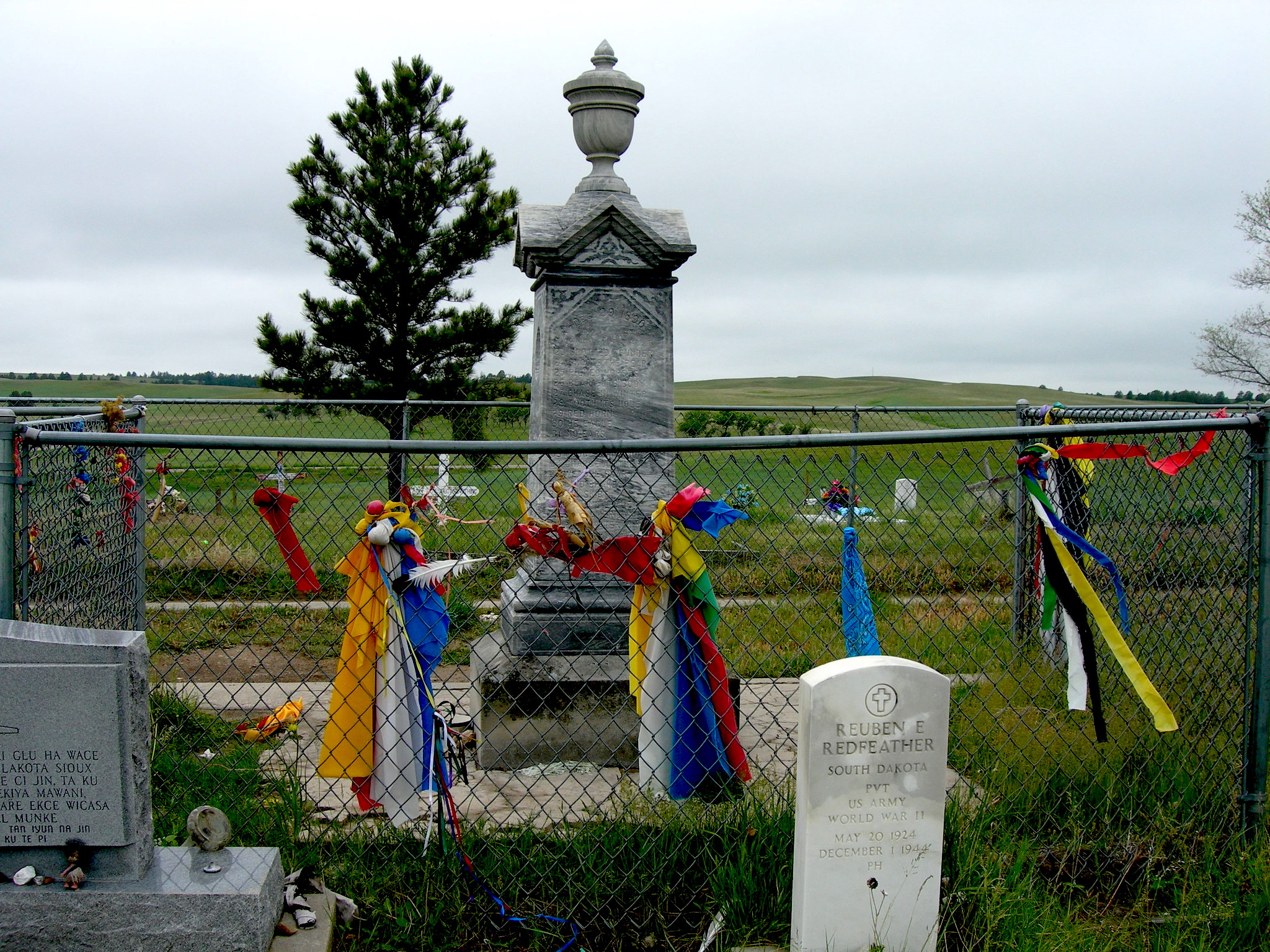
The dead from the Massacre of Wounded Knee are buried here in Wounded Knee, South Dakota. (Jimmy Emerson, DVM, Flickr, CC BY-NC-ND 2.0)

Over the last 20 years, the United States has conducted more than 93,300 air strikes — in Afghanistan, Iraq, Libya, Pakistan, Somalia, Syria and Yemen — that killed between 22,679 and 48,308 civilians, according to figures recently released by Airwars, a U.K.-based airstrike monitoring group. The total number of civilians who have died from direct violence in America’s wars since 9/11 tops out at 364,000 to 387,000, according to Brown University’s Costs of War Project.

Who were those nearly 400,000 people?

There’s Malana. In 2019, at age 25, she had just given birth to a son, when her health began to deteriorate. Her relatives were driving her to a clinic in Afghanistan’s Khost Province when their vehicle was attacked by a U.S. drone, killing Malana and four others.

And Gul Mudin. He was wounded by a grenade and shot with a rifle, one of at least three civilians murdered by a U.S. Army “kill team” in Kandahar Province in 2010.

Then there was Gulalai, one of seven people, including three women — two of them pregnant — who were shot and killed in a Feb. 12, 2010, raid by Special Operations forces in Afghanistan’s Paktia Province.

And the four members of the Razzo family — Mayada, Tuqa, Mohannad, and Najib — killed in a Sept. 20, 2015, airstrike in Mosul, Iraq.

And there were the eight men, three women, and four children — Abdul Rashid as well as Abdul Rahman, Asadullah, Hayatullah, Mohamadullah, Osman, Tahira, Nadia, Khatima, Jundullah, Soheil, Amir, and two men, ages 25 and 36 respectively, named Abdul Waheed — who were killed in a Sept. 7, 2013, drone strike on Rashid’s red Toyota pickup in Afghanistan.

Then there were 22-year-old Lul Dahir Mohamed and her 4-year-old daughter, Mariam Shilo Muse, who were killed in an April 1, 2018, airstrike in Somalia.

And between 2013 and 2020, in seven separate U.S. attacks in Yemen — six drone strikes and one raid — 36 members of the al Ameri and al Taisy families were slaughtered.

Those names we know. Or knew, if only barely and fleetingly. Then there are the countless anonymous victims like the three civilians in a blue Kia van killed by Marines in Iraq in 2003. “Two bodies were slumped over in the front seats; they were men in street clothes and had no weapons that I could see. In the back seat, a woman in a black chador had fallen to the floor; she was dead, too,” wrote Peter Maass in The New York Times Magazine in 2003. Years later, at The Intercept, he painted an even more vivid picture of the “blue van, with its tires shot out and its windows shattered by bullets, its interior stained with blood and smelling of death, with flies feasting on already-rotting flesh.”

Those three civilians in Iraq were all too typical of the many anonymous dead of this country’s forever wars — the man shot for carrying a flashlight in an “offensive” manner; the children killed by an “errant” rocket; the man slain by “warning shots”; the three women and one man “machine-gunned” to death; and the men, women and children reduced to “charred meat” in an American bombing.

Who were the 11 Afghans — four of them children — who died in a 2004 helicopter attack, or the “dozen or more” civilians killed in 2010 during a nighttime raid by U.S. troops in that same country? And what about those 30 pine-nut farm workers slaughtered a year later by a drone strike there? And what were the names of Mohanned Tadfi’s mother, brother, sister-in-law, and seven nieces and nephews killed in the U.S. bombing that flattened the city of Raqqa, Syria, in 2017?

Often, the U.S. military had no idea whom they were killing. It frequently carried out “signature strikes” that executed unknown people due to suspicious behavior. So often, Americans killed such individuals for little or no reason — like holding a weapon in places where, as in this country, firearms were ubiquitous — and then counted them as enemy dead.

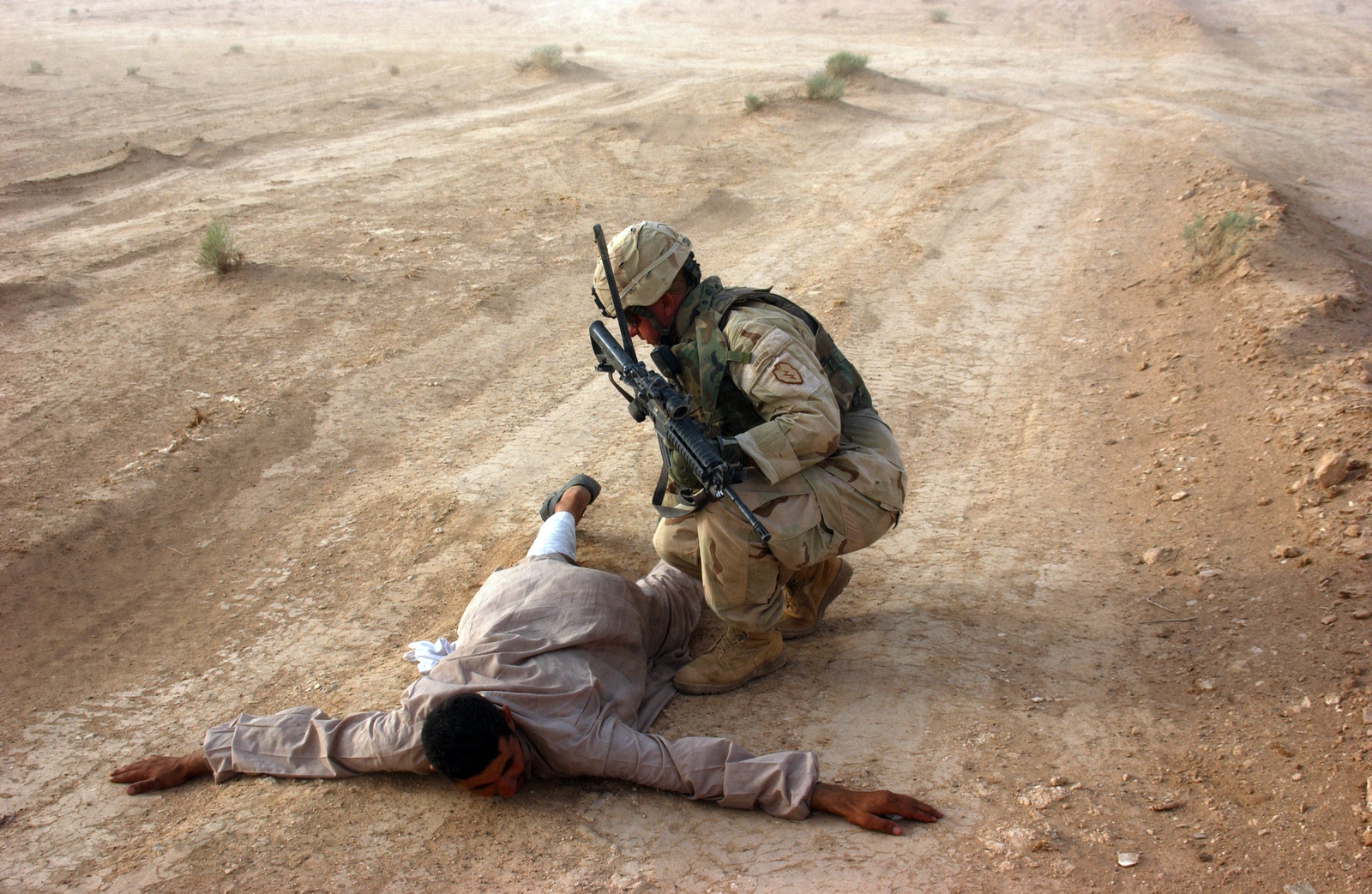
U.S. soldier searches an Iraqi man during a patrol near the Syrian border on Aug. 10, 2005. (U.S. Army, Kyle Davis)

An investigation by Connecting Vets found that during a 2019 air campaign in Afghanistan’s Helmand province, for example, the threshold for an attack “could be met by as little as a person using or even touching a radio” or if an Afghan carrying “commercially bought two-way radios stepped into a home, the entire building would sometimes be leveled by a drone strike.”

Targeted assassinations were equally imprecise. Secret documents obtained by The Intercept revealed that, during a five-month stretch of Operation Haymaker — a drone campaign in 2011 and 2013 aimed at al-Qaeda and Taliban leaders along the Afghan-Pakistan border — 200 people were killed in airstrikes conducted to assassinate 35 high-value targets. In other words, nearly nine out of 10 people slain in those “targeted” killings were not the intended targets. So, who were they?

Even if targeting was ordinarily more accurate than during Operation Haymaker, U.S. policy has consistently adhered to the dictum that “military-age males” killed in airstrikes should automatically be classified as combatants unless proven innocent. In addition to killing people for spurious reasons, the U.S. also opted for allies who would prove at least as bad as, if not worse than, those they were fighting. For two decades, such American-taxpayer-funded warlords and militiamen murdered, raped, or shook-down the very people the U.S. government was supposedly protecting. And, of course, no one knows the names of all those killed by such allies who were being advised, trained, armed and funded by the United States.

Who, for instance, were the two men tied to the rear fender of a Toyota pickup truck in southeastern Afghanistan in 2012 by members of an Afghan militia backed by U.S. Special Operations forces? They were, wrote reporter Anand Gopal, dragged “along six miles of rock-studded road” until they were dead. Then their “bodies were left decomposing for days, a warning to anyone who thought of disobeying Azizullah,” the U.S.-allied local commander.

Or what about the 12 boys gunned down by CIA-backed militiamen at a madrassa in the Afghan village of Omar Khail? Or the six boys similarly slain at a school in nearby Dadow Khail? Or any of the dead from 10 raids in 2018 and 2019 by that same militia, which summarily executed at least 51 civilians, including boys as young as eight years old, few of whom, wrote reporter Andrew Quilty, appeared “to have had any formal relationship with the Taliban”?

How many reporters’ notebooks are filled with the unpublished names of just such victims? Or counts of those killed? Or the stories of their deaths? And how many of those who were murdered never received even a mention in an article anywhere?

Last year, I wrote 4,500 words for The New York Times Magazine about the deteriorating situation in Burkina Faso. As I noted then, that nation was one of the largest recipients of American security aid in West Africa, even though the State Department admitted that U.S.-backed forces were implicated in a litany of human-rights abuses, including extrajudicial killings.

What never made it into the piece was any mention of three men who were executed in two separate attacks. On May 22, 2019, uniformed Burkinabe troops arrived in the village of Konga and took two brothers, aged 38 and 25, away in the middle of the night. The next day, a relative found them on the side of the road, bound and executed. Most of the family fled the area. “The Army came back a week later,” a relative told me. “My uncle was the only one in our family who stayed. He was shot in broad daylight.” Such deaths are ubiquitous but aren’t even factored into the 360,000-plus civilian deaths counted by the Costs of War project, which offers no estimate for those killed in America’s “smaller war zones.”

Build the Wall!

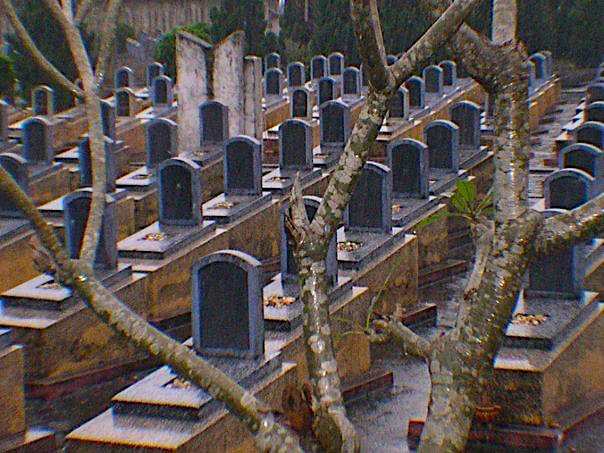
A Vietnamese graveyard from the war against the U.S. (Joe Lauria)

We live in a world filled with monuments celebrating lives and deaths, trailblazers and memorable events, heroes and villains. They run the gamut from civil rights leader Martin Luther King, Jr., and women’s rights pioneers to the chieftains of the American Confederacy and Belgium’s King Leopold.

In the United States, there’s no shortage of memorials and monuments commemorating America’s wars and fallen soldiers. One of the most poignant lists the names of the American military dead of the Vietnam War. Initially derided by hawkish veterans and conservatives as a “black gash of shame” and a “nihilistic slab,” it’s now one of the most celebrated monuments in Washington, D.C. More than 58,000 men and women are represented on the visually arresting black granite walls of the Vietnam Veterans Memorial.

Vietnam itself has no shortage of monuments of its own. Many are Soviet-style memorials to those who died defeating the United States and reuniting their country. Others are seldom-seen, tiny memorials to massacres perpetrated by the Americans and their allies. No one knows how many similar cenotaphs exist in Iraq, Syria, Yemen, and other forever-war countries, but in 2017, journalist Emran Feroz found just such a memorial in Afghanistan’s Wardak Province — a remembrance of five civilians slain in drone strikes during 2013 and 2014.

There have been other attempts to memorialize the civilian dead of the forever wars from art installations to innovative visual protests to virtual commemorations.

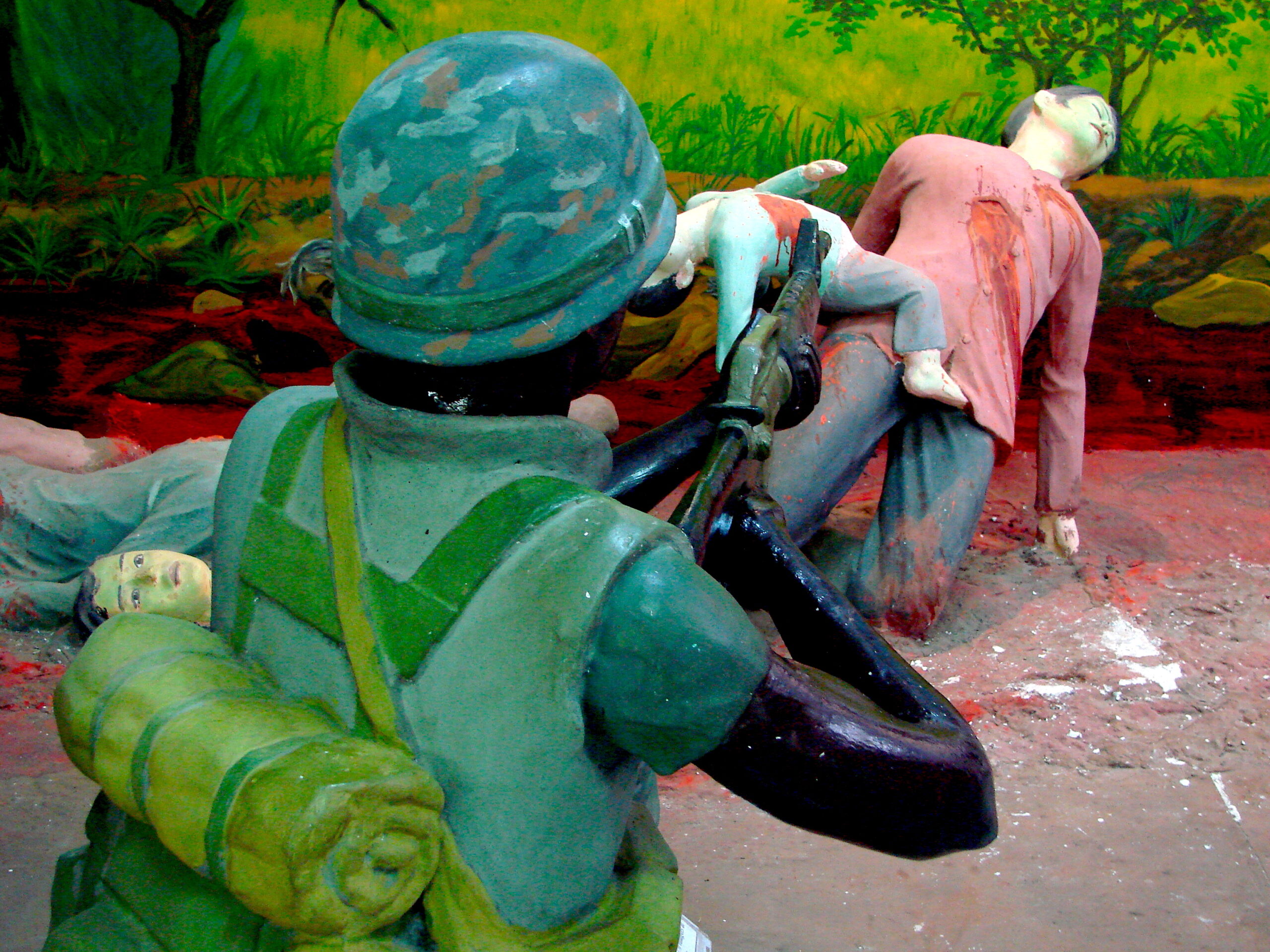
A diorama in the museum of the My Lai massacre memorial site, near Quang Ngai, Vietnam, depicts the up-close nature of the massacre. (Adam Jones, CC BY-SA 3.0, Wikimedia Commons)

In 2018, after then-President Trump signed a bill approving the construction of a Global War on Terrorism Memorial, Peter Maass proposed, even if only half-seriously, that the bullet-riddled blue Kia van he saw in Iraq should be placed on a pedestal on the National Mall. “If we start building monuments that focus our attention on the pitiless killing of civilians in our wars,” he wrote, “maybe we would have fewer wars to fight and less reason to build these monuments.”

A blue Kia on the National Mall would be a good starting point. But if we’re ever to grasp the meaning of the post-9/11 wars and all the conflicts that set the stage for them, however, we may need a wall as well — one that starts at the Kia and heads west. It would, of course, be immense. The Vietnam Veterans Memorial spans a total of 400 feet. The celebrated Vietnam War photographer Philip Jones Griffiths observed that a wall for the Vietnamese dead, counting combatants, of the American War would be nine miles long.

The Vietnam Veterans Memorial is arrayed in a unique chronological format, but the Civilian Deaths Memorial could begin with anyone. The last civilians killed by the United States as part of its 2001 to 2021 Afghan War – Zemari Ahmadi, Zamir, Faisal, Farzad, Naser, Arwin, Benyamin, Hayat, Malika, and Somaya – could lead it off. Then maybe Abdul Rashid and the 14 passengers from his red pick-up truck. Then Malana, Gul Mudin, Gul Rahim, Gulalai, Mayada, Tuqa, Mohannad, Najib, Lul Dahir Mohamed, and Mariam Shilo Muse. Then maybe Ngo Thi Sau, Cao Muoi, Cao Thi Thong, Tran Cong Chau Em, Nguyen Thi Nhi, Cao Thi Tu, Le Thi Chuyen, Dang Thi Doi, Ngo Thi Chiec, Tran Thi Song, Nguyen Thi Mot, Nguyen Thi Hai, Nguyen Thi Ba, Nguyen Thi Bon, Ho Thi Tho, Vo Thi Hoan, Pham Thi Sau, Dinh Van Xuan, Dinh Van Ba, Tran Cong Viet, Nguyen Thi Nham, Ngo Quang Duong, Duong Thi Hien, Pham Thi Kha, Huynh Van Binh, Huynh Thi Bay, Huynh Thi Ty, Le Van Van, Le Thi Trinh, Le Thi Duong, and Le Vo Danh and her unborn child, all slaughtered in the tiny South Vietnamese village of Phi Phu by U.S. troops (without any of the attention accorded to the My Lai massacre). They could be followed by the names of, or placeholders for, the remaining 2 million Vietnamese civilian dead and by countless Cambodians, Laotians, Afghans, Iraqis, Somalis and Yemenis.

The Civilian Wall could be built in a zig-zag fashion across the U.S. with the land in its way — homes and businesses, parks and roadways — seized by eminent domain, making Americans care about civilian deaths in ways that news articles never could.

When you lose your home to a slab of granite that reads “Pequot adult, Pequot adult, Pequot child…” 500 times, you may actually take notice. When you hear about renewed attacks in Iraq or drone strikes in Somalia or a Navy SEAL raid gone awry in Yemen and worry that the path of the wall might soon turn toward your town, you’re likely to pay far more attention to America’s conflicts abroad.

Obviously, a westward-traveling wall memorializing civilian carnage is a non-starter in this country, but the next time you hear some fleeting murmur about a family wiped out by a drone strike or read a passing news story about killings by a U.S.-backed militia, think about that imaginary wall and how, in a just world, it might be headed in your direction. In the meantime, perhaps the best we can hope for is Maass’s proposal for that blue Kia on the Mall. Perhaps it could be accompanied by the inscription found on a granite slab at the Heidefriedhof, a cemetery in Dresden, Germany, the site of a mass grave for civilians killed in a 1945 U.S. and British fire-bombing. It begins: “How many died? Who knows the number?”


We Are This Close To Corporate World Domination


https://www.youtube.com/watch?v=CkHDgNYHkPg&ab_channel=act.tv


How Narcissist/Psychopath Sees YOU (his Victim) & Why Borderlines Adore Them


https://www.youtube.com/watch?v=CTrEyx4hj_w&ab_channel=Prof.SamVaknin


How Narcissists Dehumanize You


https://www.youtube.com/watch?v=qMLPeQpUmyA&ab_channel=SurvivingNarcissism