Sunday, September 5, 2021

Arkansas people are slow learners


https://www.motherjones.com/coronavirus-updates/2021/08/covid-arkansas-asa-hutchinson-mask-madates/


As COVID Breaks Records in Arkansas, Its GOP Governor Regrets Ban on Mask Mandates
Asa Hutchinson is calling a special legislative session to roll it back.


INAE OHNews and Engagement EditorBio | Follow
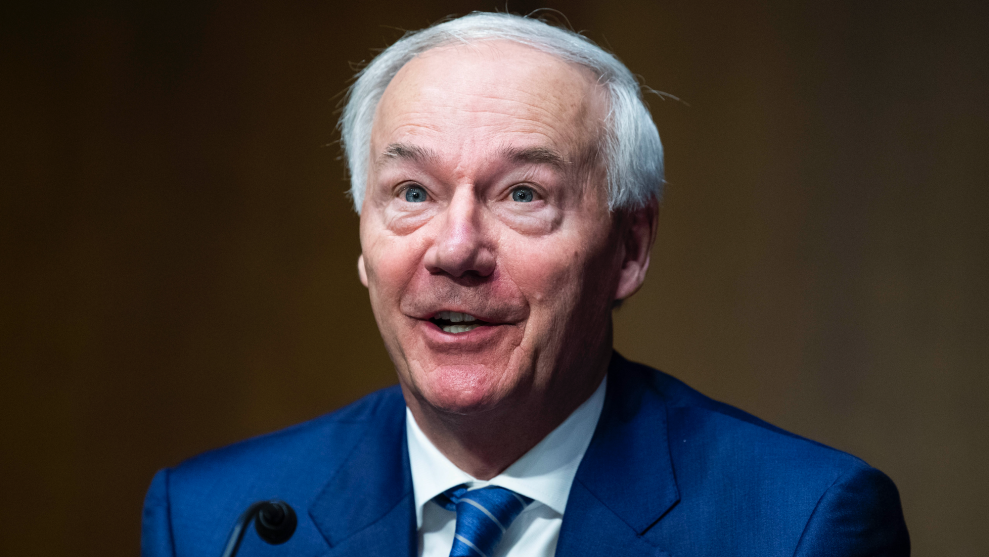


Tom Williams/ZUMA


The coronavirus is a rapidly developing news story, so some of the content in this article might be out of date. Check out our
most recent coverage of the coronavirus crisis, and subscribe to the Mother Jones Daily newsletter.

As the spread of the highly contagious Delta variant shatters coronavirus case records in Arkansas, its Republican governor is scrambling to reverse a ban on local mask mandates he signed into law just months ago. But as Gov. Asa Hutchinson admitted in a press conference Monday, rolling it back will be difficult—and something he probably can’t do without broader support from his party’s lawmakers.

“In hindsight, I wish that had not become law,” Hutchinson told reporters. “But it is the law and the only chance we have is either to amend it or for the courts to say it has an unconstitutional foundation.” The governor, who last week declared a public health emergency amid surging COVID cases, is now calling for a special legislative session to amend the ban. But Hutchinson’s admission of regret may not be enough to convince the state’s GOP-controlled legislature.

Resistance to vaccines has exacerbated the crisis, with Arkansas communities accounting for some of the country’s lowest vaccination rates. Last week, Hutchinson faced vaccine hesitancy firsthand when he was roundly booed on stage after challenging the lie that vaccines cause fertility issues.


While Hutchinson was just one of many GOP governors to enthusiastically embrace a ban on mask mandates earlier in the pandemic, he is the first to try to roll back such an order. His move stands in stark contrast to other Republican governors still doubling down on them, as in Florida, Mississippi, and Texas, even as their states see cases explode. As I wrote earlier:


On Saturday, Florida recorded 21,683 new cases of COVID-19, breaking its one-day record for new cases. But even as the state swells with fresh infections, Republican Gov. Ron DeSantis remains hellbent on his war against mask mandates. He even recently barred school districts from instituting mask mandates when classes reconvene in August.

DeSantis is far from alone in his bitter fight against mask-wearing, a measure health officials say is critical in the fight to contain the highly contagious Delta variant. In Mississippi, where ICU beds are nearing capacity with a surge of unvaccinated individuals, Republican Gov. Tate Reeves blasted the CDC’s mask guidelines as “foolish” and claimed that it reeked of “political panic.”

“It has nothing, let me say that again: It has nothing to do with rational science,” Reeves said on Thursday.

On Monday, President Biden directly called out Republican governors who are blocking schools and businesses in their states from instituting mask mandates, telling them to “get out of the way.”

“Some governors aren’t willing to do the right things to make this happen,” Biden told reporters. “I say to these governors, please help. If you aren’t going to help, at least get out of the way of the people who are trying to do the right thing. Use your power to save lives.”




'Activism Works': EU to Return Covid Vaccines to Africa After Backlash


https://www.commondreams.org/news/2021/09/03/activism-works-eu-return-covid-vaccines-africa-after-backlash


"We can and must overcome greedy pharma and selfish rich governments' business as usual."


JAKE JOHNSONSeptember 3, 2021


The European Union has agreed to return to Africa millions of Johnson & Johnson coronavirus vaccine doses that were shipped out of the continent under a contract arrangement that drew widespread backlash from vaccine equity campaigners and African officials.

As the Wall Street Journal reported Thursday, the South Africa-based pharmaceutical giant Aspen "has a contract with J&J to fill into vials and package the U.S. company's vaccine, with some 40% of its production slated for export to Europe through September and the rest going to African countries."

When the details of the contract first emerged last month, Fatima Hassan of the South Africa-based Health Justice Initiative called the agreement "the sickening result of the free market in a pandemic—while Africa waits for supplies and gets a drip feed, more vaccine stock is diverted to Europe."

But Strive Masiyiwa, head of the African Union's Vaccine Acquisition Task Team, said Thursday that the "arrangement has been suspended." Masiyiwa said less than 20 million doses were exported to the E.U. under the deal.

"All the vaccines from this facility are now under the control of the South African government," he added.


The People's Vaccine Alliance, a coalition of more than 70 international public health and human rights organizations, called the suspension of the agreement "a step in the right direction" and said that "African manufacturers should be allowed to produce for Africans."

"Activism works! We can and must overcome greedy pharma and selfish rich governments' business as usual," the coalition tweeted. "We need a people's vaccine."

According to the latest data, just 11% of South Africa's population—and less than 3% of the total population of the African continent—has been fully vaccinated. By contrast, around 70% of adults in the E.U. have been fully inoculated against Covid-19.

"In Africa, the issue is vaccine supply," Masiyiwa said Thursday. "Even if there are loud noises about vaccine hesitancy—and we will not dismiss it—but let’s get to 60%, OK, and then we worry about the 40%."

"But if 60% of our population right now are happy to take the vaccine," he added, "let's give it to them."


'Catastrophe' Feared as 35 Million People Are Set to Lose Jobless Aid in 3 Days


https://www.commondreams.org/news/2021/09/03/catastrophe-feared-35-million-people-are-set-lose-jobless-aid-3-days


"Millions will suffer as they lose this critical source of income and the loss of spending will suppress job growth."


JAKE JOHNSONSeptember 3, 2021


Millions of jobless workers are set to lose critical unemployment benefits in roughly 72 hours—and neither Congress nor the Biden administration seem prepared to do anything about it.


The consequences of government inaction in the face of what one analyst recently described as "the largest cutoff of unemployment benefits in history" could be massive, both for those directly impacted by the cuts and the still-ailing U.S. economy.Despite the ongoing threat posed by the highly transmissible Delta variant, the White House and Democratic lawmakers have provided no indication that they plan to prevent several pandemic-related unemployment programs from expiring on September 6, which—in a cruel irony—happens to be Labor Day.

As Matt Bruenig of the People's Policy Project noted Thursday, the Labor Department's latest weekly unemployment insurance (UI) report shows that "9.2 million people are currently receiving benefits from either the Pandemic Emergency Unemployment Compensation (PEUC) program or the Pandemic Unemployment Assistance (PUA) program," which were implemented last year to extend the duration of jobless aid and provide assistance to those who are typically ineligible for UI, such as gig workers.

"According to the Census Household Pulse Survey, the average household that is receiving UI benefits has 3.8 members in it," Bruenig observed. "This means that around 35 million people (10% of the U.S. population) live in households that are scheduled to lose unemployment income."

"These are not small cuts either," he continued. "Based on what happened in the states that already cut these benefits, we know that around half of those on UI will see their benefits drop to $0 while the remaining half will see their benefits cut by $300 per week, which is equivalent to $15,200 per year. Those formerly on UI will also cut their spending by about $145 per week ($7,540 annually), which will have negative effects on the revenue and employment of the businesses they patronize."


But even amid such dire warnings, the possibility of a UI extension has been virtually absent from discussions on Capitol Hill as Democratic lawmakers work to assemble a $3.5 trillion spending package aimed at achieving a range of longstanding policy goals, from major climate investments to Medicare expansion.

“The Biden administration has not made it a priority, and outside of Ron Wyden, you haven't heard too many people in the Senate be willing to push on that," Andrew Stettner, a senior fellow at the Century Foundation, told Vox, referring to the Democratic senator from Oregon, a key architect of the soon-to-expire UI programs.

"It doesn't seem like right now there would even be 50 votes in the Senate" for an extension, Stettner observed.

Last week, Labor Secretary Marty Walsh and Treasury Secretary Janet Yellen said that President Joe Biden believes it is "appropriate" for the $300-per-week federal UI boost to expire as scheduled. Twenty-six states—each led by a Republican governor except Louisiana—have already ended the emergency UI aid, and the Biden administration did not try to stop them.

Subsequent research has vindicated economists who warned that—contrary to the claims and predictions of Republican leaders—ending the benefits prematurely would do little to boost hiring. A Wall Street Journal analysis released Wednesday found that "states that ended enhanced federal unemployment benefits early have so far seen about the same job growth as states that continued offering the pandemic-related extra aid."

While Republicans have insisted that the emergency UI programs are dissuading people from returning to the workforce, analysts have pointed to the myriad other factors at play, including lack of child care and pandemic-related health concerns.

Dr. Rakeen Mabud, the chief economist at the Groundwork Collaborative, warned in a statement earlier this week that "amid increasing uncertainty in the trajectory of the pandemic, Monday's unemployment cliff could not come at a worse time."

"Millions will suffer as they lose this critical source of income and the loss of spending will suppress job growth, setting us back yet again in our efforts for an inclusive and equitable recovery," Mabud said.

Painful enough in itself, the benefit cut-off will come just days after the U.S. Supreme Court struck down the Biden administration's nationwide eviction moratorium, putting millions of people at imminent risk of losing their homes amid a deadly pandemic. The U.S. is currently averaging around 164,000 new coronavirus infections and 1,500 deaths per day.

"It's going to be a perfect storm for a lot of folks," Jordan Dewbre, a staff attorney for the New York-based community organization BronxWorks, said of the confluence of UI expirations and the end of the eviction moratorium. "We are still in the middle of a pandemic."

In a series of tweets on Thursday, Stettner of the Century Foundation warned that "this cliff dwarfs anything we have seen before." If the federal programs expire, jobless workers will be left with often-paltry state-level UI benefits or—if they've exhausted their eligibility for such assistance—nothing at all.

"The unwillingness to extend emergency benefits—or even debate it—shows how inured we've become to plight of the unemployed," Stettner wrote. "With eviction protections ending at the same time, long-term unemployed workers are now vulnerable to lasting economic damage. Black and Latino workers have the least in savings built up to navigate this transitional period."

"Congress should have the courage to reinstate benefits, especially in high unemployment states, if the Delta surge slows the recovery," Stettner added, "and make permanent changes to UI benefits so that we won't have to rely on emergency programs during the next economic crisis."


CNN Buries Climate Catastrophe in Hurricane Coverage


https://www.youtube.com/watch?v=YZgG-MgwR1A


Man Pees on Floor in Restaurant When Asked to Wear a Mask


https://www.youtube.com/watch?v=EiKXnqO-8os


Republicans plan to use big government to shut down private businesses


https://www.youtube.com/watch?v=2zt5E0AS3t4


US Agencies’ Planned Expansion of Facial Recognition


https://consortiumnews.com/2021/09/03/us-agencies-planned-expansion-of-facial-recognition/


The Electronic Frontier Foundation called the expanded use of the technology for law enforcement purposes one of the most disturbing aspects of the GAO report.

(EFF Photos, Flickr, CC BY 2.0)

By Julia Conley
Common Dreams

Digital rights advocates reacted harshly last month to an internal U.S. government report detailing how 10 federal agencies have plans to greatly expand their reliance on facial recognition in the years ahead.

The Government Accountability Office surveyed federal agencies and found that 10 have specific plans to increase their use of the technology by 2023 — surveilling people for numerous reasons including to identify criminal suspects, track government employees’ level of alertness, and match faces of people on government property with names on watch lists.

The report (pdf) was released as lawmakers face pressure to pass legislation to limit the use of facial recognition technology by the government and law enforcement agencies.

Sens. Ron Wyden (D-OR) and Rand Paul (D-KY) introduced the Fourth Amendment Is Not for Sale Act in April to prevent agencies from using “illegitimately obtained” biometric data, such as photos from the software company Clearview AI. The company has scraped billions of photos from social media platforms without approval and is currently used by hundreds of police departments across the United States.

The bill has not received a vote in either chamber of Congress yet.

The plans described in the GAO report, tweeted law professor Andrew Ferguson, author of “The Rise of Big Data Policing,” are “what happens when Congress fails to act.”

Six agencies including the Departments of Homeland Security (DHS), Justice (DOJ), Defense (DOD), Health and Human Services (HHS), Interior and Treasury plan to expand their use of facial recognition technology to “generate leads in criminal investigations, such as identifying a person of interest, by comparing their image against mugshots,” the GAO reported.

DHS, DOJ, HHS, and the Interior all reported using Clearview AI to compare images with “publicly available images” from social media.

The DOJ, DOD, HHS, Department of Commerce, and Department of Energy said they plan to use the technology to maintain what the report calls “physical security,” by monitoring their facilities to determine if an individual on a government watchlist is present.

“For example, HHS reported that it used [a facial recognition technology] system (AnyVision) to monitor its facilities by searching live camera feeds in real-time for individuals on watchlists or suspected of criminal activity, which reduces the need for security guards to memorize these individuals’ faces,” the report reads. “This system automatically alerts personnel when an individual on a watchlist is present.”

The Electronic Frontier Foundation said the government’s expanded use of the technology for law enforcement purposes is one of the “most disturbing” aspects of the GAO report.

“Face surveillance is so invasive of privacy, so discriminatory against people of color, and so likely to trigger false arrests, that the government should not be using face surveillance at all,” the organization told MIT Technology Review.

According to The Washington Post, three lawsuits have been filed in the last year by people who say they were wrongly accused of crimes after being mistakenly identified by law enforcement agencies using facial recognition technology. All three of the plaintiffs are Black men.

A federal study in 2019 showed that Asian and Black people were up to 100 times more likely to be misidentified by the technology than white men. Native Americans had the highest false identification rate.

Maine, Virginia and Massachusetts have banned or sharply curtailed the use of facial recognition systems by government entities, and cities across the country including San Francisco, Portland, and New Orleans have passed strong ordinances blocking their use.

But many of the federal government’s planned uses for the technology, Jake Laperruque of the Project on Government Oversight told the Post, “present a really big surveillance threat that only Congress can solve.”