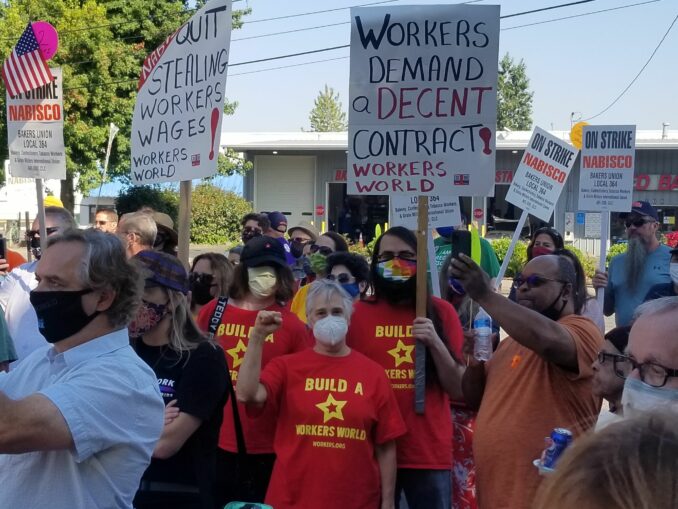
Aug. 28 — Nearly 200 supporters attended a rally in support of Portland Nabisco workers, who went out on strike Aug. 10. As of Aug. 25, approximately 1,000 members of the Bakery, Confectionery, Tobacco Workers and Grain Millers Union have been on strike across all six Nabisco bakeries and distribution centers in the U.S.
Strike locations besides Portland include Chicago, Richmond, Va.; Aurora, Colo.; Addison, Ill.; and Norcross, Ga. Workers are striking against company proposals to change the health care plan and cut overtime pay on the weekends by altering schedules.
The Portland strikers, some of whom have worked at the company for up to 50 years, spoke at the rally. One said: “The union has done so much. We are so thankful to the retirees and people from other unions supporting us here today.”
A group of about 20 people from the United Food and Commercial Workers were present to show support. They told this reporter that, like the Nabisco workers, they had worked through the COVID-19 pandemic and are now having their benefits taken away by their employers.
World Socialist Web Site reporters spoke with railway workers in Paris on Thursday. They expressed their support and solidarity for the ongoing national rail strike by their counterparts in Germany.
The German rail strike has been underway Thursday afternoon. The drivers and other rail employees are opposing the efforts of the Deutsche Bahn national operator to impose a labour contract that cuts pensions and enforces a zero percent wage rise—in reality, given inflation, a real wage cut. The company is effectively demanding that the workforce bear the brunt of the costs of the coronavirus pandemic through a further reduction in its conditions.
Their French counterparts are familiar with the international assault underway against railway workers. In 2018, French President Emmanuel Macron announced that he would scrap the railway statute that had been in place since World War II. Thousands of workers have since been laid off; the railways are being steadily opened up to competition from private providers, while new-hire workers are being hired on different conditions, with fewer protections and on lower wage scales.
In June 2018, French rail workers conducted a powerful strike to oppose Macron’s pro-corporate law. The strike was defeated because it was isolated by the rail unions, who refused to mobilise any broader support in the working class and kept the workers isolated.
“Good luck to the workers in Germany,” said Louis, who inspects tickets on the SNCF network and has been working on the rail lines since 2016. “If they are still fighting they can’t give up, because once you give up it’s finished. I support them completely especially if they want to avoid what we have just been through.”
In the wake of the 2018 strike, Louis explained, “the rules that are supposed to protect us in terms of hours and conditions are not respected at all. We are all exhausted. We work hours that are completely absurd now.”
When he heard that the German rail networks were demanding that the workers bear the costs of the pandemic, Louis replied that “it is the same situation here. It’s the employees who have to pay. They have already laid off workers and made other changes to the schedules since the beginning of the pandemic. They took advantage of it to get rid of temporary workers. Now many of us work nine or ten hours a day because there are fewer people to do the same work. The coronavirus was just an excuse to do what they wanted to do for a long time.”
“I hope that the passengers are with them and support them,” Louis added. “What they have to do is explain to the population why they are on strike and show them what is going to happen if we don’t strike. The times when we explained this to the public they felt it and understood it.”
Louis said he thought it would be powerful for workers in Germany, France and across Europe to conduct united actions together. “But it would be on the condition that we had a spokesperson, a real representation which speaks on behalf of the workers. Often the union heads are just there for themselves, or prefer to fight with one another than make a common front against the enemy.”
Stefan, a driver with 23 years’ experience, gave this message to the strikers in Germany: “We support them, as train drivers in Europe. They should know that what impacts them can come here as well. The more that time passes, the more our conditions tend to become the same. The more there are things that impact them, the more it will affect us. We have to support them.”
“In Germany I believe they have had competition in the rails for a number of years,” he said. “Now they are doing this here too, and it will come into force in the next years. We are not yet fully impacted but it will come quick. I think they are trying to bring the level down everywhere. It is up to the workers to do the maximum to defend their interests.”
At 2 in the morning on Thursday, train drivers and other railway workers began a third consecutive strike to obtain better wages and working conditions. In freight transport, a strike had already begun on Wednesday afternoon. It is becoming increasingly clear that the industrial action raises political issues which cannot be resolved or left in the hands of the trade union that called for the strikes, the German Train Drivers’ Union (GDL).
Striking railway workers in Frankfurt
The offer made to strikers on Tuesday by the management of the Deutsche Bahn (DB) railway company is a sham. Deutsche Bahn remains insistent on cutting the company pensions of railway workers and freezing wages for 2021.
GDL leader Claus Weselsky accused the DB board of seeking to destroy his union. He said that although the GDL had recently gained about 4,000 new members, the DB management was not prepared to comply with a contract already agreed with the GDL.
Earlier this year, a new law on Collective Bargaining Unity (Tarifeinheitsgesetz, TEG) has been applied to the railways which stipulates that companies can only conclude contracts with the union which has the largest number of members in that workplace. In most railway companies, the larger union is the Rail and Transport Workers’ Union (EVG), which has already agreed to a pay freeze and has ordered its members to work during the strike, effectively forcing them to scab on workers in the GDL.
On Thursday, the DB board also took legal action against the train drivers’ strike. Martin Seiler, the board member responsible for human resources, applied to the labour court in Frankfurt am Main for a temporary injunction to ban the industrial action. According to Seiler, the strike did “not fall into the framework of applicable law.”
The Labour Court threw out the application the same evening, stating it was not possible to determine sufficiently in summary proceedings whether inadmissible strike objectives were being pursued. Deutsche Bahn has announced that it will appeal against the court’s decision, and the Regional Labour Court in Frankfurt scheduled the appeal for Friday.
Drivers and conductors, who have worked day and night during the coronavirus pandemic, are very bitter about the action taken by the DB executive. “We have practically no weekends off, have different working hours every day, have been on the job throughout the pandemic. Who is of systemic importance here?” said one striking train driver at Frankfurt’s main station. “The DB executive awards itself bonuses worth millions, but nobody cares about us.”
In fact, the offer made by DB to the workers is a new provocation. Deutsche Bahn did agree to pay a one-time coronavirus bonus of “600 or 400 euros” and “shorten” the duration of the contract from the originally planned 40 months to 36 months. In these three years, however, wages would increase by a total of just 3.2 percent, under conditions of soaring inflation which is already nearly 4 percent in Germany. The DB board still refuses to pay even one cent more in 2021.
At the same time, the board of directors is raking in millions. The annual financial statement of Deutsche Bahn for 2019 listed total remuneration of the six board members at more than 7.4 million euros; in addition, more than 1.3 billion euros is listed in provisions for the pensions of retired board members.
The head of Deutsche Bahn, Richard Lutz, pocketed more than 1.7 million euros in 2019. Ronald Pofalla, DB’s Board Member for Infrastructure and former chief of staff of the German Chancellery, raked in just under 1.25 million. Martin Seiler, the head of Human Resources who is leading contract bargaining, took home more than 800,000 euros.
“The inequality is unimaginably blatant,” a striking train attendant in Frankfurt commented. “I have huge difficulty finding any affordable housing here in Frankfurt. You can’t find anything in the city for less than 800 euros, and yet I am often expected to turn up here at the station in the middle of the night to work.”
Like other strikers, including very young ones, this train conductor was particularly outraged by the board’s attacks on the company pension. “We want at least the hope that we can live reasonably securely when we retire. Poverty in old age is definitely an issue. For example, my grandma is now in a situation where she has to live on a monthly pension of just 650 euros.”
Train drivers and conductors are fighting over social issues that affect all workers. They are in conflict not only with the DB board and the German government, which owns Deutsche Bahn, they also face the hostility of the rest of the trade unions and all of Germany’s main political parties.
The head of the Federation of German Trade Unions (DGB) Reiner Hoffmann and EVG chairman Klaus-Dieter Hommel have publicly denounced the strikes and stabbed train workers in the back. The leading election candidate of the Left Party, Dietmar Bartsch, has described the strike as “theatre” and “completely unreasonable” and called upon Chancellor Angela Merkel (CDU) to intervene.
For its part, the GDL is also neither willing nor able to lead a principled struggle for a real improvement of wages and working conditions. It has only called for limited strike action: two strikes of two days, and now a five-day stoppage, but vehemently rejects an indefinite strike.
At the same time, the demands set by the GDL also mean a real wage reduction, even if they were fully implemented. The GDL is demanding 1.4 percent more pay this year and 1.8 percent next year to cover a 28-month period, plus a coronavirus bonus of 600 euros. In 2014, the GDL called off a strike on short notice, although it had been confirmed as legal by a labour court.
The career of Martin Seiler, the personnel director of Deutsche Bahn, illustrates the close relations between the trade union bureaucracy and management. For 15 years Seiler was a works council member and trade union section leader, first of the German Postal Workers’ Union, then of the service trade union Verdi. In 2003, he moved to the management of Deutsche Post AG, and twelve years later became Labour Director at Deutsche Telekom, responsible for 70,000 employees. At the beginning of 2018, he took over as personnel director at Deutsche Bahn in charge of 320,000 railway employees.
The German media is acting as a mouthpiece for management in the rail strike. This is another issue that deeply angers strikers. The media describe the strike as a pure “power play” by the GDL. All of the news reports about the strike on Wednesday contained the sentence: “Despite a new offer from Deutsche Bahn, train drivers began their announced strike this morning.” None of the media outlets said a word about what the “offer” really entailed.
A team from the German public broadcaster ZDF filmed and interviewed several train drivers in front of Frankfurt’s main station on Wednesday morning, but the subsequent broadcast featured just one sentence from the strikers alongside a number of spiteful comments critical of the strike.
“We’ve explained everything in detail to the media so many times,” one striking train driver told the World Socialist Web Site in response. “But they don’t publish it.” Instead, for example, the Berliner Zeitung newspaper reported on the GDL’s “hunger for power,” while the Hamburger Abendblatt described the strike as “out of control.”
The Socialist Equality Party (SGP) advocates mobilising broad sections of the working class to support the strike and warns it cannot not be left in the hands of GDL leadership. It is necessary to build independent action committees. Members and supporters discussed with strikers at stations and distributed the SGP statement, entitled: “Support the struggle of train drivers and conductors! Build independent action committees!”
In the statement the SGP formulates the political tasks facing rail workers: “Today, train drivers and conductors are confronted with political tasks at every turn. All of the political parties represented in the Bundestag, including today’s SPD and the Left Party, vehemently oppose their strike.” The Socialist Equality Party (SGP) is contesting the federal election to build a new mass party in the working class, fighting for a socialist and international programme.