Sunday, September 5, 2021

CNN Buries Climate Catastrophe in Hurricane Coverage


https://www.youtube.com/watch?v=YZgG-MgwR1A


Man Pees on Floor in Restaurant When Asked to Wear a Mask


https://www.youtube.com/watch?v=EiKXnqO-8os


Republicans plan to use big government to shut down private businesses


https://www.youtube.com/watch?v=2zt5E0AS3t4



US Agencies’ Planned Expansion of Facial Recognition


https://consortiumnews.com/2021/09/03/us-agencies-planned-expansion-of-facial-recognition/


The Electronic Frontier Foundation called the expanded use of the technology for law enforcement purposes one of the most disturbing aspects of the GAO report.

(EFF Photos, Flickr, CC BY 2.0)

By Julia Conley
Common Dreams

Digital rights advocates reacted harshly last month to an internal U.S. government report detailing how 10 federal agencies have plans to greatly expand their reliance on facial recognition in the years ahead.

The Government Accountability Office surveyed federal agencies and found that 10 have specific plans to increase their use of the technology by 2023 — surveilling people for numerous reasons including to identify criminal suspects, track government employees’ level of alertness, and match faces of people on government property with names on watch lists.

The report (pdf) was released as lawmakers face pressure to pass legislation to limit the use of facial recognition technology by the government and law enforcement agencies.

Sens. Ron Wyden (D-OR) and Rand Paul (D-KY) introduced the Fourth Amendment Is Not for Sale Act in April to prevent agencies from using “illegitimately obtained” biometric data, such as photos from the software company Clearview AI. The company has scraped billions of photos from social media platforms without approval and is currently used by hundreds of police departments across the United States.

The bill has not received a vote in either chamber of Congress yet.

The plans described in the GAO report, tweeted law professor Andrew Ferguson, author of “The Rise of Big Data Policing,” are “what happens when Congress fails to act.”

Six agencies including the Departments of Homeland Security (DHS), Justice (DOJ), Defense (DOD), Health and Human Services (HHS), Interior and Treasury plan to expand their use of facial recognition technology to “generate leads in criminal investigations, such as identifying a person of interest, by comparing their image against mugshots,” the GAO reported.

DHS, DOJ, HHS, and the Interior all reported using Clearview AI to compare images with “publicly available images” from social media.

The DOJ, DOD, HHS, Department of Commerce, and Department of Energy said they plan to use the technology to maintain what the report calls “physical security,” by monitoring their facilities to determine if an individual on a government watchlist is present.

“For example, HHS reported that it used [a facial recognition technology] system (AnyVision) to monitor its facilities by searching live camera feeds in real-time for individuals on watchlists or suspected of criminal activity, which reduces the need for security guards to memorize these individuals’ faces,” the report reads. “This system automatically alerts personnel when an individual on a watchlist is present.”

The Electronic Frontier Foundation said the government’s expanded use of the technology for law enforcement purposes is one of the “most disturbing” aspects of the GAO report.

“Face surveillance is so invasive of privacy, so discriminatory against people of color, and so likely to trigger false arrests, that the government should not be using face surveillance at all,” the organization told MIT Technology Review.

According to The Washington Post, three lawsuits have been filed in the last year by people who say they were wrongly accused of crimes after being mistakenly identified by law enforcement agencies using facial recognition technology. All three of the plaintiffs are Black men.

A federal study in 2019 showed that Asian and Black people were up to 100 times more likely to be misidentified by the technology than white men. Native Americans had the highest false identification rate.

Maine, Virginia and Massachusetts have banned or sharply curtailed the use of facial recognition systems by government entities, and cities across the country including San Francisco, Portland, and New Orleans have passed strong ordinances blocking their use.

But many of the federal government’s planned uses for the technology, Jake Laperruque of the Project on Government Oversight told the Post, “present a really big surveillance threat that only Congress can solve.”


US Collected 4.8 Million Biometric Records of Afghans


https://consortiumnews.com/2021/09/03/us-collected-4-8-million-biometric-records-of-afghans/


Margaret Hu calls it a lesson in the life-and-death consequences of data collection in conflict zones.

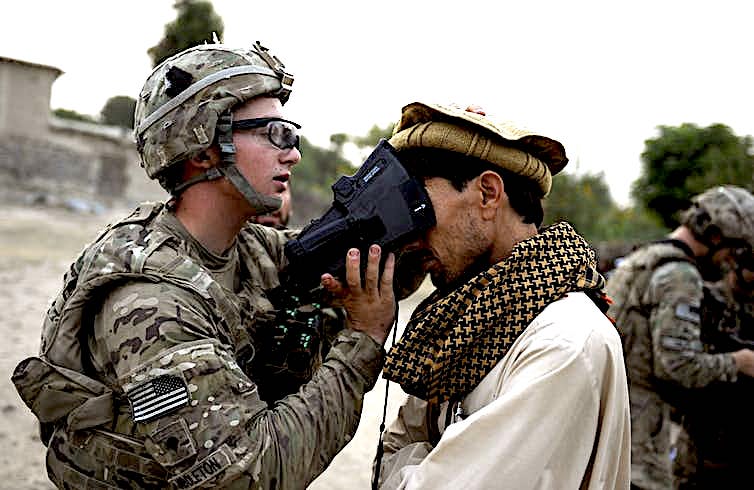
U.S. Army soldier scans the irises of an Afghan civilian in 2012 as part of an effort by the military to collect biometric information from much of the Afghan population. (Jose Cabezas/AFP via GettyImages)

This article, first published by The Conversation, reveals that the U.S. occupiers took 4.8 million records of biometric data from Afghans in what can only be seen as a humiliation of a nation’s people. Americans might imagine what it would be like for them to be subjected to this by a foreign power on their own soil. That the Taliban may now have access to this data to pursue collaborators should be seen as consequence of the U.S. imperial project. Towards the end of the article the author writes: “The Pentagon should use this as an opportunity to question whether it was necessary to collect the biometric data in the first instance.” The U.S. accuses WikiLeaks publisher Julian Assange of revealing the names of its informants, when he was actually redacting them. Now they’ve left many of those names, and their iris scans, behind.

By Margaret Hu
Penn State

In the wake of the Taliban’s takeover of Kabul and the ouster of the Afghan national government, alarming reports indicate that the insurgents could potentially access biometric data collected by the U.S. to track Afghans, including people who worked for U.S. and coalition forces.
Afghans who once supported the U.S. have been attempting to hide or destroy physical and digital evidence of their identities. Many Afghans fear that the identity documents and databases storing personally identifiable data could be transformed into death warrants in the hands of the Taliban.

This potential data breach underscores that data protection in zones of conflict, especially biometric data and databases that connect online activity to physical locations, can be a matter of life and death. My research and the work of journalists and privacy advocates who study biometric cybersurveillance anticipated these data privacy and security risks.

Biometric-Driven Warfare

Investigative journalist Annie Jacobson documented the birth of biometric-driven warfare in Afghanistan following the terrorist attacks on Sept. 11, 2001, in her book First Platoon. The Department of Defense quickly viewed biometric data and what it called “identity dominance” as the cornerstone of multiple counterterrorism and counterinsurgency strategies. Identity dominance means being able to keep track of people the military considers a potential threat regardless of aliases, and ultimately denying organizations the ability to use anonymity to hide their activities.

By 2004, thousands of U.S. military personnel had been trained to collect biometric data to support the wars in Afghanistan and Iraq. By 2007, U.S. forces were collecting biometric data primarily through mobile devices such as the Biometric Automated Toolset (BAT) and Handheld Interagency Identity Detection Equipment (HIIDE).

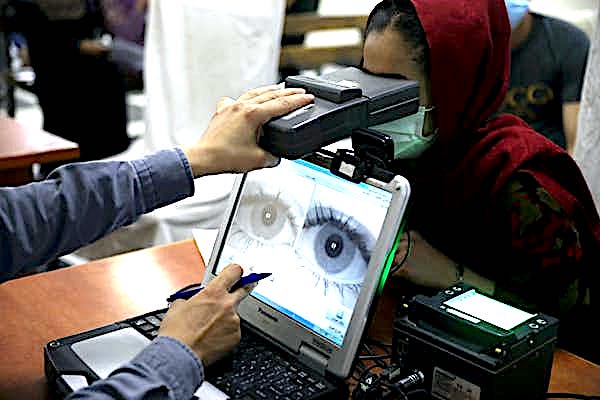
BAT includes a laptop, fingerprint reader, iris scanner and camera. HIIDE is a single small device that incorporates a fingerprint reader, iris scanner and camera. Users of these devices can collect iris and fingerprint scans and facial photos, and match them to entries in military databases and biometric watchlists.

In addition to biometric data, the system includes biographic and contextual data such as criminal and terrorist watchlist records, enabling users to determine if an individual is flagged in the system as a suspect. Intelligence analysts can also use the system to monitor people’s movements and activities by tracking biometric data recorded by troops in the field.

By 2011, a decade after 9/11, the Department of Defense maintained approximately 4.8 million biometric records of people in Afghanistan and Iraq, with about 630,000 of the records collected using HIIDE devices. Also by that time, the U.S. Army and its military partners in the Afghan government were using biometric-enabled intelligence or biometric cyberintelligence on the battlefield to identify and track insurgents.

In 2013, the U.S. Army and Marine Corps used the Biometric Enrollment and Screening Device, which enrolled the iris scans, fingerprints and digital face photos of “persons of interest” in Afghanistan. That device was replaced by the Identity Dominance System-Marine Corps in 2017, which uses a laptop with biometric data collection sensors, known as the Secure Electronic Enrollment Kit.

Over the years, to support these military objectives, the Department of Defense aimed to create a biometric database on 80 percent of the Afghan population, approximately 32 million people at today’s population level. It is unclear how close the military came to this goal.

More Data Equals More People at Risk

In addition to the use of biometric data by the U.S. and Afghan military for security purposes, the Department of Defense and the Afghan government eventually adopted the technologies for a range of day-to-day governmental uses. These included evidence for criminal prosecution, clearing Afghan workers for employment and election security.

In addition, the Afghan National ID system and voter registration databases contained sensitive data, including ethnicity data. The Afghan ID, the e-Tazkira, is an electronic identification document that includes biometric data, which increases the privacy risks posed by Taliban access to the National ID system.

Before falling to the Taliban, the Afghan government made extensive use of biometric security, including scanning the irises of people such as this woman who applied for passports. (AP Photo/Rahmat Gul)

It’s too soon after the Taliban’s return to power to know whether and to what extent the Taliban will be able to commandeer the biometric data once held by the U.S. military. One report suggested that the Taliban may not be able to access the biometric data collected through HIIDE because they lack the technical capacity to do so.

However, it’s possible the Taliban could turn to longtime ally Inter-Services Intelligence, Pakistan’s intelligence agency, for help getting at the data. Like many national intelligence services, ISI likely has the necessary technology.

Another report indicated that the Taliban have already started to deploy a “biometrics machine” to conduct “house-to-house inspections” to identify former Afghan officials and security forces. This is consistent with prior Afghan news reports that described the Taliban subjecting bus passengers to biometric screening and using biometric data to target Afghan security forces for kidnapping and assassination.

Longstanding Concerns

For years following 9/11, researchers, activists and policymakers raised concerns that the mass collection, storage and analysis of sensitive biometric data posed dangers to privacy rights and human rights. Reports of the Taliban potentially accessing U.S. biometric data stored by the military show that those concerns were not unfounded.

They reveal potential cybersecurity vulnerabilities in the U.S. military’s biometric systems. In particular, the situation raises questions about the security of the mobile biometric data collection devices used in Afghanistan.

The data privacy and cybersecurity concerns surrounding Taliban access to U.S. and former Afghan government databases are a warning for the future. In building biometric-driven warfare technologies and protocols, it appears that the U.S. Department of Defense assumed the Afghan government would have the minimum level of stability needed to protect the data.

The U.S. military should assume that any sensitive data — biometric and biographical data, wiretap data and communications, geolocation data, government records — could potentially fall into enemy hands. In addition to building robust security to protect against unauthorized access, the Pentagon should use this as an opportunity to question whether it was necessary to collect the biometric data in the first instance.

Understanding the unintended consequences of the U.S. experiment in biometric-driven warfare and biometric cyberintelligence is critically important for determining whether and how the military should collect biometric information. In the case of Afghanistan, the biometric data that the U.S. military and the Afghan government had been using to track the Taliban could one day soon – if it’s not already – be used by the Taliban to track Afghans who supported the U.S.


Humoresque by Dvorak


https://www.youtube.com/watch?v=IJg2DKfL-fc


Aures tuas.

Wolff Responds: Labor Day for Undocumented Immigrants


https://www.youtube.com/watch?v=pcSwJLq4SNo