Saturday, September 4, 2021
ROE V. WADE IN GRAVE DANGER
By Jake Johnson,
Common Dreams.
September 2, 2021
https://popularresistance.org/roe-v-wade-in-grave-danger-as-supreme-court-lets-texas-abortion-ban-take-effect/
Supreme Court Lets Texas Abortion Ban Take Effect.
“Access to almost all abortion has just been cut off for millions of people. The impact will be immediate and devastating.”
A draconian Texas law banning abortions beyond around six weeks of pregnancy took effect at midnight after the conservative U.S. Supreme Court did not act to block it on Tuesday, a decision that could have major implications for reproductive rights across the country.
While the Supreme Court could still grant an emergency request to suspend the law in the coming hours, the justices’ decision to remain silent Tuesday allows Texas to begin implementing what rights groups have characterized as the most restrictive state-level abortion ban since the 1973 Roe v. Wade decision. Abortion providers estimate that the measure could bar care for “at least 85% of Texas abortion patients.”
Nancy Northup, president and CEO of the Center for Reproductive Rights, warned earlier this week that if the ban is permitted to stand, “Texas politicians will have effectively overturned Roe v. Wade.”
Signed into law by Republican Gov. Greg Abbott in May, Senate Bill 8 empowers private individuals to sue anyone who performs an abortion after the sixth week of a pregnancy—before many people even know they’re pregnant—or anyone who “knowingly engages in conduct that aids or abets the performance or inducement of an abortion.” Plaintiffs who prevail in court are entitled to $10,000 as well as the recovery of their legal fees.
By deputizing private individuals instead of state actors to enforce the sweeping abortion ban, Texas Republicans have made it extremely difficult to challenge the law’s constitutionality in court—a maneuver that other GOP-controlled states will likely attempt to replicate if the Texas law is upheld.
“SB8 will stop access overnight and will decimate the already vulnerable care infrastructure in place,” warned Avow, a Texas-based abortion rights organization. “Most importantly, it will leave Texans who need access to compassionate care and support services scared to reach out for help, and advocates afraid to help them.”
The ACLU—which, along with Planned Parenthood and other organizations, filed an emergency appeal to block the Texas law—said early Wednesday that “access to almost all abortion has just been cut off for millions of people.”
“The impact will be immediate and devastating,” the group continued. “Private individuals—including anti-abortion activists with no connection to patients—can now sue anyone who they believe is providing abortion or assisting someone in accessing abortion after six weeks… The law doesn’t just allow these lawsuits—it actively encourages private individuals to act as bounty hunters by awarding them at least $10,000 if they are successful.”
“This is a full-scale assault on patients, our healthcare providers, and our support systems,” the ACLU added. “This abortion ban is blatantly unconstitutional. We won’t stop fighting until it’s blocked.”
In addition to dramatically curtailing abortion rights in Texas, the Supreme Court’s inaction Tuesday could also indicate that the body’s six conservative justices are gearing up to attack established legal precedent that has protected reproductive freedoms nationwide. In its next term—which begins in October—the Supreme Court is set to hear a case involving a Mississippi abortion ban that poses a direct challenge to both Roe v. Wade and Planned Parenthood v. Casey.
As Buzzfeed‘s Zoe Tillman and Nicole Fallert explained Wednesday, “Because of how the Texas case reached the justices, Tuesday’s order only affects that state, at least for now.”
“But in the Mississippi case, the justices are set to consider whether it can be constitutional for any state to ban an abortion before a fetus is considered viable, meaning it can survive outside of a person’s womb,” the pair noted. “Lower courts for years have applied Roe and Casey to mean that previability bans are unconstitutional, blocking the Mississippi law and other similar ones optioned in over 10 states during the Trump administration. The Supreme Court’s willingness to consider the case at all signaled a potentially massive sea-change in abortion rights.”
Jessica Mason Pieklo, the executive editor of Rewire News Group—an online publication focused on reproductive health and abortion rights—wrote in a series of tweets early Wednesday that “the Supreme Court effectively overturned Roe v. Wade tonight for folks in Texas under cover of darkness.”
“Instead of issuing a ruling blocking Texas’ six-week abortion ban from taking effect, the court did nothing. But in this case, doing nothing is actually doing everything,” Mason Pieklo argued. “Because by doing nothing, the justices said Roe is no longer good law.”
“If SCOTUS was interested in upholding abortion rights precedent, it would have issued an order that says basically, ‘Sorry Texas, Roe says you can’t ban abortion at six weeks. Nice try.’ SCOTUS didn’t issue that order,” she continued. “And by not issuing that order, SCOTUS signaled that the 6-3 conservative majority has no interest in upholding Roe as precedent. And it did so on the shadow docket.”

INDIGENOUS RESISTANCE DISRUPTS BILLIONS OF TONS OF GREENHOUSE GAS EMISSIONS ANNUALLY
By Collin Rees,
Oil Change International.
September 2, 2021
https://popularresistance.org/indigenous-resistance-disrupts-billions-of-tons-of-greenhouse-gas-emissions-annually/
A New Report.
Bemidji, Minnesota — The Indigenous Environmental Network and Oil Change International are releasing a new report titled Indigenous Resistance Against Carbon. The report analyzes the impact that Indigenous resistance to fossil fuel projects in the United States and Canada has had on greenhouse gas emissions over the past 10 years. From the struggle against the Cherry Point coal export terminal in Lummi territory to fights against pipelines crossing critical waterways, Indigenous land defenders have exercised their rights and responsibilities to not only stop fossil fuel projects in their tracks, but establish precedents to build successful social justice movements.
The new report shows that Indigenous communities resisting the more than 20 fossil fuel projects analyzed have stopped or delayed greenhouse gas pollution equivalent to at least 25 percent of annual U.S. and Canadian emissions. Given the current climate crisis, Indigenous peoples are demonstrating that the assertion of Indigenous Rights not only upholds a higher moral standard, but provides a crucial path to confronting climate change head-on and reducing emissions.
The recently released United Nations climate change report by the Intergovernmental Panel on Climate Change (IPCC) states that in order to properly mitigate the worst of the climate crisis, rapid and large-scale action must be taken, with a focus on immediate reduction of fossil fuel emissions. As the United Nations prepares for its upcoming COP 26 climate change conference in Glasgow, Scotland, countries are being asked to update their pledges to cut emissions — but as the IPCC report states, current pledges fall short of the changes needed to mitigate the climate chaos already millions of people around the world.
While United Nations member countries continue to ignore the IPCC’s scientists and push false solutions and dangerous distractions like the carbon markets in Article 6 of the Paris Agreement, Indigenous peoples continue to put their bodies on the line for Mother Earth. False solutions do not address the climate emergency at its root, and instead have damaging impacts like continued land grabs from Indigenous Peoples in the Global South. Indigenous social movements across Turtle Island have been pivotal in the fight for climate justice.
Quotes:
“Indigenous Resistance has stopped or delayed greenhouse gas pollution equivalent to at least 25% of annual U.S. & Canadian emissions. The numbers don’t lie. Indigenous peoples have long led the fight to protect Mother Earth and the only way forward is to center Indigenous knowledge and keep fossil fuels in the ground,” said Dallas Goldtooth, Keep It In The Ground Organizer, Indigenous Environmental Network
“Indigenous communities resisting oil, gas, and coal projects across their territory are demonstrating true climate leadership. Brave resistance efforts by Indigenous land and water defenders have kept billions of tons of carbon in the ground, showing that respecting and honoring the wisdom and sovereignty of Indigenous Peoples is a key solution to the climate crisis,” said Collin Rees, U.S. Campaign Manager at Oil Change International
Read the full report: https://ienearth.org/indigenous-resistance-against-carbon
ORGANIZING AGAINST MILITARISM FROM ISRAEL TO EUROPE
By Jonathan Hempel,
ROAR Magazine.
September 2, 2021
https://popularresistance.org/organizing-against-militarism-from-israel-to-europe/
The EU has invested billions in Israeli arms companies to further militarize its border agency Frontex.
Building a global antimilitarist movement is essential.
By the end of 2020, a total of 82.4 million people worldwide had been forcibly displaced from their homes according to the UNHCR. The number of forcibly displaced persons globally has doubled since 1990 and is likely to increase significantly in the coming decades due to a convergence of factors, including armed conflict and other forms of violence, as well as climate breakdown, which will compound pressures to migrate.
Displacement occurs in the context of a capitalist economic system in which profits are made both through the sale of arms that are instrumental in causing conflicts and wars, and through the militarization of migrant routes and borders. Alongside the steady increase in the value of the arms trade and the spiraling number of forcibly displaced persons, the market for border security is growing with an expected worth of US$65-68 billion by 2025. War is highly profitable and the war on migrants is becoming increasingly so too.
Israeli military technologies, central to a system of settler-colonialism, apartheid and occupation, are big players in the international arms industry. “Tried and tested” on Palestinians, Israeli arms are sold to states and private agencies around the world and Israeli arms companies are now established partners of European Union border security agencies, such as Frontex, supporting the militarization of EU borders.
The Israeli arms industry is part of a global process of border militarization in a world increasingly characterized by profit-driven conflicts and militarism, all leading to further displacement — more migration and more people seeking refuge. The struggles for freedom of movement and against militarism need to work on making these links clear so that we can tackle these challenges at the root.
Frontex And EU Border Militarization
Frontex has a huge role in the militarization of European borders, the criminalization of migrants and the monitoring of their movements. One of Frontex’s main objectives is to identify migrants and organize operations to return them to their countries of origin. The agency increasingly works together with third countries, such as Libya, Sudan, Turkey and Belarus, coordinating containment and deportation efforts beyond EU jurisdictions.
In 2020, humanitarian groups claimed the EU is using aerial surveillance to spot stranded migrants in the Mediterranean Sea, alerting Libya’s coast guard to intervene — a move that facilitates illegal pushbacks, while non-governmental rescue operations are actively prevented and criminalized. Intercepted migrants are placed in arbitrary detention facilities in Libya, where they face human rights violations including torture, sexual violence and denial of health care. Also, on the border between Greece and Turkey, human rights organizations have documented pushbacks of refugees to Turkey by official coast guard agencies, among them Frontex and national coast guards.
The expansion of the agency has been a staple of EU policy in recent years. Frontex has now secured a €5.6 billion budget until 2027, with plans to hire 10,000 armed border guards by the end of that period. Its budget has grown by a staggering 7,560 percent since 2005, with its new resources used to buy equipment including ships, helicopters and drones. Fortress Europe, meanwhile, is increasingly covered in border walls and fences: since the Berlin Wall was torn down in 1989, European countries have built or commenced building 1,200 kilometers of fencing — a distance almost 40 percent of the length of the US-Mexico border.
What Does Israel Have To Do With It?
This whole process is one in which both EU security agencies and European states purchase military equipment, including small arms, drones, ships and cybersecurity technology as part of their border security policies — much of which is sourced within the EU. This is also where the Israeli arms industry comes into the story. As the Israeli Database of Military and Security Equipment (DIMSE) shows, Israeli arms play a significant role in the militarization of EU borders.
Israeli arms that have been purchased among others by Italy, Greece and Germany include drones, radar systems and patrol vessels. But even more interesting are the direct military and security relations between Israel, the European Union and EU security agencies.
While US “aid” to Israel’s security capabilities of around $3.8 billion a year is well-documented, the collaboration of the EU with Israel can often be overlooked by critics. As an EU-associated state, Israel has enjoyed close economic and diplomatic ties with the EU for many years. Through research and innovation funds, the EU has invested billions in Israeli companies and organizations, including arms manufacturers like Elbit, Verint System and Israeli Aerospace Industries (IAI). Among dozens of EU-funded projects since 2007, IAI and Elbit reportedly landed contracts to develop drones for European security agencies like Frontex and EMSA (European Maritime Safety Agency) to “autonomously” stop “illegal migrants” and “non-cooperative vehicles.”
After conducting test flights between 2018-2020, IAI was awarded a contract in 2020 to provide Frontex with the Heron drone for maritime patrols. As the Times of Malta reported, the EU border agency carried out a first test flight in Malta at the beginning of May 2021. Different flight reports showed Heron drones making operational flights at the Libyan border in June 2021.
The main issue here is that drones are an effective way to elude the EU’s obligation under international law to save the lives of those trying to cross the Mediterranean — as they were obliged to do when patrolling with ships. Furthermore, in the new arrangement, Frontex continues to be present in the area from the air so they can be aware of different migrant boats setting out from the Libyan shores and to feed that information to the Libyan Coast Guard.
Frontex’s move of pulling investment in maritime patrol vessels and diverting it to drones is a way to spend money without having the responsibility to save lives and enables them to organize pushbacks through third countries. Beyond Israeli drones, the EU is operating European air vehicles and testing new robot systems, including long- and short-range drones.
Israel is essentially a go-to for countries looking to secure and militarize their borders. Israeli companies, specialists and top military generals have become increasingly visible at border and homeland security trade shows in the past 20 years. In that time, Israel became one of the top-ten largest defense exporters in the world and a leading supplier and consumer in the border security industrial complex. Israel’s military industry has been lobbying for years to get a share of EU multi-billion euro spending on border militarization.
In February 2021, a group of European journalists published the “Frontex Files,” a list of meetings between Frontex and various lobbyists, among them Israeli security companies such as the above-mentioned Elbit, as well as Shilat Optronics and Seraphim Optronics, which specialize in facial recognition technologies. Another company involved in Frontex operations is Israeli Shipyards, which produces naval vessels.
Another development that international researchers and activists have been observing is the increase in the usage of surveillance technologies to track movement and personal data via smartphones. Immigration agencies across Europe are showing new enthusiasm for laws and software that enable phone data to be used in deportation cases. In this context too, Israel’s cyber technologies are in high demand, with the infamous spyware provider, NSO Group, having long been used by European intelligence agencies.
Cellebrite, another especially problematic Israeli company, is reportedly involved in numerous human rights violations worldwide and already has 7,000 contracts with government and private groups — including the national police of 25 EU member states. Privacy International reported that the Israeli company is advertising its technologies used to extract data from mobile devices toward a new target: authorities interrogating people seeking asylum. In 2017 Cellebrite’s technology was operated in a test-phase by the German Federal Office for Migration and Refugees. In 2018, it was reported that the British Police are using Cellebrite’s mobile forensic technologies to access the search history of suspects and that the UK’s Immigration Enforcement Authority made a £45,000 deal with the firm in the same year. Between 2014 and 2016, Cellebrite also participated in EVIDENCE (European Informatics Data Exchange Framework for Courts and Evidence), a lucrative research and development program from the EU.
The Other Side Of The Coin
The other side of the coin is the usage of these technologies and arms here in Palestine-Israel. Israel uses military and security technologies to maintain its system of settler-colonialism, apartheid and occupation. Israel’s violations of international law and perpetration of war crimes during its incessant attacks on Palestinians in Gaza in May 2021 are well documented and research by antimilitarist activists about which arms were used in the attacks on Gaza is in progress in order to track new developments in the Israeli military industrial complex.
Israeli security and military companies work in direct connection with the Israeli military, providing equipment and weapons for its operations. This relationship means that military operations in Gaza and the West Bank are used as a laboratory for Israeli arms companies, where they can develop, test and then market their weapons as “combat proven.” It will not be long before Israeli companies will promote their new equipment again as “battle tested,” after the latest attacks on Gaza — an assault in which at least 129 Palestinian civilians were killed, 65 of them children, over 1,000 homes were destroyed and over 1,000 more severely damaged, leaving over 8,000 people without a home.
For an arms industry that has relied for years on marketing “combat proven” products, the next battle cannot come soon enough. EU funding for these companies inherently fuels Israel’s capacity to sustain its war crimes and violations of human rights and International Law, making the EU complicit in those violations, as well.
This takes us back to the Heron drone, which Frontex is now operating in the Mediterranean Sea. Heron drones have a dark history of use against Palestinians. Already after “Operation Cast Lead” in Gaza in late 2008 and early 2009, an investigation by Human Rights Watch concluded that dozens of civilians were killed with missiles launched from Israeli drones. The Heron was also widely used in the last major outbreak of attacks in May 2021.
On June 1, less than two weeks after the ceasefire, Israeli Aerospace Industries (IAI) published a press release detailing a $2 billion sale of Heron drones. The press release read: “Drones from the Heron family are the most prominent of the IAI drones and played an important and crucial role in collecting intelligence in operation ‘Guardian of the Walls.’” CEO of IAI, Boaz Levy, continued: “The deal is a testament to our customers’ strong satisfaction with the Heron UAVs, including their operational and technical performance.”
Israel’s technologies, which are taking part in a system of apartheid, settler-colonialism and occupation, being tested on Palestinians and are sold to dictators around the world, are now also being used to prevent migrants from entering Europe. Among these thousands of people are of course Palestinian refugees that have been immobilized on Greek islands or pushed back to Turkey in their attempt to find some relative freedom and safety away from Israeli apartheid.
Towards A Joint Antimilitarist Struggle
Sustaining a tradition of international cooperation among political movements is crucial in these times of economic and militaristic globalization. Solidarity actions and nonviolent interventions — both of which are acts performed by “outsiders” of a conflict in cooperation with parties in the conflict — are important, but even more significant is the formation of a joint struggle against militarism.
In the last few years, we have seen some formations of this joint struggle, one of which is the international campaign Abolish Frontex. In June 2021, actions in seven countries, including Belgium, Germany and Morocco, targeted the agency. The actions marked the launch of the international campaign, which calls to defund and dismantle Frontex and Europe’s deadly border regime. The network sees in modern borders colonial and racist constructs, institutionalized by the EU’s border policies.
The Abolish Frontex campaign calls for a halt to the militarization of borders and for freedom of movement, residence and livelihood for all. Crucially, the campaign also addresses the EU’s contributions to reasons that force people to move in the first place and the repression against solidarity activists in Europe. The campaign’s network is decentralized and autonomous and is composed of groups, organizations and individuals from inside and outside the EU, ranging from Senegal and Niger to Greece and Italy.
Veterans of the international joint struggle against militarism, War Resisters International Network has been active now for 100 years, with over 90 affiliated groups in 40 countries. International movements such as the Palestinian-led Boycott, Divestment and Sanctions movement, Black Lives Matter and Jewish Voice for Peace are some key examples of antimilitaristic movements that continue to build forms of internationalism that cut through separations between struggles.
On the local and somewhat less visible level, joint antimilitarist struggle must involve the identification of common cause between groups and opportunities to build coalitions. In the Israeli antimilitarist struggle for example, a variety of different political and activist groups collaborate with each other. Here, anti-occupation groups cooperate with religious Jewish groups in the fight against Israeli arms exports to countries that violate human rights. Antimilitarist groups collaborate with climate-change groups in a joint struggle that sees the connection between Israeli settler colonialism, the occupation of Palestine and the destruction of the environment in the region.
One such group, the Israeli feminist and antimilitarist New Profile, sees parallels between the local struggle for the demilitarization of Israeli society and the importance of an international joint struggle against militarism, placing an intersectional feminist angle on the political agenda. Aside from local activism, education work and support of military-service objectors, New Profile is a part of WRI, Abolish Frontex and other international coalitions and groups.
The Struggle To End Militarism Is Necessarily Global
Militarism is characterized by hierarchy, discipline, obedience, order, aggression and hypermasculinity and is defined by the norms and values of traditional state military structures. It is not limited to the armed forces, as other institutions take up its values and practices — whether police or security agencies, such as Frontex.
Militarism around the world will continue to sustain the racist, violent structures and borders that look to uphold a colonial and oppressive status quo. It is not just an “issue” for peace organizations and movements, as it is tied to much of the oppression and violence experienced today worldwide. We need to demilitarize the institutions and structures that sustain this status quo. This must take place as part of a radical international joint struggle where activists collaborate and learn from one another.
The struggle to demilitarize European borders, for instance, needs to be part of a global antimilitarist struggle that resists agencies like Frontex but also takes on the military industrial complex, as exemplified by the Israel-EU nexus. It needs to look at global and local structures and processes of militarism and conflicts that not only produce the technology to create borders, but also are at the root of why people need to flee in the first place.
Such a struggle involves not being stuck in only “solidarity” work: movements against militarism need to promote a fundamentally different social, economic and political order. That is, they need to put capitalism, racism and patriarchy on the political agenda — issues that are often avoided by political organizations and movements in the Global North because they require acknowledgement of our own contradictions and privileges, a questioning of our way of life and a commitment to concrete changes.
If we aspire to building a sustainable alternative to a world of profit-driven militarism and violence, we need to see it as part of the deeper challenge of overcoming global capitalism and racist colonial power relations. Therefore, the antimilitarist struggle must accentuate the relation between international feminist, anti-racist, anti-colonial, queer, anti-capitalist and anti-fascist struggles on one side and target the allied opponents of progressive values and basic human rights on the other.
AFGHANISTAN COLLAPSE REVEALS BELTWAY MEDIA’S LOYALTY TO PERMANENT WAR
By Gareth Porter,
The Grayzone.
September 2, 2021
https://popularresistance.org/afghanistan-collapse-reveals-beltway-medias-loyalty-to-permanent-war-state/
Biden’s Popular And Long Overdue Withdrawal From Afghanistan Triggered A Big Media Meltdown That Exposed Its De Facto Merger With The Military.
In the wake of a remarkably successful Taliban offensive capped by the takeover of Kabul, the responses of corporate media provided what may have been the most dramatic demonstration ever of its fealty to the Pentagon and military leadership. The media did so by mounting a full-throated political attack on President Joe Biden’s final withdrawal from Afghanistan and a defense of the military’s desire for an indefinite presence in the country.
Biden’s failure to establish a plan for evacuating tens of thousands of Afghans seeking to the flee the new Taliban regime made him a soft target for the Beltway media’s furious assault. However, it was Biden’s refusal last Spring to keep 4,500 U.S. troops in Afghanistan on an indefinite basis – flouting an aggressive Pentagon lobbying campaign – that initially triggered the rage of the military brass.
The media offensive against Biden’s Afghan withdrawal advanced arguments that the military could not make on its own – at least, not in public. It also provided the military with important cover at the moment when it was at its most vulnerable for its disastrous handling of the entire war.
Among the most disingenuous attempts at salvaging the military’s reputation was a Washington Post article blaming the Afghan catastrophe on an over-emphasis on “democratic values” while ignoring the the tight alliance between the U.S. military and despotic warlords which drove local support for the Taliban.
Playing The Al Qaeda Threat Card
On the eve of the Taliban takeover of Kabul, the New York Times’s David Sanger and Helene Cooper fired the opening salvo of the Beltway media’s assault on Biden’s decision. Sanger and Cooper began by acknowledging that the U.S. military had “overestimated” the results of its intervention for years, and that the failure of the Afghan government to pay soldiers for months had sapped the will to resist the Taliban.
But they then homed in on Biden’s refusal to keep troops in Afghanistan for counter-terrorism purposes. Recalling that Joint Chiefs Chairman Gen. Mark A. Milley had tried in the Spring to compel Biden to maintain 3,000 to 4,500 troops in the country, Sanger and Cooper cited “intelligence estimates predicting that in two or three years, Al Qaeda could find a new foothold in Afghanistan.”
That speculation was based on the assumption that the Taliban would allow such a development despite its well-established record of opposing al Qaeda’s use of its territory to plan terrorism abroad. In fact, the Taliban’s policy went back to before 9/11, when Osama bin Laden formally agreed to honor the Taliban’s restrictions while secretly plotting the 9/11 attacks in Germany rather than in Afghanistan.
In the wake of the U.S. withdrawal, the Taliban has an even stronger motivation to prevent any jihadist organizations from planning international terror attacks from Afghan territory.
To support their broadside against Biden’s withdrawal, the Times’ Sanger and Cooper turned to the retired general with arguably the greatest personal vested interest in an indefinite U.S. military presence in Afghanistan: former U.S. commander in Afghanistan Gen. David Petraeus, who oversaw the war effort from 2010 through 2011 and has since led a group of former commanders and diplomats lobbying for an endless US presence in the country.
Petraeus asserted that Biden failed to “recognize the risk incurred by the swift withdrawal” of intelligence drones and close air support, and thousands of contractors who had kept the Afghan Air Force flying.”
Next, Sanger and Cooper turned to Richard Fontaine, the chief executive of one of the most militaristic think tanks in Washington, the Center for a New American Security (CNAS).
As The Grayzone has reported, CNAS has reaped millions in funding from the arms industry and US government institutions to advance Pentagon and military thinking inside the Beltway. Among the many Beltway media insiders that enjoy writers in residence fellowships at the think tank is the New York Times’ Sanger.
For his part, Fontaine compained that the Biden administration had failed to continue providing the contractors that the Afghan Air Force depended on keep its planes in the air. But he failed to acknowledge the obvious point that contractors would be unable to function in Afghanistan without sufficient U.S.-NATO troops to provide military protection on the ground.
On August 16, after the US-backed Afghan government was eliminated, the liberal interventionist magazine, Foreign Policy, chimed in with another attack on Biden featuring interviews with “a dozen people who held posts in Afghanistan.”
According to Foreign Policy, current and former diplomats anonymously expressed “deep anger, shock and bitterness about the collapse of the government they spent decades trying to build.” Several currently-serving officials were quoted — again off the record — about their considering resigning in protest, citing an “overwhelming sense of guilt and fear for the lives of former Afghan colleagues and local staff whom the American government left behind.”
That same day, the New Yorker’s Robin Wright expressed similar anguish over the harrowing images of U.S. defeat in Afghanistan. In an article subtitled, “It’s a dishonorable end that weakens U.S. standing in the world, perhaps irrevocably,” she lamented that the United States “is engaged in what historians may some day call a Great Retreat from a ragtag army that has no air power….”
The U.S. retreat from Afghanistan, Wright asserted, is “part of an unnerving American pattern dating back to the 1970s,” starting with Reagan’s pull-out from Beirut and Obama’s withdrawal from Iraq in 2011. Echoing those insisting on an indefinite U.S. military role in Afghanistan, Wright claimed that because the Taliban had “won a key battle against democracy in Afghanistan,” the country would “again, almost certainly become a haven for like-minded militants, be they members of al Qaeda or others in search of a sponsor.”
Meanwhile, during an August 21 panel on PBS’s Washington Week, Peter Baker of the New York Times, Anne Gearan of the Washington Post and Vivian Salama of the Wall Street Journal formed a one-note chorus blaming Biden’s hasty withdrawal for the crowds of anguished Afghans desperately seeking to escape the Taliban at Kabul’s airport.
The implicit – and clearly fanciful – premise of the discussion was that the United States could have somehow embarked weeks or months earlier on a sweeping program to rescue tens and possibly hundreds of thousands of interpreters and other collaborators with the U.S. military, and that it could all be done cleanly and efficiently, without triggering any panic.
A second theme pressed by the New York Times’ Baker was that Biden had been heedless of the risks of his policy to U.S. national security. Baker said Biden had made up his mind a decade ago that the U.S. must withdraw from Afghanistan and was determined to do it “regardless of what Gen. Milley and others might have warned him about the danger of a collapse.” Baker made the same argument, along with the others embraced by his big media colleagues, in a long-winded August 20 news analysis.
Flournoy Obscures The Real Cause Of Military Failure
The Washington Post’s national security reporter, Greg Jaffe, took a different tack from most of his Beltway colleagues in his coverage of the Afghanistan endgame. In an August 14 article, Jaffe implicitly acknowledged the widely-accepted fact that the war had been an abject failure, contradicting claims by military leaders. Unfortunately, the reporter offered space for one particularly credibility-deprived former official that was obviously designed to deaden popular hostility toward those responsible for the fiasco.
Among the most questionable characters to lay into Biden’s withdrawal strategy was Michelle Flournoy, who was expected to be appointed as the next Secretary of Defense until Biden froze her out because of her role in advocating the failed troop surge in Afghanistan during the Obama administration.
Flournoy had been Obama’s Undersecretary of Defense for Policy and was responsible for supporting the commanders in the field from the Pentagon. Prior to that role, she co-founded CNAS, the arms industry-backed, Democratic Party-affiliated propaganda mill for the Pentagon and military services.
In a revealing interview with the Post’s Jaffe, the former Pentagon official blamed the failure of the U.S. war in Afghanistan on an excessive commitment to “democratic ideals,” arguing they supposedly blinded the policymakers to the realities on the ground. It all started, she claimed, with “the Afghan constitution that was created in Bonn and…was trying to create a Western democracy.” The policymakers set the bar “on our democratic ideals, not on what was sustainable or workable in an Afghan context,” she added.
But the problem was not an excessive U.S. concern for promoting democracy, but the way that U.S. policy sold out “democratic ideals” to support a group of warlords who represented the essence of anti-democratic despotism.
In explaining the Obama administration’s decision to more than double the totals of U.S. troops, Flournoy claimed that she and other U.S. officials only discovered the festering wound of Afghan corruption when it was too late, fatally dooming the military strategy. “We had made a big bet only to learn that our local partner was rotten,” she insisted.
However, Flournoy deliberately obscured the crucial fact that the U.S. war was based from its very inception on an alliance with a group of corrupt and murderous warlords. The military leadership, as well as the CIA, relied on the warlords because they had militias and were ready to oppose the Taliban. The warlords offered a steady supply of militiamen as police in the provinces and were given well-paid contracts to provide security for the constant flow of convoys to and from U.S. and NATO bases.
But the militia-police maintained their loyalty to their respective warlords, rather than to any civilian government in Kabul, and in return were given a free hand to steal from Afghans, falsely accuse them of crimes, torture them and release them only for a ransom. In many cases, the police extorted money from local families by abducting and raping their wives, daughters and sons — a pattern of abuse documented by Amnesty International as early as 2003.
The Taliban easily ousted the U.S.-supported regime from large parts of Afghanistan’s Helmand province beginning in 2005-06 because of the local population’s hatred of the lawless warlord militias designated by the U.S. military as police. And when U.S. troops re-occupied those districts in 2009, the militias returned to their brutal ways — including abducting and raping pre-teen boys, prompting bitter complaints from the local residents to the U.S. marines and threats to support the Taliban if the U.S. didn’t intervene to stop them. But the U.S. military never moved to disturb its cozy relationship with the warlords.
So Flournoy’s claim that senior military and Pentagon officials were unaware of the corruption of their Afghan allies until after the Obama administration’s massive commitment of troops is simply devoid of credibility. When she and other key policymakers made their “big bet” later in 2009, they were fully aware that the U.S. was backing a group of powerful warlords whose militia-police were committing heinous abuses against the population that forced Afghans to support the Taliban as their only defense.
The patent falsehoods peddled by the Beltway press corps in response to the Biden withdrawal reveals just how tightly they have become linked to the interests of the military and Pentagon. And its flamboyant opposition to a pull-out favored a solid majority of the American public is yet another factor that will accelerate the decline of an already cratering corporate media.
A Truth Commission for the Afghan War
https://consortiumnews.com/2021/09/03/a-truth-commission-for-the-afghan-war/
By Robert C. Koehler
Common Dreams
 “Ten members of one family—including seven children—are dead after a US drone strike targeting a vehicle in a residential neighborhood of Kabul . . .
“The youngest victims of Sunday’s airstrike were two 2-year-old girls, according to family members.
“Relatives found the remains of one of the girls, Malika, in the rubble near their home on Monday.”
Ho hum, life goes on — especially if you call it collateral damage and refuse to imagine the corpse of your own loved one lying in the rubble.
The deaths, described in a brief CNN story, resulted from a retaliatory airstrike following the ISIS suicide bombing at the Kabul airport last week, as the U.S. was allegedly ending its 20-year war with Afghanistan . . . 80,000 bombs dropped, several hundred thousand people killed, $2.3 trillion wasted, a country left utterly shattered and impoverished.
The secret to waging war, especially endless war, involves sweeping all this cold, hard data out of the public consciousness.
It also involves maintaining a total disconnect between one’s own acts of violence and those perpetrated by the enemy (the enemy is motivated solely by immoral interests, not by retaliatory outrage).
And above all, perhaps, it involves never acknowledging one’s own economic and geopolitical interests in a given conflict, but endlessly blathering about our ideals and the need to “fulfill our mission.” Indeed, in Afghanistan, as in Iraq (or Vietnam), our mission could have been code-named Casper the Friendly Ghost, so lacking was it in actual substance.
Such rules, of course, must be followed not simply by governmental spokespersons but by the mainstream media. If we all love our wars, we won’t be living in a “divided nation.”
NYT Editorial Board’s Lament
For instance, The New York Times editorial board, a leading cheerleader of the war on terror from start to finish, recently lamented the tragic nature of the war’s ending thus:
“The rapid reconquest of the capital, Kabul, by the Taliban after two decades of a staggeringly expensive, bloody effort to establish a secular government with functioning security forces in Afghanistan is, above all, unutterably tragic.
“Tragic because the American dream of being the ‘indispensable nation’ in shaping a world where the values of civil rights, women’s empowerment and religious tolerance rule proved to be just that: a dream.”
The takeaway here, of course, is that nothing has been learned, the annual U.S. military budget is still in the neighborhood of a trillion dollars, and China looms as our potential next enemy — that is, the challenger to U.S. global idealism. The U.S. wants to empower women, for God’s sake, and it drop as many bombs as necessary to give them — at least those who survive — the right to get an education.
What seems not to be part of the editorial board’s sense of unutterable tragedy is this:
“At the conclusion of twenty years of occupation and at a cost of one to two trillion dollars,” write Ben Phillips and Jonathan Glennie at Inter Press Service, “Afghanistan has been left the poorest country per capita in Asia; the number of Afghans in poverty has doubled; half of the population is dependent on humanitarian assistance; half lack access to drinkable water; poppy cultivation has trebled and opium production is at its height.”
And as Medea Benjamin and Nicolas J.S. Davies point out, “Even as UN agencies warn of an impending humanitarian crisis in Afghanistan, the U.S. Treasury has frozen nearly all of the Afghan Central Bank’s $9.4 billion in foreign currency reserves, depriving the new government of funds that it will desperately need in the coming months to feed its people and provide basic services.
“. . .instead of atoning for our role in keeping most Afghans mired in poverty, Western leaders are now cutting off desperately needed economic and humanitarian aid that was funding three quarters of Afghanistan’s public sector and made up 40 percent of its total GDP.”
While President Joe Biden’s decision to end the 20-year war is necessary and no doubt politically courageous, it’s not enough. Many — perhaps a majority — of Americans know this, but . . . so what? Militarism, and its corporate beneficiaries, still rule, basically with a public shrug of “that’s just the way it is.”
The time for change is now. The American empire is floundering in chaos of its own making and progressives are claiming political traction. After Biden announced the withdrawal, Rep. Pramila Jayapal (D-WA) tweeted: “America’s longest war is finally over. As we continue working to help our allies and welcome Afghan refugees with open arms, let’s also commit to stopping endless wars once and for all.”
And Rep. Sara Jacobs (D-CA) said, “The answer cannot be more war and violence. The answer cannot be launching more ineffective and unaccountable counterterrorism operations.” She added, according to Truthout, that the United States “owes it to all those who lost their lives to not commit the same mistakes” in the wake of Sept. 11.
Simply suggesting change — wishing and hoping for it — is never adequate. Overcoming war is probably as enormous an effort as waging it, and perhaps one place to start is with a truth commission.
Open the books, declassify the secrets and lies, let vets talk about PTSD and moral injury, let refugees talk about loved ones found in the rubble, let the corporate militarists disclose their finances, and demand full coverage by the media.
The first step in ending war is seeing it for what it is. This is terrifying to those with secrets to hide, to those who have accepted the façade of “fighting for freedom!” — and justifying murder with it. The point isn’t condemnation but to make sure it doesn’t happen again.
The Newspaper That Smeared Corbyn & the Left
September 2, 2021
https://consortiumnews.com/2021/09/02/the-newspaper-that-smeared-corbyn-the-left/
Jonathan Cook analyzes why a British media watchdog doesn’t take meaningful action against The Jewish Chronicle for its anti-Semitism libels against the former Labour leader and his followers.
By Jonathan Cook
Jonathan-Cook.net
 The Jewish Chronicle, a weekly newspaper that was saved from liquidation last year by a consortium led by a former senior adviser to Theresa May, the former U.K. prime minister, has been exposed as having a quite astonishing record of journalistic failings.
Over the past three years, the Independent Press Standards Organisation (IPSO), the misnamed and feeble “press regulator” created by the billionaire-owned corporate media, has found the paper to have breached its code of practice on at least 28 occasions. The weekly has also lost, or been forced to settle, in at least four libel cases over the same period.
According to Brian Cathcart, a professor of journalism at Kingston University in London, that means one in every four or five editions of the Chronicle has broken either the law or the IPSO code. He describes that, rather generously, as a “collapse of journalistic standards” at the paper.

The Jewish Chronicle’s offices in London. (Basher Eyre, CC BY-SA 2.0, Wikimedia Commons)
IPSO, led by Lord Edward Faulks, a former Conservative minister, has repeatedly failed to launch any kind of formal investigation into this long-term pattern of rule and law-breaking by The Jewish Chronicle. He has also dragged his feet in responding to calls from a group of nine individuals maligned by the paper that IPSO urgently needs to carry out an inquiry into the paper’s editorial standards.
Consequently, IPSO has left itself in no position to take action against the paper, even assuming it wished to. The “press regulator” has not fined the Chronicle — one of its powers — or imposed any other kind of sanction. It has not insisted on special training to end the Chronicle’s systematic editorial failings. And the paper’s editor, Stephen Pollard, has remained in place.
And here one needs to ask why.
Holding the Line
Cathcart’s main explanation is that IPSO, as the creature of the billionaire press, is there to “handle” complaints — in the sense of making them go away — rather than seriously hold the media to account or punish its transgressions.
IPSO has never fined or sanctioned any publication since it was created seven years ago by the owners of the corporate media to avoid the establishment of a proper regulatory body in the wake of the Levenson public inquiry into media abuses such as the phone hacking scandal.
The bar for launching an investigation by IPSO was intentionally set so high — failings must be shown to be “serious and systematic” — that the “press regulator” and its corporate media backers assumed they would plausibly be able to argue that no paper ever reached it.
“Cathcart’s main explanation is that IPSO, as the creature of the billionaire press, is there to ‘handle’ complaints — in the sense of making them go away.”
The Chronicle has put even this sham form of regulation to the severest test.
Cathcart argues that IPSO’s job has been to hold the line. If it tackled The Jewish Chronicle for its serial deceptions and character assassinations, it would risk paving the way to similar sanctions being imposed on Rupert Murdoch’s titles.
Attack Dog
But there is an additional reason why IPSO is so loath to crack down on the Chronicle’s systematic editorial failings. And that is because, from the point of view of the British establishment, those failings were necessary and encouraged.
It is important to highlight the context for the Chronicle’s egregious transgressions of the editors’ code of practice and libel laws. Those fabrications and deceptions were needed because they lay at the heart of the establishment’s campaign to be rid of former Labour leader, Jeremy Corbyn.
The Jewish Chronicle served as the chief attack dog on Corbyn and the Labour left, in service of an establishment represented by the Conservative party and the long-dominant right wing of the Labour party.
Whereas the rest of the corporate media tried to discredit Corbyn and the Labour left with a range of early, lamentable claims — that he was scruffy, unpatriotic, sexist, a national security threat, a former Soviet spy — the Jewish Chronicle’s task was more complicated but far more effective.
The paper’s role was to breathe life into the claim that Corbyn and his supporters were anti-semites, and the paper managed it by maliciously conflating anti-Semitism and the left’s criticisms of Israel as a racist, apartheid state that oppresses Palestinians.
Confess or You’re Guilty
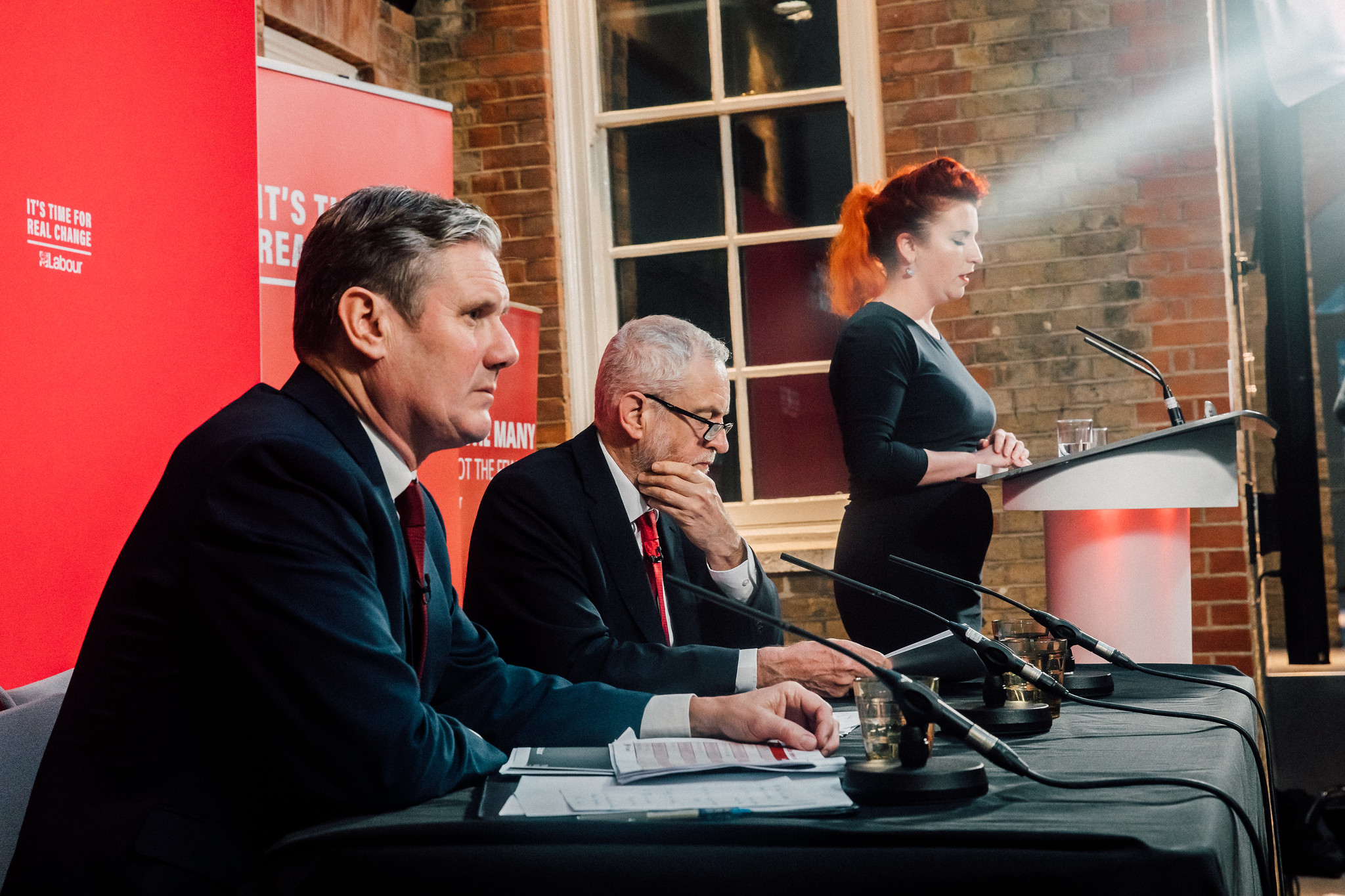
Labour Leader Keir Starmer, at left, in December 2019 with former Party Leader Jeremy Corbyn. (Jeremy Corbyn, Flickr)
The Chronicle’s job was to initiate the anti-Semitism libels and lies against Corbyn and his followers that served to feed and rationalize the fears of prominent sections of the Jewish community. Those fears could then be cited by the rest of the corporate media as evidence that Labour was riding roughshod over the Jewish community’s “sensitivities.” And in turn the Labour left’s supposed indifference to Jewish sensitivities could be attributed to its rampant anti-Semitism.
It culminated in the McCarthyite claim — now being enforced by Corbyn’s successor as Labour leader, Keir Starmer — that to deny Labour has some kind of special anti-Semitism problem, separate from that found more generally in British society, is itself proof of anti-Semitism. Once one is accused of anti-Semitism, as the Labour left endlessly is, one is guilty by definition — the choice is either to confess to anti-Semitism or be proven an anti-Semite by denying the accusation.
Like a victim caught in quicksand, the more vigorously the Labour left has rejected claims that the party is riddled with anti-Semitism the more it has sunk into the mire created by The Jewish Chronicle and others.
It is therefore hardly surprising that so many victims of the Chronicle’s libels and code violations are Corbyn supporters targeted in the anti-Semitism witch-hunt. Without these deceptions, the anti-Semitism claims against the Labour Party would have looked even more preposterous than they did to anyone familiar with the evidence.
False Accusations
For those interested, here are those four recent libel cases that went against the Chronicle:
September 2019: “The Jewish Chronicle has paid out £50,000 in libel damages to a UK charity [Interpal] that provides aid to Palestinians after wrongly linking it to terrorism.”
February 2020: “The libel settlement comes after a UK press regulator in December ruled that the paper’s four articles about [Labour activist Audrey] White had been ‘significantly misleading’ and that the paper had engaged in ‘unacceptable’ obstruction of their investigation.”
October 2020: “Nada al Sanjari, a school teacher and Labour councillor, was the subject of a number of articles published by the newspaper in 2019 that claimed she was one of several Momentum activists responsible for inviting another activist who the Jewish Chronicle characterised as anti-Semitic to a Labour Party event.”
July 2021: “The publication falsely accused [Marc] Wadsworth, in an article on its website in March, of being part of a group of current and ex-Labour members targeting Jewish activists in the party.”
It is not hard to spot the theme of all these smears, and many others, which suggest that those in solidarity with Palestinians under Israeli oppression, including Jews, are anti-Semites or guilty of supporting terrorism.
Saved from Liquidation
Remember, the 28 IPSO code violations — media euphemism for fabrications and deceptions — are only the tip of the iceberg. It is almost certain that many of those maligned by the Chronicle did not have the time, energy or resources to pursue the weekly paper either through the pointless IPSO “regulation” process or through extremely costly law courts.
And remember too that IPSO found against the Chronicle for breaching its code at least 28 times, even though that code was designed to give IPSO’s member publications every possible benefit of the doubt. IPSO has no incentive to highlight its members’ failings, especially when it was set up to provide the government with a pretext for not creating a truly independent regulatory body.
“It is almost certain that many of those maligned by the Chronicle did not have the time, energy or resources to pursue the weekly paper.”
The reality is that the 180-year-old Jewish Chronicle, or JC as it has remodelled itself, would have gone out of business some time ago had it not been twice saved from liquidation by powerful, establishment figures.
It avoided closure in 2019 after it was bailed out by “community-minded individuals, families and charitable trusts” following massive losses. The identities of those donors were not disclosed.
At the time Stephen Pollard highlighted his paper’s crucial role: “There’s certainly been a huge need for the journalism that the JC does in especially looking at the anti-Semitism in the Labour party and elsewhere.”
Consortium of Investors
Then only a year later the Chronicle had to be rescued again, this time by a shadowy consortium of investors who promised to pump in millions to keep the paper afloat and reimburse those who had donated the previous year.
Why these financiers appear so committed to a paper with proven systematic editorial failings, and which continues to be headed by the same editor who has overseen those serious failings for years, was underscored at the time by Alan Jacobs, the paper’s departing chairman.
He observed that the donors who bailed out the paper in 2019 “can be proud that their combined generosity allowed the JC to survive long enough to help to see off Jeremy Corbyn and friends, one of the greatest threats to face British Jewry in the JC’s existence.”
Corbyn had lost the general election to a Conservative Party led by Boris Johnson later that same year.

Prime Minister Boris Johnson, left, and Labour Leader Jeremy Corbyn during IYV debate. (Screenshot)
The public face of last year’s consortium was Sir Robbie Gibb, a former BBC executive and a longtime ally of figures on the Conservative right. He served as Theresa May’s spin doctor when she was prime minister. He was also an early adviser to GB News, a recent attempt to replicate the overtly rightwing Fox News channel in the UK.
Other visible consortium members are associated with the anti-Semitism campaign against Corbyn. They include former rightwing Labour MP John Woodcock, who cited anti-Semitism as his reason for quitting the party after it had begun investigating him for sending inappropriate messages to a female staff member.
Another is Jonathan Sacerdoti, a regular “analyst” on the BBC, ITV and Ch4 who previously served as a spokesperson for the Campaign Against Anti-Semitism, a lobby group set up back in 2014 specifically to discredit critics of Israel as antisemites.
And then there is John Ware, a former Sun journalist turned BBC reporter who fronted probably the single most damaging program on Corbyn. An hour-long Panorama “special” accusing Labour of anti-Semitism was deeply flawed, misleading and failed to acknowledge that several unnamed figures it interviewed were also pro-Israel lobbyists.
It would probably be unwise for me to say more about Ware or his publicly stated views on Muslims, shared by The Jewish Chronicle, because he has recently become litigious. He apparently has deep pockets, helping to fund both the rescue of the Chronicle and law suits against critics.
Exceptional Indulgence
But the exceptional indulgence of The Jewish Chronicle, both by IPSO and prominent figures in broadcasting, and the paper’s continuing credibility as a source of news for the wider corporate media, indicates how the anti-Semitism narrative about Labour served, and continues to serve, the British establishment.
Represented politically by the Conservative Party and the Labour right, that establishment was able to reassert its cozy parliamentary duopoly by ousting any meaningful challenge from the Labour left. With Corbyn gone, the threat of real politics has disappeared. We are back to one-party, corporate rule under the guise of two parties.
“The anti-Semitism narrative about Labour served, and continues to serve, the British establishment.”
Which is why IPSO cannot take any meaningful action against The Jewish Chronicle. To do so would pull the rug from under the anti-Semitism narrative that destroyed Corbyn and is now being used by his successor, Starmer, to purge Labour of the remnants of the left and to distance the party as far as possible from any lingering signs of Palestinian solidarity.
Exposure of The Jewish Chronicle as an editorial wrecking ball aimed at the left would show just how much the paper and the anti-Semitism narrative it bolstered were key to the Conservative party’s successful smearing of Corbyn that helped to keep him out of No. 10. It would highlight the enduring collusion between the corporate media and the political elite.
And it would indicate that corporate media is not really an exercise in capitalist, free-market economics, where profitable outlets drive out those that are unpopular. Rather loss-making corporate media such as The Jewish Chronicle are a price the establishment is only too happy to bear as long as those publications fulfil a more important purpose: ensuring that the political and economic climate remains favorable to the ruling class.
The Jewish Chronicle has played its part in destroying Corbyn and the left. Now it will continue that role by policing the public discourse and ensuring that no one like Corbyn ever gets near power again. Those libel payouts were a small price to pay.
How Owen Jones justifies Labour’s purge of socialists
Asa Winstanley
The Electronic Intifada
3 September 2021
https://electronicintifada.net/content/how-owen-jones-justifies-labours-purge-socialists/33831
Guardian columnist and YouTuber Owen Jones has apologized for a tweet supporting “Britain’s greatest living filmmaker” Ken Loach, who was expelled from the Labour Party last month.
Backtracking from his support, Jones tweeted last week that he wanted to “reflect” on “the justifiable distress” caused “to Jewish people” by a play Loach directed three decades ago.
I “therefore apologize for the tone of my tweet,” Jones wrote.
The 1987 production, called Perdition, was critical of the role the Zionist movement played during the Holocaust.
Zionism is Israel’s official racist and colonial ideology that is used to justify the expulsion of indigenous Palestinians and the seizure of their land.
As usual, Jones wants to have his cake and eat it.
He prefaced his condemnation of Loach with the claim that he did not support the Labour Party’s “action” against the director.
Loach’s television and cinema work, over more than six decades, has focused particularly on the lives of working class people, and has also included anti-war and anti-colonial themes.
The Palme d’Or winner is popular among the same left-wing audience that Jones relies on to buy his books and watch his videos.
A veteran British socialist, Loach has long been an advocate of Palestinian liberation.
Loach revealed his ejection from Labour on 14 August.
Loach’s expulsion is part of the McCarthyite purge of socialists and Palestine solidarity activists by right-wing party leader Keir Starmer and his acolytes,
According to right-wing party news website LabourList, Loach was expelled due to his support for Labour Against the Witchhunt, one of several left-wing groups recently banned by the party.
This is all a continuation of the right-wing campaign that single-mindedly aimed to oust Jeremy Corbyn after the veteran left-wing lawmaker was elected party leader in 2015.
The witch hunt has targeted Corbyn supporters with disciplinary measures including suspensions and expulsions. They have often been wrongly accused of “anti-Semitism” – almost always a code word for supporting Palestinian rights.
Corbyn, who resigned as leader in 2019, was himself purged the following year.
Jones’ claim that he did not support the expulsion of Loach is belied by one of his tweets from July.
Jones tweeted that he agreed with a supposedly left-wing member of Labour’s National Executive Committee, who had just voted for the “auto-expulsion” of party members associated with banned left-wing groups, including Labour Against the Witchhunt.
Pro-Israel lobby group the Jewish Labour Movement told LabourList that it supported Loach’s expulsion.
Chair Mike Katz responded that Starmer had “shown strong leadership in tackling anti-Semitism.”
Jones happily promoted Israel lobby talking points at a Jewish Labour Movement event in 2017.
Ahead of the national executive’s July vote banning the left-wing groups, LabourList reported that getting rid of Loach was one of the main motivations for including Labour Against the Witchhunt in the ban.
Loach is arguably the most high-profile supporter of the group.
So Jones’ claim not to support Loach’s expulsion when that was the inevitable and predictable result of the ban on Labour Against the Witchhunt – which Jones supported – is disingenuous or downright dishonest.
“Distressing to Jewish people”
Jones also implies that Loach is not a real socialist, tweeting: “Why would someone on the left want to make this play?”
But the play, Perdition, by late socialist scriptwriter Jim Allen, was loosely based on a real event – a fact Jones ignores.
Jones claimed the play was “incredibly distressing to Jewish people.”
But what he really meant was that the play caused distress to supporters of Israel.
Ahead of its 1987 debut at the Royal Court Theatre in London, Perdition was attacked by the Israel lobby.
Later that year protests against a reading of the play were called by the Union of Jewish Students – a pro-Israel group which at least in recent years has been funded by the Israeli government.
A day before its opening, the play was canceled. Loach and Allen correctly blamed the Israel lobby and said they were being censored.
The play was eventually staged in 1999. Once more, the Union of Jewish Students protested.
“The charge of anti-Semitism is the time-honored way to deflect anti-Zionist arguments,” Loach said in a 2004 letter to The Guardian.
“Collaboration with the Nazis”
What was all the fuss about? In order to answer that, it is necessary to relate a well-documented, but little-known episode.
Perdition was based on the 1954 Gruenwald-Kasztner trial in Israel.
Malchiel Gruenwald – a refugee from Hungary who lost 50 relatives to the Nazi Holocaust – was sued for writing a pamphlet accusing Labor Zionist functionary Rezső Kasztner of “collaboration with the Nazis” back in their native country.
A press spokesperson for an Israeli ministry, Kasztner was a member of the ruling Mapai party, the forerunner of Israel’s present-day Labor Party.
Mapai leaders were hoping to get Kasztner into the Knesset, Israel’s parliament. He was a Mapai candidate for the first two Knesset elections, and initially for the third, before he was removed as an embarrassment.

Rezső Kasztner speaking on Israeli state radio. Kasztner’s cooperation with Nazi war criminals in his native Hungary caused a national scandal after his actions came under the microscope during a 1954 libel trial in Israel. (Wikimedia Commons)

Party leaders had a degree of loyalty to Kasztner, as he had been their man in Hungary during the war. If Kasztner was a collaborator, so were they, they reasoned. Gruenwald’s accusations could not be allowed to stand.
According to a 1950 Israeli law, if Kasztner was a Nazi collaborator, he could even have faced the death penalty. The government resolved to sue Gruenwald for libel. They would come to regret it.
After months of hearings, the court found Gruenwald had not defamed Kasztner and decided that the Mapai man had indeed collaborated. Kasztner had “sold his soul to the devil,” the judge famously ruled.
Worse still for the Labor Zionists, the hearings became a trial of Kasztner in the court of public opinion – and by extension a trial of them. The affair still resonates in Israel decades later.
The trial exposed a gruesome history of Nazi-Zionist cooperation which Israeli leaders would have preferred remain buried.
Deadly lies
After the March 1944 German invasion of Hungary, Kasztner, a local member of the Zionist leadership, worked directly with the Nazis.
He agreed to help maintain calm in the Hungarian Jewish community, particularly the 20,000 Jews of Kasztner’s native town of Kluj. The Nazis wanted to ensure there was no repeat of the Warsaw Ghetto uprising in Poland the year prior.
The Jews of Kluj were concentrated in a ghetto prior to deportation, and were told a tale about “Kenyermeze,” a work camp in a German-occupied area where they would supposedly be sent and kept alive.
But this was a deadly lie: The trains were actually taking people to Auschwitz, the death camp in occupied Poland, where the Nazis murdered 12,000 Hungarian Jews per day.
Almost half a million Hungarian Jews were ultimately exterminated.
To ensure there was no rebellion, Kasztner’s men told the Jewish community that they would be safe. Fake postcards and letters from “Kenyermeze” were distributed or read by his group assuring the Jews in Kluj that all was well. Thinking they were being deported to labor camps, Jews in Hungary mostly did not resist.
As Ben Hecht writes in Perfidy, his 1961 book on the affair, the Jews of Kluj were guarded in their ghetto by fewer than two dozen Nazi and Hungarian guards. They could have easily overcome them and escaped to safety across the Romanian border, just three miles away, had Kasztner told them what fate he knew really awaited them.
But Kasztner had personally negotiated a deal with senior Hitler aide and Holocaust architect Adolf Eichmann. Kasztner knew where the “resettlement” trains were actually headed, but remained silent.
“A success for Zionism”
In exchange for deceiving his community, the Nazis agreed to let Kasztner select a group – mostly fellow Zionists, friends and family – who would be permitted to escape Hungary on a train to Switzerland. The idea was that the elite group would join the Zionist settler-colony in Palestine.
Zionists and Nazis both agreed on the goal of removing European Jews from Europe.
Eichmann was captured in Argentina in 1960 by Mossad agents and brought back to Israel, where he would be tried and executed in 1962.
Speaking to a pro-Nazi Dutch journalist, while still at large in 1955, Eichmann himself fondly recalled working with Kasztner. He described the Nazi-Zionist meeting of minds in chillingly frank terms.
According to Eichmann, Kasztner’s main concern was to make it possible for a select group of Hungarian Jews to go to Palestine.
“You can have the others,” Eichmann recalled Kasztner saying, “but let me have this group here.”
The Nazi also asserted that “there was a very strong similarity between our attitudes in the SS and the viewpoint of these immensely idealistic Zionist leaders.”
“I believe that Kasztner would have sacrificed a thousand or a hundred thousand of his blood to achieve his political goal,” Eichmann said. “He was not interested in old Jews or those who had become assimilated into Hungarian society. But he was incredibly persistent in trying to save biologically valuable Jewish blood – that is, human material that was capable of reproduction and hard work.”
“Because Kasztner rendered us a great service by helping keep the deportation camps peaceful, I would let his group escape,” Eichmann explained.
Judge Benjamin Halevy took nine months to write his ruling, concluding on 21 June 1955 that “the Nazis’ patronage of Kasztner, and their agreement to let him save six hundred prominent Jews, were part of the plan to exterminate the Jews.”
He said that Kasztner “considered the rescue of the most important Jews as a great personal success and a success for Zionism.”
“How could the judge dare!”
The Israeli press extensively covered the story and the affair dominated the 1955 Knesset elections. The government immediately appealed to the high court. There were calls in the Knesset and press to have Kasztner tried under the Nazi collaborators law.
“A nightmare, a horror,” Prime Minister Moshe Sharett wrote in his diary. “How could the judge dare!”
Kasztner had become a liability. He was leaking inconvenient facts like a damaged bucket.

Israel’s second prime minister Moshe Sharett, who called the verdict “a nightmare.” (Wikimedia Commons)

If the appeal had not gone the government’s way, calls to try Kasztner as a Nazi collaborator would have been much harder to resist.
But before he could take the stand again, Kasztner was silenced forever.
In March 1957, he was assassinated outside his home. The three killers were already known to the Shin Bet, Israel’s secret police, and immediately arrested. One of them, Zeev Eckstein, confessed to having been a Shin Bet agent prior to the killing.
During and after the Gruenwald trial, Kasztner was given police protection. Shortly before his assassination, this was lifted. There were allegations that the Israeli security establishment had made a decision to murder Kasztner to shut him up.
The killers were sentenced to life in prison – yet only five years later they were released. Israel’s first prime minister, David Ben-Gurion, had personally intervened to help secure their freedom.
The high court overturned most of the libel trial verdict. The judges did not dispute the facts that emerged in the trial about what Kasztner had done, but only Judge Halevy’s legal interpretation of what they amounted to. In some instances the judges even justified his actions.
What did Kasztner have left to tell? It’s likely that some secrets died with him.
Notably, his collaboration with Nazi war criminals did not end with the war.
After the Holocaust he traveled to Germany and testified at Nuremberg in defense of several Nazis involved in the extermination of Jews, such as SS officer Kurt Becher. As a result, Becher escaped the noose and eventually became one of West Germany’s richest industrialists.
Kasztner had originally been brought to Nuremberg to testify against Nazi war criminals, as detailed in Akiva Orr’s 1994 book Israel: Politics, Myths and Identity Crises.
But according to one American prosecutor, “Kasztner roamed the Nazi prison camp for Nazi officers searching for those he could help by testimony or intervention on their behalf. In the end we were very glad when he left.”
Jones’ double game
While Kasztner’s behavior may have been particularly egregious, it came within the context of broader Zionist-Nazi cooperation, as both movements shared the goal of removing Jews from Europe.
Kasztner’s affidavit to the Nuremberg tribunal on behalf of the Nazi Kurt Becher stated that it was given “not only in my name, but also on behalf of the Jewish Agency and the Jewish World Congress” – two of the leading bodies of the Zionist movement at the time.
In the appeal of the Gruenwald verdict, Israel’s attorney general admitted as much.
“Kasztner did nothing more and nothing less than was done by us,” he stated. “It has always been our Zionist tradition to select the few out of the many in arranging the immigration to Palestine.”
What do we learn from all this?
Owen Jones is often referred to on the British left as a weather vane, because he changes his positions so often.
In 2015 when Jeremy Corbyn was popular, Jones supported his leadership.
But at the first test in 2016, when there was an attempted coup by Labour MPs and the Israel lobby, Jones turned against him, writing that he was in “despair” about Labour under Corbyn.
Soon before the June 2017 election, Jones went further and explicitly called for Corbyn to quit.
After Corbyn’s Labour came within a few thousand votes of winning that election, depriving the ruling Conservative Party of its majority and ultimately forcing Prime Minister Theresa May to step down, Jones flip-flopped once again, writing that he had made a mistake.
Unchastened, Jones has played a similar double game ever since. He has long fueled the Labour witch hunt over “anti-Semitism,” endorsing calls for socialists like Chris Williamson, Jackie Walker and this author to be suspended or expelled.
Now, with Loach expelled, Jones again wants it both ways. He wants to claim he doesn’t support expulsion, but at the same time he unjustly condemns Loach’s work as “incredibly distressing to Jewish people” – and thus implies there’s merit to the expulsion.
Owen Jones is no true friend to socialists or Palestinians.
Sources
Lenni Brenner, Zionism in the Age of the Dictators (Atlanta: On Our Own Authority, 2014), pages 284-291
Ben Hecht, Perfidy, (New York: Julian Messner, Inc., 1961)
Akiva Orr, Israel: Politics, Myths and Identity Crises (London: Pluto Press, 1994), pages 81-116
Tom Segev, The Seventh Million (New York: Hill and Wang, 1993), pages 255-296, 305-310
Subscribe to:
Posts (Atom)