Sunday, August 29, 2021

Who Profits From the Kabul Suicide Bombing?

August 27, 2021


ISIS-Khorasan aims to prove to Afghans and to the outside world that the Taliban cannot secure the capital, writes Pepe Escobar.


By Pepe Escobar

https://consortiumnews.com/2021/08/27/who-profits-from-the-kabul-suicide-bombing/


The horrific Kabul suicide bombing introduces an extra vector in an already incandescent situation: It aims to prove to Afghans and to the outside world that the nascent Islamic Emirate of Afghanistan is incapable of securing the capital.

As it stands, at least 103 people – 90 Afghans (including at least 28 Taliban) and 13 American servicemen – were killed and at least 1,300 injured, according to the Afghan Health Ministry.

Responsibility for the bombing came via a statement on the Telegram channel of Amaq Media, the official Islamic State (ISIS) news agency. This means it came from centralized ISIS command, even as the perpetrators were members of ISIS-Khorasan, or ISIS-K.

Presuming to inherit the historical and cultural weight of ancient Central Asian lands that from the time of imperial Persia stretched all the way to the western Himalayas, that spin-off defiles the name of Khorasan.

The suicide bomber who carried out “the martyrdom operation near Kabul airport” was identified as one Abdul Rahman al-Logari. That would suggest he’s an Afghan, from nearby Logar province. And that would also suggest that the bombing may have been organized by an ISIS-Khorasan sleeper cell. Sophisticated electronic analysis of their communications would be able to prove it – tools that the Taliban don’t have.

The suicide bomber Abdul Rahman al-Logari as presented by ISIS propaganda. (Handout / Daesh)

The way social media-savvy ISIS chose to spin the carnage deserves careful scrutiny. The statement on Amaq Media blasts the Taliban for being “in a partnership” with the U.S. military in the evacuation of “spies.”

It mocks the “security measures imposed by the American forces and the Taliban militia in the capital Kabul,” as its “martyr” was able to reach “a distance of no less than five meters from the American forces, who were supervising the procedures.”

So it’s clear that the newly reborn Islamic Emirate of Afghanistan and the former occupying power are facing the same enemy. ISIS-Khorasan comprises a bunch of fanatics, termed takfiris because they define fellow Muslims – in this case the Taliban – as “apostates.”

Founded in 2015 by emigré jihadis dispatched to southwest Pakistan, ISIS-K is a dodgy beast. Its current head is one Shahab al-Mujahir, who was a mid-level commander of the Haqqani network headquartered in North Waziristan in the Pakistani tribal areas, itself a collection of disparate mujahideen and would-be jihadis under the family umbrella.

Washington branded the Haqqani network as a terrorist organization way back in 2010, and treats several members as global terrorists, including Sirajuddin Haqqani, the head of the family after the death of the founder Jalaluddin.

Up to now, Sirajuddin was the Taliban deputy leader for the eastern provinces – on the same level with Mullah Baradar, the head of the political office in Doha, who was actually released from Guantanamo in 2014.

Crucially, Sirajuddin’s uncle, Khalil Haqqani, formerly in charge of the network’s foreign financing, is now in charge of Kabul security and working as a diplomat 24/7.

The previous ISIS-K leaders were snuffed out by U.S. airstrikes in 2015 and 2016. ISIS-K started to become a real destabilizing force in 2020 when the regrouped band attacked Kabul University, a Doctor Without Borders maternity ward, the presidential palace and the airport.

NATO intel picked up by a UN report attributes a maximum of 2,200 jihadis to ISIS-K, split into small cells. Significantly, the absolute majority are non-Afghans: Iraqis, Saudis, Kuwaitis, Pakistanis, Uzbeks, Chechens and Uighurs.

The real danger is that ISIS-K works as a sort of magnet for all manners of disgruntled former Taliban or discombobulated regional warlords with nowhere to go.
The Perfect Soft Target

Kabul airport. (Peretz Partensky/Wikimedia Commons)

The civilian commotion these past few days around Kabul airport was the perfect soft target for trademark ISIS carnage.

Zabihullah Mujahid – the new Taliban minister of information in Kabul, who in that capacity talks to global media every day – is the one who actually warned NATO members about an imminent ISIS-K suicide bombing. Brussels diplomats confirmed it.

In parallel, it’s no secret among intel circles in Eurasia that ISIS-K has become disproportionally more powerful since 2020 because of a transportation ratline from Idlib, in Syria, to eastern Afghanistan, informally known in spook talk as Daesh Airlines.

Moscow and Tehran, even at very high diplomatic levels, have squarely blamed the U.S.-U.K. axis as the key facilitators. Even the BBC reported in late 2017 on hundreds of ISIS jihadis given safe passage out of Raqqa, and out of Syria, right in front of the Americans.

The Kabul bombing took place after two very significant events.

The first one was Mujahid’s claim during an American NBC News interview earlier this week that there is “no proof” Osama bin Laden was behind 9/11 – an argument that I had already hinted was coming in this podcast the previous week.

This means the Taliban have already started a campaign to disconnect themselves from the “terrorist” label associated with 9/11. The next step may involve arguing that the execution of 9/11 was set up in Hamburg, the operational details coordinated from two apartments in New Jersey.

Nothing to do with Afghans. And everything staying within the parameters of the official narrative – but that’s another immensely complicated story.

The Taliban will need to show that “terrorism” has been all about their lethal enemy, ISIS, and way beyond old school al-Qaeda, which they harbored up to 2001. But why should they be shy about making such claims? After all, the United States rehabilitated Jabhat Al-Nusra – or al-Qaeda in Syria – as “moderate rebels.”

The origin of ISIS is incandescent material. ISIS was spawned in Iraq prison camps, its core made of Iraqis, their military skills derived from ex-officers in Saddam’s army, a wild bunch fired way back in 2003 by Paul Bremmer, the head of the Coalition Provisional Authority.

ISIS-K duly carries the work of ISIS from Southwest Asia to the crossroads of Central and South Asia in Afghanistan. There’s no credible evidence that ISIS-K has ties with Pakistani military intel.

On the contrary: ISIS-K is loosely aligned with the Tehreek-e-Taliban (TTP), also known as the Pakistani Taliban, Islamabad’s mortal enemy. TTP’s agenda has nothing to do with the moderate Mullah Baradar-led Afghan Taliban who participated in the Doha process.
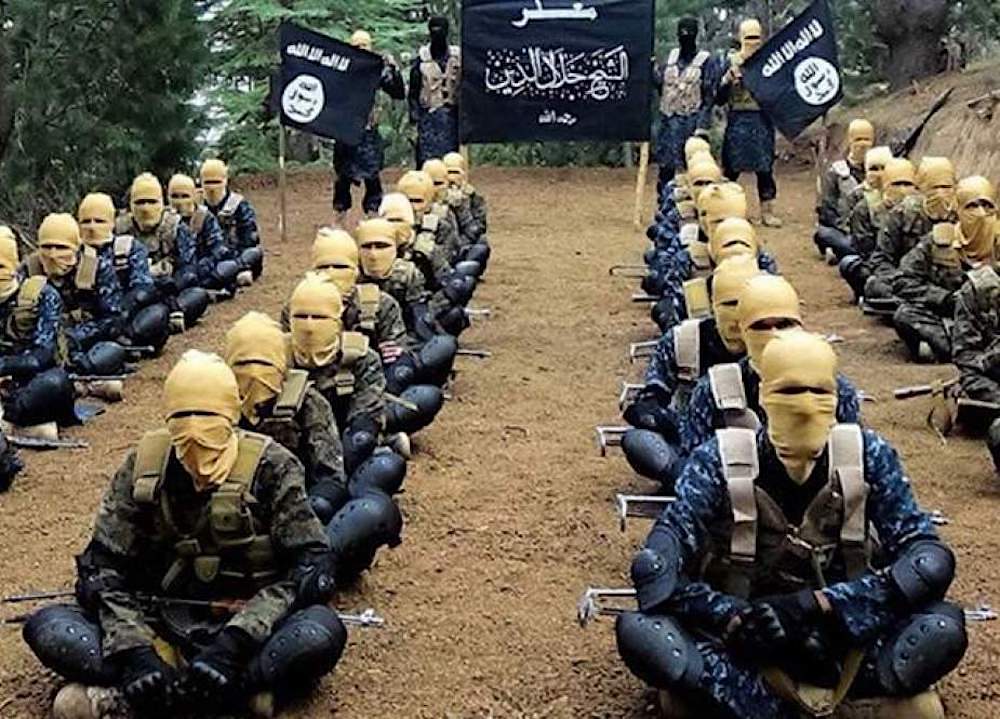
IS-K fighters in training in Afghanistan. (Facebook)
SCO to the Rescue

The other significant event tied to the Kabul bombing was that it took place only one day after yet another phone call between Presidents Vladimir Putin and Xi Jinping.

The Kremlin stressed the pair’s “readiness to step up efforts to combat threats of terrorism and drug trafficking coming from the territory of Afghanistan”; the “importance of establishing peace”; and “preventing the spread of instability to adjacent regions.”

And that led to the clincher: They jointly committed to “make the most of the potential” of the Shanghai Cooperation Organization (SCO), which was founded 20 years ago as the “Shanghai Five”, even before 9/11, to fight “terrorism, separatism and extremism.”

The SCO summit is next month in Dushanbe – when Iran, most certainly, will be admitted as a full member. The Kabul bombing offers the SCO the opportunity to forcefully step up.

Whichever complex tribal coalition is formed to govern the Islamic Emirate of Afghanistan, it will be intertwined with the full apparatus of regional economic and security cooperation, led by the three main actors of Eurasia integration: Russia, China and Iran.

The record shows Moscow has all that it takes to help the Islamic Emirate against ISIS-K in Afghanistan. After all, the Russians flushed ISIS out of all significant parts of Syria and confined them to the Idlib cauldron.

In the end, no one aside from ISIS wants a terrorized Afghanistan, just as no one wants a civil war in Afghanistan. So the order of business indicates not only an SCO-led frontal fight against existing ISIS-K terror cells in Afghanistan but also an integrated campaign to drain any potential social base for the takfiris in Central and South Asia.


6 questions about coronavirus vaccine booster shots, answered


https://www.youtube.com/watch?v=CIVWxmMAB7k&t=2s


More People Quitting Than Ever Due To Terrible Conditions


https://www.youtube.com/watch?v=MQGt7wypkOo


VENEZUELAN DIPLOMAT ALEX SAAB FIGHTS LATEST US EXTRADITION MANEUVERS


By Roger D. Harris,
Popular Resistance.

August 27, 2021


https://popularresistance.org/venezuelan-diplomat-alex-saab-fights-latest-us-extradition-maneuvers/


Venezuelan diplomat Alex Saab remains defiant after over 14 months under US-ordered arrest in the African archipelago country of Cabo Verde. A special envoy of the Venezuelan government, he is fighting extradition to the US for the “crime” of trying to procure humanitarian supplies of food, fuel, and medicine from Iran in violation of illegal US sanctions. To date, Saab’s legal appeals for freedom have been either denied, rejected, or ignored as his extradition to the US is becoming increasingly imminent.
The legal case

Saab continues to fight this flagrant attempt of extra-territorial judicial overreach by the US. In response to Saab’s recent appeal to the US 11th Circuit Court, the US filed on August 24 an application for an extension to reply on October 7. This legal delaying tactic is likely a US ploy to allow Saab’s pending extradition without recognizing his diplomatic immunity.

Under the Geneva Conventions, a credentialed diplomat such as Saab has absolute immunity from arrest, even in the time of war. The US does not recognize Saab’s diplomatic status as if Washington has the authority to qualify who other countries may choose and receive as their ambassadors.

To begin with, Saab’s arrest on June 12, 2020, was arbitrary, illegal, and irregular. While on his way from Caracas to Tehran, his plane was diverted to Cabo Verde for a technical fueling stop. Saab was forcibly removed from the plane by Cabo Verdean police who did not have an arrest warrant.

The day after the arrest and detention, the US had INTERPOL issue a Red Notice, which was subsequently annulled by INTERPOL. And when the arrest warrant arrived after the fact, it was made out in the name of a person who was not Alex Saab. Such is the truly farcical legal basis for the diplomat’s detention.

Cabo Verde is a member of and under the jurisdiction of the Economic Organization of West African State (ECOWAS) Court of Justice, which ordered Saab to be released and even paid damages by the Cabo Verde government. Cabo Verde appealed the ruling, lost, and then claimed – even though it had recognized the authority of the court by participating in the proceedings – that it did not have to obey the court’s orders.

Subsequently, the United Nations Human Rights Committee called for Saab’s release.

Saab’s legal team went to the Cabo Verde Supreme Court with a writ of habeas corpus. This was denied on the absurd grounds that Saab was at “liberty” under “house arrest.” In fact, he was not only detained but not allowed to be treated for a cancer condition by his doctors or even meet with family who came to support him when they first came to Cabo Verde. Only after pressure was Saab allowed minimal visitation.

On August 13, Saab’s case came before the Cabo Verde Constitutional Court contesting his detention on twelve constitutional grounds. Saab was not allowed to appear in person at the court. Although the Constitution Court is bound to respond, it has simply run the clock so far.
The political case

This legal theatre around the Saab case serves as an obfuscation for what is fundamentally a political case of the US attempting to impose regime-change on Venezuela through its punishing unilateral coercive measures; measures which amount to an unlawful blockade of the Latin American nation.

The US wields an inordinate amount of influence on one of the smallest nations in the world with a larger Cabo Verdean population in the US than on the home islands. With few natural resources, Cabo Verde is dependent on remittances from abroad and more unfortunately is “a waypoint for illicit drugs and other transnational organized crime,” according to a US government report. With a GDP of only $1.7bil, the current $400mil US embassy building project is a considerable carrot for Cabo Verde.

The political nature of the case is in effect recognized by the US. Saab is accused by the US of being the mastermind behind a network of sources that has allowed Venezuela to bypass the US blockade and procure needed supplies, which is the reason for targeting Saab. In pursuit of enforcing its illegal sanctions, the US would likely want to extract from Saab information on how Venezuela has tried to circumvent the blockade, which the US has imposed to asphyxiate Venezuela into submission.

Saab alleges that he has been tortured while in Cabo Verde. He has reason to expect that he would face more of the same, if he were extradited to the US, to force him to not only disclose his trade contacts and channels but to denounce the government of Venezuela.
Saab in his own words

Saab, however, remains defiant. On August 19, Saab legally charged Cape Verdean authorities with gross misconduct in his case including torture. The following are his own words in a statement released through his lawyers August 25:

“Cape Verde has not decided yet because despite having all legal terms expired and having clear knowledge that innumerable laws have been violated, the fact of now having to totally violate its own constitution in order to extradite me, upsets the conscience of those judges of the Constitutional Court, who have been honest until now, but who are strongly pressured by the US.

In Cape Verde, its president, the prime minister, the corrupt attorney general, and even the humblest people, know and recognize that I am kept kidnapped.

For those who dream that my speech or integrity will change if I am extradited, let me spoil that illusion. My integrity does not change with the [political] climate or the type of torture. Venezuela is sovereign. It is the country that adopted me.

It is the country for which all decent people fight. We do not go around the world lying and asking for sanctions against the people.

Venezuela will win this battle, whether in Cape Verde or in North America, we will win. I hope to see the sanctions lifted soon, and that priority will continue to be given to the people who need at least 30 more years of electoral victories, led by a people united around the PSUV [socialist party] and our President Nicolas Maduro Moros.

So, leave the emotions out wondering if the plane arrived, if it didn’t arrive, if I will ‘sing’ as a tenor in case they extradite me, etc. Let go of that ridiculous illusion, first because there is nothing to ‘sing’ about and second because as I have said many times, I will never betray the Homeland I serve.”
International effort to free Alex Saab

Internationally, Cabo Verde has received diplomatic letters protesting the Saab case from Iran, China, Russia, the United Nations, the African Union, ECOWAS, and of course Venezuela based on the principles of immunity and inviolability of consular rights. Over 15,000 internationals have signed a petition to the US and Cape Verdean political leadership to free Alex Saab at https://afgj.org/free-alex-saab.


Enough of the BS from these warmongers


https://www.youtube.com/watch?v=rRAMoiCgBlk


CALIFORNIA KIDS TO TEACHERS’ PENSION FUND: DIVEST FROM OIL


By Marcy Winograd,
Common Dreams.

August 27, 2021


https://popularresistance.org/california-kids-to-teachers-pension-fund-divest-from-oil/


The nation’s second largest pension fund invests in the climate crisis.

The kids are mad as hell—and so are teachers who want their California teacher pension fund, CalSTRS, to join 1,000 other institutions collectively divesting $14.5 trillion from the fossil fuel industry that threatens climate catastrophe. The retirement fund divestment fight, led by retired teachers in Fossil Free CA and students from Youth vs Apocalypse and Earth Guardians, estimates CalSTRS’ portfolio investments in fossil fuels at $16 billion, mostly in oil and gas delivery systems, but $6 billion in direct investments in oil behemoths, with $400 million in Exxon-Mobil, $350 million in Chevron, $250 million in BP and $108 million in Enbridge Inc. This is the same corporation sending attack dogs to maul water protectors protesting drilling at river crossings on indigenous land, where Enbridge’s Line 3 pipeline will send sludgy tar sands through Minnesota. The estimated pollution from the pipeline is equivalent to 50 coal powered plants running for 50 years.

Fossil Free CA and other divestment advocates, including this author, warn that CalSTRS, the nation’s second largest pension fund with a $310 billion dollar portfolio, just behind CalPERS’ $444 billion in holdings, risks sticking its members, over 700-thousand active and retired California teachers, with stranded assets—unless the pension fund moves the money before it’s too late, too late for the portfolio, too late for the planet.

CalSTRS’s resistance to divestment from Big Oil comes at a financial cost to rank and file public school teachers. In 2019, the Corporate Knights, a Toronto-based research firm, published a study showing that had CalSTRS divested during the last decade the teacher retirement fund would have generated an additional $5.5 billion. Forbes reports that during that same decade, the energy sector of big fossil fuel companies, such as Exxon (ejected from the Dow in 2020), Chevron and BP, shrunk to the smallest investment sector in Standard and Poor’s (S & P) index of the 500 largest US publicly traded companies. This year oil companies underperforming the index saw their credit ratings cut in half.

To put it in teacher terms, Big Oil is not earning a passing fiscal grade.

Divestment advocates argue now is the time to starve the fossil fuel industry of capital to prevent new oil production. Otherwise, the burning of these fuels will heat the Earth higher than 1.5 degrees Celsius, the tipping point for climate catastrophe.

Advocates point to the recent International Energy Agency (IEA) -report “Net Zero by 2050,” in which the world’s energy advisors turn a thumbs down on new oil projects, “The contraction of oil and natural gas production will have far-reaching implications for all the countries and companies that produce these fuels. No new oil and natural gas fields are needed in the net zero pathway …”

By investing in Exxon, Chevron, BP, Occidental Petroleum, Phillips 66, Royal Dutch Shell, and other oil companies, CalSTRS is encouraging new oil production and undermining the IEA.

Ultimately, the decision to divest from fossil fuels lies in the fiduciary hands of CalSTRS’ board members, who have yet to vote for divestment, despite repeated testimony and activism from teachers and middle schoolers at board meetings. On November 6, 2019, the CalSTRS investment committee was recessed for hours after middle school students drove home their divestment message with a protest dance and recording of climate activist Greta Thunberg’s recent speech to the UN. Iman, an 11 year old member of Earth Guardians Bay Area Crew, told the press, “I live in Richmond right next to the oil refinery. I can see with my own eyes the urgency for closing down fossil fuel companies. We are at the beginning of mass extinction.”

A vociferous opponent of divestment is CalSTRS Chair Harry Keiley, a Santa Monica Malibu teacher who advocates leveraging institutional heft to demand oil companies transition to renewables, a tactic rejected by climate champion former Vice President Al Gore, who testified before the CalSTRS board in April, 2021. “I have been less than impressed with carbon-intensive companies to play a meaningful role in bringing about change,” said Gore.

CalSTRS board member Denise Bradford, the former Chair of the CTA Retirement Committee, joins Keiley in opposing divestment from fossil fuels. Both she and Keiley declined to respond to this writer’s recent emails.

Fiona Ma, California’s State Treasurer, in 2019 joined with students and teachers calling for divestment. This year, CA State School Superintendent Tony Thurmond publicly stated his support for CalSTRS to divest. Betty Yee, California’s State Controller who declared in 2019, “the fossil fuel era is ending,” is a question mark, much like several others on the CalSTRS board.

As summer wildfires swept through Northern California, students wearing gas masks covered in “oil” (black molasses) marched through downtown Santa Monica, calling on CalSTRS Chair Keiley to support their divestment campaign. Sporting signs that read “Investing in Oil Makes Teachers’ Money Spoil”—”Harry, you are drowning us in oil” and “CalSTRS funds pipelines,” the students wove their way through the farmers market and Third Street Promenade, chanting, “No more fossil fools.”

In a 7/19/21 OpEd in the Sacramento Business Journal Keiley defends his anti-divestment stance, pointing to CalSTRS’ successful nomination and backing of dissidents for the Exxon Board of Directors. “For ExxonMobil, divestment would have taken away our influence and ability to effect change, especially on the board,” writes Keiley, adding, when necessary, we escalate our engagement, such as the shareholder-approved proposal we filed with Phillips 66 to report on how the company’s lobbying activities align with the Paris Climate Agreement.” Keiley’s point of view reflects CalSTRS’ stated “Perspective on fossil fuel divestment,” posted on the pension fund’s website.

Critics argue CalSTRS’ investments are propping up a dying and deadly industry, even as Chevron boasts of drilling 25 new oil wells worldwide, and Exxon-Mobil undertakes the world’s largest oil production in Guyana, set to release 125 million metric tons of CO2 per year from 2025-2040. “CalSTRS’ insistence on engaging with fossil fuel companies rather than divesting from them comes right out of the industry’s playbook,” says Jane Vosburg, a retired English teacher and co-founder of Fossil Free CA. She adds, “While large parts of the world are burning up and others drowning in floods, the CalSTRS board stays married to Big Oil. What has been the result? Threats to indigenous people’s land at the Dakota Access Pipeline and Enbridge’s Line 3, three new oil executives, including one from Enbridge, on Exxon’s board and billion-dollar losses for teachers.”

The 35,000-strong United Teachers of Los Angeles, the largest union under the umbrella of the California Teachers Association, passed a resolution in 2019 in favor of divestment, but CTA’s Sacramento lobbyist Jennifer Baker has opposed such a move. In 2017, Baker wrote a letter in opposition to California Assembly Member Ash Kalra’s bill to divest from Energy Transfer, the company building the Dakota Access Pipeline, a much-protested oil route stretching from North Dakota to Illinois, threatening ancestral lands of the Standing Rock Sioux Tribe.

Interestingly, over the last 10 years, Energy Transfer lost 5% of its stock value while the S & P went up, returning 13.6% annually. CalSTRS, according to its posted (6/30/20) financial reports, invested $42 million in Energy Transfer debt securities.

One does not need a crystal ball to predict waning returns for the fossil fuel industry; one does not need a doctoral degree in political science to know that alienating public education allies—youth, people of color, the indigenous—comes with political risks; one does not even need a degree in education to understand that teachers profiting from investments in global warming send a contemptuous message to their students facing the prospects of rising sea level, floods, drought, forest destruction—and human misery.

Anaya Sayal is part of the Youth Vs Apocalypse CalSTRS divestment team. The longer CalSTRS waits to divest, she says, “the worse the situation will get, so we need to act now, otherwise future generations will be drowning in climate issues that will be significantly more difficult to fix than for us right now.”
Take Action

Email Board@CalSTRS.com to urge the board to vote to divest.

Join Fossil Free CA and sign their petition.

Sign the Youth Vs Apocalypse & Earth Guardians Petition to CalSTRS.


SUPREME COURT ALLOWS EVICTIONS TO RESUME DURING PANDEMIC


By Mark Sherman,
Associated Press.

August 27, 2021

https://popularresistance.org/supreme-court-allows-evictions-to-resume-during-pandemic/


Washington — The Supreme Court’s conservative majority is allowing evictions to resume across the United States, blocking the Biden administration from enforcing a temporary ban that was put in place because of the coronavirus pandemic.

The court’s action late Thursday ends protections for roughly 3.5 million people in the United States who said they faced eviction in the next two months, according to Census Bureau data from early August.

The court said in an unsigned opinion that the Centers for Disease Control and Prevention, which reimposed the moratorium Aug. 3, lacked the authority to do so under federal law without explicit congressional authorization. The justices rejected the administration’s arguments in support of the CDC’s authority.

“If a federally imposed eviction moratorium is to continue, Congress must specifically authorize it,” the court wrote.

The three liberal justices dissented. Justice Stephen Breyer, writing for the three, pointed to the increase in COVID-19 caused by the delta variant as one of the reasons the court should have left the moratorium in place. “The public interest strongly favors respecting the CDC’s judgment at this moment, when over 90% of counties are experiencing high transmission rates,” Breyer wrote.

White House press secretary Jen Psaki said the administration was “disappointed” by the decision and said President Joe Biden “is once again calling on all entities that can prevent evictions — from cities and states to local courts, landlords, Cabinet Agencies — to urgently act to prevent evictions.”

It was the second loss for the administration this week at the hands of the high court’s conservative majority. On Tuesday, the court effectively allowed the reinstatement of a Trump-era policy forcing asylum seekers to wait in Mexico for their hearings. The new administration had tried to end the Remain in Mexico program, as it is informally known.

On evictions, Biden acknowledged the legal headwinds the new moratorium would likely encounter. But Biden said that even with doubts about what courts would do, it was worth a try because it would buy at least a few weeks of time for the distribution of more of the $46.5 billion in rental assistance Congress had approved.

The Treasury Department said Wednesday that the pace of distribution has increased and nearly a million households have been helped. But only about 11% of the money, just over $5 billion, has been distributed by state and local governments, the department said.

The administration has called on state and local officials to “move more aggressively” in distributing rental assistance funds and urged state and local courts to issue their own moratoriums to “discourage eviction filings” until landlords and tenants have sought the funds.

A handful of states, including California, Maryland and New Jersey, have put in place their own temporary bans on evictions. In a separate order earlier this month, the high court ended some protections for New York residents who had fallen behind on their rents during the pandemic.

The high court hinted strongly in late June that it would take this path if asked again to intervene. At that time, the court allowed an earlier pause on evictions to continue through the end of July.

But four conservative justices would have set the moratorium aside then and a fifth, Justice Brett Kavanaugh, said Congress would have to expressly authorize a new pause on evictions. Neither house of Congress has passed a new evictions moratorium.

The administration at first allowed the earlier moratorium to lapse July 31, saying it had no legal authority to allow it to continue. But the CDC issued a new moratorium days later as pressure mounted from lawmakers and others to help vulnerable renters stay in their homes as the coronavirus’ delta variant surged. The moratorium had been scheduled to expire Oct. 3.

Landlords in Alabama and Georgia who challenged the earlier evictions ban quickly returned to court, where they received a sympathetic hearing. U.S. Judge Dabney Friedrich, an appointee of former President Donald Trump, said the new moratorium was beyond the CDC’s authority.

But Friedrich said she was powerless to stop it because of an earlier ruling from the federal appeals court in Washington, D.C., that sits above her. The U.S. Court of Appeals for the District of Columbia Circuit likewise refused to put the CDC order on hold, prompting the landlords’ emergency appeal to the Supreme Court.

The earlier versions of the moratorium, first ordered during Trump’s presidency, applied nationwide and were put in place out of fear that people who couldn’t pay their rent would end up in crowded living conditions like homeless shelters and help spread the virus.

The new moratorium temporarily halted evictions in counties with “substantial and high levels” of virus transmissions and would cover areas where 90% of the U.S. population lives.

The Biden administration argued that the rise in the delta variant underscored the dangers of resuming evictions in areas of high transmission of COVID-19. But that argument did not win broad support at the high court.