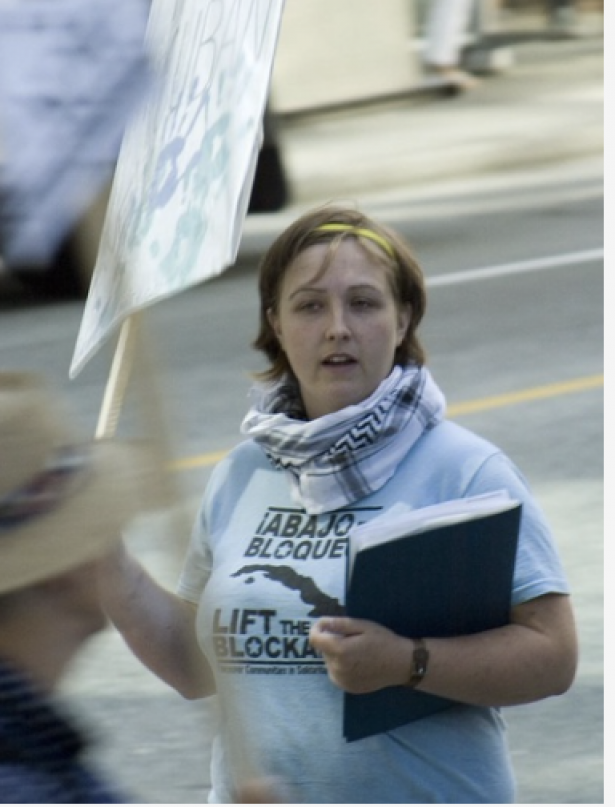
Above Photo: Terry Laban. With Nearly Three Out Of Four Households Carrying Some Kind Of Debt, Debtors’ Unions Are Reframing Indebtedness As A Shared Problem And A Source Of Collective Power.
debt•ors’ un•ion
noun
1. A group of people fighting for the renegotiation and cancellation of debts, and for universal public goods. So, like a labor union for debtors?
That’s the idea. In 2019, more than three quarters of U.S. households were holding some type of debt. In the wake of the Covid-19 pandemic, 1 in 4 adults are now struggling to pay household bills. But debt in U.S. culture is typically treated as an individual liability or a personal failure. The idea of a debtors’ union turns that experience on its head — reframing indebtedness as a shared problem and a source of collective power.
Think of a saying attributed to 20th-century industrialist J. Paul Getty: “If you owe the bank $100, that’s your problem. If you owe the bank $100 million, that’s the bank’s problem.” Sure. But I haven’t found lenders to be all that open to new perspectives on debt.
Toppling the financial architecture of late capitalism is indeed a tall order. The most prominent organization of its kind, the Debt Collective, organizes on several fronts.
First, it gives members the resources to fight specific for-profit colleges, lenders and debt collectors that commit egregious (sometimes illegal) abuses. Second, it advocates for public goods like universal healthcare and publicly funded higher education. Third, it organizes debtors to go “on strike” and withhold their payments to force debt cancellation or renegotiation. Has this ever worked?
The Debt Collective has roots in the Occupy Wall Street movement, and it’s undeniable that there’s been a huge and positive political shift over the past decade. Nowhere is that clearer than with the issue of student debt — and the Debt Collective says it’s helped abolish more than $2.8 billion of various types of debt to date.
In 2014, the Debt Collective helped organize a first-of-its-kind strike against Corinthian Colleges. Former students say the for-profit company duped them with false promises about job prospects, so they stopped paying their loans en masse. The Obama administration’s Department of Education ultimately established a federal loan-cancellation process for the defrauded students. The effort stalled out in the Trump years, but the Debt Collective has launched a “Biden Jubilee 100” campaign to pressure the new administration to cancel all $1.7 trillion in student debt. That’s a long shot, but closer than ever. How do I join?
Learn your rights, get help disputing your debt and join with thousands of others at debtcollective.org.
If the U.S. really cares for the people of Afghanistan, it should keep the U.S. Embassy in Kabul open.
I was on the small U.S. Department of State team that reopened the U.S. Embassy in Kabul in December 2001 and strongly feel that if the U.S. really cares for the people of Afghanistan, it should keep the U.S. Embassy open.
History reveals that generally when U.S. military strategies don’t work such as in Cuba (1959), Viet Nam (1975), Nicaragua (1979 and 2018), Iran (1979) and North Korea (1953), the U.S. closes embassies and wrecks havoc through brutal sanctions on the economies of the countries to have some sort of soul-soothing revenge for the politicians that put the U.S. in conflict with the countries.
I’m no supporter of the Taliban, its violence, its treatment of girls and women—and boys and men who don’t agree with them. I have firmly supported the U.S. and international efforts to assist in the education of the youth of Afghanistan and the health care for the people of Afghanistan. But I don’t want the U.S. to retaliate against the people of Afghanistan and the de-facto Taliban government of Afghanistan as it is that government that will keep basic services of the government operating for the people.
I have no doubt that U.S. discussions with Taliban representatives continue in Doha, that U.S. Embassy officials are in contact with senior Taliban from the Kabul International Airport and that U.S. Department of State officials in Washington are in touch with senior Taliban leaders. In fact the U.S. government no longer considers the Ashraf Ghani government to be the government of Afghanistan, nor a government in exile. On August 16, 2021, State Department spokesperson Ned Price said, “The U.S could recognize the Taliban as the governors of Afghanistan provided they respect human rights and have women in their government,” however, official recognition by the U.S. or other NATO countries of the Taliban and the Islamic Emirate of Afghanistan as the government of Afghanistan has not occurred. These contacts should continue through an open U.S. Embassy.
The U.S. should make funds available to the new de-facto government since the elected government fled the country and government employees who are remaining on the job need to be paid. The Taliban has reportedly been much better about paying government workers in the areas it held than the former government was in paying national military and police. Without financial assistance which has been a hallmark of the U.S. and international community propping up the economy of Afghanistan, the people of the country will suffer greatly. Will the Taliban be more corrupt than the U.S. propped up governments it supported for 20 years?
Making U.S. funding contingent on the destruction of the poppy fields of Southern Afghanistan, something the U.S. was unable to do for 20 years, and a project that only the Taliban can do as they control the poppy fields and the farmers that grow the poppies, could be a stipulation that should be pursued, if the U.S. wants to reduce if not eliminate the heroin coming from Afghanistan which reportedly has funded the Taliban’s military and administration in the provinces. Providing a substitute crop that would increase food supply for the country and pay the farmer what they were receiving for growing the poppies would be a win for the world that is flooded with heroin coming from Afghanistan.
In support of continuing programs in Afghanistan, is the February 29, 2020 agreement between the U.S. government negotiated by the Trump administration states in Part 3, paragraph 3, “The United States will seek economic cooperation for reconstruction with the new post-settlement Afghan Islamic government as determined by the intra-Afghan dialogue and negotiations, and will not intervene in its internal affairs. Of course, the U.S. can say that there was never intra-Afghan dialogue and negotiations that ended in a post settlement government, but as events on the ground played out, the U.S. and the international community is left with the de-facto government that it can either ignore, retaliate against or work with on some levels.
Part 3, paragraph 2 of the agreement states that relations between the United States and the new post-settlement Afghan Islamic government as determined by the intra-Afghan dialogue and negotiations will be positive.
Assuming the U.S. intends to uphold all parts of the Trump administration agreement with the Taliban, Part 3, Paragraph 3 of the agreement should preclude U.S. retaliation through CIA-sponsored militias against the indigenous Taliban force that waged an insurgent guerrilla war against the presence of the U.S. in its country. Let’s hope that other militia forces belonging to the warlords and former government officials do not again fight as they did after the departure of the Soviet Union from Afghanistan in 1989 that caused incredible suffering to the people of Afghanistan and massive damage to the city of Kabul. Afghanistan deserves decades of peace after decades of violence.
For its part of the agreement, in a five-paragraph description of its obligations in the agreement’s Part 2, the Taliban agreed to “prevent any group or individual, including al-Qa’ida, from using the soil of Afghanistan to threaten the security of the United states and its allies.” Within the five paragraphs, the Taliban states that it will “not cooperate with groups or individuals threatening the security of the United States and its allies,” including preventing them from recruiting, training, and fundraising, not hosting them, nor providing visas, passports, travel permits or other legal documents and dealing with those seeking asylum or residence in Afghanistan according to international migration law and the commitments of this agreement, so that such persons do not pose a threat to the security of the Untied States and its allies.
As a key part of the agreement, in Part 1, the U.S. agrees to work to remove members of the Taliban from United Nations sanctions by May 29, 2020. The U.N. monitoring group completed a 27 page report on the Taliban on May 27 and submitted it to the U.N. Security Council.
This time in the debris of the U.S. strategy that did not work in Afghanistan, for the future of the people of Afghanistan that the U.S. has maintained that it wants to help, I strong urge the U.S. government to keep the U.S. Embassy open so dialogue with the Taliban that has been occurring for the past eighteen months in Doha can continue in Kabul to ensure that important educational and health programs that benefit the people of Afghanistan can remain and that the Embassy can continue to process visas for those Afghans who have worked for the U.S. government and facilitate their departure from the country without interference from the Taliban.
Without an Embassy in Kabul, none of these can happen. This is the letter I sent to Secretary of State Blinken requesting that the U.S. Embassy stay open.
August 18, 2021Secretary of State Antony Blinken
US Department of State
Washington, DC
Dear Secretary Blinken,
I was a U.S. diplomat for sixteen years and served in U.S. Embassies in Nicaragua, Grenada, Somalia, Uzbekistan, Kyrgyzstan, Sierra Leone, Micronesia, Afghanistan and Mongolia. I am also a retired U.S. Army Colonel and served 29 years in the U.S. Army/Army Reserves.
I was on the small State Department team that reopened the U.S. Embassy in Kabul, Afghanistan in December 2001 and remained in Kabul for the first five months of 2002. I have been back to Afghanistan many times in the twenty years of U.S. involvement in the country.
I also was the Charge d’Affaires in May 1997 when due to a coup against the government of Sierra Leone, we had to close the U.S. Embassy in Freetown, Sierra Leone and evacuate 2500 persons from the Embassy family, Sierra Leone government officials, diplomats from other countries and citizens we felt would be in danger from the coup makers. I know well the challenges of the political issues and security decisions that come into play in the determination of whether to close an Embassy, the symbol of U.S. interests in a country.
With these issues in mind, I appeal to you to keep the U.S. Embassy in Kabul open.
I hope the United States sincerely wishes to assist the people of Afghanistan with humanitarian aid for the internally displaced within the country, as well as long-term projects in health, education and infrastructure. To assist Afghans, the U.S. Embassy must remain open.
Taliban pronouncements of amnesty for government workers and those who have worked with the U.S. are welcome and, of course, will have to be monitored.
A part of the small “leverage” the U.S. might have with the new government would be through the presence of a U.S. Embassy. Other countries, including China, Russia and Pakistan, have not closed their embassies. The lack of a U.S. Embassy would be seen very poorly by the people of Afghanistan.
Over a period of eighteen months, the U.S. negotiated with the Taliban a withdrawal of U.S. military. The U.S. negotiating team of State, CIA and Defense officials has had extensive discussions with senior leadership of the Taliban. The Taliban officials are now well-known to the U.S. Securing an agreement from these officials that the U.S. Embassy compound and U.S. agencies facilities will not be damaged or personnel injured by Taliban forces should be obtainable.
As a bit of history you may not be aware of, In the twelve years the U.S. Embassy was closed from 1989 until 2001 and during the five years the Taliban controlled Kabul from 1996-2001, the Taliban did not attempt to enter the Embassy properties. The only damage done to the Embassy during that 12-year period was from the rockets of warlords firing over Kabul and inadvertently hitting the Embassy. The small, local Embassy staff that protected the Embassy compound during that period were very courageous.
I strongly urge you to keep the U.S. Embassy in Kabul open.
Cuban 5 August 14/06 Protest - 2 by Airchinapilot, This image was marked with a CC BY-NC 2.0 license.
This article was originally published in Spanish and English in On Cuba News.
Cuban president Miguel Díaz-Canel has just called for “the unity of all Cubans, for respect among Cubans, and that we strip ourselves of any feelings of hatred.” Given the concrete circumstances of last Sunday, his statement may be very important.
At the same time, three historic days have already been documented in verified videos that will never be erased from our collective memory. Every effort—civic and patriotic—must be made to process the situation in ways that lead to positive solutions rather than worsen the crisis the nation is undergoing.
Who are the Cuban People?
Article 3 of the Constitution states that the nation’s sovereignty lies in the people “pueblo,” “from whom the State’s power emanates.” This text—approved by 86% of voters—requires us to respect popular sovereignty and fundamental rights.
The constitutional “right to resist” may be used against “anyone who attempts to overthrow the political, social, and economic order established by this Constitution," and use any means. Such an extreme measure requires the prior use of other measures before invoking it.
The first step is to seek political solutions to the protests. Next, declare a state of emergency with guarantees of fundamental rights. To skip over these measures and simply claim the “right to resist” is an illegitimate use of this concept, and it would augur a tragic situation for the nation.
Democratic nationalism—inclusive, anti-imperialist, anti-xenophobic—has been a central element of Cuban history up to the present. Its key element is its popular, non-elite content and meaning. The 19th-century slave owners are no longer in Cuban streets today, nor are the oligarchs of 1912, nor the bourgeoisie of 1952.
The people in the streets today are the Cuban people, or part of it, who belong to the people as much as anyone else, regardless of whether one likes the way they speak, how they act, or how they think. The Cuban people, as a whole, is sovereign. The Cuban state must listen to, respect, and protect the people.
Cubans Have Been Called on to Intervene and Participate in the Violence
An extremist sector of the Cuban exile community in the United States has called for U.S. intervention. They finance violent acts, deliberately spread fake news, and encourage people to commit arson, loot property, kill police officers, and join the battle from their cell phone trenches. However this situation works out, and whatever the suffering endured by people in Cuba, those extremists will stay where they are.
That line of thought—which by no means represents all exiles, and much less the Cuban diaspora—will do whatever it takes to achieve its version of “it’s over.” In my opinion, it is absolutely essential to distance ourselves from and oppose the agenda of that so called Cuban patriotic sector, no matter how radical the objections against the State and the conditions on the island.
Under no circumstances does that sector explain why the protests as a whole took place nor should its agenda be automatically projected on all protesters. It is important to distinguish and separate the instrumental use of these calls to civic violence from the current popular demands and actors that are part of this situation, and to recognize the full range of competing demands.
Intervention itself is absolutely unacceptable. But beyond its real possibility, the mere perception of the threat of intervention promotes the closure of all potential criticism of the domestic arena, reorienting attention toward the unified defense of the nation from an external threat, and justifiably so.
Cuba has major problems with U.S. policies, but it also has problems that are internal, and it is essential that space be created to face them.
The United States and the Soft Coup
President Biden has upheld the existing policies of sanctions, and has left them unchanged even in the midst of the most serious phase of the Covid-19 pandemic thus far. The embargo is an affront to the Cuban nation. Strictly colonial in nature, it is a crime against the Cuban people. Biden's attitude contradicts the very policy that he advocated during the Obama administration, claiming that new objectives could not be achieved by using the same failed means.
Anyone who thinks that this situation begins and ends here, or that it can only be explained as a "soft coup," confuses the core of the problem.
The project of promoting a soft coup has been present in various situations around the world. If there are any confirmed agents working to that end in Cuba, they must answer for putting themselves at the service of a foreign power. But the entire social protest should not be depicted as if it were just a product of such an effort.
The excessive use of this approach carries a great political danger: it leaves no room for the legitimacy of social demands expressed through protest. That interpretation can only lead to the repression of all protests. Moreover, the act of recognizing the legitimacy of the demands at stake today would be a serious blow to any claim that this is a soft coup.
What Can be Done
Several things can and should be done right now. The recommendations I share stem from a sense of urgency and the need to be useful. They are surely insufficient, though not irrelevant.
Immediately halt all police repression against the unarmed population which expresses itself peacefully. Contain violent civil actions taken against people and property, using norms of proportionality and clear rules of responsibility. Prohibit the use of lethal weapons except in the case of the imminent danger of death to any person. Members of the military should not be on the streets in civilian clothing. People should not be called to report to work centers, military service units, etc., to participate in violent acts against protesters.
At the same time, take the following measures: prosecute only those people who have committed serious crimes against other people or property, taking into account the seriousness of the harm these actions caused and the context in which they occurred; promise, with guarantees, a review of police actions and serious sanctions for cases of excess force; offer specific information on detainees; withdraw charges for all peaceful protesters; and provide due process for civilians who have committed violent acts with damages as defined by the law; ensure internet service; provide “fake-news” verification services; call for social peace, in the strongest sense, including the expansion and application of rights of participation and expression, such as the right to peaceful demonstration.
In addition, it is urgent to advance the legislative plans for all pending laws related to civic and political rights. These should be immediately accelerated and implemented, providing precise information on timetables, as well as measures of their popular benefit, such as promoting nation-wide food-producing initiatives. Long-term investments should be temporarily suspended and resources reallocated to emergency social plans (measures of this nature have already been announced, but much more is needed). Improved special social protection measures must be directed toward the most disadvantaged sectors of the population, such as the elderly, single-person low-income households, single mothers, and the most impoverished neighborhoods. There should be customs exemptions for imported basic necessities, and the acceleration of the review and acceptance of demands of Cuban emigrants regarding their rights in and pertaining to the country.
We now know that Diubis Laurencio Tejeda died in these protests. For years it was often said that the “first death” would benefit the official U.S. agenda of aggression against Cuba, but something else antecedes this: the revolutionary ethic of life is such that a single death is intolerable, no matter on which “side,” or whoever “benefits” from the death.
Part of this ethic lies in asking oneself to examine seriously the causes of political rage and radical hatred that we have seen throughout the country, beyond using labels such as the “same old haters,” or the “habitual mercenaries,” which only serve to stigmatize people and to cover up and reproduce the problems.
Peaceful protest is a right, while attacking people or collective property is not. All revolutionaries have the right to defend their convictions, also peacefully. We don’t need soft coups nor embargos, but we do need democratization. As José Martí once said: “bread and freedom,” as the verse says, they are either saved together, or both are lost.
There is a big difference between the U.S. and Soviet experience in Afghanistan. The Soviet Union never invented exile groups and forced them on the native Afghan population to rule over them. August 21, 2021 As'ad AbuKhalil MRONLINEPRINTER FRIENDLY
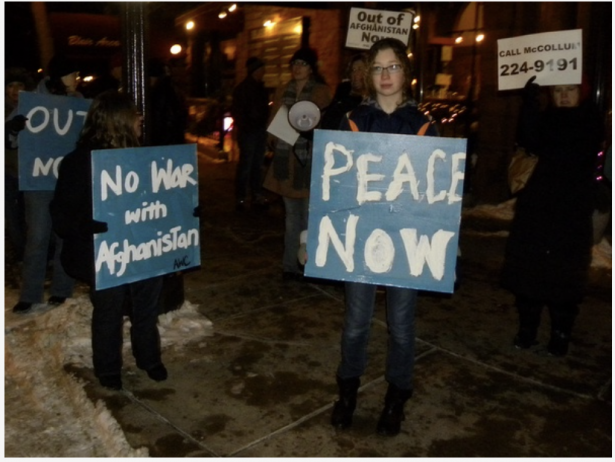
Twitter Facebook Mail Protest against the Afghanistan war and McCollum's war tax proposal in St. Paul, MN on December 17, 2009 by Fibonacci Blue, This image was marked with a CC BY 2.0 license.
The decision by President Joe Biden to withdraw “all U.S. troops” from Afghanistan (not really all, but you know how empires fold their occupation tents) was a major decision in the contemporary history of the U.S. empire since the end of the Cold War. The U.S. war in Afghanistan has lasted longer than the Soviet military intervention in Afghanistan and yet Western media never regarded U.S. involvement for what it was: an attempt to reshape the Middle East—and beyond—according to U.S. designs. Many of the facts regarding the background of the American intervention rarely make it into U.S. media narratives.
There is a big difference between the U.S. and Soviet experience in Afghanistan. The Soviet Union never invented exile groups and forced them on the native Afghan population to rule over them. In name only of course, as the U.S. military and the foreign service bureaucracy have really ruled the country. Just as in Iraq, the U.S. relied on puppets, with very little popular legitimacy in most cases, to rule in its name.
Ahmad Chalabi was a key favorite of the Bush administration, and the man the U.S. hoped would lead Iraq into the American orbit and even toward peace with Israel. But in the last Iraqi election before his death he had to align himself with Shiite cleric Muqtada As-Sadr in order to secure a seat for himself in the Iraqi parliament. The man who was key for U.S. intelligence and military (and who received millions of taxpayers’ money to conduct secret operations on behalf of the U.S.) wound up an ally of Iran and its allies in the region.
The Soviets, on the other hand, relied on local popular Afghans who had deep roots in their country and who had already formed popular progressive political parties. Those black-and-white photographs, which show how secular Afghanistan was, are but a testimony to the impact of secular, leftist rule there.
As much as the Soviet invasion of Afghanistan received coverage in U.S. media at the time (remember CBS correspondent Dan Rather donning Afghan Hollywood wardrobe and promoting the zealot mujahideen?), and as much as Western and Gulf governments complained and expressed outrage over the so-called excesses of the Soviet army, the American occupation venture in Afghanistan proved to be far more brutal and devastating—but with little media attention to U.S. human rights violations there. The number of civilians who are killed in Afghanistan by the U.S., or by its allies, often exceed the number of civilians killed per year by the Taliban. Prepping the People for Invasion
For every invasion, the U.S. prepares a set of propaganda talking points, and those points are dutifully carried in Western media as facts. Those talking points can be altered depending on the situation. The U.S. first invaded Iraq ostensibly to rid the country of WMDs, but when no WMDs were found the U.S. came up with another goal: of establishing democracy in the Middle East. And while the U.S. fought every attempt to democratize Iraq and tried to replace free elections with “caucuses,” it then came up with the goal of stabilizing the country (the country is yet to be stabilized).
In Afghanistan, the U.S. invaded to punish the Taliban for the Sept. 11 attacks although there is still no evidence that the Taliban leadership knew of Osama bin Laden’s plans. When the U.S. requested that the Taliban government surrender bin Laden in the wake of Sept. 11, the Taliban government (which had the diplomatic recognition of only three countries—Saudi Arabia, Pakistan and the UAE—all key regional allies of the U.S.) seriously considered surrendering him and asked the U.S. to provide evidence of bin Laden’s guilt.
But the U.S. refused to negotiate because it was intent on invading the country to teach a lesson and to “kick some ass.” The U.S. wanted a war of revenge and 93 percent of Americans supported that war at the time (the invasion of Iraq was not as massively popular but still an overwhelming majority of Americans supported it). President George W. Bush took the occasion to assert that the U.S. wanted to overcome the Vietnam Syndrome, even though his father said in 1991 that it had been kicked once and for all. It was all a myth anyway as the U.S. never stopped intervening militarily in the affairs of countries and invading since Vietnam, but the Republican Party created that myth to rationalize their calls for more wars and more invasions.
At the time of the Soviet intervention, Afghanistan was divided between reactionary, religious-oriented, obscurantist forces and leftists who wanted a progressive social agenda based on feminism, secularism and social justice. The U.S., of course, sided with the reactionary and religious zealots, which it rushed to organize, finance and arm in the wake of the Soviet military entering the country.
Bin Laden was the direct product of the U.S. involvement in Afghanistan as the U.S. was midwife for the birth of an internationalist force of religious fanatics, kooks and zealots. The Soviets faced an array of regional and international forces which the U.S. organized to undermine Moscow’s efforts in Afghanistan and a progressive Afghan regime. With help especially from Saudi Arabia, Pakistan and regional jihadists, the U.S. in the 1980s inflicted an internationalized war on the entire region from which the region would not recover, not even today.
The Soviets dealt with their war in Afghanistan rather differently. They did not organize an international force to prop up their allied regime. Furthermore, world communists failed miserably to see the historical significance of the Afghan conflict: they did not know that the defeat of the progressive project in Afghanistan would have severe repercussions on progress throughout the region–if not the world.
They could not see the importance of defeating the reactionary project there; had they organized—just as they had done in the Spanish Civil War—they may have been able to preserve the progressive order in Kabul. It was a missed opportunity for progress worldwide. The U.S.S.R. was not, it turned out, merely defending a progressive regime in Afghanistan, but was defending progressiveness in Muslim lands worldwide.
In contrast, the U.S. and Western powers in general, were promoting reactionary forces in the Islamic world. And those forces were in sync with the reactionary regime of Saudi Arabia, which jumped at the opportunity to collaborate—yet again—with the U.S. in combating Arab and Muslim progressives.
The U.S. did not face in Afghanistan the internationalist array of forces the U.S.S.R. had faced. Washington formed an international coalition of various governments around the world—which, oddly enough, regarded the U.S. occupation of Afghanistan and a brutal campaign of pacification that the U.S. had honed in Vietnam—as a just response or revenge for Sept. 11. Today’s Defeat
The U.S. has been defeated today in Afghanistan not by a super power with an advanced military, but by a rag-tag army of fanatical locals who perfected and consolidated their fanaticism under U.S., Saudi and Pakistani tutelage in the 1980s to fight the Soviets.
The U.S. leaves Afghanistan defeated while typically blaming a variety of forces that have nothing to do with American deeds in the country. The U.S. legacy is the disruption of village life, the rising toll of civilian casualties and the imposition of a government of thieves, embezzlers, usurpers, World Bank functionaries and a healthy dose of war criminals who were previously cobbled together in the Northern Alliance and its allies in their war against the Taliban.
Just as Iraqi expatriates (like Chalabi and Kanaan Makiyya) assured George W. Bush that native Iraqis would welcome U.S. occupation troops with open arms, a chosen select group of Afghan expatriates assured Bush that Afghans would welcome American occupation forever. But the U.S. failed to understand why locals—anywhere—would resist U.S. colonial rule.
Western media, especially The Washington Post and The New York Times, have been aghastthat the Biden administration would withdraw from the country after “only” 20 years of occupation. They asked about the fate of the good Afghans—i.e., those Afghans who worked, translated, spied on behalf of the U.S. military. Various headlines bemoaned the status of women after the American departure: what would Muslim women do without U.S. troops?
But the U.S. military could not sustain the occupation forever and the hope for a stable pacification has eluded the U.S. As it withdraws its forces from Afghanistan, it is certain that the U.S., which never understood the country, is leaving it in a much worse state than when it began its intervention 40 years ago.
Next weekend, the central bankers of the world meet in a slimmed down COVID annual jamboree at Jackson Hole, Wyoming US. The bankers will hear from Fed chair Jay Powell and US Treasury secretary Janet Yellen and wade though academic papers commissioned from various mainstream ‘monetary economists’.
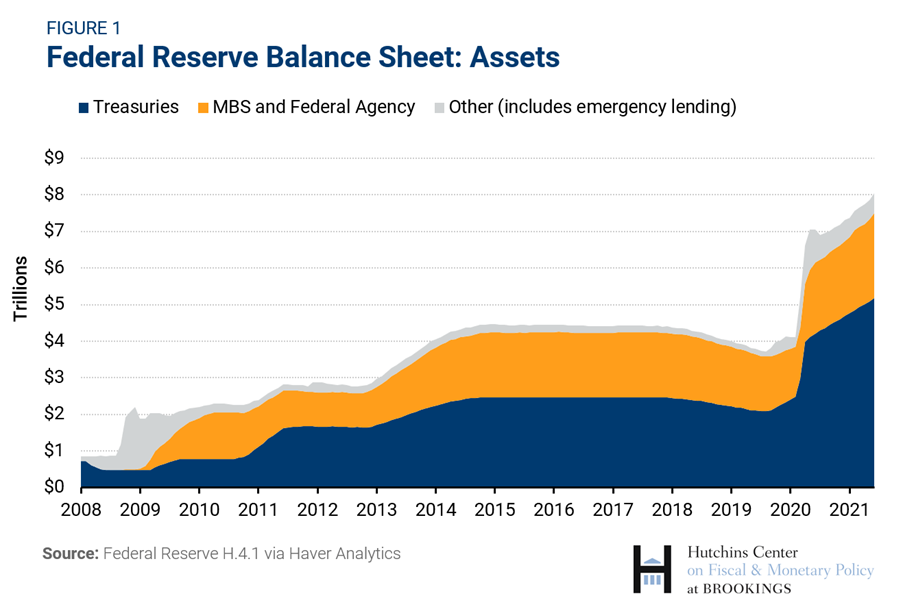
The big issue is whether it is time for central banks to wind down on their purchases of government bonds and bills designed to pump credit money into economies, which had the aim of avoiding a meltdown of businesses during the pandemic slowdown. In the COVID year of 2020, the Federal Reserve made purchases equivalent to 11% of US GDP, the Bank of England 14% of UK GDP and many other banks in the G7 of around 10% of national GDPs.Source: IIF
These purchases are called ‘quantitative easing’. Instead of lowering interest rates to encourage borrowing, since the onset of the Great Recession in 2008-9, central banks have gone for increasing sharply the quantity of dollars, euros, yen and pounds pumped into the banking and financial system. ‘Policy’ (ie central bank short-term rates) interest rates had already been driven down to zero and below. The only weapon left to central banks to stimulate economies was to ‘print’ money, in practice buying government and corporate bonds from financial institutions holding them and hope that banks lend that cash on to firms.
Throughout the Long Depression (as I call it) from 2009 to 2019, the level of central bank assets in these bonds rocketed. By December 2019, the assets held by the Federal Reserve in the United States were valued at 19.3 percent of the U.S. economy’s gross domestic product. This compares to 39.6 percent for the European Central bank, and 103.5 percent for the Bank of Japan (as of November 2019). And central banks have been purchasing $834 million an hour for the last 18 months. Since the start of the pandemic, the Fed’s balance sheet has more than doubled to $8tn. The European Central bank has total assets worth more than €8tn, the Bank of Japan has about $6tn, while the UK has doubled its QE programme to £895bn. Leading central banks now own more than £18tn in government bonds and other assets, an increase of more than 50% on pre-pandemic levels.
The questions facing the monetary authorities are: whether this huge increase and level of credit is a) working to keep economies growing; b) whether it is necessary any more given the supposed recovery in economies as the pandemic ends; and c) whether it is increasing the risk of a financial crash unless action is taken to curb QE.
The Fed is still buying $120bn (£88bn) a month in US government bonds and mortgage-backed securities to keep longer-term interest rates low. But the debate is underway among the Fed members about whether to keep QE going at this level to ensure recovery or whether this level of monetary injection should be curbed now before high inflation sets in, interest rates rise and a financial crash ensues. But the last time the Fed tried ‘tapering’ their monetary largesse in 2013 on the grounds that economies had recovered from the Great Recession, it led to a collapse in stock markets and in emerging market currencies increasing their debt burden. Even the just recent talk among Fed leaders on the issue took stock markets down last week.
And that’s the problem – it seems that banks, stock market investors and governments have become ‘addicted’ to solving their problems by getting central banks to ‘print’ more and more money. Most important, far from helping to restore productive investment and productivity growth during the Long Depression all that zero interest rates and QE have done is to boost stock and bond market levels to all-time highs. As one empirical study concluded: “output and inflation, in contrast with some previous studies, show an insignificant impact providing evidence of the limitations of the central bank’s programmes” and “the reason for the negligible economic stimulus of QE is that the money injected funded financial asset price growth more than consumption and investments.”
All the monetary injections have done is allow banks and financial speculators to build up massive amounts of what Marx called ‘fictitious capital’ ie not investment into value-creating assets in the ‘real economy’ but into stocks and bonds and cryptocurrencies – a fantasy world where a very few become billionaires while working people who don’t have stocks or even houses of their own see no increase in real incomes or wealth. QE has been a major contributor to rising inequality of incomes and wealth in the G7 economies in the last ten years.
Like the central bankers, mainstream economics is divided over whether continuing with government borrowing and quantitative easing is needed or whether continuance will lead to eventual disaster.
But in this post-COVID period, some Keynesians are pushing another argument for QE and monetary and fiscal largesse. Mark Sandbu, the European economics correspondent of the Financial Times has come up with what he calls a ‘novel idea’; namely that QE along with the sort of fiscal stimulus that US President Biden is pursuing will actually force up wages as inflation rises. This will give new bargaining power to workers and restore ‘class conflict’ in the workplace.
Sandbu recognises that employers will want to resist this situation as it might damage their profits and refers to the famous post-Keynesian paper by Michal Kalecki on why wage rises and full employment are resisted by capitalists. But Sandbu is sanguine about that conflict. Starting from the Keynesian premiss that what matters is not profits in an economy but sufficient ‘effective demand’, he reckons that rising wages “can encourage employers to increase both labour productivity and output if they expect demand growth to be strong.” So it will be possible to have “what Kalecki called “full employment capitalism”, because we can promote “an enlightened view of capital owners’ self-interest”. So “far from class conflict being a zero-sum game, productivity incentives from greater worker power can boost profits as well.” So it’s the most perfect of all possible worlds: workers get higher wages and capitalists get higher profits – all thanks to QE, Bidenomics and inflation.
This, of course, is not the view of the other side of the mainstream spectrum. These are closer to the view that governments and central banks should not intervene in markets and economies and ‘distort’ natural interest rates and cause ‘overinvestment’ in financial assets leading to a crash. In the same issue of FT that Sanbu presented his Leibniz view of capitalist economies, John Plender was severe in his condemnation of QE and all its works. Plender remarked that “the central banks have been busy topping up the punch bowl through their continued bond purchases to keep interest rates low while conducting an interminable debate on when and how to remove support. Their protestations that the risk of inflation is “transitory” look increasingly questionable.”
Plender makes the point that “central bankers’ claims that QE would boost gross domestic product are less convincing…in the meantime, unconventional monetary policy is creating ever greater balance sheet vulnerabilities.” The Keynesians fail to recognise that, although near zero interest rates keep the cost of servicing government and corporate debt low, QE shortens the maturity of that debt. That means governments and companies are faced with renewing that debt at shorter intervals. As Plender comments: “The Bank for International Settlements estimates that 15 to 45 per cent of all advanced economy sovereign debt is now, de facto, overnight. In the short run, that yields a net interest saving to governments. But their increased exposure to floating rates heightens vulnerability to rising interest rates.”
In the advanced economies, the IMF estimates that the government debt-to-GDP ratio went from under 80 per cent in 2008 to 120 per cent in 2020. The interest bill on that debt nonetheless went down over the period, encouraging a Panglossian belief that the debt must be sustainable. A similar surge in the global non-financial corporate sector led to debt hitting a record high of 91 per cent of GDP in 2019.
Plender goes on: “Against that background, investors’ search for yield has caused severe mispricing of risk, along with widespread misallocation of capital.” In true Austrian school mode, Plender predicts that: “The trigger now may be a lethal combination of rising inflation and financial instability. The difficulty is that central banks cannot take away the punch bowl and raise rates without undermining weak balance sheets and taking a wrecking ball to the economy”.
Former Indian central bank governor, Raghuram Rajan, raised the same worries in a piece for the Group of 30, a not well-known association of government and central bank institutions. Entitled, the Dangers of Endless Quantitative Easing, Rajan also points out the risks of letting QE rip on. He reckons the raging desire to make money in financial markets with zero interest credit risks a financial crash down the road. His worry is also that government interest costs could rise sharply with rising inflation. “If government debt is around 125% of GDP, every percentage-point increase in interest rates translates into a 1.25 percentage-point increase in the annual fiscal deficit as a share of GDP… and what matters is not the average debt maturity, but rather the amount of debt that will mature quickly and must be rolled over at a higher rate.”
There is no doubt that net interest on government debt is currently very low historically, only slightly more than 1% of GDP a year compared to a GDP growth rate of 2-3% a year ahead. But the Peterson Institute argues that those “who believe that rates will almost certainly not rise are too confident in their own views. The forces that have contributed to lower rates are universally difficult to predict, and, as noted above, even modest changes in rates can produce sizable movements in net interest as a share of the economy in the future.”
There you have the mainstream debate. On the one hand, rising government and corporate debt is nothing to worry about because QE and fiscal stimulus will achieve economic recovery and inflation will dissipate. Moreover, rising wages might encourage capitalists to invest and so raise productivity to pay for any rise in interest rates when central banks ‘taper’ their spending. On the other hand, goes the argument that all this QE is just going into financial speculation, causing malinvestment and inflation that will only be stopped by some financial crash of disastrous proportions.
What is the Marxist view on this debate? Well, in my view, the Keynesians and Austrian are both right and wrong. Rising government debt and even rising corporate debt does not have to be a problem if economies recover to achieve and sustain a good rate of real GDP growth and profits for companies. Government debt to GDP ratios can be reduced or at least managed if GDP growth is higher than the going interest rate. So the Keynesians are right and the Austrians wrong here.
But the Austrians are right that the continual rise in fictitious capital rather than investment in productive capital is laying the basis for a crash down the road if economic recovery should falter. Once a drug user is addicted, it is difficult to wean the user off the drug while ‘cold turkey’ could kill the patient. As Plender put it: “The imperative should rather be to ensure that the post-pandemic debt splurge finds its way into productive investment.” Exactly, but how can that be done if capitalists do not want to invest productively? What decides the level of productive investment is its profitability for capitalists and its profitability compared to the ‘search for yield’ from stock and bond market speculation that QE has bred.
Let me repeat yet again the words of Michael Pettis, a firm Keynesian economist: “the bottom line is this: if the government can spend additional funds in ways that make GDP grow faster than debt, politicians don’t have to worry about runaway inflation or the piling up of debt. But if this money isn’t used productively, the opposite is true.” That’s because “creating or borrowing money does not increase a country’s wealth unless doing so results directly or indirectly in an increase in productive investment…If US companies are reluctant to invest not because the cost of capital is high but rather because expected profitability is low, they are unlikely to respond ….by investing more.”
Profitability in the productive sectors of the major economies was near an all-time low before the pandemic struck. The pandemic slump took profitability down further and no doubt it is recovering fast right now. But will profitability get up to levels that will sustain productivity-enhancing investment in the next few years, especially if wage rises start to squeeze profit margins?
That issue will not be part of the debate at Jackson Hole this week.
 Source: IIF