Assistant U.S. Attorney Gordon Kromberg went after Daniel Hale and leads the extradition case against Julian Assange.
People should know what he and other prosecutors can really be like.
For the past two weeks I’ve been ruminating about the prosecution of drone whistleblower Daniel Hale, who was sentenced on July 27 in the Federal District Court for the Eastern District of Virginia in Alexandria. He was given 45 months in prison.
With good behavior and drug and alcohol counseling, it’ll end up being closer to 18 months.
I was in the courtroom and witnessed the sentencing and the vindictive behavior of the prosecutor, Assistant U.S. Attorney Gordon Kromberg, who acted as though Hale’s case was a personal slight. Kromberg is also the prosecutor who has feverishly led the extradition case against Julian Assange.
There is a myth about prosecutors fighting for justice. But people should know what prosecutors can really be like.
They are government employees. They get promoted when they win convictions. They get promoted when they win long sentences. They don’t get ahead in their careers by not charging people with crimes. They don’t get ahead by not seeking draconian sentences. Collecting Trophies
It’s not about “justice.” It’s about collecting trophies. And remember, an inordinate number of them go on to be partners in major national law firms or become candidates for Congress or governor.
In Hale’s case, prosecutors were seeking nine years on just one espionage charge. There were four remaining espionage charges for which he was awaiting trial. In the end, the judge issued a sentence of 45 months and dismissed the remaining charges with prejudice, meaning that they could not be brought again.
Hale contended that prosecutors had withheld exculpatory information from the defense. He argued that he blew the whistle on the drone program because he was morally outraged by it. It had caused him, in his own mind, to be nothing more than the murderer of innocents.
“I am here because I stole something that was never mine to take — precious human life,” Hale told U.S. District Judge Liam O’Grady at his sentencing. “I couldn’t keep living in a world in which people pretend that things weren’t happening that were. Please, your honor, forgive me for taking papers instead of human lives.”
The prosecution’s “theory” was that Hale, a former Air Force intelligence analyst, “leaked” information about the program to The Intercept because he wanted to “ingratiate himself with journalists.” The contention was absurd, and the judge wasn’t buying it.
Prosecutors are human beings, of course, just like anybody else. They’re competitive. They’re sometimes dishonest. And sometimes they’re willing to break the law or violate legal ethics to get that conviction. Just look at the case of former Sen. Ted Stevens (R-AK). The Case of Ted Stevens
Stevens was one of the most powerful and important senators in modern history. He served in the U.S. Senate from 1968 to 2009, becoming president pro tempore of the Senate and chairman of the Senate Armed Services Committee. At the time of his retirement, he was the longest-serving Republican senator in U.S. history.
Near the end of that career, Stevens found himself afoul of the Justice Department. Accused of failing to report official gifts and then lying to investigators about it, he was charged with seven felony counts of making a false statement. Stevens was adamant that he had reported the gifts and had done nothing wrong. He refused to take a plea and went to trial, where he was found guilty on all seven counts.
Stevens knew he was innocent and his attorney, the famed Brendan Sullivan, successfully petitioned the judge to open an inquiry into the Justice Department’s behavior in the case and its failure to turn over exculpatory evidence, including a handwritten note from Stevens to an oil company executive who paid for renovations to Stevens’s house saying, “Send me a bill. We have to do this ethically.”
In 2009, a year before Stevens’s death in a plane crash, a federal judge vacated the conviction. By then, Stevens had lost his senate seat and his reputation, all due to government misconduct. Before he could be disciplined, prosecutor Nicholas Marsh committed suicide.
Prosecutorial misconduct is common. Just ask anybody who’s been prosecuted. But rarely does anything come of it. What happened to Stevens after his “conviction” is exceedingly rare. But every once in a while, there is justice. Consider the Duke University lacrosse case, the Michael Morton murder trial, and the Eric McDavid eco-terrorism case as examples. My Own Sentencing
During my own sentencing, the prosecutors said that I did not blow the whistle because I was opposed to torture. With the same line they tried to use against Hale, they said I was trying to ingratiate myself with the media and trying to build a consulting business. It was ludicrous.
When Judge Leonie Brinkema announced that she would accept my 11 C1c plea, which was written in stone, she said that she believed I was seeking wealth in consulting and added, “This sentence is way too short. I wish I could give you the maximum.”
When it was my turn to speak, I said that the government’s “theory” was made up because they couldn’t accept the fact that somebody had spoken publicly about crimes being committed by the government. All they had to do, I said, to see that their theory was bogus, was to look at my bank account, which had nothing in it.
But don’t take it from me about prosecutors. Listen to former Supreme Court justice and former Attorney General Robert Jackson, who said:
“The prosecutor has more control over life, liberty, and reputation than any other per son in America. His discretion is tremendous. He can have citizens investigated and, if he is that kind of person, he can have this done to the tune of public statements and veiled or unveiled intimations. Or the prosecutor may choose a more subtle course and simply have a citizen’s friends interviewed.The prosecutor can order arrests, present cases to the grand jury in secret session, and on the basis of his one-sided presentation of the facts, can cause the citizen to be indicted and held for trial.He may dismiss the case before trial, in which case the defense never has a chance to be heard. Or he may go on with a public trial. If he obtains a conviction, the prosecutor can still make recommendations as to sentence, as to whether the prisoner should get probation or a suspended sentence, and after he is put away, as to whether he is a fit subject for parole.While the prosecutor at his best is one of the most beneficent forces in our society, when he acts from malice’ or other base motives, he is one of the worst.“
If not for a fair judge, Hale would have been the victim of that malice.
The gagging clause in the Science Museum’s sponsorship contract with polluting giant Shell makes one thing clear.
We can’t rely on corporate profiteers to fund the pursuit of knowledge.
It feels so tired to be going through another museum sponsorship drama. Accepting money from a fossil fuel company? In this climate? How quaint. We’ve had this conversation before; we know that corporations use relationships with museums and arts institutions to launder their reputations. Pharmaceuticals, weapons, and pollutants get washed away by these wholesome acts of public philanthropy.
The Science Museum Group’s longstanding relationship with Shell has been the subject of controversy and protest for years. There is a particularly glaring hypocrisy in such a catastrophic polluter as Shell sponsoring an exhibition about carbon capture and the future of climate change, but that kind of brazen behaviour is barely shocking enough to make major headlines.
What’s different this time is the publication by campaign group Culture Unstained of documents showing that the Museum’s agreement with Shell includes a gagging clause, specifically preventing the Museum from making any disparaging comments about Shell that could damage the company’s ‘goodwill or reputation’. Presumably, that would include putting on an exhibition about actually stopping carbon emissions before they happen. How can the Science Museum claim to be objective now? How can an exhibition about climate change ignore that its major sponsor has recently faced a groundbreaking court case that ruled its emissions cutting targets were inadequate?
There’s a tacit understanding that museums will avoid biting the hand that funds them. As much as these institutions might insist that the corporations have no power over their curatorial choices, it’s common to see a statement from sponsors at the start of an exhibition or in catalogues. There’s no doubt in my mind that a company would avoid any show that explicitly criticised its behaviour. The gagging clause is both shocking and unsurprising – it’s to be expected that corporate sponsors protect themselves, but it’s still grim to see the demands laid out so clearly.
This investigation brings a new level of scrutiny to what corporate sponsorship actually means for the galleries. Some will say it’s not the Museum’s fault: the sector as a whole has lost millions during Covid, and sites of learning are being increasingly squeezed between a government willing to threaten their funding over ‘controversial’ narratives and the conditions imposed by their private sponsors. With a government that acts in the interest of corporations, the demands of each are not dissimilar. Museums are expected not to rock the boat, and as long as they have uncertain funding, they—and their workers—are at risk of this kind of ransom.
But the conversation around this gagging clause is significant. Culture Unstained used FOI requests to access these documents, and the Museum also has corporate partnerships with BP, Equinor, and Raytheon, so there may well be similar revelations about their contracts on the way. There are also emails from Science Museum director Ian Blatchford showing a frankly nauseating enthusiasm for oil sponsorship. This is not just about convenience – it’s a symptom of an institutional culture.
The most prominent controversies over museum sponsorship have tended to focus on art collections—the Tate, the National Portrait Gallery, the Whitney, the Guggenheim—not because they’re the only institutions to receive this money, but because the idea of taking a moral or ethical stand is less at odds with the objects and narratives they display. There’s also the simple fact that these institutions work with living artists. The Design Museum’s catastrophic Hope to Nope exhibition in 2018, from which one third of works were pulled by artists and lenders who objected to the Museum’s relationship with an arms company, acts as a warning of what can happen when you alienate the people from who you profit.
Science museums have a very different remit, and still overwhelmingly hide behind the appearance of objectivity. But the reckoning around supposedly ‘neutral’ museums and the histories of colonial violence they obscure is coming, and these issues are related. Science collections tend to neglect histories of Indigenous and First Nations land stewardship, preferring stories of industrial revolution and technological advancement and failing to recognise the violence and dispossession that accompanies it. These fantasies of progress without consequence are driven by the same destructive and deliberately forgetful optimism that underlies the Science Museum’s justification for its relationship with Shell: they’ve promised to do better – isn’t that enough?
These assumptions mean that the forces that will change the Museum and others like it are located outside its management – in campaign groups, in schools, in workers and their unions. The public are the ones who are meant to benefit from these institutions, but learning funded by—and obscuring the true nature of—destructive corporations (and their governmental cheerleaders) is not learning at all; the public will also be the ones worst affected by the climate crisis. We can and must demand real institutional transparency. After all, this scrutiny is likely to lead to more secrecy from museums and their corporate sponsors before it leads to change.
‘The Most Disastrous Thing We Have Done In International Politics.’
A few days after the inauguration of Pedro Castillo, the Peruvian government has changed the official position that its predecessors maintained regarding the internal affairs of Venezuela. Yesterday Perú’s newly appointed Minister of Foreign Affairs Héctor Béjar pointed out that the policy of the new government will be opposition to blockades and “sanctions.”
Commenting on the future of the Lima Group directed by the US and formed under Peruvian President Pedro Pablo Kuczynski (2016-18), who is currently under house arrest, Béjar noted that there are already several countries of the interventionist group that changed their position on Venezuela. The Lima Group represented an attempt to bring together countries that did not recognize Venezuela’s President Nicolás Maduro as the rightful head of state of the Bolivarian Republic. Notable statements by Béjar “The Lima Group must be the most disastrous thing we have done in international politics in the history of Perú.” “Venezuela is a country that is blockaded. We will contribute, with the countries of Europe that are already working on this, and with a group of Latin American countries, to reaching an understanding with the various political tendencies that exist in Venezuela, without intervening in its internal politics.” “We will favor a democratic renewal in Venezuela that respects the social rights of Venezuelans.” “Our concern is that the rights of marginalized people are respected, not only in Venezuela, but in Perú and many other countries, and that the level of social welfare improves.” “Our policy is to defend human rights. We are against repression in Perú and in all countries. Our policy has to be democratic—that there be dialogue and not confrontation. We aspire to a dialogue with the people… and not to establish conflicting policies.” Reorienting international politics
The new Peruvian foreign minister pointed out that “in the bicentennial year we will be consistent with the historical tradition of Peruvian diplomacy and we will withdraw from Congress the request for Perú to denounce the treaty that instituted UNASUR.”
“On the contrary,” he added, “we will promote its reconstitution and modernization, as the cooperative and consultative organization that asserts South America in world politics.”
When Béjar was asked whether he plans to meet with Carlos Scull, designated as Venezuela’s “ambassador” in Perú by former deputy Juan Guaidó, Béjar responded dismissively, and said that he did not know Scull.
Media and some analysts confirm that the change of position on Venezuela will bring Perú closer to the International Contact Group, which is seeking dialogue as a resolution to the so-called Venezuelan crisis. However, other policy experts view the Contact Group as the “good cop” in a US strategy to overthrow Maduro’s government.
Regarding the recent protests in Cuba, Béjar commented that “in all countries there are people on the street,” and recalled the demonstrations against Castillo’s government called for by right-wing elements on Sunday in Lima. “The conditions are different, but every country has its internal problems,” said Béjar. “We don’t have to meddle in internal affairs.”
These statements followed President Pedro Castillo receiving congratulations on July 28 from the US Secretary of State, Antony Blinken, who asked the new Peruvian president to preserve Perú’s “constructive role” in relation to countries such as Venezuela and Cuba. Why it is important
The rearrangement of international relations and regional integration in Latin America and the Caribbean requires the recovery of respect for the sovereignty of its countries. The signals given by the newly inaugurated government are in alignment with these principles. However, it remains to be seen whether external and internal pressures from the regional right against Castillo will give him room to maneuver.
The challenges of his government are comparable to any of those in the region, as evidenced by the fact that neither the press nor his political adversaries even waited for Castillo to assume power before they sought to destabilize Perú’s institutions, already weakened by entrenched neoliberal corruption, in a country where the rights of the poor majority have been trampled on for decades.
A new short film by Real Media follows the group Palestine Action over the past year.
Palestine Action was founded a year ago by activists in the UK to focus on taking direct action against Israeli arms manufacturer Elbit Systems.
Elbit is Israel’s largest private arms manufacturer. It makes the vast majority of Israel’s drone fleet and, as the film explains, markets its weapons as “combat proven” – tested on Palestinians.
You can watch the full film in the video above. I am one of several people in the film giving context and analysis. I argue that, with persistence, Palestine Action could ultimately be successful in its goal of expelling Elbit from the UK.
Activists have carried out sit-ins and sabotage against Elbit premises, shutting factories down, smashing windows, damaging equipment, graffiting and splashing walls with red paint to symbolize Palestinian blood.
According to the film, Palestine Action have carried out more than 70 actions against Elbit in their first year, including 20 high-profile occupations of sites and factories.
According to police estimates, the group’s actions have cost Elbit and complicit companies more than $22 million and more than 100 days of weapons manufacturing, the film says. A Day In Court?
Yet despite an estimated 100 arrests and systematic repression by the British police and government, not a single trial has taken place and some activists who destroyed machinery have not even been charged.
A trial set for May was pushed back for more than a year. The trial date had happened to coincide with the most recent major Israeli bombing campaign in the Gaza Strip. Activists suspect the delay was an attempt by the police to stack the trial against them.
They are eager for the case to come to court.
Like many other direct action campaigners, Palestine Action’s legal strategy is to argue in open court that Elbit’s business activities are illegal under international law, since their weapons are used to help Israel carry out war crimes against Palestinians.
Their non-violent direct actions against the company are therefore proportionate and lawful and not in fact “criminal damage,” they argue.
A similar case collapsed in January last year when prosecutors dropped it after Elbit declined to make disclosures about its activities in the UK.
Elbit is not so keen to go to court, as it doesn’t want its activities being exposed to scrutiny, activists say. Skyrocketing Campaign
During the bombing in May, British sympathy with Palestine Action skyrocketed and local people began spontaneously forming protests in solidarity with activists as they were taking action on Elbit factory rooftops.
Founder Huda Ammori says in the film that at one point, they were getting three new volunteers join them every minute.
UK government repression of Palestine Action has included home raids, confiscation of devices and passports and even threats to use draconian anti-terror laws against the group.
Soon after Palestine Action was founded in August last year, British foreign minister Dominic Raab was meeting with Israeli ministers in Jerusalem.
Orit Farkash-Hacohen, then “Strategic Affairs” minister, complained that the “campaign against Israel has become widespread throughout Europe and the world, including in England… Only last weekend, the offices of an Israeli security company were vandalized, for the fourth time in the last month.”
was a semi-covert Israeli agency dedicated to fighting the BDS movement, the Palestinian-led global campaign for boycott, divestment and sanctions against Israel.
But the prime minister’s office announced that the ministry’s work would continue with “the transfer of their areas of activity to various government ministries.”
School districts across the Southern United States have reopened against the backdrop of a widening coronavirus pandemic that has infected tens of thousands, filling hospitals to capacity and leaving them in desperate need of emergency personnel and equipment. This includes pediatric hospitals, which in many areas have more patients than at any other time during the pandemic.
Within days of reopening, school districts across the region reported thousands of COVID-19 infections and many reverted to short-term virtual instruction. Nevertheless, the ruling class, spearheaded by the Biden administration and Republican-controlled state governments, remains steadfast that in-person schooling must resume, sacrificing children’s lives for corporate profit as their parents go back to work.
Middle school student Elise Robinson receives her first coronavirus vaccination on Wednesday, May 12, 2021 in Decatur, Georgia. (AP Photo/Ron Harris)
Educators and parents are irate and desperate as they watch children subjected to dangerous conditions. On social media, teachers have circulated petitions in an attempt to pressure politicians and superintendents to enforce mitigation strategies at the least or shut down in-person learning altogether.
In the comments section of these petitions, many parents plead desperately for virtual learning options, which have been almost totally scrapped across the country.
One signer wrote on a Texas petition, “Governor Abbott is putting future Texans in danger. He claims to be pro life and care about children. I guess that only applies to unborn children. Many kids that are here now will die because of his direct actions. He should be held accountable for any deaths that occur under his failures.”
Another commented, “What will happen in public schools in Texas during the next Covid outbreak after Governor Abbott says there will be no virtual classrooms? And will he and others be held accountable for the carnage?”
It must be stressed that the policies of the Democratic Party led by President Biden are responsible for emboldening the right-wing attacks on science and public health measures being carried out in Republican states.
Biden’s economic adviser Brian Deese admitted that the real priority in reopening schools is the “labor shortage” due to a lack of “child care and school.” It was under Biden’s administration that the Centers for Disease Control and Prevention called for vaccinated people to throw off their masks, despite having definitive proof that vaccinated people contract and spread the virus.
Within days of reopening, districts in the region reported hundreds of cases, outbreaks and school closures. In New Orleans, where masks are required, 116 active cases were reported on Monday, and 638 students and staff were quarantined, even before all campuses have opened. Despite school being in session, the Louisiana Department of Health has yet to resume its weekly K-12 COVID-19 case tracker.
In Mississippi, with many districts not reporting, 841 students and 347 staff have tested positive since August 1. For the week ending August 6, 4,435 students were quarantined.
In Georgia, districts across metro Atlanta reported hundreds of cases only days after school started. Gwinnett County Schools reported 166 cases in just two days. Dr. Cherie Drenzek, an epidemiologist with the Georgia Department of Public Health, told 11Alive that there has been a 100 percent increase in cases of children ages 5-17 over the past two weeks.
As the petitions by educators and parents indicate, there is widespread hostility to reopening schools. In Duval County, Florida (Jacksonville) 96 teachers were absent on the first day of school, up from the 80 that were absent on the first day in the last school year.
Throughout the South, hospitals are overwhelmed. Mississippi, Georgia, Florida and Louisiana accounted for more than 40 percent of all hospitalizations nationwide on August 5, according to the Associated Press. In New Orleans, a heart attack victim was “bounced from six hospitals before finding an emergency room that could take him,” reported National Public Radio.
Mississippi State Health Officer Dr. Thomas Dobbs warned on Twitter on Monday that the state expects 500 new hospitalizations in the coming days but that there will be no room for these patients: “we have ZERO ICU beds at Level 1-3 hospitals, and we have > 200 patients waiting in ERs for a room.” Similarly, Florida surpassed 15,000 hospitalizations on Tuesday, the highest number to date during the pandemic.
Supplies are low in Florida, which requested 300 ventilators from the federal government this week after the state stockpiles were exhausted, according to a Department of Health and Human Services document obtained by ABC. Republican Governor Ron DeSantis, who claimed to be unaware of the request, has banned mask mandates in schools and threatened to withhold funds from school districts which defy him. Florida currently has the highest number of children hospitalized from COVID of any state.
In Texas, while pursuing a similar policy of banning school mask mandates, Republican Governor Greg Abbott pleaded for out-of-state personnel assistance as hospitals are overwhelmed. He also requested that the Texas Hospital Association postpone elective medical procedures. School districts across the state are defying his mask ban, and he faces multiple lawsuits to overturn the ban.
Arkansas Governor Asa Hutchinson was forced to backtrack after signing a bill into law banning state and local mask mandates. Now that it is enacted, he must wait on the bill to be amended or for the courts to rule the ban unconstitutional. On Tuesday, only eight ICU beds were available across the state.
The Southern US has some of the lowest vaccination rates in the country. According to Our World in Data, less than 40 percent of the population in the states of Mississippi, Louisiana, Alabama, Arkansas and Georgia are fully vaccinated. Florida and Texas have slightly higher rates with 49 percent and 46 percent fully vaccinated, respectively. In Louisiana, only 13 percent of eligible children (12- to 17-year-olds) are vaccinated. Just 25 percent of eligible 12- to 15-year-olds nationwide have been fully vaccinated, according to CDC data.
Pediatric hospitals are also at a breaking point. Dr. Mark Kline, physician-in-chief of Children’s Hospital New Orleans, which serves patients from across the Gulf Coast, told Good Morning America that the hospital is awaiting federal medical personnel to assist with a staffing shortage: “We were thin already, having lost a number of staff over the course of 2020. … Louisiana and the region as a whole have a real dearth of professionals.”
Speaking to WDSU, Dr. Kline said that half of the 18 children currently admitted in his hospital are under two years of age. The test positivity rate for Louisiana children is 25 percent. He noted that he was “very concerned” that schools are opening now and feared “the mitigation measures we have used in the past, including masking, social distancing and hand-washing, aren’t going to be as effective for this virus.”
Nationwide, 93,824 child COVID-19 cases were reported for the week ending August 5, according to the American Academy of Pediatrics, and children represented 15 percent of all new cases.
Exposing the lie that reopening schools during a pandemic is in the best interests of children’s mental and social well-being, data continues to pour in about the long-lasting effects of even “mild” or asymptomatic COVID-19 infections. Speaking on the effects on children of Long COVID, including on school performance, Dr. Avindra Nath, chief of infections of the nervous system at the National Institute of Neurological Disorders and Stroke, told the New York Times, “I mean, they’re in their formative years. Once you start falling behind, it’s very hard because the kids lose their own self-confidence too. It’s a downward spiral.”
Additionally, recent data published in The Lancet indicates that brain damage due to COVID-19 infections can be comparable to stroke for hospitalized patients or lead poisoning for those who have respiratory difficulty but do not require hospitalization.
In the coming weeks, as districts continue to reopen in the South and across the US, educators will once again be thrust into struggle—against the Biden administration that insists schools must be open, against Republican politicians who outlaw mitigation strategies in schools and against the fraudulent organizations that claim to represent educators.
American Federation of Teachers President Randi Weingarten and National Education Association President Becky Pringle have insisted that schools reopen fully in-person. Last year, as teachers across the country died in the hundreds, if not thousands, neither organization lifted a finger to mobilize their millions of members in a nationwide strike to prevent school reopenings and needless death. The hundreds of wildcat walkouts and protests across the US were systematically isolated, while local chapters worked diligently to pressure and demoralize teachers who sought assistance. No confidence or hope can be placed in these organizations.
Educators must learn the lessons of the last school year in order to prepare for this one. Above all, they must recognize that to win requires building new organizations, independent of the trade unions and the capitalist political parties. As the Socialist Equality Party wrote in its statement “Don’t send children into unsafe schools!” teachers and parents should form rank-and-file committees to stop the drive to reopen the schools and save the health and lives of the children and school workers.
On May 1, the International Committee of the Fourth International launched the International Workers Alliance of Rank-and-File Committees (IWA-RFC) to organize workers in a common offensive to exert their collective strength, change the course of the pandemic and put an end to the needless suffering and death. The call for the closure of schools and nonessential workplaces until the pandemic is contained must be popularized in every school, factory, workplace and neighborhood across the US and globally. Preparations must be made in every country for nationwide general strike action to coalesce in a globally coordinated strike movement.
Educators, parents and all workers who agree with the demand to shut down in-person learning until the pandemic is eradicated should sign up today to build a rank-and-file committee in your area. There is no time to lose!
In my previous letter I discussed how Julian Assange’s case had taken a strange and worrying twist. The results of Wednesday’s High Court hearing is even more troubling for the WikiLeaks publisher.
The High Court in July granted the U.S. government permission to appeal the Jan. 4 decision of District Judge Vanessa Baraitser to refuse the U.S. government’s request for Assange’s extradition to the United States, where he faces charges under the Espionage Act 1917 and for conspiracy to commit computer intrusion.
The grant of permission was however limited to essentially a single ground: whether Baraitser erred by failing to provide the U.S. government with an opportunity to provide her with ‘assurances’ about the conditions of detention in which Assange would be held if he were extradited and convicted in the United States.
Permission to appeal on another ground, whether Baraitser was right to base her assessment of Assange’s health, and of the risk that he might commit suicide if he were to be kept in rigorous conditions of confinement in the United States, on the evidence of Professor Michael Kopelman, was however refused.
The U.S. government would not accept this decision, and in a most unusual step, obtained a hearing in the High Court on Wednesday in order to appeal that part of the High Court’s decision which had refused permission to challenge the part of the appeal which concerned the issues of Assange’s health and the evidence of Professor Kopelman.
As previously reported by Joe Lauria, at this hearing the High Court reversed its earlier decision to refuse the U.S. government permission to appeal the matter of Assange’s health.
This means the U.S. government has now obtained permission to appeal on all the grounds it has sought. The full appeal will be heard by the High Court on Oct. 27 and 28.
In my previous letter I said that both grounds of appeal looked threadbare.
There had been nothing to prevent the U.S. government from giving its ‘assurances’ (that it would not put Assange in special confinement and would let him serve his sentence in Australia) to Baraitser at the substantive hearing last September.
Its attempt to do so now, months after Baraitser’s decision had been made, was an attempt to use the appeal process in order to introduce the ‘assurances’ as new evidence in the case, so as to change a decision which had already been made. This makes the ‘assurances’ new evidence, which is normally inadmissible on appeal.
As for Baraitser’s decision to base her assessment of Assange’s health and of his potential risk of suicide on the evidence of Professor Kopelman, that was an assessment for her to make as the trial judge in the case, and there is no reason why the High Court on appeal should seek to interfere in it. Mr. Justice Swift, the High Court Judge who refused the U.S. government permission to appeal on this ground in July, was of precisely this view.
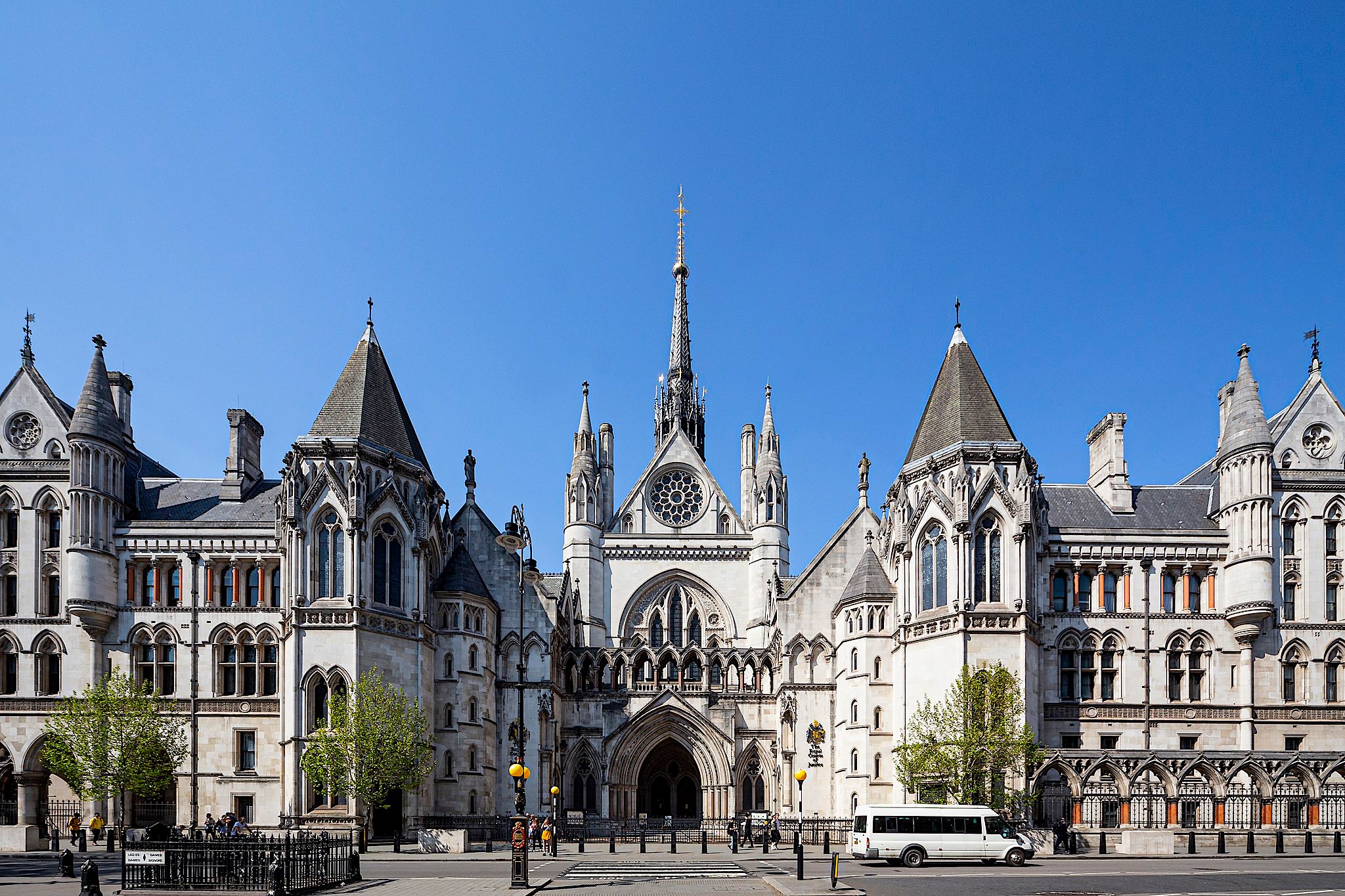
Holroyde’s Reasons for Extending Permission to Appeal The High Court at the Royal Courts of Justice. (David Castor/Wikimedia Commons)
It is this decision of Swift which the High Court at Wednesday’s hearing has reversed. In doing so, the High Court admitted it is highly unusual for an appeal court to question a trial judge’s assessment of the evidence. However in this case supposedly it is ‘arguable’ that it should do so.
Lord Justice Holroyde, a Court of Appeal Judge senior to Mr. Justice Swift, explained the decision in this way:
“I bear very much in mind that the District Judge saw and heard from all the expert witnesses and made her assessment of Professor Kopelman with that advantage, which an appellate court cannot share. I accept that, in general, this court rightly takes a cautious approach when considering the findings of fact. They may consider challenges to findings of fact, including assessments made by the judge below. It is however, very unusual for an appellate court to have to consider the position of an expert witness whose written evidence have been found to be misleading, but whose opinion has nonetheless been accepted by the court below. The general approach does not operate as a complete bar for this court to find that the judge below was wrong in her assessment of the evidence. I have come to the conclusion that it is here at least arguable that the present case is one in which such a power may operate.”
Holroyde then went on to say that in his opinion Baraitser might have given a “more critical consideration” of Professor Kopelman’s evidence.
“For those reasons, I respectfully disagree with Mr Justice Swift. I would grant the appeal on ground three. It will be for the court in the appeal hearing to determine the admissibility of the initial evidence on which the appellant seeks to revive.”
No Mention of Assange Relationship
This issue has arisen because of an omission of a fact in Professor Kopelman’s first witness statement. In that statement Kopelman omitted to mention the fact that Assange was in a relationship with Stella Moris, with whom he has had two children.
Kopelman omitted this fact from his witness statement because of Moris’s understandable anxiety for privacy for her children. Kopelman, sympathetic to Moris’s anxiety but conscious of his duty to the Court, consulted Assange’s lawyers. They apparently agreed with him that the fact of Moris’s relationship with Assange, and the fact that they had had two children together, could be kept out of the witness statement without this diminishing its evidential value, and without this detracting from Kopelman’s duty to the Court.
Holyrode (justice.uk)
It was quickly realised that this was a mistake, and in a second witness statement, which is Kopelman’s full expert report to the Court, he disclosed Assange’s relationship with Moris, and the fact that they had had two children together. This second witness statement was provided to the Court last year, before the start of the substantive hearing in the autumn, and was seen by Baraitser before the hearing began.
Baraitser accordingly made her decision to refuse extradition in the full knowledge that Kopelman’s first witness statement was incomplete, and that at the time when it was made Kopelman was concealing the existence of Assange’s relationship with Moris, and of the fact that the two had had children together. She was also aware of the reasons why this was done. In her judgment Baraitser both acknowledged the fact of the concealment, and excused it:
“In my judgment, professor Kopelman’s decision to conceal [Assange and Moris’s] relationship was misleading and inappropriate in the context of his obligations to the court, but an understandable human response to Ms. Moris’s predicament…..In short, I found Professor Kopelman’s opinion to be impartial and dispassionate; I was given no reason to doubt his motives or the reliability of his evidence.”
Holroyde and the High Court now say that this approach of Baraitser’s was ‘arguably’ wrong, and that Baraitser should have taken a ‘more critical consideration’ of Kopelman’s evidence than she did.
Open Route for U.S. to Give ‘Assurances’
At the October hearing, the question of the state of Assange’s health, and of the degree to which he really is a suicide risk, will be reconsidered. At that hearing the U.S. government can give its ‘assurances’ to the Court, which it did not previously give to Baraitser. Assuming the Court accepts the ‘assurances’, an order for Assange’s extradition to the U.S. may be made. If an appeal of that order to the Supreme Court is refused, Assange can be handed over to the United States, and the British authorities can wash their hands of the matter.
Koppelman. (nhs.uk)
This is not a foregone conclusion. The High Court at the hearing in October is not bound to follow the opinions expressed by Holroyde at the hearing on Wednesday. His forthright comments show that he will not be part of the appeal panel which will hear the appeal in October.
However, though Holroyde was careful to say that the final decision is for the appeal panel in October to make, his words strongly imply that he thinks Baraitser should have handled Kopelman’s evidence differently.
The fact that Kopelman sought advice from Assange’s lawyers, who are technically officers of the Court, to my mind show that he did not intend to mislead the Court. As Baraitser put it, his actions, and those of the lawyers, were “an understandable human response to Ms. Moris’s predicament”. No harm was intended or done. Though a mistake was made, it was corrected shortly after, and at the time of the hearing Baraitser was in possession of all the facts.
Baraitser, as the trial judge, was therefore in a position to assess the evidence, which Holroyde admits it was her right to do. Having assessed the evidence, and in full knowledge of all the facts, including those of the so-called “concealment.” she chose to give weight to the evidence of Kopelman, which she found to be “impartial and dispassionate”. There is no reason why an appeal court would want to interfere with such an approach, and as Holroyde admits, and as Swift found, ‘normally’ it would not do so. In fact, Holroyde admitted that the High Court on appeal cannot itself revisit the evidence. An appeal court is not a trial court. Its only purpose is to decide whether or not Baraitser was wrong. If it does decide on appeal that Baraitser was wrong – and it hasn’t done so yet, though Holroyde clearly thinks it should – it has two options:
(1) Send the issue back to the Westminster Magistrates’ Court, who would then decide the health issue all over again at a fresh hearing this time disregarding or placing little weight on Kopelman’s evidence; or
(2) Decide the issue of Assange’s health itself, at the same hearing as the hearing of the appeal, and directly after the appeal has been heard and decided, accepting Baraitser’s other findings of fact, but excluding or placing little weight on the evidence of professor Kopelman.
The proper course is (1) but I would not be at all surprised (if the appeal goes badly for Assange) that the High Court chooses (2).
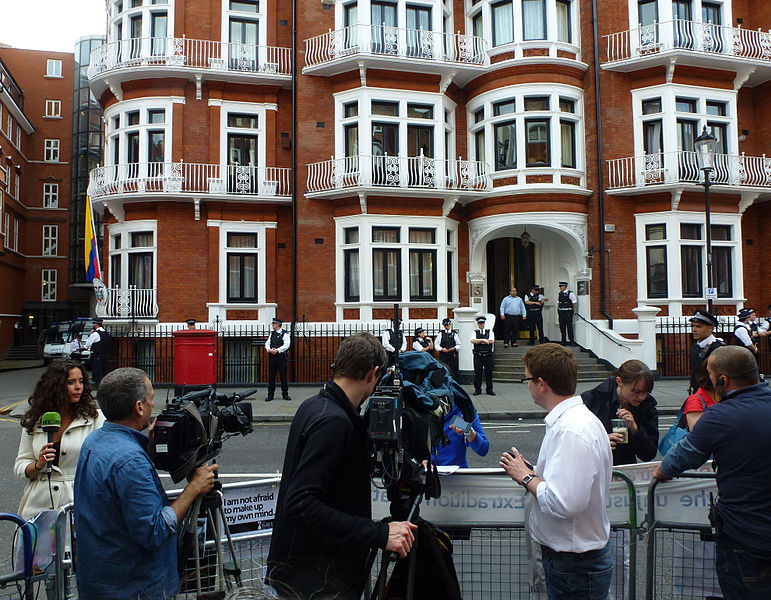
Privacy of the Family an ECHR Protected Human Right Ecuadorian embassy in London where Julian Assange took asylum. (Wikipedia)
There is moreover an absurd dimension to this whole affair. Assange, at the time when he began his relationship with Moris, was the target of round-the-clock surveillance by the U.S. and British authorities, who were spying on him in the Ecuadorian embassy, even to the point where they were observing his interactions with his lawyers.
It beggars belief that the U.S. and British authorities were unaware of Assange’s relationship with Moris, or of the fact that he had had two children by her.
At the time Kopelman drafted his first witness statement the extent to which Assange had been under placed under surveillance was known to Assange’s lawyers, and to Assange and Moris themselves. They would have known, or at the very least guessed, that the U.S. and British authorities were aware of Assange’s relationship with Moris, and of the fact that he had had two children by her. This is borne out by the testimony in a Spanish court last year that U.S. intelligence officers ordered the confiscation of one of the children’s nappies to prove Assange’s paternity by testing the DNA.
That makes it impossible that the omission of a reference to the relationship between Assange and Moris in Kopelman’s first witness statement was intended to conceal this relationship from the U.S. and British authorities, and from the Court, and that there was any intention to mislead the Court. Had such an attempt to conceal the relationship and the existence of the children from the Court been made, it would have failed, with catastrophic consequences for Assange’s case.
Obviously the concealment was intended, not to mislead the Court, but to conceal the existence of the relationship from Britain’s notoriously salacious tabloid press, who are able to access Court documents, such as Kopelman’s witness statement, which are documents of public record.
In other words it was intended to protect the family’s privacy, just as Kopelman, the lawyers, and Moris, say that it was. Julian Assange in Ecuadorian embassy in London shot on UC Global surveillance tape.
The way it was done was certainly a mistake, but one made, as Baraitser says, for understandable human reasons, and clearly intended as a temporary measure to protect the privacy of the family until the moment came for full disclosure to the Court. This took place at a bail hearing in April 2020, months before the substantive hearing before Baraitser in the autumn of that year, and months before the U.S. filed its second superseding indictment, which was the indictment actually before the Court when the case was tried.
As Baraitser rightly says, the fact that these steps to protect the privacy of the family were taken, (privacy being a human right pursuant to Article 8 of the European Convention on Human Rights, which is part of British law) does not mean that Kopelman is not an “impartial and dispassionate” witness, even if some of the steps which were taken were wrong. It is wrong to say otherwise.
A Dark Turn and a Clouded Prospect
In my previous letter I wrote of the relentless way in which the U.S. government has pursued Julian Assange. Moreover its refusal to take no for an answer, and its readiness to resort to unusual procedural devices in order to get its way, looks from the latest decision to be starting to bear fruit. I doubt any other party would be able to bend events to its will in such a way.
Regardless, the case has taken a dark turn, and the prospects in October are clouded.
Sen. Bernie Sanders slammed Republicans for complaining about Democrats' use of budget reconciliation, noting that the GOP recently used the same process to force through massive tax cuts for the rich.
The U.S. Senate approved a $3.5 trillion budget blueprint with a party-line vote in the early hours of Wednesday morning, a key step toward passage of sprawling legislation that would expand Medicare, establish paid family and medical leave, and make substantial investments in green energy.
The chamber's approval of the budget framework came after the hours-long spectacle known as "vote-a-rama," a process during which senators are allowed to offer an unlimited number of largely meaningless, non-binding amendments to the resolution.
Democratic senators also introduced amendments to the resolution. Sen. Ron Wyden (D-Ore.), chair of the Senate Finance Committee, offered an amendment expressing support for tax increases on the nation's richest 0.1%. The measure failed after Sens. Kyrsten Sinema (D-Ariz.), Jeanne Shaheen (D-N.H.), and Maggie Hassan (D-N.H.) joined every Republican in voting no.Republican senators, who are unanimously opposed to Democrats' $3.5 trillion proposal, seized the opportunity to put forth dozens of messaging amendments denouncing tax hikes on the wealthy, supporting a ban on the teaching of "critical race theory in prekindergarten programs and elementary and secondary schools," and pushing a $50 billion increase to the already-bloated Pentagon budget.
In a statement late Tuesday, the anti-war group CodePink applauded the Senate's rejection of the Pentagon amendment by a 46-53 vote.
"This vote should be viewed as a test of how committed our representatives are to actually addressing the climate crisis," said Carley Towne, CodePink's co-director. "The IPCC report released earlier this week made clear that if we're going to have any chance at addressing the climate crisis, we need to slash funding for the Pentagon, which is the largest institutional producer of greenhouse gases in the world."
"Today," Towne added, "46 senators prioritized increasing the profits of military contractors over the future of our planet."
The $3.5 trillion budget resolution now heads to the House, which can either pass the measure as is or amend it and send it back to the Senate. House Democratic Majority Leader Steny Hoyer (D-Md.) announced Tuesday that the lower chamber will cut its recess short to take up the measure on August 23.
If the House passes the budget framework, congressional committees will then move to convert the blueprint into legislative text, a process that's expected to drag on until mid-September. Once the package is assembled, Democrats will move the pass the bill with just 50 votes using budget reconciliation, which is exempt from the legislative filibuster.
In a floor speech ahead of Wednesday's vote, Sen. Bernie Sanders (I-Vt.) noted that Republicans have repeatedly used the budget reconciliation process to reward the wealthy and large corporations, pointing specifically to the $1.5 trillion Tax Cuts and Jobs Act that the GOP rammed through in 2017.
"I do understand that many of my Republican colleagues are in a bit of shock now," said Sanders, chair of the Senate Budget Committee and chief architect of the $3.5 trillion resolution. "They are finding it hard to believe that the president and the Democratic caucus are prepared to go forward in addressing the long-neglected needs of working families, and not just the 1% and wealthy campaign contributors. That's not the way things usually happen around here. Usually it’s the big money interests and the lobbyists who call the tunes. But not today. Today, we move the country forward in a different direction."
"The American people want a government which represents all of us, and not just the few," Sanders continued. "This legislation is going to ask the wealthy and the powerful to start paying their fair share of taxes so that we can address the needs of working families, the elderly, the children, the sick, and the poor. "
While all 50 Democrats voted in favor of the $3.5 trillion budget resolution, the framework merely sets the outer boundaries of the forthcoming reconciliation package. Some conservative Democrats—most prominently Sinema and Sen. Joe Manchin (D-W.Va.)—have indicated that they may not support that level of spending, setting up a potential fight with progressives in the House and Senate over the specifics of the legislation.
"In order to save millions of lives and have a chance at a thriving future economy, Democrats must take advantage of this moment and pass transformative legislation," Rep. Jamaal Bowman (D-N.Y.) said in a statement Tuesday. "The $3.5 trillion in the Democrat-led budget resolution making its way through the Senate right now is much closer to what we need, but it still doesn't go far enough. We must absolutely pass that bill, but I will be doing everything in my power over the coming weeks and months to advance and support other pieces of legislation that reflect the scope and scale of the crises we face."