Friday, August 13, 2021

In LEAKED Tape Hunter Biden Says Russian Drug Dealers Have 3 Of His Laptops


https://www.youtube.com/watch?v=9ulB_wpDnB8&ab_channel=SecularTalk


Vaush CALLS OUT Cenk Uygur of TYT, Kyle Kulinski Responds / Andrew Cuomo RESIGNS


https://www.youtube.com/watch?v=c97tAfwquXQ&ab_channel=TheVanguard


Thursday, August 12, 2021

YUROK TRIBE GROWS SOLUTIONS IN SOIL OF CRISES


https://popularresistance.org/yurok-tribe-grows-solutions-in-soil-of-crises/


By Mackenzie Wilkes,
Indian Country Today.

August 10, 2021
CREATE!


Above photo: Chinook salmon, the Klamath River’s main resource, have been harmed by climate change and a dam upstream, according to Sammy Gensaw, director of Ancestral Guard, which teaches Indigenous youth how to farm as well as fish. Beth Wallis/News21.
‘It’s not just the environment.’

‘We’re facing a whole system that needs to be changed’

A drought, a virus and a landslide – these concurrent crises have worsened the food insecurity of Northern California’s Yurok Tribe and spurred some citizens to explore their own solutions.

Their land, nestled between the Pacific Ocean and the redwoods of the Klamath Mountains, was declared a rural food desert by the USDA in 2017. The situation worsened when the COVID-19 pandemic, coupled with severe drought and a crumbling highway, slammed the reservation and nearby Indigenous communities.

Sammy Gensaw, 26, grew up paddling redwood canoes on the Klamath River and driving the winding mountain roads of California’s North Coast. Since he was 10, Gensaw has been advocating for his people – and the food provided by the river and its valley – at government meetings and with nonprofit groups.

Giving Indigenous communities the means to feed their families is a responsibility Gensaw wants to take on, starting with giving people access to healthful food choices.

“While people are dying here in the Klamath Basin – where people are getting sick and getting diabetes and not being able to provide for themselves – this is what we’re facing,” Gensaw said. “It’s not just the environment. We’re facing a whole system that needs to be changed.”

Indigenous people suffer from negative health disparities, which the Centers for Disease Control and Prevention says makes them particularly vulnerable to COVID-19. Health inequity further exacerbates disparities in food, housing and income. In response, the federal government, through the CARES Act of 2020, allocated $8 billion to be directed to Native American tribes and organizations.

CARES Act funds and financial support from nonprofits have subsidized Indigenous communities’ efforts to achieve food sovereignty. For the Yurok Tribe, that has meant a pivot from traditions such as fishing, which is becoming unsustainable as the West gets hotter and drier, toward gardening. Some tribal members are working to grow their way out of a food desert.

The CDC granted California tribes more than $19 million in CARES Act funds to address health needs and related issues; only Alaska received more. The Yurok Tribe, the largest in the state, with more than 5,000 enrolled members, received about $1 million – the largest sum from the CDC to any California tribe. The Yurok Tribe received more than $32.7 million in CARES Act money from the Coronavirus Relief Fund.

The tribe used $490,000, according to property tax records, to buy 40 acres of land, which was originally a part of their ancestral home.

The tribe’s Food Sovereignty Division plans to create “food villages” on the 40 acres, manager Taylor Thompson said. The daisy-covered hills, grassy meadows and redwoods would become a communal garden and commercial kitchen, with small homes for workers to create a self-sustaining food system that can withstand a crisis.

These food villages would provide healthy food options in an area with limited food access. The reservation’s population is 836, according to the Census Bureau, and the nearest supermarket is more than 40 miles north in Crescent City.

“The accessibility of the nearest supermarket from some of these communities is like an hour and a half drive one way,” Thompson said. “So it’s just a real barrier for people to be able to have access to fresh produce or sufficient food choices for them to be able to have healthy, well-rounded nutrition.”
Growing generational knowledge

Gensaw co-founded the organization Ancestral Guard, which became a nonprofit in 2015. The organization teaches Indigenous youth farming and fishing, as well as provides families a sustainable way to obtain and produce food.

He said it’s particularly important to root food sovereignty in younger generations, who one day will become elders who pass on their knowledge.

“When we say sovereignty, we want our people to be able to make healthy decisions,” Gensaw said. “We want our people to be able to say, ‘Yes, I can grow a garden. Yes, I have the resources to do so. And yes, I’m going to invest these resources back into my community,’ because recreating these systems of reciprocity between Indigenous people and the land that we all live in (and) depend on, these have been broken by years and years of genocide.”

U.S. 101 is the main road through the reservation. Along the highway, on the western edge of the reservation, sits the tribal-owned Pem-Mey Fuel Mart, one of two gasoline stations on the reservation and the only source of food available to purchase. The fuel mart – which also provides WiFi for an area with spotty service – is where Gensaw submitted the application for the grant that funded Ancestral Guard.

If Yurok living on the reservation want to go to the nearest grocery store in Crescent City, it takes more than an hour even without traffic. A landslide in February along a 3-mile stretch of U.S. 101 between Crescent City and Klamath, known as Last Chance Grade, stretched that drive to two hours. While repairs continue, the grade is closed from 8 a.m. to noon Mondays through Thursdays, and 8 a.m. to noon and 3 to 7 p.m. Fridays.

Last Chance Grade is so prone to landslides that locals refer to the patchwork repairs on the two-lane highway as “$1 million Band-Aid.” Since 1997, the California Department of Transportation has spent $85 million on maintaining the road, according to the Last Chance Grade Project, which began surveying the area in 2015 and is dedicated to finding a permanent solution.

The project estimates that construction of an alternative route could be completed from 2031 to 2039 but would come at a steep cost, with alternative routes costing between $295 million and $1.1 billion. A 2018 study found that a one-year closure of Last Chance Grade would reduce business output by $456 million, accrue $236 million in travel costs and require residents to make a 320-mile, six-hour detour.

Gensaw said COVID-19 also highlighted the food insecurity in the Yurok Tribe and nearby Indigenous communities. Although the Ancestral Guard was in the works before 2020, it began its five-year food sovereignty effort during the pandemic, starting with the Victorious Gardens Initiative. It launched a 10-row community garden near a bend in the calm Klamath River and has since expanded into 3-by-6-foot garden boxes at 30 homes on the reservation and in Klamath and Crescent City.
Balancing food security, traditional practices

The Yurok traditionally are fishermen – for salmon, eels, sturgeon and crab – but they also gather acorns, berries and other foods. The Klamath, historically teeming with chinook salmon, runs south through the reservation from Oregon. Del Norte and Humboldt counties are experiencing severe and extreme drought, according to the National Integrated Drought Information System.

That led Gensaw to start the Victorious Garden Initiative and show, as he says, that fishermen can farm. Teaching a young person how to garden not only will provide a stable source of food, it will create a culture of gardeners and farmers.

“We’re not just growing food, we’re not just giving it to people,” Gensaw said. “We’re trying to revitalize the idea that these gardens are a piece of our culture, because often in Indian Country, traditions and cultures get muddled together. In reality, these traditions are things that our fathers have done or our grandmothers have done and their grandparents have done and we’ll continue to teach our children.”

The historic drought has allowed the Ceratonova shasta parasite to rapidly spread among the salmon, killing off juveniles. Although these parasites naturally are present in river water, experts say the ongoing drought and a dam upriver (which is scheduled for removal in 2023) have heightened the threat by contributing to the Klamath’s low level.

The drought and pandemic have harmed tribal members financially. Jonathan Jackson grew up in the late 1980s and early ’90s, fishing the Klamath by night with his parents and brother and processing the catch at home during the day. In 2001, he started commercial fishing and later established his own business, Pacific Native Fisheries.

When the pandemic began in March 2020, he found that his regular customers – restaurants and fish markets – weren’t buying. Jackson couldn’t afford to stop fishing, so he began making home deliveries.

“When the pandemic hit and everything shut down, we lost all of our markets and then all the big buyers also quit,” he said.

Jackson doesn’t live on the reservation or in the area. He fishes down in the North Bay, he said, in part because of the drought’s effect on the Klamath. Although it’s many miles south, near San Francisco, the North Bay area still feels the effects of the river’s environmental issues. Because salmon travel south, Jackson said, their low numbers in the Klamath River mean fishermen to the south are limited by the government on how many salmon they can catch.

Crabbing season also yielded a low harvest; last season was the worst he has seen, Jackson said. His first pull yielded 400 pounds of crab, and at $3 a pound he made only $1,200. In a normal season, the first pull would be 7,000 pounds of crab, worth $21,000.

Jackson got through the pandemic and reduced fish harvests with help from Fresh Catch: North Coast Fresh From the Sea, a program run by the Del Norte County and Adjacent Tribal Lands Community Food Council. The council received a COVID-19 relief grant from Catch Together, a nonprofit that helps fishing businesses across the country.

The food council bought salmon from Jackson and other businesses to be used in its food boxes distributed by the food councils run by Pacific Pantry. The program also delivered fish meals to senior centers and packaged fish for meal-distribution centers, including some serving Indigenous people.

“With this crab season being as poor as it has been, it really saved me,” Jackson said of Fresh From the Sea. “Otherwise I wouldn’t have made my mortgage payment this year.”
A highlight of the program was its ability to address two problems, said Drea Lanctot, the council’s community food program coordinator.

“As the pandemic sort of showed us our supply chains, we’re trying to keep fish local, so that helps support small fishermen, (and) it gave our tribal elders and community members access to the nutrient dense seafood, local protein,” Lanctot said.

Although the Yurok traditionally fish, they’ve turned to growing foods for a healthier future.

“We’re really just learning what it is to be farmers, really, because we’re all fishermen,” Gensaw said.

This story was produced in collaboration with the Walter Cronkite School-based Carnegie-Knight News21 “Unmasking America,” a national reporting project on the lingering toll of COVID-19 scheduled for publication in August. Check out the project’s blog here.


COOPERATIVES AND COMMUNITY LAND TRUSTS: NATURAL PARTNERS?


https://popularresistance.org/cooperatives-and-community-land-trusts-natural-partners/


By Jake Blumgart,
ShelterForce.

August 10, 2021
CREATE!


Above photo: HUD Secretary Patricia Harris, President Jimmy Carter, and New York Mayor Abraham Beame tour the South Bronx in October 1977. National Archives and Records Administration.
Community land trusts provide far fewer units than other forms of affordable housing.

Advocates now believe the model can be one possible solution to preserving the affordability of limited-equity co-ops. We take a closer look.

The first ever presidential visit to the South Bronx took America’s chief executive to a multi-unit cooperative, a radical break from the nation’s housing norms that became a symbol of hope during the depths of the urban crisis.

In October 1977, Jimmy Carter’s cream-colored limousine rolled into the devastation of the South Bronx. Escorted by six motorcycles and three helicopters, the trip had been kept secret until the last possible moment. There were two stops on the tour. At one, Carter saw a ghost block where every building had been leveled, confirming the nightmarish popular image of this section of New York City.

The other stop was something else entirely. The president was driven to a multistory apartment building at 1186 Washington Ave., where tenants had taken control after the landlord walked away. The 28 apartments within had floors of oak and the halls were freshly painted, with one featuring a replication of Pablo Picasso’s “Three Musicians.” There were even solar panels arrayed on the roof, like those Carter would later install on the White House.

“There’s been a rapid deterioration of this neighborhood, but high rises in the midst of devastation are holding their own,” the president told reporters at the time, clearly impressed by what he had seen.

The building at 1186 Washington Ave. was just one example of the radical experimentation taking place in many American cities during the period of divestment known as the urban crisis, roughly the 1960s through the early 1990s.

The degree of abandonment is hard to overstate. “There are some parts of these cities so empty they look as though someone had dropped nerve gas,” one federal official reportedly remarked in Crabgrass Frontier: The Suburbanization of the United States. As white and capital flight remade the geography of older urban areas in the Midwest and Northeast, community groups and housing advocates were left to do what they could.

These conditions allowed the so-called urban homesteading model in New York to flourish, as tenant groups occupied and renovated abandoned buildings, paying for the repairs with their own labor (“sweat equity”) and with aid from beleaguered city governments that were willing to try almost anything. Later, in the wake of Carter’s visit, the federal government provided aid in the form of grants and cheap loans from the U.S. Department of Housing and Urban Development (HUD).

To afford the upkeep, and avoid a reversion to landlord control, many of these properties were made into limited-equity cooperatives in which multiple families, sometimes dozens of them, would co-own a building together. After buying a share, which equals one apartment, each household gets a vote in the governance of the building, and affordability is preserved by limiting the amount that a unit can be resold for.

A vast network of limited-equity co-ops were created in New York, from the Lower East Side to the South Bronx. Although the model is still most common in New York, home to half the U.S. supply, there are permanently affordable co-ops in all but six American states.

But almost 45 years after Carter’s tour of the South Bronx, many of the co-ops reclaimed from abandonment have vanished. A census performed by the Urban Homesteading Assistance Board (UHAB) in 2015-2016, found that there had been over 300,000 limited-equity cooperative units in the United States at the model’s peak in the 1980s. Distressingly, they also found that 145,000 units had since lost their affordability restrictions.

According to UHAB’s website, 1186 Washington Ave. is one of that fallen number. The building that inspired Jimmy Carter is no longer listed as a limited-equity co-op.

“The restrictions that made them limited-equity were built only into the loans, mainly HUD loans,” says Andrew Reicher, executive director of UHAB. “When they come out [of the loan period], buildings do get lost when their restrictions go away.”

Limited-equity cooperatives have had trouble sustaining themselves, in part, because they are not generally sustained by a larger organization. By the time their affordability restrictions have expired, the original owner-occupants are usually long gone. The ideological and political commitments of future owners may be different, and their technical and organizational aptitude is not guaranteed.

Everything is decided by the co-owners, and if the real estate market is hot there is a temptation to sell for a large profit once affordability restrictions in a mortgage expire. If there is no larger organization working to preserve future affordability, such an outcome is even more likely.

“In the 1970s, it was simply a mechanism to do sweat equity to invest in incredibly divested cities,” says Cea Weaver, campaign coordinator of Housing Justice for All. “It was an anti-capital flight thing: ‘If they’re not going to invest, we will.’ It’s different from the way we’re talking today, which is that we need a way to have collective wealth building to protect ourselves from too much capital.”
Pairing Land Trusts and Limited-Equity Cooperatives?

One possible solution to preserving affordability in limited-equity co-ops lies in another housing policy solution borne of the urban crisis. Although community land trusts were originally a rural and agricultural phenomenon, in the 1980s they emerged as an option for preserving lower-income housing in urban neighborhoods. Two of the most famous of these organizations date to those years of crisis and decline: Vermont’s Champlain Housing Trust (known for its association with Sen. Bernie Sanders) and Boston’s Dudley Street Neighborhood Initiative (DSNI).

Community land trusts are nonprofits, ideally with a democratic and active membership base, that own a swath of land where housing or amenities can be built for ownership or rent. Homes on the organization’s land can be owned by individual families but are tethered to the land trust by (usually) a 99-year ground lease.

These organizations are created to provide affordability and stability, so the nonprofit will include a preemptive purchase option in the case of re-sale or default. While there is no chance for a family to cash out and make a windfall profit, they can reap the rewards of modest equity gains. During their tenure, they can rely on support from the nonprofit throughout their ownership, which ensures they avoid predatory lending or contracting. (A study by the Lincoln Institute of Land Policy found in the wake of the Great Recession that homeowners in a land trust were 10 times less likely to default on their loans than those in a conventional mortgage.)

Like limited-equity cooperatives, community land trusts stem from the era of urban divestment and abandonment. Akin to the urban homesteaders of New York City, organizers in places like the lower-income Boston neighborhood of Dudley Square were able to win control of space in their community because they faced no private sector competition (or assistance). The Dudley Square Neighborhood Initiative was able to acquire 15 acres of blighted land for less than $500 from the city of Boston in the 1980s. They were also granted the power of eminent domain over privately held vacant land in the neighborhood. It is impossible to imagine something similar happening today, given Boston’s stratospheric real estate prices.

But community land trusts were more of an unknown quantity in the 1970s and 1980s than limited-equity cooperatives, and back then organizers decided against marrying the two concepts.

“With others around the country, early on we had looked at using land trusts as a way to provide oversight for buildings,” says Reicher, who has been part of UHAB’s leadership team since the late 1970s. “In the end, all the lawyers in the room said that it was such an unknown concept that it would be too complex to institute land trusts back then. We just kept the regulatory agreements that we had with the lenders, or with the city, as a way of having compliance.”

When Reicher and his counterparts decided against creating community land trusts in the 1970s and 1980s, they had no idea that many of the sites where limited-equity cooperatives are located would come to have extremely high value. These radical housing experiments were fighting abandonment in neighborhoods like the Lower East Side and Central Brooklyn, which by the early 21st century would be among the hottest housing markets in America. Even the South Bronx has seen a remarkable rally in prices, making lower-income residents nervous about displacement.

The reversal of market fortunes in large coastal cities means that affordable housing organizers and advocates are reconsidering the choices their predecessors made during the urban crisis. That’s partly because community land trusts have, arguably, attracted far more attention than other niche forms of affordable housing provision despite providing far fewer units than limited-equity co-ops. (There are only about 12,000 to 13,000 ownership units protected by community land trusts, and about twice as many rental units.)

Despite their relatively limited impact, land trusts are a much better understood tool today than they were in the 1970s and 1980s. Advocates think the model can now provide the kind of longevity and professional oversight that limited-equity cooperatives often lack.

“Having a land trust that’s permanent underneath provides some definition for what happens after 40 years, when the regulatory agreement runs out, when the restrictions that are built into your mortgage run out,” says Reicher. “The land trust provides a framework under which the new rules could be figured out. Built into the DNA of a land trust is the stewardship side of it.”
Challenges to a Marriage of Limited-Equity Co-ops and Land Trusts

Despite the advantages of partnering limited-equity cooperatives with community land trusts, there have until recently been few cases where this combination has been successfully implemented. In 2014, professor Meagan Ehlenz of Arizona State University produced some of the only research on this question and found fewer than 10 land trusts with limited-equity co-op units in their portfolios.

The San Francisco Community Land Trust is one of the most successful actors combining the two forms, with about 200 residents across 102 units. Not all of the housing units on its land are limited-equity cooperatives, but the goal is to get them all there eventually.

“LEHCs [limited-equity housing cooperatives] and CLTs [community land trusts] together are really a great team,” says Saki Bailey, executive director of the San Francisco Community Land Trust. “LEHCs promote really robust cooperative residential participation, but they don’t necessarily have all of the technical, legal, and financial assistance that they need to stay sustainable. That’s where the CLT steps in.”

Despite the successes of the San Francisco Community Land Trust, Bailey and her co-workers are facing political problems, the inverse of those faced by their predecessors a generation earlier. Back then, cities like New York, Boston, and San Francisco were faced with abandoned buildings, empty lots, and neglectful landlords. Municipal politicians and professional bureaucrats were glad to take any help they could get, even from professionalized squatting organizations that (in many cases) were the only partners available.

Today, despite the hype around an urban exodus during the COVID-19 pandemic, these coastal cities still face a searingly hot housing market. Abandoned buildings are a distant memory. Now affordable housing advocates must not only compete with market-rate developers, but with more traditional affordable housing providers that do not use the more exotic models like land trusts or cooperative housing.

Bailey says that her organization is currently “a little stuck.” The San Francisco Community Land Trust’s main source of funding has historically been the city’s Small Sites Program, which provides funds for nonprofits to obtain small rent-controlled buildings that are at risk of being converted to market-rate pricing. But recent changes have favored more traditional affordable rental models.

“As a result of restrictions by the mayor’s office on the types of financing [offered through the Small Sites Program], they’re basically discouraging the growth of co-ops in the area,” says Bailey. “This has become a huge problem for us, so we’re trying to figure out how we can find other funding sources that don’t have these types of restrictions.”

A similar story is playing out in New York City, where Mayor Bill DeBlasio’s push to build and preserve affordable housing units has resulted in the construction of very few new cooperatives.

That’s not to say that all local leaders are unfriendly to these concepts. Washington, D.C., has long offered the Tenant Opportunity to Purchase Act (TOPA), which allows renters the first right to purchase a building if it goes up for sale and has specific provisions for conversion to limited-equity cooperatives. The law dates back to the urban crisis years, with origins in the 1980s, and it’s allowed a flourishing support network of affordable financing and community development organizations to grow to specifically support the limited-equity model in that city. Many other cities are currently to following D.C.’s example.
Complementary Roles

Los Angeles is one of the places looking to pass a TOPA-style law, and community land trusts are actively supporting the campaign. In fact, one of Los Angeles’s oldest CLTs was launched with co-ops in mind from the start.

The Beverly-Vermont Community Land Trust (BVCLT), named for a key intersection in the heart of Koreatown, was founded by members of the LA Eco Village Institute (LAEVI) in 2010, the same year they created Urban Soil/Tierra Urbana (USTU), a limited-equity housing cooperative. LAEVI transferred ownership of two of its buildings to the resident cooperative in 2012, and donated the land under them to the CLT. The founding residents wanted to ensure that the land and housing would be kept affordable in perpetuity, and they decided a separate CLT was the way to do it.

Today, BVCLT has four properties—48 homes that house 75 tenants. When the organization looks to acquire new property, it seeks out buildings where the residents are already organized and tells them: “We don’t want to own this building, we are simply doing this to remove it from the speculative market and ensure its affordability,” explains BVCLT’s community organizer, Kasey Ventura. “We go into these acquisition projects thinking, ‘OK, we really want this building to be controlled by the residents, whatever that looks like.’” In one recent case, says Ventura, BVCLT was able to acquire a property because the organized residents refused to allow any prospective purchasers besides the CLT inside to view the building, and eventually the owner was forced to negotiate with the organization.

Ventura and Faizah Varlas, director of acquisition and land stewardship for BVCLT, describe a balance of different functions that the two forms bring—a cooperative enables self-governance and self-determination, control, and responsibility over one’s immediate living space. Coops are, by their nature, insular communities, says Varlas; they tend to be inward-facing and private.

BVCLT sees itself as more outward facing. The land trust connects the co-op to the neighborhood, says Varlas. Ventura calls BVCLT in part an “organizing wing” for the co-ops, there to help the residents pursue “housing justice in the greater community,” not just their buildings.

The cooperatives and CLT play mutually supportive roles in each other’s operations as well. BVCLT connects residents in their new properties with cooperative development support and training—and provides the kinds of long-term stewardship that all CLTs offer. Ventura says that having a third party like BVCLT in an ongoing relationship with the cooperative through the ground lease can be very helpful for ongoing stability. “Maintaining property is hard, even within a housing co-op,” he acknowledges. “Sometimes the land trust lends support or another set of eyes,” whether the issue at hand is planning for maintenance or handling internal conflict.

But it goes the other way as well. The experiences and skillsets that longtime residents have developed from organizing for and operating a cooperative are extremely helpful for guiding the work of the CLT and providing engaged members and board. Ventura calls it “a mutual relationship of guidance.” “At each level,” says Varlas, “we’re creating a culture of collectivism.”
Poised for Growth?

While the San Francisco Community Land Trust may be struggling to establish new co-ops in the city right now, Bailey says other governments in the region are interested in their model. She’s been working on a TOPA effort in Berkeley that is gaining political momentum. Oakland politicians too have embraced the idea.

“There’s a full ecosystem that’s starting to form and support for LEHCs in the Bay Area,” says Bailey. But there are limits, and in the land trust’s back yard there simply aren’t the resources available at the municipal level to expand, or even convert more of their existing units into limited-equity cooperatives. “The scalability question is really tied to the question of what kind of long-term soft debt or subsidies are available.”

At the federal level, there could be more room for experimentation for the first time in a generation. Joe Biden’s administration has been staffing HUD with experts who have ties to innovative advocacy groups. There has been more flexible funding as well, as the pandemic emergency has encouraged a diversity of strategies. Further funds could be forthcoming if Biden’s infrastructure bill advances, especially if his commitments to expanding affordable housing resources are fulfilled.

But so far there is no sign that a presidential motorcade will be pulling up to Bailey’s San Francisco buildings, or any other land trusts (those hosting cooperatives or otherwise).

“HUD has never really deeply invested in these models, because it’s a lot more complicated than just paying a private developer to build a rental apartment building for people at 30 percent of AMI,” says Weaver, from Housing Justice for All. “We need HUD to be committed to the model politically, and we do need support and money for acquisition.”

It’s an open question why more of these models haven’t sprung up in areas that are still experiencing the kind of divestment and abandonment that the South Bronx did in the 1970s. There are still plenty of cities and inner ring suburbs experiencing those challenges across the South, the Midwest, and other cities away from the handful of hyper-successful metropolitan areas on the coasts. There are many distressed homes across the nation that are being acquired by private-equity firms, like Blackstone.

Perhaps a catalyzing moment could still come.

“There’s a lot of opportunity in this current moment,” says Weaver. “There’s a lot of distress in the residential real estate market, and private-equity companies are buying up single-family homes. We really would like to see the state step in and purchase those homes. Now is a moment to push for limited-equity co-ops and community land trusts as an alternative.”

Additional reporting by Miriam Axel-Lute.


JUDICIAL DECISION ON ALEX SAAB’S EXTRADITION EXPECTED NEXT WEEK


https://popularresistance.org/judicial-decision-on-alex-saabs-extradition-expected-next-week/


The Constitutional Court (TC) of Cape Verde scheduled a hearing on the constitutional appeal of the special envoy of Venezuela, Alex Saab Morán, for next August 13 at 9:00 a.m. Saab has been held in Cape Verdean prison for 410 days under an arbitrary measure emanating from the United States, victim of a flawed process denounced by the diplomat, his defense, and activists and legal experts worldwide.

“We inform you that by order of the Venerable Presiding Counselor Judge in the file of the Concrete Inspection of Constitutionality No. 2/2021, in which Alex Nain Saab Moran is appellant and the Supreme Court of Justice is appealed, the first instance hearing referred to in Article 92 of Law No. 56/VI/2005, of February 28, which establishes the competence, organization, and functioning of the Constitutional Court, the statute of its judges, and the processes of its jurisdiction; is to be held August 13 at 9:00 am in the courtroom of the Constitutional Court,” read the statement of the Court quoted by local media.

The Cape Verdean media also reported that due to COVID-19, the room reserved for the public will have a capacity limited to seventeen seated people, who will only be able to attend the trial after registering.


The trial

Similarly, it was reported that the Constitutional Court sent the parties (Defense and Public Ministry) a Memorandum “containing the matters proposed to be reviewed in this case.” In keeping with Cape Verdean law, from the date of receipt of the memorandum the parties have seven working days to prepare their oral arguments.
The decision

After listening to the defense representative and the Public Ministry, the TC judges will verbally communicate their decision on the matter under discussion at the hearing.

After three to seven days, the officials will have the final decision in writing, expected to conclude the constitutional appeal of Alex Saab’s extradition to the United States.

Alex Naím Saab Morán was illegally detained on June 12, 2020 at the Sal International Airport by the Cape Verdean police, when he made a stop to refuel on a flight back to Iran, after a trip to Venezuela.

More than a year after the illegal arrest of Alex Saab, questions about the true independence of Cape Verde’s courts are growing, as it appears that its decisions have been made to correspond with the political objectives of the White House.


JULIAN ASSANGE AND CIA BACKED ASSASSINATION PLOTS


https://popularresistance.org/julian-assange-cia-backed-assassination-plots/


https://www.youtube.com/watch?v=on1AthzC4XU


MEXICO: INDIGENOUS COMMUNITIES TAKE OVER WATER-BOTTLING PLANT


https://popularresistance.org/mexico-indigenous-communities-take-over-water-bottling-plant/


By Tamara Pearson,Green Left.

August 10, 2021
RESIST!


Above photo: ‘Land and liberty’, reads the hat of this Indigenous leader. Tamara Pearson.

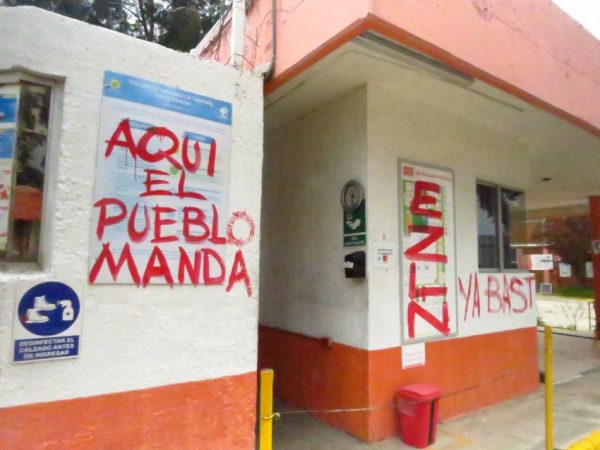
For four months, Indigenous and local communities in Mexico have managed to blockade and shut down the Bonafont plant in Cuanala in Puebla state. Bonafont is a bottled water brand owned by Danone, a Paris-based food corporation.

With large rocks blocking the main entrance, as well as tents, a cooking station and more, the communities have used their permanent blockade as a space to hold workshops, forums and cultural events.

But on Sunday, August 1, they decided it was time to take over the plant and put it to better use. They called a public meeting with state authorities and Bonafont owners for Sunday, August 8. No officials showed up.

After putting the government and corporations on trial, with members of each community testifying to the abuse of land and water in their area, the 21 communities then entered the huge water-bottling plant and took it over on Sunday.

The action coincided with the anniversary of the birth of Mexican revolutionary Emiliano Zapata. Activists immediately disabled and destroyed security cameras within the plant and moved large structures to block other entrances. They shut down one of the wells within the plant that was used to extract water from the nearby Iztaccíhuatl volcanic springs, in the east of Puebla state. Bonafont had been extracting 1.4 million litres of water a day, in order to sell them for profit, while leaving locals without.

The communities will now hold assemblies throughout Sunday night in order to decide what they will do with the giant water bottling plant, so that the space can be used to benefit the people.

“We are open to dialogue, but not to negotiation. Our communities declare this looting company closed,” said one representative, who spoke anonymously. Activists fear criminalisation, imprisonment and murder for actions like the one taken Sunday.

“We have to defend what our ancestors left us with — this mother Earth,” said another community representative.

The Bonafont plant has been in the area since 1996. There are 16,000 water purification and bottling plants in Mexico. Danone, Coca-Cola and Pepsico are the main companies profiting from the natural resource nationally, with 82% of the market.

‘Here, the people govern’, was painted near the entrance. Tamara Pearson


In Puebla State, Nestle Water and US company, Keurig Dr Pepper are also bottling water. Nestle takes water from the springs of the Popocatépetl and Iztaccíhuatl volcanoes. These companies pay, on average, 2600 pesos (AU$168) per year for a concession to extract water.

People from Almoloya, Tlautla, Colonia José Ángeles, Ometoxtla, Zacatepec, Cuanalá, Nextetelco, Coronango, Tepalcatepec, Cuachayotla, Cuapan, Xoxtla and Cuautlancingo say that while Bonafont has been taking their water and selling it in 19-litre bottles, they have been forced to buy their water from water trucks.