https://www.youtube.com/watch?v=C7jr8hyXiBQ
https://www.youtube.com/watch?v=C7jr8hyXiBQ
 Figure 1: In search of ‘innate’ probability. I’ve plotted here the results of a simulated coin toss. The blue line shows the ‘observed’ probability of heads after the respective number of tosses. The red line shows the ‘innate’ probability of heads (50%), which is embedded in the simulation code but inaccessible to observers.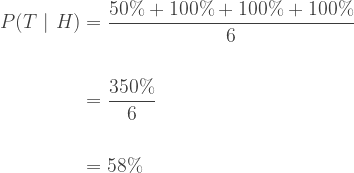
 Figure 2: When tossed 3 times, a simulated coin favors tails after heads. I’ve plotted data from a simulation in which I repeatedly toss a balanced coin 3 times. The blue line shows the observed probability that tails follows heads. The horizontal axis shows the number of times I’ve repeated the experiment.
 Figure 3: Favoratism for tails (after heads) disappears as the observation window lengthens. I’ve plotted data from a simulation in which I repeatedly toss a balanced coin n times and measure the probability of tails after heads. As the observation window n increases (from 5 to 10 to 100 tosses), tails favoratism decreases. The vertical axis shows the cumulative probability of tails after heads. The horizontal axis shows the number of times I’ve repeated the experiment.
 Figure 4: Wiping a coin’s ‘memory’. I’ve plotted here the results of a simulated coin toss in which I measure the probability of getting tails after a run of heads. Each panel shows a different sized run (from top to bottom: 3, 5, 10, and 15 heads in a row). The horizontal axis shows the number of tosses observed. The vertical axis shows the observed probability (the average outcome over many iterations) of getting tails after the corresponding run of heads. The longer the run of heads, the more tosses you need to remove the coin’s apparent preference for tails.
https://www.youtube.com/watch?v=NDRyh0RatLk
https://www.youtube.com/watch?v=kUBeAuKxpLM
https://www.youtube.com/watch?v=LPN1x8SFhao
https://www.youtube.com/watch?v=TtHJkpiVo8A
