Slavoj Žižek is one of the most controversial left-wing thinkers in the world today. For fans, he’s a figure worthy of rapturous praise and entire journals devoted to studying his thought. For detractors, he’s a charlatan and a clown — a nose-grabbing, Lacan-citing, cartoonish emblem of everything that is wrong with out-of-touch, superficially radical continental philosophy.
These critiques sometimes have a ring of truth to them. Žižek has taken some truly bad positions in recent years, one of the worst being his crypto-accelerationist “endorsement” of Donald Trump over Hillary Clinton. While Žižek has tried to explain himself since then, he’s never backed away from his basic position: that Trump’s victory would help bring about a more “authentic left.” It was a bad argument that ignored the actual history of far-right movements, which — far from accelerating the rise of a genuine left — have often bred further reaction. Žižek’s arguments also ignored the incredible damage Trump was capable of — and ultimately caused.
Žižek’s 2015 comments about refugees also warrant criticism. While he rightly criticized Western states and global capital for generating many of the conditions that cause people to flee their home countries, his view of refugees from Africa and the Middle East as radically different, almost incompatible, with European society risks reinforcing far-right racism. Žižek can claim he supports solidarity with refugees in spite of this all he wants — these still remain troubling remarks.
But despite these serious missteps, Žižek remains an important theorist for the Left for two reasons. First, his reinterpretation of dialectical materialism has resuscitated the leftist philosophy in the face of intellectual assaults. Second, he has written creative, insightful studies of ideology in our postmodern, neoliberal era. Taken together these contributions constitute a formidable legacy that ensure Žižek, whatever his flaws, will remain a touchstone for a long time. Did Somebody Say Dialectical Materialism?
Arguably Žižek’s most significant accomplishment is his rethinking of dialectical materialism. Before delving into this it will help to explain just what dialectical materialism is. The “dia-” in “dialectical” comes from Ancient Greek and refers to apart or across. The “lectical” is derived from the Greek word “logos” — a term too enigmatic to explain here, but that we’ll refer to as dialogue or discussion.
For ancient philosophers like Socrates or Plato, dialectic was the bringing forth of arguments by opposing interlocutors with the goal of reaching truth. In the eighteenth and nineteenth centuries, however — in a watershed moment for European philosophy — its meaning was transformed. No longer was “dialectic” used to describe the discrete practice of rational discussion. Instead, the German thinkers G. W. F. Hegel and Karl Marx applied it to characterize the entire advancement of society and its intellectual life, which they argued progresses through the negotiation of its internal contradictions.
According to Hegel, the forward momentum of history comes through the manifestation of concepts in the realm of practice. The fact that the Protestant Reformation had not happened in France, for instance, led to a moment of reckoning with feudal authorities in which “absolute violence” prevailed; in which the absence of social individualism meant the guillotining of enemies could be treated “with no more significance than cleaving a cabbage head.”
Though indebted to Hegel, Marx thought he used abstract concepts too freely. He attempted to set dialectics on a materialist footing by analyzing political economy. His famous thesis scarcely bears repeating: that capitalism, due to its propensity for replacing workers with machines and depriving them of the full product of their labor, eventually deprives itself of the consumer demand it needs to survive (which leads, of course, to communism).
Marx’s adaptation of dialectics, then, was always an explicitly materialist endeavor. But while using dialectics to explain the economic thrust of history became standard among Marxists, its application to nature remained controversial. From 1872 to 1882, Friedrich Engels authored — with Marx’s blessing — several manuscripts attempting to schematize natural phenomena ranging from biology to tidal friction using dialectics. The overly deterministic character — is boiling water really an example of dialectics? — caused Engels’s nature writing to be snubbed by much of the Marxist literati in the West from the 1920s onward.
The reception was far warmer among the apparatchiks of the Soviet Union. In 1938, Stalin went so far as to codify Engelsian “DiaMat” (dialectical materialism) as the official philosophy of the USSR. Given Stalin’s treatment of the natural sciences during his violent reign (most notoriously in the Lysenko affair), this didn’t exactly strengthen its intellectual repute.
For Žižek, the vulgarity of dialectical materialism, combined with the vulgarity of its political application, makes it “arguably the most stupid philosophical system of the twentieth century.” So why does he insist on identifying with the label? Žižek argues that without a vision of nature to oppose to capitalism, the Marxist left will find itself unable to speak decisively: it will, as he jokes of the poststructuralist philosopher Judith Butler, be unable to discuss a glass of water on the table without couching it in an array of caveats.
At the same time, Žižek’s version of dialectical materialism — what he calls, as if it were a Rocky sequel, “Dialectical Materialism 2” — is quite different than its stodgier precursor. The error of “Dialectical Materialism 1” is that its attempt to subordinate reality to objective laws ignores the great intellectual upheavals of modernity: namely, philosophy’s discovery (Kant via Descartes) that the structure of our thought conditions our understanding of the external world and psychoanalysis’s discovery (Lacan via Freud) that desire constitutes itself in opposition to a lack that can never be properly filled.
Žižek’s signature gesture is not to conceive of these injunctions negatively — as proof of the limitations of human reason, or as sexuality as a site of impossibility — but positively. If humans are defined by an irresolvable tension between reason and its fallibility, between desire and its lack, this proves they are part of nature. For if contemporary science has shown us anything, it’s that nature is riddled with inconsistencies, contingencies, and tensions. It is, in other words, constitutively incomplete.
To illustrate the point, Žižek often brings up quantum physics. Before quantum physics, our Newtonian understanding of the natural world was as a mechanically functioning material artifact. The shattering of this image, Žižek says, was like a player’s discovery of a video game glitch. When a gamer finds a glitch — when, say, they pass beyond a door that was put in the game for decorative purposes — they frequently find themselves mired in a mishmash of chaotic lines of code; in a liminal space in which the apparent rules of the game do not hold. But these spaces are still part of the game.According iteration of dialectical misses that reality is no holistic and harmoniou laws.
According to Žižek the same can be said of quantum physics: the shadowy conjuncture of waves and particles demonstrates the anarchic character of nature. The earlier iteration of dialectical materialism misses that reality is not holistic and harmonious, but defined by disunity and a refusal to submit to iron laws.
Given Žižek’s stress on failure and incompleteness as inherent features of the universe, it’s appropriate that his own system isn’t perfect either. One could question how useful it is to base one’s conception of nature upon contingency. Doesn’t this risk promoting a view where anything unknown can be seen as proof of its “incompleteness”?
Still, the great strength of Žižek’s dialectic materialism is that it incorporates criticisms of earlier versions. Many postmodernists have assailed orthodox dialectical materialism for being too rigid and deterministic, for assuming the knowability of reality. Žižek doesn’t reject these views outright — he builds them into his system.
It is often said that dialectics progresses in a three-step waltz, from thesis to antithesis to synthesis. With “Dialectical Materialism 2,” Žižek accomplishes a quintessentially dialectical feat: the synthesis of his opposition into something new. The Sublime Resurrection of Ideology
If Žižek’s “Dialectical Materialism 2” attempts to renew Marxist thought by jettisoning a naïve idea of objective reality, the same can be said of his theory of ideology.
In the late 1980s and ’90s, when Žižek made his name, ideology studies were thoroughly passé. Poststructuralist and “post-Marxist” critics had launched a volley of attacks on the classical account given by luminaries from Marx and Engels to Louis Althusser.
Generations of Foucauldians claimed that, contra its seemingly radical qualities, the theory of ideology was too simplistic — replicating the old appearance/reality distinction of Enlightenment liberal philosophy, just at a higher level of sophistication. Even worse, it was elitist in suggesting that only a privileged cadre of intellectuals could cast aside the illusions of ideology and approach the truth.
Building on this, more politically minded critics claimed the binary logic underpinning ideology theory generated a simplistic notion of power: ideology was treated as merely part of an epiphenomenal superstructure that justified and obfuscated the real material basis of class exploitation. According to these critics, it was crucial to recognize how ideas molded us into the entrepreneurial, neoliberal subjects who both participated in and created a world dominated by capital.
Žižek’s argument acknowledges many of these criticisms while showcasing why ideology remains a vital theoretical category for the Left. His innovation is to show that ideology is best understood not in terms of an illusion that conceals reality, but as a psychological disposition and set of behaviors. This is especially important to grasp in a postmodern society, where ironic detachment and meta-awareness of our own manipulation have become familiar cultural tropes.
Often, these sorts of dissociations are perceived as critical gestures: by stressing my awareness of ideology and power, I disenchant it. Žižek insists this is nonsense. Taking a minimal distance from ideology in fact facilitates our reconciliation with it.
There are venerable precedents for this ideological dissociation and retrenchment. The Catholic practice of confession allows people a safe space to indulge their sinful natures while retrenching the power of the Church by requiring congregants to performatively absolve these forays. It’s common to suppose we’ve moved on from such antiquarian practices. But Žižek argues we are more likely than ever to adopt customs that allow us to mock ideology while submitting to its imperatives.
The phenomena of commodity fetishism is a good example. Once upon a time we’d say that the problem is that people see commodities like expensive cars, Gucci purses, and Starbucks coffee as talismanic objects. The point of ideological analysis is therefore to make people aware that these are all just simple material objects, very often produced under exploitative conditions.
But as Žižek points out, we all already know this today. One of the reasons businesses proclaim their (superficial) commitment to racial justice is because consumers will parrot a seemingly critical rhetoric about the fashion industry depending on unrealistic beauty standards, that clothes don’t make the man, and so on. And when pushed to defend their attachment to consumer products, they’ll note that Gucci supports the LGBTQ community, that Starbucks recently committed itself to hiring more female executives, or even claim that we’re just consuming “ironically.”
The combination of expressing awareness of our consumerism, with the symbolic escape provided by appeals to cosmetic inclusion or ironic dissociation, performs the same function that confession has for the Catholic church. It gives us a safe space to take a minimal distance from ideology, while ensuring we are as beholden to it as ever. In other words, the proper ideological subject isn’t one who doesn’t know what’s going on, but someone who says “I know, but…”
The same is true of political ideologies. One of the strange features about postmodern conservatism was the number of young right-wingers, particularly online, who claimed to be supporting Trump ironically or satirically. They often claimed this wasn’t about sticking up for anything like conservative principles, but instead “owning the libs” or sending a message to “elites.”
But of course these dissociations from reactionary views provided an ideal defense against conventional forms of criticism: whenever someone pointed out that Trumpists were often thin-skinned plutocrats defending an exploitative and bigoted system of power, postmodern conservatives could claim their support was all a big joke and mock critics for taking it seriously. Far from being countercultural, this allowed them to support reactionary ideas without having to take possession of them or offer justifications. The Value of Žižek
Žižek is a mercurial figure whose work can be bafflingly spasmodic. His propensity to adopt the most provocative position has led him to conclude French voters have no reason to prefer the neoliberal Emmanuel Macron over the xenophobic Marine Le Pen. His writing vacillates between enjoyably accessible, with plenty of pop culture references to brighten things up, and frustratingly dense. And even sympathetic readers sometimes wish he would quit repeating himself throughout his myriad writings.
But these faults shouldn’t obscure the value of Žižek’s work on dialectical materialism and ideology. Few left-wing theorists have been as effective in refocusing our attention on the dynamics of neoliberal capitalism and the increasingly mysterious ways its ideology surfaces in everyday life.
Likewise, while his leftist opponents have often taken issue with his exhumation of dialectical materialism, accusing it of being pre-scientific, they could perhaps learn something from it. Žižek’s dialectics of incompleteness show us how novelty in politics, as in science, is possible — how Lenin could emerge from the periphery to seize power in the Russian Revolution, to cite one of his favorite examples.
The views of his left opponent often seem more primitive and binary. There is inequality, they tell us, so we should redistribute wealth. What this elides is the need to radically upend a system that, at present, makes fulfilling this goal nearly impossible.
If the mission of critical theory is to analyze and critique the ailments of its time, then Žižek is one of our finest diagnosticians. His work may not be sublime, but it is revelatory — which is just what the Left needs right now.
A digital marketing firm closely linked to the pro-Trump youth group Turning Point USA was responsible for a series of deceptive Facebook ads promoting Green party candidates during the 2018 US midterm elections, the Guardian can reveal.
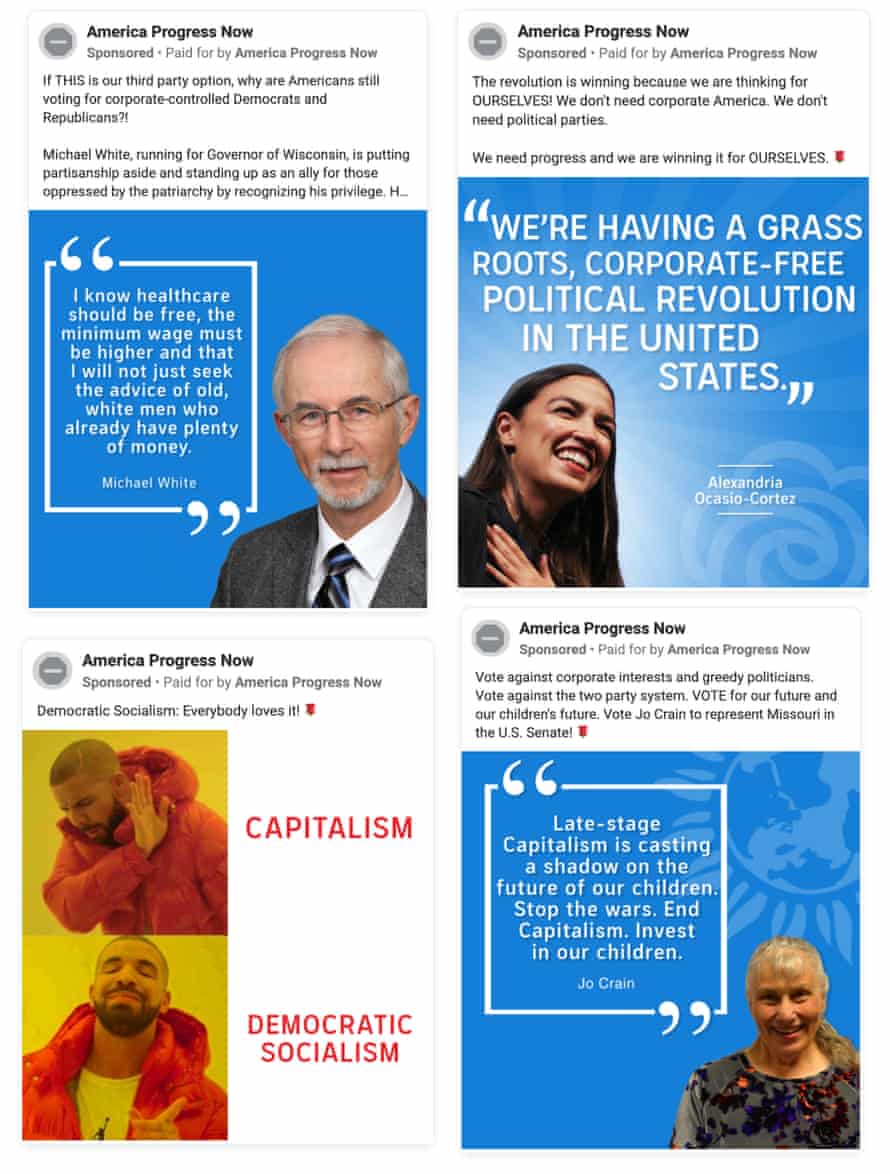
In an apparent attempt to split the Democratic vote in a number of close races, the ads purported to come from an organization called America Progress Now (APN) and used socialist memes and rhetoric to urge leftwing voters to support Green party candidates.
Facebook was aware of the true identity of the advertiser – the conservative marketing firm Rally Forge – and the deceptive nature of the ads, documents seen by the Guardian show, but the company determined that they did not violate its policies.
Rally Forge would go on to set up a pro-Trump domestic “troll farm” for Turning Point Action, a “sister” organization of Turning Point USA, in 2020, earning a permanent ban from Facebook.
“There were no policies at Facebook against pretending to be a group that did not exist, an abuse vector that has also been used by the governments of Honduras and Azerbaijan,” said Sophie Zhang, a former Facebook employee and whistleblower who played a small role in the investigation of the Green party ads.
She added: “The fact that Rally Forge later went on to conduct coordinated inauthentic behavior with troll farms reminiscent of Russia should be taken as an indication that Facebook’s leniency led to more risk-taking behavior.”
Some of the Facebook ads from America Progress Now. Composite: Facebook
Devon Kearns, a spokesperson for Facebook, said: “We removed Rally Forge from our platforms for violating our policy against coordinated inauthentic behavior. Since the 2018 midterms, we have strengthened our policies related to election interference and political ad transparency. We continue working to make political advertising more transparent on our platform and we welcome updated regulations and help from policymakers as we evolve our policies in this space.”
The revelation that the ads were linked to a rightwing organization raises questions about the Federal Election Commission’s enforcement of campaign finance laws. APN and its ads appeared to violate federal laws that require independent expenditures to be filed with the FEC and include proper disclosures on advertisements, as ProPublica and Vice News first reported in 2018.
The non-partisan campaign finance watchdog group Campaign Legal Center (CLC) filed a complaint against APN and subsequently sued the agency in an attempt to force it to investigate the group. But in July 2020, the FEC voted to dismiss allegations that America Progress Now had violated federal law, after an individual, Evan Muhlstein, took responsibility for the ads and attributed the lack of proper disclosures and filings to his “inexperience”.
It is illegal to knowingly make false or fraudulent statements to federal agencies, and the FEC appears to have taken Muhlstein at his word that the ads were a sincere but novice attempt to support Green party candidates.
The former FEC commissioner Ann Ravel, who reviewed the case at the request of the Guardian, said that were she still on the FEC, she would now refer this “stunning” case to the justice department for investigation.
“It seems as if it’s a clear fraud,” Ravel said, noting that the FEC general counsel’s office appeared to have been “misled” by Muhlstein. “The requirement for the justice department to take on an electoral matter is that it be serious and willful, and clearly in this case it was willful, in my opinion.”
Brendan Fischer, director of federal reform at CLC, said: “This is an example of why disclosure is so important in elections: swing state voters who saw ‘America Progress Now’ ads promoting Green party candidates would’ve had no idea that they were the handiwork of Republican political operatives. The FEC’s job is to enforce the transparency laws and protect voters’ right to know who is trying to influence them, but the agency here failed to conduct even a minimal investigation.” ‘A crystal clear example of astroturfing’
On 27 October 2018 – just days before the 6 November election – America Progress Now began running a series of ads that used leftist motifs, such as the red rose emoji and images of Bernie Sanders and Alexandria Ocasio-Cortez, to rail against the “corporate, two-party oligarchy” and the “corporate, capitalist wage system”. Some of the ads urged voters to choose a third party, but others endorsed Green party candidates by name – triggering FEC rules for independent expenditures.
Following the 5 November publication of a ProPublica/Vice News report on the “mysterious” group behind the ads, Facebook launched a “hi-pri[ority]” escalation to investigate whether they constituted “coordinated inauthentic behavior” (CIB) – the name Facebook gives to the kind of deceptive tactics that a Russian influence operation used during the 2016 election.
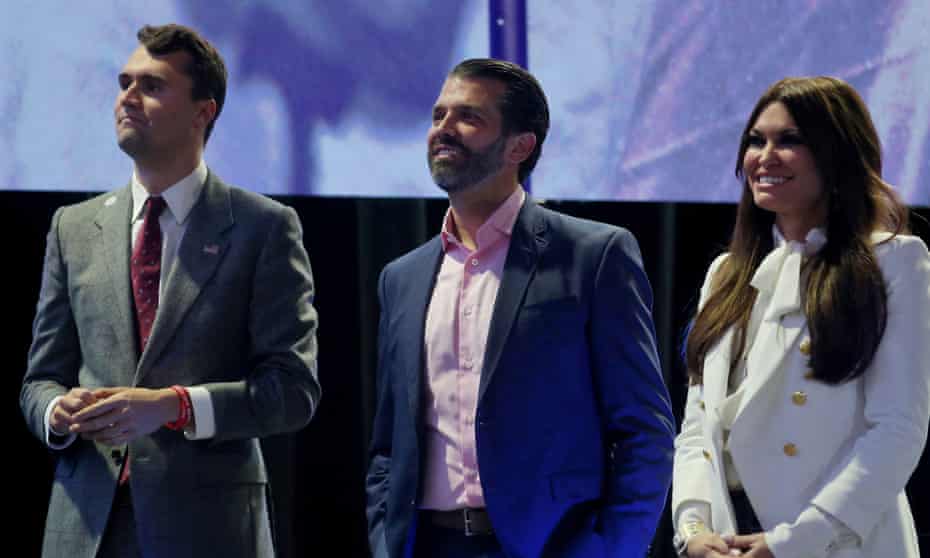
The investigation was straightforward since Facebook has access to information that regular users do not: the names of the people who control Facebook Pages. Investigators quickly realized that America Progress Now was administered by three individuals – Jake Hoffman, Connor Clegg and Colton Duncan – who also served as Facebook Page administrators for Turning Point USA, the rightwing college group founded by Charlie Kirk in 2012. Hoffman and Clegg were also administrators for Kirk’s Facebook Page.
Charlie Kirk, founder of Turning Point USA, left, with Donald Trump Jr and his girlfriend, Kimberly Guilfoyle, at a summit in 2019. Photograph: Leah Millis/Reuters
“These admins are connected to Turning Point USA,” one staffer from the civic integrity team said, according to internal task management documents seen by the Guardian. “This is very inauthentic. I don’t know what the policy here is but this seems very sketchy.” Another staffer named Rally Forge as being responsible for the ads. APN had spent nearly $5,000 to have the ads shown to users nearly 300,000 times, a third staffer noted.
A rightwing political marketing firm that ran a $350,000 pro-Trump Super Pac in the 2016 election, Rally Forge was founded and run by Hoffman, an Arizona Republican who was at the time a member of the town council in Queen Creek, Arizona. In November 2020 Hoffman was elected to serve in the Arizona state legislature.
Clegg and Duncan were alumni of Texas State University, where they had been elected student body president and vice-president respectively in 2017. Clegg was impeached and removed from office shortly before his term would have ended in 2018. Duncan resigned from his post in 2017; he appears to have been hired directly by Turning Point USA in 2019.
Since 2017, Rally Forge has been Turning Point USA’s highest-compensated independent contractor, paid more than $1.1m over two years, according to the non-profit’s public filings. Turning Point Action, an affiliated organization also founded by Kirk, paid Rally Forge $700,000 for work supporting Trump and opposing Biden during the 2020 presidential campaign, and an additional $400,000 for work on the US Senate runoff races in Georgia.
Andrew Kolvet, a spokesperson for Turning Point USA, said that neither Turning Point USA nor Turning Point Action had “any involvement” with America Progress Now or its Facebook ads.
In addition to America Progress Now and Turning Point USA, Hoffman, Clegg and Duncan all also served as administrators for a number of other rightwing Facebook Pages. The trio each maintained two accounts to administer their Facebook Pages, one using their full names and one using their first and middle initials – a violation of the company’s policy that each user can only have one Facebook account. One of each of the three men’s accounts had been authorized by Facebook to run political ads, a process that required submitting a government ID to Facebook for verification.
One of Hoffman’s accounts had spent approximately $650,000 to run Facebook ads on behalf of 40 Pages, including the official Page of Donald Trump Jr.
Hoffman declined to answer detailed questions from the Guardian, including about the nature of Rally Forge’s relationship with Muhlstein. “The premise of your questions is either ill-informed or intentionally misleading,” he said in a statement. “Rally Forge is a marketing agency, not a compliance company. Furthermore, it is my understanding that the small handful of ads, totaling less than 2,500 dollars, which qualified as independent expenditures, have been fully disclosed by the responsible organization in coordination with the FEC.”
Duncan said that he had never heard of America Progress Now before the Guardian’s inquiries and had “zero knowledge or insight into the group”. When asked about the CG Duncan account, which had passed Facebook’s verification process and was an administrator of the APN page, he responded: “I urge you to reach out to JM [Hoffman]. Let me know what you find out, I’m as curious as you are.”
Clegg did not respond to multiple attempts to contact him.
Despite possessing clear evidence of inauthenticity, Facebook staffers determined the Green party ads did not violate existing company policies related to political ads or CIB. They decided to deactivate the three men’s extra accounts, but after the election and only after providing them with advance notice.
The episode inspired some disquiet among Facebook staff.
“What I find very problematic is that the intention here is clearly to mislead users,” said the civic integrity staffer. “The users in question clearly created a new FB page to hide their identity, which would be grounds for removal on most surfaces,” she added, referring to Facebook’s rules requiring people to use their real names on their accounts.
One product manager produced an internal postmortem of the incident in which she described it as “a crystal clear example of astroturfing” – deceptive campaign tactics designed to appear as grassroots actions – “… as well as playing both sides … and political ad opacity, since users cannot see who they are. Furthermore, I could see making a case for voter suppression.”
‘The users in question clearly created a new FB page to hide their identity,’ said a Facebook civic integrity staffer. Photograph: Olivier Douliery/AFP/Getty Images
“Unfortunately, it turned out there was nothing we could do against these ads,” she added. “We ended up only aiming to remove a few [duplicate] accounts under the fake account policy, but only after proper notice – and I believe we have not removed them yet.”
“Can we strengthen our ads transparency policies so that political ads are indeed transparent to the user?” she asked.
A Facebook spokesperson said that the company had indeed removed the duplicate accounts following the midterms, and that Rally Forge’s network of Pages and accounts had gone dormant after November 2018. The company made a number of updates to its policies on political ads before the 2020 elections, including requiring advertisers to provide more information about their organizations before being authorized to run ads. It also introduced a new policy to encourage more transparency regarding who runs networks of Facebook Pages.
Rally Forge reactivated its network of Pages and accounts in June 2020, according to Facebook. It established a domestic “troll farm” in Phoenix, Arizona, that employed teenagers to churn out pro-Trump social media posts, some of which cast doubt on the integrity of the US election system or falsely charged Democrats with attempting to steal the election, the Washington Post revealed.
Facebook said that its automated systems had detected and deleted fake accounts made by Rally Forge, which then created “thinly veiled personas” to carry out deceptive campaigning. In October 2020, the platform permanently banned Rally Forge and Hoffman for violating its policy against CIB, work that Facebook said the firm had undertaken “on behalf of Turning Point USA” and another client.
A spokesman for Turning Point USA disputed the characterization of the operation as a “troll farm” and noted that it was a project of Turning Point Action, which is a separate entity.
In September 2019, CLC filed a complaint alleging that APN’s failure to register with the FEC violated federal law. The FEC responded by sending a letter to an inaccurate address that America Progress Now had listed on its Facebook Page, but it does not appear to have taken further action, prompting CLC to sue it in February 2020.
“If nothing is done, the FEC will instead be sending a message that anonymous or fake entities like America Progress Now can pop into existence just prior to an election, exploit lax registration and reporting requirements by digital platforms, spend unlimited sums of money, and then disappear into thin air once an election is over,” the group said at the time.
In April 2020, the FEC wrote again, this time to the address listed on an Arizona state business filing for America Progress Now.
On 15 April 2020, Evan Muhlstein responded to the FEC by email. Muhlstein described the lack of filing as an “error”, writing, “I believe that it is important for the commission to understand that any potential failure on either of those items is based entirely on my inexperience to the process.” He wrote that he had “assumed that Facebook’s ‘political disclaimer/disclosure’ was all that was necessary”, said his expenditures totaled “only $2,467.54”, and expressed surprise that “a spend as small as this would require any type of reporting”.
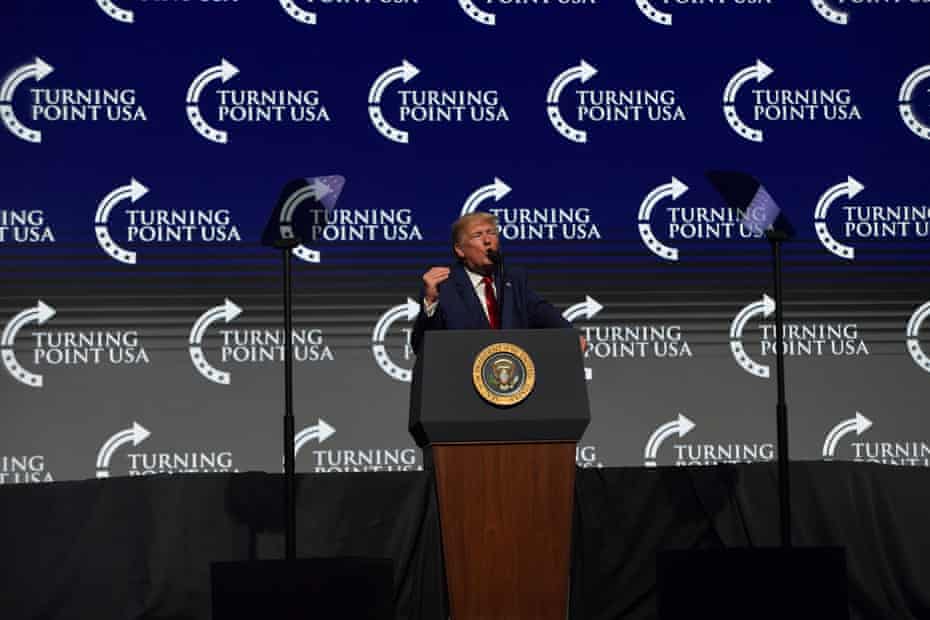
Donald Trump speaks at a Turning Point USA summit in 2019. Photograph: SMG/Rex/Shutterstock
“I again offer my sincerest apology for any potential errors in failing to disclose,” Muhlstein wrote. “Given the apparent obstacles and unknowns of participating in the election process in this manner (of which I am learning some of now), it is highly unlikely I will ever participate in it again. I feel terrible for having been so ignorant to the process.”
Muhlstein also expressed his desire to come into compliance “correctly and quickly”. At no point in the communication did Muhlstein disclose that the advertisements had been handled by a major political marketing firm.
“Muhlstein’s statement to the FEC is extremely misleading and might warrant a criminal investigation,” said Fischer, of the CLC.
Muhlstein did not respond to multiple attempts to make contact with him. His connection to Rally Forge is not known. He is a resident of Queen Creek, Arizona, the town where Hoffman also lives.
The FEC has the power to issue subpoenas and carry out serious investigations, but only after a vote of four of its five commissioners.
In a report dated 4 May, the FEC’s general counsel argued that, while it appeared that Muhlstein had violated federal law, the small amount of money involved and Muhlstein’s statement that he was unlikely to engage in further political spending led it to recommend that the FEC exercise prosecutorial discretion and dismiss the allegations with a warning.
In July, the FEC voted to follow the general counsel’s recommendation and dismiss the case, forestalling any actual investigation.
Commissioner James “Trey” Trainor went further, lambasting the CLC in a statement of reasons. “Contrary to CLC’s wild speculation, this case wasn’t about a ‘fake political group … exploit[ing] Facebook rules … and hid[ing] spending from the FEC,’” he wrote. “In fact, APN was established by an unsophisticated individual trying to show his support for several third-party candidates, but he got tripped by the myriad regulations governing online political speech.”
Trainor asserted that “there was no evidence to contradict” Muhlstein’s statement to the FEC “and no evidence to support CLC’s salacious theories about the ‘unknown person or persons’ behind APN”.
It would not be until 23 December 2020 – six months after the FEC had voted not to pursue the allegations of law violations and more than two years after the election – that Muhlstein would provide the FEC with that evidence, when he finally registered APN with the FEC and disclosed that the independent expenditure had been made through Rally Forge.
The FEC did not respond to questions from the Guardian, citing a policy not to comment on enforcement matters. Trainor did not respond to a request for comment. Fischer said: “It looks like we were right.”