Sunday, June 6, 2021

Cubs Javier Baez Crazy Play Against The Pirates


https://www.youtube.com/watch?v=jzvUZNuWLWI


Saturday, June 5, 2021

Top scientists warn of 'ghastly future of mass extinction' and climate disruption


Sobering new report says world is failing to grasp the extent of threats posed by biodiversity loss and the climate crisis


https://www.theguardian.com/environment/2021/jan/13/top-scientists-warn-of-ghastly-future-of-mass-extinction-and-climate-disruption-aoe


The planet is facing a “ghastly future of mass extinction, declining health and climate-disruption upheavals” that threaten human survival because of ignorance and inaction, according to an international group of scientists, who warn people still haven’t grasped the urgency of the biodiversity and climate crises.

The 17 experts, including Prof Paul Ehrlich from Stanford University, author of The Population Bomb, and scientists from Mexico, Australia and the US, say the planet is in a much worse state than most people – even scientists – understood.


“The scale of the threats to the biosphere and all its lifeforms – including humanity – is in fact so great that it is difficult to grasp for even well-informed experts,” they write in a report in Frontiers in Conservation Science which references more than 150 studies detailing the world’s major environmental challenges.

The delay between destruction of the natural world and the impacts of these actions means people do not recognise how vast the problem is, the paper argues. “[The] mainstream is having difficulty grasping the magnitude of this loss, despite the steady erosion of the fabric of human civilisation.”

The report warns that climate-induced mass migrations, more pandemics and conflicts over resources will be inevitable unless urgent action is taken.

“Ours is not a call to surrender – we aim to provide leaders with a realistic ‘cold shower’ of the state of the planet that is essential for planning to avoid a ghastly future,” it adds.

Dealing with the enormity of the problem requires far-reaching changes to global capitalism, education and equality, the paper says. These include abolishing the idea of perpetual economic growth, properly pricing environmental externalities, stopping the use of fossil fuels, reining in corporate lobbying, and empowering women, the researchers argue.

The report comes months after the world failed to meet a single UN Aichi biodiversity target, created to stem the destruction of the natural world, the second consecutive time governments have failed to meet their 10-year biodiversity goals. This week a coalition of more than 50 countries pledged to protect almost a third of the planet by 2030.
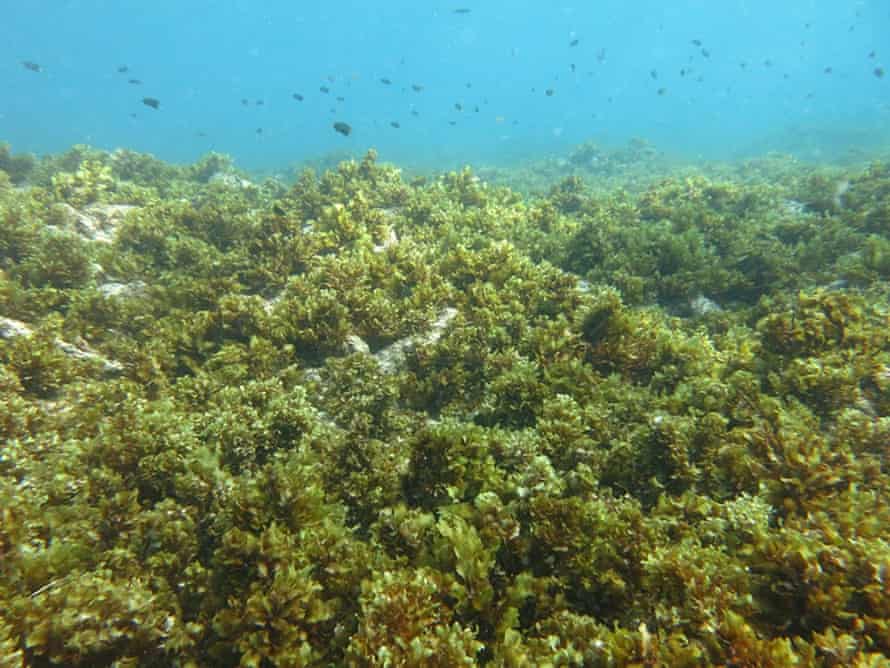
A coral reef dominated by algae in Seychelles ... the climate crisis is changing the composition of ecosystems. Photograph: Nick Graham/Lancaster University/PA


An estimated one million species are at risk of extinction, many within decades, according to a recent UN report.

“Environmental deterioration is infinitely more threatening to civilisation than Trumpism or Covid-19,” Ehrlich told the Guardian.

In The Population Bomb, published in 1968, Ehrlich warned of imminent population explosion and hundreds of millions of people starving to death. Although he has acknowledged some timings were wrong, he has said he stands by its fundamental message that population growth and high levels of consumption by wealthy nations is driving destruction.

He told the Guardian: “Growthmania is the fatal disease of civilisation - it must be replaced by campaigns that make equity and well-being society’s goals - not consuming more junk.”

Large populations and their continued growth drive soil degradation and biodiversity loss, the new paper warns. “More people means that more synthetic compounds and dangerous throwaway plastics are manufactured, many of which add to the growing toxification of the Earth. It also increases the chances of pandemics that fuel ever-more desperate hunts for scarce resources.”

The effects of the climate emergency are more evident than biodiversity loss, but still, society is failing to cut emissions, the paper argues. If people understood the magnitude of the crises, changes in politics and policies could match the gravity of the threat.

“Our main point is that once you realise the scale and imminence of the problem, it becomes clear that we need much more than individual actions like using less plastic, eating less meat, or flying less. Our point is that we need big systematic changes and fast,” Professor Daniel Blumstein from the University of California Los Angeles, who helped write the paper, told the Guardian.

The paper cites a number of key reports published in the past few years including:


The World Economic Forum report in 2020, which named biodiversity loss as one of the top threats to the global economy.


The 2019 IPBES Global Assessment report which said 70% of the planet had been altered by humans.


The 2020 WWF Living Planet report, which said the average population size of vertebrates had declined by 68% in the past five decades.


A 2018 Intergovernmental Panel on Climate Change report which said that humanity had already exceeded global warming of 1C above pre-industrial levels and is set to reach 1.5C warming between 2030 and 2052.
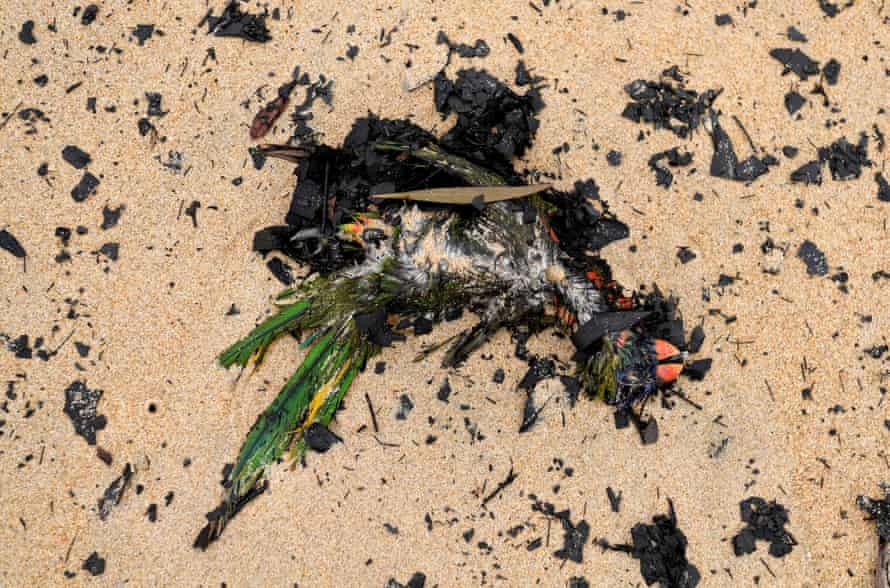
Australia saw a devastating bushfire season in 2020. Photograph: Tracey Nearmy/Reuters


The report follows years of stark warnings about the state of the planet from the world’s leading scientists, including a statement by 11,000 scientists in 2019 that people will face “untold suffering due to the climate crisis” unless major changes are made. In 2016, more than 150 of Australia’s climate scientists wrote an open letter to the then prime minister, Malcolm Turnbull, demanding immediate action on reducing emissions. In the same year, 375 scientists – including 30 Nobel prize winners – wrote an open letter to the world about their frustrations over political inaction on climate change.

Prof Tom Oliver, an ecologist at the University of Reading, who was not involved in the report, said it was a frightening but credible summary of the grave threats society faces under a “business as usual” scenario. “Scientists now need to go beyond simply documenting environmental decline, and instead find the most effective ways to catalyse action,” he said.

Prof Rob Brooker, head of ecological sciences at the James Hutton Institute, who was not involved in the study, said it clearly emphasised the pressing nature of the challenges.

“We certainly should not be in any doubt about the huge scale of the challenges we are facing and the changes we will need to make to deal with them,” he said.


What will the next decade bring? Here are 20 predictions from trend forecasters


Emily Segal


https://www.theguardian.com/commentisfree/2021/feb/15/2020s-trend-predictions-forecasters-working-from-home-ai-climate


At the beginning of every year, trend forecasters the world over put together expensive reports predicting what the future will bring. As a trend forecaster myself, I’ve read literally hundreds of predictions in the past few weeks made by the likes of McKinsey, WGSN and countless others so that you don’t have to. So, what do these professional speculators of the future think the next few years hold?

Many of the themes are predictable: automation, artificial intelligence, climate crisis and climate-related migration, virtual reality and augmented reality, China’s rising power, cryptocurrencies, Zoom, remote work and people agitating for their rights.


Like all predictions, these should be taken with a grain (or boulder) of salt. For example, the firm Mintel “predicts” that by 2030 “corporations will shape transnational politics”, something they have clearly already been doing for decades, or that by 2025 “more subtle gender labels will emerge”, something that’s also already here. Barclay’s 150 trends for investors to watch in the 2020s report, meanwhile, puts smartdust (microscopic sensor systems) in the same “unlikely to happen” quadrant as cryptocurrencies, which are booming. Needless to say, operating in the realm of the speculative and pandering to potential clients is an unsteady combination, though not without its jewels.

Still, here is a sampling of the big and compelling trends that forecasters seem convinced will come to pass, if not in 2021 then over the next five to 10 years:
1 Universal work from home policies

Remote work due to Covid-19 has exposed the inadequacies of compulsory office attendance; now that people are working from home, it will never go back to the way it used to be; geographical requirements around talent acquisitions will loosen or expand beyond urban centers.
2 End of the open-plan office

Besides being notoriously difficult for concentration and privacy, an airborne pandemic has lessened the appeal of cramming big groups of people shoulder to shoulder in a single room.
3 Digital commutes and forced mindfulness

Microsoft is reportedly introducing a “virtual commute” feature intended “to create mental bookends for the remote workday”. It is also partnering with the meditation app Headspace to add a new “emotional check-in feature”.
4 Carbon labelling for consumer goods

Like nutrition facts on food, listing carbon expenditures related to various products on their packaging or in marketing materials will become a norm. This could be used to justify higher prices for certain more “carbon-responsible” items.
5 Cashless biometric payments

You know how iPhone’s Face ID can trigger Apple Pay’s contactless payments? Now imagine this technology being available in many retail settings, and in various implementations outside of the Apple ecosystem.
5 Live shopping outside China

Live shopping, already extremely popular in China, is like Instagram Live meets the Home Shopping Network – influencers show-and-tell products live on social media, which have particular discounts and promotions only while the feed is rolling. Forecasters predict this will become globally popular in the near term.
6 Climate migration

Climate crises will increasingly force huge populations to relocate, causing strain over resource allocation, border issues, culture and the overall safety of millions.
7 Rewilding

Cities and suburbs are looking for places to downshift development and add urban greenery to compensate for rising C02 emissions. Especially if carbon sequestration is eventually monetized, this could have an impact on land use overall, since owning undeveloped forest land would be profitable. This may point to a shift away from increasingly elusive home ownership toward permaculture land ownership.
8 Breakdown of traditional education paths

As the pandemic has interrupted schooling for millions, new relationships to online learning will continue to flourish, in addition to trends like unschooling, which will penetrate new demographics (beyond the fringe). The weight of student debt and continued class conflict will also draw people away from the traditional path of college education.
9 Mushroom mania

Rising vegetarianism and the advancement of home cooking in the pandemic are two drivers for the rising excitement around these versatile fungi. (My firm Nemesis wrote a trend report last year called The Umami Theory of Value, so I am not surprised about this trend!)
10 Ultra spicy is the new umami

Forecasts say people will get increasingly excited about painfully spicy flavors, such as those found in ghost peppers and extra-strong chili sauces.
11 Mass psychedelia

Shrooms are the new weed, commercially speaking, as new firms and funds scramble to monetize psilocybin in advance of its extended clinical applications. Psychedelics as a class of drugs continue to be destigmatized, relative to other drugs. Forecasts see this reaching a new level of mainstream saturation in coming years.
11 Escape into fantasy worlds

Perhaps unsurprisingly, global uncertainty has led to a boom in escapism, and all signs point to this continuing strongly into the next decade. Fantasy can and will take various forms, including long-form immersive gaming experiences, ketamine’s recreational popularity and new acceptance as a clinical treatment, and increasing commercial emphasis on the worlds of young adult literature and its spin offs across media.
12 Full-filter reality

Immersive, photo realistic imagery in the form of Instagram-style filter layers will become widespread beyond just phones when applied via increasingly mature augmented reality systems, forcing people to question the relationship between the visual and the real, and potentially fragmenting consensus reality even further.
13 Tech platform exit

Consumer backlash against big tech has been heralded for years, but its widespread implementation finally seems likely. Mainstream awareness of the data power imbalance with big companies will make consumers happy to pay for things like search, email and VPN instead of having companies use their data. Increasing attention to the power imbalances of this model will lead to the adoption of more niche services and platforms.
14 Blockchain

More widespread adoption of blockchain technologies will affect the way people portray identities online. Protest movements will demand transparency from power, which will drive adoption of blockchain technologies with their public accounting systems. Historically speculative products like NFTs (non-fungible tokens) which create unique digital identities for items like digital artworks or gaming items, will go mainstream.
15 China power shift

China’s status as an economic, political and cultural center will continue its meteoric rise. The US will continue its downward spiral. Chinese consumption patterns will set the tone for the world.
16 Amazon Nations

The relationship between enormous corporations whose resources increasingly dwarf actual countries and small countries in need of debt relief will lead to unusually baroque tax-evasion schemes and complex international monopoly issues.
17 Zoom fashion

Fashion designers and retailers will create markedly different strategies for fashion that appears on the upper body, ie above “the Zoom line” compared with the bottom half of the body, which isn’t usually visible on screen.
18 Return of the facelift

More invasive procedures such as surgical facelifts will regain popularity – people are tired of paying over and over for fillers, which is more like a subscription model. Superusers say a surgical facelift is cheaper in the long run, and forecasts seem to be aligned with them, as the plastic surgery sector will continue to boom overall.
19 No-melody music

Stripped-down rap with no melody is perfect for soundtracking viral TikTok videos; the trend of stripping out elements may expand widely into various categories of music and media.
20 Death of music genres

Spotify’s move toward mood-driven instead of genre-driven playlists has been successful to the point of suggesting that musical genres themselves will be increasingly outmoded in the coming years – or at least completely illegible.


Jimmy Dore: Biden Moving Toward Bill Clinton


https://www.youtube.com/watch?v=ZNaf6c96LRQ


YOU CAN DITCH UBER FOR A DRIVER-OWNED RIDESHARE APP


By Whitney Kimball, Gizmodo.

June 3, 2021


https://popularresistance.org/you-can-ditch-uber-for-a-driver-owned-rideshare-app/


The thank-you banners are down, but New York City residents have a real opportunity to show their appreciation for a population of low-paid, primarily immigrant frontline workers. New York City residents can help now by ditching Uber and Lyft for a competing driver-owned alternative app called “Co-op Ride,” created by the mostly volunteer-run Drivers Cooperative. If Co-op’s proposal plays out, drivers could make more money while their passengers, particularly those in underserved communities, could end up paying less for rides.

Launched this past weekend and now available to New York City residents ****in the App Store and Google Play, Co-op Ride is a cooperative, driver-owned business. Each driver owns one share of the company, giving them a vote in the company’s leadership and an even cut of any and all profits. (Even if you’re not in New York, you can donate here to help them grow and achieve profitability.) The app is powered by a combination of Google Maps’ API, Stripe, and Waze.

Co-op Ride claims to take a 15% commission from fares for operating expenses: much lower than 25%-30%, which drivers have said Lyft and Uber take. Neither Lyft nor Uber provide standard commission percentages on their website, due to the fact that it varies based on location and trip times relative to distance (profitability), leaving open a possible range from zero fees to exorbitantly high ones. (Oddly, Uber also cites a 25% flat commission here. It’s unclear whether this is out of date.) Longtime driver and Co-op Ride recruiter Michael Ugwu told Gizmodo that Uber can take up to 40%, depending on the circumstances.

Ugwu, who’s incurred thousands of out-of-pocket expenses on car payments, primarily wants drivers to at least know that they’re getting the maximum benefits from their labor. “Drivers’ lives are in the hands of Uber and Lyft,” Ugwu told Gizmodo. “This is our time to make money for our own selves, instead of enriching those giant companies. We made them giant, by the way. Drivers invested their money in big cars— eighty or ninety thousand dollars, just to drive for them, and they don’t care.”

On Tuesday morning, Gizmodo found that Co-op Ride seemed to cost the same as Uber—$16.55 for a 17-minute ride within Brooklyn (without tolls, etc.) versus $16.56 through Uber X. Unlike Uber, though, Co-op Ride had priced in a 20% tip. (A tip is not required, but encouraged, as an optional standard percentage the user can select during the sign-up process.)

Erik Forman, a Driver’s Cooperative co-founder (as well as facilitator for Spectrum strikers’ cooperatively-owned ISP), told Gizmodo that every driver gets a background check and safety training as part of the licensing process through the Taxi and Limousine Commission, and Co-op Ride provides additional training. But Forman granted that lawmakers need to secure better industry standards so that Co-op Ride can operate more ethically while competing with corporate giants.

“Unfortunately our competitors Uber and Lyft have refused to pay into the state unemployment benefits fund,” he noted. “We think that’s wrong. We would like to pay the state unemployment benefits fund, but we call on the state to enforce the law equally so that Co-op Ride would not be put at a disadvantage.” Currently, the model is to just incorporate the four percent unemployment tax in additional worker pay.

Another potential holdup for the profit-sharing concept is that even Uber and Lyft are not yet profitable. Forman pointed out that keeping exorbitant lobbying costs, such as about $3 million on down-ballot New York State legislators and over $200 million (with DoorDash) on Prop 22 could help. “When you’re not buying [state] senators, it turns out you can actually save a lot of money,” he said. (And also investments like flying taxis.) In the event of a loss, Co-op Ride can draw on grant funding and donations.

Co-op Ride would also need to be mindful of the balance of riders to drivers. Researchers have found that Uber and Lyft drivers’ pay has decreased in part because the companies put too many drivers on the road, reducing wait times for riders but also the number of fares per shift.

“We think it’s frankly reprehensible that Uber misled tens of thousands of working-class New Yorkers into investing money in vehicles and going on the road when they knew that demand would outstrip supply,” Forman said. “They artificially flooded the market and priced themselves below break-even in order to put their competition out of business. We think there needs to be planning to match supply and demand to make sure drivers can make a decent living and make sure to make sure people who live in transit deserts, especially, can get a car when they need it.”

For tax purposes, Co-op Ride drivers are still independent contractors, a status which legislators have correctly argued for years bars drivers from labor protections. Uber and Lyft have claimed that non-employee status is better for drivers, primarily allowing them to retain flexibility. If all goes well for Co-op, we’ll find out what they think about ownership status.


PEACE IN COLOMBIA SHOULD MEAN LAND REFORM AND AN END TO HUNGER


By Vijay Prashad and Zoe Alexandra, People's Dispatch.

June 3, 2021


https://popularresistance.org/peace-in-colombia-should-mean-land-reform-and-an-end-to-hunger/


Colombia’s Ongoing National Strike Is Part Of A Decades-Long Struggle Against The Political And Economic Elites To Demand Peace And Dignity For All.

Since the end of April, Colombia’s streets have smelled of tear gas. The government of Colombian President Iván Duque imposed policies that put the costs of the pandemic on the working class and the peasantry and tried to suffocate any advancement of the Havana peace accords of 2016. Discontent led to street protests, which were repressed harshly by the government. These protests, Rodrigo Granda of Colombia’s Comunes party told us in an interview, “are defined by the wide participation of youth, women, artists, religious people, the Indigenous, Afro-Colombians, unions and organizations from neighborhoods of the poor and the working class. Practically the whole of Colombia is part of the struggle.” A range of concrete demands defines the protest: running water and schools, the disbandment of the riot police (ESMAD), and the expansion of democratic possibilities.

The Comunes party was formed in 2017 by members of the FARC-EP (Revolutionary Armed Forces of Colombia-People’s Army). Granda, who is known internationally for his former role as the foreign minister of the FARC, is now in the national board of the Comunes party. As a legal political party, Comunes is a direct product of the 2016 Havana peace accords signed by the Colombian government and the FARC. Over the past two years, members of the Comunes have been on the streets alongside their fellow Colombians who are fighting to bring democracy to the country’s economy and politics. Granda spoke to us about the ongoing protests and helped to put these protests in the context of the long history of struggle in Colombia.
Colombia’s Violent Oligarchy

The current protests remind Granda of the 1977 national civic strike that he participated in, with one difference: then, he says, there was “no international solidarity,” while now the global media attention to Colombia’s struggle allows the people in his country “not to lose heart” during a difficult fight. The 1977 strike emerged out of a long struggle against the country’s oligarchy.

Years before the strike, Granda looked forward to the Colombian elections of April 1970. He hoped that the former president and general Gustavo Rojas Pinilla of the National Popular Alliance (ANAPO) would win. Rojas Pinilla was not a leftist, but he offered the country a way out of the grip of Colombia’s oligarchy. Young people like Granda hoped that an ANAPO victory in Colombia and then, later in the year, the victory of Salvador Allende’s Popular Unity in Chile would help change the character of South America’s politics. But Rojas Pinilla’s victory was embroiled in fraud, and while Allende won the election, he was ejected from power in 1973 in a coup. Looking back over these 50 years, Granda told us that he feels an “internal frustration” with the theft of that election in 1970 and the tortuous path his country has had to take since then.

The fight has been difficult because the ruling bloc of Colombia, including Duque, is unwilling to honestly participate in a democratic agenda. None of the major political parties that have controlled the state since 1948 have been eager for any kind of change. Suffocation of politics since then and the routine assassination of political leaders moved the left—through the FARC and other groups—into armed struggle in 1964. The FARC regularly called upon the ruling bloc to open negotiations, but with little success. However, talks with President Belisario Betancur in 1982 opened the way to the 1984 La Uribe Agreement, which resulted in a ceasefire from 1984 to 1987. Members of the FARC joined with others on the left to create Union Patriótica (UP) as a legal political party. Attempts to move a reform agenda by the UP came alongside a policy of assassinations by the state against the left. No genuine liberal sentiment pervades the Colombian ruling bloc, which refuses to share even a modicum of power with other groups.

The situation deteriorated under President Andrés Pastrana—who was in power from 1998 to 2002—and US President Bill Clinton, who both signed Plan Colombia, which proved to be the beginning of a policy to define the FARC as “narco-terrorists” and conduct a war of extermination against the rebels. Incidentally, it was Pastrana’s father who stole the election of 1970 from Rojas Pinilla. Brutality characterized the Colombian state’s approach toward the FARC and toward anyone else who questioned its policies. Gradually, the ruling bloc was led by more and more ruthless men, none more so than President Álvaro Uribe (2002-2010). Uribe, Granda told us, “promised to exterminate us [the FARC] in four years, but he could not.”
Peace Accords

Granda understands why peace had to define the agenda a decade ago. “After the failure of Plan Colombia and a stalemate in the war,” he told us, “we could not defeat the Colombian army in a short time, and the Colombian army could not defeat the guerrillas in a short time either. Therefore, a political solution through dialogue was necessary.” President Juan Manuel Santos (2010-2018) wrote a letter to the FARC saying that he recognized the internal problems in Colombia and also recognized that the FARC was a political organization and not a narco-terrorist organization. This set in motion the negotiation in Havana that resulted in the accords.

The accords put in place a plan for integrated agrarian reform and democracy, as well as restitution for the victims of the long war. “We put down our arms,” Granda said, “but we did not disarm ourselves from an ideological point of view.” The signing of the accords is only one part of the FARC’s plan toward peace, since their implementation is key before other kinds of meaningful change can be made. But the Colombian oligarchy, Granda said, has an entirely different view of what peace would mean. For the oligarchy, peace means that the guns of the FARC are silent. “For us,” he says, “peace means an attack on the factors that generate the violence in the first place.” These include factors like hunger, dispossession and the frustration with the oligarchy and the harsh violence by the state against which the people of Colombia continue to protest.


HOW USAID CREATED NICARAGUA’S ANTI-SANDINISTA MEDIA APPARATUS


By Ben Norton, The Grayzone

June 3, 2021


https://popularresistance.org/how-usaid-created-nicaraguas-anti-sandinista-media-apparatus-now-under-money-laundering-investigation/


Now Under Money Laundering Investigation.

With tens of millions of dollars over years of work, CIA front USAID helped create and train Nicaragua’s anti-Sandinista opposition. At the center of its operations is the elite Chamorro Foundation, which stands accused of money laundering.

The US government has spent years cultivating a ring of right-wing media outlets in Nicaragua that played a central role in a violent 2018 coup attempt. This network is now being investigated by the Nicaraguan government on allegations of money laundering.

These publications are an integral part of a political opposition that Washington has carefully managed, trained, and funded with millions of dollars over the past decade. While relentlessly accusing Nicaragua’s leftist government of corruption, they have been suspiciously obscure with their own finances and record-keeping.

The institution at the heart of the US-backed influence network is called the Fundación Violeta Barrios de Chamorro para la Reconciliación y la Democracia, or Violeta Barrios de Chamorro Foundation for Reconciliation and Democracy – often referred to simply as the Chamorro Foundation.

Run by one of the richest and most powerful family dynasties in Nicaragua, the Chamorro Foundation is perhaps the most important domestic organization in coordinating the political opposition to the Central American nation’s socialist-oriented Sandinista National Liberation Front (FSLN).

The Chamorro Foundation is a central vehicle for Washington’s massive financial, technical, and logistical support to the Nicaraguan opposition, acting as what the CIA refers to as a “pass-through” – a third-party organization that serves as a seemingly independent channel for US government funding to foreign political groups and media outlets.

Since the Sandinistas came to power in 2007, the United States has funneled tens of millions of dollars to opposition groups in Nicaragua through its soft-power arm the US Agency for International Development (USAID), a CIA front that has long been used as “humanitarian” cover for operations to destabilize independent left-wing governments, especially in Latin America.

Internal reports from USAID show that the agency does much more than just fund anti-Sandinista political organizations, NGOs, and media outlets in Nicaragua; it births them, nurtures them, and trains them in every aspect of politicking, from electoral strategies and public relations to outreach and social media messaging, branding and marketing to organizing and building broad alliances, developing technology skills and navigating legal issues to managing finances and accounting.

This Grayzone investigation illustrates how USAID has helped to create Nicaragua’s anti-Sandinista opposition from the ground up. The right-wing political forces that comprise it are anything but organic; they are the product of an enormous campaign of foreign meddling by US government interference at every single level of Nicaraguan society.

The US astroturfing has been especially effective in forming Nicaragua’s anti-Sandinista media apparatus. Publicly available records show that USAID has spent at least $10 million specifically on opposition media outlets in Nicaragua since 2009. Of that money, USAID sent more than $7 million to the Chamorro Foundation from 2014 to 2021.

Given that much of the information that USAID discloses about its support for the political opposition and media outlets in Nicaragua is redacted, these figures are likely conservative estimates.

Western European governments have supplemented Washington’s efforts in cultivating the anti-Sandinista opposition, with a special emphasis on the press.

European Union member states have handed out millions to the Chamorro Foundation, using the influential opposition group to fund right-wing news outlets. In 2020 alone, the foundation received €831,527 (more than $1 million USD) from the Spanish Agency for International Development Cooperation (AECID), an arm of Madrid’s soft power that is modeled after USAID.

The Western funding has been bolstered with millions of dollars from Washington’s National Endowment for Democracy (NED) – another CIA front that exists to push regime change across the globe. Between 2016 and 2019, the NED provided at least $4.4 million to Nicaraguan opposition groups, including media organizations, according to public records – although this is likely an underestimate as well.

These are exorbitant sums of money in Central America, one of the poorest regions of the world, where the minimum wage amounts to around $200 per month. Such foreign funding is the main force keeping Nicaragua’s right-wing opposition afloat – especially given that polling show it has mere single-digit support among the general population.

Many of the media outlets bankrolled by USAID in these programs traffic in blatant fake news and extremist content, while inciting violence against the Nicaraguan government and supporters of the Sandinista Front.

The prominent tabloid opposition network 100% Noticias, for instance, which is funded by USAID through the Chamorro Foundation, regularly transmitted calls for Nicaraguans to overthrow their elected government during the violent 2018 coup attempt.

The director and founder of that US-funded station, Miguel Mora, stated in an interview with Grayzone editor Max Blumenthal that he wanted the US military to invade Nicaragua, violently remove the elected Sandinista Front party from power, and capture President Daniel Ortega. He cited Washington’s 1989 invasion of Panama as a model.

“What I see from the United States is it doing a Noriega-style operation, like in Panama,” Mora told Blumenthal in an interview in Managua, days after the putsch fizzled out in July 2018.

“They come, they grab the [Ortega-Murillo] family, they take them away, and the army is not involved. In two days, 24 hours, this is solved, if there were US intervention like that,” the US-funded 100% Noticias director said.

“So what I see, instead of the United States giving weapons, like what it did with the Contras, is that they come and do a Noriega-style operation,” Mora added.

While USAID bankrolled violent, far-right, coup-plotting elements like Mora, internal documents reviewed by The Grayzone show that it was simultaneously supporting liberal NGOs that exploited issues like LGBT equality, women’s empowerment, and Indigenous rights, to provide the rightist anti-Sandinista opposition with progressive cover.

The USAID-backed coordinator of many of these opposition groups, the Chamorro Foundation, was accused of fiscal improprieties this May, and the Nicaraguan government launched an official investigation on suspicion of money laundering, stating that it had found “serious financial inconsistencies in the reports presented to the government and the amounts received by the foundation.”

Serious questions about the Chamorro Foundation remain unanswered. This February, the organization announced that it had voluntarily suspended its operations in Nicaragua as a form of protest against a law passed in October 2020 by the nation’s democratically elected National Assembly that requires NGOs funded by foreign governments to register as foreign agents. (The legislation was harshly condemned by Washington, although it was modeled after an 83-year-old US law.)

However, while the foundation claimed to have legally shut down in Nicaragua, it still continued receiving large sums of money from foreign governments. In 2020, Washington gave the Chamorro Foundation at least $1.3 million, and as of this May, the US government sent the group at least $419,000 more for 2021.

Exactly where this money has gone is not clear, and what happened with the millions in its bank accounts when the foundation shut down is not known.

The Chamorro Foundation has denied the charges by pointing to a 2020 audit done by an accounting firm called Baker Tilly Nicaragua S.A. (a company that is closely linked to the country’s right-wing opposition). But the USAID inspector general’s office admitted in an internal memo that there was no external peer review of the audit, noting that it did not meet Washington’s own Generally Accepted Government Auditing Standards (GAGAS) requirements.

A high-profile elected member of the National Assembly from a left-wing party allied with the Sandinista Front, Wilfredo Navarro, accused the Chamorros of using a money-laundering ring to fund the 2018 coup attempt in Nicaragua.

“Between the Chamorro Foundation, the Grupo Cinco [another Western government-funded media organization run by the Chamorro family], and other NGOs, they laundered money and sent more than $30 million to pay the killers and torturers, the authors of the pain, destruction, and death in the failed 2018 coup,” Navarro alleged. “Neither justice in heaven or on Earth will forgive them. Their hands are full of blood.”

For its part, the Chamorro family has thus far stonewalled, refusing to publicly provide concrete answers to the lingering questions about its finances.

In a revealing response to the allegations of financial malpractice, the founder and director of the foundation, opposition politician Cristiana Chamorro – the elite daughter of the right-wing former president of Nicaragua after whom the foundation is named – rejected the investigation by immediately citing the authority of her patrons in the US government.

Cristiana Chamorro insisted in an official statement, “The US State Department rejected the charges of money laundering against the Violeta Barrios de Chamorro Foundation based on audits they conducted that did not find evidence of money laundering or diversion of funds.”

Managua’s Public Ministry replied by politely reminding Chamorro that Nicaragua is a sovereign country and the US government does not control its justice system. “The statement by the State Department is not relevant to the investigative process taking place in Nicaragua, which is being carried out according to the Constitution and laws of the Republic,” the ministry wrote.

Cristiana Chamorro appeared to have forgotten that she was a citizen of Nicaragua, not the United States. Her confusion was perhaps understandable, however, given that her foundation – and the Central American nation’s right-wing opposition as a whole – has been not only financially sustained by Washington, but created, cultivated, and propped up by the US government over the course of a decades-long foreign meddling operation.
Nicaragua’s Oligarch Family Tries To Retake Control, With Help From Washington

The Chamorro family has long been one of Uncle Sam’s most reliable assets in the region. An oligarchic clan descended from Spanish colonialists, the Chamorro dynasty boasts seven former presidents of Nicaragua, tracing back to the very first head of state of the republic in the 1850s.

The modern history of the Chamorro family clearly reflects Washington’s role as the guiding force behind Nicaragua’s right-wing opposition.

Cristiana Chamorro’s mother, and the namesake of her foundation, Violeta Barrios de Chamorro, was the first opposition president to come to power after the 1979 Sandinista Revolution that toppled Nicaragua’s decades-long US-backed military dictatorship.

In the 1980s, Washington poured millions of dollars into violent far-right death squads, known as the Contras (short for “counterrevolutionaries” in Spanish), which resorted to terrorist tactics in a failed bid to overthrow the socialist Sandinista government.

One of the most important leaders of the Contras was Edgar Chamorro – another member of the same oligarchic family. He later turned against the murderous paramilitary groups, and published a revealing letter-to-the-editor in the New York Times in 1986 titled, “Terror Is the Most Effective Weapon of Nicaragua’s ‘Contras’.”

“The ‘contras’ were, and are, a proxy army controlled by the U.S. Government,” Edgar Chamorro wrote. “If U.S. support were terminated, they would not only be incapable of conducting any military activities against the Sandinistas, but would also immediately begin to disintegrate. I resigned rather than continue as a Central Intelligence Agency puppet.”

Edgar Chamorro’s description of the anti-Sandinista opposition in Nicaragua as a proxy of the US government that would collapse were it not for Washington’s enormous economic, political, and logistical support remains true today.

Violeta Barrios de Chamorro only came to power in 1990 thanks to a presidential campaign that was directed and financed by the US government. Her victory reflected the exhaustion of a population sapped by a decade of Washington-sponsored terrorist war – compounded by an economic crisis created by an illegal US blockade of their country, as well as an implicit US threat to levy even more sanctions on the impoverished nation if Ortega won.

Violeta Chamorro’s presidential campaign was one of the first projects of the US government’s newly created National Endowment for Democracy (NED), a CIA front that still bankrolls the anti-Sandinista opposition today.

Her presidential tenure was an unmitigated disaster, and the horrors that working-class Nicaraguans suffered through during that period, which they now call the “neoliberal era,” are seared into their collective sociocultural memory. Despite massive economic assistance from the United States and debt forgiveness by its financial organs the World Bank and International Monetary Fund, Violeta’s Chicago Boy-style policies led to skyrocketing poverty and inequality, unleashing an epidemic of organized crime, drug-trafficking, and prostitution in Nicaragua, creating one of the highest murder rates in the world.

Violeta Chamorro’s departure in 1997 was followed by another decade of neoliberal rule that continued the trend of widespread poverty and inequality. To perpetuate her legacy, she founded the Violeta Barrios de Chamorro Foundation the year she left office.

When the leftist Sandinista Front won Nicaragua’s 2006 presidential election and returned to power a year later, the Chamorro Foundation became the central pass-through for US government funding to the opposition.

The foundation is run by Violeta’s daughter, Cristiana, who is the top opposition choice for Nicaragua’s November 2021 presidential election, and the preferred pick in Washington. Although she has no real political experience, Cristiana’s sponsors in Western governments and corporate media outlets frequently refer to her as an “opposition leader.”

Cristiana has been aggressively boosted by mainstream corporate media outlets, becoming a regular fixture on CNN en Español, which lavishes praise on her as the “woman who promises to save Nicaragua.”

The scion of a veritable aristocratic clan, Cristiana has marketed herself as the second-coming of her mother, making it clear that she hopes to inherit the presidency with her aristocratic last name – and a little help from her friends in the US government.
USAID-Funded Chamorro Foundation And NED Sustain Coup-Mongering Nicaraguan Right-Wing Media

In addition to their enormous political and economic influence, the Chamorro dynasty has significant control over Nicaragua’s media. The country’s two largest newspapers, La Prensa and Confidencial, are run by Chamorros – and funded by the US government. And the Washington-backed Chamorro Foundation is used to sustain other right-wing outlets in the country.

Western governments and corporate media outlets often accuse the Sandinista government of opposing freedom of the press and freedom of speech, but the reality is that the majority of Nicaraguan media outlets are neoliberal and viciously anti-Sandinista.

The opposition’s media apparatus in Nicaragua consists of newspapers such as La Prensa and Confidencial; TV channels Canal 10, Canal 11, Canal 12, and Vos TV; the outlet Radio Corporación and radio show Café con Voz; as well as online outlets 100% Noticias, Artículo 66, Nicaragua Investiga, Nicaragua Actual, BacanalNica, and Despacho 505, to name just a few. This is further supplemented by dozens of right-wing social media influencers.

These domestic outlets receive heavy amplification from foreign-based corporate media networks, which broadcast nonstop anti-Sandinista propaganda – and quite a bit of fake news – day in and day out.

Sustaining most of the Nicaraguan opposition outlets is a steady flow of US government money through the Chamorro Foundation.

These media platforms played a key role in the violent coup attempt in Nicaragua in 2018. The Washington-funded outlets spread fake news, openly incited violence against Sandinistas, and even called on opposition supporters to attack the government and kill President Ortega.

As mentioned above, the founding director of the influential right-wing network 100% Noticias, Miguel Mora, called for the US military to invade his country and overthrow President Daniel Ortega in a “Noriega-style operation,” in his July 2018 interview with The Grayzone editor Max Blumenthal.

With the help of USAID funding through the Chamorro Foundation, 100% Noticias also sent its reporter Lucía Pineda Ubau to the violent barricades erected by armed coup-plotters, known as tranques, where she encouraged viewers to join them and take up arms against the elected government.

Another fanatical right-wing Nicaraguan media personality who advocated for the coup attempt in 2018, host Jaime Arellano of Radio Corporación, openly broadcasted his support for former US President Donald Trump.

Arellano, known as “El Pingüino,” posted a photo on Facebook in 2020 of himself wearing a Trump hat, accompanied by the text “Nicas for Trump.”

Arellano and 100% Noticias staff were among the media figures who were called in for questioning by the Nicaraguan justice system in May 2021 as part of its investigation into alleged money laundering.

Nicaragua’s top two newspapers, La Prensa and Confidencial, are slightly more measured in their messaging, but essentially espouse the same extremist viewpoints.

For her part, Cristiana Chamorro – who was educated in the United States and has never had a real job other than positions she inherited from her family – is not only director of the Chamorro Foundation; she is also vice president of La Prensa.

Both institutions are funded largely by Washington, which effectively makes Cristiana an unofficial employee of the US government.

La Prensa is directed by Jaime Chamorro Cardenal, Cristiana’s uncle. Following the 1979 Sandinista Revolution, the newspaper served as Washington’s key propaganda weapon. During the US terror war in the 1980s, the NED used La Prensa to spread pro-Contra disinformation.

The Chamorro family also ran the leading newspaper El Nuevo Diario, which closed down in 2019. Meanwhile, the other major Nicaraguan opposition news outlet, Confidencial, is run by Cristiana’s brother, Carlos Fernando.

Carlos Fernando Chamorro is essentially the Rupert Murdoch of Nicaragua. Thanks to the many millions of dollars he has received from Western governments over years, Carlos Fernando has built a veritable media empire.

The most important weapon in Carlos Fernando’s information warfare arsenal is Confidencial. He uses it to churn out non-stop propaganda against the government of President Daniel Ortega, while pushing an aggressively neoliberal editorial line that makes Fox News look like a bastion of journalistic rigor.

Confidencial refers to Nicaragua’s elected government as a “dictatorship” and “regime,” and often pushes dubious stories and disinformation with little basis in fact.

This May, for instance, Carlos Fernando’s publication sought to distract from the government’s investigation into his family’s alleged money laundering by running an absurd story that claimed an attempt by the Managua mayor’s office to collect unpaid back taxes owed by Nicaraguan corporations was part of an “extortion scheme.” Confidencial has also accused the mayor’s office of “fiscal terrorism” for forcing wealthy elites to pay taxes.

The institution that bankrolls this disinformation factory is the US government. Confidencial is funded by the NED, through the companies Invermedia and Promedia, which Carlos Fernando owns.

Confidencial is also financed by the Swiss government, an appropriate patron given that Carlos Fernando has employed a Swiss bank-style strategy to create a panoply of de facto shell companies to rake in foreign funding for anti-Sandinista media outlets.

In addition to Confidencial, Invermedia, and Promedia, Carlos Fernando runs an influential group called the Centro de Investigaciones de la Comunicación (CINCO).

The Grupo CINCO, like his sister Cristiana’s Chamorro Foundation, is funded by another EU member state, the Spanish Agency for International Development Cooperation (AECID).

Carlos Fernando Chamorro helps run Grupo CINCO with the prominent opposition activist Sofía Montenegro. They are allied with the Movimiento Renovador Sandinista, or Sandinista Renovation Movement (MRS), an ostensible social-democratic opposition party founded by upper-class NGO activists and academics who claimed momentary loyalty to the Sandinista movement in the 1980s, but broke with it when it lost power in the 1990s.

When the Sandinista Front returned to power in 2007, wealthy liberal intellectuals like Carlos Fernando Chamorro and Montenegro emerged as some of the government’s most vehement opponents. They allied with the Washington, reaping substantial paychecks from the United States’ regime-change entities.

Nicaragua-based journalists Nora McCurdy and Stephen Sefton uncovered photos showing Montegro holding friendly meetings with the US embassy, alongside MRS leaders.

The MRS has never been able to earn more than 2% in a presidential election, but its petite-bourgeois members dominate Nicaragua’s NGO sector, media, and academia. The MRS was a significant player in the violent US-backed coup attempt in 2018, helping to organize and supply the various elements vying to topple the elected government.

In January 2021, MRS leadership shed any pretense of loyalty to Sandinismo and rename their party the Unión Democrática Renovadora (Democratic Renovation Union), or UNAMOS.

The website NicaLeaks published a leaked internal USAID document revealing that Montenegro and the Grupo CINCO that she helps run with Carlos Fernando Chamorro are funded by the US government.

In 2016, USAID gave Montenegro a one-year grant of $80,000 to fund her anti-Sandinista media work.

Other shell organizations run by Carlos Fernando Charmorro include the little-known Fondo de Apoyo al Periodismo Investigativo, as well as the Costa Rica-based Asociación Productora de Periodismo Independiente. Then there is his radio station Onda Local, and his TV shows, “Esta Semana” and “Esta Noche.”

The closeness that Carlos Fernando and Cristiana Chamorro enjoy to the US government was reflected in the fact that they were both invited to sign an open letter in 2020 organized by the NED, which accused “authoritarian regimes” of exploiting the Covid-19 pandemic “tighten their grip on power.” They were joined by a slew of powerful right-wing political leaders from across Latin America.
US And EU Baselessly Accuse Nicaragua Of Money Laundering While Funding Rich Elites Accused Of Money Laundering

Among average working-class Nicaraguans, it is well-known that the Chamorro oligarchs control myriad shell companies, front groups, and political NGOs, and have many millions of dollars flowing into their multiple bank accounts from a variety foreign sponsors. The family is notorious for its financial murkiness.

The government’s investigation into alleged money laundering by the Chamorro Foundation comes at a time when Nicaragua is trying to crack down on rampant tax evasion by local elites.

This May, Nicaragua’s National Assembly voted to strengthen the laws on money laundering, in order to better combat the crime, noting that new technologies like cryptocurrencies have made it easier for plutocrats to hide their wealth from taxation.

The increased enforcement of laws against money laundering and tax evasion is partly aimed at boosting Nicaragua’s tax base, which has been hard-hit by the 2018 coup attempt and the subsequent, aggressive US sanctions that effectively locked the country’s economy out of the Washington-controlled international financial system.

In February 2020, Nicaragua was placed on the “greylist” of the Financial Action Task Force, an instrument created by the G7 nations ostensibly to reduce money laundering, but which is, in fact, an economic arm of NATO designed to punish countries that refused to toe the neoliberal line demanded by Washington and Brussels.

That same year, the European Commission added Nicaragua to its short list of “high-risk third countries” – another economic attack on the Sandinista government disguised as a measure against money laundering.

While Western governments employ dubious accusations of money laundering to economically strangle Nicaragua, they continue funneling tens of millions of dollars to conservative Nicaraguan elites who are infamous for shady book-keeping.
USAID’s Explicitly Stated Goal In Nicaragua: “Political Transition”

The main financial sponsor of Nicaragua’s political opposition has been the US Agency for International Development (USAID). Most grassroots Sandinistas are familiar with USAID’s dark history in the country, and the organization’s name has become synonymous with meddling and destabilization.

During the 1980s, USAID helped the CIA run covert operations to arm and fund the far-right Contra death squads. Then-Assistant Secretary of State Elliott Abrams admitted that the Reagan administration sent weapons to the Contras on so-called “humanitarian aid” flights.

Today, USAID plays a similar role in Washington’s attempts to topple the democratically elected leftist government not only in Nicaragua, but also in Venezuela.

USAID was used to funnel hundreds of millions of dollars to a parallel Venezuelan coup regime led by Juan Guaidó. The agency was also integral to a violent US coup attempt against Venezuela in February 2019. In 2021, the US government’s own inspector general’s office acknowledged that USAID committed fraud in order to fund regime-change efforts in Venezuela.

The fact that USAID wants regime change in Nicaragua as well is hardly hidden. The agency admits on its own website that USAID has run a program in Nicaragua sponsored by its Office of Transition Initiatives (OTI).

The OTI’s goal is simple: to overthrow governments that challenge Washington’s political and economic domination of the world. It states this quite clearly on its website, explaining that the office “supports U.S. foreign policy objectives” and “provides fast, flexible, short-term assistance targeted at key political transition.”

USAID/OTI boasts of supporting “Independent civil society, independent media, and human rights defenders” – or in other words, the right-wing opposition – in Nicaragua during and after the failed 2018 coup d’etat, pushing for an “exit from the current political crisis” and an end to the democratically elected government of President Daniel Ortega.

USAID/OTI was exposed for running a similarly putschist plot to overthrow Venezuela’s elected President Hugo Chávez. A secret 2006 US State Department cable published by WikiLeaks shows that the USAID/OTI regime-change strategy was aimed at “Penetrating Chavez’ Political Base, Dividing Chavismo, Protecting Vital US business, and Isolating Chavez internationally.”

In Nicaragua, USAID is advancing the same goals: penetrating the Sandinista Front’s base, dividing Sandinismo, isolating President Ortega internationally, and of course, advancing the interests of US corporations.

In 2020, The Grayzone exposed USAID’s latest regime-change scheme in Nicaragua by exposing a leaked internal document revealing the agency’s Responsive Assistance in Nicaragua (RAIN) program. This project calls openly for the overthrow of the Sandinista government, as well as imposing neoliberal reforms based on a “market economy” and the “protection of private property rights,” and purging the military, police, and all state institutions of any trace of Sandinismo.
USAID’s $9.4 Million “Media Strengthening Program” Bankrolls Nicaragua’s Anti-Sandinista Outlets

As the recipient of at least $7 million from USAID from 2013 to today, the Chamorro Foundation is the central node in contemporary USAID operations in Nicaragua.

Much of the information surrounding USAID grants for Nicaragua is redacted from documents, citing the Foreign Aid Transparency and Accountability Act of 2016 as justification. The redactions have become more comprehensive since the failed 2018 coup attempt exposed the extent of US penetration of Nicaraguan civil society.

In 2020, for instance, an organization in Nicaragua received $2.82 million from USAID, but the agency redacted the recipient’s name and the nature of its activities. In 2021, USAID again obscured the recipients of and reasons for a $1.6 million grant, as well as another $1.2 million grant.

This means that this $7 million figure given to the Chamorro Foundation is likely just a conservative estimate, and the actual sum of US financial support for the foundation and other anti-Sandinista opposition organizations could be significantly higher.

The public records that do exist show that USAID ran its programs supporting the opposition in Nicaragua through various contractors, including the following:
National Democratic Institute (NDI), which also trained opposition forces against socialist President Rafael Correa in Ecuador
International Republican Institute (IRI), which played a key role in US-backed coups against Haiti’s progressive elected President Jean-Bertrand Aristide
Freedom House, a regime-change lobby group
US Consortium for Elections and Political Process Strengthening (CEPPS)
World Bank’s International Finance Corporation
International Research and Exchanges Board (IREX)
RTI International
Global Communities
Creative Associates International
FHI 360
Chamorro Foundation

Internal USAID data reviewed by The Grayzone shows that USAID has a decade-long, multimillion-dollar program with the Chamorro Foundation to create, fund, and train right-wing media outlets in Nicaragua.

Titled the “Media Strengthening Program,” the initiative is highly secretive. However, USAID records show that, in 2014, the agency signed a $9.4 million agreement with the Chamorro Foundation to oversee the program, which was earmarked to run through 2023.

As of May 2021, more than $7 million of that allotted $9.4 million has been delivered to the foundation.

There are no internal reports exposing the scope of USAID’s Media Strengthening Program, and almost no mention of it on the internet, aside from two audit reports published by the agency’s Office of Inspector General.

USAID does, however, operate a similar “Media Strengthening Program” in Mozambique, another formerly colonized country that is governed by the revolutionary party that overthrow the colonial regime – in its case, FRELIMO, or the Liberation Front of Mozambique.

In Nicaragua, the website NicaLeaks published leaked internal documents showing that at least 12 opposition media outlets were “partners” of the Chamorro Foundation, and therefore received funding from USAID.

Among the USAID/Chamorro Foundation’s key partners is the right-wing network 100% Noticias, which played a key role in the failed 2018 coup attempt, spreading fake news, inciting violence against Sandinistas, and encouraging viewers to take up arms against the elected government.

The head of 100% Noticias, Miguel Mora, who called for the Panama-style US military invasion of Nicaragua in 2018, personally received $43,100 from USAID through the Chamorro Foundation in 2015. And this grant is from just one year in a decade-long program.

Another recipient of USAID money through the Chamorro Foundation is La Prensa – the same newspaper where foundation director Cristiana Chamorro serves as vice president.

This means that Cristiana has double-dipped USAID money, using it not only to fund her Chamorro Foundation, but also to pay her family and herself.

This is a clear conflict of interest; as head of the Chamorro Foundation, Cristiana controlled how much money would be sent to the newspaper she helped run.

NicaLeaks obtained another USAID document showing the agency approving the foundation’s disbursement of USAID money to La Prensa. This meant that the US government knew Cristiana was using its citizens’ tax dollars to enrich herself and her family members, and took no measures to impede her corruption.

Given its shady financial dealings, it should be no surprise that the Chamorro Foundation is being investigated on suspicions of money laundering.

Washington claims its support for media outlets in Nicaragua is a means of supporting “independent journalism” and the freedom of the press. In reality, the records clearly show that the United States seeks to destabilize the Sandinista government by propping up and promoting the country’s leading right-wing political operatives.
USAID Trained And Funded Nicaraguan Opposition Leaders, Holding In-Person Meetings To Coordinate With Media

While precise details about USAID’s $9.4 million Media Strengthening Program through the Chamorro Foundation are redacted, a look at an array of USAID operations supporting opposition groups in Nicaragua can shed critical light on the foundation’s activities.

Between 2013 and 2018, USAID simultaneously oversaw a separate operation to support anti-Sandinista groups in Nicaragua, earmarking more than $6 million in funding for Capacity Building for Civil Society Advocacy (CBCSA). USAID’s partner for this program was the Dexis Consulting Group, which in turn subcontracted the work out to Chemonics.

Chemonics is a for-profit company that contracts with US government agencies in sensitive areas around the globe, specializing in destabilization and intelligence operations. The founder of the firm openly admitted he created it to “have my own CIA.”

The Grayzone documented how Chemonics was used to provide millions of dollars in US government funding to the White Helmets in Syria, while also helping to destabilize the government of Ecuador’s democratically elected socialist President Rafael Correa.

Publicly available data show that USAID gave Dexis/Chemonics at least $6,117,000 to run the Capacity Building for Civil Society Advocacy initiative.

When the CBCSA program concluded in 2018, Dexis/Chemonics prepared an internal report summarizing the successes of the initiative. The publicly available document shows how USAID not only funded opposition leaders in Nicaragua, but drilled them in methods to undermine the Sandinista government.

USAID said one of the program’s principal objectives was to “Improve the capacity of CSOs and individuals to increasingly coordinate and network with one another, the private sector, and media outlets to promote awareness, advocacy, and activism.” In other words, CBCSA aimed to cultivate opposition leaders and build an anti-Sandinista alliance uniting US-funded NGOs, powerful business interests, and the press.

USAID took credit for creating 126 “alliances and partnerships” and supporting 224 civil society organizations as part of the five-year CBCSA program.

Using an acronym to refer to anti-Sandinista civil society organizations (CSOs), USAID said “CBCSA worked with CSOs to establish partnerships with the private sector.”

One of the main so-called civil society organizations that USAID’s CBCSA program utilized was the Chamorro Foundation. Using another acronym to refer to the Violeta Barrios de Chamorro Foundation (FVBCH), USAID boasted that it “worked with FVBCH … to ensure increased dissemination of the CSOs’ activities through independent media outlets.”

CBCSA even organized quarterly “in-person networking and outreach” meetings in Nicaragua, bringing together US-funded NGOs and opposition media outlets for sessions on improving anti-Sandinista messaging.

USAID boasted, “These meetings provided CSOs the opportunity to coordinate with one another and with media outlets.” It added that a majority of attendees had “increased press coverage because of the meetings.”

The report singled out the Chamorro Foundation specifically as a group that helped “ensure increased dissemination of the CSOs’ activities through independent media outlets.”

The USAID report published a photo showing Nicaraguan opposition figures meeting to share tactics under US tutelage.

In addition to training opposition activists and connecting them with businesses and the media, USAID boasted that “CBCSA designed digital and media campaign materials, including posters, Twitter messages, and Facebook pages” for the anti-Sandinista groups.

In other words, a noted CIA front helped create and run social media accounts for Nicaraguan opposition organizations.

As cover for these anti-Sandinista operations, USAID cynically exploited issues like sexual violence against women, LGBT equality, and Indigenous rights. It even helped launch a campaign called “Let’s raise voices against child sexual abuse” as cover for opposition activities.

USAID highlighted in its report that CBCSA’s work creating, cultivating, training, and funding the anti-Sandinista opposition was complemented with help from the Central American branch of the Kellogg corporation, as well as the Catholic Church.

In an unintentionally comical section demonstrating the total subservience of Nicaragua’s opposition to Washington, the report noted that “CBCSA provided guidance and training to RED LOCAL and FVBCH to purchase air tickets for consultants and staff to ensure compliance with the Fly America Act, including how to document an exemption for individual travel. RED LOCAL and FVBCH now have the knowledge to compliantly purchase U.S.-funded travel in the future.”

Cristiana and her Chamorro Foundation can now sleep comfortably with the assurance that, whenever they want to fly to Miami or Washington, Uncle Sam has it covered.
USAID’s $2.8 Million “Nicaragua Media Program” Designed “To Advance U.S. Interests”

USAID’s Media Strengthening Program and Capacity Building for Civil Society Advocacy initiative were just two of the agency’s many operations aimed at attacking Nicaragua’s leftist government.

From 2010 to 2013, USAID ran a very similar project called the Nicaragua Media Program, with $2.8 million in funding.

While the 10-year Media Strengthening Program was run out of the Chamorro Foundation, the three-year Nicaragua Media Program was run by a contractor called Family Health International (FHI) 360.

At the end of the project in 2013, USAID produced a final performance evaluation report, which stated clearly, using an acronym for the Nicaragua Media Program, that the “NMP sought to advance U.S. interests.”

The document noted that the USAID program was actively promoted by then-US Ambassador Robert J. Callahan, and added, “The broad dissemination of USAID messages served to promote the United States Government (USG) presence [in Nicaragua].”

The report revealed that the Nicaragua Media Program ultimately awarded 45 grants ranging from $10,000 to $15,000 each year to anti-Sandinista media outlets, for a total of $2.8 million over the three years.

This is a substantial sum of money in a region where the minimum wage is around $200 per month.

USAID’s Nicaragua Media Program carried out operations in 12 cities and two autonomous regions across Nicaragua.

Among the main goals of the program, USAID admitted in the report, was “promoting economic growth, with equity to private sector-led growth and market-led agriculture” – in other words, advocating for neoliberal economic reforms.

Another openly stated USAID goal was “implementing the Dominican Republic-Central America-United States Free Trade Agreement (CAFTA-DR).” This placed the program directly at odds with the Bolivarian Alliance, or ALBA, that President Daniel Ortega joined when he returned to power in 2007, an economic bloc unifying Nicaragua with fellow leftist governments in Venezuela, Cuba, Bolivia, and Ecuador.

One of the cornerstones of US foreign policy in Latin America since the ALBA was created in 2004 has been to force countries to leave the alliance. Honduras’ democratically elected left-wing former President Manuel Zelaya explained to The Grayzone that the US government threatened him, warning Honduras could not join the ALBA; and when he did so, he was soon overthrown in a Washington-sponsored military coup.

Many of the opposition outlets funded by the Nicaragua Media Program received multiple grants, and the report boasted that “NMP funding helped several media outlets remain in business.”

The report surveyed recipients and found “75% of the interviewed grantees believe that NMP support was essential for them to stay in business.”

One of the striking features of the evaluation is that USAID compiled a list of influential Twitter users in Nicaragua. Many of those named are recipients of US government funding, and almost all are opposition supporters.

The list is a bit dated, given the report was published in 2013, but it is proof that the US government is watching influential foreign voices on social media.

USAID also compiled a list of Nicaraguan general media influencers, demonstrating the agency’s careful monitoring of the country’s press and identification of those who best serve US interests.

Noticeable in both of these lists was that nearly all of the influencers identified at that time were supporters of the political opposition. USAID is clearly not interested in pro-Sandinista influencers, only in amplifying anti-Sandinista voices.

The contractor that ran the Nicaragua Media Program for USAID, FHI 360, boasts on its website that it was not the only project it was running for the agency.

FHI 360 had another USAID contract for a neoliberal initiative called “Market-Based Opportunities for Conservation and Sustainable Tourism in Nicaragua.” One of the prominent young Nicaraguan “entreprenuers” who was trained in this USAID program and publicly promoted by the firm, Nestor Bonilla, is a die-hard anti-Sandinista opposition figure who now lives in Panama.
USAID, Chamorro Foundation, And Nicaraguan Corporations Exploit Women To Boost Anti-Sandinista Opposition

Before it launched the Media Strengthening Program in 2013, USAID ran another operation in Nicaragua through the Chamorro Foundation, exploiting the issue of women’s rights to strengthen the anti-Sandinista opposition.

In 2009, USAID incorporated the Central American nation into a larger international soft-power project, launching what it called Voces Vitales Nicaragua, or Vital Voices Nicaragua.

Voces Vitales Nicaragua was the local manifestation of the Vital Voices program that emerged out of the US government under the Bill Clinton administration. Then-First Lady Hillary Clinton and Secretary of State Madeleine Albright used the initiative to support female opposition leaders in countries targeted for regime change, and to push neoliberal economic policies that benefited US corporations behind the guise of women’s empowerment.

In Nicaragua, the project was run by the Chamorro Foundation – the obvious choice for any neoliberal US initiative – with Cristiana Chamorro as one of its leaders.

In addition to the funding the Chamorro Foundation received from USAID for this program, it raked in hundreds of thousands of dollars in grants from large corporations like CitiBank.

The Clinton-led Vital Voices program states clearly on its official website that its goal is “to promote the advancement of women as a U.S. foreign policy goal.”
USAID Wages Multi-Million Dollar Hybrid War On Nicaragua’s Sandinista Government

The programs described above represent just the surface level of the unconventional war that Washington has waged on Nicaragua’s Sandinista government.

The minute details of most of these USAID programs are not known because the specifics are redacted. However, data on the agency’s website show tens of millions of dollars more have been poured into supporting opposition groups.

One of the largest projects run by the US government in Nicaragua is its Municipal Governance Program, which received a whopping $29,999,763 from USAID between 2010 and 2020.

USAID’s Municipal Governance Program in Nicaragua was run by the US-based NGO Global Communities, which notes on its website that, in addition to functioning as a government contractor, it “partners” with corporations like Chevron, Coca-Cola, Goldman Sachs, IBM, and Walmart.

USAID says this program “promotes the effective engagement of citizens with municipal governments to influence decision making, demand accountability and transparency, and improve management of public resources,” by “strengthening networks of key civil society organizations (CSOs)” and helping them “conduct better oversight of the government-funded projects.”

In other words, USAID’s Municipal Governance Program is a massive, $30 million, decade-long project to support and develop anti-Sandinista forces in local governments in Nicaragua, in order to weaken the authority of the central government.

USAID’s description also hints that its Municipal Governance Program was aimed at bolstering opposition NGOs in their activism against the Sandinista government’s infrastructure projects. And at the top of the list of Nicaraguan infrastructure projects that Washington has worked to sabotage is the long-awaited construction of an inter-oceanic canal that could challenge the monopoly of the US-created Panama Canal.

Nicaraguan government officials have said they believe the canal project – which was being built with help from Chinese companies – was a major reason for the violent US-backed coup attempt in 2018. The project is currently on hold.

Another enormous, decade-long operation run by the US government in Nicaragua is called the Democratic Leadership Development Program. This initiative is technically not run by USAID, but rather by another US regime-change arm, the National Democratic Institute (NDI).

The NDI is one of the main branches of CIA front the National Endowment for Democracy. Overseeing both of these outfits is USAID, which ultimately funds the NED through the State Department budget approved by Congress.

USAID’s public records include figures spent by NDI projects. They show that in the 10 years from 2010 through the end of 2019, the NDI spent more than $21 million on its Democratic Leadership Development Program (DLDP) in Nicaragua.

There is almost no information publicly available about the Democratic Leadership Development Program. USAID’s website has a brief summary that says it “brings together respected Nicaraguan and international institutions and experts to support democratic political processes by strengthening democratic leadership of youth,” and “supports the development of a core group of young political leaders that fosters a more transparent, participatory and democratic society.”

This description makes it clear that the program was aimed to create, train, and cultivate anti-Sandinista opposition leaders in Nicaragua. Such an interpretation is reinforced by one of the only other places on the internet that mentions the Democratic Leadership Development Program: the LinkedIn profile of the former NDI country director for Nicaragua, Julian Quibell.

His page shows that Quibell, in his words, “Oversaw the design and implementation of a 10 year $22.9 million dollar USAID democracy and governance project focused on youth leadership and citizen participation in a challenging environment with increasingly closed political space.” That reads as a fairly clear implication that NDI was training young anti-Sandinista leaders to undermine the leftist government.

In case it wasn’t clear that NDI’s work in Nicaragua was explicitly partisan, Quibell revealed that he managed “relations with media, civil society and political party leaders, private sector, international cooperation and diplomatic corps.”

This enormous NDI program helped set the stage for the attempted 2018 coup d’etat. And soon after the failure of the violent regime-change operation in Nicaragua, Quibell moved to Ecuador, where he become country director for NDI’s operation there.

The Grayzone has documented how the NDI was used to train and fund opposition parties and leaders in Ecuador to oppose the leftist Correísta movement founded by former President Rafael Correa. The fact that Quibell transferred to Ecuador in 2020 is significant, because these NDI-cultivated forces were integral in handing the 2021 presidential election to right-wing banker Guillermo Lasso.

Before he worked in Nicaragua, Quibell was also NDI country director for Mexico, where he admits on LinkedIn that he “cultivated and maintained relationships with Mexican government officials at the federal, state, and municipal levels, as well as key civic and political leaders.”

Another US regime-change front and NED subsidiary, the International Republican Institute (IRI), has also been active in Nicaragua.

USAID data show that the IRI has spent at least $8 million to fund Nicaragua-based projects since 2013, although what exactly these programs are is not known because the information is redacted.

As The Grayzone editor Max Blumenthal has documented, the IRI played a significant role in a 2004 US-backed military coup against Haiti’s first democratically elected president, left-wing liberation theology advocate Jean-Bertrand Aristide.

USAID’s own website transparently illustrates its role as arm of US political power that aims to advance neoliberal governance and shatter any political movement or party that presents an alternative economic model.

In 2019, the year after the failed coup, for instance, more than 90% of USAID grants for Nicaragua-related programs were classified under its “Government and Civil Society” sector, whereas spending on public health, agriculture, and the environment was almost non-existent.

Of the $34 million that USAID allotted for Nicaragua-related programs in 2020, $22 million – nearly two-thirds – were classified as “Government and Civil Society” spending. Another $5.2 million, or 15%, went to USAID’s own operating expenses.

The fact that USAID uses its supposed “aid” money to support right-wing opposition forces in Nicaragua is reflected most explicitly by the record-breaking surge in its budget in 2006.

That year, the neoliberal President Enrique Bolaños was very unpopular, and opinion polls showed that Daniel Ortega and his socialist Sandinista Front were on the verge of returning to power after 16 years in the opposition.

Washington was desperate to beat back the so-called Pink Tide, or wave of progressive movements that were winning elections across Latin America at the time. So the US government returned to a strategy it had used with President Violeta Chamorro: attempt to bribe the Nicaraguan people with enormous offers of aid.

In 2006, USAID poured a staggering $260 million into projects in Nicaragua. Most of that funding went into an infrastructure, rural development, and transportation project run through Washington’s Millennium Challenge Corporation.

But the windfall spending failed, Ortega won the 2006 election, and Nicaragua shifted back to the left. By 2009, USAID spending had shrunken from $260 million down to $45 million, and by 2012 to just $34 million.

USAID’s own data make it clear without a doubt: it not a humanitarian entity, but a mechanism for political infiltration and destabilization that cultivates and funds right-wing opposition to the Sandinista government.

It is therefore not hyperbole to say that the US government in essence created Nicaragua’s political opposition, and directs its activities today.

As a product of foreign meddling, Nicaragua’s opposition reflects an extraordinary case study of Washington’s toxic legacy in the region and across the globe.