Saturday, June 5, 2021

Sri Lankan workers call for full investigation into New Zealand’s Pike River disaster


https://www.wsws.org/en/articles/2021/06/05/slnz-j05.html


Our reporters
13 hours ago


World Socialist Web Site readers in Sri Lanka have made statements supporting the campaign of Socialist Equality Group (SEG) in New Zealand for a full investigation into the Pike River mine disaster in 2010, which killed 29 workers.
The families’ 2016/2017 blockade of the road to Pike River mine, aimed at stopping the National Party government’s attempt to seal it without an underground investigation [Source: “Supporting the Recovery of our Pike 29” Facebook group]


The WSWS calls on workers throughout the world to send statements of support for the Pike River Families Group, which represents 22 of the 29 families of those who died. It is demanding that the Labour Party-led government reverse its decision to end an underground investigation of the mine and permanently seal it, leaving vital evidence unexamined. This is aimed at protecting the company managers from prosecution.

To read previously published statements, click here, here, here and here. Former miners in the UK have contributed statements here.

Dhammika, doctor:

I am deeply saddened that after a 20-year struggle, New Zealand’s largest industrial disaster is being silently pushed under the surface.

National Party and Labour Party-led governments have repeatedly issued empty promises to deeply investigate the mine. But Jacinda Ardern’s Labour Party has decided that they will no longer fund any underground investigation to go deeper into the mine—a ploy to hide crucial evidence that could be used in future prosecutions. Pike River Coal, aided by the government regulators, gambled with human lives for profit by sending workers into a mine, despite warnings that it was explosive and extremely dangerous.

Trade union leader Andrew Little remarked after the explosion that nothing unusual had happened at the mine. Today he is a Minister in the Arden government. He has made it his task to halt investigations. I see this treacherous dedication of unions to protecting companies as an international phenomenon. Just like London’s Grenfell Tower fire and the Virginia Upper Big Branch mine disaster, it seems that the Pike River mine victims will not be given justice.

As a reader of the WSWS and as a Sri Lankan working class citizen, I take this time to express my well-wishes and congratulations to those fighting for justice as well as to show my deepest and sincere sorrow for the families that were affected by this cruel incident.

Nuwan, construction worker in Colombo city:

The dangerous circumstances in which the workers died in the Pike River accident are clear. Workers all over the world have been forced into such dangerous conditions in order to make a living. We ourselves have been pushed to work under difficult conditions, as the COVID-19 pandemic has been utilised to destroy jobs. Despite the pandemic, companies continue their contracts without delay. However, workloads are unbearable as the number of workers has been cut.

Work-related accidents are on the rise due to the cutting of costs for our physical security, as in the Pike River mine. Here, employers have stopped providing safety boots. Instead, only giving low-cost canvas boots.

For months, I have not been with my wife and son. None of the workers here gets an opportunity to spend time with their children and wives. In the name of protecting us from the pandemic, the company has confined us. These experiences make clear that the same capitalist policy of placing profits ahead of human lives is in operation, like at Pike River.

The World Socialist Web Site, compared to other media, is totally different. Other media does not inform us of news relevant to the working class, such as the Pike River accident. The WSWS always speaks from the workers’ side. It is only the WSWS and the SEP which oppose the government’s “essential service orders” in Sri Lanka that forces us to work in unsafe conditions. Even though we thought that the trade unions would oppose these orders, they capitulated without saying a single word. Through the WSWS, I learned that they did so because they have been transformed into the instruments of the capitalists.

It is clear why the trade unions do not come forward to defend the rights of the Pike River workers: they are on the side of the company. So, I express my support to the committee and campaign that has been formed by the Pike River families independently of the trade unions. Building such committees, and discussing the political issues they face, is crucial.

Sajaith Bandara, newspaper cartoonist:

I extend my support to the fight by WSWS to do justice to the 29 workers who perished at the Pike River mine in New Zealand.

I oppose the suppression of the inquiries into their deaths and say straightaway that the causes for the deaths should be reviewed and those responsible held accountable. I denounce all the organisations, including the trade unions and the pseudo-lefts, who support ending the investigation.

The deaths of these workers that happened ten years ago were not an accident but a crime. It was a result of conscious decisions that place profit above human lives.

Despite highly-advanced technology, this disaster in 2010 shows the dire situation facing humanity. This tragedy is only one example of the negligence towards human lives under the capitalist system. As the WSWS has explained, the COVID-19 pandemic has intensified the crisis of capitalism. I think that the situation in Sri Lanka is no different. Although there are thousands of deaths, the rulers demand that workers go to work—decisions that place profit ahead of human lives.

Hemal, teacher at a Bandarawela school:

I was so shocked to hear that 29 mine workers in New Zealand had died in the Pike River mine. The New Zealand government and the mining company are responsible for this tragedy. The fact that even 10 years later, neither the courts, nor the company, nor the government has done any justice to the families of those workers demonstrates that New Zealand, like other countries in the world, criminally neglects workers’ lives.

This makes clear that the media campaign claiming New Zealand is ahead of the other countries in terms of suppressing the coronavirus pandemic is a hollow thing. I express my support for the campaign by the families of dead workers against the suppression of the investigation into the deaths and think that the workers in other countries should support it.

Mahesh Bandara, teacher from Polonnaruwa:

I oppose the step taken by the New Zealand government to stop the investigation into the tragic deaths of 29 workers, including a 17-year-old worker at the Pike River mine.

First, the fundamental right of the family members of those workers to know what caused their loved ones’ deaths has been violated. Secondly, that decision prevents knowledge being gained that could prevent such tragedies in the future. Thirdly, it would free the company from its accountability, if the disaster occurred as a result of the criminal negligence of the company.

In this sense, I consider such an investigation is a right, not only of the family members but also of the working class in New Zealand and internationally. It is clear that the inquiry is being suppressed to protect the mining company.

All over the world, the policy of the capitalist governments is to place profit ahead of human lives. This is clear from the response to the coronavirus pandemic by the rulers in every country. Behind the ugly conspiracy to suppress this investigation in New Zealand is this same policy. In opposition to it, we should rise up as workers.

Members of the dead workers’ families in the Pike River mine, I stand with you in your struggle against stopping the inquiry.

IYSSE spokesperson files formal complaint against Humboldt University president Sabine Kunst


https://www.wsws.org/en/articles/2021/06/05/kuns-j05.html


Sven Wurm
13 hours ago


Sven Wurm, a deputy in the student parliament at Berlin’s Humboldt University for the International Youth and Students for Social Equality, filed a disciplinary complaint against Humboldt University president Sabine Kunst. It was sent to Berlin’s Mayor, Michael Müller, and state secretary for scholarship and research, Steffen Krach, on Monday.

***

To the Mayor of Berlin and the state secretary for scholarship and research

Dear Mr. Müller and Mr.Krach,

As a deputy of the student parliament and a student of history at Humboldt University, I hereby file a disciplinary complaint against university president Sabine Kunst. In a session of the academic senate at Humboldt University, Ms. Kunst supported a physical attack by the right-wing extremist professor Jörg Baberowski on me and took no action to ensure a safe environment for students and the autonomous student representative body. She even refused to rule on a disciplinary complaint filed against Baberowski.

I informed Ms. Kunst on 5 February, 2020, that Mr. Prof. Dr. Jörg Baberowski physically assaulted me and made vulgar threats on the campus of Humboldt University. When I caught him removing and destroying election placards for the IYSSE’s student parliament election campaign, which were displayed on a blackboard in accordance with regulations, he struck my phone from my hand and said threateningly, “Should I smack you in the face?” All of this is documented in a video that I made available to Ms. Kunst.
Left, Sabine Kunst [Source: Wikipedia Commons]. Right, a screenshot of a video of Jörg Baberowski tearing down IYSSE fliers at Humboldt University


Due to this interference with the autonomy of the student administration and the criminal behaviour towards me, I filed a formal complaint against Baberowski with Ms. Kunst and demanded that she clearly condemn his act of violence. When I addressed her about it on February 11, she dismissed me and said she would not comment. However, at the meeting of the academic senate the same day, she stated that Baberowski’s attack on me and his destruction of the election placards were “understandable in a human sense.”

To this day, she has refused to rule on the disciplinary complaint, which is a violation of article 17 of Germany’s Basic Law. In response to my valid complaint, I have neither received confirmation of receipt nor information about the review process, much less a decision. On the contrary, as described above, Ms. Kunst has refused to comment.

This is made all the more grave by the fact that Baberowski attempted, by means of property damage, bodily harm, and intimidation, to stop students campaigning for their list for the student election.

Ms. Kunst ignored my complaint as well as an official letter from the student election board on February 16, 2020, which called on university management to use its legal authority to take action against Baberowski’s interference with the election. A majority decision of the student parliament from 18 June, 2020, was also ignored. The decision condemned the “serious and violent interference into this year’s election,” and called on the presidium to “end its support for the right-wing extremist professor and hold Baberowski to account.”

With her blatant defence of professorial violence against students, Ms. Kunst made clear that she has no concern for the wellbeing of her students or any interest in creating a safe environment for political discussion and scholarly debate. Instead, she functions as a political actor who wishes to suppress all criticism of far-right teaching content and positions.

Baberowski is one of the most well known right-wing extremist academics. In 2015, he founded the “Baberowski salon” (Die Zeit), where anyone with a reputation among the far-right meets at least twice a year. He regularly agitates against refugees, campaigns for brutal wars, and trivialises the crimes of the Nazis.

In January last year, Baberowski repeated in an interview with the conservative daily FAZ the main lie of Holocaust deniers, that Hitler “did not want to know anything about Auschwitz.” He did so with the aim of justifying his previous statement that Hitler was “not vicious.” The trivialisation of Nazi crimes runs like a red thread through his academic scholarship.

The fact that this right-wing extremist ideologist has now started marching around campus like a far-right activist, destroying student election advertising and physically attacking students is also the responsibility of university president Sabine Kunst. She has supported for years and defended the right-wing extremist structures that have emerged in Baberowski’s department of Eastern European history.

Already over four years ago, when I informed Kunst on February 12, 2017 that Baberowski issued a vulgar threat against me during an official lecture and urged students to disrupt IYSSE meetings, she defended the far-right professor and described “attacks in the media” against him as “unacceptable.” When Baberowski began insulting and threatening other professors at Humboldt University because they criticised a right-wing petition, Kunst supported him.

Then in December 2018, around two dozen right-wing extremists followed a call made by Baberowski to disrupt an IYSSE meeting at Humboldt University. The Alternative for Germany (AfD) functionaries who were present interrupted the speakers, threatened participants, and attempted to sing the German National Anthem. While the student parliament unanimously condemned this far-right attack on a student event at HU, Kunst once again refused to take a position on these actions.

When Baberowski insulted the two academic senators Bafta Sarbo and Juliane Ziegler on his Facebook page as “incredibly stupid” and “left-wing extremists” because they opposed his proposal to create a centre for research on dictatorships, Ms. Kunst again refused to rule on a disciplinary complaint from the two students, let alone take any action against Baberowski.

Finally, at the end of last year, I informed Ms. Kunst that a close colleague of Baberowski had been a well-known neo-Nazi in Hannover during his youth. He participated, among other things, in a demonstration with right-wing extremist terrorists against the Wehrmacht Exhibition. The university responded with a one-liner stating that they do not speak publicly about employees’ personal details. Ms. Kunst did absolutely nothing to protect the students from such lecturers.

There is no harmless explanation for this chronology of events. Ms. Kunst has time and time again systematically covered up Baberowski’s verbal and physical attacks on students, and suppressed necessary criticism of the right-wing extremist professor. She therefore bears responsibility for the climate of intimidation aimed at preventing students from criticising the right-wing opinions of professors. This is incompatible with a democratic university.

On June 29, the next election takes place for the student parliament. Students must have the right to campaign for their lists without intimidation and threats, and advocate their positions. I therefore call upon you to immediately review my complaint, ensure that the elections are held without disruptions, and initiate disciplinary measures against Ms. Kunst and Mr. Baberowski.

Yours sincerely,

Sven Wurm


The “Wuhan lab” lie and the political witch hunt against science


https://www.wsws.org/en/articles/2021/06/05/pers-j05.html


Andre Damon@Andre__Damon
10 hours ago


Over the past week, the US media and the Biden administration have sought to legitimize the conspiracy theory that the COVID-19 virus emerged from the Wuhan Institute of Virology in China.
Dr. Anthony Fauci, director of the National Institute of Allergy and Infectious Diseases [Credit: Sarah Silbiger/Pool via AP]


On May 23, the Wall Street Journal published an article by Michael R. Gordon claiming US “officials” said workers at the Wuhan Institute of Virology became sick in November 2019. The story led virtually the entire US media to declare the conspiracy theory “credible.”

The corollary of the statement that the Wuhan lab conspiracy theory is “credible” is that all of the world’s leading experts in infectious diseases, who universally dismissed it after a rigorous investigation, were engaging in a massive cover-up.

Neither the Journal nor any of the other news outlets promoting its report disclosed the fact that Gordon was the author of the discredited 2002 New York Times story that falsely claimed Iraqi President Saddam Hussein was seeking to buy “aluminum tubes” to build nuclear weapons.

Responding to the Journal report, the Washington Post declared the lab-leak theory “credible,” baldly asserting that “efforts to discover a natural source of the virus have failed.”

The Biden White House, meanwhile, has ordered US intelligence agencies to carry out an inquiry into the potentially man-made origins of COVID-19, while Health and Human Services Secretary Xavier Becerra, speaking at the United Nations World Health Assembly, demanded a “transparent” investigation into the origins of the disease.

Along with the campaign by the Democratic Party, figures claiming association with left-wing politics, including journalist Glenn Greenwald and Jacobin contributor Branko Marcetic, have jumped in to legitimize the “Wuhan lab” theory.

With their coordinated campaign to promote the “Wuhan lab” lie, the establishment media and the Biden administration are bringing into the mainstream what would otherwise have remained in the smelly backrooms of fascist and far-right politics.

According to the proponents of the “Wuhan lab” conspiracy theory, the United States National Institutes of Health funded research by the Chinese military at the Wuhan Institute of Virology, which then genetically engineered and released, whether accidentally or deliberately, COVID-19. “US paid Chinese People’s Liberation Army to engineer coronaviruses,” declared Rupert Murdoch’s Australian, in one of countless variants of this account.

The proponents of this conspiracy theory accuse National Institute of Allergy and Infectious Diseases Director Anthony Fauci and leading disease experts—including Kristian G. Andersen, director of Infectious Disease Genomics at Scripps Research Translational Institute, and Peter Daszak, president of the Ecohealth Alliance—of covering up the allegedly man-made origins of the disease, or having been directly involved in manufacturing it.

Far-right supporters of Trump are going on the offensive. “Told you,” tweeted the right-wing ideologue Rand Paul, with the hashtag #firefauci. Congresswoman Marjorie Taylor Greene, a supporter of the fascistic QAnon movement, railed against Fauci on Twitter: “He needs to be FIRED!”

The legitimization of the far-right went so far as an official “correction” by the Washington Post of an article that it wrote in February 2020 on the promotion of the Wuhan lab narrative by the fascistic senator from Arkansas, Tom Cotton. The Post’s original headline read, “Cotton keeps repeating a coronavirus conspiracy theory that was already debunked.”

The Post editors “revised” the story this past week, posting a notice stating that the article had “inaccurately characterized” Cotton. “The term ‘debunked’ and The Post’s use of ‘conspiracy theory’ have been removed because, then as now, there was no determination about the origins of the virus.”

If the Post were being honest, it would state that the Post itself, along with the Biden administration and the Democratic Party, are now promoting the “conspiracy theory” that has, in fact, been debunked.

In stereotypical Orwellian fashion, the past must be rewritten to serve the interests of the present. In this case, the Post is in effect apologizing to and establishing an alliance with Cotton. The Arkansas senator infamously published in June of 2020 an op-ed in the New York Times calling for the Trump administration to invoke the Insurrection Act to deploy the military against protests over police violence.

In the thousands of articles written on the subject of the “Wuhan lab” theory, there has not been a shred of direct evidence indicating any connection between COVID-19 and the Wuhan Institute of Virology. The most concrete “evidence” was provided by Gordon’s article in the Journal claiming that unnamed US officials said researchers at the institute were hospitalized in November.

However, according to the fact sheet issued by the State Department earlier this year, the alleged illnesses had “symptoms consistent with both COVID-19 and common seasonal illnesses.” Moreover, as Gordon’s article noted, “One person said that it [the evidence] was provided by an international partner and was potentially significant but still in need of further investigation and additional corroboration.”

In other words, the entire evidence for the “Wuhan lab” theory boils down to the assertion by a promoter of the Iraq war lies that some unnamed officials say some staff at the Wuhan Institute of Virology had symptoms “consistent with… common seasonal illnesses,” while other, also unnamed, officials question this claim.

The promotion of this unsubstantiated theory by the US media can be explained only on the basis of the socioeconomic interests driving it. As the World Socialist Web Site International Editorial Board wrote in its statement earlier this week, the campaign has two interrelated aims:


First, it aims to divert attention from the actions of the US and other governments in implementing policies that led to deaths on a massive scale. As the public begins to recover from the overwhelming shock of the pandemic, there will be demands for explanations for why so many people died, along with accountability for those responsible…

Second, the Wuhan lab lie seeks to drum up nationalist hatred to support the Biden administration’s central strategic aim: the preparation for economic and potentially military conflict with China.

While the scientists are the direct target, this campaign has as its aim the abandonment of all scientifically grounded measures necessary to contain the pandemic. The leading advocates of the conspiracy theory support the program of “herd immunity”—that is, allowing the pandemic to spread unrestricted.

As COVID-19 continues to spread rapidly throughout the world, new variants are emerging. Africa is facing a 20 percent surge in COVID-19 cases over the past week, with eight countries showing an increase of more than 30 percent. In the more vaccinated UK, the so-called “Delta variant” has become dominant, fueling an increase in cases.

With a looming global resurgence of the pandemic, the ruling classes will insist that no measures can be taken that save lives at the expense of profit. They will insist that blame for mass death, the equivalent of “war guilt,” is to be laid at the feet of China. The attack on science and scientists is aimed at silencing and intimidating all opposition to a policy that threatens countless lives.

But the ruling class’s inhuman and antiscientific policies confront growing resistance in a working class increasingly entering into struggle in defense its own social interests. It is this social force that provides the basis for the defense of science and for medically necessary measures to stop the spread of COVID-19. This is why the defense of science and the fight to stop the COVID-19 pandemic are inseparable from the building of a socialist movement in the working class.


How Third-Party Auditors Make Oil Industry Fraud Possible


The accounting companies hired by oil companies to evaluate their inflated financial claims are on the hook from investors frustrated by the lack of accountability.


ANALYSIS

Justin Mikulka
onJun 3, 2021 @ 10:36


https://www.desmog.com/2021/06/03/miller-energy-kpmg-auditors-oil-fraud/


Major accounting firm KPMG is under fire from investors who filed a class action lawsuit against the firm for overstating the asset values of now-defunct oil exploration company Miller Energy Resources. And last month, a judge dismissed KPMG’s attempt to have the case thrown out.

At issue in the lawsuit, filed in 2016, is a $4.55 million purchase by Miller Energy in 2009 for land and offshore oil assets in Alaska which included existing oil production infrastructure. Miller Energy then claimed those same assets were worth approximately half a billion dollars, a claim which would require approval by third-party auditors.

But according to the Securities and Exchange Commission (SEC), the property and old oil infrastructure in Alaska was worth only a fraction of those claims; inflating its value beyond its worth amounted to fraud, according to the SEC. The SEC stated that “Miller Energy overvalued the Alaska assets by more than $400 million.” But the oil company wasn’t the only one at fault, said the SEC. In January 2016, the SEC sent a cease and desist order for Miller Energy detailing the major fraud case and focusing in part on the role that third-party auditors such as KPMG played in making it possible.

The onshore and offshore Alaskan oil assets purchased by Miller Energy had been abandoned by the previous owner because the asset retirement obligations (AROs) — the amount of money required to properly decommission the existing assets — were likely greater than the value of the remaining oil in the ground. The property was essentially worthless once the cost of the AROs was considered. But Miller Energy then told the SEC in 2010 that property was worth half a billion dollars and KPMG signed off on that estimate for several years, starting in 2011.

In an August 2017 cease and desist order for KPMG, the SEC summarized the extent of KPMG’s failure to perform a valid audit of Miller Energy:

“[T]he KPMG engagement team performed an inadequate assessment of the risks associated with the Miller Energy engagement. Among other things, KPMG’s initial evaluation, which was completed by Riordan and approved by KPMG management, failed to adequately consider Miller Energy’s bargain purchase, its recent history as a penny-stock company, its lack of experienced executives and qualified accounting staff, its existing material weaknesses in internal control over financial reporting, its long history of reported financial losses, and its pressing need to obtain financing to operate the newly acquired Alaska Assets.”

The Miller Energy executive who signed off on the overvaluation ultimately paid an SEC fine of $125,000, while KPMG was fined $1 million.

Oil reserves fraud — in which companies overestimate the amount of oil that can be produced from their assets — has been recognized as a growing problem in the oil and gas industry, as DeSmog has previously reported. But in order for companies to succeed in convincing investors of their incredible claims, it is critical to have independent third-party auditors — like KPMG — to support these claims.
A Seal of Approval on Fraud

Having third-party professionals sign off on corporate financial reporting is a standard part of doing business. The idea is to have independent parties verify that the reports are accurate. When companies are engaged in fraud, getting an apparently reputable third party to put its name on the financial reporting is one way to hide the fraudulent dealings, while also offering plausible deniability to those committing the fraud.

Much like the role of Enron’s auditor, the major accounting firm Arthur Andersen, whose “audits were meant to, and did, act as a seal of approval, a willingness to put a stamp of good practice on Enron transactions,” as Slate described in 2002, Miller Energy found a third party to sign off on its questionable financials: the small firm Sherb & Co.

And just like that seal of approval by a supposedly independent auditor ended up being the downfall of Arthur Andersen — then part of The Big Five accounting firms in the U.S. — and saw Enron’s top executives go to prison, so too are Miller Energy and its auditors’ activities now under scrutiny.

Sherb & Co. completed audits for Miller Energy in 2009 and 2010. Then, in 2013, the SEC found “that Sherb & Co. LLP and its auditors falsely represented in audit reports that they had conducted the audits in accordance with U.S. auditing standards when in fact they were riddled with failures and improper professional conduct.”

But by that time Miller Energy had switched, in 2011, to a new auditing firm to validate the claim that the land and oil infrastructure the company purchased in Alaska was worth one hundred times what it paid for it: Big Four accounting firm KPMG.
SEC and Miller Energy

In August 2017, the SEC charged KPMG with “audit failures” in its work with Miller Energy.

“Auditing firms must fully comprehend the industries of their clients. KPMG retained a new client and failed to grasp how it valued oil and gas properties, resulting in investors being misinformed that properties purchased for less than $5 million were worth a half-billion dollars,” Walter E. Jospin, Director of the SEC’s Atlanta Regional Office, said in a statement at the time.

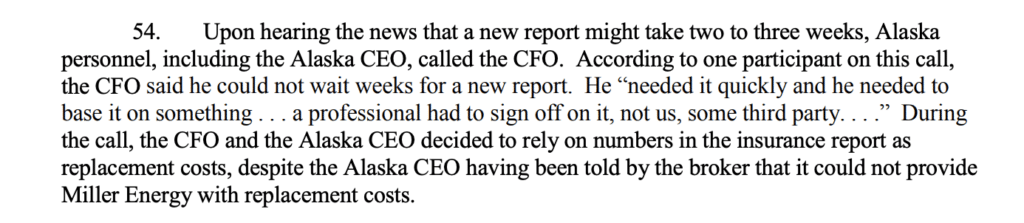
The SEC’s 2016 order against Miller Energy recounted the details of a 2010 call in which the management discussed how to validate the oil company’s inflated asset valuations. On that call, the Miller Energy CFO reportedly told the other participants that “a professional had to sign off on it, not us, some third party…”


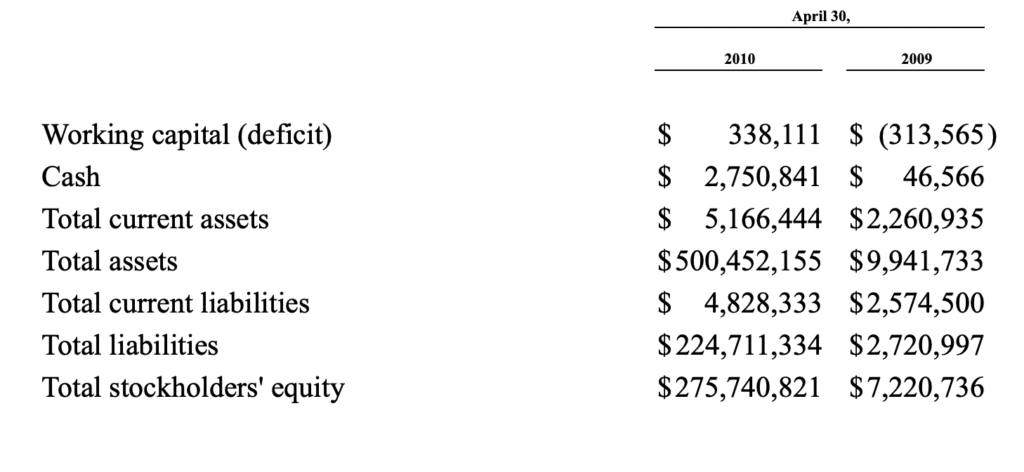
Financial reporting at the heart of the matter in 2010 showed an increase in asset value of over $490 million for Miller Energy, compared to 2009 when the company had assets of less than $10 million. Essentially, the company’s entire value in 2010 was attributable to the Alaskan assets.
Miller Energy 2010 Financial Statement. Source: SEC filing


Both Sherb & Co, and later KPMG, audited and approved that valuation.

Then, in April 2011 the SEC sent a letter to Miller Energy with some questions about its annual 10-K filing from the previous year, first asking the oil company to explain its valuation of the Alaskan property.

Starting with its response to this question, Miller Energy went all-in on its fraudulent claims and shielded itself with the veneer of credibility from a Big Four accounting firm.
“The Management is Incompetent”

According to SEC documents, KPMG was retained as Miller Energy’s independent auditor on February 1, 2011. Two months later, on April 13, executives for the oil exploration firm rang the opening bell on the stock market floor as the company was listed on the New York Stock Exchange. It was a big moment for a company with no history of profits and that had been trading as a penny stock before the Alaska purchase.

That day, Miller Energy CEO Scott Boruff gave an interview on the trading floor, mentioning his company’s “explosive growth” and its bright future prospects. Boruff was paid $7.6 million in 2011.


Boruff was joined that day by company founder Delroy Miller, who also happened to be his father-in-law. While this arrangement apparently didn’t raise any questions with auditors, in 2014 their relationship was flagged in more SEC correspondence from “Concerned Miller Shareholders (CMS)”:

“In the absence of proper qualifications, CMS has raised reasonable questions surrounding Mr. Boruff’s appointment as Miller’s CEO and specifically, whether it was motivated by his close familial ties to the Company’s founder.”

Boruff had no oil industry experience before being appointed in 2008 as CEO by his father-in-law. However, Boruff did have experience with companies involved in financial fraud, as lawyers for CMS noted.

According to CMS correspondence with the SEC, in a section titled “The Management is Incompetent,” Boruff had previously worked at the firm GunnAllen Financial, leaving in October 2006, and that “GunnAllen has since been closed by regulators [in 2010] and entered bankruptcy in the wake of investor lawsuits and allegations of a major Ponzi scheme involving Provident Asset Management.”

Provident was a good old-fashioned Ponzi scheme, promising investors eye-popping 18 percent returns from oil and gas royalties. In reality, however, the company paid those returns with money coming from new investors. The scam involved almost a half-billion dollars.

But Boruff, who worked as a broker at GunnAllen, was not charged in that Ponzi scheme. Instead of distancing himself from it, however, as the new head of Miller Energy, he hired Darren Gibson in 2009, who according to documents sent to the SEC, “was Provident’s former National Sales Director during the alleged Ponzi scheme.”

Announcing the new hire in a press release, Boruff said “[Gibson]’s proven track record in raising capital will allow Miller to aggressively pursue our acquisition and drilling program goals.”

But Boruff and Gibson’s proven track record should have raised red flags to auditors evaluating the company’s financial records, especially given the pair’s lack of oil and gas industry experience.

Despite all this, KPMG continued rubber-stamping Miller’s financial statements even after the concerned shareholders had been communicating with the SEC.
Reserves Fraud and Asset Retirement Obligations

As DeSmog has reported, oil and gas companies inflating the values or volumes of their reserves estimates lies at the heart of much of the fraud now surfacing in the industry. Miller Energy is just one example of many.

Another major factor is how oil companies get around financial obligations to clean up their old wells and surrounding lands after they are done extracting oil and gas — known in the industry as asset retirement obligations (AROs). These obligations are increasingly becoming an issue as oil and gas companies try to sell old assets because the cleanup liabilities are likely greater than the value of the oil and gas. This was the case with Miller Energy.

The asset retirement obligations for the Alaskan property Miller acquired were the reason why no one else wanted to buy it.

In July 2010, the SEC asked questions about Miller’s AROs and noted that in 2009, “a third party report had indicated that the AROs for these assets were $41 million.”

Miller Energy’s finances were rife with red flags. Enough even to get one engineering firm, with prior experience with the Alaskan property Miller purchased, to walk away. According to the SEC, this was because the firm “refused to assign any value to a property known as the Redoubt Shoal field [a major part of the Alaskan assets Miller acquired, which was then valued at $291 million by Miller], because it was uneconomical … and the prior firm had explained that it would not put its ‘name on a report that implies value exists where it likely does not.’”

After its Alaska deal, Miller Energy not only needed an auditor to give its seal of approval to claims that its property and oil infrastructure in Alaska had some value, it would require an auditor to agree it was worth half a billion dollars. KPMG was willing to do this.
Third-Party Auditors and KPMG

In 2017, the SEC laid out the many failures of KPMG in the Miller Energy case, including that the evidence that something was wrong should have been obvious to anyone who knew to look for it: “All of these facts were readily ascertainable from the publicly available bankruptcy records of the prior owner of the Alaska Assets. If they had reviewed those records, KPMG would have learned that their understanding of the facts leading to the acquisition was inaccurate.”

The SEC also noted that, like the CEO of Miller Energy, the partner whom KPMG put in charge of the audit, John Riordan, lacked relevant oil and gas industry experience, “resulting in departures from professional standards.”

But the issue was not just one partner at KPMG, according to the SEC, which noted that company management and national personnel “became aware of the unusual and highly material prior-year transaction,” yet “the firm did not take sufficient action.”


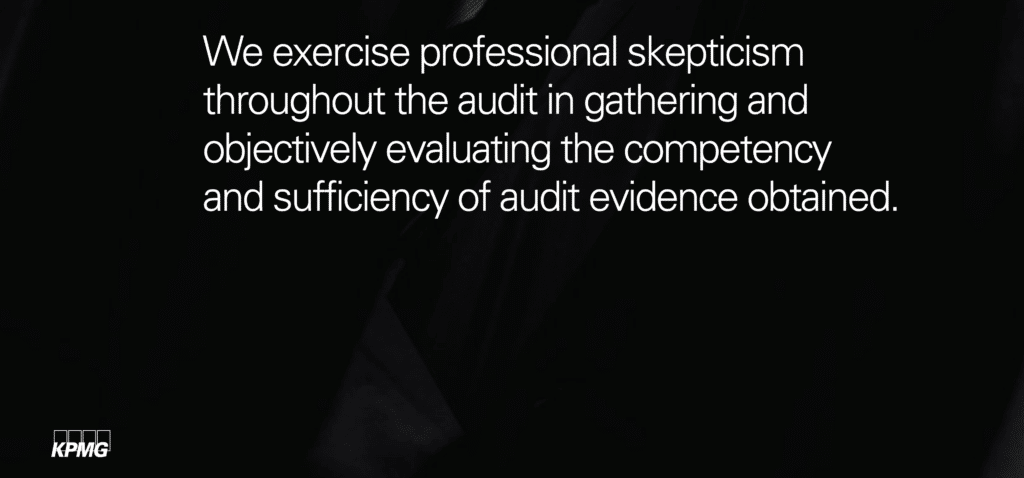
As the SEC also noted in this case, due diligence requires an auditor to exercise professional skepticism — something the Miller valuation should have raised. Yet in 2011, when the financial website Street Sweeper published research challenging Miller Energy’s financial claims, KPMG chose to overlook those red flags as well, says the SEC. Now defunct, Street Sweeper was known for reporting on “over-valued, over-hyped stocks on Wall Street.”


The SEC noted that KPMG’s Department of Professional Practices (DPP), which was responsible for developing the firm’s internal auditing standards and guidance, failed to step in despite its knowledge of the Miller Energy case.

The SEC concluded that “DPP’s decision not to inquire further about the valuation of the Alaska Assets was unreasonable in light of the circumstances.” It also added that once KPMG learned of the 2011 Street Sweeper report, the department should have provided oversight of both Miller’s assessment and its own company procedures for the valuation.

In August 2017, the SEC found KPMG guilty of a long list of violations with regard to its audits of Miller Energy, including “lack of competence” and “highly unreasonable conduct.”

While not specifically implicated in the Miller Energy audit, David Middendorf, the former head of KPMG’s DPP where he was responsible for “audit quality and professional practice,” was sentenced to prison in 2019 for his part in trying to cover up KPMG’s dismal auditing results from 2013 and 2014.

After being misled about the oil company’s financial realities, many investors in Miller Energy lost their entire investments, which is why they are now suing KPMG.
Investors Lose, Fraudsters Walk Away

In the end, the SEC settled the charges against KPMG and John Riordan, its partner overseeing the case. KPMG agreed to give back the money it earned from working for Miller Energy, which was a little over $5 million when interest was included. Additionally, KPMG paid a civil penalty of $1 million while Riordan was fined $25,000. Riordan remained a partner at KPMG until he retired in 2020.

KPMG did not respond to a request for comment on whether anyone at KPMG was held accountable for their role in the Miller Energy audit.

Miller Energy was also fined $5 million, but due to its 2015 bankruptcy, it is not clear if that amount was ever paid in full during the three years it had to make the payments. In 2016, the company was reorganized into new entities controlled by Apollo Investment Corporation.

The SEC did not respond to a request for information on the status of that payment.

For their roles in the fraud, Miller’s CFO Paul Boyd and COO David Hall were both personally fined $125,000.

Scott Boruff, the CEO who oversaw all of the fraudulent activity, was not fined. After leaving Miller Energy in March 2016 when the bankruptcy was finalized, Boruff was sued by his father-in-law for failure to repay a $6 million personal loan.

Meanwhile, defrauded investors have turned to a lawsuit against KPMG to try to recoup their losses. That lawsuit is now expected to proceed next year.

Jeffrey Skilling, CEO of Enron, spent 14 years in jail for misleading investors. Arthur Andersen ceased to exist as one of the Big Five accounting firms due to its role in the Enron fraud. Meanwhile, Miller Energy executives and KPMG have essentially walked away with fines irrelevant to the scale of the fraud.

The oil company executives who oversaw the company during this fraud kept the money they were paid.

As this case and many others make clear, there is little incentive for oil industry executives to play by the rules when a company can engage in blatant fraud, get caught, and suffer almost no consequences. However, these frauds require the help of a third-party auditor willing to look the other way.

And while there are clearly auditors and engineering firms who will not put their “name on a report that implies value exists where it likely does not,” as the SEC wrote, there are plenty of others who will — including some of the biggest names in the business.


THE COMMUNIST MANIFESTO - FULL AudioBook - by Karl Marx & Friedrich Engels


https://www.youtube.com/watch?v=PdYLRTGmQ3c


What Does Mutual Aid And Direct Action Mean?


https://www.youtube.com/watch?v=KXMb7zvHTSE


LPC Loon Cam 1 - LIVE


https://www.youtube.com/watch?v=lycw03pV-So