Wednesday, June 2, 2021

The centenary of the Tulsa, Oklahoma race massacre


https://www.wsws.org/en/articles/2021/06/02/pers-j02.html


Niles Niemuth@niles_niemuth
11 hours ago


This week marks the centenary of the Tulsa, Oklahoma race massacre, one of the deadliest and most destructive antiblack pogroms in the history of the United States.

Officials confirmed 39 deaths—26 black and 13 white people—but it is estimated that the true toll could be as high as 300, with many African American victims uncounted and buried in mass graves. An Oklahoma state commission estimated in 2001 that the present day cost of the damage was $30 million.
Excavation begins anew at Oaklawn Cemetery in a search for victims of the Tulsa race massacre believed to be buried in a mass grave, June 1, 2021, in Tulsa, Oklahoma (AP Photo/Sue Ogrocki)


On the night of May 31 and into June 1, 1921, a marauding mob of several thousand armed white men with the complicity of the police rampaged through the segregated African American section of Tulsa, Oklahoma, known as Greenwood, looting and burning businesses and homes. Eyewitnesses relayed that airplanes flew overhead, dropping firebombs onto rooftops.

Black residents, many of them veterans of World War I, fought back with rifles and pistols, but it was not enough to hold back the mob. When the attack subsided and the smoke cleared, 35 square blocks of Greenwood had been burnt to the ground, including the business district and the city’s largest African American church. Some 1,470 homes were burned or looted. With the aid of deputized marauders, 6,000 black residents were rounded up by the police and National Guard and imprisoned for several days. Many men were held in the livestock pens at the city’s fairgrounds.

The trigger for the violent rampage was an encounter between Dick Rowland, a black 19-year-old shoeshiner, and Sarah Page, a white 17-year-old elevator operator, in an elevator in downtown Tulsa on May 30, 1921.

According to the most widely accepted account, Rowland had tripped on Page’s foot and grabbed her arm, and she screamed out before running away. There is speculation that the two had a romantic relationship, and Page refused to pursue charges against Rowland. The next day Rowland was arrested and charged with attempting to rape a white woman, an accusation that had ended in the violent lynching of many other black men. The Tulsa Tribune ran an article with the headline, “Nab Negro for Attacking Girl in Elevator.”

Fearing that Rowland would be lynched, a group of armed black men twice went to the courthouse to offer to protect him but were denied by the police. On the second occasion, a white man attempted to disarm a black veteran. A shot was fired, triggering the violence that ensued.

The Tulsa massacre is a genuinely horrific moment in American history, which has been concealed from public consciousness for far too long and has never been dealt with and confronted as it should. Its commemoration and memorialization should be welcomed. However, like all such events, how it is presented and analyzed is critical to drawing the necessary political lessons.
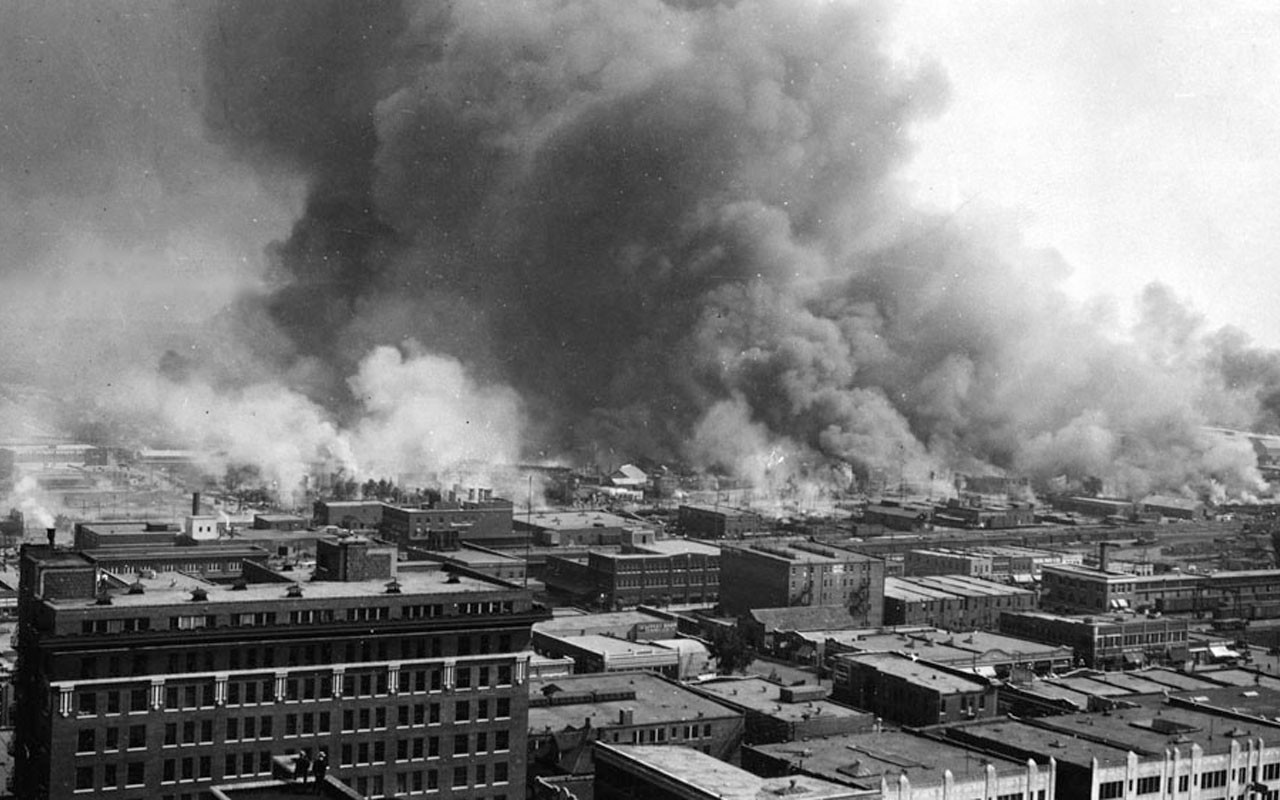
Destruction from the 1921 Tulsa race massacre


How could such an outrage take place nearly 60 years after the end of the Civil War, in which tens of thousands of white men died to end slavery? The narrative that is now being promoted is one that focuses entirely on race. It would be absurd to remove race and racism from the narrative, as the victims were overwhelmingly African American. However, it is impossible to understand what happened, and why, except within its broader historical and political context.

The period surrounding 1921 was one of intense class conflict, to which the ruling class responded with savage violence.

The United States experienced its largest strike wave to date in the years between 1916 and 1922. In spite of the American Federation of Labor’s efforts to keep workers on the job during the war, more than 1 million went on strike each year.

The growth of the class struggle throughout the world was intensified by the Russian Revolution of 1917, which showed that it was possible for the working class to take political power into their own hands. In February 1919, more than 65,000 workers in Seattle, Washington participated in a five-day general strike, part of a massive strike wave that involved 4.5 million workers that year. The Communist Party was founded in the United States at the end of 1919 after a split in the Socialist Party.

The American ruling class responded to this radicalization by launching an open war against the working class. No ruling class feared more the influence of Bolshevism than the American bourgeoisie. Every form of prejudice was promoted, against Italians, Irish, Catholics and Jews. African American workers were often brought from the South to the North by company bosses to be used as strike breakers, with the express aim of inflaming racial tensions.

The US entry into World War I and its aftermath gave rise to a wave of political reaction across the United States known as the First Red Scare, much of it centered on stamping out labor radicals. Internationally, fascism was on the rise in Italy under the leadership of Benito Mussolini, and Hitler was consolidating his control over the fledgling Nazi Party in Germany.

This was the period of the Palmer Raids, anti-immigrant hysteria, the trial of Sacco and Vanzetti, and the transformation of the FBI, with J. Edgar Hoover at the helm, into a national police force devoted to the struggle against left-wing radicalism. Immigrants and socialist union organizers, who opposed the war or failed to swear their loyalty, were imprisoned and lynched. Socialist Party of America leader Eugene Debs was arrested in 1918 and sentenced to 10 years in prison for giving a speech opposing US intervention in the world war.

The lynching of African Americans intensified, especially as a growing number of veterans returning home from the war in Europe challenged Jim Crow restrictions. Democratic President Woodrow Wilson expressed his concern in private remarks in March 1919 that “the American Negro returning from abroad would be our greatest medium in conveying Bolshevism to America.” The modern Ku Klux Klan, which terrorized European immigrants and African Americans, boasted half a million members throughout the country by 1921.

The massacre in Greenwood was preceded by the Tulsa Outrage in 1917, when the Knights of Liberty, an outfit similar to the KKK, drove 12 members of the Industrial Workers of the World (IWW), who were organizing oil workers, out of town, tarring, feathering and whipping them.

The Socialist Party of Oklahoma, which had over 9,000 dues-paying members in the state in 1916, was subjected to repeated attacks for opposing the war and defending equal rights for African Americans. Its 1912 platform upheld the basic socialist principle that “safety and advancement of the working class depends upon its solidarity and class consciousness. Those who would engender or foster race hatred or animosity between the white and black sections of the working class are the enemies of both.” The party was disbanded in 1917 under the pressure of intense persecution by vigilantes and state prosecution and after the suppression of the Green Corn Rebellion, an interracial uprising against wartime conscription in central Oklahoma.

Reaction reared its head far and wide in these years. Frank Little, a member of the IWW’s General Executive Board, was lynched in Butte, Montana in 1917 while fighting to organize miners. Little was grabbed by masked men, beaten and dragged from the back of a car before being hanged from a bridge on the edge of town. IWW member Wesley Everest was castrated and lynched in Centralia, Washington after a deadly confrontation with members of the American Legion in November 1919.

The Red Summer of 1919 saw attacks on black neighborhoods by white mobs in at least 60 cities. In the worst instance of urban violence, 38 were killed in fighting in Chicago, 23 black and 15 white persons, after a black youth was stoned to death by a white mob at a beach on the segregated lakefront. That year also saw the Elaine Massacre, in which up to 237 African Americans and five whites were killed. The attack was part of an effort to crush the unionization of poor black sharecroppers and tenant farmers across Arkansas.

Just three months after Tulsa, between August and September 1921, 10,000 striking miners squared off with police and company strike breakers in West Virginia in the Battle of Blair Mountain. As many as 100 miners were killed and 1,000 arrested. The miners strike was finally broken by a combined assault of the US Army, West Virginia National Guard, the Baldwin-Felts Detective Agency, and local and state police. A million rounds were fired, and airplanes were used to drop bombs on entrenched miners.
A man stands in front of his home which was destroyed during the attack on Greenwood


A review of the historical background and context of the Tulsa massacre makes clear that it was part of a broader offensive of the ruling class against left-wing and socialist opposition in the working class. Racism was promoted as part of this offensive, employed consciously to divide workers and utilized as a spearhead of political reaction.

The massacre in Tulsa is presented by the Democratic Party and the mainstream media as the product of the all-consuming racial hatred that all whites hold toward blacks. As with the 1619 Project, which posits that American history is driven by white racism and that blacks have fought back alone, this narrative is anti-historical and profoundly dangerous, stoking racial animosities that have been created to weaken and divide the working class.

President Joe Biden issued a proclamation Monday declaring a national day of remembrance and calling on Americans to “reflect on the deep roots of racial terror in our Nation and recommit to the work of rooting out systemic racism across our country.” On Tuesday he traveled to Tulsa, where he met with survivors of the massacre, and announced vague policy proposals that he claimed would close the “wealth gap” between blacks and whites and combat racial discrimination in the housing market.

Historical falsifications have contemporary political motives and consequences. The current effort to blame “systemic racism” for all of society’s ills and to portray the United States as torn between “white America” and “black America” absolves the capitalists of any responsibility, places blame on the general population, especially white workers, and pits workers against each other along racial lines.

The most fundamental problem of the socialist movement in the United States has been the fight to unify all workers in one of the most racially and ethnically diverse countries in the world. It is only on this basis that all forms of backwardness and reaction can be vanquished and the rights and interests of all workers defended.

There will be no solution to the social and economic problems which black workers confront today outside of a united struggle of workers in the US and internationally against the capitalist system and the fight for socialism—the establishment of the democratic control over society by the working class and the end of the profit system.


WE’RE GOING TO HAVE FAIRY CREEKS HAPPEN ALL THE TIME


By Sarah Cox, The Narwhal.

June 1, 2021


https://popularresistance.org/were-going-to-have-fairy-creeks-happen-all-the-time/


Question And Answer With Garry Merkel From B.C.’S Old-Growth Review Panel.

As tensions escalate and arrest tallies grow at logging blockades on Vancouver Island, The Narwhal spoke with one of the foresters tapped to help the province navigate its old-growth woes


Last fall, during the B.C. election campaign, NDP leader John Horgan promised to implement the recommendations of an old-growth strategic review panel led by foresters Garry Merkel and Al Gorley.

After hearing from thousands of people all over the province, Merkel and Gorley called for a paradigm shift in the way B.C. manages its old-growth forests, saying old forests have intrinsic value for all living things and should be managed for ecosystem health, not for timber.

The report, which laid out a blueprint for change in 14 recommendations, also said many old forests are not renewable, countering the notion that trees, no matter how old, will always grow back.

Fast forward to May 2021, more than one year after Merkel and Gorley submitted their report to the NDP government, which was subsequently re-elected. None of the panel’s recommendations have been fully implemented, leaving some questioning the government’s sincerity.

At least four dozen people have been arrested at visually striking, emotionally charged, on-going protests in the Fairy Creek and Caycuse watersheds on southern Vancouver Island, where forestry company Teal Jones has obtained a court injunction banning blockades of logging activities — and the conflict shows no signs of abating.

Merkel, a member of the Tahltan Nation, is watching the Fairy Creek events closely. He’s also waiting to see how the B.C. government implements landmark provincial legislation that embraces the UN Declaration on the Rights of Indigenous Peoples.

The Fairy Creek watershed lies in the territory of the Pacheedaht First Nation, which has asked people to respect that it is up to Pacheedaht people to determine how the nation’s forestry resources will be used. The Caycuse watershed, where blockades and arrests are also taking place, lies in the territory of the Dididaht First Nation. Although arrests are now taking place at encampments throughout the area, the name Fairy Creek is used as a catch-all term to describe the blockades generally.

The Narwhal asked Merkel if the Fairy Creek conflict could have been prevented and what big and small steps we need to take — including painful, thorny ones — to sidestep future conflicts over the old-growth forests left in B.C.

The interview has been edited for brevity.
We’re Seeing Increasing Conflict Over Old-Growth Logging Right Now In B.C., Highlighted By The Recent Arrests At Fairy Creek And The Continuing Blockades On Vancouver Island. Is There Anything We Could Have Done To Avoid This Situation?

This might sound a bit fatalist but I’m not sure that there is. Our paradigm in British Columbia is that we see the forest as a huge bank of unending resources, particularly timber. That’s its value. It’s a mental thing because we built British Columbia on the backs of the timber industry. This is our culture in British Columbia. It’s where we come from. It’s who we are.

Shifting from that culture to a new lens that’s focused on ecosystem health, the health of landscapes, the preservation of ecosystem functions — and taking timber as one of many benefits that flow from managing that perspective — is an extremely difficult shift. It involves such a huge mental shift to start with. And then there’s the associated policy, legislation, management systems, practices, etcetera, all the other pieces that have to follow. The transition is not so easy because we built our entire way of being on that previous mentality.
Have We Missed Previous Opportunities To Shift That Paradigm?

B.C. did an old-growth strategy 25 years ago. There were a huge number of really good recommendations. If we had implemented them, we would not be in the situation we’re in right now. We implemented almost nothing out of that report.

We’re in a world now where people are afraid. They see the effects of climate change. They see the effects of large-scale pollution. You can see now at a global level what we are causing and that it’s going to hurt us — lots — as a species and hurt other things too. There’s very little accessible iconic old-growth. Couple that with the entrenched paradigm. You almost have to have conflict to get through it, and push and shove. I hate to be a bit fatalistic, but when I look at it at a larger scale it’s what I feel about this. It’s almost necessary for us to move through this, unfortunately.
How Do You Understand The Significance Of Fairy Creek Within B.C.’S Larger Forestry Context?

We’re going to have Fairy Creeks happen all the time. There is certainly a perception out there in the public that we have so little old-growth left that we need to protect what’s left. And I can appreciate why people would have that. The kinds of old-growth that they’re speaking about tend to be those very iconic old big coastal stands or interior. It is true, those are the first ones that disappear when you harvest.

The industry was built down in the lowlands and it got to the easy areas first. Those are the areas we populated. Those are the areas where we built our farms. Those are the areas where we built our roads, where we do all our clearing. All those things are a death of a thousand cuts. We have harder-to-get-at areas and Fairy Creek is one of those. And there are other places like that in the province, where it feels to a lot of people that they’re making a last stand. You have to go so far to actually see something like that now. And a lot of people only know one or two of those places and, if they’re going to get cut down, they’re going to fight for them.

I don’t think that we’re going to get through this for a while, if ever, because this is a flash point. It’s like climate change. It becomes symbolic. It doesn’t become about the place itself. It becomes symbolic about a much larger issue, so it’s going to continue. I don’t see it changing. That’s just what the realism side of me says.
I’m Curious About The Old-Growth Strategy From 25 Years Ago. Can You Point To Some Of Those Recommendations That Would Have Made A Difference?

What science tells us is that as long as you have at least 70 per cent of the older parts of the ecosystems, in sufficient size, you will have little to no material effect on biodiversity. But once you start dropping below 70 per cent, you start to impact biodiversity and you’re going to start to see species loss. You’re going to start to see possible water issues. Your biodiversity index is going to go down. It keeps dropping quite quickly until you get to about 30 per cent.

Once you get to 30 per cent or so, you will be at the highest risk of biodiversity loss. You are pretty much guaranteed to have species loss and probably major large mammal loss. You’re starting to lose caribou, moose, sheep, goats, possibly bears, you’re starting to see all those major mammal species being negatively impacted. By then you have lost numerous smaller species, plus you’ve lost numerous species of plants. And if you don’t have biodiversity, you also start to become much more susceptible to wide-scale disease and infestations. And so, we manage for risk. We say ‘how much risk are we willing to accept?’

Low risk is 70 per cent. Medium risk is 50 per cent. High risk is down in the 30 per cent range. That old-growth report advocated that we manage for at least 50 per cent medium risk, which means we might see some impacts but they would not be material or major. Well, we didn’t do that. We implemented a couple small things out of it — OGMAs, old-growth management areas, little patches across the landscape, and a couple of other small things — and then we just forgot about it.

Their report was almost as comprehensive as ours and had a lot of similar thoughts in it. If we had implemented that, our options and choices would be very different right now. But we manage for timber, subject to constraints, and we really have to change that paradigm. Until we do, as a society we’re going to keep pushing ourselves deeper and deeper into a hole.
How Much Biodiversity Risk Do We Have Now In B.C.?

Let me give you one really ugly, graphic example. The maps produced by Rachel Holt, Karen Price and Dave Daust show that in almost all of the province we’re in a high-risk situation. High risk meaning 30 per cent or less. If we follow our current management regime, in the not very distant future there will be very little yellow left and there will be no green left in the entire province. Red meaning high risk, yellow meaning medium risk, green meaning low risk. Some people might be able to argue the numbers a little bit. But it’s pretty hard to argue them because they used the same information and mapping data that everybody else uses.

We often hear that, ‘oh, we have nothing to worry about because we have 50 per cent of our old-growth left.’ And I think some of the people who are saying that actually believe it because they don’t understand the science. Very few people understand the science. And so, then it just becomes a big numbers game. But almost all of that 50 per cent right now is at the tops of mountains and has tiny little trees. That doesn’t make a landscape healthy. Not having any connectivity between them and not having any of the richest sites that support the highest level of biodiversity, which tend to be down in the rich lowland areas, almost all of those are gone now.

I want to tell you a story. We did the CORE plans [The Commission on Resources and Environment, a collaborative planning model used in B.C. in the 1990s.] The Kootenay Boundary plan, after full public involvement, recommended managing to a 50 per cent biodiversity risk. That means try to maintain 50 per cent of each type of ecosystem. But when the government approved the plan there was a huge uproar. It didn’t get very much press, which surprised me. Government unilaterally at the time decided to cut that target to a third. So the target became 17 per cent with the stroke of a pen.

And to compound that even more, we didn’t build a system to track it. So, we weren’t really sure what we had left and it was poorly mapped to begin with. Recently a group of government folks did the research and mapped it out and looked at where they were at and, in most areas, they were below the 17 per cent already because they weren’t tracking it. And that’s not an unusual situation in this province. And so, one of our recommendations said [the government needs] to ensure compliance with provincial orders. That’s part of the issue right there.
B.C. Has Reallocated Some Forest Tenures To First Nations. Do You See First Nations Tenures As Part Of The Solution?

First Nations tenures tend to be allocated in hot spots because they [logging companies] have more ability to get to them. A lot of those tenures are dependent on those areas that are right on the edge [of consequential biodiversity loss.] I just felt that was absolutely unfair for that to have happened. Because we don’t want to disproportionately affect their tenures, that’s not fair. It’s certainly not consistent with DRIPA [B.C.’s Declaration on the Rights of Indigenous Peoples Act.]

The government did make an announcement and clawed back tenure from most of the licensees and reallocated it to First Nations. But interestingly enough, many First Nations don’t have the ability to operate those tenures and the tenures are too small for them to build the necessary corporate infrastructure to do it. So, they just enter into operating agreements with companies and have companies manage them as part of their tenure in exchange for benefits and employment and involvement in planning and things like that.
What Situation Does This Put First Nations Communities In?

It does create internal tension in some areas. In other areas, they have started to come up with management systems that are built from their community’s way of thinking about land and are trying to come up with new approaches so that they don’t have to do this. On the coast, it’s not as easy because everywhere is old except for some second-growth and there’s not enough second-growth on line to support the industry yet. We’re hugely dependent on old-growth right now to maintain our industry as it is.
In Terms Of Fairy Creek, The Pacheedaht First Nation Is Essentially Saying To Everyone ‘Please Back Off, It’s Our Territory, We’ll Do Our Own Job Of Managing It, Thank-You Very Much.’ Can You Comment On That?

That is what most First Nations are saying across this province. I just want to read to you our first recommendation [from the old-growth strategic review panel report]: “Engage the full involvement of Indigenous leaders and organizations to review this report and any substantive policy or strategy development and implementation.” We believe that it is critical to implement this in cooperation and collaboration with the Indigenous community. And that means setting up the management relationships on a local basis across the province. And the province has already started to implement that anyway as a result of DRIPA. And that’s really where First Nations want to be.

I’m dealing with this in my own community right now. It’s not that we don’t want to use land. The way the land is being used is the problem. It’s not being used right. Almost every First Nation I know … they’re just not happy with the way that the land is being used because they feel it’s just too harmful and destructive and it’s wrecking things. And they want to change that.

From the time I was born, I learned that I had to look after the land. It’s built right into you. I know my family’s been from where I come from for at least 8,500 years. When you go there you just feel something very, very different. It’s deeply inherent in you this notion that you have a stewardship responsibility. It’s just part of who you are. And yes, there is an economic component to it. But the driving thing is we want to be part of looking after our lands again, the way we always have.

In a lot of First Nations communities we saw, they were not deeply dependent on the economic side and so still they had lots of options and flexibility. A lot of them are building their own management system from their own cultural philosophy. I think some of those systems are going to have a lot to teach all of us about how to manage for ecosystems, about how to look at the land holistically, about how to treat it gently — all of those things that we’re struggling to figure out right now.
Some People Say The Provincial Government Has Fostered The Dependence Of First Nations Communities On Old-Growth Logging. What’s Your Response To That?

I certainly don’t think that was by design. There was a strong desire for First Nations to be part of the forest sector and all of the economy. And the government saw that as an important policy direction. Part of it was a bit of self-interest … if [First Nations are] involved on the economic side, maybe we can work our way through some of these disputes. There was no illusion that First Nations were going to convert and become the type of commercial entities we see now, at least not on a mass scale. But at least with them being involved, that removed an impediment to having the conversations. And then if they were involved on the management side, ‘maybe we will have a new future and it will look different. And the fights are not there anymore because we’re working it out together.’ That tended to be more the policy driver. I know there’re a lot of people out there who believe conspiracy theories out of government. Government frankly is too disjointed and not able to think with a cohesive mind to actually do that.

First Nations wanted it, too, and industry was supportive of it. Industry is trying to work in the First Nations territory and every single permit they get and everything they try to do was always a constant battle because the community didn’t know the industry, they weren’t getting anything out of it and it was just an incredible source of frustration. So, industry supported this and said ‘they should be involved and it would be a lot better for all of us if they were.’
What Situation Does This Put First Nations In Now, Especially In Areas Like Fairy Creek That Are The Subject Of So Much Controversy? Could Anybody Have Foreseen This?

Hindsight’s always 20-20. Let’s put it this way. If you’re operating by approved operating plans that say ‘this is your operable forest land base, your timber harvesting land base and that area’s included it.’ If you’re not at a policy level then you just take that for granted. And a lot of the people who allocate and manage tenure, they’re not dealing with these higher policy issues. They have a map in front of them that says ‘this is your operable land base. Go forth and do what you’ve got to do.’ And that’s where they run into conflicts. If you’re going to manage a tenure yourself, you’ve got to go for easier, less expensive and more valuable stuff which tends to be the most controversial, unless you go into an operating agreement with a large company.
You Said We Haven’t Seen The Last Of These Conflicts. What Would You Do Now If You Were In Charge To Make Things Better?

COVID has been a real challenge. There’s no question. They’re trying to implement a major policy change [to implement the old-growth panel recommendations] in the middle of a time when you can’t bring people into a room and work together. And that is tough, tough, tough by any standard. If I were in charge, I would do a couple things. Number one, I would build a report card on implementation of that old-growth strategy and other associated initiatives. I would build a report card using a multi-disciplinary group to provide advice and oversee and build an objective report card on how we are progressing and make that available publicly on a regular basis. Then you’re just saying ‘we’re making this transition together folks’ — and then we’re all part of the ugliness of it because it is a tough transition.

The second thing I would do is I would put a lot of resources into building the capacity to adapt to this change. One specific example is as we move to collaborative or joint management with Indigenous groups we’re doing all of the necessary supporting paperwork — we’re changing the legislation, we’re changing the policy — but we’re putting very little into building our readiness for that both on the government and on the First Nations side. It’s very similar to the whole shift to ecosystem health-based management.

We’re just not putting the necessary work in to develop readiness to actually do the job. We’re struggling still. It’s just so much all at once that I think people are almost overwhelmed. And now on top of that there’s huge stress because of things like Fairy Creek.

I’m not the boss. I’m not in charge. These are just musings of an old fellow sitting here who gets lots of time to think. I don’t have to live with the consequences.
Do You Think Conservation Financing Could Play A Role?

Yes. There is an unavoidable economic component to this. Carbon offset, conservation financing, a number of other financial tools would need to be employed. Economic diversification is obviously a really important tool, but here we are in the middle of COVID where nobody’s allowed to come here. We just got hit with a perfect storm right now. What I worry about is that, because it’s been so difficult to implement this, maybe our momentum starts to drop and maybe because of that we just take our foot off the gas pedal.
Where Do You Find Hope And Optimism In All This?

I find hope and optimism in the fact that we have an incredibly well-informed scientific community around us which is watching closely and who are very media savvy. We have a lot of people in government with very good intentions who want to go here. They’re afraid to, of course, just like everybody. We have a government who, at least on the surface, wants to go here. I genuinely believe they want to go here. How far they are able to go is another question.

At a more global scale, the reality of what we’re doing to the planet is becoming less and less avoidable and it’s getting much, much harder for us to deny and duck it. That whole trend is really, really pushing the envelope, the Greta Thunberg, the youth movement. Our young people are just not happy. They want a change. I see so many of them doing so many amazing things. They don’t just talk about it, they actually go out and build companies that do good things. They’re doing real things to make changes, they’re not just bitchin’ … if you’ve got the energy and the smarts, go figure out something to do, let’s all chip in here. I am really optimistic about that — that’s where I see a lot of hope.
Do You Have Any Final Thoughts?

I think we have a whole crowd of people out there just waiting to see what’s going to happen here. It’s like a pot that’s on simmer just below boil … waiting to see the government’s response.


NICARAGUA – A REVOLUTION WORTH DEFENDING


By Jorge Capelán and Stephen Sefton, Telesur English.

June 1, 2021


https://popularresistance.org/nicaragua-a-revolution-worth-defending/


One Of The Reasons Comrades Elsewhere Have Difficulty Perceiving This Revolutionary Model Of Sandinista Nicaragua In Its True Dimensions Is Because For The Sandinista Revolution In Nicaragua The Development Of The Productive Economy Is A Central Task.

In a recent article “Washington: new attempt to overthrow the Nicaraguan government” Pablo Jofre Leal recognizes that Nicaragua, is the target of imperialist aggression by the U.S. and its regional pawns, more than ever now in this election year. He also notes the absurdity of the US authorities’ declaration that Nicaragua is a danger to US national security and observes how the media routinely falsely portrays Nicaragua as a dictatorship, focusing its hate campaign mostly on President Comandante Daniel Ortega. Jofre Leal accurately and correctly summarizes that Nicaragua, like Bolivia, Cuba and Venezuela is the object of a conspiracy between the U.S. and its European allies to destabilize the country through economic warfare, psychological warfare, and the financing of opposition organizations and politicians.

His article then goes on to enunciate a series of problems that in his opinion the government of President Daniel Ortega has to overcome, but he does so on the basis of a completely false account of Nicaraguan reality. Jofre Leal documents his reservations in relation to the government of the Sandinista National Liberation Front and President Ortega by means of a reference to this article by Tomás Andino Mencia in which the author demonstrates his total ignorance about the reality of Nicaragua. Anyone who wants to get an idea of Andino Mencia’s fallacies can follow this link.

That intelligent people accept this kind of falsehood promoted by the Nicaraguan opposition and its regional supporters indicates a lack of intellectual rigor in sectors of the Latin American left in relation to Nicaragua. Almost all of these falsehoods originate from individuals and organizations financed by imperialist governments, primarily though non-governmental proxies in Nicaragua. That fact alone is sufficient to indicate the falsity of these sources of information. It is worth noting that, as a rule, both official Sandinista government sources, as well as associated media and even independent media supporting the Sandinista revolution, are de facto routinely ignored and made invisible.

To be sure, both Nicaraguan revolutionaries themselves and international solidarity comrades inside and outside Nicaragua have, over the years, produced a considerable amount of material on the reality of the country from every conceivable angle. For example, the books “Live from Nicaragua – Uprising or Coup?” and “The Revolution Will Not Be Stopped” or writings by international anti-imperialist authors such as Fabrizio Casari, Dick Emanuelsson, Brian Willson, Giorgio Trucchi, Max Blumenthal, Rick Sterling, John Perry, Alex Anfruns, Steve Sweeney or Dan Kovalik. It is striking that most leftist analysts generally prefer to ignore this intellectual production in solidarity with the Sandinista revolution in favor of material of highly dubious origin and veracity.

On the subject of solidarity with Nicaragua in the face of aggression by the United States and its allies, Jofre Leal cites the solidarity of governments in the region and movements such as the Sao Paulo Forum. This solidarity emphasizes the defense of fundamental concepts of international law such as non-intervention and self-determination. But we should clarify that Nicaragua is not simply an object of the Sao Paulo Forum’s solidarity, but in fact a leading actor in this continental coordinating body of the Latin American Left. Together with Brazil, Nicaragua is the country that has most often organized the Forum’s meetings and had it not been for the Covid-19 pandemic, this year’s meeting would have been held in Managua for the fourth time.

Jofre Leal states that the hysterical obsession of the U.S. government against Nicaragua indicates the failure of imperial policy in the region but, after mentioning the words of President Ortega denouncing the constant meddling of the U.S. Ambassador in Nicaragua, he concludes by arguing:

“The government and the people of Nicaragua can independently find the peaceful solution to their difficulties that have arisen in the interest of guaranteeing the sustainable socio-economic development of society, respecting constitutional norms and principles, with respect for human rights and civil liberties but also with all-out combat against the threat of a coup. For this, the Ortega government must also deepen social reforms that allow satisfying social needs and this implies following a path, which avoids maintaining a model whose shortcomings have been demonstrated by other countries in Our America.”

It is good that Jofre Leal cares enough about Nicaragua and its people to offer well-intentioned advice to President Ortega. However, he ignores the tremendous efforts the Nicaraguan government has made to foster a national dialogue, efforts which continue to date with no serious response from the country’s political opposition. Instead, Nicaragua’s opposition calls for economic aggression against their own nation by the imperialist powers and seeks the intervention of Luis Almagro, Secretary General of the OAS. On the other hand, some sectors of private enterprise that never allied themselves with the coup perpetrators maintain excellent relations with the government. So, it is not for lack of willingness to dialogue that the Sandinista government has not been able to reach a new consensus after the pre-2018 consensus broke down.

It is also difficult to understand what Jofre Leal means when he suggests that Nicaragua should “move along a path, which is not just to maintain a model whose shortcomings other countries in our America have demonstrated.” In relation to that, one could say that South American intellectuals have a very superficial idea of what is happening here in Nicaragua. In fact, it is clear that if one takes as a reference the fantasies of writers like Tomas Andino Mencia one cannot have the faintest idea that here in Nicaragua the government and people are developing a truly revolutionary model.

One of the reasons comrades elsewhere have difficulty perceiving this revolutionary model of Sandinista Nicaragua in its true dimensions is because for the Sandinista revolution in Nicaragua the development of the productive economy is a central task. Unfortunately, the Latin America and Caribbean Left generally and in rest of the world, have trouble visualizing what that means. In the worst case, they tend not to see beyond mere income redistribution or, at best, they tend to support some version of State capitalism.

But socialism is more than that, it means direct producers’ control over the means of production. That is what we are building in Nicaragua, where associative, cooperative and family enterprises today are responsible for a decisive part of the economy. The country’s former ruling oligarchy still exists, but they no longer control society’s strategic heights of society and no matter how hard they try, they cannot destroy the economic and political power Nicaragua’s people have now made their own.

Pablo Jofre Leal’s article shows there are comrades with the best intentions who want to support us, since it is indeed true that we are the under imperialist attack. For the Sandinista Front, being attacked by the empire in some shape or form has always been a permanent reality, it has not started just now and we must point out that sometimes not even our friends understand what our true situation really is.

We are not merely victims. Within the precarious Central American and Caribbean reality, we do have the means to defend ourselves and we have accumulated a wealth of experience. One might argue that at this moment the Sandinista Revolution and the FSLN are stronger than ever before in the last 17 years. And that is true despite the destruction the economy suffered as a consequence of the “soft coup” of April 2018, followed by the tremendous effects of the pandemic and the two strongest hurricanes of the last 20 years.

How is it possible to have achieved that level of resilience? Quite simply, because Nicaragua is guided by a Sandinista Revolution. Neoliberalism has no place in Nicaragua, because if it did:

There would be no public education or health, which is now not only free, but of a quality previously unthinkable in the country.

There would be no heavily subsidized and quality basic services (electricity, water and transport) for the majority of low income people .

There would be no constant improvement in the infrastructure of a country which, despite being one of the poorest in Latin America, is among the countries with the best roads in the region.

Food production would not be at a level where the country is almost 90% self-sufficient in terms of national consumption

Nicaragua would not prohibit the planting of genetically manipulated crops.

The country would not be a world leader in gender equality with majority participation of women in government posts and one of the countries with the highest number of women in parliament.

Nicaragua would not be among the countries that have most empowered women economically at every level.

Small and medium-sized landowners would not control 80% of the country’s land.

Nor would Nicaragua be a country whose small and medium-sized producers are the bulwark defending and making possible the country’s economy development.

An underlying problem preventing many people from understanding the Nicaraguan “miracle” is that they believe the 1979 revolution ended in 1990. This is not true. What has happened in Nicaragua from 1979 to date is part of a single process, one that had to overcome the extremely adverse conditions after the war imposed by the United States as well as resisting 16 years of constant attack by neoliberal governments on the achievements of the first period of revolutionary government of the Sandinista National Liberation Front. The lessons of the 1980s were assimilated, and what is being done today derives from those lessons, now in the context not of a war but of a regional economy still being strangled by the dead hand of Western capitalism.The Sandinista Front, with Comandante Daniel Ortega at its head, understood very deeply that the development of the real economy should be and is the fundamental task of contemporary revolutionaries. In a world in which capital controlled by the Western financial monopolies does not want to produce, it is necessary that workers become economic subjects, prioritizing and developing their productive capacity. To achieve this emancipation of the productive capacity of the Nicaraguan people, the Sandinista government is implementing a true democratization of all aspects of national life.The government of President Ortega has promoted an economy with infrastructure policies, with a health system, with an education system, all working in an integrated way in favor of small and medium producers, both rural and urban, in favor of women, in favor of indigenous and Afro-descendant peoples, in favor of youth. Latin American and Caribbean opinion does not perceive this reality because, often unconsciously, it tends to accept uncritically the lies produced on an industrial scale by a Nicaraguan opposition managed and financed by its North American and European owners. If anyone really wants to offer a rigorous, serious opinion on the Nicaraguan reality, the best way to do so is to visit the country and see for oneself.


OVER 35,000 PEOPLE RALLY FOR PALESTINE IN DC


By Nadia B. Ahmad and Faisal R. Khan, Mondoweiss

June 1, 2021


https://popularresistance.org/over-35000-people-rally-for-palestine-in-dc/


‘The Landscape Is Shifting’

Over 35,000 protestors converged in Washington DC this Memorial Day weekend for The National March for Palestine, the largest protest against U.S. foreign policy in the nation’s capital in decades.

Standing atop the steps of the Lincoln Memorial, Nuha Maharoof peered over the crowd at the National March for Palestine on Saturday. To her left, she saw a man on the ledge set off red and green smoke grenades, signifying the colors of the Palestinian flag. She described the cinematic moment “like a scene from a movie, every head in the crowd turned to the sky to watch the colors dissipate.” She pulled out her phone and captured the iconic moment, saying her heart filled with hope for Palestine. The image has since gone viral. She had learned of the protest the day before from social media posts and decided to go with her friends. We tracked her down through a Google image search.

The scene at the Lincoln Memorial in Washington DC was a sharp contrast to the one six months ago when Trump supporters stormed Capitol Hill in an attempted insurrection. Vexed by white supremacy at home and settler colonial foreign policy abroad, Muslim, Palestinian, and progressive groups launched a wide coalition of support in solidarity with Palestine.

Over 35,000 protestors converged in Washington DC this Memorial Day weekend for The National March for Palestine, the largest nationwide protest against U.S. foreign policy in decades. More than 100 buses arrived at the Lincoln Memorial from as far away as Minneapolis, Minnesota and Dallas, Texas. Organized in less than one week, the event unfurled the potential for Muslim American and Palestinian activists to lead antiwar mobilizations. The program was spearheaded by American Muslims for Palestine and the U.S. Council of Muslim Organizations. The groups urged sanctions on Israel in the wake of its recent 11 day bombing campaign in Gaza where over 66 children were killed, including 11 who were recovering from trauma of previous Israeli government attacks.

This unprecedented gathering on Saturday at the Lincoln Memorial was a clear sign to President Joe Biden, his administration, and to Israel that public opinion in the United States is shifting, and people of conscience demand a tangible solution for Palestinians who have endured decades of dehumanization, marginalization, and subjugation.

The rally and march were a collective condemnation of two weeks of Israeli indiscriminate bombing of Palestinian civilians including children and destruction of infrastructure including homes, schools and clinics. The storming and attacking of Masjid Al-Aqsa, the third holiest site for Muslims, during the holy month of Ramadan, and expulsion of Palestinians from their homes in neighborhood of Sheikh Jarrah in East Jerusalem was the catalyst that awakened a sleeping giant worldwide demanding President Biden take bold steps which he failed to deliver.

People from all demographics and professions came together to show support to the Palestinian diaspora in the U.S. and their families who have experienced colonial annexation of their land and racism. Partners of the National March for Palestine included the U.S. Council of Muslim Organizations (USCMO), American Muslims for Palestine (AMP), Council on American Islamic Relations (CAIR), Muslim American Society (MAS), ICNA Council for Social Jusice, Muslim Ummah of North America (MUNA), Majlis Ash-Shura: Islamic Leadership Council of New York, Turkish American National Steering Committee (TASC) and Palestinian Youth Movement (PYM). Jewish Voice for Peace, Veterans for Peace, MPower Change, United National Antiwar Coalition, Progressive Democrats of America, Our Revolution National, National Lawyers Guild, and Honor the Earth, and endorsed along with over 130 organizations.


The U.S. Council of Muslim Organizations and American Muslims for Palestine have demanded the placement of an arms embargo on Israel, the cancellation of the US-Israel free trade agreement, a shut down of ‘charitable’ organizations supporting Israeli war crimes, and a ban on the import of products from Israel’s illegal colonies. The groups also sought to end weapons transfer to Israel, objecting to gross violations of human rights with US weapons and violations of the Foreign Assistance Act and Arms Export Control Act.

The National March for Palestine was the culmination of weeks of organizing protests in solidarity with Palestine, building on the 73 year resistance campaign to the Nakba. While Israel’s bombing campaigns and military strikes are not new, the wave of Palestinian solidarity has ignited a tsunami wave of youth activism, fresh from the surge of Black Lives Matter and climate mobilizations. As members of the National March for Palestine organizing committee, we sensed the urgency of a nationwide grassroots mobilization stemming from campaigns in support of Palestinian families in Sheikh Jarrah and Gaza.

Jinan Deena, who led organizing for more than 100 march volunteers and is the National Organizer at American-Arab Anti-Discrimination Committee (ADC) said, “There’s a lot of behind the scenes work that people don’t see. But the renewed energy I get is from seeing all those faces out in the crowd. People want to help. They want to be there and shout for Palestine. It brings tears to my eyes and it makes me know that the work I do is not in vain. And so that is why I wake up the next day, sore and tired, and get up and do it again. Because the work doesn’t stop. Not until we achieve full liberation.”


Overwhelming majority of attendees on Saturday came to show support for Palestinians and to uphold the universal principles of justice and human rights. The crowd was very disciplined and it was obvious that they were deeply disappointed and infuriated by the ethnic cleansing of Palestinians sanctioned by the U.S. and other allies. People of all religious and non-religious background were present, and it was impressive to see that there were no symbols, signs and slogans of hate or antisemitism. The main focus was on Palestine and its right to exist in peace and dignity. There were many small group gatherings in the rally that spoke out on the killings of 67 Palestinian children including three Israeli children.

Secretary General of the U.S. Council of Muslim Organizations, Oussama Jammal said, “The clear diversity of the many thousands who participated in last Saturday’s march sends a strong message that Al-Aqsa Mosque goes beyond Palestine, it belongs to all Muslims around the world. It was obvious this time around in the Israeli-Palestinian conflict that Israel could not play the usual innocent victim. Major news agencies are breaking the silence and reporting the ugly reality of a long deceiving Israeli propaganda. More importantly, the young generations of Muslims and non-Muslims, Palestinians and non-Palestinians are in the forefront of activism for Palestine.”

Anthony Lorenzo Green, who is core organizer for Black Lives Matter DC, riveted the crowd, saying “I’m not just an ally. I am a comrade. Our struggles are connected.” He recognized past solidarity of Palestinian activists at Black Lives Matter speeches in years past.


Altaf Husain, who is a long time supporter of Palestinian rights and an academic focusing on immigrant and refugee rights recognized what he saw as, “a clear and growing intersection between the folks organizing around the world saying Black Lives Matter and those who are organizing around the world saying Palestine will be free.”

“Beyond respecting both movements, there are people who are now showing up saying they are genuinely part of both movements. And within the U.S. and Europe, these people increasingly represent a greater majority of young, non-Palestinians and non-Blacks, who a.) understand that our government is complicit in the continued persecution of Blacks in America and of Palestinians in the Occupied territories, and b.) who are demanding that our government do better. That’s heartening,” Husain said.

The National March for Palestine was built on years of coalition work and increased civic engagement within the activist scene. Ismahan Abdullahi, who served on the organizing committee for the march and is the director of the Muslim American Society-Public Affairs and Civic Engagement (MAS-PAC) noted how the conversation is shifting.

“People’s eyes are wide open. We, as a community, are demanding more from those in positions of power. You can no longer be ‘Progressive except Palestine.’ You can no longer claim to be against systemic racism, xenophobia, Islamophobia, antisemitism, etc. without standing against the injustice faced by Palestinians. The landscape is shifting. Those who stand on the right side of history will be known,” Abdullahi said.

Dr. Osama Abuirshaid, Executive Director of American Muslims for Palestine, said in a statement, ”Millions of Americans around the country are joining to say that there must be an end to this ugly, immoral, and illegal status quo. We are here to assert that we cannot live another day under the status quo, which is one of apartheid, ethnic cleansing, occupation, violations of international law and the Palestinian people’s fundamental, inalienable rights to life of dignity, freedom, justice, and equality. It is unconscionable that the administration licensed a $735 million weapons sale to Israel last week despite the historic Congressional opposition in the aftermath of Israel’s cruel and deadly attack on civilians in the Gaza Strip.”

Speakers on Saturday’s rally included Haris Ansari, Hatem Bazian, Amani Barakat, Oussama Jammal, Halil Mutlu, Zeina Ashrawi Hutchinson, Mohammed Khader, Kayla Kelly, Harun Rashid, Mohamed Mohamed, Lisbeth Melendez Rivera, Maher Masisis, Fuad Foty, Tahani Saleh, Josh Ruebner, Anthony Lorenzo Green, Amer Zahr, Dana Abushanab, Laura Albast, Lina Shahid, Raya Hudhud, Nihad Awad, Phyllis Bennis, Mohsin Ansari, Ayman Hammous, Nouf Bazaz, Raja Abdulhaq, Lamis Deek, Osama Abu-Irshad, and Omar Suleiman.

Using the hashtag of #March4Palestine, short form content creator and Palestinian activist Mo Mustafa of Gen Z for Change catalyzed scores of protestors from his one million TikTok followers.


Maharoof, the student who captured the iconic shot of the protest, said she was “incredibly inspired” by the protest.

“We channeled the weight of our heavy hearts into our voices as we marched through the streets of Washington DC,” she added. “As I returned home from Saturday’s protest, I felt hopeful for the future of the Palestinian people – although there’s still so much to be done to ensure change is made, the energy of the thousands of protestors gave me hope that one day Palestine will be free.”


URGENT SITUATION DEVELOPING AT OIL FIELD IN PUTAMAYO, COLOMBIA


By Brent Patterson, Peace Brigades International - Canada.

June 1, 2021


https://popularresistance.org/urgent-situation-developing-at-oil-field-in-putamayo-colombia/


An Urgent Situation Appears To Be Developing At The Costayaco Oil Field In Putumayo, Colombia Operated By Calgary-Based Gran Tierra Energy.

Corporación Viso Mutop has just tweeted this video noting: “This is the situation inside the oil well of the Canadian multinational Gran Tierra. Peasants, tired of waiting for the attention of the final government, entered that Well in Villagarzón #Putumayo.”

Pueblerina en Paro has also tweeted: “In PUTUMAYO SOS, the Anti-narcotics police and the National Army shoot firearms at protesters. One seriously injured. Costayaco well of Gran Tierra. Villagarzon PUTUMAYO.”

This video tweeted by the National Organization of the Indigenous Peoples of the Colombian Amazon (OPIAC) includes the text: “Public force attacks with shots against indigenous peoples in Villagarzon-Putumayo.”

The Association of Indigenous Councils of the Municipality of Villagarzón Putumayo (ACIMVIP) has also just stated: “We ask the Ministry of Defense, National Army, National Police and ESMAD to respect the standards of Human Rights and IHL, regarding their actions within the framework of our legitimate right to social protest; this bearing in mind that we are NOT armed actors and under no circumstances should we be treated as such.”

And Telesur reports: “The Regional Strike Committee in the Colombian department of Putumayo denounced on Monday [May 31] police aggression against demonstrators, who legitimately took Costayaco Oil Well 10 from the Canadian transnational Gran Tierra.” The Committee’s statement further notes there were “uniformed members of the National Army who were guarding the well.”
May 27 Statement

A May 27 statement by the Sub-regional Strike Committee of the Villagarzón Resistance Point included these excerpts:

“Since last May 16, the social protest moved to the Costayaco Field of GTE, demanding the immediate suspension of oil operations due to the historical environmental liabilities generated by this multinational, and in the meantime agreements are established with the national and departmental government regarding points that support our protest exercise.

Despite the fact that the Gran Tierra Energy company agreed to suspend its operations, understanding that there are substantive reasons in our claims and agreed to allow the entry of a verification commission that will ensure the effective operational suspension, so far GTE has not kept its word, since in three spaces they have refused to verify alleging alleged technical difficulties in the facilities.

We call on the directors of the company Gran Tierra Energy to comply with the agreements to suspend operations and allow the entry of the verification commission of the regional strike committee. Likewise, we make a call to the municipal, departmental and national control entities that make follow-up to our mobilization process, so that they monitor the actions of the company and provide guarantees to protesters in the area.”
May 31 Statement

There is also this May 31 statement shared by the National Indigenous Organizations of Colombia (ONIC):


May 17 Statement From Gran Tierra

On May 17, Gran Tierra posted this statement on the impact of the ongoing national strike in Colombia on its operations: “As of May 16, 2021, the Costayaco field continues to produce approximately 5,100 bopd [barrels of oil per day].”

It also noted: “The Company has successfully finished its 2021 development drilling campaign of 3 new oil wells, prior to any impact from the national protests. Currently, none of these 3 wells are on production, but Gran Tierra expects to bring them all on-line by the end of the second quarter of 2021.”

And while Gran Tierra does reference the blockades in Putumayo in their statement, they noted “these blockades are not directed at Gran Tierra.”

Gran Tierra has a Beyond Compliance policy and its Human Rights Policy includes the International Labour Organization (ILO) conventions. A key ILO convention is the Indigenous and Tribal Peoples Convention, 1989 (No. 169). The company has indicated that it is committed to Prior Consultation with Indigenous Groups.

Gran Tierra Energy does not appear to have publicly commented yet on the situation that has developed today in Villagarzón.
Updates:

May 31, 5:38 pm – Indigenous Nasa defender Feliciano Valencia tweeted: “Jordany Estrella, a young peasant from the la Castellana village, who participated in the demonstrations in Villagarzón, Putumayo, was assassinated. The State was cruel to the youth of the country. Enough already!”


TORTURE SITES AND MASS GRAVES REPORTED IN COLOMBIA


By Dominic Gustavo, WSWS.

June 1, 2021


https://popularresistance.org/torture-sites-and-mass-graves-reported-in-colombia/


Repression Intensifies Against Mass Protests.

A May 23 report prepared by the human rights organization Justicia y Paz stated that fascistic paramilitary groups, which operate in concert with the far-right and US-backed regime of Colombian President Ivan Duque, have created torture sites and mass graves in an attempt to suppress protests in the city of Cali, which has been the epicenter of continuing countrywide demonstrations.

The report described “chop houses” in Ciudad Jardín, a neighborhood of Cali, where protesters kidnapped by fascists were tortured and dismembered. Residents, the document asserts, were generally too frightened to denounce these chilling crimes, for they knew that they had the sanction of the police and the state.

The report went on to describe mass graves, “where the bodies of many young people were taken,” in the cities of Yumbo and Buga. It noted: “The people who have shared their testimony indicated that the youths were detained, some of them have been reported missing by their friends or families, and in Guacari, in Buga, 45 minutes from Cali, they were executed. Some of the survivors of the executions were found with gunshot wounds in health centers and today are terrified and in hiding.”

Thousands of people involved in protests have been arbitrarily detained and often subjected to brutal treatment, sometimes including torture. Of these, hundreds have been “disappeared.” The Ombudsman’s Office of Colombia had reported 548 missing persons as of May 7. In Cali alone, human rights groups reported 206 missing persons as of May 20.

The corpses of murdered protesters have begun to turn up in rivers, some showing signs of torture, others dismembered. In one particularly grisly instance, the severed head of a missing protester was found in a plastic bag. Other bodies have been found alongside abandoned roadways. Among those murdered was Beatriz Moreno Mosquera, a Buenaventura teacher and syndicalist, whose body was found bearing signs of torture.

Even as it employs such gruesome and outright fascistic methods against the predominantly peaceful protests, the Duque administration is escalating state repression. Duque announced on May 28, which marks a month since the demonstrations began, a “maximum deployment” of the military and police in the western province of Valle del Cauca and its capital Cali. Thirteen demonstrators were killed on that day alone in Cali.

In employing the military and paramilitary forces, including for kidnappings and murder, the Colombian oligarchy is adopting the tactics of the decades-long US-backed counterinsurgency war during which hundreds of thousands of mostly peasants were killed and “disappeared.”

These methods of brute force and terror mark an escalation in the efforts to suppress protests involving millions of youths and workers against social inequality and the homicidal response of the government to the COVID-19 pandemic, which has claimed over 88,000 lives in the country, according to official figures.

Protests began on April 28, triggered by a proposed tax reform which would shift the burden of the pandemic onto poor and working-class Colombians while protecting the wealth of the country’s oligarchy, who form the main constituency of the Duque regime.

Although the tax reform was ultimately withdrawn in the face of the growing unrest, the demonstrations quickly escalated into a generalized outpouring of anger against corruption, police brutality and the government’s mishandling of the COVID-19 pandemic, among other longstanding social grievances. The protests grew to massive proportions, with as many as 15 million Colombians out of a population of 50 million taking part in demonstrations in one form or another.

According to Human Rights Watch, there have been 63 “credible” reports of deaths since the start of the protests, which is higher than the 45 deaths reported by the Colombian Ministry of Defense. The majority of the dead have been gunned down with live ammunition by the National Police, the Mobile Anti-Disturbance Squadron (ESMAD) and fascistic paramilitary forces who work in concert with the security forces.

Many thousands have been injured. One favored tactic of the security forces has been aiming “nonlethal” projectiles at the faces of protesters, often causing severe injuries, including blindness*.* The NGO Temblores reports at least 46 protesters with eye mutilations as of May 20.

In addition, at least 22 women have reported being sexually assaulted at the hands of the police. In the city of Popayán, a 17-year-old girl committed suicide after she denounced the ESMAD officials, who had detained her, of sexual assault. This triggered angry protests and the burning down of the local police jail.

The bourgeois press in Colombia has imposed an unofficial blackout on the protests to cover up the crimes of the state. The government has also taken to cutting off power and internet access to targeted areas, allowing their forces to move in and commit atrocities under cover of darkness.

The bloody details of the repression have nevertheless been captured on hundreds of cellphone videos that have been uploaded to social media. One video uploaded to Twitter shows a block of working-class homes going up in flames, apparently after police fired tear gas canisters into the buildings. In another instance, police fired tear gas into a hospital.

The ruling capitalist oligarchy is seeking to defend its wealth and privileges at any cost. The vicious repression meted out by the state, on the one hand, and the desperate anger fueling the protests, on the other, reflect the enormous social tensions that exist within this deeply unequal country, in which 42.5 percent of the population live below the poverty line.

VICE interviewed a doctor who runs a makeshift clinic in Cali that provides medical aid to protesters wounded by police. In reference to the Cali youths who have formed defensive groups to confront the police, known as the Front Line, he said, “The people putting themselves on the line are the people who have nothing. They feel that since they already have nothing, there’s nothing they can take away from them.”

One of these Front Line youths told VICE, “We’re young people who removed our blindfolds and can now see the truth. We’re sick of the lack of opportunity, of the inequality, of this society of rich people that sees us as delinquents because we rebelled and decided to act against this situation.”

The heroic determination of the Colombian workers and youth in the face of deadly state repression stands in stark contrast to the duplicity and cowardice of those claiming to represent them. The major trade unions and the pseudo-left organizations, organized in a “National Strike Committee,” have been involved in talks with the Duque regime in an effort to bring an end to the protests. The Catholic Church and the UN are also involved.

The National Strike Committee’s demands have focused on reformist measures such as the dismantling of the ESMAD, greater opportunities for students and a basic income. This promotion of illusions in half-measures is meant to distract workers from the irreconcilable class conflict that lies at the heart of Colombian capitalism. The Committee has also carefully avoided mobilizing workers in key industries, thereby deliberately isolating the protest movement.

By their actions, the trade unions and the pseudo-left—representing sections of the affluent middle class—whatever their rhetoric, demonstrate that they serve as auxiliaries of the Colombian state in protecting the interests of the oligarchy and its US imperialist sponsors.


KAMLOOPS DISCOVERY PROMPTS CALL FOR FRAMEWORK TO INVESTIGATE MASS GRAVES


By Simon Little, GlobalNews.ca

June 1, 2021


https://popularresistance.org/kamloops-discovery-prompts-call-for-formal-framework-to-investigate-mass-graves/


The discovery of a mass grave at a former Kamloops residential school highlights the need for a formal, legal and human rights framework to investigate similar sites in Canada, says a B.C. legal scholar and advocate.

Mary Ellen Turpel-Lafond heads the University of British Columbia’s Indian Residential School History and Dialogue Centre, and formerly served as the province’s advocate for children and youth.


“A mass grave is a crime scene, it is not a historic site or a heritage site,” Turpel-Lafond told Global News.

“It is well and past the time that Canada and provinces, they need to stop treating the finding of human remains of Indigenous people as sort of a heritage issue.”

The Kamloops Indian Residential School is but one of many where Turpel-Lafond says Indigenous people have reported children disappearing, but have been given little or no state support to investigate.

That has left First Nations to spearhead the work themselves, potentially with the support of a few academics and intermittent grants.

“The United Nations has a framework to deal with mass unmarked graves in such situations like Rwanda and other places around the world,” she said.

“We may have to turn to some of those international principles so that we can make sure we do the right thing here.”

Turpel-Lafond is calling on the federal government to immediately appoint a special rapporteur to bring international standards to the issue in Canada.

Legislation and funding to create a framework that will ensure investigations happen, are done correctly, and are done in a way that incorporates Indigenous leadership while respecting cultural safety and protocols, are also needed, she said.

“There are fundamental human rights issues here that we have to consider — the right to life, were these children’s right to life appropriately respected? I mean, every indication points to it that they were not,” she said.

“What about the disappearance? How can you just disappear like this? What kind of last rites and dignified treatment was given to these children? Their parents and families maybe were not notified, probably were not. And they’ve just simply been missing.

“Indigenous people have to have a right to a proper investigation, a remedy and reparation, respect culture and beliefs here. But fundamentally, what we’re talking about is the importance of the right to truth.”

State support, she added, would mean Indigenous peoples and survivors of the residential school system would not be forced to shoulder the burden of an inevitably re-traumatizing investigation, she added.

The Tk’emlúps te Secwépemc said Thursday that ground-penetrating radar had confirmed the remains of at least 215 children at the site of the former residential school.

The band is now laying the groundwork for what will likely be a multi-year process of identifying, repatriating and telling the stories of the children. That effort could involve the B.C. Coroners service, the Royal B.C. Museum and forensics experts.

The Kamloops residential school operated between 1890 and 1969. The federal government took over the facility’s operation from the Catholic Church and ran it as a day school until it closed in 1978.

The National Truth and Reconciliation Commission has records of at least 51 children dying at the school between 1915 and 1963.