Tuesday, May 25, 2021
The very expensive human cost of climate change
Storms devastate. Climate change makes them more devastating. Now we know how much the human cost of climate change really is.
By Tim Radford
https://climatenewsnetwork.net/the-very-expensive-human-cost-of-climate-change/
LONDON, 25 May, 2021 − We know already that the human cost of climate change is immense. Now we can put a figure on it. Nine years on, New Yorkers have a clearer idea of the direct cost of human-driven climate change to them during just one stormy weekend in October 2012.
They became poorer by $8.1 billion, say researchers from Princeton, New Brunswick and Hoboken in New Jersey, and Boston in Massachusetts, just because of sea level rise powered first by global heating fuelled by profligate combustion worldwide of coal, oil and gas, and then by a superstorm called Hurricane Sandy.
Researchers can also number the additional people who suffered damages inflicted precisely because of human-driven climate change on that one long, painful weekend: 71,000.
“This study is the first to isolate the human-contributed sea level effects during a coastal storm and put a dollar sign to the additional flooding damage,” said Philip Orton, of Stevens Institute of Technology in Hoboken, one of the authors.
“With coastal flooding increasingly impacting communities and causing widespread destruction, pinpointing the financial toll and lives affected by climate change will hopefully add urgency to our efforts to reduce it.”
“If we were to calculate the cost of climate change across all flooding events that figure would provide clarity on the severe damage we are inflicting on our planet”
There would have been damage anyway: Sandy was a powerful hurricane that slammed into the northeast US coast so hard it set the earthquake alarms ringing. The destruction attributed to Sandy is more than $62 billion, as one of the worst storms in history at the New York bight arrived with the evening high tide to cause devastation and disruption in New York City, New Jersey and Connecticut.
It also killed 43 people in New York City and destroyed thousands of homes and around a quarter of a million cars, vans, buses and trucks.
And now a study in the journal Nature Communications reasons that anthropogenic or human-powered sea level rise must have accounted for at least 13% of the total bill. That is because global heating from greenhouse gas emissions seems to have raised mean sea levels in the New York region by around 10 cms over the last century or so. In fact, Sandy arrived with the highest water level in at least 300 years in the New York metropolitan area.
The researchers set themselves the target of identifying precisely the impact of climate change on sea level rise in that region. To do that, they had to subtract the change that could be explained by coastal subsidence: as a consequence of heavy construction and groundwater abstraction, coastal settlements everywhere are likely to subside.
Knowing the threat
Then they combed maps of the damage, contour data and insurance data to arrive at a specific contribution by sea level rise linked to climate change: at the very least, they judged, $4.7bn, at the most $14bn, and so they compromised on $8bn.
They then numbered the humans who might not have been hit by flooding had there been no climate change: they calculated at least 40,000, and no more than 131,000, before settling on 70,000 additional victims.
Such exercises matter: city planners, coastal defence agencies, insurers and seaside property-holders need to know the scale of extra risk conferred by climate change. There will be more storm damage and flooding, and the new methodology could be adapted to other vulnerable cities.
US coasts already face more frequent floods, rising seas promise more such superstorms and − once again because of global heating − the north-eastern US seaboard can expect to be in the track of fiercer hurricanes.
“If we were to calculate the cost of climate change across all flooding events − both nuisance floods and those caused by extreme storm events − that figure would be enormous,” Dr Orton said. ”It would provide clarity on the severe damage we are inflicting on ourselves and on our planet.”

Australia: Transport Workers Union calls for food delivery minimum wage
https://www.wsws.org/en/articles/2021/05/24/ubea-m24.html
Jack Turner
a day ago
On Wednesday, the Transport Workers Union (TWU) held a rally in Sydney over the low wages and dangerous conditions faced by UberEats delivery drivers. Five of these highly-exploited workers were killed on Australian roads in just two months late last year.
Workers at the protest (Credit:WSWS)
Far from being part of a fight to improve the atrocious conditions, the rally was part of a campaign by the union to use the growing anger of delivery drivers to give the TWU a seat at the bargaining table with Uber. Called with just over a day’s notice and barely promoted by the union among delivery drivers, let alone the working class more broadly, the rally was attended by no more than 15 drivers. The small turnout was certainly not due to any lack of concern among workers about worsening pay and conditions in the industry.
Drivers who spoke to the World Socialist Web Site described growing pressure to make deliveries and a sharp decline in their income. One bicycle rider said after expenses are considered, he makes an average of only $5 an hour. Another rider said he now makes $10 an hour during peak times, half of what he used to earn.
Ady explained that when he started in 2017, he worked eight to nine hours a day, five days a week and earned over $1,000 a week from just one app.

Far from being part of a fight to improve the atrocious conditions, the rally was part of a campaign by the union to use the growing anger of delivery drivers to give the TWU a seat at the bargaining table with Uber. Called with just over a day’s notice and barely promoted by the union among delivery drivers, let alone the working class more broadly, the rally was attended by no more than 15 drivers. The small turnout was certainly not due to any lack of concern among workers about worsening pay and conditions in the industry.
Drivers who spoke to the World Socialist Web Site described growing pressure to make deliveries and a sharp decline in their income. One bicycle rider said after expenses are considered, he makes an average of only $5 an hour. Another rider said he now makes $10 an hour during peak times, half of what he used to earn.
Ady explained that when he started in 2017, he worked eight to nine hours a day, five days a week and earned over $1,000 a week from just one app.
Ady (Credit: WSWS)
“Now I am on every app,” he said. “New ones keep coming and you just sign up hoping they will be better than the last, but they are all just getting worse. The riders are facing the impact of this. A driver will try to get as much work as he can in the busy hours to maximise his earnings, he doesn’t have any option. If he doesn’t do it then he may not get another order for the rest of the day.
“Just imagine the mental aspect of a person who is sitting in a car waiting for the next order to hit and if it is not coming then he is in a constant state of panic. It is getting worse and worse. Every passing day the rates are coming down. You could be online for a couple of hours and you won’t get anything.”
Vamshidhar said he started on a bicycle but after two years on UberEats he had his access suddenly cancelled due to “poor service” according to an email from Uber, even though he delivered food in “bad weather conditions, rainy days, very hot days, very busy days, sometimes with very late pickups and drop offs at night.”
The rally was addressed by Michael Kaine, national secretary of the TWU, who lauded Tuesday’s decision by the Fair Work Commission (FWC) that former delivery driver Diego Franco was an employee of Deliveroo and that he had been unfairly dismissed by the company. Kaine presented the FWC’s decision as a “landmark ruling” that made Uber’s boardroom members “panic.” The ruling, however, was explicitly presented as a one-off case, without any immediate impact on the status of any other rider.
Over the last four years the FWC has, on four separate occasions, ruled that delivery drivers are not employees, but “independent contractors,” with next to no legal rights or benefits. However, the Deliveroo ruling, as well as Uber’s recent out-of-court settlement over the alleged unfair dismissal of Amita Gupta, and findings in the UK and elsewhere that delivery drivers are employees, have prompted Uber competitor Menulog to work closely with the TWU to ensure that any changes to riders’ legal status has minimal impact on profit.
Kaine praised Menulog, which he claimed, had “come forward to say that things have to change.” The TWU is currently in negotiations with Menulog to establish the country’s first “on-demand industry award,” which would change the status of delivery drivers to “employees” while continuing their exploitation and formalising the role of the union in the growing sector. The new award is necessary because Menulog is unwilling to accept the minimum shift lengths required under existing awards.
Menulog will soon begin a small trial in which delivery riders will be employed under the Miscellaneous Award, meaning workers will be paid the minimum casual wage of $24.80 per hour. The company says it will also provide an injury insurance plan that is “as close as we can get to workers compensation.” When asked at a recent NSW parliamentary inquiry if the changes would “destroy” Menulog’s business, Menulog Australia’s managing director Morten Belling bluntly replied, “No. Otherwise we wouldn’t go down this path.”
Minimum wage and formal status as employees will not end the exploitation of delivery drivers. Indeed, it will create new opportunities for employers to exercise control over workers. The nature of gig-economy work, which requires workers to constantly run a GPS- and internet-connected smartphone app, allows employers unprecedented scope to enforce performance targets and demand speed-ups.
Permanent employees will likely be unable to pick up rides from competitors, reducing their potential sources of income. The establishment of a permanent, low-paid workforce will also allow Menulog to reduce the number of riders on its books.
Kaine sought to promote illusions in the Labor Party, who he said, “has indicated what it will” address the conditions of gig-economy workers, unlike the Liberal-National government. He called on Tony Sheldon, a New South Wales (NSW) Labor senator, who told workers “you should all be allowed to ensure you get minimum wage.”
Tony Sheldon (Credit: alp.org.au)
Sheldon directly appealed to the Coalition, stating, “This is a real opportunity for the government to turn around and say let’s have a bipartisan support for decent working conditions for everybody who works in this country.”
Sheldon’s posturing is bogus. It was the Labor governments of Bob Hawke and Paul Keating, as well as the unions, that signed a series of accords with big business in the 80s and 90s, providing for the deregulation of the economy, the destruction of hundreds of thousands of permanent jobs and the elimination of entire industries.
Since then, Labor and the unions have worked hand-in-hand with corporations to suppress the class struggle and enforce one enterprise agreement after another that undermined secure working conditions, paving the way for the gig-economy. As a result, about one-third of Australian workers are now in insecure casual or part-time work or are “independent contractors.”
Sheldon played a central role in implementing this agenda in the transport and delivery sector. It was under his tenures as the TWU’s NSW state secretary (1999–2008) and national secretary (2006–2019), that the gig-economy became predominant in the delivery industry, without the slightest opposition from the union.
The already rapid growth of the Australian food delivery industry—now worth $2.6 billion—was accelerated by the coronavirus pandemic. Consumer spending in the sector has tripled since the beginning of 2020.
Mass unemployment and the federal government’s decision to exclude international students and overseas workers on temporary visas from any form of welfare during the pandemic, without opposition from Labor, helped ensure a ready supply of desperate riders and drivers for Uber and its competitors.
According to a report commissioned by Uber, 59 percent of the company’s delivery riders began work during the COVID-19 pandemic, 77 percent said they were ineligible for government support and 60 percent said they found it difficult to access “traditional” work.
The TWU is desperate to expand its deal with Menulog to include other companies, such as Uber and Deliveroo. The establishment of delivery drivers as employees will potentially give the TWU access to a vast and untapped supply of membership dues. More than that, it will enable the TWU to extend its role as an industrial police force in a growing sector of the economy in Australia and internationally, which only exists due to the betrayals and defeats of the working class presided over by the unions over decades.
None of the measures presented by either Kaine or Sheldon have anything to do with defending the rights and conditions of delivery drivers. Workers should reject with contempt the demands by the TWU and Labor that they accept the poverty-level minimum wage.
Instead, all workers should be provided with permanency and a living wage that eliminates the need to risk their lives to complete jobs or make quotas. But that requires a head on assault on the wealth of the corporate and financial elite, which the unions and Labor oppose. The next step for delivery drivers is therefore to establish independent rank-and-file committees that can take forward a unified fight for wages and conditions.
Boeing donates $50 million to Virginia Tech University’s “Innovation Campus”
https://www.wsws.org/en/articles/2021/05/24/tech-m24.html
Ray Coleman
a day ago
On May 4, the aerospace manufacturer Boeing announced it will donate $50 million to Virginia Tech to help launch the university’s new Innovation Campus located in Alexandria, Virginia, just outside Washington D.C. The donation is the largest in the university’s history, and will support scholarships and financial aid, faculty hiring, as well as programs aimed at preparing students for undergraduate course study in tech-focused and computer science programs.
The website for the Innovation Campus describes the gift as a “multiyear commitment” from Boeing to “jump-start Virginia Tech’s effort to create the most diverse graduate technology campus in the United States.” Located alongside Amazon’s HQ2, the Pentagon, and industry-related academic research centers such as George Mason University’s Institute for Digital Innovation, Virginia Tech’s generously funded Innovation Campus will become a major locus for the state-military-intelligence apparatus in Northern Virginia.
In a statement announcing the donation, Virginia Tech President Tim Sands said, “We are extraordinarily grateful to Boeing for this extraordinarily generous show of support.” Sands called the corporate gift “a milestone moment in our university’s history.” He enthused that the corporate donation “will propel our work to help establish the greater Washington, D.C. area as the world’s next major tech hub.”
Virginia Tech (Credit: https://vt.edu)
Virginia Tech is set to begin construction on its $1 billion Innovation Campus later this year, with the first building opening in 2024. Eventually, the goal for the Innovation Campus is to have close to 1,000 students in master’s or doctoral level programs. Once completed, the Innovation Campus will be the focal point of a 65-acre area, just across the Potomac River from Washington, serving as an “innovation district” with labs, academic spaces and office space for startup and corporate partners.
Boeing, a commercial airplane maker and defense contractor, has spent much of the past two years seeking to rehabilitate its image in the wake of the fatal crashes involving its 737 MAX. Despite the criminality of Boeing’s executives and US regulators, the aerospace giant received the legal equivalent of a slap on the wrist.
The aerospace corporation is just one of several major companies investing in tech talent in the Washington region. Amazon, which is building its second corporate headquarters in Alexandria, also has connections to the future Innovation Campus. In wooing the company during its HQ2 competition of 2018-19, Virginia agreed to invest millions of dollars in the Innovation Campus as part of its larger $750 million sweetheart deal with the online retailer.
Furthermore, in 2019, the Commonwealth of Virginia announced it will invest a total of $961.5 million over two decades in computer science and STEM programs at 11 of the state’s universities through the Tech Talent Investment Program. The goal of this program is to produce an additional 31,000 graduates in technology-focused fields over 20 years.
These university-level programs at the undergraduate-through-postdoctoral levels complement initiatives by corporations to fund childhood education in STEM (science, technology, engineering, and mathematics) fields. Amazon, for instance, helps fund computer science education and scholarships through its Future Engineer program.
Likewise, the Innovation Campus, Virginia Tech and other universities in the state will engage not only in advanced research but also in STEM education and outreach at the level of primary and secondary education, which will be partly supported by Boeing’s donation.
In its statement, Virginia Tech itself said the Innovation Campus in Alexandria will not only be a large innovation district but serve as “a nexus of government, industry, and research.” In other words, Boeing’s gift serves to align further the corporate world with the US military and intelligence agencies.
This entrenched alignment of corporate America and the interests of US imperialism was emphasized by Senator Mark Warner (Democrat from Virginia), himself a former venture capitalist, at an announcement ceremony attended by university officials. “The US must maintain international leadership in advancing technology, and talent is our most critical resource,” the senator declared.
Warner continued, “We are seeing in China an emerging competitive threat. This is one of the few remaining issues where there is wide bipartisan agreement. ... The competition of the 21st century will be military, but even more, technology-based.” Warner also said developing a diverse “pipeline” of tech workers was “the right moral thing to do” but would also provide an optimal “return on investment.”
In 2015, a report in Vice determined Virginia Tech, along with GMU and Northern Virginia Community College, were among the 20 most militarized college campuses in the US. The further integration of companies, universities, and government agencies through so-called “STEM talent pipelines,” as Calhoun called them, only serves to subordinate the possibilities of science, engineering and technology to the requirements of war and the surveillance state.
In addition to the state and military implications of Boeing’s investments in Northern Virginia, the corporation also sought to dress up its alliance with Washington in the language of “inclusion” and “diversity,” signaling an appeal to middle-class advocates of racial and gender-based identity politics.
Speaking on the donation, Boeing CEO Ed Calhoun stated, “Virginia Tech has a bold and unique vision to unlock the power of diversity to solve the world’s most pressing problems through technology, and we’re proud to help make that vision a reality.” Calhoun continued, “Boeing is dedicated to advancing equity and inclusion, both within our company and in our communities, and we look forward to partnering with Virginia Tech to build a robust and diverse STEM talent pipeline to drive the future of aerospace.”
Boeing’s use of such language in announcing its donation to the Innovation Campus becomes further evidence of the ruling class’ increasing reliance on identity politics and racialism to silence objections as it seeks to impose its militaristic policies on the population and suppress working class social opposition. A struggle on the basis of the international working class, regardless of gender or race, is the only way technology can be secured as a tool to improve the lives of billions of people around the world.
Virginia Tech is set to begin construction on its $1 billion Innovation Campus later this year, with the first building opening in 2024. Eventually, the goal for the Innovation Campus is to have close to 1,000 students in master’s or doctoral level programs. Once completed, the Innovation Campus will be the focal point of a 65-acre area, just across the Potomac River from Washington, serving as an “innovation district” with labs, academic spaces and office space for startup and corporate partners.
Boeing, a commercial airplane maker and defense contractor, has spent much of the past two years seeking to rehabilitate its image in the wake of the fatal crashes involving its 737 MAX. Despite the criminality of Boeing’s executives and US regulators, the aerospace giant received the legal equivalent of a slap on the wrist.
The aerospace corporation is just one of several major companies investing in tech talent in the Washington region. Amazon, which is building its second corporate headquarters in Alexandria, also has connections to the future Innovation Campus. In wooing the company during its HQ2 competition of 2018-19, Virginia agreed to invest millions of dollars in the Innovation Campus as part of its larger $750 million sweetheart deal with the online retailer.
Furthermore, in 2019, the Commonwealth of Virginia announced it will invest a total of $961.5 million over two decades in computer science and STEM programs at 11 of the state’s universities through the Tech Talent Investment Program. The goal of this program is to produce an additional 31,000 graduates in technology-focused fields over 20 years.
These university-level programs at the undergraduate-through-postdoctoral levels complement initiatives by corporations to fund childhood education in STEM (science, technology, engineering, and mathematics) fields. Amazon, for instance, helps fund computer science education and scholarships through its Future Engineer program.
Likewise, the Innovation Campus, Virginia Tech and other universities in the state will engage not only in advanced research but also in STEM education and outreach at the level of primary and secondary education, which will be partly supported by Boeing’s donation.
In its statement, Virginia Tech itself said the Innovation Campus in Alexandria will not only be a large innovation district but serve as “a nexus of government, industry, and research.” In other words, Boeing’s gift serves to align further the corporate world with the US military and intelligence agencies.
This entrenched alignment of corporate America and the interests of US imperialism was emphasized by Senator Mark Warner (Democrat from Virginia), himself a former venture capitalist, at an announcement ceremony attended by university officials. “The US must maintain international leadership in advancing technology, and talent is our most critical resource,” the senator declared.
Warner continued, “We are seeing in China an emerging competitive threat. This is one of the few remaining issues where there is wide bipartisan agreement. ... The competition of the 21st century will be military, but even more, technology-based.” Warner also said developing a diverse “pipeline” of tech workers was “the right moral thing to do” but would also provide an optimal “return on investment.”
In 2015, a report in Vice determined Virginia Tech, along with GMU and Northern Virginia Community College, were among the 20 most militarized college campuses in the US. The further integration of companies, universities, and government agencies through so-called “STEM talent pipelines,” as Calhoun called them, only serves to subordinate the possibilities of science, engineering and technology to the requirements of war and the surveillance state.
In addition to the state and military implications of Boeing’s investments in Northern Virginia, the corporation also sought to dress up its alliance with Washington in the language of “inclusion” and “diversity,” signaling an appeal to middle-class advocates of racial and gender-based identity politics.
Speaking on the donation, Boeing CEO Ed Calhoun stated, “Virginia Tech has a bold and unique vision to unlock the power of diversity to solve the world’s most pressing problems through technology, and we’re proud to help make that vision a reality.” Calhoun continued, “Boeing is dedicated to advancing equity and inclusion, both within our company and in our communities, and we look forward to partnering with Virginia Tech to build a robust and diverse STEM talent pipeline to drive the future of aerospace.”
Boeing’s use of such language in announcing its donation to the Innovation Campus becomes further evidence of the ruling class’ increasing reliance on identity politics and racialism to silence objections as it seeks to impose its militaristic policies on the population and suppress working class social opposition. A struggle on the basis of the international working class, regardless of gender or race, is the only way technology can be secured as a tool to improve the lives of billions of people around the world.
COVID-19 breaks out in Taiwan, with daily case numbers above 100
https://www.wsws.org/en/articles/2021/05/24/taiw-m24.html
Jerry Zhang
a day ago
Amid the continuing global pandemic, a new wave of COVID-19 infections has broken out in Taiwan. The Taiwan Pandemic Control Centre announced on May 23 that there were 287 new cases, 284 local cases and three imported cases in Taiwan. Six people have died. This is the ninth day that there have been more than 100 new cases.
With this sudden outbreak, Taiwan is again shrouded in anxiety about the potential dangers. Amid an ongoing public debate, the government is yet to implement a full lock-down to contain its spread.
According to Taiwanese media reports, the outbreak has been traced to infections that took place in a quarantine hotel at the end of April. Some crew members from a China Airlines cargo plane returning to Taiwan were infected—at least one with the British strain, according to the Taiwan Pandemic Control Centre.
People line up at a rapid coronavirus testing center after the COVID-19 alert raise to level 3 in Taipei, Taiwan, Tuesday, May 18, 2021. (AP Photo/Chiang Ying-ying)
The crew members were quarantined in a hotel near the airport, but the hotel did not comply with the epidemic prevention regulations. As result, cross-infection took place between the crew members and hotel employees, which then spread to their families. Now, Taiwan is experiencing cases in which the infection source is unknown.
On May 15, Taiwan added 180 local cases and another five imported cases—a daily record of confirmed cases. Taiwan’s Minister of Health and Welfare Chen Shih-Chung told a press conference on May 15 that the new cases were mainly concentrated in the greater Taipei area, including 89 cases in Taipei City and 75 cases in New Taipei City. The patients were between five and eighty years old.
Taiwan Prime Minister Su Tsen-chang announced the need for “larger, stronger and more timely” measures to control the outbreak. At present, Taipei City and New Taipei City have been upgraded to the third level of restrictions—the second highest level. Gatherings of more than five people indoors and 10 people outdoors are prohibited. All entertainment venues and gyms in Taiwan are closed, and religious venues must halt their activities.
The government’s limited response has provoked public criticism, with accusations that the authorities are trying to avoid any impact on the economy by avoiding the imposition of a complete lock-down. Health minister Chen Shih-Chung has defended the government’s actions with the absurd claim that further restrictions would lead to “epidemic prevention fatigue.”
Cases have continued to escalate. Taiwan announced on May 17 that 333 new local cases had been detected in a single day—a new daily record. The government reacted by suspending the arrival of foreign tourists and flights to Taiwan from May 19 until June 18. Schools in Taipei City and New Taipei City are closed until May 28.
Over the past year, the Taiwanese government has been boasting of its lack of COVID-19 cases, holding the island up as “a model for epidemic prevention.” With US backing, it argued on the basis of this record that it should be represented at World Health Organisation meetings—a move that Beijing rejected as a breach of the One-China policy that treats Taiwan as part of China.
Despite the resurgence of the pandemic globally, Taipei continued to ease restrictions, leading to what is now a dangerous outbreak. Some health experts have criticised the lack of facilities to carry out large-scale testing. Chen Yi-min, a Taiwanese epidemiologist, accused the government of not wanting to conduct large-scale testing as the current situation was already difficult to handle.
Su Ih-jen, the former director of the Centre for Disease Control, said that the most effective way to prevent the epidemic was vaccination, but the country had insufficient vaccines and a “golden opportunity” to protect the population had been missed.
Taiwan opened its vaccination program on March 22, but its uptake has been slow, in part because of the incessant government propaganda that Taiwan was a “safe country.” Although doctors and medical experts have stressed the importance of vaccination, the government has largely ignored that issue. To date, the vaccination rate in Taiwan is less than 1 percent—one of the lowest in a relatively developed country.
The outbreak in Taiwan—an island nation—demonstrates that there is no “safe country” while the pandemic continues to rage globally. Concerned by the latest outbreak, many people have begun to seek vaccinations but are facing a shortage. A doctor told the media that clinics are already full and vaccinations will not be available in Taipei City until June.
Taiwan is completely dependent on imports for vaccines, but with European and American countries scrambling to stock up vaccines Taiwan’s access is very limited.
Vaccine supplies are also restricted as a result of tensions between China and Taiwan, further fuelled by Washington’s increasingly aggressive confrontation with Beijing. On May 17, the Taiwan Affairs Office of China offered to provide vaccine assistance, but the offer was immediately rejected by the Taiwanese Mainland Affairs Council which declared that the Chinese government did not have to “pretend to be kind.”
Over the past year, the ruling Democratic Progressive Party (DPP), which favours greater independence from Beijing, has joined the US and its allies in denigrating China’s offers of vaccine assistance as “vaccine diplomacy” designed to further China’s interests. The accusation is entirely hypocritical coming from Washington which always used its foreign aid to advance its political and strategic ends.
The government’s attitude has been criticized by opposition parties, including the Kuomintang, which favours closer relations with China. Chang Hsien-yao, former deputy director of the Taiwan Mainland Affairs Council, told the media that geopolitical factors should not come into consideration when dealing with pandemics and vaccines.
Despite the criticism, the government is maintaining its hostile attitude to Beijing. Chen Zong-yan, Taiwan’s Deputy Minister of the Interior, accused the Chinese government of spreading false news about the Taiwan pandemic.
Lee Chun-yi, Deputy Secretary-General of the Office of the President of Taiwan, branded calls on social media for large-scale testing, temporary quarantine hospitals, lock-down and the use of Chinese vaccines as part of Beijing's psychological warfare. The purpose, he claimed, was to “intensify internal conflicts in Taiwan, reduce Taiwan's productive forces, and hit the economy and stock market.”
Faced with the increasing case numbers and an unresolved vaccine shortage the Taiwanese government is attempting to divert public attention from its own inadequate response by trying to shift the blame to China and accusing its critics of being part of Beijing’s psychological warfare.
Abandonment of health measures threatens US COVID-19 resurgence
https://www.wsws.org/en/articles/2021/05/24/pers-m24.html
Andre Damon
a day ago
On May 13, the Centers for Disease Control and Prevention reversed its guidance on mask-wearing, urging vaccinated people to stop wearing masks and socially distancing in crowded areas.
The World Socialist Web Site, in line with the statements of leading epidemiologists, warned that these guidelines would trigger businesses, states and municipalities to remove all masking and social distancing requirements for vaccinated and unvaccinated people alike.
These warnings have been confirmed. Nearly every major retailer in the United States, including Walmart, Trader Joe’s, Whole Foods and Walgreens, abandoned nationwide masking requirements within days of the CDC’s ruling, with no mechanism to verify whether those walking into their facilities are vaccinated or not.
National Guard members assisting with processing COVID-19 deaths and placing them into temporary storage at LA County Medical Examiner-Coroner Office in Los Angeles, Jan. 12, 2021. (LA County Dept. of Medical Examiner-Coroner via AP)
Epidemiologists and workplace safety experts have vocally condemned the CDC’s action. “It’s such a mess! So many of us are really upset. It is incredibly frustrating!” Dr. Eric Feigl-Ding, Senior Fellow at the Federation of American Scientists, told the World Socialist Web Site last week. “Inevitably, now state after state and business after business is saying you don’t need to wear your masks if you are vaccinated.”
From the beginning of the pandemic, workplaces have been a central source of transmission and broader outbreaks. The removal of any restrictions, under conditions in which nearly two-thirds of the population is not fully vaccinated, will lead to an increase in cases and deaths.
Over 500 people continue to die every single day from the disease in the United States. This translates to a death rate of 15,000 every month, or 182,500 every year.
The fact that hundreds of people are dying every single day from a disease that could be stopped through aggressive public health measures is treated as a non-event in the media. When the official US death toll crossed 600,000, the media simply ignored the milestone, just like it downplayed last week’s report by the Institute for Health Metrics and Evaluation that the real death toll in the country is actually closer to one million.
Globally, moreover, new cases remain at or near record highs, and epidemiologists are warning about the dangers posed by new variants of COVID-19 emerging as the pandemic surges throughout the world.
Every day, 600,000 people test positive for the disease, a figure that vastly underestimates its spread. Daily deaths are at more than 12,000. In India, the total death toll has surged past 300,000. While the country is recording more than 4,000 deaths per day, given the scale of undercounting, the actual figure could be in the tens of thousands. In Brazil, the official death toll is approaching half a million, and the 65,000 daily new cases are just shy of records set in March.
On Sunday, Germany banned travel from the UK as a new variant of COVID-19—termed the B.1617.2 or “Indian” variant—is spreading rapidly throughout the country.
Dr. Feigl-Ding warned of the significant dangers posed by the new variant of the disease. “Pay attention to rising #B16172 crisis in UK—crucial because [the] Indian variant affects us all,” Feigl-Ding wrote on Twitter. “It is now ~50% of all cases in England, surging fast, especially in kids. Hospital #COVID19 ward in Bolton filling up.”
He noted that the new variant “is by leaps and bounds growing faster than any other variant. The previously fast #B117 is growing much much slower—5x slower than B16172.” He continued, “Reinfections with #B16172 is also approximately ~4x more with B16172 versus #B117 if we compare the rates of reinfections / variant cases found. 4x ... is a lot.”
The rise of COVID-19 variants that are increasingly resistant to vaccines is reason for utmost vigilance. Government policy, however, is in exactly the opposite direction.
The CDC’s mask reversal has created the conditions for an even more dangerous move. The ending of mask requirements in schools, placing the lives of unvaccinated students as well as teachers in danger.
On Tuesday, Texas Governor Greg Abbott banned mask mandates in public schools, declaring that “no student, teacher, parent or other staff member or visitor may be required to wear a face covering.” On Thursday, Iowa Governor Kim Reynolds banned schools from requiring masks, and South Carolina Governor Henry McMaster followed suit.
These actions come despite extensive scientific evidence showing that masking significantly reduces the spread of COVID-19 in schools. Dr. Leana Wen, the former health commissioner of Baltimore, condemned these moves, noting that “unvaccinated children need to stay masked around other unvaccinated people, including in schools. Nearly 1 in 4 new [COVID-19] infections are in kids. We need to help keep them safe.”
The reduction of COVID-19 cases in the United States is the outcome of mass vaccination that came about as a result of an unprecedented effort by scientists and academic institutions to create a whole new class of vaccines in record time.
In a rational society, the reduction of COVID-19 cases would be used to strengthen protections ahead of what public health experts warn will be a new resurgence in the fall. But the Biden administration is squandering what health officials call a temporary reprieve to abandon measures to monitor and contain the disease.
On May 1, the CDC ended its monitoring of “breakthrough infections” of COVID-19 in people who are fully vaccinated, unless the disease leads to hospitalization or death.
Like the withdrawal of masking recommendations, the move has drawn condemnation from epidemiologists, who warned that it would leave the US blind to the effect of new COVID-19 variants.
“By the CDC not doing this level of monitoring, it’s very reminiscent to me about how I felt in the Trump era: ‘You’re each on your own,’” Dr. Kavita Patel, a primary care physician and nonresident fellow at the Brookings Institution, told the Washington Post.
The Post paraphrased Eric Topol, a professor of molecular medicine at Scripps Research in San Diego, as saying that “the CDC should monitor those people, along with hospitalized and fatal cases, to determine whether and how virus variants might evade vaccine protection, help discover new variants and track how well certain vulnerable groups, such as the immunocompromised, are shielded by vaccines.”
The Biden White House, like the Trump White House before it, is seeking to convince the public to disregard the continued pandemic—in many cases leading by example.
The attitude inside the White House was summed up by a recent headline by NPR: “How the Biden White House Learned to Drop the Masks and Stop Worrying.”
“At the Biden White House,” wrote NPR, “it’s like 2019 all over again, with large and largely mask-free events in the East Room both Thursday and Friday.” Asked whether the White House was even tracking whether those in attendance were vaccinated or not, White House Press Secretary Jen Psaki told NPR bluntly, “That’s not the role we’re going to play.”
As with similar displays under Trump, such callous disregard for public health and safety has the direct intent of sending a message: The pandemic is over. There can no longer be any obstacle—in the name of preserving public health—to the accumulation of private profit.
The stance of the Biden administration channels the demands of major corporations, which see efforts to save lives from COVID-19 as an unacceptable impingement on the extraction of profits from the working class.
If the response to the pandemic is left in the hands of this financial oligarchy, the disease that has already killed nearly a million people in US will take the lives of countless others. It is urgently necessary that workers take up the struggle against the pandemic into their own hands, both through the fight to create rank-and-file safety committees at workplaces and the political struggle against the capitalist system that subordinates human life to private profit.
Webinar on Wednesday: A pivotal moment for Israel-Palestine
Haggai Matar | Executive Director
Dear reader,
While the ceasefire between Israel and Hamas has provided some respite from two weeks of death and destruction, there is no calm. We are seeing a new round of police aggression in Jerusalem and cities throughout Israel, with the authorities carrying out arrests of hundreds of Palestinians who participated in protests this past month. The attempts to displace Palestinian families in Jerusalem neighborhoods like Sheikh Jarrah and Silwan also continue unabated.
But new opportunities have opened up. The Palestinian popular struggle has re-energized between the river and the sea, in a show of unity that could significantly alter the dynamics on the ground. Meanwhile, in the U.S., cracks in the bipartisan consensus, which had long turned a blind eye to Israel’s sustained dispossession of the Palestinians, are rapidly widening.
Join us on Wednesday, May 26, at 12 pm EST / 9 am PST / 5 pm GMT for a conversation that looks at where we go from here, sponsored by +972 Magazine, the Foundation for Middle East Peace, and Just Vision.
I’ll be moderating a conversation between Amjad Iraqi, +972 editor and writer; Ahmed Alnaouq, advocacy and outreach officer at Euro-Med Human Rights Monitor; and Lara Friedman, president of the Foundation for Middle East Peace. We’ll discuss the future of the Palestinian struggle, new developments in U.S. public opinion and policy, how Israel is likely to proceed, and more.
To register, click this link and fill out your name and email address. Also, if you want to support our journalism and help us organize more events like this, please consider becoming a member of +972 Magazine.
Hope to see you there,
Haggai
Participant bios:
Amjad Iraqi is an editor and writer at +972 Magazine. He is also a policy analyst at the think tank Al-Shabaka, and was previously an advocacy coordinator at the legal center Adalah. In addition to +972, he has written for the London Review of Books, The Guardian, Le Monde Diplomatique, and Palestine Square, among others.
Ahmed Alnaouq is the advocacy and outreach officer at Euro-Med Human Rights Monitor. He was the inspiration for and the original project manager of We Are Not Numbers, a platform for youth from Gaza to tell their stories. He later won the Chevening scholarship and earned a master's degree in international journalism from Leeds University. He is co-founder of Beyond the Wall, a Hebrew media outlet that tells Palestinian stories and amplifies the Palestinian narrative. Ahmed's writings have been published by the Gulf News, New Arab and other websites.
Lara Friedman is the president of the Foundation for Middle East Peace (FMEP). With more than 25 years working in the Middle East foreign policy arena, Lara is a leading authority on U.S. foreign policy in the Middle East, with particular expertise on the Israeli-Arab conflict, Israeli settlements, Jerusalem, and the role of the U.S. Congress. She is published widely in the U.S. and international press and is regularly consulted by members of Congress and their staffs, by Washington-based diplomats, by policy-makers in capitals around the world, and by journalists in the U.S. and abroad. In addition to her work at FMEP, Lara is a contributing writer at Jewish Currents and a non-resident fellow at the U.S./Middle East Project (USMEP). Prior to joining FMEP, Lara was the Director of Policy and Government Relations at Americans for Peace Now, and before that she was a U.S. Foreign Service Officer, serving in Jerusalem, Washington, Tunis and Beirut.
Haggai Matar (moderator) is an award winning journalist, a political activist and the executive director of +972 Magazine. He was a co-founding editor of Local Call, and is a board member of the Journalists' Union in Israel. Haggai has also written for outlets like Ha'aretz, Ma'ariv and The Forward. In 2002, Haggai was imprisoned for two years for refusing Israeli military conscription.
United States: California’s megadrought and the fight for socialism
Jake Thorpe
24 May 2021
https://www.marxist.com/united-states-california-s-megadrought-and-the-fight-for-socialism.htm
California, the breadbasket of the United States, is facing devastation as a centuries-long drought cycle coincides with the ongoing effects of man-made climate change. Rather than mitigating the catastrophe through rational planning, the short-term profiteering of capitalism – and agribusiness in particular – threatens to create an even greater catastrophe. It will be workers, in California and far beyond, who will be made to pay. It has never been clearer that if our planet is to remain habitable for human beings, capitalism must die.
The history of California in the capitalist era is as mythic as the American Dream itself. From around the world, countless workers have emigrated to the “Golden State” in search of a better life. The exploitation of their labor, coupled with the region’s enormous natural resources, has turned California into an economic powerhouse. California’s share of US GDP is around 15%, nearly twice that of the second most significant contributor, Texas. While places like Hollywood and Venice Beach are known worldwide for their cultural significance, California renders immense services to world capitalism as a finance, real estate, and technology hub. Were it an independent country, the state would be the fifth-largest economy in the world, ahead of the UK, India, and France.
California is also an agricultural region of global significance—a veritable “land of milk and honey.” It provides two-thirds of the US’s fruits and nuts, over a third of its vegetables, 80% of the world’s almonds, and is the world’s fourth-largest wine producer. Overall, the state’s agricultural bounty includes more than 400 commodities. If California were a sovereign nation, it would rank in the top ten of countries globally for output in food production.
Cyclical shifts in climate are a problem humanity has contended with before, with nature exacting a heavy price from the populations involved. Today, the technology and productive capacity exist to liberate humanity from a precarious existence at the mercy of nature. But capitalism turns this promise on its head and limits human potential, particularly when it comes to building a sustainable future. The capacity for a world of superabundance is shackled to the market’s chaos and distorted by the profit motive. Capitalism continually creates crises of its own while exacerbating the problems nature itself throws at us.

Today, the technology and productive capacity exist to liberate humanity from a precarious existence at the mercy of nature – but not under capitalism / Image: Alan Grinberg, FlickrFolsom Lake Drought Alan Grinberg Flickr
In California, the combination of anthropogenically accelerated climate change and a natural, cyclical centennial-scale climatic event has brought on the worst “megadrought” in over 400 years. Through a study of tree rings in species with centuries-long lifespans, scientists have been able to piece together a picture of the extreme climate cycles that are endemic to the region. The most recent period of exceptional drought, from 2014–2017, had widespread cultural, political, and economic effects throughout the country. The potentially disastrous scale of the current megadrought, which began in the mid-2000s, is shown in the fact that the previous cycle lasted from 1575–1603—nearly three decades of desiccation—well before the human-driven increase in extreme weather events. This does not bode well for our future under capitalism.
As a key “breadbasket” region for our entire society, the failure of California agriculture would have a crippling effect throughout both the national and world economies, placing the livelihoods of tens of millions at risk and threatening our food supply. Unfortunately, this is precisely the scenario we are facing. The ongoing megadrought now afflicts 77% of the Western US. The effects of the drought have been widespread and nonlinear. A potentially catastrophic array of feedback loops based on current water usage and conservation practices in California is on the cards. Under a rational system, the worst effects could be mitigated. However, for-profit agriculture is dead set on further intensifying these contradictions.
Fire and water
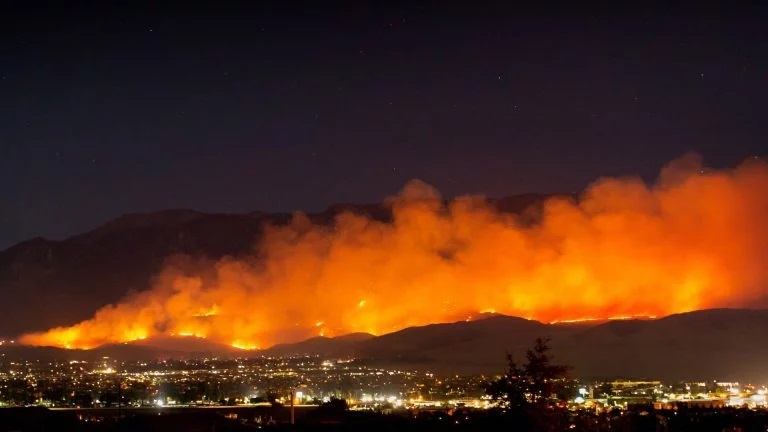
Wildfires are a cyclical constant in the western United States. However, climate change has accelerated their occurrence and severity. Dryness from a lack of precipitation, loss of biodiversity, and even a rise in the number of lightning strikes aggravate the frequency, duration, and severity of fires. Further, California’s aging energy infrastructure and cost-cutting shortcuts have led to the most destructive fires on record in recent years.
Despite being among the regions most susceptible to drought, California remains more consumptive and reliant on freshwater than any other state for manufacturing, power generation, public usage, and primarily, industrial agriculture. The loss of biodiversity due to climatic shifts beyond what native species can withstand is likely to change California’s landscape dramatically. In the coming years, we may see grasslands turn to deserts, blown-out and dried-up rivers and streams, and continually receding reservoirs in place of lakes.
Even under relatively temperate conditions, California has always been excessively dependent on irrigation and the transport of water across vast distances for most of its agriculture. Despite the media’s focus on individual conservation efforts—such as taking fewer showers and collecting rainwater—the overwhelming majority of freshwater consumed in the state goes towards agricultural and environmental purposes.
In California, the combination of anthropogenically accelerated climate change and a natural, cyclical centennial-scale climatic event has brought on the worst “megadrought” in over 400 years. Through a study of tree rings in species with centuries-long lifespans, scientists have been able to piece together a picture of the extreme climate cycles that are endemic to the region. The most recent period of exceptional drought, from 2014–2017, had widespread cultural, political, and economic effects throughout the country. The potentially disastrous scale of the current megadrought, which began in the mid-2000s, is shown in the fact that the previous cycle lasted from 1575–1603—nearly three decades of desiccation—well before the human-driven increase in extreme weather events. This does not bode well for our future under capitalism.
As a key “breadbasket” region for our entire society, the failure of California agriculture would have a crippling effect throughout both the national and world economies, placing the livelihoods of tens of millions at risk and threatening our food supply. Unfortunately, this is precisely the scenario we are facing. The ongoing megadrought now afflicts 77% of the Western US. The effects of the drought have been widespread and nonlinear. A potentially catastrophic array of feedback loops based on current water usage and conservation practices in California is on the cards. Under a rational system, the worst effects could be mitigated. However, for-profit agriculture is dead set on further intensifying these contradictions.
Fire and water
Wildfires are a cyclical constant in the western United States. However, climate change has accelerated their occurrence and severity. Dryness from a lack of precipitation, loss of biodiversity, and even a rise in the number of lightning strikes aggravate the frequency, duration, and severity of fires. Further, California’s aging energy infrastructure and cost-cutting shortcuts have led to the most destructive fires on record in recent years.
Despite being among the regions most susceptible to drought, California remains more consumptive and reliant on freshwater than any other state for manufacturing, power generation, public usage, and primarily, industrial agriculture. The loss of biodiversity due to climatic shifts beyond what native species can withstand is likely to change California’s landscape dramatically. In the coming years, we may see grasslands turn to deserts, blown-out and dried-up rivers and streams, and continually receding reservoirs in place of lakes.
Even under relatively temperate conditions, California has always been excessively dependent on irrigation and the transport of water across vast distances for most of its agriculture. Despite the media’s focus on individual conservation efforts—such as taking fewer showers and collecting rainwater—the overwhelming majority of freshwater consumed in the state goes towards agricultural and environmental purposes.
Wildfires occur on a cyclical basis in California, but man-made climate change has exacerbated their frequency and severity / Image: Brody Hessin
Under conditions of creeping desertification, the current practices are unsustainable. Continued access to potable water across the state is under threat, and many areas may not only become non-arable but entirely inhospitable for humans altogether. California farms, operating for profit and without regard to a long-term plan of production for need and sustainability, frequently rely on groundwater pumping to maintain crops. Under current drought conditions, where freshwater availability is 30–70% of the non-drought average, this puts even more pressure on the water system. Groundwater pumping draws from aquifers—layers of porous rock between non-permeable layers that hold water. Once drained of water, or nearly so, aquifers become compacted, collapsing in on themselves and permanently limiting the region’s freshwater capacity.
The San Joaquin Delta provides for the irrigation of four million acres of surrounding farmland. From here, it is diverted south, where it provides two-thirds of freshwater for the entire state. The Delta’s management is a testament to the shortsighted and irrational use of natural resources in a capitalist economy. Unsustainable irrigation has led to subsidence, or “sinking in,” of entire portions of California’s Central Valley by more than 20 feet.
As the land subsides, some portions of the valley have fallen below sea level. The outflow of fresh water from the delta is reduced by drought and aggressive irrigation. Saltwater from the San Francisco Bay estuary flows progressively further inland. As sea levels rise, this effect will be amplified, with saltwater intrusion penetrating deeper into the state and transforming surrounding habitats.
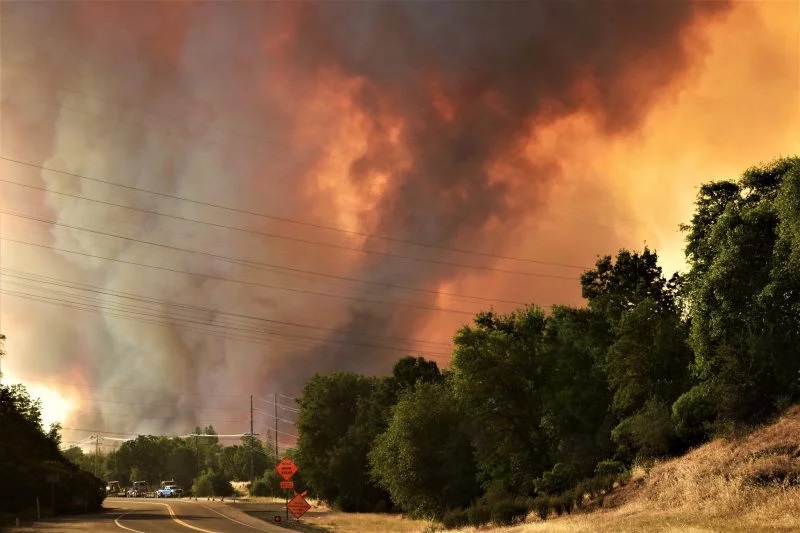
Under capitalism, the fallout from these converging factors will be disastrous. Nearly 70% of all Californians who live in coastal regions will experience increased flooding, worsening smog, heat waves, invasive pest species, and extreme weather events. Prices for many agricultural goods could skyrocket worldwide, with the market potentially taking decades or more to compensate for California’s drop in production. Those further inland will not fare much better. More than 25% of Californians live in wildfire risk zones. These millions are threatened not only by the damage and loss that accompany wildfires but also by the hazardous air filling their lungs with smoke and particulate matter.
Under conditions of creeping desertification, the current practices are unsustainable. Continued access to potable water across the state is under threat, and many areas may not only become non-arable but entirely inhospitable for humans altogether. California farms, operating for profit and without regard to a long-term plan of production for need and sustainability, frequently rely on groundwater pumping to maintain crops. Under current drought conditions, where freshwater availability is 30–70% of the non-drought average, this puts even more pressure on the water system. Groundwater pumping draws from aquifers—layers of porous rock between non-permeable layers that hold water. Once drained of water, or nearly so, aquifers become compacted, collapsing in on themselves and permanently limiting the region’s freshwater capacity.
The San Joaquin Delta provides for the irrigation of four million acres of surrounding farmland. From here, it is diverted south, where it provides two-thirds of freshwater for the entire state. The Delta’s management is a testament to the shortsighted and irrational use of natural resources in a capitalist economy. Unsustainable irrigation has led to subsidence, or “sinking in,” of entire portions of California’s Central Valley by more than 20 feet.
As the land subsides, some portions of the valley have fallen below sea level. The outflow of fresh water from the delta is reduced by drought and aggressive irrigation. Saltwater from the San Francisco Bay estuary flows progressively further inland. As sea levels rise, this effect will be amplified, with saltwater intrusion penetrating deeper into the state and transforming surrounding habitats.
Under capitalism, the fallout from these converging factors will be disastrous. Nearly 70% of all Californians who live in coastal regions will experience increased flooding, worsening smog, heat waves, invasive pest species, and extreme weather events. Prices for many agricultural goods could skyrocket worldwide, with the market potentially taking decades or more to compensate for California’s drop in production. Those further inland will not fare much better. More than 25% of Californians live in wildfire risk zones. These millions are threatened not only by the damage and loss that accompany wildfires but also by the hazardous air filling their lungs with smoke and particulate matter.
Millions are threatened not only by damage and loss accompanying wildfires but also by hazardous air conditions that can damage human lungs / Image: Bureau of Land Management California, Flickr
Policy initiatives purportedly aimed at alleviating the worst effects of climate change are being increasingly exposed as the largely symbolic gestures that they are. Initiatives to retrain workers from the fossil fuel industry as green energy workers remain chronically underfunded. And studies that advocate the replacement of water-intensive cash crops with grains more appropriate to the historic drought fall on deaf ears.
California’s cap-and-trade system—a so-called “carbon market”—is another heinous example of ineffectual capitalist-driven climate policy. It creates an army of middle-men carbon brokers who produce nothing of value, offshoring emission reduction benefits through shell companies set up out of state. This allows companies to buy and sell the “right” to pollute and does nothing to address the totality of the problem.
Workers pay the price
But California is not an agricultural and manufacturing powerhouse in the abstract—millions of workers produce all of that wealth. The state is a highly urbanized population center with more residents than the whole of Canada. Los Angeles and its surrounding counties is the second-largest metropolitan area in the country, with an estimated 13 million people.
California has already proven vulnerable to rising temperatures and other causes and effects of the drought. Last year, the state experienced its first rolling blackout in 20 years. Apocalyptic scenes flooded the media as residents crammed into “cooling zones” amidst statewide wildfires and a global pandemic. Faced with rising temperatures, the bourgeois-liberal solution to avoid blackouts is to increase electricity prices to minimize air conditioner usage. In other words, the capitalist solution is to shift the burden onto workers.
Climate change has the potential to upend urban existence in California. Projected sea-level rises will erode the coastline of the state, changing the map and submerging several areas altogether. The profit-motive-driven logic of capitalism sharply contradicts the level of planning required to address these coming changes.
Any disruption to California’s urban economy could be calamitous for the world economy. As the technology center of the world and a major financial hub, California drives much of the innovation on the world market and is a media powerhouse. If its cities are flooded as sea levels rise, these industries are unlikely to survive the exodus of workers. And in the shorter term, if the drought intensifies, the stability of urban life will likewise be undermined.
Despite the capitalists’ craven unwillingness to tackle climate change head-on, workers and young people are more supportive than ever of bold initiatives to alleviate and ameliorate its effects. Advances in technology point the way forward, but the pursuit of profit is an unyielding barrier to meaningful progress. At some point down the line, some desperate and severe measures may be adopted by the capitalists. But who will pay? How many millions will suffer displacement, unemployment, homelessness, ill health, and personal loss? Once the climate catastrophe has exacted its warlike privations from the working people of California, what will be left of the breadbasket for future generations to steward and develop?
Climate struggle is class struggle!
Instead of leaving it up to the capitalists and their apologists to act decisively on climate change when it is convenient—read: profitable—for them to do so, workers and youth must act for themselves.
The enormous productive capacity in California must be retooled to serve the interests of environmental stewardship while at the same time continuing to feed millions. Scientists and engineers can be redirected from for-profit industries into research aimed at reducing the environmental impact of agricultural and industrial production year after year.
We cannot leave it to the capitalist class to fix the climate crisis. They will only act when it is profitable to do so. In the meantime, millions of ordinary people will suffer terrible consequences / Image: Socialist Revolution
We must fight for public ownership over the land, energy, and natural resources to bring the waste and profiteering that predominates under capitalism to heel. Since climate change in coastal areas across the globe all but guarantees displacement, we must use this public ownership to guarantee paid employment for every worker who requires relocation and retraining. The nationalization of big agriculture, tech, finance, manufacturing, and entertainment will allow the working class to rationally plan for the public health and wellbeing of the entire population, and not only in California.
Climate change is not going away—but capitalism must if we are to respond to it as seriously as the threat demands. Workers worldwide will bear the brunt of these challenges in the future—we must ensure that we are the ones in the driver’s seat if further catastrophes are to be prevented.
The environments we live in are an incredibly complex layering of natural systems, each one dependent on every other. Humanity is capable of understanding these systems and working in tandem with them, provided that we first understand and rationally organize our own society. But capitalism is beholden to national borders, blind market forces, and internal contradictions. Private ownership of the means of production is not the end-all-be-all for our species. It is a blunt and unreliable instrument for the production and distribution of resources and no longer has a place in mediating our delicate balance with the planet. Any serious attempt to adapt to and overcome a future of megadroughts, gigafires, and rising sea levels will require a democratically planned socialist economy. On this economic basis, and with a workers’ government in power, humanity could seamlessly implement the necessary transitions to ameliorate the worst effects of climate change. Capitalism threatens the very existence of our species and deserves to be overthrown. If humans are to have a future worthy of the name, it must be socialist!
Policy initiatives purportedly aimed at alleviating the worst effects of climate change are being increasingly exposed as the largely symbolic gestures that they are. Initiatives to retrain workers from the fossil fuel industry as green energy workers remain chronically underfunded. And studies that advocate the replacement of water-intensive cash crops with grains more appropriate to the historic drought fall on deaf ears.
California’s cap-and-trade system—a so-called “carbon market”—is another heinous example of ineffectual capitalist-driven climate policy. It creates an army of middle-men carbon brokers who produce nothing of value, offshoring emission reduction benefits through shell companies set up out of state. This allows companies to buy and sell the “right” to pollute and does nothing to address the totality of the problem.
Workers pay the price
But California is not an agricultural and manufacturing powerhouse in the abstract—millions of workers produce all of that wealth. The state is a highly urbanized population center with more residents than the whole of Canada. Los Angeles and its surrounding counties is the second-largest metropolitan area in the country, with an estimated 13 million people.
California has already proven vulnerable to rising temperatures and other causes and effects of the drought. Last year, the state experienced its first rolling blackout in 20 years. Apocalyptic scenes flooded the media as residents crammed into “cooling zones” amidst statewide wildfires and a global pandemic. Faced with rising temperatures, the bourgeois-liberal solution to avoid blackouts is to increase electricity prices to minimize air conditioner usage. In other words, the capitalist solution is to shift the burden onto workers.
Climate change has the potential to upend urban existence in California. Projected sea-level rises will erode the coastline of the state, changing the map and submerging several areas altogether. The profit-motive-driven logic of capitalism sharply contradicts the level of planning required to address these coming changes.
Any disruption to California’s urban economy could be calamitous for the world economy. As the technology center of the world and a major financial hub, California drives much of the innovation on the world market and is a media powerhouse. If its cities are flooded as sea levels rise, these industries are unlikely to survive the exodus of workers. And in the shorter term, if the drought intensifies, the stability of urban life will likewise be undermined.
Despite the capitalists’ craven unwillingness to tackle climate change head-on, workers and young people are more supportive than ever of bold initiatives to alleviate and ameliorate its effects. Advances in technology point the way forward, but the pursuit of profit is an unyielding barrier to meaningful progress. At some point down the line, some desperate and severe measures may be adopted by the capitalists. But who will pay? How many millions will suffer displacement, unemployment, homelessness, ill health, and personal loss? Once the climate catastrophe has exacted its warlike privations from the working people of California, what will be left of the breadbasket for future generations to steward and develop?
Climate struggle is class struggle!
Instead of leaving it up to the capitalists and their apologists to act decisively on climate change when it is convenient—read: profitable—for them to do so, workers and youth must act for themselves.
The enormous productive capacity in California must be retooled to serve the interests of environmental stewardship while at the same time continuing to feed millions. Scientists and engineers can be redirected from for-profit industries into research aimed at reducing the environmental impact of agricultural and industrial production year after year.
We cannot leave it to the capitalist class to fix the climate crisis. They will only act when it is profitable to do so. In the meantime, millions of ordinary people will suffer terrible consequences / Image: Socialist Revolution
We must fight for public ownership over the land, energy, and natural resources to bring the waste and profiteering that predominates under capitalism to heel. Since climate change in coastal areas across the globe all but guarantees displacement, we must use this public ownership to guarantee paid employment for every worker who requires relocation and retraining. The nationalization of big agriculture, tech, finance, manufacturing, and entertainment will allow the working class to rationally plan for the public health and wellbeing of the entire population, and not only in California.
Climate change is not going away—but capitalism must if we are to respond to it as seriously as the threat demands. Workers worldwide will bear the brunt of these challenges in the future—we must ensure that we are the ones in the driver’s seat if further catastrophes are to be prevented.
The environments we live in are an incredibly complex layering of natural systems, each one dependent on every other. Humanity is capable of understanding these systems and working in tandem with them, provided that we first understand and rationally organize our own society. But capitalism is beholden to national borders, blind market forces, and internal contradictions. Private ownership of the means of production is not the end-all-be-all for our species. It is a blunt and unreliable instrument for the production and distribution of resources and no longer has a place in mediating our delicate balance with the planet. Any serious attempt to adapt to and overcome a future of megadroughts, gigafires, and rising sea levels will require a democratically planned socialist economy. On this economic basis, and with a workers’ government in power, humanity could seamlessly implement the necessary transitions to ameliorate the worst effects of climate change. Capitalism threatens the very existence of our species and deserves to be overthrown. If humans are to have a future worthy of the name, it must be socialist!
Subscribe to:
Comments (Atom)