Tuesday, May 25, 2021
The Political Situation and the National Strike in Colombia
By Pedro Santana Rodríguez on May 20, 2021
https://www.resumen-english.org/2021/05/the-political-situation-and-the-national-strike-in-colombia/
The protests in Colombia have continued for 23 days in the midst of brutal repression that has resulted in more than 50 demonstrators killed, according to the non-governmental organization INDEPAZ (Instituto de Estudios Para el Desarrollo y La Paz / The Institute of Studies for Development and Peace), as of May 18, 2021. There were 46 cases of killings by police, in addition to six other cases that were in the process of verification, the latter in the city of Cali. As of May 12th, according to a joint report by INDEPAZ and Temblores, there had also been 278 wounded, 32 eye injuries, 356 physical aggressions, 18 acts of sexual violence and more than 1,000 arrests. At this time, 134 people have gone missing and have not yet been located.
The most visible case of sexual violence occurred in the city of Popayán on the night of Wednesday, May 12th. It was documented in a recording by local media filming the protest in that city. Alison Meléndez, a 17 year old girl who was a by-stander near the demonstrations, was recording what was happening and was violently detained by four police officers. She was taken to the prosecutor’s office where she was sexually abused. She was later released and committed suicide at her grandmother’s house. This is one of the 18 cases of sexual aggression against women by members of the National Police in the context of the protests that have been shaking the country since April 28th. The generalized repudiation in the country and the recordings widely published by the social networks forced the Police, which initially denied the facts — calling them fake news — to finally admit the violent detention of the young girl, who was also the daughter of a police officer. The events ended with the burning of the facilities of the Detention Unit where the sexual abuse of the minor allegedly took place.
The magnitude of the repression is disproportionate and corresponds, in my opinion, to a deliberate strategy of the government and the security forces to try to contain and suffocate the demonstrations. The aim is to provoke fear and reduce popular protest by force. Infiltrating the demonstrations and showing the unfettered action of paramilitary groups in the city of Cali and in the neighboring city of Yumbo, proof of this strategy has been widely documented by citizens who have recorded both the excesses of the public forces and the presence of armed civilians. Together with the police, civilians shoot at unarmed demonstrators. This occurred on Sunday, May 9, in the city of Cali against the Indigenous Minga, resulting in the wounding of 12 indigenous people. To date, and despite the recordings showing these events, the Attorney General’s Office has not offered any results of the investigations it says were undertaken. They wanted to reduce the protest with violence. And despite the dreadful toll in deaths, injuries, arrests and violence, the protest continues. In the face of national and international pressure, President Duque has reluctantly, and without showing remorse, acknowledged the excesses of the security forces. The truth is that there has been no condemnation and no results of the investigations have been released. The government continues to use repression to try to weaken the protest movement, but has not succeeded. So far, this strategy has failed, but that does not mean that the Uribe-Duque government has given up on it.
The government has refused to authorize the request of the Inter-American Commission on Human Rights, IACHR, which wants to go to Colombia to investigate what has happened and what is still happening. Nor has it issued a statement in favor of the formation of a Truth Commission that, with the presence of international delegates, would investigate the events that occurred in Colombia and the way the State responded to the protests. These proposals are part of the document that the National Strike Committee delivered to the government last Sunday, May 16th. There has been no concrete response from the government except for the presidential speeches which have neither acknowledged the proposals nor taken responsibility for the excessive use of force against demonstrators.
The other strategy is to criminalize and prosecute social leaders who have been active in calling for the strike and the ongoing demonstrations. In this strategy, the most notorious event was propitiated by the Minister of Defense himself, Diego Molano. On May 15, at the end of a security council meeting in the city of Popayán, Molano accused four recognized social leaders of being the instigators of the attack and subsequent burning of the URI and the headquarters of Legal Medicine in that city. Molano’s outburst was so ridiculous that the Governor of the Department Elías Larrahondo Carabalí and the Mayor of the city of Popayán, Juan Carlos López, came out to deny what the minister had said, pointing out that this issue had not been considered in the security council and that the Molano’s accusations were made against four well-known social leaders in the city. They further said that the four social leaders had nothing to do with the vandalism against the official facilities. This is another problematic strategy that puts the life and honor of protest leaders at risk. For this fact and for the murders registered during the protests, as well as for the repression and violence against the demonstrators, Molano will have to face a motion of censure next Tuesday, May 25th. We will see what happens, but so far the motion of censure does not seem to have the necessary votes to remove him from office. However, the pressure that the mobilizations exert on Congress comes back into play.
While continuing with this strategy to weaken the movement, the government is moving in two other directions. One of them is to broaden the political support base with new partners. The first objective is to add the Liberal Party led by former President Cesar Gaviria. Two long conversations took place between Duque and Gaviria last week with a bittersweet outcome for Duque. Gaviria, one of the mentors and promoters of the neoliberal model — the real cause of the social crisis and poverty, aggravated by the current pandemic — publicly stated that he supported Duque. He advised Duque that he should get rid of several ministers. First, dump the Minister of Defense, Diego Molano. Gaviria told Duque he could support his new tax reform project, as long as the new resources did not affect the middle class and the popular sectors. But still, he has not managed to integrate liberalism to the government. And the fact is that Gaviria has serious differences with a sector of his party in Congress, which does not agree with backing an unpopular government such as Duque’s with an electoral campaign for Congress next March. Even with these limitations, this position gives Duque an air of support, although nebulous.
The situation is very volatile in the political arena. This is mainly due to the proximity of the presidential and congressional elections. Proof of this are two new defeats that the mobilizations and protests have achieved. The first one is the exit through the back door of the opaque and erratic Foreign Minister Claudia Blum, who presented her resignation letter after making a number of mistakes. Nothing new is expected in terms of international relations with the appointment of the loquacious Vice President Martha Lucia Ramirez. The other more significant defeat was the axing of the health reform bill which sought to deepen the privatization of the health system. After resisting in the Congress, both in the House and in the Senate by large majorities, the bill was defeated on Wednesday, May 19th. This was another victory for the street protests that had called on the government to withdraw it.
Attrition, exhaustion and future of the movement
The intensification of repression does not seem to be the government’s primary strategy, although the person who is really pulling Duque’s strings — former President Alfaro Uribe — continues to insist on it. That strategy would escalate internal divisions and does not seem to me to have enough acceptance today in the government and its partners in the business associations. Neither does the possibility of a coup d’état. There are powerful adverse factors in this situation. The pressure from the international community is strong and above all the pressure from an important parliamentary block of U.S. Democrats. So are the critical positions of the European Union, the United Nations and some governments of the region. They point to the repression and tie it to the amount of military assistance being given to the government. And little would be added to this strategy by the declaration, at least in the short term, of internal divisions.
The collaboration of the control agencies also allows the government to use repressive mechanisms without major consequences, given that the prosecutor is a government official, as well as the Comptroller General, the Attorney General and the Ombudsman. The Justice Department, with the communiqué issued by the high courts, is also under the control of the government, although somewhat limited; it is the only institutional counterweight that has worked so far. In addition, there is a non-existent Congress, since it functions ‘virtually’ with many limitations. The government continues to have narrow majorities in the Congress, but majorities nonetheless. Duque and Uribe are now seeking to keep their closest partners satisfied with quotas and resources to avoid weakening their alliance, which explains the change of ministers and Duque’s hopes to bring the Liberals into the government coalition. So, on the institutional front, the regime is under control. Therefore, I see neither internal divisions in the short term nor a coup d’état.
The popular protest movement will now have to face its own fatigue as a result of long weeks of mobilization. Lots of people turned out for the demonstrations yesterday, Wednesday, May 19th — which was big but smaller than those of other days called by the National Strike Committee. The sit-ins and blockades remain in effect, but have been lifted at some points due to the demands of communities facing food shortages and the decrease in commerce and street sales where a very important part of the population obtains its means of survival. Perhaps it is time to temporarily rethink the mobilization strategy. Give way to staggered mass mobilizations that maintain the pressure while awaiting the outcome of the negotiations. At the same time, broad processes of deliberation could be opened on the contents of the proposals for tax reform, basic income, massive public employment plan, policies for rural/farm economies, public policies for youth, zero enrollment for higher education, reform of the security forces, political reforms, which are, in my opinion, the central issues of the protests at this juncture. Perhaps it is time for the collective construction of public policy proposals on these and other priority issues. Preserve and expand organization and deliberation accompanied by large peaceful mobilizations. These issues should be debated in the movement and, of course, in the National Strike Committee.
Pedro Santana Rodríguez is Director of Sur Magazine
Source: Alainet, translation Resumen Latinoamericano – English

Poll: Israel failed to win support of US voters during Gaza massacre
Ali Abunimah Lobby Watch 23 May 2021
https://electronicintifada.net/blogs/ali-abunimah/poll-israel-failed-win-support-us-voters-during-gaza-massacre
Israel failed to win the sympathy of most Americans during its massive attack on Gaza , a new survey finds.
In only one demographic group – Republicans – did Israel manage to eke out a narrow majority in support, according to a Morning Consult poll conducted for Politico from 14 to 17 May.
Among Democrats and young voters, more people stood with Palestinians than with Israelis.
The survey of almost 2,000 registered voters was taken amidst Israel’s savage bombing campaign in Gaza that began on 10 May and ended with a ceasefire in the early hours of Friday.
Overall, 28 percent of voters surveyed were more sympathetic to Israelis, compared with 11 percent who were more sympathetic to the Palestinians.
But while US voters were more likely to side with Israelis than Palestinians, they were even more likely (29 percent) to sympathize with both.
Over 11 days, at least 230 Palestinians, including more than 60 children, were killed by Israeli forces and 2,000 were injured.
Twelve people were killed in Israel.
Israel’s bombing of civilian homes, businesses, media agencies, health facilities and other infrastructure caused massive damage in Gaza and displaced tens of thousands of people.
Israel killed 27 Palestinians in the West Bank and injured 6,000 in the same period.
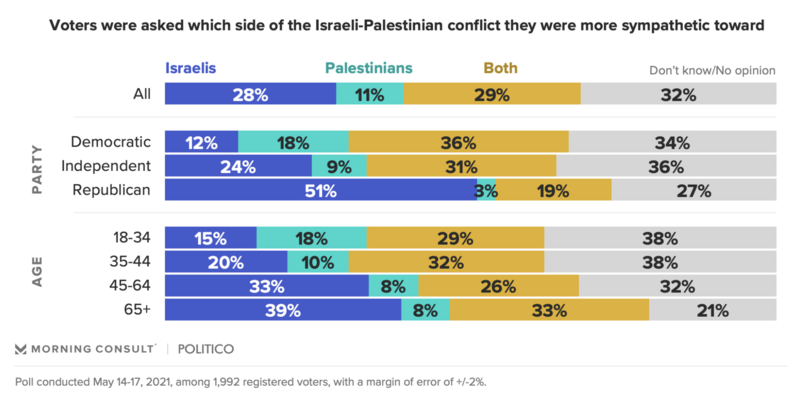
Source: Morning Consult
Dwindling support among Democrats
Remarkably, the only group where Israelis found majority sympathy was among Republican voters – by the barest margin of 51 percent.
In the 18-34 age group, just 15 percent favored Israelis, while 18 percent sympathized more with the Palestinians. Twenty-nine percent said they stood with “both.”
A mere 12 percent of Democratic voters said their sympathy lay more with Israelis, while 18 percent stood with the Palestinians. More than a third of Democrats – 36 percent – opted for “both.”
The escalation of Israeli violence against Gaza followed rocket fire by Palestinian resistance groups in response to Israel’s attacks on worshippers at the al-Aqsa mosque compound and intensifed ethnic cleansing of Palestinians in occupied East Jerusalem.
The poll will undoubtedly unnerve Israel and its lobby groups, which launched their usual propaganda blitz demonizing Palestinians in order to justify the carnage as a “response” to “terror.”
Yet it confirms a long-term trend: the steady erosion of support for Israel among significant groups of Americans.
Failed strategies
In recent years, Israel and its lobby have invested huge resources in trying to appeal to younger and more left-leaning demographic groups – apparently without success.
“Support for Israel is driven largely by Republicans and older voters, while Democrats and younger voters are more likely to back the Palestinian cause in the decades-long Middle Eastern conflict,” Morning Consult observes.
A lot of Israeli propaganda aims at marketing Israel as “progressive” – particularly for its supposed support of LGBTQ rights and environmental issues.
These pinkwashing and greenwashing strategies have been a dismal failure.
Israel and its army of propagandists are finding again and again that there is just no way to make a state that perpetrates vengeful massacres and apartheid against Palestinians seem hip and cool.
Bernie Sanders says “tone down the rhetoric” on Israel’s crimes
Ali Abunimah Power Suits 24 May 2021
https://electronicintifada.net/blogs/ali-abunimah/bernie-sanders-says-tone-down-rhetoric-israels-crimes
Palestinians are still reeling from the horrific toll of death and destruction inflicted by Israel in the Gaza Strip this month.
Over 11 days, more than 240 Palestinians were killed in Gaza, including more than 60 children, and 2,000 others were injured.
In the occupied West Bank, almost 30 families are mourning loved ones killed by occupation forces just during the past two weeks. And within Israel, Palestinian citizens faced organized pogroms by Jewish Israeli mobs backed by authorities.
Meanwhile, Israel continues its assaults on Palestinians throughout historic Palestine, particularly in occupied Jerusalem.
Raw numbers cannot capture the scale of the terror and trauma Israel continues to inflict.
But Senator Bernie Sanders, the supposed standard bearer of US progressives, wants Palestinians and their supporters to make a little bit less of a fuss.
Decades after Palestinians first accurately described Israel as an apartheid state, such mainstream human rights organizations as Israel’s B’Tselem and New York-based Human Rights Watch have in recent months reached the same conclusion.
Yikes what a disgrace. https://t.co/lzjxcWBgmG— Mohammed (@m7mdkurd) May 23, 2021
“Tone down the rhetoric”
On Sunday, Sanders was asked about the use of this term on CBS’ Face The Nation.
Host John Dickerson – who sounded like a defense attorney for Israel throughout the interview – told Sanders that “there are a number of liberals who use the word apartheid to describe Israel’s treatment of the Palestinians.”
Citing an Israel lobby group, Dickerson claimed such criticism was fueling an upsurge in anti-Jewish bigotry.
He then put it to Sanders that using the word apartheid “has increased the level of vitriol that has contributed to this anti-Semitism.”
Rather than affirm that Israel indeed practices apartheid and reject the equation between criticism of Israel’s crimes and anti-Semitism, Sanders agreed with his host.
“Well, I think we should tone down the rhetoric,” Sanders said, before serving up a word salad that concluded, “the job of the United States is to bring people together.”
Mohammed El-Kurd, a Palestinian poet and activist against ethnic cleansing in occupied East Jerusalem’s Sheikh Jarrah neighborhood, called Sanders’ answer “a disgrace.”
There was a torrent of similar criticism of Sanders from Palestinians and their supporters.
Sadly, it was not the only disgraceful thing Sanders said in the 8-minute segment on Palestine that you can watch at the top of this article.
As the world recoils at the brazenness of Israel’s colonial war crimes, Sanders still insisted that “We have to be pro-Israel, but we have to be pro-Palestinian” – adamantly sticking to a false balance that equates the perpetrator with the victim.
And rather than challenge the language that has for decades been used to demonize and delegitimize any and all Palestinian resistance, Sanders called Hamas “a terrorist, corrupt, authoritarian group of people” and insisted “we have got to stand up to them.”
As significant as what Sanders said is what he failed to say.
Nowhere did he criticize Zionism, Israel’s racist state ideology.
Nor did he call for effective, popular solidarity with Palestinians by endorsing and promoting BDS – the boycott, divestment and sanctions movement modeled on the global campaign that helped end apartheid in South Africa.
Indeed, Sanders is on record opposing BDS.
Sanders failed to call for Israeli leaders to be held to account for war crimes.
He did not demand that the Biden administration drop its opposition to the International Criminal Court’s investigation of war crimes in the West Bank and Gaza Strip.
Instead, the senator sought to shield Israel from criticism by deflecting the blame on to its current government.
“Over the years, the Netanyahu government has become extremely right wing,” Sanders asserted, and “there are people in the Israeli government now who are overt racists.”
Every Israeli government of every political stripe from Zionist “left” to Zionist right has been racist since the state was founded by ethnic cleansing in 1948.
But just as many liberals think that America’s problems started with the election of Donald Trump in 2016, Sanders apparently believes that Benjamin Netanyahu invented racism in Israel.
“White moderate”
None of this should be surprising.
It is all in keeping with Sanders’ long record of support for Zionism, not to mention his staunch record of support for US imperialism.
However his latest comments should put to rest any hope that Sanders can fundamentally change or be a real ally to Palestinians.
Sanders’ efforts to police and “tone down” the language that accurately describes Israel’s crimes brings to mind the archetypal “white moderate” so eloquently described by Martin Luther King, Jr. in his 1963 Letter from a Birmingham Jail:
I have almost reached the regrettable conclusion that the Negro’s great stumbling block in his stride toward freedom is not the White Citizen’s Counciler or the Ku Klux Klanner, but the white moderate, who is more devoted to “order” than to justice; who prefers a negative peace which is the absence of tension to a positive peace which is the presence of justice; who constantly says: “I agree with you in the goal you seek, but I cannot agree with your methods of direct action”; who paternalistically believes he can set the timetable for another man’s freedom; who lives by a mythical concept of time and who constantly advises the Negro to wait for a “more convenient season.” Shallow understanding from people of good will is more frustrating than absolute misunderstanding from people of ill will. Lukewarm acceptance is much more bewildering than outright rejection.
So it is with Sanders’ lukewarm support for Palestinians.
Just like the white moderate who condemned segregation, Sanders does acknowledge some of the wrongs perpetrated by Israel.
On Face the Nation, for example, he stated that in the recent attack on Gaza, Israel “killed 64 children and destroyed a large part of the infrastructure of Gaza in a community that has already been one of the most uninhabitable territories in the world.”
“The United States of America has got to be leading the world in bringing people together, not simply supplying weapons to kill children in Gaza,” he added.
Ineffective measures
Sanders has put forward a Senate resolution to block $735 million in further sales of precision-guided bombs from the US to Israel.
Given that as recently 2014, Sanders was angrily berating and silencing his constituents for objecting to Israel’s massacre of Palestinians in Gaza that year, this could be seen as “progress.”
But what it really is, is a distraction.
If Sanders put forward the Senate resolution while supporting the Palestinian people’s struggle and legitimate resistance, particularly BDS, it might be seen as a building block.
But he is offering a resolution that has no chance of passage while opposing and condemning all forms of Palestinian resistance – even using the Israel lobby’s demonizing terminology of “terrorism.”
Even with all his criticism of Israeli leaders – the worst he will call Netanyahu is “right wing” and a “racist” – Sanders is still harsher in his denunciation of Palestinians.
At best Sanders provides rhetorical support to Palestinians, at worst he is undermining their struggle for liberation by defusing anger and demands for action by channeling them into a dead end.
Just as he twice sheepdogged left-wing voters into the corporate, warmongering Democratic Party, Sanders seeks to channel supporters of Palestinian rights away from clear diagnosis and effective solidarity, into his moribund liberal Zionism.
At a moment when support for Israel is collapsing within the base of the Democratic Party, here comes Bernie Sanders to the rescue, with soft criticism of Israel and ineffective measures.
Writing from his jail cell, King rejected the “moderate” criticism that nonviolent direct action was generating crisis and tension and that he needed, so to speak, to tone it down.
“We merely bring to the surface the hidden tension that is already alive. We bring it out in the open, where it can be seen and dealt with,” King countered.
“Like a boil that can never be cured so long as it is covered up but must be opened with all its ugliness to the natural medicines of air and light, injustice must be exposed.”
That is as true today of Israel’s regime of occupation, apartheid and settler-colonialism, as it was of the American apartheid King was fighting, and which sadly persists to this day.
No one should listen to Bernie Sanders’ advice. Do not tone it down. Tone it up.
DIGITAL APARTHEID: PALESTINIANS BEING SILENCED ON SOCIAL MEDIA
By Omar Zahzah, Black Agenda Report.
May 23, 2021
https://popularresistance.org/digital-apartheid-palestinians-being-silenced-on-social-media/
Social Media Companies, From Zoom To Facebook And Twitter, Are Reinforcing Israel’s Erasure Of Palestinians.
“Big Tech’s censors material related to the Palestinian struggle on Israel’s demand.”
In 1984, Palestinian American intellectual and Columbia University Professor Edward Said famously argued that Palestinians are denied “permission to narrate”.
More than 30 years later, in 2020, Maha Nassar, a Palestinian American Associate Professor at the University of Arizona, analyzed opinion articles published in two daily newspapers – The New York Times and The Washington Post – and two weekly news magazines – The New Republic and The Nation – over a 50-year period, from 1970 to 2019. Perhaps unsurprisingly, she found that “Editorial boards and columnists seem to have been quite consumed with talking about the Palestinians, often in condescending and even racist ways – yet they somehow did not feel the need to hear much from Palestinians themselves.”
Nassar’s research, like many others before it, clearly demonstrates that more than three decades after the publication of Said’s landmark essay, the exclusion of Palestinian voices from mainstream media narratives in the West – and the attempts to erase the humanity of the Palestinians or whitewash Israel’s crimes against them – continue unabated.
Sadly, however, this unjust status quo has not only remained unchanged since Said brought it under the spotlight – it has deteriorated.
“The exclusion of Palestinian voices from mainstream media narratives in the West continues unabated.”
In recent years, social media became a lifeline for many who want to raise awareness about causes and struggles ignored or undermined by mainstream media outlets.
Yet tech companies are now actively working to exclude Palestinian voices from their platforms, thereby expanding the calculated erasure and silencing of the Palestinians to social media.
In April, for example, Zoom, Facebook and Youtube blocked the online academic event “Whose Narratives? What Free Speech for Palestine?” co-sponsored by the Arab and Muslim Ethnicities and Diasporas (AMED) Studies program at San Francisco State University, the Council of UC Faculty Associations (CUFCA), and the University of California Humanities Research Institute (UCHRI).
The event was to feature anti-apartheid activists from around the globe, including Palestinian resistance icon Leila Khaled and South Africa’s former ANC military leader Ronnie Kasrils.
This event was in fact a repeat of an open classroom co-organized by Dr. Rabab Ibrahim Abudulhadi (AMED Studies) and Dr. Tomomi Kinukawa (Women and Gender Studies) of San Francisco State University that Zoom initially censored in September 2020. Then, as now, Zoom and other social media companies said they decided to block the event from their platforms due to the planned participation of Leila Khaled. They claimed, as Khaled is affiliated with the Popular Front for the Liberation of Palestine (PFLP), a “US-designated terrorist organization,” allowing the event to proceed would be in violation of US laws prohibiting material support for terrorism.
“Tech companies are now actively working to exclude Palestinian voices from their platforms.”
As repeatedly asserted by numerous legal experts, the argument put forth by the social media companies is without merit. It not only ignores all relevant legal precedents and falsely alleges violations of US law, but also amounts to an attack on academic freedoms.
Indeed, in an open letter to Zoom executives published in October last year, experts from Palestine Legal and other legal organizations stressed that Zoom’s censoring of the AMED event constitutes “a dangerous attack on free speech and academic freedom, and an abuse of your contract with our public university systems.” They added that “[Zoom’s] status as an essential public service does not give you veto power over the content of the nation’s classrooms and public events.”
These warnings, however, went unheeded, with Zoom and other social media companies completely ignoring the growing criticism of their biased policies and escalating their efforts to silence Palestinian speech on their platforms.
In April, after Zoom refused to host the “Whose Narratives?” event for the second time – following pressure from an Israeli government app and several right-wing Zionist organizations – Facebook not only took down publicity posts about the event, but also deleted the page of the AMED Studies program from its platform in its entirety, effectively erasing a vast archive of talks, discussions and documents on the Palestinian liberation struggle and its relationship to freedom movements from around the world. These materials were being intentionally shared and stored on Facebook for academics, activists, organizers and the community at large to be able to engage with them free of charge and without restriction.
“Zoom’s censoring of the AMED event constitutes ‘a dangerous attack on free speech and academic freedom.’”
Coming on the heels of Zoom’s repeated attempts to arbitrate what is and is not acceptable speech in academia, Facebook’s deletion of the AMED page made clear Big Tech’s modus operandi when it comes to Israel-Palestine: censor material related to the Palestinian struggle on Israel’s demand, and ignore any criticism of these unlawful and unjust actions.
Israel and its allies are not only pressuring Big Tech to silence the Palestinians from outside. Facebook’s oversight board, an independent body tasked with deliberating on the platform’s content decisions, includes former director-general of the Israeli Ministry of Justice, Emi Palmor. Palmor personally managed Israel’s Cyber Unit in the past, which successfully lobbied for the removal of thousands of pieces of Palestinian content from Facebook.
While it is only logical to assume Palmor’s presence on the oversight board is contributing to Facebook’s anti-Palestinian actions, Big Tech’s routine silencing of Palestinian voices cannot be blamed on such overtly pro-Israeli actors in its higher echelons alone.
Since the very beginning, social media companies have gravitated towards and aligned with centers of power in the US capitalist and imperialist structures. They even partnered with the US Department of Defense, coordinating surveillance and big data analysis. So it is not that a few powerful pro-Israeli voices are coopting social media companies into silencing dissent; the industry itself is rotten to its core. Let us not forget how Big Tech executives and employees have orchestrated a huge land grab and gentrification in the San Francisco Bay Area, displacing thousands of working-class and poor communities of color.
“The industry itself is rotten to its core.”
The AMED Studies Facebook page has not been restored. But as the event organizers have also rightfully noted, the problem is not only Big Tech censorship: after the censoring of the AMED event, university officials refused to offer alternative platforms for the event to take place and engaged in messaging and programming that effectively delegitimized it.
Universities are far from being neutral arbiters in this story: by conceding to the monopoly of tech companies over pedagogical programming and by normalizing anti-Palestinian rhetoric, they are complicit in these companies’ overreaching erasure of Palestine and Palestinians from the curriculum.
And the repression of Palestinian voices on social media extends far beyond academia. In recent days, many individuals documenting Israeli settler and state violence against Palestinian families in the occupied East Jerusalem neighborhood of Sheikh Jarrah reported that Facebook, Twitter and Instagram (owned by Facebook) has been “systematically censoring” their content.
In the latest chapter of Israel’s ongoing ethnic cleansing of Palestine, the Palestinian families of Sheikh Jarrah face imminent forced removal from their homes and are contending with violent repression that is sanctioned and enabled by all levels of the Israeli state.
“Individuals documenting Israeli settler and state violence against Palestinian families in the occupied East Jerusalem neighborhood of Sheikh Jarrah have been censored.”
Last Friday, more than 200 people were wounded when Israeli police shot rubber bullets and threw stun grenades at Palestinians in Al-Aqsa mosque. Israeli forces tried to prevent medics from treating the injured and at least three Palestinians lost an eye as a result of the attack. On Monday, Israeli occupation forces again fired at Palestinians, who had gathered at Al-Aqsa to pray and protect the site from settler violence, with rubber-coated bullets, stun grenades, and tear gas; reporters, journalists and medics were among the wounded. In the latest act of collective punishment, Israel began a ruthless bombing campaign in the Gaza Strip on Monday night, flattening civilian infrastructure and media offices. On Wednesday night, settler and police violence against Palestinians in the city of Lydd (also known as Lod) peaked as hundreds of Israelis stormed the city, attacking Palestinian protesters following the murder of 33-year-old Palestinian man, Musa Hassouna. Israeli Border Forces were eventually transferred to Lydd from the West Bank. Furthermore, fascist Israelis participated in an attempted lynching of a Palestinian man in Bat Yam, forcibly removing him from his car and beating him unconscious.
The Israeli Supreme Court has since delayed the Sheikh Jarrah forced removals for 30 days, but activists have identified this as a stalling tactic meant to diffuse momentum and support for the Sheikh Jarrah residents.
“Fascist Israelis participated in an attempted lynching of a Palestinian man in Bat Yam.”
In a recent CNN interview, Mohamed El-Kurd, a Palestinian poet and activist from Sheikh Jarrah, powerfully turned the age-old media trope of Palestinians being inherently “violent” on its head by responding to the reporter’s leading question with one of his own: “Do you support the violent dispossession of me and my family?” As usual, US mainstream media organizations attempt to hide the asymmetrical nature of Israel’s aggression by defining its latest and ongoing attacks on the Palestinian people as “clashes” or a “conflict.”
Mainstream media’s ongoing efforts to whitewash Israel’s deadly occupation, coupled with the dire and rapidly escalating situation of Palestinians in Sheikh Jarrah as well as all Palestinians resisting in support of them, make unrestricted access to social media especially crucial for Palestinians and their allies.
But rather than amplifying the righteous struggle of Palestinians resisting violence and displacement, social media companies are furthering the interests and agenda of the very government attacking them.
This latest round of social media censorship of Palestinian posts about Sheikh Jarrah is part of a larger pattern of repression, given the long and well-documented complicity between Israel and social media companies in regulating and censoring Palestinian content and accounts. Instagram officially attributed these latest deletions to a “global technical issue.” Twitter likewise claimed the restriction of the account of Palestinian writer Mariam Barghouti, which was subsequently reinstated following a huge social media outcry, was an “accident.” Activists and watchdog organizations have expressed doubts about such explanations, given the targeted nature of the removals and censures.
“Instagram officially attributed these latest deletions to a ‘global technical issue.’”
Decades after Edward Said’s criticism of the US media’s insistent refusal to allow Palestinians to narrate their own stories, the voices in support of the Palestinian liberation struggle are being silenced not only by mainstream media organizations but also social media companies.
But we must not give in. Despite efforts by social media companies and media organizations to silence Palestinians, those who truly believe in equality, justice and freedom should continue to endorse and amplify the calls to save Sheikh Jarrah, stop the expansion of illegal Israeli settlements, end all military funding for Israel, and bring an end to Israel’s occupation of Palestinian lands and state-sanctioned discrimination against Palestinians. We should also support the Boycott, Divestment and Sanctions (BDS) movement, until Israel agrees to cease its colonial and apartheid practices for good. Media organizations and social media companies can try to control and distort narratives about Palestine, but they cannot hide the truth and silence Palestinians’ righteous calls for justice forever.
This does not mean we should not try and expose the unethical and unlawful practices by these companies and organizations. We must fight the targeted, cross-platform censorship that echoes and reinforces the Israeli state’s ongoing structural oppression of Palestinians and systematic erasure of Palestinian voices. By engaging in such behavior, social media companies are practicing digital apartheid. We cannot sit idly by. Now more than ever, we need to continue to expose and resist this discriminatory silencing as part of the larger fight for Palestinian freedom and liberation.
DUPING A WHISTLEBLOWER
By John Kiriakou, Consortium News.
May 23, 2021
https://popularresistance.org/duping-a-whistleblower/
What Just Happened To Daniel Hale Is Yet Another Injustice.
What has happened to whistleblower Daniel Hale is very troubling. A former U.S. Air Force intelligence officer, he was arrested on May 4 in advance of his July 13 sentencing for blowing the whistle on the U.S. government’s deadly and illegal drone program.
Justice Department prosecutors maintain that Hale had “violated the terms of his bail.” In court, his attorneys maintained “there were no violations committed by the defendant as alleged.” They’re right. The government is lying. Daniel explained what happened to me in a phone call from jail. And what happened is yet another injustice against this hero. For the record, Daniel is permitting me to make these details public.
Like any whistleblower facing years, or possibly decades, in prison, he is depressed. He had casually told his therapist a few days before his arrest that he was depressed and did not want to go to prison. This is, of course, an utterly logical emotion.
I was depressed when I was awaiting sentencing after blowing the whistle on the CIA’s torture program, and I didn’t want to go to prison either. The therapist took it upon himself to report Hale to prosecutors as “suicidal” and “a danger to himself.”
He said he wasn’t suicidal and posed no danger to himself or to anybody else. But he had no idea that the therapist had ratted him out to prosecutors. A court officer then called Hale and told him to go to the courthouse for a routine urinalysis. He dutifully went in as ordered, with a full bladder, and was promptly arrested. He was told that it was “for his own safety.”
Risky Move
Hale is already is facing an uphill battle as he approaches sentencing. He agreed last month to plead guilty to one count under the Espionage Act for passing classified documents to a reporter, without a sentencing recommendation from prosecutors. It was a risky strategic move, but one urged by his attorneys.
He would plead guilty, hope that prosecutors would drop the remaining four charges and hope further that the judge would issue a lenient sentence. Prosecutors have bandied about the idea of five years in prison. That’s a long time. And with a national security crime, Daniel would be ineligible to spend his sentence in a minimum-security work camp. This isn’t “justice.”
Hale is facing several challenges with which most national security whistleblowers are confronted. The Justice Department wants to make an example of him to frighten other would-be whistleblowers from going public. The prosecutors want to get him the longest possible sentence to improve their own chances of promotion or of going on to a lucrative career in the private sector.
The judge has a reputation for being tough in sentencing national-security cases and is unlikely to take pity on him. And he is represented by public defenders who, although they have great reputations, are overworked and underpaid. In addition, one of Hale’s attorneys had a recent death in the family and has been out of touch for three weeks.
The prospects for a fair hearing are not good. How can Daniel Hale, or any defendant, adequately defend himself from solitary confinement or without ready access to his attorneys? How can any defendant without available cash afford to defend himself in the first place?
The entire system must be changed, and this can only be done legislatively. Hoping for the best won’t work. After all, as they say in business school, hope is not a strategy.
Please write to Daniel Hale. He told me he is desperate for news articles and asks if he can be sent printouts of articles on politics and international affairs. He is NOT PERMITTED to receive articles with photos in them, and he is NOT PERMITTED to receive books. He can be reached at Daniel E. Hale, William G. Truesdale Adult Detention Center, 2001 Mill Road, Alexandria, VA 22314.
MORE OF THE SAME: BIDEN’S HYBRID WAR AGAINST CHINA
By Madison Tang and Jodie Evans, Asia Times.
May 23, 2021
https://popularresistance.org/more-of-the-same-bidens-hybrid-war-against-china/
The Policy Of Singling Out A Rising China For ‘Containment’ To Maintain US Dominance Abroad Has Been Long In The Making.
US President Joe Biden’s budget proposal for the next fiscal year was recently announced, and it requests $715 billion for his first Pentagon budget, 1.6% more than the $704 billion enacted under Donald Trump’s administration. The outline states that the primary justification for this increase in military spending is to counter the threat of China, and identifies China as the United States’ “top challenge.”
Within the proposal is an endorsement of US Indo-Pacific Command head Admiral Philip Davidson’s request for $4.7 billion for the “Pacific Deterrence Initiative,” which will increase US military capabilities in Guam and the surrounding region. The Indo-Pacific Command is also requesting $27 billion in additional spending between 2022 and 2027 to build a network of precision-strike missiles along the islands surrounding Beijing.
The United States’ unilateral aggression toward China – in the hybrid form of economic, legal, information, and military warfare – is particularly dangerous because there is bipartisan consensus in Washington on these policies.
And while the anti-China stance may seem like a recent phenomenon to some, the consolidation of a US national-security policy that singles out a rising China as a target for “containment” in order to maintain US dominance abroad has been long in the making.
After the fall of the USSR in 1989, the US had no further political need to cooperate or engage with China to counterbalance the Soviet Union. Led by Andrew Marshall, a member of RAND and the top adviser to 12 secretaries of defense, the Pentagon’s military supremacy policy (or “full-spectrum dominance,” as the Department of Defense calls it) since then has gradually shifted focus to containing an emerging China.
In 1992, neoconservatives drafted the Defense Planning Guidance (DPG) document, or the “Wolfowitz Doctrine,” which announced the US role as the world’s only remaining superpower following the collapse of the Soviet Union and proclaimed the prevention of “the re-emergence of a new rival” as its main objective.
While this document was dismissed for its hubris when it was leaked, scholar and journalist K J Noh explains that its ideas were not discarded and were later converted into the 2000 “Rebuilding America’s Defenses” document by the Project for the New American Century (PNAC).
Along with its focus on stated enemy nations like Russia, North Korea, Iran and Iraq, “Rebuilding America’s Defenses” explicitly stated that “with Europe now generally at peace, the new strategic center of concern appears to be shifting to East Asia. The missions for America’s armed forces have not diminished so much as shifted,” and that “raising US military strength in East Asia is the key to coping with the rise of China to great-power status.”
So when secretary of state Hillary Clinton announced the United States’ “pivot to Asia” in Foreign Policy magazine in 2011, although she emphasized the positive rebalance and opportunity the Asia-Pacific region presented for the US economy, behind the scenes she was adhering to PNAC’s defense strategy as the intellectual justification for the transference of 60% of US naval capacity to the Asia-Pacific region, including the encircling of China with 400 US military bases with invasive radar and missile systems.
Defensive Or Pre-Emptive?
Now the US is launching a full-scale multi-pronged new cold war on China and is relying on the same threat-inflation strategies that foreign-policy architect Andrew Marshall and his hawkish neoconservative protégés began nearly three decades ago.
From this progression, it is clear that the Joe Biden administration’s stated reasons for escalating war and hostility with China – that the Chinese government is a dangerous aggressor and that the US must maintain a robust defensive posture in response – belie the United States’ historical and ongoing imperialist motivations in its involvement in the Asia-Pacific region.
Just as the 1992 “Wolfowitz Doctrine” explicitly defined itself as a “blueprint for maintaining global US pre-eminence,” President Biden vowed in his first formal press conference on March 25 that he would not let China surpass the US as a global leader.
“China has an overall goal … to become the leading country in the world, the wealthiest country in the world, and the most powerful country in the world,” he told reporters at the White House. “That’s not going to happen on my watch because the United States is going to continue to grow.”
Upon closer examination, the notion that China is the aggressor and the US is maintaining a purely defensive military posture does not align with the facts.
For example, the US spends about three times as much on its military as China does. The US has more than 800 overseas bases compared with China’s three; 400 of these 800 US military bases are encircling China’s borders.
The US Indo-Pacific Command has been conducting extensive military exercises, including missile test flights, with regularity. As Fareed Zakaria recently described for The Washington Post, the US has nearly 20 times the number of nuclear warheads as China, has twice the tonnage of warships at sea, and has more than 130,000 troops stationed in the Indo-Pacific.
The People’s Liberation Army of China has also not waged a full-scale war outside its borders in more than 40 years since the Vietnam War, while the US has engaged in combat in more than 66 other nations since 1979.
Importantly, China maintains a no-first-use policy on nuclear weapons, and has even publicly called on nuclear-weapon states to create and join a multilateral Treaty on Mutual No First Use of Nuclear Weapons; the US does not maintain a no-first-use policy.
In fact, since the 2002 Nuclear Posture Review, the US has explicitly prepared for nuclear war with China, threatening “intolerable damage” in response to “non-nuclear or nuclear aggression.”
The US is continuing its attempts to maintain its status as a global power at all costs, rather than accepting the development of other nations as a positive form of progress for the international community.
Instead of provoking a new cold war, the US should be cooperating with China, whose administration has reiterated its willingness to maintain bilateral respect and non-confrontational relations, on pressing crises and humanitarian concerns like climate-change mitigation, global poverty, and equitable worldwide vaccine distribution during the Covid-19 pandemic.
CHILE IS REBORN: A (POLITICAL) EARTHQUAKE EMERGED FROM THE STREETS
By Patricio Zamorano, Council on Hemispheric Affairs.
May 23, 2021
https://popularresistance.org/chile-is-reborn-by-a-political-earthquake-that-emerged-from-the-streets/
What happened in Chile this past weekend seems to be one of those historic events that cannot but follow its inexorable course. It is like an enormous, powerful tsunami wave whose size cannot be appreciated on the high seas, until it comes crashing into the coast, stunning everyone with its massive strength. This happens with processes of change from the left and the right, in times of democracy and times of dictatorship.
Could any human force have stopped the inexorable onslaught of that immoral showman Donald Trump on his path to the U.S. presidency? Who would have believed that someone so dysfunctional on so many levels could have governed the most powerful country on the planet for four years? He got more than 70 million U.S. votes, making him the Republican to win the most votes in history, legitimizing his political and pseudo-ideological platform, whether we like it or not. His rise to power was unstoppable.
Fidel had the same telluric force of history behind him when 12 disciples of José Martí, decimated by the disastrous landing of the Granma, carried out an impossible revolution from the Sierra Maestra in just three years. This feat has stirred the passions of revolutionaries and reactionaries alike for some 60 years now.
Some political processes are simply unstoppable.
What just happened on May 15 and 16, 2021 in Chile has the same air of the refounding of an entire nation. It means the end of traditional party politics and the establishment of collectives with diverse origins. These collectives are focused on contemporary issues such as the environment, gender equality, local issues against capital centralism (Santiago), and the demands of other emerging sectors.
An Historic Constitutional Assembly
First, the numbers. Intense social unrest that raised demands in the streets was met by bloody repression by the security forces which deployed tear gas and rubber bullets, destroying the eyes of dozens of Chileans. The path was opened to something people had thought impossible within formal government institutions: 155 delegates have been elected to draft a new constitution for Chile. These are people from the political class, social movements, grass roots organizations, and many independents. Out of those 155, according to data from the Electoral Service of Chile (SERVEL), 77% identify with left-leaning values, are against Pinochet’s legacy, and reject the neoliberal model founded in the military repression of September 11, 1973.
The right-wing parties banding together in “Vamos Chile” needed 54 delegates to the constituent assembly to break the two-thirds majority and wield veto power. They only obtained 37 seats, which in practice means that they will only have limited power from the political margins.
These results are completely logical. The right-wing parties in Congress, in Sebastián Piñera’s Executive Branch, and in the media have spent all these years systematically blocking all efforts by the country’s majority to reform the healthcare system and make it more just; to reform the education system and make it more accessible to the entire population; and to reform the tax system to make it more equitable. The actual truth is that with an agenda so disconnected from the despair of the overwhelming majority of the Chilean people, the great leaders of the right and of Chilean capital cannot escape their own responsibility for the defeat that befell them last weekend.
The neoliberal ideology pretended to champion markets that would be free from state intervention. Yet as the Chilean experiment demonstrates, it took massive social control by the state with no check and balances (no Congress, no political parties, no social movements), and a harsh reign of terror, to enforce the structural adjustment packages that imposed austerity to facilitate the economic exploitation of human and natural resources. In fact, corporate interests have politically captured the state, putting its institutions at the service of capital, for all governments after Pinochet, both center-left and center-right ones. Furthermore, the promises of “accumulation of capital” for all Chileans that would be created by “trickle-down economics” was a complete failure, except for a minority of those with the highest incomes.
Today’s Chile is advocating with the language of “sexual diversity,” “gender parity,” “equal rights and opportunities,” “inclusion,” “tolerance,” and “social dignity.” Some of the most conservative right-wing Chileans appear disconnected, reactive, and very uncomfortable with this new reality that they have yet to comprehend.
Mayor Of Santiago From The Communist Party
The historic gestures are impressive for a conservative country such as Chile. Along with representatives to the constituent assembly, mayors and city council members were also elected.
Santiago, the capital, will now be led by Iraci Hassler as mayor. She is an economist from the University of Chile and notably a member of the Communist Party (CP). Fifty years after the policy of extermination and torture imposed by the Pinochet dictatorship on the Communist Party of Chile (the party of Pablo Neruda, winner of the Nobel Prize for Literature, and the great singer-songwriter Víctor Jara), there is no doubt that this electoral victory is a hard symbolic blow to the most conservative, militaristic, and anti-communist sectors of the country. Social media has revealed their ideological anxiety: dozens of memes painting the electoral districts with the symbol of the CP (the hammer and sickle) and words in Russian. This is a reminder of the irrational politics that still run strong among this radical minority in a country undergoing a profound transformation.
There was also an explicit effort to inject gender and cultural parity into the election for the Constitutional Convention, ensuring that at least 45% of the seats went to women and reserving 17 seats for indigenous communities. This is vital to reflect the wishes of the Chilean people when 80% of them voted for a new constitution in the plebiscite of October 2020. The objective of this popular outpouring is to eliminate all anti-democratic provisions inherited from the 1980 militaristic constitution inspired by the Chicago Boys.
Delegates have an opportunity to remove capitalist equations from areas such as health, education, and pensions, returning those key aspects of Chilean life to the category of fundamental social rights. Broadly speaking, delegates can now establish a more just constitutional framework in order to better distribute wealth and income among the whole population and neutralize the country’s tremendous inequality—one of the worst on the planet.
The Numbers Reflect A Seismic Shift
In electoral terms, it is a scenario of major change. Valparaíso, the second largest city in the country, was kept by independent leftist Mayor Jorge Sharpo. Viña del Mar, another major urban center near Valparaíso, was carried by Macarena Ripamonti, a member of the new leftist collective Frente Amplio. Frente Amplio is not one of the traditional parties, and has wrested from the right wing a city that normally votes conservative. And in Concepción, independent leftist Camilo Rifo came in second place, leaving the right wing in third.
In Santiago, the right lost large municipalities, including Maipú, Ñuñoa, Estación Central, and San Bernardo, to name a few.
In sum, the entire region around greater Santiago, home to one third of the population (about 6 out of 19 million people), according to SERVEL reports as of today, gave the center-left 27 mayoral offices, while the right only won 14 (of course, including many of the wealthy neighborhoods of eastern Santiago). Add to that total 11 independents.
What’s Next
The next steps include the launching of the new Constitutional Convention between June and July of this year. It will have nine to 12 months to draft the new Charter. Approximately 60 days after this task is completed, a new and final plebiscite will be held to approve or reject the new constitution. That is, 2022 should usher in a new constitution for Chile.
Beyond the numbers and electoral engineering, what happened last weekend lends immense legitimacy to what the people have been demanding in the streets, from the grass roots of society. It has left no doubt of the need for the country’s business and financial sectors to take a hard look at the imperious need to support a process of reconstruction, which at the end of the day, their own representative at La Moneda, Sebastián Piñera, was unable to do. Six points of negative growth in 2020, amplified by the pandemic, the social explosion, and chronic inequality in the country have left no room for ideological protectionism among Conservatives.
Either they join the process of change, trying to influence it as much as they can with the seats they have won at the polls, or they remain alienated from millions of families’ longing for recovery—expectations that cannot be held back. The other path is the strategy of failure that they have been implementing throughout Chile’s history: launch a plan to boycott the country’s political and social development, using their de facto power to keep hindering the reforms the country needs. The obstructionist path would hurt their own pocket books, keep the streets in flames, and betray the essential value of “homeland” that supposedly is their most cherished value.
For Chile’s right wing, the popular vote has made it brutally clear: it is time to get on the right side of history.
Subscribe to:
Comments (Atom)