Wednesday, April 28, 2021

At UN, ex-Colin Powell aide calls out ‘egregious’ OPCW Syria cover-up


AARON MATÉ·APRIL 20, 2021


https://thegrayzone.com/2021/04/20/at-un-ex-colin-powell-aide-calls-out-egregious-opcw-syria-cover-up/


Speaking to the UN Security Council, Lawrence Wilkerson, the former chief of staff to Colin Powell, calls out the OPCW’s Syria cover-up scandal.


Years after renouncing his role in helping to make the phony case for the Iraq war, Lawrence Wilkerson returns to the United Nations Security Council to challenge a new pro-war deception: the OPCW’s Syria cover-up.

Lawrence Wilkerson is a retired Army Colonel who served as Chief of Staff to Secretary State Colin Powell. In 2003, Wilkerson helped prepare Powell’s infamous speech to the United Nations making the phony case for invading Iraq. Wilkerson has since renounced those Iraq war fabrications.

“This OPCW business really needs to get settled,” Wilkerson says. “Here we have an egregious situation that from everything I can see, really calls on people of concern to straighten it out.”

Wilkerson is among the signatories of a Statement of Concern about the OPCW scandal, joined by notable global voices including five former OPCW officials.


Video: Lawrence Wilkerson. Retired Army Colonel who served as Chief of Staff to Secretary State Colin Powell. Speaking at an Arria-Formula Meeting of the United Nations Security Council, April 16 2021.


UNRESOLVED QUESTIONS ABOUT NY’S EXCLUDED WORKERS FUND


By Daniel Parra, City Limits.

April 26, 2021


https://popularresistance.org/unresolved-questions-about-nys-excluded-workers-fund/


And What We Can Learn From Other States.

How did relief funds for immigrants and excluded workers work in California and Chicago, and what lessons can New York learn as it prepares to launch its own aid program?

It has been just over two weeks since the $2.1 billion Excluded Workers Fund was approved as part of New York’s State budget deal and the state Department of Labor, charged with running the program and coming up with the application form, has yet to provide answers to basic questions about the initiative—such as when can the process will begin or what will happen if the number of applicants exceeds the estimated 290,000 people the state expects will be eligible.

The Excluded Workers Fund would divide the target population into two groups: the first, known as tier 1, would include those who can demonstrate both New York residency (before March 27, 2020) and lost income due to the pandemic (by showing taxes from previous years; W-2s or 1099s; letters from former employers with dates of employment; or pay stubs). This group could receive up to $15,600 in aid, minus $780 for taxes. The maximum amount is not an arbitrary figure, but is based on the $300 per week in unemployment benefit provided by the government for one year, or 52 weeks—benefits undocumented workers have been unable to access throughout the pandemic.

The second group, or tier 2, would be made up of those who do not have all of these documents handy, but who would still have to prove both their identity and residency in New York State in order to receive a maximum of $3,200, minus $160 for taxes. The maximum amount is the equivalent of the three rounds of federal stimulus payments: the first for $1,200, the second for $600, and the third for $1,400.
How Big Is The Population Really?

The question of how many New Yorkers could potentially receive this benefit is important to consider. We asked the state Department of Labor how many applicants they expect, but City Limits did not receive a specific answer.

According to the Fiscal Policy Institute (FPI), the fund is likely to benefit 290,000 people, a figure that “includes 92,000 we estimate will qualify for Tier 1 benefits and 199,000 for Tier 2 benefits.”

However, New York City alone reported being home to an estimated 560,000 undocumented people in 2018, and 89.9 percent of them were in the 18 to 64 age range. Moreover, since the beginning of the excluded workers campaign, advocacy group Make the Road NY has insisted that there are “500,000 undocumented immigrant workers excluded” from entitlement to unemployment benefits. And the Migration Policy Institute says that there are 866,000 people in the state who are undocumented, 690,000 of them over the age of 25.

When the $2.1 billion was agreed upon for the Excluded Workers Fund in the recent budget deal, the FPI did a calculation based on previous reports and came up with the estimate of 290,000 people who might benefit from it. “We kind of did a backward analysis to say how many do we think that would affect,” says David Dyssegaard Kallick, FPI’s Deputy Director and Director of Immigration Research.

Another factor to consider is tier distribution. The FPI estimates around 68.6 percent of eligible people would not have sufficient documents to apply for tier 1.

However, there has been an outreach campaign to help people prepare and gather the necessary documents since news broke about Gov. Andrew Cuomo and lawmakers in Albany reaching a budget agreement that included the Excluded Workers Fund. What’s more, hundreds of thousands of undocumented workers in New York State work in essential sectors where it is possible to gather the documentation required to enter tier 1.

According to the Center for Migration Studies, there are 74,700 undocumented workers in the state’s restaurant industry, 72,500 in construction, 19,800 in-home health care aides or as aides for the elderly, 19,800 in building cleaning and 18,500 working in transportation infrastructure. That suggests a larger than expected crowd could apply for tier 1 benefits, meaning the fund could potentially be exhausted before all needs are met. FPI had initially proposed a $3.5 billion fund.

It has been just over two weeks since the $2.1 billion Excluded Workers Fund was approved as part of New York’s State budget deal and the state Department of Labor, charged with running the program and coming up with the application form, has yet to provide answers to basic questions about the initiative—such as when can the process will begin or what will happen if the number of applicants exceeds the estimated 290,000 people the state expects will be eligible.

The Excluded Workers Fund would divide the target population into two groups: the first, known as tier 1, would include those who can demonstrate both New York residency (before March 27, 2020) and lost income due to the pandemic (by showing taxes from previous years; W-2s or 1099s; letters from former employers with dates of employment; or pay stubs).
California’s Experience

Others states’ experiences managing funds for immigrants and excluded workers can be illuminating for New York.

In 2020, California was one of the first states to create a $125 million mixed fund ($75 million coming from the state and $50 million from philanthropic organizations) to aid undocumented workers impacted by the pandemic. When the fund opened in May, information on how to apply was publicized in the media, and 12 organizations were in charge of distributing the funds on a first-come, first-served basis.

California estimated that 150,000 undocumented Californians could benefit from the fund, which provided $500 per person or a maximum of $1,000 per household. In just over a month, between May 18 and June 30, more than 150,000 people applied. So California’s experience can serve as a benchmark for New York’s estimates.

The size of New York State’s Excluded Workers Fund is more than ten times the size of California’s—which at one time was the largest fund to assist the undocumented population nationally—and relief aid is expected to be in high demand.

“Have at top of the mind that this is a population that has been hurting for over a year and, by and large, has not had access to any cash assistance,” said Alexandra Rojas, senior advisor for Tides’ Healthy Democracy Fund, and Daranee Petsod, California Immigrant Resilience Fund (CIRF) Advisor at Tides, in an email. “Both desperation and expectations will be high.”

In California, several media outlets reported that many were unable to register for the state’s relief aid, and an hour after phone lines opened on the first day for applications, the lines crashed. Because of these concerns, both Rojas and Petsod stress the importance of New York investing a lot of time in planning before launching the program.

“On the operations front,” they recommend that New York, “sets up a system––whether phone, website, in-person, application or all of the above––that can handle extremely high volumes.”

Additionally, “Be sure you have enough staffing, particularly in the first few weeks. Make sure your technology is tested in advance and have tech support ready to troubleshoot at every point,” they said in an email.

Another suggestion is for New York to “consider conducting focus groups representing a cross-section of likely beneficiaries to understand documentation-related barriers and how to eliminate them.” The documentation requirements and what the process will be should be clear from the get-go, Rojas and Petsod added.

Rojas and Petsod also suggest New York’s program pay special attention to agricultural workers, a population that is very difficult to reach due to their isolation and their long working hours. “Our biggest lesson was to invest in immigrant-led grassroots groups that have built trust with this population; know how to reach them where they live, work, and worship; and speak their languages (many in California are indigenous and have little or no Spanish, much less English).”

FPI estimates areas home to agricultural workers—such as the lower and mid-Hudson Valley, the Capital Region, and the northern and western regions of New York—only 42,000 people will apply to the fund.
The Effort In Chicago

Chicago also created a cash assistance program called the Chicago Resiliency Fund, under which all eligible individuals in Chicago would receive $1,000 per household. This cash assistance came from a partnership between the city, the Resurrection Project and Open Society Foundations, which also supported a pandemic relief program in New York City.

Chicago’s Resurrection Project took on the task of responding to requests, and within five days they had 3,000 applications. In addition to being prepared to expect high demand at the launch of the program, Resurrection Project recommends offering “hybrid approaches,” to the application process. This could mean opening online applications in addition to providing call-in options for immigrants without digital access, as well as incorporating non-profit organizations and community leaders who can work to connect with the hardest-to-reach populations.

Those involved in Chicago’s efforts say there’s an advantage in having New York’s Department of Labor in charge of the state’s relief fund. “The government has more capacity than non-profit organizations and can meet demand at a faster pace,” says Eréndira Rendón, vice president of strategy and immigration defense at Resurrection Project. “The centralized intake and process can be clearer if done through one agency, rather than 20 nonprofits.”

On the downside, though, Rendón points out that the New York program may face a “lack of understanding of the unique obstacles that undocumented immigrants face, [and] availability of languages.”

Rendón recommended that New York accept affidavits as part of its documentation process, since many undocumented workers are paid in cash. And for the application process, she suggested clarifying whether it will be a “per household” or “per person” application. If it is per household, then Rendón recommends “asking for the names and date of birth of all household members to avoid duplicates, but allowing several households living at the same address to apply.”

“We did not do this. I wish we had,” she admits.

She further recommended accepting various forms of proof-of-residency, such as “bills, statements, hospital and doctors’ letters, non-profit letters or church letters.” What is known at the moment is that New York will have a point-based system, so the applicant would need to have four points worth of documentation total (non-expired driver’s licenses, U.S. passports and an IDNYC card would be worth four points; a non-expired non-U.S. passport would give three points; foreign birth certificates, marriage licenses, and high school diplomas would each count one point.)

Another recommendation: “Use text messaging to automatically communicate progress on applications (best investment we made),” Rendón writes about Chicago’s experience.

There might be more lessons in store from other states as New York sets out on its own program. “We are happy to introduce NYS to organizations in California and other states that can offer suggestions on fraud prevention and more,” concludes Rojas and Petsod.


JOE BIDEN’S NEW CLIMATE PLEDGE ISN’T FAIR OR AMBITIOUS


By Rishika Pardikar, Jacobin Magazine.

April 26, 2021


https://popularresistance.org/joe-bidens-new-climate-pledge-isnt-fair-or-ambitious/


President Joe Biden Has Announced A New Emissions Reduction Plan.

It doesn’t do nearly enough to address the US’s climate impacts on the rest of the world.

On Thursday, President Joe Biden announced that the United States will cut emissions by 50 to 52 percent below 2005 levels by 2030 as part of its commitment to the 2016 Paris Agreement on climate change.

Biden’s announcement came during the administration’s virtual Leaders Summit on Climate, which aimed to push climate action around the world.

A key goal of the summit was “to keep a limit to warming of 1.5 degree Celsius within reach.” A 2018 special report by the Intergovernmental Panel on Climate Change (IPCC) concluded that global greenhouse gas emissions need to drop by 50 percent by 2030 to keep warming below 1.5 degrees Celsius and avoid the worst impacts of climate change.

But Biden’s emissions pledge will not do enough to reach this goal, according to an analysis by Climate Action Tracker, a scientific organization that measures governmental climate action.

The group found that Biden’s new target is “considerably stronger” than the United States’ previous Paris Agreement goal under President Barack Obama, which entailed cutting emissions to 26 to 28 percent below 2005 levels by 2025. However, the analysis concluded that Biden’s plan still falls 5 to 10 percent short of what’s needed to keep warming within 1.5 degrees by 2030.

But even if the United States reduced its emissions target by that additional amount, experts say the country still wouldn’t be contributing its fair share to the global effort to combat the climate crisis. Considering the country’s past impacts on the planet, and the resources it has available to help developing nations address climate change in other parts of the world, critics say the United States is duty bound to adopt a far more ambitious and far-reaching climate action plan.

Biden’s pledge “doesn’t go far enough, and we expect much more, especially because the Biden administration is viewed as being sympathetic to environmental and climate justice,” said Meena Raman, a Malaysia-based legal adviser and senior researcher at the Third World Network (TWN), a nonprofit international research and advocacy organization involved in development issues and North-South affairs.

“The U.S. has been a laggard in so far as climate action is concerned,” Raman added, pointing to the country’s failure to ratify the Kyoto Protocol and its history of opposition to climate action during UN climate change negotiations.
The Biggest Polluter In History

The idea that global emissions need to fall by 50 percent by 2030 “is a global average target,” said Jason Hickel, an economic anthropologist from Eswatini, the Southern African country formerly known as Swaziland. Hickel serves on the Statistical Advisory Panel for the UN Human Development Report 2020, the advisory board of the Green New Deal for Europe, and on Harvard’s Lancet Commission on Reparations and Redistributive Justice.

To meet that target, Hickel told the Daily Poster that the United States and other high-income nations “have a responsibility under the terms of the Paris Agreement to cut emissions much faster than [Biden’s pledge], given their overwhelming contributions to historical emissions.”

The United States is the biggest carbon dioxide emitter in history. More specifically, the United States has emitted 25 percent of the world’s emissions since 1751. And even though US emissions have fallen in recent years, fossil fuels still account for 80 percent of energy production in the United States.

The 1992 United Nations Framework Convention on Climate Change (UNFCCC), the first major international climate change treaty, acknowledged that countries should address the crisis “in accordance with their common but differentiated responsibilities and respective capabilities and their social and economic conditions.” The Paris Agreement is a treaty within UNFCCC.

This meant developed countries should bear more responsibility in global sustainability efforts, based on the outsized impact their societies have on the environment and the technologies and financial resources they command.

Therefore, said Hickel, Biden’s announcement “might sound ambitious,” but it is “totally inadequate and flies in the face of climate justice.”

A 2020 paper by Hickel explored the concept of “carbon budget,” the idea that the atmosphere is part of the global commons and all countries should only emit their fair share of carbon dioxide. According to the paper, the United States has already overshot its share of the carbon budget by 40 percent. Overall, the Global North has overshot its carbon budget by 92 percent, with the European Union being responsible for 29 percent of that total.

Biden’s new emissions pledge means that “the U.S. will continue to colonize the atmospheric commons, gobbling up the fair shares of poorer nations, causing enormous destruction in the process,” said Hickel. “Why should anyone in the Global South accept this? It is morally and politically untenable.”

Hickel noted that the United States should instead “commit to reach zero emissions by 2030, and to pay reparations for climate damage to countries in the Global South.” Such effort would include helping to facilitate emission reduction efforts in poorer nations that have yet to consume their fair share of the global carbon budget.

The US Climate Fair Share Project, an effort backed by over a hundred seventy-five climate organizations, also believes the United States should do more to combat climate breakdown in developing countries. The project has concluded that in order to cover its fair share of climate impacts, the United States would have to cut its emissions by 195 percent — meaning the country would have to be responsible for negative emissions.

To achieve this goal, the US Climate Fair Share project says the United States would need to cut emissions by 70 percent, then meet the remaining 125 percent reduction by financing international climate efforts and providing technological support to developing countries.

“The U.S., like wealthy countries in general, has a fair share [of emissions reductions] that is too large to be achieved domestically,” noted the project. ”Wealthy countries can do their fair shares by supporting developing countries as they seek levels of ambition greater than they could achieve on their own, levels that are actually commensurate with the 1.5°C temperature goal.”

The 2018 IPCC Special Report elaborated on how temperature rise has already caused “profound alterations” to human and natural systems, leading to extreme weather, droughts, floods, sea level rise, and biodiversity loss, causing unprecedented risks to vulnerable populations. Referring to developing countries, the report noted “the most affected people live in low and middle income countries, some of which have already experienced a decline in food security, linked in turn to rising migration and poverty.”

As of now, the planet is headed toward a 3 degree Celsius increase by the end of the century. About one-fifth of the world’s population already live in regions that have warmed beyond 1.5 degrees Celsius.
“A Worrying Focus On The Private Sector”

References in Biden’s emissions reduction plan to relying on net-zero emissions and private sector involvement are also raising concerns.

A White House press release on the plan said “America’s 2030 target picks up the pace of emissions reductions in the United States, compared to historical levels, while supporting President Biden’s existing goals to create a carbon pollution-free power sector by 2035 and net-zero emissions economy by no later than 2050. There are multiple paths to reach these goals, and the U.S. federal, state, local, and tribal governments have many tools available to work with civil society and the private sector to mobilize investment to meet these goals while supporting a strong economy.”

Net-zero goals have been heavily criticized for distracting from an urgent need to drastically cut down emissions on the assumption that future technologies can sequester the carbon that is emitted today.

As for private sector participation, Harjeet Singh, global climate lead at the international nongovernmental organization ActionAid, pointed out that there is “a worrying focus on the private sector to deliver.”

“How can we have confidence in companies driven by profit margins when we’re not seeing real zero targets from businesses, especially from the polluting industries most responsible for the climate crisis?” Singh asked.

For example, many private US fossil fuel companies have announced dubious net-zero targets while failing to commit to reducing oil and gas output and opposing policies that would help reduce emissions. Between 2000 and 2016, the fossil fuel industry spent over $2 billion in lobbying efforts to kill climate action.

“Fossil fuel groups like the American Petroleum Institute have lobbied U.S. governments under presidents from both parties,” said Raman at the Third World Network. “So Biden has inherited a huge problem, but his [emissions cut] announcement doesn’t do enough.”


STATEN ISLAND AMAZON WORKERS BEGIN UNION DRIVE


By Candice Bernd, Truthout.

April 26, 2021


https://popularresistance.org/staten-island-amazon-workers-begin-union-drive/


Draw Lessons From Bessemer.

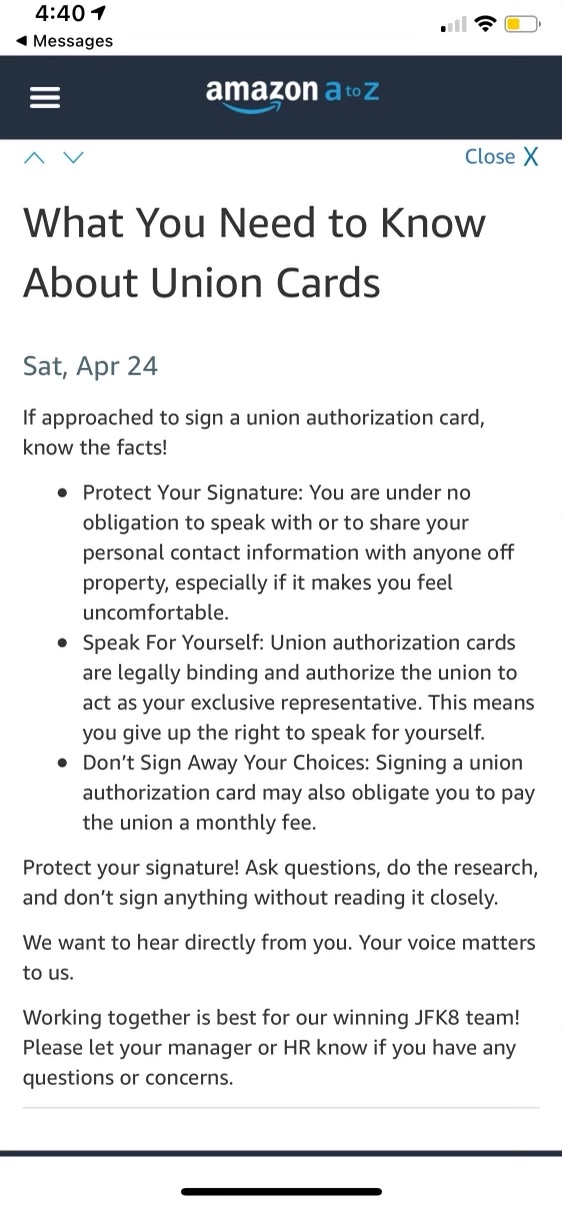
UPDATE: After this story was published, Staten Island warehouse workers forwarded Truthout a message from the facility’s human resources team sent warehouse-wide on April 24, warning employees against signing a union card.

In some ways, Amazon workers’ more than yearlong struggle for adequate COVID-19 protections and against corporate retaliation at the company’s Staten Island facility in New York City helped pave the way for this month’s unionization attempt at the Bessemer, Alabama, warehouse.

Now, as the Retail, Wholesale, and Department Store Union (RWDSU) seeks a second election through the National Labor Relations Board (NLRB), filing official objections Friday charging Amazon with engaging in illegal interference to defeat the union, Staten Island “JFK8” warehouse workers with The Congress of Essential Workers (TCOEW) tell Truthout they aren’t deterred by the outcome. Rather, their on-the-ground experiences in Alabama, where the unionization effort gained national attention but ultimately failed, have taught them hard lessons that will inform their own approach to unionizing JFK8.

“We all wanted the union push to be successful in Alabama, especially with the odds being totally against them, being that Alabama is a nonunion state. But the fact that they had the opportunity to vote as a facility was historic,” JFK8 warehouse worker Derrick Palmer told Truthout. “We have to take the bruises and pick it up where they left off. If anything it started a movement. It’s going to be like a domino effect.”

Palmer says the Bessemer push inspired JFK8 workers to take their labor organizing to the next level and start their own union drive. While Palmer says they’ve spoken with officials at a handful of allied unions, TCOEW organizers are pursuing an independent union that would be led directly by the facility’s workers. The outcome in Bessemer, they say, has solidified the choice as the best option for Staten Island’s more than 5,000 workers, especially since other unions have tried and failed to unionize facilities in New York.

In fact, TCOEW organizers say they’ve already called the NLRB to ensure they’re taking the proper legal steps in establishing their own local, the Amazon Labor Union (ALU). They hope ALU will eventually represent workers not just in Staten Island but at other Amazon facilities too.

“We figure, … go the independent route which is worker-led,” says Christian Smalls, who was fired from JFK8 last year after organizing a walkout to protest the company’s lack of physical-distancing and COVID-19 protections. “That will build more confidence for workers that want to join because they’ll be like, ‘Hey look, this is something that is employee-driven, this is not a third party coming in, this is you guys creating your own union with your own set of rules and negotiations.’ I think that’s more appealing to the worker.”

Smalls tells Truthout he isn’t surprised by the outcome in Bessemer, having witnessed Amazon’s union-busting tactics firsthand during TCOEW organizers’ visit to the Alabama facility in February. “I was disappointed like everyone else, but I wasn’t discouraged,” he says. “There were some missed opportunities that [RWDSU] didn’t do that we learned from going down there, so we’re going to try to learn from those mistakes.”

TCOEW organizers say one thing they’ve learned is to take a slower, more cautious approach in order to build enough internal support within the large warehouse for an independent union. “We’re just trying to get all the pieces in order so that we do it effectively rather than just rushing into it,” Palmer says.

JFK8 has several advantages over Bessemer, they say. For one thing, the warehouse has been around longer, and TCOEW organizers have more direct experience at the facility and a good reputation and influence among the workforce. Moreover, New York is a union-friendly state.

TCOEW organizers say they just starting to hand out union cards and pamphlets to workers at the facility. They’re not just trying to build informal support for a union, they say, but are trying to build a more robust workers’ committee fully committed to the project and ready to face the company’s union-busting efforts. Smalls says they hope that by emphasizing worker-to-worker relationships — instead of relying on outside union organizers — they will be able to build trust among those working at the plant.

After Smalls was fired for helping organize the March 30, 2020, walkout at JFK8, Palmer faced disciplinary action, ironically, for violating Amazon’s physical-distancing rules even though he was protesting to pressure the company to enforce those very rules. On April 10, 2020, Palmer says he was given a “final write-up,” typically given for repeated violations, without receiving any previous write-ups.

In November 2020, a federal judge dismissed Palmer and others’ lawsuit arguing the company failed to track and prevent the spread of the COVID-19 among workers or follow proper guidelines provided by public health agencies. But in February 2021, New York Attorney General Letitia James sued Amazon for failing to protect workers at warehouses in Staten Island and Queens and accused the company of illegally retaliating against workers, including Palmer and Smalls.

Amazon maintains that it has always followed public health guidance for COVID-19 and provided employees with adequate personal protective equipment. Moreover, the company describes the New York AG’s filing as failing to present an “accurate picture of Amazon’s industry-leading response to the pandemic.”

Amazon Spokesperson Maria Boschetti responded to the union push at JFK8, telling Truthout in a statement, “We respect our employees’ right to join, form or not to join a labor union or other lawful organization of their own selection, without fear of retaliation, intimidation or harassment. Across Amazon, including in our fulfillment centers, we place enormous value on having daily conversations with each employee and work to make sure direct engagement with our employees is a strong part of our work culture.”

Still, TCOEW organizers says management at the Staten Island warehouse has kept a watchful eye on their efforts. Palmer, for instance, tells Truthout that in February, he and small group of workers were told they had to attend a refresher hazmat training on potentially hazardous materials. But when the group got to an orientation room for the training, they were instead shown a video about “code of business conduct and ethics.” The video, he says, warned against employees’ discussing potential safety issues or other “sensitive” information on social media.

At this point, Palmer says, he’s not worried about further retaliation since he’s already in the public spotlight for speaking out against the company’s attempt to punish him for his organizing efforts. Smalls was already fired, and says he has nothing else to lose. “What’s the worst that can happen? We’ve already been through the fire,” he says.

The fight for COVID protections for Amazon workers has taken Smalls and other TCOEW organizers to Amazon headquarters as well as several of CEO Jeff Bezos’s mansions over the past year. The organization is still campaigning on behalf of families that lost loved ones due to the Amazon employees being exposed to COVID at its warehouses. The organization is demanding the company pay those families at least $200,000 each, saying Amazon’s offer of two months of free counseling isn’t nearly enough.

Jordan Flowers, another a JFK8 worker, tells Truthout he was fired in June because he couldn’t work amid the pandemic due to his lupus nephritis. The company rehired him the following week, Flowers says, but wasn’t paying him since he couldn’t come into work, so he had to file for unemployment for several months. The company is only just now beginning to make accommodations for him, he says, potentially placing him on paid leave. He now needs a kidney transplant and fears he could be fired again and lose his health insurance.

“I was kind of sad to talk about [my condition] at first, but that gave me the opportunity to tell the world what it is, so now it gives other people who are scared to talk about their medical issue, on the job or not, a chance to talk about it,” Flowers tells Truthout. “I’m giving the voice of employees with medical issues a chance to speak out, especially since Amazon’s not union, and they can do whatever they want.”

Flowers says he’s in talks with attorneys about the possibility of taking legal action against the company over what he calls a wrongful termination in the midst of the pandemic. “Amazon makes blood money. They would rather see their employees suffer but make the customers happy,” he says. Amazon Spokesperson Boschetti didn’t respond to specific questions about Flowers’s employment status.

Even if TCOEW is unable to build enough support for a union at JFK8, they’re still pursuing several legal challenges that have already forced changes at the facility. These kinds of indirect strategies are being increasingly eyed by labor and union organizers in the aftermath of the Bessemer election, with unions using protests and other forms of public pressure to get Amazon to make changes that workers want. An Amazon worker group called Amazonians United Chicagoland, for instance, has led protests and walkouts in the Chicago area throughout the pandemic.

Meanwhile, labor organizing at other Amazon facilities is also gaining steam. In Iowa, a local chapter of the Teamsters Union has been working on organizing Amazon warehouse workers and delivery drivers. Teamsters Local 238 Secretary-Treasurer Jesse Case told The New York Times the group is also trying to take a different route than RWDSU, saying they don’t want to rely on the union “election process to raise standards.”

Union organizers typically need to win an election at individual facilities for a large company like Amazon. Once organizers get 30 percent of workers to sign a card saying they’re interested in a union, the NLRB will hold an election. It takes a simple majority of votes to establish a union. If a majority of workers sign union cards, however, a company can voluntarily recognize the union. While it’s unlikely that Amazon would do so, a clear majority would increase public pressure and potentially force the tech giant’s hand.

RWDSU has said the organization has heard from more than 1,000 Amazon workers at other facilities who are interested in unionizing. But the union has yet to indicate whether or at which facilities they might push for an election.

Amazon’s victory in the David-versus-Goliath unionization effort in Bessemer has intensified pressure on Senate Democrats to eliminate the filibuster and pass the Protecting the Right to Organize Act, one of the most ambitious attempts to strengthen the rights of workers and unions in decades. That pressure appears to be working: Conservative Democrat Sen. Joe Manchin announced he would co-sponsor the bill Monday. If passed, the legislation would ban many of the union-busting tactics Amazon used to crush the organizing drive.

The legislation would be “a step toward the right direction,” Smalls says. “It won’t solve all the issues, but at least it allows us to organize without union-busting, and if there is union-busting … to hold the company or employees accountable. I think it’ll also help galvanize workers to begin these workplace committees and form their own unions. I think it’ll be a lot easier.”


COVID-19 deaths surge in Michigan


https://www.wsws.org/en/articles/2021/04/26/pers-a26.html


Bryan Dyne
a day ago


Michigan, the center of auto production in the United States, is facing the deadliest wave of COVID-19 anywhere in the country. Since the beginning of the month, more than 1,200 Michigan residents have died from COVID-19. The 7-day average of daily deaths has more than quadrupled from its low in mid-March, from 16 lives lost per day to 67.

Michigan hospitals are now admitting twice the number of those in their 30s and 40s compared to during the fall and winter peak, according to data aggregated by the Michigan Health & Hospital Association. Like last spring, hospitals are once again implementing “surge protocols” to handle the emergency.

Despite the disaster, however, Michigan Governor Gretchen Whitmer has rejected the necessary measures to contain the disease, including closing schools, limiting after-school activities or shutting bars. In an effort to blame the population for the outbreak, Whitmer has insisted that the state has a “compliance problem,” not a “policy problem.”

Dr. Rafik Abdou and respiratory therapist Babu Paramban check on a COVID-19 patient. [Credit: AP Photo/Jae C. Hong, File]


Whitmer’s inaction has led scientists and public health experts to demand emergency measures to contain the pandemic. “As a matter of disease mitigation, there’s no question” that closing schools and other restrictions would slow transmission and save lives, Dr. Joshua Sharfstein, associate dean for Public Health Practice and Training at the Johns Hopkins Bloomberg School of Public Health, told the Detroit Free Press. He urged that “stronger action” be “seriously considered.”

Children have also been increasingly hard hit, in Michigan and nationally. At least 70 were in intensive care last week in the state, double the number during the worst days of last November. The American Academy of Pediatrics reported that the 10–19 age group had the most new infections in the second week of April, averaging 1,150 new cases each day. Nationally, children now make up about 1 in 5 new cases, and at least 582 deaths have been caused by the deadly contagion.

These figures give the lie to the claims of US President Joe Biden, who told a second-grader in February, “Kids don’t get … COVID very often. It’s unusual for that to happen.” He added, “You’re in the safest group of people in the whole world.”

In fact, a recent study done in Nebraska shows shows that children are extremely vulnerable to COVID-19. By regularly testing both staff and students, infection rates were found to be two-and-a-half times higher for staff and nearly six times higher among students than what had been revealed by self-initiated tests. This and numerous other accounts make clear that children are more likely to be asymptomatic while functioning as carriers and spreaders of the virus.

Michigan’s latest surge of new cases is predominantly driven by the B.1.1.7 variant of the coronavirus, first identified in the United Kingdom. It is estimated to be 60 percent more contagious and 67 percent more deadly. It has emerged as the dominant mutation of the coronavirus in the United States and now causes an estimated 70 percent of cases in Michigan.

Before the new variant took hold this past winter, twice as many of those 65 and older who contracted the virus were hospitalized as compared to those younger. Now, the reverse is true, with data from the US Centers for Disease Control and Prevention showing that adults in their 20s to 50s are the most hospitalized in Michigan, as well as Minnesota, New Jersey and North Carolina.

According to data from the state of Michigan, the greatest driver of new outbreaks are schools and universities, followed by workplaces such as factories and warehouses.

The disaster has only been exacerbated by the big three automakers, who have done everything possible to conceal outbreaks at their plants. Auto workers at multiple plants have told the WSWS that management refuses to tell workers when their coworkers have tested positive for COVID-19, making it impossible for workers to quarantine.

In rejecting any measures to contain the disease, Whitmer has capitulated to the demands of Trump and his fascistic supporters. In October 2020, the FBI revealed the existence of a far-reaching fascist plot to kidnap Whitmer and overthrow the state government, centered on the demand that she reopen schools and workplaces.

Now, nearly six months later, Whitmer has effectively embraced the policies of the coup plotters, refusing to take any measures to contain the pandemic that would impinge on the profits of the auto bosses that run the state.

The past year has made clear that if things are left to the capitalists and their subservient politicians, the disease will never be stopped, and workers will continue to die by the thousands. It is urgently necessary to close all non-essential production, with full compensation for all lost income for workers, contractors and small business people.

Already, workers in key sections of the US auto industry are beginning to take action, forming rank-and-file committees throughout the state to defend workers’ lives and livelihoods. On May Day 2021, the International Committee of the Fourth International is issuing the call for the formation of the International Workers Alliance of Rank-and-File Committees, aiming to enforce the measures necessary to contain the pandemic and save human lives.

The International Committee of the Fourth International is advancing this initiative to provide a political program for workers, both to fight the pandemic and to end the social system, capitalism, which is responsible for the worldwide catastrophe. We urge workers throughout Michigan, the United States and the world to attend.



Tuesday, April 27, 2021

Prof. Richard Wolff: To See Real Recovery We Need New Eyes


https://www.youtube.com/watch?v=r60ZfrIih3U


Economic Update: A Green 3rd Party for the U.S.


https://www.youtube.com/watch?v=zWNf2v1QwQw