Saturday, April 10, 2021

Nils Frahm - Haldern Pop Festival 2015 - WDR Rockpalast


https://www.youtube.com/watch?v=7sfe3AubDVg


Bezos Claims Bessemer VICTORY in Amazon Union-Busting Blowout


https://www.youtube.com/watch?v=BxA2ybtF2Do


Friday, April 9, 2021

Nils Frahm . Spaces (2013)


https://www.youtube.com/watch?v=bHm6XeB4Dw4


Nils Frahm ‎– Electric Piano (2008)


https://www.youtube.com/watch?v=dqUq32Ly0lY


Tension and Mendacity Surround the Colombia-Venezuela Border Conflict


https://www.resumen-english.org/2021/04/tension-and-mendacity-surround-the-colombia-venezuela-border-conflict/


By Alejandra Garcia on April 8, 2021


Bolivarian militia, photo: Bill Hackwell

For the last two weeks, Colombia’s drug trafficking and paramilitary groups have been engaging in border incursions into Venezuela. The rising tensions in the state of Apure, which borders Colombia´s Arauca department, are making headlines in local and international media. A group of armed Colombians have set up clandestine camps with the intent to further penetrate Venezuela in the hopes of generating chaos and violence.

Venezuela has declared a state of alarm, and it has reinforced its military presence in over 700 of the 2,200-kilometers-long border with Colombia. Members of the National Armed Forces (FANB) and the Navy have joined efforts to put an end to the conflict that has caused the death of at least eight Venezuelan soldiers.

“We will not rest until we bring peace and guarantee the protection of the Venezuelan people, even if that means risking our lives on the battlefield,” the head of the FANB’s Strategic Operational Command Remigio Ceballos assured on Tuesday.

The clashes are having dire consequences for the country, which is experiencing an unprecedented economic crisis triggered by U.S. unilateral sanctions and the pandemic. President Nicolas Maduro’s government has been forced to allocate resources to thwart the conflict that originated from Colombia.

Violence in Colombia is endemic. Drug trafficking is a business that has permeated that society and state institutions with the full complicity of successive Colombian governments.

“This is an irrefutable truth. However, the administration of Ivan Duque and the right-wing media at the service of Washington insist on blaming Venezuela for the armed conflicts that have shaken that country for 70 years and the recent border crisis,” Foreign Affairs Minister Jorge Arreaza explained.

Duque has purposely abandoned the Colombian border. No one knows who controls it, whether paramilitaries, guerrillas, drug traffickers, or other irregular groups that may appear. “On the other side of the frontier there is chaos,” Arreaza pointed out.

The Colombian president’s cynicism reached its limit when he accused Venezuela of being a narco-state. “It seems to be a tactic out of the pages of Nazi military strategist Joseph Goebbels. Colombia is attacking our country to divert attention from its own reality,” Arreaza condemned.

In an article published in Mision Verdad, journalist Carola Chavez explained the phenomenon in these terms, “There is no better context for lies to spread than a war scenario, especially in these times, when the truth has to be carefully excavated from among million of lies and half-truths,” she wrote.

The new media campaign against Venezuela has grown along with the tensions in Apure. For Duque’s oligarchic media, terrorists who threaten the country’s tranquility are not criminals, but some “hard-working and peaceful farmers.” However, the land they cultivate is somehow sprouting anti-personnel mines.

Lies are raining down from all fronts of the oligarchic media. Headlines such as these are common: “Maduro’s complicity with the Colombian guerrillas is taking its toll,” or “Extrajudicial executions are being carried out by FANB Soldiers.”

“Venezuelans are fleeing the violence of Maduro’s government,” Duque said without mentioning that no official from his administration has visited the refugee camps that give shelter to nearly 8 million people displaced due to the internal war Colombia wants to bring to Venezuela.

“Duque has taken the stage to project onto Venezuela his own country´s miseries. Meanwhile, the armed groups are trying to implant in Venezuela the germ of the war that Colombia and Washington want to impose. But of course, it doesn’t matter because the liars at Washington’s service are there to whitewash everything,” Carola Chavez said.


Bitcoin: Revolutionary Money in a Time of Universal Deceit


By Nozomi Hayase
April 9, 2021

Save

In the cryptocurrency’s decentralized network, Nozomi Hayase says those who seek to conspire in secret have no place to hide, as Bitcoin aids WikiLeaks’ mission to keep governments transparent and honest.

https://consortiumnews.com/2021/04/09/bitcoin-revolutionary-money-in-a-time-of-universal-deceit/


George Orwell is reputed to have said, “In a time of universal deceit, speaking truth to power is a revolutionary act.” Over a decade ago in the spring of 2010, WikiLeaks burst onto the global stage with the publication of the “Collateral Murder” video that depicted the U.S. military gunning down Iraqi civilians and Reuters journalists on a street in New Baghdad.

WikiLeaks, through the method of transparency, exposed war crimes of the U.S. empire including spying, torture and human rights abuses the world over. Their publications triggered a global crisis of legitimacy, showing how democracy in the West has become an empty shell filled with lies and corruption.

In reaction to WikiLeaks’ disclosures, the U.S. government has waged an unprecedented war on whistleblowers. With the DOJ’s efforts to extradite WikiLeaks founder Julian Assange to the U.S., this has now escalated into an attempted criminalization of journalism. For more than two years, Assange has been locked up in inhumane conditions inside London’s maximum-security prison, facing several effective death sentences if found guilty of these politically driven charges.

Now in the Covid-19 pandemic, as the economic and political system further disintegrates, elites increase their control of public perception with the censorship imposed by Silicon Valley giant tech companies and their manipulation of algorithms. As the veil of deception thickens, a new force for truth has emerged on the internet. Bitcoin — revolutionary money — has arrived.

Conspiracy as Governance

Bitcoin, an uncensorable peer-to-peer digital cash, was invented during the 2008 finan­cial crisis. In its 12 years of existence, it has attained the status of the world’s first stateless currency. In its infancy, Bitcoin formed an alliance with WikiLeaks when the organization faced the banking blockade imposed by Bank of America, Visa, Mastercard, PayPal and Western Union at the end of 2010 as a direct result of their publications. Now, the cryptocurrency that helped WikiLeaks bypass that economic censorship carries on WikiLeaks’ mission to keep the government transparent and honest.

Inspired by the vision of Cypherpunks, a loosely tied group that advocates social change by the use of strong cryptography, WikiLeaks created a platform through which ordinary people around the world work together to hold power to account.


(defendwikileaks.org)

WikiLeaks’ revolutionary journalism was built on Julian Assange’s understanding of the structure of power. Assange, in his 2006 essay “Conspiracy as Governance,” analyzed ways that authoritarian power is maintained through conspiracy, concluding that its primary planning methodology is secrecy. He described conspiracies as “cognitive devices” that give the members of a conspiracy special advantages over those acting alone:

“Conspiracies take information about the world in which they operate (the conspiratorial environment), pass it around the conspirators and then act on the result. We can see conspiracies as a type of device that has inputs (information about the environment) and outputs (actions intending to change or maintain the environment).”

Assange dissected conspiracy as “the agent of deception and information restriction.” He assessed that the key to dismantling such an unjust system of governance is cutting off the links between conspirators, thereby stopping the information flows that are required for them to maintain their collaborative secrecy. He envisaged that leaks (releasing concealed information) would induce fear and distrust among conspirators and, therefore, weaken their power.

WikiLeaks’ groundbreaking publications, with its pristine record of accuracy of documents, appeared to have been able to at least wound conspiratorial networks. Yet, as was shown with the government’s aggressive prosecution of truthtellers, the movement toward transparency has faced serious pushback.

Money Based on Trust

Now, Bitcoin, as a holy grail of Cypherpunks, may hold the solution to the problem of government secrecy and unaccounted power. The rise of Bitcoin has revealed a root cause of conspiratorial governance that has been kept hidden until now. Money supply has been the single greatest source of power that generates the patronage network of “In Each Other We Trust.”

In her book Web of Debt, attorney Ellen Brown explains how most people think money is issued by elected officials, declared to be legal tender by the government, but the creation of money has been taken over by private corporations like the Federal Reserve. Money managed by central banks functions as an agent of deception, giving power to “invisible hands” to change and manipulate the environment.
This centralized money relies on financial institutions serving as trusted third parties to process transactions. There is inherent weakness in this trust-based money. Human trust is easily exploitable by those who can act selfishly without concern for others —as demonstrated by the bailouts of Wall Street banks in the panic of 2008, along with the fraud and depravity exemplified in the top banks’ currency rigging. The underlying trust in this monetary system was completely broken.

Bitcoin now provides an alternative to this “trusted third-party” model of money that is prone to manipulation. The core invention of Bitcoin is a proof-of-work consensus algorithm — a decentralized trust that allows strangers to achieve consensus without intermediaries. This system, built by cryptographic proof instead of trust, effectively eliminates counterparty risk in a transaction, allowing individuals to exchange value directly with one another without a need for a central authority.

Money with Integrity


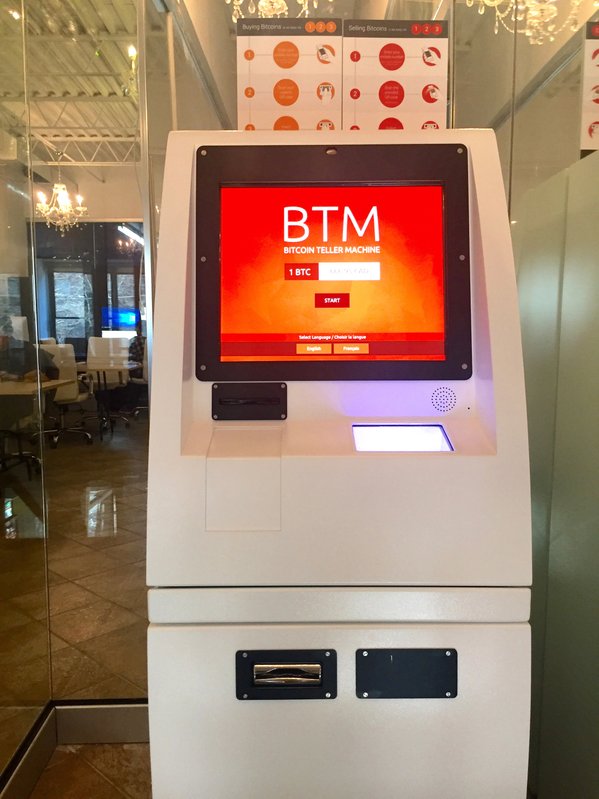
Bitcoin ATM in Toronto that allows users to buy or sell bitcoins with cash. (KryptoNatasha, CC BY-SA 4.0, Wikimedia Commons)

Bitcoin regulates itself through algorithms. Unlike central banks whose monetary policy is subject to printing at will, the open-source protocol of Bitcoin uses rules that are fixed and made clear at the outset. They include the total quantity of bitcoin that can ever be created (math caps the monetary base at 21 million BTC), a predictable issuance rate and automatic adjustment of mining difficulty.

In an open network where rules are applied to everyone equally, computers around the world (called miners) engage in a broadcast math competition. By using precious resources, miners work to solve difficult mathematics problems. Every 10 minutes, problems are solved and whoever solves the problem first wins a fixed number of bitcoins. This process leads to both creation of money and clearing of transactions.

Bitcoin brings transparency to the process of money creation. The option to trust math rather than politicians and bankers enables better security of the system. In Bitcoin’s decentralized network where there is no central vector, attackers cannot fake trust. In order to gain control over the network, they would have to compromise the mathematics on which the system is based.

Power corrupts, and the best way to check and balance power is to not have these points of control in the first place. Through distributing trust across a network and minimizing the necessity to trust a third party, the system removes the vulnerability that often leads to concentration of power. With careful balancing of risk and reward a network of “rules without leaders” incentivizes honesty and truth, maintaining its own integrity.

Peaceful Revolution


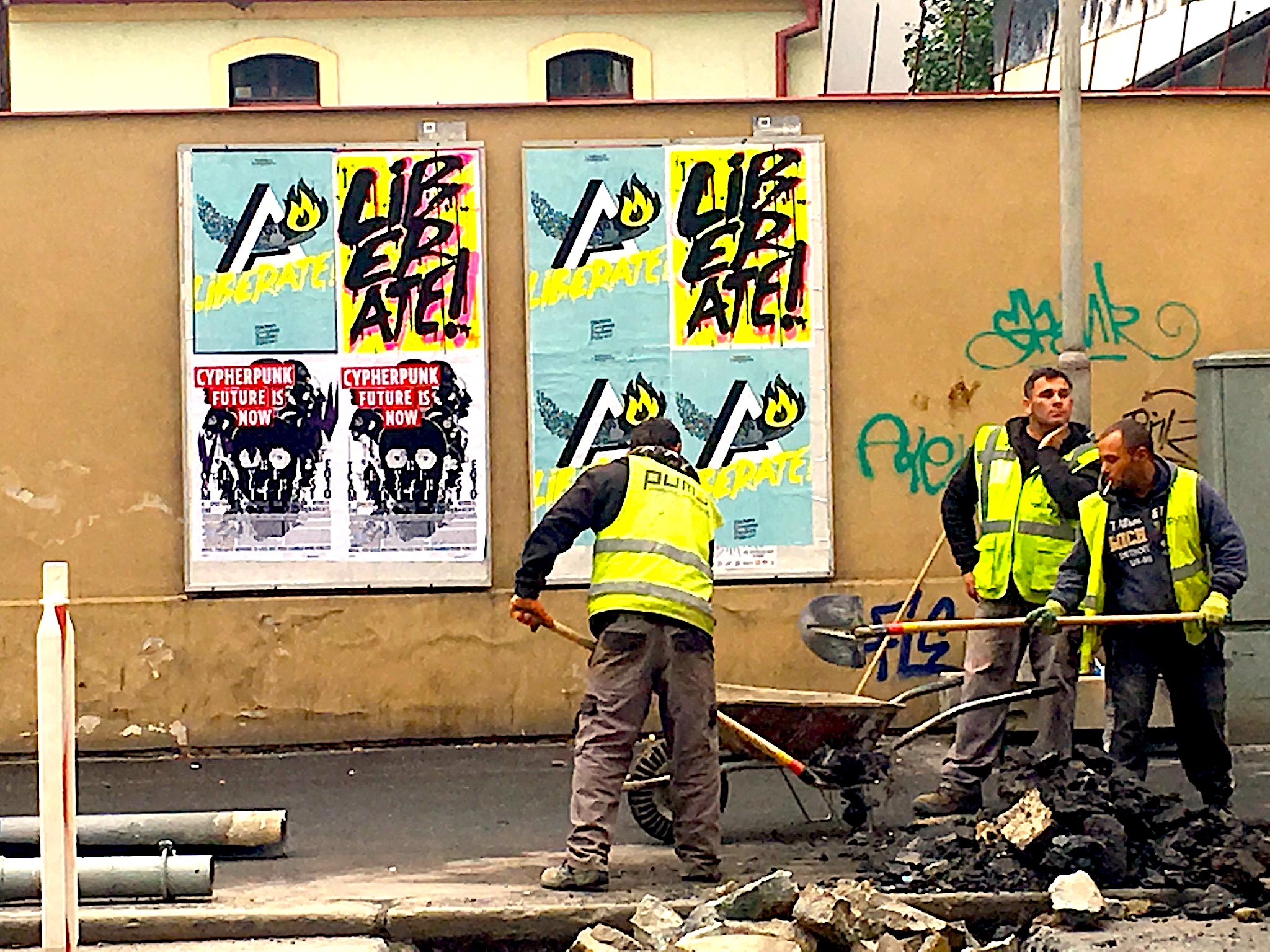
Cypherpunk posters, Prague, October 2017. (Michael Bumann, Flickr, (CC BY-NC-SA 2.0)

In combating the crisis of pandemic, the federal government has spent more than $6 trillion to fund the government rescue program, according to The Washington Post. While their money printing temporarily keeps the dead economy afloat, world leaders are trying to lock down the population as a new digital empire arises — one foreshadowed by the initiatives of “The Great Reset.”

As pretense of legitimate governance continues, with fake money propping up propaganda, Bitcoin’s new network of transparency has begun to break down this web of deception.

Authoritarian regimes derive their power from people’s compliance. Their game of monopoly, perpetuating slavery and oppression, can only prevail as long as we continue to play by their rules. Efforts to hold leaders accountable suck us further into the struggle of power. They amplify darkness, strengthening a system that has no legitimacy by allowing it to feed off our energies.

Bitcoin, an open-source technology of cooperation, can now be used as a tool for ordinary people around the world to create their own network of trust that is uncensorable, living under their own rules.

Through each of us simply exiting from the nation-state’s rigged system of “democracy” we can boycott “the system,” cutting off their chain of money supply and distributions. We can throttle conspiratorial connections of political elites, thereby defunding their resource wars, surveillance and extractive capitalism, and making their system of control obsolete.

In Bitcoin’s decentralized network that dissolves levers of control, those who seek to conspire in secret have no place to hide. We can now create a just and humane world where whistleblowers and publishers no longer need to sacrifice their lives — a future in which there are no political prisoners.

Bitcoin may be the most honest money ever invented. This money based on truth now calls all of us to take action inspired by love.

In a time of universal deceit, HODLing bitcoin is a revolutionary act.

Join Bitcoin’s peaceful revolution and become a part of creative destruction of conspiracy of governance!

To get a better understanding of how Bitcoin works and its real impact on the economy, watch Max Keiser’s interviews with Jimmy Dore on The Jimmy Dore Show and Lee Camp on Redacted Tonight.


Author’s note: WikiLeaks founder Julian Assange is facing up to 175 years in prison for publishing truthful information in the public interest. Check out the official campaign page, “Don’t Extradite Assange,” and “The Assange Defense Committee,” a U.S. coalition fighting to free Assange, to get information on how you can help stop the extradition. Also, please consider donating to the WikiLeaks Official Defence Fund.


Financial fiction part two: the new ones (SPACs, NFTs, cryptocurrencies)


by michael roberts


In my last post I discussed recent financial engineering and swindles that are traditional to the accumulation of and speculation in what Marx called fictitious capital, ie financial assets like bonds, stocks, property, credit and so-called derivatives of these.


Financial fictions: the old ones

Finance capital is ever-ingenious in inventing new ways of speculation and swindles. In the past we have had the dot.com boom when the stock prices of many internet start-ups exploded upwards, only to crash when the profits of these companies did not materialise and the cost of borrowing to speculate rose. That was in 2000 and followed by a mild recession in 2001.

Then we had the huge credit boom in house prices, mortgages and the securitised mortgage packages and their derivatives that fuelled a huge property and stock market boom that collapsed into the Global Financial Crash of 2008 and the subsequent Great Recession. That was followed by a massive injection of central bank money with low to zero interest rates and ‘quantitative easing’ leading to a further rise in stock and bond markets up to record highs. The COVID slump only led central banks to doubling-down on ‘quantitative easing’ to keep the prices of financial assets rising, while the ‘real economy’ based on the profitability and investment in productive assets stagnated.

In this 21st century world of easy money borrowing, there have been a spate of new fictions in the casino world of financial speculation.

First, there are SPACS, Special Purpose Acquisition Vehicles. These are so-called “blank cheque” companies e. banks and other hedge funds invest in a SPAC, which owns nothing, but promises investors that the SPAC will buy a privately-owned company, then take it to the stock market in what is called an Initial Public Offering (selling shares to the public). If the IPO leads to higher price than the investment in the SPAC, everybody makes a profit.

SPACs have taken Wall Street by storm and become a favourite investment among hedge fund managers. As one SPAC explained, we have an “inherently investor-friendly structure” with little downside. In the US, which accounts for the bulk of SPAC activity, 235 vehicles have raised $72bn so far this year, according to Refinitiv. But is there ‘little downside’? Supposedly there is little risk of losing the original investment because cash is put into a trust that invests in US treasuries and shareholders can ask for their money back at any point. But there is a potential to make lofty returns come from a unique quirk in the SPAC, which splits into shares and ‘warrants’ (options to buy shares) shortly after the structure starts trading. And here there is substantial risk that things will go wrong.

A warrant, typically worth only a fraction of a share, acts as a sweetener for early backers, who can redeem their investment while keeping hold of the warrant. When the SPAC finds a company to acquire, the warrants convert to relatively inexpensive stakes in the new company. But those who who did not take warrants but opted for a stake in the merged company (mainly small investors), bear the risk of both a potentially bad deal and significant dilution compared to the free warrants handed out to early backers.

And quite often it is a bad deal. While the hedge funds buy the ‘warrants’ at a fraction of the SPAC share price and get out before the SPAC acquisition is completed, small ‘retail’ investors stay on the for the full deal and find that the acquisition IPO price drops very quickly, leaving them with significant losses. The result is that small investors provide the money for the rich wide boys to take. Nevertheless, while money is cheap and the stock market booms, the small-time better will go on hoping to make a killing.

Then there are NFTs, or ‘non-fungible tokens’. What the hell as these, you might say? NFTs are digital financial assets stored on blockchains (digital codes). You can convert anything into an NFT to try and sell it. Christies has already auctioned an NFT (digitally coded) artwork for $70m. An Oscar nominated movie has been released as an NFT (digital code) and so on. But what is being sold is just one unique, blockchained (digital coded) representation of the artwork, not the actual thing itself. It’s the ultimate derivative: a digital code derived from an object or even a person, but with no rights of ownership. So what’s the point? None really – it’s just a fad and the buyer of the NFT hopes that it can be sold on to another idiot for a profit.

A particular negative of the NFT craze is that encoding artwork or an idea onto a blockchain involves complex computations that are highly energy intensive. In six months, a single NFT by one crypto artist consumed electricity equivalent to an EU citizen’s average energy consumption over 77 years. This naturally results in a significant carbon footprint.

And this is an issue that applies to blockchain technology more generally. For example, the original cryptocurrency Bitcoin (BTC) has an estimated annual energy consumption in the range equivalent to about 0.45 percent of the world’s entire electricity production.

And that brings me to the saga of cryptocurrencies like bitcoin. I wrote on blockchains and crypto craze over three years ago. I argued then that Bitcoin aims at reducing transaction costs in internet payments and completely eliminating the need for financial intermediaries ie banks. But I doubted that such digital currencies could replace existing fiat currencies and become widely used in daily transactions.

Since then, the price of bitcoin in fiat currencies like the dollar has violently fluctuated but more recently has rocketed to stratospheric heights as cheap money and low inflation have pushed down the value of the main reserve and store of currency, the US dollar. Whereas gold used to be the alternative store of value to the dollar, now it seems that cryptocurrencies like Bitcoin are taking over as the speculative money asset. Why? Well, most gold is the vaults of central banks and so the price is subject not only to the supply from gold mines but also the policy decisions of government-controlled banks. Instead, Bitcoin has a clearly defined amount to digital supply and through blockchains, it can be mined and transacted without government controls.

In the current fantasy world of casino financial investment, Bitcoin and other cryptocurrencies seem more attractive to currency speculators than even gold. And so the crypto boom continues. For example, Coinbase Global Inc, the largest US cryptocurrency exchange, is now valued at around $68 billion, compared to just $8 billion in October 2018. The company now has more than 43 million users in more than 100 countries.

But cryptocurrencies are no closer to achieving acceptance as a means of exchange. Bitcoin’s value is not backed by any government guarantees, by definition. It is backed just by ‘code’ and the consensus that exists among its key ‘miners’ and holders. As with fiat currencies, where there is no physical commodity that has intrinsic value in the labour time to produce it, the crypto currency depends on trust of the users. And actually that trust for cryptocurrencies varies with its price relative to the fiat currency, the dollar. Its price is measured in dollars or in what is called a ‘stable coin’ tied to the dollar.

Indeed, while the cryptocraze has exploded, the US dollar has entrenched itself ever more firmly as the world’s premier settlement currency (67% of all settlements, followed by the euro, the yen and yuan).

Bitcoin is no nearer universal acceptance than it was when it started. So while cryptocurrencies have increasingly become part of speculative digital finance, I still don’t think they will replace fiat currencies, where the supply is controlled by central banks and governments as the main means of exchange. They will remain on the micro-periphery of the spectrum of digital moneys, just as Esperanto has done as a universal global language against the might of imperialist English, Spanish and Chinese.

Moreover, there are already rivals to cryptocurrencies that carry the backing of governments: central bank digital currencies (CBDCs). CBDCs have been discussed for years as an alternative to cash as many economies have witnessed a slump in physical money being used in transactions. Cash accounted for only 20% of payments in China – the world’s second largest economy in 2018, according to research published by the Bundesbank in 2019. This week, China became the first major economy to create a blockchain-based digital version of its currency, the cyber yuan, to be used in transactions. Sweden’s central bank, the Riksbank revealed this week that its current pilot project will take at least one more year to be ready for the e-krona.

The US is more reluctant because American finance has the dollar as the world’s top currency. This week, Federal Reserve Chairman Jerome Powell said “that there’s no hurry to develop a central bank digital currency.” Having trashed cryptocurrencies as “highly volatile and therefore not really useful stores of value and not backed by anything,” Powell went on “It’s more a speculative asset that’s essentially a substitute for gold rather than for the dollar.” Even so, the Boston Fed last year entered into a partnership with the Massachusetts Institute of Technology on a multiyear study into developing a central bank digital currency. But the work is expected to take two to three years.

These CBDCs in theory provide a seamless and trustworthy way of doing digital transactions more or less instantaneously and as they ar backed by government, they make them attractive compared to gold, fiat currencies and crypto coinage. But they also reduce the freedom of individuals to control their own ‘cash’ and they open the doors of personal financial activities to governments, supposedly reducing corruption, but also putting people’s livelihoods even more in the grip of governments.

In the last 20 years, financial fictions have been increasingly digitalised. High frequency financial transactions have been superseded by digital coding. But these technological developments have mainly been used to increase speculation in the financial casino, leaving regulators behind in the wash. When the financial markets go belly up, which they eventually will, the digital damage will be exposed.